Final Exam Recitation - Answers & Guidelines | Microeconomics | Trường Đại học Quốc tế, Đại học Quốc gia Thành phố Hồ Chí Minh
This exam contains 13 pages (including this cover page) and 17 questions. Check to see if any pages are missing. • The exam is scheduled for 2 hours. • This is a closed-book, closed-note exam, no calculator exam. • Answer each multiple choice question by writing the correct answer on the line at the right margin of the corresponding question. Make sure that your answer is clearly written or it will be marked incorrect. Tài liệu được sưu tầm và soạn thảo dưới dạng file PDF để gửi tới các bạn cùng tham khảo, ôn tập đầy đủ kiến thức, chuẩn bị cho các buổi học thật tốt. Mời bạn đọc đón xem!
Môn: Microeconomics 635 tài liệu
Trường: Trường Đại học Quốc tế, Đại học Quốc gia Thành phố Hồ Chí Minh 1.9 K tài liệu
Tác giả:



Preview text:
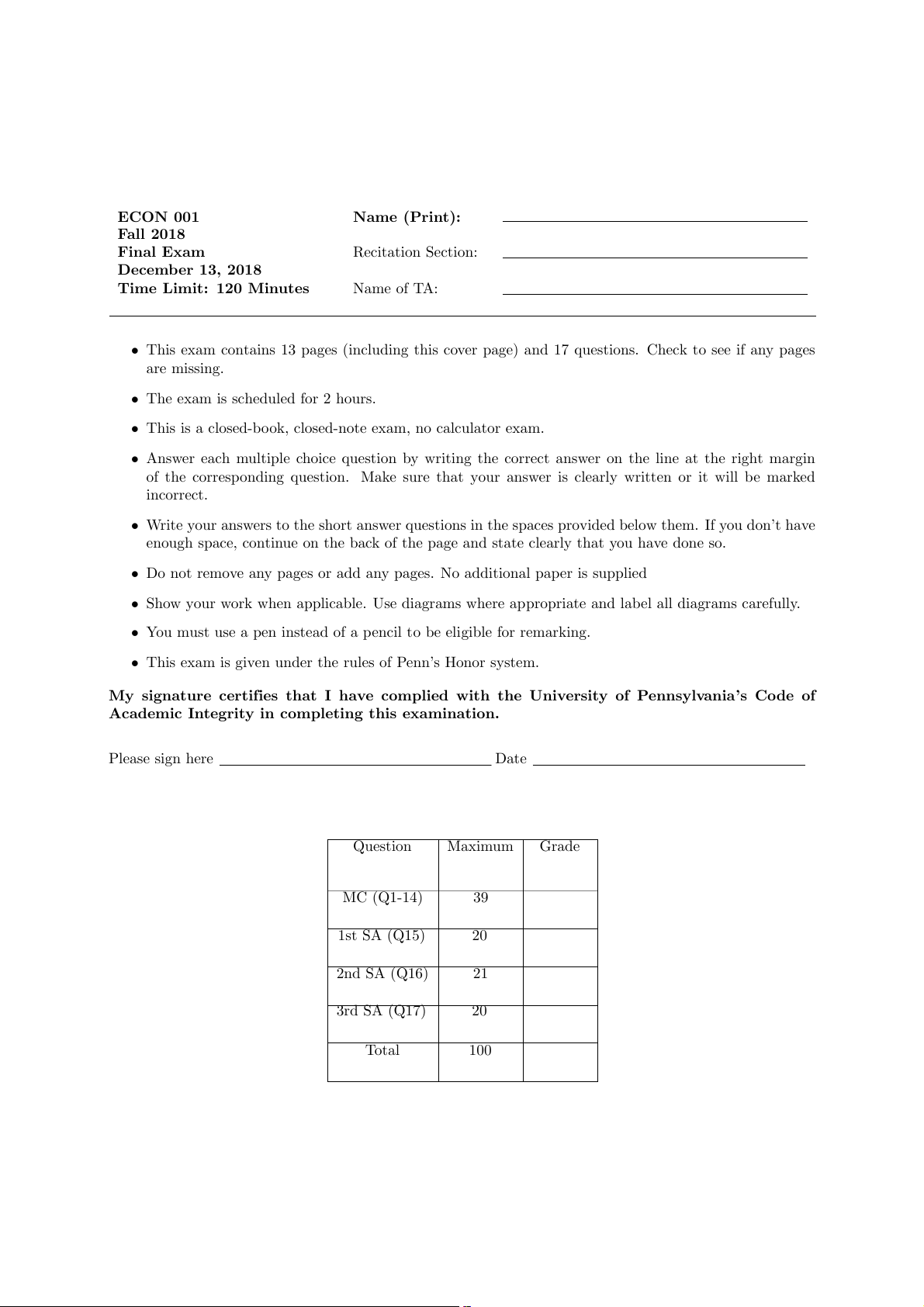
ECON 001 Name (Print): Fall 2018 Final Exam Recitation Section: December 13, 2018 Time Limit: 120 Minutes Name of TA:
• This exam contains 13 pages (including this cover page) and 17 questions. Check to see if any pages are missing.
• The exam is scheduled for 2 hours.
• This is a closed-book, closed-note exam, no calculator exam.
• Answer each multiple choice question by writing the correct answer on the line at the right margin
of the corresponding question. Make sure that your answer is clearly written or it will be marked incorrect.
• Write your answers to the short answer questions in the spaces provided below them. If you don’t have
enough space, continue on the back of the page and state clearly that you have done so.
• Do not remove any pages or add any pages. No additional paper is supplied
• Show your work when applicable. Use diagrams where appropriate and label all diagrams carefully.
• You must use a pen instead of a pencil to be eligible for remarking.
• This exam is given under the rules of Penn’s Honor system.
My signature certifies that I have complied with the University of Pennsylvania’s Code of
Academic Integrity in completing this examination. Please sign here Date Question Maximum Grade MC (Q1-14) 39 1st SA (Q15) 20 2nd SA (Q16) 21 3rd SA (Q17) 20 Total 100 Name: Section: TA: Page 2 of 13
Multiple Choice Questions (best 13 out of 14: 39 points)
1. (3 points) Doug spends all his money on books and beer. When Doug quit his job and moved to the
United States to attend graduate school, his income fell by 50%. Fortunately, beer (an inferior good) is
50% cheaper in the USA. The price of books (a normal good) is the same as in his home country. Which of the following is true?
A. Doug consumes less of both goods.
B. Doug consumes more of both goods.
C. Doug consumes less beer and more books.
D. Doug consumes fewer books but more beer. 1. D
2. (3 points) Suppose that milk and cookies are complements. A technological innovation in the cookie
industry has affected the equilibrium price of cookies. Which of the following can be said about the new
equilibrium in the milk market?
A. Equilibrium price will increase.
B. Equilibrium price will decrease.
C. Equilibrium quantity supplied will decrease.
D. Both equilibrium price and equilibrium quantity will decrease. 2. A
3. (3 points) The market for pumpkins is perfectly competitive. The price is equal to P= 5$. In the short
run, Jack is growing 100 pumpkins and his Fixed Cost amounts to 300$. How much is his Variable Cost? A. At least 500$ B. Exactly 500$ C. At most 500$ D. Zero 3. C
4. (3 points) The market for sugar is initially in equilibrium with a perfectly inelastic demand line (QD =
10) and an upward-sloping supply line (QS = P ). Suppose that the government sets a price floor at $12.
Compute the change in Producer Surplus (PS) and the size of Deadweight Loss (DWL).
A. PS increases by 20, DWL is 0.
B. PS increases by 22, DWL is 0.
C. PS increases by 20, DWL is 2.
D. PS increases by 22, DWL is 2.
E. PS remains the same, DWL is 0. 4. A Name: Section: TA: Page 3 of 13
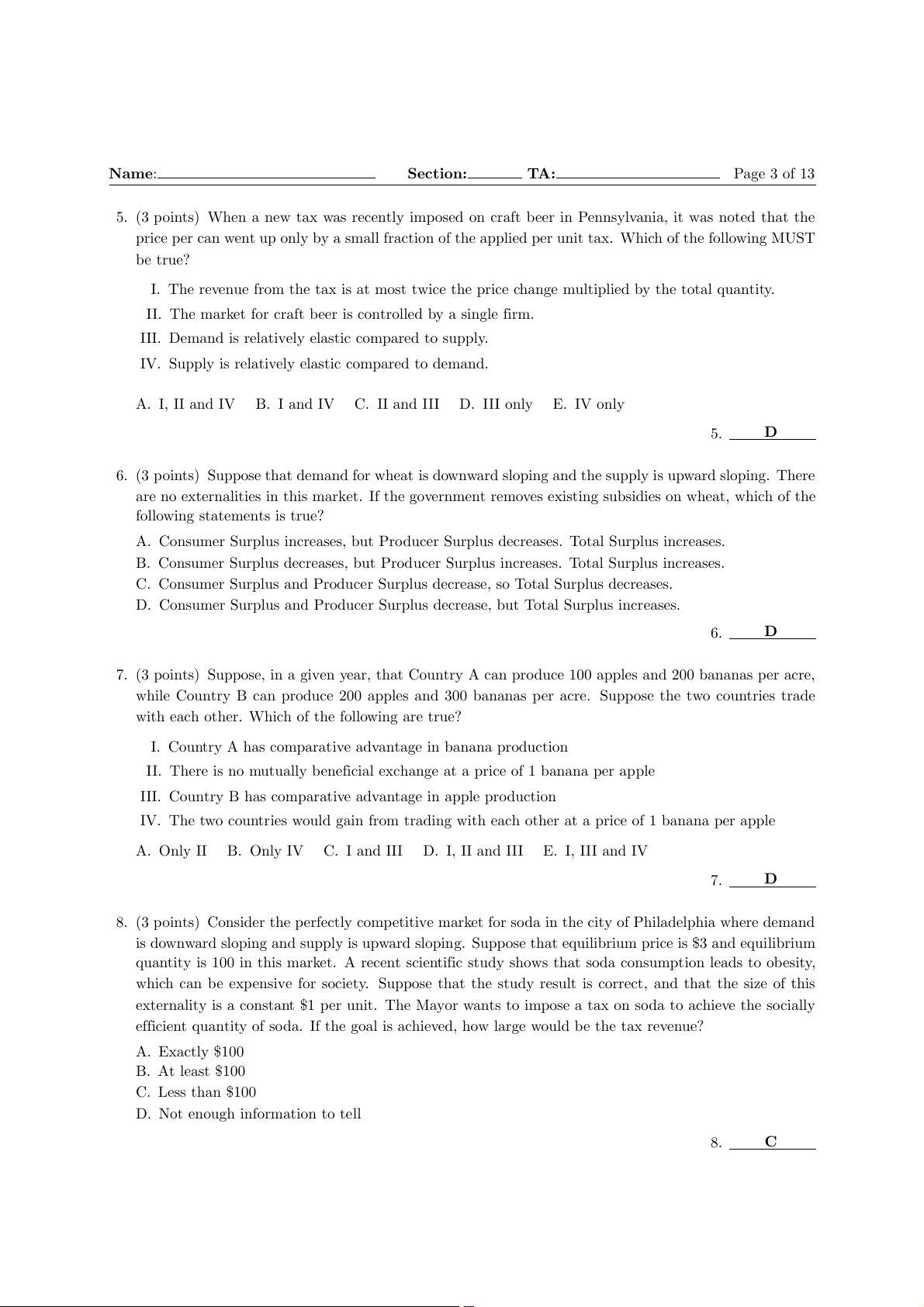
5. (3 points) When a new tax was recently imposed on craft beer in Pennsylvania, it was noted that the
price per can went up only by a small fraction of the applied per unit tax. Which of the following MUST be true?
I. The revenue from the tax is at most twice the price change multiplied by the total quantity.
II. The market for craft beer is controlled by a single firm.
III. Demand is relatively elastic compared to supply.
IV. Supply is relatively elastic compared to demand. A. I, II and IV B. I and IV C. II and III D. III only E. IV only 5. D
6. (3 points) Suppose that demand for wheat is downward sloping and the supply is upward sloping. There
are no externalities in this market. If the government removes existing subsidies on wheat, which of the following statements is true?
A. Consumer Surplus increases, but Producer Surplus decreases. Total Surplus increases.
B. Consumer Surplus decreases, but Producer Surplus increases. Total Surplus increases.
C. Consumer Surplus and Producer Surplus decrease, so Total Surplus decreases.
D. Consumer Surplus and Producer Surplus decrease, but Total Surplus increases. 6. D
7. (3 points) Suppose, in a given year, that Country A can produce 100 apples and 200 bananas per acre,
while Country B can produce 200 apples and 300 bananas per acre. Suppose the two countries trade
with each other. Which of the following are true?
I. Country A has comparative advantage in banana production
II. There is no mutually beneficial exchange at a price of 1 banana per apple
III. Country B has comparative advantage in apple production
IV. The two countries would gain from trading with each other at a price of 1 banana per apple A. Only II B. Only IV C. I and III D. I, II and III E. I, III and IV 7. D
8. (3 points) Consider the perfectly competitive market for soda in the city of Philadelphia where demand
is downward sloping and supply is upward sloping. Suppose that equilibrium price is $3 and equilibrium
quantity is 100 in this market. A recent scientific study shows that soda consumption leads to obesity,
which can be expensive for society. Suppose that the study result is correct, and that the size of this
externality is a constant $1 per unit. The Mayor wants to impose a tax on soda to achieve the socially
efficient quantity of soda. If the goal is achieved, how large would be the tax revenue? A. Exactly $100 B. At least $100 C. Less than $100
D. Not enough information to tell 8. C Name: Section: TA: Page 4 of 13
9. (3 points) ABC Inc is the only seller on the local flower market. It faces a downward sloping demand
curve. Consumption of flowers will create positive externality: the flower in your yard will make the
whole neighborhood happier. ABC Inc has a upward sloping marginal cost curve and sets a single price
that maximizes the firm’s profit. Consider comments below:
I. The quantity such that market demand intersects the firm’s marginal cost curve is socially efficient.
II. ABC Inc produces less than the socially efficient quantity.
III. ABC Inc generates a deadweight loss
Which of the above is (are) unambiguously correct? A. Only I B. I and II C. II and III D. I and III E. I, II and III 9. C
10. (3 points) ABC Inc is the only seller on the local flower market. It faces a downward sloping demand
curve P = 10 − Q, where P is the market price. ABC Inc has a constant marginal cost MC = 2. If the
firm is able to perfectly price discriminate instead of charging a single price: A. Profit increases by 4 B. Profit increases by 16 C. Profit increases by 32 D. Not enough information 10. B
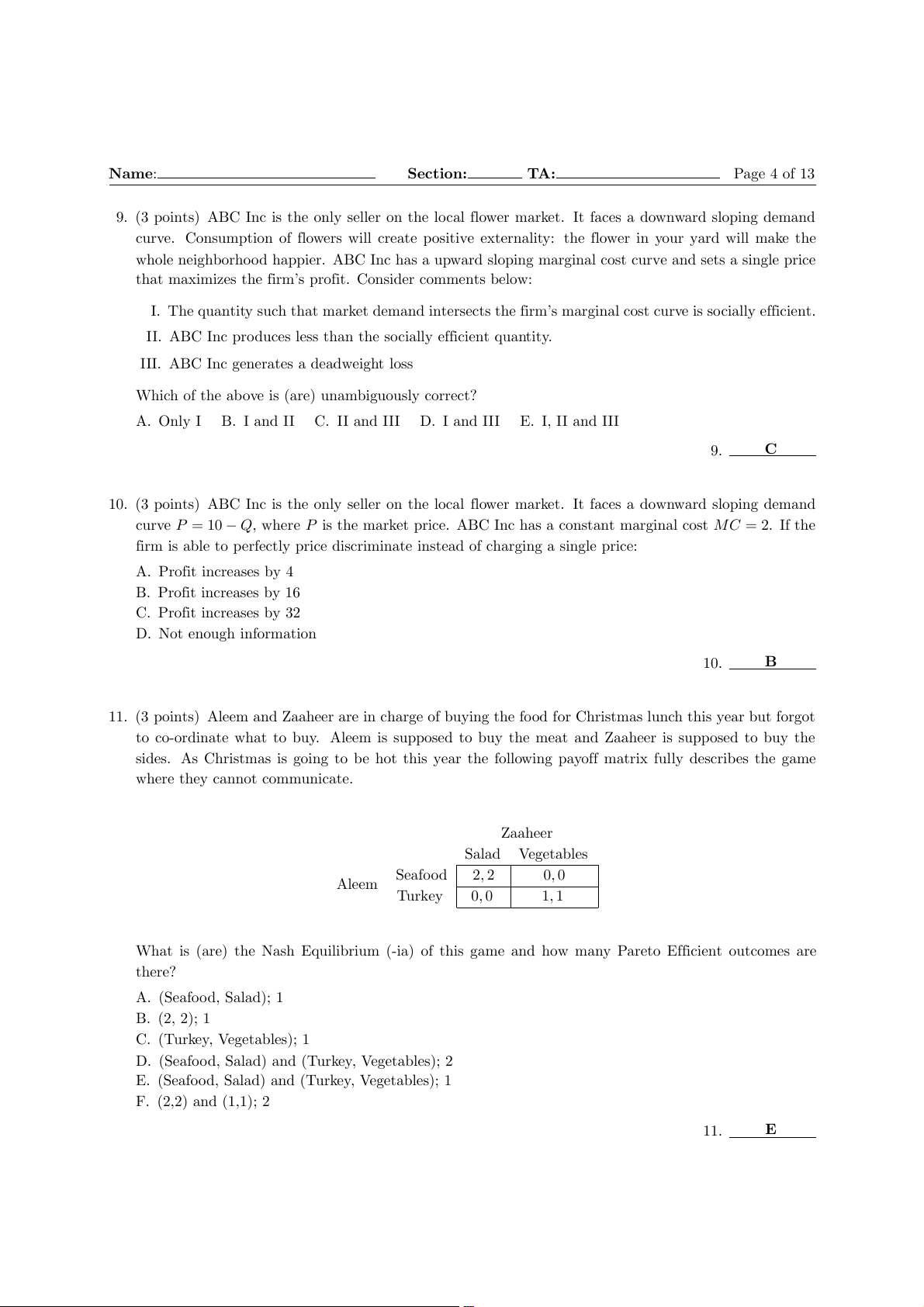
11. (3 points) Aleem and Zaaheer are in charge of buying the food for Christmas lunch this year but forgot
to co-ordinate what to buy. Aleem is supposed to buy the meat and Zaaheer is supposed to buy the
sides. As Christmas is going to be hot this year the following payoff matrix fully describes the game where they cannot communicate. Zaaheer Salad Vegetables Seafood 2, 2 0, 0 Aleem Turkey 0, 0 1, 1
What is (are) the Nash Equilibrium (-ia) of this game and how many Pareto Efficient outcomes are there? A. (Seafood, Salad); 1 B. (2, 2); 1 C. (Turkey, Vegetables); 1
D. (Seafood, Salad) and (Turkey, Vegetables); 2
E. (Seafood, Salad) and (Turkey, Vegetables); 1 F. (2,2) and (1,1); 2 11. E Name: Section: TA: Page 5 of 13
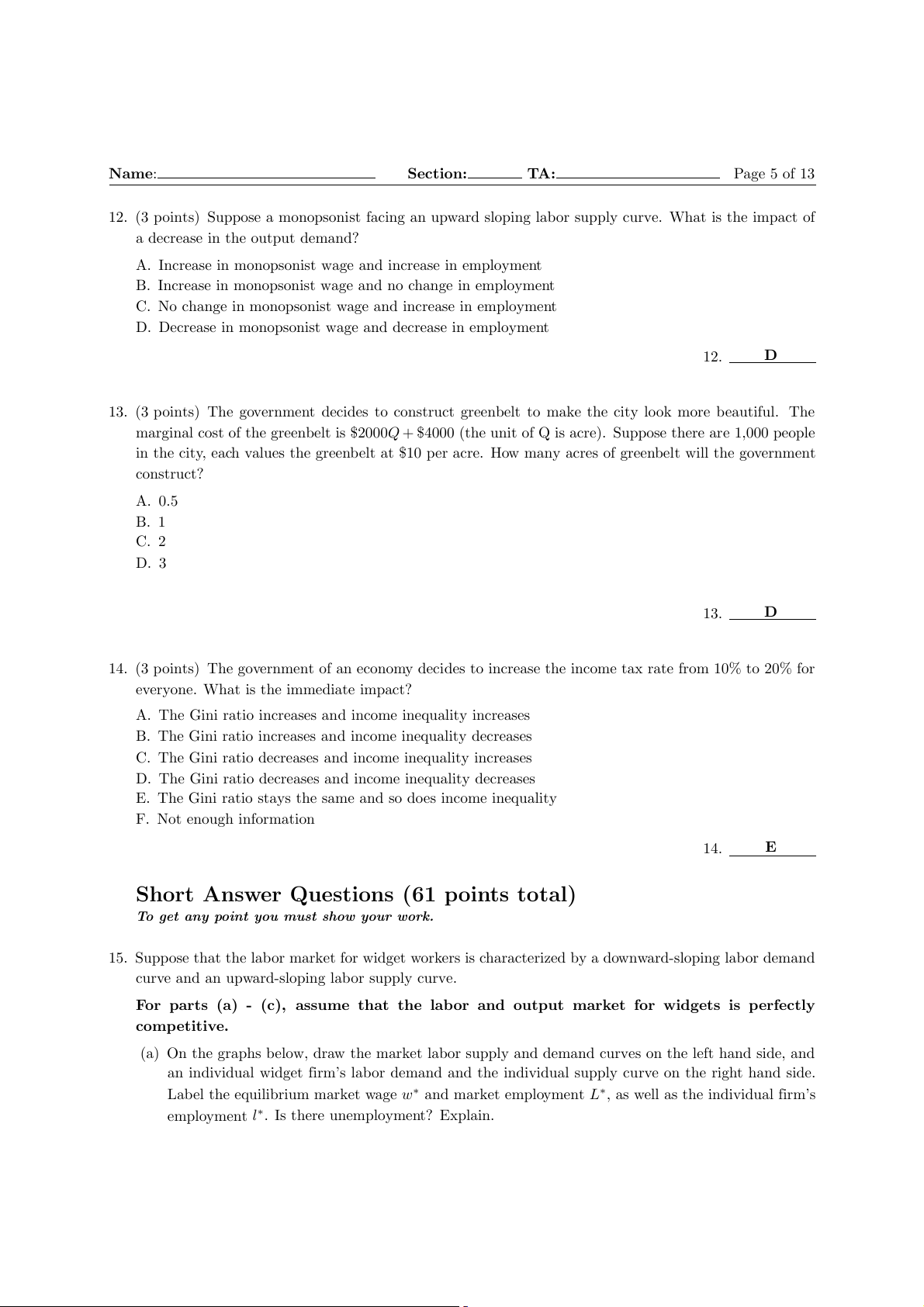
12. (3 points) Suppose a monopsonist facing an upward sloping labor supply curve. What is the impact of
a decrease in the output demand?
A. Increase in monopsonist wage and increase in employment
B. Increase in monopsonist wage and no change in employment
C. No change in monopsonist wage and increase in employment
D. Decrease in monopsonist wage and decrease in employment 12. D
13. (3 points) The government decides to construct greenbelt to make the city look more beautiful. The
marginal cost of the greenbelt is $2000Q + $4000 (the unit of Q is acre). Suppose there are 1,000 people
in the city, each values the greenbelt at $10 per acre. How many acres of greenbelt will the government construct? A. 0.5 B. 1 C. 2 D. 3 13. D
14. (3 points) The government of an economy decides to increase the income tax rate from 10% to 20% for
everyone. What is the immediate impact?
A. The Gini ratio increases and income inequality increases
B. The Gini ratio increases and income inequality decreases
C. The Gini ratio decreases and income inequality increases
D. The Gini ratio decreases and income inequality decreases
E. The Gini ratio stays the same and so does income inequality F. Not enough information 14. E
Short Answer Questions (61 points total)
To get any point you must show your work.
15. Suppose that the labor market for widget workers is characterized by a downward-sloping labor demand
curve and an upward-sloping labor supply curve.
For parts (a) - (c), assume that the labor and output market for widgets is perfectly competitive.
(a) On the graphs below, draw the market labor supply and demand curves on the left hand side, and
an individual widget firm’s labor demand and the individual supply curve on the right hand side.
Label the equilibrium market wage w∗ and market employment L∗, as well as the individual firm’s
employment l∗. Is there unemployment? Explain. Name: Section: TA: Page 6 of 13 w w Q l 0 0 Figure 1: Market for labor Figure 2: Individual Firm Solution: w w SL w unemployment min wmin w∗ w∗ DL M RPl l L 0 LD L∗ LS 0 lD l∗
There is no unemployement because the quantity of labor demanded is equal to the quantity of labor supplied.
(b) Assume that the labor market for widgets is in the equilibrium described in part (a). Congress
proposes imposing a minimum wage above the current equilibrium wage. How does this minimum
wage regulation affect the wage and the levels of employment and unemployment? Explain in words
and show graphically on the graphs above. Solution:
The minimum wage will be effective, it will increase the wage above the equilibrium wage,
decrease employment from L∗ to LD, and generate unemployement (excess supply of labor),
equal to LS − LD (see graph above).
(c) The minimum wage legislation fails, and the market remains in the equilibrium described in part
(a). A new policy change lowers the cap of visas for immigrant workers in the widget labor market, Name: Section: TA: Page 7 of 13
causing workers to immediately exit the labor supply.
Explain in words how this change in the labor market affects:
• the price and quantity of widgets in the widget market
• the wage, employment, and unemployment levels in the labor market
(You can use the space below the graphs to answer)
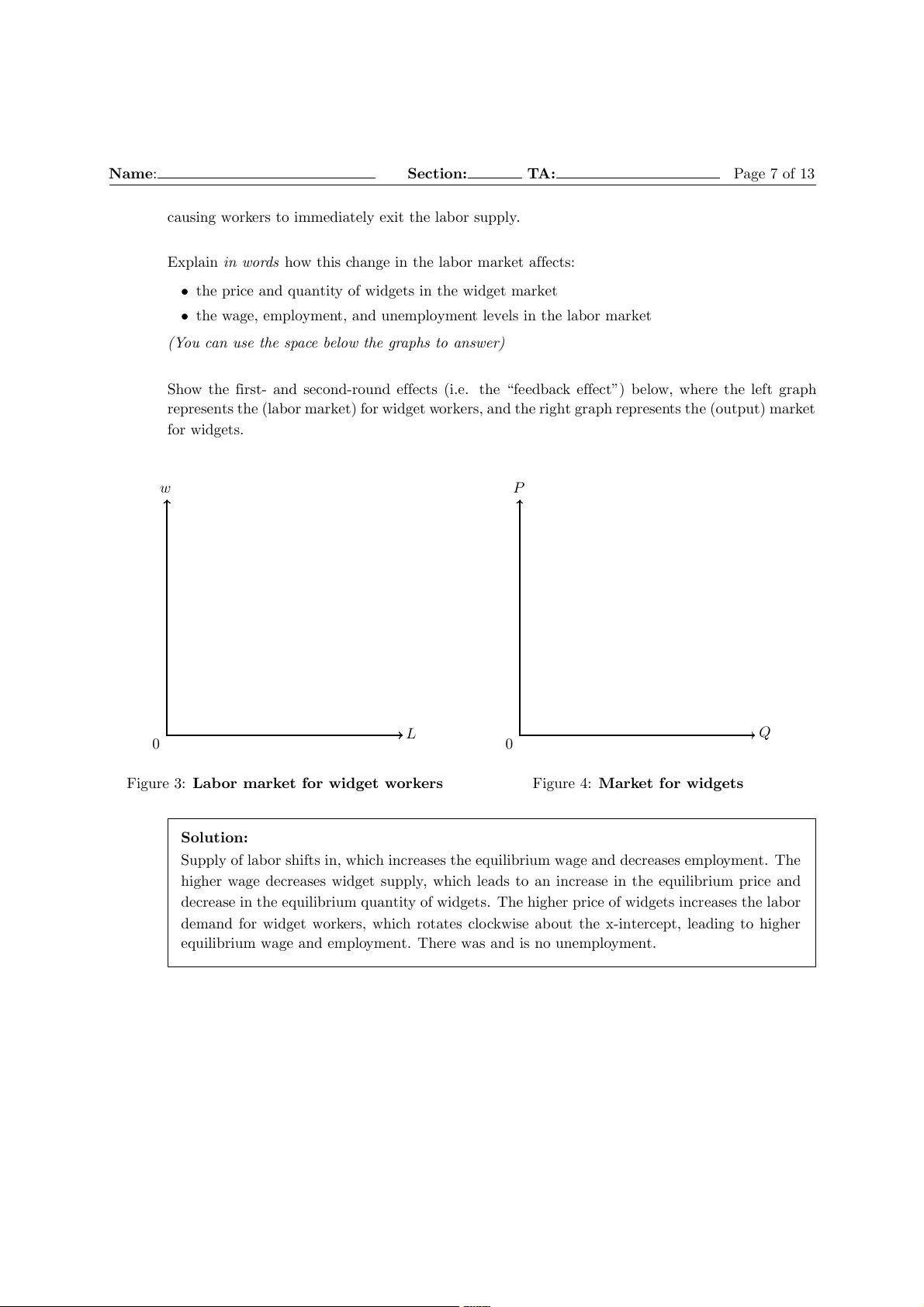
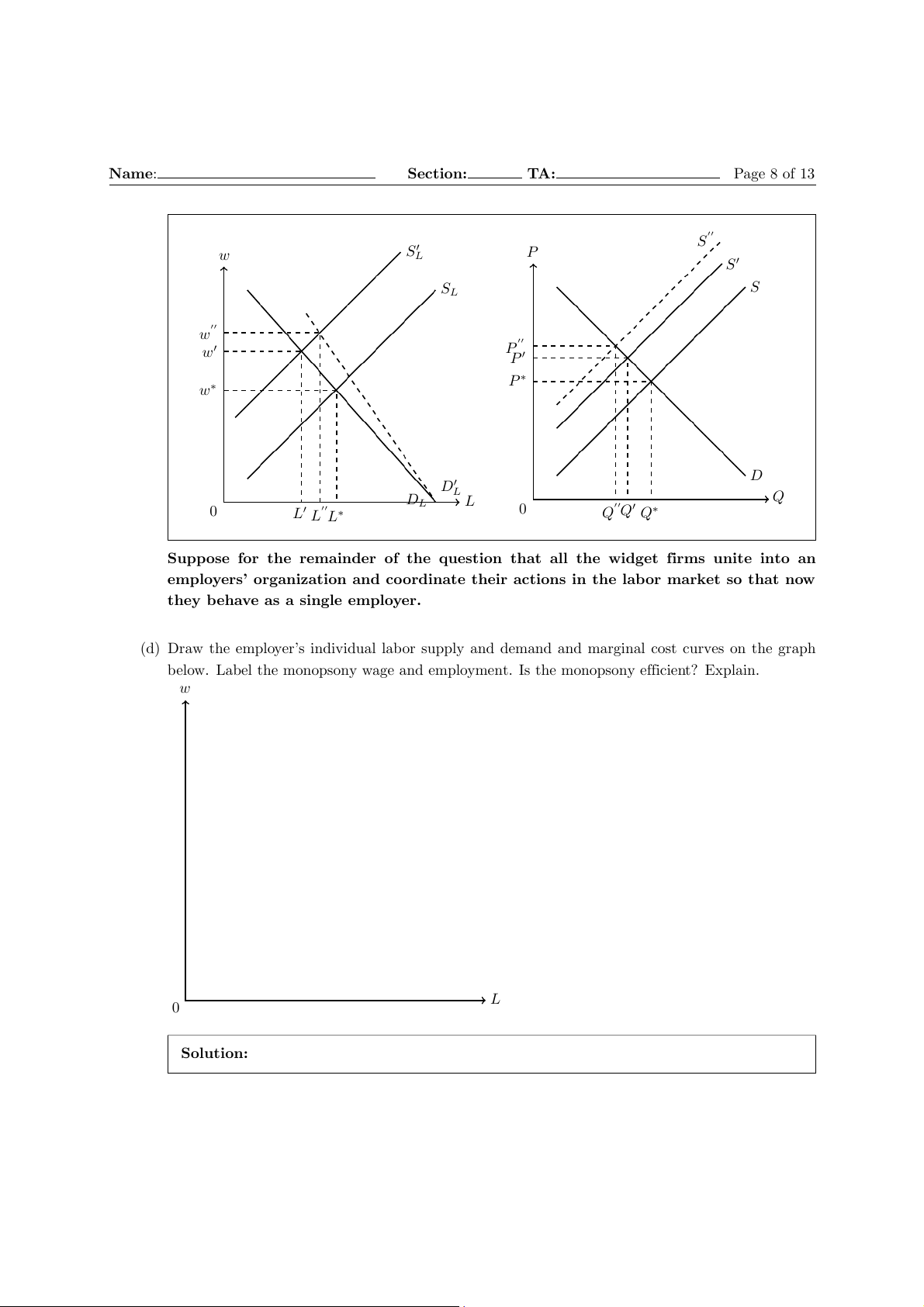
Show the first- and second-round effects (i.e. the “feedback effect”) below, where the left graph
represents the (labor market) for widget workers, and the right graph represents the (output) market for widgets. w P L Q 0 0
Figure 3: Labor market for widget workers Figure 4: Market for widgets Solution:
Supply of labor shifts in, which increases the equilibrium wage and decreases employment. The
higher wage decreases widget supply, which leads to an increase in the equilibrium price and
decrease in the equilibrium quantity of widgets. The higher price of widgets increases the labor
demand for widget workers, which rotates clockwise about the x-intercept, leading to higher
equilibrium wage and employment. There was and is no unemployment. Name: Section: TA: Page 8 of 13 00 S w S0L P S0 S S L 00 w 00 w0 PP0 P ∗ w∗ D D0L D Q L L 0 00 L0 00 0 L L∗ Q Q0 Q∗
Suppose for the remainder of the question that all the widget firms unite into an
employers’ organization and coordinate their actions in the labor market so that now
they behave as a single employer.
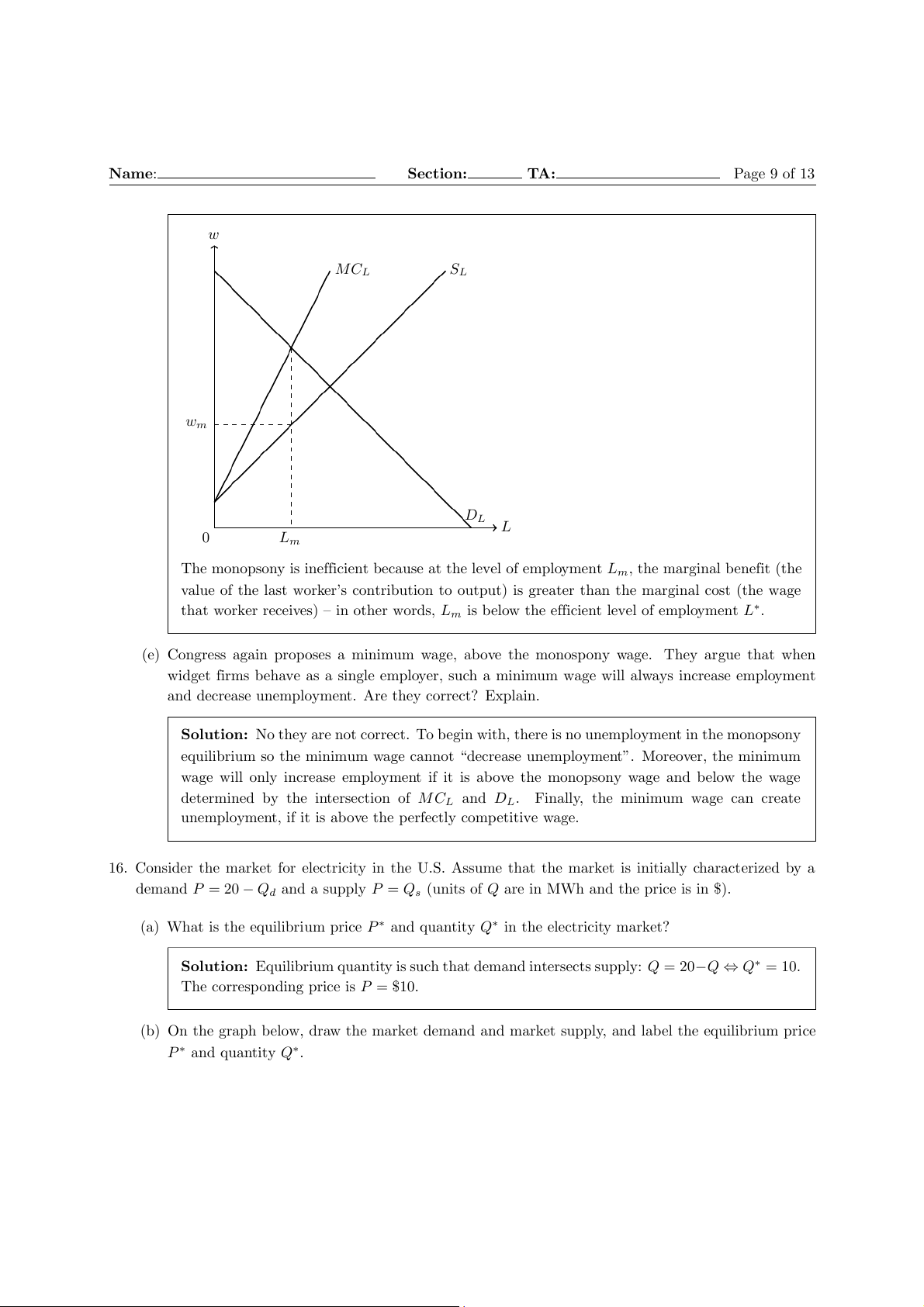
(d) Draw the employer’s individual labor supply and demand and marginal cost curves on the graph
below. Label the monopsony wage and employment. Is the monopsony efficient? Explain. w L 0 Solution: Name: Section: TA: Page 9 of 13 w M CL SL wm DL L 0 Lm
The monopsony is inefficient because at the level of employment Lm, the marginal benefit (the
value of the last worker’s contribution to output) is greater than the marginal cost (the wage
that worker receives) – in other words, Lm is below the efficient level of employment L∗.
(e) Congress again proposes a minimum wage, above the monospony wage. They argue that when
widget firms behave as a single employer, such a minimum wage will always increase employment
and decrease unemployment. Are they correct? Explain.
Solution: No they are not correct. To begin with, there is no unemployment in the monopsony
equilibrium so the minimum wage cannot “decrease unemployment”. Moreover, the minimum
wage will only increase employment if it is above the monopsony wage and below the wage
determined by the intersection of M CL and DL.
Finally, the minimum wage can create
unemployment, if it is above the perfectly competitive wage.
16. Consider the market for electricity in the U.S. Assume that the market is initially characterized by a
demand P = 20 − Qd and a supply P = Qs (units of Q are in MWh and the price is in $).
(a) What is the equilibrium price P ∗ and quantity Q∗ in the electricity market?
Solution: Equilibrium quantity is such that demand intersects supply: Q = 20−Q ⇔ Q∗ = 10.
The corresponding price is P = $10.
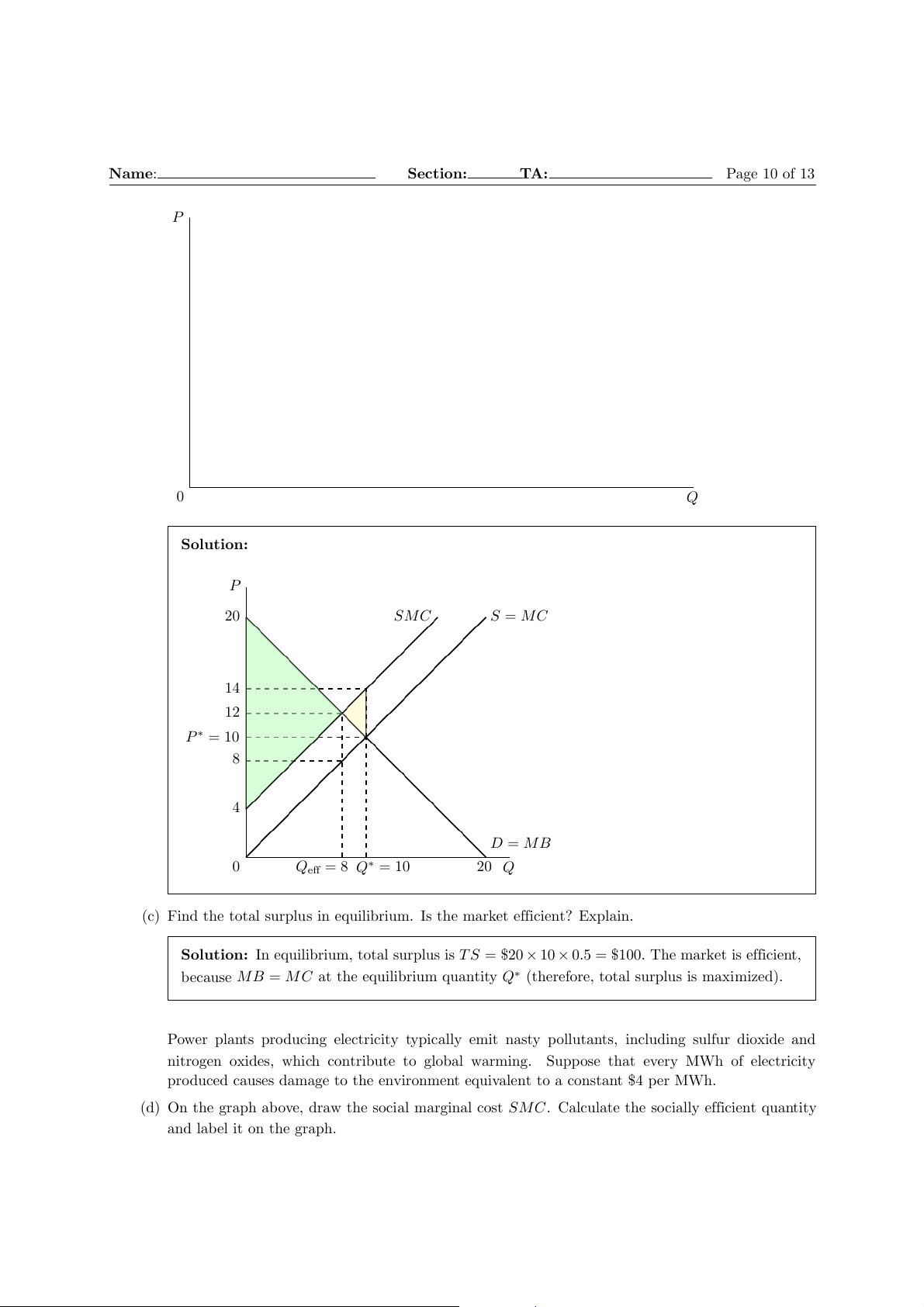
(b) On the graph below, draw the market demand and market supply, and label the equilibrium price P ∗ and quantity Q∗. Name: Section: TA: Page 10 of 13 P 0 Q Solution: P 20 SM C S = MC 14 12 P ∗ = 10 8 4 D = MB 0 Qeff = 8 Q∗ = 10 20 Q
(c) Find the total surplus in equilibrium. Is the market efficient? Explain.
Solution: In equilibrium, total surplus is T S = $20 × 10 × 0.5 = $100. The market is efficient,
because MB = M C at the equilibrium quantity Q∗ (therefore, total surplus is maximized).
Power plants producing electricity typically emit nasty pollutants, including sulfur dioxide and
nitrogen oxides, which contribute to global warming. Suppose that every MWh of electricity
produced causes damage to the environment equivalent to a constant $4 per MWh.
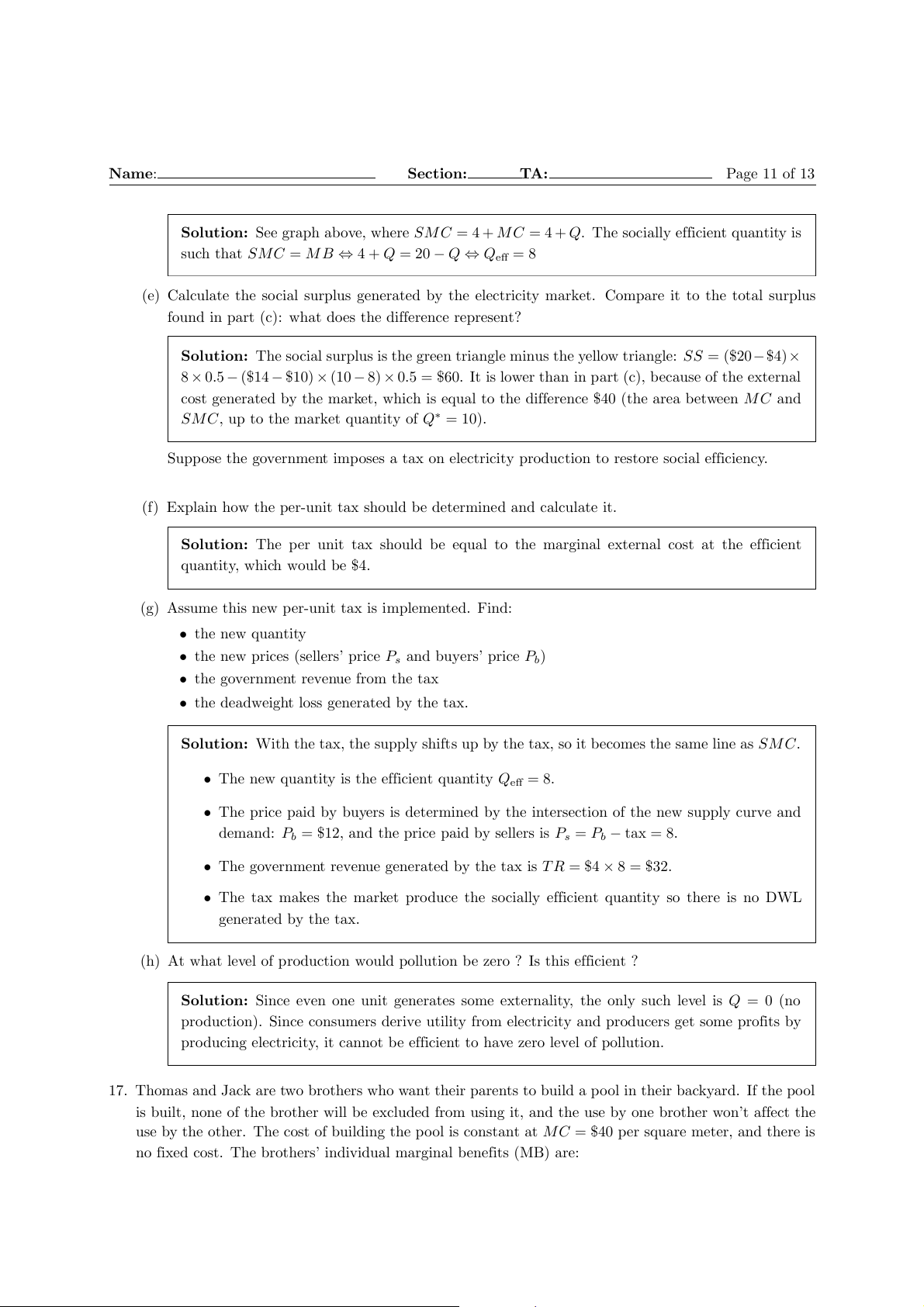
(d) On the graph above, draw the social marginal cost SMC. Calculate the socially efficient quantity and label it on the graph. Name: Section: TA: Page 11 of 13
Solution: See graph above, where SM C = 4 + M C = 4 + Q. The socially efficient quantity is
such that SMC = M B ⇔ 4 + Q = 20 − Q ⇔ Qeff = 8
(e) Calculate the social surplus generated by the electricity market. Compare it to the total surplus
found in part (c): what does the difference represent?
Solution: The social surplus is the green triangle minus the yellow triangle: SS = ($20− $4)×
8 × 0.5 − ($14 − $10) × (10 − 8) × 0.5 = $60. It is lower than in part (c), because of the external
cost generated by the market, which is equal to the difference $40 (the area between M C and
SM C , up to the market quantity of Q∗ = 10).
Suppose the government imposes a tax on electricity production to restore social efficiency.
(f) Explain how the per-unit tax should be determined and calculate it.
Solution: The per unit tax should be equal to the marginal external cost at the efficient quantity, which would be $4.
(g) Assume this new per-unit tax is implemented. Find: • the new quantity
• the new prices (sellers’ price Ps and buyers’ price Pb)
• the government revenue from the tax
• the deadweight loss generated by the tax.
Solution: With the tax, the supply shifts up by the tax, so it becomes the same line as SM C.
• The new quantity is the efficient quantity Qeff = 8.
• The price paid by buyers is determined by the intersection of the new supply curve and
demand: Pb = $12, and the price paid by sellers is Ps = Pb − tax = 8.
• The government revenue generated by the tax is T R = $4 × 8 = $32.
• The tax makes the market produce the socially efficient quantity so there is no DWL generated by the tax.
(h) At what level of production would pollution be zero ? Is this efficient ?
Solution: Since even one unit generates some externality, the only such level is Q = 0 (no
production). Since consumers derive utility from electricity and producers get some profits by
producing electricity, it cannot be efficient to have zero level of pollution.
17. Thomas and Jack are two brothers who want their parents to build a pool in their backyard. If the pool
is built, none of the brother will be excluded from using it, and the use by one brother won’t affect the
use by the other. The cost of building the pool is constant at MC = $40 per square meter, and there is
no fixed cost. The brothers’ individual marginal benefits (MB) are: Name: Section: TA: Page 12 of 13 • Thomas: M BT = 30 − 0.2Q • Jack: M BJ = 30 − 0.3Q,
where Q is the size of the pool, in square meters.
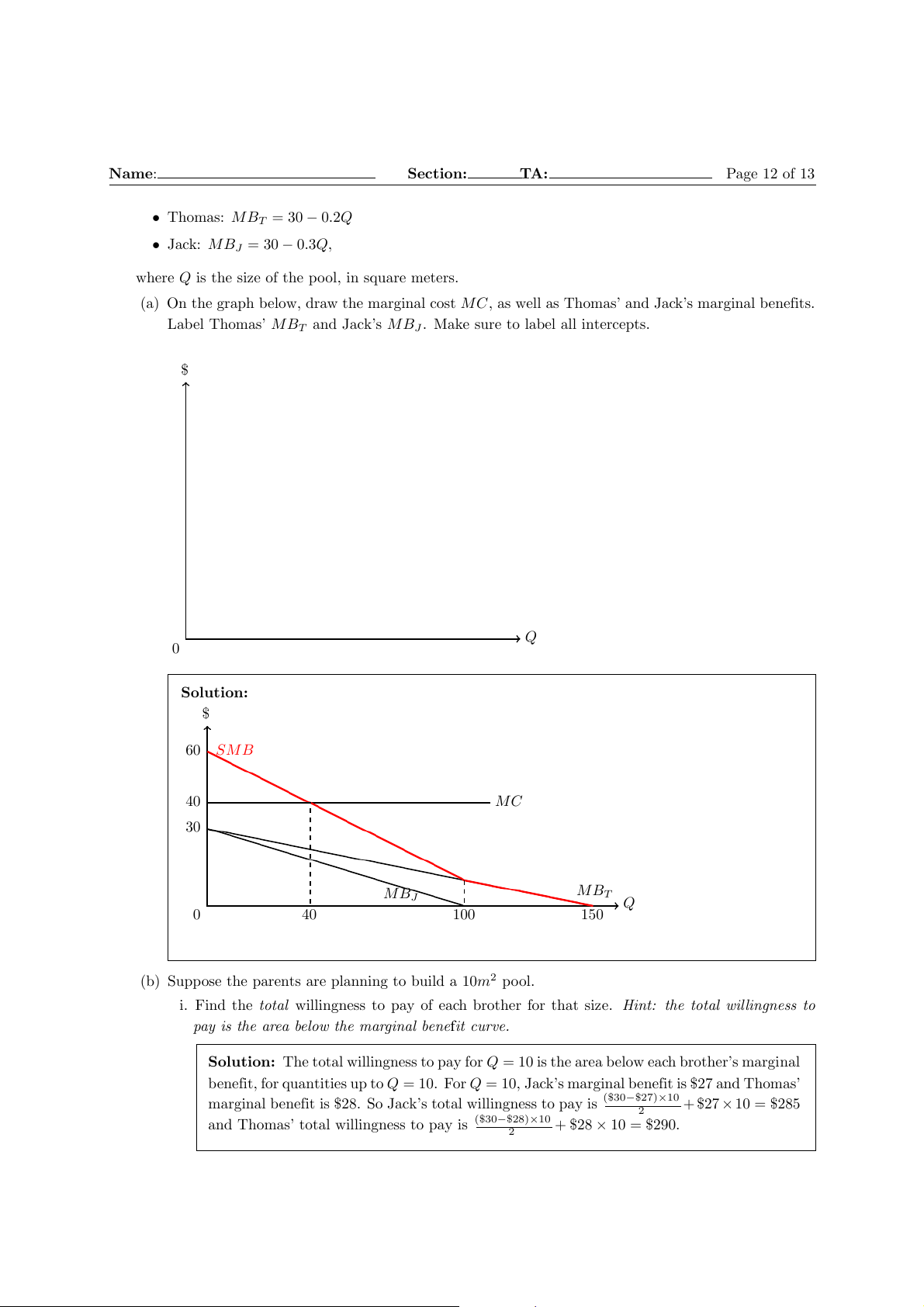
(a) On the graph below, draw the marginal cost MC, as well as Thomas’ and Jack’s marginal benefits.
Label Thomas’ MBT and Jack’s MBJ . Make sure to label all intercepts. $ Q 0 Solution: $ 60 SM B 40 M C 30 M BT M BJ Q 0 40 100 150
(b) Suppose the parents are planning to build a 10m2 pool.
i. Find the total willingness to pay of each brother for that size. Hint: the total willingness to
pay is the area below the marginal benefit curve.
Solution: The total willingness to pay for Q = 10 is the area below each brother’s marginal
benefit, for quantities up to Q = 10. For Q = 10, Jack’s marginal benefit is $27 and Thomas’
marginal benefit is $28. So Jack’s total willingness to pay is ($30−$27)×10 + $27 × 10 = $285 2
and Thomas’ total willingness to pay is ($30− × $28) 10 + $28 × 10 = $290. 2 Name: Section: TA: Page 13 of 13
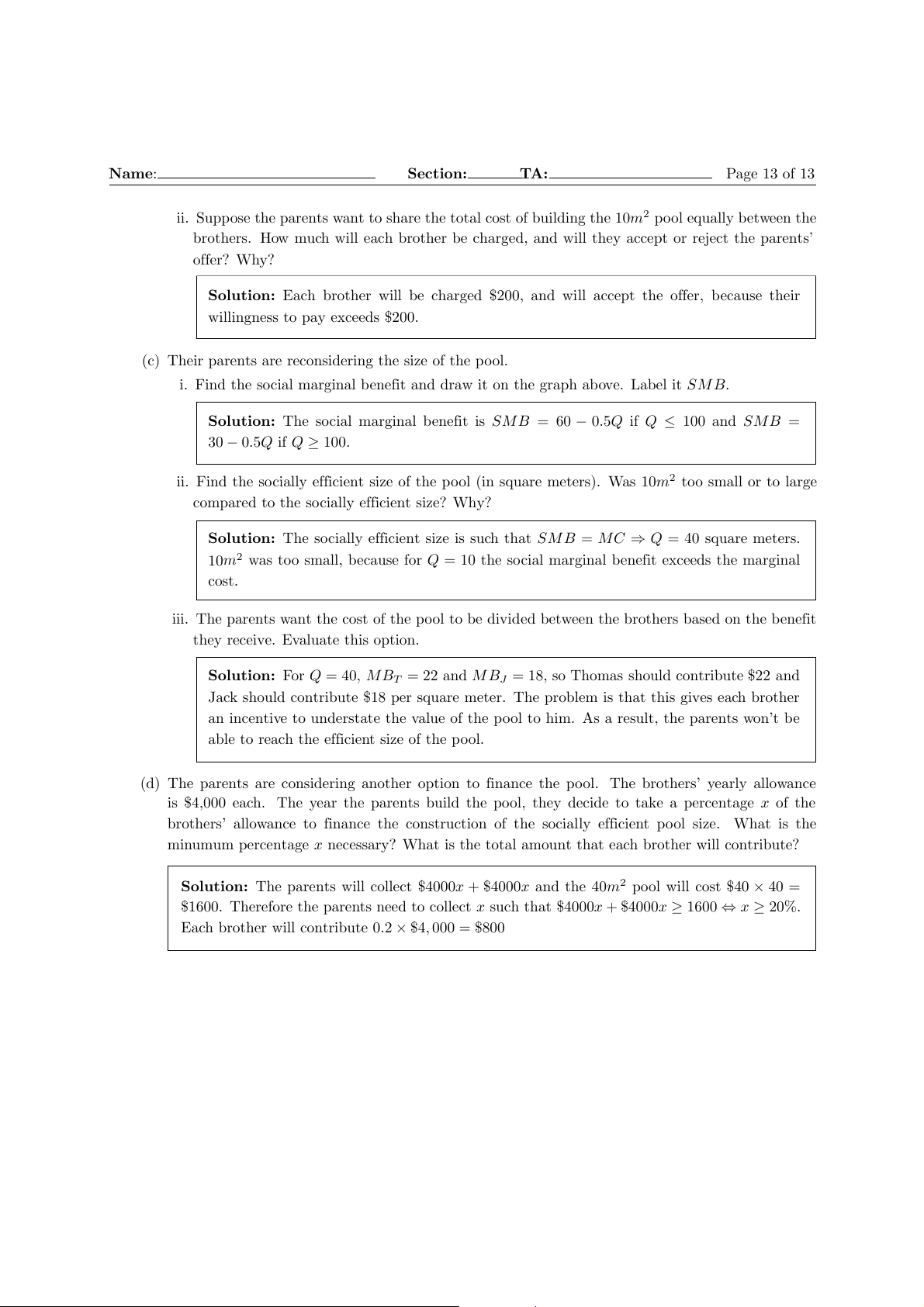
ii. Suppose the parents want to share the total cost of building the 10m2 pool equally between the
brothers. How much will each brother be charged, and will they accept or reject the parents’ offer? Why?
Solution: Each brother will be charged $200, and will accept the offer, because their
willingness to pay exceeds $200.
(c) Their parents are reconsidering the size of the pool.
i. Find the social marginal benefit and draw it on the graph above. Label it SM B.
Solution: The social marginal benefit is SMB = 60 − 0.5Q if Q ≤ 100 and SMB = 30 − 0.5Q if Q ≥ 100.
ii. Find the socially efficient size of the pool (in square meters). Was 10m2 too small or to large
compared to the socially efficient size? Why?
Solution: The socially efficient size is such that SM B = MC ⇒ Q = 40 square meters.
10m2 was too small, because for Q = 10 the social marginal benefit exceeds the marginal cost.
iii. The parents want the cost of the pool to be divided between the brothers based on the benefit
they receive. Evaluate this option.
Solution: For Q = 40, MBT = 22 and M BJ = 18, so Thomas should contribute $22 and
Jack should contribute $18 per square meter. The problem is that this gives each brother
an incentive to understate the value of the pool to him. As a result, the parents won’t be
able to reach the efficient size of the pool.
(d) The parents are considering another option to finance the pool. The brothers’ yearly allowance
is $4,000 each. The year the parents build the pool, they decide to take a percentage x of the
brothers’ allowance to finance the construction of the socially efficient pool size. What is the
minumum percentage x necessary? What is the total amount that each brother will contribute?
Solution: The parents will collect $4000x + $4000x and the 40m2 pool will cost $40 × 40 =
$1600. Therefore the parents need to collect x such that $4000x + $4000x ≥ 1600 ⇔ x ≥ 20%.
Each brother will contribute 0.2 × $4, 000 = $800
Tài liệu liên quan:
-
Chương 3: độ co giãn và các nhân tố ảnh hưởng | Microeconomics | Trường Đại học Quốc tế, Đại học Quốc gia Thành phố Hồ Chí Minh
4 2 -
Microeconomics Syllabus | Microeconomics | Trường Đại học Quốc tế, Đại học Quốc gia Thành phố Hồ Chí Minh
4 2 -
Microeconomics Course Syllabus & Assessment Details | Microeconomics | Trường Đại học Quốc tế, Đại học Quốc gia Thành phố Hồ Chí Minh
4 2 -
Assignment 3 - Elasticity MCQs and Key Concepts | Microeconomics | Trường Đại học Quốc tế, Đại học Quốc gia Thành phố Hồ Chí Minh
4 2 -
Assignment 2 - Economic Equilibrium Analysis of Fridges and Motorcycles | Microeconomics | Trường Đại học Quốc tế, Đại học Quốc gia Thành phố Hồ Chí Minh
4 2