Final Group Project: Microeconomics of Vietnam's | Microeconomics | Trường Đại học Quốc tế, Đại học Quốc gia Thành phố Hồ Chí Minh
Cakes and candies hold a special place in Vietnamese culinary culture, cherished as beloved snacks across the nation. They are a great treat for all ages, especially for families with small children, because of their varied textures and tastes. One of the food industries in Vietnam that is expanding the fastest is the candy business, which makes the country's confectionery market one of the most promising in Asia. Tài liệu được sưu tầm và soạn thảo dưới dạng file PDF để gửi tới các bạn cùng tham khảo, ôn tập đầy đủ kiến thức, chuẩn bị cho các buổi học thật tốt. Mời bạn đọc đón xem!
Môn: Microeconomics 635 tài liệu
Trường: Trường Đại học Quốc tế, Đại học Quốc gia Thành phố Hồ Chí Minh 1.9 K tài liệu
Tác giả:


Preview text:
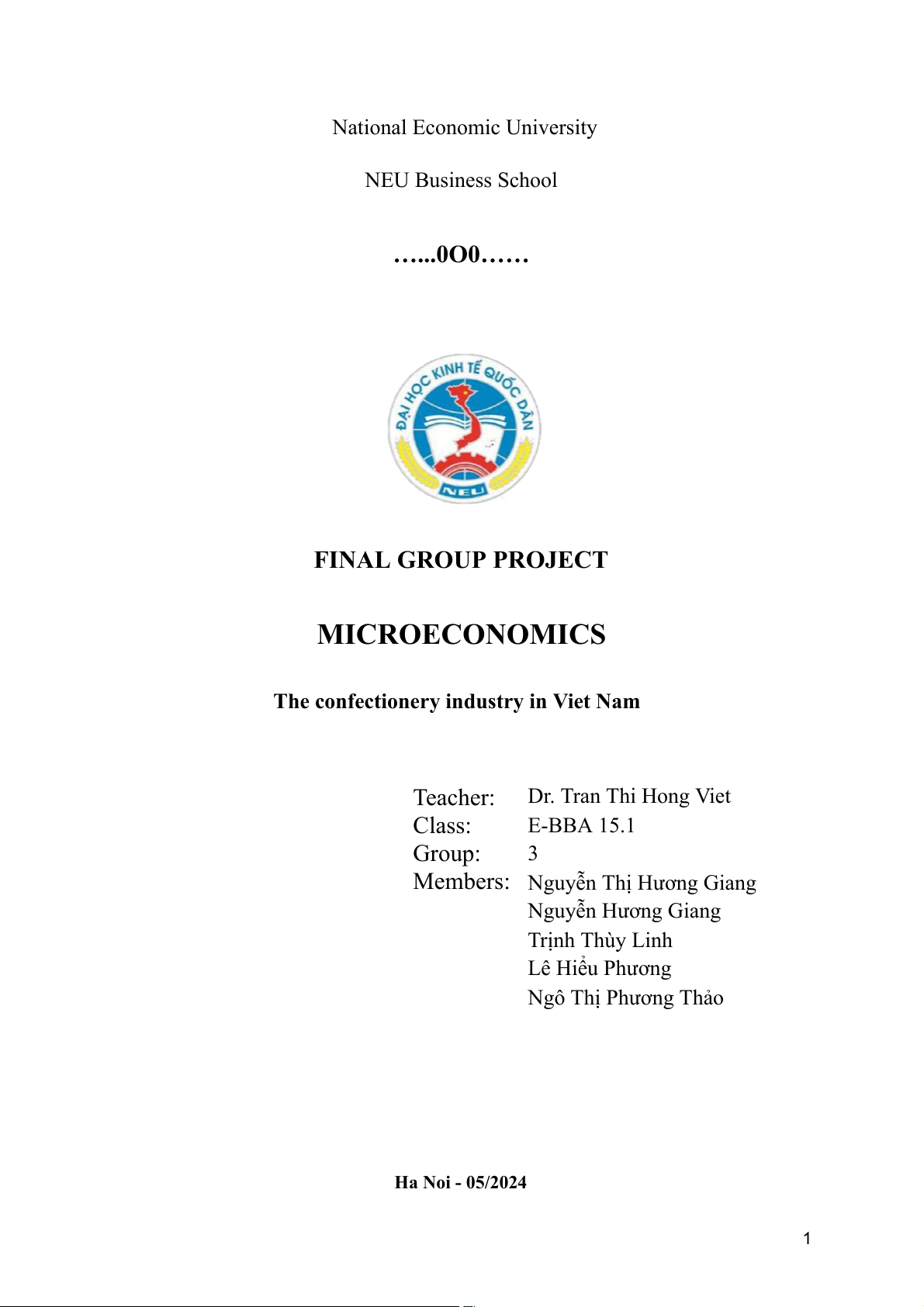
National Economic University NEU Business School …...0O0…… FINAL GROUP PROJECT MICROECONOMICS
The confectionery industry in Viet Nam Teacher: Dr. Tran Thi Hong Viet Class: E-BBA 15.1 Group: 3
Members: Nguyễn Thị Hương Giang Nguyễn Hương Giang Trịnh Thùy Linh Lê Hiểu Phương Ngô Thị Phương Thảo Ha Noi - 05/2024 1 TABLE OF CONTENT
1. Introduction and objectives..................................................................................... 3
2. Definition................................................................................................................... 3
2.1 What is confectionary..........................................................................................3
2.2 Effect on the economy in Viet Nam.................................................................... 3
3. Discussion.................................................................................................................. 4
3.1. The confectionery industry is closer to monopolistic........................................ 4
3.1.1. What is monopolistic competition..............................................................4
3.1.2. Why the confectionary market is monopolistic competition..................... 4
3.2. Factors affecting demand and supply of the market...........................................8
3.2.1. Demand of the market............................................................................... 8
3.2.2. Supply of the market..................................................................................9
3.2.3. Factors influencing the demand.................................................................9
3.2.4. Factors influencing the supply.................................................................11
4. Potential, challenging and market trend.............................................................. 12
5. Recommendation.................................................................................................... 14
6. Conclusion............................................................................................................... 14 2 1. Introduction and objectives Introduction
Cakes and candies hold a special place in Vietnamese culinary culture,
cherished as beloved snacks across the nation. They are a great treat for all ages,
especially for families with small children, because of their varied textures and tastes.
One of the food industries in Vietnam that is expanding the fastest is the candy
business, which makes the country's confectionery market one of the most promising
in Asia. According to research, sugary confections are consumed in the greatest
quantities, followed by sweet biscuits and preserved goods (Statista, 2024). In order to
have a more profound understanding of the Vietnamese confectionery business, we
have carried out a research named "The Vietnamese Confectionery Market." Objectives
Here are some objectives for our project (1) To prove that the confectionery
industry is monopolistic. (2) To identify factors that influence the demand and supply
of the confectionary industry in Viet Nam. (3) To provide recommendations for firms
in the market to improve their profits and revenues. 2. Definition 2.1 What is confectionary
The Confectionery segment covers food items with relatively high sugar.
Confectionery has a variety of flavorings, colorings, and other components that give
them their distinct taste, texture, and appearance. This segment is divided into four
subsegments: chocolate confectionery, ice cream, preserved pastry goods and cakes
and sugar confectionery (Statista, 2024).
2.2 Effect on the economy in Viet Nam
It is estimated that the total domestic production in 2023 reached 1.5 million
tons, generating revenue of 8,5 billion USD with an annual growth rate of 10.17%
(Vietnam Briefing, 2023). Between domestic and international businesses, there is
now considerable rivalry in the Vietnamese confectionery sector. Although the import
duty on candy from ASEAN nations has decreased to 0 percent, locally-made
confectionery continues to dominate the market in Vietnam, accounting for over 90
percent of the country’s total confectionery sales, according to state media (ANTV,
2023). According to Statista, as of March 2024, the revenue in the confectionery
market is estimated to reach $1.64 billion USD and continues to show growth 3
momentum. This not only contributes to the economic growth of Vietnam but also
enhances the potential for exporting these products to other countries. 3. Discussion
Question 1: Explain the main factors that have affected the supply and the
demand of the commodity chosen over the last years.
Question 2: Explain the main factors that have affected the supply and the
demand of the commodity chosen over the last years.
3.1. The confectionery industry is closer to monopolistic
3.1.1. What is monopolistic competition
Based on microeconomics, monopolistic competition has four main
characteristics, including actions of firms, product differentiation, market power,
barrier to entry, and non-price competition. Monopolistic competition has a relatively
large number of small firms with small market shares, also, these firms operate
independently, which means that there is no collusion among firms. One of the most
important features of this kind of competition is the products are similar, but not identical.
3.1.2. Why the confectionary market is monopolistic competition Number of firms
The confectionery market in Vietnam is vibrant and diverse, with a large
number of companies operating in the market. While the exact number of
confectionery firms in Vietnam is not specified in our search, it is estimated that there
are hundreds of small companies, approximately 30 large domestic enterprises, and
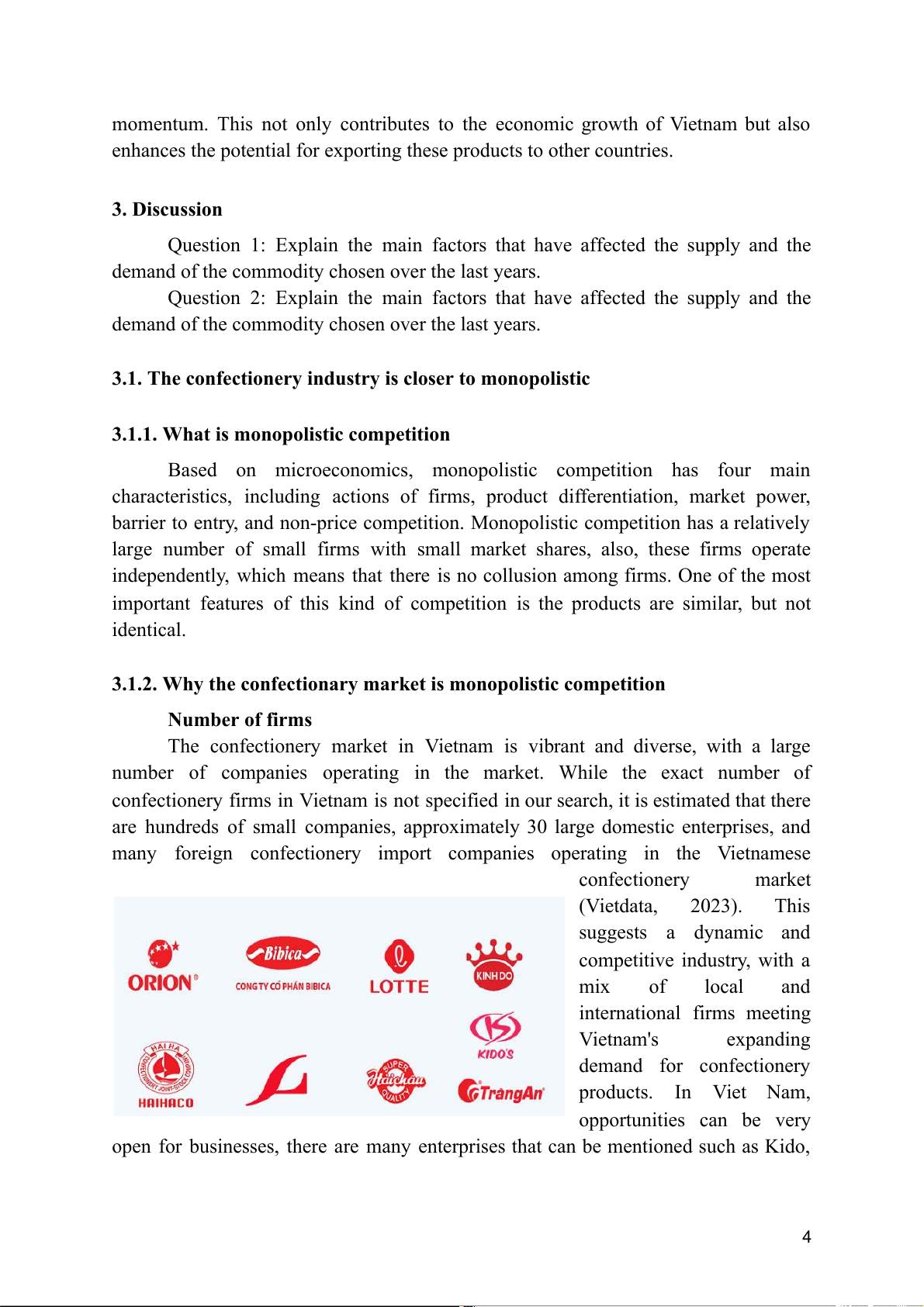
many foreign confectionery import companies operating in the Vietnamese confectionery market (Vietdata, 2023). This suggests a dynamic and competitive industry, with a mix of local and international firms meeting Vietnam's expanding demand for confectionery products. In Viet Nam, opportunities can be very
open for businesses, there are many enterprises that can be mentioned such as Kido, 4
Hai Ha, Bibica, Orion Viet Nam, Lotte, Hai Chau, Trang An… like large firms. Also,
Viet Nam’s confectionary market has many small companies such as:
In conclusion, the confectionary industry in Viet Nam contains a lot of types of
firms, but there are many small businesses compared to an estimated 30 large
businesses, one of the characteristics of monopolistic competition. Market share
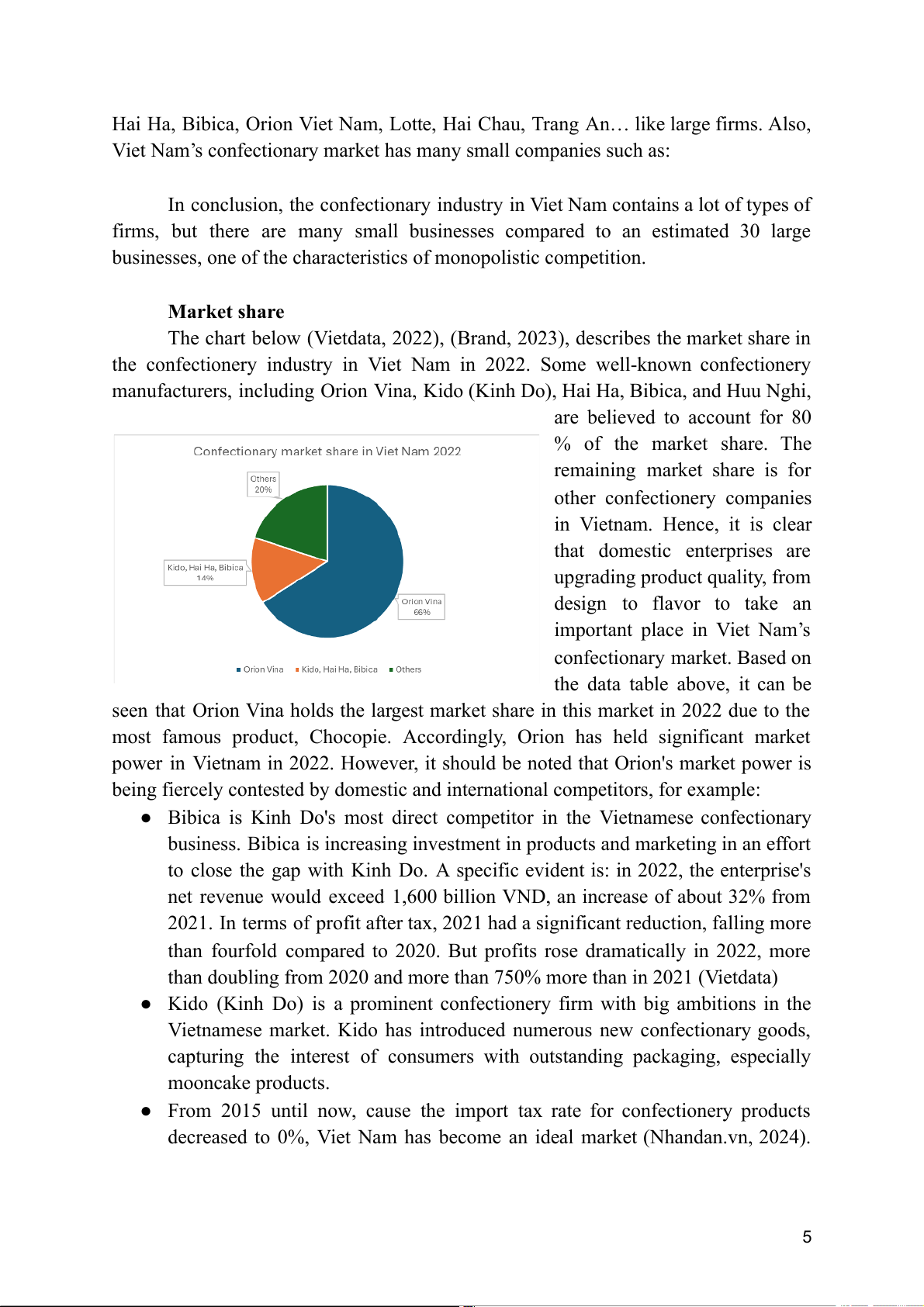
The chart below (Vietdata, 2022), (Brand, 2023), describes the market share in
the confectionery industry in Viet Nam in 2022. Some well-known confectionery
manufacturers, including Orion Vina, Kido (Kinh Do), Hai Ha, Bibica, and Huu Nghi, are believed to account for 80 % of the market share. The remaining market share is for other confectionery companies in Vietnam. Hence, it is clear that domestic enterprises are
upgrading product quality, from design to flavor to take an
important place in Viet Nam’s confectionary market. Based on
the data table above, it can be
seen that Orion Vina holds the largest market share in this market in 2022 due to the
most famous product, Chocopie. Accordingly, Orion has held significant market
power in Vietnam in 2022. However, it should be noted that Orion's market power is
being fiercely contested by domestic and international competitors, for example: ●
Bibica is Kinh Do's most direct competitor in the Vietnamese confectionary
business. Bibica is increasing investment in products and marketing in an effort
to close the gap with Kinh Do. A specific evident is: in 2022, the enterprise's
net revenue would exceed 1,600 billion VND, an increase of about 32% from
2021. In terms of profit after tax, 2021 had a significant reduction, falling more
than fourfold compared to 2020. But profits rose dramatically in 2022, more
than doubling from 2020 and more than 750% more than in 2021 (Vietdata) ●
Kido (Kinh Do) is a prominent confectionery firm with big ambitions in the
Vietnamese market. Kido has introduced numerous new confectionary goods,
capturing the interest of consumers with outstanding packaging, especially mooncake products. ●
From 2015 until now, cause the import tax rate for confectionery products
decreased to 0%, Viet Nam has become an ideal market (Nhandan.vn, 2024). 5
Accordingly, many foreign firms want to enter to take market share in Viet
Nam’s confectionery industry by numerous ways.
Hence, it can be seen that the market power of firms in the confectionery
market fluctuates significantly, companies are always innovating to gain more market
share with their own strategies. Accordingly, the confectionery market is closer to monopolistic. Product differentiation
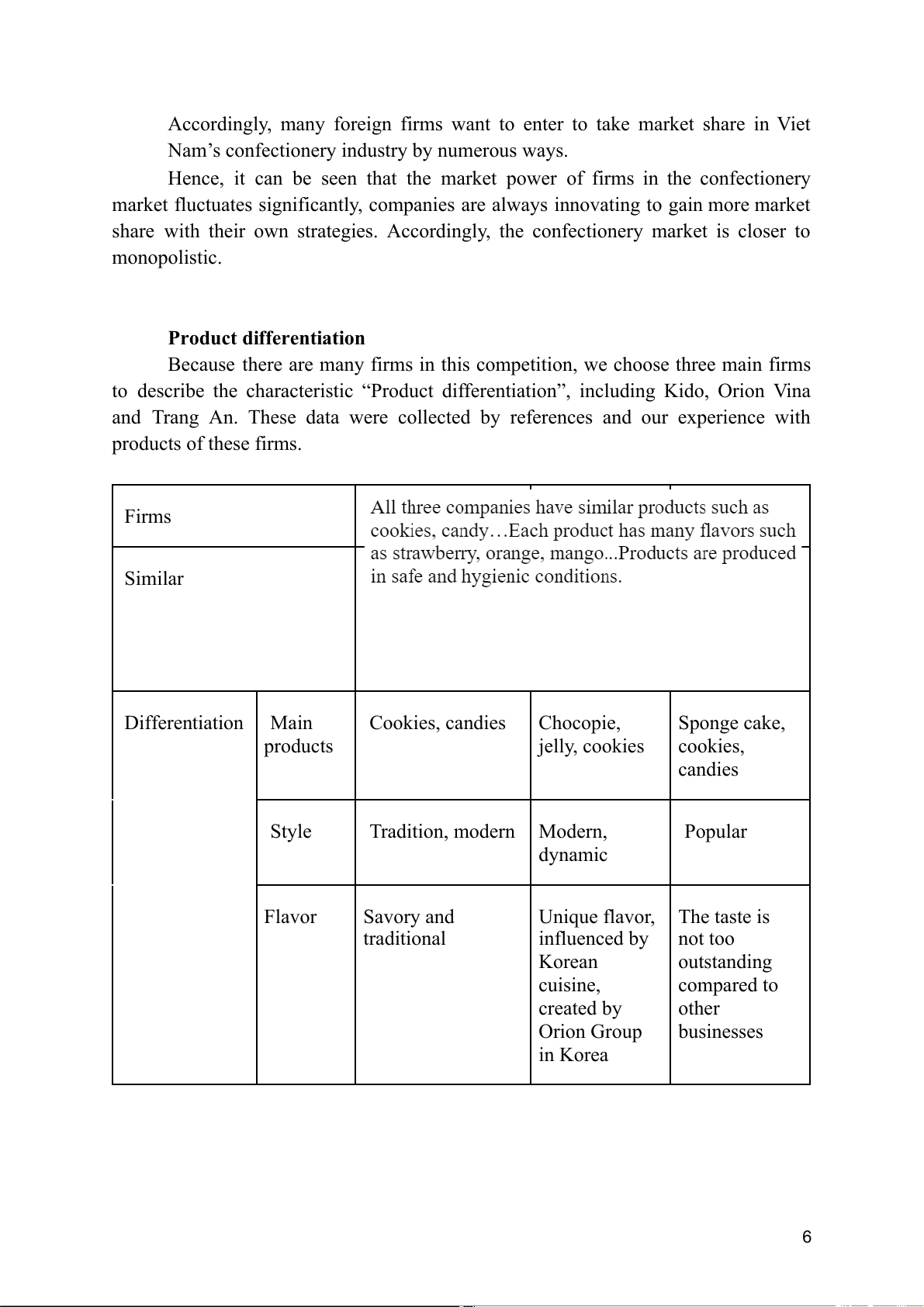
Because there are many firms in this competition, we choose three main firms
to describe the characteristic “Product differentiation”, including Kido, Orion Vina
and Trang An. These data were collected by references and our experience with products of these firms. Firms Similar Differentiation Main Cookies, candies Chocopie, Sponge cake, products jelly, cookies cookies, candies Style Tradition, modern Modern, Popular dynamic Flavor Savory and Unique flavor, The taste is traditional influenced by not too Korean outstanding cuisine, compared to created by other Orion Group businesses in Korea 6 Barrier to entry
Entering the Vietnamese confectionery market presents both promising
opportunities and significant challenges. Here are some of the key barriers that new businesses need to consider: 1. Legal Barriers: ●
Food Safety Regulations: Vietnam has strict food safety regulations for
confectionery products. New businesses must fully obey these regulations to
manufacture and have business licenses. ●
Labeling Regulations: Confectionery product labels must display information
according to Vietnamese law, including ingredients, expiration date, usage instructions, etc. ●
Licensing Procedures: The process of obtaining a license to produce and sell
confectionery in Vietnam can be time-consuming and involve complex
procedures based on the law of Viet Nam 2. Competitive Barriers: ●
Highly Competitive Market: The Vietnamese confectionery industry is highly
competitive with numerous domestic and international firms, such as: Trang
An, Kido, Hai Ha, Orion Vina… Major confectionery companies like Kinh Do,
Bibica, and Orion have established strong brands and hold a significant firm
position in the confectionery market. Moreover, they always change their
actions to fit the need of consumers on Viet Nam. Also, in recent years,
numerous foreign firms have entered this market; hence, the competitive pressure is increasing. ●
Price Barriers: Confectionery product prices in Vietnam are relatively
competitive, making it difficult for new businesses to enter the market if they use a low-price strategy.
3. Consumer Preference Barriers: ●
Consumer Preferences: Vietnamese consumers tend to favor established and
reputable confectionery brands. ●
Behavior: Vietnamese consumers typically purchase confectionery from
grocery stores, supermarkets, and convenience stores. Hence, new firms need
to gain the trust of stores, and supermarkets… to be more accessible to customers Non-price competition
Nowadays, there are many ways to promote products, such as through social
networks, television, newspapers... Companies in the confectionary market are very
aware of trends to be able to make suitable advertisements for their target audience. ● Kido 7
In 2020, Kido posted a TVC to promote the Mooncake product, Kingdom,
“Kingdom - Tết trao Phúc lộc, Thu chúc An Khang”. Kingdom is one of the newly
produced products in 2020, containing many purposes of this firm, opening the new product line of Kido ● Orion Vina
Orion Food Vina frequently appears on major television networks like as
VTV1, VTV3, and VCTV. These programs help to disseminate information
efficiently. Additionally, it has an impact on young individuals, middle-aged people,
and children. Orion Food Vina also hires news websites to generate advertising and
content. At the same time, make contracts with celebrities and KOLs to promote items.
3.2. Factors affecting demand and supply of the market 3.2.1. Demand of the market
Confectionery is one of the food industries recording rapid development in
Vietnam with an estimated domestic production output of about 1.5 million tons/year
and annual revenue of approximately VND 40 trillion.
Recently, many foreign businesses have entered the Vietnamese confectionery
market, due to the high population and demand for this product. Accordingly, this
competitive pressure, domestic confectionery businesses are required to innovate and
find new directions to regain market share. (Nhandan, 2024)
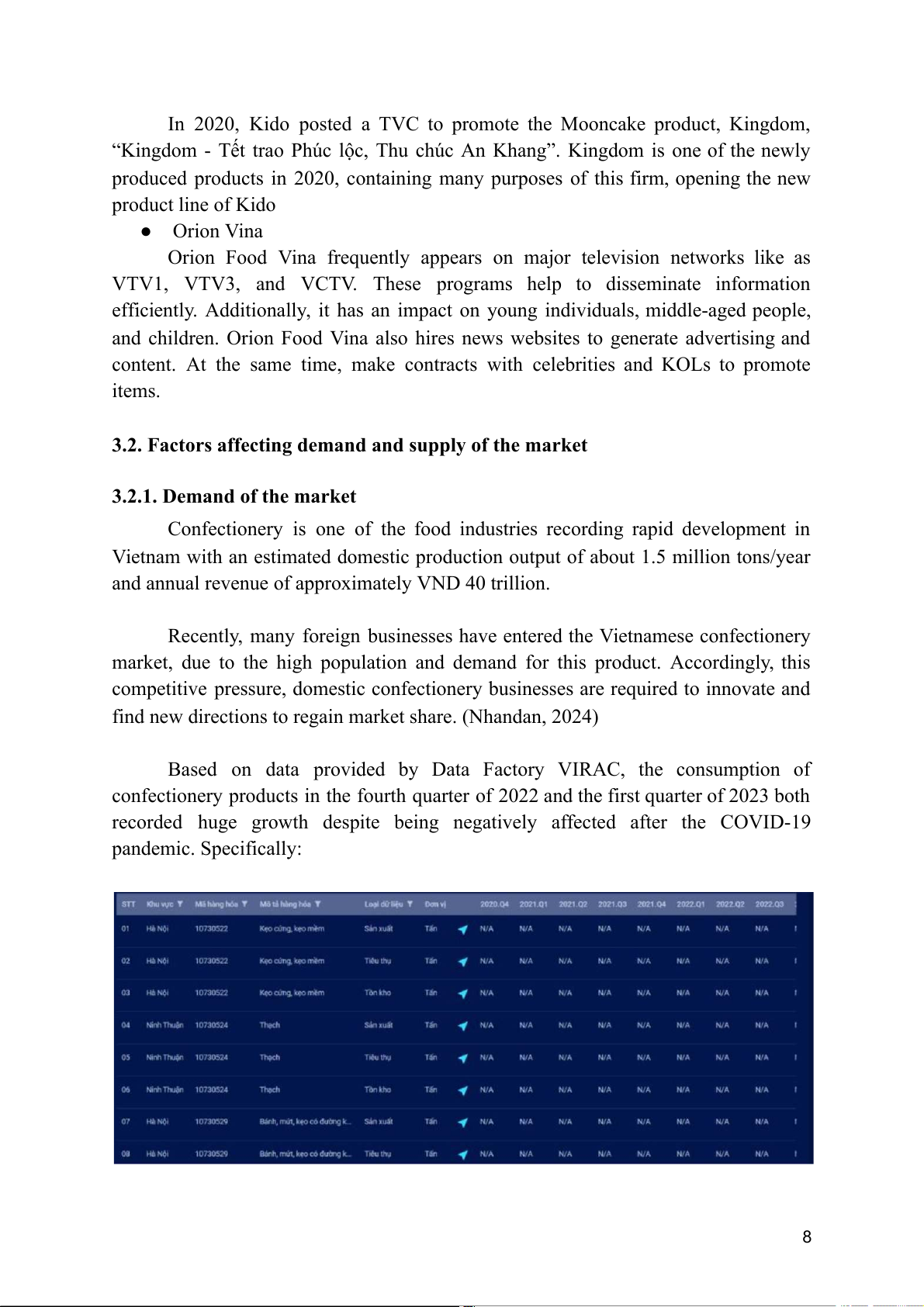
Based on data provided by Data Factory VIRAC, the consumption of
confectionery products in the fourth quarter of 2022 and the first quarter of 2023 both
recorded huge growth despite being negatively affected after the COVID-19 pandemic. Specifically: 8
Despite the economic downturn, people's demand for confectionery products
increased in one month before Tet. The confectionery market has also become more
active. Tet is a huge and significantly important festival for the Vietnamese people, so
people will continue to spend a lot of money on candies, drinks, and necessities during
Tet. Accordingly, the demand of the market is increasing depending on many factors. 3.2.2. Supply of the market
The Vietnamese confectionery market has been literally known as a potential
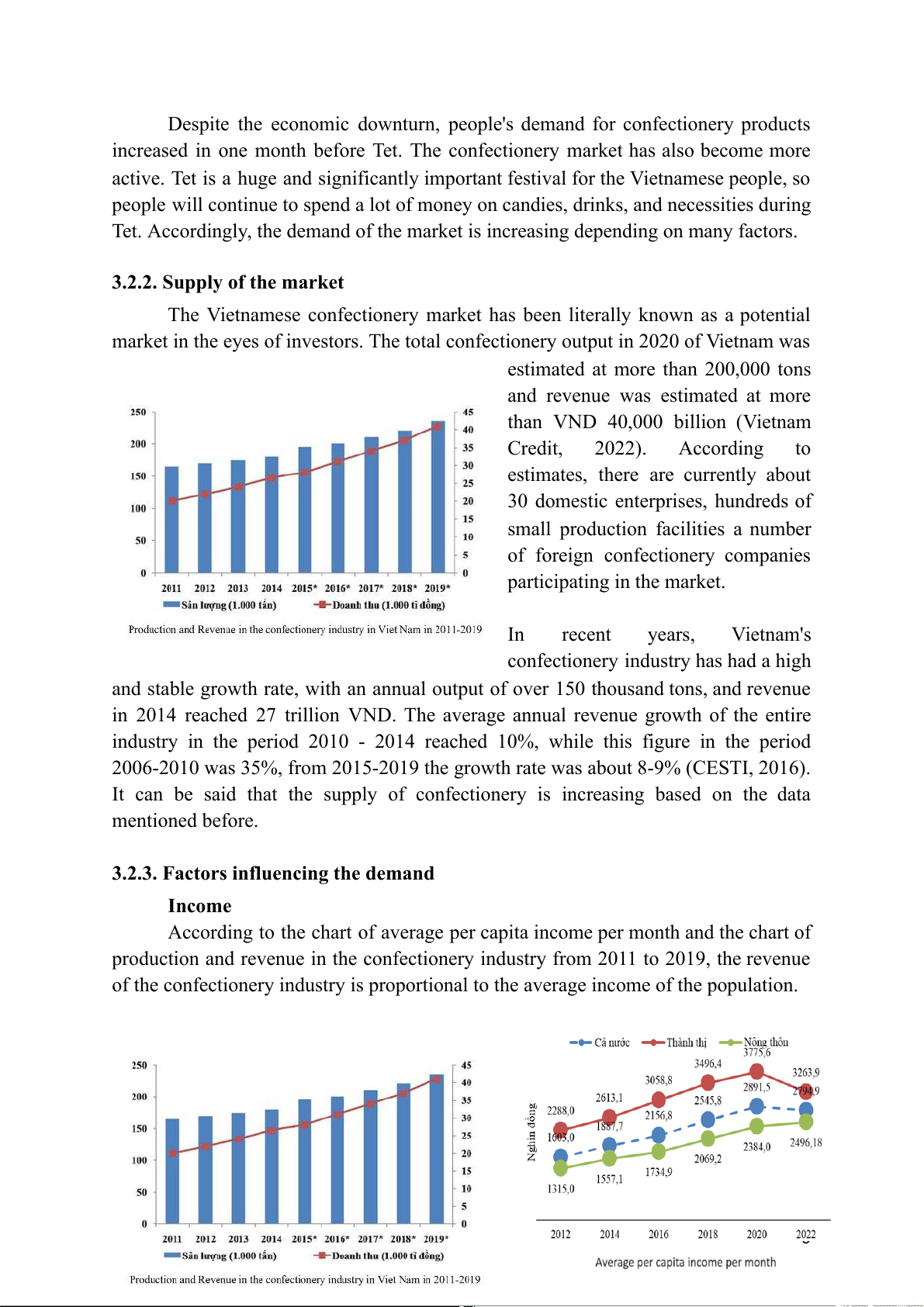
market in the eyes of investors. The total confectionery output in 2020 of Vietnam was
estimated at more than 200,000 tons
and revenue was estimated at more
than VND 40,000 billion (Vietnam Credit, 2022). According to
estimates, there are currently about
30 domestic enterprises, hundreds of
small production facilities a number
of foreign confectionery companies participating in the market. In recent years, Vietnam's
confectionery industry has had a high
and stable growth rate, with an annual output of over 150 thousand tons, and revenue
in 2014 reached 27 trillion VND. The average annual revenue growth of the entire
industry in the period 2010 - 2014 reached 10%, while this figure in the period
2006-2010 was 35%, from 2015-2019 the growth rate was about 8-9% (CESTI, 2016).
It can be said that the supply of confectionery is increasing based on the data mentioned before.
3.2.3. Factors influencing the demand Income
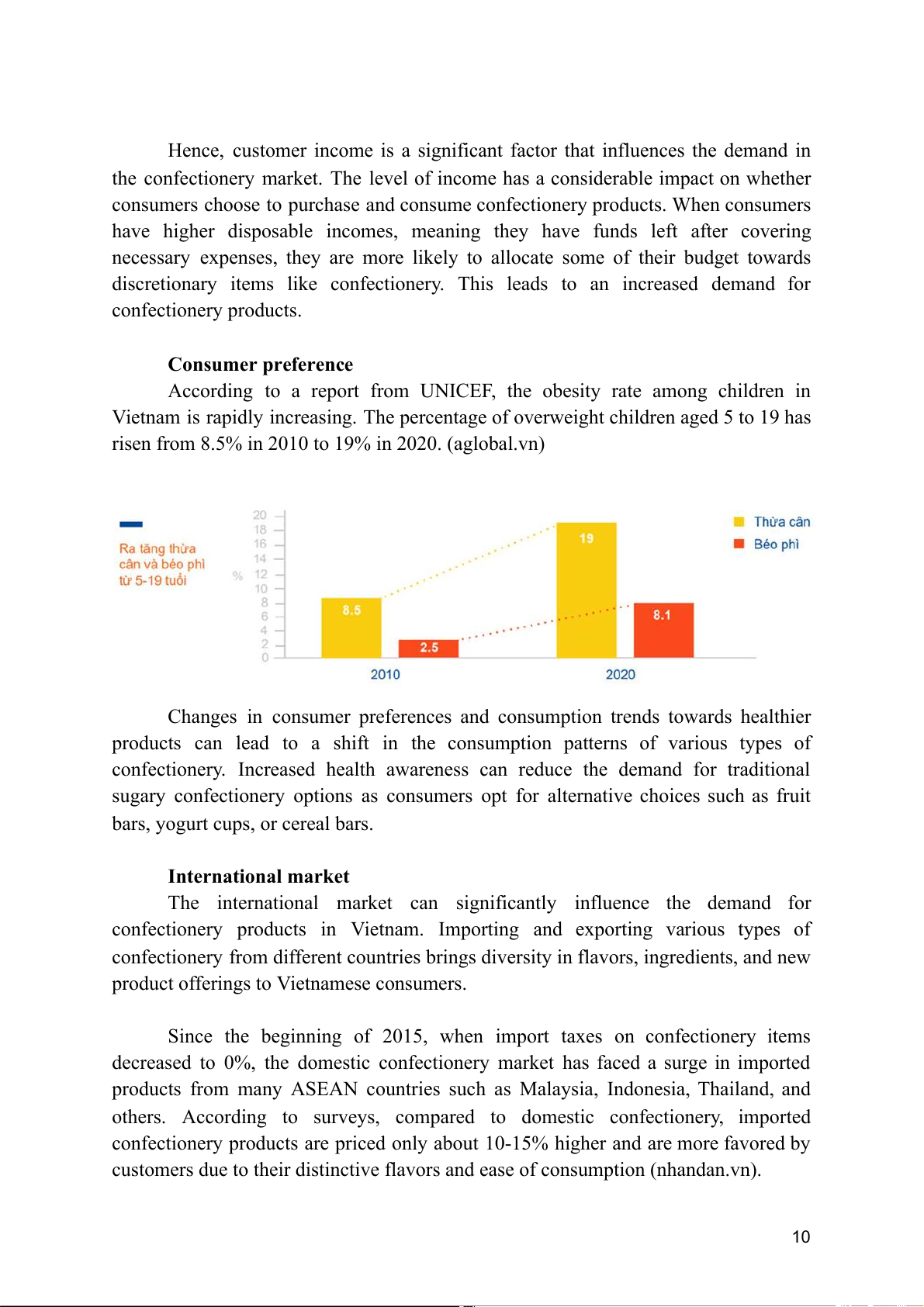
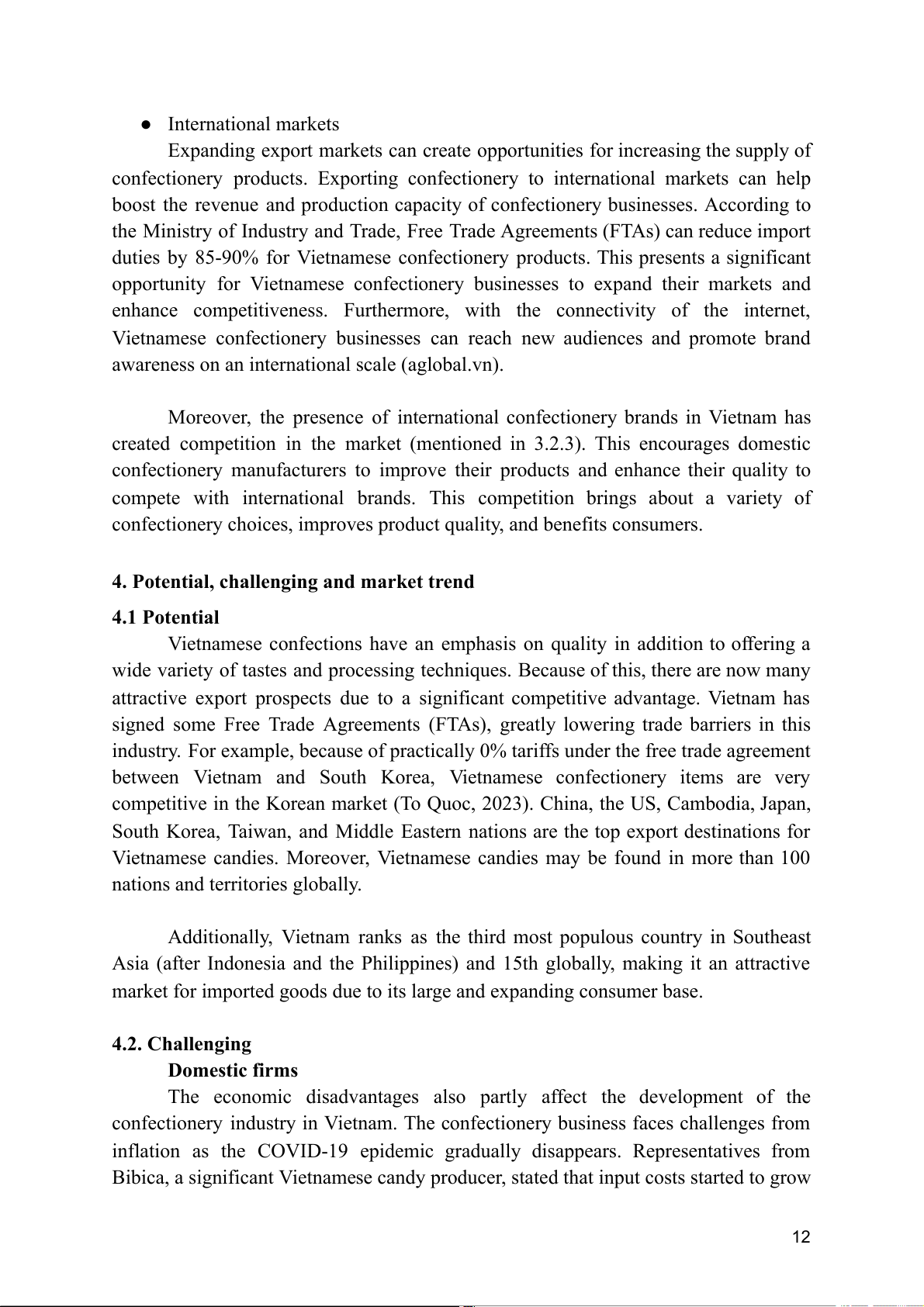
According to the chart of average per capita income per month and the chart of
production and revenue in the confectionery industry from 2011 to 2019, the revenue
of the confectionery industry is proportional to the average income of the population.
Hence, customer income is a significant factor that influences the demand in
the confectionery market. The level of income has a considerable impact on whether
consumers choose to purchase and consume confectionery products. When consumers
have higher disposable incomes, meaning they have funds left after covering
necessary expenses, they are more likely to allocate some of their budget towards
discretionary items like confectionery. This leads to an increased demand for confectionery products. Consumer preference
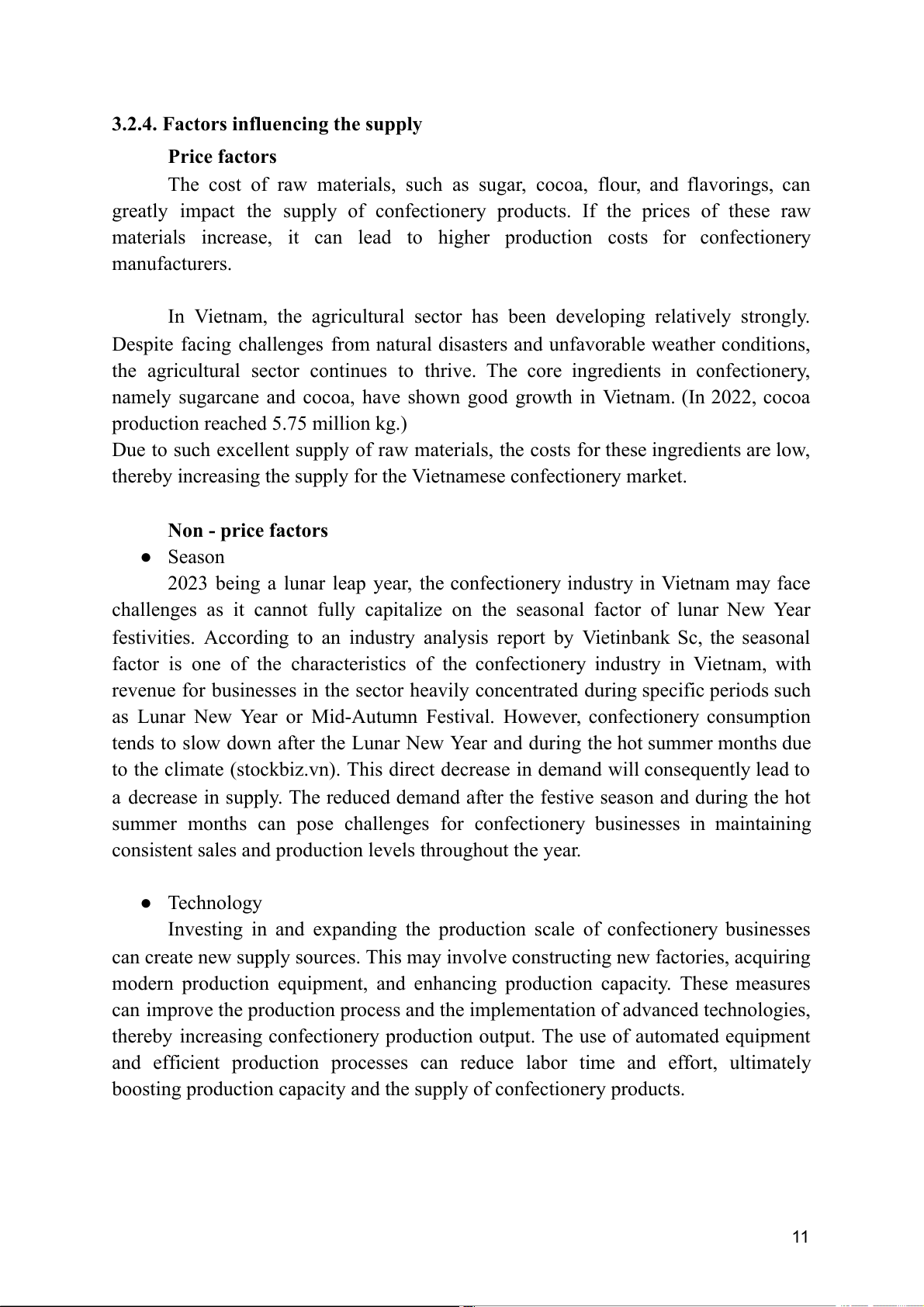
According to a report from UNICEF, the obesity rate among children in
Vietnam is rapidly increasing. The percentage of overweight children aged 5 to 19 has
risen from 8.5% in 2010 to 19% in 2020. (aglobal.vn)
Changes in consumer preferences and consumption trends towards healthier
products can lead to a shift in the consumption patterns of various types of
confectionery. Increased health awareness can reduce the demand for traditional
sugary confectionery options as consumers opt for alternative choices such as fruit
bars, yogurt cups, or cereal bars. International market
The international market can significantly influence the demand for
confectionery products in Vietnam. Importing and exporting various types of
confectionery from different countries brings diversity in flavors, ingredients, and new
product offerings to Vietnamese consumers.
Since the beginning of 2015, when import taxes on confectionery items
decreased to 0%, the domestic confectionery market has faced a surge in imported
products from many ASEAN countries such as Malaysia, Indonesia, Thailand, and
others. According to surveys, compared to domestic confectionery, imported
confectionery products are priced only about 10-15% higher and are more favored by
customers due to their distinctive flavors and ease of consumption (nhandan.vn). 10
3.2.4. Factors influencing the supply Price factors
The cost of raw materials, such as sugar, cocoa, flour, and flavorings, can
greatly impact the supply of confectionery products. If the prices of these raw
materials increase, it can lead to higher production costs for confectionery manufacturers.
In Vietnam, the agricultural sector has been developing relatively strongly.
Despite facing challenges from natural disasters and unfavorable weather conditions,
the agricultural sector continues to thrive. The core ingredients in confectionery,
namely sugarcane and cocoa, have shown good growth in Vietnam. (In 2022, cocoa
production reached 5.75 million kg.)
Due to such excellent supply of raw materials, the costs for these ingredients are low,
thereby increasing the supply for the Vietnamese confectionery market. Non - price factors ● Season
2023 being a lunar leap year, the confectionery industry in Vietnam may face
challenges as it cannot fully capitalize on the seasonal factor of lunar New Year
festivities. According to an industry analysis report by Vietinbank Sc, the seasonal
factor is one of the characteristics of the confectionery industry in Vietnam, with
revenue for businesses in the sector heavily concentrated during specific periods such
as Lunar New Year or Mid-Autumn Festival. However, confectionery consumption
tends to slow down after the Lunar New Year and during the hot summer months due
to the climate (stockbiz.vn). This direct decrease in demand will consequently lead to
a decrease in supply. The reduced demand after the festive season and during the hot
summer months can pose challenges for confectionery businesses in maintaining
consistent sales and production levels throughout the year. ● Technology
Investing in and expanding the production scale of confectionery businesses
can create new supply sources. This may involve constructing new factories, acquiring
modern production equipment, and enhancing production capacity. These measures
can improve the production process and the implementation of advanced technologies,
thereby increasing confectionery production output. The use of automated equipment
and efficient production processes can reduce labor time and effort, ultimately
boosting production capacity and the supply of confectionery products. 11 ● International markets
Expanding export markets can create opportunities for increasing the supply of
confectionery products. Exporting confectionery to international markets can help
boost the revenue and production capacity of confectionery businesses. According to
the Ministry of Industry and Trade, Free Trade Agreements (FTAs) can reduce import
duties by 85-90% for Vietnamese confectionery products. This presents a significant
opportunity for Vietnamese confectionery businesses to expand their markets and
enhance competitiveness. Furthermore, with the connectivity of the internet,
Vietnamese confectionery businesses can reach new audiences and promote brand
awareness on an international scale (aglobal.vn).
Moreover, the presence of international confectionery brands in Vietnam has
created competition in the market (mentioned in 3.2.3). This encourages domestic
confectionery manufacturers to improve their products and enhance their quality to
compete with international brands. This competition brings about a variety of
confectionery choices, improves product quality, and benefits consumers.
4. Potential, challenging and market trend 4.1 Potential
Vietnamese confections have an emphasis on quality in addition to offering a
wide variety of tastes and processing techniques. Because of this, there are now many
attractive export prospects due to a significant competitive advantage. Vietnam has
signed some Free Trade Agreements (FTAs), greatly lowering trade barriers in this
industry. For example, because of practically 0% tariffs under the free trade agreement
between Vietnam and South Korea, Vietnamese confectionery items are very
competitive in the Korean market (To Quoc, 2023). China, the US, Cambodia, Japan,
South Korea, Taiwan, and Middle Eastern nations are the top export destinations for
Vietnamese candies. Moreover, Vietnamese candies may be found in more than 100
nations and territories globally.
Additionally, Vietnam ranks as the third most populous country in Southeast
Asia (after Indonesia and the Philippines) and 15th globally, making it an attractive
market for imported goods due to its large and expanding consumer base. 4.2. Challenging Domestic firms
The economic disadvantages also partly affect the development of the
confectionery industry in Vietnam. The confectionery business faces challenges from
inflation as the COVID-19 epidemic gradually disappears. Representatives from
Bibica, a significant Vietnamese candy producer, stated that input costs started to grow 12
near the end of l2022 and that as of right now, raw material costs had increased by
20–25% when compared to the same period in 2022 (thesaigontimes, 2022). Foreign firms
Manufacturing raw materials for the confectionery production process poses a
significant challenge in Vietnam, primarily due to the seasonal nature of many raw
materials, coupled with natural disasters and adverse weather conditions.
In the context of deepening international economic integration, the export of
Vietnamese confectionery also faces numerous opportunities and challenges. There
are strict laws covering quality, food safety, labeling, inspection, and other factors to
each export market. To export to these markets, businesses need to follow certain
laws. This necessitates thorough documentation preparation, ongoing oversight, and
updating of these regulations, in addition to meticulous document preparation. Failure
to comply with these regulations puts businesses at risk of export rejection or product
recall, resulting in financial loss and damage to reputation.
The Vietnamese confectionery market also faces fierce competition from
imported products, especially from ASEAN countries and Europe. Import duties on
confectionery from ASEAN countries in Vietnam have been reduced to 0%, leading to
a large influx of imported confectionery products into the Vietnamese market. 4.3. Consumption trend
According to a 2023 Coc Coc study, 63% of participants preferred snacks, with
those aged 13–19 favoring them more (70%) than those aged 20 and older (57%).
Chocolate, ice cream, and cakes were products that appealed to people of every
generation. Price, region of origin, and flavor were the main variables that influenced
purchase decisions, with flavor having the most influence. The older group favored
nutritive materials, whereas the younger group was more interested in taste and
novelty. Two-thirds of respondents were willing to try new products, while the
youngers showed greater interest in premium brands and older people gravitated
toward limited edition products. The list of the most well-known confectionery brands
makes it clear that "imported" names dominate the market. The top 4 most familiar
brands with Vietnamese consumers include Oishi, Orion, Kinh Đô, and Lay’s. While
the market is full of potential, it is also a fierce competition for domestic enterprises to
assert their position on their home turf.
Not only does the Vietnamese confectionery market have a large consumer
base, but it also sees frequent purchases, with nearly half of respondents buying these
products weekly. Direct shopping channels like convenience stores and supermarkets 13
are preferred by 75% of consumers. About 35% of consumers make faster purchasing
decisions when encountering appealing promotions, and feel stimulated by unique
packaging or new product launches from their favorite brands. Overall, Vietnamese
consumers tend to buy snacks for themselves, with average spending ranging from
20,000 to 50,000 VND per product (Coccoc, 2023). 5. Recommendation
Put Quality and Food Safety First
To earn the confidence and loyalty of customers, make sure that all output
items adhere to quality and safety requirements. Diversify Product Offerings
Expand the range of confectionery products to cater to diverse consumer
preferences. Introduce innovative flavors, textures, and packaging designs to captivate
the market and stay ahead of competitors. Adjust to consumer trends
Constantly monitor trends and customer preferences to modify product offers.
Promote natural, healthful items and eco-friendly packaging to draw in customers who care about the environment.
Invest in research and development
Set aside funds for projects aimed at innovating and setting products apart from
the competition. To stand out from the competition and satisfy rising customer needs,
we're testing novel recipes and production methods. 6. Conclusion
After reviewing and analyzing, we describe the characteristics to prove the
confectionery industry is closer to monopolistic competition, with a relatively large
number of small firms and some main large firms in Vietnam’s confectionary market.
Until 2022, Kido took the largest market share in this industry. Products in firms are
similar but not identical, including main products, styles, and flavors. Barriers to entry
into the market are quite high causing new firms to need to meet conditions if they
want to have a significant position.
Moreover, this project shows the demand, and supply of the market and the
factors affecting them. But, in general, both the demand and supply of confectionary
products increase and are expected to increase soon due to the data we mentioned above. 14
In addition, due to identify the potential, challenges, and trends in the industry,
we make some recommendations for firms in this sector. Over the years, human needs
have changed, and the factors affecting supply and demand have also gradually
changed, so businesses need to grasp that to develop and gain more market share in
the market. In addition, Vietnam's confectionery market is an ideal place to attract
foreign businesses with many opportunities to enhance profits. REFERENCE
Aglobal THỊ TRƯỜNG BÁNH KẸO VIỆT NAM: TỪ NỘI ĐỊA ĐẾN VỊ THẾ
QUỐC TẾ [Online] Retrieved from:
https://aglobal.vn/blog/thi-truong-banh-keo-viet-nam-tu-noi-dia-den-vi-the-quoc-te-13 30272020
Brands Vietnam (2023) ORION TĂNG TRƯỞNG DOANH THU 2 CHỮ SỐ,
CHIẾM THÊM THỊ PHẦN NHỜ KHÔNG TĂNG GIÁ [Online] Retrived from:
https://www.brandsvietnam.com/23721-Orion-tang-truong-doanh-thu-2-chu-so-chiem
-them-thi-phan-nho-khong-tang-gia
CESTI (2016) HẤP DẪN THỊ TRƯỜNG BÁNH KẸO VIỆT NAM [Online] Retrieved from:
https://cesti.gov.vn/bai-viet/TGDL/hap-dan-thi-truong-banh-keo-viet-nam-01002491- 0000-0000-0000-000000000000
Nhandan (2024) GIAN NAN TÌM THỊ PHẦN CHO BÁNH KẸO VIỆT NAM [Online] Retrieved from:
https://nhandan.vn/gian-nan-tim-thi-phan-cho-banh-keo-viet-nam-post242278.html Retrieved from:
https://stockbiz.vn/tin-tuc/nguyen-nhan-bat-ngo-khien-cac-doanh-nghiep-banh-keo-ga
p-kho-khan-hon-trong-nam-2023-nam-nhuan/17437709
Stockbiz (2023) NGUYÊN NHÂN BẤT NGỜ KHIẾN CÁC DOANH NGHIỆP
BÁNH KẸO GẶP KHÓ KHĂN HƠN TRONG NĂM 2023: NĂM NHUẬN [Online]
To Quoc (2023) NGÀNH BÁNH KẸO TẠI VIỆT NAM ĐANG BÙNG NỔ [Online] Retrieved from:
https://toquoc.vn/nganh-banh-keo-tai-viet-nam-dang-bung-no-20230802084635445.ht m
Tong cuc thong ke (2022) THÔNG CÁO BÁO CHÍ KẾT QUẢ KHẢO SÁT MỨC
SỐNG DÂN CƯ 2022 [Online]. Retrieved from:
https://www.gso.gov.vn/du-lieu-va-so-lieu-thong-ke/2023/05/thong-cao-bao-chi-ket-q
ua-khao-sat-muc-song-dan-cu-2022/ 15
Vietdata (2023) KIDO - THAM VỌNG GIÀNH LẠI VỊ TRÍ DẪN ĐẦU TRONG
THỊ TRƯỜNG BÁNH KẸO VIỆT [Online] Retrieved from:
https://www.vietdata.vn/vi/post/kido-tham-v%E1%BB%8Dng-gi%C3%A0nh-l%E1%
BA%A1i-v%E1%BB%8B-tr%C3%AD-ng%C3%A0nh-b%C3%A1nh-k%E1%BA%B 9o
VietinBankSc (2015) BÁO CÁO NGÀNH BÁNH KẸO[Online]. Retrieved from:
https://www.cts.vn/wp-content/uploads/migrate/2015/09/30/cts-bao-cao-nganh-banh-k eo-092015-vnsshort.pdf
Vietnam Credit (2022) OVERVIEW OF VIETNAM’S CONFECTIONERY
INDUSTRY [Online] Retrieved from:
https://vietnamcredit.com.vn/news/overview-of-vietnams-confectionery-industry_147 78
Virac Research (2023) THỊ TRƯỜNG BÁNH KẸO TẾT 2024: DOANH NGHIỆP
TĂNG SẢN LƯỢNG – NGƯỜI TIÊU DÙNG ƯU TIÊN SẢN PHẨM LÀNH MẠNH [Online] Retrived from:
https://viracresearch.com/thi-truong-banh-keo-tet-2024-san-luong-hang-tang/ 16
Tài liệu liên quan:
-
Chương 3: độ co giãn và các nhân tố ảnh hưởng | Microeconomics | Trường Đại học Quốc tế, Đại học Quốc gia Thành phố Hồ Chí Minh
3 2 -
Microeconomics Syllabus | Microeconomics | Trường Đại học Quốc tế, Đại học Quốc gia Thành phố Hồ Chí Minh
3 2 -
Microeconomics Course Syllabus & Assessment Details | Microeconomics | Trường Đại học Quốc tế, Đại học Quốc gia Thành phố Hồ Chí Minh
3 2 -
Assignment 3 - Elasticity MCQs and Key Concepts | Microeconomics | Trường Đại học Quốc tế, Đại học Quốc gia Thành phố Hồ Chí Minh
3 2 -
Assignment 2 - Economic Equilibrium Analysis of Fridges and Motorcycles | Microeconomics | Trường Đại học Quốc tế, Đại học Quốc gia Thành phố Hồ Chí Minh
3 2