Final Group Project on Micro Economics: The Coffee Industry | Microeconomics | Trường Đại học Quốc tế, Đại học Quốc gia Thành phố Hồ Chí Minh
Coffee is a widely used beverage in every country. It is a very profitable crop. Consequently, the global coffee market is quite advanced. Among the nations that export coffee, this one has the fastest growth rate. The demand for coffee has not dropped but rather grown, particularly during the COVID-19 epidemic when the global economy was badly impacted. Vietnam is no different;The second-largest producer and exporter of coffee worldwide. Tài liệu được sưu tầm và soạn thảo dưới dạng file PDF để gửi tới các bạn cùng tham khảo, ôn tập đầy đủ kiến thức, chuẩn bị cho các buổi học thật tốt. Mời bạn đọc đón xem!
Môn: Microeconomics 635 tài liệu
Trường: Trường Đại học Quốc tế, Đại học Quốc gia Thành phố Hồ Chí Minh 1.9 K tài liệu
Tác giả:

Preview text:
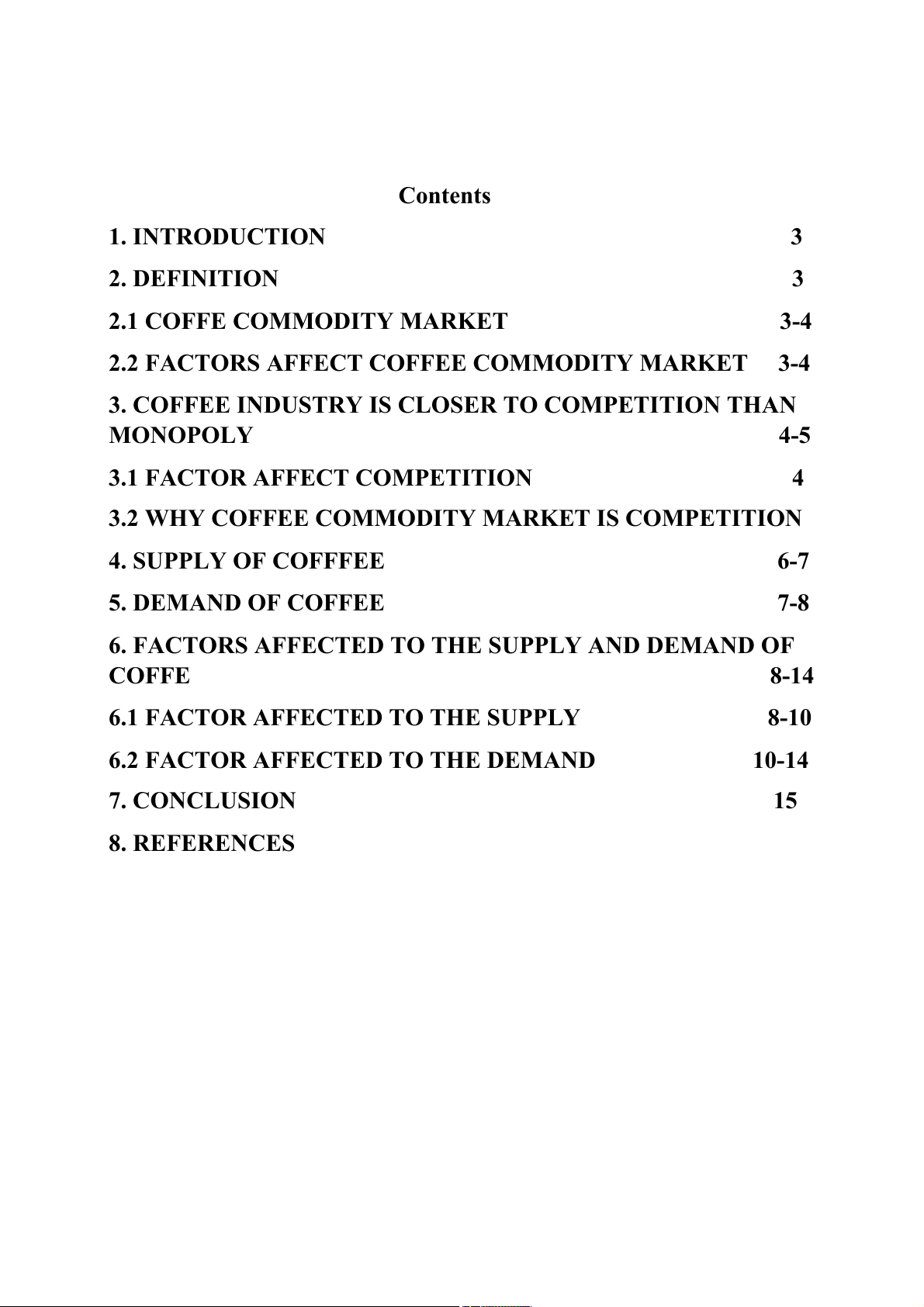
Contents 1. INTRODUCTION 3 2. DEFINITION 3
2.1 COFFE COMMODITY MARKET 3-4
2.2 FACTORS AFFECT COFFEE COMMODITY MARKET 3-4
3. COFFEE INDUSTRY IS CLOSER TO COMPETITION THAN MONOPOLY 4-5
3.1 FACTOR AFFECT COMPETITION 4
3.2 WHY COFFEE COMMODITY MARKET IS COMPETITION
4. SUPPLY OF COFFFEE 6-7 5. DEMAND OF COFFEE 7-8
6. FACTORS AFFECTED TO THE SUPPLY AND DEMAND OF COFFE 8-14
6.1 FACTOR AFFECTED TO THE SUPPLY 8-10
6.2 FACTOR AFFECTED TO THE DEMAND 10-14 7. CONCLUSION 15 8. REFERENCES 1. Introduction
Coffee is a widely used beverage in every country. It is a very
profitable crop. Consequently, the global coffee market is quite advanced.
Among the nations that export coffee, this one has the fastest growth rate.
The demand for coffee has not dropped but rather grown, particularly during
the COVID-19 epidemic when the global economy was badly impacted.
Vietnam is no different;The second-largest producer and exporter of coffee
worldwide is Vietnam. Given that the population is still growing at a pace of
around one million people per year, the country's coffee industry is predicted
to develop significantly over the course of the projected period..Therefore,
we chose Coffee market to be the topic of the final Microeconomics group projects. 2. Definition
2.1 Coffee commodity market
A common plant, coffee, is native to Africa and is grown in parts of the
Indian Ocean before eventually spreading to nearby areas and being produced
all over the world. Coffee has evolved over hundreds of years to become a
widely consumed beverage. Coffee is a very profitable crop. In the coffee
commodity market in Vietnam, it includes raw coffee and coffee productions
which is processed into beverage,etc.
In addition, Vietnam is an agricutural country, there are many areas where
are able to cultivate and produce Coffee on a large scale, these areas have
suitable weather, waters, bazan soil,.. such as Buon Ma Thuat, Daklak. Besides
that Vietnam has numerous enterprises capable of producing and exporting
Coffee such as Trung Nguyen Legend, King Coffee, Phuc Long Tea &
Coffee,etc. Furthermore, the auarantee of the suppy of distributors, especially
large distributors, has helped stabilize the source of manufactured goods, such
as Aeon Vietnam co, the Vinmart and Vinmart +, … and major export markets
such as America, China, Japan, Korea,…
2.2 Factors affect coffee commodity market
Recently, we can be seen that there is an increasing in the number of
coffee raw and products, there are many other factors affecting the
market, including: Price, Input price, Production technology, Supplier’s
expectation, Government policy, Consumer’s income and Number of
consumers. These factors will greatly affect the supply from businesses
and the demand from consumers. In particular, customer income, tastes,
and expectations will directly affect consumer demand; selling prices,
technology, human resources, and government policies will affect the supply of goods in the market
3. Coffee industry is closer to competition than monopoly
3.1 Factors affect competition
From a microeconomics perspective, competition is decided by 5
simply factors: products features, the wide variety of sellers, statistics
availability, location and obstacles to entry. Ech element hinges on the
availability or splendor of subsitutes and while no options exist the
corporation is a vendor of a completely unique product, a monopoly exists
and there is a zero oppo sition. In short, competition happens when there are
many sellers, easy entry, identical products and sellers are price takers.
3.2 Why coffee market is competition (*) Product features:
The features of the coffee market today are similar.Coffee is a
beverage that the French brought to Vietnam in the 19th century and that
has since assimilated into Vietnamese life and culture. Because caffeine,
a component of coffee, can enhance your short-term memory if you
consume it in moderation throughout the day, most individuals drink
coffee in the morning. Additionally, coffee aids in preventing oxidation.
Caffeine in coffee helps to reduce mental cognitive loss by preventing the
buildup of beta-amyloid plaque, which starts the process of Alzheimer's
disease, a form of dementia. Additionally, coffee protects against liver,
breast, and rectal cancers, especially in women. For athletes, coffee can
aid improve excerise performance.
(*) The wide variety of sellers:
Although producing coffee is difficult and expensive but Vietnam as
a developing nation and the former second-largest coffee producer in the
world the quality must makes up for the quantity and assure the demand.
The cost of producing coffee is not too high, so that in Vietnam there arae
3 main coffee distribution channels.
1, Production group: Not too much company in Vietnam are
qualified to produce coffee that complies with the prescribed standards.
Besides that, coffee producers must follow to a numerous requirement
regarding staff, infrastructure, techonology and quality. These businesses
are eligible to expand in the market and the main exporter of Vietnam’s coffee to the world
2, Agents and businesses who distribute coffee in bulk, are included in
the wholesale group. This organization frequently works as a production facility or
as a partner with one. They are always the top businesses in the nation for the
distribution and manufacture of smart devices and supplies. That includes a chain
of both large and small coffee shop, a supermarket, and a shopping center,etc. (*) Obstacles to entry:
We have a very large coffee production, so it is easy for sellers to import, but
the cost of preserving and forming the product is quite large. In order to produce
better quality and better quality and quantity of coffee than usal, the production
cost needs to be relatively large. Producers need to be careful in barriers to entry. (*) Statistics availability:
The availability of information is also important, and it largely revolves
around price discovery. Currently, large companies have their own websites, social
media platforms to update products and prices that is so convenient for customers
to keep track and compare. For ordinary coffees users can directly consult the
price, because coffee products are so popular and interested by a number of consumers. (*) Strategy
Competing on the type of coffee so that each company can make a big
profit, so that most of the coffee is present throughout our country for many people
to know. Due to the increasing competition, most people will invest in advertising,
to promote the product to the market with new product ideas. In addition,
nowadays people have a tendency to buy Coffee in distance through e-markets
such as shoppee food, nowfood,etc. So that by locating their money resources to
advertising their products on these e-market that can attract more consumers’
attention. Which is very helpful for the company to increase the revenue. (*) Location
Coffee are usually sold at major roads, in coffee shops, beverage
spots,etc. So that companies want to compete to be distributed in large locations
that are easy to attract consumers. Especially nowadays, consumers have a
tendency to buy coffee frequently so a large and reputable sales location will help
the company increase total revenue. 4. Supply of Coffee
Beginning with talking about coffee supply in the world, there are
many countries capable of exporting coffee in a large quantity.We can
mention of the world's leading export names such as Brazil, Colombia,
Indonesia, India, etc. And our Vietnam is also 1 of them. Our Vietnam is the
2nd largest coffee exporter in the world. Coffee is one of 6 export items with
a turnover of over 3 billion USD/year. With that value, it belongs to the
leading group of the agricultural sector and rural development sector and
contributes to the growth of commodity exports in Vietnam. In Vietnam,
thanks to the climate and suitable terrain, those things have helped our
country's coffee production to be higher and higher. Coffee is grown a lot in
Vietnam, we must mention the first is the Central Highlands. In particular,
Buon Ma Thuot coffee bowl in Dak Lak is one of the largest coffee bowls in
the world. With ideal weather conditions, this place is suitable for growing
coffee, especially Robusta coffee. Coffee production in Buon Ma Thuot is
currently at the top of the country. Besides the "coffee capitals", Vietnam
has many coffee growing places: Gia Lai, Quảng Trị, Đắk Hà, Đắk Mil, Đắk
Hà, …. In the EU market, Vietnam is the second largest coffee supplier after
Brazil (22.2%), accounting for 16.1% market share in volume. In particular,
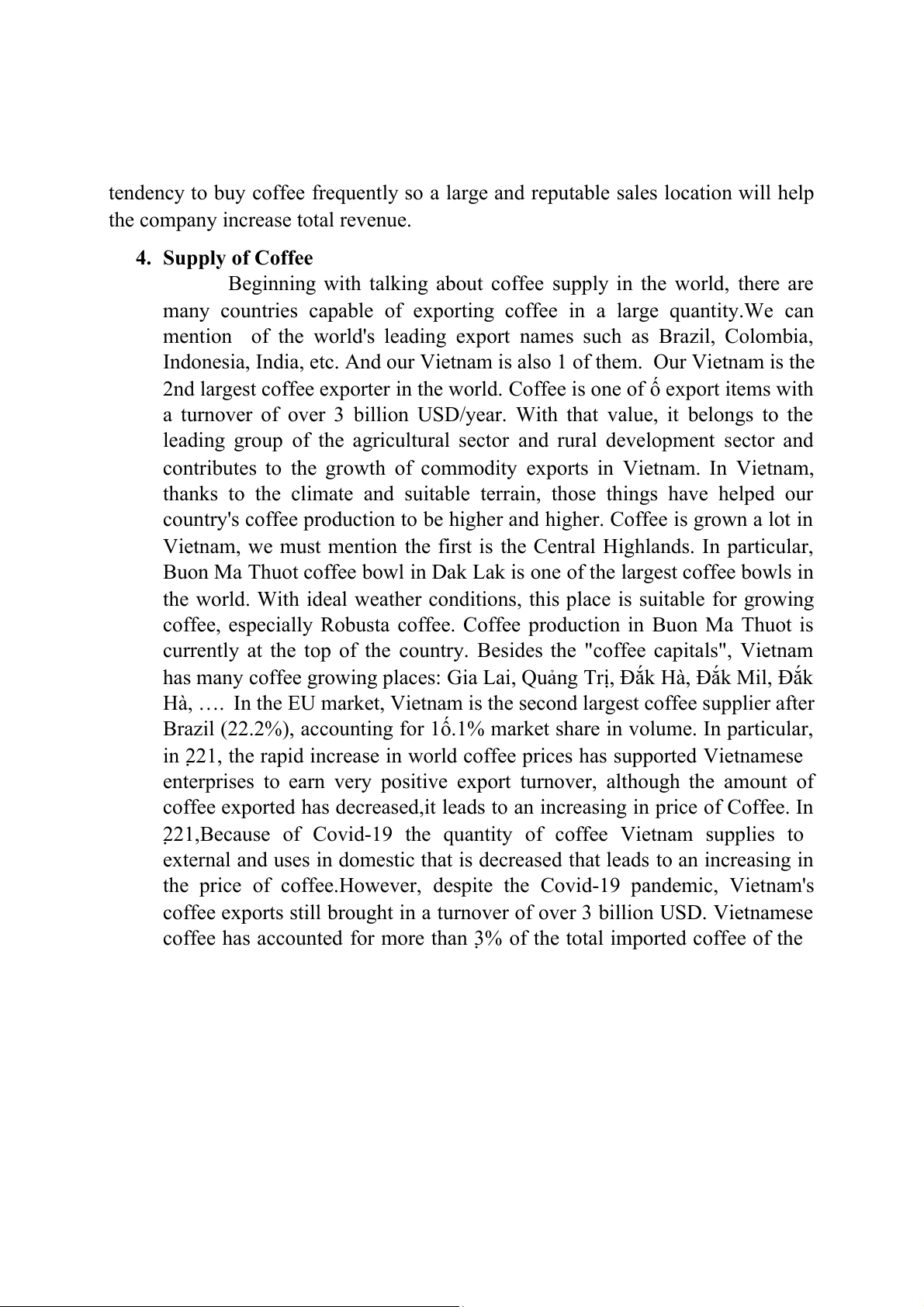
in 2021, the rapid increase in world coffee prices has supported Vietnamese
enterprises to earn very positive export turnover, although the amount of
coffee exported has decreased,it leads to an increasing in price of Coffee. In
2021,Because of Covid-19 the quantity of coffee Vietnam supplies to
external and uses in domestic that is decreased that leads to an increasing in
the price of coffee.However, despite the Covid-19 pandemic, Vietnam's
coffee exports still brought in a turnover of over 3 billion USD. Vietnamese
coffee has accounted for more than 30% of the total imported coffee of the most populous market. 5. Demand of coffee
When it comes to supply, we definitely have to talk about demand, in
general, we can see that most people have had coffee at least once. There are
people who are so addicted to coffee that without it every morning, they will work
unfocused and lack energy for the long day. In the world, we can name the top
coffee consumers in the world: Finland, Norway, Iceland, Denmark, ... Returning
to Vietnam, coffee can also be considered a "national" drink. Vietnamese people
also often enjoy coffee every day. We must have encountered big coffee brands in
Vietnam. When talking about coffee brands in Vietnam, people immediately think
of Trung Nguyen, Highland, The Coffee House,..... These coffee brands are
increasingly expanding, reaching the customer market, from which they will have
loyal customers. Besides that there are numerous coffee distributors in Vietnam, so
there would be a wide range of coffee pricing. Due to daily price changes in the
global market, coffee prices will also change. However, Vietnamese people have
long been accustomed to drinking coffee, thus despite price changes, customers
continue to purchase the beverage. Coffee helps people concentrate, become
smarter, have more energy, and reduce stress. Some customers find it impossible to
stop drinking coffee since it contains caffeine. Additionally, it takes a long time to
stop drinking coffee or find a substitute. The growing coffee culture may
potentially lead to higher than usual consumer demand for the beverage. The
popularity of coffee from other cultures has piqued consumers' curiosity and desire
to try new coffee flavors. That further stimulates big brands to have strategies to
attract new customers and retain old ones thanks to the quality of coffee and
accompanying services. However, with the economic situation in 2022, the
economy is somewhat depressed and the average price level of coffee increased
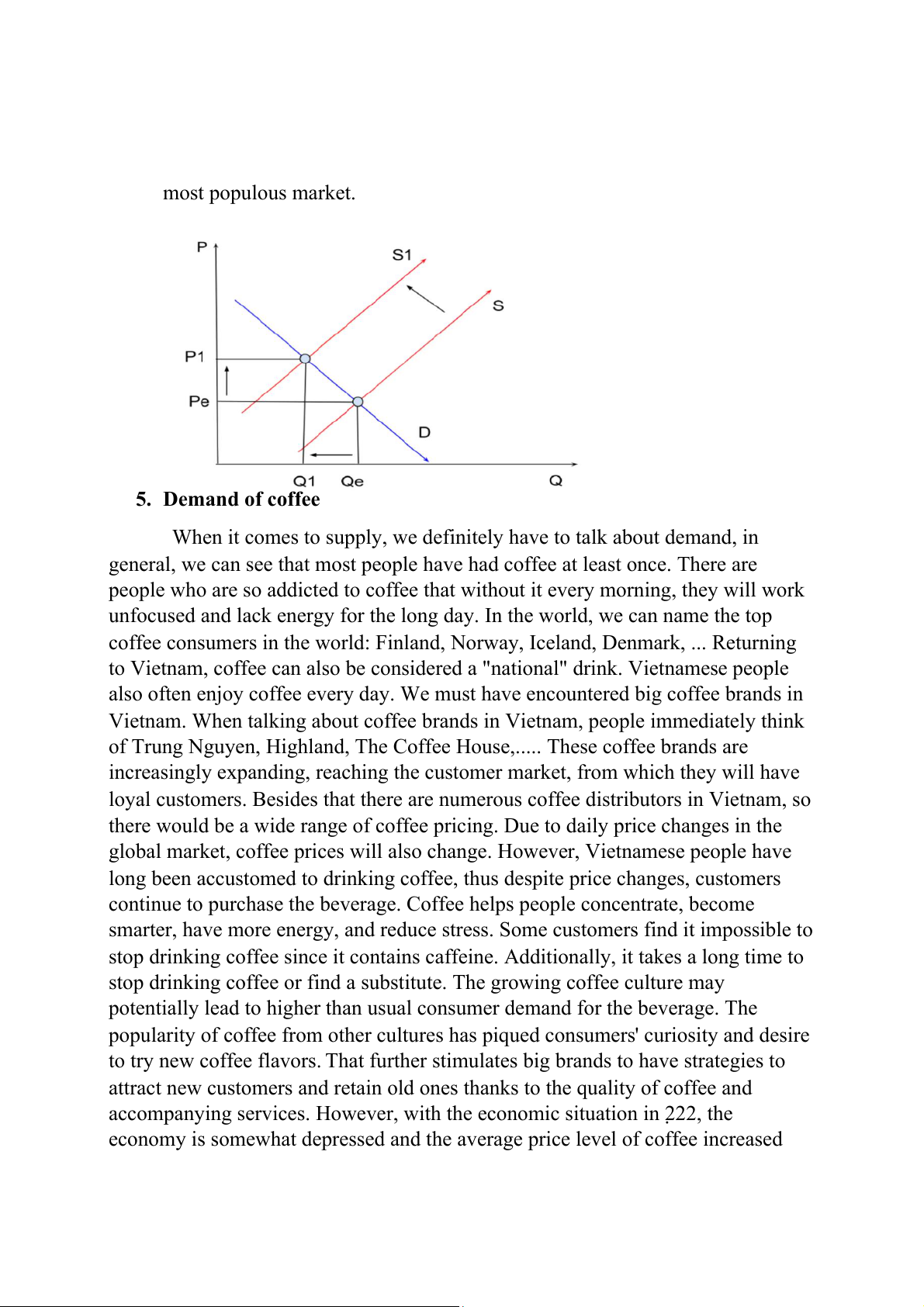
before the pandemic a cup of black coffee was about 20.000-25.000 VND , but
now it is 25.000-35.000 VND.But people's demand for coffee is still more and
more, no longer the same as before.
Total coffee consumption in Vietnam from 2015 to 2022 with a forecast to 2023 (in 1,000 60 kg bags)
6. Factors affected the supply and demand of Coffee
6.1 Factors affected the supply (*) The price factor
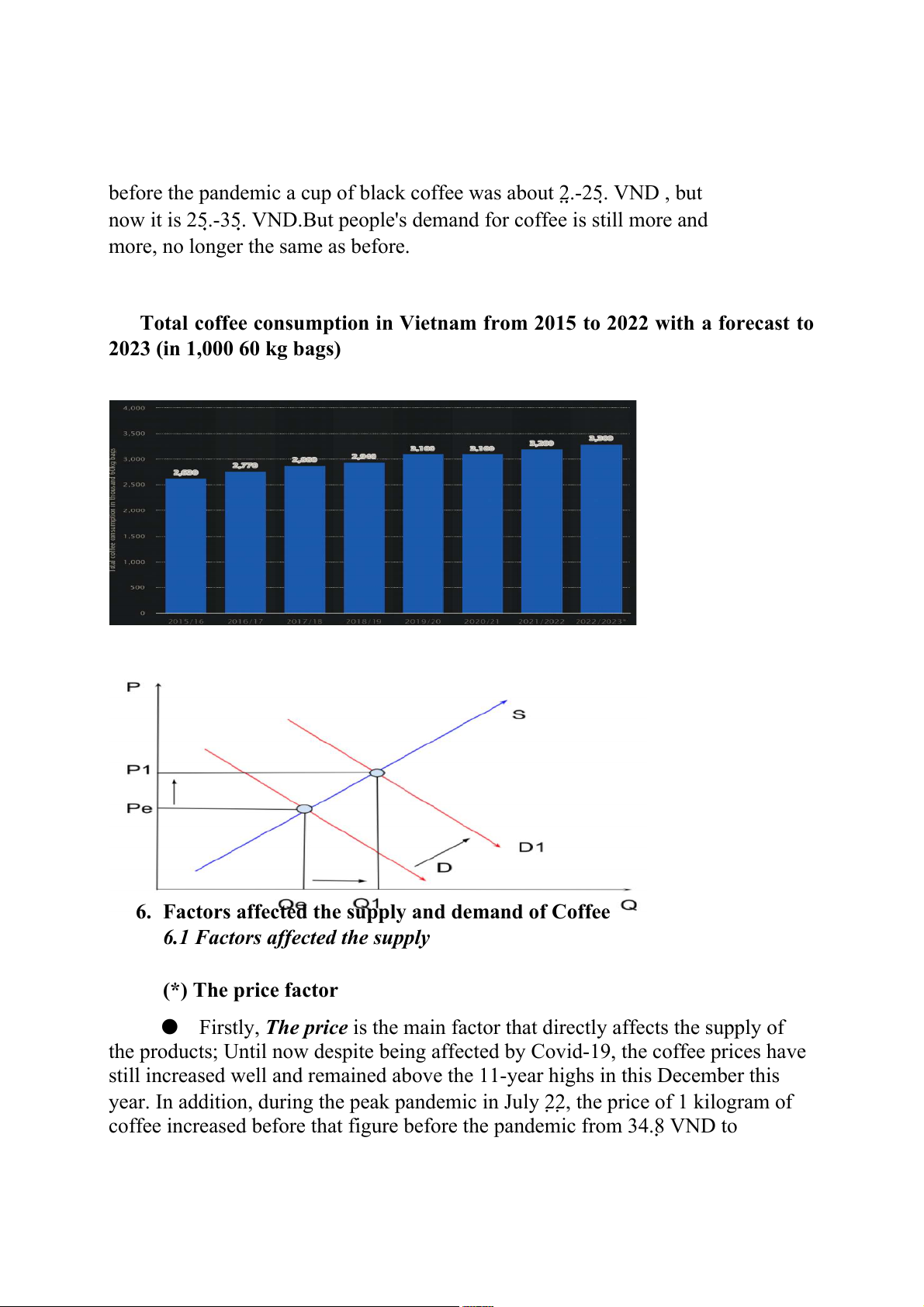
● Firstly, The price is the main factor that directly affects the supply of
the products; Until now despite being affected by Covid-19, the coffee prices have
still increased well and remained above the 11-year highs in this December this
year. In addition, during the peak pandemic in July 2020, the price of 1 kilogram of
coffee increased before that figure before the pandemic from 34.800 VND to
40.800 VND per KG in Robusta coffee. As a consequence, more and more firms
and companies are engaging in this kind of commodity market. Leading to an
increase in supply. For instance, based on a research from baonhandan.com the
coffee.Leading to an increase in supply. For instance, based on a research from
statista.com, from June 2022 to August 2022, more than 2000 firms and companies
decided to take part in the Coffee commodity market in Vietnam, which leads to
the huge number of productions related to coffee that is being produced.
(*) The non-price factors:
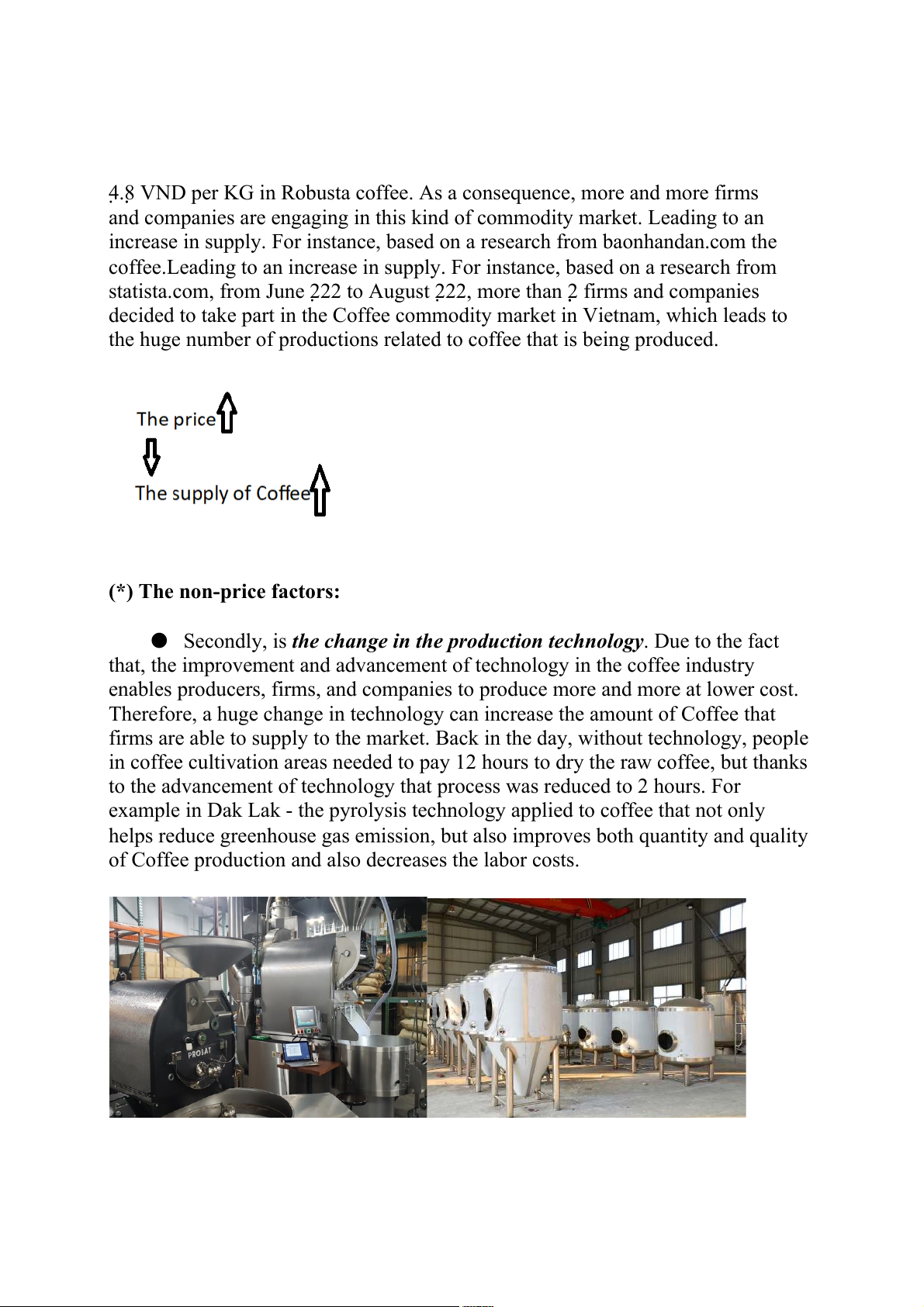
● Secondly, is the change in the production technology. Due to the fact
that, the improvement and advancement of technology in the coffee industry
enables producers, firms, and companies to produce more and more at lower cost.
Therefore, a huge change in technology can increase the amount of Coffee that
firms are able to supply to the market. Back in the day, without technology, people
in coffee cultivation areas needed to pay 12 hours to dry the raw coffee, but thanks
to the advancement of technology that process was reduced to 2 hours. For
example in Dak Lak - the pyrolysis technology applied to coffee that not only
helps reduce greenhouse gas emission, but also improves both quantity and quality
of Coffee production and also decreases the labor costs.
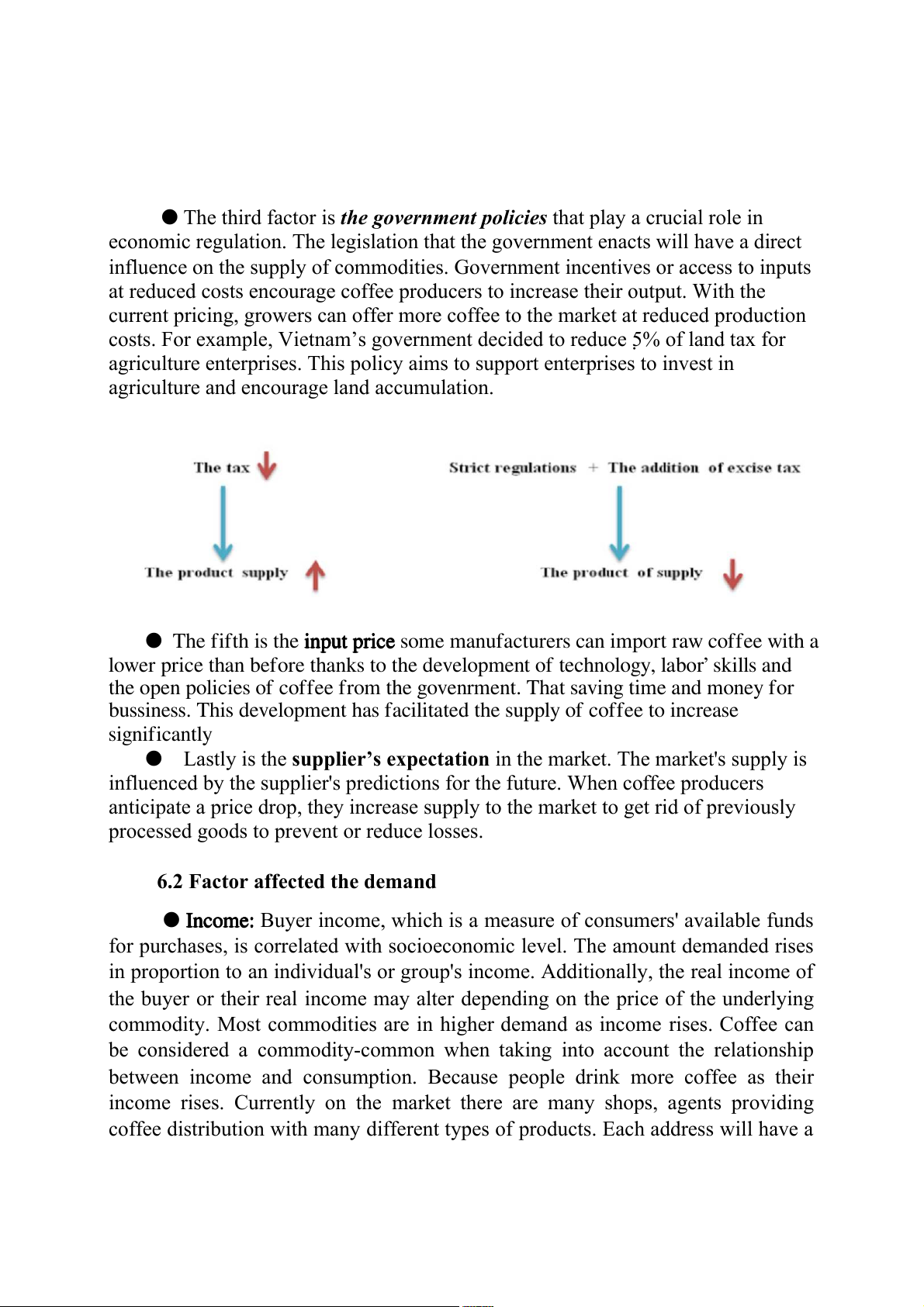
● The third factor is the government policies that play a crucial role in
economic regulation. The legislation that the government enacts will have a direct
influence on the supply of commodities. Government incentives or access to inputs
at reduced costs encourage coffee producers to increase their output. With the
current pricing, growers can offer more coffee to the market at reduced production
costs. For example, Vietnam’s government decided to reduce 50% of land tax for
agriculture enterprises. This policy aims to support enterprises to invest in
agriculture and encourage land accumulation. ● The fifth is the in i pu n t pu pr t i pr c i e c s
e ome manufacturers can import raw coffee with a
lower price than before thanks to the development of technology, labor’ skills and
the open policies of coffee from the govenrment. That saving time and money for
bussiness. This development has facilitated the supply of coffee to increase significantly
● Lastly is the supplier’s expectation in the market. The market's supply is
influenced by the supplier's predictions for the future. When coffee producers
anticipate a price drop, they increase supply to the market to get rid of previously
processed goods to prevent or reduce losses.
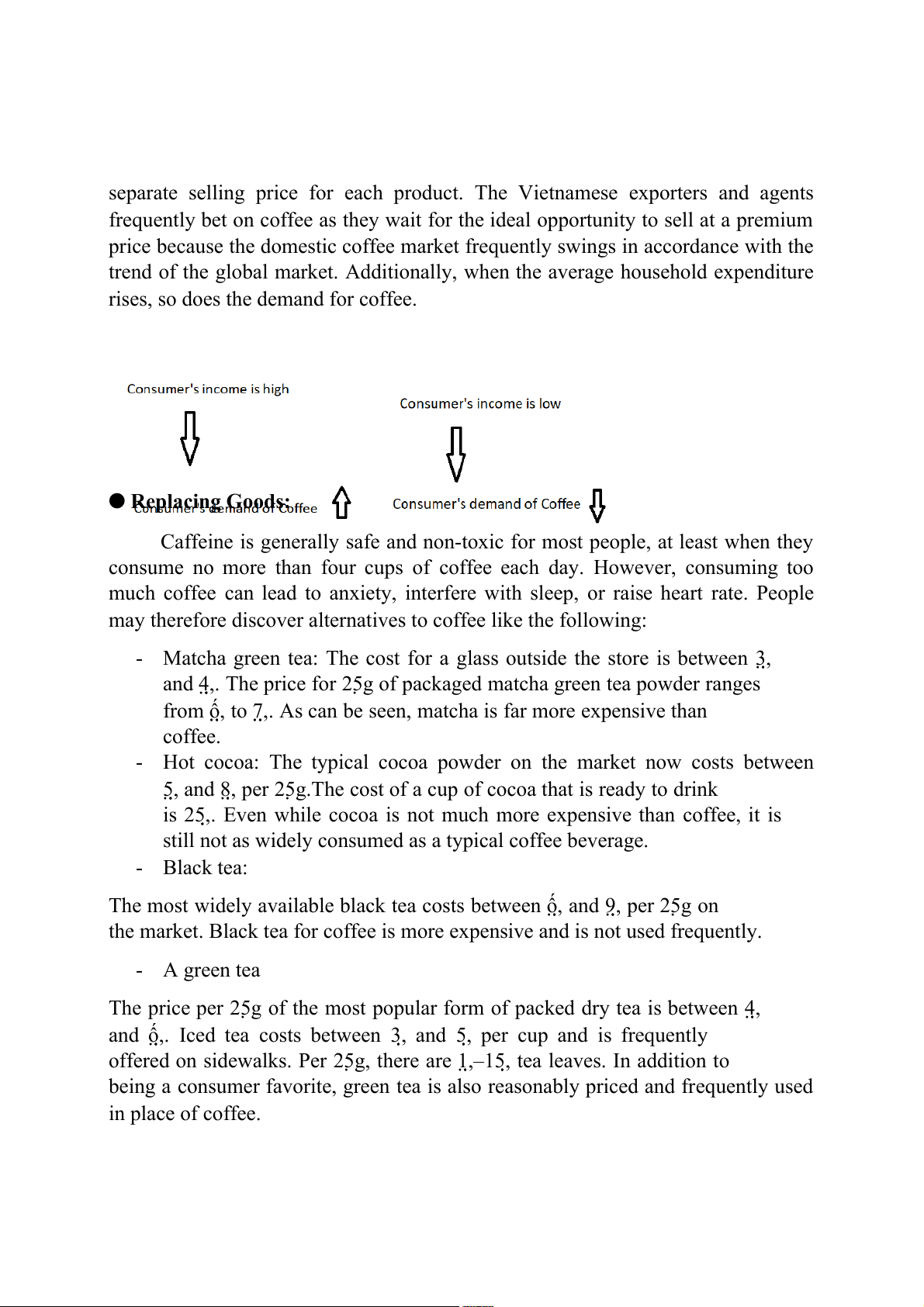
6.2 Factor affected the demand ● In I c n o c m o e m :
e Buyer income, which is a measure of consumers' available funds
for purchases, is correlated with socioeconomic level. The amount demanded rises
in proportion to an individual's or group's income. Additionally, the real income of
the buyer or their real income may alter depending on the price of the underlying
commodity. Most commodities are in higher demand as income rises. Coffee can
be considered a commodity-common when taking into account the relationship
between income and consumption. Because people drink more coffee as their
income rises. Currently on the market there are many shops, agents providing
coffee distribution with many different types of products. Each address will have a
separate selling price for each product. The Vietnamese exporters and agents
frequently bet on coffee as they wait for the ideal opportunity to sell at a premium
price because the domestic coffee market frequently swings in accordance with the
trend of the global market. Additionally, when the average household expenditure
rises, so does the demand for coffee. ● Replacing Goods:
Caffeine is generally safe and non-toxic for most people, at least when they
consume no more than four cups of coffee each day. However, consuming too
much coffee can lead to anxiety, interfere with sleep, or raise heart rate. People
may therefore discover alternatives to coffee like the following:
- Matcha green tea: The cost for a glass outside the store is between 30,000
and 40,000. The price for 250g of packaged matcha green tea powder ranges
from 600,000 to 700,000. As can be seen, matcha is far more expensive than coffee.
- Hot cocoa: The typical cocoa powder on the market now costs between
50,000 and 80,000 per 250g.The cost of a cup of cocoa that is ready to drink
is 25,000. Even while cocoa is not much more expensive than coffee, it is
still not as widely consumed as a typical coffee beverage. - Black tea:
The most widely available black tea costs between 60,000 and 90,000 per 250g on
the market. Black tea for coffee is more expensive and is not used frequently. - A green tea
The price per 250g of the most popular form of packed dry tea is between 40,000
and 60,000. Iced tea costs between 3,000 and 5,000 per cup and is frequently
offered on sidewalks. Per 250g, there are 10,000–15,000 tea leaves. In addition to
being a consumer favorite, green tea is also reasonably priced and frequently used in place of coffee. ● User preferences
Approximately 10% of coffee users determine the change in demand when the
price changes, so it can be concluded that the good for coffee has a price inelastic
demand. According to VHLSS, Coffee in the Vietnamese market has up to 90% of
the total coffee consumption market volume are loyal users, so when placing
coffee in its own market, coffee is considered to be an essential commodity.
Additionally, coffee is not an expensive product for the majority of people, and
because its price only varies by a little amount, the impact on household income is
minimal. From there, it can be seen that coffee continues to be a popular beverage
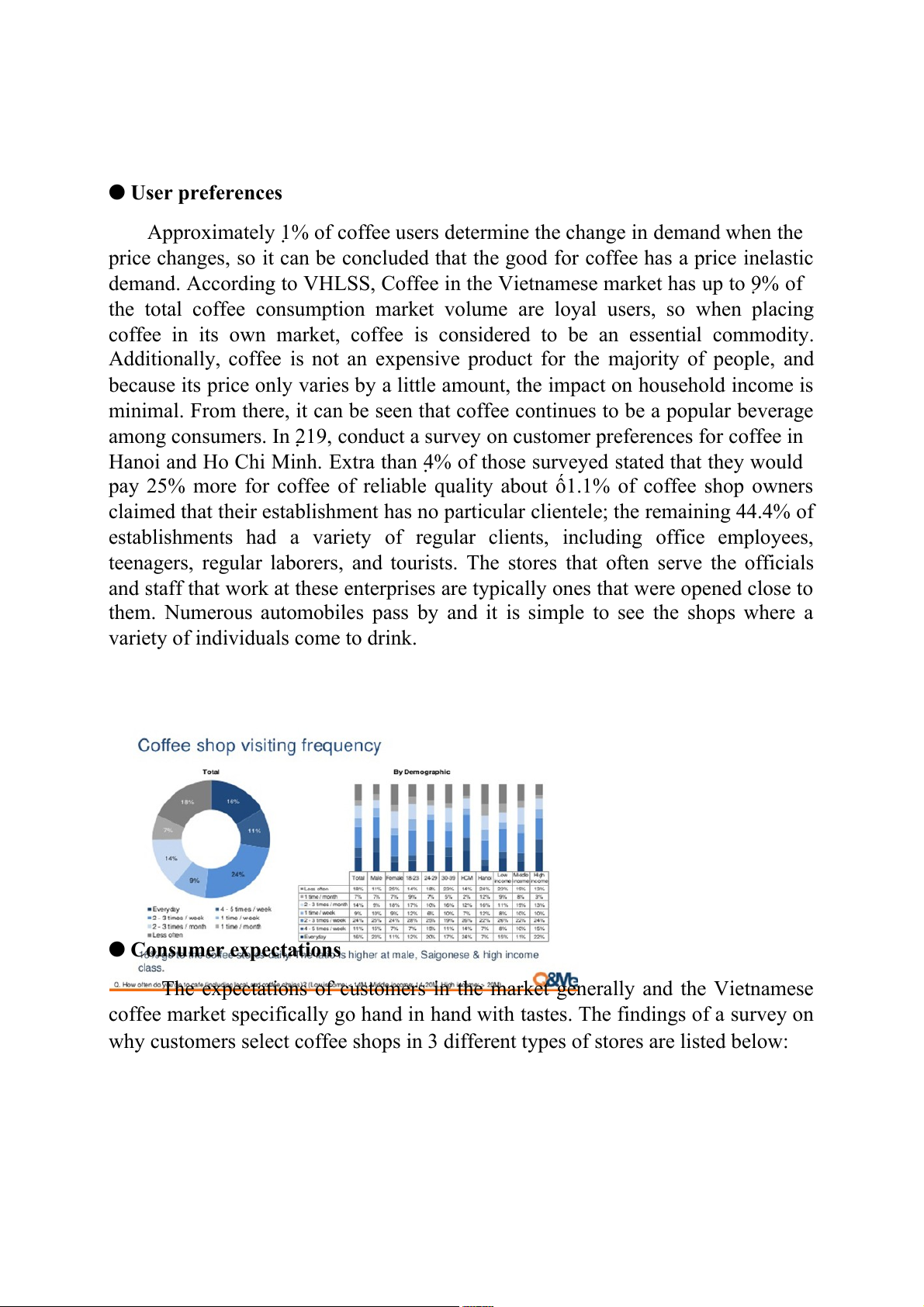
among consumers. In 2019, conduct a survey on customer preferences for coffee in
Hanoi and Ho Chi Minh. Extra than 40% of those surveyed stated that they would
pay 25% more for coffee of reliable quality about 61.1% of coffee shop owners
claimed that their establishment has no particular clientele; the remaining 44.4% of
establishments had a variety of regular clients, including office employees,
teenagers, regular laborers, and tourists. The stores that often serve the officials
and staff that work at these enterprises are typically ones that were opened close to
them. Numerous automobiles pass by and it is simple to see the shops where a
variety of individuals come to drink.
● Consumer expectations
The expectations of customers in the market generally and the Vietnamese
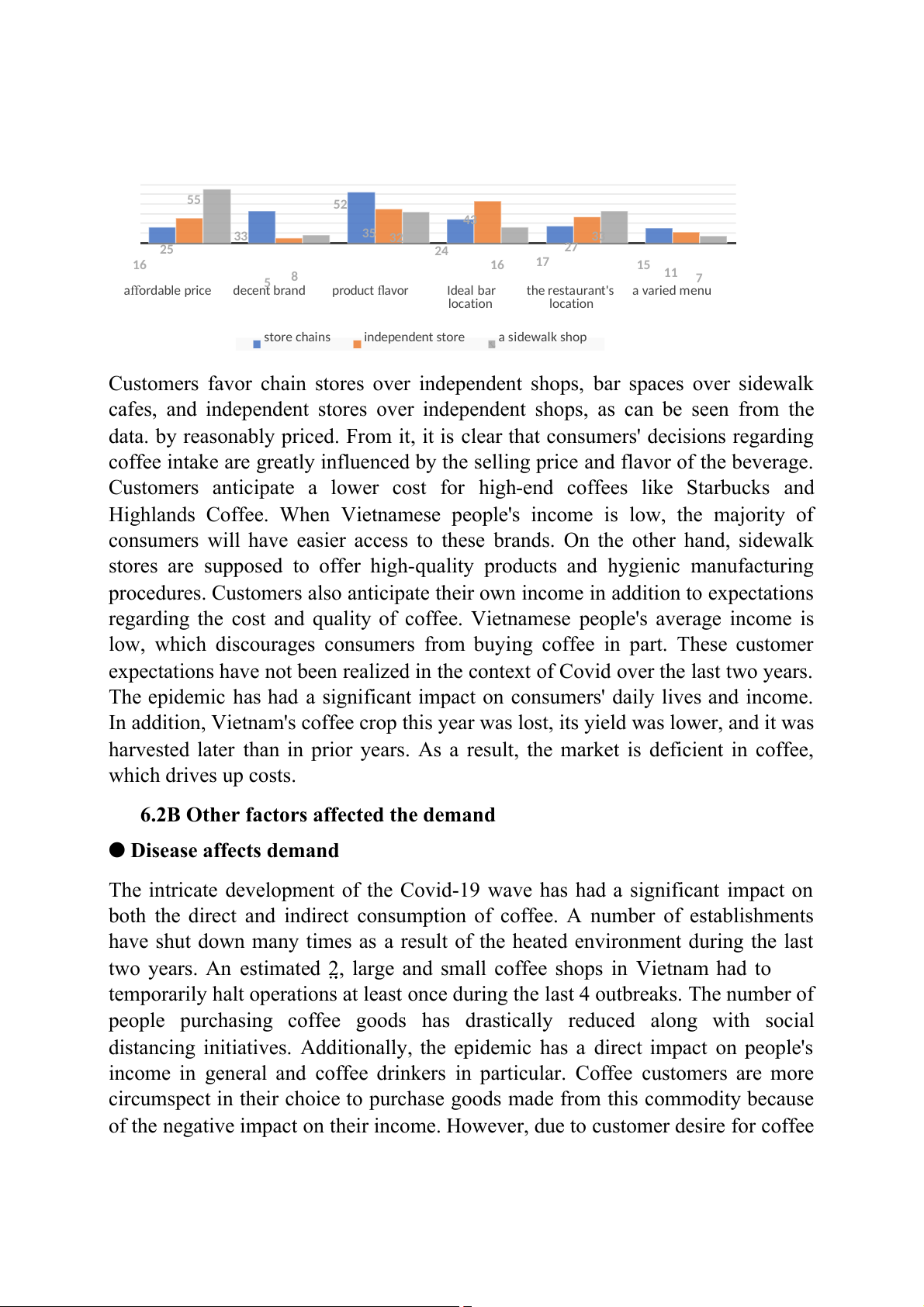
coffee market specifically go hand in hand with tastes. The findings of a survey on
why customers select coffee shops in 3 different types of stores are listed below: 55 52 43 33 35 32 33 25 24 27 16 17 16 15 11 8 5 7 affordable price decent brand product flavor Ideal bar the restaurant's a varied menu location location store chains independent store a sidewalk shop
Customers favor chain stores over independent shops, bar spaces over sidewalk
cafes, and independent stores over independent shops, as can be seen from the
data. by reasonably priced. From it, it is clear that consumers' decisions regarding
coffee intake are greatly influenced by the selling price and flavor of the beverage.
Customers anticipate a lower cost for high-end coffees like Starbucks and
Highlands Coffee. When Vietnamese people's income is low, the majority of
consumers will have easier access to these brands. On the other hand, sidewalk
stores are supposed to offer high-quality products and hygienic manufacturing
procedures. Customers also anticipate their own income in addition to expectations
regarding the cost and quality of coffee. Vietnamese people's average income is
low, which discourages consumers from buying coffee in part. These customer
expectations have not been realized in the context of Covid over the last two years.
The epidemic has had a significant impact on consumers' daily lives and income.
In addition, Vietnam's coffee crop this year was lost, its yield was lower, and it was
harvested later than in prior years. As a result, the market is deficient in coffee, which drives up costs.
6.2B Other factors affected the demand
● Disease affects demand
The intricate development of the Covid-19 wave has had a significant impact on
both the direct and indirect consumption of coffee. A number of establishments
have shut down many times as a result of the heated environment during the last
two years. An estimated 20,000 large and small coffee shops in Vietnam had to
temporarily halt operations at least once during the last 4 outbreaks. The number of
people purchasing coffee goods has drastically reduced along with social
distancing initiatives. Additionally, the epidemic has a direct impact on people's
income in general and coffee drinkers in particular. Coffee customers are more
circumspect in their choice to purchase goods made from this commodity because
of the negative impact on their income. However, due to customer desire for coffee
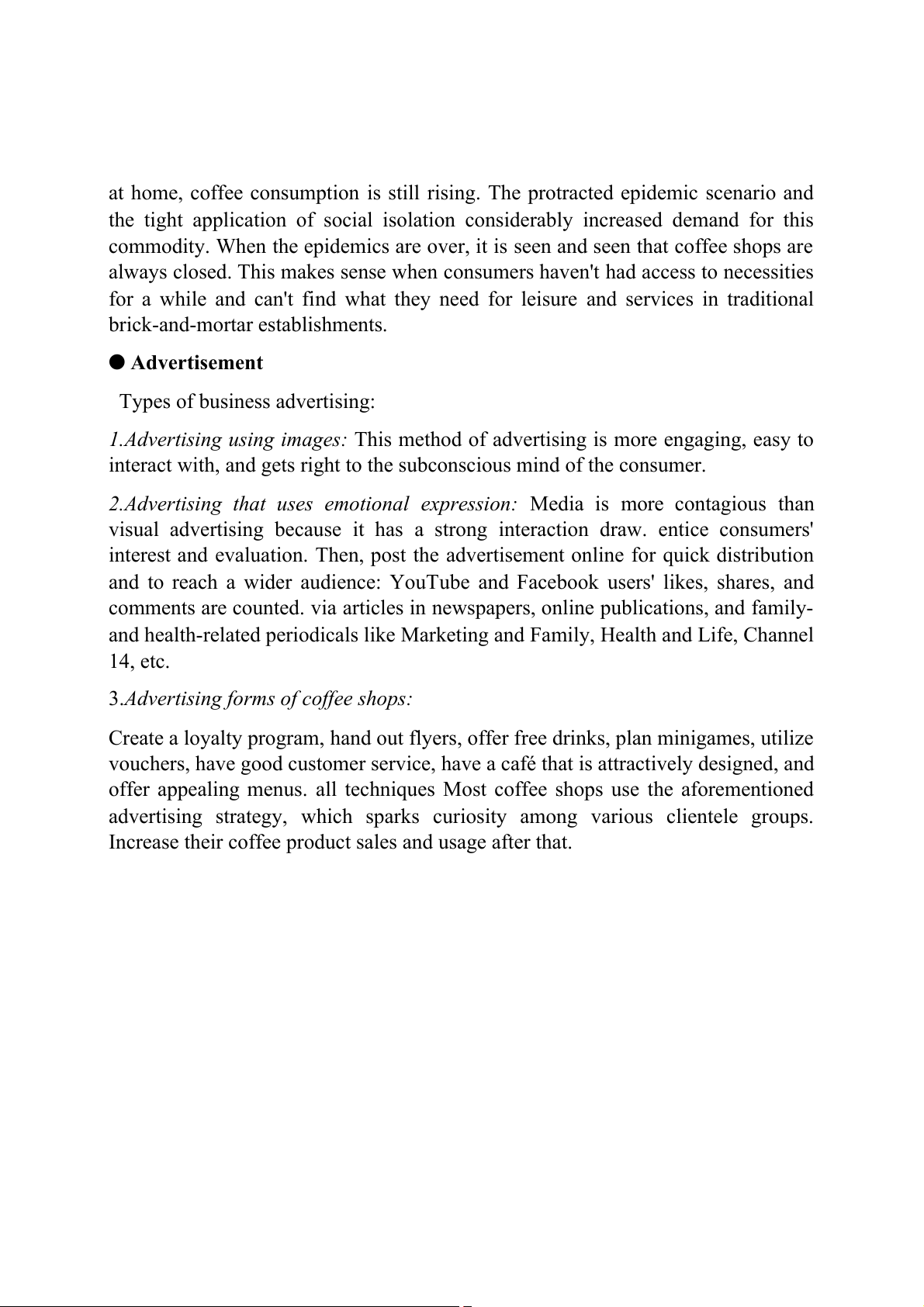
at home, coffee consumption is still rising. The protracted epidemic scenario and
the tight application of social isolation considerably increased demand for this
commodity. When the epidemics are over, it is seen and seen that coffee shops are
always closed. This makes sense when consumers haven't had access to necessities
for a while and can't find what they need for leisure and services in traditional
brick-and-mortar establishments. ● Advertisement
Types of business advertising:
1.Advertising using images: This method of advertising is more engaging, easy to
interact with, and gets right to the subconscious mind of the consumer.
2.Advertising that uses emotional expression: Media is more contagious than
visual advertising because it has a strong interaction draw. entice consumers'
interest and evaluation. Then, post the advertisement online for quick distribution
and to reach a wider audience: YouTube and Facebook users' likes, shares, and
comments are counted. via articles in newspapers, online publications, and family-
and health-related periodicals like Marketing and Family, Health and Life, Channel 14, etc.
3.Advertising forms of coffee shops:
Create a loyalty program, hand out flyers, offer free drinks, plan minigames, utilize
vouchers, have good customer service, have a café that is attractively designed, and
offer appealing menus. all techniques Most coffee shops use the aforementioned
advertising strategy, which sparks curiosity among various clientele groups.
Increase their coffee product sales and usage after that. 7. Conclusion
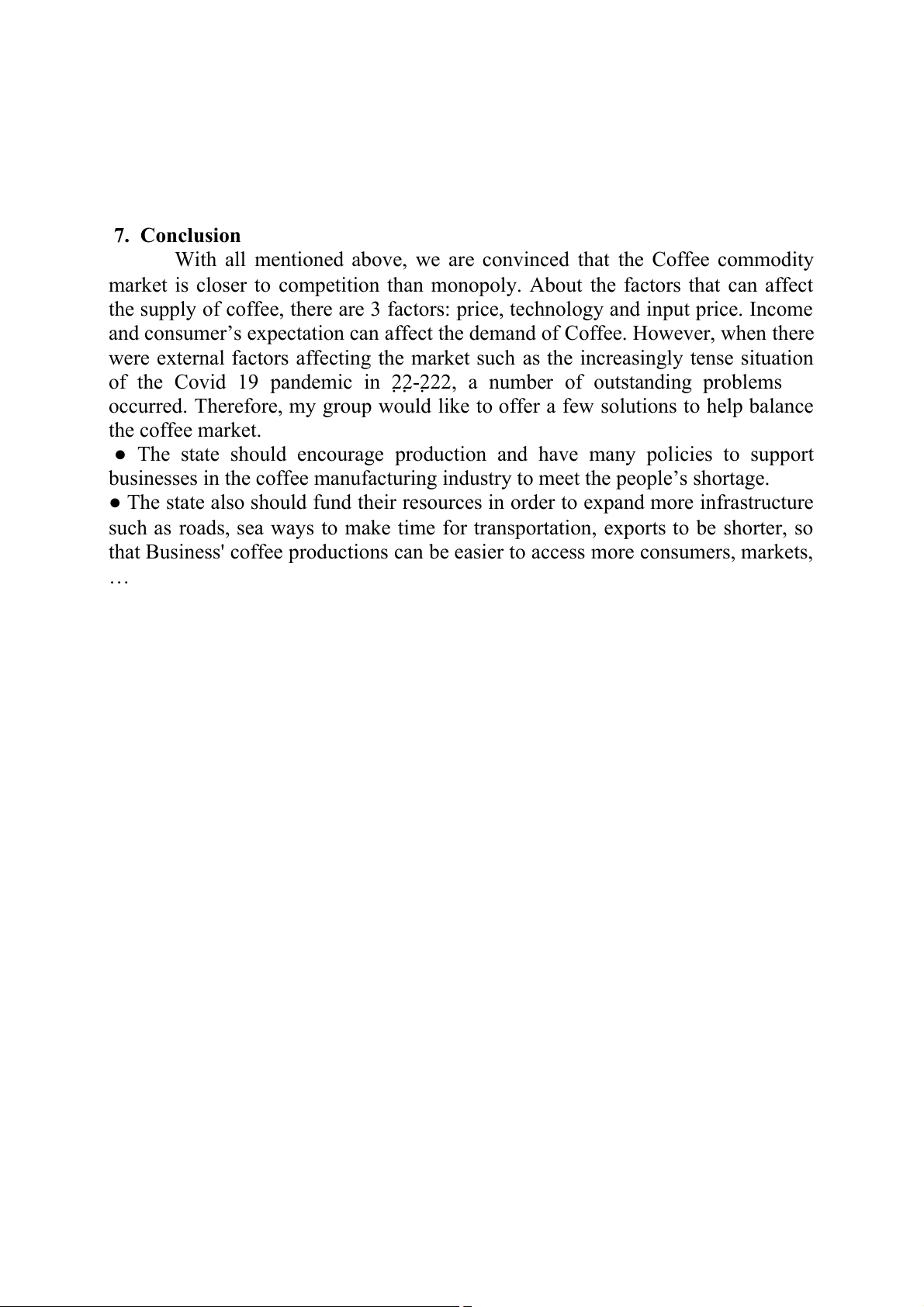
With all mentioned above, we are convinced that the Coffee commodity
market is closer to competition than monopoly. About the factors that can affect
the supply of coffee, there are 3 factors: price, technology and input price. Income
and consumer’s expectation can affect the demand of Coffee. However, when there
were external factors affecting the market such as the increasingly tense situation
of the Covid 19 pandemic in 2020-2022, a number of outstanding problems
occurred. Therefore, my group would like to offer a few solutions to help balance the coffee market.
● The state should encourage production and have many policies to support
businesses in the coffee manufacturing industry to meet the people’s shortage.
● The state also should fund their resources in order to expand more infrastructure
such as roads, sea ways to make time for transportation, exports to be shorter, so
that Business' coffee productions can be easier to access more consumers, markets, … 8. References
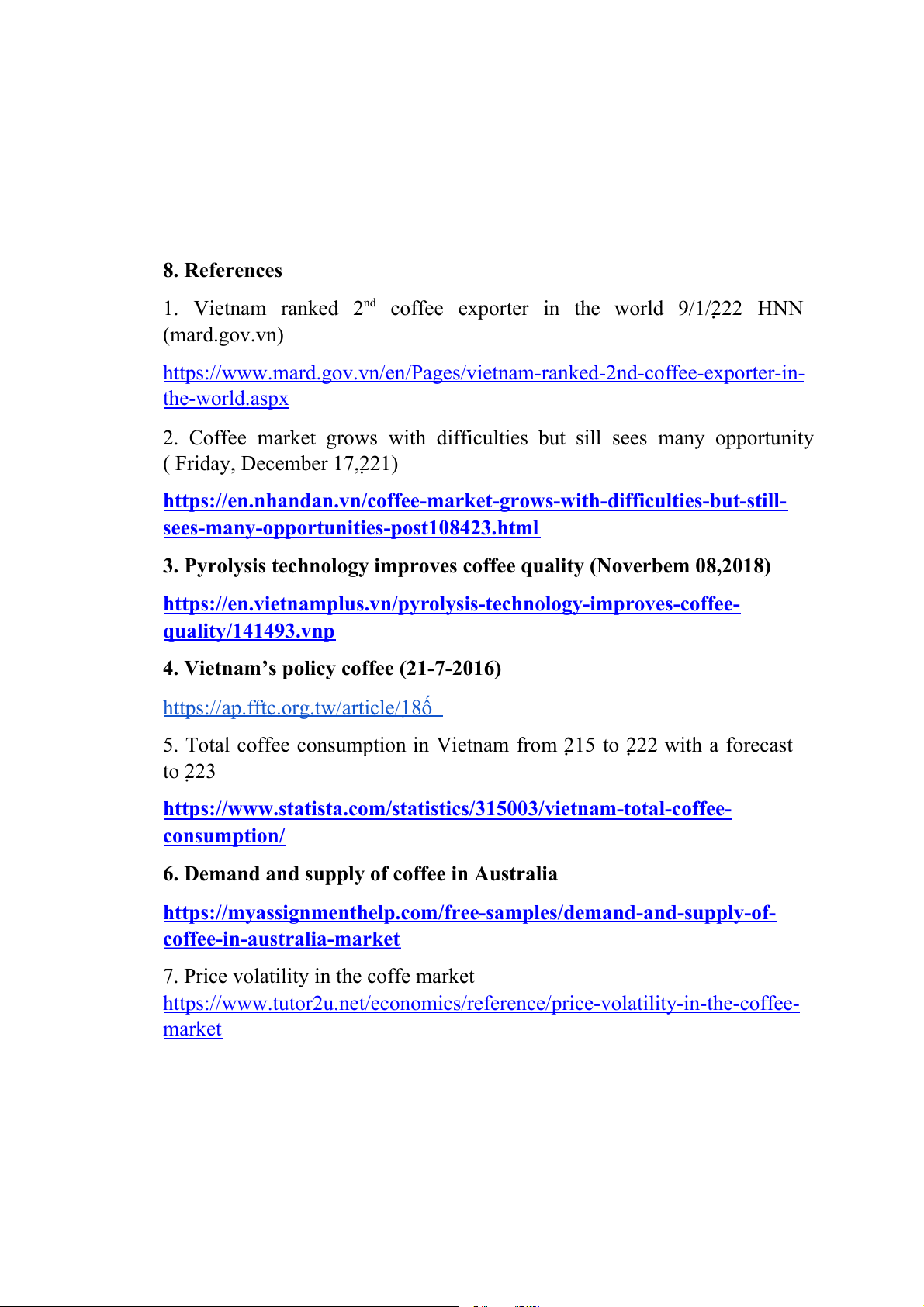
1. Vietnam ranked 2nd coffee exporter in the world 9/1/2022 HNN (mard.gov.vn)
https://www.mard.gov.vn/en/Pages/vietnam-ranked-2nd-coffee-exporter-in- the-world.aspx
2. Coffee market grows with difficulties but sill sees many opportunity ( Friday, December 17,2021)
https://en.nhandan.vn/coffee-market-grows-with-difficulties-but-still-
sees-many-opportunities-post108423.html
3. Pyrolysis technology improves coffee quality (Noverbem 08,2018)
https://en.vietnamplus.vn/pyrolysis-technology-improves-coffee- quality/141493.vnp
4. Vietnam’s policy coffee (21-7-2016)
https://ap.fftc.org.tw/article/1086
5. Total coffee consumption in Vietnam from 2015 to 2022 with a forecast to 2023
https://www.statista.com/statistics/315003/vietnam-total-coffee- consumption/
6. Demand and supply of coffee in Australia
https://myassignmenthelp.com/free-samples/demand-and-supply-of- coffee-in-australia-market
7. Price volatility in the coffe market
https://www.tutor2u.net/economics/reference/price-volatility-in-the-coffee- market
Tài liệu liên quan:
-
Chương 3: độ co giãn và các nhân tố ảnh hưởng | Microeconomics | Trường Đại học Quốc tế, Đại học Quốc gia Thành phố Hồ Chí Minh
3 2 -
Microeconomics Syllabus | Microeconomics | Trường Đại học Quốc tế, Đại học Quốc gia Thành phố Hồ Chí Minh
3 2 -
Microeconomics Course Syllabus & Assessment Details | Microeconomics | Trường Đại học Quốc tế, Đại học Quốc gia Thành phố Hồ Chí Minh
3 2 -
Assignment 3 - Elasticity MCQs and Key Concepts | Microeconomics | Trường Đại học Quốc tế, Đại học Quốc gia Thành phố Hồ Chí Minh
3 2 -
Assignment 2 - Economic Equilibrium Analysis of Fridges and Motorcycles | Microeconomics | Trường Đại học Quốc tế, Đại học Quốc gia Thành phố Hồ Chí Minh
3 2