Final Project on Vietnam's Coffee Market Structure | Microeconomics | Trường Đại học Quốc tế, Đại học Quốc gia Thành phố Hồ Chí Minh
Microeconomics is the study of individuals, households and firms' behavior in decision making and the allocation of resources. It generally applies to markets of goods and services and deals with individual and economic issues. Different from macroeconomics, microeconomics does a smaller research on the issue of what choices people make, what factors influence their choices and how their decisions affect the markets by affecting the price, the supply and demand. Tài liệu được sưu tầm và soạn thảo dưới dạng file PDF để gửi tới các bạn cùng tham khảo, ôn tập đầy đủ kiến thức, chuẩn bị cho các buổi học thật tốt. Mời bạn đọc đón xem!
Môn: Microeconomics 635 tài liệu
Trường: Trường Đại học Quốc tế, Đại học Quốc gia Thành phố Hồ Chí Minh 1.9 K tài liệu
Tác giả:

Preview text:
NATIONAL ECONOMIC UNIVERSITY BUSINESS SCHOOL FINAL GROUP PROJECT SUBJECT: MICROECONOMICS
Topic: Vietnam coffee market structure and
the impact to supply and demand
Name: Duong Minh Nguyet – 11214484 Le Hong Linh - 11213172 Nguyen Van Quynh - 11219345 Le Thu Huong - 11212516 Phan Thi Linh Chi - 11219331 Class: EBDB-3 Hanoi 2022 Table of Contents
INTRODUCTION........................................................................................................... 2 I.
The reason why the Coffee business is closer to pure competition..........................3
1. Characteristics of a pure competition market........................................................3
a. Demand & Marginal revenue curve......................................................................3
b. Profit maximization in the short run.....................................................................5
c. Production decisions. Break-even point and shutdown point................................5
d. In the long run.......................................................................................................6
2. Vietnam coffee industry market structure.............................................................6
a. Numbers of firms:.................................................................................................6
b. Nature of product:.................................................................................................7
c. Barriers of entry....................................................................................................9
d. Market power:.....................................................................................................11
e. Non-price Competition:......................................................................................12
II – Factors that have affected coffee demand and supply the past few years..............13
1. Factors affecting Viet Nam’s coffee supply.........................................................13
1.1. Price factor...................................................................................................... 13
1.2. Non-price factors.............................................................................................. 14
2. Factors affecting Viet Nam’s coffee demand.......................................................19
2.1. Price factors: Price of the product.......................................................................19
2.2. Non-price factors................................................................................................19
2.3. Other factors.......................................................................................................21
CONCLUSION......................................................................................................... 23
REFERENCES........................................................................................................ 24 1 INTRODUCTION
Microeconomics is the study of individuals, households and firms' behavior in
decision making and the allocation of resources. It generally applies to markets of goods
and services and deals with individual and economic issues. Different from
macroeconomics, microeconomics does a smaller research on the issue of what choices
people make, what factors influence their choices and how their decisions affect the
markets by affecting the price, the supply and demand. For example, if there is a rise in
car prices, the demand for a substitute good will also increase. The reason is explained by
the law of supply and demand, which is a part of the study of microeconomics. It might
sound too theoretical and unnecessary for the real-world. However, by understanding the
use of microeconomics, people can clarify the source of industry’s problems and make suitable decisions in time.
Vietnam has been worldwide famous for its strong and impactful flavour of coffee
for many years. To understand how the mutual interaction between market and consumer
can affect the supply and demand for coffee, this essay will explain the market structure
of coffee production firms and how the Vietnamese coffee industry’s demand and supply
has been in the last few years. 2 I.
The reason why the Coffee business is closer to pure competition
1. Characteristics of a pure competition market.
a. Demand & Marginal revenue curve
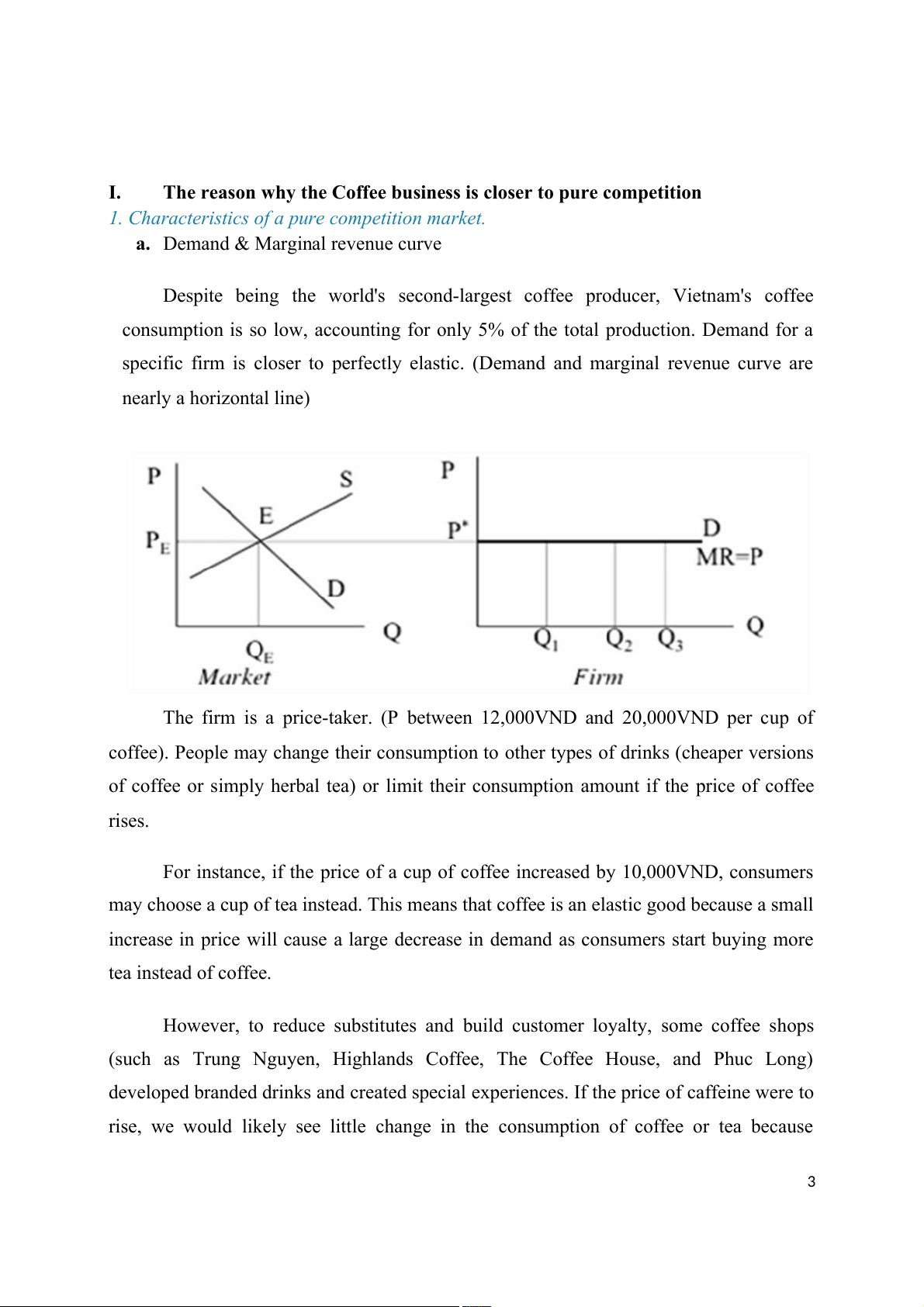
Despite being the world's second-largest coffee producer, Vietnam's coffee
consumption is so low, accounting for only 5% of the total production. Demand for a
specific firm is closer to perfectly elastic. (Demand and marginal revenue curve are nearly a horizontal line)
The firm is a price-taker. (P between 12,000VND and 20,000VND per cup of
coffee). People may change their consumption to other types of drinks (cheaper versions
of coffee or simply herbal tea) or limit their consumption amount if the price of coffee rises.
For instance, if the price of a cup of coffee increased by 10,000VND, consumers
may choose a cup of tea instead. This means that coffee is an elastic good because a small
increase in price will cause a large decrease in demand as consumers start buying more tea instead of coffee.
However, to reduce substitutes and build customer loyalty, some coffee shops
(such as Trung Nguyen, Highlands Coffee, The Coffee House, and Phuc Long)
developed branded drinks and created special experiences. If the price of caffeine were to
rise, we would likely see little change in the consumption of coffee or tea because 3
customers would not willingly give up their morning cup of caffeine regardless of the
price. Coffee is an inelastic product in this case.
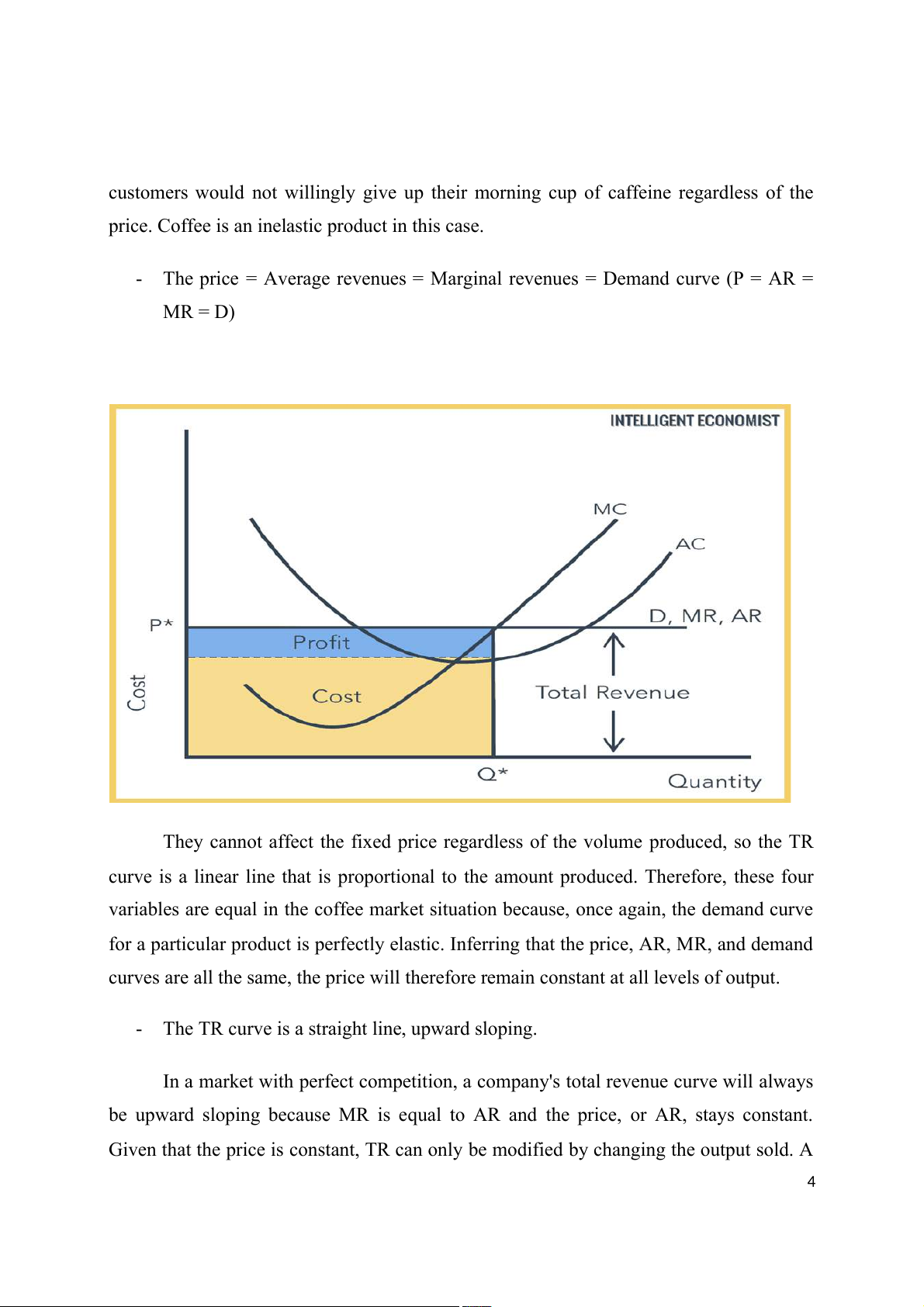
- The price = Average revenues = Marginal revenues = Demand curve (P = AR = MR = D)
They cannot affect the fixed price regardless of the volume produced, so the TR
curve is a linear line that is proportional to the amount produced. Therefore, these four
variables are equal in the coffee market situation because, once again, the demand curve
for a particular product is perfectly elastic. Inferring that the price, AR, MR, and demand
curves are all the same, the price will therefore remain constant at all levels of output.
- The TR curve is a straight line, upward sloping.
In a market with perfect competition, a company's total revenue curve will always
be upward sloping because MR is equal to AR and the price, or AR, stays constant.
Given that the price is constant, TR can only be modified by changing the output sold. A 4
similar proportion exists between the rise in TR and the rise in output sold. The curve
crosses the origin, which suggests that if the output sold is zero TR will also be zero regardless of price level.
b. Profit maximization in the short run
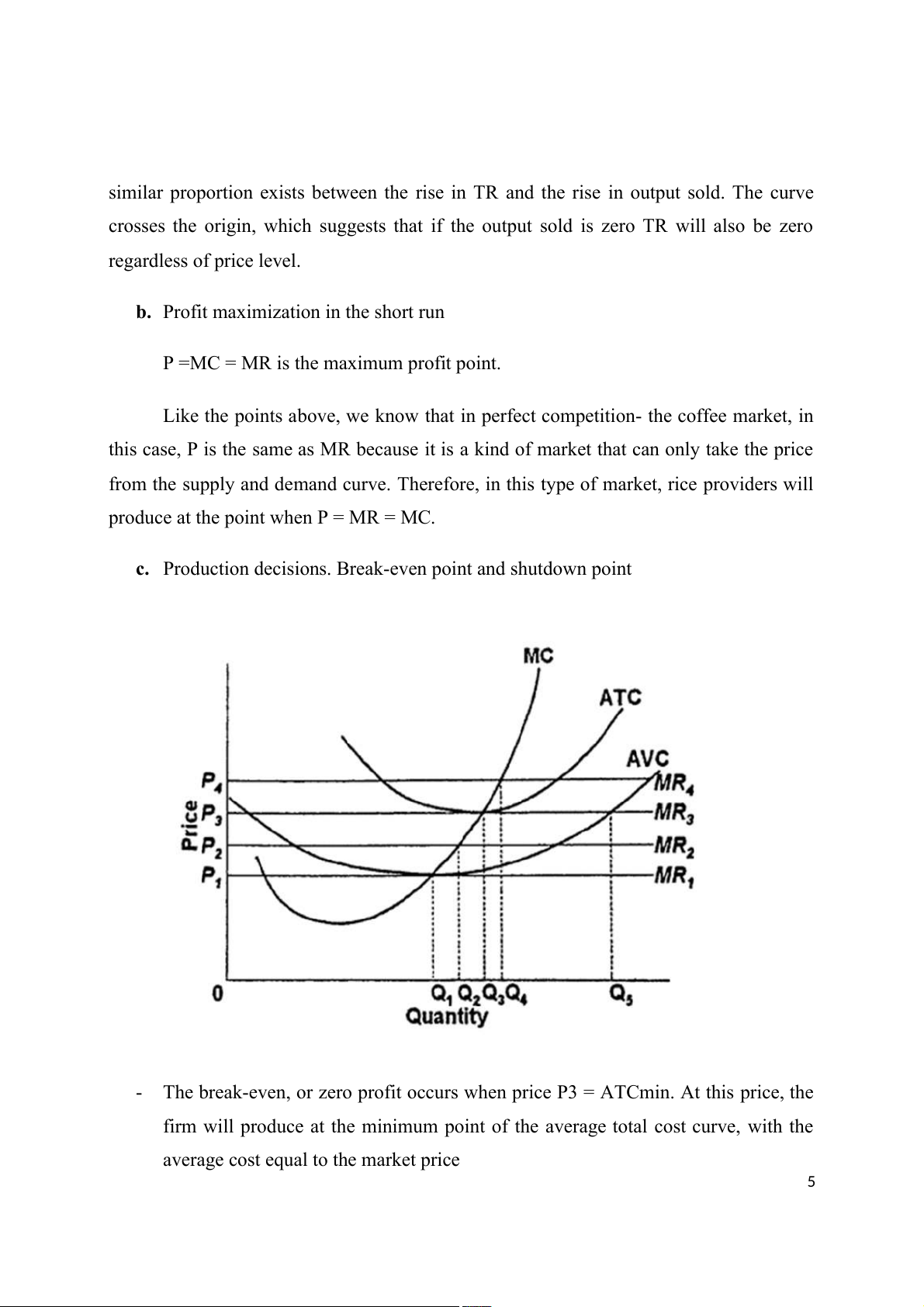
P =MC = MR is the maximum profit point.
Like the points above, we know that in perfect competition- the coffee market, in
this case, P is the same as MR because it is a kind of market that can only take the price
from the supply and demand curve. Therefore, in this type of market, rice providers will
produce at the point when P = MR = MC.
c. Production decisions. Break-even point and shutdown point
- The break-even, or zero profit occurs when price P3 = ATCmin. At this price, the
firm will produce at the minimum point of the average total cost curve, with the
average cost equal to the market price 5
- At a higher price, the firm will make a positive economic profit. (When P4 > ATCmin)
- At a price between the shut-down price and the break-even price (AVCmin < P2 <
ATCmin), the firm will lose money but will continue to operate at a loss because
total revenue will exceed the variable cost of growing coffee.
- The firm’s shut-down price is at P1 = AVCmin d. In the long run
- In long-run competition: the total cost of coffee is equal to the total revenue of
coffee, so the maximum profit equals 0. Coffee production has all allocative
efficiency and productive efficiency
- In a perfect competition market, there is no death weight loss, so the net social benefit of coffee is maximum.
2. Vietnam coffee industry market structure a. Numbers of firms:
Coffee has become a morning habit of not only Vietnamese consumers but also
many international consumers, whether male or female. Coffee customers are often very
loyal, 65% of Vietnamese coffee users drink coffee 7 times a week, in favor of men
(59%). 21% of consumers use instant coffee 3 to 4 times a week, leaning towards female
consumers (52%). With favorable climate and soil conditions for growing and developing
coffee trees, there are many famous coffee brands in Viet Nam such as Trung Nguyen
Coffee, Highlands Coffee, Nescafe, Classic Coffee, Vinacafe, Cong coffee, and Phuc
Long coffee…. All join hands to bring Vietnamese coffee brands to the world.
The whole country has 97 bean coffee processing establishments, 160 roasting
coffee processing establishments, 8 instant coffee processing facilities, and 11 blended
coffee processing establishments.
Nescafe of Nestle, G7 of Trung Nguyen, Vinacafe and Wake up of Vinacafé Bien
Hoa, Cafe Pho of Food Empire Singapore are the top 5 instant coffee brands with the 6
highest level of awareness. Nestle leads this list with 35% of the total consumption,
followed by Vinacafe, Trung Nguyen and Food Empire at 20.3%, 18.7% and 3.6%
respectively. The remaining 21% belongs to other brands and small local coffee shops.
This shows that the coffee market has been shaped very well, there are hardly any opportunities for new players.
Since 2013, the Vietnamese coffee market has really heated up when Starbucks
began to increase its presence and followed by the Korean coffee chain Coffee Bene, the
American brand PJ's Coffee and the domestic chain such as PJ's Coffee. The Coffee
House, Trung Nguyen, Highlands, Phuc Long, Passio…
Up to now, the Highlands system owns the largest number of shops with nearly
150 stores in many provinces and cities. Starbucks has about 30 stores, Trung Nguyen
has more than 60 stores and The Coffee House has 80 stores, .... No chain has expressed
its intention to stop at a certain number but continue to plan to invest to expand and develop. b. Nature of product:
The coffee market is usually divided into two major segments: roasted and ground
coffee and instant coffee. Roasted coffee accounted for 1/3 of the market, the rest was
instant coffee. In the instant coffee segment, it is also divided into two sub-segments is
pure instant coffee and mixed instant coffee: - Roasted coffee:
Roasted coffee is a general term for only high quality coffee, ground on the spot –
at the point of sale to distinguish it from poor quality coffee with impurities.
The roasting process is the process of creating the characteristic flavor of coffee by
causing the green coffee beans to change flavor. Unroasted coffee beans contain higher if
not higher levels of acids, proteins, sugars and caffeine than roasted beans, but do not 7
have the flavor of roasted coffee beans due to other chemical reactions that take place during roasting.
Coffee is selected from the best coffee beans, through the roasting and grinding
process, to produce coffee products without impurities such as beans, corn, starch or
other additives and flavors. During the roasting process, butter and alcohol can be added
and aged under certain temperature conditions. - Instant coffee:
Instant coffee is a beverage derived from coffee in the form of coffee powder and
has been pre-seasoned to taste and processed by dry roasting method. Instant coffee can
be used immediately by making it with boiling water and stirring well. This type of
coffee is very convenient to use, can be stored for a long time and is easy to use.
Instant coffee appeared on the market in the 1950s and has grown rapidly to
become one of the most popular types of coffee. Globally, instant coffee always
generates a stable revenue of over 20 billion USD, which is equivalent to the revenue of
coffee shop chains. Currently, the instant coffee market share for more than half a century is dominated by Nescafe.
According to a survey, VinaCafe is still the leading brand in the instant coffee
market, accounting for about 45% of the market share, followed by NesCafe with 38%
and G7 with about 10%... the rest are brands. other. The three leading instant coffee
brands in Vietnam today are Vinacafé of Bien Hoa Coffee Joint Stock Company, Nescafé
of the world's No. 1 food group Nestlé and G7 of Trung Nguyen Co., Ltd. Retailer of AC
Nielsen in 2011, Trung Nguyen's G7 instant coffee led the Vietnamese instant coffee
market with 38% market share, followed by VinaCafe of Bien Hoa Coffee Joint Stock
Company with 31% and Nescafe of the Joint Stock Company of the world's No. 1 food
group Nestlé about 27%...the rest are other brands.
- Is instant coffee or ground coffee better? 8
In general, the debate about whether ground coffee is better than instant coffee
depends on personal preference. In terms of health levels, instant coffee is likely to be
considered healthier due to its lower caffeine levels.
Instant coffee, on the other hand, is simpler to prepare. Just add hot water, we are
basically ready to use. It can be finished in minutes and if you are a busy person instant
coffee is a perfect choice. However, you can't do that with ground coffee, it takes at least
3-5 minutes to finish, not to mention the washing and cleaning stage.
In terms of taste, the general consensus is that ground coffee offers more flavor
than instant coffee. Ground coffee keeps all the essential oils and other chemicals intact,
providing a fuller, richer and more subtle flavor than most instant coffees. In terms of
cost, instant coffee is cheaper and doesn't need any specialized equipment to make them. c. Barriers of entry
In general, for the Vietnamese coffee industry, the barriers to entry are quite low
and there is freedom to enter the market. It is relatively easy for new businesses to enter
the coffee market as agricultural products are already available in the country and there
are few legal constraints. In addition, businesses can easily exit the market if their coffee
products are not profitable, but there are still high barriers to entry for specialty or "big
man" in the coffee industry get high:
Economics of scale: Potential competitors wishing to enter the industry will face a
number of barriers. The first is the fact that companies like Vinacafe, Netcafe and G7
have built many Asian-class coffee processing factories across the country to meet the
needs of domestic consumption as well as export. Such a factory in terms of construction
costs alone is about 80 million-90 million USD.
Product differentiation: standing in front of many big names in the Vietnamese
coffee market such as Trung Nguyen, G7, and Nescafé is a big challenge for new
businesses. Although Trung Nguyen has recently had many fluctuations, this is still a big 9
problem when it has a variety of designs and is the first name of coffee that Vietnamese
people mention. Besides, Vinacafe with sweet taste is mostly for the elderly in Vietnam.
Nescafe when taken has a charismatic aroma. G7 with rich flavor in every cup of coffee.
This is because their R&D units operate very efficiently throughout the country.
Accompanying those are the statistical units that are always looking for information and
changing the tastes of customers every day so that the company can come up with
development strategies in the future. Therefore, it is difficult for new companies to win
the trust of customers in a short time
Capital requirements: this is a very important issue for beginners. Companies
advertise massively in recent times with huge advertising costs. The second is the
investment cost for research activities from roasting and roasting activities right from the
selection stage to the procurement of modern machinery and equipment into the
production stage to ensure the full flavor of traditional coffee is preserved.
Access to distribution channels: as a latecomer, when the market is covered by
large distributors, the problem of bringing products to customers is more difficult than
ever. Nescafe is a world leader with a worldwide production and sales network. And
companies like Vinacafe, Trung Nguyen have also established distribution systems
covering the whole country. Most large companies have integrated later, causing many
difficulties for companies who want to enter the industry.
In short, there is a huge barrier to entry for businesses that want to build a big
brand because they are dominated by existing businesses. For small businesses, the
barriers are quite low, but in return, the growth rate is quite slow. d. Market power:
Enterprises in the Vietnamese coffee industry are not the ones who decide or
accept the price. Each brand has its own standout product, so in each coffee there is a
business that affects the price. It's not entirely, but it's a pretty big part. Therefore, the 10
market power of the coffee industry depends on each brand, for big brands like Highlands
Coffee, Phuc Long Coffee,Starbuck ... the market power is relatively high, the rest is
mostly low. The degree to which price control power depends on the strength of buyers
attached to their brand. Because each firm produces its own coffee product, it may charge
more or less than its competitors. The company can set its own price and does not need to
take it out of the industry as a whole, although industry pricing may become a constraint :
Coffee prices increased sharply in late 2021 and are being kept stable around the
beginning of this year. Currently, the price of Robusta coffee - Vietnam's main
commodity - is considered the highest in the past 9 - 10 years. This growth momentum
does not seem to have stopped as the price support factors remain stable and is expected to increase in 2022.
In particular, Trung Nguyen's powdered coffee, Vinacafe's instant coffee, and
Nescafe's instant coffee, and Highlands Coffee... not only dominate the domestic market,
but are also welcomed in many regional markets, and have initially built a brand name
Vietnamese coffee . Trung Nguyen coffee, Vinacafe and Nescafe are three traditional
brands and account for about 70% of the instant coffee market share. 11
e. Non-price Competition:
In the competitive coffee market, prices are negligible, so most businesses
compete on brand, quality and creativity (bold and different ideas). Therefore, businesses
focus on advertising to attract customers, promote sales and product research and development.
Currently, Starbucks, Highlands Coffee and Phuc Long are the 3 most popular
coffee shop chains in the coffee market. In order to increase brand awareness, companies
have had extremely successful advertising strategies to attract customers.
Phuc Long is a Vietnamese brand, so with the home field advantage, Phuc Long is
ready to confront any foreign brand, including Starbucks. Phuc Long has set up stores in
prime locations in big cities such as Hanoi and Ho Chi Minh City. Ho Chi Minh.
Moreover, Phuc Long is not afraid to set up shop next to big competitors such as
Starbucks, Highlands, etc. In the first year, Phuc Long expanded its area to Hanoi with
the first store in the IPH trade center, even though this is not the case. not the best option
but it is also close to many office districts and universities.Currently, Phuc Long has
nearly 100 stores across the country, the stores are concentrated in big cities with
locations that are golden lands and extremely potential. Phuc Long's products are not only
displayed and sold at stores, but also in many supermarkets and commercial centers, convenience stores, etc.
II – Factors that have affected coffee demand and supply the past few years. 1.
Factors affecting Viet Nam’s coffee supply
Coffee was first introduced to Vietnam around 1850 by the French. Despite the
late appearance in Vietnam, after a few decades, during the 90s, Vietnam’s coffee
production increased rapidly, becoming the world’s second largest producer and exporter
of coffee green beans in 1999 (Source: ICO historical data). During recent years, the
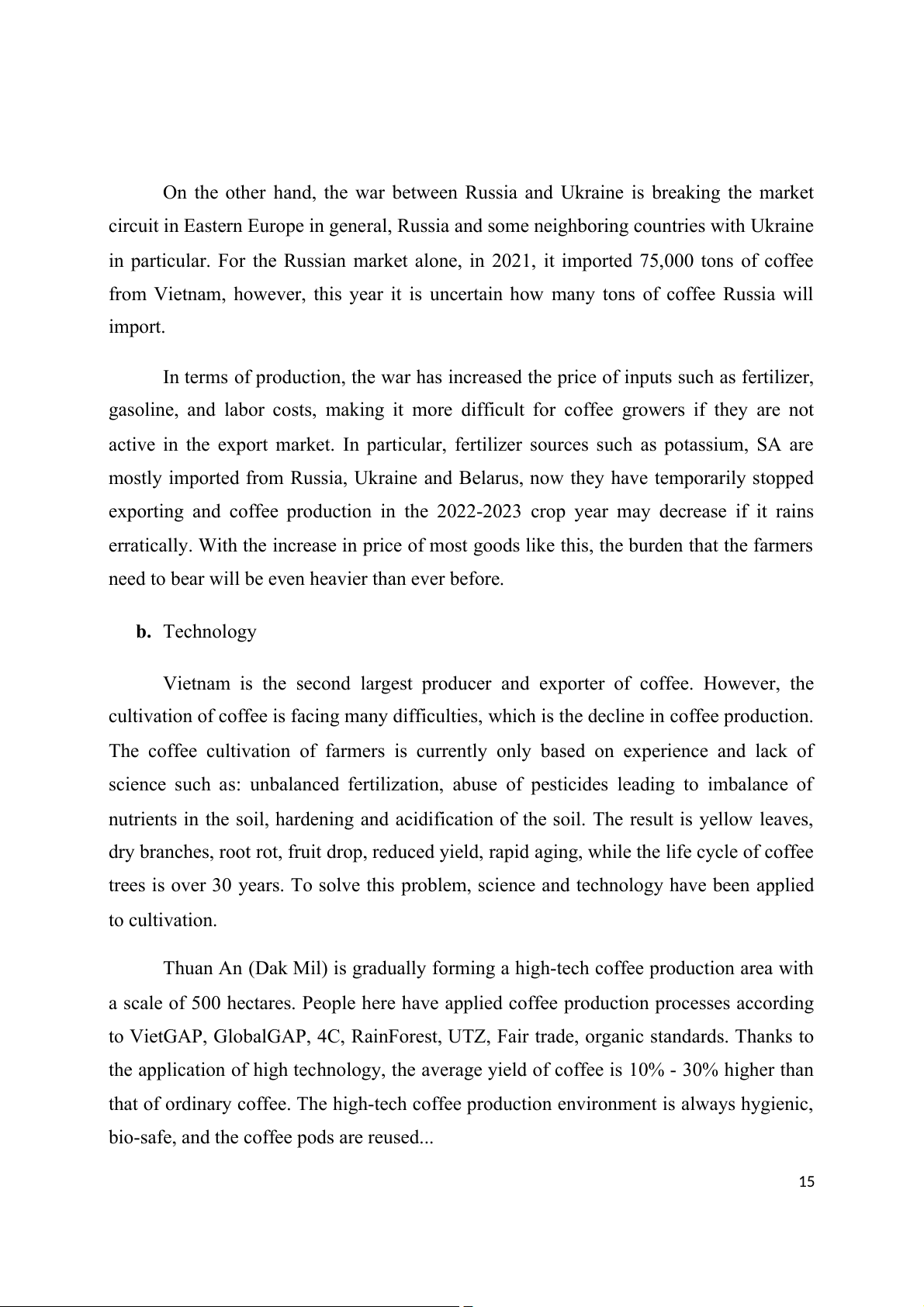
production of coffee in Vietnam has changed constantly, this is resulting from many factors. 12 Crop year 2015/16 2016/17 2017/18 2018/19 2019/20
Total production in thousand 60kg bags 31,090 27,819 33,432 30,283 30,487 . Price factor 1.1
The price of coffee can greatly impact coffee production of the growers. Price of
coffee has mostly stayed around 30000-35000VNĐ, however, recently the price has
increased to the highest level ever recorded before, to over 40000/kg. Despite that,
farmers still don’t feel happy because the price can hardly cover the cost of production
and wages. According to the Minister of Agriculture and Rural Development
(NN&PTNT) Nguyễn Xuân Cường, in 2018, although the total area of coffee increased
10,800 hectares compared to 2017, the area under coffee cultivation in some areas shrank because of low prices.
This situation continued. According to the Dong Nai Statistics Department, by the
end of 2021, the total area of coffee trees in Dong Nai province decreased nearly 1.4
thousand hectares compared to the previous year; harvested output reached over 18,000
tons, decreased more than 2.3 thousand tons, equivalent to 11.45% over the same period.
The reason for the sharp decrease in the area of coffee trees is that in recent years,
farmers in many areas of the province have been racing to cut down coffee trees because
of low profits. This is also the general situation of many areas across the country. The
area of coffee decreased, supply was lower than demand while exports increased, so
during the coffee harvest in 2021, the price of coffee sold reached more than 40,000
VND/kg, much higher than every year.
In two other major price crises in the last 30 years, coffee prices have been kept
below 100 US cents for 5-7 years. What we saw when that happened was the farmer,
first, reduced inputs, pesticides, and other farm-related costs. From there, the next step is
usually to reduce education or other family expenses first, ultimately reducing necessities
like food. The only option other than that is to give up the farm all together. 13 1.2. Non-price factors a. Input prices
According to the 2018 coffee market report by Vietnambiz, at one point, the price
of coffee hit a 50-year low while costs such as gasoline and services, fertilizers, and
pesticides increased. The selling price sometimes falls below the production cost, causing
farmers not to pay attention to fertilization, affecting the yield of the crop. As a result,
some of the replanted areas have switched to growing durian, avocado, passion fruit and
other trees of higher value, leading to a decrease in coffee area. According to the
Department of Crop Production, the area of avocado and durian has increased to 102,000
hectares. In addition, with more than 93,000 hectares of coffee, of which about 80,000
hectares are in business, Gia Lai province has faced a shortage of workers for many
years. In the harvest season, in some places, the harvesting worker’s wages increased by
nearly 20% to 1 million VND per ton.
Experts emphasized that the impact of the Covid-19 pandemic is still affecting the
domestic and foreign coffee market. Logistics crises such as lack of empty containers and
space on ships have limited coffee production in 2021. In the same year, the price of
coffee increased to more than 40,000 VND/kg, the highest level in the past 10 years, but
coffee was still not profitable, farmers become labor on their own land because 1 kg of
coffee has to carry nearly 10 kinds of costs, especially fertilizer and labor costs increased.
The COVID-19 epidemic has turned global and domestic supply chains upside down,
fertilizer prices have increased by 30-50%, plant protection drugs have increased by 10-
20%, and labor costs have increased by 25% on average compared to 2020, putting great
pressure on farmers. According to the Department of Agriculture and Rural Development
(NN&PTNT) of Dak Nong province, normally, the cost of fertilizer accounts for 45-50%
of the cost, the hiring of harvesting workers accounts for 25-30% of the production cost. 14
On the other hand, the war between Russia and Ukraine is breaking the market
circuit in Eastern Europe in general, Russia and some neighboring countries with Ukraine
in particular. For the Russian market alone, in 2021, it imported 75,000 tons of coffee
from Vietnam, however, this year it is uncertain how many tons of coffee Russia will import.
In terms of production, the war has increased the price of inputs such as fertilizer,
gasoline, and labor costs, making it more difficult for coffee growers if they are not
active in the export market. In particular, fertilizer sources such as potassium, SA are
mostly imported from Russia, Ukraine and Belarus, now they have temporarily stopped
exporting and coffee production in the 2022-2023 crop year may decrease if it rains
erratically. With the increase in price of most goods like this, the burden that the farmers
need to bear will be even heavier than ever before. b. Technology
Vietnam is the second largest producer and exporter of coffee. However, the
cultivation of coffee is facing many difficulties, which is the decline in coffee production.
The coffee cultivation of farmers is currently only based on experience and lack of
science such as: unbalanced fertilization, abuse of pesticides leading to imbalance of
nutrients in the soil, hardening and acidification of the soil. The result is yellow leaves,
dry branches, root rot, fruit drop, reduced yield, rapid aging, while the life cycle of coffee
trees is over 30 years. To solve this problem, science and technology have been applied to cultivation.
Thuan An (Dak Mil) is gradually forming a high-tech coffee production area with
a scale of 500 hectares. People here have applied coffee production processes according
to VietGAP, GlobalGAP, 4C, RainForest, UTZ, Fair trade, organic standards. Thanks to
the application of high technology, the average yield of coffee is 10% - 30% higher than
that of ordinary coffee. The high-tech coffee production environment is always hygienic,
bio-safe, and the coffee pods are reused... 15
Mr. Nguyen Hong Phong - General Director of Tien Nong Agriculture Industry
Joint Stock Company introduced the solution of using Tien Nong nutrition
synchronously, applying scientific and technical advances to the fertilizer production
process for farmers. Before using Tien Nong's fertilizer, they had to spray pesticides 3
times a year, now they only need to spray once, rust disease is prevented, fruits develop
evenly, costs are reduced by 1/3 , and productivity increases by 20%”.
Recently, Master Tran Thi Hoang Anh has cooperated with colleagues at the Tay
Nguyen Agro-Forestry Science and Technology Institute to research and implement the
solution: “Application of bioreactor in coffee seed production by culture technology.
tissue". Compared with the bud grafting method, this method increases the multiplication
speed by 1,000-2,000 times, creating better coffee varieties with higher survival rate
while shortening the time of 2-3 months.
According to the Ministry of Agriculture and Rural Development, scientific and
technological solutions are prioritized to improve research capacity, transfer technology
of replanting and grafting to improve coffee for scientific and technological units under
the Ministry of Agriculture and Rural Development. and localities. Specifically, the
industry will research, select and create new coffee varieties suitable for each ecological
region in the direction of productivity, high quality, resistance to pests and diseases,
adaptation to climate change conditions, and good mechanical properties.
Since applying science and technology in cultivating, our coffee production has
increased significantly. It is clear that science and technology should be given special
focus in order to enhance the production level of coffee. c. Government policies
Although Vietnam entered the coffee market late compared to other countries,
after just a short period, Vietnam has become the second largest producer and exporter of
coffee. The reason for these achievements is the government's policies on encouraging
export development and export coffee production. The system of policies on export, 16
trade, credit, agricultural extension, etc. has created momentum and force for Vietnamese
coffee towards sustainable development.
Policy of integration and expansion of export markets. Vietnam is a member of the
International Coffee Organization (ICO) and the Vietnamese government also signed the
International Coffee Agreement (ICA) in 2008, making our country's coffee market a part
of the global coffee chain. Besides, joining the World Trade Organization (WTO) and
other international and regional organizations has also created a large market for our
country's coffee industry. The policy of free circulation and market development in recent
years has brought into play the strength of all economic sectors in coffee production and
trading. The connection between domestic and foreign markets also creates favorable
conditions for the coffee industry to expand the consumption market at home and abroad.
In addition, the government also introduced financial support policies, preferential
policies on land and land rent to create favorable conditions for coffee producers to
participate in large-scale and to enhance production. productivity and quality of exported
coffee products. There are a number of other policies of the government which support,
encourage and regulate coffee exports such as export subsidy policy, input and output
product subsidy policy, exchange rate policy, etc.
So, the government has recognized the importance of the coffee market to the
country, a market which is second only to rice, and has implemented appropriate policies
to promote and support production and coffee exports, creating favorable conditions for
our country's coffee exports to increase in quantity and export turnover, enhancing
product brands name around the world. d. Expectation
Statistics and data have a significant impact on the producer’s decision to continue
to grow coffee. Producers depend on the news and data from some source like
International Coffee Organization (ICO) and United States Department of Agriculture
(USDA)’s reports, newspaper and television to predict the trend of the coffee market. 17
Currently, due to the lack of arabica coffee supply, some roasters are looking for the
option of mixing arabica and robusta coffee to lower the selling price. This in the long
run can help change consumer tastes and become more accustomed to drinking roasted
and ground robusta coffee and will help Vietnam's Robusta coffee exports more smoothly
and production for robusta may increase. e. Weather
Weather will decide whether a year has a good or bad harvest. According to the
United States Department of Agriculture (USDA), Vietnam's total coffee production in
the year 2016/17 is estimated at 26 million bags, slightly down from the previous forecast
of 26.7 million bags, which was because of the unusual rains that caused the production
of Robusta coffee to drop unexpectedly. However, in the next MY 2017/18, coffee
production was forecast at around 28.6 million bags, up 10% from 2016/17 due to
favorable weather conditions in the first half of 2017/18. From January to March 2018,
moderate rainfall helped coffee trees branch more and have earlier flowering.
According to the Vietnam Meteorological and Hydrological Administration's
observations and forecasts, temperatures in Tay Nguyen in the first months of 2022 were
slightly lower than average, which was favorable for coffee flowering and
cherry setting stages. Temperatures will be at the average level in May-September, and
slightly higher in October. Rainfall will be at the average level in May-September, and
slightly lower in October. These weather forecasts may be favorable for MY 2022/23
coffee harvests. Generally, the production of coffee can be predicted by the weather of
that year, whether it is dry or rainy.
2. Factors affecting Viet Nam’s coffee demand
2.1. Price factors: Price of the product
There is an inverse (negative) relationship between the price of a product and the
amount of that product consumers are willing and able to buy. Consumers want to buy 18
more of a product at a low price and less of a product at a high price. This inverse
relationship between price and the amount consumers are willing and able to buy is often
referred to as The Law of Demand. It is said by Vicofa ( Viet Nam’s Coffee and Cocoa
Association) that there has been a continuous decrease in coffee prices from 2016 to the
end of 2020. Along with that, the association also claimed that in recent years, the
amount of coffee consumed by the domestic market has increased to about 10 percent of
the country's total coffee production. 2.2. Non-price factors
a. The income of consumers
The amount of money available to customers to purchase goods is known as their
buyer's income, which is correlated with their socioeconomic level. Coffee is considered
normal goods. Therefore, when the income of a person increases, so does the quantity
demanded. According to Ceicdata, the average household income of Vietnamese people
has risen over the years. In addition, the consumption of coffee in Vietnam's market also
experienced a slight increase during a 7 years period from 2015 to 2021.
b. Price of related goods
Substitute goods: Substitute goods are goods which can be used in place of one
another for satisfaction of a particular want. There are several substitutions for coffee
ranging from hot cocoa, matcha to green tea. Take green tea as an example, green tea is a
common substitute for coffee since it has an affordable price and same uses as coffee. In
Viet Nam’s market, packaged dry tea is sold with the price of 60 or 90 thousand dongs
per 250g. To specify the effect of the price of substitute goods, the decreasing price of
green tea will lead to a reduction in demand for coffee in the local market since people
will turn to buy green tea more.
Complementary goods: A complementary good is a product or service that adds
value to another. In other words, they are two goods that the consumer uses together. On 19
Tài liệu liên quan:
-
Chương 3: độ co giãn và các nhân tố ảnh hưởng | Microeconomics | Trường Đại học Quốc tế, Đại học Quốc gia Thành phố Hồ Chí Minh
5 3 -
Microeconomics Syllabus | Microeconomics | Trường Đại học Quốc tế, Đại học Quốc gia Thành phố Hồ Chí Minh
5 3 -
Microeconomics Course Syllabus & Assessment Details | Microeconomics | Trường Đại học Quốc tế, Đại học Quốc gia Thành phố Hồ Chí Minh
5 3 -
Assignment 3 - Elasticity MCQs and Key Concepts | Microeconomics | Trường Đại học Quốc tế, Đại học Quốc gia Thành phố Hồ Chí Minh
5 3 -
Assignment 2 - Economic Equilibrium Analysis of Fridges and Motorcycles | Microeconomics | Trường Đại học Quốc tế, Đại học Quốc gia Thành phố Hồ Chí Minh
5 3