Individual assignment topic 9 | Microeconomics | Trường Đại học Quốc tế, Đại học Quốc gia Thành phố Hồ Chí Minh
Problem 1: A monopoly has a demand function of P=15-Q ($) and total cost function of TC= 7Q ($) a. What is price and optimal quantity that gives the firm maximum profit? Using Lerner indicator (L) to identify market power of this firm? Tài liệu được sưu tầm và soạn thảo dưới dạng file PDF để gửi tới các bạn cùng tham khảo, ôn tập đầy đủ kiến thức, chuẩn bị cho các buổi học thật tốt. Mời bạn đọc đón xem!
Môn: Microeconomics 635 tài liệu
Trường: Trường Đại học Quốc tế, Đại học Quốc gia Thành phố Hồ Chí Minh 1.9 K tài liệu
Tác giả:


Preview text:
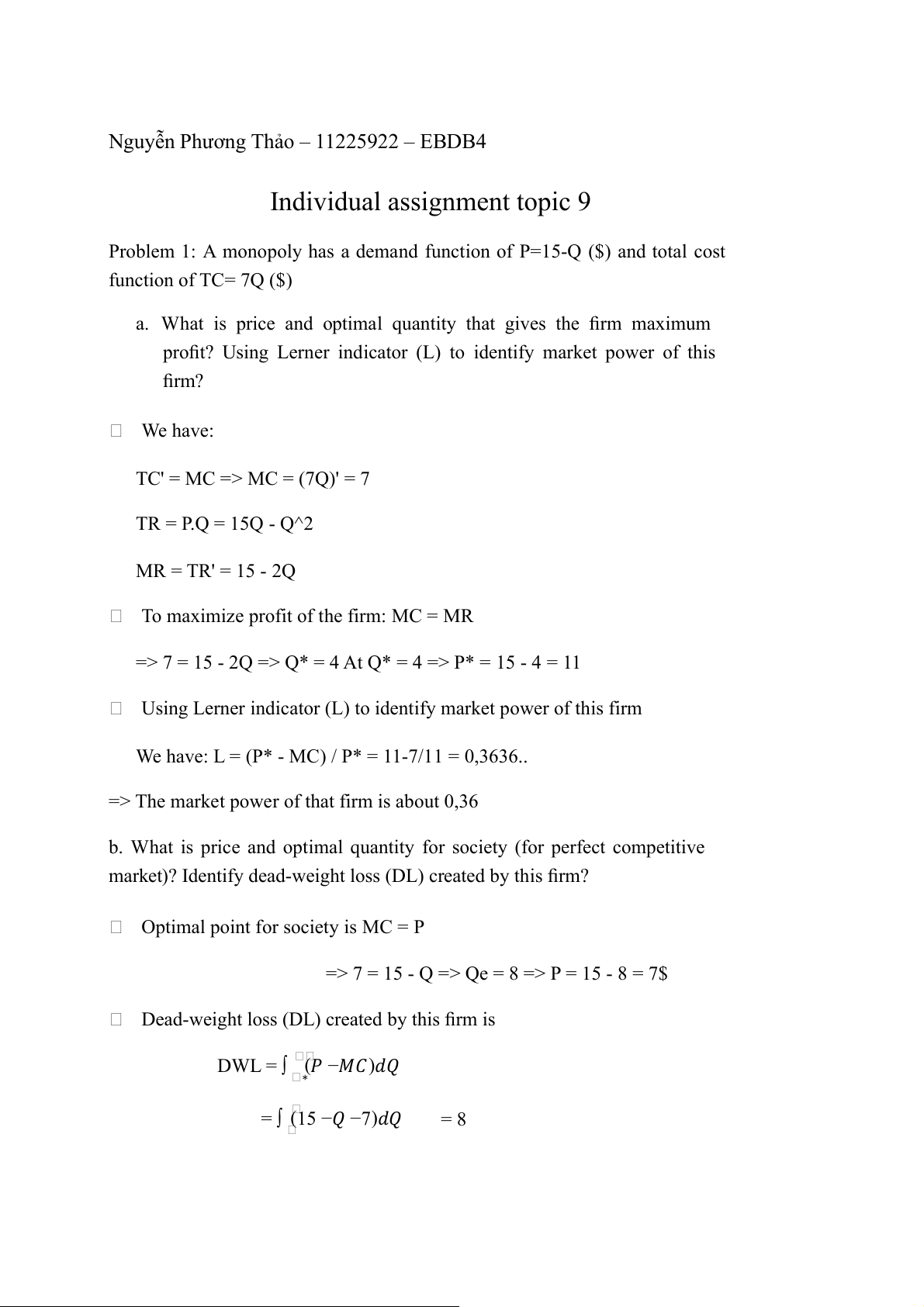
Nguyễn Phương Thảo – 11225922 – EBDB4 Individual assignment topic 9
Problem 1: A monopoly has a demand function of P=15-Q ($) and total cost function of TC= 7Q ($)
a. What is price and optimal quantity that gives the firm maximum
profit? Using Lerner indicator (L) to identify market power of this firm? We have: TC' = MC => MC = (7Q)' = 7 TR = P.Q = 15Q - Q^2 MR = TR' = 15 - 2Q
To maximize profit of the firm: MC = MR
=> 7 = 15 - 2Q => Q* = 4 At Q* = 4 => P* = 15 - 4 = 11
Using Lerner indicator (L) to identify market power of this firm
We have: L = (P* - MC) / P* = 11-7/11 = 0,3636..
=> The market power of that firm is about 0,36
b. What is price and optimal quantity for society (for perfect competitive
market)? Identify dead-weight loss (DL) created by this firm?
Optimal point for society is MC = P
=> 7 = 15 - Q => Qe = 8 => P = 15 - 8 = 7$
Dead-weight loss (DL) created by this firm is
DWL = ∫ (𝑃 −𝑀𝐶)𝑑𝑄 ∗
= ∫ (15 −𝑄 −7)𝑑𝑄 = 8
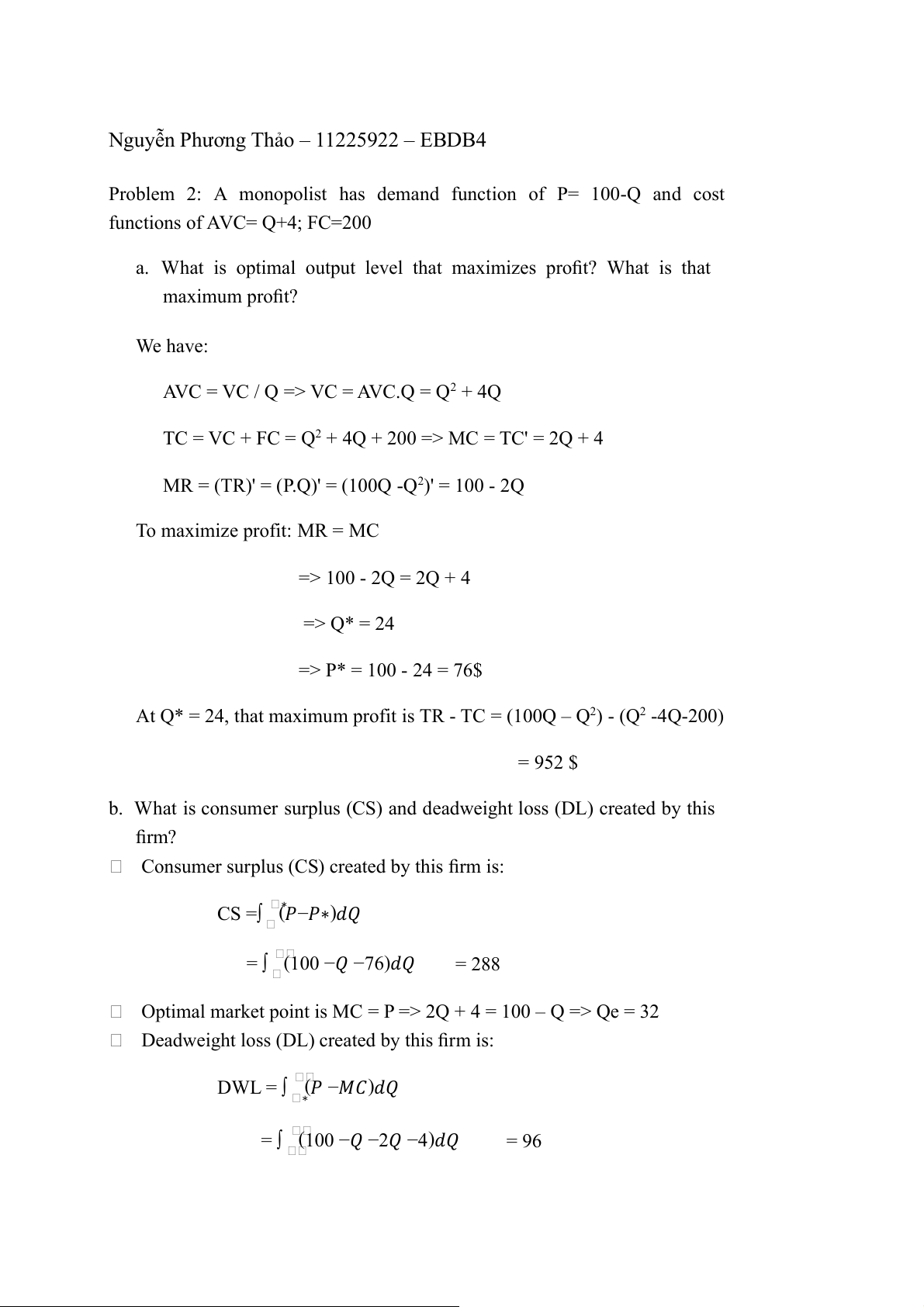
Nguyễn Phương Thảo – 11225922 – EBDB4
Problem 2: A monopolist has demand function of P= 100-Q and cost functions of AVC= Q+4; FC=200
a. What is optimal output level that maximizes profit? What is that maximum profit? We have:
AVC = VC / Q => VC = AVC.Q = Q2 + 4Q
TC = VC + FC = Q2 + 4Q + 200 => MC = TC' = 2Q + 4
MR = (TR)' = (P.Q)' = (100Q -Q2)' = 100 - 2Q To maximize profit: MR = MC => 100 - 2Q = 2Q + 4 => Q* = 24 => P* = 100 - 24 = 76$
At Q* = 24, that maximum profit is TR - TC = (100Q – Q2) - (Q2 -4Q-200) = 952 $
b. What is consumer surplus (CS) and deadweight loss (DL) created by this firm?
Consumer surplus (CS) created by this firm is:
CS =∫ (∗𝑃−𝑃∗)𝑑𝑄
= ∫ (100 −𝑄 −76)𝑑𝑄 = 288
Optimal market point is MC = P => 2Q + 4 = 100 – Q => Qe = 32
Deadweight loss (DL) created by this firm is:
DWL = ∫ (𝑃 −𝑀𝐶)𝑑𝑄 ∗
= ∫ (100 −𝑄 −2𝑄 −4)𝑑𝑄 = 96
Nguyễn Phương Thảo – 11225922 – EBDB4
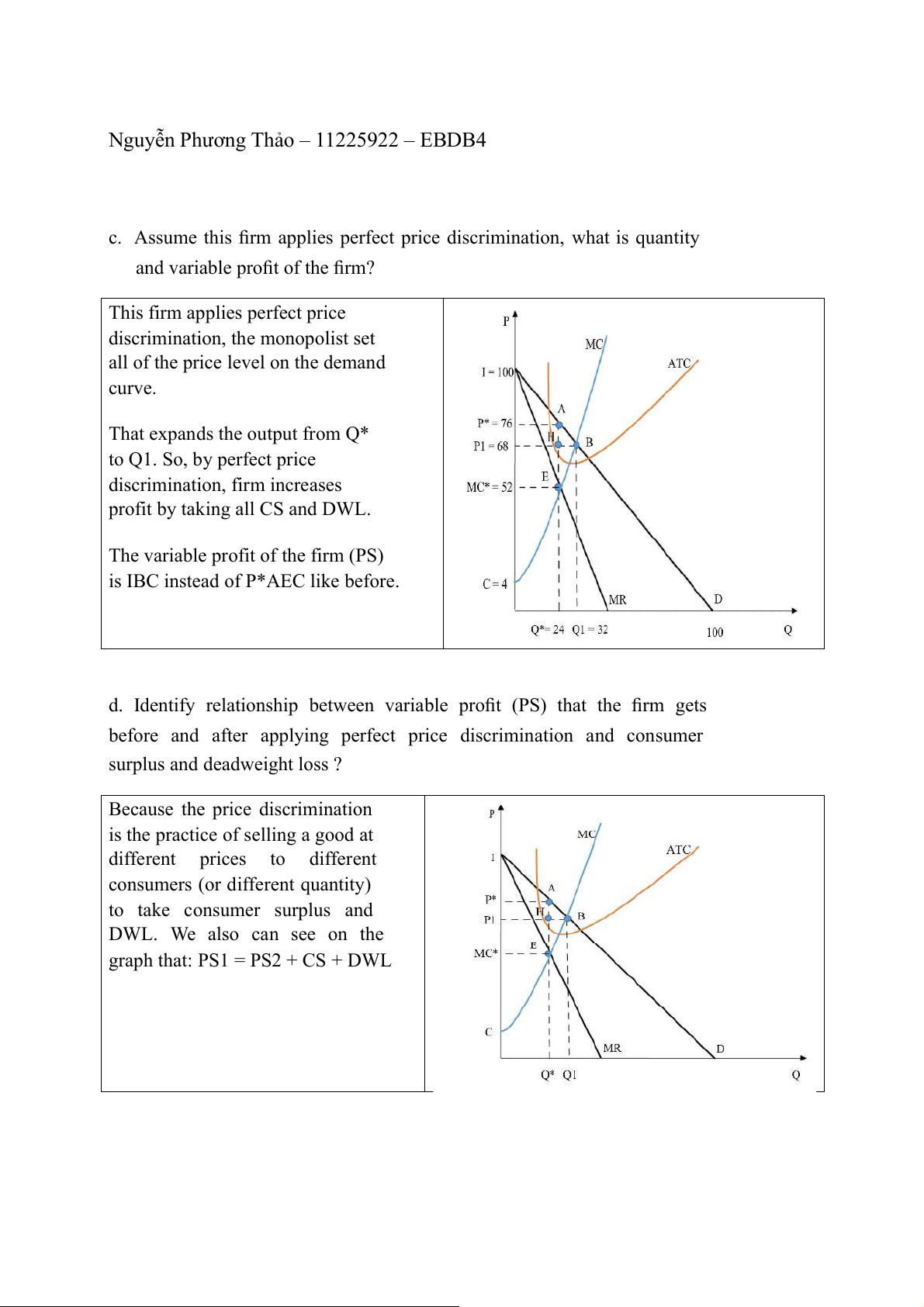
c. Assume this firm applies perfect price discrimination, what is quantity
and variable profit of the firm?
This firm applies perfect price
discrimination, the monopolist set
all of the price level on the demand curve.
That expands the output from Q* to Q1. So, by perfect price
discrimination, firm increases
profit by taking all CS and DWL.
The variable profit of the firm (PS)
is IBC instead of P*AEC like before.
d. Identify relationship between variable profit (PS) that the firm gets
before and after applying perfect price discrimination and consumer surplus and deadweight loss ?
Because the price discrimination
is the practice of selling a good at different prices to different
consumers (or different quantity) to take consumer surplus and DWL. We also can see on the
graph that: PS1 = PS2 + CS + DWL
Nguyễn Phương Thảo – 11225922 – EBDB4
Tài liệu liên quan:
-
Chương 3: độ co giãn và các nhân tố ảnh hưởng | Microeconomics | Trường Đại học Quốc tế, Đại học Quốc gia Thành phố Hồ Chí Minh
3 2 -
Microeconomics Syllabus | Microeconomics | Trường Đại học Quốc tế, Đại học Quốc gia Thành phố Hồ Chí Minh
3 2 -
Microeconomics Course Syllabus & Assessment Details | Microeconomics | Trường Đại học Quốc tế, Đại học Quốc gia Thành phố Hồ Chí Minh
3 2 -
Assignment 3 - Elasticity MCQs and Key Concepts | Microeconomics | Trường Đại học Quốc tế, Đại học Quốc gia Thành phố Hồ Chí Minh
3 2 -
Assignment 2 - Economic Equilibrium Analysis of Fridges and Motorcycles | Microeconomics | Trường Đại học Quốc tế, Đại học Quốc gia Thành phố Hồ Chí Minh
3 2