Insights from the Nobel Prize in Economic Sciences | Microeconomics | Trường Đại học Quốc tế, Đại học Quốc gia Thành phố Hồ Chí Minh
Tài liệu được sưu tầm và soạn thảo dưới dạng file PDF với mục đích hỗ trợ học tập và tham khảo. Nội dung tài liệu được trình bày rõ ràng, dễ tiếp cận, phù hợp cho việc ôn tập và củng cố kiến thức trong quá trình học đại học. Đây sẽ là nguồn tư liệu hữu ích giúp các bạn sinh viên chuẩn bị tốt hơn cho các buổi học, đồng thời mở rộng thêm hiểu biết về môn học. Hy vọng tài liệu này sẽ mang lại nhiều giá trị và hỗ trợ các bạn trong hành trình học tập. Mời bạn đọc cùng tham khảo!
Môn: Microeconomics 635 tài liệu
Trường: Trường Đại học Quốc tế, Đại học Quốc gia Thành phố Hồ Chí Minh 1.9 K tài liệu
Tác giả:


Preview text:
11 OCTOBER 2010
Scientific Background on the Sveriges Riksbank Prize in Economic Sciences in Memory of Alfred Nobel 2010 MARKETS WITH SEARCH FRICTIONS
compiled by the Economic Sciences Prize Committee of the Royal Swedish Academy of Sciences
THE ROYAL SWEDISH ACADEMY OF SCIENCES has as its aim to promote the sciences and strengthen their influence in society.
BOX 50005 (LILLA FRESCATIVÄGEN 4 A), SE-104 05 STOCKHOLM, SWEDEN
TEL +46 8 673 95 00, FAX +46 8 15 56 70, INFO@KVA.SE HTTP://KVA.SE MarketswithSearchFrictions 1 Introduction
Mostreal-worldtransactionsinvolvevariousformsofimpedimentstotrade,
or“frictions”. Buyersmayhavetrouble ndingthegoodstheyarelooking
forandsellersmaynotbeableto ndbuyersforthegoodstheyhaveto
offer. These frictions can take many forms and may have many sources,
including worker and rm heterogeneity, imperfect information, and costs
oftransportation. Howaremarketoutcomesin uencedbysuchfrictions?
Thatis,howshouldweexpectpricestoformand–giventhatmarketswill
notclear atallpointsintime–howarequantitiesdetermined? Dothese
frictions motivate government intervention? These questions are perhaps
particularlypertinentinthelabormarketwherecostlyandtime-consuming
transactionsarepervasiveandwherethequantitydeterminationmayresult
inunemployment: someworkerswillnot ndjobopeningsortheirapplica-
tionswillbeturneddowninfavorof otherworkers.
This year’s Prize is awarded for fundamental contributions to search
andmatchingtheory. Thistheoryoffersaframeworkforstudyingfrictions
in real-world transactions and has led to new insights into the workings
ofmarkets. Thedevelopmentofequilibriummodelsfeaturingsearchand
matchingstartedintheearly1970sandhassubsequentlydevelopedintoa
verylargeliterature. ThePrizeisgrantedforthecloselyrelatedcontribu-
tionsmadeby PeterDiamond,DaleMortensen,andChristopherPissarides.
Thesecontributionsincludetheanalysisofpricedispersionandefficiencyin
economieswithsearchandmatchingfrictionsaswellasthedevelopmentof
whathascometobeknownasthemodernsearchandmatchingtheoryof unemployment.
TheresearchofDiamond,MortensenandPissaridesfocusesonspeci c
frictionsduetocostlysearchandpairwisematching,i.e.,theexplicitdiffi-
cultiesbuyersandsellershaveinlocatingeachother,therebyresultingin
failure of markets to clear at all points in time. Buyers and sellers face
costsintheirattemptstolocateeachother(“search”)andmeetpairwise 1
whentheycomeintocontact(“matching”). Incontrast,standardmarket
descriptionsinvolvealargenumberofparticipantswhotradeatthesame
time. Accessto thismarketplaceandalltherelevantinformationaboutit
iscostlesslyavailabletoalleconomicagents;inparticular,alltraderswould
tradeatthesamemarketprice. Oneofthemainissues,therefore,ishow
priceformationworksinamarketwithsearchfrictions. Inparticular,how
much price dispersion will be observed, and how large are the deviations fromcompetitivepricing?
PeterDiamondaddressedthesequestionsinanimportantpaperfrom
1971,whereheshowed, rst,thatthemerepresenceofcostlysearchand
matchingfrictionsdoesnotsufficetogenerateequilibriumpricedispersion.
Second,andmorestrikingly,Diamondfoundthatevenaminutesearch cost
movestheequilibriumpriceveryfar fromthecompetitiveprice: heshowed
thattheonlyequilibrium outcomeisthemonopolyprice. Thissurprising
ndinghasbeenlabeledthe“Diamondparadox”andgeneratedmuchfollow- upresearch.
Anotherimportantissueinsearchmarketsiswhetherthereistoomuch
ortoolittlesearch, i.e.,whetherornotthemarketsdeliverefficientoutcomes.
Sincetherewillbeunexecutedtradeandunemployedresources–buyerswho
havenotmanagedtolocatesellers,andviceversa–theoutcomemightbe
regardedasnecessarilyinefficient. However,theappropriatecomparisonis
notwithaneconomywithoutfrictions. Giventhatthefrictionisafunda-
mentalonethattheeconomycannotavoid,therelevantissueiswhetherthe
economyisconstrainedefficient,i.e., deliversthebestoutcomegiventhis
restriction. Itshouldalsobenotedthataggregatewelfareisnotnecessarily
higherwithmoresearchsincesearchiscostly. Diamond, Mortensen,and
Pissarides all contributed important insights into the efficiency question,
withthe rstresultsappearinginthelate1970sandearly1980s(Diamond
and Maskin, 1979, 1981; Diamond 1982a; Mortensen, 1982a,b; Pissarides
1984a,b). Agenericresultisthatefficiencycannotbeexpectedandpolicy
interventionsmaythereforebecomedesirable.
Alongsimilarlines,Diamondarguedthatasearchandmatchingenvi-
ronmentcanleadtomacroeconomicunemploymentproblemsasaresultof
thedifficultiesincoordinatingtrade. Thisargumentwasintroducedina
highlyin uentialpaper,Diamond(1982b),whereamodelfeaturingmulti-
plesteady-stateequilibriaisdeveloped. Theanalysisprovidesarationale
for “aggregate demand management” so as to steer the economy towards
thebestequilibrium. Thekeyunderlyingthisresultisasearchexternality,
wherebyasearchingworkerdoesnotinternalizeallthebene tsandcosts
toothersearchers. ThemodelDiamonddevelopedinthiscontexthasalso 2
become a starting point for strands of literature in applied areas such as
monetary economicsandhousing,whichfeaturespeci ckindsofexchange
thatareusefullystudiedwithDiamond’ssearchandmatchingmodel.
Theresearchonsearchandmatchingtheorythusraisesgeneralandim-
portantquestionsrelevantformanyappliedcontexts. However,thetheory
hasbyfarhaditsdeepestimpactswithinlaboreconomics. Thequestion
ofwhyunemployment existsandwhatcanandshouldbedoneaboutitis
oneofthemostcentralissuesineconomics. Labormarketsdonotappear
to“clear”: therearejoblessworkerswhosearchforwork(unemployment)
and rms that look for workers (vacancies). It has proven to be a diffi-
cultchallengetoformulateafullyspeci edequilibriummodelthatgener-
atesbothunemploymentandvacancies. TheresearchbyPeterDiamond,
Dale Mortensen and Christopher Pissarides has fundamentally in uenced
ourviewsonthedeterminantsofunemploymentand,moregenerally,onthe
workingsoflabormarkets. Akeycontributionisthedevelopmentofanew
frameworkforanalyzinglabormarketsforbothpositiveandnormativepur-
posesinadynamicgeneralequilibriumsetting. Theresultingclassofmodels
hasbecomeknownastheDiamond-Mortensen-Pissaridesmodel(orDMP
model). This canonical model originated in the rst search-matching in-
sightsfromthe1970salthoughthecrucialdevelopmentsoccurredlateron.
Especially important contributions were Mortensen and Pissarides (1994)
and Pissarides (1985). The DMP model allows us to consider simultane-
ously(i)howworkersand rmsjointlydecidewhethertomatchortokeep
searching;(ii)in caseofacontinuedmatch,howthebene tsfrom the match
aresplitintoawagefortheworkerandapro tforthe rm;(iii) rmentry,
i.e., rms’decisionsto“createjobs”;and(iv)howthematchofaworkerand
a rmmightdevelopovertime,possiblyleadingtoagreed-uponseparation.
Theresultingmodelsandtheirfurtherdevelopmentswerequiterichand
theappliedresearchonlabormarkets,boththeoreticalandempirical,has
ourished. Theoreticalworkhasincludedpolicyanalysis,bothpositiveand
normative. Itwasnowstraightforwardtoexaminetheeffectsofpoliciescon-
cerning hiringcosts, ringcosts,minimumwagelaws,taxes,unemployment
bene ts,etc. onunemploymentandeconomicwelfare. Empiricalworkhas
consistedofsystematicwaysofevaluatingthesearchandmatchingmodel
using aggregate data on vacancies and unemployment, including the de-
velopmentofdatabasesandanalysesoflabormarket ows, i.e., owsof
workersbetweendifferentlabor-marketactivitiesaswellasjobcreationand jobdestruction ows.
TheDMPmodelhasalsobeenusedtoanalyzehowaggregateshocks
are transmitted to the labor market and lead to cyclical uctuations in 3
unemployment, vacancies, and employment ows. The rst step towards
a coherent search-theoretical analysis of the dynamics of unemployment,
vacanciesandrealwageswastakenbyPissarides(1985).
Applications of search and matching theory extend well beyond labor
markets. The theory has been used to study issues in consumer theory,
monetary theory, industrial organization, public economics, nancial eco-
nomics,housingeconomics,urbaneconomicsandfamilyeconomics.
2 Generalaspectsofsearchandmatchingmarkets
The broad theoretical work on search and matching addresses three fun-
damentalquestions. The rstispricedispersion; i.e., whetherthelawof
onepriceshouldbeexpectedtoholdinmarketswithfrictions. Acentral
resulthereistheDiamondparadoxandthesubsequentattemptstoresolve
it. The second issue concerns efficiency, which began to be addressed in
thelate1970sandintothenextdecade. Thethirdquestionfocusesonthe
possibility ofcoordinationfailuresbasedonthestylizedmodelinDiamond (1982b). 2.1 Priceformation
The rststrandofmodelswithexplicitsearchactivityhadanentirelymi-
croeconomicfocusandexaminedworkers’orconsumers’optimalsearchbe-
haviorunderimperfectinformationaboutwagesorprices. Importantearly
contributions to this microeconomic literature include McCall (1970) and
Mortensen(1970a,b). Thesemodelsgeneratednewresultsregardingthede-
terminantsofsearchactivityand,inparticular,thedurationofunemploy-
ment. Theproblemaddressedintheprototypemicroeconomicjobsearch
modelconcernstheoptimalruleforacceptingjoboffers. Theunemployed
worker searching for employment is portrayed as unaware of wage offers
availableatsingle rmsbutawareofthedistributionofwageoffersacross
rms. Theworkeristhenenvisionedassamplingwageofferssequentially
andattemptingtomaximizetheexpectedpresentvalueoffutureincome.
Optimalsearchbehaviorinvolvesareservationwage,atwhichtheworkeris
indifferentbetweenacceptingajobandremainingunemployed. Thereser-
vationwageisthussetsoastoequatethevalueofunemployment,whose
immediatereturnisanyunemploymentbene ttheworkerreceives,tothe
present discounted value of future wage incomes from this job, which in-
volvesthelikelihoodofkeepingthejob,theinterestratebywhichthefu-
tureearningsarediscounted,andanyexpectedwagemovementsonthejob. 4
Afundamentalquestionleftunansweredintheearlymicroliteraturewas
whetherthepostulateddistributionofprices, orwages, couldberationalized asanequilibriumoutcome.
Diamond’s (1971) article “A Model of Price Adjustment” established
whatcametobeknownastheDiamondparadox. Hedemonstrated, surpris-
ingly,thatunderrathergeneralconditionsinanenvironmentwherebuyers
andsellerssearchforeachother,andwherethe sellersset,i.e.,committo,
prices in advance of meeting customers, the single monopoly price would
prevail. Diamondarguedthat,evenwithveryminorsearchcostsandwith
alargenumberofsellers,asearchandmatchingenvironmentwoulddeliver
aratherlargedeparturefrom theoutcomeunderperfectcompetition(which
wouldprevailifthesearchcostswerezero). Thus,asmallsearchfriction
canhavealargeeffectonpriceoutcomes,anditwouldnotleadtoanyprice dispersionatall.
AheuristicexplanationofDiamond’sargumentisasfollows. Suppose
therearemanyidenticalbuyers,eachinsearchofoneunitofagood, and
thateachconsumeriswillingtobuythegood provideditcostsnomorethan
∗. Supposealsothattherearemanyidenticalsellers,whoeachcommittoa
priceatthebeginningofthegame. Thebuyersareperfectlyinformedabout
thepricedistribution,butateachpointintimeabuyeronlyknowstheprice
askedbyaparticularseller. Eachbuyermustthendecidewhethertobe
satis edwiththispriceorsearchmoretolearnthepriceofoneadditional
seller(sequentialsearch). Thissearch,however,only occursat acost,which
isassumedtobe xed. Itiseasytoseethatoptimalsearchpolicyinthis
contextinvolvesacutoffprice : thebuyerbuysthegood assoonasshe
encounters a price at or below . The precise level of this cutoff price
dependsontheparameters ofthemodel, suchasthe xedsearchcost, andon
theendogenouspricedistribution. Giventhatallconsumershaveidentical
searchcostsandfacethesamepricedistribution,itmustthenfollowthat
they have the same cutoff price. This immediately implies that all the
sellerswillcharge . However,ifthere isnodispersioninprices,itcannot
beoptimaltolearnmorethanoneprice. Thus,theuniqueequilibriumisone
inwhichallsellerschargethehighestpricebuyersarewillingtopay,i.e., ∗,
the“monopolyprice”. Putdifferently,no below ∗ canbeanequilibrium,
sinceanygiven rmwoulddeviateandchooseapriceeversoslightlyhigher
than ,byanamountsmallenoughthatitwouldnotbeworthwhilefor any
consumertosearchforanother rm. Thislogicworksnomatterhowsmall
thesearchcostis,aslongasitispositive.
Diamond’s surprising result inspired subsequent research on the exis-
tence of price and wage dispersion in search equilibrium where rms set 5
prices (wages) optimally. Some authors, for example Albrecht and Axell
(1984),developedmodelswheresomeheterogeneityacrossworkersand/or
rmsprevailedexante andwereabletoshowhowwagedispersionemerged
asanequilibriumoutcome. Otherauthorsmaintainedtheassumptionofex
ante identicalagentsbutconsideredalternativestosequentialsearch. An
importantcontributioninthisgenreisBurdettandJudd(1983),whore-
laxedtheassumptionofsequentialsearchandwereabletoprovethatprice
dispersionmayexistinequilibrium.
AdifferentresolutionoftheDiamondparadoxwasofferedinapaperby
BurdettandMortensen(1998). Theydevelopedamodelwithmonopsonistic
wagecompetitioninaneconomywith searchfrictionsandwereabletosolve
explicitly for the equilibrium wage distribution. Workers are identical ex
antebutindividualheterogeneityarisesexpost asworkersbecomeemployed
or unemployed. A key innovation was to allow for on-the-job search and
recognizethatreservationwagesamongemployedandunemployedsearchers
generallydiffer. Reservationwageheterogeneitycreatesatradeofffor rms
between“volume”and“margin”: high-wage rmsareabletoattractand
retainmoreworkersthanlow-wage rmsare,buttherentperworkerthat high-wage
rmscanextractisrelativelylow. Asintraditionalmodelsof
monopsony,anappropriatelysetminimumwagecanincreaseemployment andwelfare.
The literature on wage dispersion is nicely summarized in the recent
bookbyMortensen(2005). Onestrandofargumentsintheliteratureon
wagedispersionsuggeststhatmodelswithquantitativelylargewagedisper-
sionrequirethatworkerscansearchforotherjobswhileemployed;see,e.g.,
Burdett(1978)forapartial-equilibriumanalysis,Postel-VinayandRobin
(2002)foranequilibriummodel,andHornsteinetal.(2007)foraquantita-
tivecomparisonofmodelswithandwithouton-the-jobsearch. 2.2 Efficiency
Frictionalmarketsinvolvesearchexternalitiesthatmaynotbeinternalized
byagents. Consideramodelwheretheunemployedworkerdetermineshow
intensely to search for jobs. An increase in search effort implies a higher
individualprobabilityofbecomingemployed. However, therearetwoex-
ternalitieswhicharenottaken intoaccountby theindividualworker. On
theonehand, bysearchingharder,theindividualworkermakesotherun-
employedworkersworseoffbyreducingtheirjob ndingrates(“congestion
externality”). Ontheotherhand,bysearchingharder,theworkermakesem-
ployersbetteroffbyincreasingtherateatwhichtheycan lltheirvacancies 6
(“thickmarketexternality”). Congestionandthickmarketexternalitiesare
commoninsearchandmatchingmodelsanditisapriori unclearwhether
decentralizeddecisionsonsearchandwagesetting willinternalizethem.
In a series of contributions, Diamond examined the efficiency proper-
tiesofmarketswithfrictions(DiamondandMaskin,1979,1981;Diamond,
1982a). BuildingonanearlierpaperbyMortensen(1978)onefficientlabor
turnover, Diamond and Maskin (economics laureate in 2007) developed a
modelwhereindividualsmeetpairwiseandnegotiatecontractstocarryout
projects(DiamondandMaskin,1979). Thequalityofthematchisstochas-
ticandmatchedindividualshavetheoptiontokeepsearching(atacost)for
bettermatches. Aunilateralseparation(“breachofcontract”)occurswhen
apartnerhasfoundabettermatch. Theauthorsstudiedalternativecom-
pensationrulesforsuchbreachesofcontractandexaminedhowefficiency
is related to the properties of the meeting technology, i.e., the matching
function. Ingeneral,thecompensationrulesunderstudydonotresultin efficientoutcomes.
Diamond (1982a) considers a labor market with search on both sides
of the market albeit with a xed number of traders. Contacts between
traders—unemployedworkersand rmswithvacancies—aregovernedbya
matchingfunctionandwagesaredeterminedthroughNashbargaining. The
paperidenti essearchexternalitiesandis aprecursortomorerecentwork
oncongestionandthickmarketexternalities.
OtherimportantcontributionsinthisareaincludeMortensen(1982a,b)
andPissarides(1984a,b). Mortensen(1982a)speci esanexplicitmatching
technologyandtreatstheagents’searcheffortsasendogenous. Anefficient
outcomeisshowntorequirethatthematchsurplusshouldbecompletely
allocatedtothe“matchmaker”,i.e.,theagentwhoinitiatedthecontact.
However,thereisnomechanismtoachievethatoptimum;theequilibrium
isthusgenericallyinefficient. Mortensen(1982b)studiesdynamicgames,
including a patent race and a matching problem, where actions taken by
asingleagentaffectfutureoutcomesforother agents. Themainresultis
similartoMortensen(1982a): efficiencyrequiresthattheagentwhoiniti-
atedaneventshouldobtainthewholesurplus,lessacompensationpaidto
agentswhoareadverselyaffected. Theresultissometimesreferredtoas the“Mortensenprinciple”.
Pissarides(1984a)considersaneconomywithendogenoussearchinten-
sitiesonbothsidesofthemarketandshowsthatsearchintensitiesaregen-
erallytoolowandequilibriumunemploymenttoohigh. Pissarides(1984b)
analyzestheefficiencypropertiesofasearcheconomywithstochasticmatch
productivityand ndsthattherecanbetoolittleortoomuchjobrejection. 7
Pissaridesarguesthattoolittlejobrejectionisthemostplausibleoutcome,a
resultthatmaysuggestaroleforunemploymentbene tssoastoencourage
morerejectionsoflow-productivitymatches.
Thesestudiesonefficiency byDiamond,MortensenandPissaridesare
forerunnerstothecomprehensivetreatmentofsearchexternalitiesinmatch-
ingmodelsprovidedbyHosios(1990). Theso-calledHosiosconditionstates
that the equilibrium outcome is constrained efficient if the elasticity of
matching with respect to unemployment is equal to the worker’s relative
bargaining power.1 With Nash bargaining over wages, there is no reason
whytheHosiosconditionshouldapply. Recentworkonefficiencyproper-
tiesofsearchequilibriahasconsideredalternativestoNashbargaining. One
strandofliterature–competitivesearchequilibriumtheory–hasshownhow
theHosios conditioncanariseendogenously;see,e.g.,Moen(1997). In one
versionofthesemodels, rmspostwagessoastoattractmoreapplicants.
Jobseekers allocatethemselvesacross rms,whilerecognizingthatahigher
offeredwage isassociatedwitha lowerprobabilityofgettinghired sincea
higherwageleadstoalongerqueueofseekers. Inequilibrium,workersare
indifferentaboutwhich rmtoconsider.
Arelated strandofthesearchliteraturebeginswithLucasandPrescott
(1974),whodevelopan“islandmodel”ofsearch. Oneachisland,markets
arecompetitive(withmany rmscompetingformanyworkers)andthere
arenosearchcosts,butworkersmaysearchamongislandsandbe imper-
fectlyinformedaboutconditionsonspeci cislands. Asformulated,these
modelsdonotfeatureanyexternalitieseitheranddecentralizedequilibria areefficient. 2.3 Coordinationfailures
InDiamond(1982b),itisarguedthatsearchexternalitiescanevengenerate
macroeconomiccoordinationproblems. Inordertomakeacomprehensive
logicalargument,Diamondconstructedanabstractmodelthatallowedfor
carefulexaminationoftheseissues. Variantsandfurtherdevelopmentsof
thismodelhavehadalargeimpactinseveralareasofeconomics,notonlyfor
thestudy ofcoordinationproblemsbutalsoasaprototypewayofstudying
equilibriawithsearchandmatching.
1 Using a common functional form for the matching function, the relevant elasticity,
denoted ,isconstant. Intermsofthenotationofthelabor-marketmodelinSection3
below,thematchingfunctioncanbewrittenas ( ) = 1− ,where and denote
unemploymentandvacancies. TheHosioscondition saysthat = , where isameasure
oftheworker’srelativebargainingpower. 8
Consideracontinuumofrisk-neutralagentswhoderiveutilityfromcon-
suminganindivisiblegoodandwhodiscountutilityatrate ;timeiscon- tinuous,and the
owutilityofconsuming agoodis . Consumersneedto
trade: theyeachproduceagood,buttheydonotconsumethegoodthey
produceandthereforeneedto ndatradingpartnerin ordertoexchange
goods. Forsimplicity,Diamondassumesthataconsumeriswillingtocon-
sumeanygoodotherthanhisown. Productionofgoodsoccursrandomly
andwitharandomcost structure. Theopportunitytoproduceagoodar-
rivesaccordingtoaPoissonprocessata owprobabilityrate . Whena
production possibility appears, the cost of production is , with the cost
drawn from a distribution function ( ). The consumer can then choose
to produce or not depending on (i) how costly it is and (ii) the value of
beingendowedwithagoodthatcanbeusedfortrade,which dependson
how easy it is to encounter other consumers endowed with goods. Thus,
theproduction-consumptionstructureassumedhereisanabstractwayof
capturinggainsfrombilateraltrade;thoughexpressedaveryparticularway
inthemodel,theideaandapplicabilityoftheargumentseemquitegeneral.
Bilateralmeetings,however, donotoccurwithoutfrictionsinDiamond’s
model. Letthenumberofconsumersendowedwith agood,andthussearch-
ingfortradingpartners,bedenoted
(for“searchers”). Wefocusonthe
casewheretheeconomyisinasteadystate,sothat isconstant. Letthe
owprobabilityofmeetingatradingpartnerbe ( ), where (0) = 0 and 0( )
0. The greater the number of agents searching for partners, the
higheristheprobabilityof ndingoneforanygivenagent.
Thepoolofsearchersisdiminishedateachpointintimebythenumber
of traders who nd partners and thus can consume, ( ). The pool is
increasedbythenumberofagentswhohaveaproductionopportunityand who decide to produce: (1− )
( ∗), i.e., the number of non-searchers
timestheprobabilityofaproductionopportunitytimestheprobabilitythat
theproductioncostisbelowthecutoffcost, ∗. Flowequilibriumimplies: ( ) = (1− ) ( ∗) (1)
Thecutoff costistobedeterminedinequilibrium. Productionoppor- tunitiesareacceptedfor ≤ ∗ andrejectedfor ∗. Todeterminethe
cutoffcost,considerthe owutilityofasearchingconsumerwhichisgiven as = ( )[ − ( − )] (2) where
is the expected lifetime utility of a searching agent and the
expected lifetime utility of an agent who does not search. The searching 9
agent meets a trading partner at the rate ( ), consumes and switches
fromsearchertonon-searcher,therebyexperiencingalossinlifetimeutility givenby −
. The owutilityofanon-traderreads = maxZ ∗(− + − ) ( ) (3) 0 ∗
Thenon-searcher ndsaproductionopportunityattherate anddecides
whether or not to pay the cost , thereby experiencing a capital gain of − .
Thesteadystateofthemodelisstraightforwardtoanalyze. Clearly,it
mustbethatthecutoffcostsatis es ∗ = − . Itisthuspossibleto subtract(3)from (2)toobtain Z ∗ ( ) − ∗ ( ∗). (4) ∗ = ( )( − ∗)+ 0
Equation(4)andthesteady-stateconditiongivenby(1)determine ∗
and . Theequationscanbedepictedastwopositivelyslopedrelationships inthe( ∗
) space. Ingeneral,multipleequilibriaarepossibleandequilibria
involvingahigherlevelofeconomicactivityyieldhigherwelfare. Thus,there
ispotentiallyarolefor“demandmanagement”,i.e.,forgovernmentpolicy
inducinghigheractivity sothattheeconomycouldmovefromabadtoa goodsteadystate.
Literally,aproofthatagoodsteadystateisbetterthanabadsteady
stateisnota proofofinefficiency. Themovefromabadsteadystatetoa
goodsteadystatewouldrequireatransitionperiodwherebyagentswould
rststartproducingonlytobeabletotradelater. Initiallyitwouldbehard
to ndtradingpartnerssincethereareveryfewofthemduetothelowlevel
ofproduction. Inalaterpaper,DiamondandFudenberg(1989)analyzed
themodelfromthisperspectiveandindeedestablishedinefficiencyaswellas
entirely“expectations-driven”equilibriummultiplicity. Theyalso demon-
strated that this economy could feature business-cycle-like uctuations in
outputwithout uctuationsinthefundamentalparameters.
Akeyingredient–subjecttomuchdiscussionandempiricalevaluation–
inDiamond’ssettingistheassumptionthat ( ) isincreasing: thelarger
thenumberoftradersinthemarket,thehigherthemeetingrates. Thatis,
themoretradersthereare,thelowerarethesearchfrictions. Thisassump-
tion,emphasizingtheimportanceofscale, isusuallyreferredtoasoneof
“increasingreturnstoscale”. Itisanopenquestioninanygiventrading 10
contextwhetherthisassumptionisappropriate. Forlabormarkets,many
argue that constant returns–in which case multiple steady states cannot
coexist–describerealitybetter(see,e.g.,PetrongoloandPissarides,2001).
Themodelsetuphasalsobeenusedinothercontexts,seee.g.,Duffieetal.
(2005)for anapplicationto nancialmarkets.
Diamond’s(1982b)articleisoftenviewedasde ninganewapproach,
basedonacarefulanalysisusingmicroeconomicfoundations,toanalyzing
someofthecentralthemesofKeynes’sbusiness-cycletheory.2 Coordina-
tionproblemswereofcentralimportanceinKeynes’swritings;theycanbe
viewedasawayofallowingfor“sentiments”toin uencetheeconomy,such
asKeynes’swell-knownparableofthe“animalspirits”ofinvestors. Ifin-
vestorssensethatotherinvestorswillbeactiveandproduce,theyproduce
too,thereby leadingtohigheconomicactivity. Butanotherequilibriumin
thesameeconomyinvolveslowactivity. 3 Equilibriumunemployment
Unemploymentsuggests“missingopportunities”fromasocietalperspective
and potential inefficiency of market outcomes. Through a long series of
systematicandpartly overlapping contributions,Diamond,Mortensen and
Pissarideshavebuiltafoundationfortheanalysisoflabormarketsbased
onsearchandmatchingfrictions. Thiswork,whichbeganwithMortensen
(1970a,b), has fundamentally in uenced the way economists and policy-
makers approach the subject of unemployment. Their canonical model–
the DMP model–has more broadly become a cornerstone of macroeco-
nomicanalysisofthelabormarket. Key contributionsareDiamond(1981,
1982a,b),Mortensen (1982a,b),Pissarides(1979, 1984a,b,1985),andMor-
tensenandPissarides(1994). Pissarides’sin uentialmonograph(1990/2000)
providessynthesisandextensions.3
TheDMPmodelisatheoreticalframeworkwithacommoncoreanda
rangeofspeci cmodelsthatdealwithparticularissuesandinvokealterna-
tiveassumptions. Wagesareusuallydeterminedviabargainingbetweenthe
workerandthe rm. Frictionsin themarketimplythattherearerentsto
besharedonceaworkeranda rmhaveestablishedcontact. Rentsaretyp-
2 Diamond’sWickselllectures(Diamond,1984)includesabroaddiscussionofthesearch
equilibriumapproachtothemicrofoundationsofmacroeconomics.
3 MortensenandPissarides(1999b,c)reviewthesearchandmatchingmodelwithappli-
cationstolaboreconomicsandmacroeconomics. Arecentcomprehensivesurveyofsearch
modelsofthelabormarketisprovided byRogersonetal. (2005). 11
icallysharedthroughtheNashsolution,butthebasicmodeliscompatible withotherwage-settingrules.
AnimportantconceptintheDMPmodelistheso-calledmatchingfunc-
tionthatrelatesthe owofnewhirestothetwokeyinputsinthematching
process: thenumberofunemployedjobsearchersandthenumberofjobva-
cancies. Thisconcepthasallowedresearcherstoincorporatesearchfrictions
intomacromodelswithouthavingtospecifythecomplexdetailsofthose
frictions(suchasgeographicalorinformationaldetail). 3.1 Abenchmarkmodel
The benchmark labor-market model that emerged from the work of Dia-
mond,MortensenandPissaridescanbedescribed inarelativelycompact
way. Inthefollowing,asimpleversionofthesetupdevelopedinPissarides
(1985) is described. This setup, which does not address wage dispersion,
canperhapsbeviewedasthecanonicalequilibriummodelofsearchunem-
ployment. Albeitsimple,themodelis exibleenoughtobeusefulforboth
confrontingdataandanalyzingpolicyissues. 3.1.1 Labor-market ows
Consider a labor market in a steady state with a xed number of labor force participants,
, who are either employed or unemployed. Time is
continuous and agents have in nite time horizons. Jobs are destroyed at
theexogenousrate ;allemployedworkersthuslosetheirjobsandenter
unemployment at the same rate. Unemployed workers enter employment at the rate
which is endogenously determined. Frictions in the labor
marketaresummarizedbyamatchingfunctionoftheform = ( ), where
isthenumberofunemployedworkersand thenumber ofjob
vacancies. Thematchingfunctionistakenasincreasinginbotharguments,
concaveandexhibitingconstantreturnstoscale. Unemployedworkers nd jobs at the rate = ( ) = (1 ) = ( ), where ≡
is a measure of labor market tightness. Firms ll vacancies at the rate = ( ) = ( 1)= ( ). Obviously, 0( ) 0, 0( ) 0 and ( )=
( ). Thetighterthelabormarket,theeasieritisforworkersto
ndajob,andthemoredifficultfor rmsto llavacancy.
Asteadystateentails“equilibrium”inthelabormarketinthesensethat
theunemploymentrateisunchangingovertime. Thisoccurswhenthein ow
fromemploymentintounemployment, (1− ) , equalstheout owfrom unemployment to employment, ( )
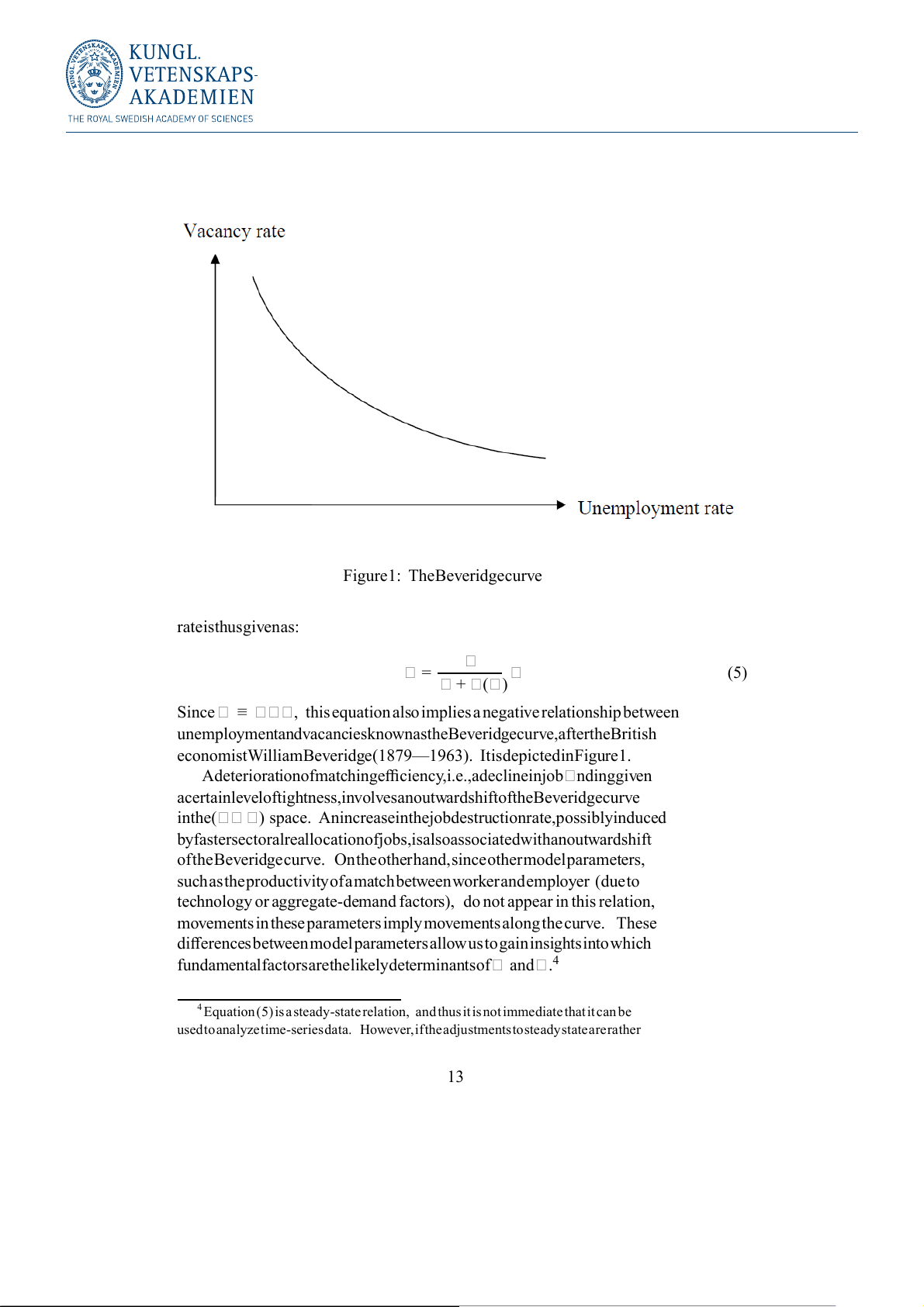
. The steady-state unemployment 12 Figure1: TheBeveridgecurve rateisthusgivenas: = (5) + ( ) Since ≡
, thisequationalsoimpliesanegativerelationshipbetween
unemploymentandvacanciesknownastheBeveridgecurve,aftertheBritish
economistWilliamBeveridge(1879—1963). ItisdepictedinFigure1.
Adeteriorationofmatchingefficiency,i.e.,adeclineinjob ndinggiven
acertainleveloftightness,involvesanoutwardshiftoftheBeveridgecurve inthe(
) space. Anincreaseinthejobdestructionrate,possiblyinduced
byfastersectoralreallocationofjobs,isalsoassociatedwithanoutwardshift
oftheBeveridgecurve. Ontheotherhand,sinceothermodelparameters,
suchastheproductivityofamatchbetweenworkerandemployer (dueto
technology or aggregate-demand factors), do not appear in this relation,
movementsintheseparametersimplymovementsalongthecurve. These
differencesbetweenmodelparametersallowustogaininsightsintowhich
fundamentalfactorsarethelikelydeterminantsof and .4
4 Equation(5)isasteady-staterelation, andthusitisnotimmediatethatitcanbe
usedtoanalyzetime-seriesdata. However,iftheadjustmentstosteadystatearerather 13
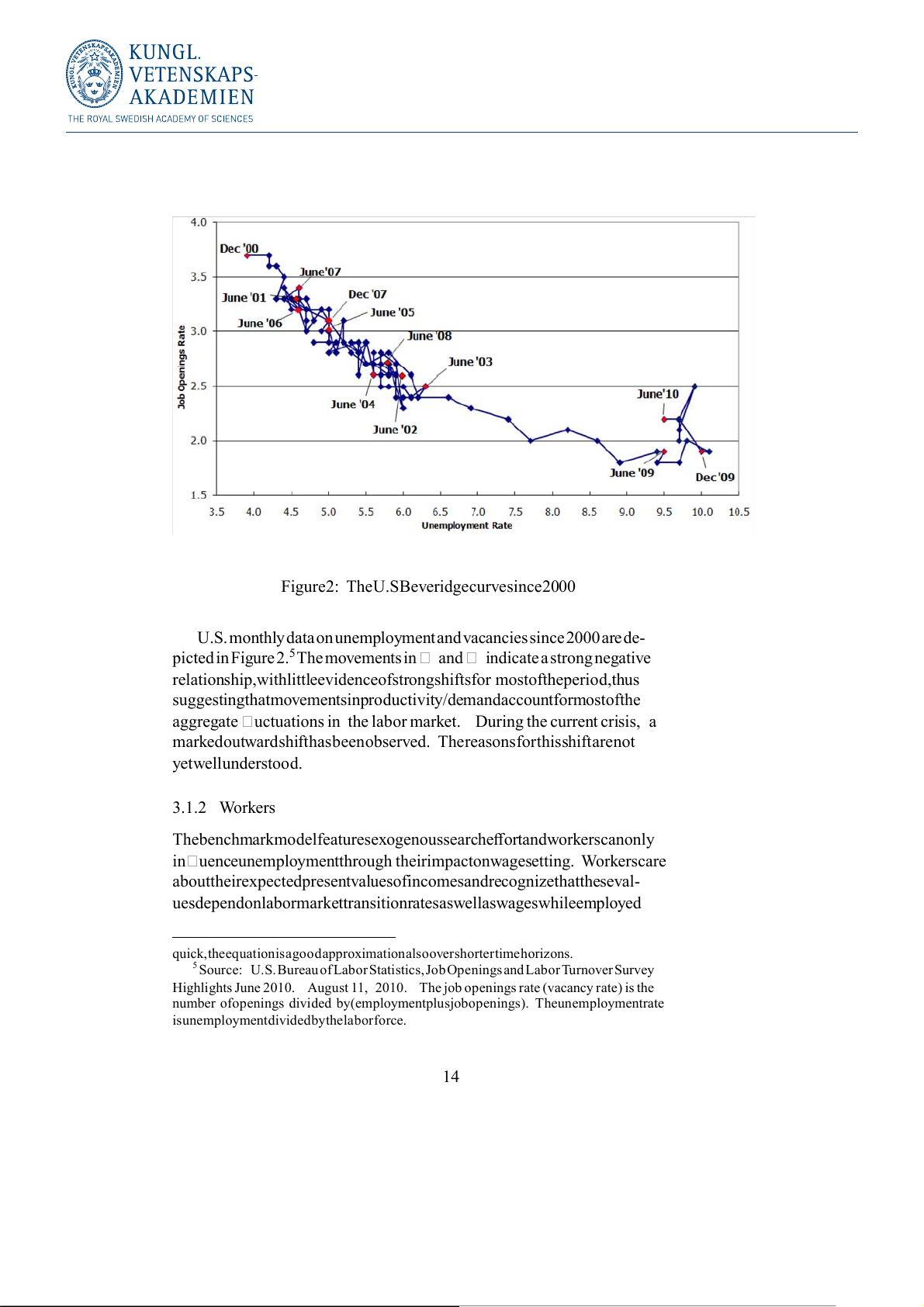
Figure2: TheU.SBeveridgecurvesince2000
U.S.monthlydataonunemploymentandvacanciessince2000arede-
pictedinFigure2.5Themovementsin and indicateastrongnegative
relationship,withlittleevidenceofstrongshiftsfor mostoftheperiod,thus
suggestingthatmovementsinproductivity/demandaccountformostofthe
aggregate uctuations in the labor market. During the current crisis, a
markedoutwardshifthasbeenobserved. Thereasonsforthisshiftarenot yetwellunderstood. 3.1.2 Workers
Thebenchmarkmodelfeaturesexogenoussearcheffortandworkerscanonly
in uenceunemploymentthrough theirimpactonwagesetting. Workerscare
abouttheirexpectedpresentvaluesofincomesandrecognizethattheseval-
uesdependonlabormarkettransitionratesaswellaswageswhileemployed
quick,theequationisagoodapproximationalsoovershortertimehorizons.
5 Source: U.S.BureauofLaborStatistics,JobOpeningsandLaborTurnoverSurvey
Highlights June 2010. August 11, 2010. The job openings rate (vacancy rate) is the
number ofopenings divided by(employmentplusjobopenings). Theunemploymentrate
isunemploymentdividedbythelaborforce. 14
andunemploymentbene tswhileunemployed. Let denotetheexpected
presentvalueofincomeofanunemployedworkerand thecorresponding
present value of an employed worker. With an in nite time horizon and
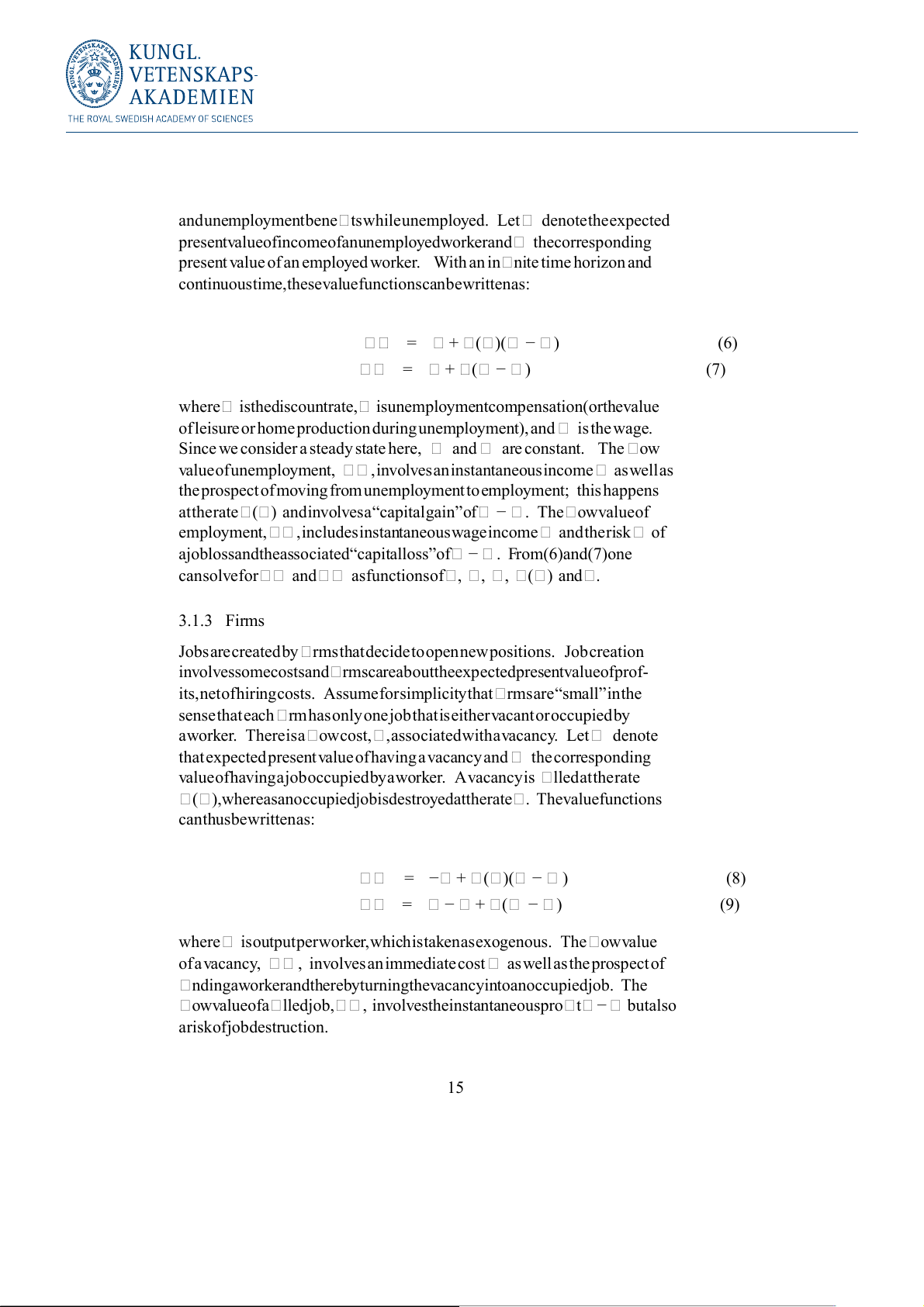
continuoustime,thesevaluefunctionscanbewrittenas: = + ( )( − ) (6) = + ( − ) (7) where
isthediscountrate, isunemploymentcompensation(orthevalue
ofleisureorhomeproductionduringunemployment),and isthewage.
Since we consider a steady state here, and are constant. The ow valueofunemployment, ,involvesaninstantaneousincome aswellas
theprospectofmovingfromunemploymenttoemployment; thishappens
attherate ( ) andinvolvesa“capitalgain”of − . The owvalueof employment,
,includesinstantaneouswageincome andtherisk of
ajoblossandtheassociated“capitalloss”of − . From(6)and(7)one cansolvefor and asfunctionsof , , , ( ) and . 3.1.3 Firms
Jobsarecreatedby rmsthatdecidetoopennewpositions. Jobcreation
involvessomecostsand rmscareabouttheexpectedpresentvalueofprof-
its,netofhiringcosts. Assumeforsimplicitythat rmsare“small”inthe
sensethateach rmhasonlyonejobthatiseithervacantoroccupiedby
aworker. Thereisa owcost, ,associatedwithavacancy. Let denote
thatexpectedpresentvalueofhavingavacancyand thecorresponding
valueofhavingajoboccupiedbyaworker. Avacancyis lledattherate
( ),whereasanoccupiedjobisdestroyedattherate . Thevaluefunctions canthusbewrittenas: = − + ( )( − ) (8) = − + ( − ) (9) where
isoutputperworker,whichistakenasexogenous. The owvalue ofavacancy, , involvesanimmediatecost aswellastheprospectof
ndingaworkerandtherebyturningthevacancyintoanoccupiedjob. The owvalueofa lledjob,
, involvestheinstantaneouspro t − butalso ariskofjobdestruction. 15 Freeentryofvacanciesimplies =0 inequilibrium: rmsopenvacan-
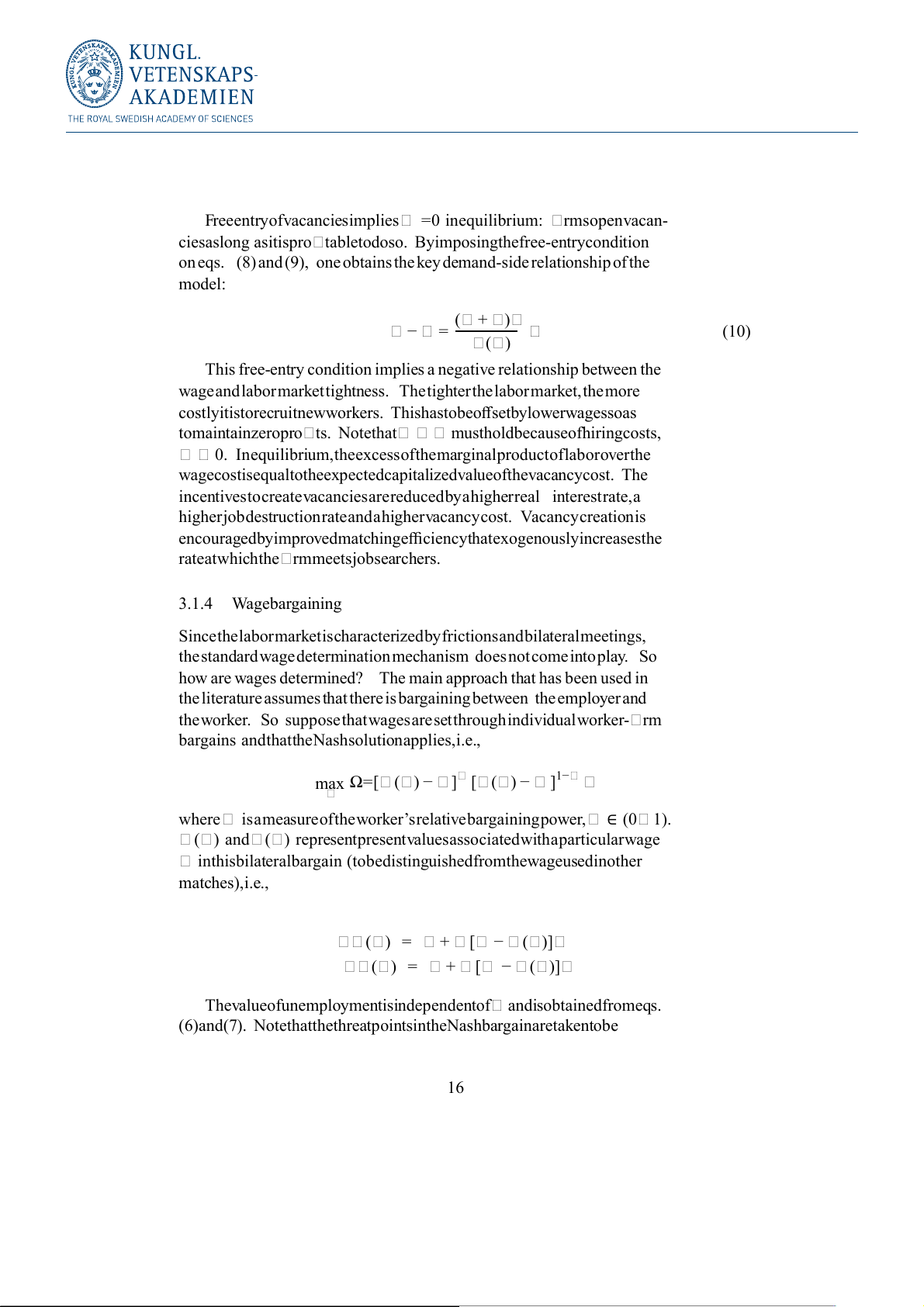
ciesaslong asitispro tabletodoso. Byimposingthefree-entrycondition
on eqs. (8) and (9), one obtains the key demand-side relationship of the model: ( + ) − = (10) ( )
This free-entry condition implies a negative relationship between the
wageandlabormarkettightness. Thetighterthelabormarket,themore
costlyitistorecruitnewworkers. Thishastobeoffsetbylowerwagessoas tomaintainzeropro ts. Notethat mustholdbecauseofhiringcosts,
0. Inequilibrium,theexcessofthemarginalproductoflaboroverthe
wagecostisequaltotheexpectedcapitalizedvalueofthevacancycost. The
incentivestocreatevacanciesarereducedbyahigherreal interestrate,a
higherjobdestructionrateandahighervacancycost. Vacancycreationis
encouragedbyimprovedmatchingefficiencythatexogenouslyincreasesthe
rateatwhichthe rmmeetsjobsearchers. 3.1.4 Wagebargaining
Sincethelabormarketischaracterizedbyfrictionsandbilateralmeetings,
thestandardwagedeterminationmechanism doesnotcomeintoplay. So
how are wages determined? The main approach that has been used in
theliteratureassumesthatthereisbargainingbetween theemployerand
theworker. So supposethatwagesaresetthroughindividualworker- rm
bargains andthattheNashsolutionapplies,i.e., max Ω=[ ( ) − ] [ ( ) − ]1− where
isameasureoftheworker’srelativebargainingpower, ∈ (0 1).
( ) and ( ) representpresentvaluesassociatedwithaparticularwage
inthisbilateralbargain (tobedistinguishedfromthewageusedinother matches),i.e., ( ) = + [ − ( )] ( ) = + [ − ( )]
Thevalueofunemploymentisindependentof andisobtainedfromeqs.
(6)and(7). NotethatthethreatpointsintheNashbargainaretakentobe 16
and ,i.e.,whattheworkerandthe rmwouldreceiveuponseparation fromeachother.
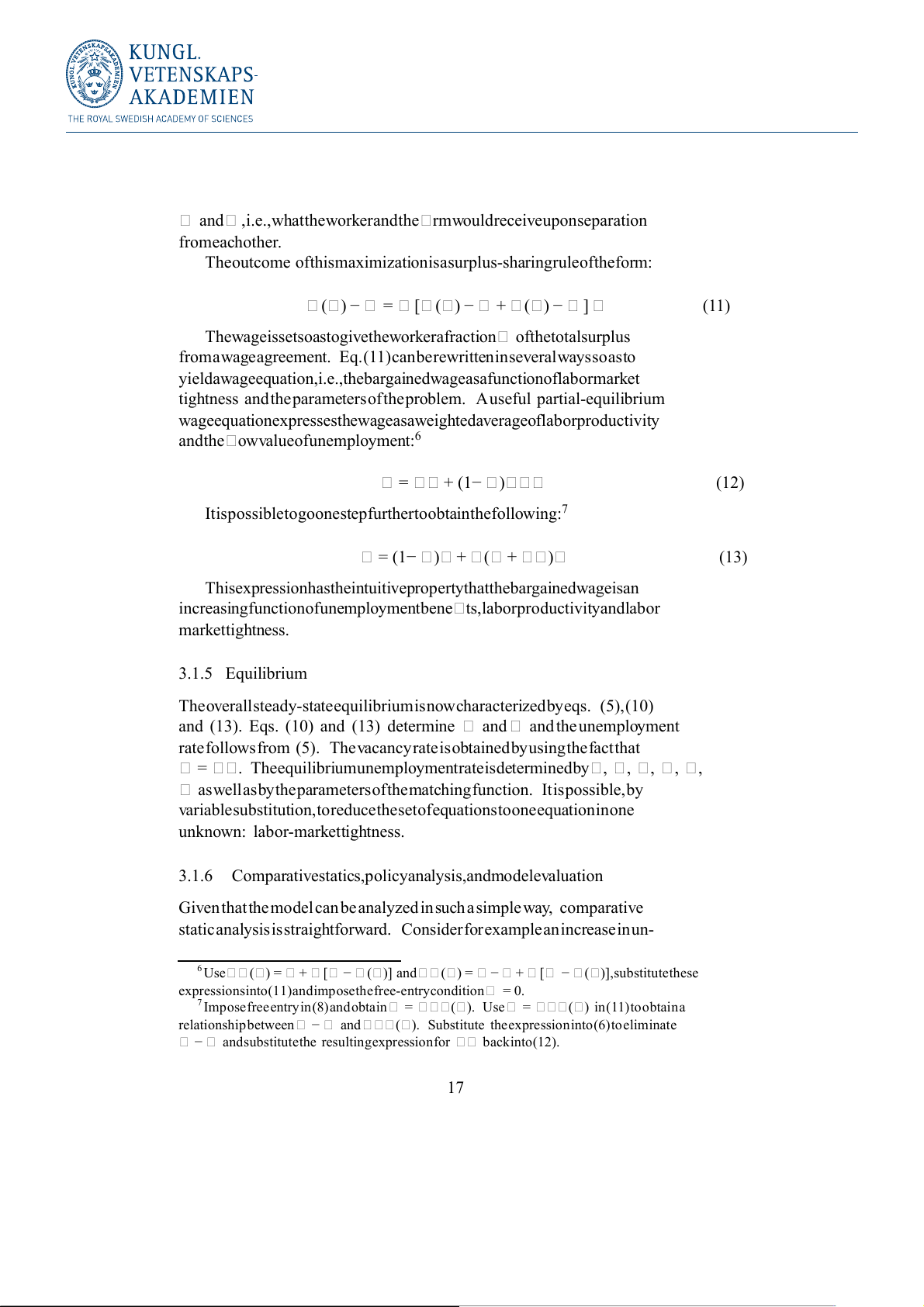
Theoutcome ofthismaximizationisasurplus-sharingruleoftheform: ( ) − = [ ( ) − + ( ) − ] (11)
Thewageissetsoastogivetheworkerafraction ofthetotalsurplus
fromawageagreement. Eq.(11)canberewritteninseveralwayssoasto
yieldawageequation,i.e.,thebargainedwageasafunctionoflabormarket
tightness andtheparametersoftheproblem. Auseful partial-equilibrium
wageequationexpressesthewageasaweightedaverageoflaborproductivity andthe owvalueofunemployment:6 = + (1− ) (12)
Itispossibletogoonestepfurthertoobtainthefollowing:7 = (1− ) + ( + ) (13)
Thisexpressionhastheintuitivepropertythatthebargainedwageisan
increasingfunctionofunemploymentbene ts,laborproductivityandlabor markettightness. 3.1.5 Equilibrium
Theoverallsteady-stateequilibriumisnowcharacterizedbyeqs. (5),(10)
and (13). Eqs. (10) and (13) determine and andtheunemployment
ratefollowsfrom (5). Thevacancyrateisobtainedbyusingthefactthat =
. Theequilibriumunemploymentrateisdeterminedby , , , , ,
aswellasbytheparametersofthematchingfunction. Itispossible,by
variablesubstitution,toreducethesetofequationstooneequationinone
unknown: labor-markettightness. 3.1.6
Comparativestatics,policyanalysis,andmodelevaluation
Giventhatthemodelcanbeanalyzedinsuchasimpleway, comparative
staticanalysisisstraightforward. Considerforexampleanincreaseinun- 6 Use ( ) = + [ − ( )] and ( ) = − + [ − ( )],substitutethese
expressionsinto(11)andimposethefree-entrycondition = 0.
7 Imposefreeentryin(8)andobtain = ( ). Use = ( ) in(11)toobtaina relationshipbetween − and
( ). Substitute theexpressioninto(6)toeliminate −
andsubstitutethe resultingexpressionfor backinto(12). 17
employmentbene ts. Thisraisesthevalueofunemploymentand reduces
the worker’s gain from a wage agreement; the resulting increase in wage
pressureleadstoadeclineinjobcreation,higherunemploymentandhigher
realwages. Ahigherrealinterestratehasanadverseimpactonjobcreation
whichleadstofewervacancies,higherunemploymentandlowerrealwages.
It also easy to verify that unemployment increases if there is an increase
inthevacancycost, thejobdestructionrate,orthe worker’srelativebar-
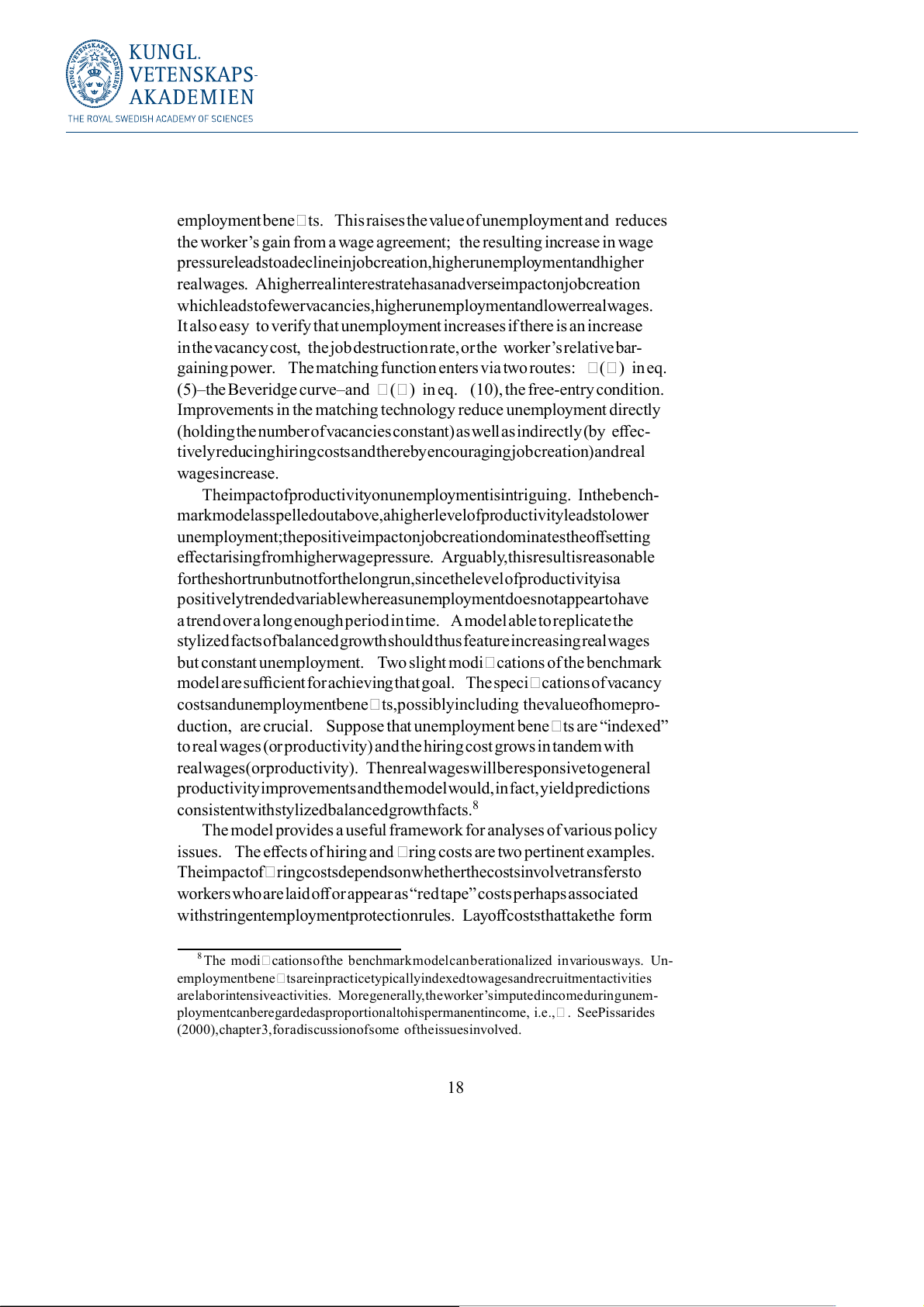
gainingpower. Thematchingfunctionentersviatworoutes: ( ) ineq.
(5)–the Beveridge curve–and
( ) in eq. (10), the free-entry condition.
Improvements in the matching technology reduce unemployment directly
(holdingthenumberofvacanciesconstant)aswellasindirectly(by effec-
tivelyreducinghiringcostsandtherebyencouragingjobcreation)andreal wagesincrease.
Theimpactofproductivityonunemploymentisintriguing. Inthebench-
markmodelasspelledoutabove,ahigherlevelofproductivityleadstolower
unemployment;thepositiveimpactonjobcreationdominatestheoffsetting
effectarisingfromhigherwagepressure. Arguably,thisresultisreasonable
fortheshortrunbutnotforthelongrun,sincethelevelofproductivityisa
positivelytrendedvariablewhereasunemploymentdoesnotappeartohave
atrendoveralongenoughperiodintime. Amodelabletoreplicatethe
stylizedfactsofbalancedgrowthshouldthusfeatureincreasingrealwages
but constant unemployment. Two slight modi cations of the benchmark
modelaresufficientforachievingthatgoal. Thespeci cationsofvacancy
costsandunemploymentbene ts,possiblyincluding thevalueofhomepro-
duction, are crucial. Suppose that unemployment bene ts are “indexed”
torealwages(orproductivity)andthehiringcostgrowsintandemwith
realwages(orproductivity). Thenrealwageswillberesponsivetogeneral
productivityimprovementsandthemodelwould,infact,yieldpredictions
consistentwithstylizedbalancedgrowthfacts.8
The model provides a useful framework for analyses of various policy
issues. The effects of hiring and ring costs are two pertinent examples.
Theimpactof ringcostsdependsonwhetherthecostsinvolvetransfersto
workerswhoarelaidofforappearas“redtape”costsperhapsassociated
withstringentemploymentprotectionrules. Layoffcoststhattakethe form
8 The modi cationsofthe benchmarkmodelcanberationalized invariousways. Un-
employmentbene tsareinpracticetypicallyindexedtowagesandrecruitmentactivities
arelaborintensiveactivities. Moregenerally,theworker’simputedincomeduringunem-
ploymentcanberegardedasproportionaltohispermanentincome, i.e., . SeePissarides
(2000),chapter3,foradiscussionofsome oftheissuesinvolved. 18
ofseverancepaytolaid-offworkersdonotalterthetotalsurplusofamatch
andwillnotaffectjobcreationandunemployment. Redtapecostsreduce
thesurplusofamatchandleadtolowerjobcreation.
There is also a large literature that assesses the model quantitatively,
usingavarietyofevaluationmethodsanddifferentdatasets. Thedevel-
opment of search and matching theory has led to a large empirical liter-
ature. The early microeconomic models of job search initiated new data
collection efforts focusing on individual labor market transitions, in par-
ticular transitions from unemployment to employment. The more recent
macroeconomics-oriented search and matching theory has been developed
in parallel with improved data availability on worker ows and job ows (seeSection3.3below).
Themicroeconomicsearchmodelshavestimulated numerousempirical
studiesofthedeterminantsofunemploymentduration. Themethodological
literatureoneconometricdurationanalysishasexpandedsubstantiallyover
thepastcoupleofdecades, adevelopmentthatistoalargeextentdriven
bythegrowthandimpactofmicroeconomicsearchtheory. Theeffectsof
unemploymentbene tsonindividualunemploymentdurationconstitutethe
mostwidelyresearchedissueinthisstrandofliterature. Theearlypapers,
datingback tothelate1970s,typicallyidenti edtheimpactbyexploiting
cross-sectionalbene tvariationacrossindividuals. Morerecentstudieshave
exploitedinformationfrompolicyreformsandquasi-experiments. The em-
piricalstudiesgenerally suggestthatmoregenerousbene tstendtoincrease
thedurationofunemployment. AkeytheoreticalpredictionfromMortensen
(1977)–thattheexitratefromunemploymentincreasesastheworker ap-
proachesbene texhaustion–hasbeencorroboratedinaverylargenumber ofstudiesfrommanycountries.
Althoughinformationabouthowindividualsrespondtobene tchanges
isuseful,itcapturesonlyapartialequilibriumrelationshipsince rmbehav-
iorisignored. Theequilibriumoutcomewillalmostcertainlydifferquan-
titatively and conceivably also qualitatively from the partial equilibrium
relationship. Moreover, there are many policies, such as minimum wages
oremploymentsubsidies,thatcannotbeanalyzedwithinthepartialequi-
libriumframework. Theseconcernshaveinitiatedanumberofattemptsto
estimatemodelsofequilibriumsearcheconometricallyusingmicrodata. A
seminalpaperisEcksteinandWolpin(1990),whoestimatedtheAlbrecht
andAxell(1984)model. AmorerecentstudyisvandenBergandRidder
(1998),whoestimatedanextendedversionoftheBurdett andMortensen
(1998) model. Mortensen (2005) includes a comprehensive discussion of
wagedifferencesinDenmarkfromtheperspectiveofsearchandmatching 19
Tài liệu liên quan:
-

Chương 3: độ co giãn và các nhân tố ảnh hưởng | Microeconomics | Trường Đại học Quốc tế, Đại học Quốc gia Thành phố Hồ Chí Minh
4 2 -
Microeconomics Syllabus | Microeconomics | Trường Đại học Quốc tế, Đại học Quốc gia Thành phố Hồ Chí Minh
4 2 -

Microeconomics Course Syllabus & Assessment Details | Microeconomics | Trường Đại học Quốc tế, Đại học Quốc gia Thành phố Hồ Chí Minh
4 2 -

Assignment 3 - Elasticity MCQs and Key Concepts | Microeconomics | Trường Đại học Quốc tế, Đại học Quốc gia Thành phố Hồ Chí Minh
4 2 -
Assignment 2 - Economic Equilibrium Analysis of Fridges and Motorcycles | Microeconomics | Trường Đại học Quốc tế, Đại học Quốc gia Thành phố Hồ Chí Minh
4 2