Key Concepts Summary for Final Exam | Microeconomics | Trường Đại học Quốc tế, Đại học Quốc gia Thành phố Hồ Chí Minh
The costs of taxation: - A tax: drives a wedge between the price buyers pay and the price sellers receive - The effects of a tax: reduces the welfare loss usually exceeds the revenue the tax raises for the government. - The deadweight loss (DWL) of a tax: the fall in total surplus (consumer surplus, producer surplus, tax revenue) - The price elasticities of demand and supply measure how much buyers and sellers respond to price changes => Higher elasticities imply higher DWL. Tài liệu được sưu tầm và soạn thảo dưới dạng file PDF để gửi tới các bạn cùng tham khảo, ôn tập đầy đủ kiến thức, chuẩn bị cho các buổi học thật tốt. Mời bạn đọc đón xem!
Môn: Microeconomics 635 tài liệu
Trường: Trường Đại học Quốc tế, Đại học Quốc gia Thành phố Hồ Chí Minh 1.9 K tài liệu
Tác giả:

Preview text:
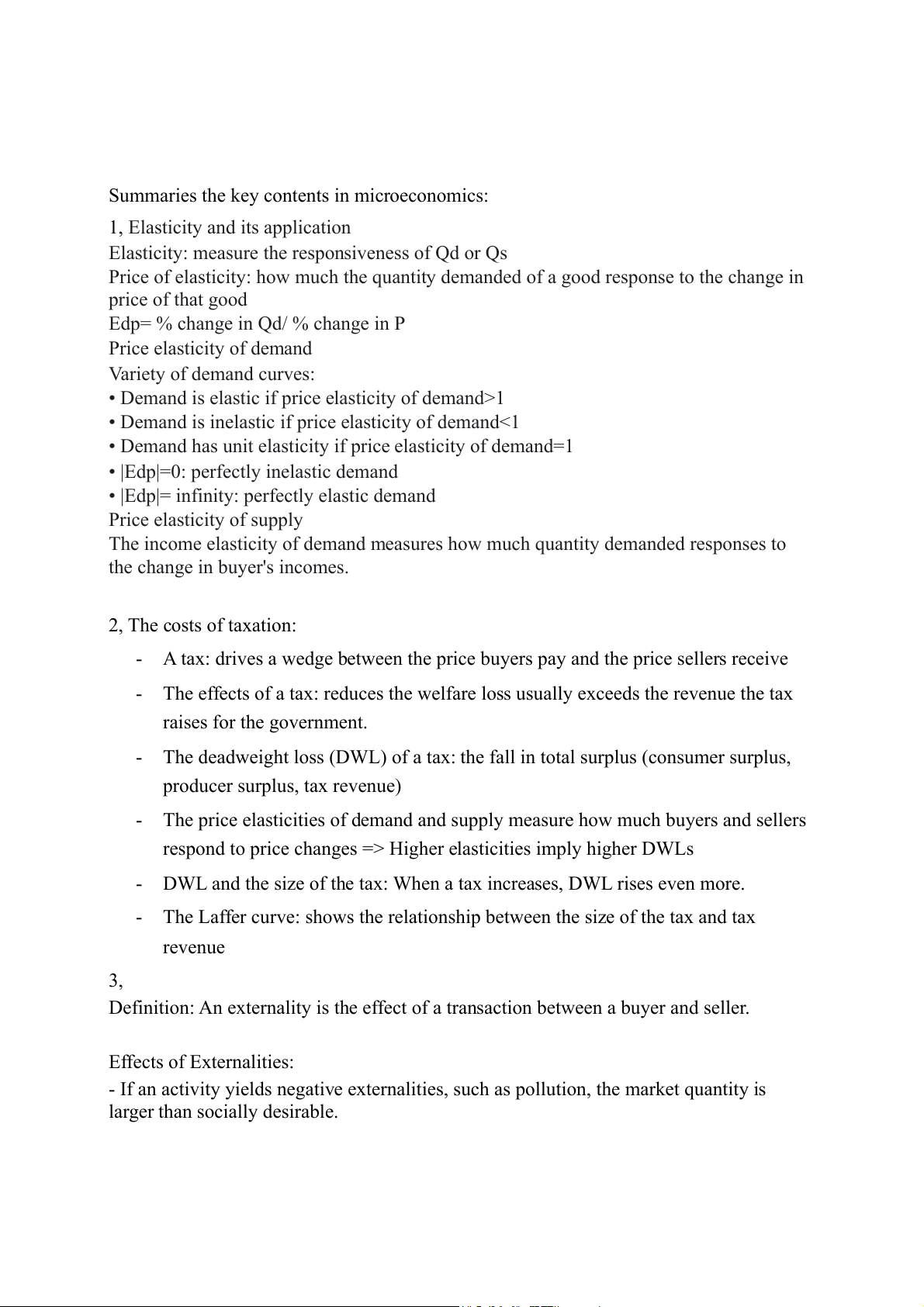
Summaries the key contents in microeconomics:
1, Elasticity and its application
Elasticity: measure the responsiveness of Qd or Qs
Price of elasticity: how much the quantity demanded of a good response to the change in price of that good
Edp= % change in Qd/ % change in P Price elasticity of demand Variety of demand curves:
• Demand is elastic if price elasticity of demand>1
• Demand is inelastic if price elasticity of demand<1
• Demand has unit elasticity if price elasticity of demand=1
• |Edp|=0: perfectly inelastic demand
• |Edp|= infinity: perfectly elastic demand Price elasticity of supply
The income elasticity of demand measures how much quantity demanded responses to the change in buyer's incomes. 2, The costs of taxation:
- A tax: drives a wedge between the price buyers pay and the price sellers receive
- The effects of a tax: reduces the welfare loss usually exceeds the revenue the tax raises for the government.
- The deadweight loss (DWL) of a tax: the fall in total surplus (consumer surplus, producer surplus, tax revenue)
- The price elasticities of demand and supply measure how much buyers and sellers
respond to price changes => Higher elasticities imply higher DWLs
- DWL and the size of the tax: When a tax increases, DWL rises even more.
- The Laffer curve: shows the relationship between the size of the tax and tax revenue 3,
Definition: An externality is the effect of a transaction between a buyer and seller. Effects of Externalities:
- If an activity yields negative externalities, such as pollution, the market quantity is
larger than socially desirable.
- By contrast, if an activity yields positive externalities, such as technology spillovers, the
market quantity smaller than socially desirable
Solution: Governments pursue various policies to remedy the inefficiencies caused by externalities: – Regulating behavior
– Internalizes an externality using corrective taxes (such as taxing on goods with
negaative externalities or subsidizing goods with positive externalities)
– Issue permits (similar results to imposing
corrective taxes on polluters) such as taxing on goods with negaative externalities or
subsidizing goods with positive externalities
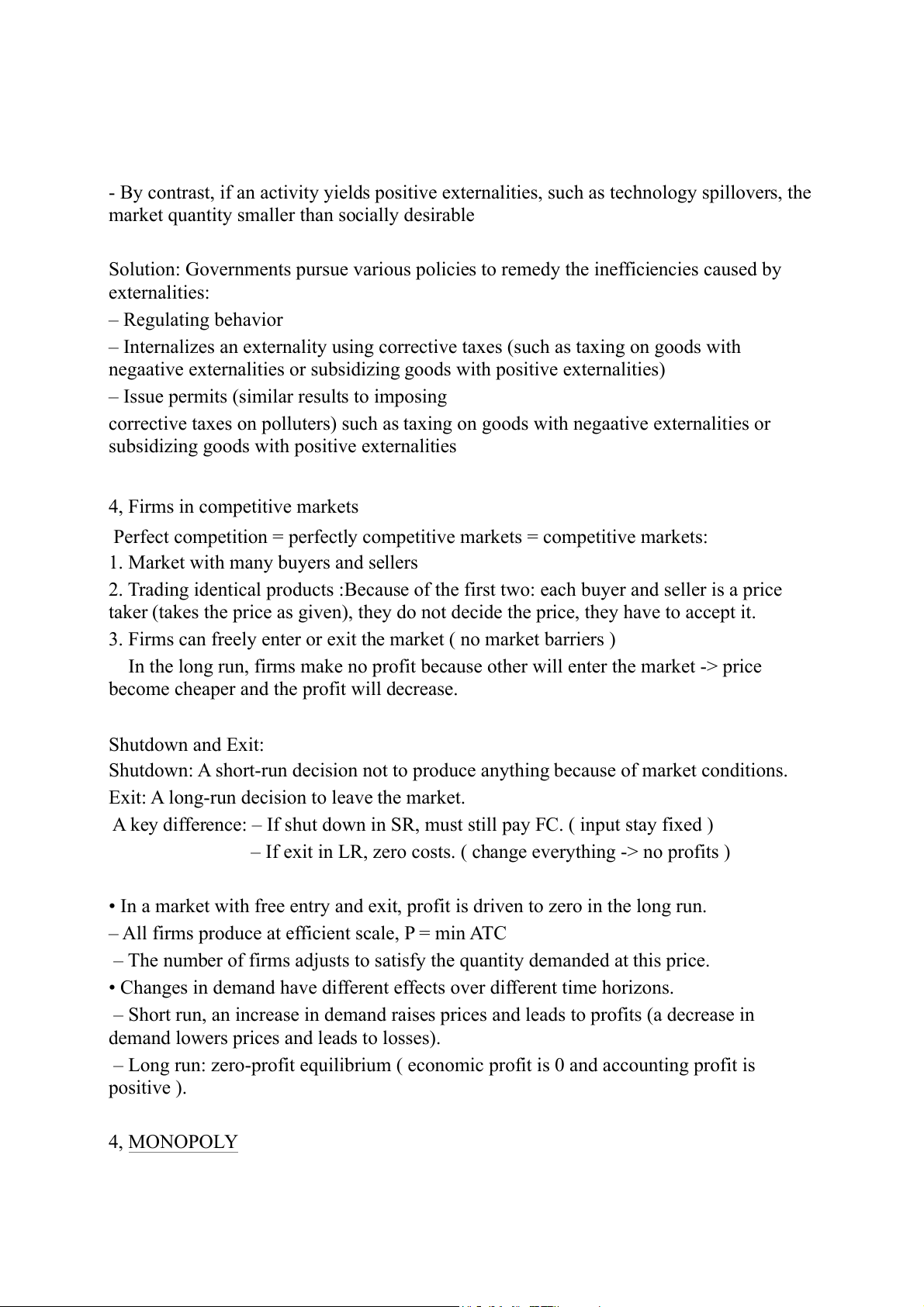
4, Firms in competitive markets
Perfect competition = perfectly competitive markets = competitive markets:
1. Market with many buyers and sellers
2. Trading identical products :Because of the first two: each buyer and seller is a price
taker (takes the price as given), they do not decide the price, they have to accept it.
3. Firms can freely enter or exit the market ( no market barriers )
In the long run, firms make no profit because other will enter the market -> price
become cheaper and the profit will decrease. Shutdown and Exit:
Shutdown: A short-run decision not to produce anything because of market conditions.
Exit: A long-run decision to leave the market.
A key difference: – If shut down in SR, must still pay FC. ( input stay fixed )
– If exit in LR, zero costs. ( change everything -> no profits )
• In a market with free entry and exit, profit is driven to zero in the long run.
– All firms produce at efficient scale, P = min ATC
– The number of firms adjusts to satisfy the quantity demanded at this price.
• Changes in demand have different effects over different time horizons.
– Short run, an increase in demand raises prices and leads to profits (a decrease in
demand lowers prices and leads to losses).
– Long run: zero-profit equilibrium ( economic profit is 0 and accounting profit is positive ). 4, MONOPOLY
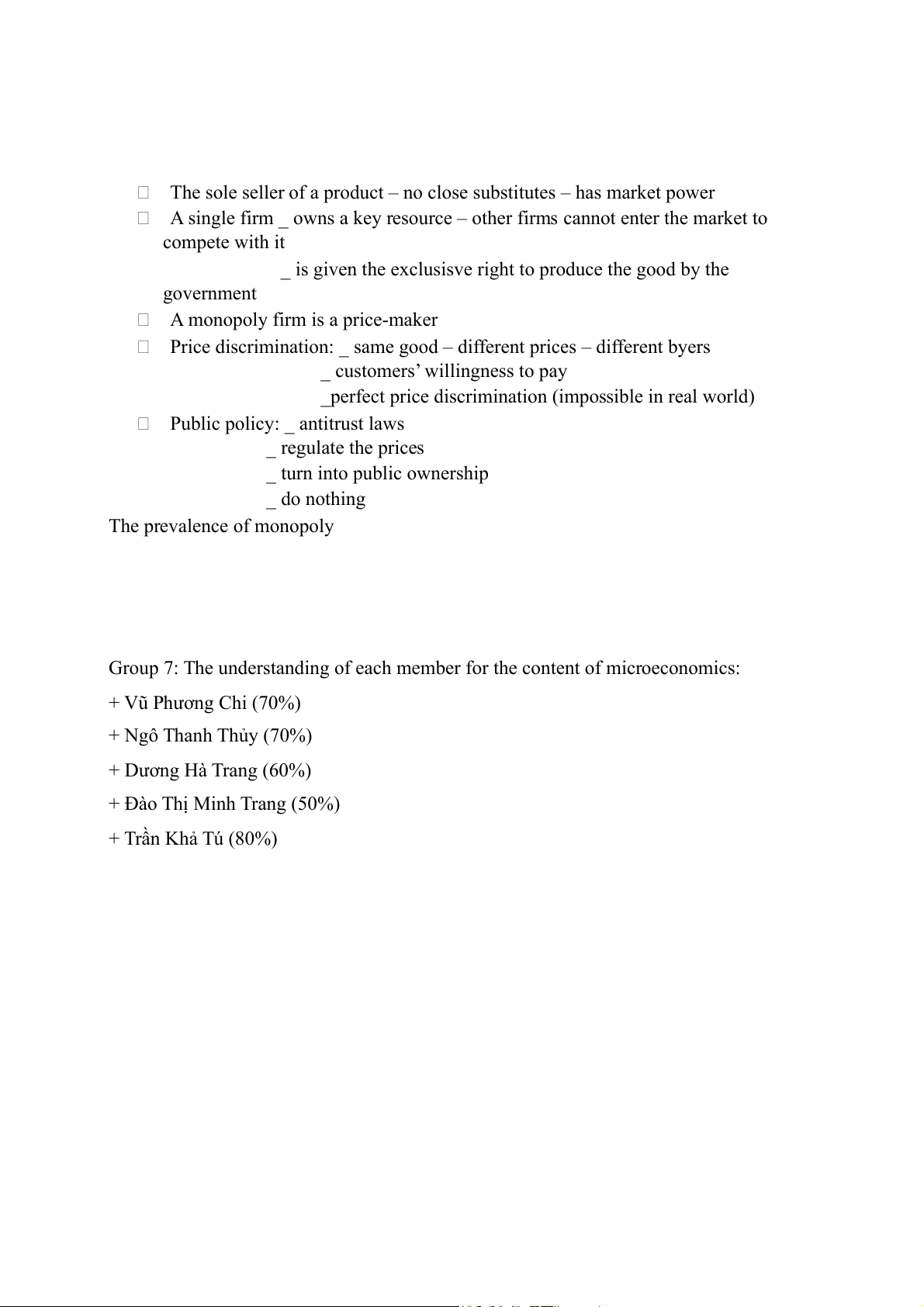
The sole seller of a product – no close substitutes – has market power
A single firm _ owns a key resource – other firms cannot enter the market to compete with it
_ is given the exclusisve right to produce the good by the government
A monopoly firm is a price-maker
Price discrimination: _ same good – different prices – different byers
_ customers’ willingness to pay
_perfect price discrimination (impossible in real world)
Public policy: _ antitrust laws _ regulate the prices _ turn into public ownership _ do nothing The prevalence of monopoly
Group 7: The understanding of each member for the content of microeconomics: + Vũ Phương Chi (70%) + Ngô Thanh Thủy (70%) + Dương Hà Trang (60%) + Đào Thị Minh Trang (50%) + Trần Khả Tú (80%)
Tài liệu liên quan:
-

Chương 3: độ co giãn và các nhân tố ảnh hưởng | Microeconomics | Trường Đại học Quốc tế, Đại học Quốc gia Thành phố Hồ Chí Minh
4 2 -
Microeconomics Syllabus | Microeconomics | Trường Đại học Quốc tế, Đại học Quốc gia Thành phố Hồ Chí Minh
4 2 -
Microeconomics Course Syllabus & Assessment Details | Microeconomics | Trường Đại học Quốc tế, Đại học Quốc gia Thành phố Hồ Chí Minh
4 2 -
Assignment 3 - Elasticity MCQs and Key Concepts | Microeconomics | Trường Đại học Quốc tế, Đại học Quốc gia Thành phố Hồ Chí Minh
4 2 -
Assignment 2 - Economic Equilibrium Analysis of Fridges and Motorcycles | Microeconomics | Trường Đại học Quốc tế, Đại học Quốc gia Thành phố Hồ Chí Minh
4 2