Lecture 03: Understanding Percentages, Powers & Simplification | Microeconomics | Trường Đại học Quốc tế, Đại học Quốc gia Thành phố Hồ Chí Minh
Calculate percentages. Understand an advanced operation, power, which can be positive. Tài liệu được sưu tầm và soạn thảo dưới dạng file PDF với mục đích hỗ trợ học tập và tham khảo. Nội dung tài liệu được trình bày rõ ràng, dễ tiếp cận, phù hợp cho việc ôn tập và củng cố kiến thức trong quá trình học đại học. Đây sẽ là nguồn tư liệu hữu ích giúp các bạn sinh viên chuẩn bị tốt hơn cho các buổi học, đồng thời mở rộng thêm hiểu biết về môn học. Hy vọng tài liệu này sẽ mang lại nhiều giá trị và hỗ trợ các bạn trong hành trình học tập. Mời bạn đọc cùng tham khảo!
Môn: Microeconomics 635 tài liệu
Trường: Trường Đại học Quốc tế, Đại học Quốc gia Thành phố Hồ Chí Minh 1.9 K tài liệu
Tác giả:



Preview text:
Lecture 3 PERCENTAGES, QUANTITATIVE POWERS METHODS AND SIMPLIFICATION Lecture 3 LEARNING OBJECTIVES Calculate percentages.
Understand an advanced operation, power, which can be positive,
negative, an integer and a fraction.
Simplify expressions using expansion and factorisation.
Understand the fundamental concept of present value. Lecture 3 INTRODUCTION
A company employs 100 people of whom 25 are women, this could be expressed as:
• Women make up one-quarter of the labour force (fraction)
• Women make up 0.25 of the labour force (decimal)
• Women make up 25% of the labour force (percentage)
The literal meaning of “percent” is per hundred (“centum” meant one
hundred in Latin; “cent” is French for a hundred, “cento” is Italian for a
hundred, “a century” is a hundred years in English). Lecture 3 1. PERCENTAGES CALCULATINGPERCENTAGES
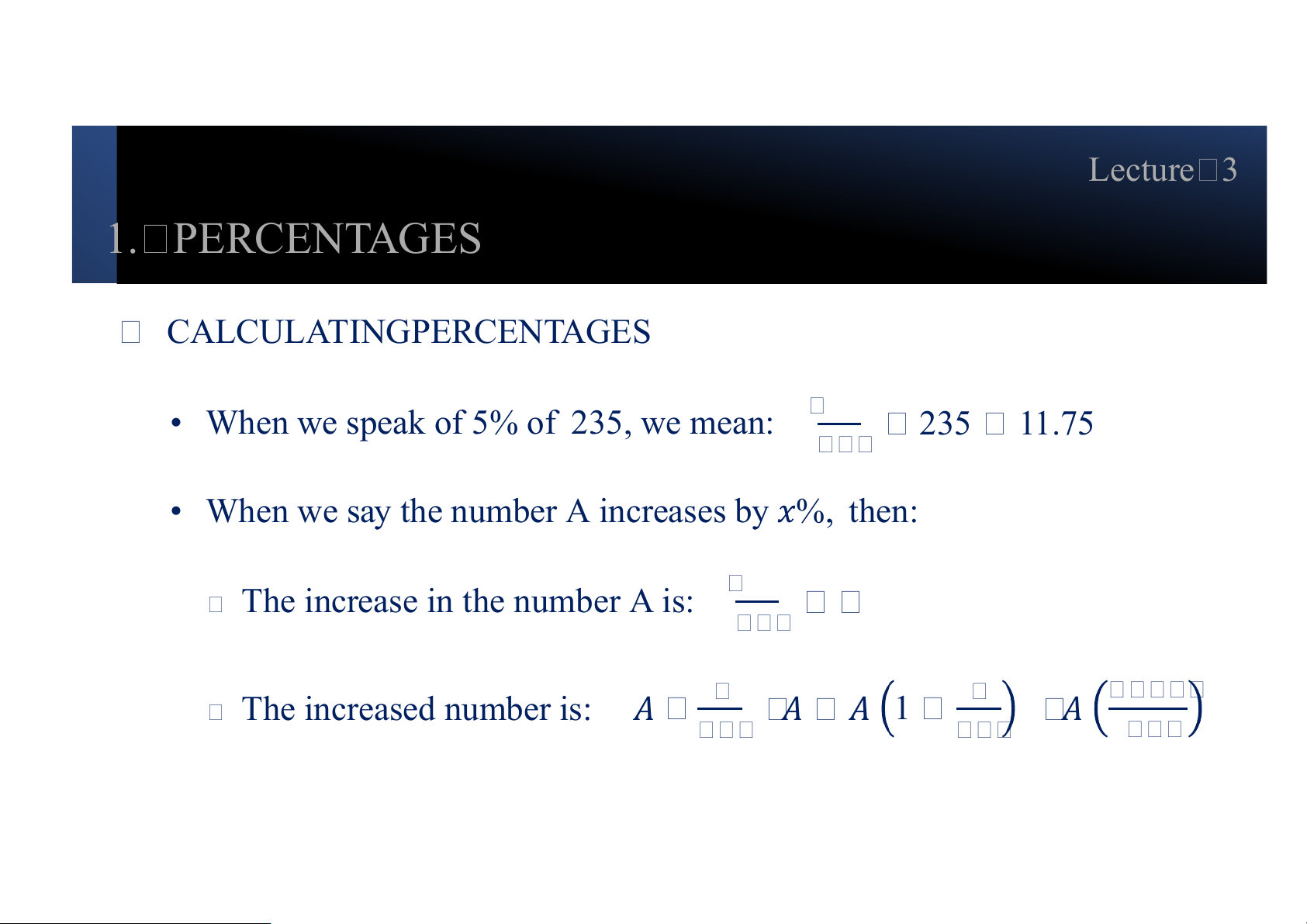
• When we speak of 5% of 235, we mean: 235 11.75
• When we say the number A increases by 𝑥%, then:
The increase in the number A is: The increased number is: 𝐴 𝐴 𝐴 1 𝐴 Lecture 3 1. PERCENTAGES CALCULATINGPERCENTAGES
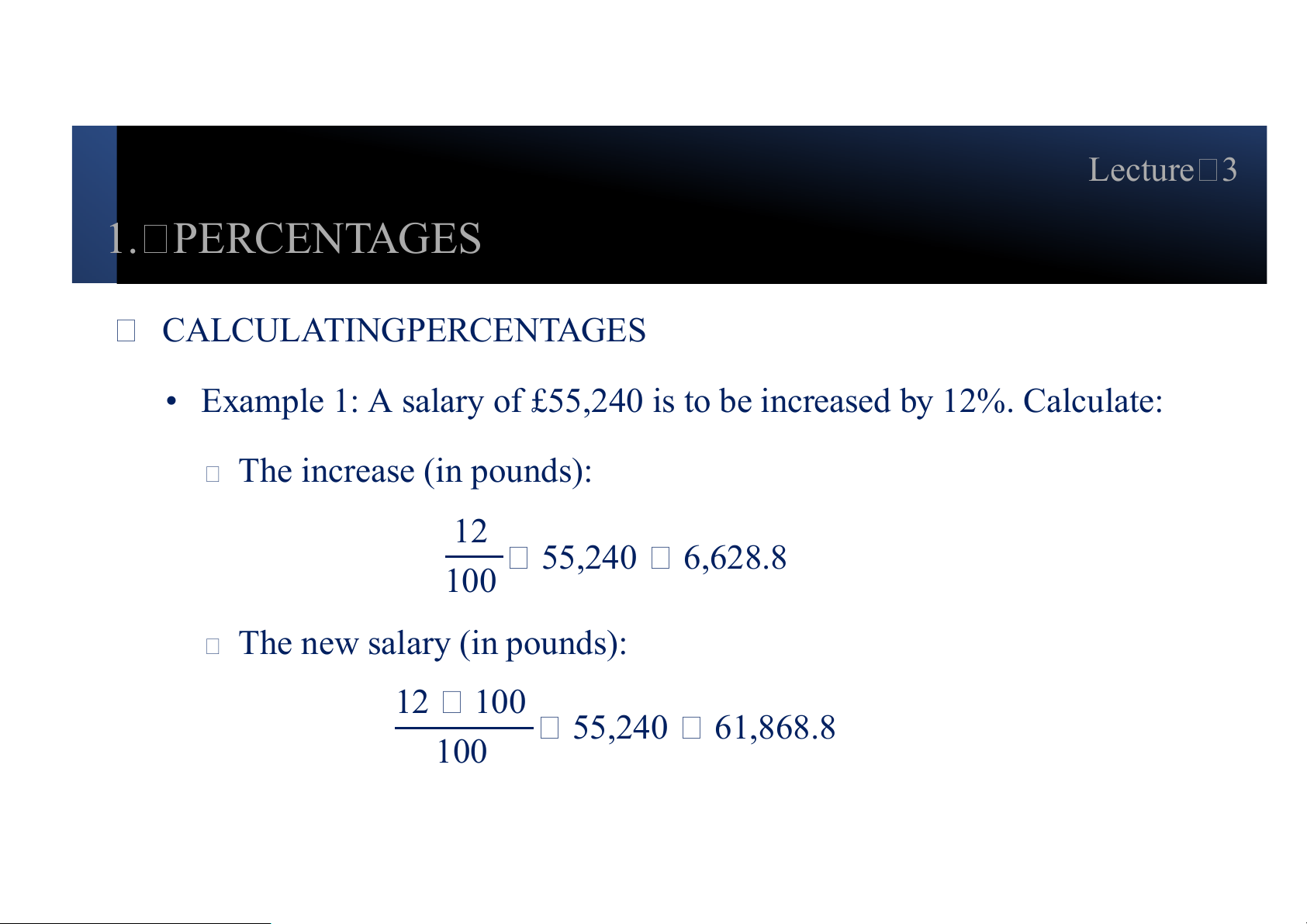
• Example 1: A salary of £55,240 is to be increased by 12%. Calculate: The increase (in pounds): 12 55,240 6,628.8 100 The new salary (in pounds): 12 100 55,240 61,868.8 100 Lecture 3 1. PERCENTAGES CALCULATINGPERCENTAGES
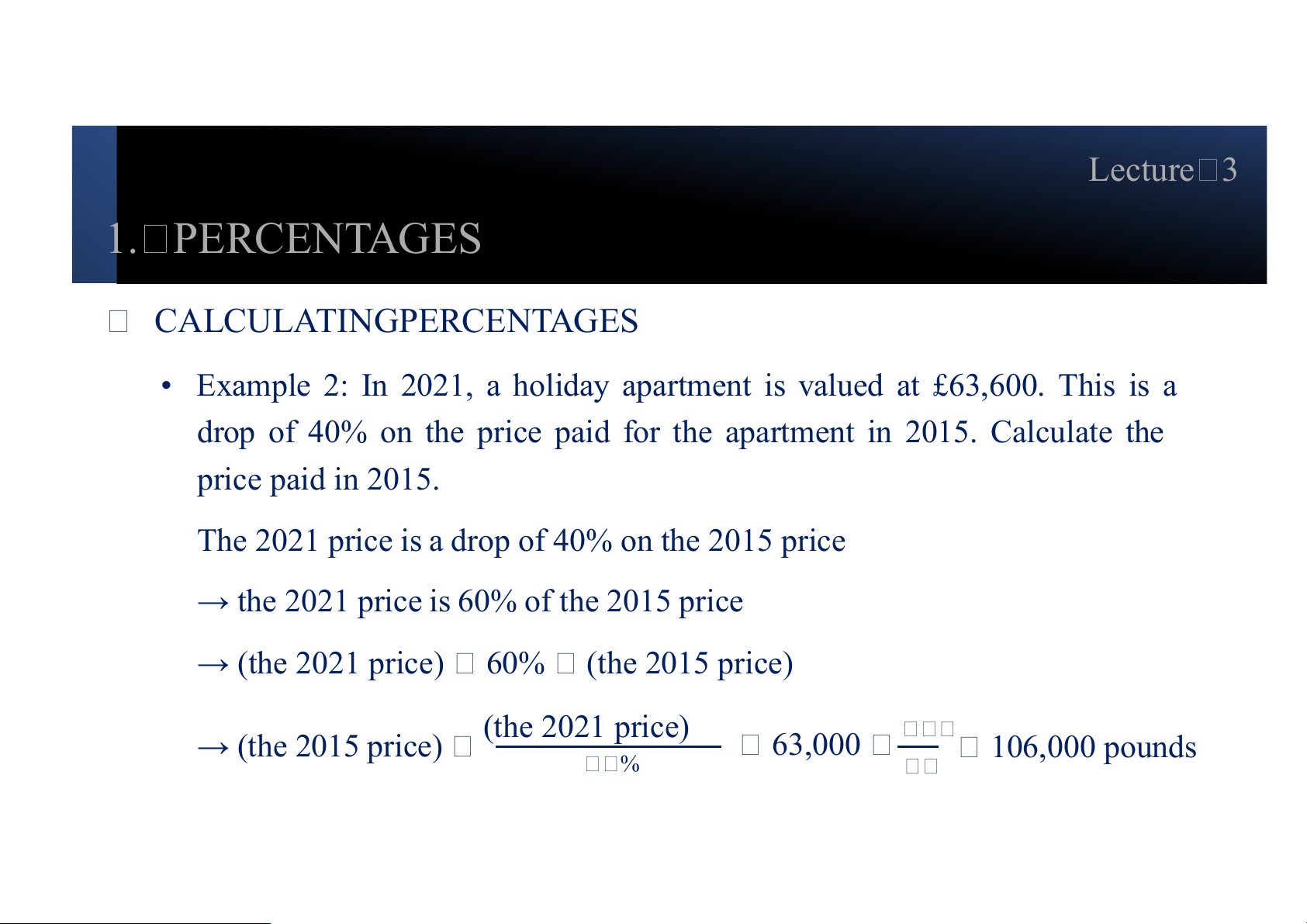
• Example 2: In 2021, a holiday apartment is valued at £63,600. This is a
drop of 40% on the price paid for the apartment in 2015. Calculate the price paid in 2015.
The 2021 price is a drop of 40% on the 2015 price
→ the 2021 price is 60% of the 2015 price → (the 2021 price) 60% (the 2015 price) (the 2021 price) → (the 2015 price) 63,000 106,000 pounds % Lecture 3 1. PERCENTAGES CALCULATINGPERCENTAGES
• Example 3: A bookshop gets £20 for every copy of a particular book
sold, 70% of which is paid to the publisher. The publisher pays 10%
of the 70% they get to the writer of the book. If the book sells 270
copies, how much will the writer get? The bookshop gets: 270 20 5400 pounds The publisher gets: 5400 70% 3780 pounds The writer gets: 3780 10% 378 pounds Lecture 3 2. POWERS DEFINITION
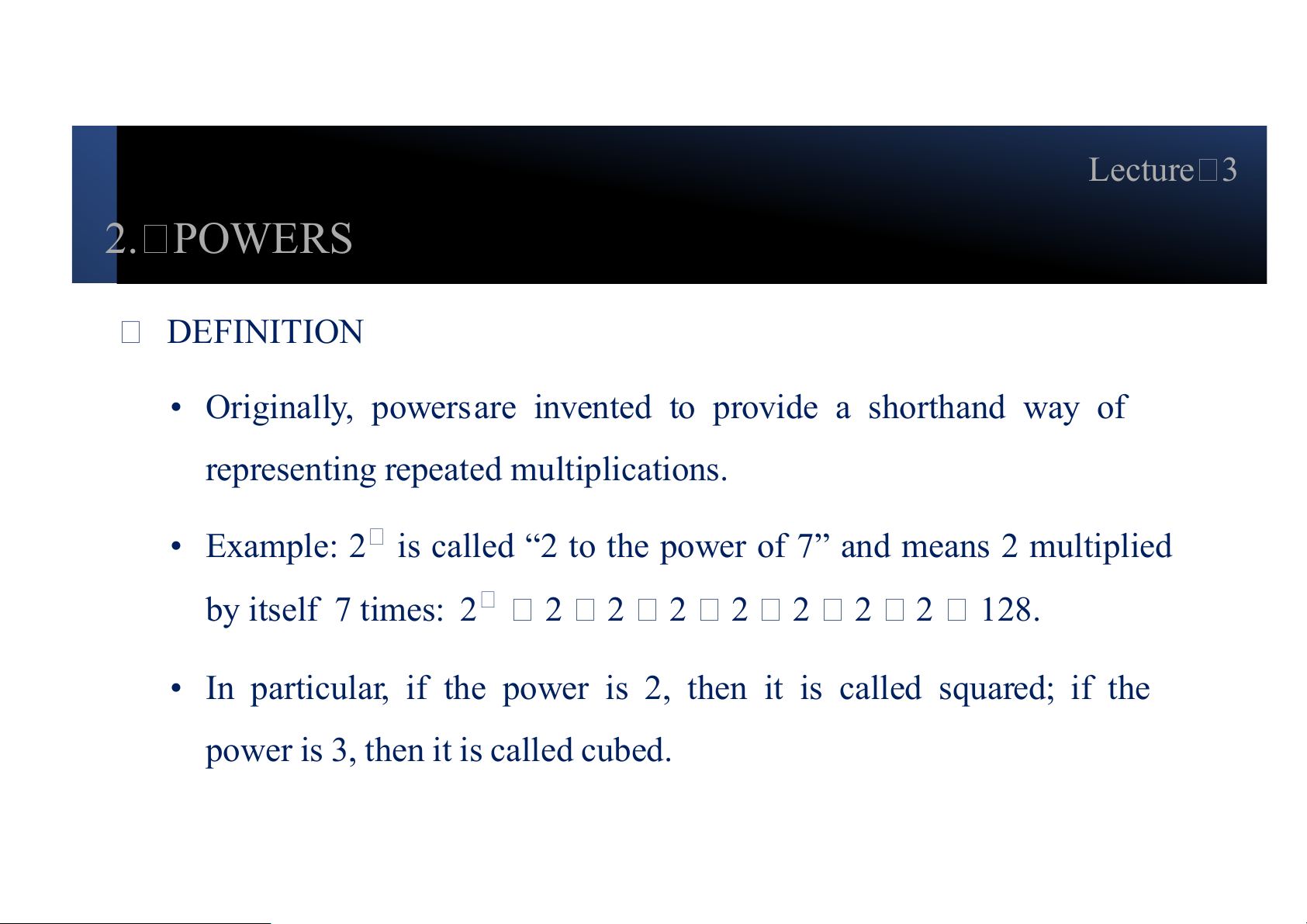
• Originally, powersare invented to provide a shorthand way of
representing repeated multiplications.
• Example: 2 is called “2 to the power of 7” and means 2 multiplied by itself 7 times: 2 2 2 2 2 2 2 2 128.
• In particular, if the power is 2, then it is called squared; if the
power is 3, then it is called cubed. Lecture 3 2. POWERS DEFINITION
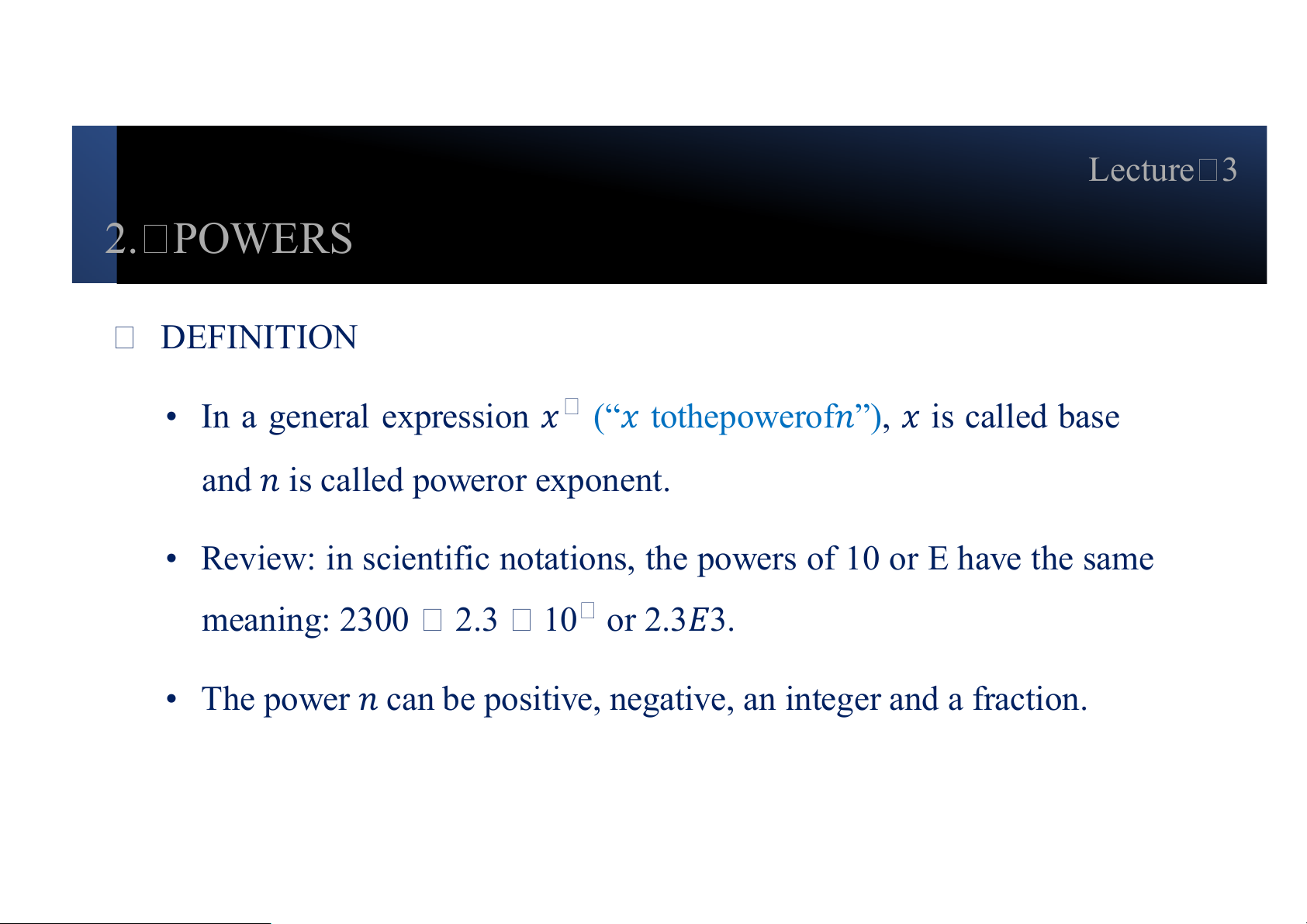
• In a general expression 𝑥 (“𝑥 tothepowerof𝑛”), 𝑥 is called base
and 𝑛 is called poweror exponent.
• Review: in scientific notations, the powers of 10 or E have the same meaning: 2300 2.3 10 or 2.3𝐸3.
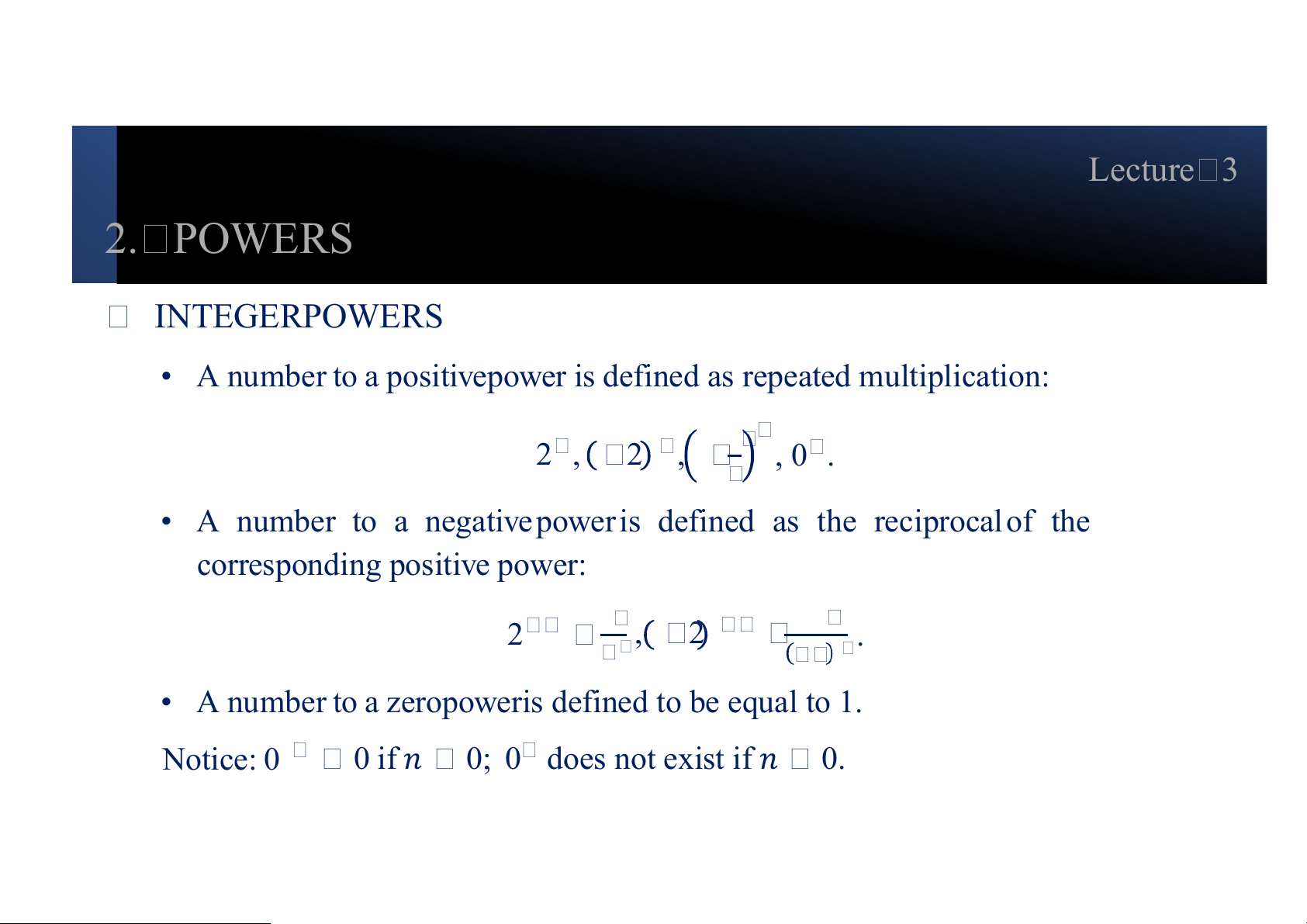
• The power 𝑛 can be positive, negative, an integer and a fraction. Lecture 3 2. POWERS INTEGERPOWERS
• A number to a positivepower is defined as repeated multiplication: 2 , 2 , , 0 .
• A number to a negativepoweris defined as the reciprocalof the corresponding positive power: 2 , 2 .
• A number to a zeropoweris defined to be equal to 1. Notice: 0 0 if 𝑛 0; 0 does not exist if 𝑛 0. Lecture 3 2. POWERS LAWSOFPOWERS
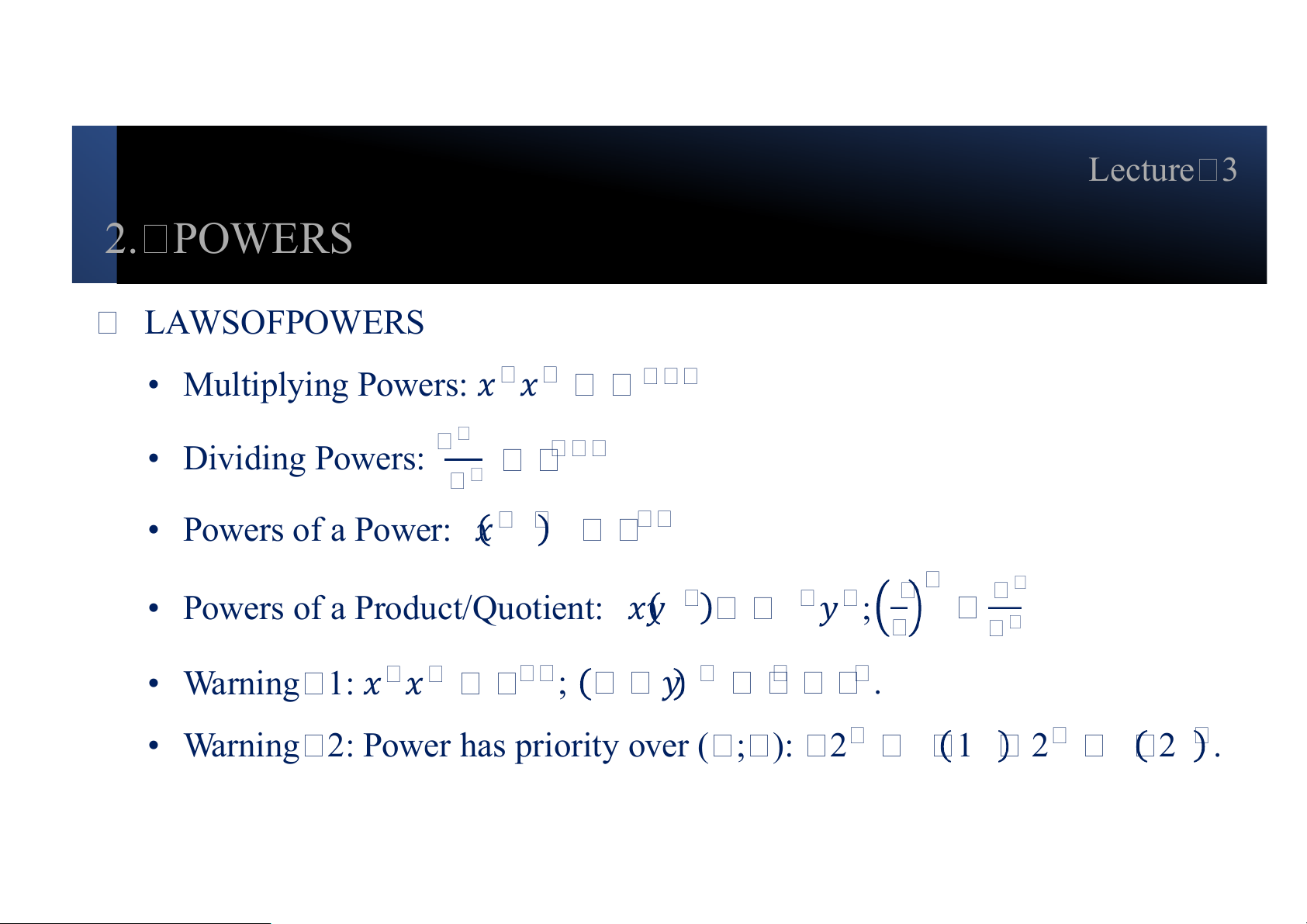
• Multiplying Powers: 𝑥 𝑥 • Dividing Powers: • Powers of a Power: 𝑥
• Powers of a Product/Quotient: 𝑥𝑦 𝑦 ; • Warning 1: 𝑥 𝑥 ; 𝑦 .
• Warning 2: Power has priority over ( ; ): 2 1 2 2 . Lecture 3 2. POWERS FRACTIONALPOWERS
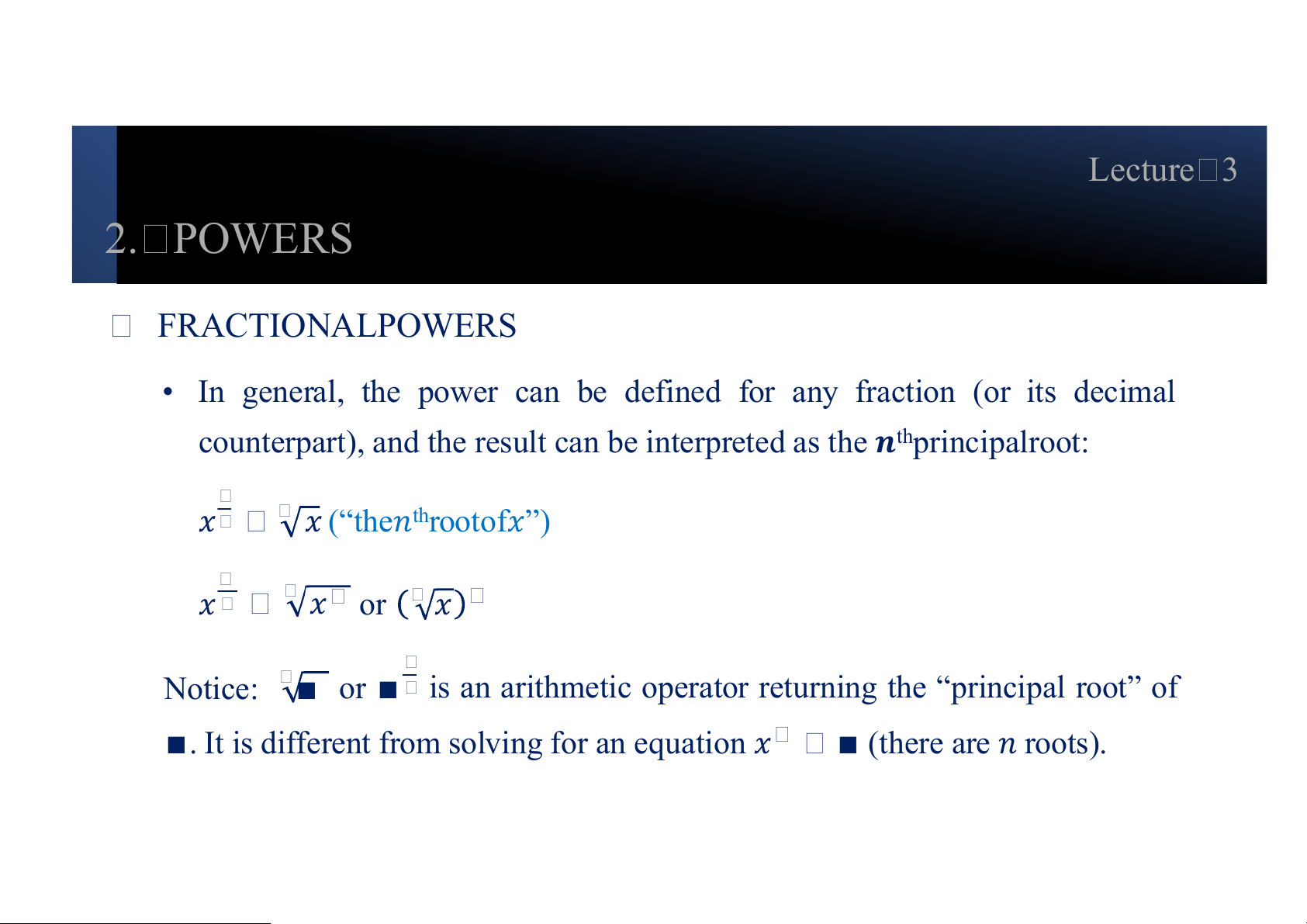
• In general, the power can be defined for any fraction (or its decimal
counterpart), and the result can be interpreted as the 𝒏thprincipalroot: 𝑥
𝑥 (“the𝑛throotof𝑥”) 𝑥 𝑥 or 𝑥
Notice: ∎ or ∎ is an arithmetic operator returning the “principal root” of
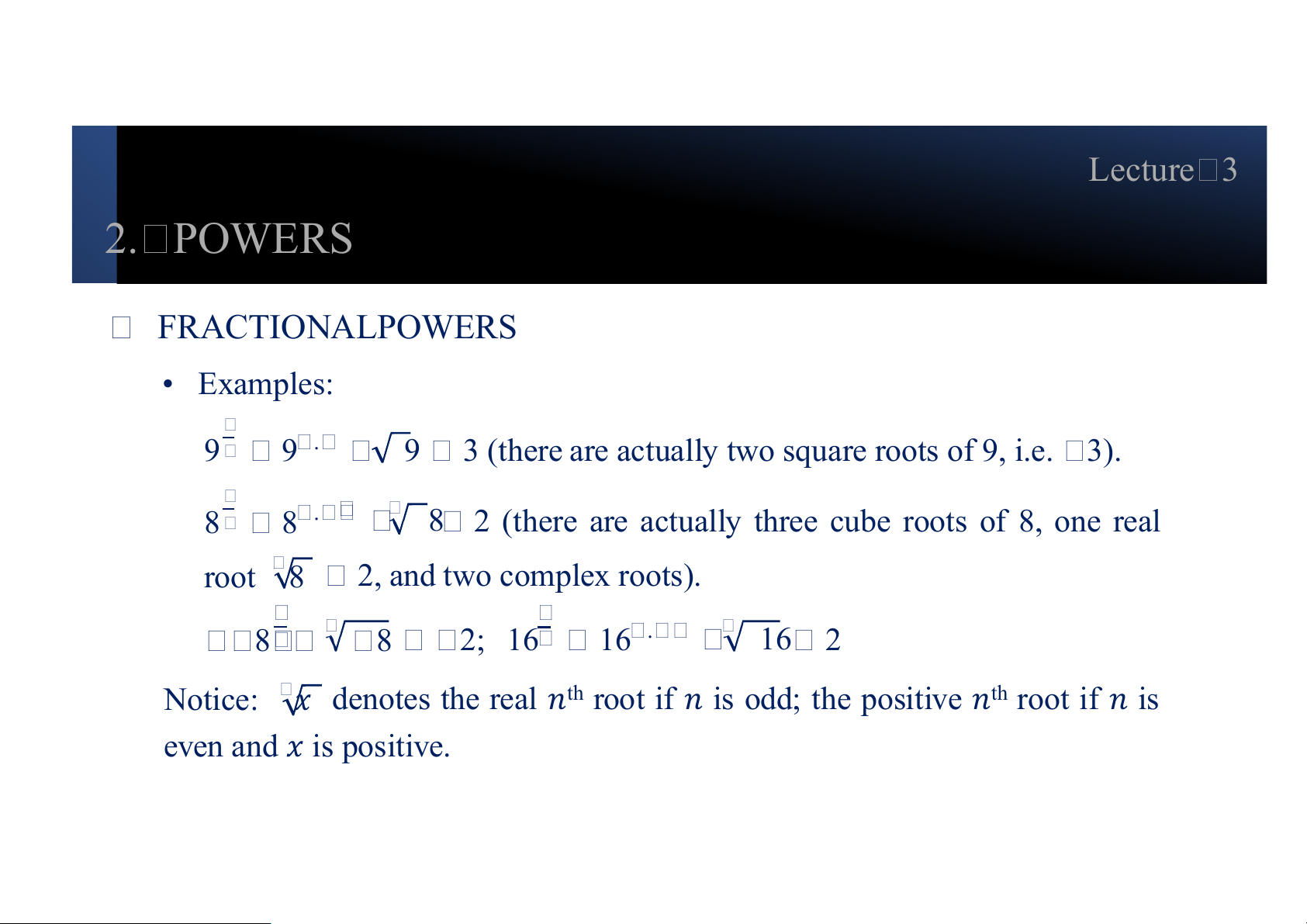
∎. It is different from solving for an equation 𝑥 ∎ (there are 𝑛 roots). Lecture 3 2. POWERS FRACTIONALPOWERS • Examples: 9 9 . 9
3 (there are actually two square roots of 9, i.e. 3). 8 8 .
8 2 (there are actually three cube roots of 8, one real root 8 2, and two complex roots). 8 8 2; 16 16 . 16 2
Notice: 𝑥 denotes the real 𝑛th root if 𝑛 is odd; the positive 𝑛th root if 𝑛 is even and 𝑥 is positive. Lecture 3 2. POWERS REVIEW:ORDERSOFOPERATIONS
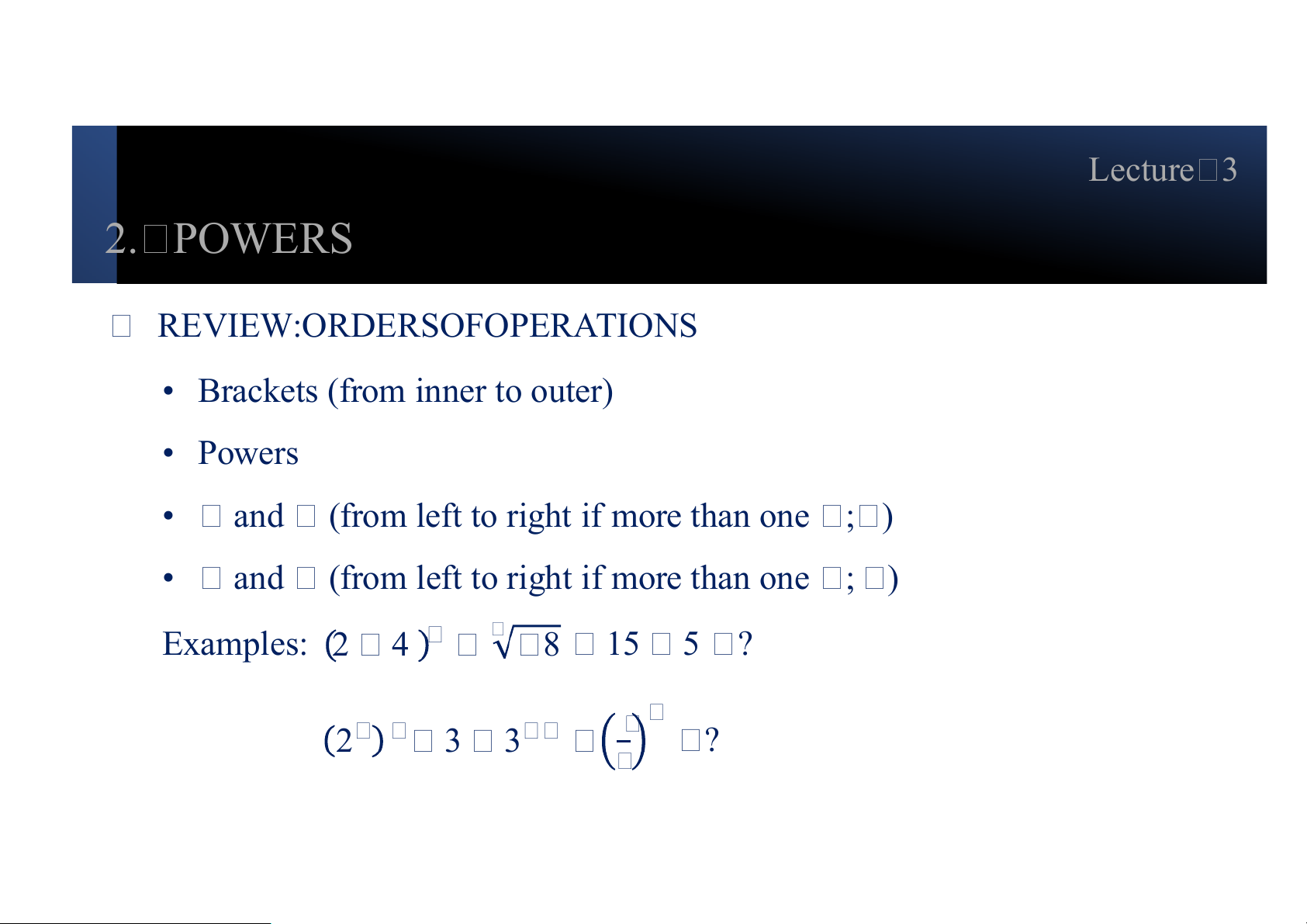
• Brackets (from inner to outer) • Powers •
and (from left to right if more than one ; ) •
and (from left to right if more than one ; ) Examples: 2 4 8 15 5 ? 2 3 3 ? Lecture 3 2. POWERS APPLICATION:PRESENTVALUE
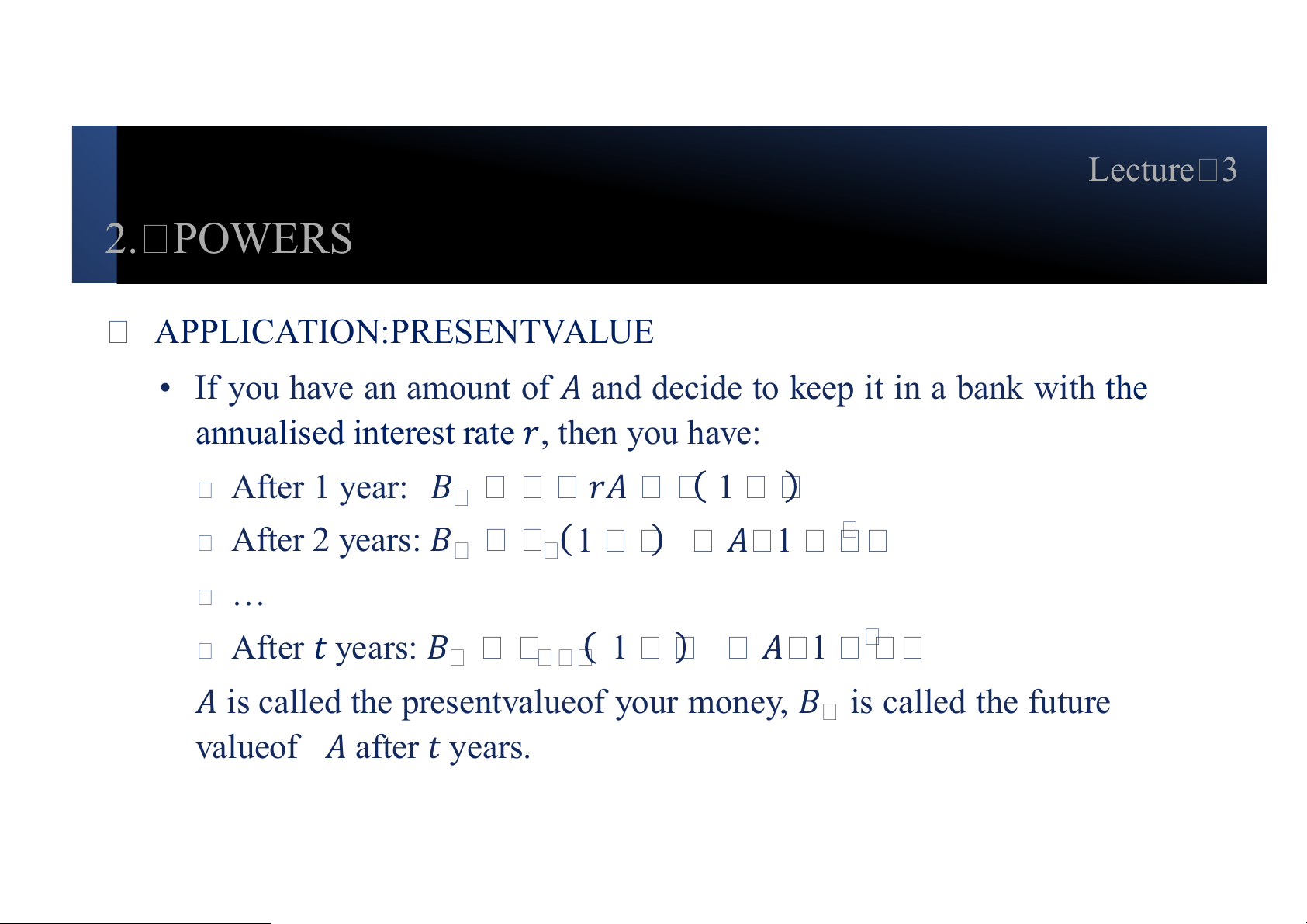
• If you have an amount of 𝐴 and decide to keep it in a bank with the
annualised interest rate 𝑟, then you have: After 1 year: 𝐵 𝑟𝐴 1 After 2 years: 𝐵 1 𝐴 1 … After 𝑡 years: 𝐵 1 𝐴 1
𝐴 is called the presentvalueof your money, 𝐵 is called the future valueof 𝐴 after 𝑡 years. Lecture 3 2. POWERS APPLICATION:PRESENTVALUE
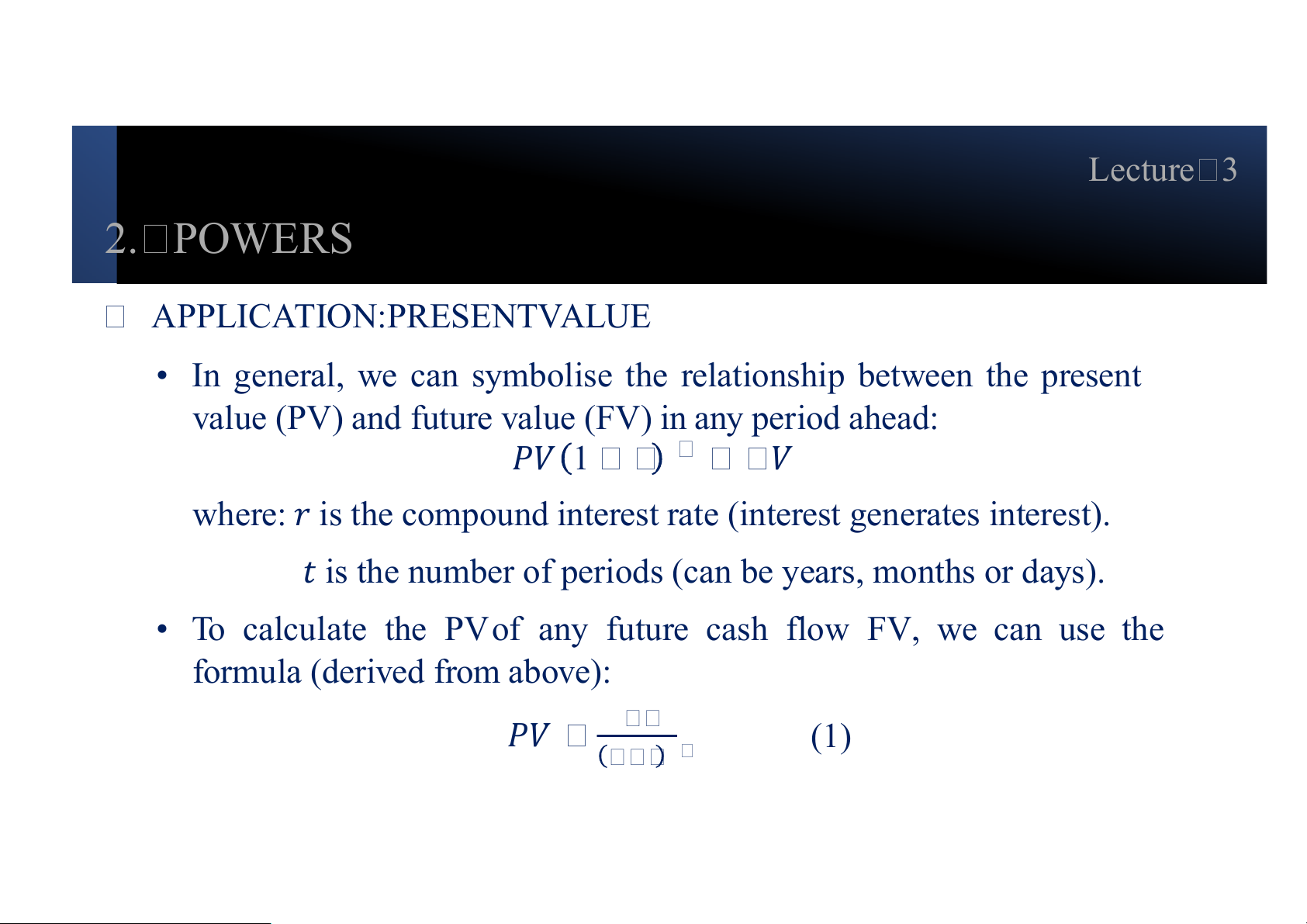
• In general, we can symbolise the relationship between the present
value (PV) and future value (FV) in any period ahead: 𝑃𝑉 1 𝑉
where: 𝑟 is the compound interest rate (interest generates interest).
𝑡 is the number of periods (can be years, months or days).
• To calculate the PVof any future cash flow FV, we can use the formula (derived from above): 𝑃𝑉 (1) Lecture 3 2. POWERS APPLICATION:PRESENTVALUE
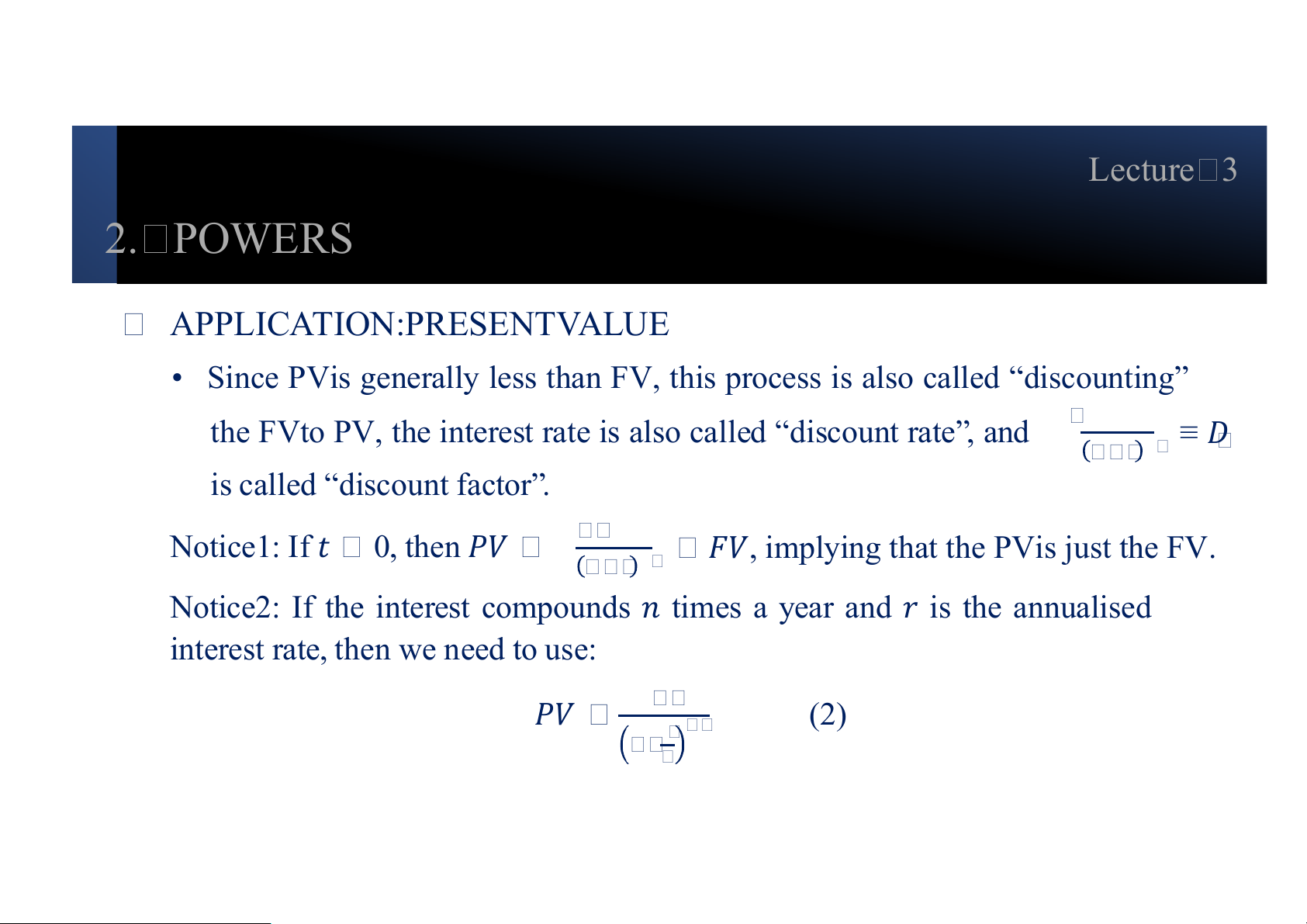
• Since PVis generally less than FV, this process is also called “discounting”
the FVto PV, the interest rate is also called “discount rate”, and ≡ 𝐷
is called “discount factor”. Notice1: If 𝑡 0, then 𝑃𝑉
𝐹𝑉, implying that the PVis just the FV.
Notice2: If the interest compounds 𝑛 times a year and 𝑟 is the annualised
interest rate, then we need to use: 𝑃𝑉 (2) Lecture 3 2. POWERS APPLICATION:PRESENTVALUE
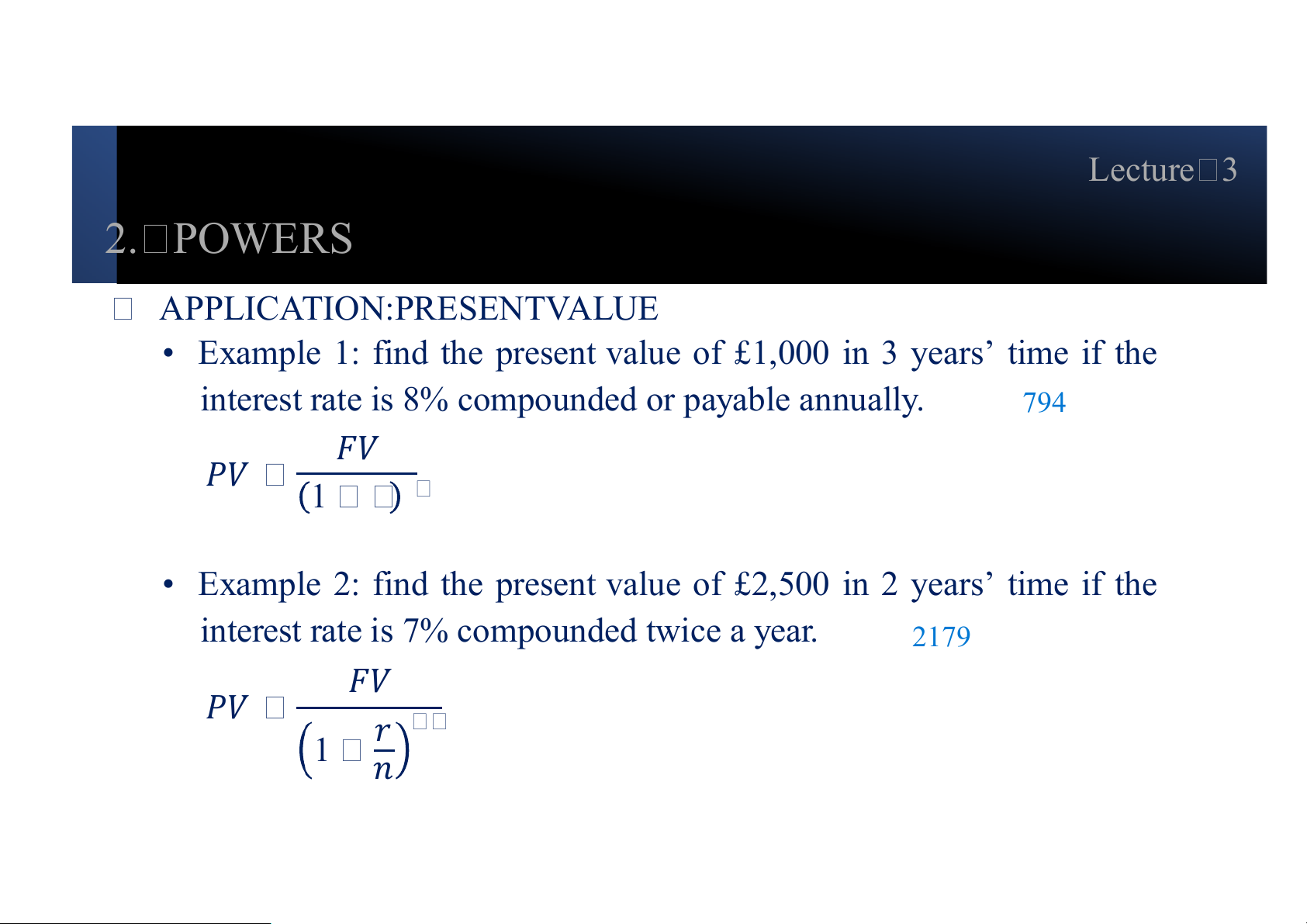
• Example 1: find the present value of £1,000 in 3 years’ time if the
interest rate is 8% compounded or payable annually. 794 𝐹𝑉 𝑃𝑉 1
• Example 2: find the present value of £2,500 in 2 years’ time if the
interest rate is 7% compounded twice a year. 2179 𝐹𝑉 𝑃𝑉 1 𝑟 𝑛 Lecture 3 2. POWERS APPLICATION:PRESENTVALUE
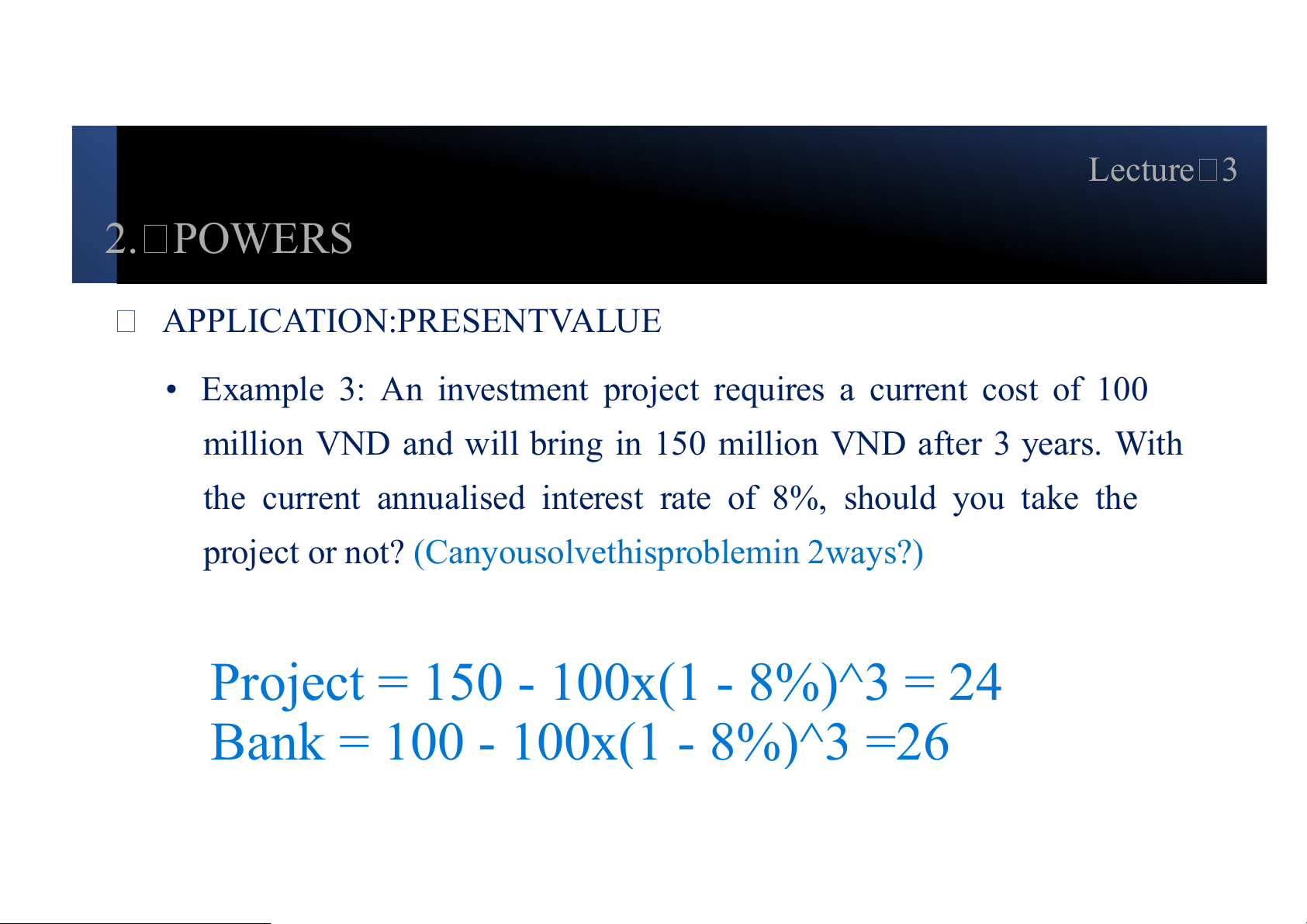
• Example 3: An investment project requires a current cost of 100
million VND and will bring in 150 million VND after 3 years. With
the current annualised interest rate of 8%, should you take the
project or not? (Canyousolvethisproblemin 2ways?)
Project = 150 - 100x(1 - 8%)^3 = 24
Bank = 100 - 100x(1 - 8%)^3 =26 Lecture 3 3. SIMPLIFICATION PURPOSE
• With the help of symbols, we can use variables and parameters to build a
model to express some general relationships between quantities.
• Both numbers and symbols follow the same set of rules and laws, by which
we can transform an expression from one to another equivalent form.
• When we transform an expression, some forms are preferred to others,
because they are simple and informative – that is the ultimate purpose of simplification.
• Simplification using expansionand factorisationcan help understanding
complicated models more easily.
Tài liệu liên quan:
-
Chương 3: độ co giãn và các nhân tố ảnh hưởng | Microeconomics | Trường Đại học Quốc tế, Đại học Quốc gia Thành phố Hồ Chí Minh
4 2 -
Microeconomics Syllabus | Microeconomics | Trường Đại học Quốc tế, Đại học Quốc gia Thành phố Hồ Chí Minh
4 2 -
Microeconomics Course Syllabus & Assessment Details | Microeconomics | Trường Đại học Quốc tế, Đại học Quốc gia Thành phố Hồ Chí Minh
4 2 -
Assignment 3 - Elasticity MCQs and Key Concepts | Microeconomics | Trường Đại học Quốc tế, Đại học Quốc gia Thành phố Hồ Chí Minh
4 2 -
Assignment 2 - Economic Equilibrium Analysis of Fridges and Motorcycles | Microeconomics | Trường Đại học Quốc tế, Đại học Quốc gia Thành phố Hồ Chí Minh
4 2