Lecture 1: Key Concepts & Trade Principles | Microeconomics | Trường Đại học Quốc tế, Đại học Quốc gia Thành phố Hồ Chí Minh
Scarcity: limited resources unlimited needs - Factors of production: N, K, L, H, Entrepreneurship - 3 economic problems: what to produce, how to produce, for whom produce - An economy 3 members: HHs, Fs, Gov & 3 systems: Command; Market (The circular flow model) – tương tác giữa cả người mua và người bán + giải quyết 3 câu hoi What, How, For whom; Mixed - Economic: + Micro vs Macro + Normative vs Positive statement. Tài liệu được sưu tầm và soạn thảo dưới dạng file PDF để gửi tới các bạn cùng tham khảo, ôn tập đầy đủ kiến thức, chuẩn bị cho các buổi học thật tốt. Mời bạn đọc đón xem!
Môn: Microeconomics 635 tài liệu
Trường: Trường Đại học Quốc tế, Đại học Quốc gia Thành phố Hồ Chí Minh 1.9 K tài liệu
Tác giả:

Preview text:
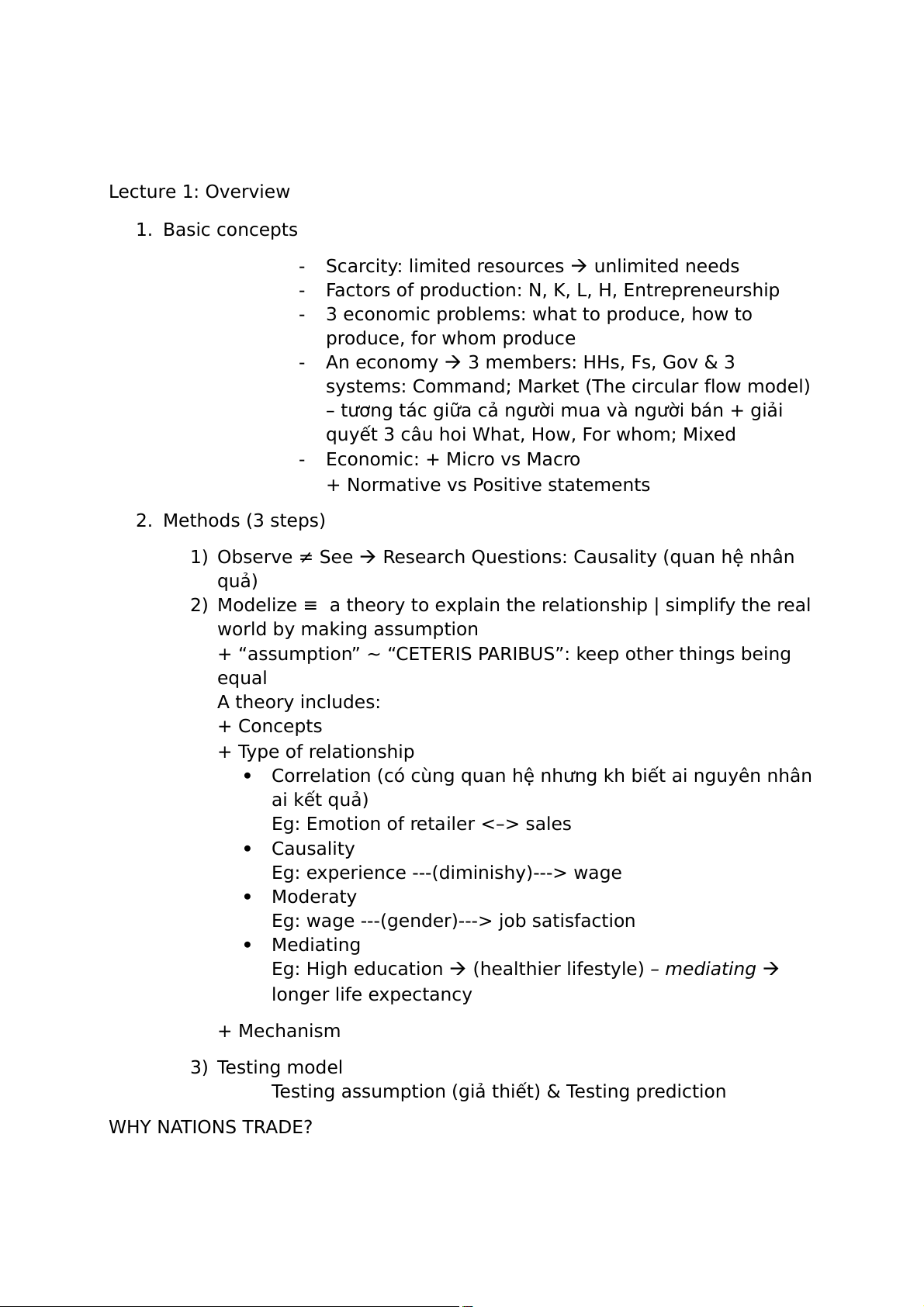
Lecture 1: Overview 1. Basic concepts
- Scarcity: limited resources unlimited needs
- Factors of production: N, K, L, H, Entrepreneurship
- 3 economic problems: what to produce, how to produce, for whom produce
- An economy 3 members: HHs, Fs, Gov & 3
systems: Command; Market (The circular flow model)
– tương tác giữa cả người mua và người bán + giải
quyết 3 câu hoi What, How, For whom; Mixed - Economic: + Micro vs Macro
+ Normative vs Positive statements 2. Methods (3 steps) 1) Observe ≠ See R
esearch Questions: Causality (quan hệ nhân quả)
2) Modelize ≡ a theory to explain the relationship | simplify the real world by making assumption
+ “assumption” ~ “CETERIS PARIBUS”: keep other things being equal A theory includes: + Concepts + Type of relationship
Correlation (có cùng quan hệ nhưng kh biết ai nguyên nhân ai kết quả)
Eg: Emotion of retailer <–> sales Causality
Eg: experience ---(diminishy)---> wage Moderaty
Eg: wage ---(gender)---> job satisfaction Mediating
Eg: High education (healthier lifestyle) – mediating longer life expectancy + Mechanism 3) Testing model
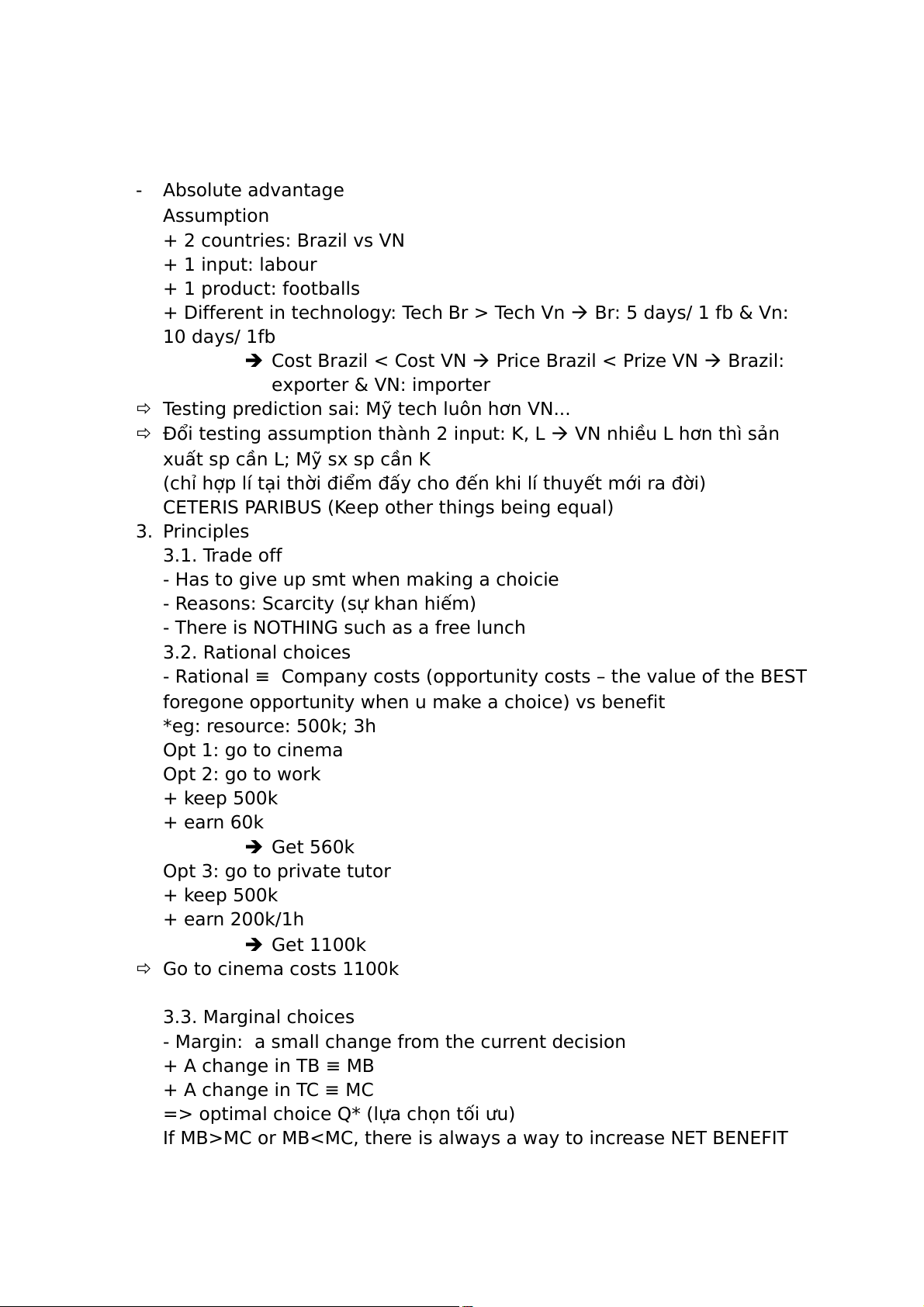
Testing assumption (giả thiết) & Testing prediction WHY NATIONS TRADE? - Absolute advantage Assumption + 2 countries: Brazil vs VN + 1 input: labour + 1 product: footballs
+ Different in technology: Tech Br > Tech Vn Br: 5 days/ 1 fb & Vn: 10 days/ 1fb
Cost Brazil < Cost VN Price Brazil < Prize VN Brazil: exporter & VN: importer
Testing prediction sai: Mỹ tech luôn hơn VN...
Đổi testing assumption thành 2 input: K, L VN nhiều L hơn thì sản
xuất sp cần L; Mỹ sx sp cần K
(chỉ hợp lí tại thời điểm đấy cho đến khi lí thuyết mới ra đời)
CETERIS PARIBUS (Keep other things being equal) 3. Principles 3.1. Trade off
- Has to give up smt when making a choicie
- Reasons: Scarcity (sự khan hiếm)
- There is NOTHING such as a free lunch 3.2. Rational choices
- Rational ≡ Company costs (opportunity costs – the value of the BEST
foregone opportunity when u make a choice) vs benefit *eg: resource: 500k; 3h Opt 1: go to cinema Opt 2: go to work + keep 500k + earn 60k Get 560k Opt 3: go to private tutor + keep 500k + earn 200k/1h Get 1100k Go to cinema costs 1100k 3.3. Marginal choices
- Margin: a small change from the current decision + A change in TB ≡ MB + A change in TC ≡ MC
=> optimal choice Q* (lựa chọn tối ưu)
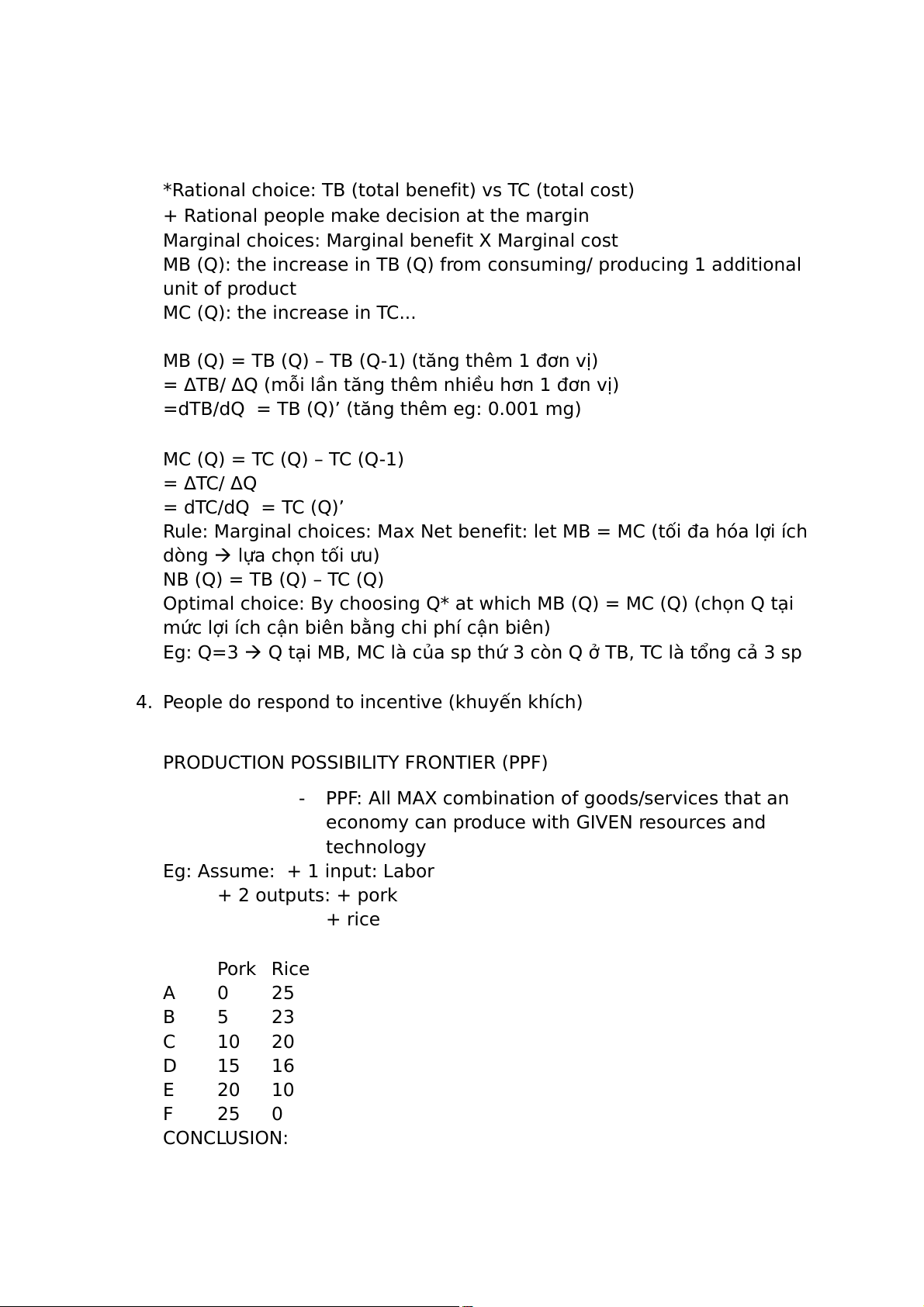
If MB>MC or MB*Rational choice: TB (total benefit) vs TC (total cost)
+ Rational people make decision at the margin
Marginal choices: Marginal benefit X Marginal cost
MB (Q): the increase in TB (Q) from consuming/ producing 1 additional unit of product MC (Q): the increase in TC...
MB (Q) = TB (Q) – TB (Q-1) (tăng thêm 1 đơn vị)
= ΔTB/ ΔQ (mỗi lần tăng thêm nhiều hơn 1 đơn vị)
=dTB/dQ = TB (Q)’ (tăng thêm eg: 0.001 mg) MC (Q) = TC (Q) – TC (Q-1) = ΔTC/ ΔQ = dTC/dQ = TC (Q)’
Rule: Marginal choices: Max Net benefit: let MB = MC (tối đa hóa lợi ích dòng lựa chọn tối ưu) NB (Q) = TB (Q) – TC (Q)
Optimal choice: By choosing Q* at which MB (Q) = MC (Q) (chọn Q tại
mức lợi ích cận biên bằng chi phí cận biên)
Eg: Q=3 Q tại MB, MC là của sp thứ 3 còn Q ở TB, T C là tổng cả 3 sp
4. People do respond to incentive (khuyến khích)
PRODUCTION POSSIBILITY FRONTIER (PPF)
- PPF: All MAX combination of goods/services that an
economy can produce with GIVEN resources and technology Eg: Assume: + 1 input: Labor + 2 outputs: + pork + rice Pork Rice A 0 25 B 5 23 C 10 20 D 15 16 E 20 10 F 25 0 CONCLUSION:
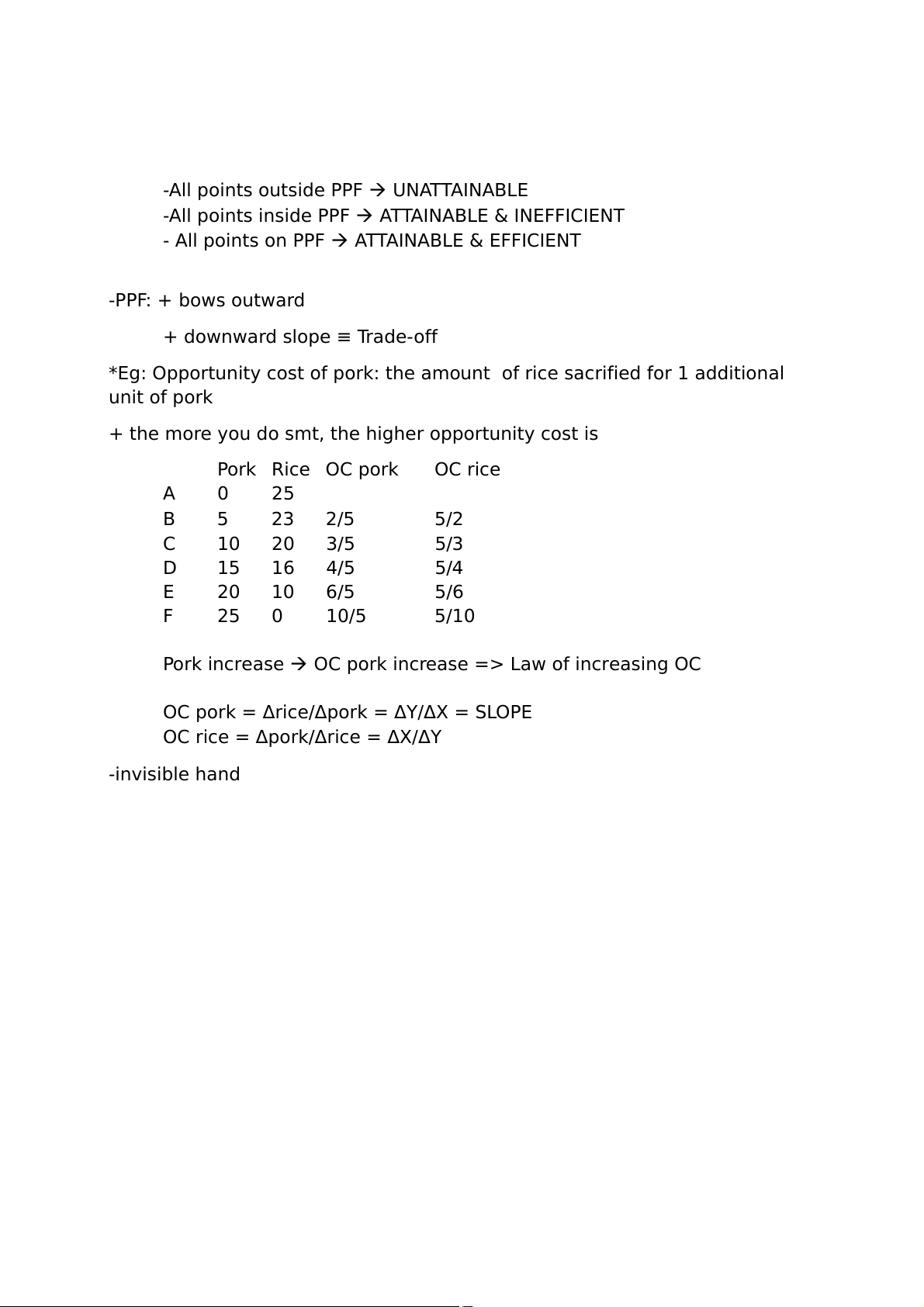
-All points outside PPF UNATTAINABLE
-All points inside PPF ATTAINABLE & INEFFICIENT
- All points on PPF ATTAINABLE & EFFICIENT -PPF: + bows outward + downward slope ≡ Trade-off
*Eg: Opportunity cost of pork: the amount of rice sacrified for 1 additional unit of pork
+ the more you do smt, the higher opportunity cost is Pork Rice OC pork OC rice A 0 25 B 5 23 2/5 5/2 C 10 20 3/5 5/3 D 15 16 4/5 5/4 E 20 10 6/5 5/6 F 25 0 10/5 5/10 Pork increase OC pork incr
ease => Law of increasing OC
OC pork = Δrice/Δpork = ΔY/ΔX = SLOPE
OC rice = Δpork/Δrice = ΔX/ΔY -invisible hand Lecture 2: Supply & Demand 1. Demand (D) 1.1. Def -All quantity tha
Tài liệu liên quan:
-
Chương 3: độ co giãn và các nhân tố ảnh hưởng | Microeconomics | Trường Đại học Quốc tế, Đại học Quốc gia Thành phố Hồ Chí Minh
3 2 -
Microeconomics Syllabus | Microeconomics | Trường Đại học Quốc tế, Đại học Quốc gia Thành phố Hồ Chí Minh
3 2 -
Microeconomics Course Syllabus & Assessment Details | Microeconomics | Trường Đại học Quốc tế, Đại học Quốc gia Thành phố Hồ Chí Minh
3 2 -
Assignment 3 - Elasticity MCQs and Key Concepts | Microeconomics | Trường Đại học Quốc tế, Đại học Quốc gia Thành phố Hồ Chí Minh
3 2 -
Assignment 2 - Economic Equilibrium Analysis of Fridges and Motorcycles | Microeconomics | Trường Đại học Quốc tế, Đại học Quốc gia Thành phố Hồ Chí Minh
3 2