Lecture Notes on Economic Principles | Microeconomics | Trường Đại học Quốc tế, Đại học Quốc gia Thành phố Hồ Chí Minh
To economists, the main difference between ‘the short run’ and ‘the long run’ is that: A: the law of diminishing returns applies in the long run, but not in the short run. : in the long run, all resources are variable, while in the short run, at least one resource is fixed. C: fixed costs are more important to decision making in the long run than they are in the short run. D: in the short run all resources are fixed, while in the long run, all resources are variable. Tài liệu được sưu tầm và soạn thảo dưới dạng file PDF để gửi tới các bạn cùng tham khảo, ôn tập đầy đủ kiến thức, chuẩn bị cho các buổi học thật tốt. Mời bạn đọc đón xem!
Môn: Microeconomics 635 tài liệu
Trường: Trường Đại học Quốc tế, Đại học Quốc gia Thành phố Hồ Chí Minh 1.9 K tài liệu
Tác giả:

Preview text:
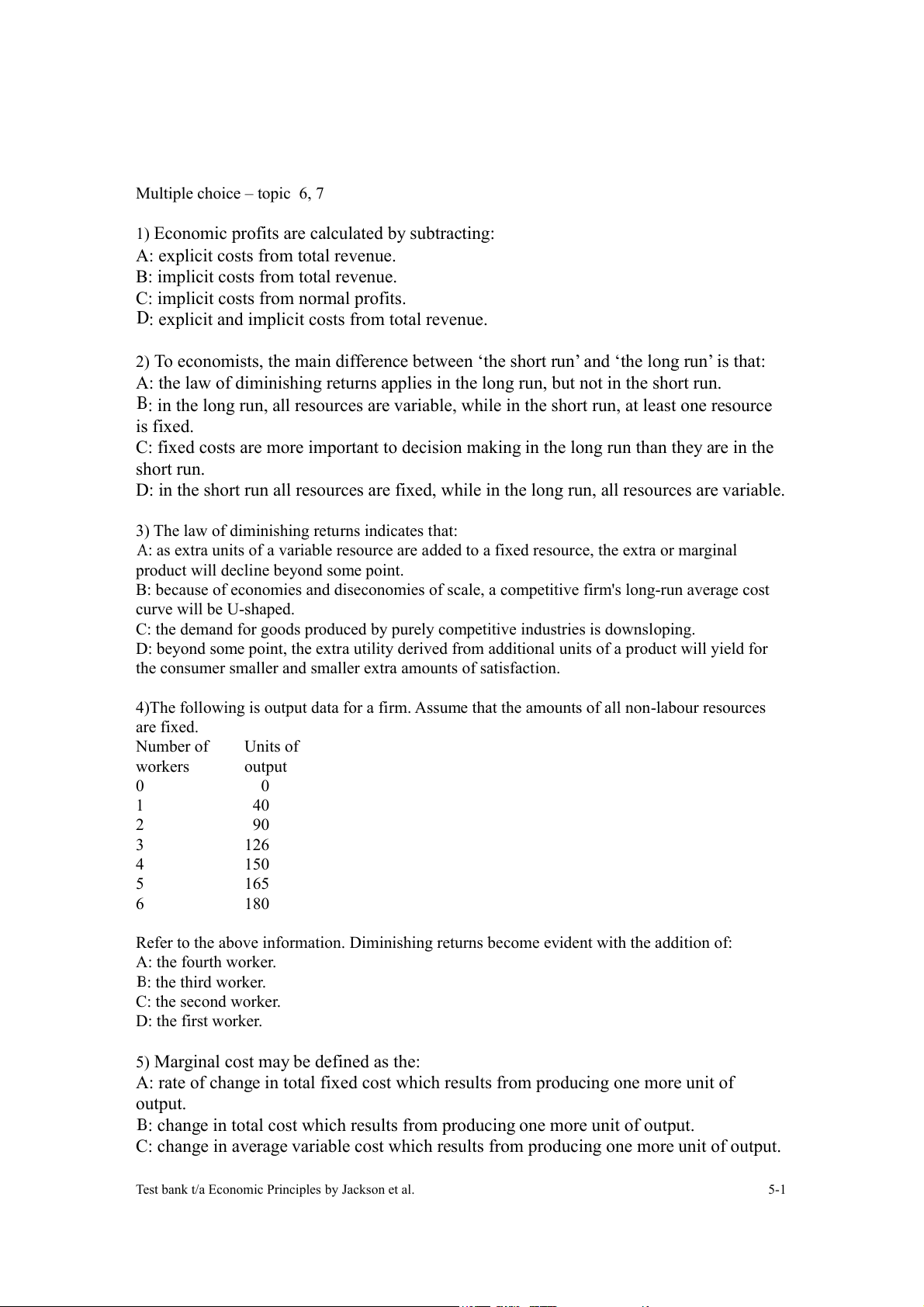
Multiple choice – topic 6, 7
1) Economic profits are calculated by subtracting:
A: explicit costs from total revenue.
B: implicit costs from total revenue.
C: implicit costs from normal profits.
: explicit and implicit costs from total revenue.
2) To economists, the main difference between ‘the short run’ and ‘the long run’ is that:
A: the law of diminishing returns applies in the long run, but not in the short run.
: in the long run, all resources are variable, while in the short run, at least one resource is fixed.
C: fixed costs are more important to decision making in the long run than they are in the short run.
D: in the short run all resources are fixed, while in the long run, all resources are variable.
3) The law of diminishing returns indicates that:
as extra units of a variable resource are added to a fixed resource, the extra or marginal
product will decline beyond some point.
B: because of economies and diseconomies of scale, a competitive firm's long-run average cost curve will be U-shaped.
C: the demand for goods produced by purely competitive industries is downsloping.
D: beyond some point, the extra utility derived from additional units of a product will yield for
the consumer smaller and smaller extra amounts of satisfaction.
4)The following is output data for a firm. Assume that the amounts of all non-labour resources are fixed. Number of Units of workers output 0 0 1 40 2 90 3 126 4 150 5 165 6 180
Refer to the above information. Diminishing returns become evident with the addition of: A: the fourth worker. : the third worker. C: the second worker. D: the first worker.
5) Marginal cost may be defined as the:
A: rate of change in total fixed cost which results from producing one more unit of output.
: change in total cost which results from producing one more unit of output.
C: change in average variable cost which results from producing one more unit of output.
Test bank t/a Economic Principles by Jackson et al. 5-1
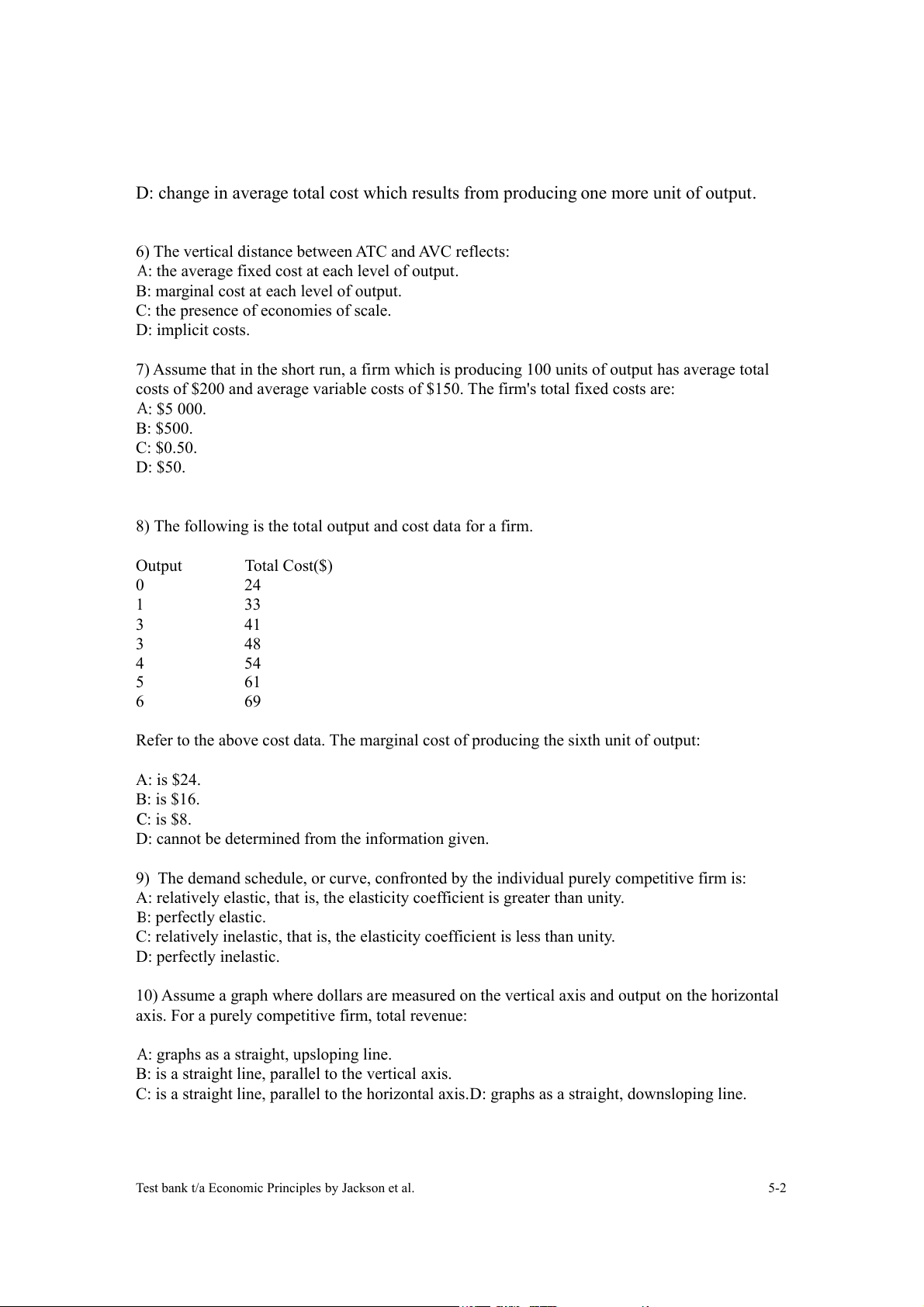
D: change in average total cost which results from producing one more unit of output.
6) The vertical distance between ATC and AVC reflects:
: the average fixed cost at each level of output.
B: marginal cost at each level of output.
C: the presence of economies of scale. D: implicit costs.
7) Assume that in the short run, a firm which is producing 100 units of output has average total
costs of $200 and average variable costs of $150. The firm's total fixed costs are: : $5 000. B: $500. C: $0.50. D: $50.
8) The following is the total output and cost data for a firm. Output Total Cost($) 0 24 1 33 3 41 3 48 4 54 5 61 6 69
Refer to the above cost data. The marginal cost of producing the sixth unit of output: A: is $24. B: is $16. : is $8.
D: cannot be determined from the information given.
9) The demand schedule, or curve, confronted by the individual purely competitive firm is:
A: relatively elastic, that is, the elasticity coefficient is greater than unity. : perfectly elastic.
C: relatively inelastic, that is, the elasticity coefficient is less than unity. D: perfectly inelastic.
10) Assume a graph where dollars are measured on the vertical axis and output on the horizontal
axis. For a purely competitive firm, total revenue:
: graphs as a straight, upsloping line.
B: is a straight line, parallel to the vertical axis.
C: is a straight line, parallel to the horizontal axis.D: graphs as a straight, downsloping line.
Test bank t/a Economic Principles by Jackson et al. 5-2
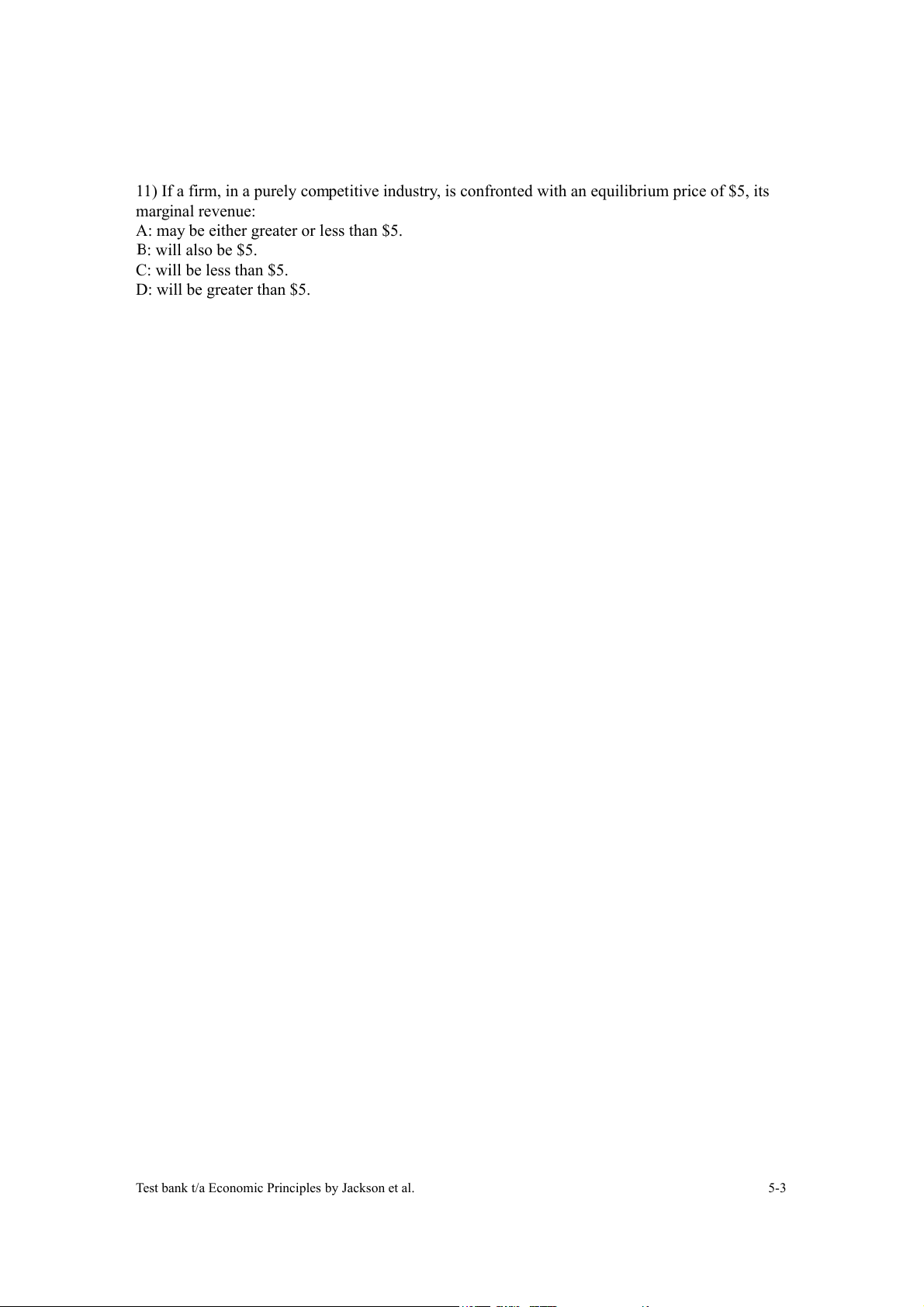
11) If a firm, in a purely competitive industry, is confronted with an equilibrium price of $5, its marginal revenue:
A: may be either greater or less than $5. : will also be $5. C: will be less than $5. D: will be greater than $5.
Test bank t/a Economic Principles by Jackson et al. 5-3
Tài liệu liên quan:
-

Chương 3: độ co giãn và các nhân tố ảnh hưởng | Microeconomics | Trường Đại học Quốc tế, Đại học Quốc gia Thành phố Hồ Chí Minh
3 2 -
Microeconomics Syllabus | Microeconomics | Trường Đại học Quốc tế, Đại học Quốc gia Thành phố Hồ Chí Minh
3 2 -
Microeconomics Course Syllabus & Assessment Details | Microeconomics | Trường Đại học Quốc tế, Đại học Quốc gia Thành phố Hồ Chí Minh
3 2 -
Assignment 3 - Elasticity MCQs and Key Concepts | Microeconomics | Trường Đại học Quốc tế, Đại học Quốc gia Thành phố Hồ Chí Minh
3 2 -
Assignment 2 - Economic Equilibrium Analysis of Fridges and Motorcycles | Microeconomics | Trường Đại học Quốc tế, Đại học Quốc gia Thành phố Hồ Chí Minh
3 2