Linear Programming Exercises | Microeconomics | Trường Đại học Quốc tế, Đại học Quốc gia Thành phố Hồ Chí Minh
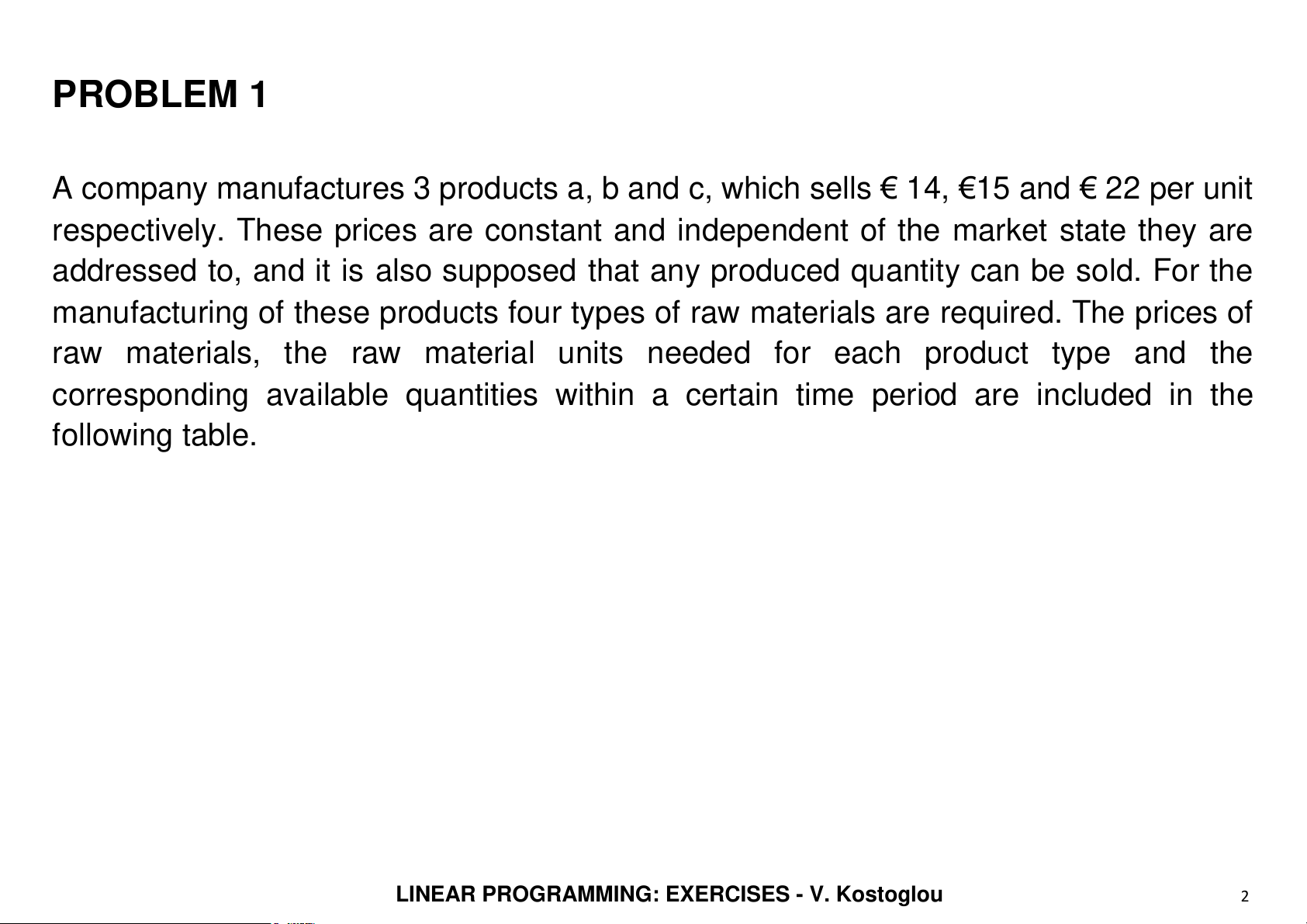
A company manufactures 3 products a, b and c, which sells € 14, €15 and € 22 per unit respectively. These prices are constant and independent of the market state they are addressed to, and it is also supposed that any produced quantity can be sold. For the manufacturing of these products four types of raw materials are required. The prices of raw materials, the raw material units needed for each product type and the corresponding available quantities within a certain time period are included in the following table. Tài liệu được sưu tầm và soạn thảo dưới dạng file PDF để gửi tới các bạn cùng tham khảo, ôn tập đầy đủ kiến thức, chuẩn bị cho các buổi học thật tốt. Mời bạn đọc đón xem!
Môn: Microeconomics 635 tài liệu
Trường: Trường Đại học Quốc tế, Đại học Quốc gia Thành phố Hồ Chí Minh 1.9 K tài liệu
Tác giả:

Preview text:
LINEAR PROGRAMMING: EXERCISES Vassilis Kostoglou
E-mail: vkostogl@it.teithe.gr
URL: www.it.teithe.gr/~vkostogl
LINEAR PROGRAMMING: EXERCISES - V. Kostoglou 1 PROBLEM 1
A company manufactures 3 products a, b and c, which sel s € 14, €15 and € 22 per unit
respectively. These prices are constant and independent of the market state they are
addressed to, and it is also supposed that any produced quantity can be sold. For the
manufacturing of these products four types of raw materials are required. The prices of
raw materials, the raw material units needed for each product type and the
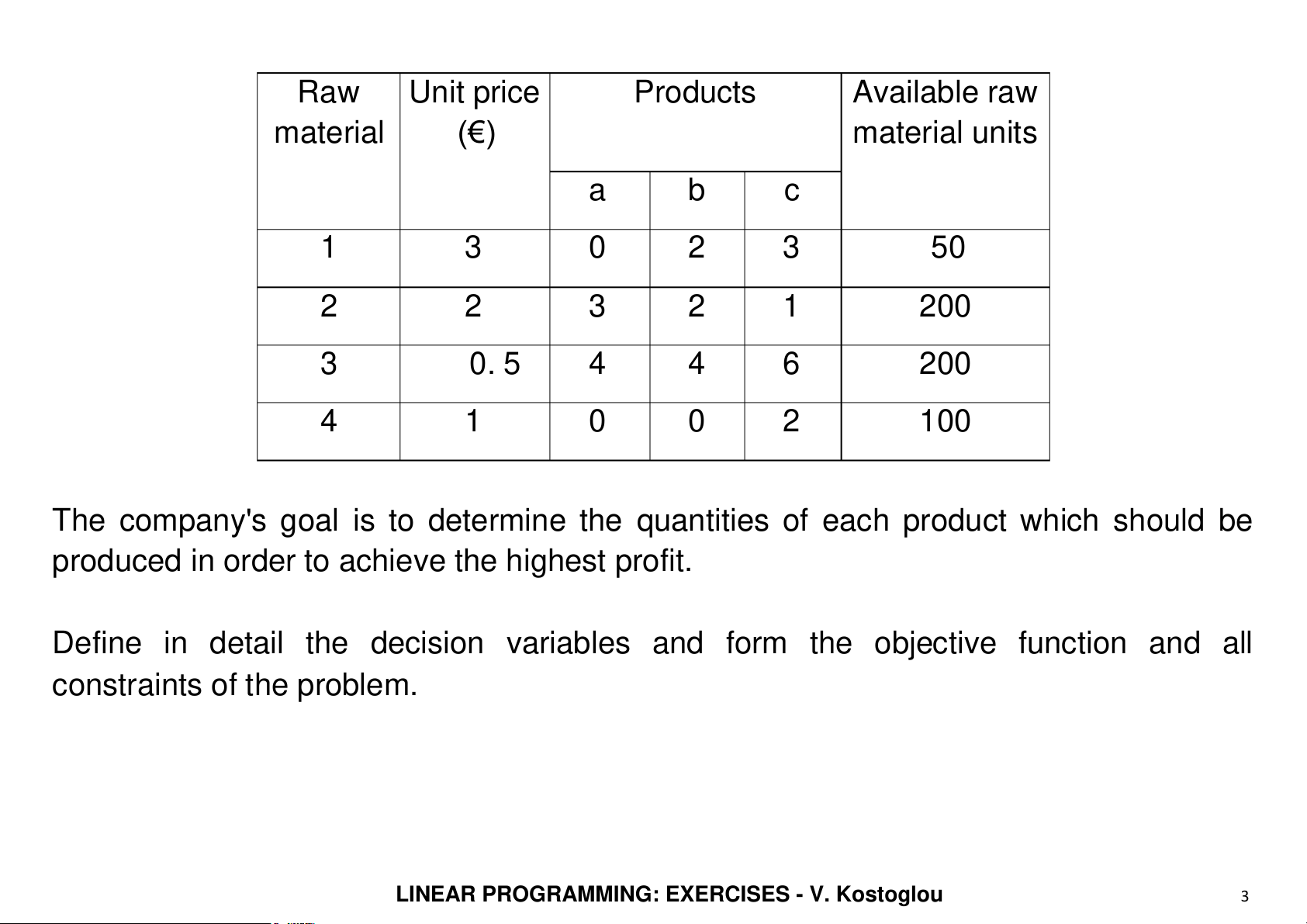
corresponding available quantities within a certain time period are included in the fol owing table.
LINEAR PROGRAMMING: EXERCISES - V. Kostoglou 2 Raw Unit price Products Available raw material (€) material units a b c 1 3 0 2 3 50 2 2 3 2 1 200 3 0. 5 4 4 6 200 4 1 0 0 2 100
The company's goal is to determine the quantities of each product which should be
produced in order to achieve the highest profit.
Define in detail the decision variables and form the objective function and al constraints of the problem.
LINEAR PROGRAMMING: EXERCISES - V. Kostoglou 3 PROBLEM 2
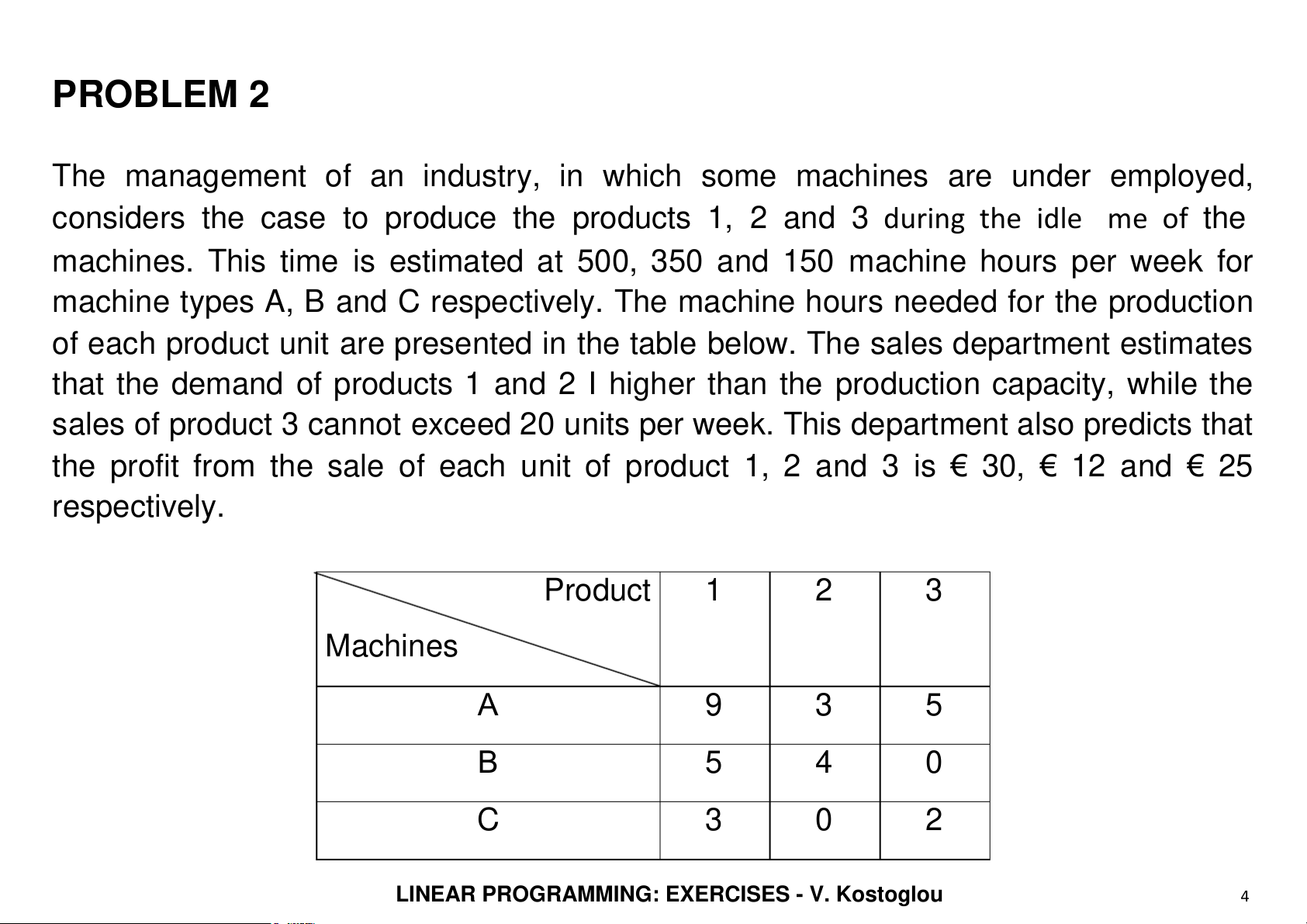
The management of an industry, in which some machines are under employed,
considers the case to produce the products 1, 2 and 3 during the idle time of the
machines. This time is estimated at 500, 350 and 150 machine hours per week for
machine types A, B and C respectively. The machine hours needed for the production
of each product unit are presented in the table below. The sales department estimates
that the demand of products 1 and 2 I higher than the production capacity, while the
sales of product 3 cannot exceed 20 units per week. This department also predicts that
the profit from the sale of each unit of product 1, 2 and 3 is € 30, € 12 and € 25 respectively. Product 1 2 3 Machines Α 9 3 5 Β 5 4 0 C 3 0 2
LINEAR PROGRAMMING: EXERCISES - V. Kostoglou 4
Which mathematical model should solve the industry to identify the quantities of
products that should be produced, in order to maximize the net profit?
LINEAR PROGRAMMING: EXERCISES - V. Kostoglou 5 PROBLEM 3
A company which manufactures canoes employs 120 employees, each of whom
working 30 hours per week. Half of them work in the carpenter department, 20 persons
in the plastics department, and the rest of them at the completion department. The
company manufactures the simple canoes with net unit profit € 7 and the luxury canoes
with corresponding profit € 10. A simple canoe requires 4.5 hours in the carpenter
department and two hours in each of the other two departments. The working hours for
each luxury canoe are 5, 1 and 4 at the carpenter department, plastics department and
completion department respectively. Marketing calculations have shown that not less
than 1/3 and not more than 2/3 of the total number of the canoes should be luxurious.
How wil the company maximize its overal net profit?
Formulate the appropriate LP model.
LINEAR PROGRAMMING: EXERCISES - V. Kostoglou 6 PROBLEM 4
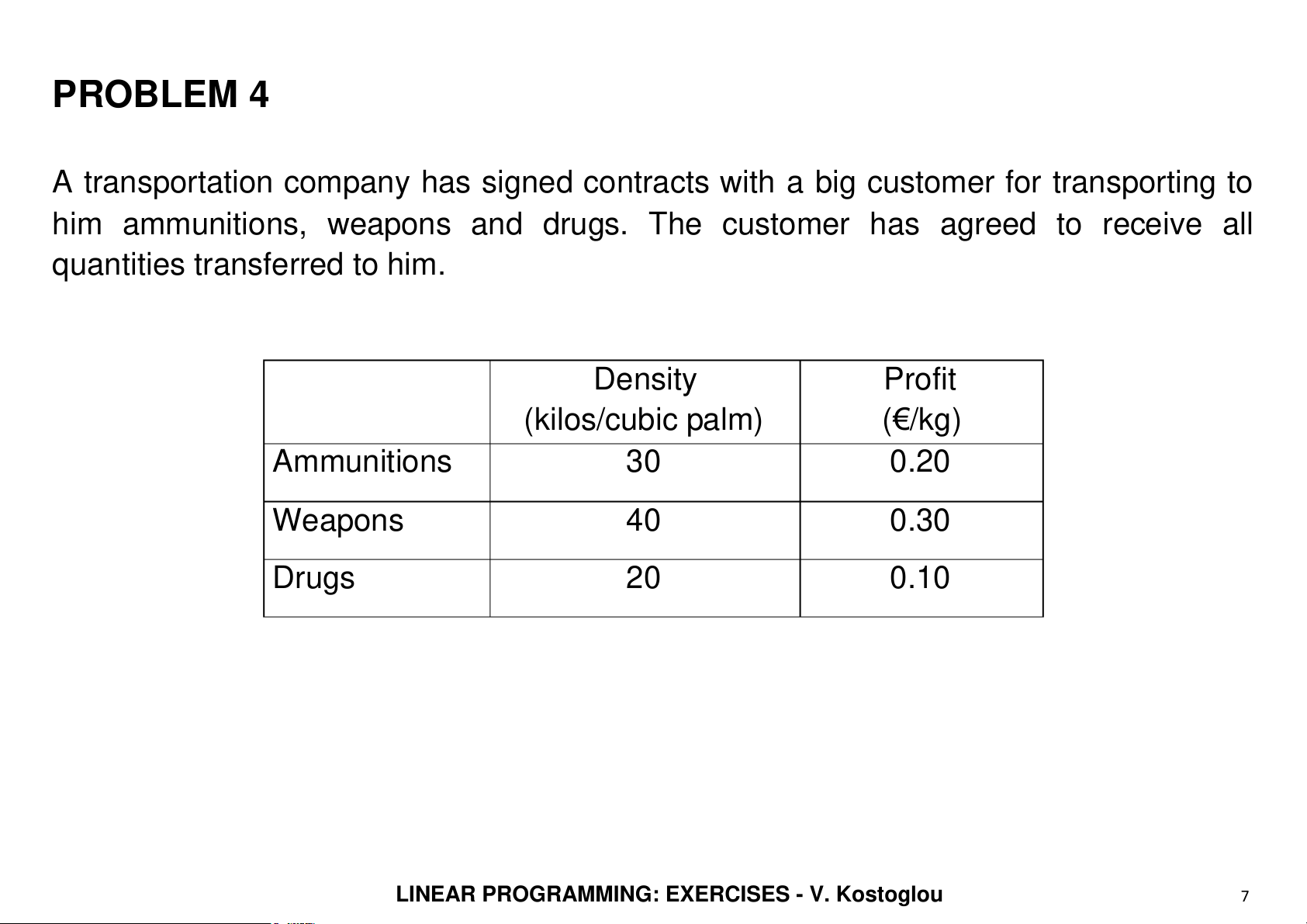
A transportation company has signed contracts with a big customer for transporting to
him ammunitions, weapons and drugs. The customer has agreed to receive al
quantities transferred to him. Density Profit (kilos/cubic palm) (€/kg) Ammunitions 30 0.20 Weapons 40 0.30 Drugs 20 0.10
LINEAR PROGRAMMING: EXERCISES - V. Kostoglou 7
The company uses two planes. Plane A cannot transport more than 15 tons neither
more than 0.1 m3 of cargo. Plane B cannot transport more than 25 tons and over 0.2
m3 of cargo. There is one more restriction: no more than 100 kg of drugs can be
transported in each delivery (the delivery includes two flights, one of plane A and one of plane B).
Formulate - with al the necessary documentation – the appropriate model to solve this
problem. Comment also on which unit is appropriate to be represented the decision variables of the problem.
LINEAR PROGRAMMING: EXERCISES - V. Kostoglou 8 PROBLEM 5
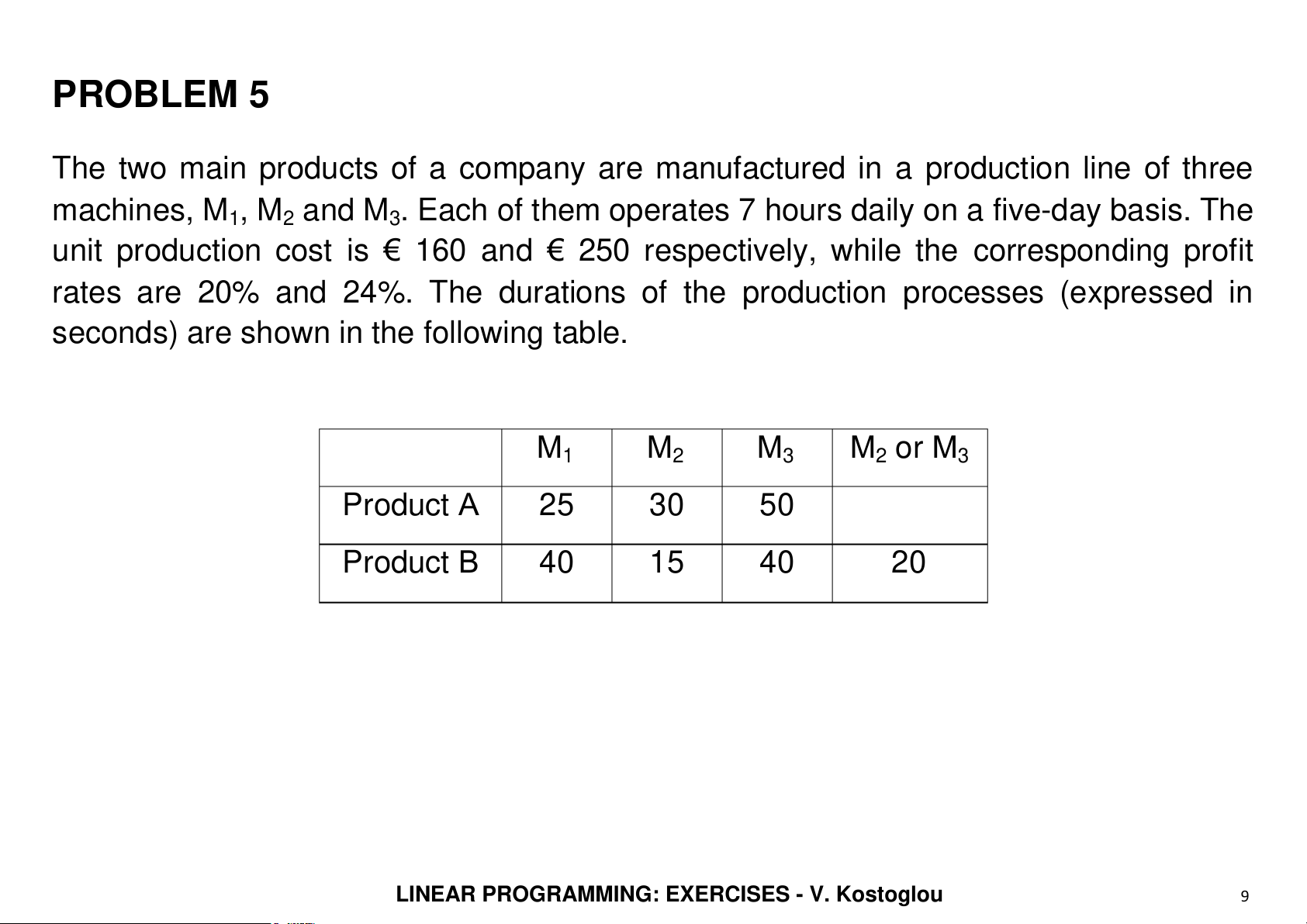
The two main products of a company are manufactured in a production line of three
machines, M1, M2 and M3. Each of them operates 7 hours daily on a five-day basis. The
unit production cost is € 160 and € 250 respectively, while the corresponding profit
rates are 20% and 24%. The durations of the production processes (expressed in
seconds) are shown in the fol owing table. Μ1 Μ2 Μ3 Μ2 or Μ3 Product Α 25 30 50 Product Β 40 15 40 20
LINEAR PROGRAMMING: EXERCISES - V. Kostoglou 9
The first product is completed in three phases, while the second one is required to pass
a fourth phase, which can be performed either by machine M2 or machine M3. The
problem which the company faces is to identify the units that must be produced by
each product to maximize the weekly net profit.
Design (variables - function - constraints) the appropriate linear programming model to solve this problem.
LINEAR PROGRAMMING: EXERCISES - V. Kostoglou 10 PROBLEM 6
A rural family owns 125 acres and has $ 40,000 stock for investment. Each member
can provide 3500 hours of work during the winter months (mid October – mid April) and
4000 hours during the summer. If any of these hours are not necessary then the
younger members of the family can go and work in the nearby farm for $ 5 per hour for
the winter months and $ 6 per hour during the summer.
Income in cash can come from the three crops, from cows and from chickens. No stock
investment is needed for crops. In contrary an investment of $ 1200 for each cow and
$ 9 for each chicken is needed.
LINEAR PROGRAMMING: EXERCISES - V. Kostoglou 11
Each cow needs 1.5 hectares of land, 100 human hours of personal work during the
winter months and another 50 hours for the summer. Each cow wil give income $ 1000
each year for the family. The corresponding figures for each chicken is no land, 0.6
hours of personal human work in winter and 0.3 more hours in summer with annual
income $5 for each chicken. The farm can feed a maximum of 3000 chickens and the
existing stable is sufficient for up to 32 cows.
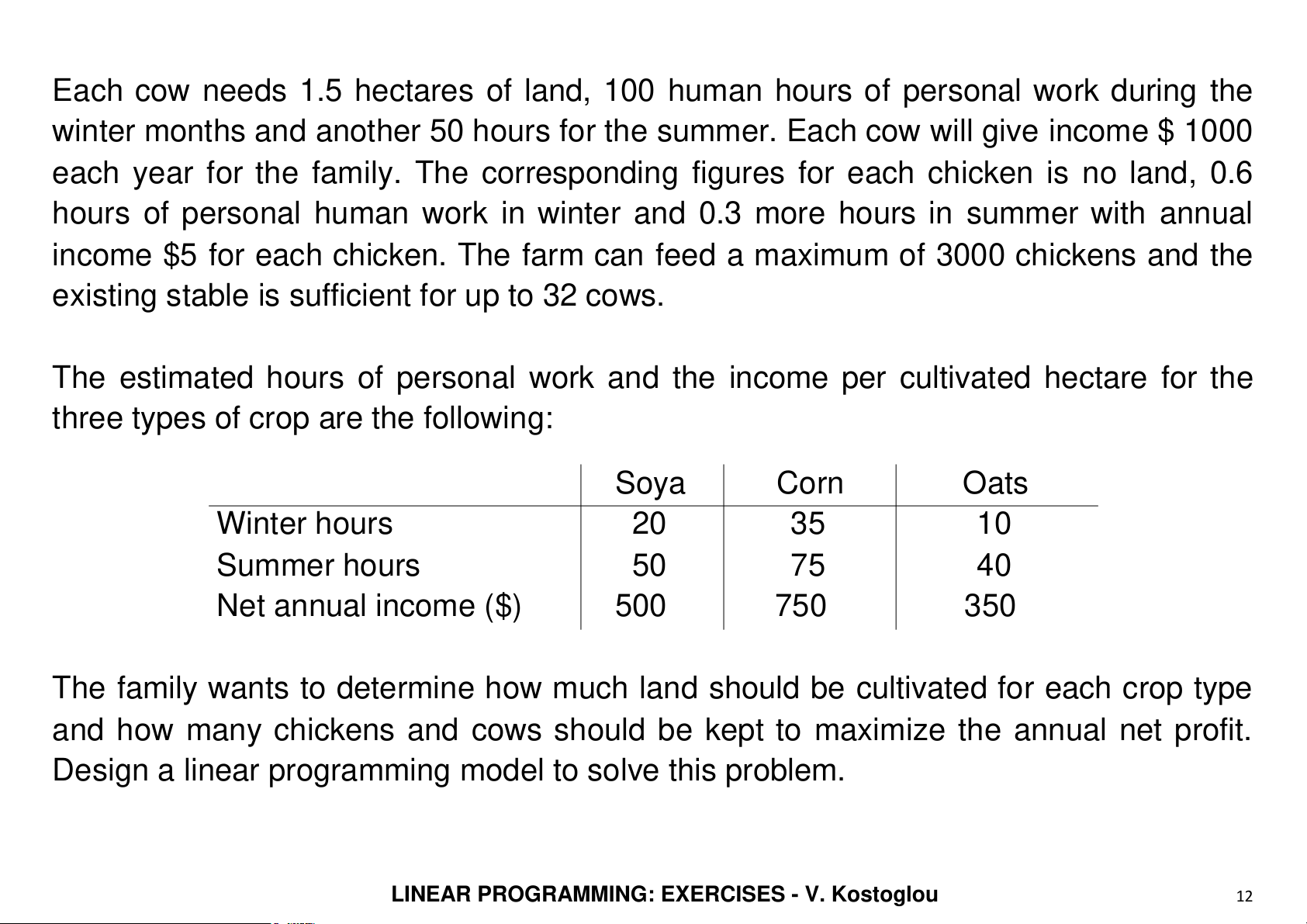
The estimated hours of personal work and the income per cultivated hectare for the
three types of crop are the fol owing: Soya Corn Oats Winter hours 20 35 10 Summer hours 50 75 40 Net annual income ($) 500 750 350
The family wants to determine how much land should be cultivated for each crop type
and how many chickens and cows should be kept to maximize the annual net profit.
Design a linear programming model to solve this problem.
LINEAR PROGRAMMING: EXERCISES - V. Kostoglou 12 PROBLEM 7
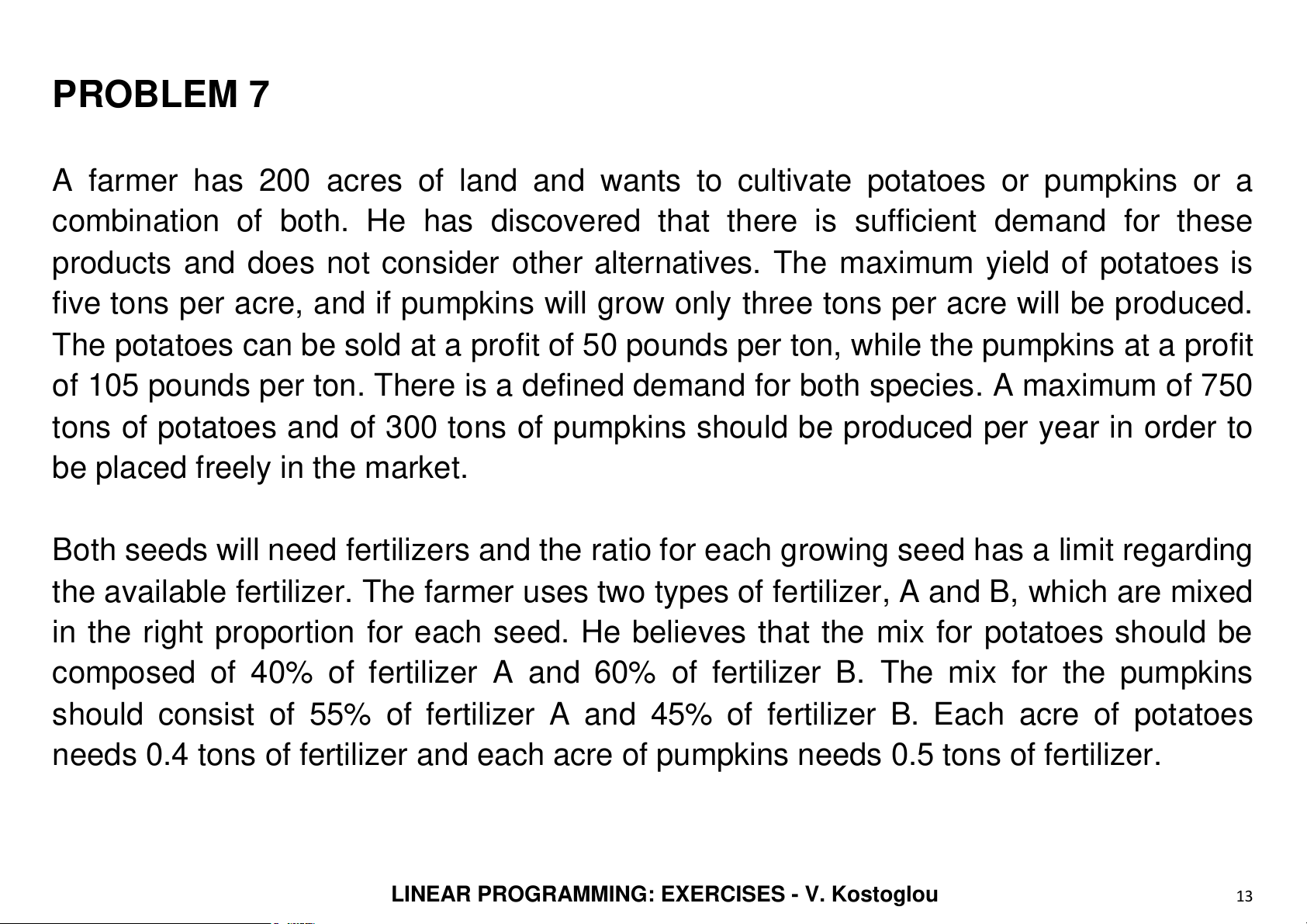
A farmer has 200 acres of land and wants to cultivate potatoes or pumpkins or a
combination of both. He has discovered that there is sufficient demand for these
products and does not consider other alternatives. The maximum yield of potatoes is
five tons per acre, and if pumpkins wil grow only three tons per acre wil be produced.
The potatoes can be sold at a profit of 50 pounds per ton, while the pumpkins at a profit
of 105 pounds per ton. There is a defined demand for both species. A maximum of 750
tons of potatoes and of 300 tons of pumpkins should be produced per year in order to
be placed freely in the market.
Both seeds wil need fertilizers and the ratio for each growing seed has a limit regarding
the available fertilizer. The farmer uses two types of fertilizer, A and B, which are mixed
in the right proportion for each seed. He believes that the mix for potatoes should be
composed of 40% of fertilizer A and 60% of fertilizer B. The mix for the pumpkins
should consist of 55% of fertilizer A and 45% of fertilizer B. Each acre of potatoes
needs 0.4 tons of fertilizer and each acre of pumpkins needs 0.5 tons of fertilizer.
LINEAR PROGRAMMING: EXERCISES - V. Kostoglou 13
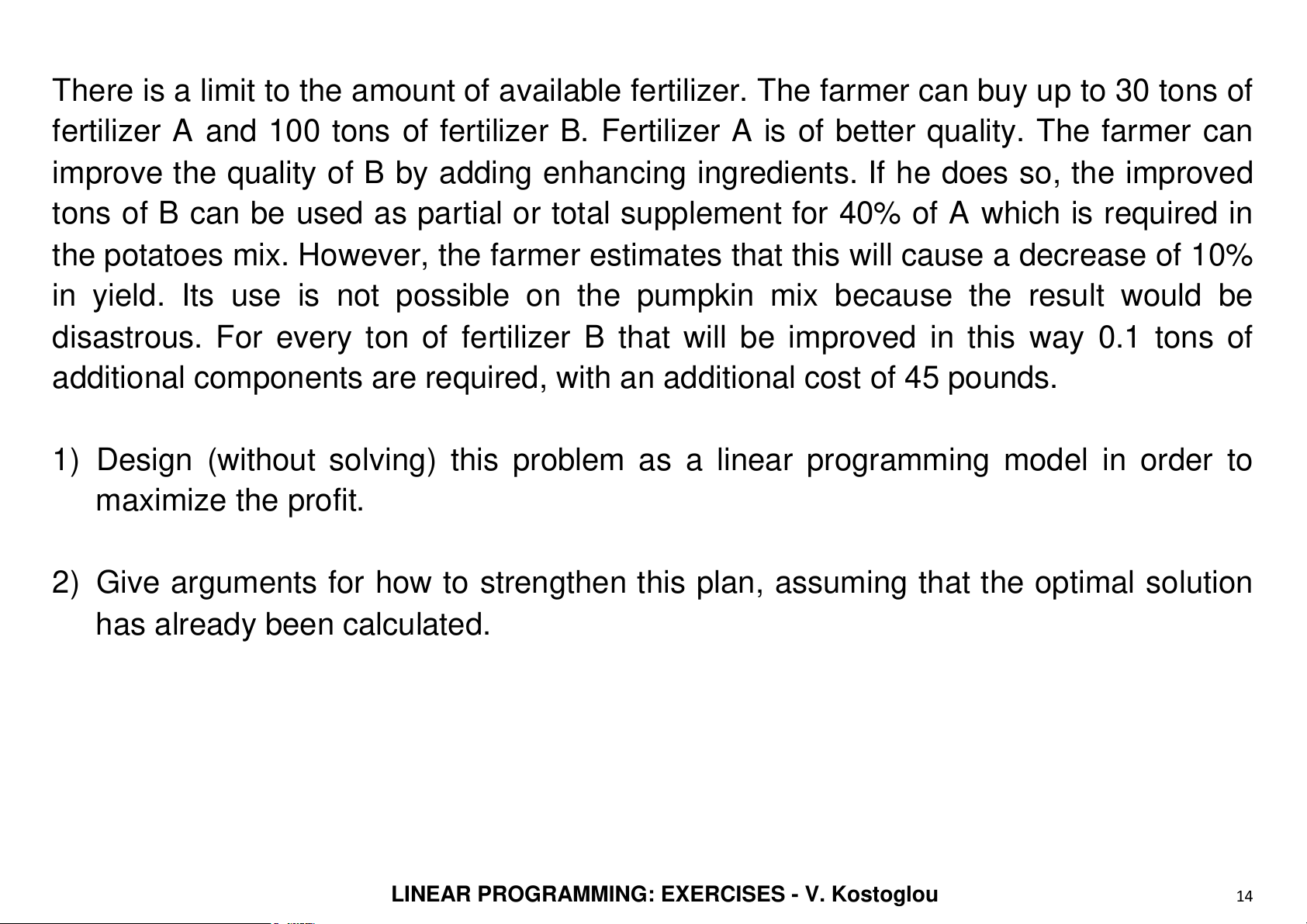
There is a limit to the amount of available fertilizer. The farmer can buy up to 30 tons of
fertilizer A and 100 tons of fertilizer B. Fertilizer A is of better quality. The farmer can
improve the quality of B by adding enhancing ingredients. If he does so, the improved
tons of B can be used as partial or total supplement for 40% of A which is required in
the potatoes mix. However, the farmer estimates that this wil cause a decrease of 10%
in yield. Its use is not possible on the pumpkin mix because the result would be
disastrous. For every ton of fertilizer B that wil be improved in this way 0.1 tons of
additional components are required, with an additional cost of 45 pounds.
1) Design (without solving) this problem as a linear programming model in order to maximize the profit.
2) Give arguments for how to strengthen this plan, assuming that the optimal solution has already been calculated.
LINEAR PROGRAMMING: EXERCISES - V. Kostoglou 14 PROBLEM 8
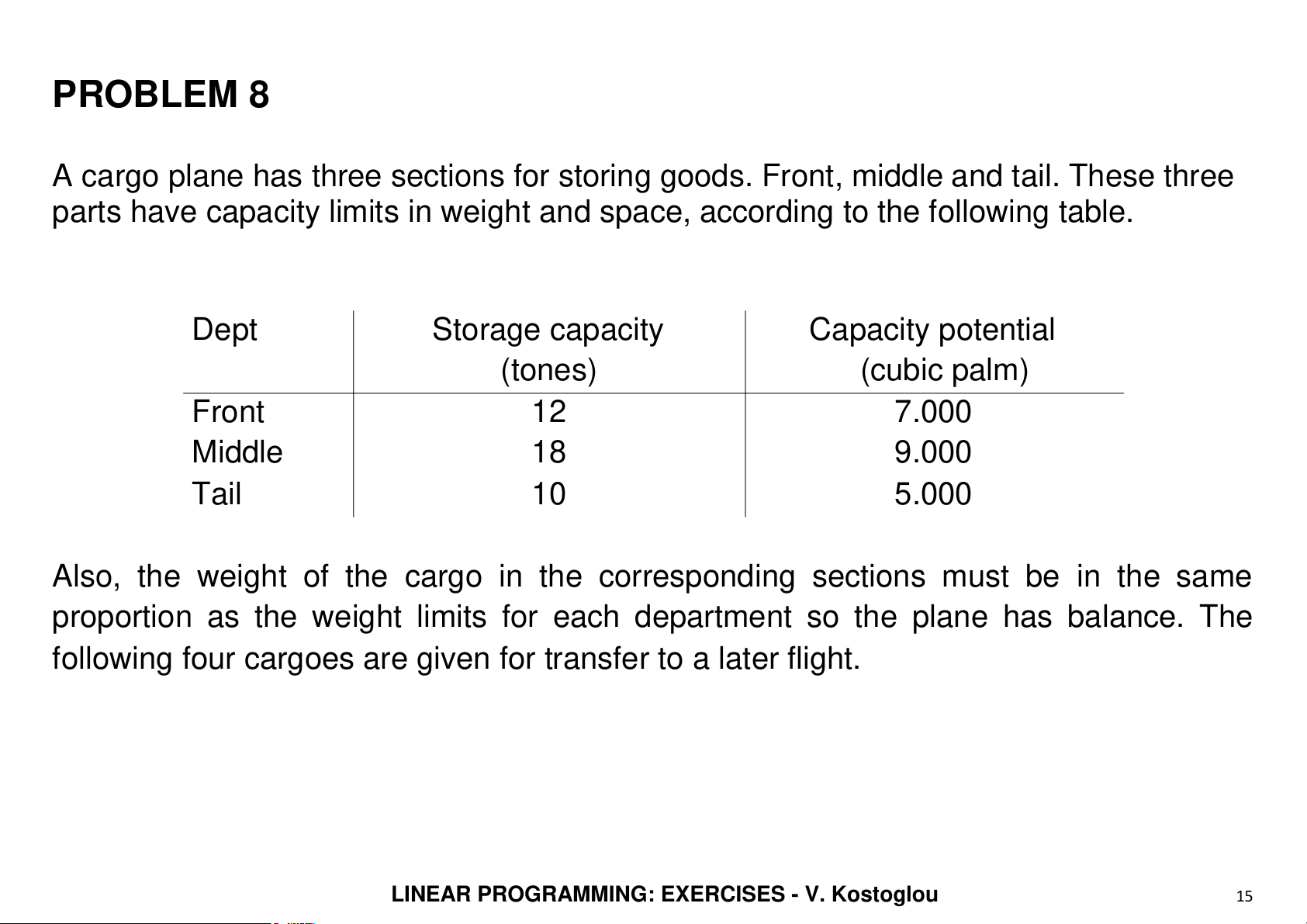
A cargo plane has three sections for storing goods. Front, middle and tail. These three
parts have capacity limits in weight and space, according to the fol owing table. Dept Storage capacity Capacity potential (tones) (cubic palm) Front 12 7.000 Middle 18 9.000 Tail 10 5.000
Also, the weight of the cargo in the corresponding sections must be in the same
proportion as the weight limits for each department so the plane has balance. The
fol owing four cargoes are given for transfer to a later flight.
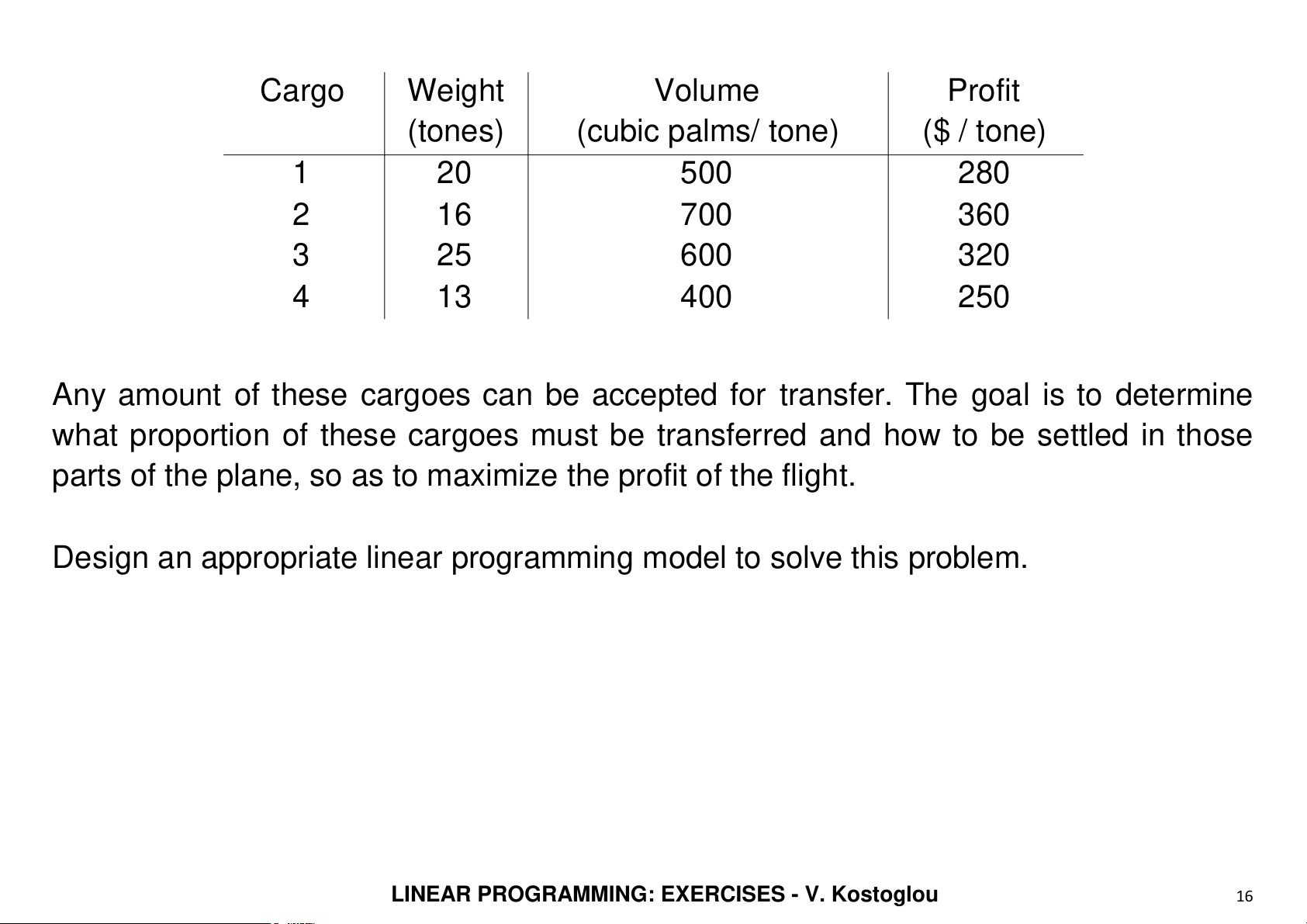
LINEAR PROGRAMMING: EXERCISES - V. Kostoglou 15 Cargo Weight Volume Profit (tones) (cubic palms/ tone) ($ / tone) 1 20 500 280 2 16 700 360 3 25 600 320 4 13 400 250
Any amount of these cargoes can be accepted for transfer. The goal is to determine
what proportion of these cargoes must be transferred and how to be settled in those
parts of the plane, so as to maximize the profit of the flight.
Design an appropriate linear programming model to solve this problem.
LINEAR PROGRAMMING: EXERCISES - V. Kostoglou 16 PROBLEM 9
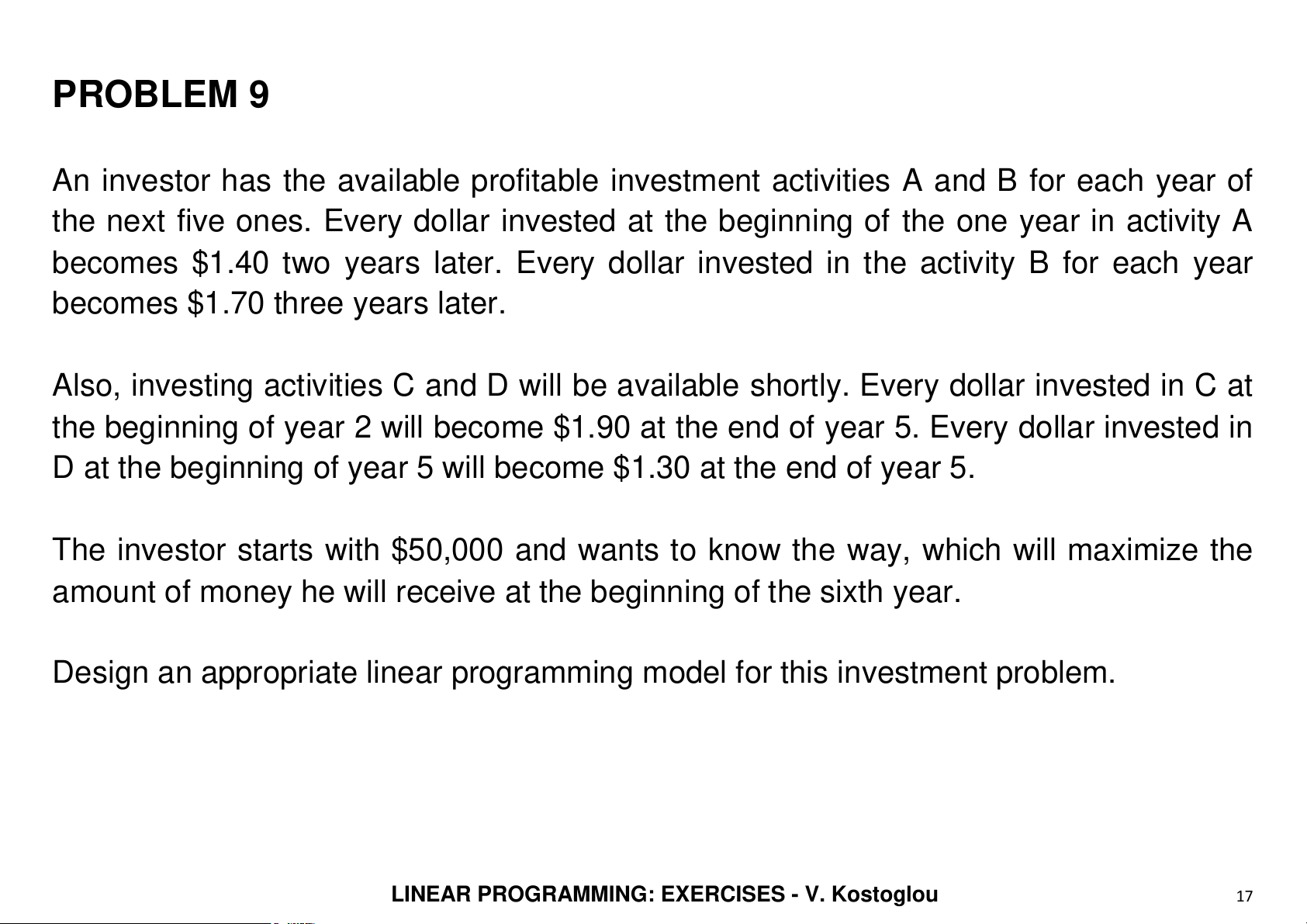
An investor has the available profitable investment activities A and B for each year of
the next five ones. Every dol ar invested at the beginning of the one year in activity A
becomes $1.40 two years later. Every dol ar invested in the activity B for each year
becomes $1.70 three years later.
Also, investing activities C and D wil be available shortly. Every dol ar invested in C at
the beginning of year 2 wil become $1.90 at the end of year 5. Every dol ar invested in
D at the beginning of year 5 wil become $1.30 at the end of year 5.
The investor starts with $50,000 and wants to know the way, which wil maximize the
amount of money he wil receive at the beginning of the sixth year.
Design an appropriate linear programming model for this investment problem.
LINEAR PROGRAMMING: EXERCISES - V. Kostoglou 17 PROBLEM 10
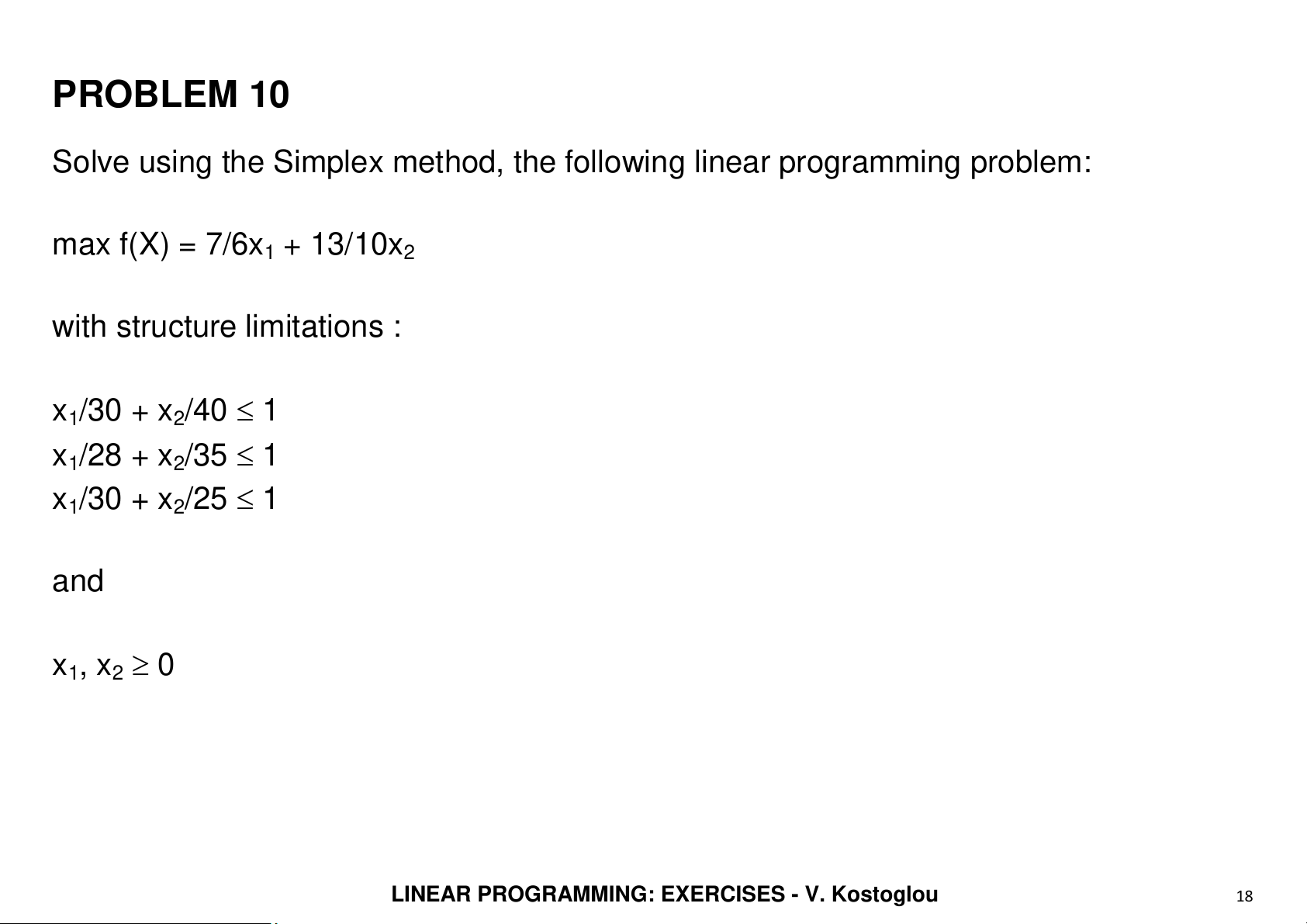
Solve using the Simplex method, the fol owing linear programming problem: max f(X) = 7/6x1 + 13/10x2 with structure limitations : x1/30 + x2/40 1 x1/28 + x2/35 1 x1/30 + x2/25 1 and x1, x2 0
LINEAR PROGRAMMING: EXERCISES - V. Kostoglou 18 PROBLEM 11
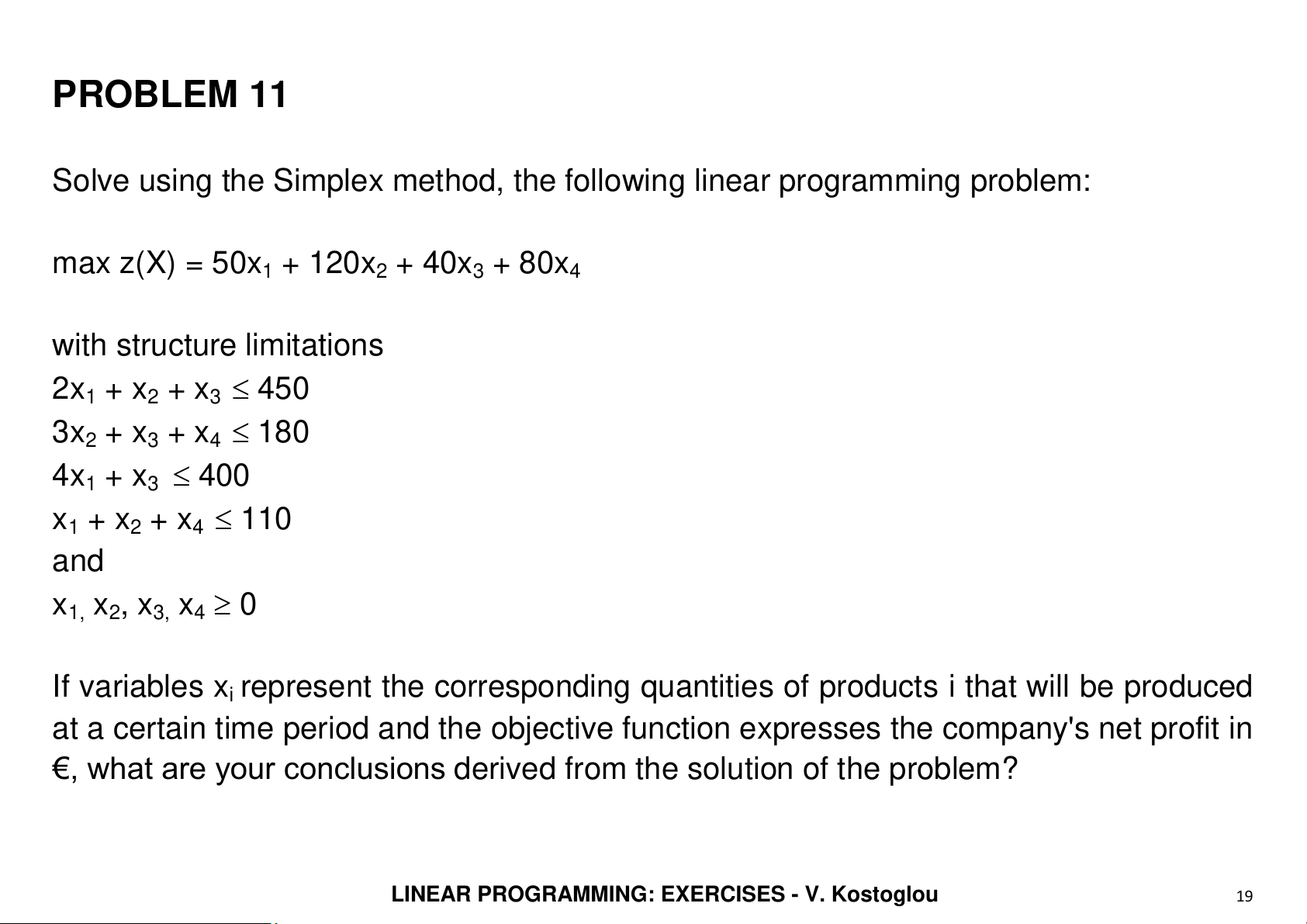
Solve using the Simplex method, the fol owing linear programming problem:
max z(X) = 50x1 + 120x2 + 40x3 + 80x4 with structure limitations 2x1 + x2 + x3 450 3x2 + x3 + x4 180 4x1 + x3 400 x1 + x2 + x4 110 and x1, x2, x3, x4 0
If variables xi represent the corresponding quantities of products i that wil be produced
at a certain time period and the objective function expresses the company's net profit in
€, what are your conclusions derived from the solution of the problem?
LINEAR PROGRAMMING: EXERCISES - V. Kostoglou 19 PROBLEM 12
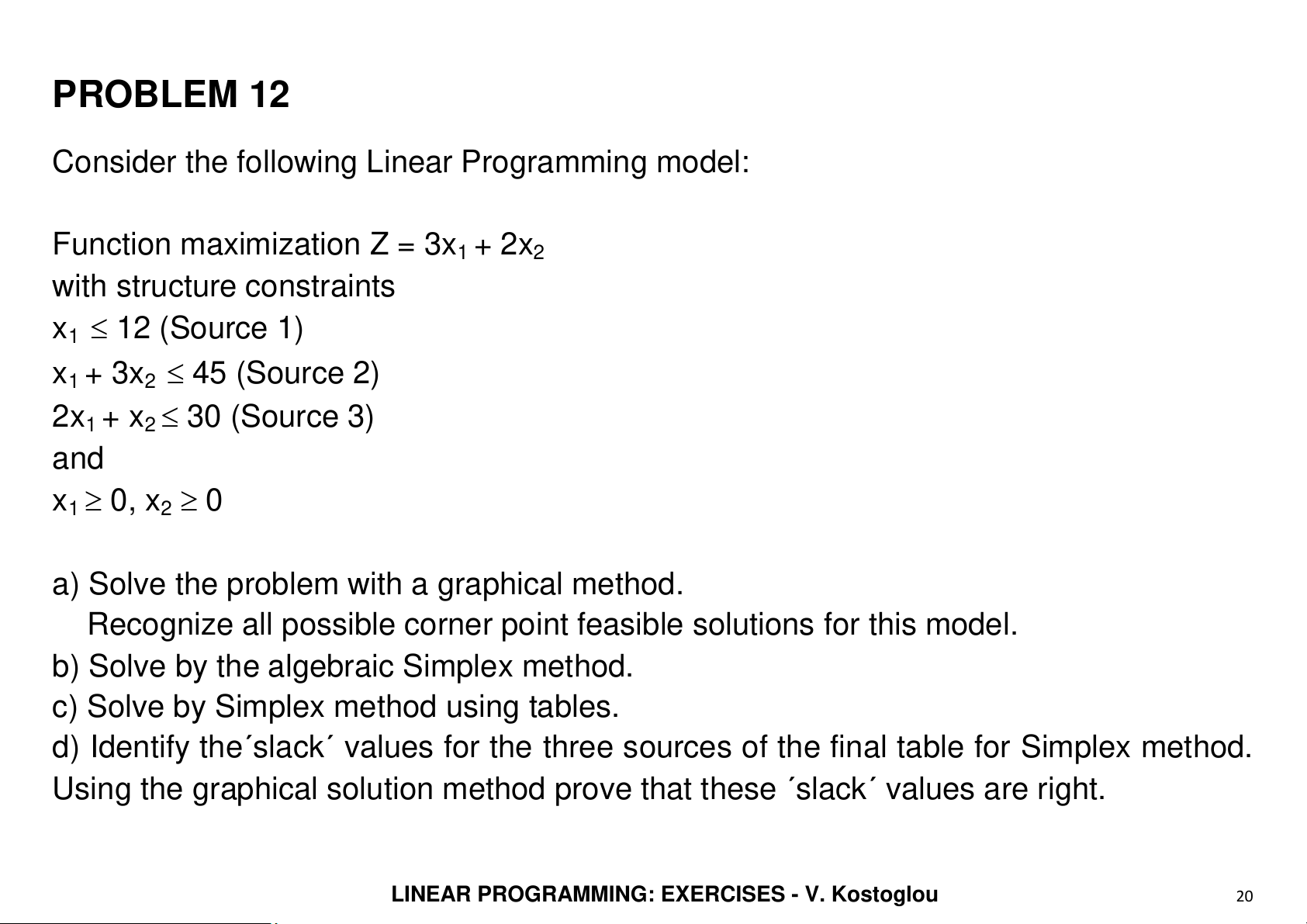
Consider the fol owing Linear Programming model:
Function maximization Z = 3x1 + 2x2 with structure constraints x1 12 (Source 1) x1 + 3x2 45 (Source 2) 2x1 + x2 30 (Source 3) and x1 0, x2 0
a) Solve the problem with a graphical method.
Recognize al possible corner point feasible solutions for this model.
b) Solve by the algebraic Simplex method.
c) Solve by Simplex method using tables.
d) Identify the΄slack΄ values for the three sources of the final table for Simplex method.
Using the graphical solution method prove that these ΄slack΄ values are right.
LINEAR PROGRAMMING: EXERCISES - V. Kostoglou 20
Tài liệu liên quan:
-
Chương 3: độ co giãn và các nhân tố ảnh hưởng | Microeconomics | Trường Đại học Quốc tế, Đại học Quốc gia Thành phố Hồ Chí Minh
4 2 -
Microeconomics Syllabus | Microeconomics | Trường Đại học Quốc tế, Đại học Quốc gia Thành phố Hồ Chí Minh
4 2 -
Microeconomics Course Syllabus & Assessment Details | Microeconomics | Trường Đại học Quốc tế, Đại học Quốc gia Thành phố Hồ Chí Minh
4 2 -
Assignment 3 - Elasticity MCQs and Key Concepts | Microeconomics | Trường Đại học Quốc tế, Đại học Quốc gia Thành phố Hồ Chí Minh
4 2 -
Assignment 2 - Economic Equilibrium Analysis of Fridges and Motorcycles | Microeconomics | Trường Đại học Quốc tế, Đại học Quốc gia Thành phố Hồ Chí Minh
4 2