Lý thuyết về Hành vi Tổ chức và Kỹ năng Giao tiếp trong Công việc | Môn Hành vi tổ chức - Đại học Kinh Tế Quốc Dân
Lý thuyết về Hành vi Tổ chức và Kỹ năng Giao tiếp trong Công việc Môn Hành vi tổ chức. Tài liệu được sưu tầm gồm 59 trang, giúp bạn ôn tập tốt hơn. Mời các bạn đón xem.
Môn: Hành vi tổ chức 72 tài liệu
Trường: Trường Đại học Kinh Tế Quốc Dân 8.2 K tài liệu
Tác giả:









Preview text:
lOMoAR cPSD| 61229936
THE IMPORTANCE OF INTERPERSONAL SKILLS
1. Demonstrate the importance of the interpersonal skills in the workplace. • Management functions:
+ All managers perform five management functions: planning, organizing, leading, and controlling.
+ Planning -> defining an organization goals, overall strategy..
+ Organizing -> design an organization's structure.
+ Leading -> direct and coordinate people.
+ Controlling -> monitor the organization's performance and compare with previously set goals. • Management Skills:
+ Technical Skills -> ability to apply specialized knowledge or expertise.
+ Human Skills -> Ability to understand, communicate with, motivate,… people.
+ Conceptual Skills -> Mental ability to analyze and diagnose complex situation -> decision making.
DIVERSITY IN ORGANIZATIONS 1. Diversity
1.1. Describe the two major workforce
- Learn how individual characteristics like age, gender, race, ethnicity, and
abilities can influence employee performance.
Levels of diversity
- Demographic (age, race, gender, ethnic, religion, and disability status ) are just
the tip of the iceberg (reflect only surface level diversity).
Evidence shown that as people get to know one each other, they become
less concerned about demographic differences if they see themselves
as sharing more important characteristics -> represent deep-level diversity.
Deep-level similarities will overshadow the more superficial difference.
Discrimination (Sự phân biệt)
- Working to eliminate unfair discrimination.
Means that allowing our behavior to be influenced by steoreotypes about
group of people -> assumes everyone in a group is the same. lOMoAR cPSD| 61229936
- Forms of Discrimination: EX: Discriminatory policies or practices; sexual
harassment, intimidation (sự hăm dọa, bullying), mockery and insults (Jokes or
negative stereotypes); exclusion (sự k include); incivility (disrespectful treatment)
2. Biographical Characteristics (Tiểu sử)
- Biographical Characteristics (age, gender, race, disabilities, and length of
service affect work organization. Age
- Older workers bring to jobs such as experience, judgment, a strong work ethnic, and commitment to quality.
- But, age also effect: absenteeism, productivity, and satisfaction. Sex
- No consistent male-female differences in problem-solving ability, analytical
skills, competitive drive, motivation, sociability, or learning ability.
Race and Ethnicity
- Relate to employment outcomes such as hiring decisions, performance
valuation, pay, and workplace discrimination. Disability
- The impact of disabilities on employment outcomes has been explored from a
variety of perspectives. On the other hand, a review of the evidence suggests
workers with disabilities receive higher performance evaluations. However, this
same review found that despite their higher performance, individuals with
disabilities tend to encounter lower performance expectations.
Other Biographical Characteristics: Tenure, Religion, Sexual Orientation,
and Gender Identity.
- Tenure: Expressed as work experience, appears to be a good predictor of employee productivity. - Religion
- Sexual orientation and Gender Identity: Employers differ widely in their
treatment of sexual orientation. 3. Ability
- Ability is and individual’s current capacity to perform the various tasks in a job.
Made of two sets of factors: intellectual and physical.
3.1. Intellectual Ability
- Are abilities needed to perform mental activity – thinking, reasoning, and problem solving.
Dimensions of Intellectual Ability
- Number Aptitude, Verbal Comprehension (Relationship of words), Perceptual
Speed (Identify visual similarities and differences quickly); Introductive lOMoAR cPSD| 61229936
Reasoning (Identify a logical sequence in a problem -> solve); Deductive
reasoning (Use logic and assess the implications of an argument); Spatial Visualization; Memory)
While intelligence is a big help in performing a job well, it doesn’t make
people happier or more satisfied with their jobs.
3.2. Physical Abilities
Nine basic Physical Abilities
- Dynamic Strength; Trunk Strength; Static Strength; Explosive Strength; Extent
Flexibilities; Dynamic Flexibility; Body Coordinator; Balance; Stamina
4. Implementing Diversity Management Strategies 4.1.
Attracting, Selecting, Developing, and Retaining Diverse Employees
- One method: Target recruiting messages to specific demographic groups
underrepresented (không đại diện) in the workforce.
- The selection process -> important places to apply diversity efforts. Managers
need to value fairness and objectivity in selecting and focus on the productive
potential of new recruits.
- Similaritiy in personality -> affect career advancement.
4.2. Diversity in Groups
4.3. Effective Diversity Programs
4.4. The Flynn Effect – Improving Worldwide IQ test performance
ATTITUDES AND JOB SATISFACTION 1. Attitude
1.1. Components of attitude
- Attitudes are evaluative statements – about objects, people, or events.
- Three components of attitude: cognition, affect, and behavior. Cognitive = Evaluation
- A description of or a belief in the way things are. Ex statement “My pay is low”
or “My supervisor gave a promotion to a co-worker who deserved it less than
me! My supervisor is unfair!”
Sets the stage for the more critical part of Attitude – Affective Component. Affective = Feeling
- Emotional or feeling segment of an attitude and is reflected in the statement “I
am angry over how little I’m paid” or “I dislike my supervisor”.
Leads to behavioral outcomes. Behavioral = Action
- Intention to behave in a certain way toward someone or something, ex “I’m
going to look for another job that pays better.”
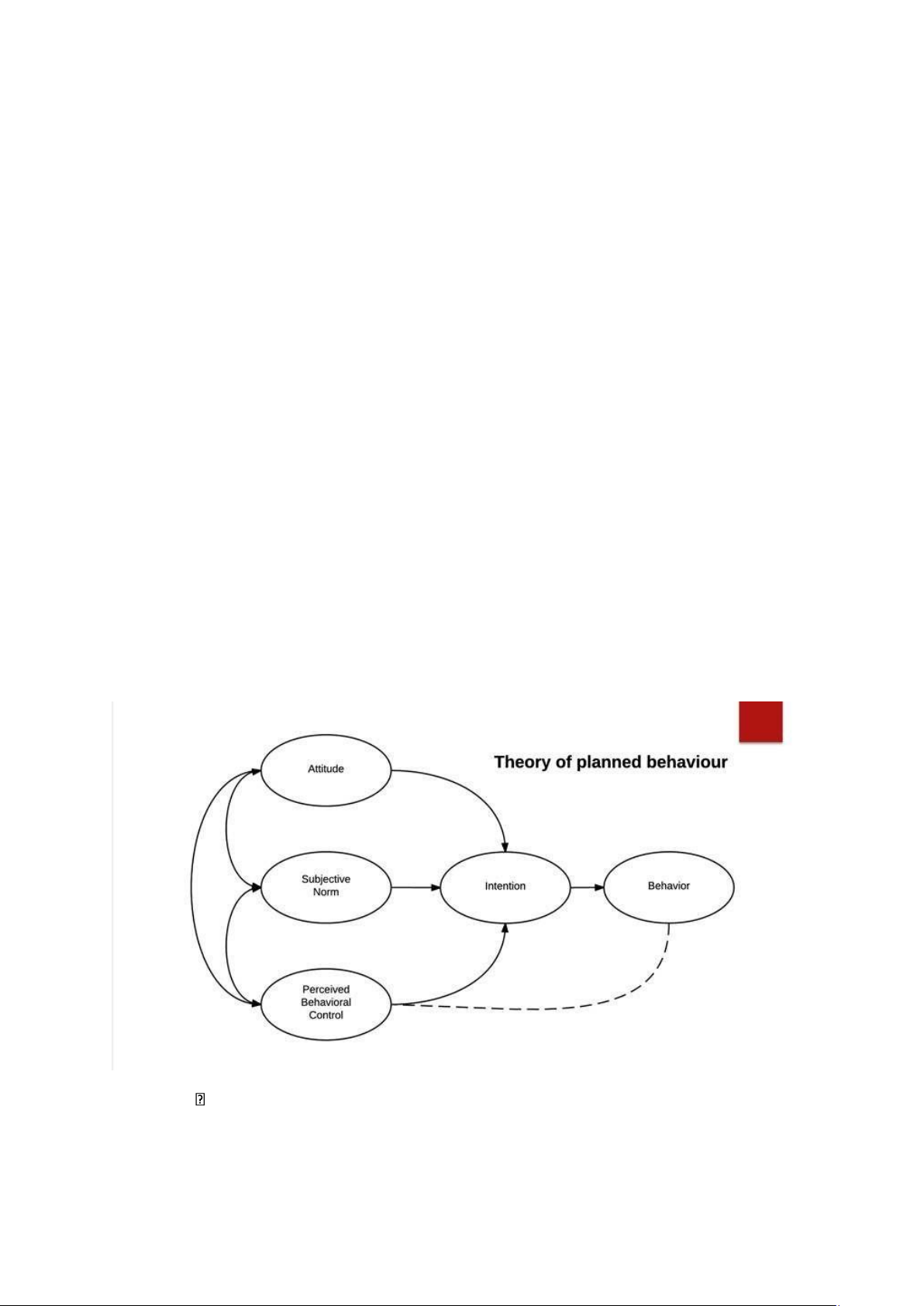
1.2. Relationship between Attitudes and Behavior lOMoAR cPSD| 61229936
- Attitude following behavior -> cognitive dissonance: the discomfort a person
feels when their behavior does not align with their values or beliefs.
In these examples, there's a clear inconsistency between what a person knows or
believes (cognition) and how they behave (behavior). This inconsistency creates a
state of discomfort or tension, which is known as cognitive dissonance: The person
knows smoking is bad for their health (cognition), but they continue to smoke (behavior) Moderating variables:
- Moderators of the attitudes relationship: importance of the attitude,
correspondence (sự tương hợp) to behavior, accessibility, presence of social
pressures, and whether a person has direct experience with the attitude.
- Ex: If you feel strongly about an issue (e.g., environmental protection), your
attitudes are more likely to guide your actions (e.g., recycling, reducing plastic use).
- The more specific the attitude, the better it predicts specific behaviors. For
example, a general attitude towards healthy eating is less likely to predict
specific food choices than an attitude towards eating vegetables.
- Attitudes that are easily recalled from memory are more likely to influence
behavior. If you can quickly and effortlessly access your attitude towards a
particular product, you're more likely to act in accordance with it.
- Social norms and expectations can influence behavior, sometimes overriding
personal attitudes. For example, you might have a negative attitude towards
smoking, but social pressure from friends might lead you to smoke anyway.
- Attitudes formed through direct experience (e.g., trying a product) tend to be
stronger and more predictive of behavior than attitudes formed through indirect
experience (e.g., reading a review). 1.3. Job Attitude Job Satisfaction
Employee Attitudes -> positive feeling about a job, resulting from an
evaluation of its characteristics. - Job involvement - Organizational Commitment
- Perceived Organizational Support •
Measuring Job Satisfaction - Two approaches are popular:
+ A response to one question, such as “All things considered, how satisfied are you
with your job?”. Respondents circle a number between 1 and 5 on a scale from “highly
satisfied” to “highly dissatisfied”.
+ The second method, the summation of job facets, is more sophisticated. It identifies
key elements in a job such as the nature of the work, supervision, present pay,
promotion opportunities, and relationships with co-workers. lOMoAR cPSD| 61229936 •
What lead to Job Satisfaction
- Training, variety, independence, and control satisfy most employees.
- Interdependence, feedback, social support, and interaction with co-workers outside the workplace.
- Pay does correlate with job satisfaction and overall happiness. But once an
individual reaches a level of comfortable living, depending on the region and
family size, the relationship between pay and job satisfaction virtually disappears
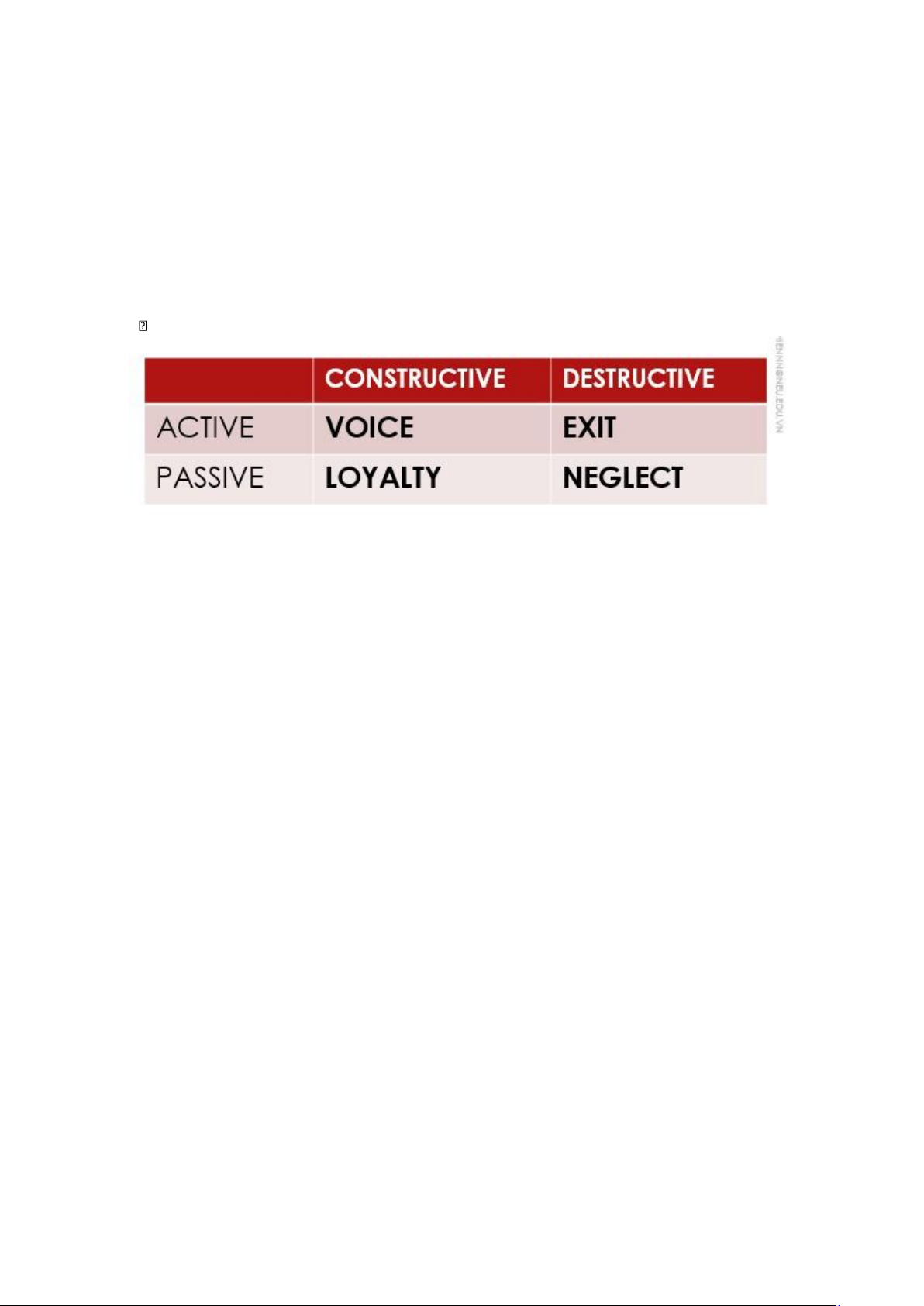
The impact of Satisfied and Dissatified employees on the Workplace?
- An employee who is dissatisfied with their salary decides to quit their job and
find a new one with a higher salary. Explanation: This is a clear example of the
"Exit" response. The employee has chosen to leave the organization because
they are not satisfied with the current situation.
- An employee who is unhappy with a new company policy may attend a meeting
to voice their opposition and suggest improvements. This is an example of the
"Voice" response. The employee is trying to change the situation by expressing
their dissatisfaction and offering solutions.
- A loyal customer of a brand may overlook a few minor mistakes and continue
to buy the brand's products.This is an example of the "Loyalty" response. The
customer has chosen to stay with the brand, even though they are not completely satisfied.
- An employee who is dissatisfied with their job may start working more slowly,
skip meetings, or lose enthusiasm for their work. This is an example of the
"Neglect" response. The employee is reducing their effort and engagement in the job.
- Measures the degree to which people identify psychologically with their
job and consider their perceived performance level important to selfworth.
- Employees with a high level of job involvement strongly identify with and really
care about the kind of work they do. lOMoAR cPSD| 61229936
- High levels of both job involvement are positively related to organizational
citizenship and job performance.
- High job involvement is also related to reduced absences and lower resignation rates.
- Research suggests two closely related types of organizational factors that tend
to promote job involvement and motivate effort toward achievement of
organizational goals: psychological climate and human resource policies and practices. Ví dụ:
- Meaning: As a graphic designer in a tech startup, the work has significant
meaning. They are not just creating designs; they are shaping the visual identity
of a new product or service that could potentially impact many people's lives.
- Autonomy: Designers in startups often have a high degree of autonomy. They
are given the freedom to explore different design concepts and have a
significant say in the final product.
- Growth: Startups are fast-paced environments, providing ample opportunities
for growth. Designers can learn new skills, work on diverse projects, and quickly move up the career ladder.
- Impact: Their work directly impacts the success of the startup. A welldesigned
product can attract more users and investors.
- Connection: In a startup, everyone is working towards a common goal.
Designers often collaborate closely with engineers, product managers, and
other team members, fostering a strong sense of community.
Organizational Commitment lOMoAR cPSD| 61229936
- Affective commitment is defined as the employee's positive emotional
attachment to the organization. An employee who is affectively committed
strongly identifies with the goals of the organization and desires to remain a
part of the organization. This employee commits to the organization because he/she "wants to".
- Continuance commitment is the "need" component or the gains versus losses
of working in an organization.
- Things like economic cost (such as pension accruals) and social costs
(friendship ties with co-workers) would be costs of losing organizational
membership. But an individual doesn't see the positive costs as enough to stay
with an organization they must also take into account the availability of
alternatives (such as another organization), disrupt personal relationships, and
other "side bets" that would be incurred from leaving their organization. The
problem with this is that these "side bets" don't occur at once but that they
"accumulate with age and tenure".
- Normative commitment: The individual commits to and remains with an
organization because of feelings of obligation
- These feelings may derive from a strain on an individual before and after joining
an organization. For example, the organization may have invested resources
in training an employee who then feels a 'moral' obligation to put forth effort on
the job and stay with the organization to 'repay the debt.' It may also reflect an
internalized norm, developed before the person joins the organization through
family or other socialization processes, that one should be loyal to one's
organization. The employee stays with the organization because he/she "ought to".
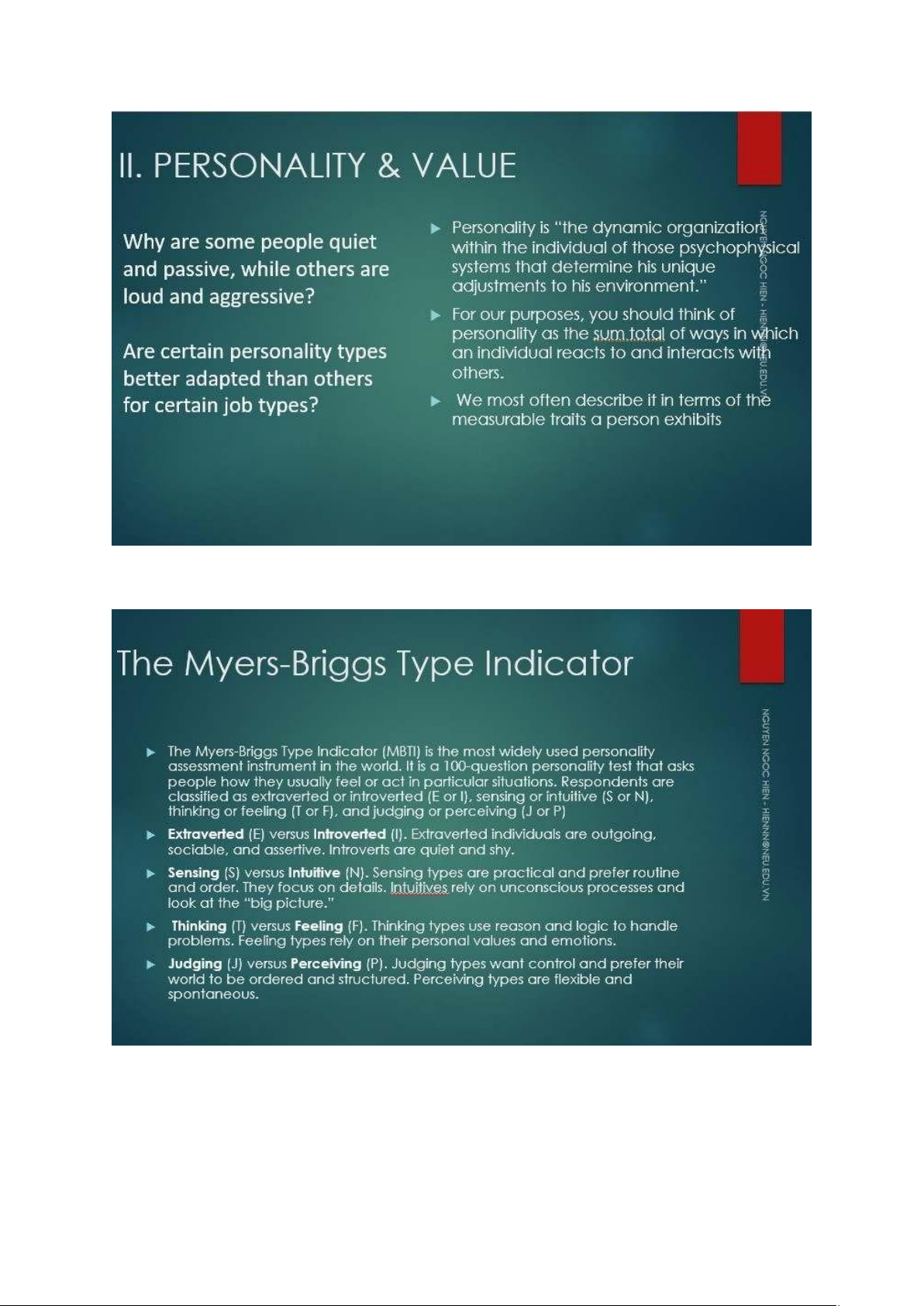
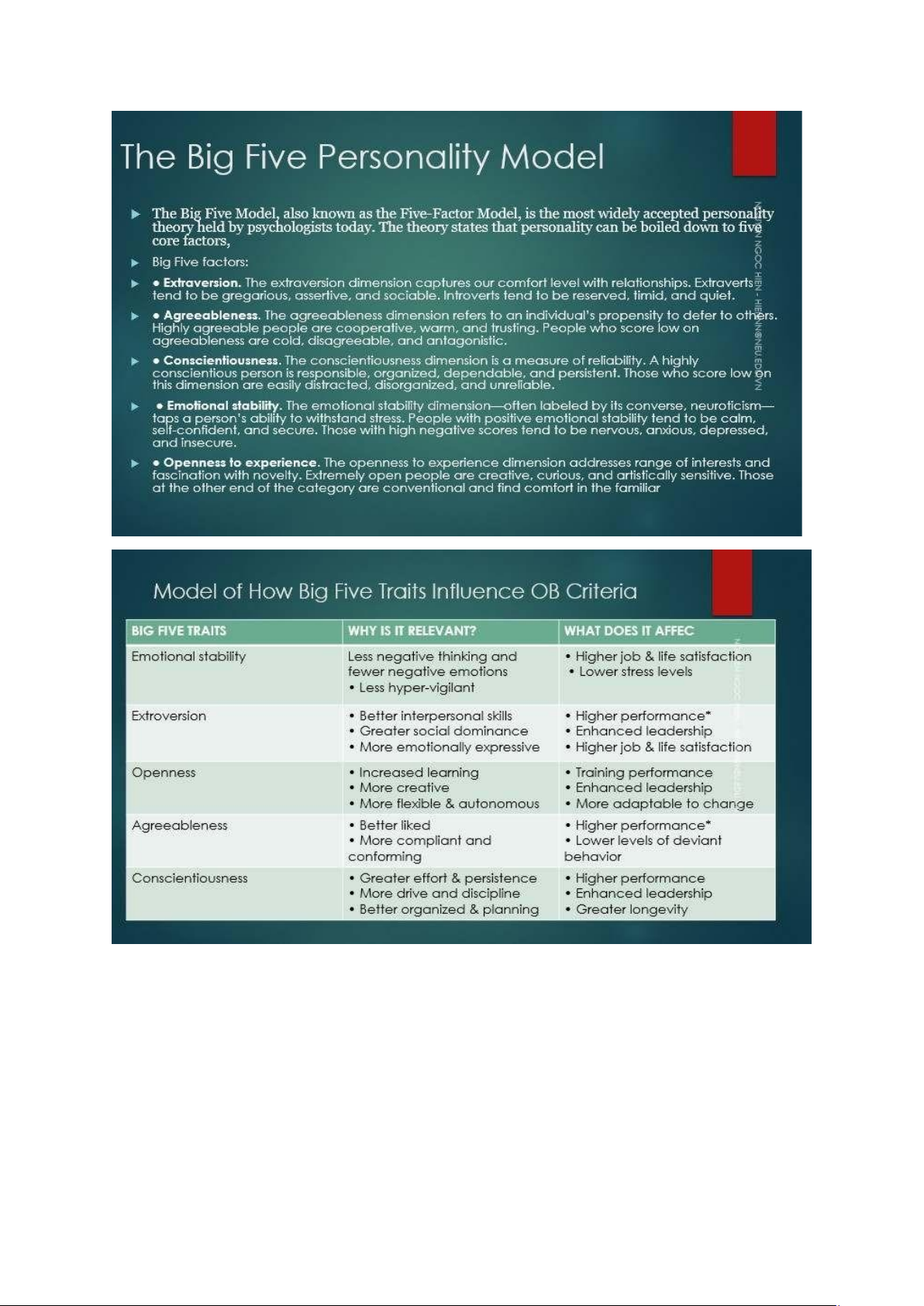
Khuyến khích đưa vào bài. 1.4. Personality and Value lOMoAR cPSD| 61229936
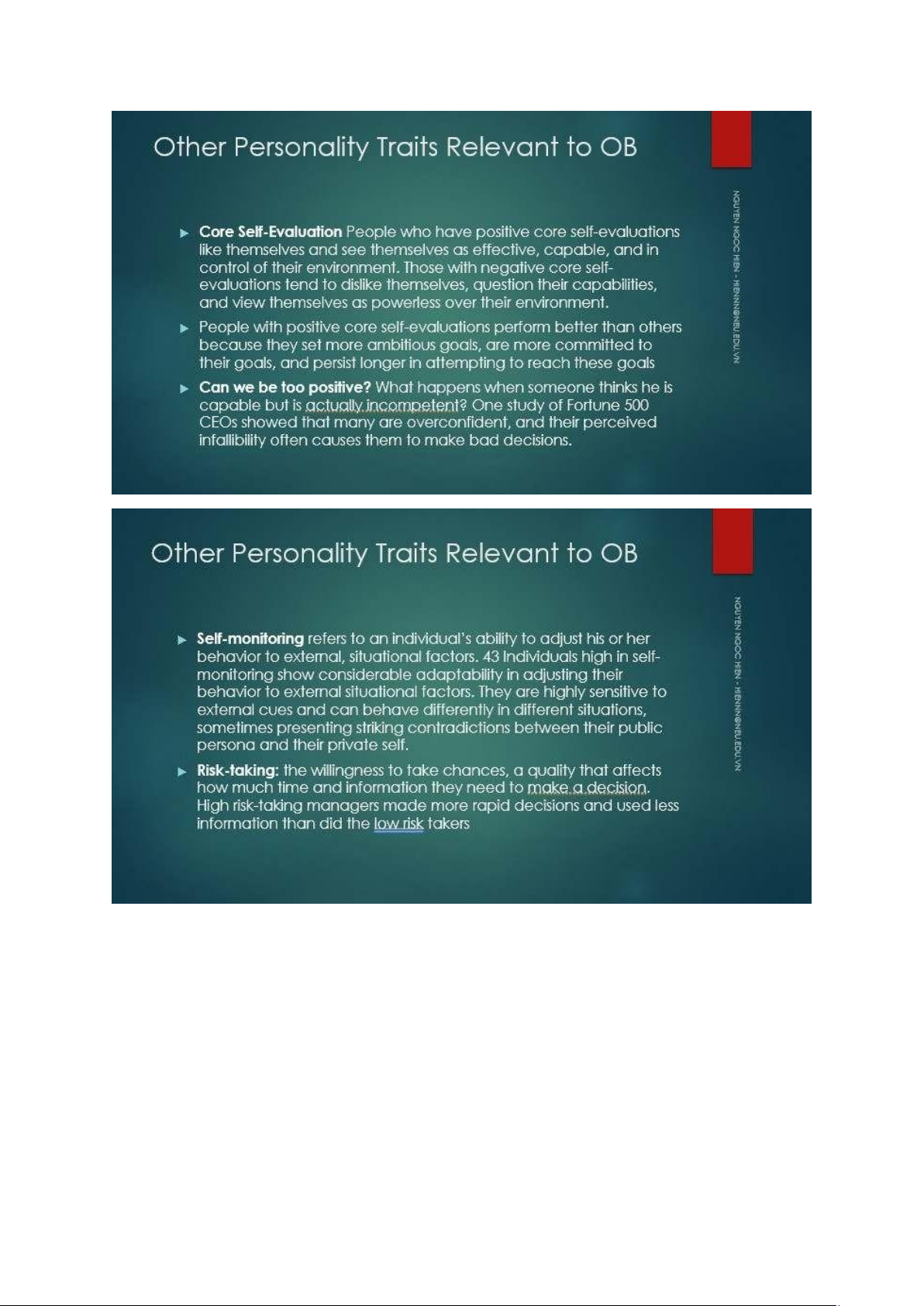
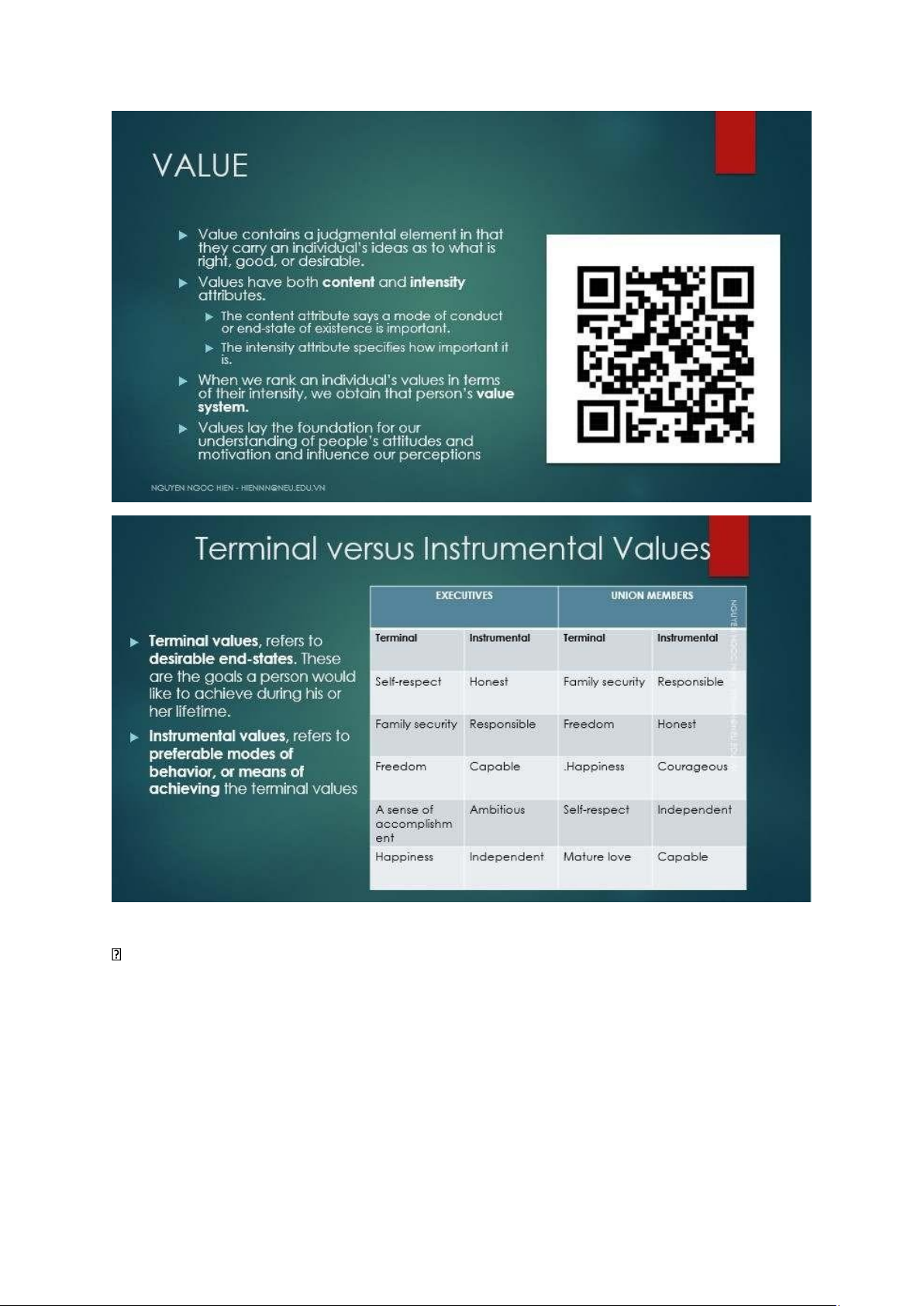
- Components: The Myers-Briggs Type Indicator; The Big Five Personality Model. lOMoAR cPSD| 61229936 lOMoAR cPSD| 61229936 lOMoAR cPSD| 61229936 1.5. Perception
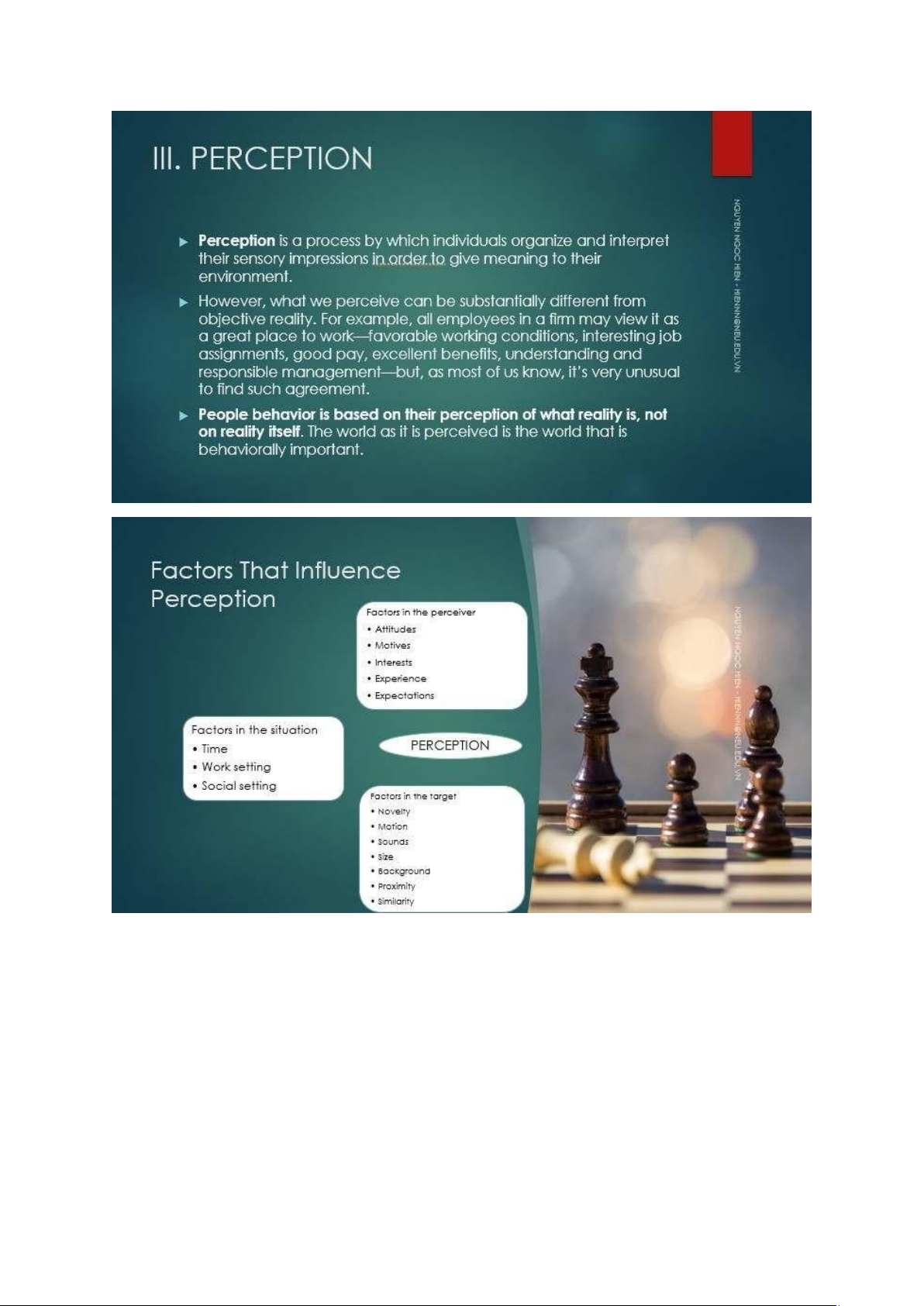
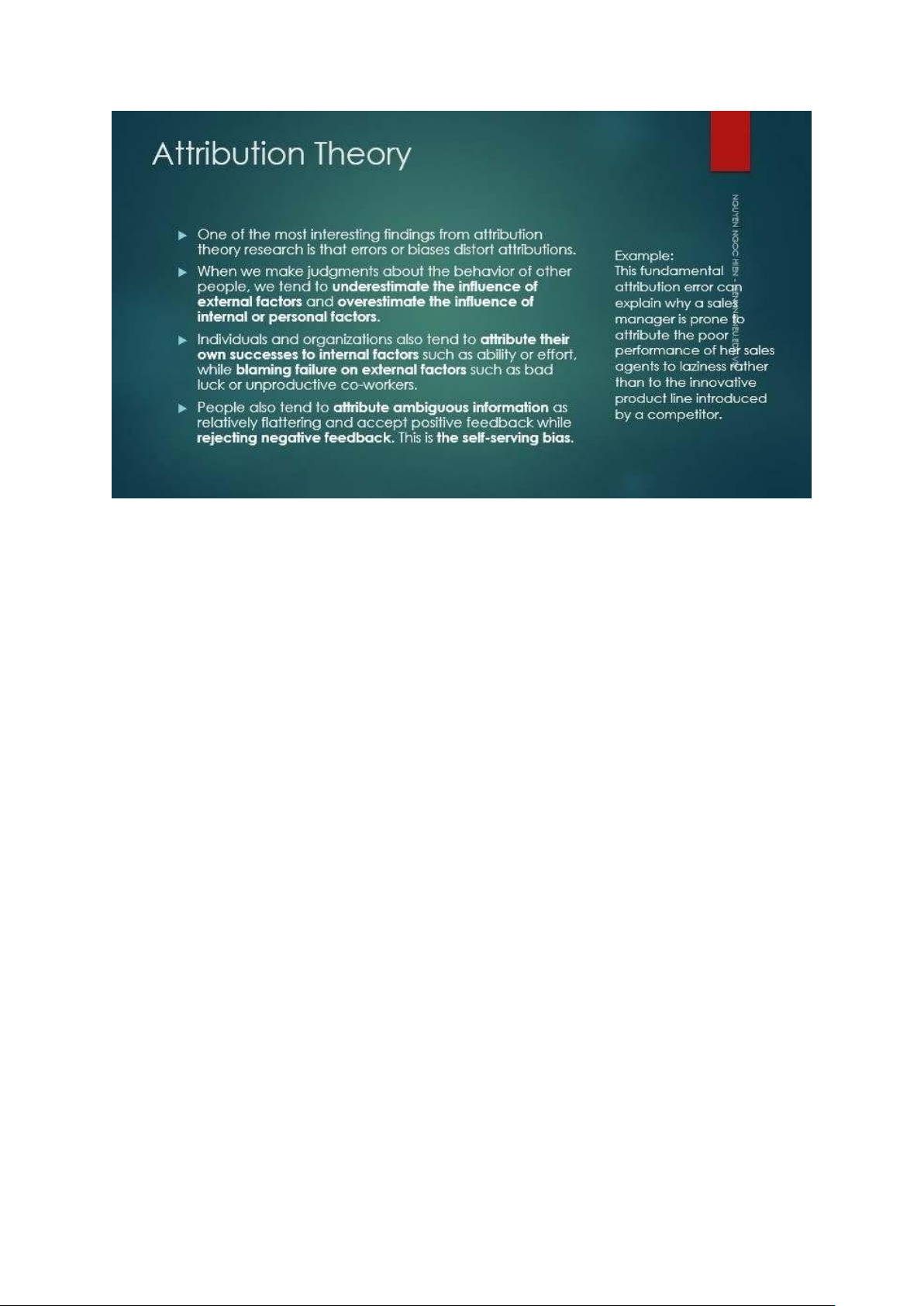
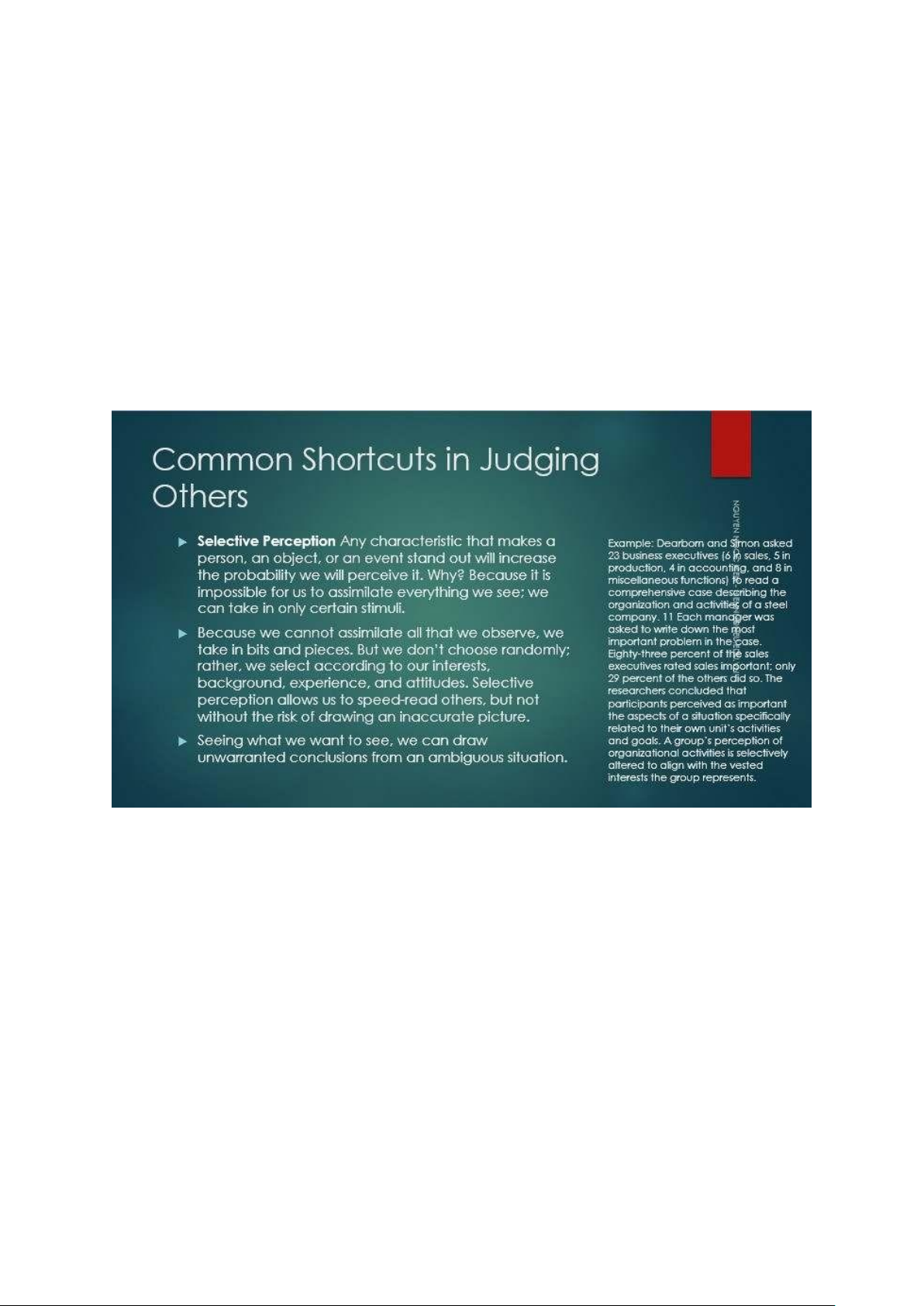
Đề thi hỏi cái gì về Perception, đều đưa định nghĩa vào. lOMoAR cPSD| 61229936 1.6. Attribution Theory lOMoAR cPSD| 61229936 lOMoAR cPSD| 61229936
Ví dụ 2: Một người bạn bị mất việc
Tình huống: Một người bạn thân của bạn vừa bị mất việc.
Quy kết nội tại: "He lost his job because he's lazy and doesn't work hard." (Anh ấy mất
việc vì lười biếng và không làm việc chăm chỉ.)
Quy kết ngoại tại: "The company is going through a tough time, and many people are
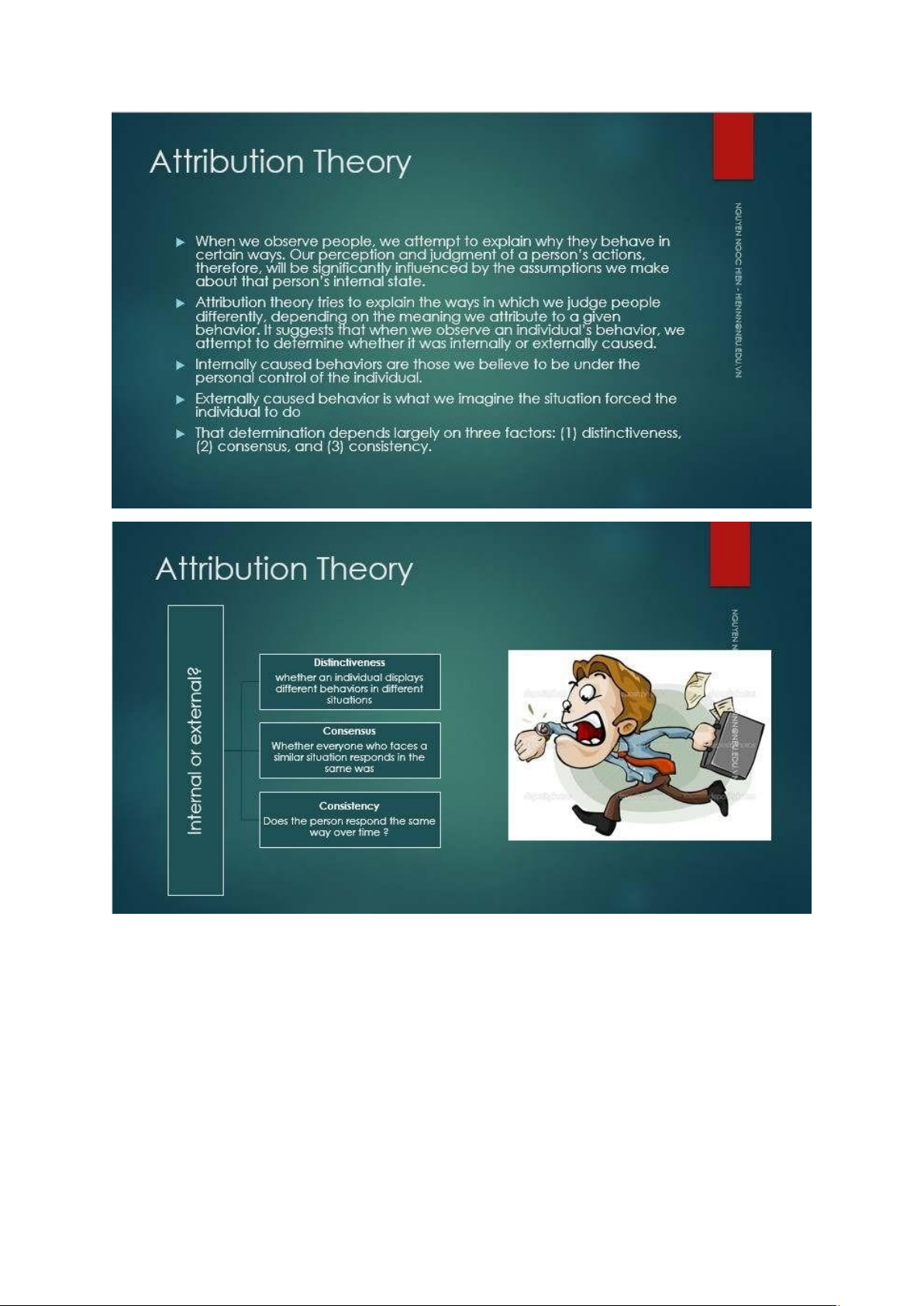
being laid off." (Công ty đang gặp khó khăn và nhiều người đang bị sa thải.) Consistency: •
High consistency: If this student consistently fails math exams, regardless of
the topic or the teacher, we might attribute their failure to a lack of ability in
math. This suggests that their performance is consistent across different situations. •
Low consistency: If this student usually does well in math but failed this
particular exam, we might attribute their failure to an external factor, such as a
particularly difficult exam or a temporary illness. This suggests that their
performance is inconsistent and influenced by other factors. • Distinctiveness: •
High distinctiveness: If this student only fails math exams but does well in
other subjects, we might attribute their failure to the specific subject of math.
This suggests that their difficulty is specific to math and not a general academic problem. •
Low distinctiveness: If this student fails in all subjects, we might attribute their
failure to a more general internal factor, such as a lack of motivation or study lOMoAR cPSD| 61229936
skills. This suggests that their difficulty is not specific to one subject but is a broader issue. • Consensus: •
High consensus: If many other students also failed the same math exam, we
might attribute the failure to an external factor, such as a difficult exam or a poor
teaching method. This suggests that the failure is not unique to the individual
but is a common experience for many. •
Low consensus: If only a few students failed the math exam, we might
attribute the failure to an internal factor, such as the student's lack of
preparation. This suggests that the failure is specific to the individual. lOMoAR cPSD| 61229936 1.7. Learning
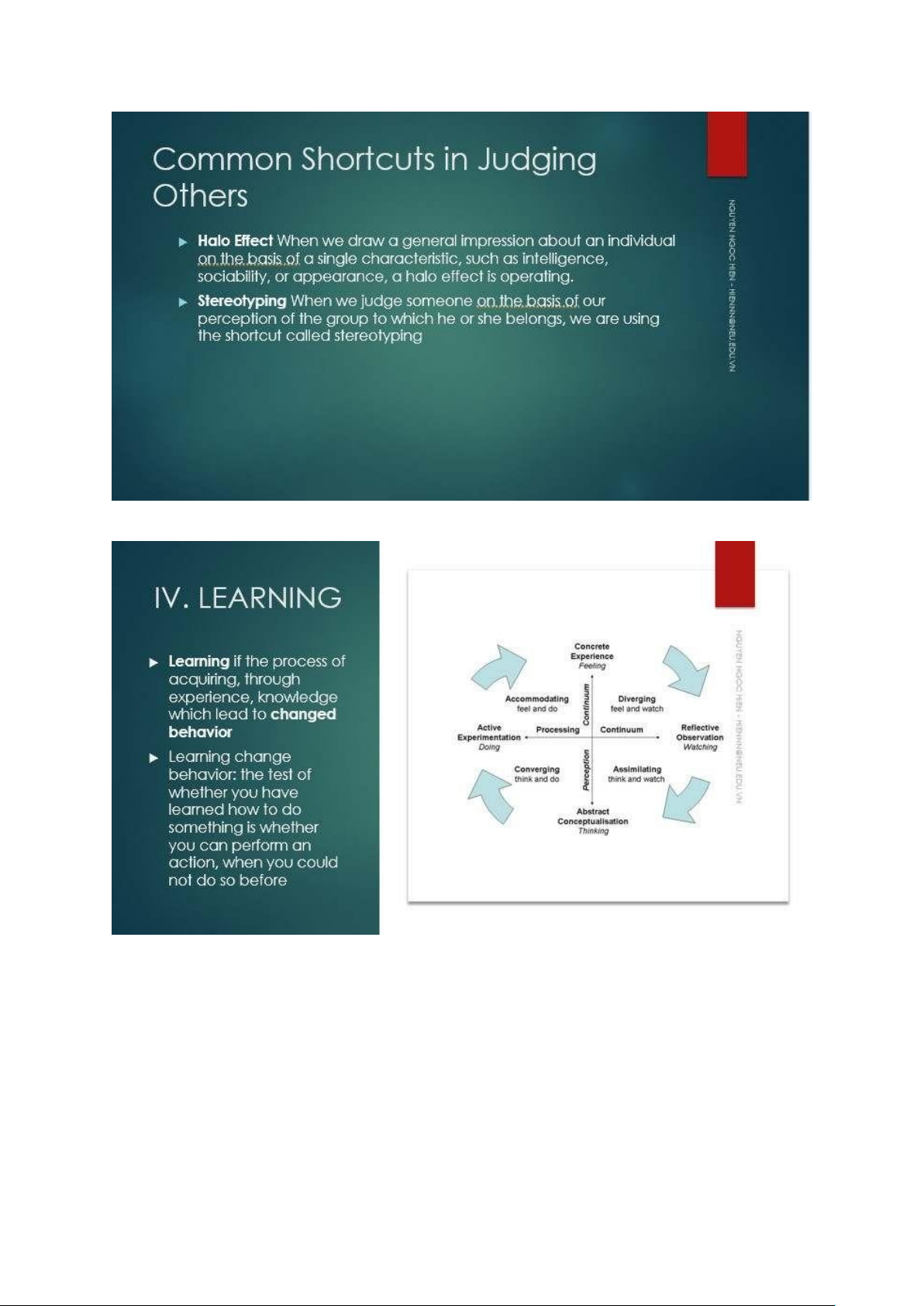
Chương 3: Decision making and improving individual creativity in an organization
1. Individual Decision Makng in an Organization •
Individuals in organizations make decisions, choices from among two or more alternatives. lOMoAR cPSD| 61229936 •
Individual decision making is thus an important part of organizational behavior.
But the way individuals make decisions and the quality of their choices are
largely influenced by their perceptions. •
Top managers determine their organization’s goals, what products or services
to offer, how best to finance operations, or where to locate a new manufacturing plant. •
Middle- and lower-level managers set production schedules, select new
employees, and decide how to allocate pay raises. •
Nonmanagerial employees decide how much effort to put forth at work and
whether to comply with a boss’s request.
1.1. Nature of decision making
- Decision making occurs as a reaction to a problem.
- A problem: is a discrepancy exists between the current state of affairs and some
desired state, requiring us to consider alternative courses of action.
- Unfortunately, most problems don’t come neatly labeled “problem.” One
person’s problem can be another person’s satisfactory state of affairs.
- Awareness that a problem exists and that a decision might or might not be needed is a perceptual issue
1.2. Rational Decision-Making Model.
- Rational Decision-Making Model relies on some assumptions, including
- The decision maker has complete information
- The decision maker is able to identify all the relevant options in an unbiased
manner and chooses the option with the highest utility.
- However, most decisions in the real world don’t follow the rational model.
People are usually content to find an acceptable or reasonable solution to a
problem rather than an optimal one. Choices tend to be limited to the
neighborhood of the problem symptom and the current alternative.
- As one expert in decision making put it, “Most significant decisions are made
by judgment, rather than by a defined prescriptive model.” - Step 1: Define the problems
+ Though this starting place might seem rather obvious, a failure to identify the
problem clearly can derail the entire process.
+ It can sometimes require serious thought to find the central issue that must be addressed. For example:
You have taken a new job and you may initially decide you need to find a new car for
commuting back and forth from work.
However, the central problem is that you need a reliable way to commute to and from work. lOMoAR cPSD| 61229936
- Step 2: Identify Decision Criteria
In this step, the decision maker needs to determine what is relevant in making the decision.
This step will bring the decision maker’s, and any other stakeholder’s, interests, values
and preferences into the process.
For example: let’s assume you are married. Some of the criteria identified might
include budget, safety, functionality, and reliability. - Step 3: Allocate Weigh to Decision Criteria
Because the criteria identified will seldom be equally important, you will need to weight
the criteria to create the correct priority in the decision.
For example, you may have weighted budget, safety, and reliability as the most
important criteria to consider, along with several other slightly less critical criteria. - Step 4: Generate Alternatives
Once you have identified the issue and gathered relevant information, now it is time to
list potential options for how to decide what to do.
Some of those alternatives will be common and fairly obvious options, but it is often
helpful to be creative and name unusual solutions as well.
The alternatives you generated could include the types of cars, as well as using public
transportation, car pooling and a ride-hailing servic
- Step 5: Evaluate the Alternatives
After creating a somewhat full list of possible alternatives, each alternative can be evaluated.
Which choice is most desirable and why? Are all of the options equally feasible, or are
some unrealistic or impossible?
Now is the time to identify both the merits and the challenges involved in each of the possible solutions.
- Step 6: Select the best Alternative:
After a careful evaluation of alternatives, you must choose a solution.
You should clearly state your decision so as to avoid confusion or uncertainty. The
solution might be one of the particular options that was initially listed, an adaptation of
one of those options, or a combination of different aspects from multiple suggestions.
It is also possible that an entirely new solution will arise during the evaluation process.
1.3. Bounded Rationality (hạn chế tính hợp lý) lOMoAR cPSD| 61229936
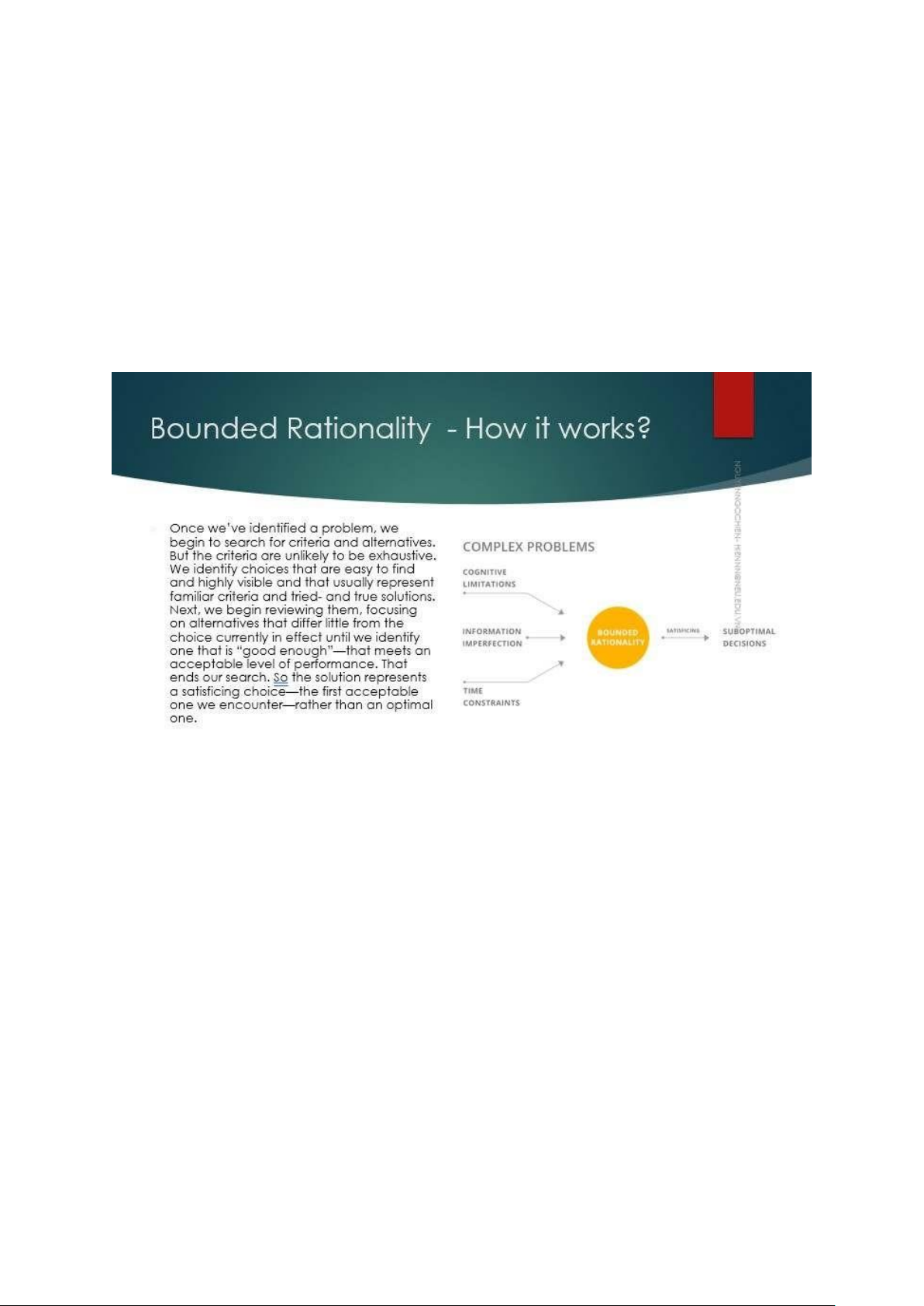
Our limited information-processing capability makes it impossible to assimilate and
understand all the information necessary to optimize. So, most people respond to a
complex problem by reducing it to a level at which they can readily understand it.
Also many problems don’t have an optimal solution because they are too complicated
to fit the rational decision-making model. So people satisfice; they seek solutions that
are satisfactory and sufficient
Because the human mind cannot formulate and solve complex problems with ful
rationality, we operate within the confines of bounded rationality. We construct
simplified models that extract the essential features from problems without capturing all their complexity
1.4. Intuition (Trực giác)
Perhaps the least rational way of making decisions is intuitive decision making, an
unconscious process created from distilled experience.
It occurs outside conscious thought; it relies on holistic associations, or links between
disparate pieces of information; it’s fast; and it’s affectively charged, meaning it usually engages the emotions.
1.5. Common Biases and Errors in Decision Making Overconfidence Bias
Anchoring Bias The anchoring bias is a tendency to fixate on initial information and fail
to adequately adjust for subsequent information
Confirmation Bias The rational decision-making process assumes we objectively
gather information. But we don’t. We selectively gather it. The confirmation bias
represents a specific case of selective perception: we seek out information that
reaffirms our past choices, and we discount information that contradicts them
Availability Bias More people fear flying than fear driving in a car. But if flying on a lOMoAR cPSD| 61229936
commercial airline really were as dangerous as driving, the equivalent of two 747s
filled to capacity would crash every week, killing all aboard. Because the media give
much more attention to air accidents, we tend to overstate the risk of flying and
understate the risk of driving.
Another distortion that creeps into decisions is a tendency to escalate commitment. 53
Escalation of commitment refers to staying with a decision even when there is clear evidence it’s wrong
- Randomness Error Most of us like to think we have some control over our world
and our destiny. Our tendency to believe we can predict the outcome of random
events is the randomness error.
- Risk aversion (tránh né rủi ro): This tendency to prefer a sure thing over a risky outcome
1.6. Reducing Biases and Errors (Những sai lệch trong tư duy)
Focus on Goals. Without goals, you can’t be rational, you don’t know what information
you need, you don’t know which information is relevant and which is irrelevant, you’ll
find it difficult to choose between alternatives, and you’re far more likely to experience
regret over the choices you make. Clear goals make decision making easier and help
you eliminate options that are inconsistent with your interests.
Look for Information That Disconfirms Your Beliefs. One of the most effective means
for counteracting overconfidence and the confirmation and hindsight biases is to
actively look for information that contradicts your beliefs and assumptions. When we
overtly consider various ways we could be wrong, we challenge our tendencies to think
we’re smarter than we actually are.
Don’t Try to Create Meaning out of Random Events. The educated mind has been
trained to look for cause-and-effect relationships. When something happens, we ask
why. And when we can’t find reasons, we often invent them. You have to accept that
there are events in life that are outside your control. Ask yourself if patterns can be
meaningfully explained or whether they are merely coincidence. Don’t attempt to
create meaning out of coincidence.
Increase Your Options. No matter how many options you’ve identified, your final choice
can be no better than the best of the option set you’ve selected. This argues for
increasing your decision alternatives and for using creativity in developing a wide
range of diverse choices. The more alternatives you can generate, and the more
diverse those alternatives, the greater your chance of finding an outstanding one.
2. Improving Creativity in Decision Making
Tài liệu liên quan:
-
TOP Câu hỏi trắc nghiệm Môn Hành vi tổ chức | Đại học Kinh Tế Quốc Dân
90 45 -
Hành Vi Tổ Chức và Quản Lý Giao Tiếp Trong Cách Mạng Công Nghiệp 4.0 | Môn Hành vi tổ chức - Đại học Kinh Tế Quốc Dân
76 38 -

Chương 1: Hành vi tổ chức và các khái niệm cơ bản | Môn Hành vi tổ chức - Đại học Kinh Tế Quốc Dân
99 50 -
Câu hỏi ôn tập Môn Hành vi tổ chức | Đại học Kinh Tế Quốc Dân
116 58 -

Tóm tắt Chương 2-5: Hành vi tổ chức và Giao tiếp trong Tổ chức | Môn Hành vi tổ chức - Đại học Kinh Tế Quốc Dân
84 42