Market Forces of Supply and Demand Practice Problems | Microeconomics | Trường Đại học Quốc tế, Đại học Quốc gia Thành phố Hồ Chí Minh
Explain the law of demand Other things equal, when the price of a good rise, the quantity demanded of the good decrease, when the price falls, the quantity demanded rises => negatively related 3. Other variables Income, tastes, expectation, price of related goods, number of buyers in the market 4. What is the difference between a normal good and an inferior good? Inferior good: I↑ => D↓ Normal good: I↑=> D↑ 5. Explain the law of supply Other things are equal, when the price of a good rises , the quantity supplied of the good rises, when the price. Tài liệu được sưu tầm và soạn thảo dưới dạng file PDF để gửi tới các bạn cùng tham khảo, ôn tập đầy đủ kiến thức, chuẩn bị cho các buổi học thật tốt. Mời bạn đọc đón xem!
Môn: Microeconomics 635 tài liệu
Trường: Trường Đại học Quốc tế, Đại học Quốc gia Thành phố Hồ Chí Minh 1.9 K tài liệu
Tác giả:

Preview text:
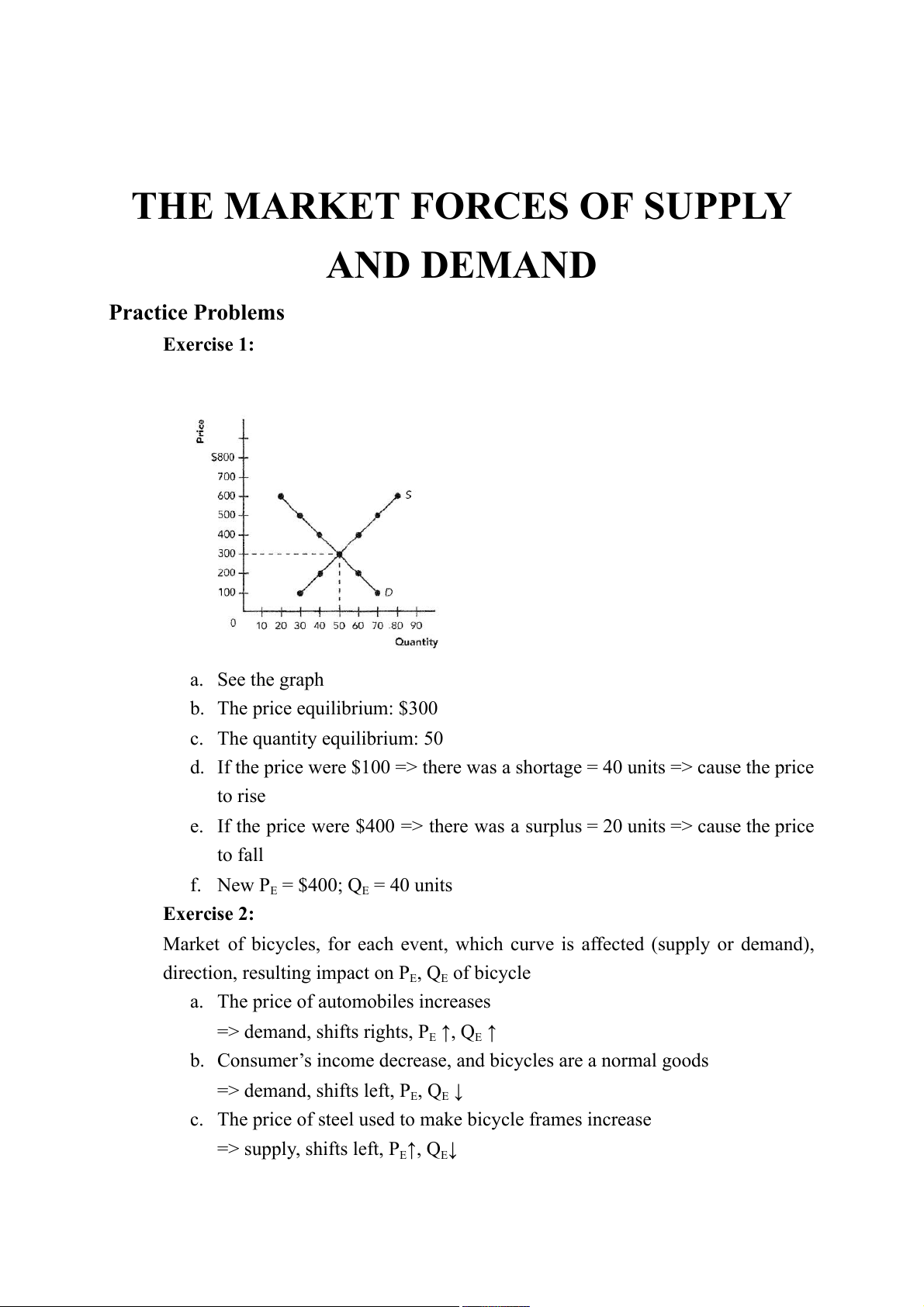
THE MARKET FORCES OF SUPPLY AND DEMAND Practice Problems Exercise 1: a. See the graph
b. The price equilibrium: $300
c. The quantity equilibrium: 50
d. If the price were $100 => there was a shortage = 40 units => cause the price to rise
e. If the price were $400 => there was a surplus = 20 units => cause the price to fall
f. New PE = $400; QE = 40 units Exercise 2:
Market of bicycles, for each event, which curve is affected (supply or demand),
direction, resulting impact on PE, QE of bicycle
a. The price of automobiles increases
=> demand, shifts rights, PE ↑, QE ↑
b. Consumer’s income decrease, and bicycles are a normal goods
=> demand, shifts left, PE, QE ↓
c. The price of steel used to make bicycle frames increase
=> supply, shifts left, PE↑, QE↓
d. An environmental movement shifts taste toward bicycling
=> demand, shifts right, PE ↑, QE ↑
e. Consumers expect the price of bicycles to fall in the future
=> demand, shifts left, PE, QE ↓
f. A technological advance in the manufacture of bicycles occurs
=> supply, shifts right, PE ↓, QE ↑
g. The price of bicycles helmets and shoes are reduced
=> demand, shifts right, PE ↑, QE ↑
h. Consumer’s income decrease, and bicycle are an inferior good
=> demand, shifts right, PE ↑, QE ↑ Exercise 3: a. PE ambiguous, QE ↑ b. PE ↑, QE ↑ Short Answer Questions
1. Two main characteristics of perfectly competitive market
- All goods are exactly the same
- Buyers and sellers are so numerous that no one can effect the market price 2. Explain the law of demand
Other things equal, when the price of a good rise, the quantity demanded of the
good decrease, when the price falls, the quantity demanded rises => negatively related 3. Other variables
Income, tastes, expectation, price of related goods, number of buyers in the market
4. What is the difference between a normal good and an inferior good?
Inferior good: I↑ => D↓ Normal good: I↑=> D↑ 5. Explain the law of supply
Other things are equal, when the price of a good rises , the quantity supplied of the
good rises, when the price falls, the quantity supplied falls => positively related 6. Other variables
Input prices, technology, number of sellers, expectations
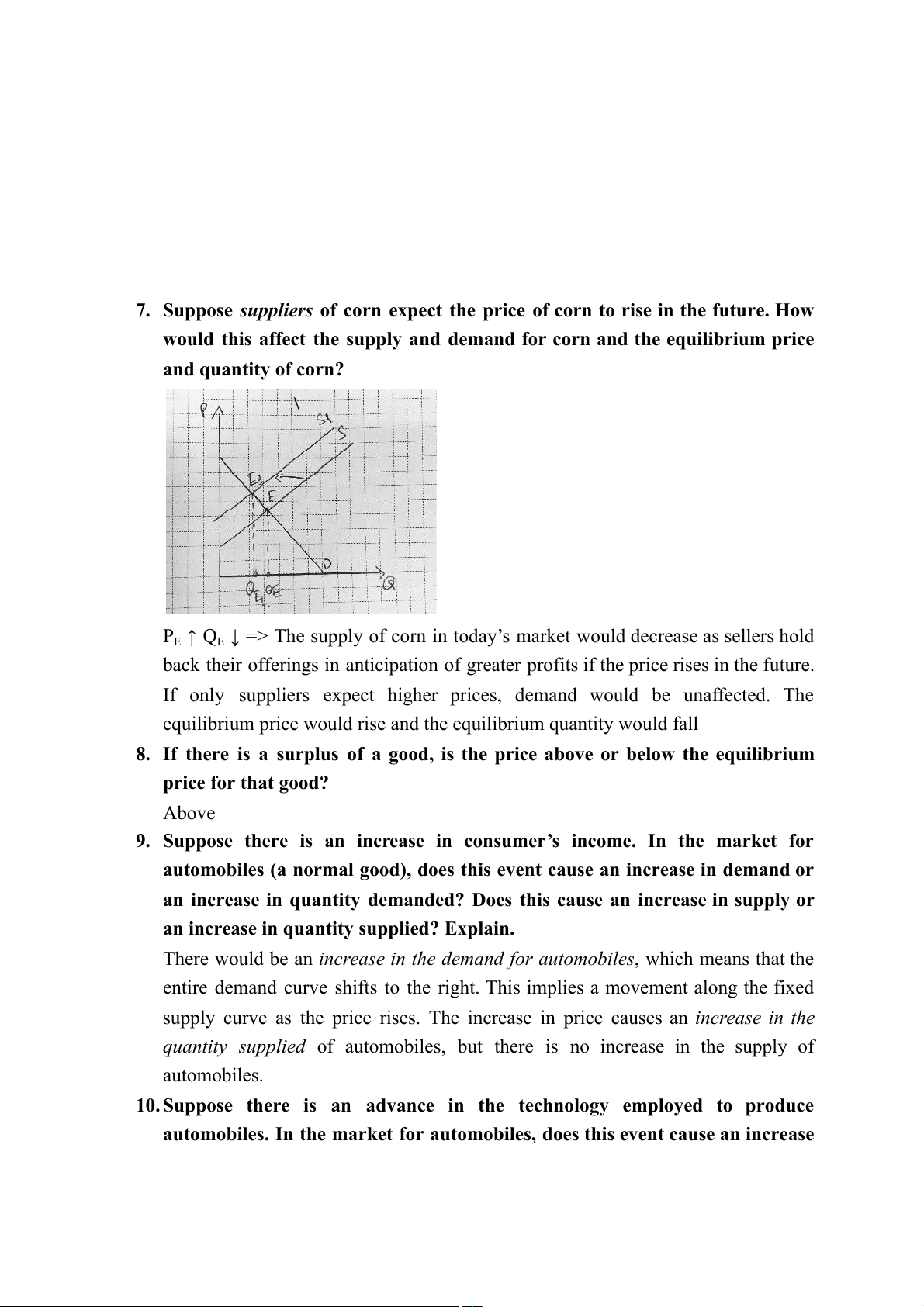
7. Suppose suppliers of corn expect the price of corn to rise in the future. How
would this affect the supply and demand for corn and the equilibrium price and quantity of corn?
PE ↑ QE ↓ => The supply of corn in today’s market would decrease as sellers hold
back their offerings in anticipation of greater profits if the price rises in the future.
If only suppliers expect higher prices, demand would be unaffected. The
equilibrium price would rise and the equilibrium quantity would fall
8. If there is a surplus of a good, is the price above or below the equilibrium price for that good? Above
9. Suppose there is an increase in consumer’s income. In the market for
automobiles (a normal good), does this event cause an increase in demand or
an increase in quantity demanded? Does this cause an increase in supply or
an increase in quantity supplied? Explain.
There would be an increase in the demand for automobiles, which means that the
entire demand curve shifts to the right. This implies a movement along the fixed
supply curve as the price rises. The increase in price causes an increase in the
quantity supplied of automobiles, but there is no increase in the supply of automobiles.
10. Suppose there is an advance in the technology employed to produce
automobiles. In the market for automobiles, does this event cause an increase
in supply or an increase in the quantity supplied? Does this cause an increase
in demand or an increase in the quantity demanded? Explain.
There would be an increase in the supply of automobiles, which means that the
entire supply curve shifts to the right. This implies a movement along the fixed
demand curve as the price falls. The decrease in price causes an increase in the
quantity demanded of automobiles, but there is no increase in the demand of automobiles. True/ False Questions
1. F => all goods are exactly the same in perfectly competitive market 2. T
3. F => the quantity demanded
4. F => if apples and oranges are substitutes, an increase in the price of apples will
increase the demand for oranges. 5. T 6. T 7. T
8. F => an increase in the price of an input shifts the supply curve for the output to the left
9. F => it causes a surplus 10. T 11. F => tend to rise 12. T 13. T 14. T
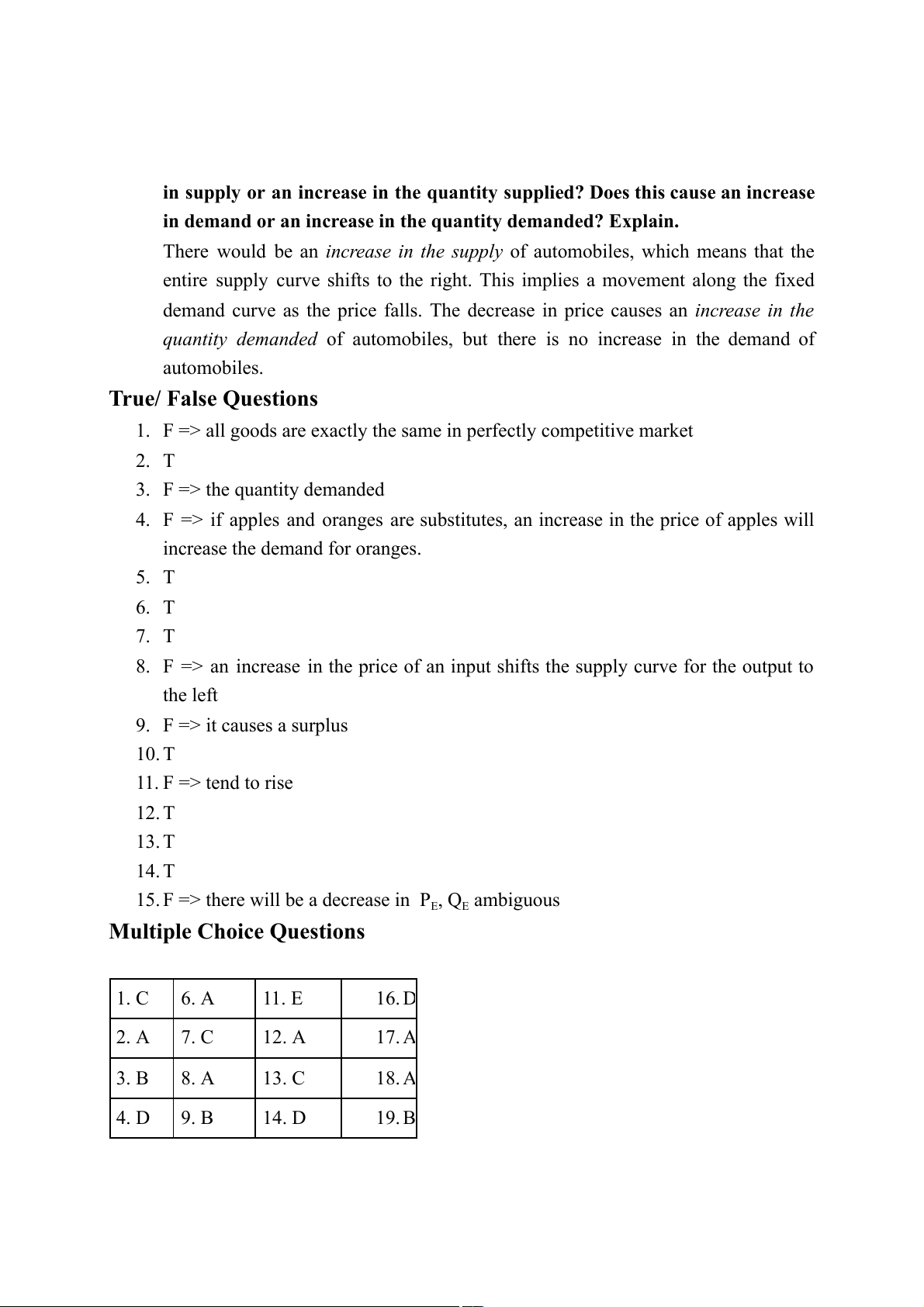
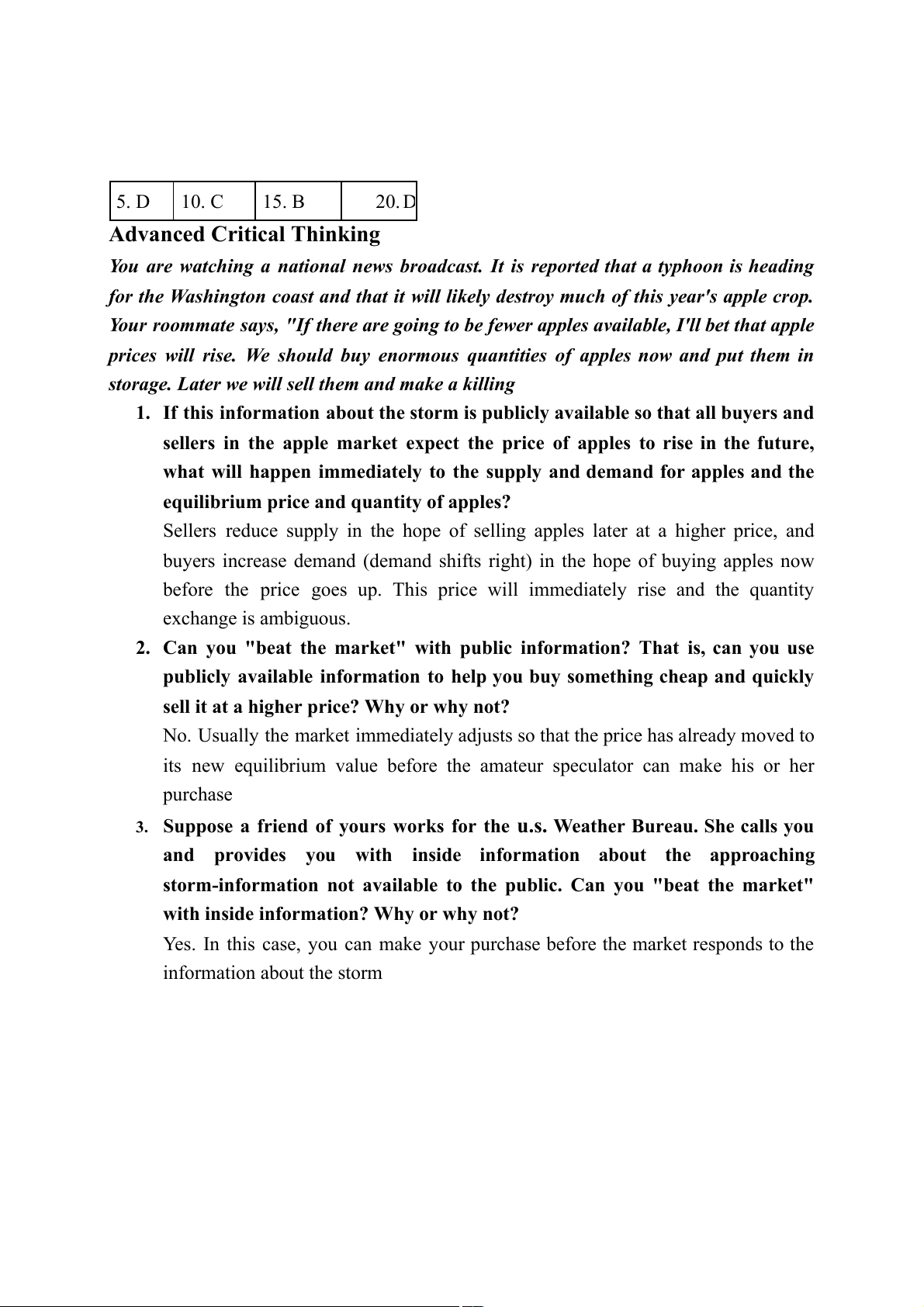
15. F => there will be a decrease in PE, QE ambiguous Multiple Choice Questions 1. C 6. A 11. E 16. D 2. A 7. C 12. A 17. A 3. B 8. A 13. C 18. A 4. D 9. B 14. D 19. B 5. D 10. C 15. B 20. D Advanced Critical Thinking
You are watching a national news broadcast. It is reported that a typhoon is heading
for the Washington coast and that it will likely destroy much of this year's apple crop.
Your roommate says, "If there are going to be fewer apples available, I'll bet that apple
prices will rise. We should buy enormous quantities of apples now and put them in
storage. Later we will sell them and make a killing
1. If this information about the storm is publicly available so that all buyers and
sellers in the apple market expect the price of apples to rise in the future,
what will happen immediately to the supply and demand for apples and the
equilibrium price and quantity of apples?
Sellers reduce supply in the hope of selling apples later at a higher price, and
buyers increase demand (demand shifts right) in the hope of buying apples now
before the price goes up. This price will immediately rise and the quantity exchange is ambiguous.
2. Can you "beat the market" with public information? That is, can you use
publicly available information to help you buy something cheap and quickly
sell it at a higher price? Why or why not?
No. Usually the market immediately adjusts so that the price has already moved to
its new equilibrium value before the amateur speculator can make his or her purchase
3. Suppose a friend of yours works for the u.s. Weather Bureau. She calls you
and provides you with inside information about the approaching
storm-information not available to the public. Can you "beat the market"
with inside information? Why or why not?
Yes. In this case, you can make your purchase before the market responds to the information about the storm
Tài liệu liên quan:
-

Chương 3: độ co giãn và các nhân tố ảnh hưởng | Microeconomics | Trường Đại học Quốc tế, Đại học Quốc gia Thành phố Hồ Chí Minh
5 3 -
Microeconomics Syllabus | Microeconomics | Trường Đại học Quốc tế, Đại học Quốc gia Thành phố Hồ Chí Minh
5 3 -
Microeconomics Course Syllabus & Assessment Details | Microeconomics | Trường Đại học Quốc tế, Đại học Quốc gia Thành phố Hồ Chí Minh
5 3 -
Assignment 3 - Elasticity MCQs and Key Concepts | Microeconomics | Trường Đại học Quốc tế, Đại học Quốc gia Thành phố Hồ Chí Minh
5 3 -
Assignment 2 - Economic Equilibrium Analysis of Fridges and Motorcycles | Microeconomics | Trường Đại học Quốc tế, Đại học Quốc gia Thành phố Hồ Chí Minh
5 3