Micro Econ Chapter 5 Notes: Elasticity and Its Applications | Microeconomics | Trường Đại học Quốc tế, Đại học Quốc gia Thành phố Hồ Chí Minh
You design websites for local businesses – You charge $200 per website, and currently sell 12 websites per month. • Your costs are rising (including the opportunity cost of your time) – You consider raising the price to $250. • The law of demand: you won’t sell as many websites if you raise your price. – How many fewer websites? – How much will your revenue fall, or might it increase. Tài liệu được sưu tầm và soạn thảo dưới dạng file PDF để gửi tới các bạn cùng tham khảo, ôn tập đầy đủ kiến thức, chuẩn bị cho các buổi học thật tốt. Mời bạn đọc đón xem!
Môn: Microeconomics 635 tài liệu
Trường: Trường Đại học Quốc tế, Đại học Quốc gia Thành phố Hồ Chí Minh 1.9 K tài liệu
Tác giả:

Preview text:
CHAPTER 5: Elasticity and Its Application A scenario:
• You design websites for local businesses – You charge $200 per website, and currently sell 12 websites per month.
• Your costs are rising (including the opportunity cost of your time) – You consider raising the price to $250.
• The law of demand: you won’t sell as many websites if you raise your price. – How many fewer websites?
– How much will your revenue fall, or might it increase? *
The Elasticity of Demand • Elasticity
– Measure of the responsiveness of Qd or Qs to a change in one of its determinants • Price elasticity of demand
– How much the quantity demanded of a good responds to a change in the price of that good
+ Loosely speaking, it measures the price-sensitivity of buyers’ demand
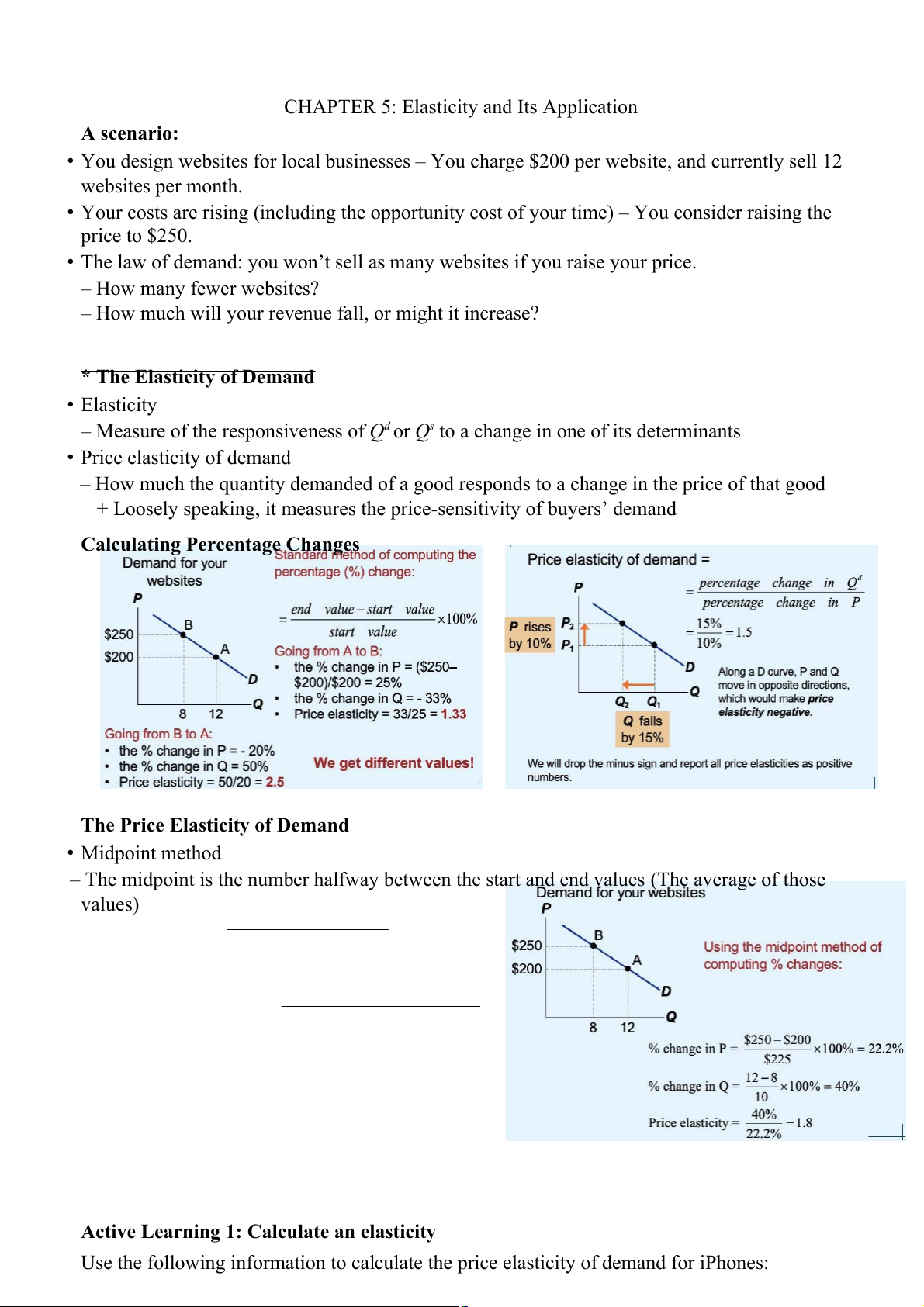
Calculating Percentage Changes
The Price Elasticity of Demand • Midpoint method
– The midpoint is the number halfway between the start and end values (The average of those values)
Active Learning 1: Calculate an elasticity
Use the following information to calculate the price elasticity of demand for iPhones: • if P = $400, Q = 10,600 d • if P = $600, Q = 8,400 d
Use the midpoint method to calculate percentage changes. Answers
• % change in P = [($600 - $400)/$500] ×100 = 40%
• % change in Q = [(10,600 – 8,400)/9,500] ×100 = 23.16% d
• Price elasticity of demand = % change in Q / % change in P = 23.16/40 = 0.58 d
Determinants of price elasticity of demand
– We look at a series of examples comparing two common goods - In each example:
+ Suppose prices of both goods rise by 20%
+ Which good has the highest price elasticity of demand? Why?
+ What lesson we learn about the determinants of price elasticity of demand?
- Price elasticity is higher when close substitutes are available
Example 1: Breakfast cereal vs. Sunscreen. Prices of both of these goods rise by 20%.
For which good does Qd drop the most? Why?
+ Cereal has close substitutes, so buyers can easily switch if the price rises
+ Sunscreen has no close substitutes, so a price increase would not affect demand very much
- Price elasticity is higher for narrowly defined goods than for broadly defined ones.
Example 2: Blue Jeans vs Clothing. Prices of both of these goods rise by 20%.
For which good does Q drop the most? Why? d
+ For a narrowly defined good, blue jeans, there are many substitutes
+ There are fewer substitutes available for broadly defined goods (clothing)
- Price elasticity is higher for luxuries than for necessities.
Example 3: Insulin vs Yachts. Prices of both of these goods rise by 20%.
For which good does Q drop the most? Why? d
+ Insulin is a necessity to diabetics. A rise in price would cause little or no decrease in demand
+ A yacht is a luxury. If the price rises, some people will forego it.
- Price elasticity is higher in the long run
Example 4: Gasoline in the Short Run vs Gasoline in the Long Run. The price of gasoline
rises 20%. Does Q drop more in the short run or the long run? W d hy?
+ There’s not much people can do in the short run, other than ride the bus or carpool.
+ In the long run, people can buy smaller cars or live closer to work. Variety of demand curves
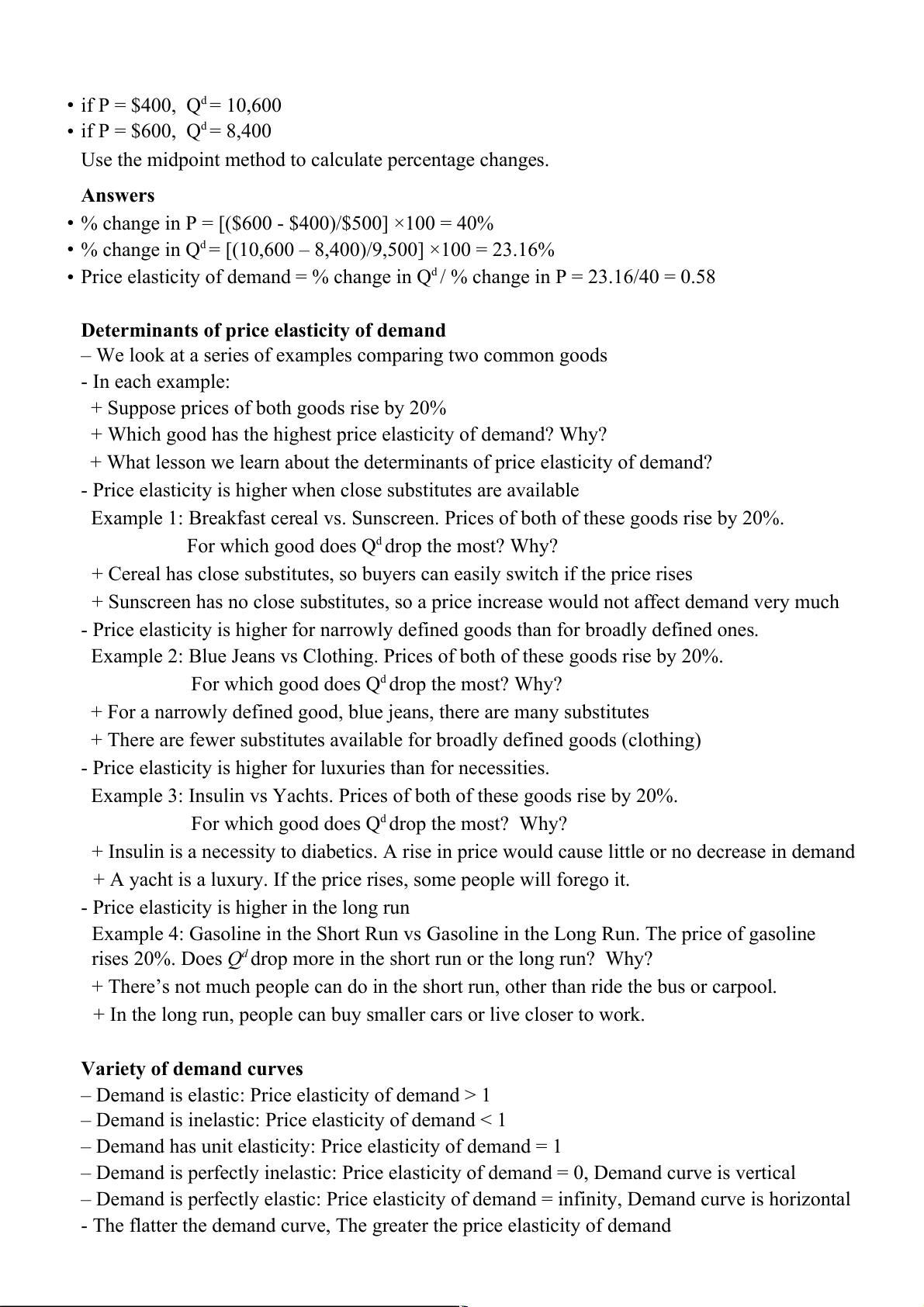
– Demand is elastic: Price elasticity of demand > 1
– Demand is inelastic: Price elasticity of demand < 1
– Demand has unit elasticity: Price elasticity of demand = 1
– Demand is perfectly inelastic: Price elasticity of demand = 0, Demand curve is vertical
– Demand is perfectly elastic: Price elasticity of demand = infinity, Demand curve is horizontal
- The flatter the demand curve, The greater the price elasticity of demand
Perfectly inelastic demand Inelastic demand
Unit elastic demand Elastic demand
Perfectly elastic demand
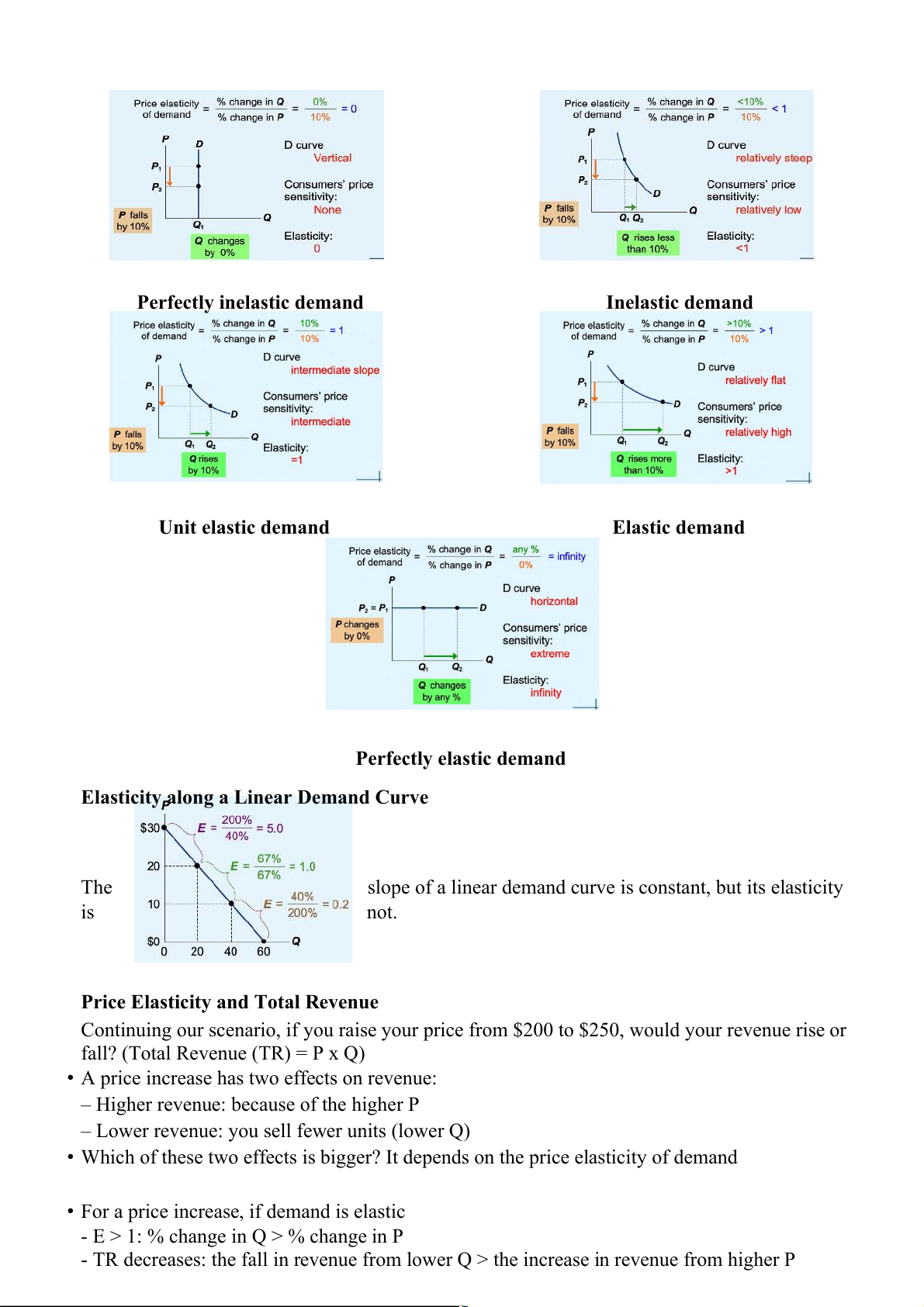
Elasticity along a Linear Demand Curve The
slope of a linear demand curve is constant, but its elasticity is not.
Price Elasticity and Total Revenue
Continuing our scenario, if you raise your price from $200 to $250, would your revenue rise or
fall? (Total Revenue (TR) = P x Q)
• A price increase has two effects on revenue:
– Higher revenue: because of the higher P
– Lower revenue: you sell fewer units (lower Q)
• Which of these two effects is bigger? It depends on the price elasticity of demand
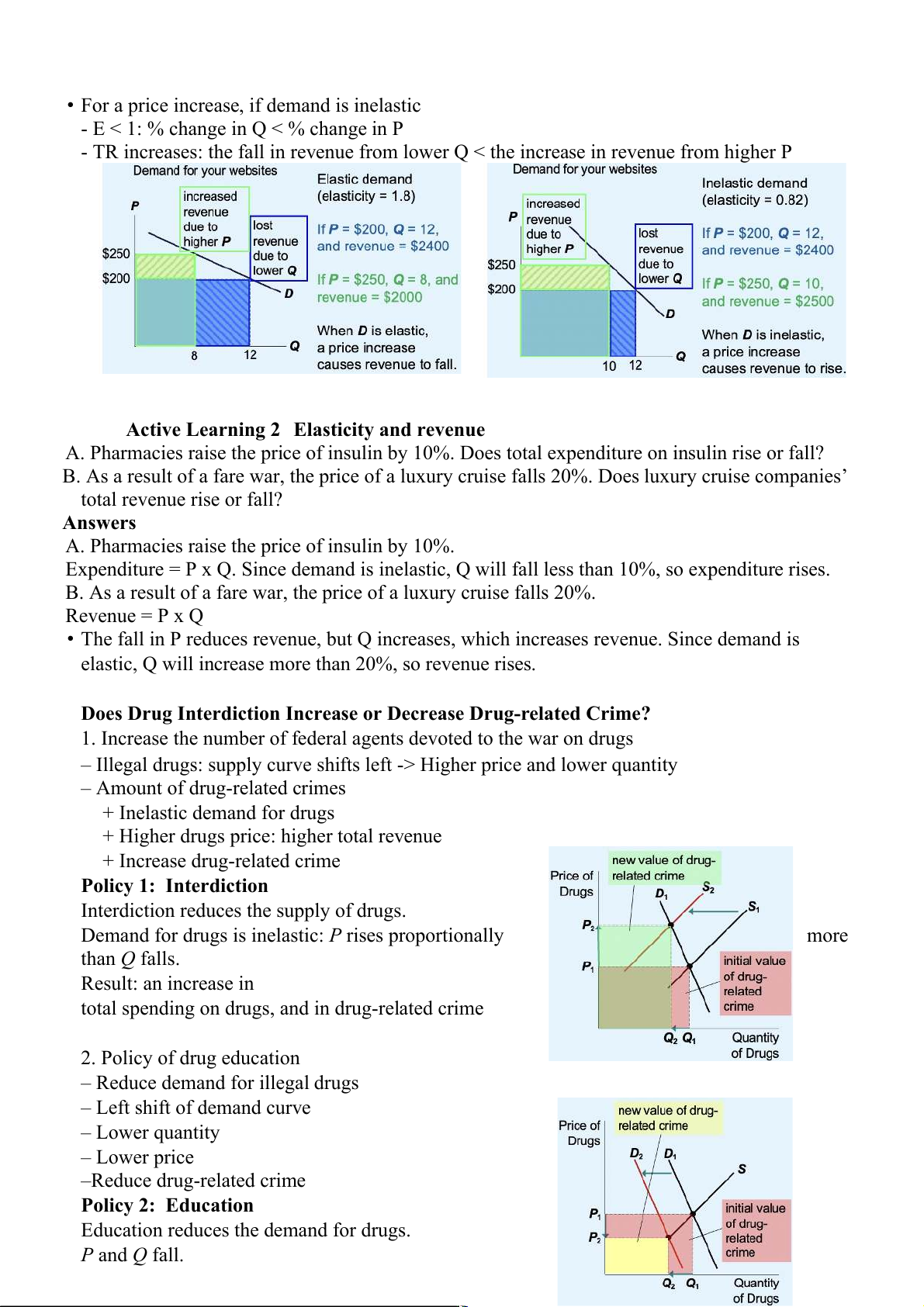
• For a price increase, if demand is elastic
- E > 1: % change in Q > % change in P
- TR decreases: the fall in revenue from lower Q > the increase in revenue from higher P
• For a price increase, if demand is inelastic
- E < 1: % change in Q < % change in P
- TR increases: the fall in revenue from lower Q < the increase in revenue from higher P
Active Learning 2 Elasticity and revenue
A. Pharmacies raise the price of insulin by 10%. Does total expenditure on insulin rise or fall?
B. As a result of a fare war, the price of a luxury cruise falls 20%. Does luxury cruise companies’ total revenue rise or fall? Answers
A. Pharmacies raise the price of insulin by 10%.
Expenditure = P x Q. Since demand is inelastic, Q will fall less than 10%, so expenditure rises.
B. As a result of a fare war, the price of a luxury cruise falls 20%. Revenue = P x Q
• The fall in P reduces revenue, but Q increases, which increases revenue. Since demand is
elastic, Q will increase more than 20%, so revenue rises.
Does Drug Interdiction Increase or Decrease Drug-related Crime?
1. Increase the number of federal agents devoted to the war on drugs
– Illegal drugs: supply curve shifts left -> Higher price and lower quantity
– Amount of drug-related crimes + Inelastic demand for drugs
+ Higher drugs price: higher total revenue + Increase drug-related crime Policy 1: Interdiction
Interdiction reduces the supply of drugs.
Demand for drugs is inelastic: P rises proportionally more than Q falls. Result: an increase in
total spending on drugs, and in drug-related crime 2. Policy of drug education
– Reduce demand for illegal drugs – Left shift of demand curve – Lower quantity – Lower price –Reduce drug-related crime Policy 2: Education
Education reduces the demand for drugs. P and Q fall. Result:
A decrease in total spending on drugs, and in drug-related crime. *
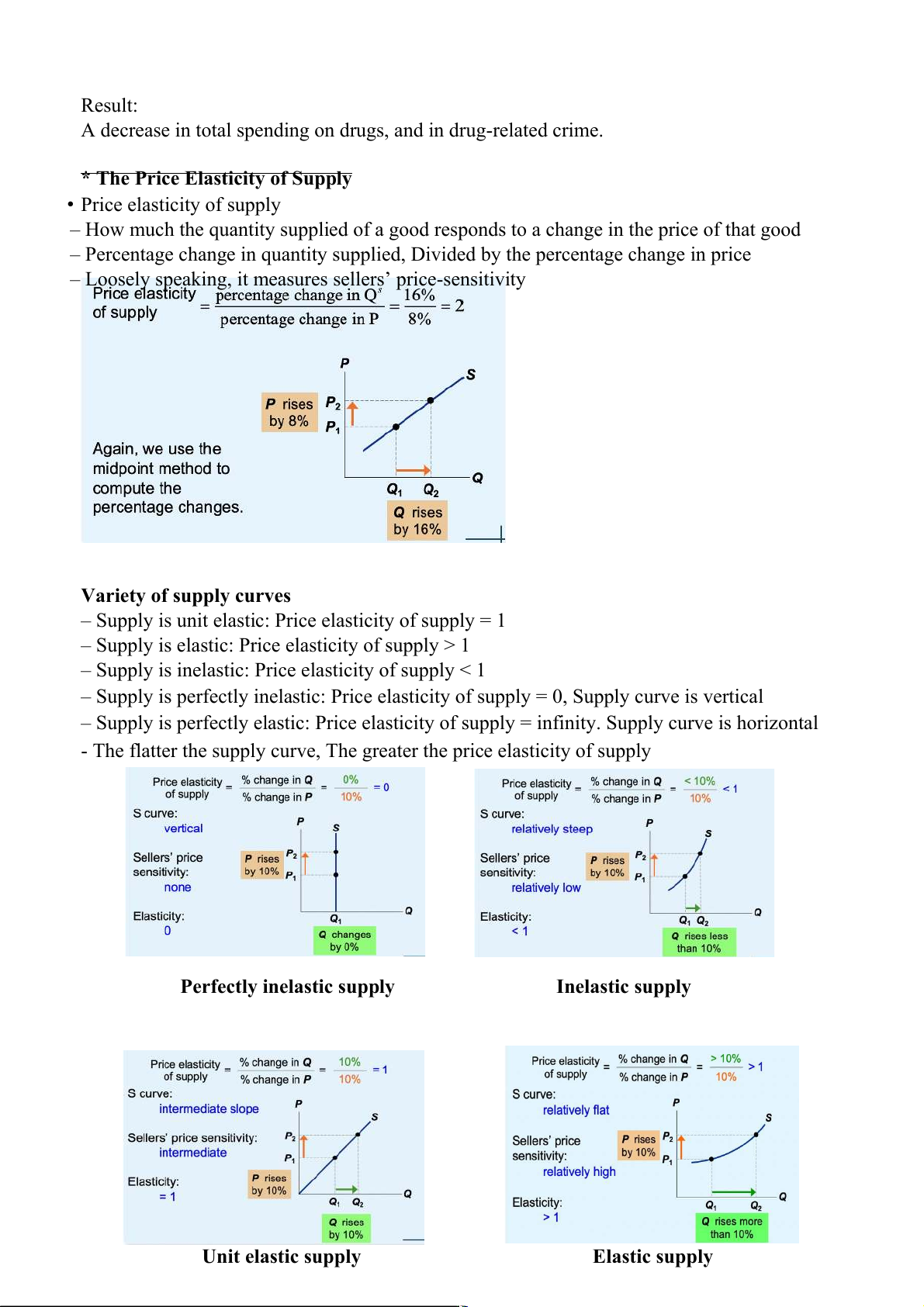
The Price Elasticity of Supp ly • Price elasticity of supply
– How much the quantity supplied of a good responds to a change in the price of that good
– Percentage change in quantity supplied, Divided by the percentage change in price
– Loosely speaking, it measures sellers’ price-sensitivity Variety of supply curves
– Supply is unit elastic: Price elasticity of supply = 1
– Supply is elastic: Price elasticity of supply > 1
– Supply is inelastic: Price elasticity of supply < 1
– Supply is perfectly inelastic: Price elasticity of supply = 0, Supply curve is vertical
– Supply is perfectly elastic: Price elasticity of supply = infinity. Supply curve is horizontal
- The flatter the supply curve, The greater the price elasticity of supply
Perfectly inelastic supply Inelastic supply
Unit elastic supply Elastic supply
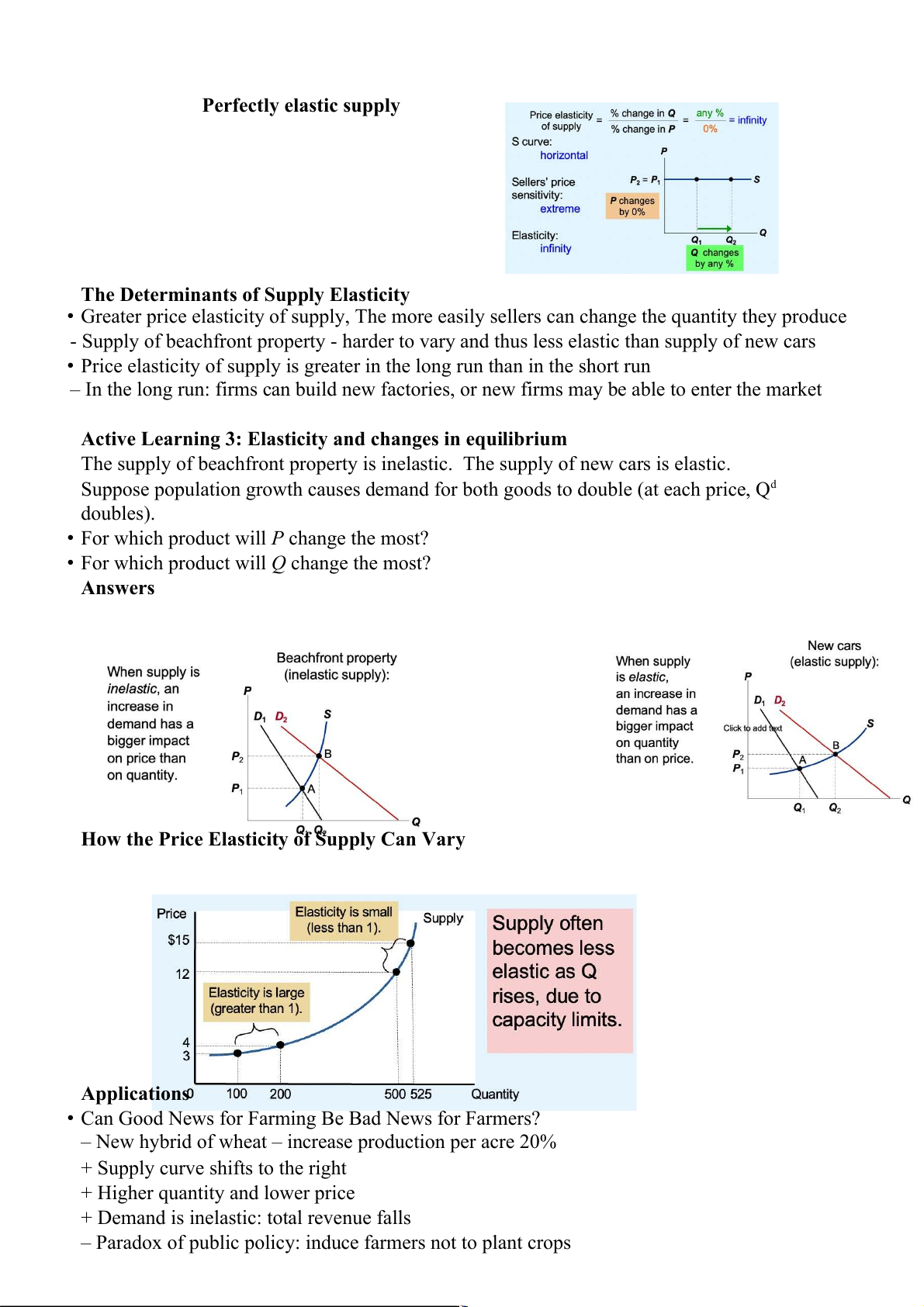
Perfectly elastic supply
The Determinants of Supply Elasticity
• Greater price elasticity of supply, The more easily sellers can change the quantity they produce
- Supply of beachfront property - harder to vary and thus less elastic than supply of new cars
• Price elasticity of supply is greater in the long run than in the short run
– In the long run: firms can build new factories, or new firms may be able to enter the market
Active Learning 3: Elasticity and changes in equilibrium
The supply of beachfront property is inelastic. The supply of new cars is elastic.
Suppose population growth causes demand for both goods to double (at each price, Qd doubles).
• For which product will P change the most?
• For which product will Q change the most? Answers
How the Price Elasticity of Supply Can Vary Applications
• Can Good News for Farming Be Bad News for Farmers?
– New hybrid of wheat – increase production per acre 20%
+ Supply curve shifts to the right
+ Higher quantity and lower price
+ Demand is inelastic: total revenue falls
– Paradox of public policy: induce farmers not to plant crops
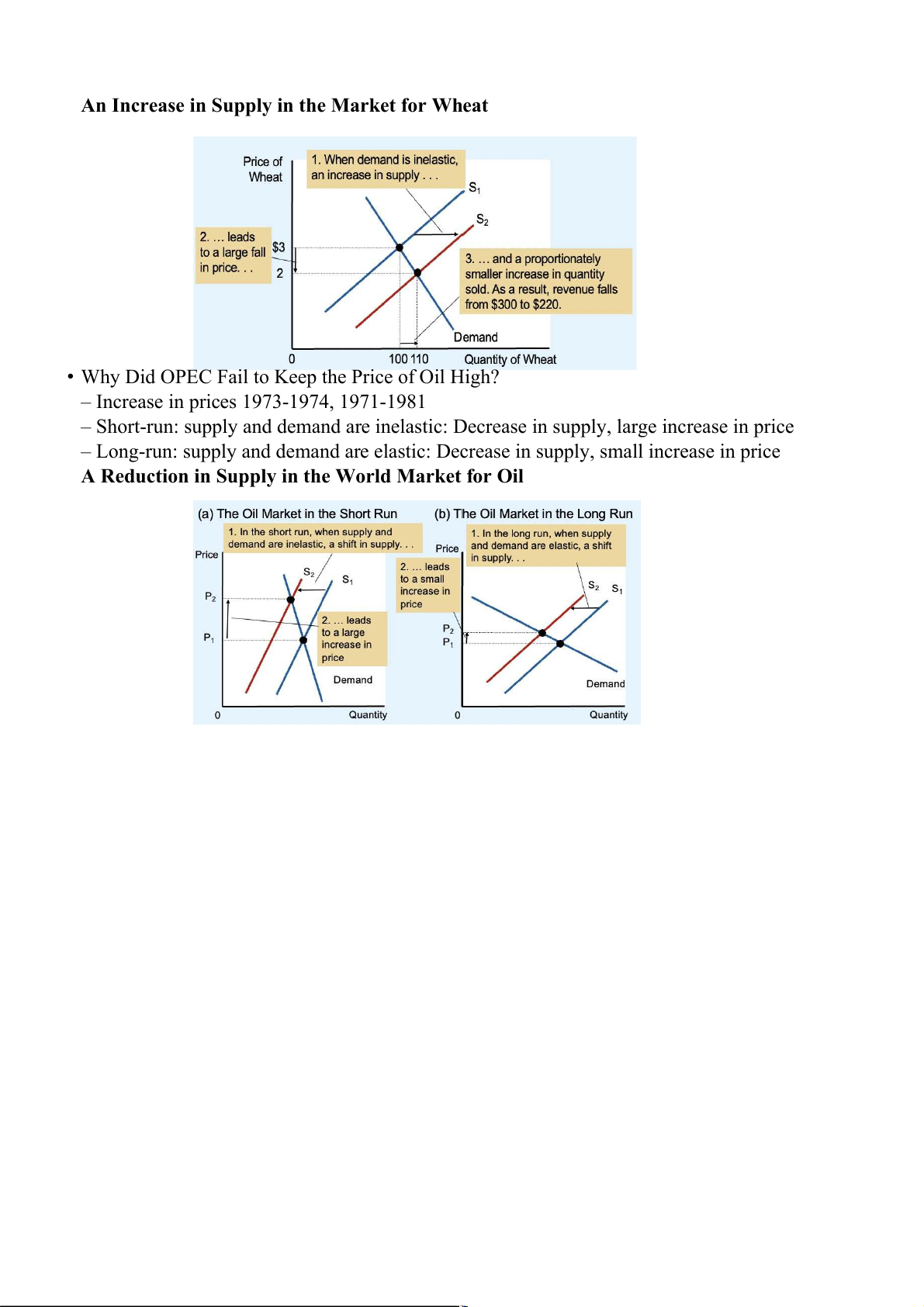
An Increase in Supply in the Market for Wheat
• Why Did OPEC Fail to Keep the Price of Oil High?
– Increase in prices 1973-1974, 1971-1981
– Short-run: supply and demand are inelastic: Decrease in supply, large increase in price
– Long-run: supply and demand are elastic: Decrease in supply, small increase in price
A Reduction in Supply in the World Market for Oil
Tài liệu liên quan:
-
Chương 3: độ co giãn và các nhân tố ảnh hưởng | Microeconomics | Trường Đại học Quốc tế, Đại học Quốc gia Thành phố Hồ Chí Minh
4 2 -
Microeconomics Syllabus | Microeconomics | Trường Đại học Quốc tế, Đại học Quốc gia Thành phố Hồ Chí Minh
4 2 -
Microeconomics Course Syllabus & Assessment Details | Microeconomics | Trường Đại học Quốc tế, Đại học Quốc gia Thành phố Hồ Chí Minh
4 2 -
Assignment 3 - Elasticity MCQs and Key Concepts | Microeconomics | Trường Đại học Quốc tế, Đại học Quốc gia Thành phố Hồ Chí Minh
4 2 -
Assignment 2 - Economic Equilibrium Analysis of Fridges and Motorcycles | Microeconomics | Trường Đại học Quốc tế, Đại học Quốc gia Thành phố Hồ Chí Minh
4 2