Microeconomics Assignment 1 - Production Possibility Frontier Analysis | Microeconomics | Trường Đại học Quốc tế, Đại học Quốc gia Thành phố Hồ Chí Minh
Assumption: the economy is currently at point C: - From point C to D, the opportunity cost of producing 2 million more car s is 9 thousand guided missiles. Tài liệu được sưu tầm và soạn thảo dưới dạng file PDF với mục đích hỗ trợ học tập và tham khảo. Nội dung tài liệu được trình bày rõ ràng, dễ tiếp cận, phù hợp cho việc ôn tập và củng cố kiến thức trong quá trình học đại học. Đây sẽ là nguồn tư liệu hữu ích giúp các bạn sinh viên chuẩn bị tốt hơn cho các buổi học, đồng thời mở rộng thêm hiểu biết về môn học. Hy vọng tài liệu này sẽ mang lại nhiều giá trị và hỗ trợ các bạn trong hành trình học tập. Mời bạn đọc cùng tham khảo!
Môn: Microeconomics 635 tài liệu
Trường: Trường Đại học Quốc tế, Đại học Quốc gia Thành phố Hồ Chí Minh 1.9 K tài liệu
Tác giả:

Preview text:
MICROECONOMICS: ASSIGNMENT 1 Name: Nguyen Hai Linh 1
Student Code: 1223547 Class: E-BDB 4 EXERCISE 1: Production alternatives Types of product A B C D E Cars (in millions) 0 2 4 6 8 Guided missiles (in 30 27 21 12 0 thousands)
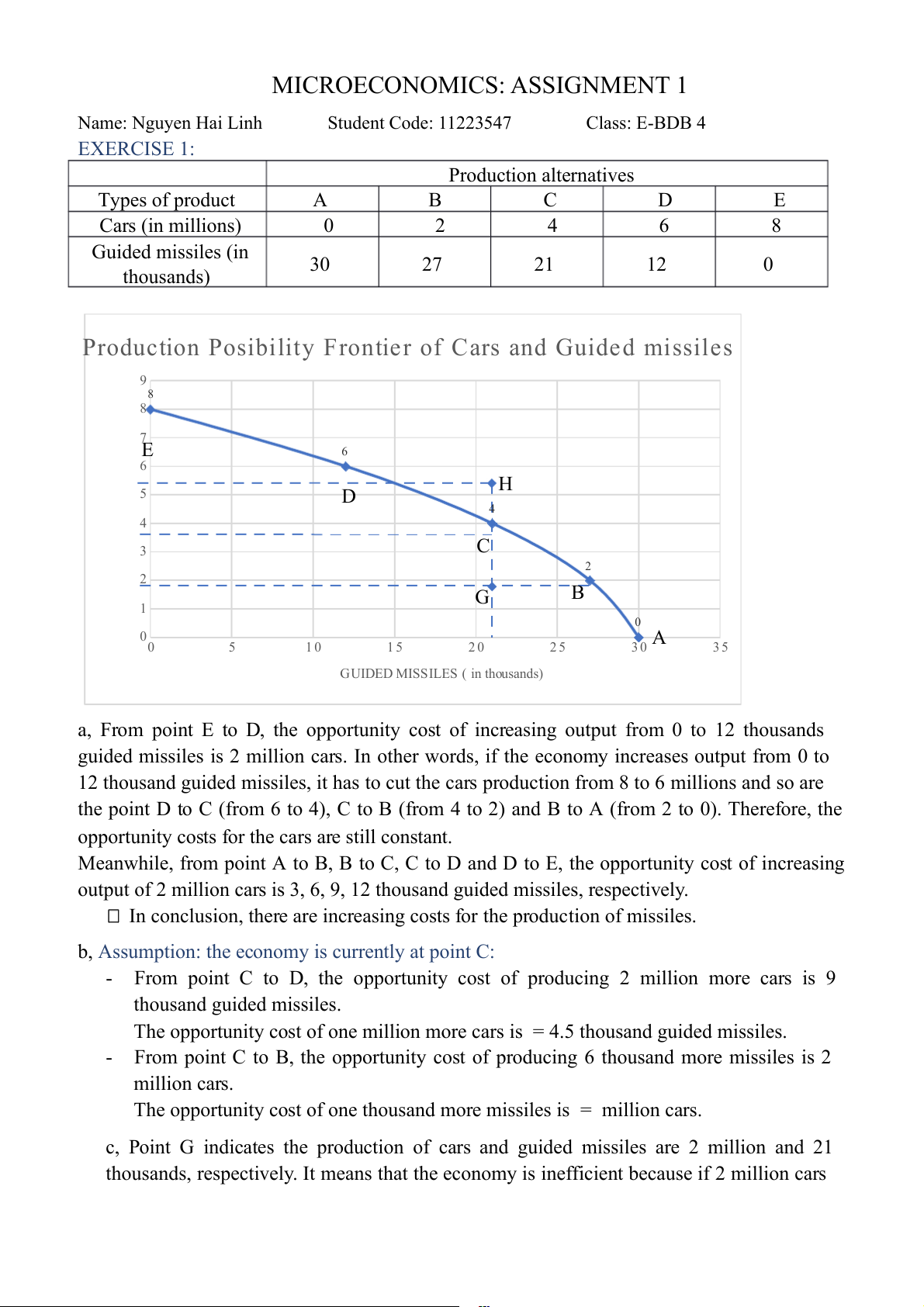
Production Posibility Frontier of Cars and Guided missiles 98 8 7E 6 6 illions) H 5 D 4 ( in m 4 S R C A 3 C 2 2 G B 1 0 0 A 0 5 1 0 1 5 2 0 2 5 3 0 3 5
GUIDED MISSILES ( in thousands)
a, From point E to D, the opportunity cost of increasing output from 0 to 12 thousands
guided missiles is 2 million cars. In other words, if the economy increases output from 0 to
12 thousand guided missiles, it has to cut the cars production from 8 to 6 millions and so are
the point D to C (from 6 to 4), C to B (from 4 to 2) and B to A (from 2 to 0). Therefore, the
opportunity costs for the cars are still constant.
Meanwhile, from point A to B, B to C, C to D and D to E, the opportunity cost of increasing
output of 2 million cars is 3, 6, 9, 12 thousand guided missiles, respectively.
In conclusion, there are increasing costs for the production of missiles.
b, Assumption: the economy is currently at point C:
- From point C to D, the opportunity cost of producing 2 million more cars is 9 thousand guided missiles.
The opportunity cost of one million more cars is = 4.5 thousand guided missiles.
- From point C to B, the opportunity cost of producing 6 thousand more missiles is 2 million cars.
The opportunity cost of one thousand more missiles is = million cars.
c, Point G indicates the production of cars and guided missiles are 2 million and 21
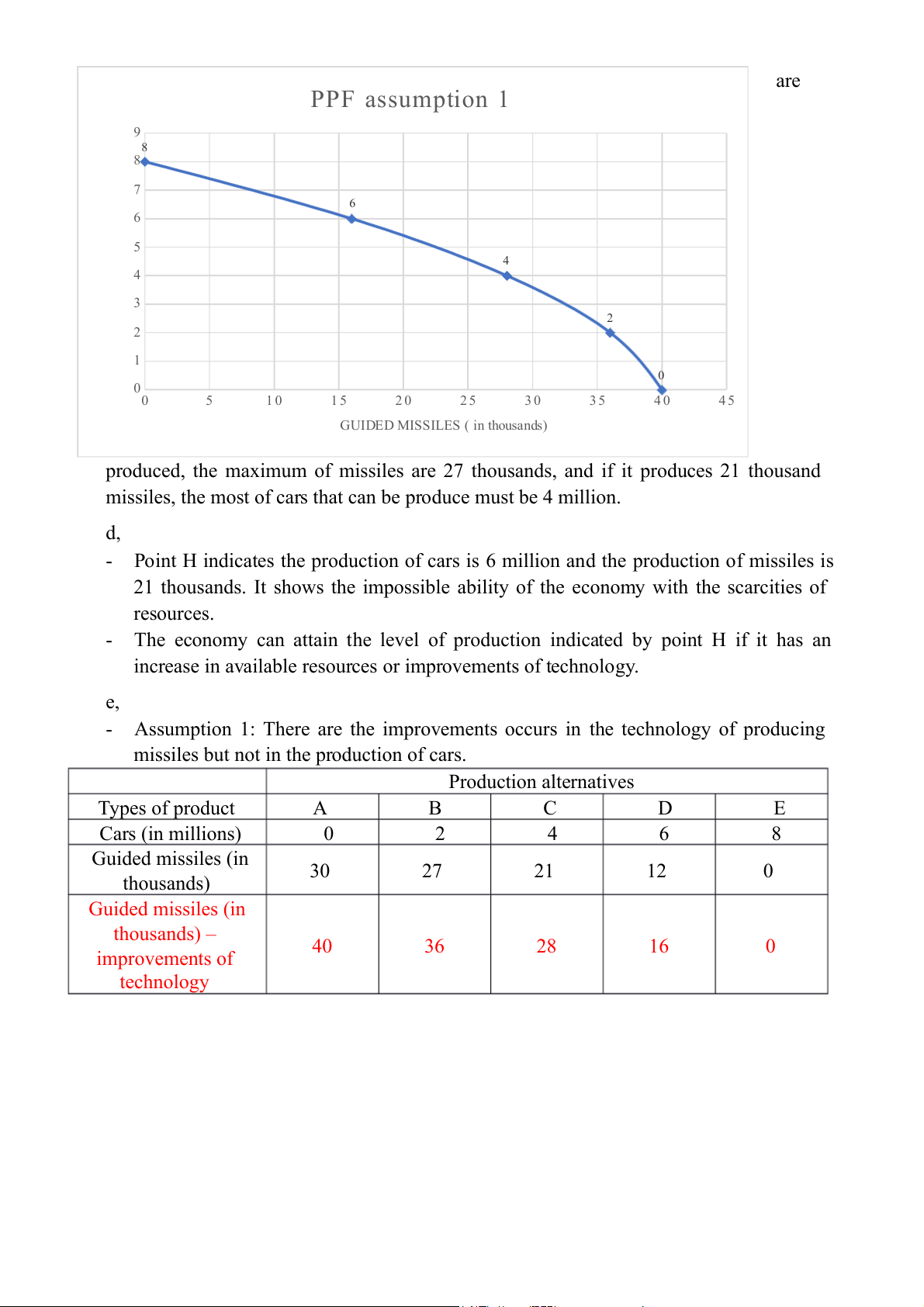
thousands, respectively. It means that the economy is inefficient because if 2 million cars are PPF assumption 1 9 8 8 7 6 6 ions) ill 5 4 4 ( in m S AR 3 C 2 2 1 0 00 5 1 0 1 5 2 0 2 5 3 0 3 5 4 0 4 5
GUIDED MISSILES ( in thousands)
produced, the maximum of missiles are 27 thousands, and if it produces 21 thousand
missiles, the most of cars that can be produce must be 4 million. d,
- Point H indicates the production of cars is 6 million and the production of missiles is
21 thousands. It shows the impossible ability of the economy with the scarcities of resources.
- The economy can attain the level of production indicated by point H if it has an
increase in available resources or improvements of technology. e,
- Assumption 1: There are the improvements occurs in the technology of producing
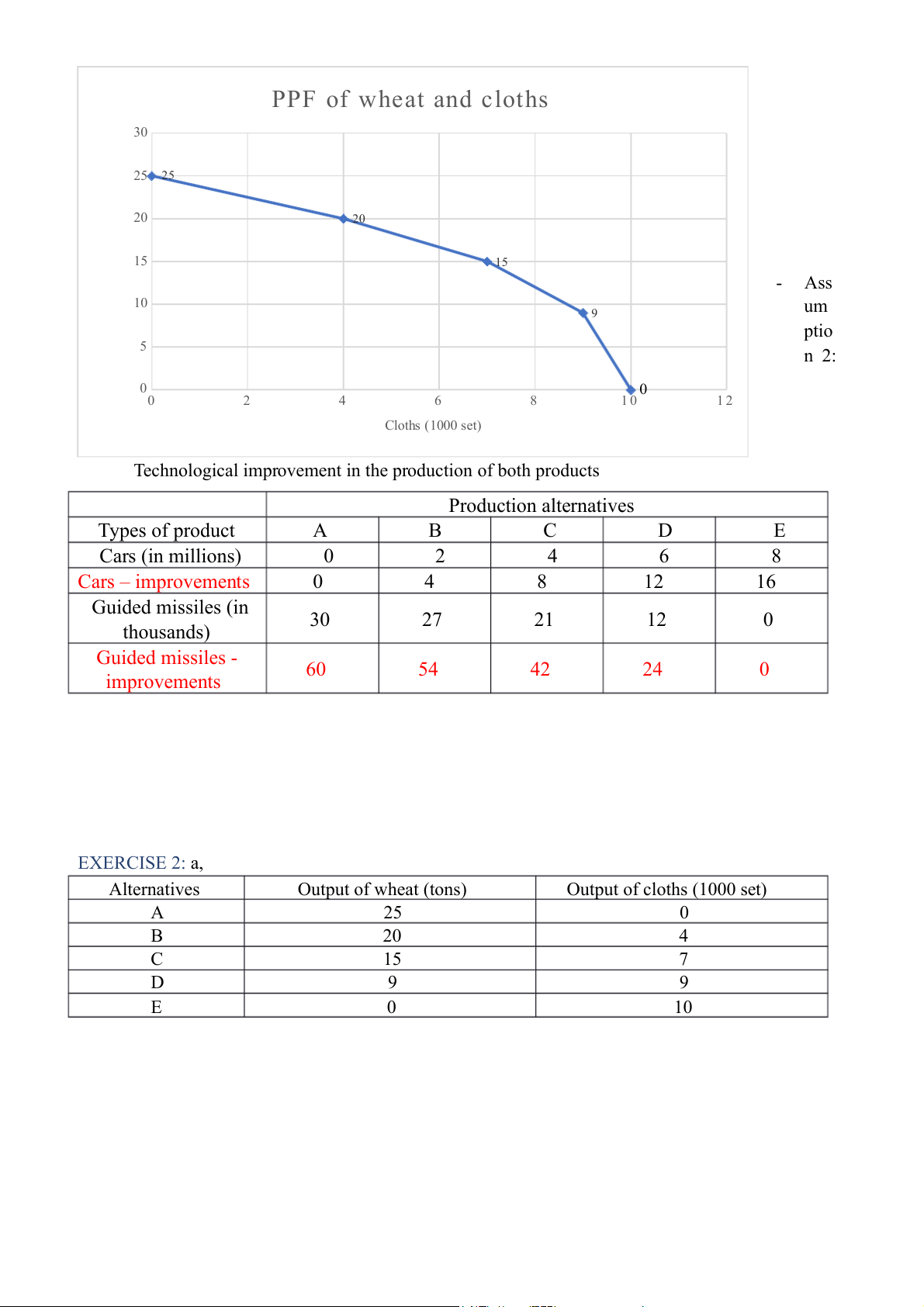
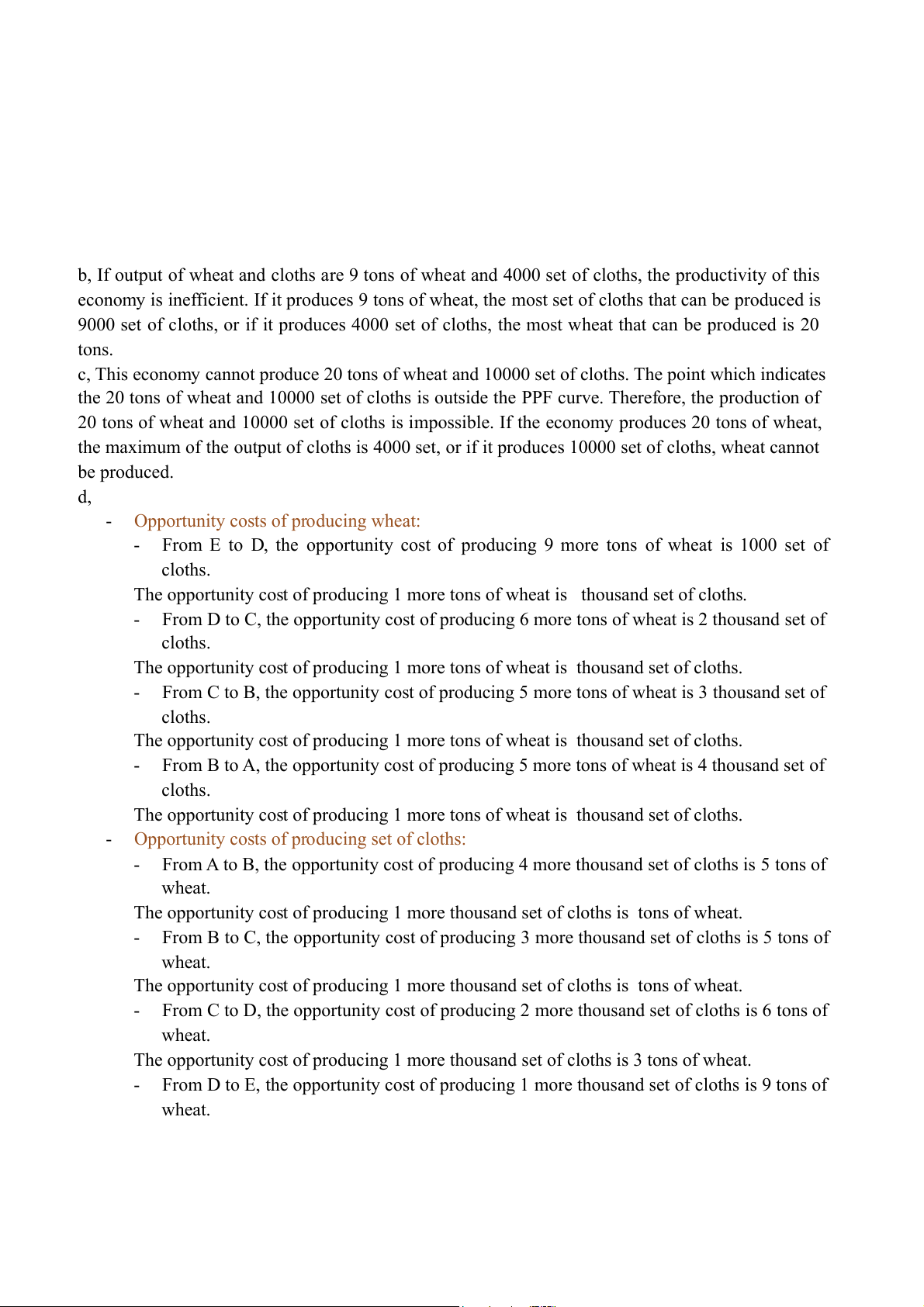
missiles but not in the production of cars. Production alternatives Types of product A B C D E Cars (in millions) 0 2 4 6 8 Guided missiles (in 30 27 21 12 0 thousands) Guided missiles (in thousands) – 40 36 28 16 0 improvements of technology PPF of wheat and cloths 30 25 25 20 20 ns) (to 15 15 - Ass Wheat 10 um 9 ptio 5 n 2: 0 0 0 2 4 6 8 1 0 1 2 Cloths (1000 set)
Technological improvement in the production of both products Production alternatives Types of product A B C D E Cars (in millions) 0 2 4 6 8 Cars – improvements 0 4 8 12 16 Guided missiles (in 30 27 21 12 0 thousands) Guided missiles - 60 54 42 24 0 improvements EXERCISE 2: a, Alternatives Output of wheat (tons) Output of cloths (1000 set) A 25 0 B 20 4 C 15 7 D 9 9 E 0 10
b, If output of wheat and cloths are 9 tons of wheat and 4000 set of cloths, the productivity of this
economy is inefficient. If it produces 9 tons of wheat, the most set of cloths that can be produced is
9000 set of cloths, or if it produces 4000 set of cloths, the most wheat that can be produced is 20 tons.
c, This economy cannot produce 20 tons of wheat and 10000 set of cloths. The point which indicates
the 20 tons of wheat and 10000 set of cloths is outside the PPF curve. Therefore, the production of
20 tons of wheat and 10000 set of cloths is impossible. If the economy produces 20 tons of wheat,
the maximum of the output of cloths is 4000 set, or if it produces 10000 set of cloths, wheat cannot be produced. d, -
Opportunity costs of producing wheat: -
From E to D, the opportunity cost of producing 9 more tons of wheat is 1000 set of cloths.
The opportunity cost of producing 1 more tons of wheat is thousand set of cloths. -
From D to C, the opportunity cost of producing 6 more tons of wheat is 2 thousand set of cloths.
The opportunity cost of producing 1 more tons of wheat is thousand set of cloths. -
From C to B, the opportunity cost of producing 5 more tons of wheat is 3 thousand set of cloths.
The opportunity cost of producing 1 more tons of wheat is thousand set of cloths. -
From B to A, the opportunity cost of producing 5 more tons of wheat is 4 thousand set of cloths.
The opportunity cost of producing 1 more tons of wheat is thousand set of cloths. -
Opportunity costs of producing set of cloths: -
From A to B, the opportunity cost of producing 4 more thousand set of cloths is 5 tons of wheat.
The opportunity cost of producing 1 more thousand set of cloths is tons of wheat. -
From B to C, the opportunity cost of producing 3 more thousand set of cloths is 5 tons of wheat.
The opportunity cost of producing 1 more thousand set of cloths is tons of wheat. -
From C to D, the opportunity cost of producing 2 more thousand set of cloths is 6 tons of wheat.
The opportunity cost of producing 1 more thousand set of cloths is 3 tons of wheat. -
From D to E, the opportunity cost of producing 1 more thousand set of cloths is 9 tons of wheat.
Tài liệu liên quan:
-
Chương 3: độ co giãn và các nhân tố ảnh hưởng | Microeconomics | Trường Đại học Quốc tế, Đại học Quốc gia Thành phố Hồ Chí Minh
3 2 -
Microeconomics Syllabus | Microeconomics | Trường Đại học Quốc tế, Đại học Quốc gia Thành phố Hồ Chí Minh
3 2 -
Microeconomics Course Syllabus & Assessment Details | Microeconomics | Trường Đại học Quốc tế, Đại học Quốc gia Thành phố Hồ Chí Minh
3 2 -
Assignment 3 - Elasticity MCQs and Key Concepts | Microeconomics | Trường Đại học Quốc tế, Đại học Quốc gia Thành phố Hồ Chí Minh
3 2 -
Assignment 2 - Economic Equilibrium Analysis of Fridges and Motorcycles | Microeconomics | Trường Đại học Quốc tế, Đại học Quốc gia Thành phố Hồ Chí Minh
3 2