Microeconomics Assignment Week 1: Opportunity Costs & Production Efficiency | Microeconomics | Trường Đại học Quốc tế, Đại học Quốc gia Thành phố Hồ Chí Minh
Tài liệu được sưu tầm và soạn thảo dưới dạng file PDF với mục đích hỗ trợ học tập và tham khảo. Nội dung tài liệu được trình bày rõ ràng, dễ tiếp cận, phù hợp cho việc ôn tập và củng cố kiến thức trong quá trình học đại học. Đây sẽ là nguồn tư liệu hữu ích giúp các bạn sinh viên chuẩn bị tốt hơn cho các buổi học, đồng thời mở rộng thêm hiểu biết về môn học. Hy vọng tài liệu này sẽ mang lại nhiều giá trị và hỗ trợ các bạn trong hành trình học tập. Mời bạn đọc cùng tham khảo!
Môn: Microeconomics 393 tài liệu
Trường: Trường Đại học Quốc tế, Đại học Quốc gia Thành phố Hồ Chí Minh 1.7 K tài liệu
Tác giả:

Preview text:
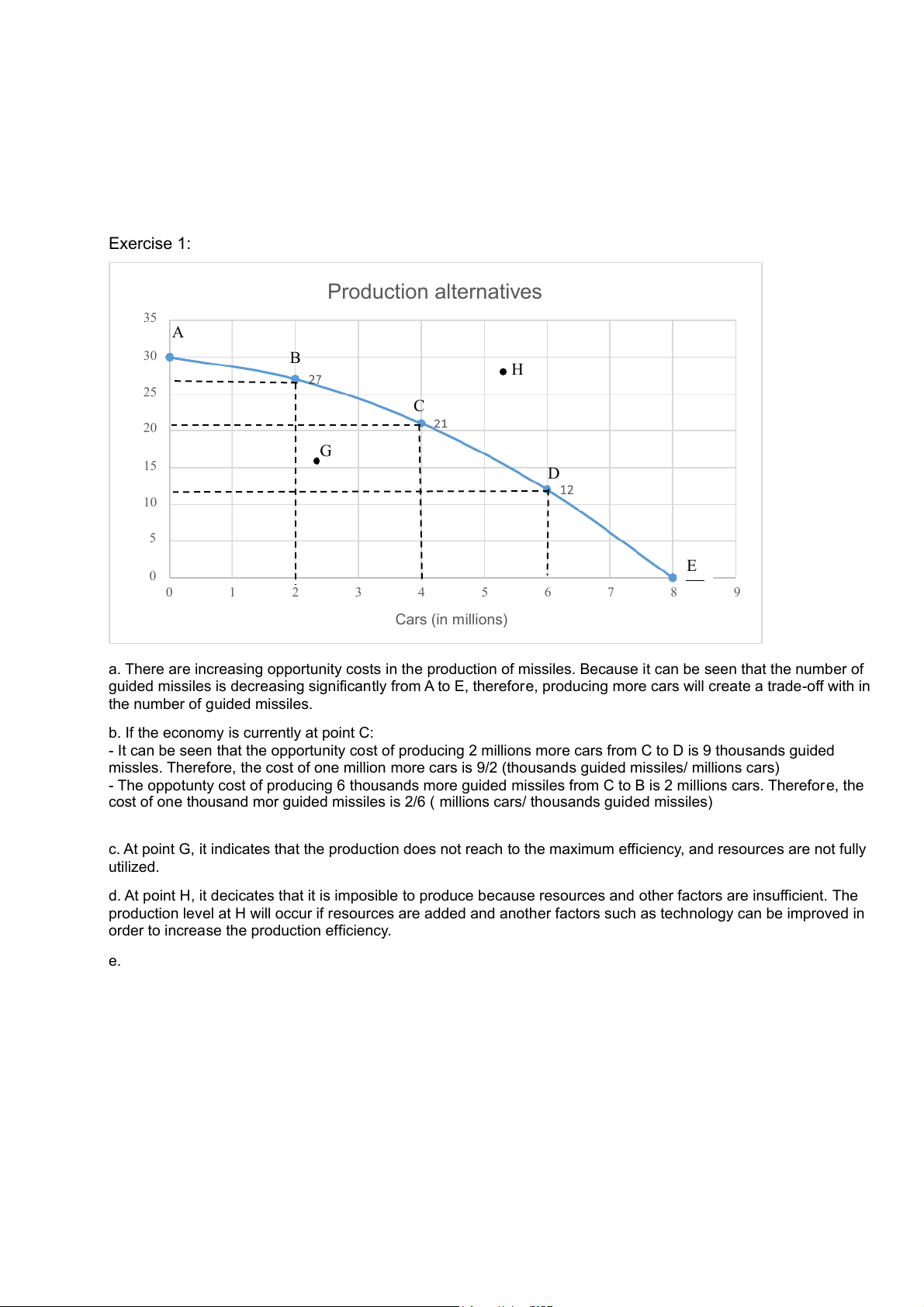
Exercise 1: Production alternatives 35 A ) 30 B H 25 C thousands 20 es(in G 15 D 10 Guided missil 5 E 0 0 1 2 3 4 5 6 7 8 9 Cars (in mil ions)
a. There are increasing opportunity costs i
n the production of missiles. Because it can be seen that the number of
guided missiles is decreasing significantly from A to E, therefore, producing more cars wil create a trade-off with in
the number of guided missiles.
b. If the economy is currently at point C:
- It can be seen that the opportunity cost of producing 2 mil ions more cars from C to D is 9 thousands guided
missles. Therefore, the cost of one mil ion more cars is 9/2 (thousands guided missiles/ mil ions cars)
- The oppotunty cost of producing 6 thousands more guided missiles from C to B is 2 mil ions cars. Therefore, the
cost of one thousand mor guided missiles is 2/6 ( mil ions cars/ thousands guided missiles)
c. At point G, it indicates that the production does not reach to the maximum efficiency, and resources are not ful y utilized.
d. At point H, it decicates that it is imposible to produce because resources and other factors are insufficient. The
production level at H wil occur if resources are added and another factors such as technology can be improved in
order to increase the production efficiency. e. -
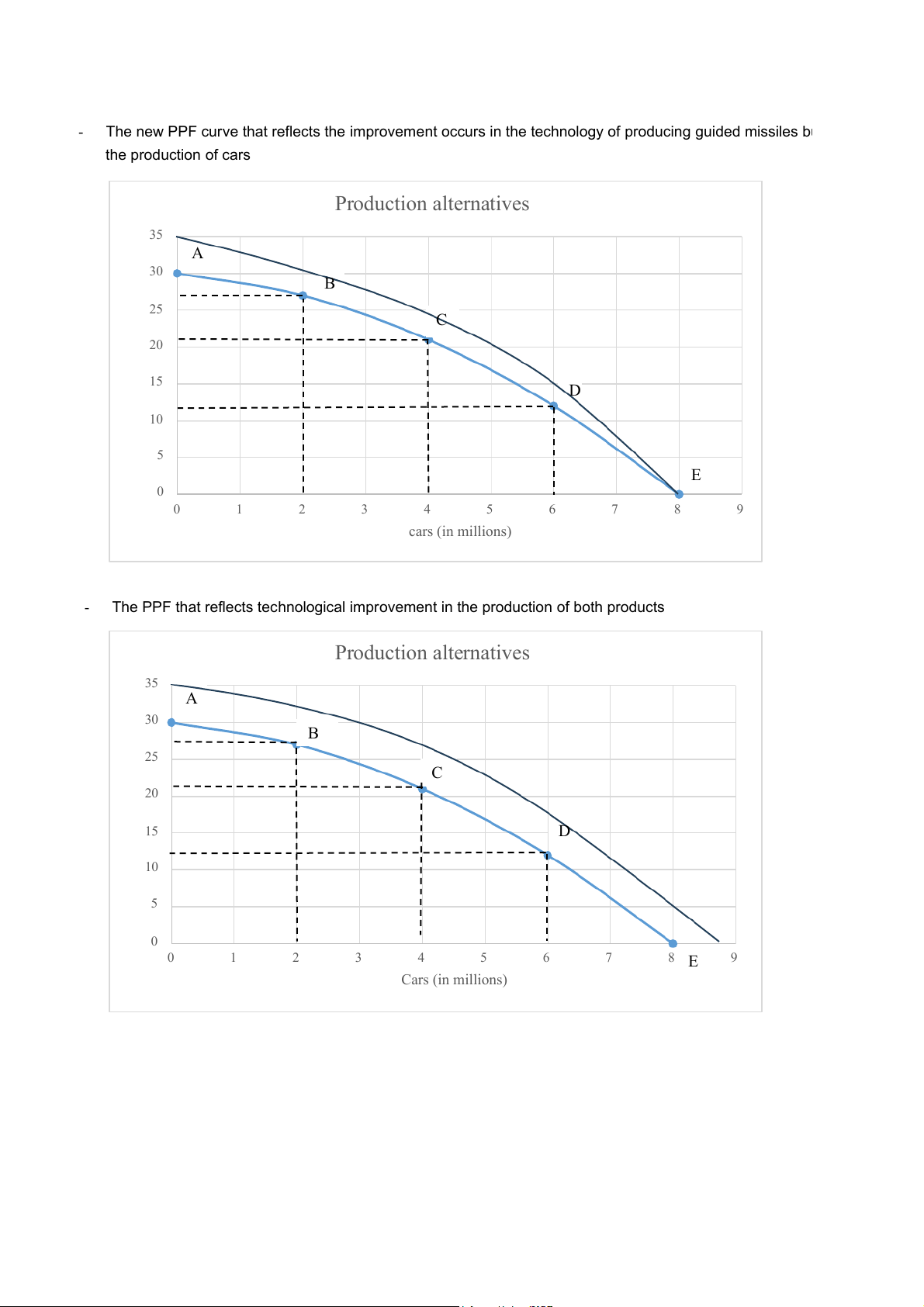
The new PPF curve that reflects the improvement occurs in the technology of producing guided missiles bu the production of cars Production alternatives 35 A 30 B 25 C 20 15 issiles(in thousands) D 10 uided m G 5 E 0 0 1 2 3 4 5 6 7 8 9 cars (in millions)
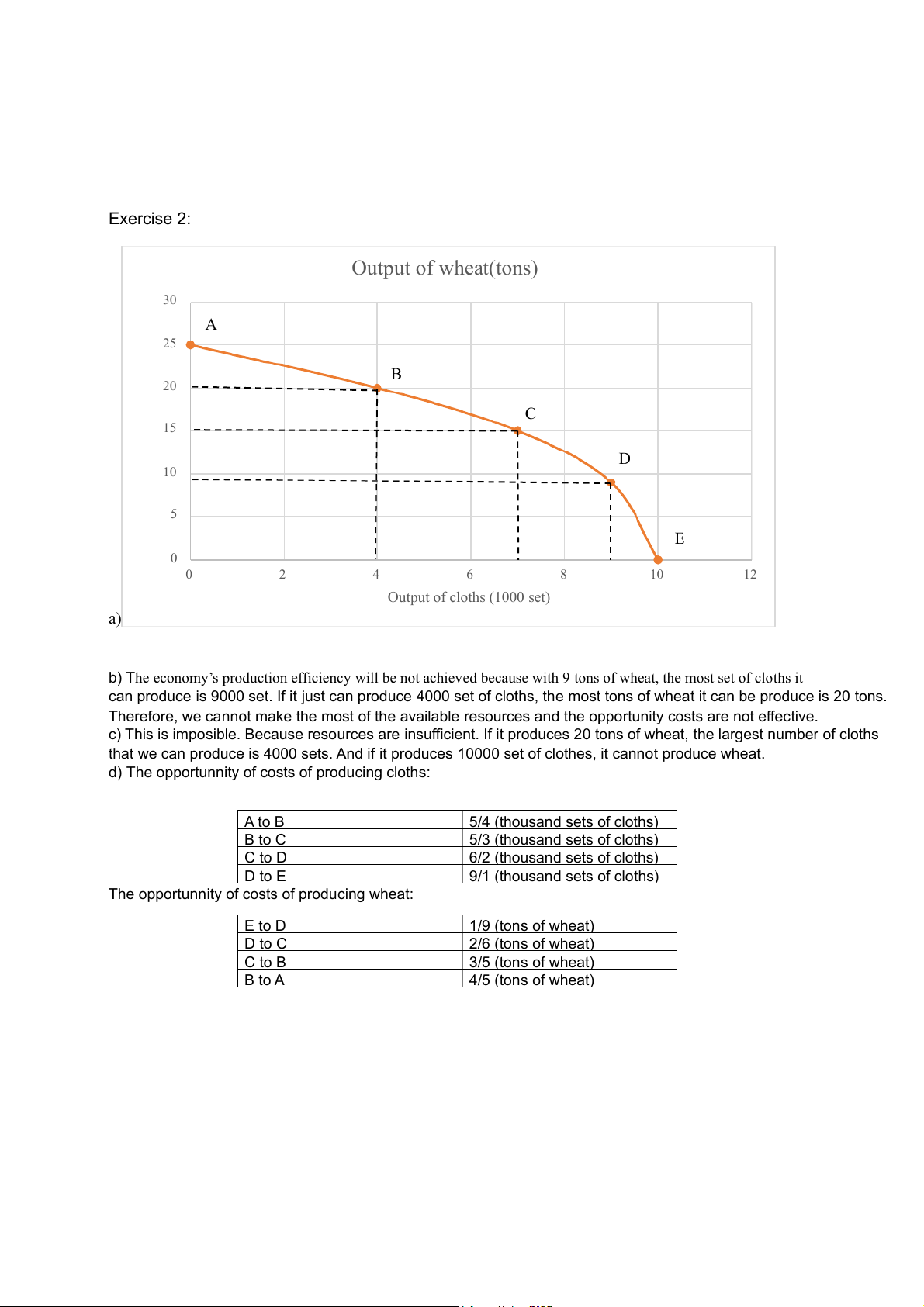
- The PPF that reflects technological improvement in the production of both products Production alternatives 35 A 30 B 25 C 20 15 D issiles(in thousands) 10 uided m G 5 0 0 1 2 3 4 5 6 7 8 9 E Cars (in millions) Exercise 2: Output of wheat(tons) 30 A 25 B 20 C heat (tons) 15 D 10 utput of w O 5 E 0 0 2 4 6 8 10 12 Output of cloths (1000 set) a)
b) The economy’s production efficiency will be not achieved because with 9 tons of wheat, the most set of cloths it
can produce is 9000 set. If it just can produce 4000 set of cloths, the most tons of wheat it can be produce is 20 tons.
Therefore, we cannot make the most of the available resources and the opportunity costs are not effective.
c) This is imposible. Because resources are insufficient. If it produces 20 tons of wheat, the largest number of cloths
that we can produce is 4000 sets. And if it produces 10000 set of clothes, it cannot produce wheat.
d) The opportunnity of costs of producing cloths: A to B 5/4 (thousand sets of cloths) B to C 5/3 (thousand sets of cloths) C to D 6/2 (thousand sets of cloths) D to E 9/1 (thousand sets of cloths)
The opportunnity of costs of producing wheat: E to D 1/9 (tons of wheat) D to C 2/6 (tons of wheat) C to B 3/5 (tons of wheat) B to A 4/5 (tons of wheat)
Tài liệu liên quan:
-
Multiple Choice Questions on Monopolistic Competition and Oligopoly | Microeconomics | Trường Đại học Quốc tế, Đại học Quốc gia Thành phố Hồ Chí Minh
1 1 -
Vi mô và Tính Toán Giới Hạn Lợi Ích Cuối Kỳ | Microeconomics | Trường Đại học Quốc tế, Đại học Quốc gia Thành phố Hồ Chí Minh
1 1 -
Firm Behavior & Market Structures Exam Notes | Microeconomics | Trường Đại học Quốc tế, Đại học Quốc gia Thành phố Hồ Chí Minh
1 1 -
Monopolist & Firm Analysis Assignment | Microeconomics | Trường Đại học Quốc tế, Đại học Quốc gia Thành phố Hồ Chí Minh
1 1 -
Public Economy 18: The Impact of Tariffs on Voter Participation and Policy | Microeconomics | Trường Đại học Quốc tế, Đại học Quốc gia Thành phố Hồ Chí Minh
1 1