Microeconomics Concepts and Solutions | Microeconomics | Trường Đại học Quốc tế, Đại học Quốc gia Thành phố Hồ Chí Minh
The demand for cars in a certain country is given by:D= 20,000 –P, wherePis the price of a car. Supply by domestic car producers is:S= 5,000 + 0.5P.Suppose the economy is closed. The equilibrium price of a car is _____ and equilibrium quantity is____. a. $12,000; 8,000 b. $6,000; 14,000 c. $10,000; 10,000 In a closed economy, the equilibrium price equates the quantity supplied and the quantity demanded. Solving 20,000 –P= 5,000 + 0.5P, we see thatP* = $10,000. At that price,Q* = 10,000. Tài liệu được sưu tầm và soạn thảo dưới dạng file PDF để gửi tới các bạn cùng tham khảo, ôn tập đầy đủ kiến thức, chuẩn bị cho các buổi học thật tốt. Mời bạn đọc đón xem!
Môn: Microeconomics 635 tài liệu
Trường: Trường Đại học Quốc tế, Đại học Quốc gia Thành phố Hồ Chí Minh 1.9 K tài liệu
Tác giả:



Preview text:
Question1 Correct Mark 1.00 out of 1.00 Flag question Question text
The demand for cars in a certain country is given by:D= 20,000 –P, wherePis
the price of a car. Supply by domestic car producers is:S= 5,000 +
0.5P.Suppose the economy is closed. The equilibrium price of a car is _____ and equilibrium quantity is____. a. $12,000; 8,000 b. $6,000; 14,000 c. $10,000; 10,000
In a closed economy, the equilibrium price equates the quantity supplied and
the quantity demanded. Solving 20,000 –P= 5,000 + 0.5P, we see thatP* =
$10,000. At that price,Q* = 10,000. d. $8,000; 12,000 Feedback
The correct answer is: $10,000; 10,000 Question 2 Correct Mark 1.00 out of 1.00 Flag question Question text
In the absence of environmental protection laws, firms pollute because a.
business owners follow different norms than do environmentalists. b.
business owners do not believe that pollution is a problem. c.
controlling emissions costs money, thereby reducing profits.
Reducing pollution is costly for firms. d.
the cost pollution imposes on society is small relative to the cost of reducing pollution. Feedback
The correct answer is: controlling emissions costs money, thereby reducing profits. Question 3 Correct Mark 1.00 out of 1.00 Flag question Question text
The accompanying graph shows the production possibilities curve for the
economy with only two members, Selena and Arturo. Selena can produce either
50 pounds of beef or 2 computers per week, and Arturo can produce 100 pounds
of beef or 1 computer per week. Both of them work 40 weeks per year.
With the opportunity to trade, Selena can trade all the computers she can
produce per year if she specializes in producing computers, for _____ pounds of beef. a. 2,000 b. 6,000 c. 4,000
If Arturo and Selena completely specialize, they will be at pointy. Engaging in
trade allows them to move along the consumption possibilities line. The
maximum amount of beef they can consume is 8,000 pounds, which is 4,000
pounds more than they consume when at pointy, with no trade. d. 3,000 Feedback The correct answer is: 4,000 Question 4 Correct Mark 1.00 out of 1.00 Flag question Question text
Once a firm has determined the quantity of output it wishes to sell, the
maximum price it can charge for each unit is determined by a.
the demand curve facing the firm.
The demand curve dictates the maximum price a firm for each quantity produced. b.
the marginal cost of making the product. c.
the average cost of making the product. d.
the firm’s marginal revenue curve. Feedback
The correct answer is: the demand curve facing the firm. Question 5 Correct Mark 1.00 out of 1.00 Flag question Question text
Consider an industry with two firms producing similar products. Each firm's total
cost (in dollars) is given below.
Mega Corp:TC= 5,000 + 100Q
Big Inc:TC= 4,000 + 200Q
We can conclude that ______ has a higher fixed cost and ______ has a higher marginal cost. a. Mega Corp; Big Inc
$5,000 > $4,000 and $200 > $100. b. Mega Corp; Mega Corp c. Big Inc; Mega Corp d. Big Inc; Big Inc Feedback
The correct answer is: Mega Corp; Big Inc Question 6 Correct Mark 1.00 out of 1.00 Flag question Question text
The demand for cars in a certain country is given by:D= 20,000 −P, wherePis
the price of a car. Supply by domestic car producers is:S= 5,000 + 0.5P.If this
economy is open to trade, and the world price of a car is $6,000, the domestic
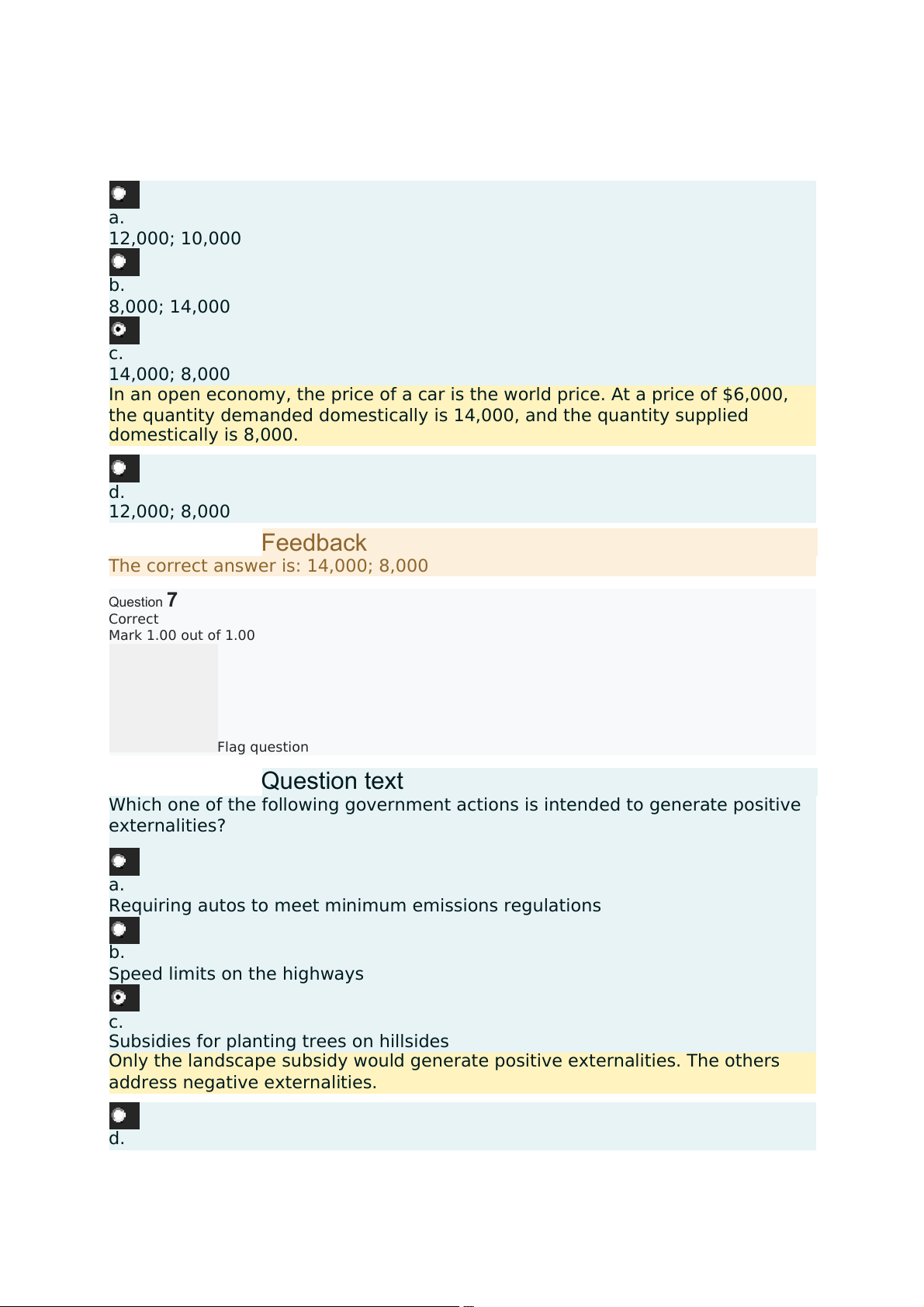
quantity demanded will be ______ and quantity supplied will be _____. a. 12,000; 10,000 b. 8,000; 14,000 c. 14,000; 8,000
In an open economy, the price of a car is the world price. At a price of $6,000,
the quantity demanded domestically is 14,000, and the quantity supplied domestically is 8,000. d. 12,000; 8,000 Feedback
The correct answer is: 14,000; 8,000 Question 7 Correct Mark 1.00 out of 1.00 Flag question Question text
Which one of the following government actions is intended to generate positive externalities? a.
Requiring autos to meet minimum emissions regulations b. Speed limits on the highways c.
Subsidies for planting trees on hillsides
Only the landscape subsidy would generate positive externalities. The others
address negative externalities. d. Taxing polluting industries Feedback
The correct answer is: Subsidies for planting trees on hillsides Question 8 Correct Mark 1.00 out of 1.00 Flag question Question text
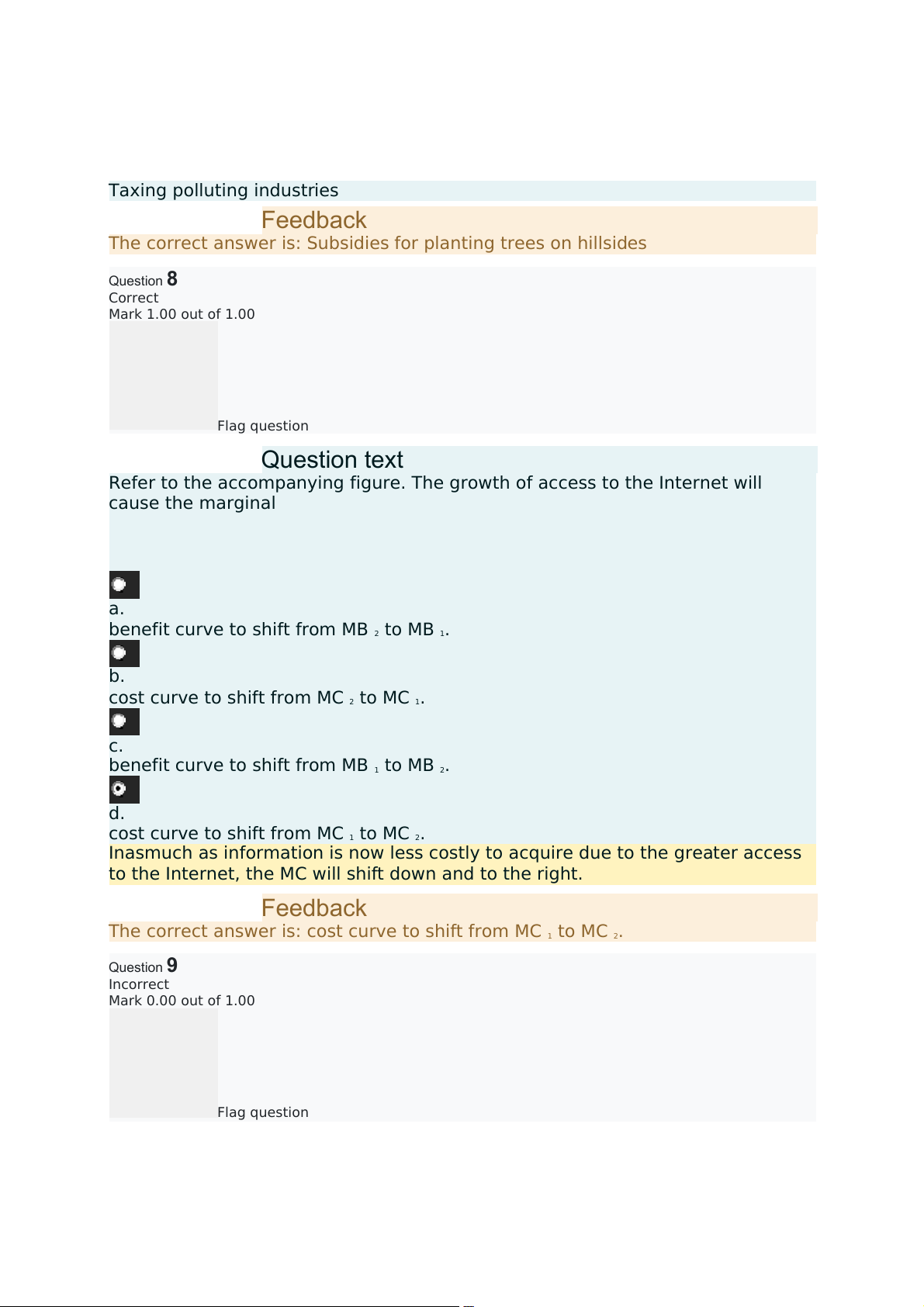
Refer to the accompanying figure. The growth of access to the Internet will cause the marginal a.
benefit curve to shift from MB2to MB1. b.
cost curve to shift from MC2to MC1. c.
benefit curve to shift from MB1to MB2. d.
cost curve to shift from MC1to MC2.
Inasmuch as information is now less costly to acquire due to the greater access
to the Internet, the MC will shift down and to the right. Feedback
The correct answer is: cost curve to shift from MC1to MC2. Question 9 Incorrect Mark 0.00 out of 1.00 Flag question Question text
Suppose Danielle is considering whether to see Fast Times at Zombie High at
her local movie theater. Tickets cost $16 each, but Danielle isn't sure how much
she's going to like the movie. There's a 20 percent chance she'll get $60 worth
of enjoyment from seeing the movie, and there's a 80 percent chance she'll only
get $10 worth of enjoyment from seeing the movie. Danielle's expected value of seeing the movie is a. $2. b. $36.
The expected value of seeing the movie is $4 = (0.20 × $60) + (0.80 × $10) − $16. c. $4. d. $52. Feedback The correct answer is: $4. Question 10 Correct Mark 1.00 out of 1.00 Flag question Question text
The demand for microwaves in a certain country is given by:D= 8,000 –30P,
wherePis the price of a microwave. Supply by domestic microwave producers
is:S= 4,000 + 10P. Suppose the economy is closed. The equilibrium price of a
microwave is _____ and equilibrium quantity is____. a. $50; 8,000 b. $75; 6,000 c. $125; 4,000 d. $100; 5,000
In a closed economy, the equilibrium price will equate the quantity supplied and
the quantity demanded. Solving 8,000 – 30P = 4,000 + 10P, we find that P* = 100 and Q* = 5,000. Feedback
The correct answer is: $100; 5,000 Question 11 Correct Mark 1.00 out of 1.00 Flag question Question text
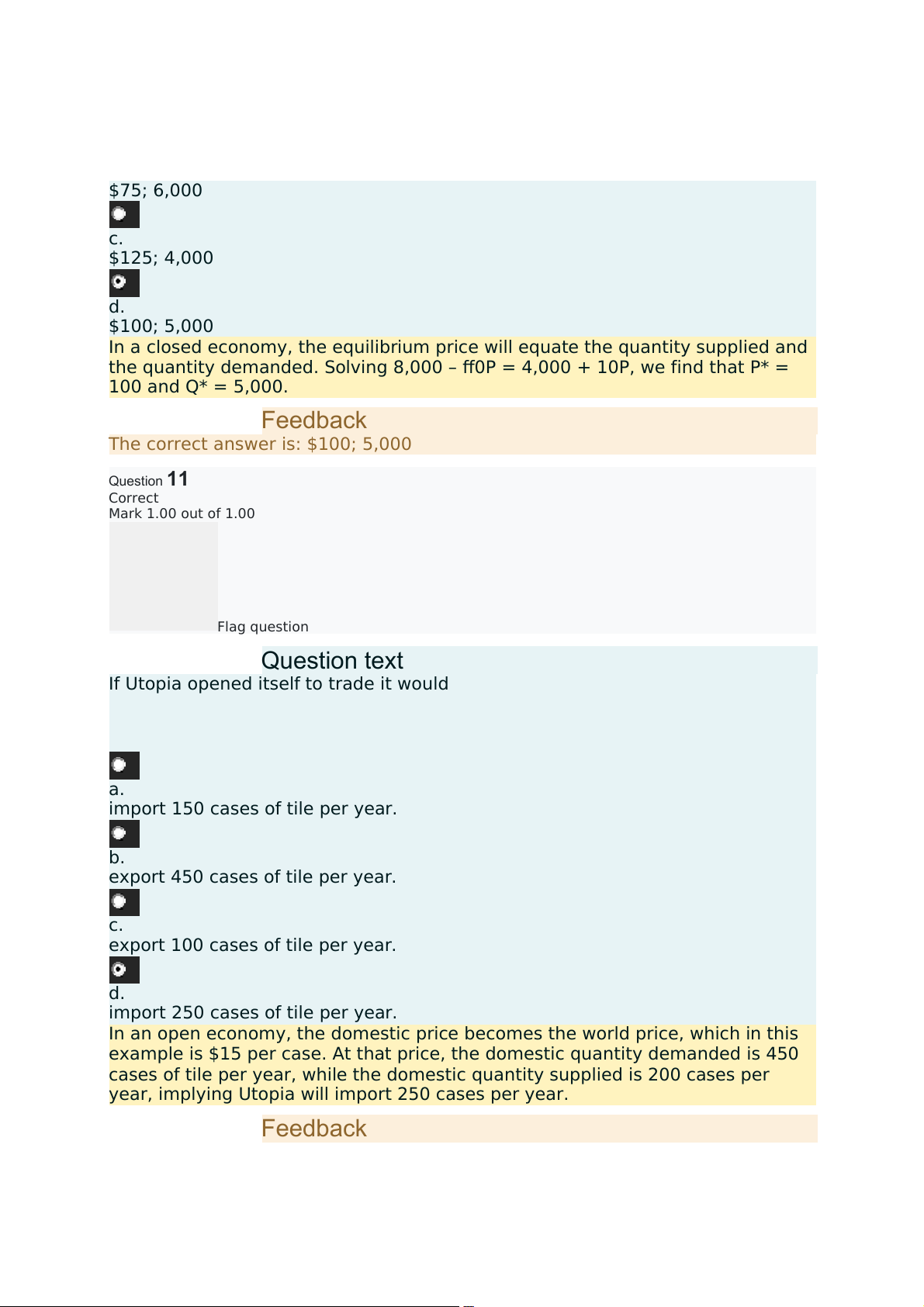
If Utopia opened itself to trade it would a.
import 150 cases of tile per year. b.
export 450 cases of tile per year. c.
export 100 cases of tile per year. d.
import 250 cases of tile per year.
In an open economy, the domestic price becomes the world price, which in this
example is $15 per case. At that price, the domestic quantity demanded is 450
cases of tile per year, while the domestic quantity supplied is 200 cases per
year, implying Utopia will import 250 cases per year. Feedback
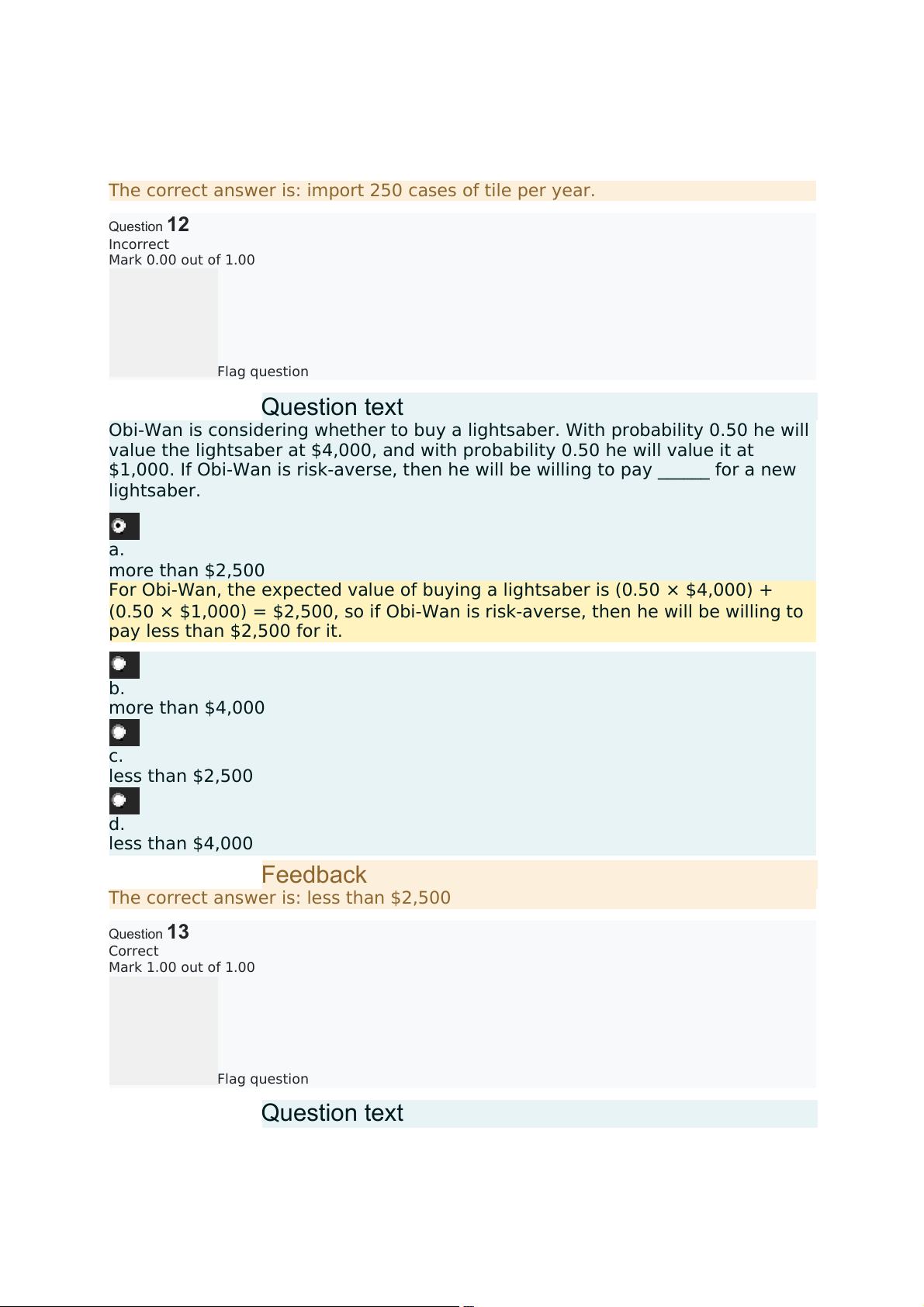
The correct answer is: import 250 cases of tile per year. Question 12 Incorrect Mark 0.00 out of 1.00 Flag question Question text
Obi-Wan is considering whether to buy a lightsaber. With probability 0.50 he will
value the lightsaber at $4,000, and with probability 0.50 he will value it at
$1,000. If Obi-Wan is risk-averse, then he will be willing to pay ______ for a new lightsaber. a. more than $2,500
For Obi-Wan, the expected value of buying a lightsaber is (0.50 × $4,000) +
(0.50 × $1,000) = $2,500, so if Obi-Wan is risk-averse, then he will be willing to pay less than $2,500 for it. b. more than $4,000 c. less than $2,500 d. less than $4,000 Feedback
The correct answer is: less than $2,500 Question 13 Correct Mark 1.00 out of 1.00 Flag question Question text
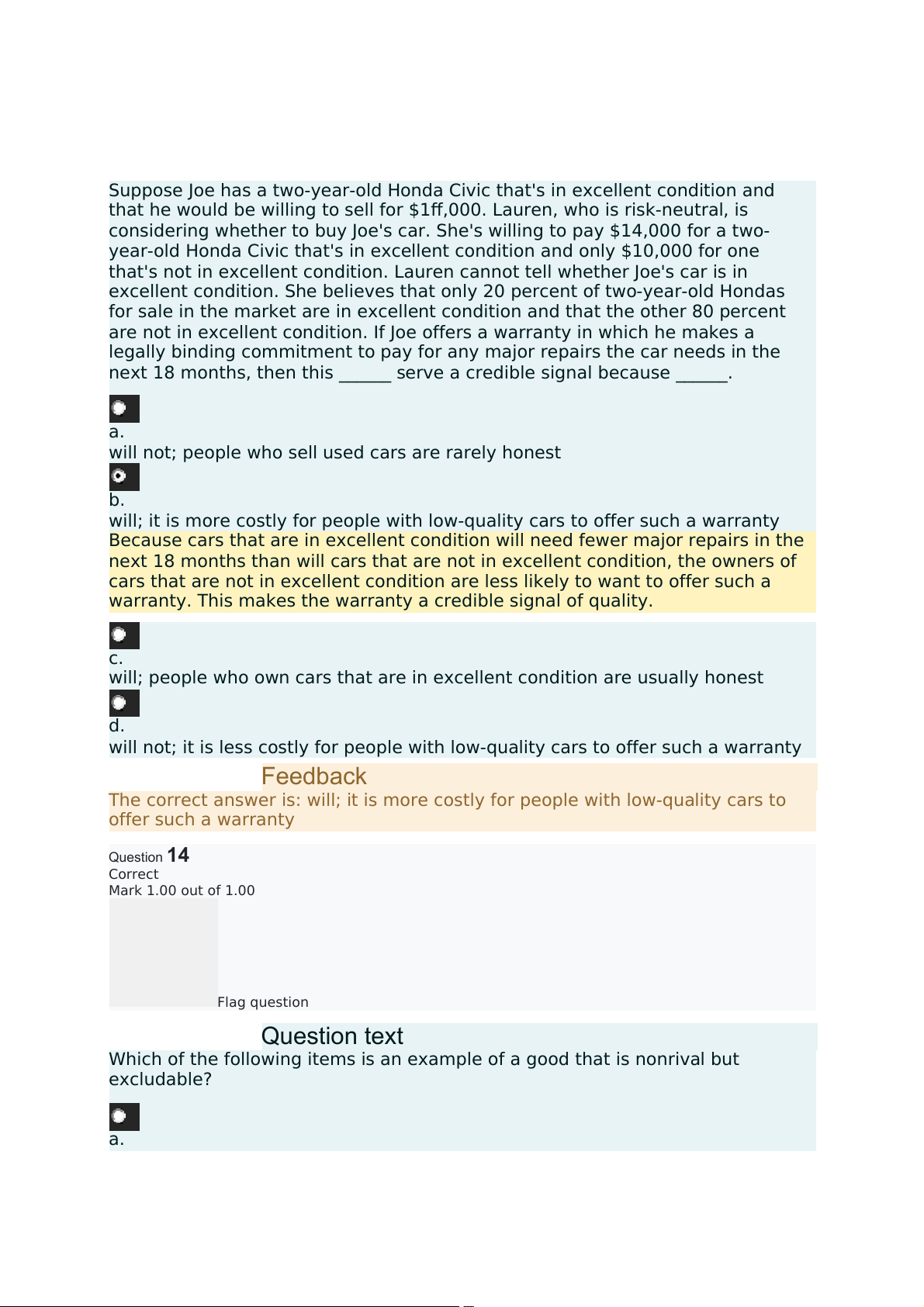
Suppose Joe has a two-year-old Honda Civic that's in excellent condition and
that he would be willing to sell for $13,000. Lauren, who is risk-neutral, is
considering whether to buy Joe's car. She's willing to pay $14,000 for a two-
year-old Honda Civic that's in excellent condition and only $10,000 for one
that's not in excellent condition. Lauren cannot tell whether Joe's car is in
excellent condition. She believes that only 20 percent of two-year-old Hondas
for sale in the market are in excellent condition and that the other 80 percent
are not in excellent condition. If Joe offers a warranty in which he makes a
legally binding commitment to pay for any major repairs the car needs in the
next 18 months, then this ______ serve a credible signal because ______. a.
will not; people who sell used cars are rarely honest b.
will; it is more costly for people with low-quality cars to offer such a warranty
Because cars that are in excellent condition will need fewer major repairs in the
next 18 months than will cars that are not in excellent condition, the owners of
cars that are not in excellent condition are less likely to want to offer such a
warranty. This makes the warranty a credible signal of quality. c.
will; people who own cars that are in excellent condition are usually honest d.
will not; it is less costly for people with low-quality cars to offer such a warranty Feedback
The correct answer is: will; it is more costly for people with low-quality cars to offer such a warranty Question 14 Correct Mark 1.00 out of 1.00 Flag question Question text
Which of the following items is an example of a good that is nonrival but excludable? a. Broadcast television b. Corn c. National defense d. Pay-per-view movies
More than one person can enjoy a per-per-view movie at one time, but people
who do not pay for it can be excluded from enjoying it. Feedback
The correct answer is: Pay-per-view movies Question 15 Correct Mark 1.00 out of 1.00 Flag question Question text
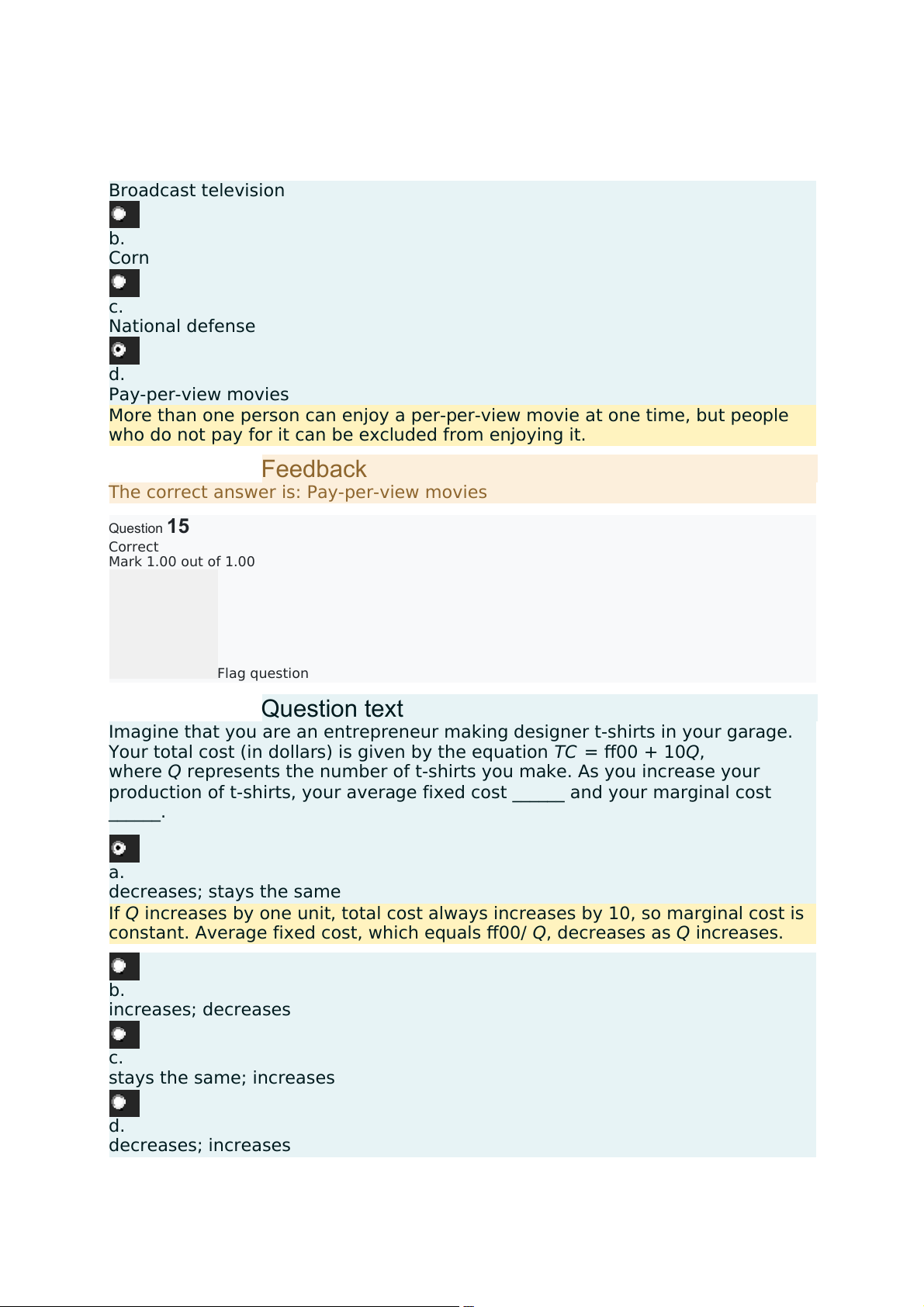
Imagine that you are an entrepreneur making designer t-shirts in your garage.
Your total cost (in dollars) is given by the equationTC= 300 + 10Q,
whereQrepresents the number of t-shirts you make. As you increase your
production of t-shirts, your average fixed cost ______ and your marginal cost ______. a. decreases; stays the same
IfQincreases by one unit, total cost always increases by 10, so marginal cost is
constant. Average fixed cost, which equals 300/Q, decreases asQincreases. b. increases; decreases c. stays the same; increases d. decreases; increases Feedback
The correct answer is: decreases; stays the same Question 16 Correct Mark 1.00 out of 1.00 Flag question Question text
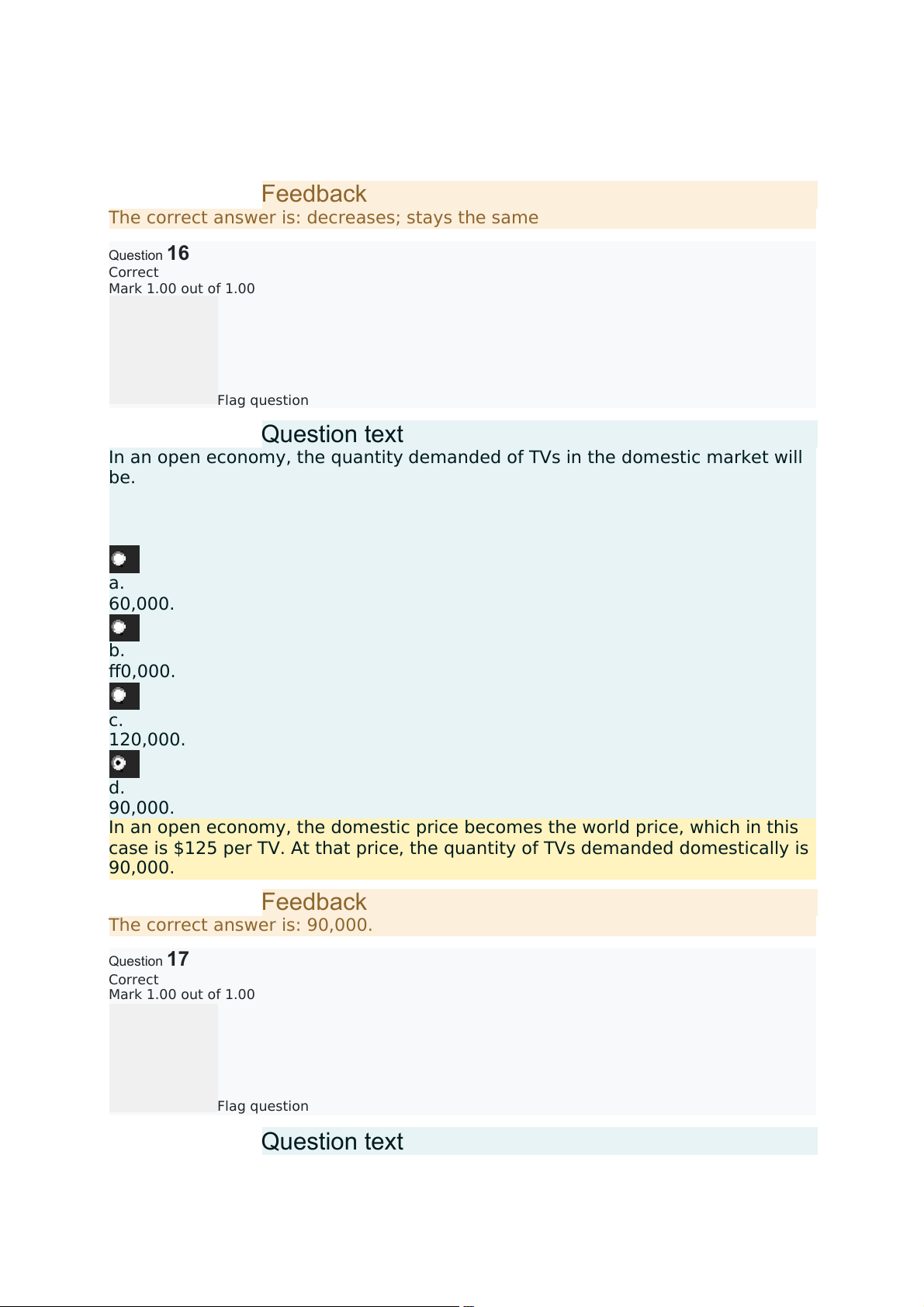
In an open economy, the quantity demanded of TVs in the domestic market will be. a. 60,000. b. 30,000. c. 120,000. d. 90,000.
In an open economy, the domestic price becomes the world price, which in this
case is $125 per TV. At that price, the quantity of TVs demanded domestically is 90,000. Feedback The correct answer is: 90,000. Question 17 Correct Mark 1.00 out of 1.00 Flag question Question text
A good or service that is both rival and excludable is a a. public good. b. collective good. c. commons good. d. private good.
Private goods are both rival and excludable. Feedback
The correct answer is: private good. Question 18 Incorrect Mark 0.00 out of 1.00 Flag question Question text
The accompanying graph shows the production possibilities curve for the
economy with only two members, Selena and Arturo. Selena can produce either
50 pounds of beef or 2 computers per week, and Arturo can produce 100 pounds
of beef or 1 computer per week. Both of them work 40 weeks per year.
Selena has a comparative advantage in producing ____, and Arturo has a
comparative advantage in producing ____. a. beef; beef b. computers; beef c. computers; computers
In the time it takes Arturo to produce 1 computer, he can produce 100 pounds of
beef. In the time it takes Selena to produce 1 computer, she can produce 25
pounds of beef. Therefore, Selena has the comparative advantage in producing
computers, since she has the lower opportunity cost. Arturo must have the
comparative advantage in producing beef. d. beef; computers Feedback
The correct answer is: computers; beef Question 19 Correct Mark 1.00 out of 1.00 Flag question Question text
The essential feature that differentiates imperfectly competitive firms from
perfectly competitive firms is that an imperfectly competitive firm a.
faces a downward-sloping demand curve.
The essential difference between perfectly competitive firms and imperfectly
competitive firms is that a perfectly competitive firm faces a horizontal demand
curve while an imperfectly competitive firm faces a downward-sloping demand curve. b.
produces a good with no close substitutes. c. faces high barriers to entry. d.
coordinates their output decisions with other firms. Feedback
The correct answer is: faces a downward-sloping demand curve. Question 20 Correct Mark 1.00 out of 1.00 Flag question Question text
In the case of either a positive or negative externality, a good's market price will a.
not equate the quantity supplied by sellers with the quantity demanded by buyers. b. be too low. c.
not fully reflect a good's social marginal cost or social marginal benefit.
When there are externalities, the market equilibrium price will not fully capture
a good's social marginal cost or social marginal benefit. d. be too high. Feedback
The correct answer is: not fully reflect a good's social marginal cost or social marginal benefit. Question 21 Correct Mark 1.00 out of 1.00 Flag question Question text
Suppose the accompanying figure illustrates the demand curve facing a monopolist.
Suppose this firm maximizes its profits by charging a price of $8 per unit. This implies that the firm’s a. marginal cost is $8. b. marginal cost is less than $8. c. marginal cost is $0.
At a price of $8 per unit, the firm will sell 400 units, and we know that the
marginal revenue of producing the 400th unit is $0 because for any straight-line
demand curve, the associated marginal revenue curve has a horizontal intercept
that is half the horizontal intercept of the demand curve. So, if the firm
maximizes its profit by charging $8 per unit, it must be the case that the
marginal cost of the 400th unit is zero. d. average total cost is $8. Feedback
The correct answer is: marginal cost is $0. Question 22 Correct Mark 1.00 out of 1.00 Flag question Question text
When a pharmaceutical company introduces a new drug, its research and
development costs are ______, and the cost of the chemicals used in
manufacturing the drug are ______. a. start-up costs; fixed costs b. start-up costs; variable costs
Start-up costs are one-time costs incurred when a new product is developed.
Variable costs are costs that vary as output varies. c. fixed costs; start-up costs d. marginal costs; variable costs Feedback
The correct answer is: start-up costs; variable costs Question 23 Correct Mark 1.00 out of 1.00 Flag question Question text
Mel is thinking of going on a cruise. Mel values a cruise in nice weather at
$2,000 and values a cruise in bad weather at $50. The probability of nice
weather is 60 percent, and the probability of bad weather is 40 percent. Trip
insurance is sometimes available. If purchased, it allows travelers to delay the
cruise until the weather is nice. Suppose that the price of the cruise is $1,200. If
Mel is risk-neutral, then Mel should a. not buy trip insurance. b.
only buy trip insurance if it costs less than $20. c.
only buy trip insurance if it costs less than $50. d.
only buy trip insurance if it costs less than $780.
In the absence of trip insurance, the expected value of the cruise is $20 = (0.60
× $2,000) + (0.40 × $50) − $1,200. With trip insurance, the expected value of
the cruise is $800 = $2,000 − $1,200. Thus, if Mel is risk-neutral, then she
would be willing to pay up to $780 for trip insurance. Feedback
The correct answer is: only buy trip insurance if it costs less than $780. Question 24 Correct Mark 1.00 out of 1.00 Flag question Question text
Which of the following is NOT an example of a public good? a. The ocean b.
Government-subsidized public housing
Although the government subsidizes housing for some low-income families,
housing is not considered a public good because it is neither nonrival nor nonexcludable. c. National defense d. Police protection Feedback
The correct answer is: Government-subsidized public housing Question 25 Correct Mark 1.00 out of 1.00 Flag question Question text
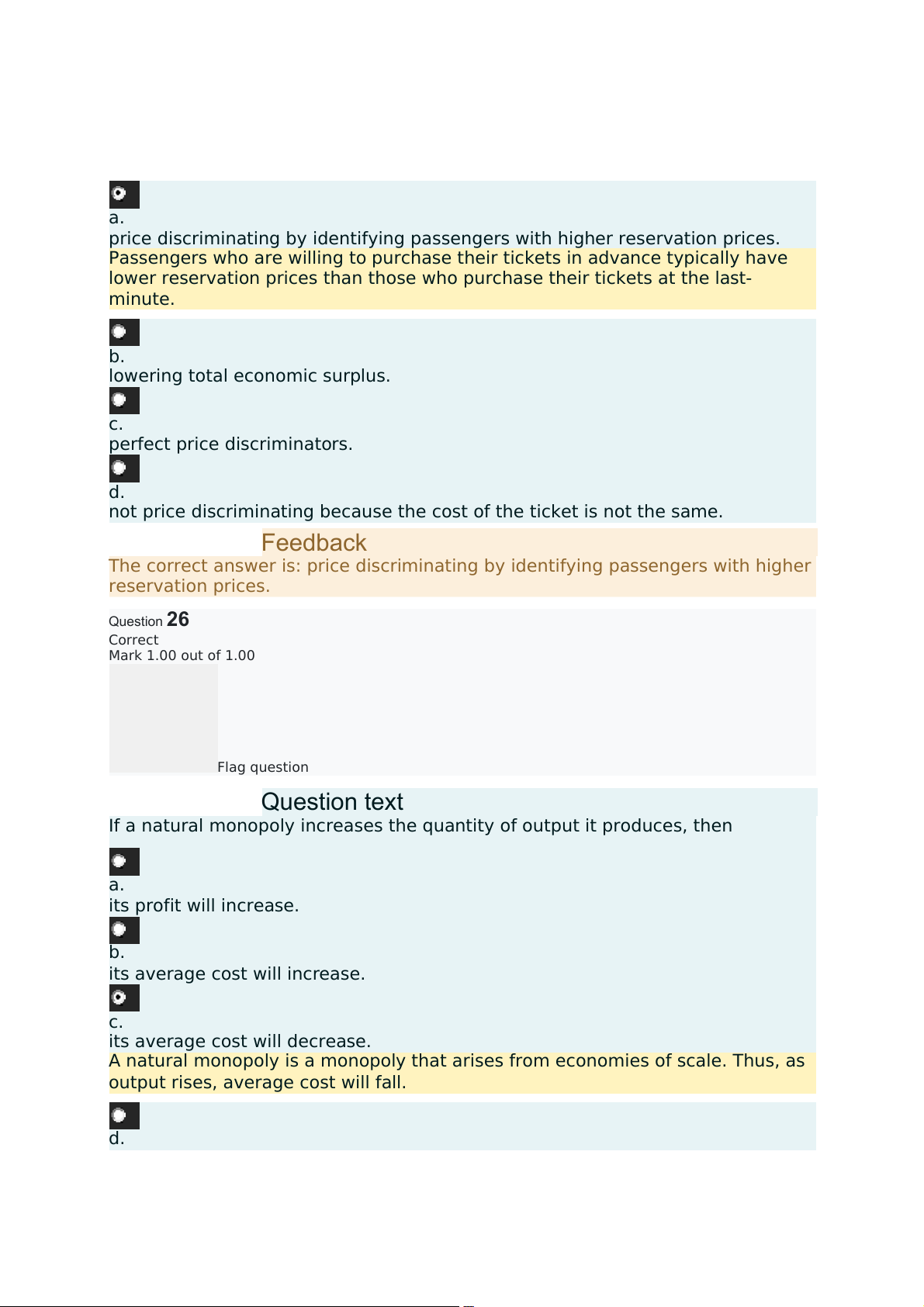
Airlines that charge higher prices for customers who purchase their tickets at the last minute are a.
price discriminating by identifying passengers with higher reservation prices.
Passengers who are willing to purchase their tickets in advance typically have
lower reservation prices than those who purchase their tickets at the last- minute. b.
lowering total economic surplus. c. perfect price discriminators. d.
not price discriminating because the cost of the ticket is not the same. Feedback
The correct answer is: price discriminating by identifying passengers with higher reservation prices. Question 26 Correct Mark 1.00 out of 1.00 Flag question Question text
If a natural monopoly increases the quantity of output it produces, then a. its profit will increase. b.
its average cost will increase. c.
its average cost will decrease.
A natural monopoly is a monopoly that arises from economies of scale. Thus, as
output rises, average cost will fall. d.
it will have to increase its price. Feedback
The correct answer is: its average cost will decrease. Question 27 Correct Mark 1.00 out of 1.00 Flag question Question text
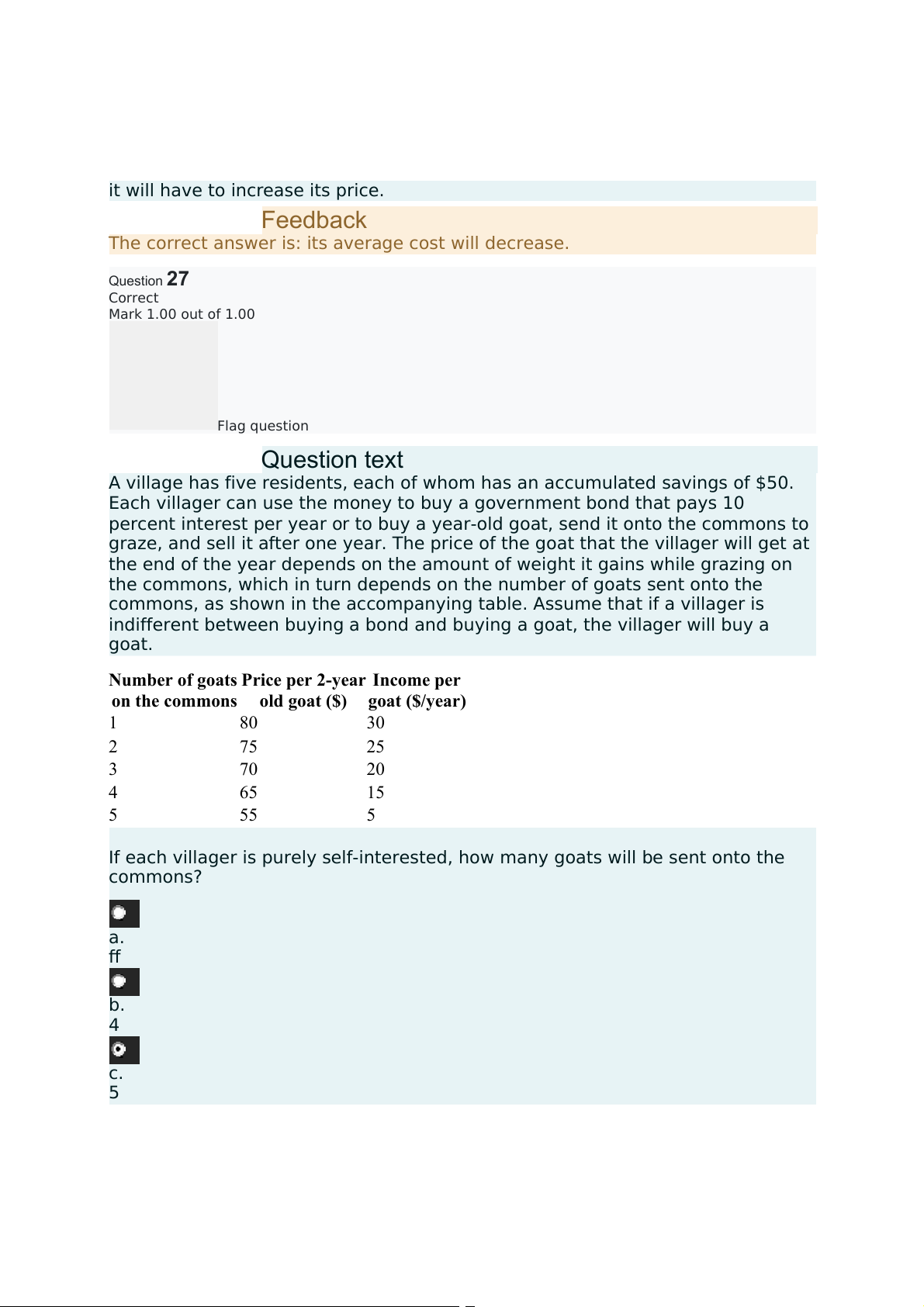
A village has five residents, each of whom has an accumulated savings of $50.
Each villager can use the money to buy a government bond that pays 10
percent interest per year or to buy a year-old goat, send it onto the commons to
graze, and sell it after one year. The price of the goat that the villager will get at
the end of the year depends on the amount of weight it gains while grazing on
the commons, which in turn depends on the number of goats sent onto the
commons, as shown in the accompanying table. Assume that if a villager is
indifferent between buying a bond and buying a goat, the villager will buy a goat.
Numberofgoats Priceper2-year Incomeper onthecommons oldgoat($) goat($/year) 1 80 30 2 75 25 3 70 20 4 65 15 5 55 5
If each villager is purely self-interested, how many goats will be sent onto the commons? a. 3 b. 4 c. 5
Tài liệu liên quan:
-
Chương 3: độ co giãn và các nhân tố ảnh hưởng | Microeconomics | Trường Đại học Quốc tế, Đại học Quốc gia Thành phố Hồ Chí Minh
4 2 -
Microeconomics Syllabus | Microeconomics | Trường Đại học Quốc tế, Đại học Quốc gia Thành phố Hồ Chí Minh
4 2 -
Microeconomics Course Syllabus & Assessment Details | Microeconomics | Trường Đại học Quốc tế, Đại học Quốc gia Thành phố Hồ Chí Minh
4 2 -
Assignment 3 - Elasticity MCQs and Key Concepts | Microeconomics | Trường Đại học Quốc tế, Đại học Quốc gia Thành phố Hồ Chí Minh
4 2 -
Assignment 2 - Economic Equilibrium Analysis of Fridges and Motorcycles | Microeconomics | Trường Đại học Quốc tế, Đại học Quốc gia Thành phố Hồ Chí Minh
4 2