Microeconomics Homework - Equilibrium & Demand Analysis | Microeconomics | Trường Đại học Quốc tế, Đại học Quốc gia Thành phố Hồ Chí Minh
Tài liệu được sưu tầm và soạn thảo dưới dạng file PDF với mục đích hỗ trợ học tập và tham khảo. Nội dung tài liệu được trình bày rõ ràng, dễ tiếp cận, phù hợp cho việc ôn tập và củng cố kiến thức trong quá trình học đại học. Đây sẽ là nguồn tư liệu hữu ích giúp các bạn sinh viên chuẩn bị tốt hơn cho các buổi học, đồng thời mở rộng thêm hiểu biết về môn học. Hy vọng tài liệu này sẽ mang lại nhiều giá trị và hỗ trợ các bạn trong hành trình học tập. Mời bạn đọc cùng tham khảo!
Môn: Microeconomics 635 tài liệu
Trường: Trường Đại học Quốc tế, Đại học Quốc gia Thành phố Hồ Chí Minh 1.9 K tài liệu
Tác giả:

Preview text:
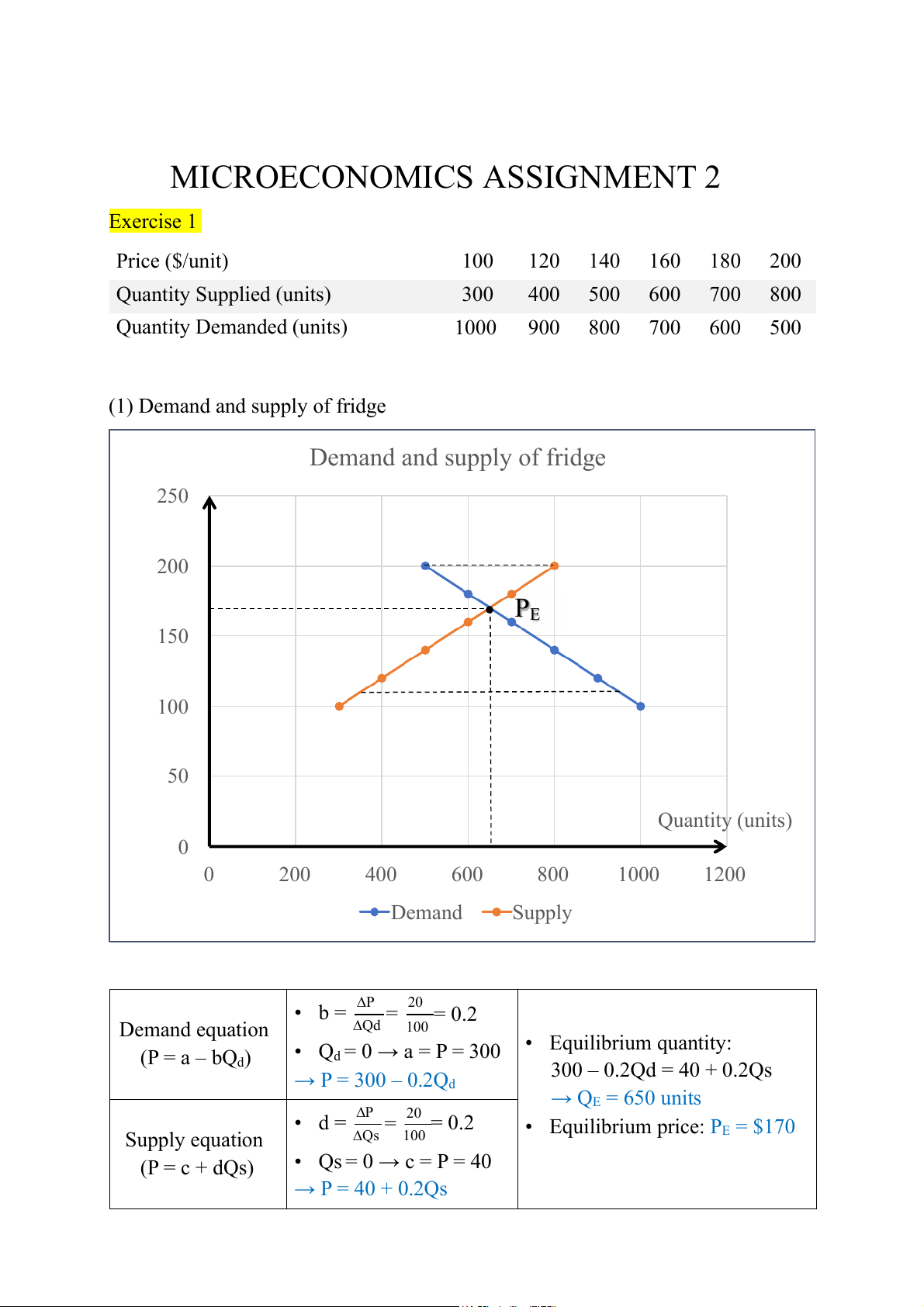
MICROECONOMICS ASSIGNMENT 2 Exercise 1 Price ($/unit) 100 120 140 160 180 200 Quantity Supplied (units) 300 400 500 600 700 800 Quantity Demanded (units) 1000 900 800 700 600 500
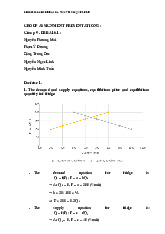
(1) Demand and supply of fridge Demand and supply of fridge 250 200 PE 150 rice ($/unit) 100 P 50 Quantity (units) 0 0 200 400 600 800 1000 1200 Demand Supply • b = ∆P = 20 = 0.2 Demand equation ∆Qd 100 • Equilibrium quantity: (P = a – bQ • Q d) d = 0 → a = P = 300 → P = 300 – 0.2Q 300 – 0.2Qd = 40 + 0.2Qs d → QE = 650 units • d = ∆P = 20 = 0.2
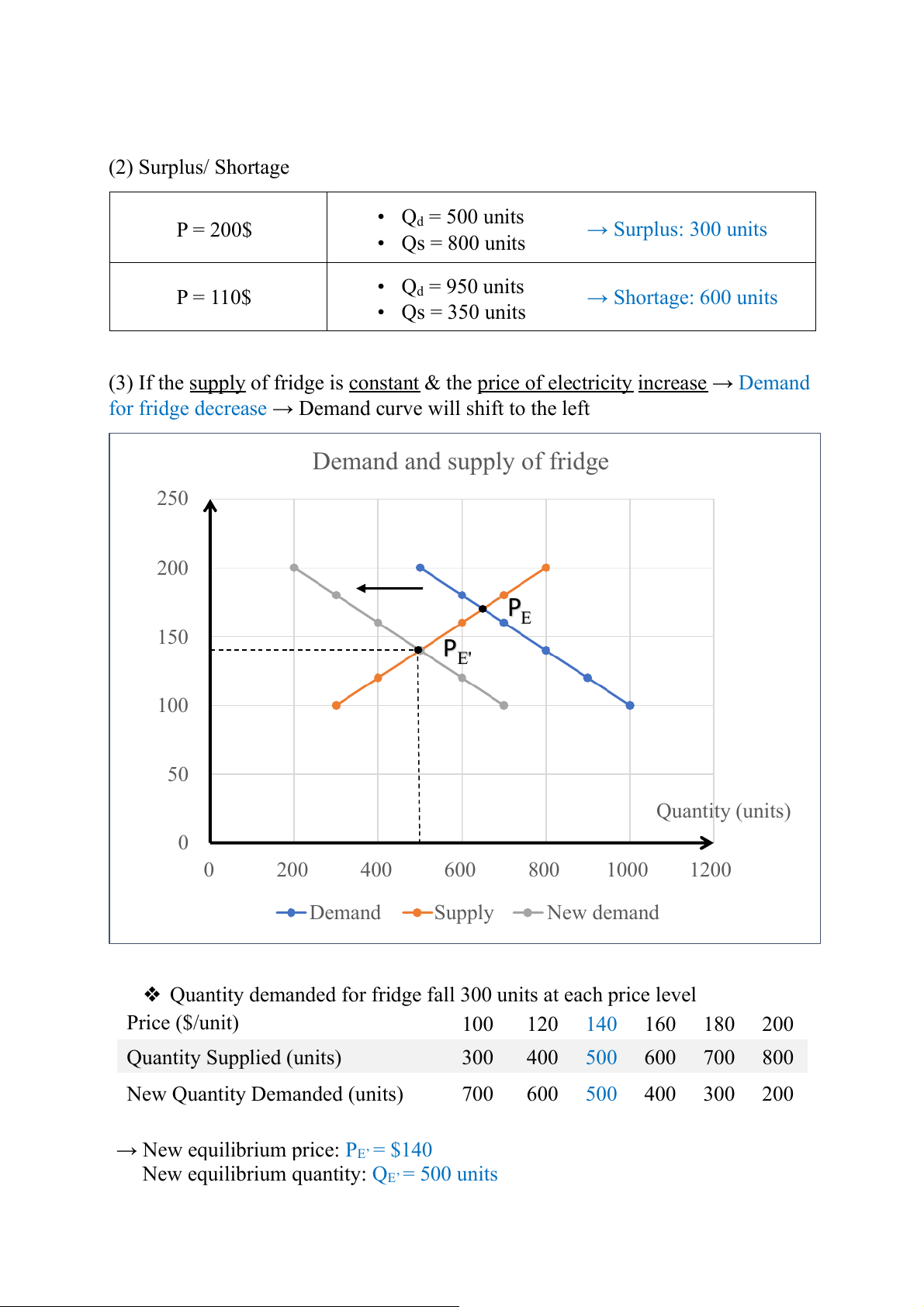
• Equilibrium price: PE = $17 0 Supply equation ∆Qs 100 (P = c + dQs) • Qs = 0 → c = P = 4 0 → P = 40 + 0.2Qs (2) Surplus/ Shortage • Q P = 200$ d = 500 units → Surplus: 300 units • Qs = 800 units P = 110$ • Qd = 950 units → Shortage: 600 units • Qs = 350 units
(3) If the supply of fridge is constant & t he price of electricity increase → Demand
for fridge decrease → Demand curve will shift to the left Demand and supply of fridge 250 200 E 150 E' rice ($/unit) 100 P 50 Quantity (units) 0 0 200 400 600 800 1000 1200 Demand Supply New demand
❖ Quantity demanded for fridge fall 300 units at each price level Price ($/unit) 100 120 140 160 180 200 Quantity Supplied (units) 300 400 500 600 700 800 New Quantity Demanded (units) 700 600 500 400 300 200
→ New equilibrium price: PE’ = $140
New equilibrium quantity: QE’ = 500 units
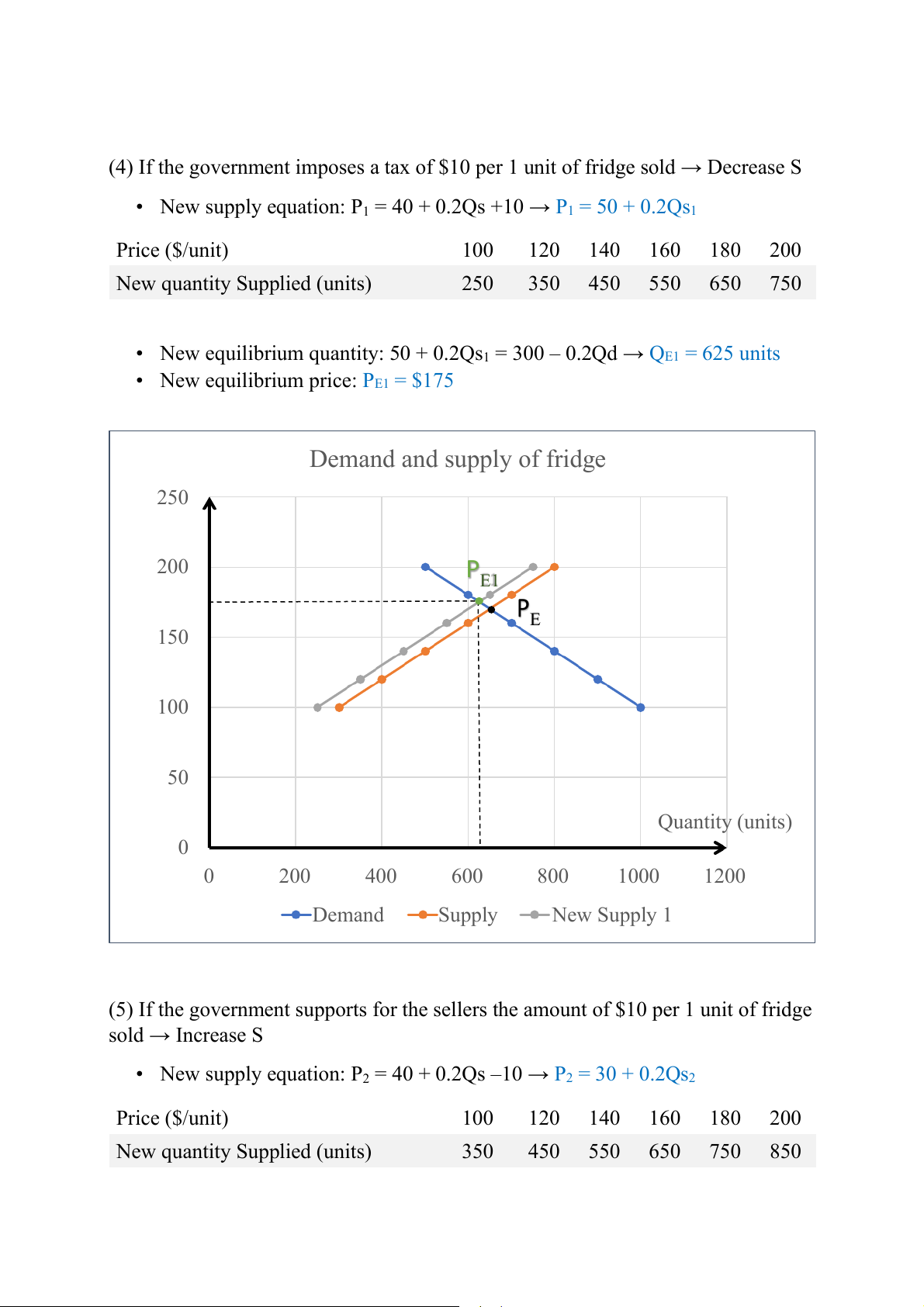
(4) If the government imposes a tax of $10 per 1 unit of fridge sold → Decrease S
• New supply equation: P1 = 40 + 0.2Qs +10 → P1 = 50 + 0.2Qs1 Price ($/unit) 100 120 140 160 180 200 New quantity Supplied (units) 250 350 450 550 650 750
• New equilibrium quantity: 50 + 0.2Qs1 = 300 – 0.2Qd → QE1 = 625 units
• New equilibrium price: PE1 = $175 Demand and supply of fridge 250 200 E1 E 150 rice ($/unit) 100 P 50 Quantity (units) 0 0 200 400 600 800 1000 1200 Demand Supply New Supply 1
(5) If the government supports for the sellers the amount of $10 per 1 unit of fridge sold → Increase S
• New supply equation: P2 = 40 + 0.2Qs –10 → P2 = 30 + 0.2Qs2 Price ($/unit) 100 120 140 160 180 200 New quantity Supplied (units) 350 450 550 650 750 850
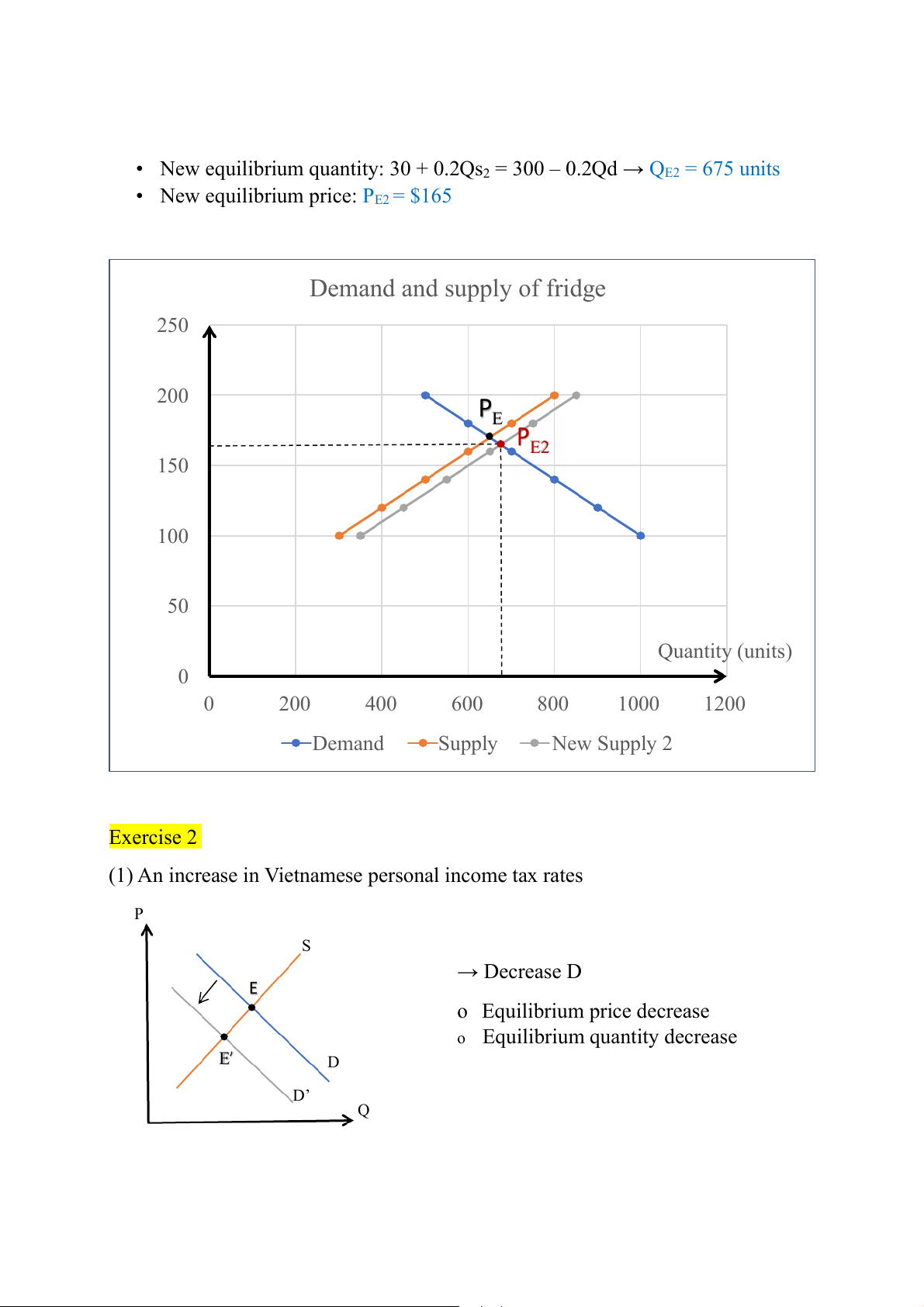
• New equilibrium quantity: 30 + 0.2Qs2 = 300 – 0.2Qd → QE2 = 675 units
• New equilibrium price: PE2 = $165 Demand and supply of fridge 250 200 E E2 150 rice ($/unit) 100 P 50 Quantity (units) 0 0 200 400 600 800 1000 1200 Demand Supply New Supply 2 Exercise 2
(1) An increase in Vietnamese personal income tax rates P S → Decrease D o Equilibrium price decrease
o Equilibrium quantity decrease E D D’ Q
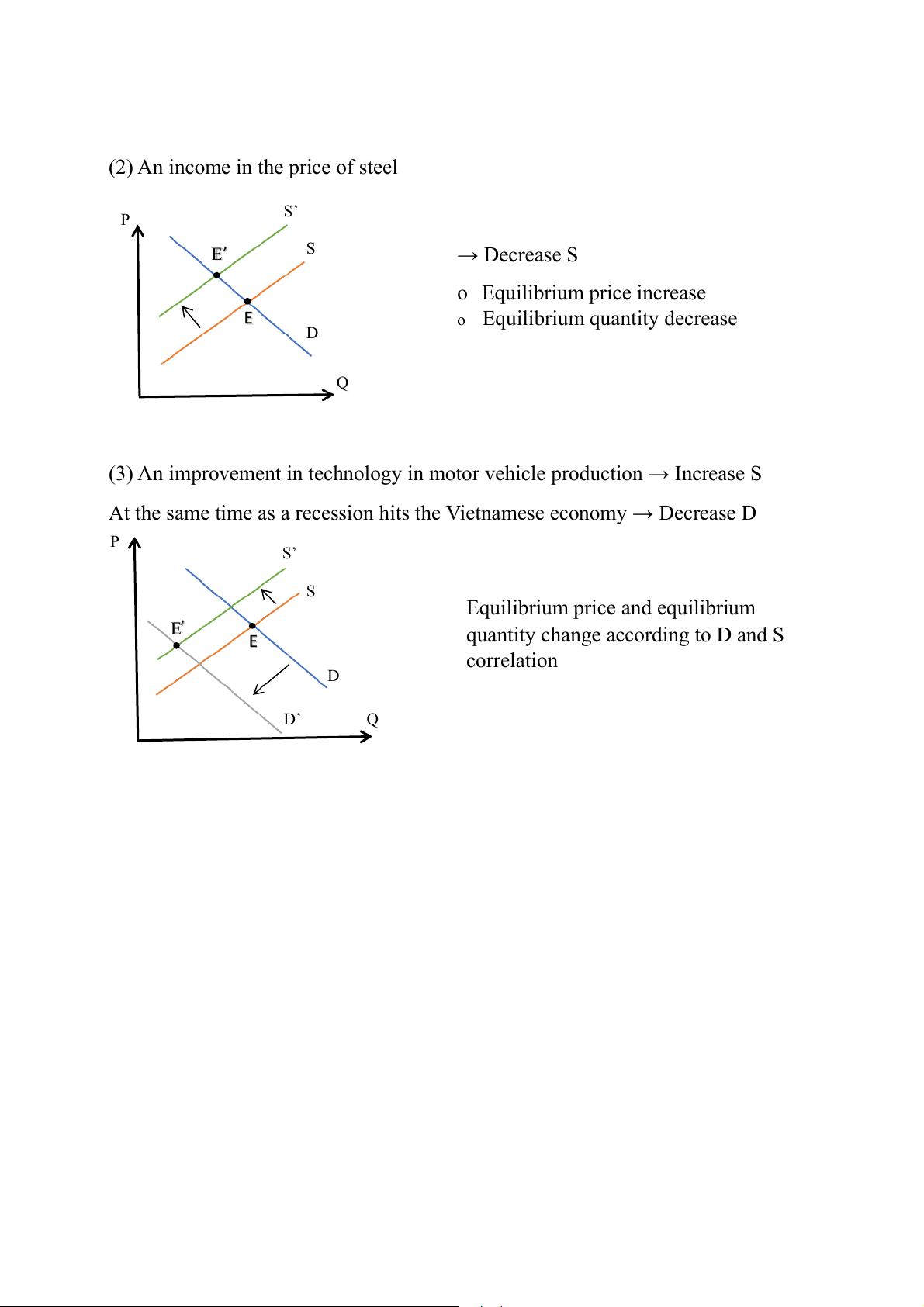
(2) An income in the price of steel P S’ S E → Decrease S o Equilibrium price increase
o Equilibrium quantity decrease D Q
(3) An improvement in technology in motor vehicle production → Increase S
At the same time as a recession hits the Vietnamese economy → Decrease D P S’ S
Equilibrium price and equilibrium E
quantity change according to D and S correlation D D’ Q
Tài liệu liên quan:
-
Chương 3: độ co giãn và các nhân tố ảnh hưởng | Microeconomics | Trường Đại học Quốc tế, Đại học Quốc gia Thành phố Hồ Chí Minh
6 3 -
Microeconomics Syllabus | Microeconomics | Trường Đại học Quốc tế, Đại học Quốc gia Thành phố Hồ Chí Minh
5 3 -
Microeconomics Course Syllabus & Assessment Details | Microeconomics | Trường Đại học Quốc tế, Đại học Quốc gia Thành phố Hồ Chí Minh
5 3 -
Assignment 3 - Elasticity MCQs and Key Concepts | Microeconomics | Trường Đại học Quốc tế, Đại học Quốc gia Thành phố Hồ Chí Minh
5 3 -
Assignment 2 - Economic Equilibrium Analysis of Fridges and Motorcycles | Microeconomics | Trường Đại học Quốc tế, Đại học Quốc gia Thành phố Hồ Chí Minh
6 3