Microeconomics Practice Questions | Microeconomics | Trường Đại học Quốc tế, Đại học Quốc gia Thành phố Hồ Chí Minh
Part 2: Additional 40 Practice Questions (No Answers) 1. Which of the following is NOT one of the 10 Principles of Economics? 2. A “normal good” is one where: 3. Inferior goods are defined as: 4. Which market structure has identical products and price-taking firms? 5. The supply curve represents: 6. The law of supply states: 7. Market demand equals: 8. A binding price floor is set: 9. Deadweight loss refers to: 10. Cross-price elasticity is positive for: 11. A perfectly inelastic demand curve is: 12. In the circular-flow diagram, households supply. Tài liệu được sưu tầm và soạn thảo dưới dạng file PDF để gửi tới các bạn cùng tham khảo, ôn tập đầy đủ kiến thức, chuẩn bị cho các buổi học thật tốt. Mời bạn đọc đón xem!
Môn: Microeconomics 635 tài liệu
Trường: Trường Đại học Quốc tế, Đại học Quốc gia Thành phố Hồ Chí Minh 1.9 K tài liệu
Tác giả:

Preview text:
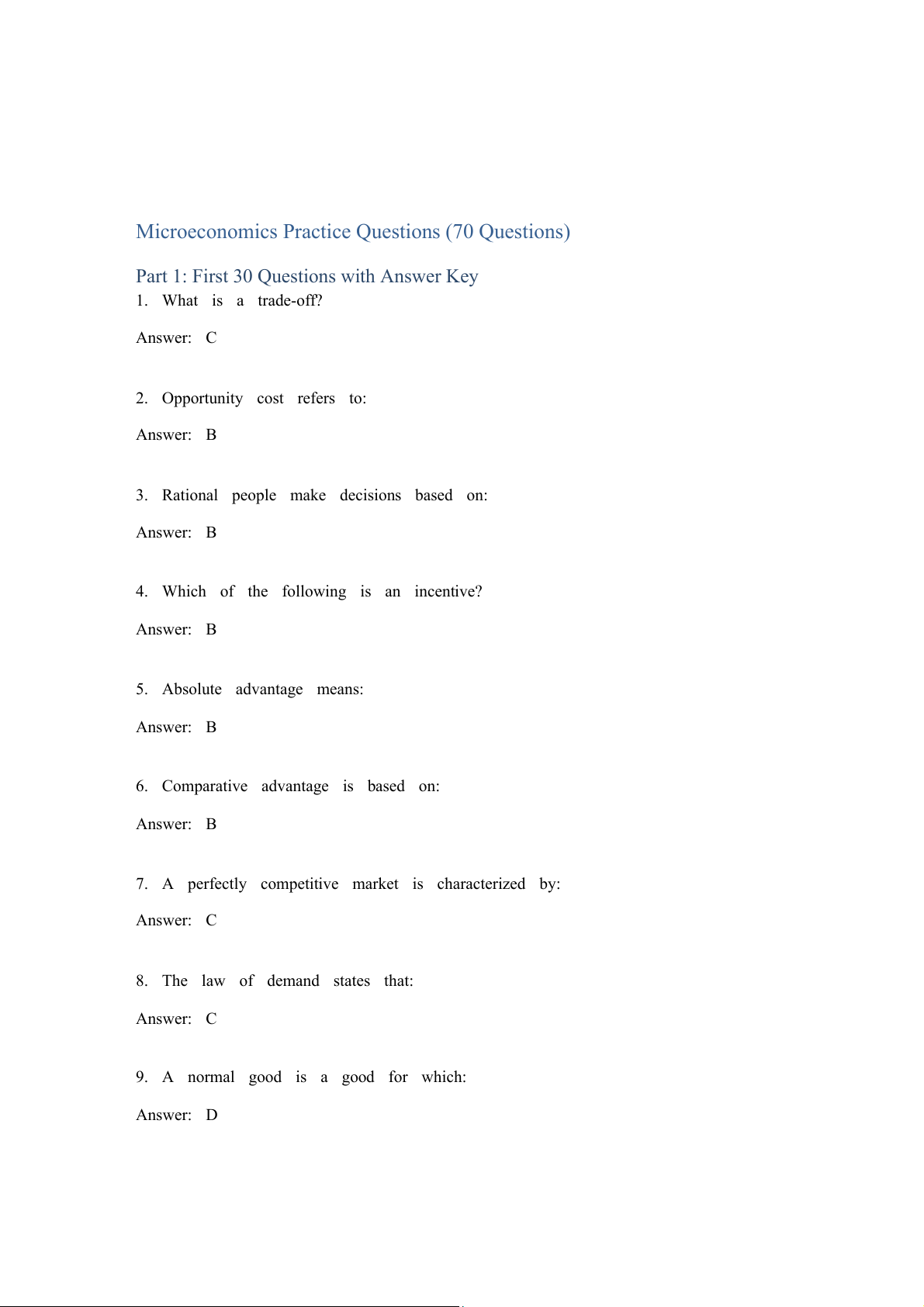
Microeconomics Practice Questions (70 Questions)
Part 1: First 30 Questions with Answer Key 1. What is a trade-off? Answer: C 2. Opportunity cost refers to: Answer: B
3. Rational people make decisions based on: Answer: B
4. Which of the following is an incentive? Answer: B 5. Absolute advantage means: Answer: B
6. Comparative advantage is based on: Answer: B
7. A perfectly competitive market is characterized by: Answer: C
8. The law of demand states that: Answer: C
9. A normal good is a good for which: Answer: D
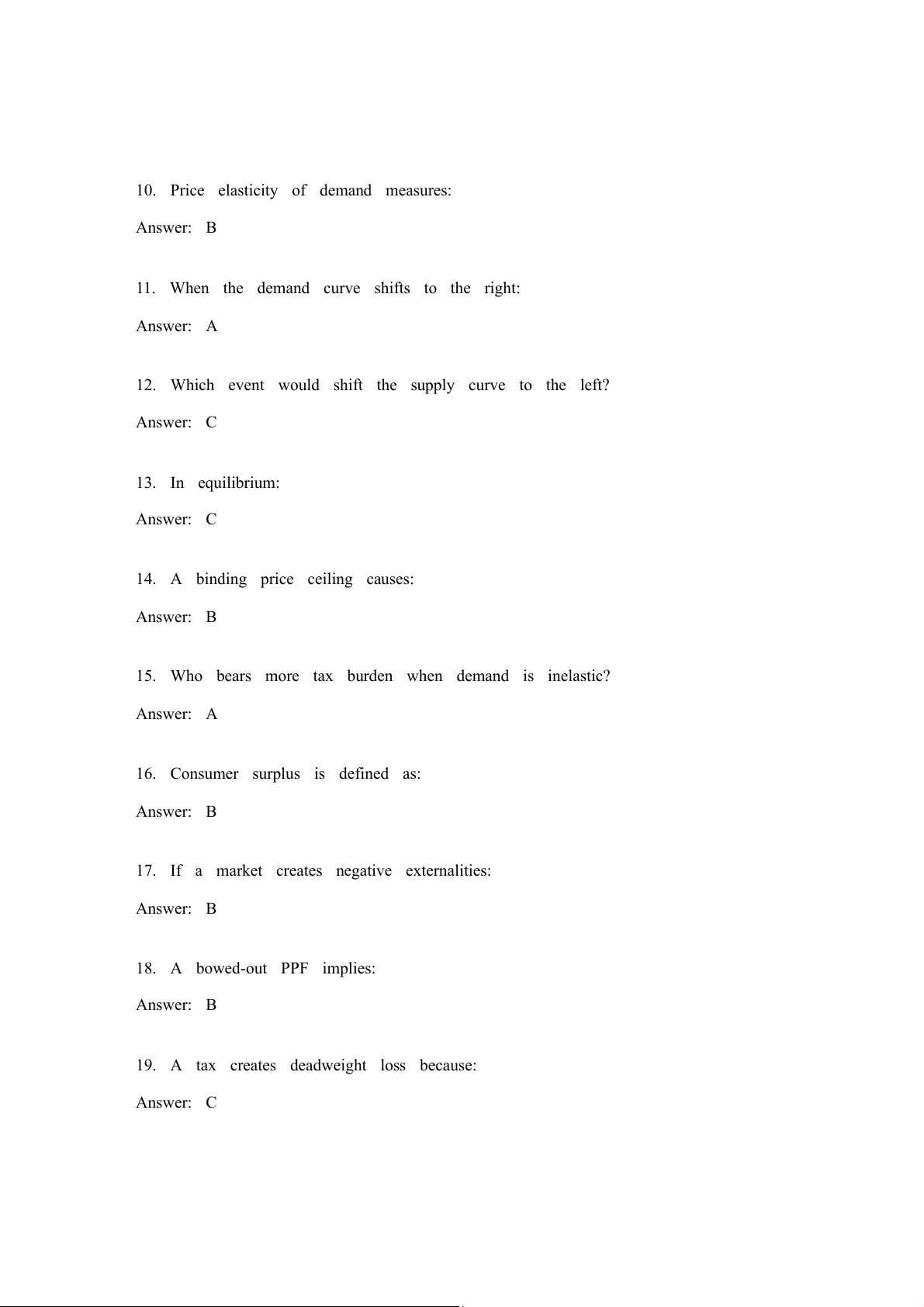
10. Price elasticity of demand measures: Answer: B
11. When the demand curve shifts to the right: Answer: A
12. Which event would shift the supply curve to the left? Answer: C 13. In equilibrium: Answer: C
14. A binding price ceiling causes: Answer: B
15. Who bears more tax burden when demand is inelastic? Answer: A
16. Consumer surplus is defined as: Answer: B
17. If a market creates negative externalities: Answer: B 18. A bowed-out PPF implies: Answer: B
19. A tax creates deadweight loss because: Answer: C
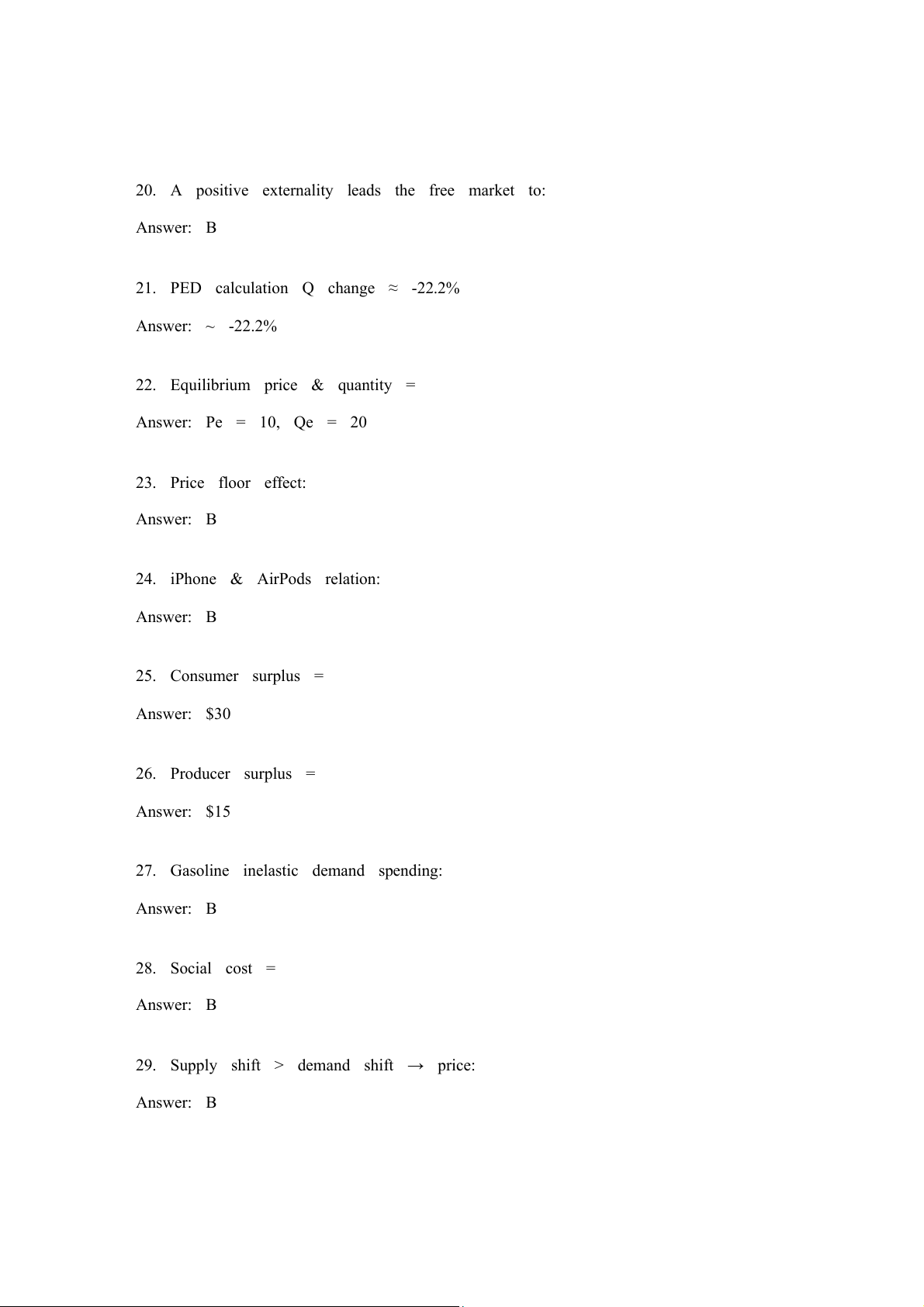
20. A positive externality leads the free market to: Answer: B
21. PED calculation Q change ≈ -22.2% Answer: ~ -22.2%
22. Equilibrium price & quantity = Answer: Pe = 10, Qe = 20 23. Price floor effect: Answer: B
24. iPhone & AirPods relation: Answer: B 25. Consumer surplus = Answer: $30 26. Producer surplus = Answer: $15
27. Gasoline inelastic demand spending: Answer: B 28. Social cost = Answer: B
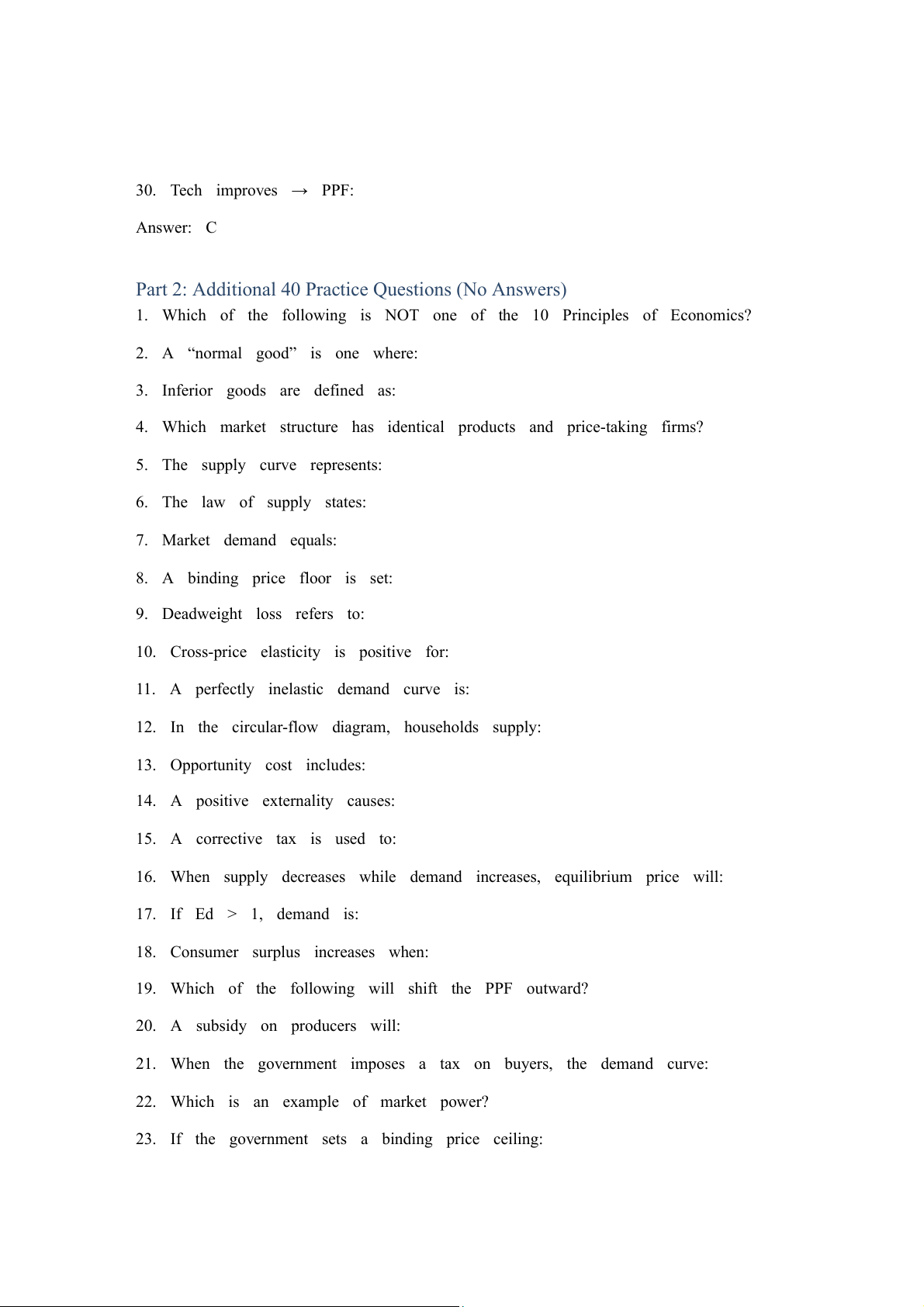
29. Supply shift > demand shift → price: Answer: B 30. Tech improves → PPF: Answer: C
Part 2: Additional 40 Practice Questions (No Answers)
1. Which of the following is NOT one of the 10 Principles of Economics?
2. A “normal good” is one where:
3. Inferior goods are defined as:
4. Which market structure has identical products and price-taking firms?
5. The supply curve represents: 6. The law of supply states: 7. Market demand equals:
8. A binding price floor is set: 9. Deadweight loss refers to:
10. Cross-price elasticity is positive for:
11. A perfectly inelastic demand curve is:
12. In the circular-flow diagram, households supply: 13. Opportunity cost includes:
14. A positive externality causes:
15. A corrective tax is used to:
16. When supply decreases while demand increases, equilibrium price will: 17. If Ed > 1, demand is:
18. Consumer surplus increases when:
19. Which of the following will shift the PPF outward?
20. A subsidy on producers will:
21. When the government imposes a tax on buyers, the demand curve:
22. Which is an example of market power?
23. If the government sets a binding price ceiling:
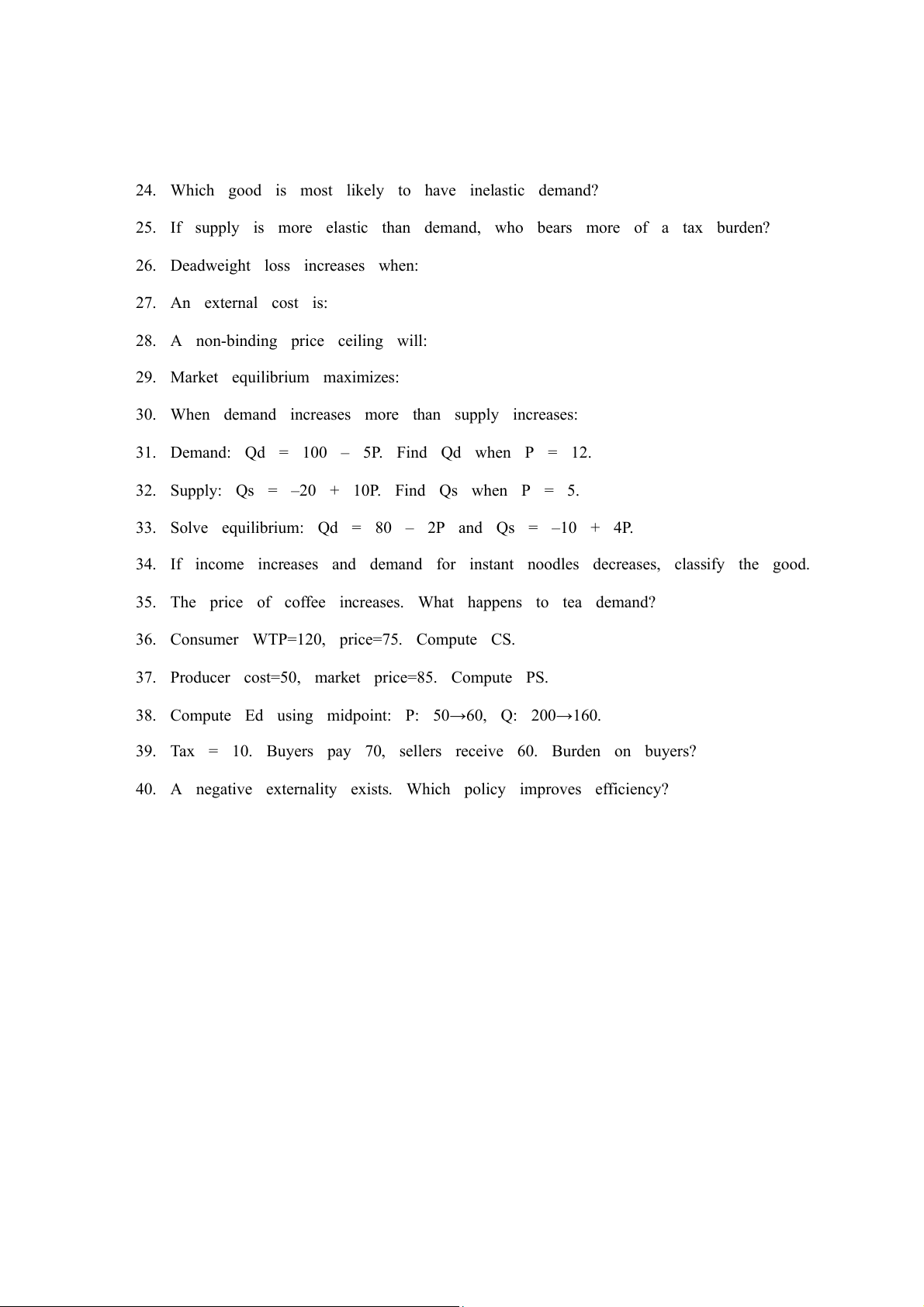
24. Which good is most likely to have inelastic demand?
25. If supply is more elastic than demand, who bears more of a tax burden?
26. Deadweight loss increases when: 27. An external cost is:
28. A non-binding price ceiling will:
29. Market equilibrium maximizes:
30. When demand increases more than supply increases:
31. Demand: Qd = 100 – 5P. Find Qd when P = 12.
32. Supply: Qs = –20 + 10P. Find Qs when P = 5.
33. Solve equilibrium: Qd = 80 – 2P and Qs = –10 + 4P.
34. If income increases and demand for instant noodles decreases, classify the good.
35. The price of coffee increases. What happens to tea demand?
36. Consumer WTP=120, price=75. Compute CS.
37. Producer cost=50, market price=85. Compute PS.
38. Compute Ed using midpoint: P: 50→60, Q: 200→160.
39. Tax = 10. Buyers pay 70, sellers receive 60. Burden on buyers?
40. A negative externality exists. Which policy improves efficiency?
Tài liệu liên quan:
-
Chương 3: độ co giãn và các nhân tố ảnh hưởng | Microeconomics | Trường Đại học Quốc tế, Đại học Quốc gia Thành phố Hồ Chí Minh
5 3 -
Microeconomics Syllabus | Microeconomics | Trường Đại học Quốc tế, Đại học Quốc gia Thành phố Hồ Chí Minh
5 3 -
Microeconomics Course Syllabus & Assessment Details | Microeconomics | Trường Đại học Quốc tế, Đại học Quốc gia Thành phố Hồ Chí Minh
5 3 -
Assignment 3 - Elasticity MCQs and Key Concepts | Microeconomics | Trường Đại học Quốc tế, Đại học Quốc gia Thành phố Hồ Chí Minh
5 3 -
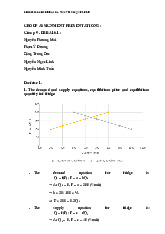
Assignment 2 - Economic Equilibrium Analysis of Fridges and Motorcycles | Microeconomics | Trường Đại học Quốc tế, Đại học Quốc gia Thành phố Hồ Chí Minh
5 3