Microeconomics Syllabus - Advanced Educational Program | Microeconomics | Trường Đại học Quốc tế, Đại học Quốc gia Thành phố Hồ Chí Minh
The main objective of the course is to improve economic literacy as well as critical thinking and problem solving skills to explain and predict economic issues. Tài liệu được sưu tầm và soạn thảo dưới dạng file PDF với mục đích hỗ trợ học tập và tham khảo. Nội dung tài liệu được trình bày rõ ràng, dễ tiếp cận, phù hợp cho việc ôn tập và củng cố kiến thức trong quá trình học đại học. Đây sẽ là nguồn tư liệu hữu ích giúp các bạn sinh viên chuẩn bị tốt hơn cho các buổi học, đồng thời mở rộng thêm hiểu biết về môn học. Hy vọng tài liệu này sẽ mang lại nhiều giá trị và hỗ trợ các bạn trong hành trình học tập. Mời bạn đọc cùng tham khảo!
Môn: Microeconomics 635 tài liệu
Trường: Trường Đại học Quốc tế, Đại học Quốc gia Thành phố Hồ Chí Minh 1.9 K tài liệu
Tác giả:

Preview text:
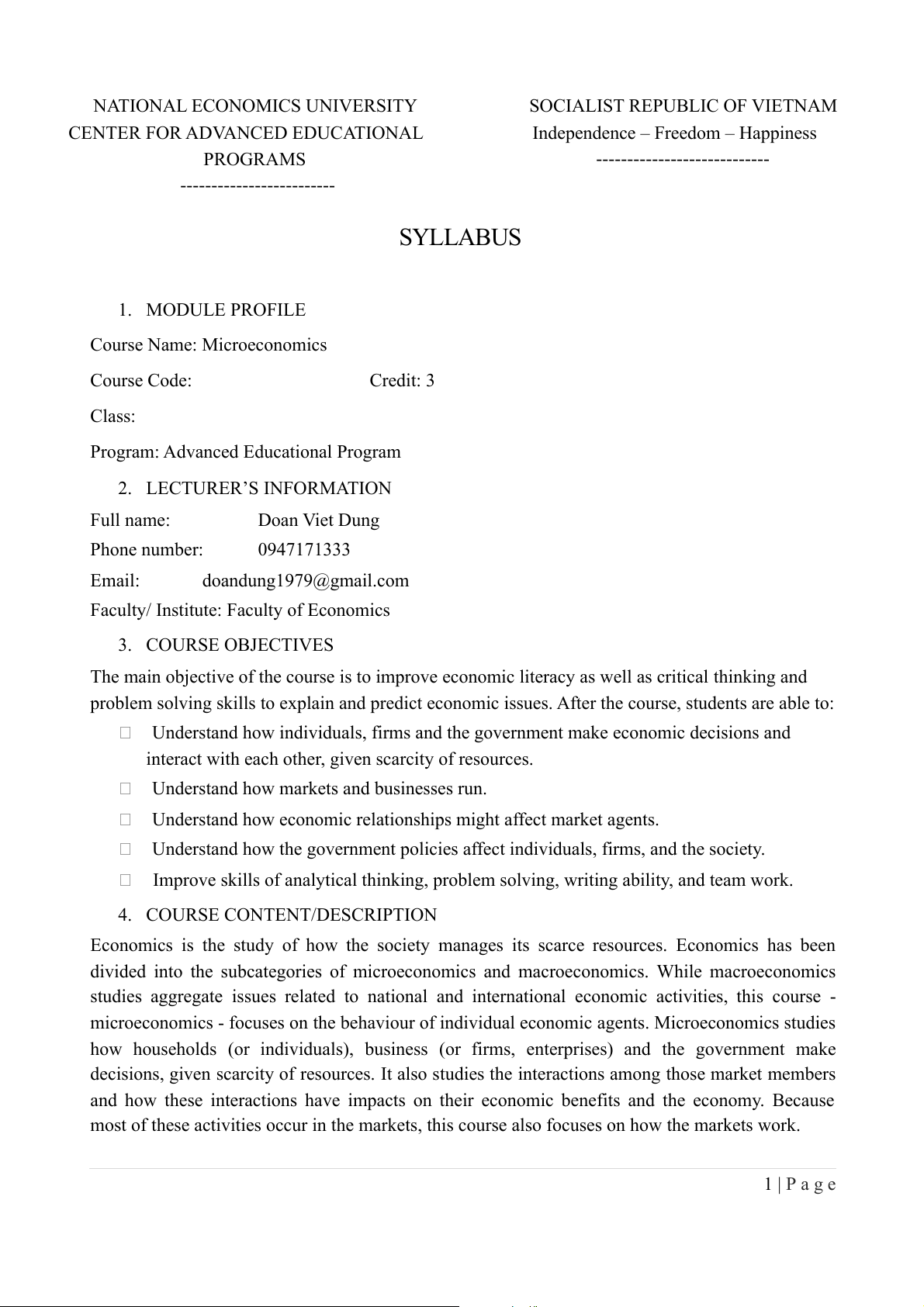
NATIONAL ECONOMICS UNIVERSITY SOCIALIST REPUBLIC OF VIETNAM
CENTER FOR ADVANCED EDUCATIONAL
Independence – Freedom – Happiness PROGRAMS ---------------------------- ------------------------- SYLLABUS 1. MODULE PROFILE Course Name: Microeconomics Course Code: Credit: 3 Class:
Program: Advanced Educational Program 2. LECTURER’S INFORMATION Full name: Doan Viet Dung Phone number: 0947171333 Email: doandung1979@gmail.com
Faculty/ Institute: Faculty of Economics 3. COURSE OBJECTIVES
The main objective of the course is to improve economic literacy as well as critical thinking and
problem solving skills to explain and predict economic issues. After the course, students are able to:
Understand how individuals, firms and the government make economic decisions and
interact with each other, given scarcity of resources.
Understand how markets and businesses run.
Understand how economic relationships might affect market agents.
Understand how the government policies affect individuals, firms, and the society.
Improve skills of analytical thinking, problem solving, writing ability, and team work. 4. COURSE CONTENT/DESCRIPTION
Economics is the study of how the society manages its scarce resources. Economics has been
divided into the subcategories of microeconomics and macroeconomics. While macroeconomics
studies aggregate issues related to national and international economic activities, this course -
microeconomics - focuses on the behaviour of individual economic agents. Microeconomics studies
how households (or individuals), business (or firms, enterprises) and the government make
decisions, given scarcity of resources. It also studies the interactions among those market members
and how these interactions have impacts on their economic benefits and the economy. Because
most of these activities occur in the markets, this course also focuses on how the markets work. 1 | P a g e 5. DETAILED CLASS SCHEDULE
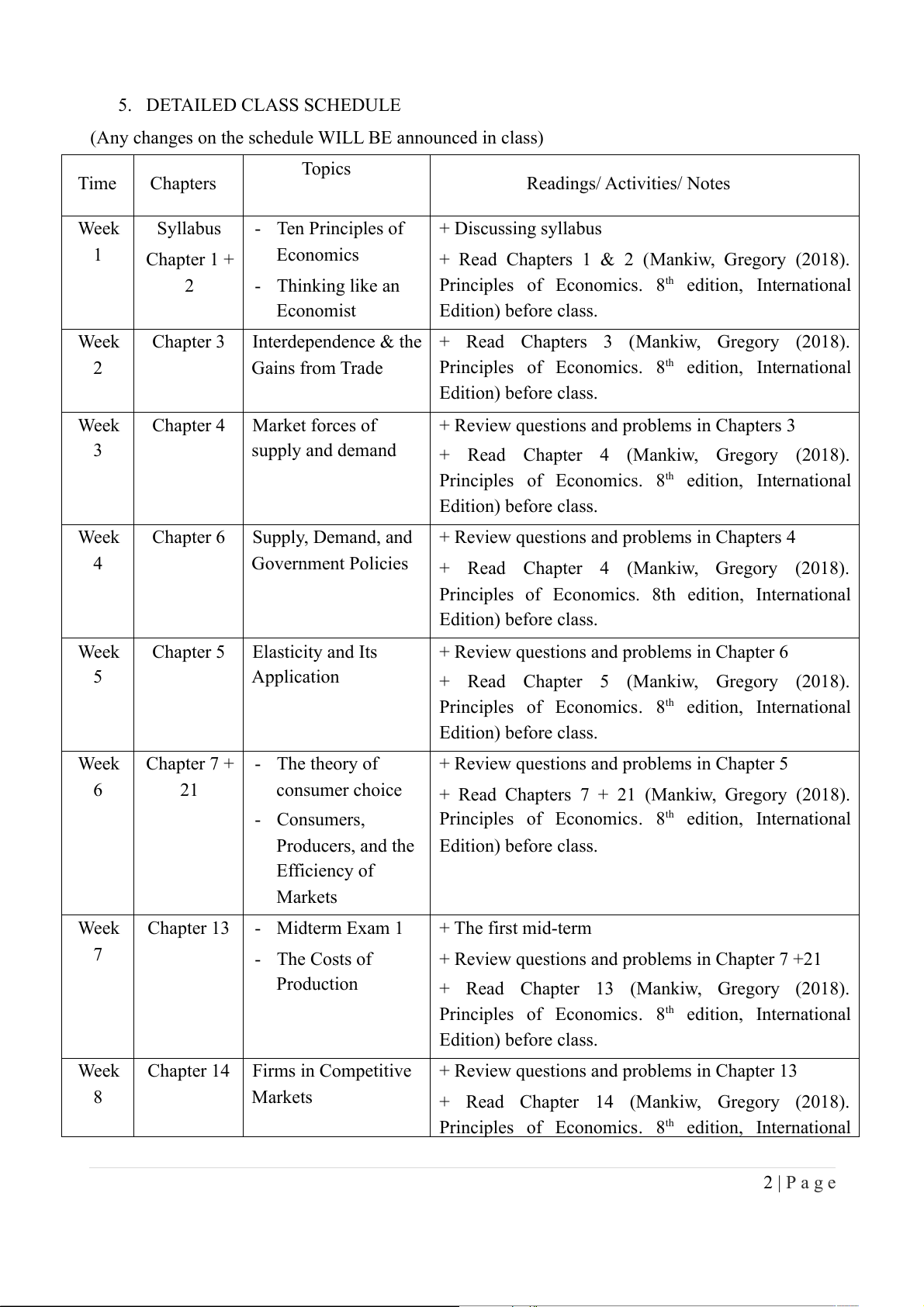
(Any changes on the schedule WILL BE announced in class) Topics Time Chapters Readings/ Activities/ Notes Week Syllabus - Ten Principles of + Discussing syllabus 1 Chapter 1 + Economics
+ Read Chapters 1 & 2 (Mankiw, Gregory (2018). 2 - Thinking like an
Principles of Economics. 8th edition, International Economist Edition) before class. Week Chapter 3
Interdependence & the + Read Chapters 3 (Mankiw, Gregory (2018). 2 Gains from Trade
Principles of Economics. 8th edition, International Edition) before class. Week Chapter 4 Market forces of
+ Review questions and problems in Chapters 3 3 supply and demand
+ Read Chapter 4 (Mankiw, Gregory (2018).
Principles of Economics. 8th edition, International Edition) before class. Week Chapter 6 Supply, Demand, and
+ Review questions and problems in Chapters 4 4 Government Policies
+ Read Chapter 4 (Mankiw, Gregory (2018).
Principles of Economics. 8th edition, International Edition) before class. Week Chapter 5 Elasticity and Its
+ Review questions and problems in Chapter 6 5 Application
+ Read Chapter 5 (Mankiw, Gregory (2018).
Principles of Economics. 8th edition, International Edition) before class. Week Chapter 7 + - The theory of
+ Review questions and problems in Chapter 5 6 21 consumer choice
+ Read Chapters 7 + 21 (Mankiw, Gregory (2018). - Consumers,
Principles of Economics. 8th edition, International
Producers, and the Edition) before class. Efficiency of Markets Week Chapter 13 - Midterm Exam 1 + The first mid-term 7 - The Costs of
+ Review questions and problems in Chapter 7 +21 Production
+ Read Chapter 13 (Mankiw, Gregory (2018).
Principles of Economics. 8th edition, International Edition) before class. Week Chapter 14 Firms in Competitive
+ Review questions and problems in Chapter 13 8 Markets
+ Read Chapter 14 (Mankiw, Gregory (2018).
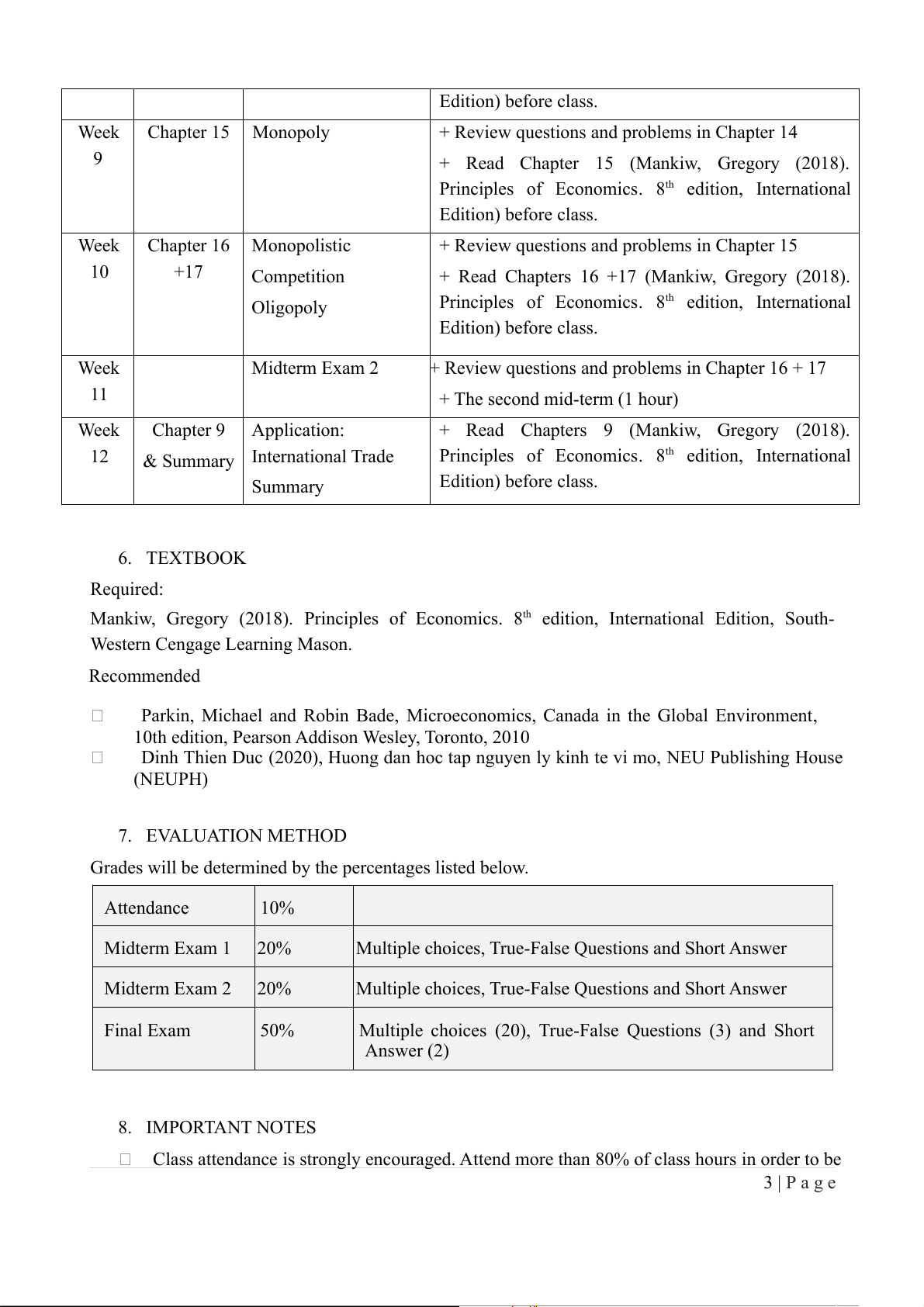
Principles of Economics. 8th edition, International 2 | P a g e Edition) before class. Week Chapter 15 Monopoly
+ Review questions and problems in Chapter 14 9
+ Read Chapter 15 (Mankiw, Gregory (2018).
Principles of Economics. 8th edition, International Edition) before class. Week Chapter 16 Monopolistic
+ Review questions and problems in Chapter 15 10 +17 Competition
+ Read Chapters 16 +17 (Mankiw, Gregory (2018). Oligopoly
Principles of Economics. 8th edition, International Edition) before class. Week Midterm Exam 2
+ Review questions and problems in Chapter 16 + 17 11 + The second mid-term (1 hour) Week Chapter 9 Application:
+ Read Chapters 9 (Mankiw, Gregory (2018). 12
& Summary International Trade
Principles of Economics. 8th edition, International Summary Edition) before class. 6. TEXTBOOK Required:
Mankiw, Gregory (2018). Principles of .
Economics 8th edition, International Edition, South-
Western Cengage Learning Mason. Recommended
Parkin, Michael and Robin Bade, Microeconomics, Canada in the Global Environment,
10th edition, Pearson Addison Wesley, Toronto, 2010
Dinh Thien Duc (2020), Huong dan hoc tap nguyen ly kinh te vi mo, NEU Publishing House (NEUPH) 7. EVALUATION METHOD
Grades will be determined by the percentages listed below. Attendance 10% Midterm Exam 1 20%
Multiple choices, True-False Questions and Short Answer Midterm Exam 2 20%
Multiple choices, True-False Questions and Short Answer Final Exam 50%
Multiple choices (20), True-False Questions (3) and Short Answer (2) 8. IMPORTANT NOTES
Class attendance is strongly encouraged. Attend more than 80% of class hours in order to be 3 | P a g e
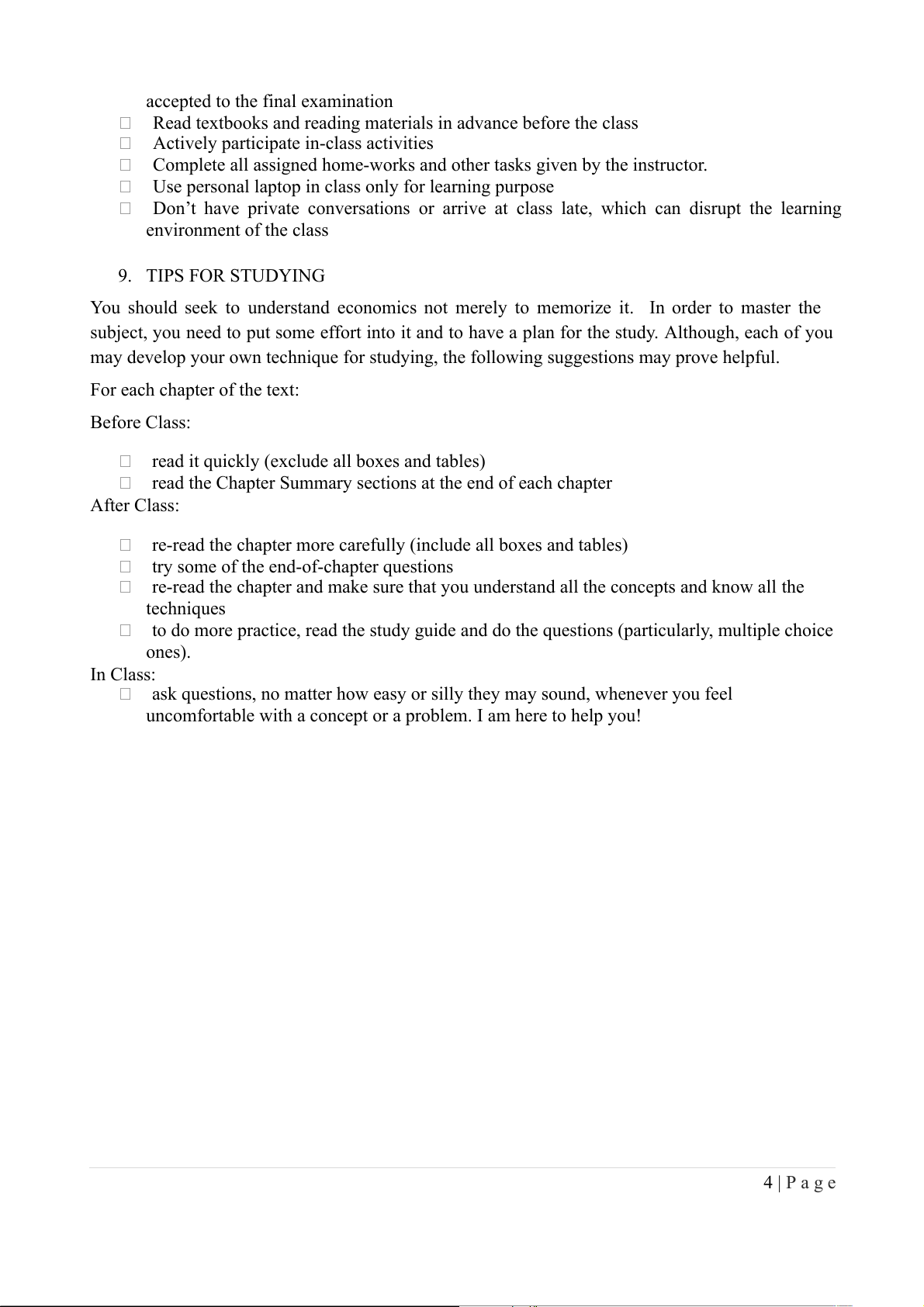
accepted to the final examination
Read textbooks and reading materials in advance before the class
Actively participate in-class activities
Complete all assigned home-works and other tasks given by the instructor.
Use personal laptop in class only for learning purpose
Don’t have private conversations or arrive at class late, which can disrupt the learning environment of the class 9. TIPS FOR STUDYING You should seek to
understand economics not merely to
memorize it. In order to master the
subject, you need to put some effort into it and to have a plan for the study. Although, each of you
may develop your own technique for studying, the following suggestions may prove helpful. For each chapter of the text: Before Class:
read it quickly (exclude all boxes and tables)
read the Chapter Summary sections at the end of each chapter After Class:
re-read the chapter more carefully (include all boxes and tables)
try some of the end-of-chapter questions
re-read the chapter and make sure that you understand all the concepts and know all the techniques
to do more practice, read the study guide and do the questions (particularly, multiple choice ones).
In Class:ask questions, no matter how easy or silly they may sound, whenever you feel
uncomfortable with a concept or a problem. I am here to help you! 4 | P a g e
Tài liệu liên quan:
-
Chương 3: độ co giãn và các nhân tố ảnh hưởng | Microeconomics | Trường Đại học Quốc tế, Đại học Quốc gia Thành phố Hồ Chí Minh
3 2 -
Microeconomics Syllabus | Microeconomics | Trường Đại học Quốc tế, Đại học Quốc gia Thành phố Hồ Chí Minh
3 2 -
Microeconomics Course Syllabus & Assessment Details | Microeconomics | Trường Đại học Quốc tế, Đại học Quốc gia Thành phố Hồ Chí Minh
3 2 -
Assignment 3 - Elasticity MCQs and Key Concepts | Microeconomics | Trường Đại học Quốc tế, Đại học Quốc gia Thành phố Hồ Chí Minh
3 2 -
Assignment 2 - Economic Equilibrium Analysis of Fridges and Motorcycles | Microeconomics | Trường Đại học Quốc tế, Đại học Quốc gia Thành phố Hồ Chí Minh
3 2