Microeconomics Test Bank Chapter 16 - The Great Depression Insights | Microeconomics | Trường Đại học Quốc tế, Đại học Quốc gia Thành phố Hồ Chí Minh
Macroeconomics first developed as a new subfield of economics A) when Adolph Hitler ordered economists to learn more about national economies. B) following the oil price increases of the 1970s. C) as a result of Adam Smith's publication of The Wealth of Nations in 1776. D) in response to the severe economic hardships of the Great. Tài liệu được sưu tầm và soạn thảo dưới dạng file PDF để gửi tới các bạn cùng tham khảo, ôn tập đầy đủ kiến thức, chuẩn bị cho các buổi học thật tốt. Mời bạn đọc đón xem!
Môn: Microeconomics 635 tài liệu
Trường: Trường Đại học Quốc tế, Đại học Quốc gia Thành phố Hồ Chí Minh 1.9 K tài liệu
Tác giả:




Preview text:
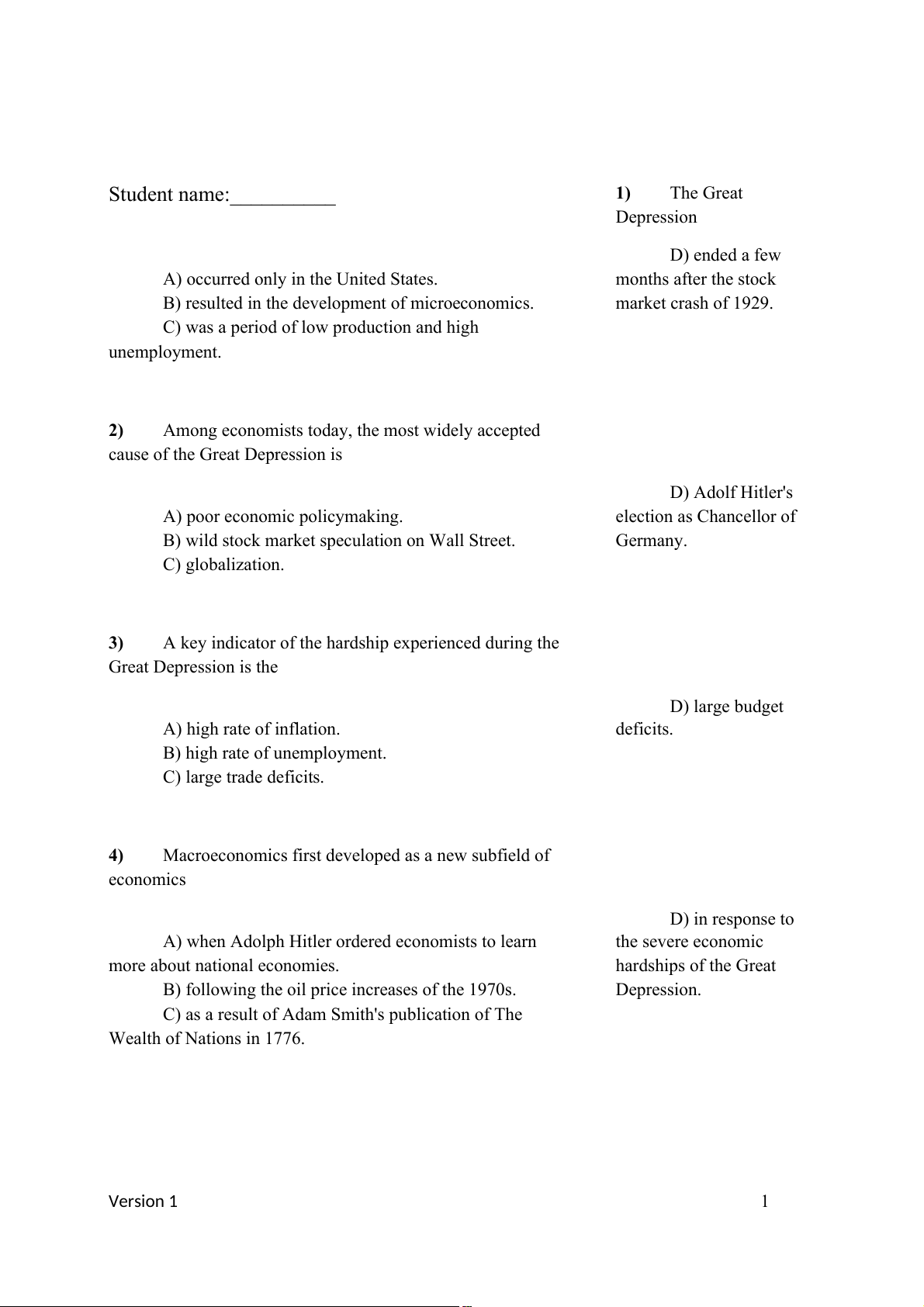
Student name:__________ 1) The Great Depression D) ended a few
A) occurred only in the United States. months after the stock
B) resulted in the development of microeconomics. market crash of 1929.
C) was a period of low production and high unemployment. 2)
Among economists today, the most widely accepted
cause of the Great Depression is D) Adolf Hitler's A) poor economic policymaking. election as Chancellor of
B) wild stock market speculation on Wall Street. Germany. C) globalization. 3)
A key indicator of the hardship experienced during the Great Depression is the D) large budget A) high rate of inflation. deficits. B) high rate of unemployment. C) large trade deficits. 4)
Macroeconomics first developed as a new subfield of economics D) in response to
A) when Adolph Hitler ordered economists to learn the severe economic more about national economies. hardships of the Great
B) following the oil price increases of the 1970s. Depression.
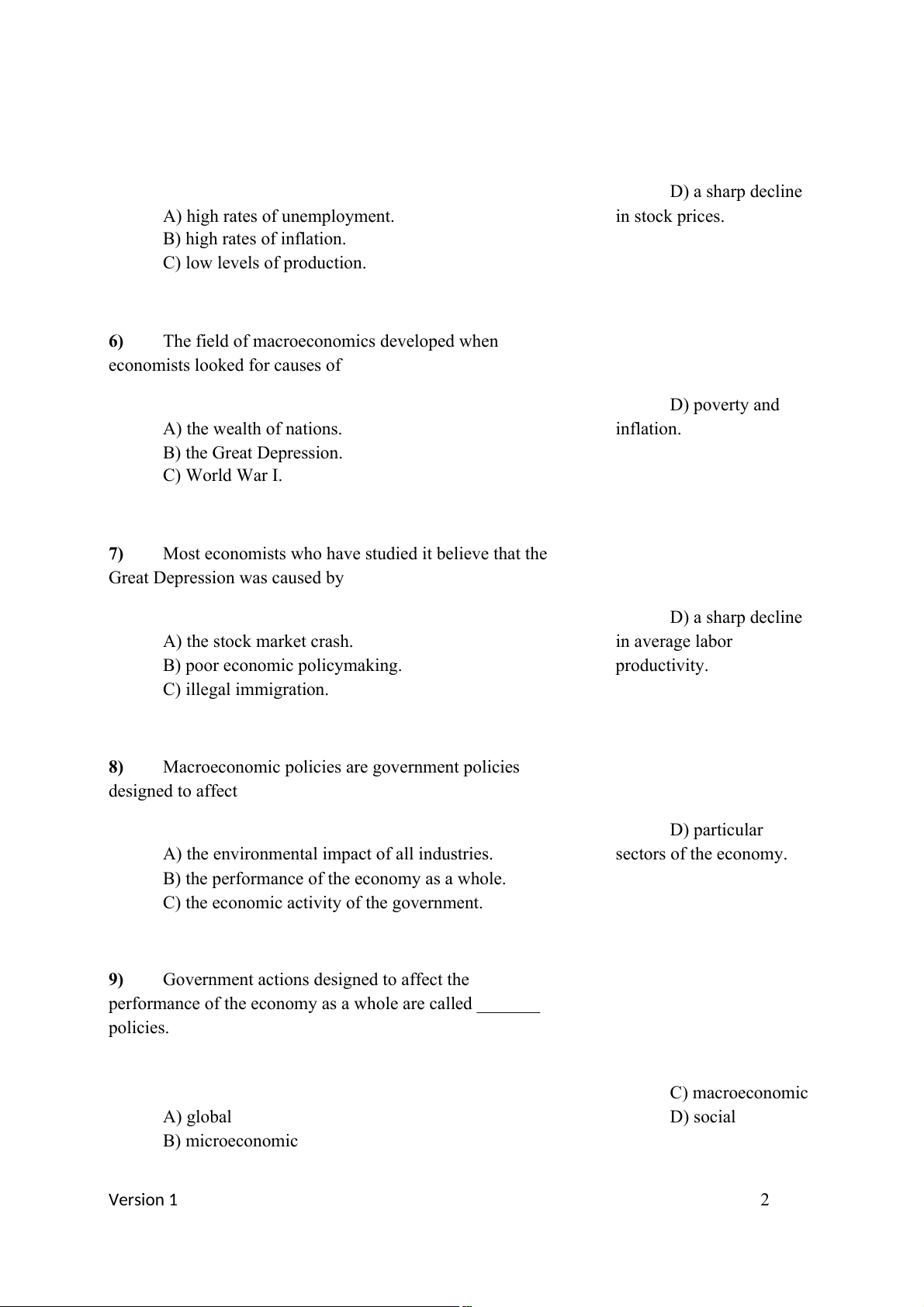
C) as a result of Adam Smith's publication of The Wealth of Nations in 1776. Version 1 1 D) a sharp decline A) high rates of unemployment. in stock prices. B) high rates of inflation. C) low levels of production. 6)
The field of macroeconomics developed when
economists looked for causes of D) poverty and A) the wealth of nations. inflation. B) the Great Depression. C) World War I. 7)
Most economists who have studied it believe that the Great Depression was caused by D) a sharp decline A) the stock market crash. in average labor B) poor economic policymaking. productivity. C) illegal immigration. 8)
Macroeconomic policies are government policies designed to affect D) particular
A) the environmental impact of all industries. sectors of the economy.
B) the performance of the economy as a whole.
C) the economic activity of the government. 9)
Government actions designed to affect the
performance of the economy as a whole are called _______ policies. C) macroeconomic A) global D) social B) microeconomic Version 1 2 10)
Since 1950, the standard of living in the United States has D) decreased when
A) increased when measured by output per person, but measured by both total
decreased when measured by total output. output and output per
B) increased when measured by both total output and person. output per person.
C) decreased when measured by output per person, but
increased when measured by total output. 11)
The degree to which people have access to goods and
services that make their lives easier, healthier, safer, and more enjoyable is called the D) standard of A) microeconomic standard. living. B) global standard. C) scarcity standard. 12)
People who enjoy high standards of living usually
have all of the following except: D) better general A) higher literacy rates. health. B) longer life expectancies. C) freedom from scarcity. 13)
The standard of living in an economy is best measured by D) the inflation A) average labor productivity. rate. B) total output. C) output per person. Version 1 3 14)
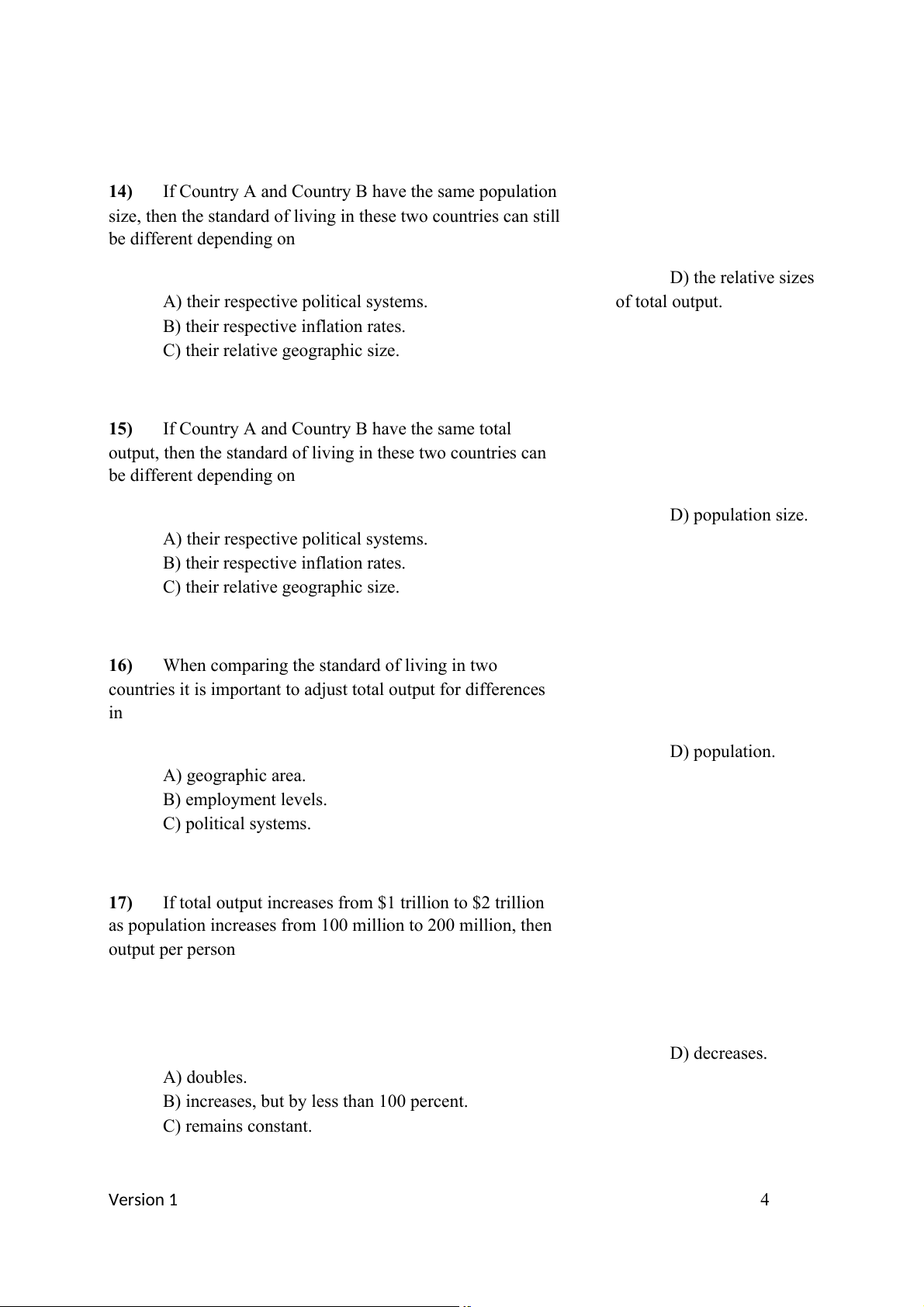
If Country A and Country B have the same population
size, then the standard of living in these two countries can still be different depending on D) the relative sizes
A) their respective political systems. of total output.
B) their respective inflation rates.
C) their relative geographic size. 15)
If Country A and Country B have the same total
output, then the standard of living in these two countries can be different depending on D) population size.
A) their respective political systems.
B) their respective inflation rates.
C) their relative geographic size. 16)
When comparing the standard of living in two
countries it is important to adjust total output for differences in D) population. A) geographic area. B) employment levels. C) political systems. 17)
If total output increases from $1 trillion to $2 trillion
as population increases from 100 million to 200 million, then output per person D) decreases. A) doubles.
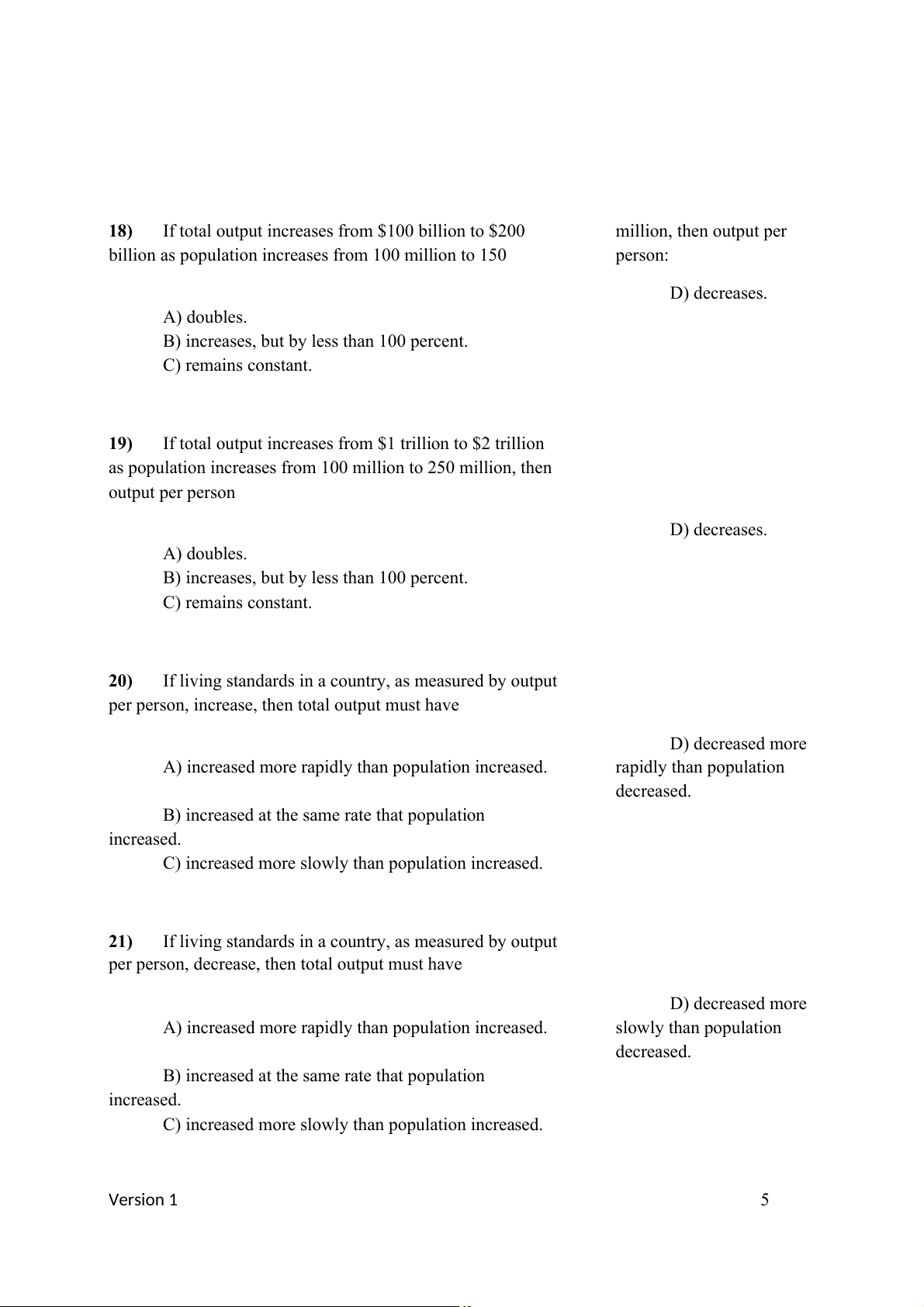
B) increases, but by less than 100 percent. C) remains constant. Version 1 4 18)
If total output increases from $100 billion to $200 million, then output per
billion as population increases from 100 million to 150 person: D) decreases. A) doubles.
B) increases, but by less than 100 percent. C) remains constant. 19)
If total output increases from $1 trillion to $2 trillion
as population increases from 100 million to 250 million, then output per person D) decreases. A) doubles.
B) increases, but by less than 100 percent. C) remains constant. 20)
If living standards in a country, as measured by output
per person, increase, then total output must have D) decreased more
A) increased more rapidly than population increased. rapidly than population decreased.
B) increased at the same rate that population increased.
C) increased more slowly than population increased. 21)
If living standards in a country, as measured by output
per person, decrease, then total output must have D) decreased more
A) increased more rapidly than population increased. slowly than population decreased.
B) increased at the same rate that population increased.
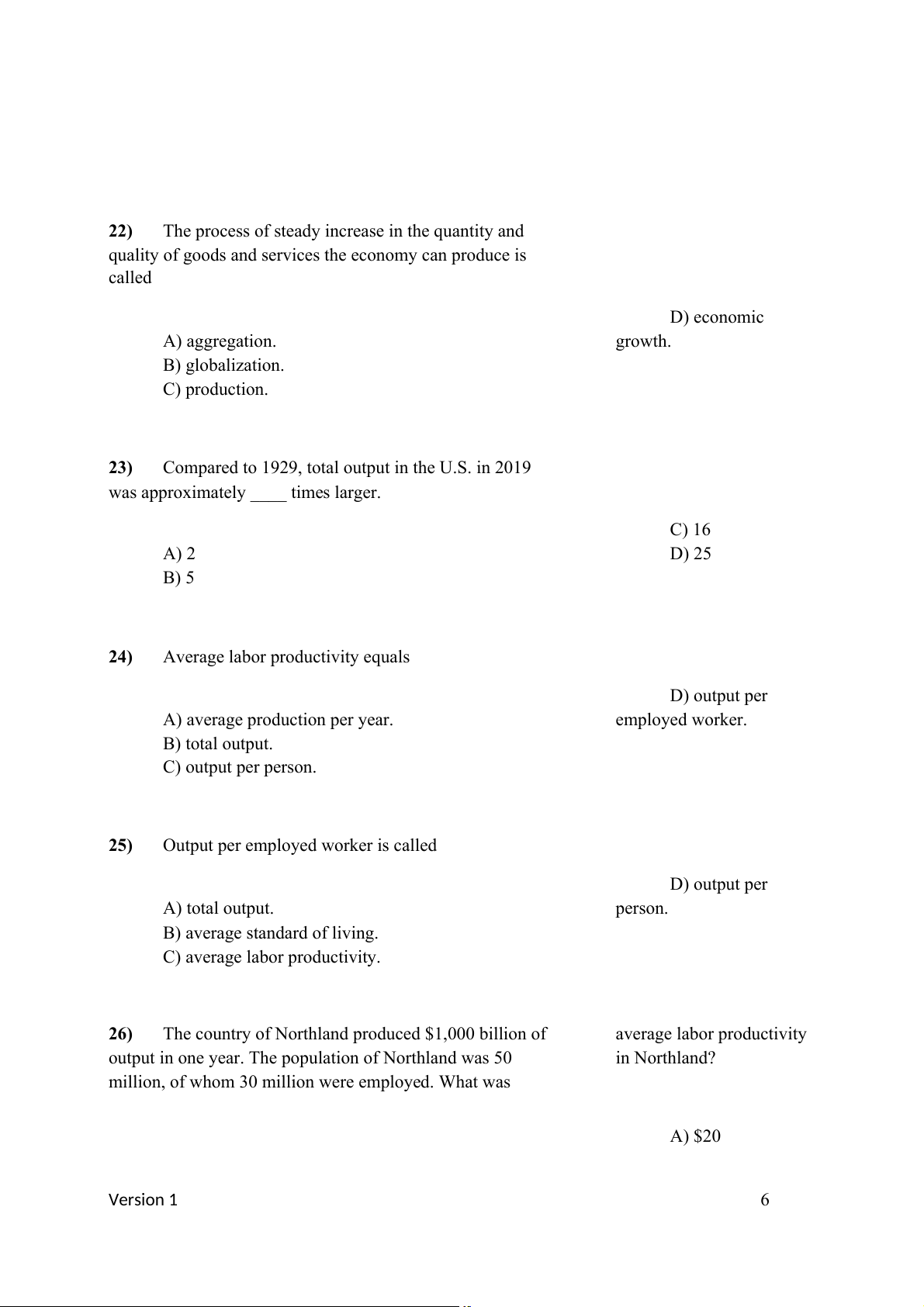
C) increased more slowly than population increased. Version 1 5 22)
The process of steady increase in the quantity and
quality of goods and services the economy can produce is called D) economic A) aggregation. growth. B) globalization. C) production. 23)
Compared to 1929, total output in the U.S. in 2019
was approximately ____ times larger. C) 16 A) 2 D) 25 B) 5 24)
Average labor productivity equals D) output per
A) average production per year. employed worker. B) total output. C) output per person. 25)
Output per employed worker is called D) output per A) total output. person. B) average standard of living. C) average labor productivity. 26)
The country of Northland produced $1,000 billion of average labor productivity
output in one year. The population of Northland was 50 in Northland?
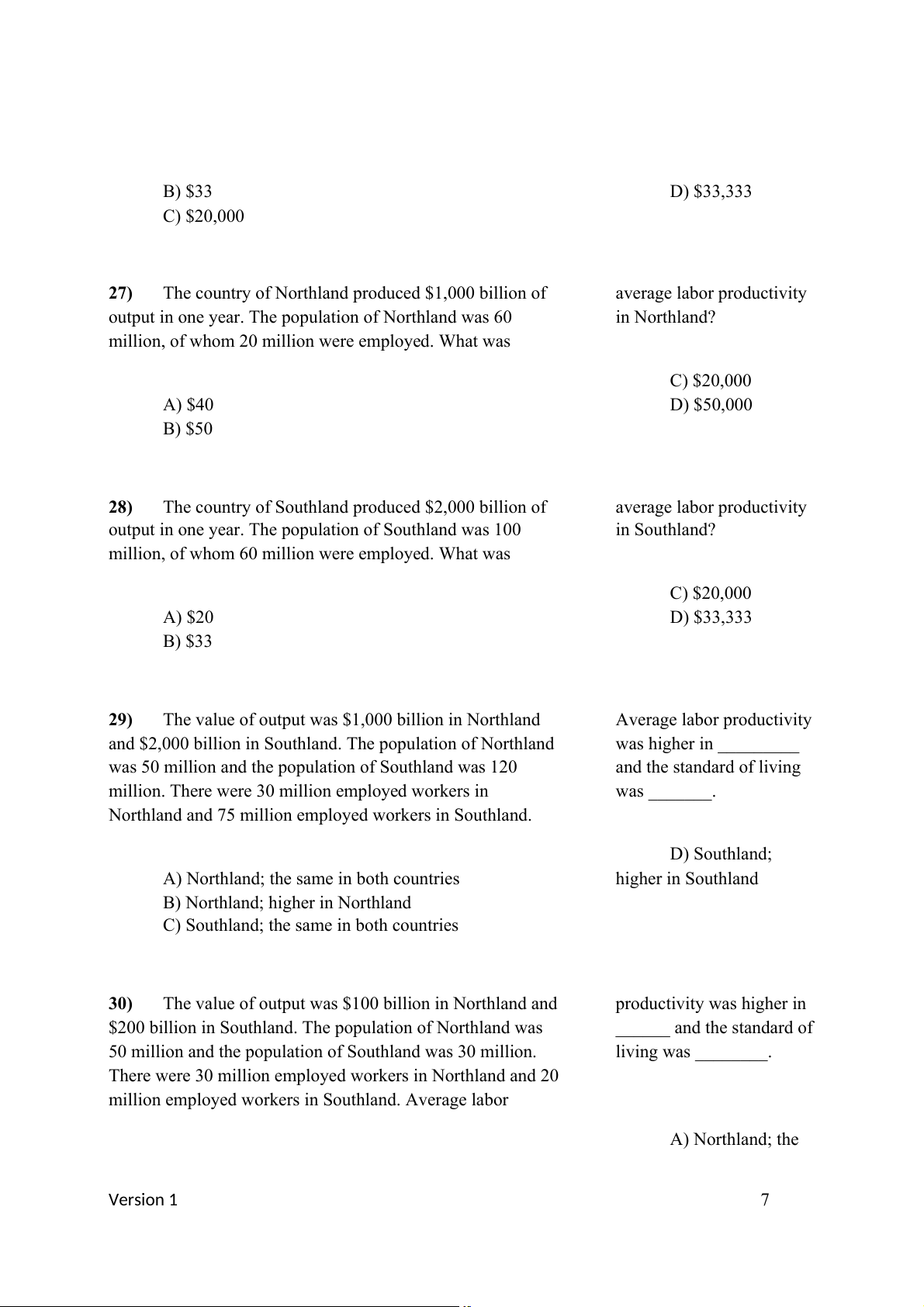
million, of whom 30 million were employed. What was A) $20 Version 1 6 B) $33 D) $33,333 C) $20,000 27)
The country of Northland produced $1,000 billion of average labor productivity
output in one year. The population of Northland was 60 in Northland?
million, of whom 20 million were employed. What was C) $20,000 A) $40 D) $50,000 B) $50 28)
The country of Southland produced $2,000 billion of average labor productivity
output in one year. The population of Southland was 100 in Southland?
million, of whom 60 million were employed. What was C) $20,000 A) $20 D) $33,333 B) $33 29)
The value of output was $1,000 billion in Northland Average labor productivity
and $2,000 billion in Southland. The population of Northland was higher in _________
was 50 million and the population of Southland was 120 and the standard of living
million. There were 30 million employed workers in was _______.
Northland and 75 million employed workers in Southland. D) Southland;
A) Northland; the same in both countries higher in Southland
B) Northland; higher in Northland
C) Southland; the same in both countries 30)
The value of output was $100 billion in Northland and productivity was higher in
$200 billion in Southland. The population of Northland was ______ and the standard of
50 million and the population of Southland was 30 million. living was ________.
There were 30 million employed workers in Northland and 20
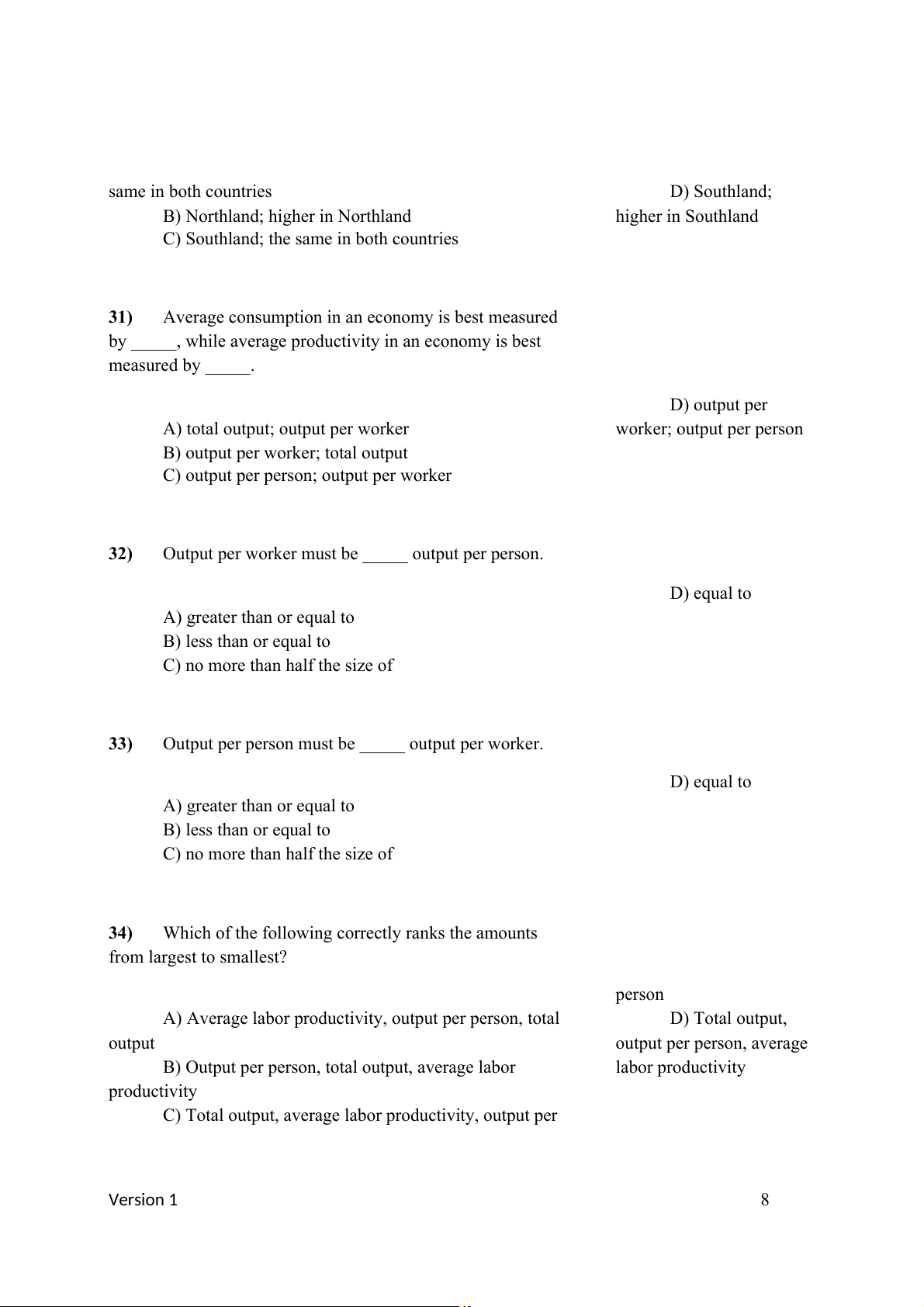
million employed workers in Southland. Average labor A) Northland; the Version 1 7 same in both countries D) Southland;
B) Northland; higher in Northland higher in Southland
C) Southland; the same in both countries 31)
Average consumption in an economy is best measured
by _____, while average productivity in an economy is best measured by _____. D) output per
A) total output; output per worker worker; output per person
B) output per worker; total output
C) output per person; output per worker 32)
Output per worker must be _____ output per person. D) equal to A) greater than or equal to B) less than or equal to
C) no more than half the size of 33)
Output per person must be _____ output per worker. D) equal to A) greater than or equal to B) less than or equal to
C) no more than half the size of 34)
Which of the following correctly ranks the amounts from largest to smallest? person
A) Average labor productivity, output per person, total D) Total output, output output per person, average
B) Output per person, total output, average labor labor productivity productivity
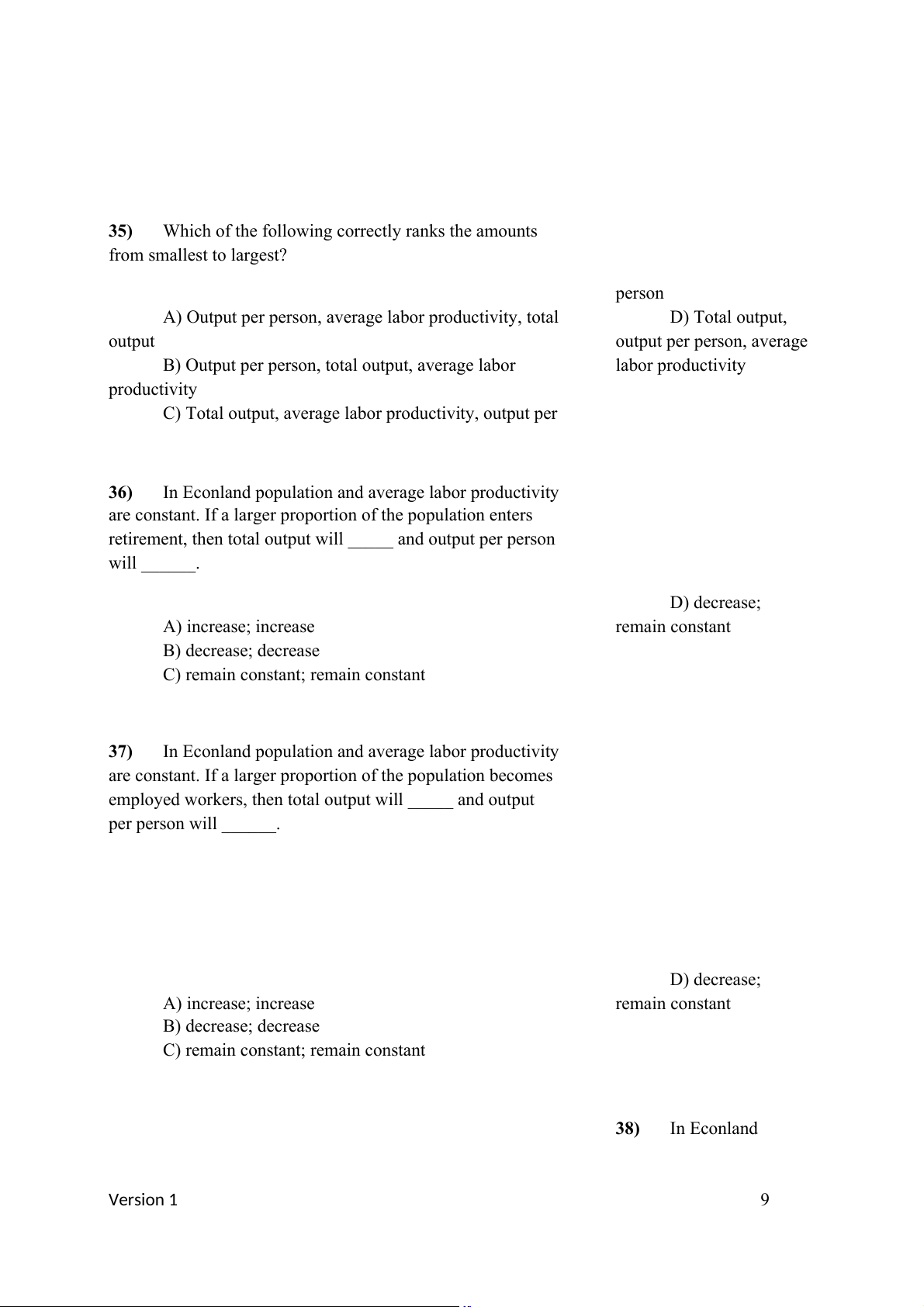
C) Total output, average labor productivity, output per Version 1 8 35)
Which of the following correctly ranks the amounts from smallest to largest? person
A) Output per person, average labor productivity, total D) Total output, output output per person, average
B) Output per person, total output, average labor labor productivity productivity
C) Total output, average labor productivity, output per 36)
In Econland population and average labor productivity
are constant. If a larger proportion of the population enters
retirement, then total output will _____ and output per person will ______. D) decrease; A) increase; increase remain constant B) decrease; decrease
C) remain constant; remain constant 37)
In Econland population and average labor productivity
are constant. If a larger proportion of the population becomes
employed workers, then total output will _____ and output per person will ______. D) decrease; A) increase; increase remain constant B) decrease; decrease
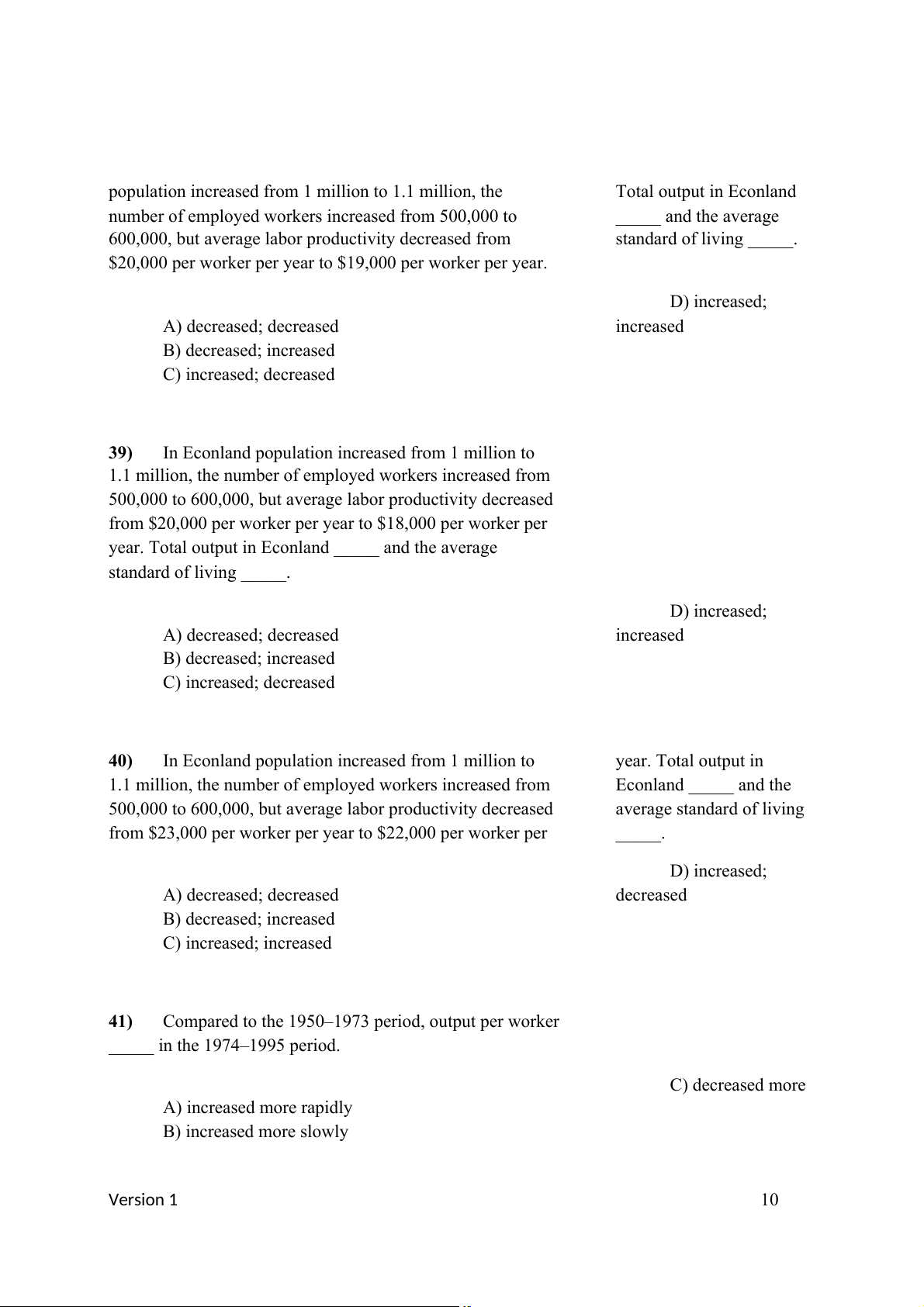
C) remain constant; remain constant 38) In Econland Version 1 9
population increased from 1 million to 1.1 million, the Total output in Econland
number of employed workers increased from 500,000 to _____ and the average
600,000, but average labor productivity decreased from standard of living _____.
$20,000 per worker per year to $19,000 per worker per year. D) increased; A) decreased; decreased increased B) decreased; increased C) increased; decreased 39)
In Econland population increased from 1 million to
1.1 million, the number of employed workers increased from
500,000 to 600,000, but average labor productivity decreased
from $20,000 per worker per year to $18,000 per worker per
year. Total output in Econland _____ and the average standard of living _____. D) increased; A) decreased; decreased increased B) decreased; increased C) increased; decreased 40)
In Econland population increased from 1 million to year. Total output in
1.1 million, the number of employed workers increased from Econland _____ and the
500,000 to 600,000, but average labor productivity decreased average standard of living
from $23,000 per worker per year to $22,000 per worker per _____. D) increased; A) decreased; decreased decreased B) decreased; increased C) increased; increased 41)
Compared to the 1950–1973 period, output per worker
_____ in the 1974–1995 period. C) decreased more A) increased more rapidly B) increased more slowly Version 1 10 rapidly D) decreased more slowly Version 1 11 42)
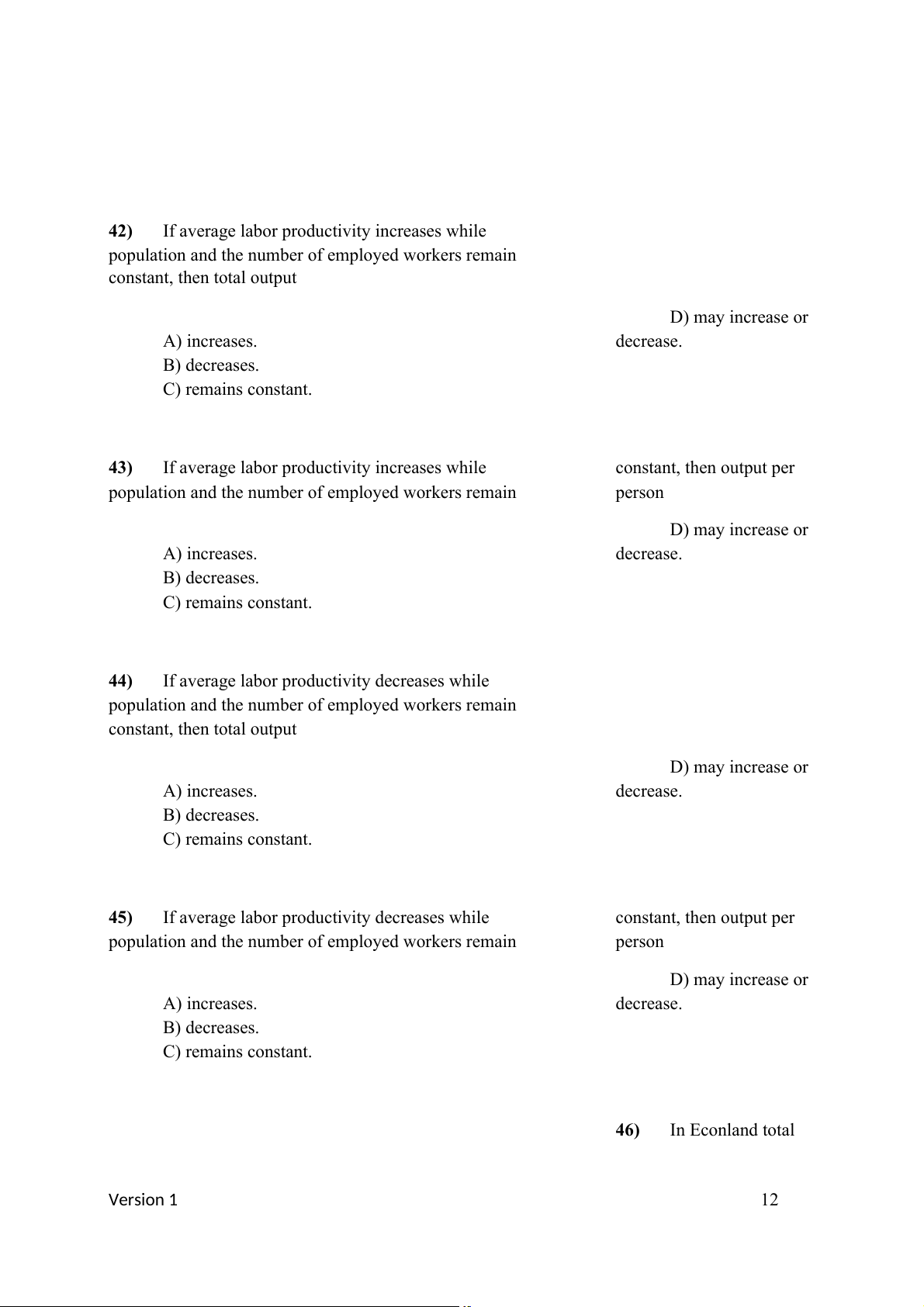
If average labor productivity increases while
population and the number of employed workers remain constant, then total output D) may increase or A) increases. decrease. B) decreases. C) remains constant. 43)
If average labor productivity increases while constant, then output per
population and the number of employed workers remain person D) may increase or A) increases. decrease. B) decreases. C) remains constant. 44)
If average labor productivity decreases while
population and the number of employed workers remain constant, then total output D) may increase or A) increases. decrease. B) decreases. C) remains constant. 45)
If average labor productivity decreases while constant, then output per
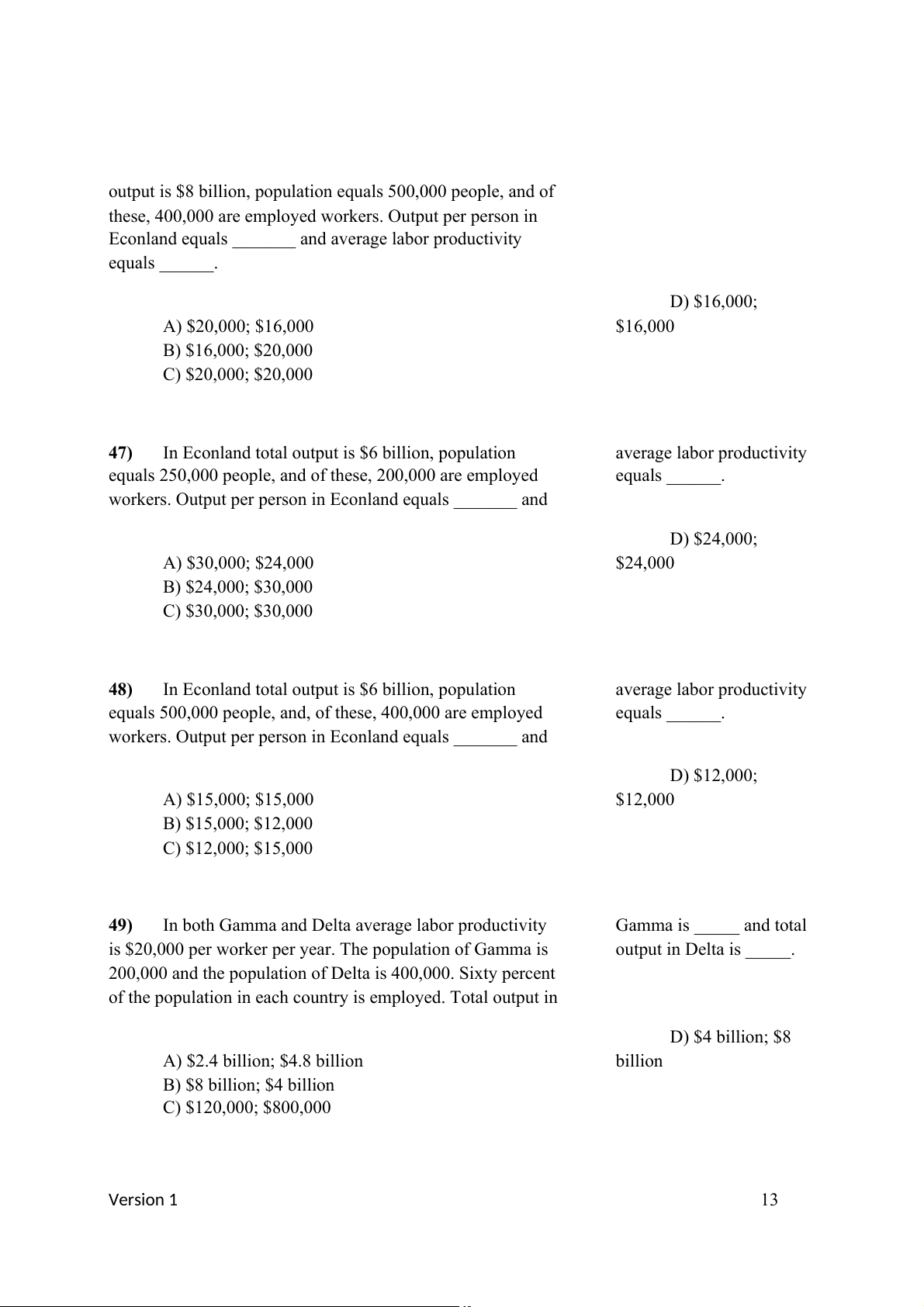
population and the number of employed workers remain person D) may increase or A) increases. decrease. B) decreases. C) remains constant. 46) In Econland total Version 1 12
output is $8 billion, population equals 500,000 people, and of
these, 400,000 are employed workers. Output per person in
Econland equals _______ and average labor productivity equals ______. D) $16,000; A) $20,000; $16,000 $16,000 B) $16,000; $20,000 C) $20,000; $20,000 47)
In Econland total output is $6 billion, population average labor productivity
equals 250,000 people, and of these, 200,000 are employed equals ______.
workers. Output per person in Econland equals _______ and D) $24,000; A) $30,000; $24,000 $24,000 B) $24,000; $30,000 C) $30,000; $30,000 48)
In Econland total output is $6 billion, population average labor productivity
equals 500,000 people, and, of these, 400,000 are employed equals ______.
workers. Output per person in Econland equals _______ and D) $12,000; A) $15,000; $15,000 $12,000 B) $15,000; $12,000 C) $12,000; $15,000 49)
In both Gamma and Delta average labor productivity Gamma is _____ and total
is $20,000 per worker per year. The population of Gamma is output in Delta is _____.
200,000 and the population of Delta is 400,000. Sixty percent
of the population in each country is employed. Total output in D) $4 billion; $8 A) $2.4 billion; $4.8 billion billion B) $8 billion; $4 billion C) $120,000; $800,000 Version 1 13 50)
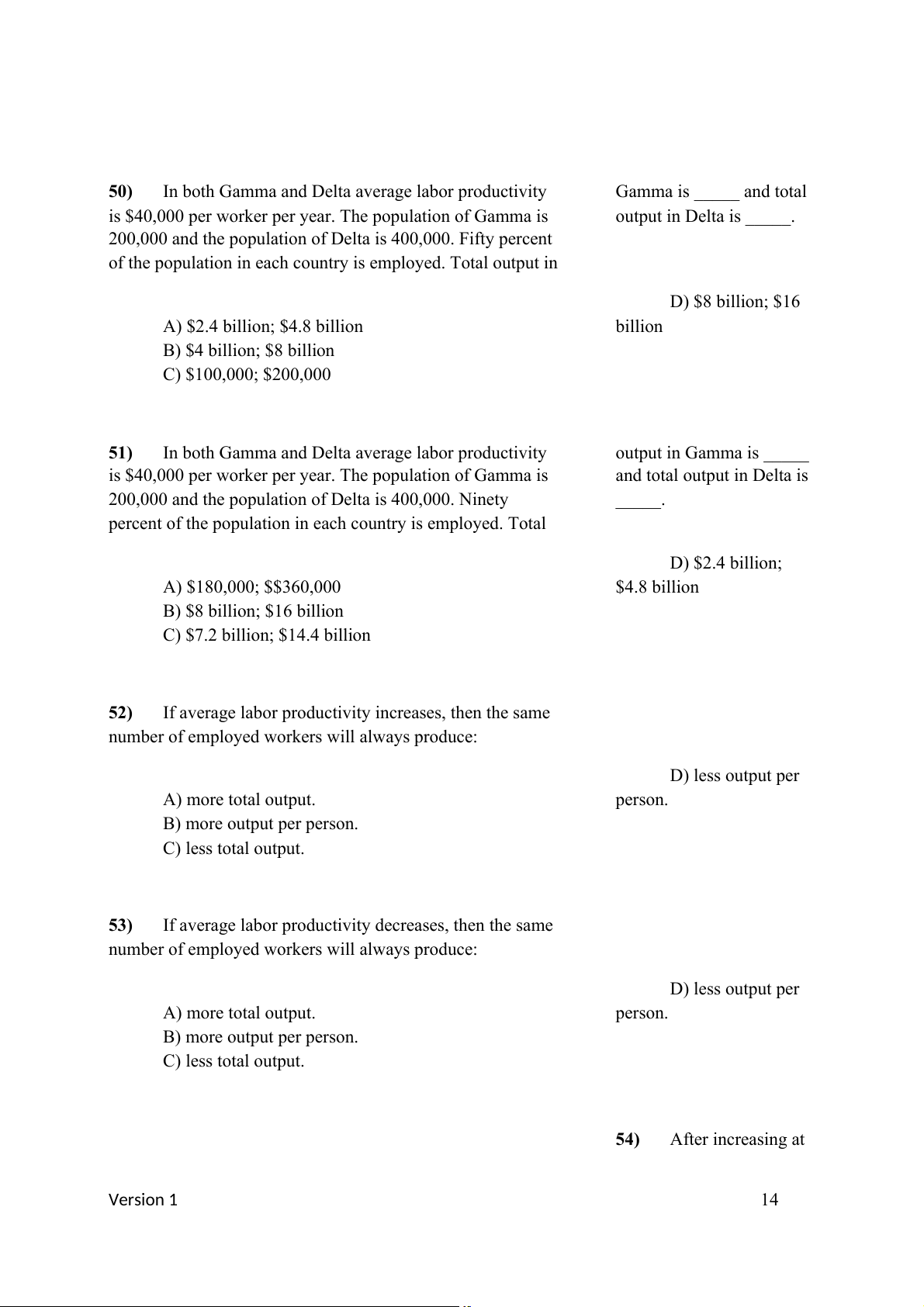
In both Gamma and Delta average labor productivity Gamma is _____ and total
is $40,000 per worker per year. The population of Gamma is output in Delta is _____.
200,000 and the population of Delta is 400,000. Fifty percent
of the population in each country is employed. Total output in D) $8 billion; $16 A) $2.4 billion; $4.8 billion billion B) $4 billion; $8 billion C) $100,000; $200,000 51)
In both Gamma and Delta average labor productivity output in Gamma is _____
is $40,000 per worker per year. The population of Gamma is and total output in Delta is
200,000 and the population of Delta is 400,000. Ninety _____.
percent of the population in each country is employed. Total D) $2.4 billion; A) $180,000; $$360,000 $4.8 billion B) $8 billion; $16 billion C) $7.2 billion; $14.4 billion 52)
If average labor productivity increases, then the same
number of employed workers will always produce: D) less output per A) more total output. person. B) more output per person. C) less total output. 53)
If average labor productivity decreases, then the same
number of employed workers will always produce: D) less output per A) more total output. person. B) more output per person. C) less total output. 54) After increasing at Version 1 14
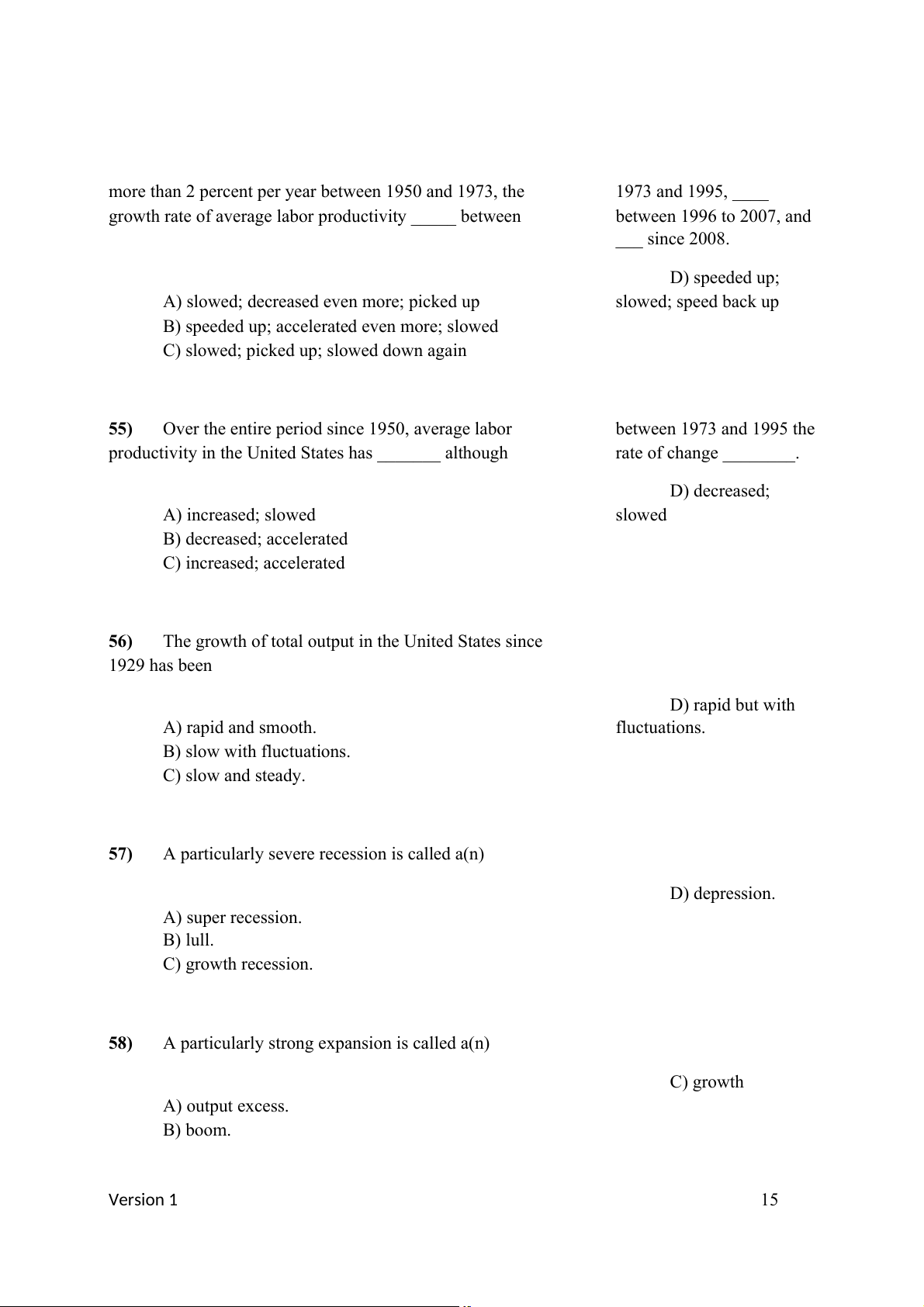
more than 2 percent per year between 1950 and 1973, the 1973 and 1995, ____
growth rate of average labor productivity _____ between between 1996 to 2007, and ___ since 2008. D) speeded up;
A) slowed; decreased even more; picked up slowed; speed back up
B) speeded up; accelerated even more; slowed
C) slowed; picked up; slowed down again 55)
Over the entire period since 1950, average labor between 1973 and 1995 the
productivity in the United States has _______ although rate of change ________. D) decreased; A) increased; slowed slowed B) decreased; accelerated C) increased; accelerated 56)
The growth of total output in the United States since 1929 has been D) rapid but with A) rapid and smooth. fluctuations. B) slow with fluctuations. C) slow and steady. 57)
A particularly severe recession is called a(n) D) depression. A) super recession. B) lull. C) growth recession. 58)
A particularly strong expansion is called a(n) C) growth A) output excess. B) boom. Version 1 15 recession. D) bonanza. Version 1 16 59)
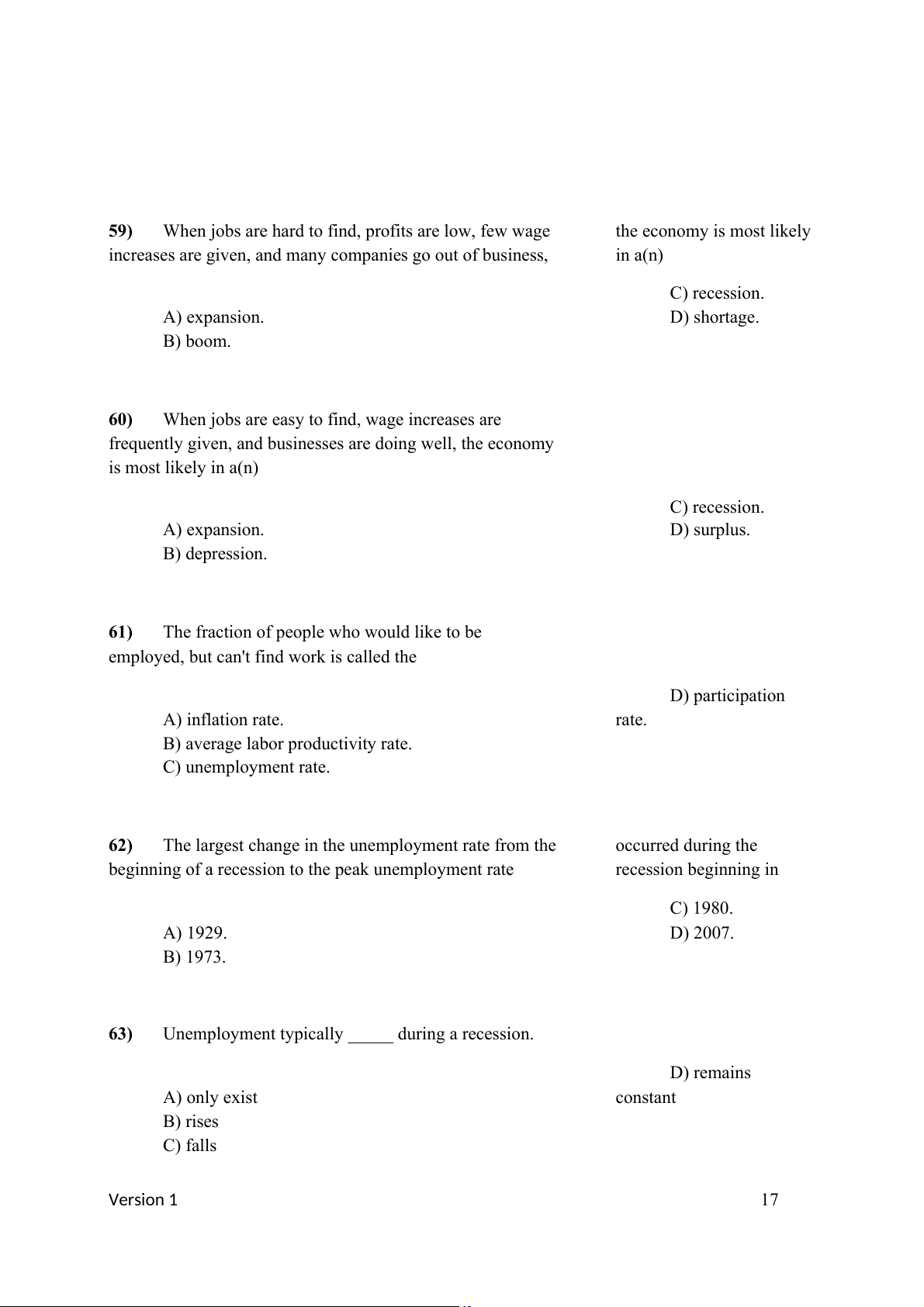
When jobs are hard to find, profits are low, few wage the economy is most likely
increases are given, and many companies go out of business, in a(n) C) recession. A) expansion. D) shortage. B) boom. 60)
When jobs are easy to find, wage increases are
frequently given, and businesses are doing well, the economy is most likely in a(n) C) recession. A) expansion. D) surplus. B) depression. 61)
The fraction of people who would like to be
employed, but can't find work is called the D) participation A) inflation rate. rate.
B) average labor productivity rate. C) unemployment rate. 62)
The largest change in the unemployment rate from the occurred during the
beginning of a recession to the peak unemployment rate recession beginning in C) 1980. A) 1929. D) 2007. B) 1973. 63)
Unemployment typically _____ during a recession. D) remains A) only exist constant B) rises C) falls Version 1 17 64)
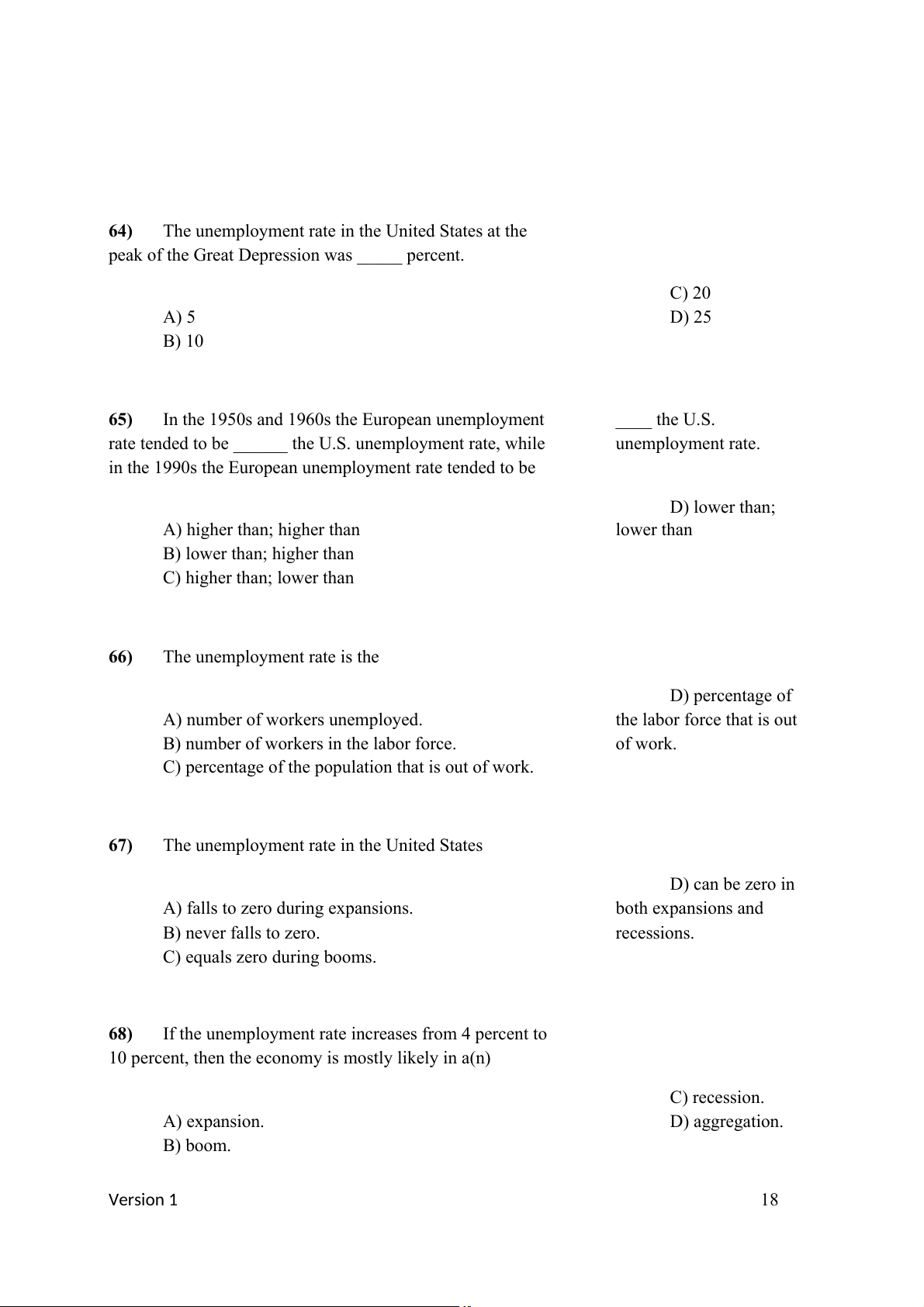
The unemployment rate in the United States at the
peak of the Great Depression was _____ percent. C) 20 A) 5 D) 25 B) 10 65)
In the 1950s and 1960s the European unemployment ____ the U.S.
rate tended to be ______ the U.S. unemployment rate, while unemployment rate.
in the 1990s the European unemployment rate tended to be D) lower than; A) higher than; higher than lower than B) lower than; higher than C) higher than; lower than 66) The unemployment rate is the D) percentage of
A) number of workers unemployed. the labor force that is out
B) number of workers in the labor force. of work.
C) percentage of the population that is out of work. 67)
The unemployment rate in the United States D) can be zero in
A) falls to zero during expansions. both expansions and B) never falls to zero. recessions. C) equals zero during booms. 68)
If the unemployment rate increases from 4 percent to
10 percent, then the economy is mostly likely in a(n) C) recession. A) expansion. D) aggregation. B) boom. Version 1 18 69)
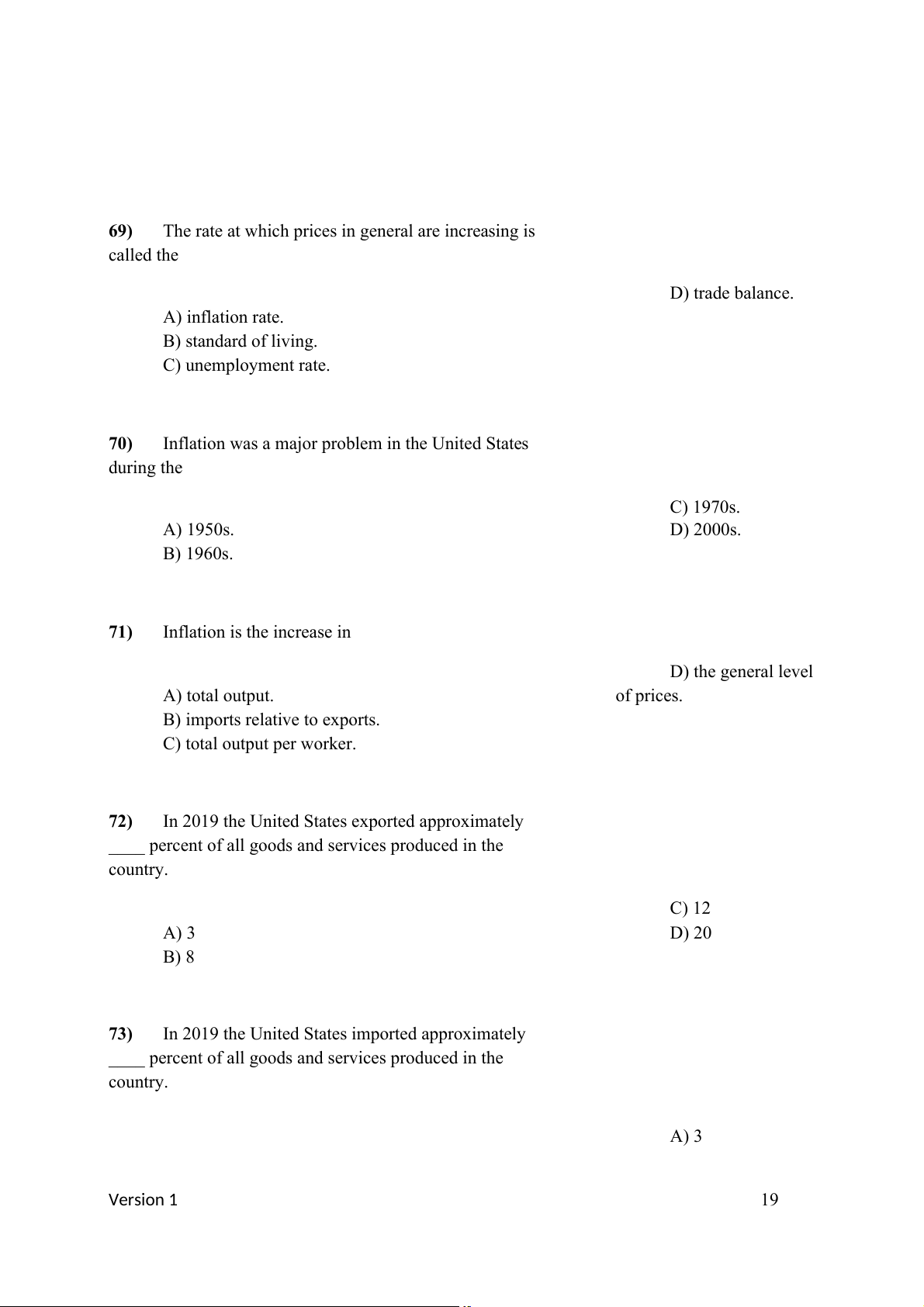
The rate at which prices in general are increasing is called the D) trade balance. A) inflation rate. B) standard of living. C) unemployment rate. 70)
Inflation was a major problem in the United States during the C) 1970s. A) 1950s. D) 2000s. B) 1960s. 71) Inflation is the increase in D) the general level A) total output. of prices.
B) imports relative to exports. C) total output per worker. 72)
In 2019 the United States exported approximately
____ percent of all goods and services produced in the country. C) 12 A) 3 D) 20 B) 8 73)
In 2019 the United States imported approximately
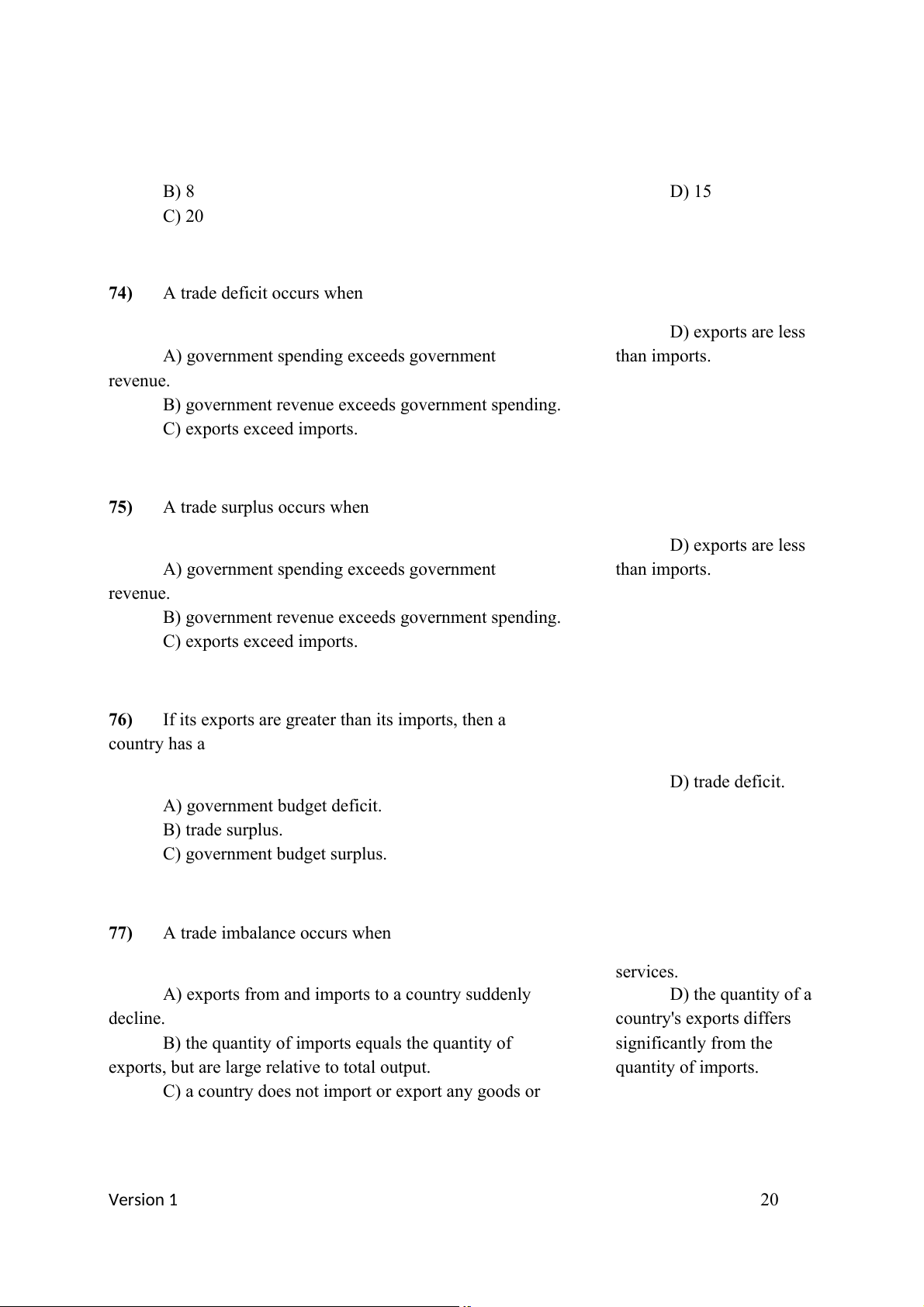
____ percent of all goods and services produced in the country. A) 3 Version 1 19 B) 8 D) 15 C) 20 74) A trade deficit occurs when D) exports are less
A) government spending exceeds government than imports. revenue.
B) government revenue exceeds government spending. C) exports exceed imports. 75) A trade surplus occurs when D) exports are less
A) government spending exceeds government than imports. revenue.
B) government revenue exceeds government spending. C) exports exceed imports. 76)
If its exports are greater than its imports, then a country has a D) trade deficit. A) government budget deficit. B) trade surplus. C) government budget surplus. 77) A trade imbalance occurs when services.
A) exports from and imports to a country suddenly D) the quantity of a decline. country's exports differs
B) the quantity of imports equals the quantity of significantly from the
exports, but are large relative to total output. quantity of imports.
C) a country does not import or export any goods or Version 1 20
Tài liệu liên quan:
-

Chương 3: độ co giãn và các nhân tố ảnh hưởng | Microeconomics | Trường Đại học Quốc tế, Đại học Quốc gia Thành phố Hồ Chí Minh
6 3 -
Microeconomics Syllabus | Microeconomics | Trường Đại học Quốc tế, Đại học Quốc gia Thành phố Hồ Chí Minh
5 3 -
Microeconomics Course Syllabus & Assessment Details | Microeconomics | Trường Đại học Quốc tế, Đại học Quốc gia Thành phố Hồ Chí Minh
5 3 -
Assignment 3 - Elasticity MCQs and Key Concepts | Microeconomics | Trường Đại học Quốc tế, Đại học Quốc gia Thành phố Hồ Chí Minh
5 3 -
Assignment 2 - Economic Equilibrium Analysis of Fridges and Motorcycles | Microeconomics | Trường Đại học Quốc tế, Đại học Quốc gia Thành phố Hồ Chí Minh
6 3