Microeconomics - TLTK - Multiple Choice & Analysis | Microeconomics | Trường Đại học Quốc tế, Đại học Quốc gia Thành phố Hồ Chí Minh
The quantity supplied of a good or service is the amount that A. is actually bought during a given time period at a given price. B. producers wish they could sell at a higher price. C. producers plan to sell during a given time period at a given price. D. people are willing to buy during a given time period at a given price. 11 Good 𝐴 and good 𝐵 are substitutes in production. The demand for good 𝐴 increases so that the price of good 𝐴 rises. The increase in the price of good 𝐴 shifts the A. demand curve for good 𝐵 rightward. C. demand curve for good B leftward. B. supply curve of good B rightward. D. supply curve of good B leftward. Tài liệu được sưu tầm và soạn thảo dưới dạng file PDF để gửi tới các bạn cùng tham khảo, ôn tập đầy đủ kiến thức, chuẩn bị cho các buổi học thật tốt. Mời bạn đọc đón xem!
Môn: Microeconomics 635 tài liệu
Trường: Trường Đại học Quốc tế, Đại học Quốc gia Thành phố Hồ Chí Minh 1.9 K tài liệu
Tác giả:


Preview text:
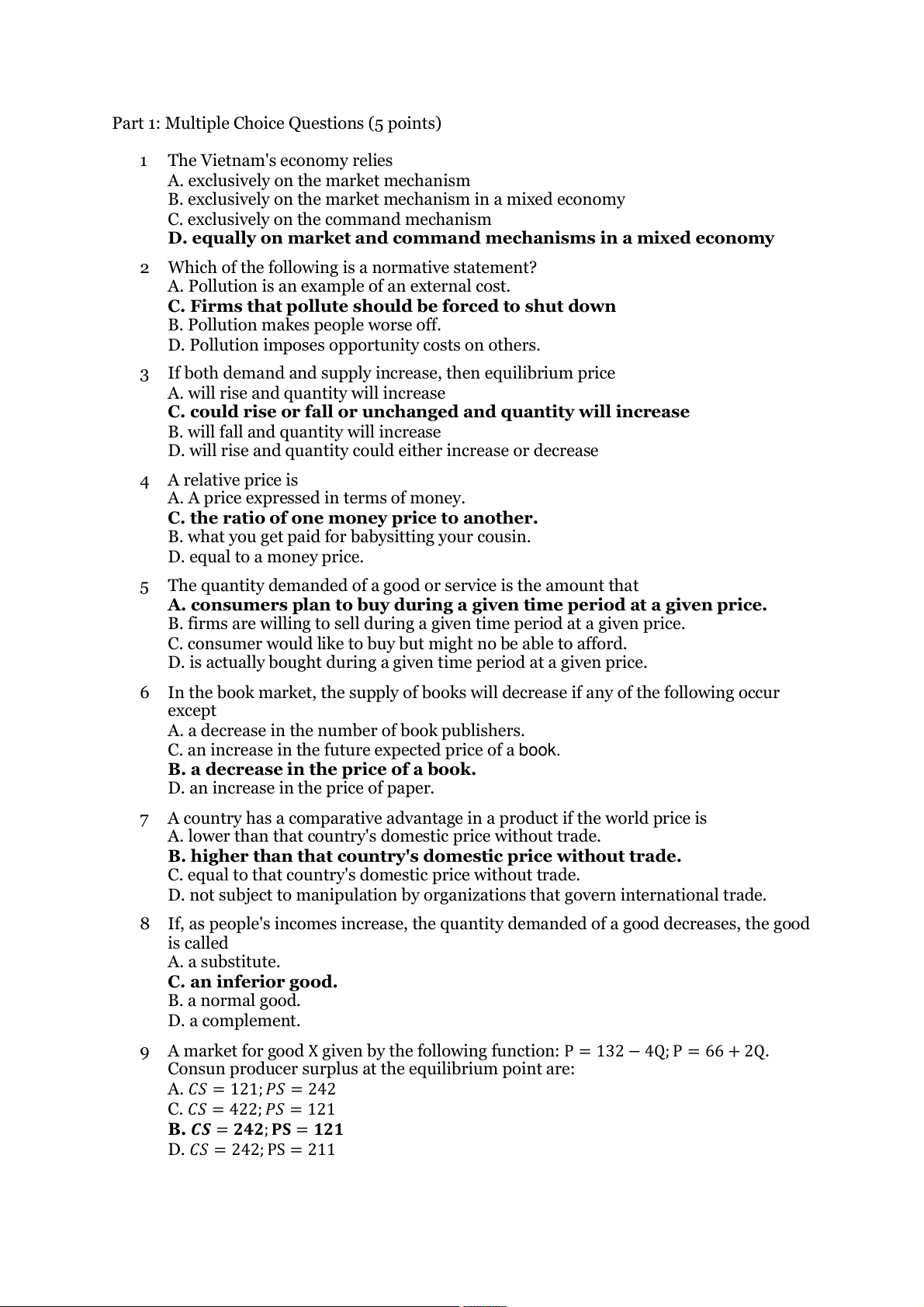
Part 1: Multiple Choice Questions (5 points)
1 The Vietnam's economy relies
A. exclusively on the market mechanism
B. exclusively on the market mechanism in a mixed economy
C. exclusively on the command mechanism
D. equally on market and command mechanisms in a mixed economy
2 Which of the following is a normative statement?
A. Pollution is an example of an external cost.
C. Firms that pollute should be forced to shut down
B. Pollution makes people worse off.
D. Pollution imposes opportunity costs on others.
3 If both demand and supply increase, then equilibrium price
A. will rise and quantity will increase
C. could rise or fall or unchanged and quantity will increase
B. will fall and quantity will increase
D. will rise and quantity could either increase or decrease 4 A relative price is
A. A price expressed in terms of money.
C. the ratio of one money price to another.
B. what you get paid for babysitting your cousin. D. equal to a money price.
5 The quantity demanded of a good or service is the amount that
A. consumers plan to buy during a given time period at a given price.
B. firms are willing to sell during a given time period at a given price.
C. consumer would like to buy but might no be able to afford.
D. is actually bought during a given time period at a given price.
6 In the book market, the supply of books will decrease if any of the following occur except
A. a decrease in the number of book publishers.
C. an increase in the future expected price of a book.
B. a decrease in the price of a book.
D. an increase in the price of paper.
7 A country has a comparative advantage in a product if the world price is
A. lower than that country's domestic price without trade.
B. higher than that country's domestic price without trade.
C. equal to that country's domestic price without trade.
D. not subject to manipulation by organizations that govern international trade.
8 If, as people's incomes increase, the quantity demanded of a good decreases, the good is called A. a substitute. C. an inferior good. B. a normal good. D. a complement.
9 A market for good X given by the following function: P = 132 − 4Q; P = 66 + 2Q.
Consun producer surplus at the equilibrium point are:
A. 𝐶𝑆 = 121; 𝑃𝑆 = 242
C. 𝐶𝑆 = 422; 𝑃𝑆 = 121
B. 𝑪𝑺 = 𝟐𝟒𝟐; 𝐏𝐒 = 𝟏𝟐𝟏 D. 𝐶𝑆 = 242; PS = 211
10 The quantity supplied of a good or service is the amount that
A. is actually bought during a given time period at a given price.
B. producers wish they could sell at a higher price.
C. producers plan to sell during a given time period at a given price.
D. people are willing to buy during a given time period at a given price.
11 Good 𝐴 and good 𝐵 are substitutes in production. The demand for good 𝐴 increases
so that the price of good 𝐴 rises. The increase in the price of good 𝐴 shifts the
A. demand curve for good 𝐵 rightward.
C. demand curve for good B leftward.
B. supply curve of good B rightward.
D. supply curve of good B leftward.
12 A fall in the price of cabbage from $10.50 to $9.5
0 per bushel increases the quantity
demanded from 18,800 to 21,200 bushels. The price elasticity of demand is
A. 𝟏. 𝟐𝟎. C. 0.80. B. 8.00. D. 1.25.
13 If the price of the Walkman is below the equilibrium price, there will be a the price will A. surplus; fall C. shortage; rise B. shortage; fall D. surplus; rise
14 An indifference curve shows
A. affordable combinations of goods.
B. the relative price of one good relative to another.
C. consumption possibilities that a consumer faces at different prices and income.
D. different combinations of two goods among which the consumer is indifferent.
15 When price of the fixed input increases
A. Average variable cost curve shifts up
C. Average total cost curve shifts down
B. Average total cost curve shifts up
D. Marginal cost curve shifts up
16 A perfectly competitive firm has average variable cost function as follow 𝐴𝑉𝐶 = 𝑄 +
1. The firm's supply function is: A. 𝑃 = 2𝑄 + 1 C. 𝑃 = 𝑄 + 2 B. 𝑷 = 𝑸 + 𝟏 D. 𝑃 = 2𝑄 + 2
17 A competitive firm wants to maximize profit must A. Maximize total revenue
C. Maximize unit profit B. Minimize total cost D. None of the above
18 Monopolist does not set highest price for its product because
A. Monopolist will not have maximum profit
C. Monopolist wants to maximize total revenue
B. Monopolist wants to maximize consumer's welfare
D. Cost of production is very low
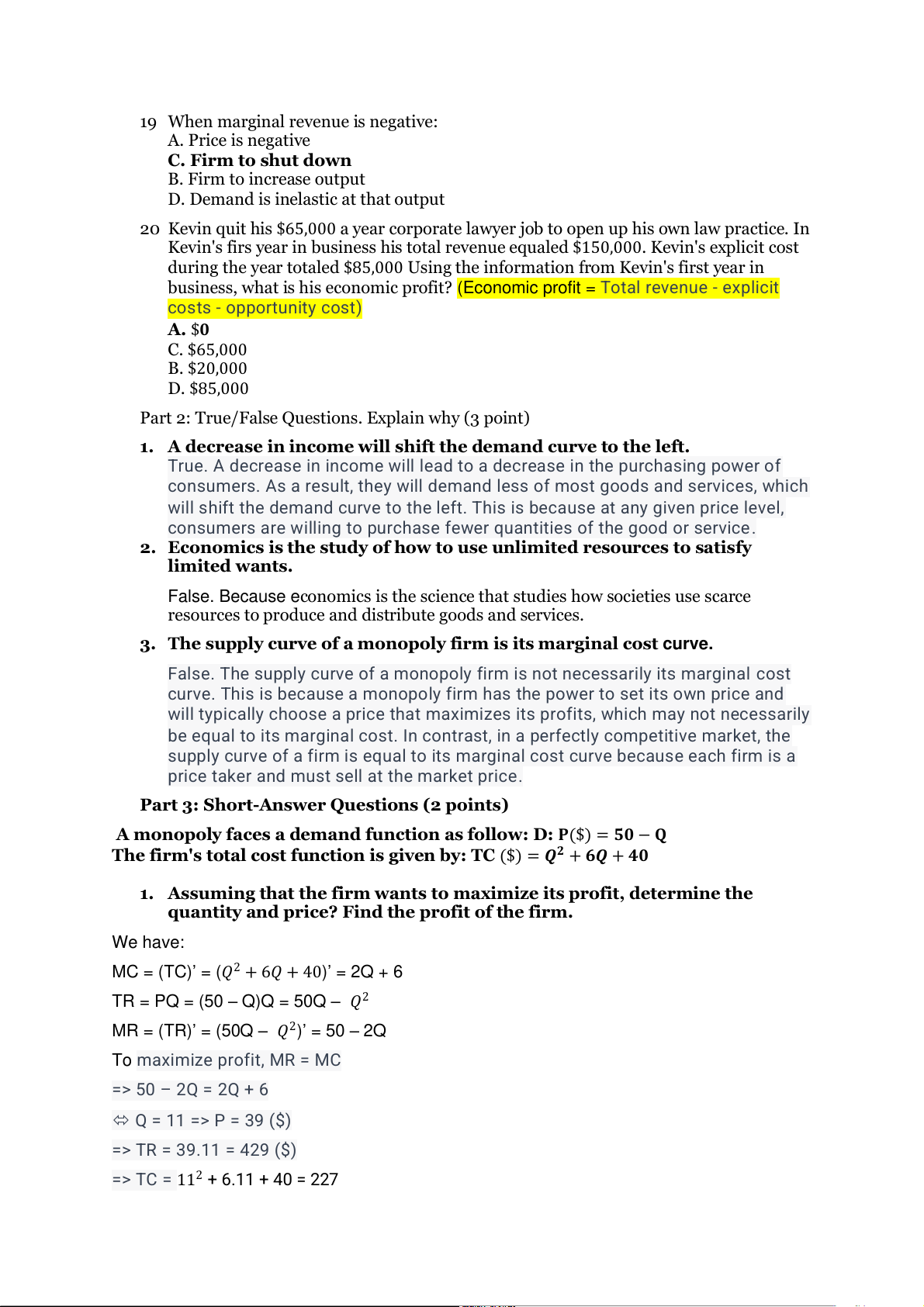
19 When marginal revenue is negative: A. Price is negative C. Firm to shut down B. Firm to increase output
D. Demand is inelastic at that output
20 Kevin quit his $65,000 a year corporate lawyer job to open up his own law practice. In
Kevin's firs year in business his total revenue equaled $150,000. Kevin's explicit cost
during the year totaled $85,000 Using the information from Kevin's first year in
business, what is his economic profit? (Economic profit = Total revenue - explicit costs - opportunity cost) A. $𝟎 C. $65,000 B. $20,000 D. $85,000
Part 2: True/False Questions. Explain why (3 point)
1. A decrease in income will shift the demand curve to the left.
True. A decrease in income will lead to a decrease in the purchasing power of
consumers. As a result, they will demand less of most goods and services, which
will shift the demand curve to the left. This is because at any given price level,
consumers are willing to purchase fewer quantities of the good or service.
2. Economics is the study of how to use unlimited resources to satisfy limited wants.
False. Because economics is the science that studies how societies use scarce
resources to produce and distribute goods and services.
3. The supply curve of a monopoly firm is its marginal cost curve.
False. The supply curve of a monopoly firm is not necessarily its marginal cost
curve. This is because a monopoly firm has the power to set its own price and
will typically choose a price that maximizes its profits, which may not necessarily
be equal to its marginal cost. In contrast, in a perfectly competitive market, the
supply curve of a firm is equal to its marginal cost curve because each firm is a
price taker and must sell at the market price.
Part 3: Short-Answer Questions (2 points)
A monopoly faces a demand function as follow: D: 𝐏($) = 𝟓𝟎 − 𝐐
The firm's total cost function is given by: TC ($) = 𝑸𝟐 + 𝟔𝑸 + 𝟒𝟎
1. Assuming that the firm wants to maximize its profit, determine the
quantity and price? Find the profit of the firm. We have:
MC = (TC)’ = (𝑄2 + 6𝑄 + 40)’ = 2Q + 6
TR = PQ = (50 – Q)Q = 50Q – 𝑄2
MR = (TR)’ = (50Q – 𝑄2)’ = 50 – 2Q To maximize profit, MR = MC => 50 – 2Q = 2Q + 6 Q = 11 => P = 39 ($) => TR = 39.11 = 429 ($)
=> TC = 112 + 6.11 + 40 = 227
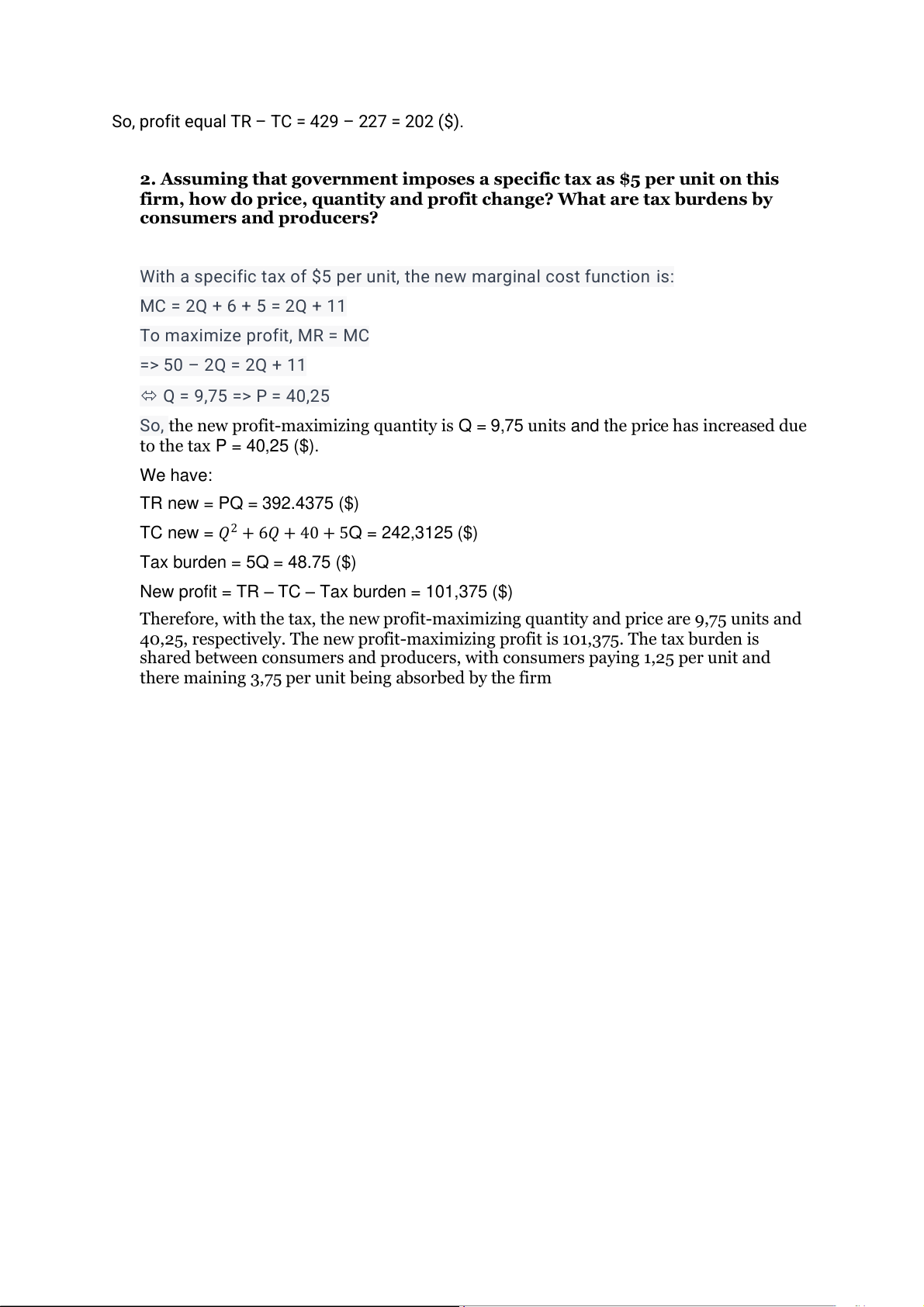
So, profit equal TR – TC = 429 – 227 = 202 ($).
2. Assuming that government imposes a specific tax as $5 per unit on this
firm, how do price, quantity and profit change? What are tax burdens by consumers and producers?
With a specific tax of $5 per unit, the new marginal cost function is: MC = 2Q + 6 + 5 = 2Q + 11 To maximize profit, MR = MC => 50 – 2Q = 2Q + 11 Q = 9,75 => P = 40,25
So, the new profit-maximizing quantity is Q = 9,75 units and the price has increased due to the tax P = 40,25 ($). We have: TR new = PQ = 392.4375 ($)
TC new = 𝑄2 + 6𝑄 + 40 + 5Q = 242,3125 ($) Tax burden = 5Q = 48.75 ($)
New profit = TR – TC – Tax burden = 101,375 ($)
Therefore, with the tax, the new profit-maximizing quantity and price are 9,75 units and
40,25, respectively. The new profit-maximizing profit is 101,375. The tax burden is
shared between consumers and producers, with consumers paying 1,25 per unit and
there maining 3,75 per unit being absorbed by the firm
Tài liệu liên quan:
-
Chương 3: độ co giãn và các nhân tố ảnh hưởng | Microeconomics | Trường Đại học Quốc tế, Đại học Quốc gia Thành phố Hồ Chí Minh
4 2 -
Microeconomics Syllabus | Microeconomics | Trường Đại học Quốc tế, Đại học Quốc gia Thành phố Hồ Chí Minh
4 2 -
Microeconomics Course Syllabus & Assessment Details | Microeconomics | Trường Đại học Quốc tế, Đại học Quốc gia Thành phố Hồ Chí Minh
4 2 -
Assignment 3 - Elasticity MCQs and Key Concepts | Microeconomics | Trường Đại học Quốc tế, Đại học Quốc gia Thành phố Hồ Chí Minh
4 2 -
Assignment 2 - Economic Equilibrium Analysis of Fridges and Motorcycles | Microeconomics | Trường Đại học Quốc tế, Đại học Quốc gia Thành phố Hồ Chí Minh
4 2