Mid-Semester Exam Sample: Section 2 Analysis | Microeconomics | Trường Đại học Quốc tế, Đại học Quốc gia Thành phố Hồ Chí Minh
Beer and wine are two substitute products that are both sold in a competitive market. Barley is an essential ingredient in the production of beer; grapes are an input into making wine. We observe that when price increases in both the beer and wine market, the quantity traded of beer falls and there is an increase in the quantity traded in the wine. Tài liệu được sưu tầm và soạn thảo dưới dạng file PDF để gửi tới các bạn cùng tham khảo, ôn tập đầy đủ kiến thức, chuẩn bị cho các buổi học thật tốt. Mời bạn đọc đón xem!
Môn: Microeconomics 635 tài liệu
Trường: Trường Đại học Quốc tế, Đại học Quốc gia Thành phố Hồ Chí Minh 1.9 K tài liệu
Tác giả:


Preview text:
ECON1001 – Introductory Microeconomics
Mid-semester exam sample
Section 1 (multiple choice):
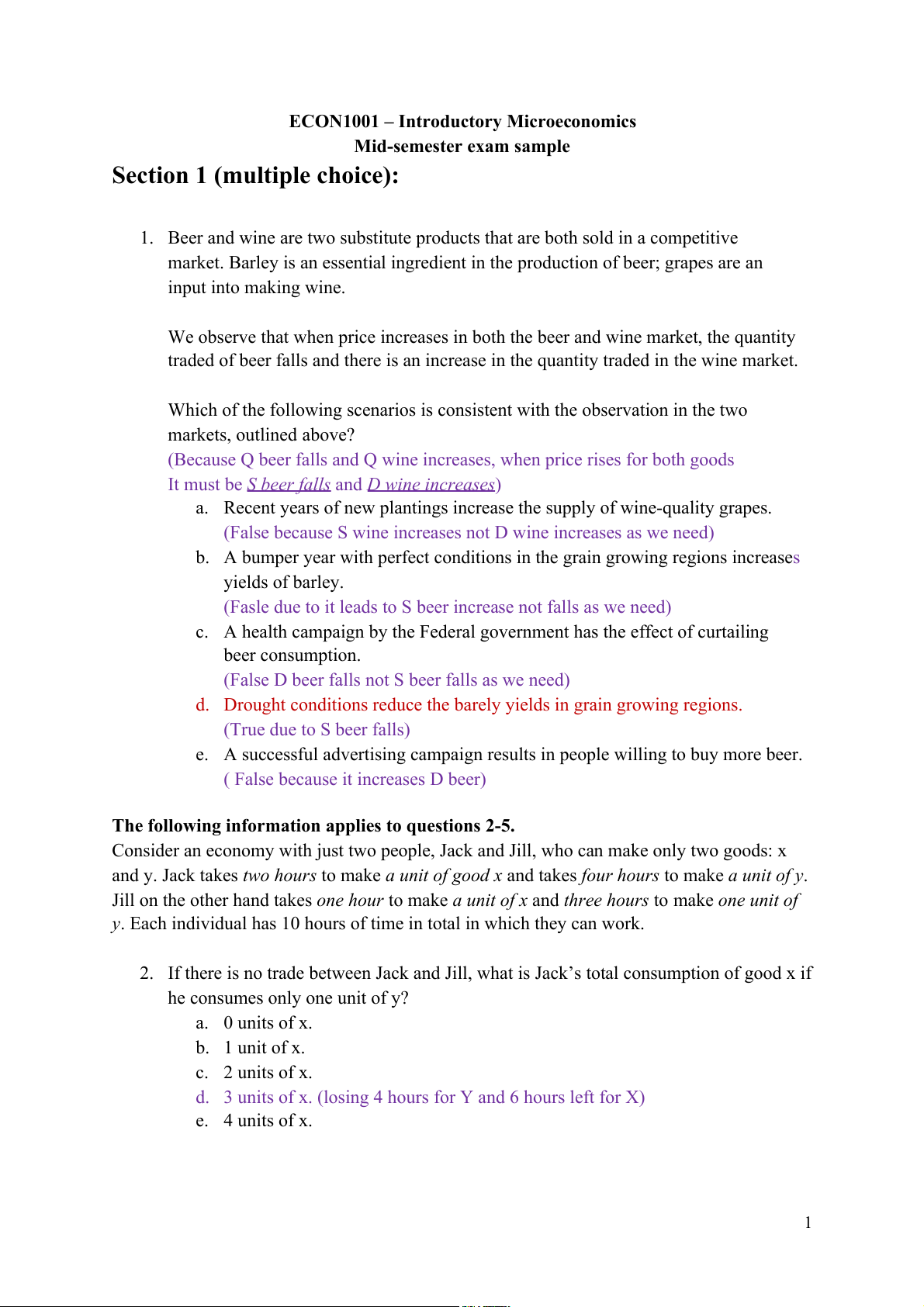
1. Beer and wine are two substitute products that are both sold in a competitive
market. Barley is an essential ingredient in the production of beer; grapes are an input into making wine.
We observe that when price increases in both the beer and wine market, the quantity
traded of beer falls and there is an increase in the quantity traded in the wine market.
Which of the following scenarios is consistent with the observation in the two markets, outlined above?
(Because Q beer falls and Q wine increases, when price rises for both goods
It must be S beer falls and D wine increases)
a. Recent years of new plantings increase the supply of wine-quality grapes.
(False because S wine increases not D wine increases as we need)
b. A bumper year with perfect conditions in the grain growing regions increases yields of barley.
(Fasle due to it leads to S beer increase not falls as we need)
c. A health campaign by the Federal government has the effect of curtailing beer consumption.
(False D beer falls not S beer falls as we need)
d. Drought conditions reduce the barely yields in grain growing regions. (True due to S beer falls)
e. A successful advertising campaign results in people willing to buy more beer.
( False because it increases D beer)
The following information applies to questions 2-5.
Consider an economy with just two people, Jack and Jill, who can make only two goods: x
and y. Jack takes two hours to make and takes a unit of good x to make four hours a unit of y. Jill on the other hand takes
one hour to make a unit of x and to three hours make one unit of
y. Each individual has 10 hours of time in total in which they can work.
2. If there is no trade between Jack and Jill, what is Jack’s total consumption of good x if
he consumes only one unit of y? a. 0 units of x. b. 1 unit of x. c. 2 units of x.
d. 3 units of x. (losing 4 hours for Y and 6 hours left for X) e. 4 units of x. 1 3.
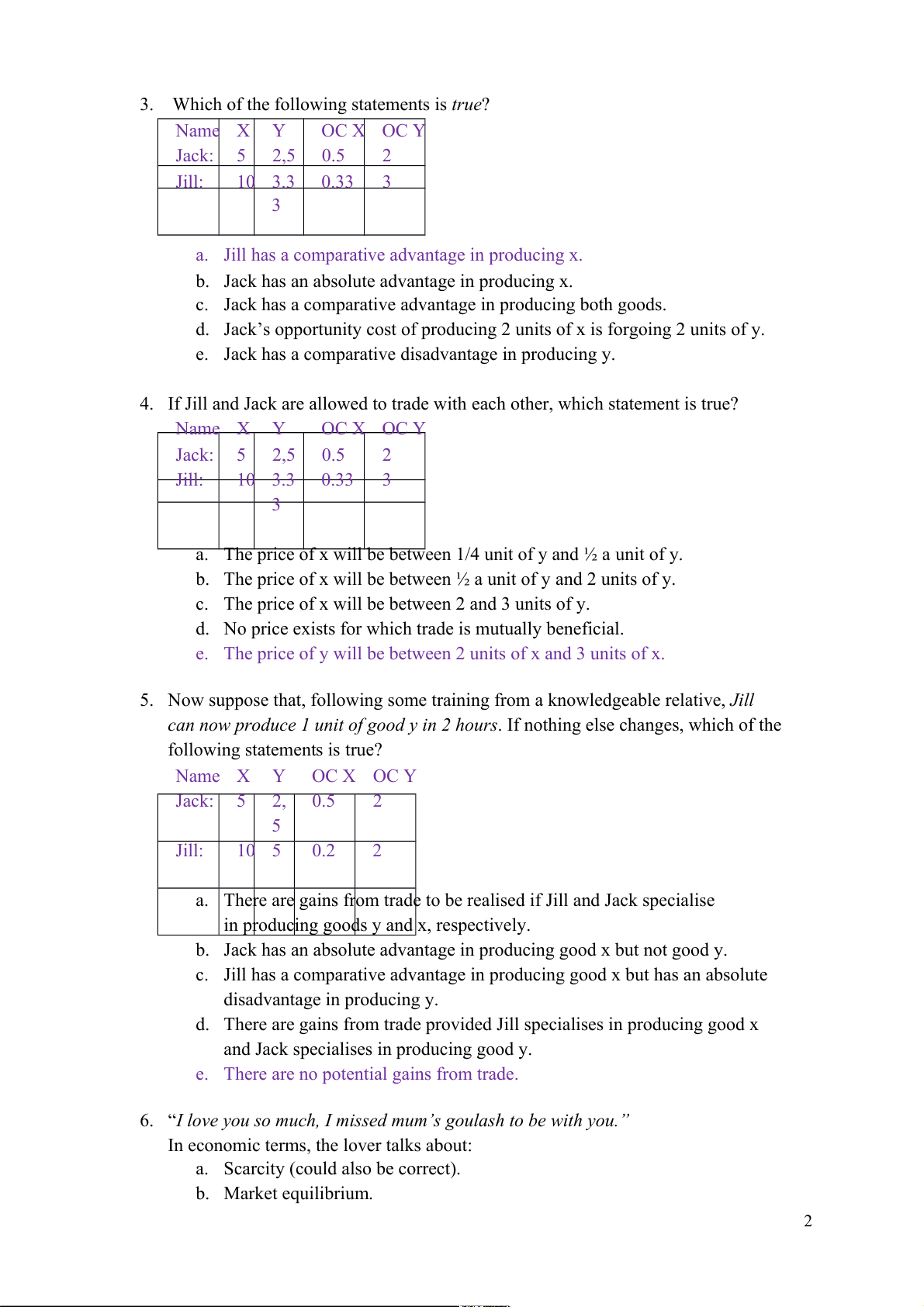
Which of the following statements is true? Name X Y OC X OC Y Jack: 5 2,5 0.5 2 Jill: 10 3.3 0.33 3 3
a. Jill has a comparative advantage in producing x.
b. Jack has an absolute advantage in producing x.
c. Jack has a comparative advantage in producing both goods.
d. Jack’s opportunity cost of producing 2 units of x is forgoing 2 units of y.
e. Jack has a comparative disadvantage in producing y.
4. If Jill and Jack are allowed to trade with each other, which statement is true? Name X Y OC X OC Y Jack: 5 2,5 0.5 2 Jill: 10 3.3 0.33 3 3
a. The price of x will be between 1/4 unit of y and ½ a unit of y.
b. The price of x will be between ½ a unit of y and 2 units of y.
c. The price of x will be between 2 and 3 units of y.
d. No price exists for which trade is mutually beneficial.
e. The price of y will be between 2 units of x and 3 units of x.
5. Now suppose that, following some training from a knowledgeable relative, Jill
can now produce 1 unit of good y in 2 hours. If nothing else changes, which of the following statements is true? Name X Y OC X OC Y Jack: 5 2, 0.5 2 5 Jill: 10 5 0.2 2
a. There are gains from trade to be realised if Jill and Jack specialise
in producing goods y and x, respectively.
b. Jack has an absolute advantage in producing good x but not good y.
c. Jill has a comparative advantage in producing good x but has an absolute disadvantage in producing y.
d. There are gains from trade provided Jill specialises in producing good x
and Jack specialises in producing good y.
e. There are no potential gains from trade.
6. “I love you so much, I missed mum’s goulash to be with you.”
In economic terms, the lover talks about:
a. Scarcity (could also be correct). b. Market equilibrium. 2 c. Opportunity cost. d. Comparative advantage. e. Elasticity. 3
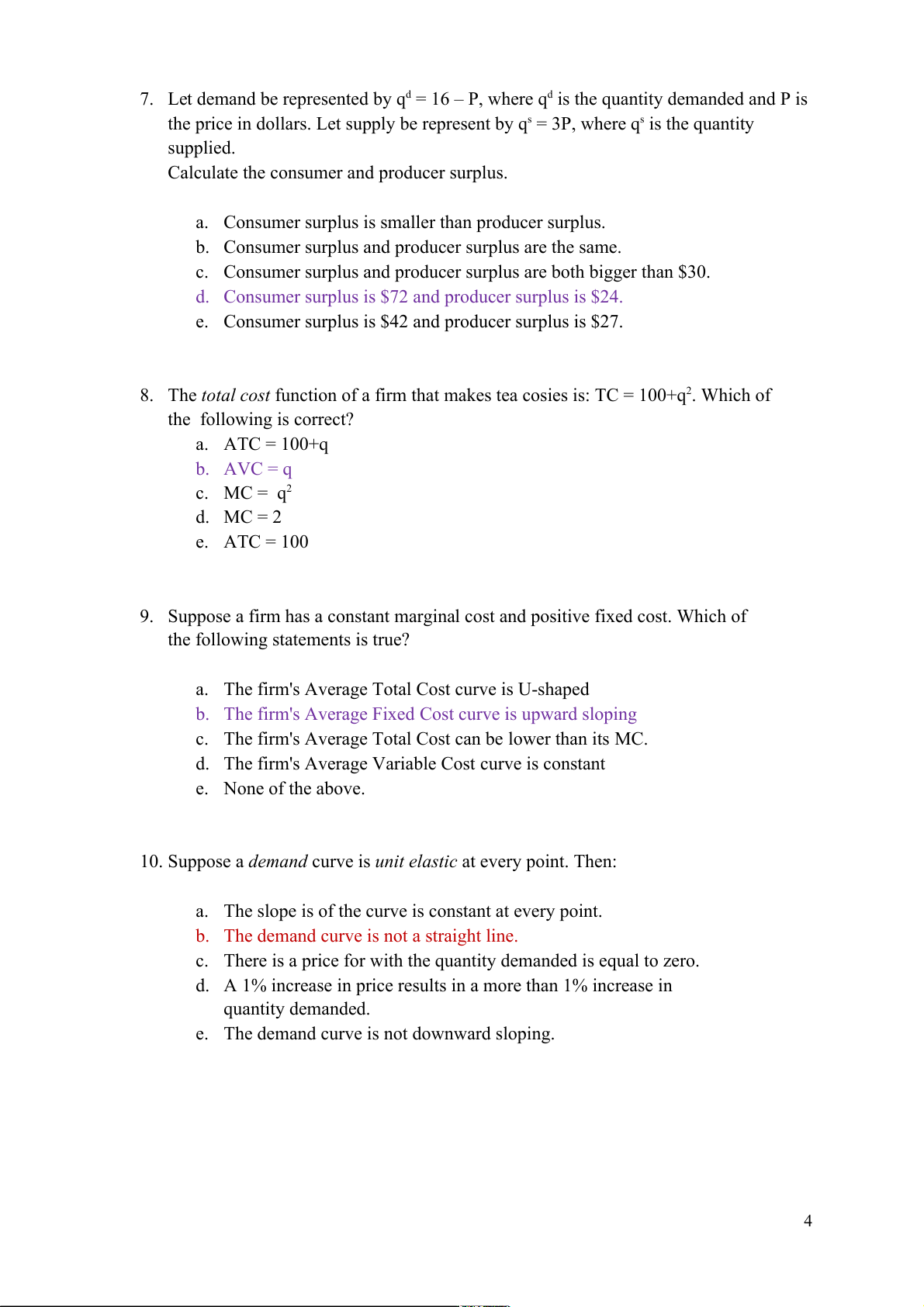
7. Let demand be represented by q = 16 – P, where q d
is the quantity demanded and P is d
the price in dollars. Let supply be represent by qs = 3P, where qs is the quantity supplied.
Calculate the consumer and producer surplus.
a. Consumer surplus is smaller than producer surplus.
b. Consumer surplus and producer surplus are the same.
c. Consumer surplus and producer surplus are both bigger than $30.
d. Consumer surplus is $72 and producer surplus is $24.
e. Consumer surplus is $42 and producer surplus is $27.
8. The total cost function of a firm that makes tea cosies is: TC = 100+q . Which of 2 the following is correct? a. ATC = 100+q b. AVC = q c. MC = q2 d. MC = 2 e. ATC = 100
9. Suppose a firm has a constant marginal cost and positive fixed cost. Which of
the following statements is true?
a. The firm's Average Total Cost curve is U-shaped
b. The firm's Average Fixed Cost curve is upward sloping
c. The firm's Average Total Cost can be lower than its MC.
d. The firm's Average Variable Cost curve is constant e. None of the above. 10. Suppose a curve is demand at every point. Then: unit elastic
a. The slope is of the curve is constant at every point.
b. The demand curve is not a straight line.
c. There is a price for with the quantity demanded is equal to zero.
d. A 1% increase in price results in a more than 1% increase in quantity demanded.
e. The demand curve is not downward sloping. 4
Section 2 (short answer): Question 1
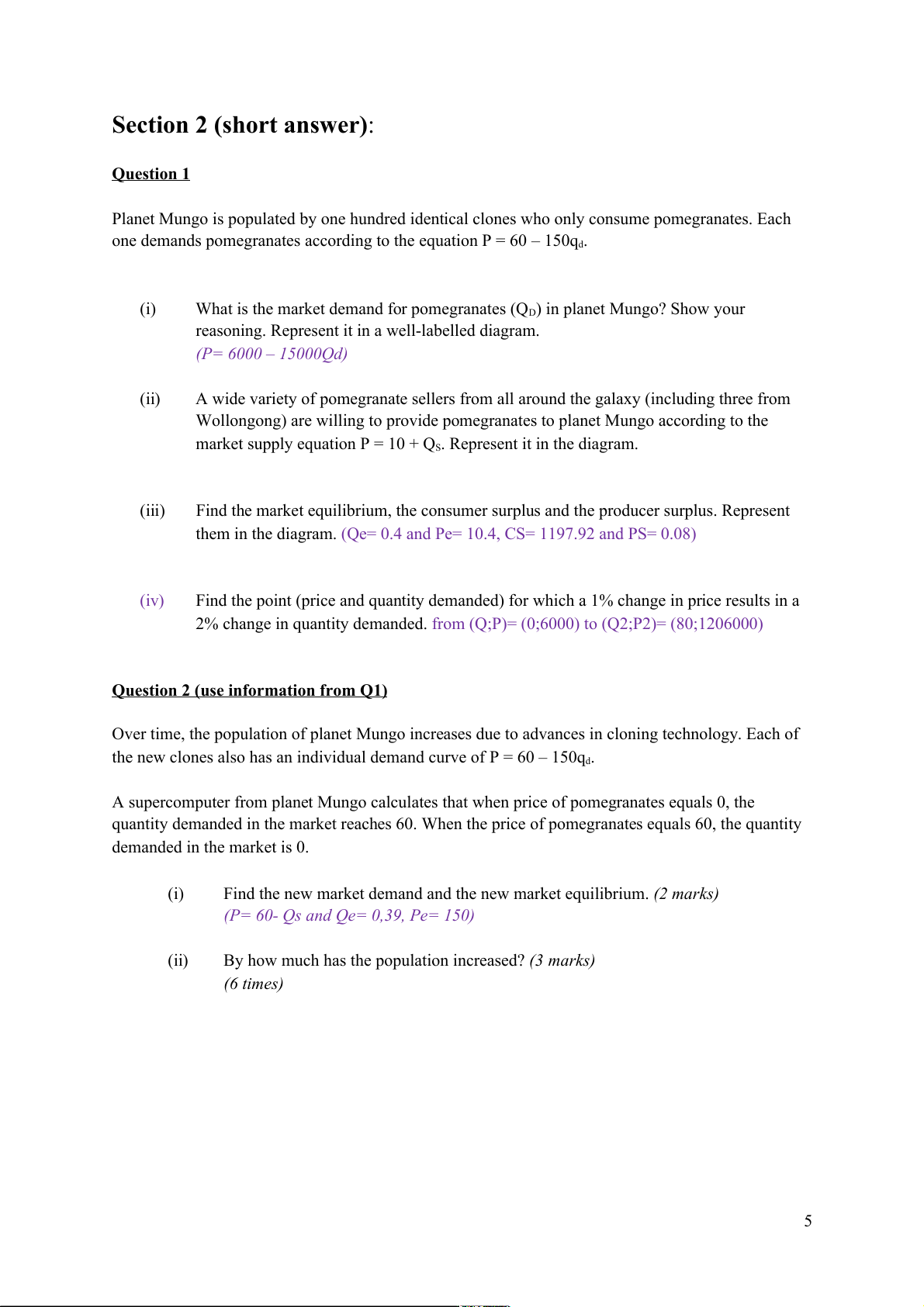
Planet Mungo is populated by one hundred identical clones who only consume pomegranates. Each
one demands pomegranates according to the equation P = 60 – 150qd. (i)
What is the market demand for pomegranates (QD) in planet Mungo? Show your
reasoning. Represent it in a well-labelled diagram. (P= 6000 – 15000Qd) (ii)
A wide variety of pomegranate sellers from all around the galaxy (including three from
Wollongong) are willing to provide pomegranates to planet Mungo according to the
market supply equation P = 10 + QS. Represent it in the diagram. (iii)
Find the market equilibrium, the consumer surplus and the producer surplus. Represent
them in the diagram. (Qe= 0.4 and Pe= 10.4, CS= 1197.92 and PS= 0.08) (iv)
Find the point (price and quantity demanded) for which a 1% change in price results in a
2% change in quantity demanded. from (Q;P)= (0;6000) to (Q2;P2)= (80;1206000) Question
2 (use information from Q1)
Over time, the population of planet Mungo increases due to advances in cloning technology. Each of
the new clones also has an individual demand curve of P = 60 – 150qd.
A supercomputer from planet Mungo calculates that when price of pomegranates equals 0, the
quantity demanded in the market reaches 60. When the price of pomegranates equals 60, the quantity demanded in the market is 0. (i)
Find the new market demand and the new market equilibrium. (2 marks)
(P= 60- Qs and Qe= 0,39, Pe= 150) (ii)
By how much has the population increased? (3 marks) (6 times) 5
Tài liệu liên quan:
-
Chương 3: độ co giãn và các nhân tố ảnh hưởng | Microeconomics | Trường Đại học Quốc tế, Đại học Quốc gia Thành phố Hồ Chí Minh
5 3 -
Microeconomics Syllabus | Microeconomics | Trường Đại học Quốc tế, Đại học Quốc gia Thành phố Hồ Chí Minh
5 3 -
Microeconomics Course Syllabus & Assessment Details | Microeconomics | Trường Đại học Quốc tế, Đại học Quốc gia Thành phố Hồ Chí Minh
5 3 -
Assignment 3 - Elasticity MCQs and Key Concepts | Microeconomics | Trường Đại học Quốc tế, Đại học Quốc gia Thành phố Hồ Chí Minh
5 3 -
Assignment 2 - Economic Equilibrium Analysis of Fridges and Motorcycles | Microeconomics | Trường Đại học Quốc tế, Đại học Quốc gia Thành phố Hồ Chí Minh
5 3