Midterm Exam 1 - True/False, Short Answer, Multiple Choice | Microeconomics | Trường Đại học Quốc tế, Đại học Quốc gia Thành phố Hồ Chí Minh
Prices allocate a market economy’s scarce resources. 2. In a market economy, supply and demand determine both the quantity of each good produced and the price at which it is sold. 3. A market is a group of buyers and sellers of a particular good or service. 4. Sellers as a group determine the demand for a product, and buyers as a group determine the supply of a product. 5. A yard sale is an example of a market. 6. A newspape. Tài liệu được sưu tầm và soạn thảo dưới dạng file PDF để gửi tới các bạn cùng tham khảo, ôn tập đầy đủ kiến thức, chuẩn bị cho các buổi học thật tốt. Mời bạn đọc đón xem!
Môn: Microeconomics 635 tài liệu
Trường: Trường Đại học Quốc tế, Đại học Quốc gia Thành phố Hồ Chí Minh 1.9 K tài liệu
Tác giả:


Preview text:
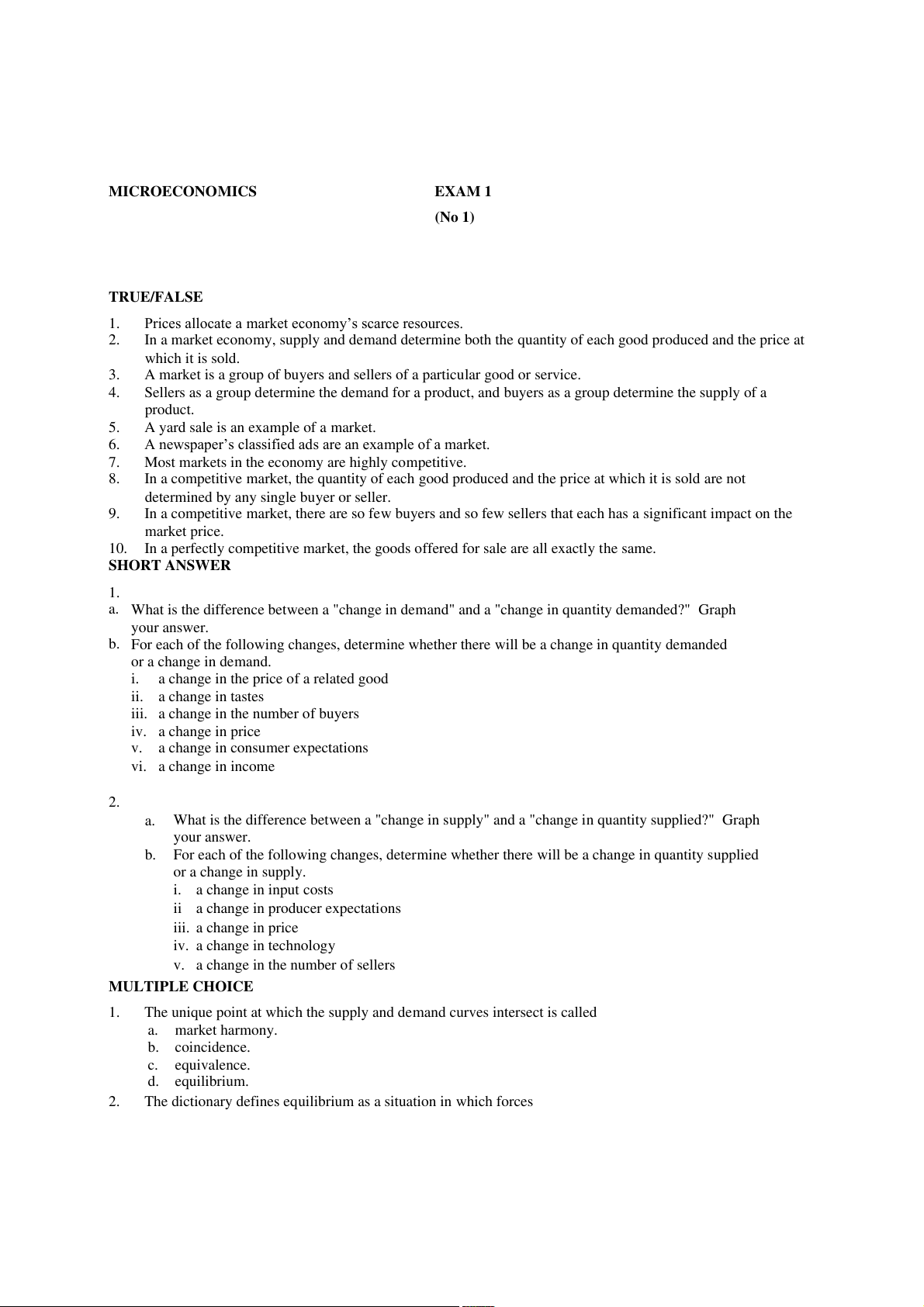
MICROECONOMICS EXAM 1 (No 1) TRUE/FALSE 1.
Prices allocate a market economy’s scarce resources. 2.
In a market economy, supply and demand determine both the quantity of each good produced and the price at which it is sold. 3.
A market is a group of buyers and sellers of a particular good or service. 4.
Sellers as a group determine the demand for a product, and buyers as a group determine the supply of a product. 5.
A yard sale is an example of a market. 6.
A newspaper’s classified ads are an example of a market. 7.
Most markets in the economy are highly competitive. 8.
In a competitive market, the quantity of each good produced and the price at which it is sold are not
determined by any single buyer or seller. 9.
In a competitive market, there are so few buyers and so few sellers that each has a significant impact on the market price.
10. In a perfectly competitive market, the goods offered for sale are all exactly the same. SHORT ANSWER 1.
a. What is the difference between a "change in demand" and a "change in quantity demanded?" Graph your answer.
b. For each of the following changes, determine whether there will be a change in quantity demanded or a change in demand.
i. a change in the price of a related good ii. a change in tastes
iii. a change in the number of buyers iv. a change in price
v. a change in consumer expectations vi. a change in income 2.
a. What is the difference between a "change in supply" and a "change in quantity supplied?" Graph your answer.
b. For each of the following changes, determine whether there will be a change in quantity supplied or a change in supply. i. a change in input costs
ii a change in producer expectations iii. a change in price iv. a change in technology
v. a change in the number of sellers MULTIPLE CHOICE 1.
The unique point at which the supply and demand curves intersect is called a. market harmony. b. coincidence. c. equivalence. d. equilibrium. 2.
The dictionary defines equilibrium as a situation in which forces a. are in balance. b. are the same. c. clash. d. remain constant. 3.
At the equilibrium price, the quantity of the good that buyers are willing and able to buy
a. is greater than the quantity that sellers are willing and able to sell.
b. exactly equals the quantity that sellers are willing and able to sell.
c. is less than the quantity that sellers are willing and able to sell.
d. (a) and (c) could both be correct. 4.
Another term for equilibrium price is a. dynamic price. b. market-clearing price. c. quantity-defining price. d. balance price. 5.
In a given market, how are the equilibrium price and the market-clearing price related? a. There is no relationship. b. They are the same price.
c. The market-clearing price exceeds the equilibrium price.
d. The equilibrium price exceeds the market-clearing price. 6.
Buyers are able to buy all they want to buy and sellers are able to sell all they want to sell
a. at prices at and above the equilibrium price.
b. at prices at and below the equilibrium price.
c. at prices above and below the equilibrium price, but not at the equilibrium price.
d. at the equilibrium price, but not above or below the equilibrium price. 7.
In markets, prices move toward equilibrium because of
a. the actions of buyers and sellers.
b. government regulations placed on market participants.
c. increased competition among sellers.
d. buyers' ability to affect market outcomes. 8.
When the price of a good is higher than the equilibrium price, a. a shortage will exist.
b. buyers desire to purchase more than is produced.
c. sellers desire to produce and sell more than buyers wish to purchase.
d. quantity demanded exceeds quantity supplied. 9.
A surplus exists in a market if
a. there is an excess demand for the good.
b. the situation is such that the law of supply and demand would predict an increase in the price of the good from its current level.
c. the current price is above its equilibrium price.
d. quantity demanded exceeds quantity supplied.
10. If a surplus exists in a market, then we know that the actual price is
a. above the equilibrium price and quantity supplied is greater than quantity demanded.
b. above the equilibrium price and quantity demanded is greater than quantity supplied.
c. below the equilibrium price and quantity demanded is greater than quantity supplied.
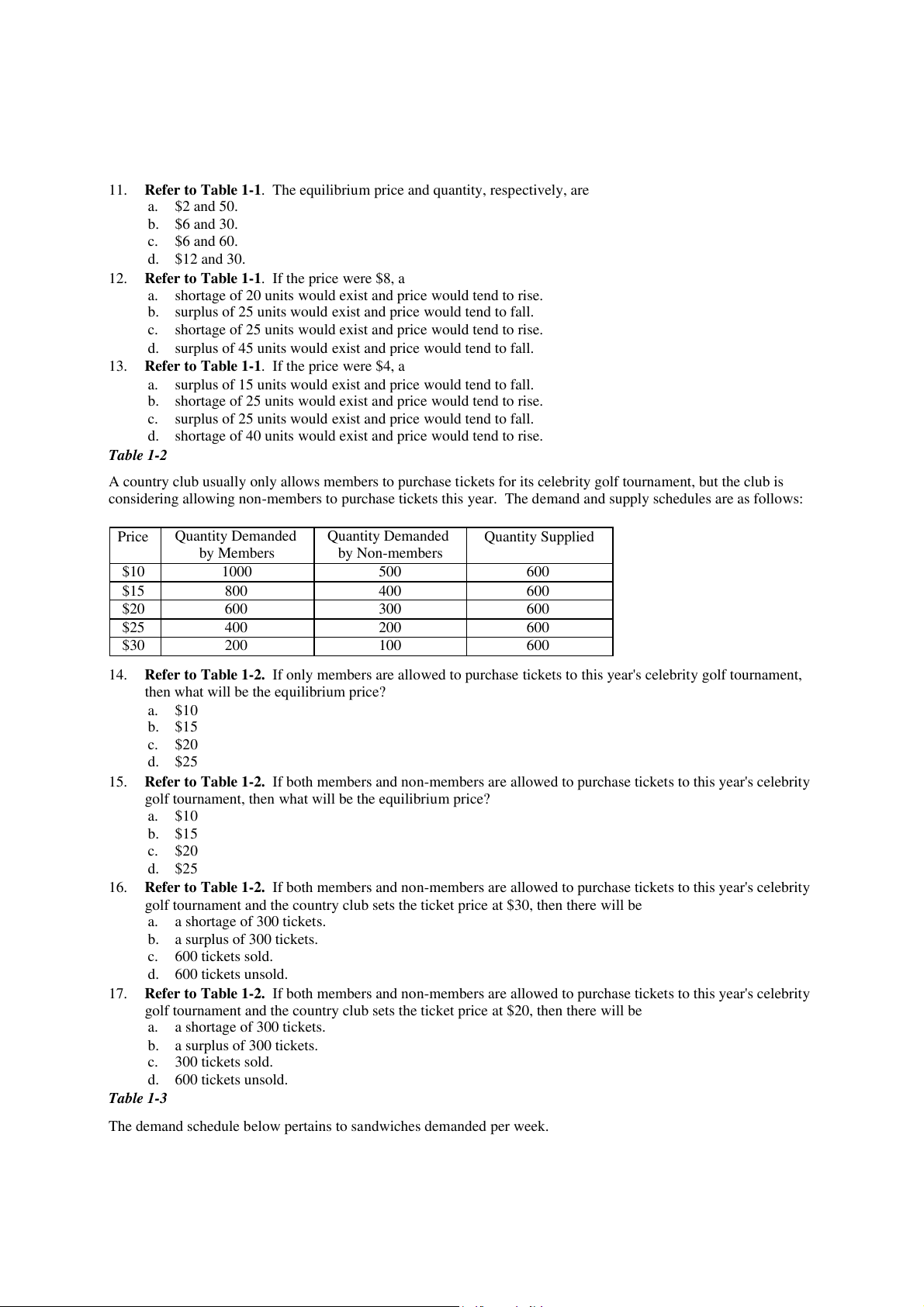
d. below the equilibrium price and quantity supplied is greater than quantity demanded. Table 1-1 Price Quantity Quantity Demanded Supplied $10 10 60 $8 20 45 $6 30 30 $4 40 15 $2 50 0
11. Refer to Table 1-1. The equilibrium price and quantity, respectively, are a. $2 and 50. b. $6 and 30. c. $6 and 60. d. $12 and 30.
12. Refer to Table 1-1. If the price were $8, a
a. shortage of 20 units would exist and price would tend to rise.
b. surplus of 25 units would exist and price would tend to fall.
c. shortage of 25 units would exist and price would tend to rise.
d. surplus of 45 units would exist and price would tend to fall.
13. Refer to Table 1-1. If the price were $4, a
a. surplus of 15 units would exist and price would tend to fall.
b. shortage of 25 units would exist and price would tend to rise.
c. surplus of 25 units would exist and price would tend to fall.
d. shortage of 40 units would exist and price would tend to rise. Table 1-2
A country club usually only allows members to purchase tickets for its celebrity golf tournament, but the club is
considering allowing non-members to purchase tickets this year. The demand and supply schedules are as follows:
Price Quantity Demanded Quantity Demanded Quantity Supplied by Members by Non-members $10 1000 500 600 $15 800 400 600 $20 600 300 600 $25 400 200 600 $30 200 100 600
14. Refer to Table 1-2. If only members are allowed to purchase tickets to this year's celebrity golf tournament,
then what will be the equilibrium price? a. $10 b. $15 c. $20 d. $25
15. Refer to Table 1-2. If both members and non-members are allowed to purchase tickets to this year's celebrity
golf tournament, then what will be the equilibrium price? a. $10 b. $15 c. $20 d. $25
16. Refer to Table 1-2. If both members and non-members are allowed to purchase tickets to this year's celebrity
golf tournament and the country club sets the ticket price at $30, then there will be a. a shortage of 300 tickets. b. a surplus of 300 tickets. c. 600 tickets sold. d. 600 tickets unsold.
17. Refer to Table 1-2. If both members and non-members are allowed to purchase tickets to this year's celebrity
golf tournament and the country club sets the ticket price at $20, then there will be a. a shortage of 300 tickets. b. a surplus of 300 tickets. c. 300 tickets sold. d. 600 tickets unsold. Table 1-3
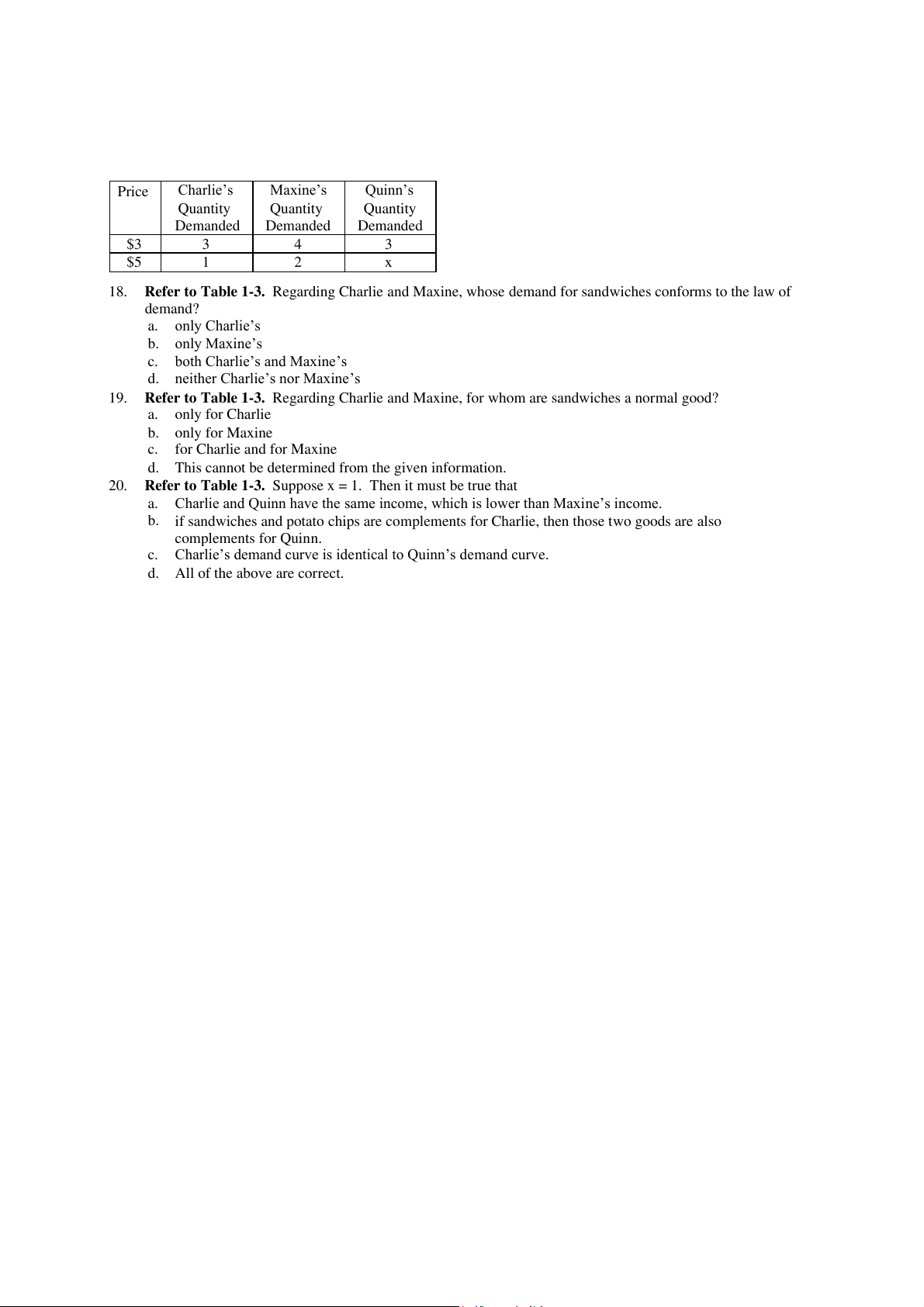
The demand schedule below pertains to sandwiches demanded per week. Price Charlie’s Maxine’s Quinn’s Quantity Quantity Quantity Demanded Demanded Demanded $3 3 4 3 $5 1 2 x
18. Refer to Table 1-3. Regarding Charlie and Maxine, whose demand for sandwiches conforms to the law of demand? a. only Charlie’s b. only Maxine’s
c. both Charlie’s and Maxine’s
d. neither Charlie’s nor Maxine’s
19. Refer to Table 1-3. Regarding Charlie and Maxine, for whom are sandwiches a normal good? a. only for Charlie b. only for Maxine c. for Charlie and for Maxine
d. This cannot be determined from the given information.
20. Refer to Table 1-3. Suppose x = 1. Then it must be true that
a. Charlie and Quinn have the same income, which is lower than Maxine’s income.
b. if sandwiches and potato chips are complements for Charlie, then those two goods are also complements for Quinn.
c. Charlie’s demand curve is identical to Quinn’s demand curve.
d. All of the above are correct.
Tài liệu liên quan:
-
Chương 3: độ co giãn và các nhân tố ảnh hưởng | Microeconomics | Trường Đại học Quốc tế, Đại học Quốc gia Thành phố Hồ Chí Minh
4 2 -
Microeconomics Syllabus | Microeconomics | Trường Đại học Quốc tế, Đại học Quốc gia Thành phố Hồ Chí Minh
4 2 -
Microeconomics Course Syllabus & Assessment Details | Microeconomics | Trường Đại học Quốc tế, Đại học Quốc gia Thành phố Hồ Chí Minh
4 2 -
Assignment 3 - Elasticity MCQs and Key Concepts | Microeconomics | Trường Đại học Quốc tế, Đại học Quốc gia Thành phố Hồ Chí Minh
4 2 -
Assignment 2 - Economic Equilibrium Analysis of Fridges and Motorcycles | Microeconomics | Trường Đại học Quốc tế, Đại học Quốc gia Thành phố Hồ Chí Minh
4 2