Midterm Exam 2 - Đề Thi Cơ Sở Kinh Tế Học | Microeconomics | Trường Đại học Quốc tế, Đại học Quốc gia Thành phố Hồ Chí Minh
The difference between long run and short run is that the long run allows for: 2. The socially optimal amount of pollution occurs where: the marginal social benefit of pollution is equal to the marginal social cost of pollution 3. The U-shape of the long run average total cost curve is primarily due to: economies and diseconomies of scale 4. Tài liệu được sưu tầm và soạn thảo dưới dạng file PDF để gửi tới các bạn cùng tham khảo, ôn tập đầy đủ kiến thức, chuẩn bị cho các buổi học thật tốt. Mời bạn đọc đón xem!
Môn: Microeconomics 635 tài liệu
Trường: Trường Đại học Quốc tế, Đại học Quốc gia Thành phố Hồ Chí Minh 1.9 K tài liệu
Tác giả:

Preview text:
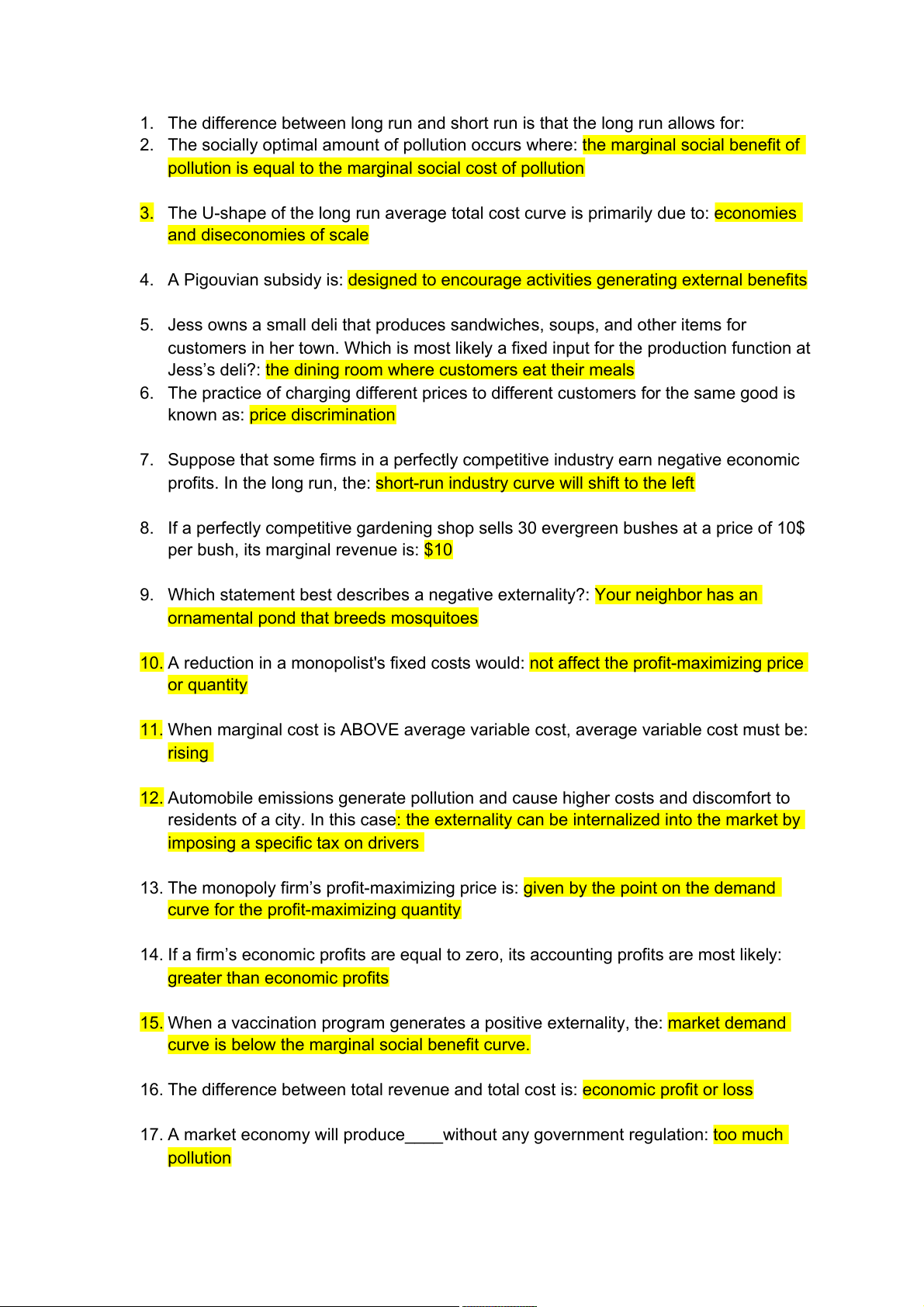
1. The difference between long run and short run is that the long run allows for:
2. The socially optimal amount of pollution occurs where: the marginal social benefit of
pollution is equal to the marginal social cost of pollution
3. The U-shape of the long run average total cost curve is primarily due to: economies and diseconomies of scale
4. A Pigouvian subsidy is: designed to encourage activities generating external benefits
5. Jess owns a small deli that produces sandwiches, soups, and other items for
customers in her town. Which is most likely a fixed input for the production function at
Jess’s deli?: the dining room where customers eat their meals
6. The practice of charging different prices to different customers for the same good is
known as: price discrimination
7. Suppose that some firms in a perfectly competitive industry earn negative economic
profits. In the long run, the: short-run industry curve will shift to the left
8. If a perfectly competitive gardening shop sells 30 evergreen bushes at a price of 10$
per bush, its marginal revenue is: $10
9. Which statement best describes a negative externality?: Your neighbor has an
ornamental pond that breeds mosquitoes
10. A reduction in a monopolist's fixed costs would: not affect the profit-maximizing price or quantity
11. When marginal cost is ABOVE average variable cost, average variable cost must be: rising
12. Automobile emissions generate pollution and cause higher costs and discomfort to
residents of a city. In this case: the externality can be internalized into the market by
imposing a specific tax on drivers
13. The monopoly firm’s profit-maximizing price is: given by the point on the demand
curve for the profit-maximizing quantity
14. If a firm’s economic profits are equal to zero, its accounting profits are most likely: greater than economic profits
15. When a vaccination program generates a positive externality, the: market demand
curve is below the marginal social benefit curve.
16. The difference between total revenue and total cost is: economic profit or loss
17. A market economy will produce____without any government regulation: too much pollution
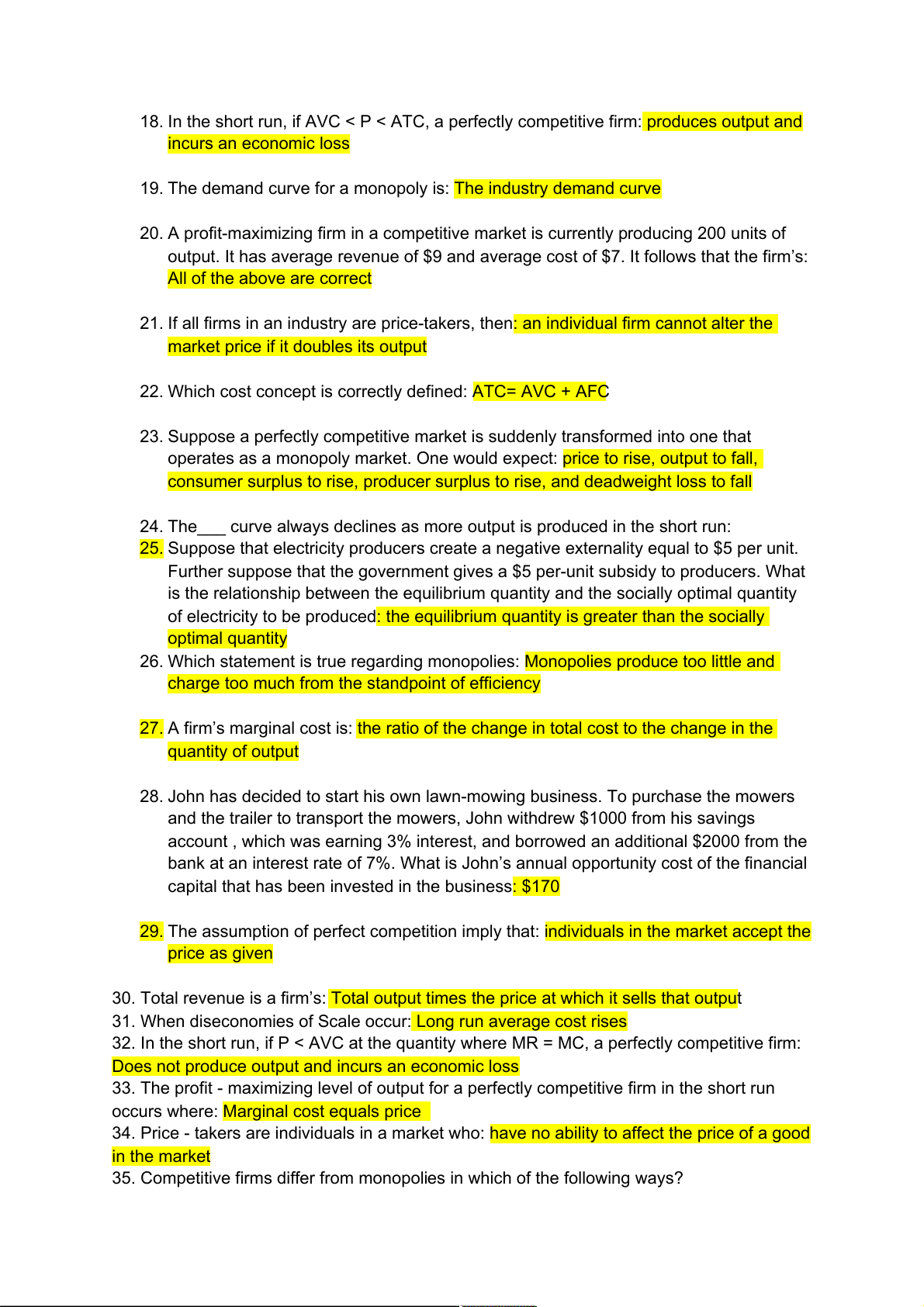
18. In the short run, if AVC < P < ATC, a perfectly competitive firm: produces output and incurs an economic loss
19. The demand curve for a monopoly is: The industry demand curve
20. A profit-maximizing firm in a competitive market is currently producing 200 units of
output. It has average revenue of $9 and average cost of $7. It follows that the firm’s: All of the above are correct
21. If all firms in an industry are price-takers, then: an individual firm cannot alter the
market price if it doubles its output
22. Which cost concept is correctly defined: ATC= AVC + AFC
23. Suppose a perfectly competitive market is suddenly transformed into one that
operates as a monopoly market. One would expect: price to rise, output to fall,
consumer surplus to rise, producer surplus to rise, and deadweight loss to fall
24. The___ curve always declines as more output is produced in the short run:
25. Suppose that electricity producers create a negative externality equal to $5 per unit.
Further suppose that the government gives a $5 per-unit subsidy to producers. What
is the relationship between the equilibrium quantity and the socially optimal quantity
of electricity to be produced: the equilibrium quantity is greater than the socially optimal quantity
26. Which statement is true regarding monopolies: Monopolies produce too little and
charge too much from the standpoint of efficiency
27. A firm’s marginal cost is: the ratio of the change in total cost to the change in the quantity of output
28. John has decided to start his own lawn-mowing business. To purchase the mowers
and the trailer to transport the mowers, John withdrew $1000 from his savings
account , which was earning 3% interest, and borrowed an additional $2000 from the
bank at an interest rate of 7%. What is John’s annual opportunity cost of the financial
capital that has been invested in the business: $170
29. The assumption of perfect competition imply that: individuals in the market accept the price as given
30. Total revenue is a firm’s: Total output times the price at which it sells that output
31. When diseconomies of Scale occur: Long run average cost rises
32. In the short run, if P < AVC at the quantity where MR = MC, a perfectly competitive firm:
Does not produce output and incurs an economic loss
33. The profit - maximizing level of output for a perfectly competitive firm in the short run
occurs where: Marginal cost equals price
34. Price - takers are individuals in a market who: have no ability to affect the price of a good in the market
35. Competitive firms differ from monopolies in which of the following ways?
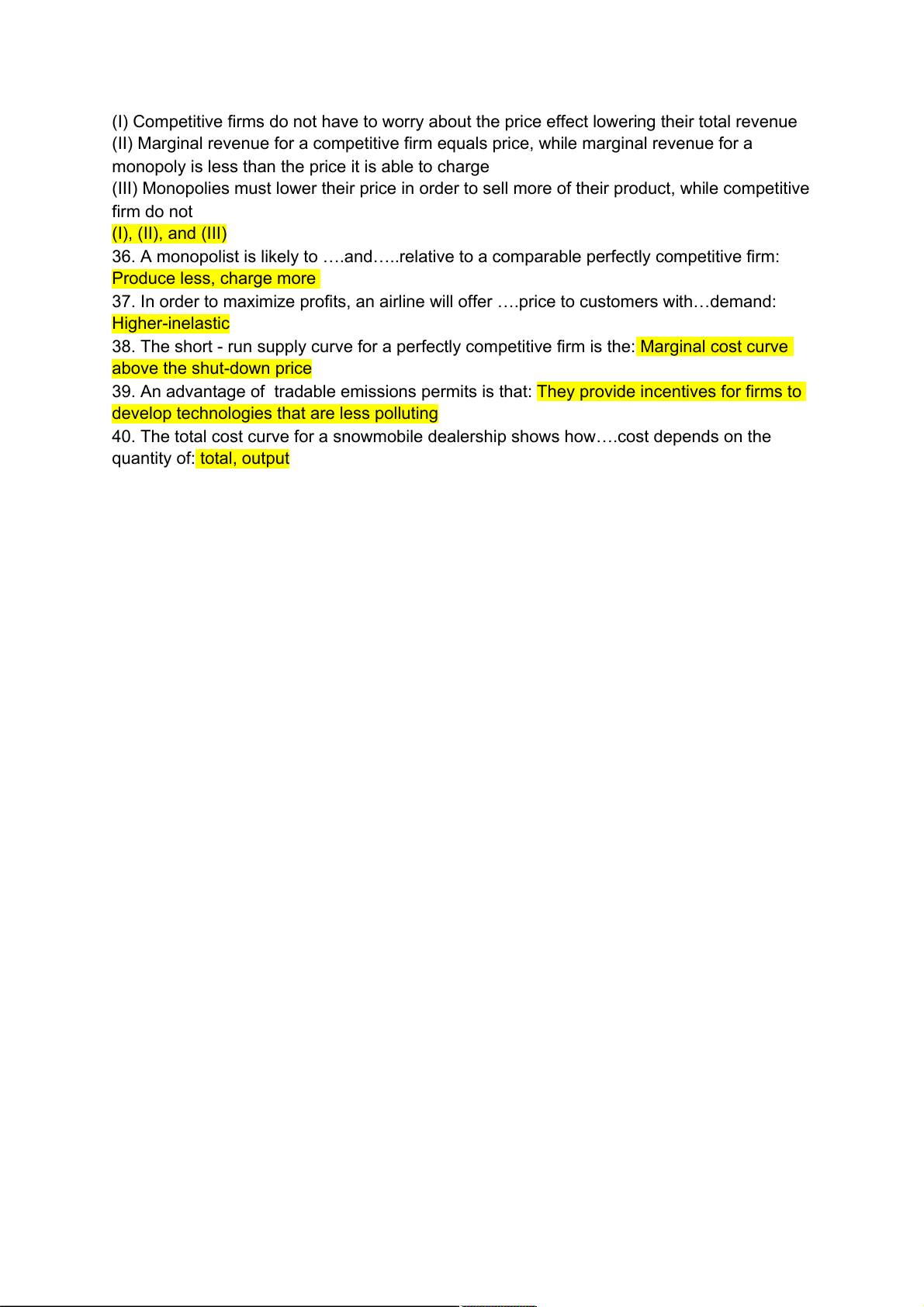
(I) Competitive firms do not have to worry about the price effect lowering their total revenue
(II) Marginal revenue for a competitive firm equals price, while marginal revenue for a
monopoly is less than the price it is able to charge
(III) Monopolies must lower their price in order to sell more of their product, while competitive firm do not (I), (II), and (III)
36. A monopolist is likely to ….and…..relative to a comparable perfectly competitive firm: Produce less, charge more
37. In order to maximize profits, an airline will offer ….price to customers with…demand: Higher-inelastic
38. The short - run supply curve for a perfectly competitive firm is the: Marginal cost curve above the shut-down price
39. An advantage of tradable emissions permits is that: They provide incentives for firms to
develop technologies that are less polluting
40. The total cost curve for a snowmobile dealership shows how….cost depends on the quantity of: total, output
Tài liệu liên quan:
-

Chương 3: độ co giãn và các nhân tố ảnh hưởng | Microeconomics | Trường Đại học Quốc tế, Đại học Quốc gia Thành phố Hồ Chí Minh
4 2 -
Microeconomics Syllabus | Microeconomics | Trường Đại học Quốc tế, Đại học Quốc gia Thành phố Hồ Chí Minh
4 2 -
Microeconomics Course Syllabus & Assessment Details | Microeconomics | Trường Đại học Quốc tế, Đại học Quốc gia Thành phố Hồ Chí Minh
4 2 -
Assignment 3 - Elasticity MCQs and Key Concepts | Microeconomics | Trường Đại học Quốc tế, Đại học Quốc gia Thành phố Hồ Chí Minh
4 2 -
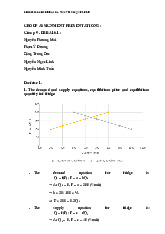
Assignment 2 - Economic Equilibrium Analysis of Fridges and Motorcycles | Microeconomics | Trường Đại học Quốc tế, Đại học Quốc gia Thành phố Hồ Chí Minh
4 2