Midterm Exam Answers for Microeconomics | Microeconomics | Trường Đại học Quốc tế, Đại học Quốc gia Thành phố Hồ Chí Minh
In general, when the price of a variable factor of production increases a. total cost falls. b. the profit-maximizing price falls. c. the profit maximizing level of output rises. d. marginal cost rises. When the price of a variable factor of production increases, the cost of producing another unit of output increases. Tài liệu được sưu tầm và soạn thảo dưới dạng file PDF để gửi tới các bạn cùng tham khảo, ôn tập đầy đủ kiến thức, chuẩn bị cho các buổi học thật tốt. Mời bạn đọc đón xem!
Môn: Microeconomics 635 tài liệu
Trường: Trường Đại học Quốc tế, Đại học Quốc gia Thành phố Hồ Chí Minh 1.9 K tài liệu
Tác giả:


Preview text:
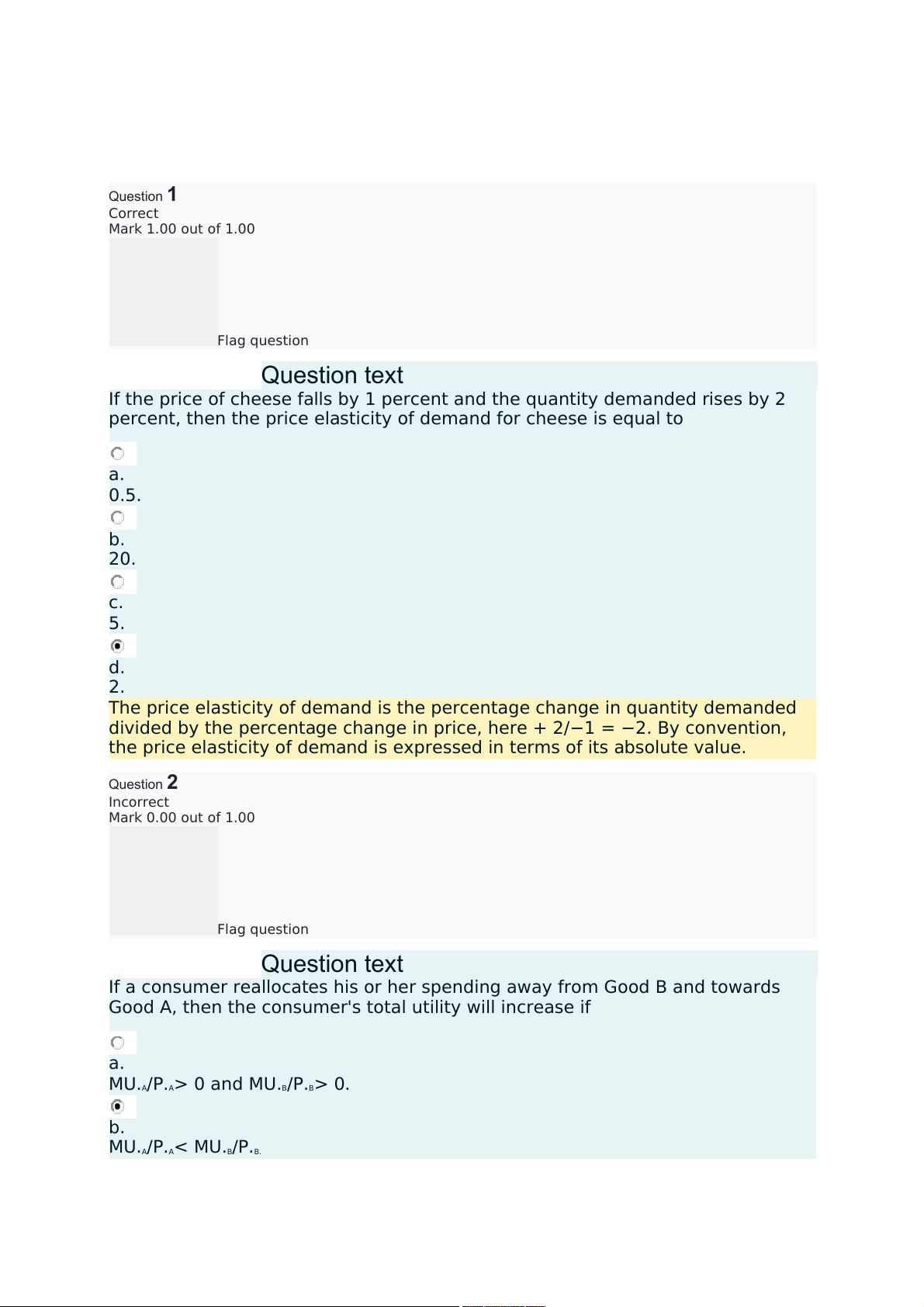
Question1 Correct Mark 1.00 out of 1.00 Flag question Questiontext
If the price of cheese falls by 1 percent and the quantity demanded rises by 2
percent, then the price elasticity of demand for cheese is equal to a. 0.5. b. 20. c. 5. d. 2.
The price elasticity of demand is the percentage change in quantity demanded
divided by the percentage change in price, here + 2/−1 = −2. By convention,
the price elasticity of demand is expressed in terms of its absolute value. Question2 Incorrect Mark 0.00 out of 1.00 Flag question Questiontext
If a consumer reallocates his or her spending away from Good B and towards
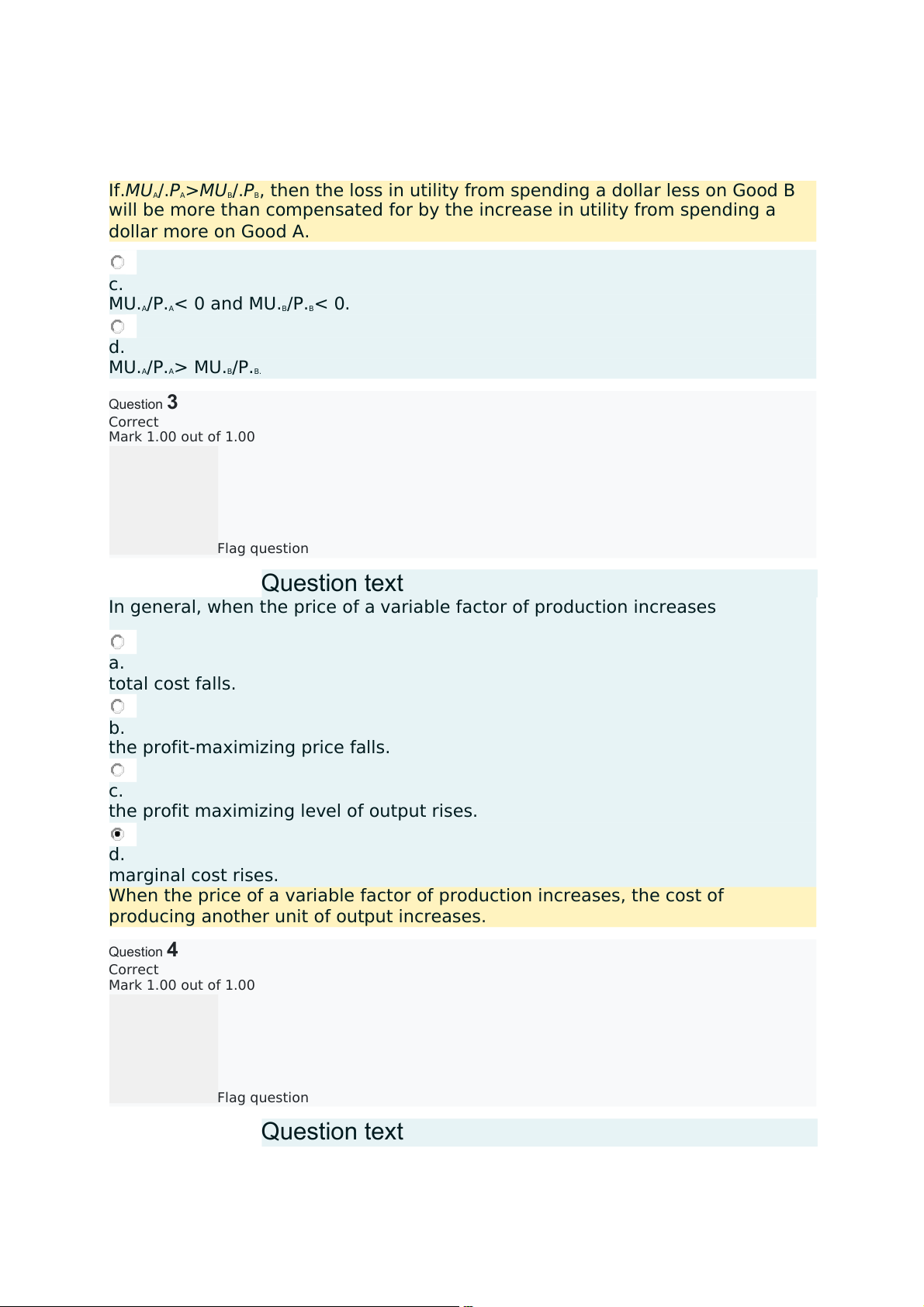
Good A, then the consumer's total utility will increase if a. MU. > 0 and MU. > 0. A/P.A B/P.B b. MU. < MU. A/P.A B/P.B. If.MU P MU
P , then the loss in utility from spending a dollar less on Good B A/. A> B/. B
will be more than compensated for by the increase in utility from spending a dollar more on Good A. c. MU. < 0 and MU. < 0. A/P.A B/P.B d. MU. > MU. A/P.A B/P.B. Question3 Correct Mark 1.00 out of 1.00 Flag question Questiontext
In general, when the price of a variable factor of production increases a. total cost falls. b.
the profit-maximizing price falls. c.
the profit maximizing level of output rises. d. marginal cost rises.
When the price of a variable factor of production increases, the cost of
producing another unit of output increases. Question4 Correct Mark 1.00 out of 1.00 Flag question Questiontext
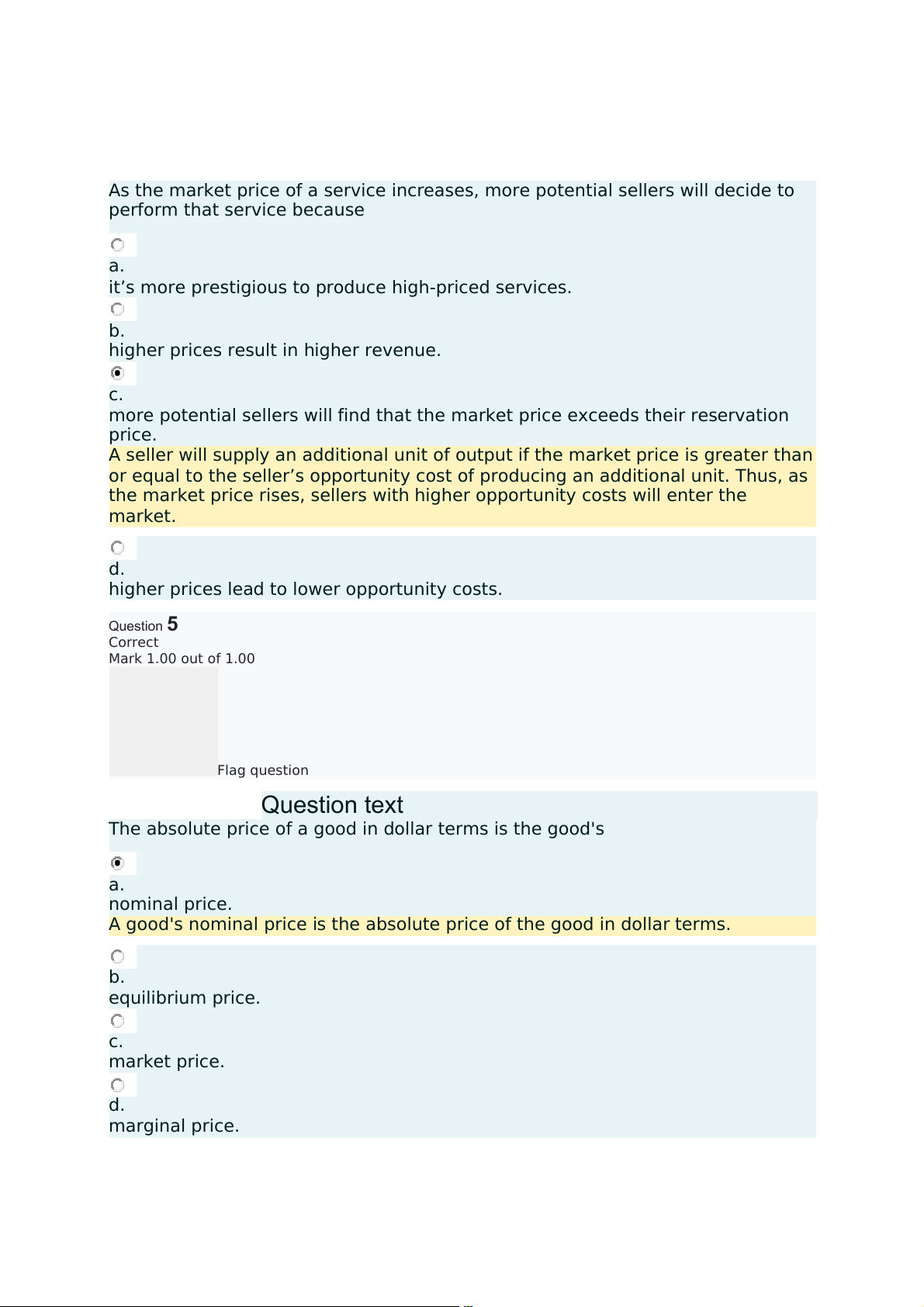
As the market price of a service increases, more potential sellers will decide to perform that service because a.
it’s more prestigious to produce high-priced services. b.
higher prices result in higher revenue. c.
more potential sellers will find that the market price exceeds their reservation price.
A seller will supply an additional unit of output if the market price is greater than
or equal to the seller’s opportunity cost of producing an additional unit. Thus, as
the market price rises, sellers with higher opportunity costs will enter the market. d.
higher prices lead to lower opportunity costs. Question5 Correct Mark 1.00 out of 1.00 Flag question Questiontext
The absolute price of a good in dollar terms is the good's a. nominal price.
A good's nominal price is the absolute price of the good in dollar terms. b. equilibrium price. c. market price. d. marginal price. Question6 Incorrect Mark 0.00 out of 1.00 Flag question Questiontext
Entry into a perfectly competitive industry occurs whenever a.
economic profit is equal to zero. b.
accounting profit is equal to zero.
Entry of new firms is a response to the existence of positive economic profit. c.
accounting profit is greater than zero. d.
economic profit is greater than zero. Question8 Correct Mark 1.00 out of 1.00 Flag question Questiontext
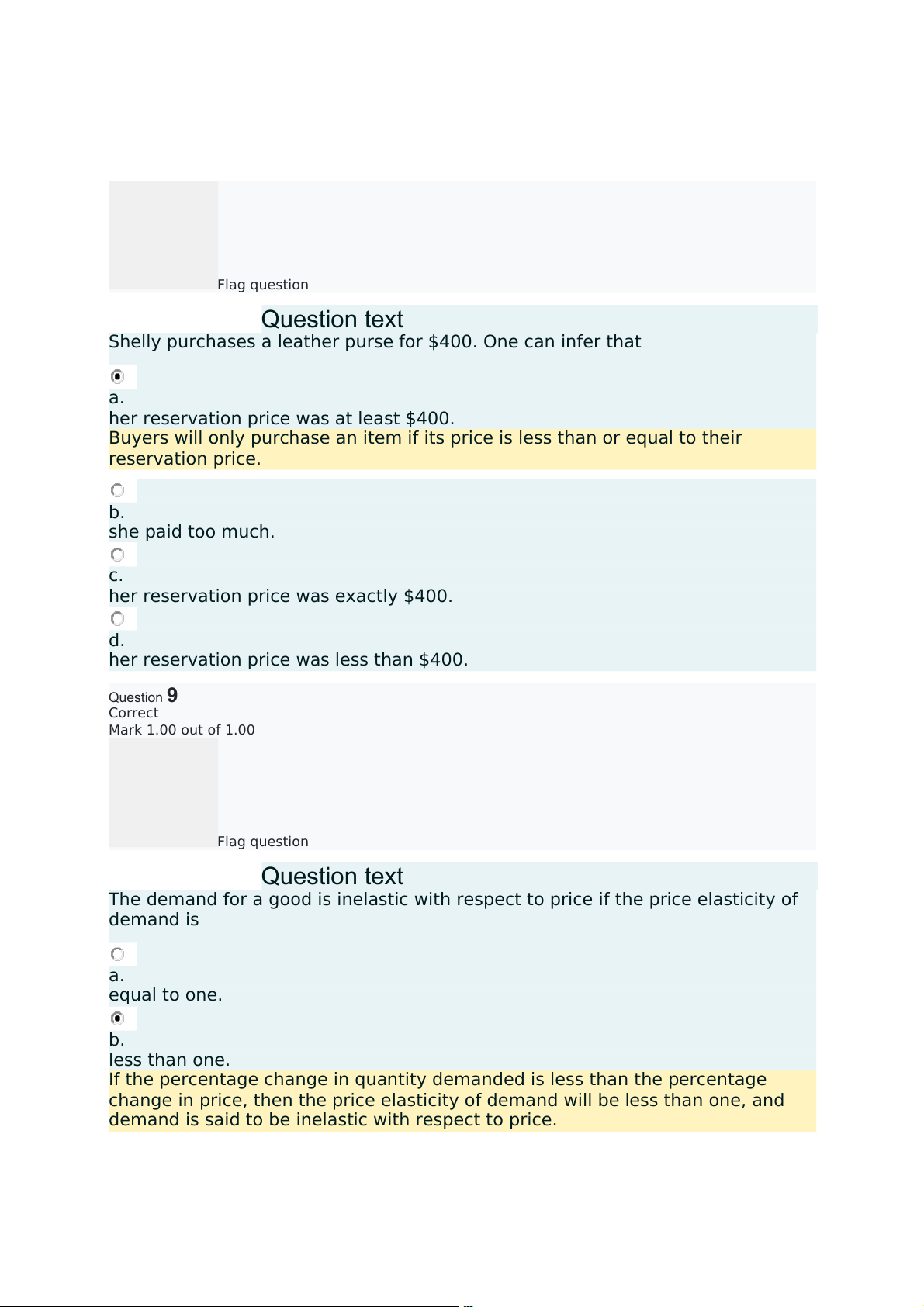
Shelly purchases a leather purse for $400. One can infer that a.
her reservation price was at least $400.
Buyers will only purchase an item if its price is less than or equal to their reservation price. b. she paid too much. c.
her reservation price was exactly $400. d.
her reservation price was less than $400. Question9 Correct Mark 1.00 out of 1.00 Flag question Questiontext
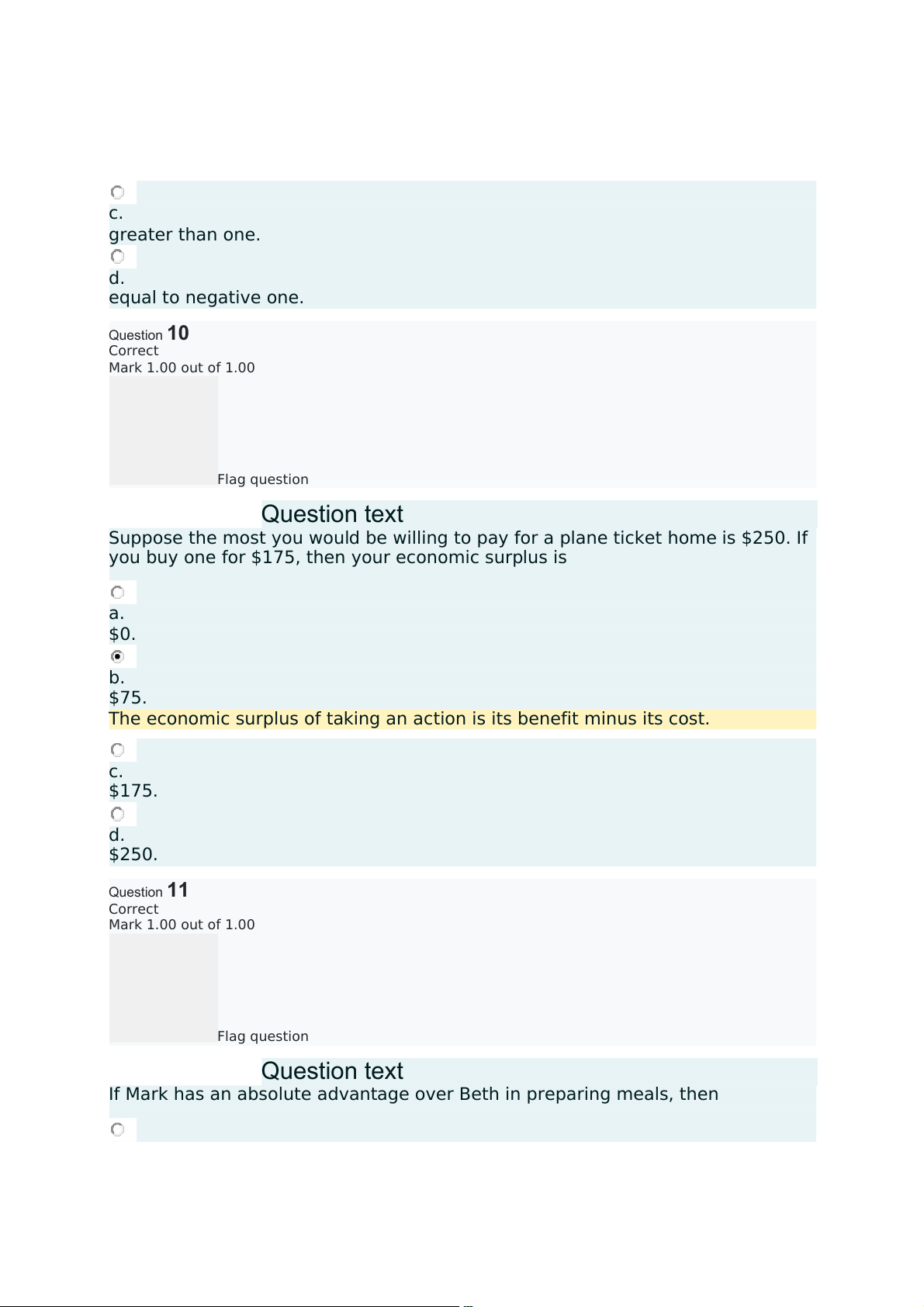
The demand for a good is inelastic with respect to price if the price elasticity of demand is a. equal to one. b. less than one.
If the percentage change in quantity demanded is less than the percentage
change in price, then the price elasticity of demand will be less than one, and
demand is said to be inelastic with respect to price. c. greater than one. d. equal to negative one. Question10 Correct Mark 1.00 out of 1.00 Flag question Questiontext
Suppose the most you would be willing to pay for a plane ticket home is $250. If
you buy one for $175, then your economic surplus is a. $0. b. $75.
The economic surplus of taking an action is its benefit minus its cost. c. $175. d. $250. Question11 Correct Mark 1.00 out of 1.00 Flag question Questiontext
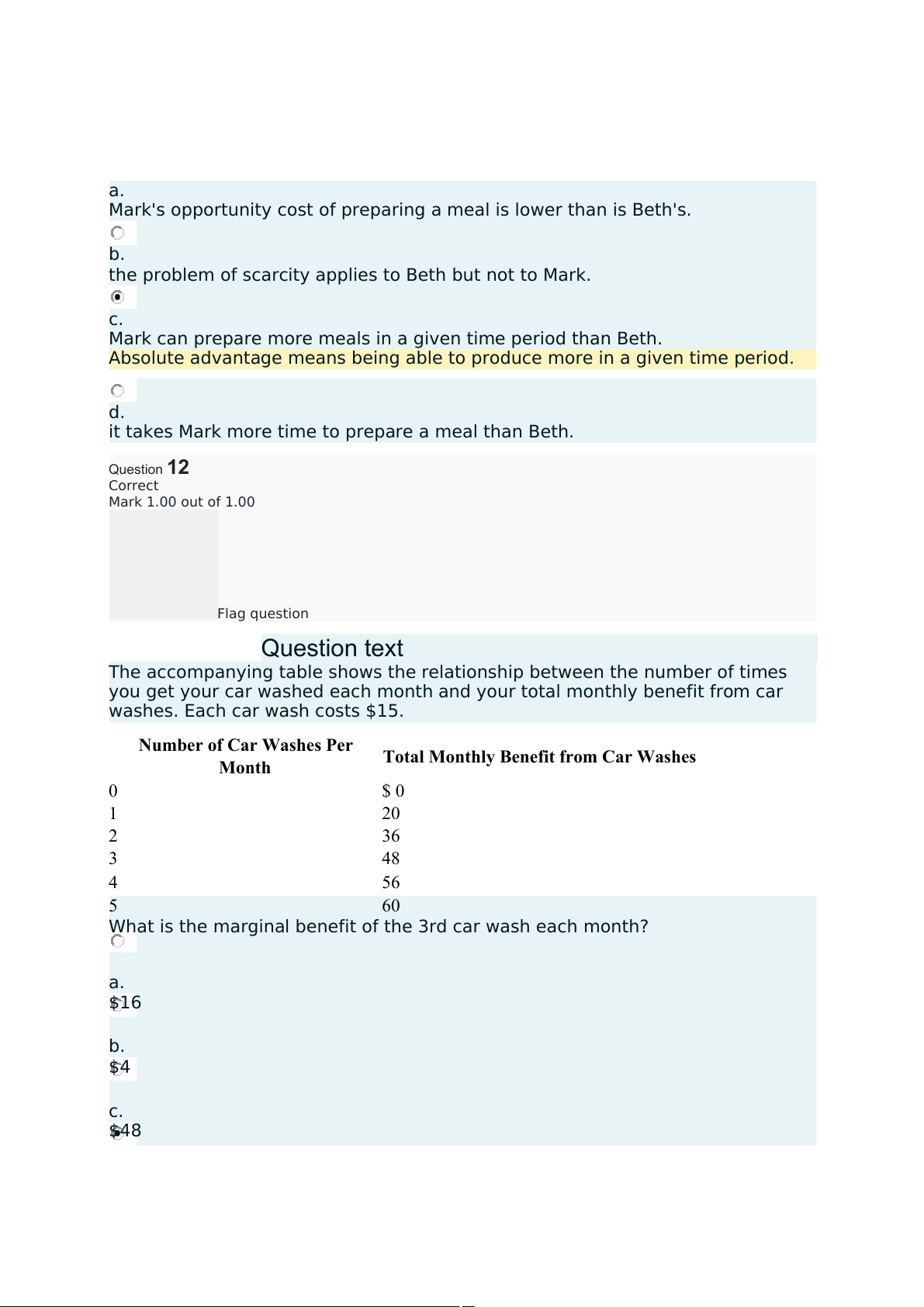
If Mark has an absolute advantage over Beth in preparing meals, then a.
Mark's opportunity cost of preparing a meal is lower than is Beth's. b.
the problem of scarcity applies to Beth but not to Mark. c.
Mark can prepare more meals in a given time period than Beth.
Absolute advantage means being able to produce more in a given time period. d.
it takes Mark more time to prepare a meal than Beth. Question12 Correct Mark 1.00 out of 1.00 Flag question Questiontext
The accompanying table shows the relationship between the number of times
you get your car washed each month and your total monthly benefit from car
washes. Each car wash costs $15.
Number of Car Washes Per
Total Monthly Benefit from Car Washes Month 0 $ 0 1 20 2 36 3 48 4 56 5 60
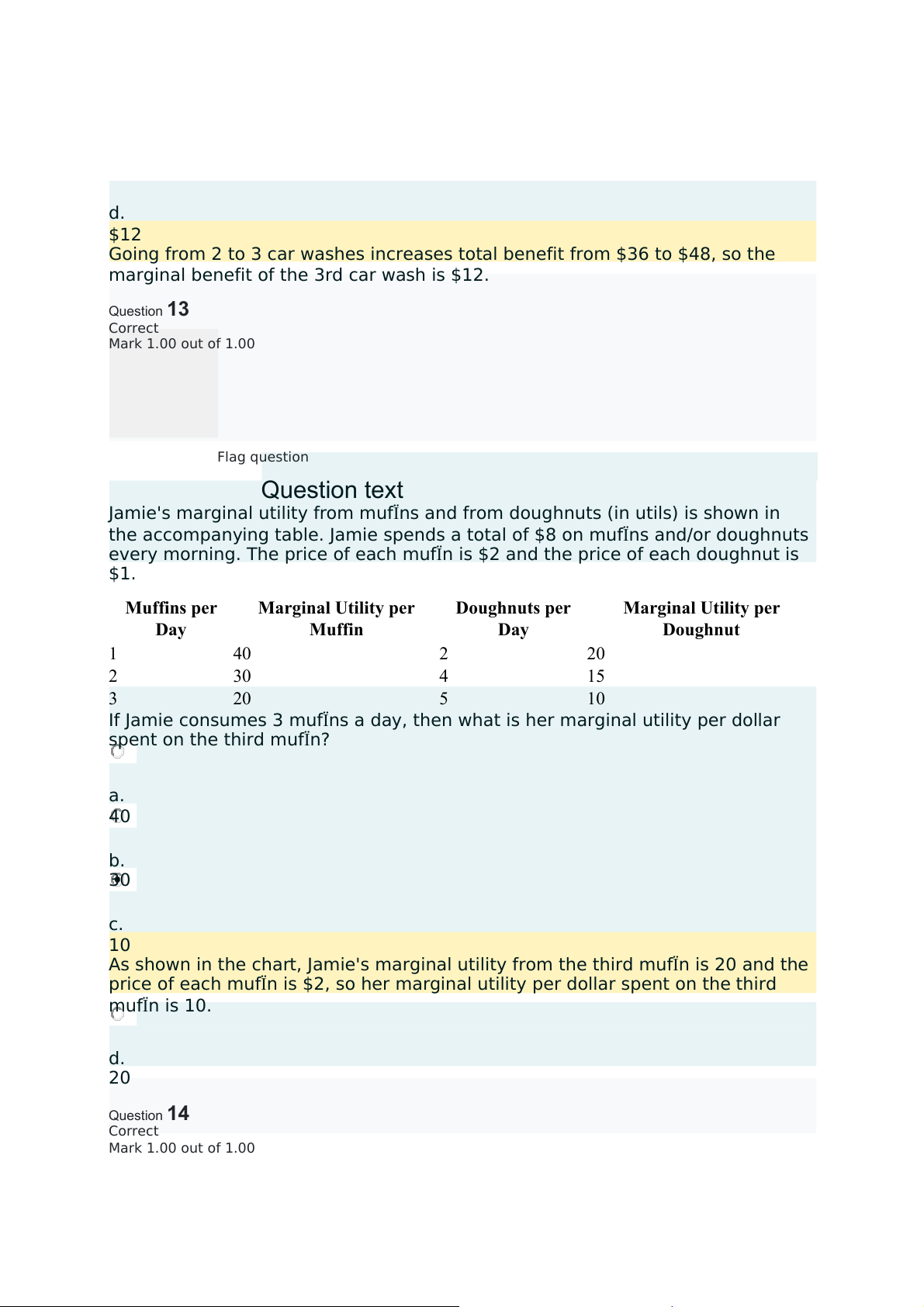
What is the marginal benefit of the 3rd car wash each month? a. $16 b. $4 c. $48 d. $12
Going from 2 to 3 car washes increases total benefit from $36 to $48, so the
marginal benefit of the 3rd car wash is $12. Question13 Correct Mark 1.00 out of 1.00 Flag question Questiontext
Jamie's marginal utility from mufÏns and from doughnuts (in utils) is shown in
the accompanying table. Jamie spends a total of $8 on mufÏns and/or doughnuts
every morning. The price of each mufÏn is $2 and the price of each doughnut is $1. Muffins per Marginal Utility per Doughnuts per Marginal Utility per Day Muffin Day Doughnut 1 40 2 20 2 30 4 15 3 20 5 10
If Jamie consumes 3 mufÏns a day, then what is her marginal utility per dollar spent on the third mufÏn? a. 40 b. 30 c. 10
As shown in the chart, Jamie's marginal utility from the third mufÏn is 20 and the
price of each mufÏn is $2, so her marginal utility per dollar spent on the third mufÏn is 10. d. 20 Question14 Correct Mark 1.00 out of 1.00 Flag question Questiontext
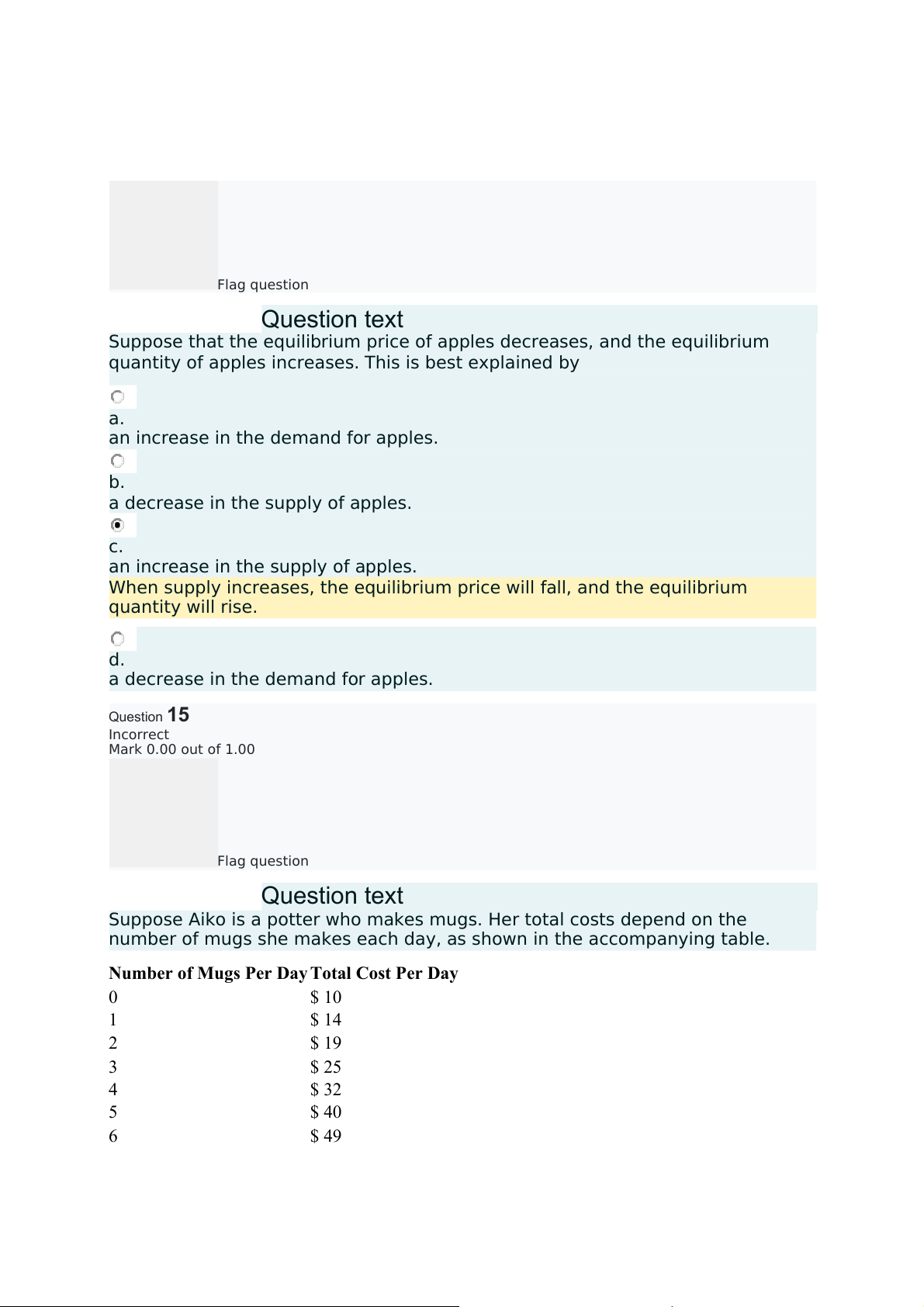
Suppose that the equilibrium price of apples decreases, and the equilibrium
quantity of apples increases. This is best explained by a.
an increase in the demand for apples. b.
a decrease in the supply of apples. c.
an increase in the supply of apples.
When supply increases, the equilibrium price will fall, and the equilibrium quantity will rise. d.
a decrease in the demand for apples. Question15 Incorrect Mark 0.00 out of 1.00 Flag question Questiontext
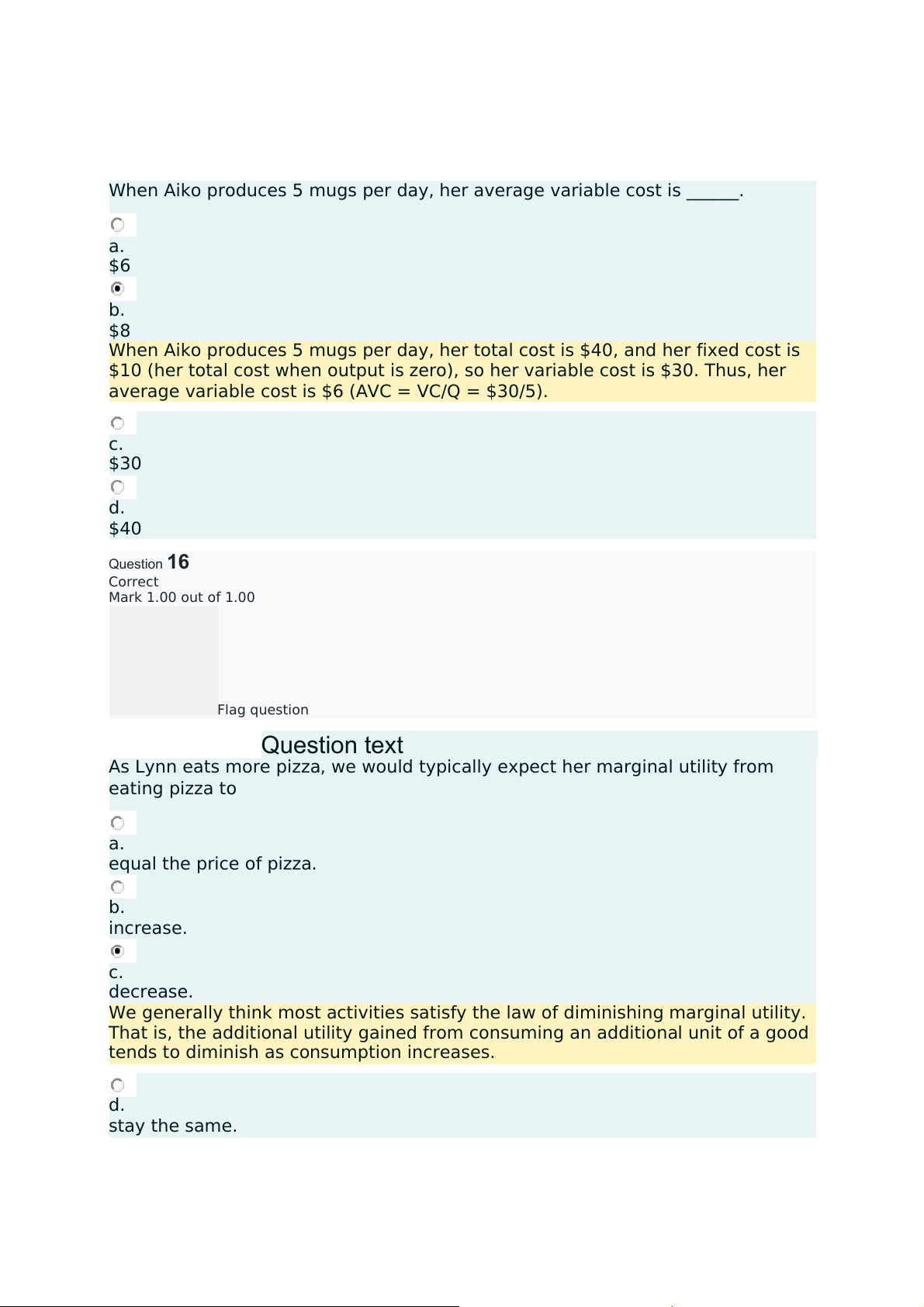
Suppose Aiko is a potter who makes mugs. Her total costs depend on the
number of mugs she makes each day, as shown in the accompanying table.
Number of Mugs Per Day Total Cost Per Day 0 $ 10 1 $ 14 2 $ 19 3 $ 25 4 $ 32 5 $ 40 6 $ 49
When Aiko produces 5 mugs per day, her average variable cost is ______. a. $6 b. $8
When Aiko produces 5 mugs per day, her total cost is $40, and her fixed cost is
$10 (her total cost when output is zero), so her variable cost is $30. Thus, her
average variable cost is $6 (AVC = VC/Q = $30/5). c. $30 d. $40 Question16 Correct Mark 1.00 out of 1.00 Flag question Questiontext
As Lynn eats more pizza, we would typically expect her marginal utility from eating pizza to a. equal the price of pizza. b. increase. c. decrease.
We generally think most activities satisfy the law of diminishing marginal utility.
That is, the additional utility gained from consuming an additional unit of a good
tends to diminish as consumption increases. d. stay the same. Question17 Incorrect Mark 0.00 out of 1.00 Flag question Questiontext
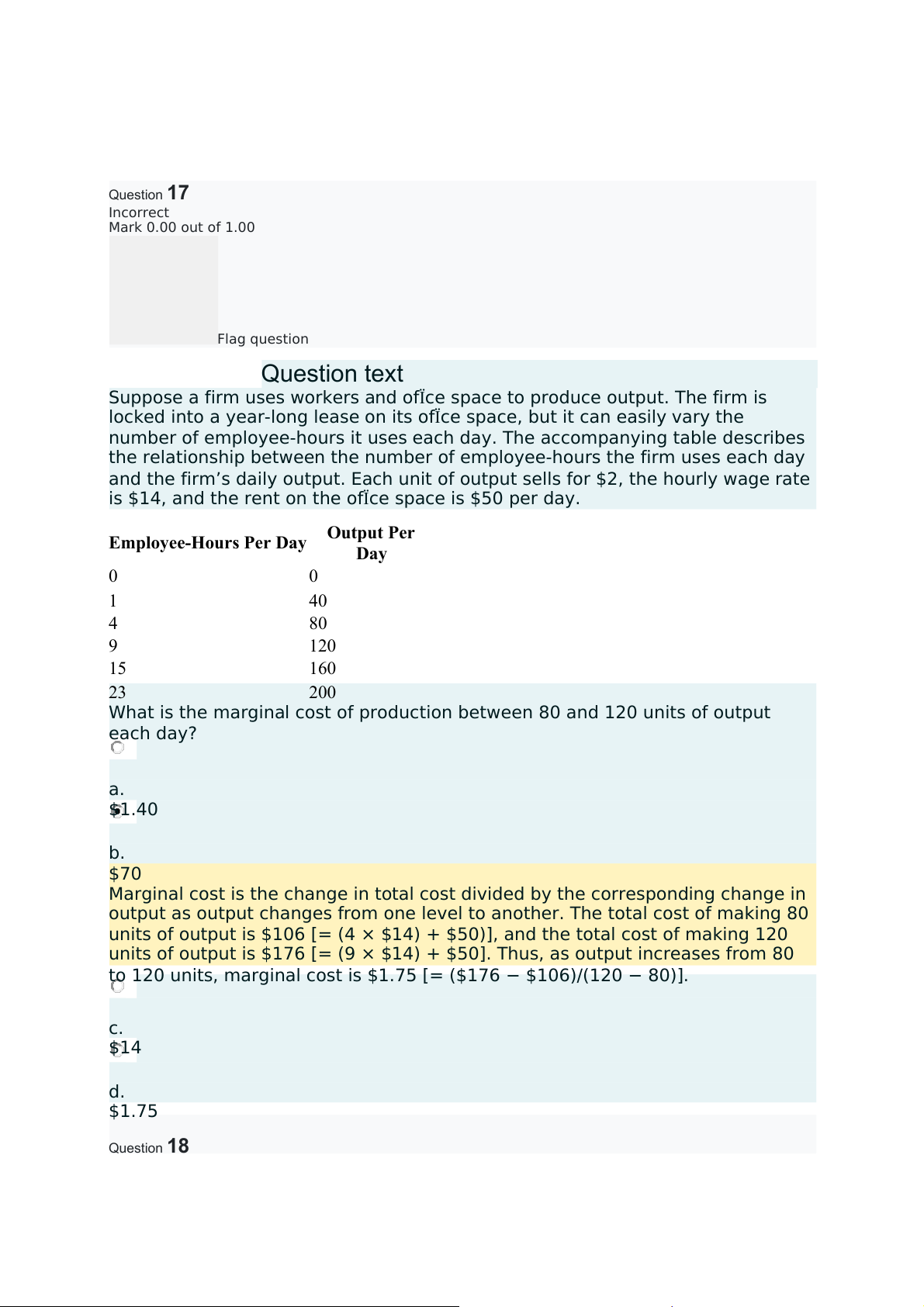
Suppose a firm uses workers and ofÏce space to produce output. The firm is
locked into a year-long lease on its ofÏce space, but it can easily vary the
number of employee-hours it uses each day. The accompanying table describes
the relationship between the number of employee-hours the firm uses each day
and the firm’s daily output. Each unit of output sells for $2, the hourly wage rate
is $14, and the rent on the ofÏce space is $50 per day. Output Per Employee-Hours Per Day Day 0 0 1 40 4 80 9 120 15 160 23 200
What is the marginal cost of production between 80 and 120 units of output each day? a. $1.40 b. $70
Marginal cost is the change in total cost divided by the corresponding change in
output as output changes from one level to another. The total cost of making 80
units of output is $106 [= (4 × $14) + $50)], and the total cost of making 120
units of output is $176 [= (9 × $14) + $50]. Thus, as output increases from 80
to 120 units, marginal cost is $1.75 [= ($176 − $106)/(120 − 80)]. c. $14 d. $1.75 Question18 Correct Mark 1.00 out of 1.00 Flag question Questiontext
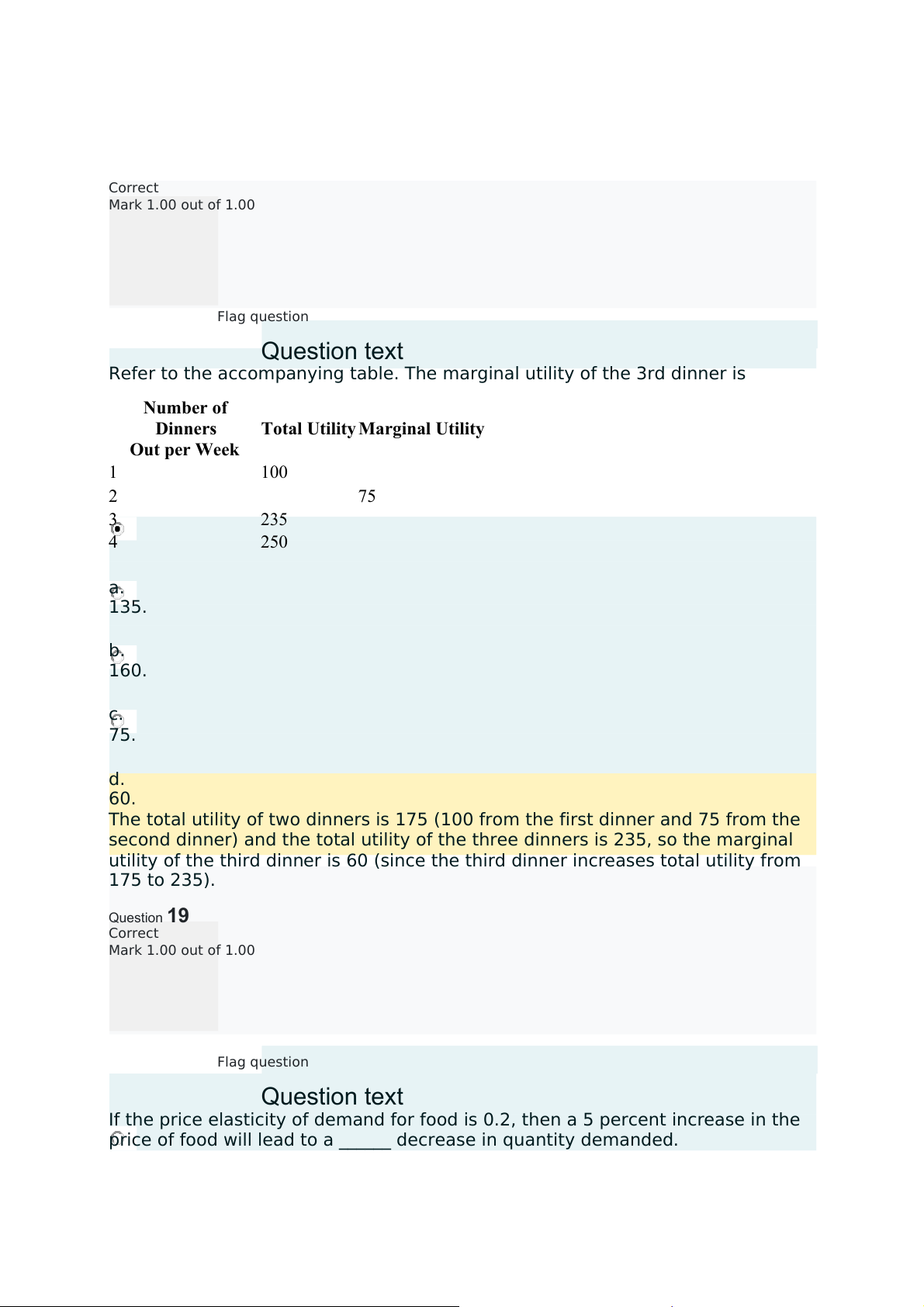
Refer to the accompanying table. The marginal utility of the 3rd dinner is Number of Dinners
Total Utility Marginal Utility Out per Week 1 100 2 75 3 235 4 250 a. 135. b. 160. c. 75. d. 60.
The total utility of two dinners is 175 (100 from the first dinner and 75 from the
second dinner) and the total utility of the three dinners is 235, so the marginal
utility of the third dinner is 60 (since the third dinner increases total utility from 175 to 235). Question19 Correct Mark 1.00 out of 1.00 Flag question Questiontext
If the price elasticity of demand for food is 0.2, then a 5 percent increase in the
price of food will lead to a ______ decrease in quantity demanded. a. 2.5 percent b. 0.1 percent c. 1 percent
The price elasticity of demand tells you the percentage change in the quantity
demanded of a good that results from a 1 percent change in price. Thus, if the
price elasticity of demand is 0.2 and there is a price increase of 5 percent, then
quantity demanded will change by 0.2 × 5 = 1 percent. d. 25 percent Question21 Correct Mark 1.00 out of 1.00 Flag question Questiontext
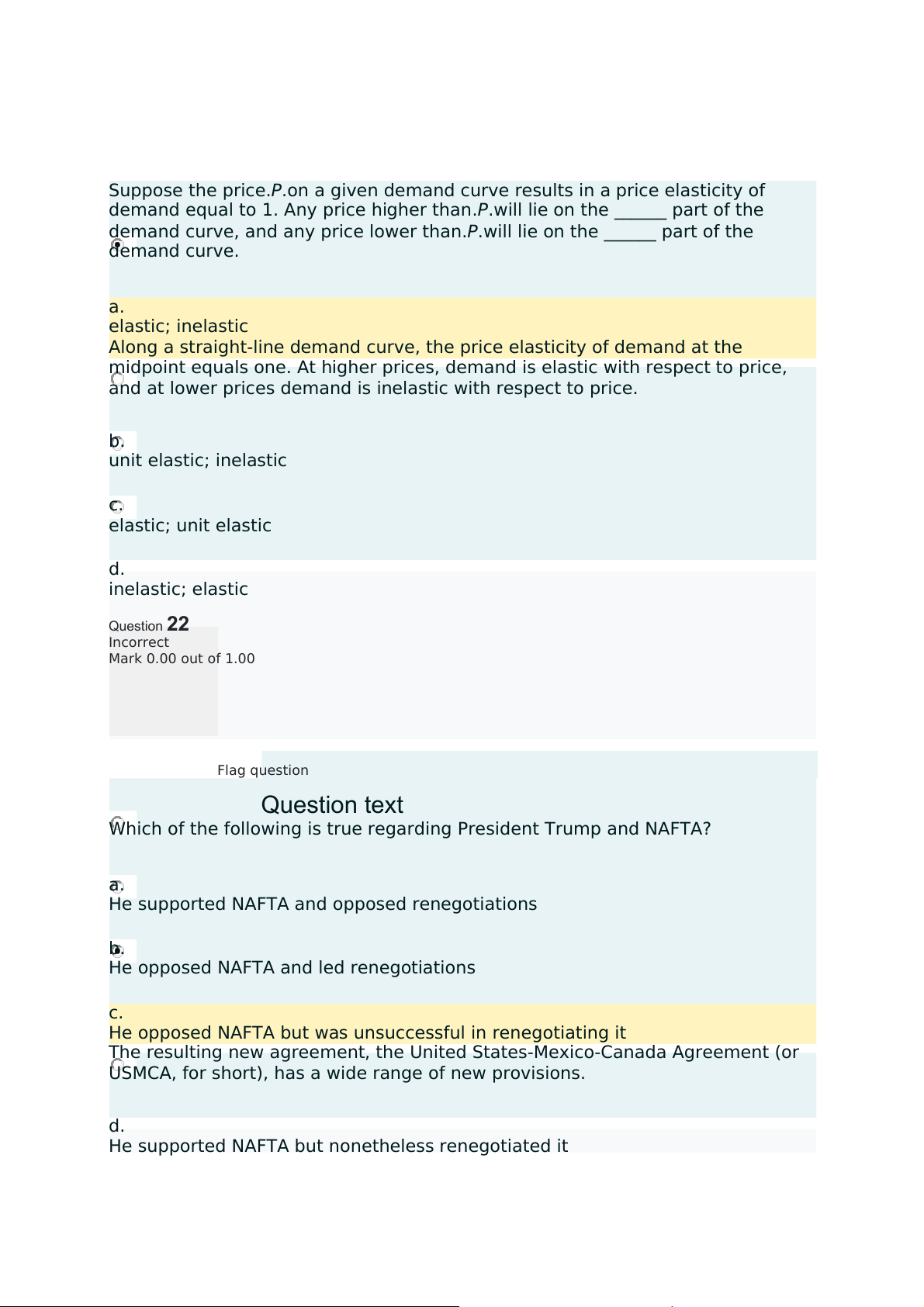
Suppose the price.P.on a given demand curve results in a price elasticity of
demand equal to 1. Any price higher than.P.will lie on the ______ part of the
demand curve, and any price lower than.P.will lie on the ______ part of the demand curve. a. elastic; inelastic
Along a straight-line demand curve, the price elasticity of demand at the
midpoint equals one. At higher prices, demand is elastic with respect to price,
and at lower prices demand is inelastic with respect to price. b. unit elastic; inelastic c. elastic; unit elastic d. inelastic; elastic Question22 Incorrect Mark 0.00 out of 1.00 Flag question Questiontext
Which of the following is true regarding President Trump and NAFTA? a.
He supported NAFTA and opposed renegotiations b.
He opposed NAFTA and led renegotiations c.
He opposed NAFTA but was unsuccessful in renegotiating it
The resulting new agreement, the United States-Mexico-Canada Agreement (or
USMCA, for short), has a wide range of new provisions. d.
He supported NAFTA but nonetheless renegotiated it Question23 Incorrect Mark 0.00 out of 1.00 Flag question Questiontext
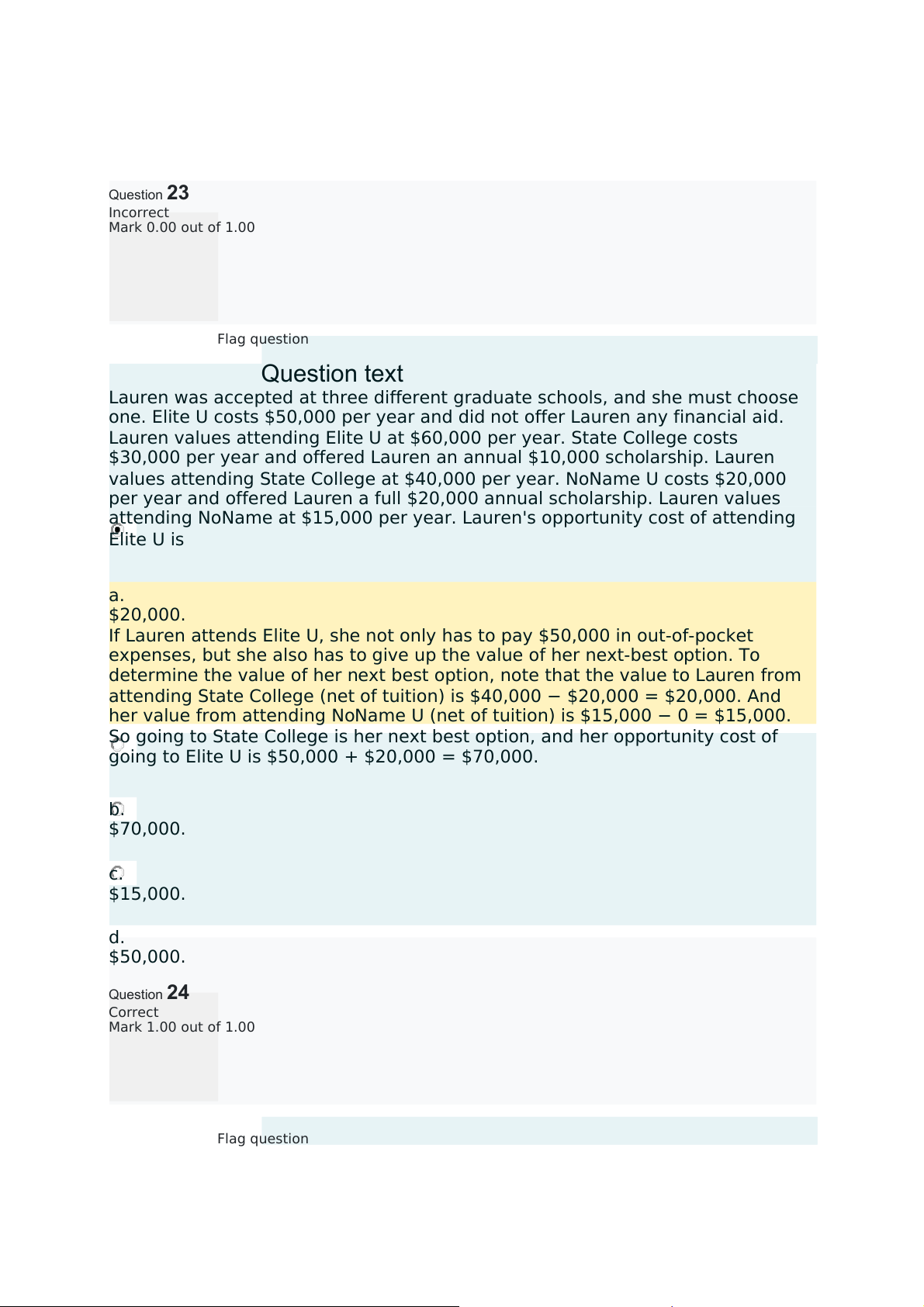
Lauren was accepted at three different graduate schools, and she must choose
one. Elite U costs $50,000 per year and did not offer Lauren any financial aid.
Lauren values attending Elite U at $60,000 per year. State College costs
$30,000 per year and offered Lauren an annual $10,000 scholarship. Lauren
values attending State College at $40,000 per year. NoName U costs $20,000
per year and offered Lauren a full $20,000 annual scholarship. Lauren values
attending NoName at $15,000 per year. Lauren's opportunity cost of attending Elite U is a. $20,000.
If Lauren attends Elite U, she not only has to pay $50,000 in out-of-pocket
expenses, but she also has to give up the value of her next-best option. To
determine the value of her next best option, note that the value to Lauren from
attending State College (net of tuition) is $40,000 − $20,000 = $20,000. And
her value from attending NoName U (net of tuition) is $15,000 − 0 = $15,000.
So going to State College is her next best option, and her opportunity cost of
going to Elite U is $50,000 + $20,000 = $70,000. b. $70,000. c. $15,000. d. $50,000. Question24 Correct Mark 1.00 out of 1.00 Flag question Questiontext
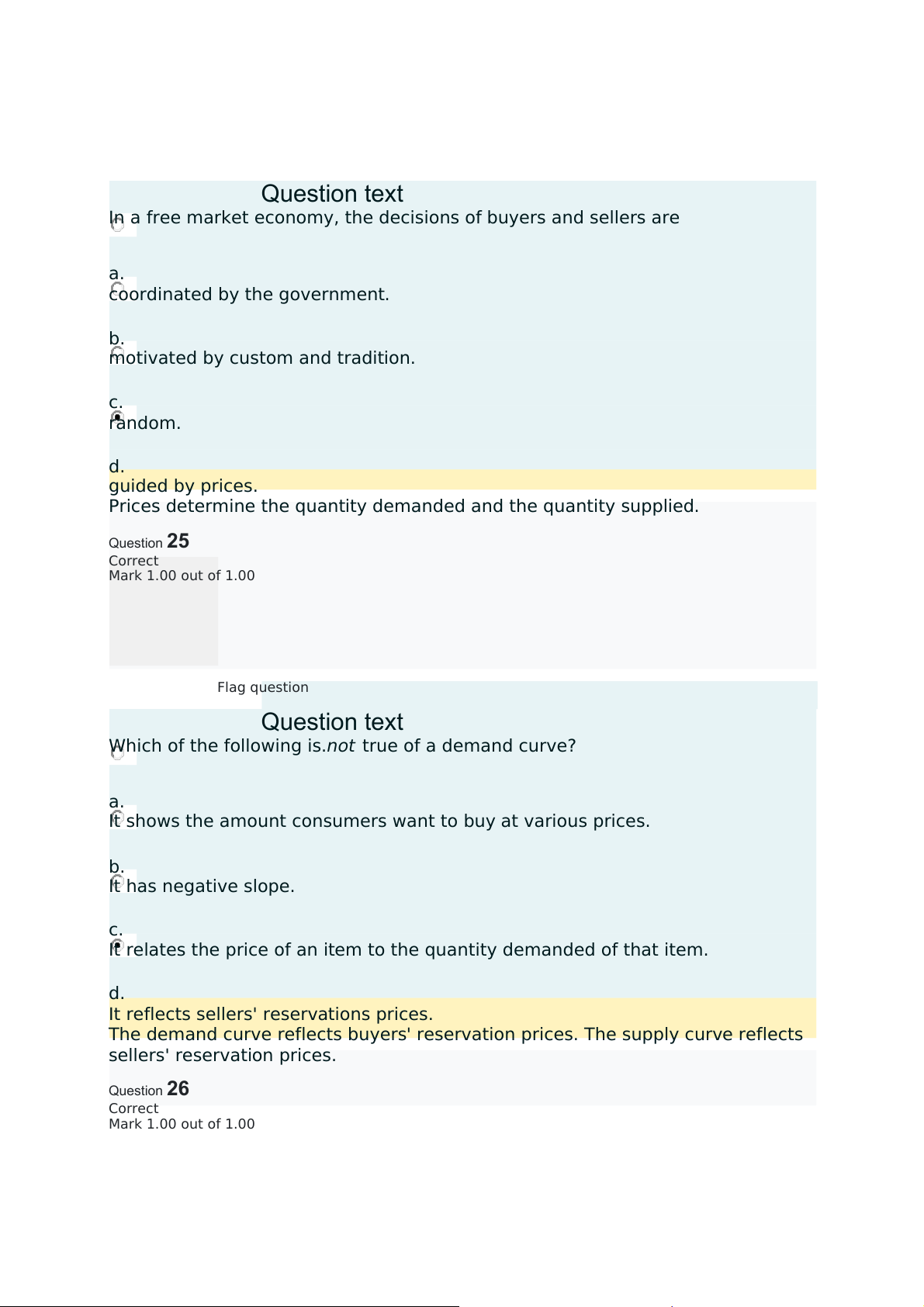
In a free market economy, the decisions of buyers and sellers are a. coordinated by the government. b.
motivated by custom and tradition. c. random. d. guided by prices.
Prices determine the quantity demanded and the quantity supplied. Question25 Correct Mark 1.00 out of 1.00 Flag question Questiontext
Which of the following is.nottrue of a demand curve? a.
It shows the amount consumers want to buy at various prices. b. It has negative slope. c.
It relates the price of an item to the quantity demanded of that item. d.
It reflects sellers' reservations prices.
The demand curve reflects buyers' reservation prices. The supply curve reflects sellers' reservation prices. Question26 Correct Mark 1.00 out of 1.00 Flag question Questiontext
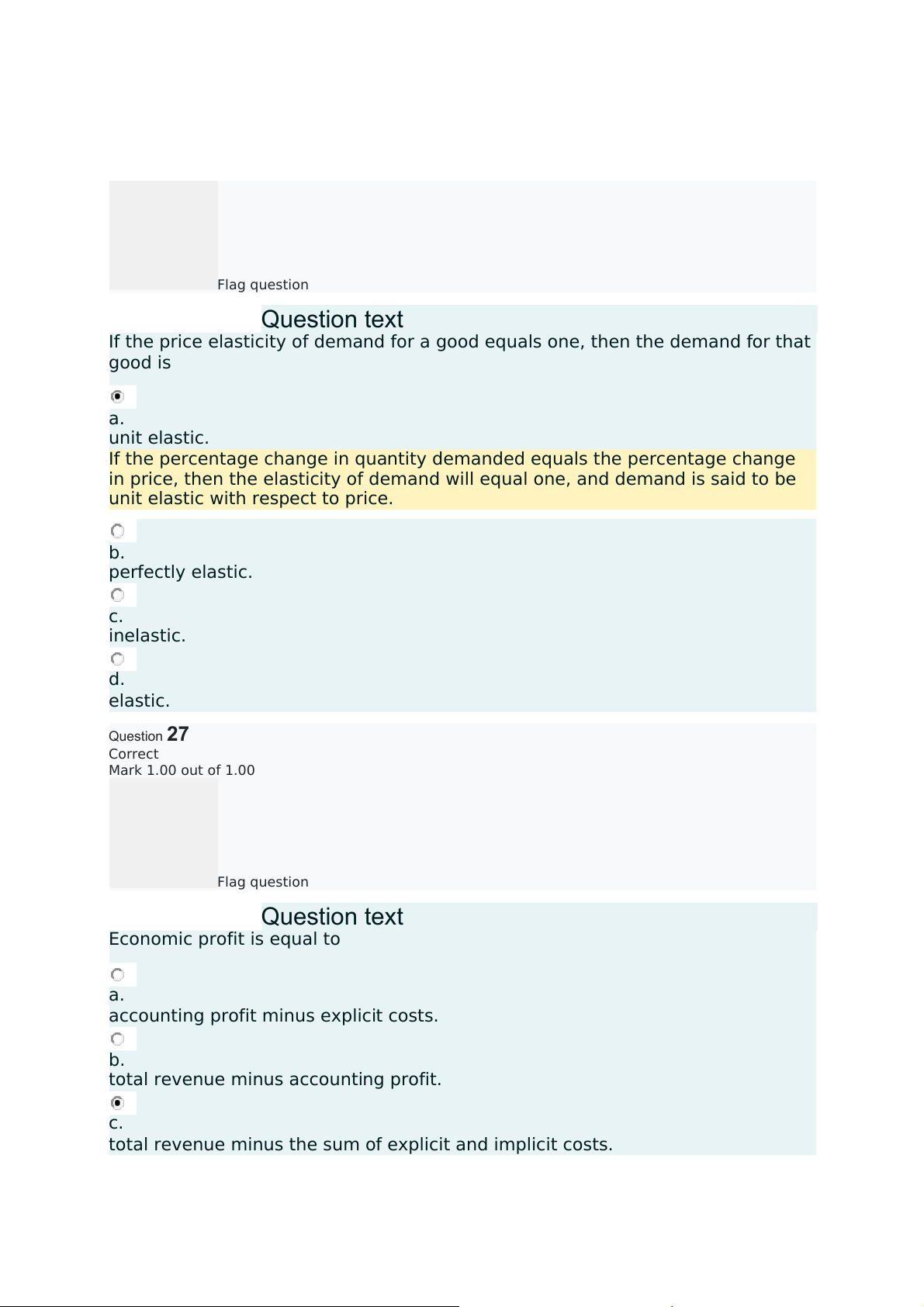
If the price elasticity of demand for a good equals one, then the demand for that good is a. unit elastic.
If the percentage change in quantity demanded equals the percentage change
in price, then the elasticity of demand will equal one, and demand is said to be
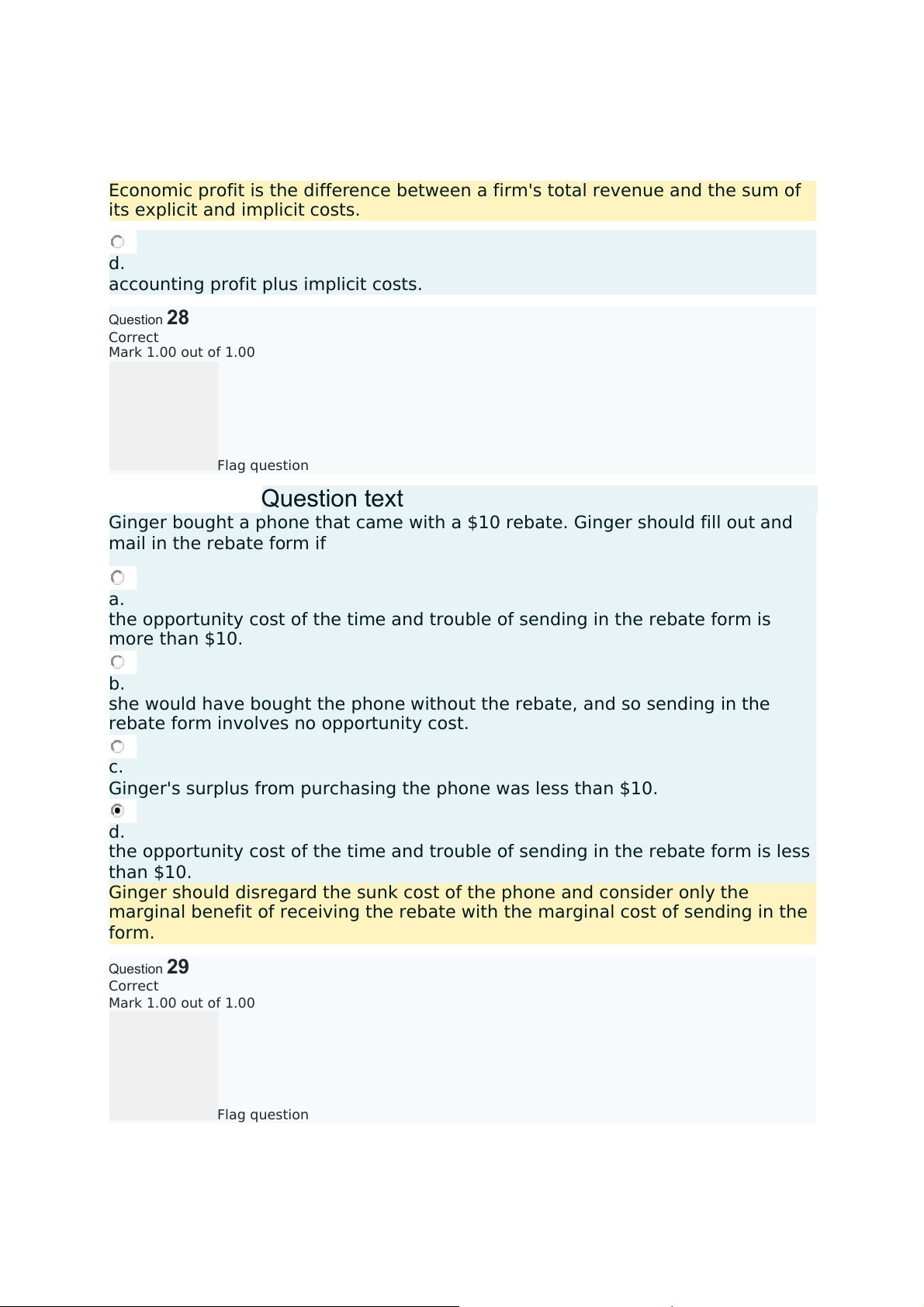
unit elastic with respect to price. b. perfectly elastic. c. inelastic. d. elastic. Question27 Correct Mark 1.00 out of 1.00 Flag question Questiontext Economic profit is equal to a.
accounting profit minus explicit costs. b.
total revenue minus accounting profit. c.
total revenue minus the sum of explicit and implicit costs.
Economic profit is the difference between a firm's total revenue and the sum of
its explicit and implicit costs. d.
accounting profit plus implicit costs. Question28 Correct Mark 1.00 out of 1.00 Flag question Questiontext
Ginger bought a phone that came with a $10 rebate. Ginger should fill out and mail in the rebate form if a.
the opportunity cost of the time and trouble of sending in the rebate form is more than $10. b.
she would have bought the phone without the rebate, and so sending in the
rebate form involves no opportunity cost. c.
Ginger's surplus from purchasing the phone was less than $10. d.
the opportunity cost of the time and trouble of sending in the rebate form is less than $10.
Ginger should disregard the sunk cost of the phone and consider only the
marginal benefit of receiving the rebate with the marginal cost of sending in the form. Question29 Correct Mark 1.00 out of 1.00 Flag question Questiontext
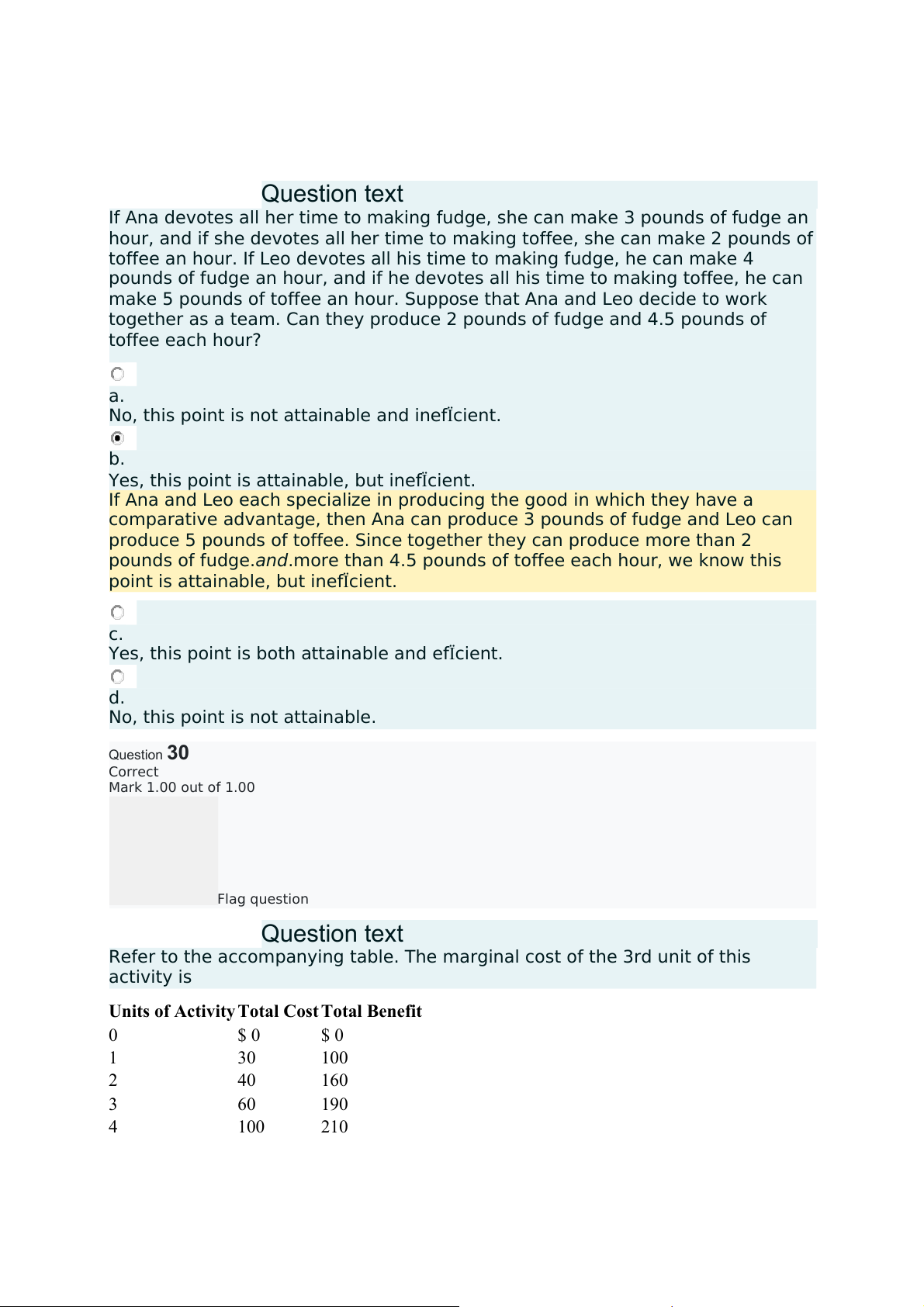
If Ana devotes all her time to making fudge, she can make 3 pounds of fudge an
hour, and if she devotes all her time to making toffee, she can make 2 pounds of
toffee an hour. If Leo devotes all his time to making fudge, he can make 4
pounds of fudge an hour, and if he devotes all his time to making toffee, he can
make 5 pounds of toffee an hour. Suppose that Ana and Leo decide to work
together as a team. Can they produce 2 pounds of fudge and 4.5 pounds of toffee each hour? a.
No, this point is not attainable and inefÏcient. b.
Yes, this point is attainable, but inefÏcient.
If Ana and Leo each specialize in producing the good in which they have a
comparative advantage, then Ana can produce 3 pounds of fudge and Leo can
produce 5 pounds of toffee. Since together they can produce more than 2
pounds of fudge.and.more than 4.5 pounds of toffee each hour, we know this
point is attainable, but inefÏcient. c.
Yes, this point is both attainable and efÏcient. d.
No, this point is not attainable. Question30 Correct Mark 1.00 out of 1.00 Flag question Questiontext
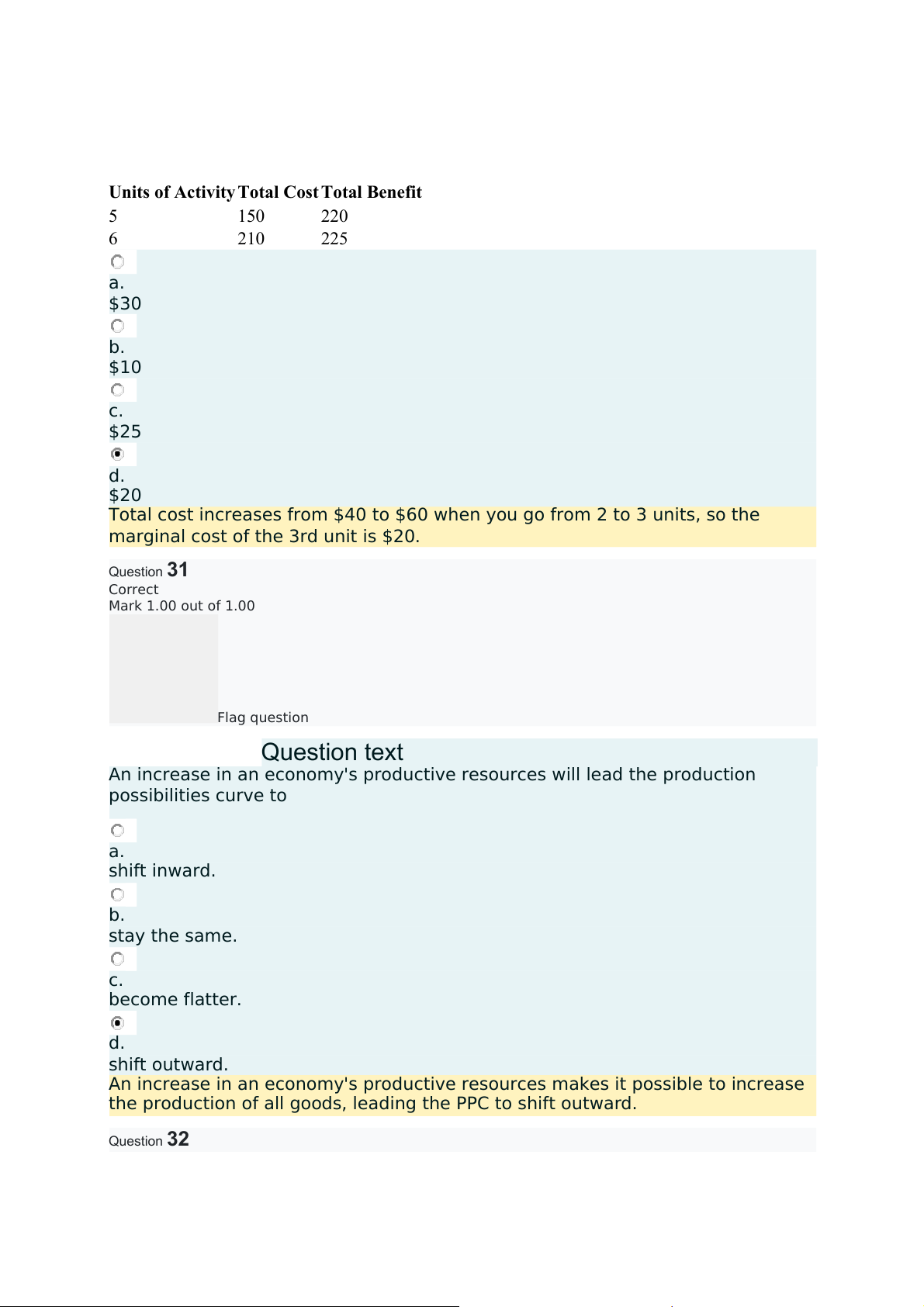
Refer to the accompanying table. The marginal cost of the 3rd unit of this activity is
Units of Activity Total Cost Total Benefit 0 $ 0 $ 0 1 30 100 2 40 160 3 60 190 4 100 210
Units of Activity Total Cost Total Benefit 5 150 220 6 210 225 a. $30 b. $10 c. $25 d. $20
Total cost increases from $40 to $60 when you go from 2 to 3 units, so the
marginal cost of the 3rd unit is $20. Question31 Correct Mark 1.00 out of 1.00 Flag question Questiontext
An increase in an economy's productive resources will lead the production possibilities curve to a. shift inward. b. stay the same. c. become flatter. d. shift outward.
An increase in an economy's productive resources makes it possible to increase
the production of all goods, leading the PPC to shift outward. Question32
Tài liệu liên quan:
-
Chương 3: độ co giãn và các nhân tố ảnh hưởng | Microeconomics | Trường Đại học Quốc tế, Đại học Quốc gia Thành phố Hồ Chí Minh
5 3 -
Microeconomics Syllabus | Microeconomics | Trường Đại học Quốc tế, Đại học Quốc gia Thành phố Hồ Chí Minh
5 3 -
Microeconomics Course Syllabus & Assessment Details | Microeconomics | Trường Đại học Quốc tế, Đại học Quốc gia Thành phố Hồ Chí Minh
5 3 -
Assignment 3 - Elasticity MCQs and Key Concepts | Microeconomics | Trường Đại học Quốc tế, Đại học Quốc gia Thành phố Hồ Chí Minh
4 2 -
Assignment 2 - Economic Equilibrium Analysis of Fridges and Motorcycles | Microeconomics | Trường Đại học Quốc tế, Đại học Quốc gia Thành phố Hồ Chí Minh
4 2