Monopolist Analysis Group Assignment Presentation | Microeconomics | Trường Đại học Quốc tế, Đại học Quốc gia Thành phố Hồ Chí Minh
No, this firm is not perfectly competitive. The demand function P=100−QP indicates that the firm faces a downward-sloping demand curve, which means it has some control over the price (price-maker), a characteristic of monopoly or imperfect competition, not perfect competition. Tài liệu được sưu tầm và soạn thảo dưới dạng file PDF để gửi tới các bạn cùng tham khảo, ôn tập đầy đủ kiến thức, chuẩn bị cho các buổi học thật tốt. Mời bạn đọc đón xem!
Môn: Microeconomics 635 tài liệu
Trường: Trường Đại học Quốc tế, Đại học Quốc gia Thành phố Hồ Chí Minh 1.9 K tài liệu
Tác giả:

Preview text:
Group assignment presentation 8 Problem 1.
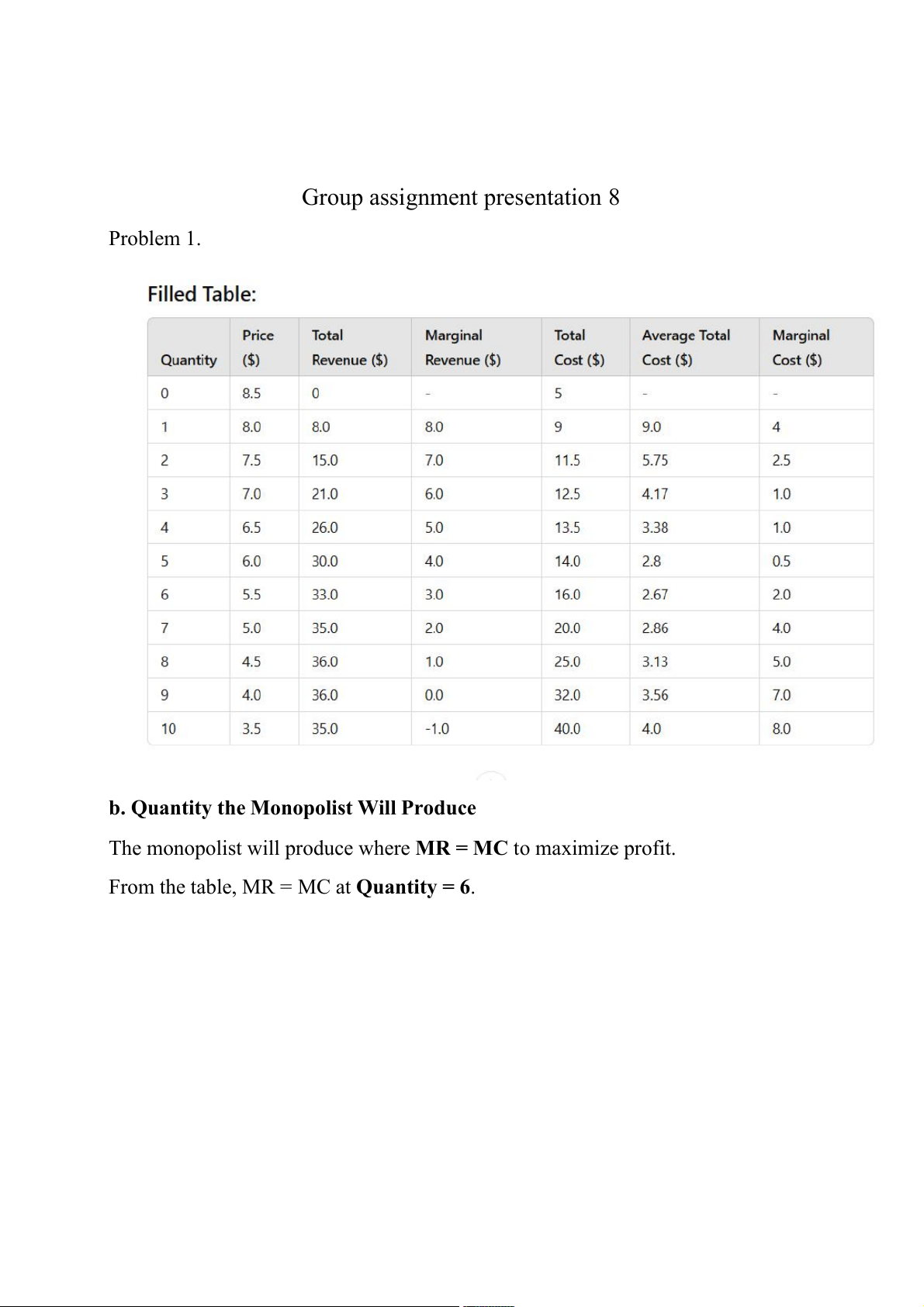
b. Quantity the Monopolist Will Produce
The monopolist will produce where MR = MC to maximize profit.
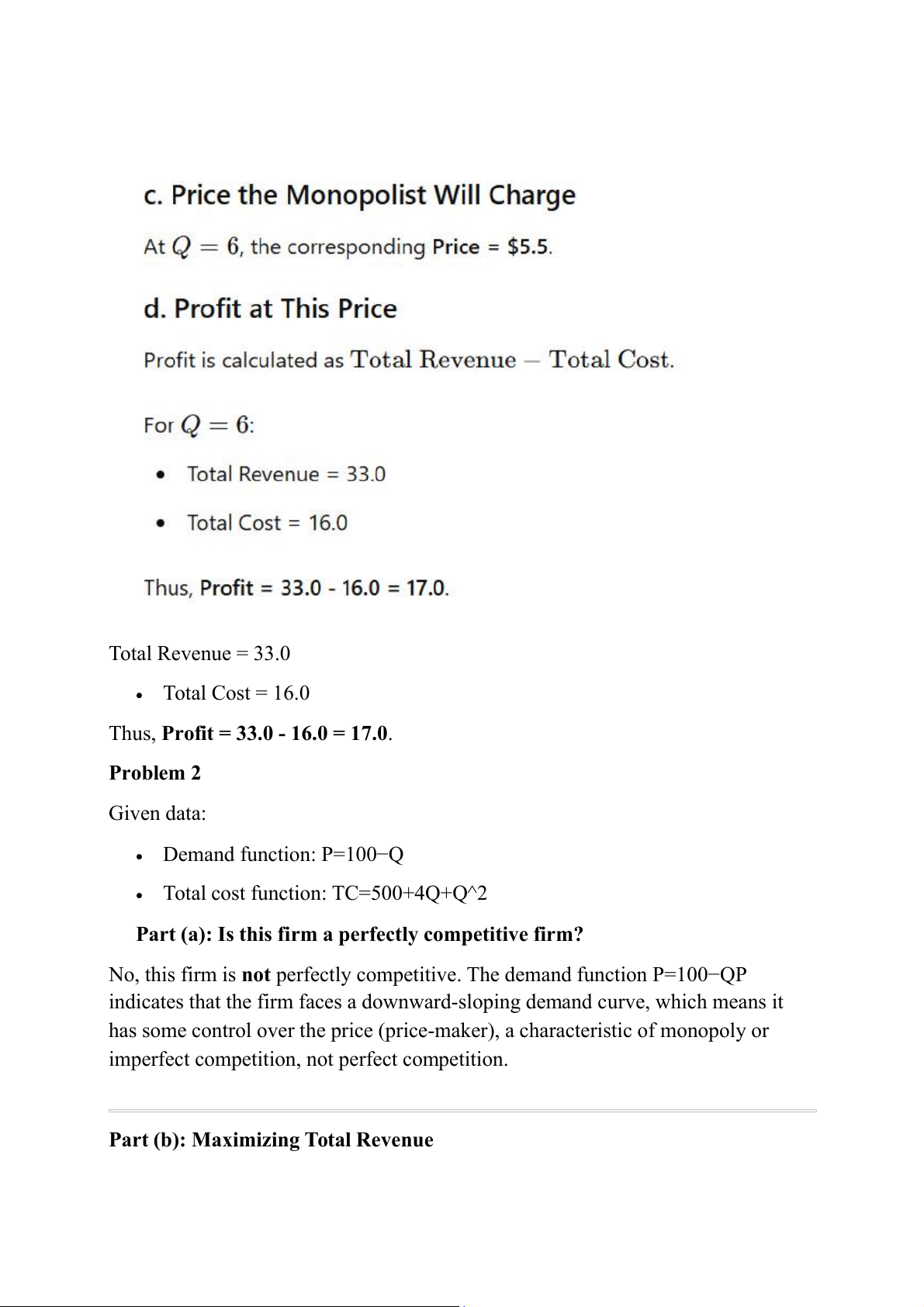
From the table, MR = MC at Quantity = 6. Total Revenue = 33.0 Total Cost = 16.0
Thus, Profit = 33.0 - 16.0 = 17.0. Problem 2 Given data: Demand function: P=100−Q
Total cost function: TC=500+4Q+Q^2
Part (a): Is this firm a perfectly competitive firm?
No, this firm is not perfectly competitive. The demand function P=100−QP
indicates that the firm faces a downward-sloping demand curve, which means it
has some control over the price (price-maker), a characteristic of monopoly or
imperfect competition, not perfect competition.
Part (b): Maximizing Total Revenue
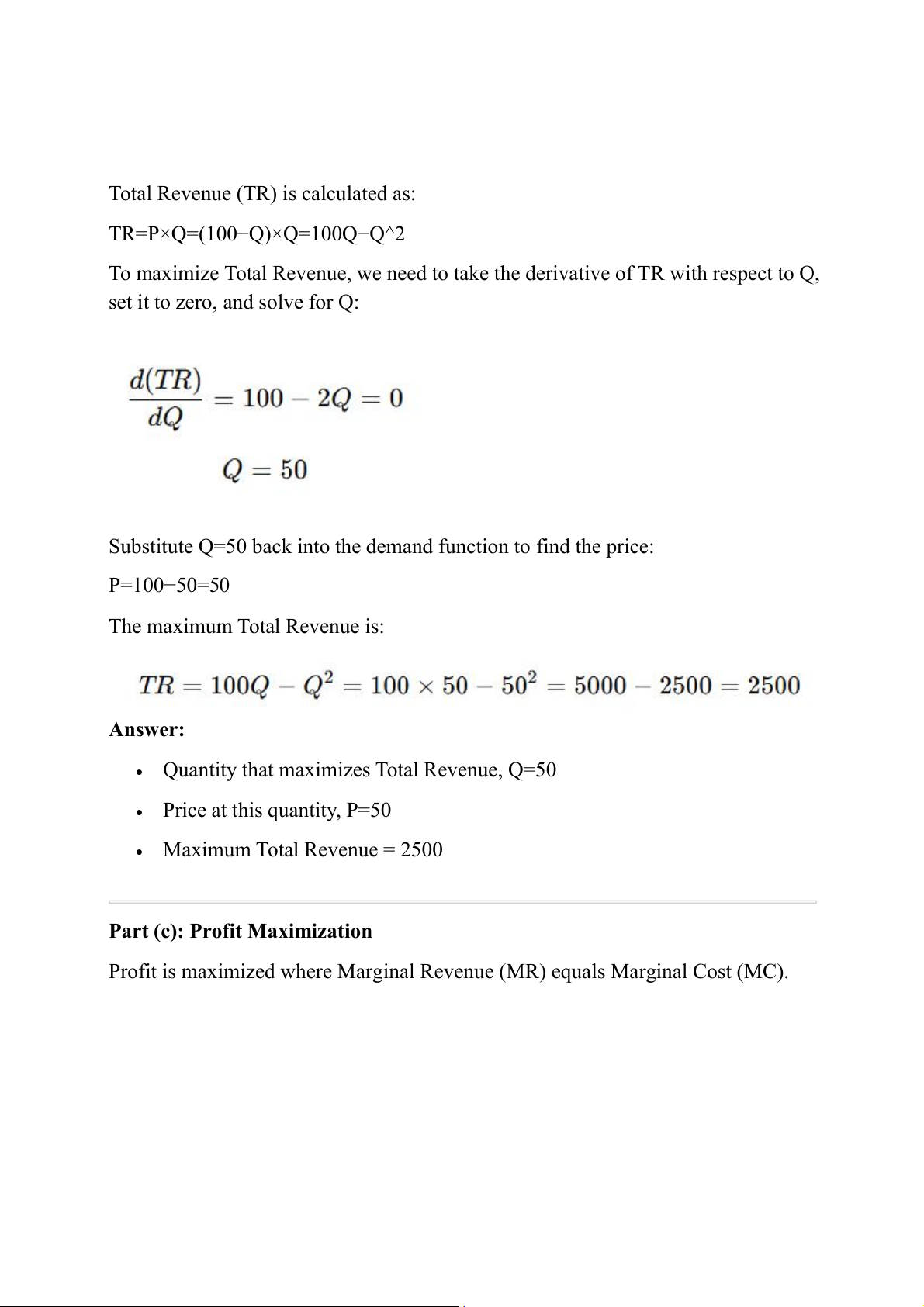
Total Revenue (TR) is calculated as:
TR=P×Q=(100−Q)×Q=100Q−Q^2
To maximize Total Revenue, we need to take the derivative of TR with respect to Q,
set it to zero, and solve for Q:
Substitute Q=50 back into the demand function to find the price: P=100−50=50 The maximum Total Revenue is: Answer:
Quantity that maximizes Total Revenue, Q=50 Price at this quantity, P=50 Maximum Total Revenue = 2500 Part (c): Profit Maximization
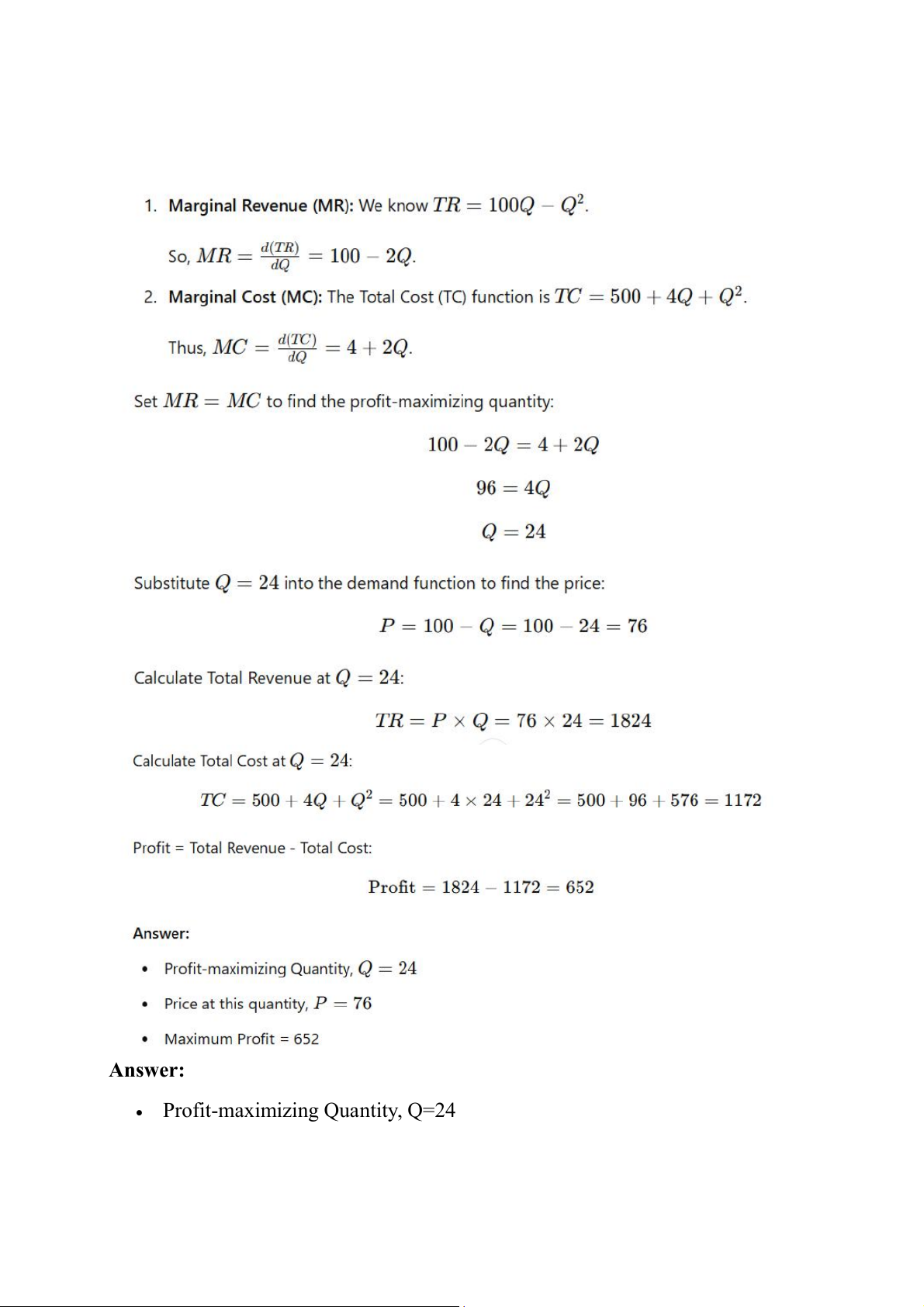
Profit is maximized where Marginal Revenue (MR) equals Marginal Cost (MC). Answer:
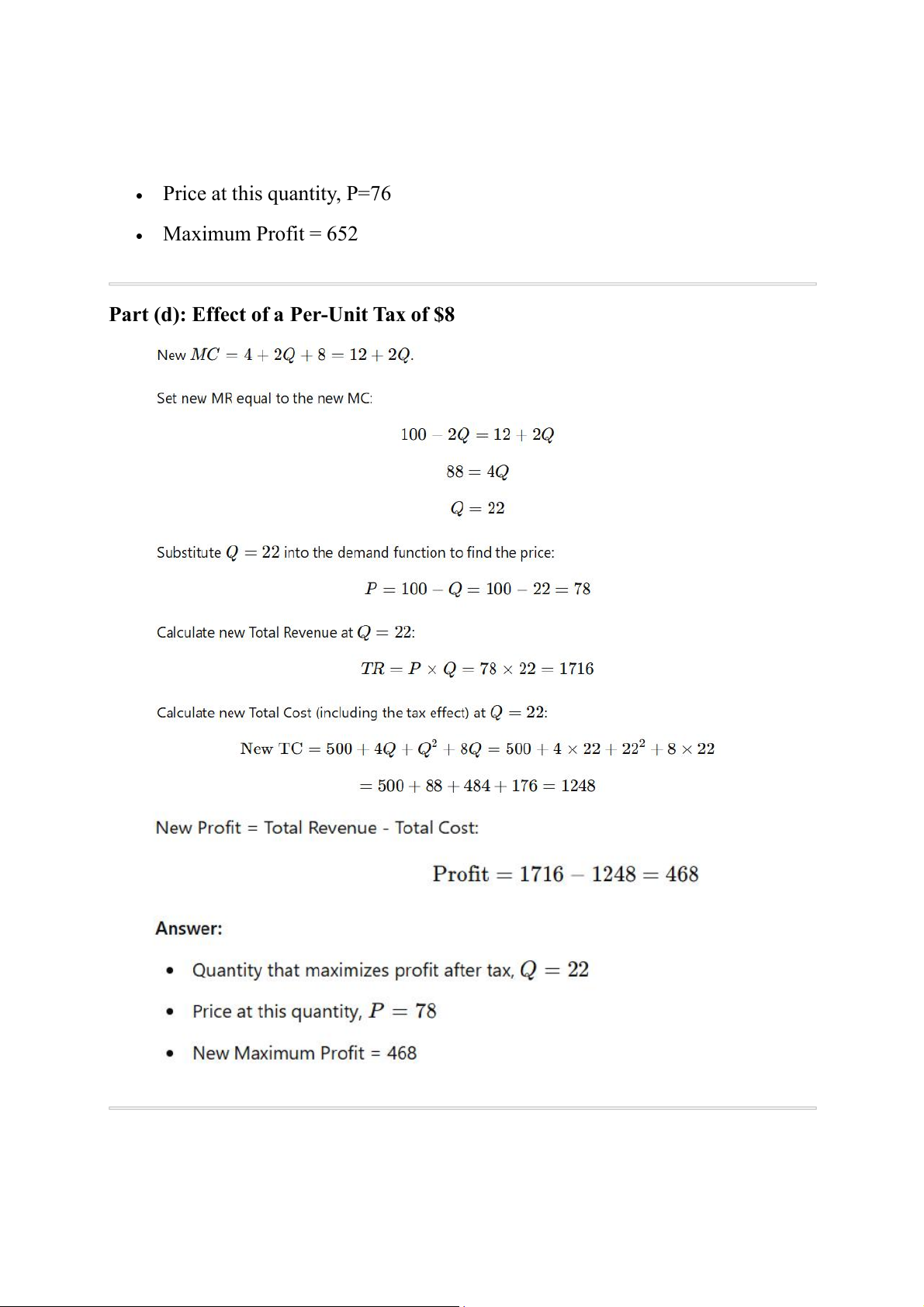
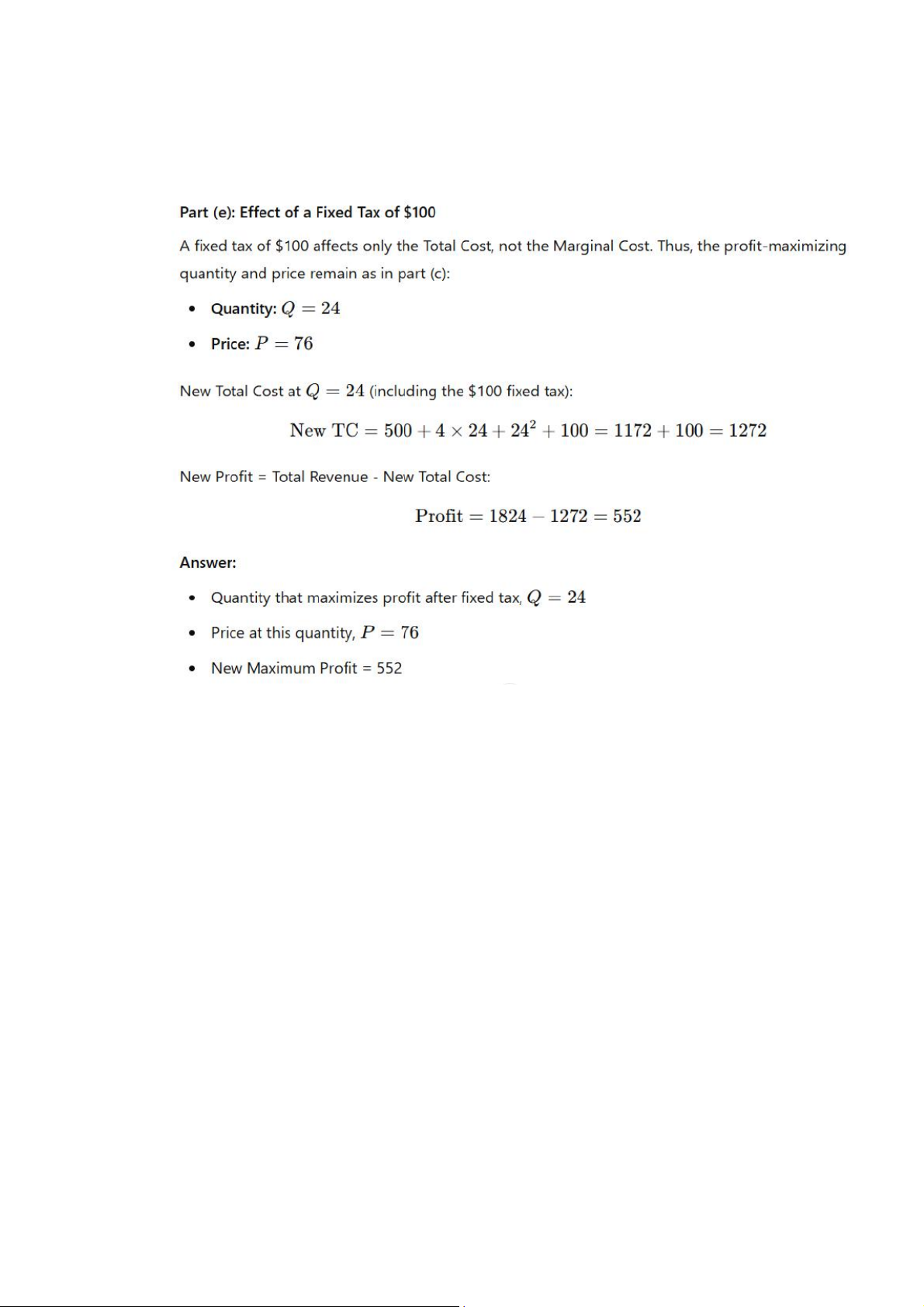
Profit-maximizing Quantity, Q=24 Price at this quantity, P=76 Maximum Profit = 652
Part (d): Effect of a Per-Unit Tax of $8
Tài liệu liên quan:
-
Chương 3: độ co giãn và các nhân tố ảnh hưởng | Microeconomics | Trường Đại học Quốc tế, Đại học Quốc gia Thành phố Hồ Chí Minh
0 0 -
Microeconomics Syllabus | Microeconomics | Trường Đại học Quốc tế, Đại học Quốc gia Thành phố Hồ Chí Minh
1 1 -
Microeconomics Course Syllabus & Assessment Details | Microeconomics | Trường Đại học Quốc tế, Đại học Quốc gia Thành phố Hồ Chí Minh
1 1 -
Assignment 3 - Elasticity MCQs and Key Concepts | Microeconomics | Trường Đại học Quốc tế, Đại học Quốc gia Thành phố Hồ Chí Minh
1 1 -
Assignment 2 - Economic Equilibrium Analysis of Fridges and Motorcycles | Microeconomics | Trường Đại học Quốc tế, Đại học Quốc gia Thành phố Hồ Chí Minh
1 1