Monopolist and Cost Analysis | Microeconomics | Trường Đại học Quốc tế, Đại học Quốc gia Thành phố Hồ Chí Minh
What quantity will the monopolist produce? -The monopolist will produce 6 products. Because at the quantity the MR will be closest to MC c.What price will the monopolist charge? The monopolist will charge 5.5$ per unit => P=5.5$ at Q=6 d.What will the profit be at this price? At this price, the profit will be : TR-TC=33-16=17$ Problem 2. A firm has demand function of P=100-Q ($) and total cost function of TC=500+ 4Q+Q2 ($). Tài liệu được sưu tầm và soạn thảo dưới dạng file PDF để gửi tới các bạn cùng tham khảo, ôn tập đầy đủ kiến thức, chuẩn bị cho các buổi học thật tốt. Mời bạn đọc đón xem!
Môn: Microeconomics 635 tài liệu
Trường: Trường Đại học Quốc tế, Đại học Quốc gia Thành phố Hồ Chí Minh 1.9 K tài liệu
Tác giả:


Preview text:
Assignment 8:Te T am1 Trần Ngọc Ánh Chu Văn Tiến Đạt Giáp Huy Hoàng Hồng Anh Hồ Hải Anh
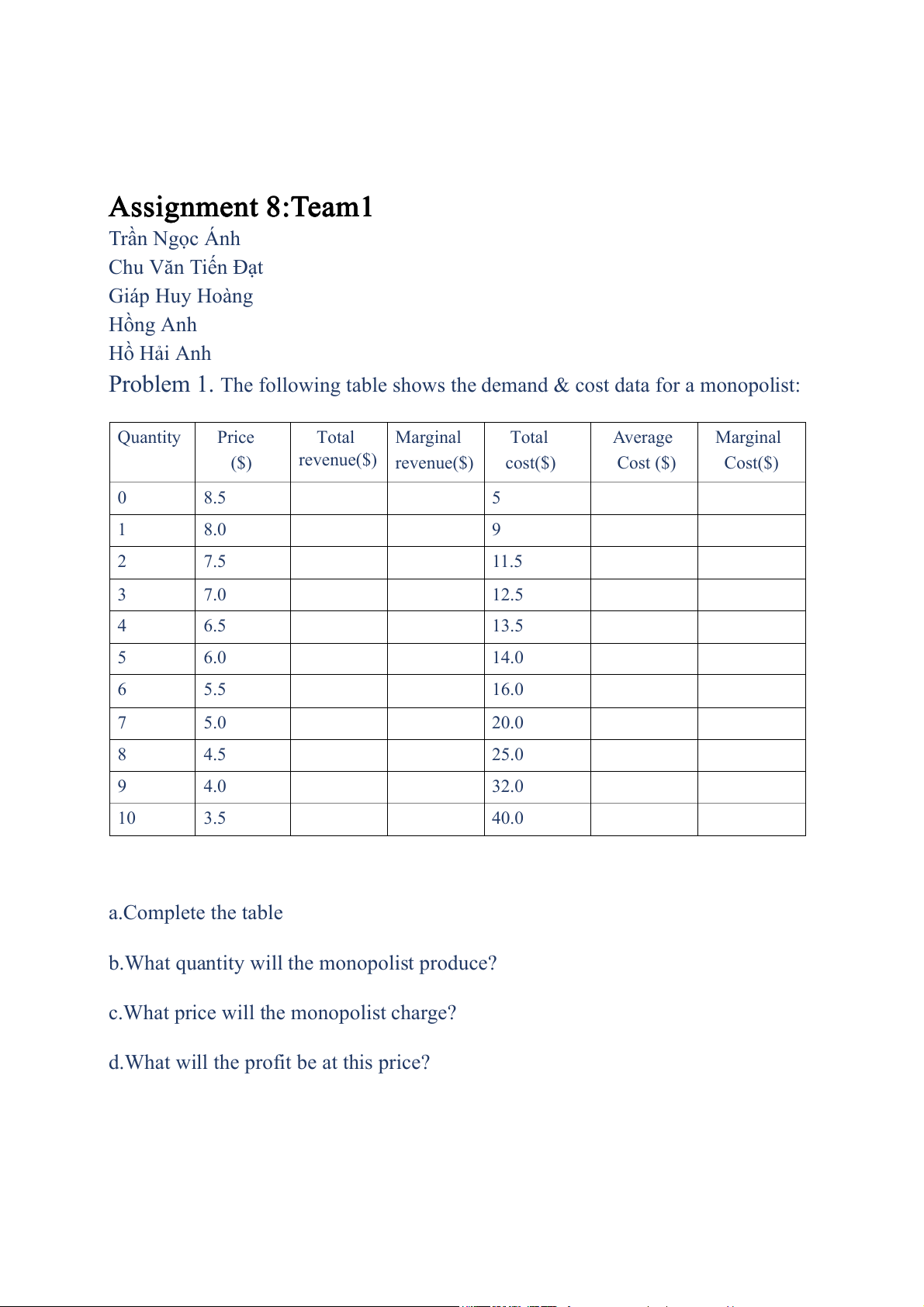
Problem 1. The following table shows the demand & cost data for a monopolist: Quantity Pric e Total Marginal Total Average Marginal ($) revenue($) revenue($) cost($ ) Cost ($) Cost($) 0 8.5 5 1 8.0 9 2 7.5 11.5 3 7.0 12.5 4 6.5 13.5 5 6.0 14.0 6 5.5 16.0 7 5.0 20.0 8 4.5 25.0 9 4.0 32.0 10 3.5 40.0 a.Complete the table
b.What quantity will the monopolist produce?
c.What price will the monopolist charge?
d.What will the profit be at this price? a.Complete the table Quantity Pric e Total Marginal Total Average Marginal ($) revenue($) revenue($) cost($ ) Cost ($) Cost($) 0 8.5 0 _ 5 _ _ 1 8.0 8 8 9 9 9 2 7.5 15 7 11.5 5.75 2.5 3 7.0 21 6 12.5 25/6 1 4 6.5 26 5 13.5 3.375 1 5 6.0 30 4 14.0 2.8 0.5 6 5.5 33 3 16.0 8/3 2 7 5.0 35 2 20.0 20/7 4 8 4.5 36 1 25.0 3.125 5 9 4.0 36 0 32.0 32/9 7 10 3.5 35 -1 40.0 4 8
b.What quantity will the monopolist produce?
-The monopolist will produce 6 products. Because at the quantity the MR will be closest to MC
c.What price will the monopolist charge?
The monopolist will charge 5.5$ per unit => P=5.5$ at Q=6
d.What will the profit be at this price?
At this price, the profit will be : TR-TC=33-16=17$ Problem 2.
A firm has demand function of P=100-Q ($) and total cost function of TC=500+ 4Q+Q2 ($).
a. Is this firm a perfect competitive firm? Why?
b. What is price and quantity to maximize total revenue ? What is that maximum total revenue ?
c. What is price and optimal quantity to maximize profit? What is that maximum total profit ?
d. Asume government imposes a tax of 8 $ per unit of good sold, what is price and
optimal quantity that gives the firm maximum profit? What is this maximum profit?
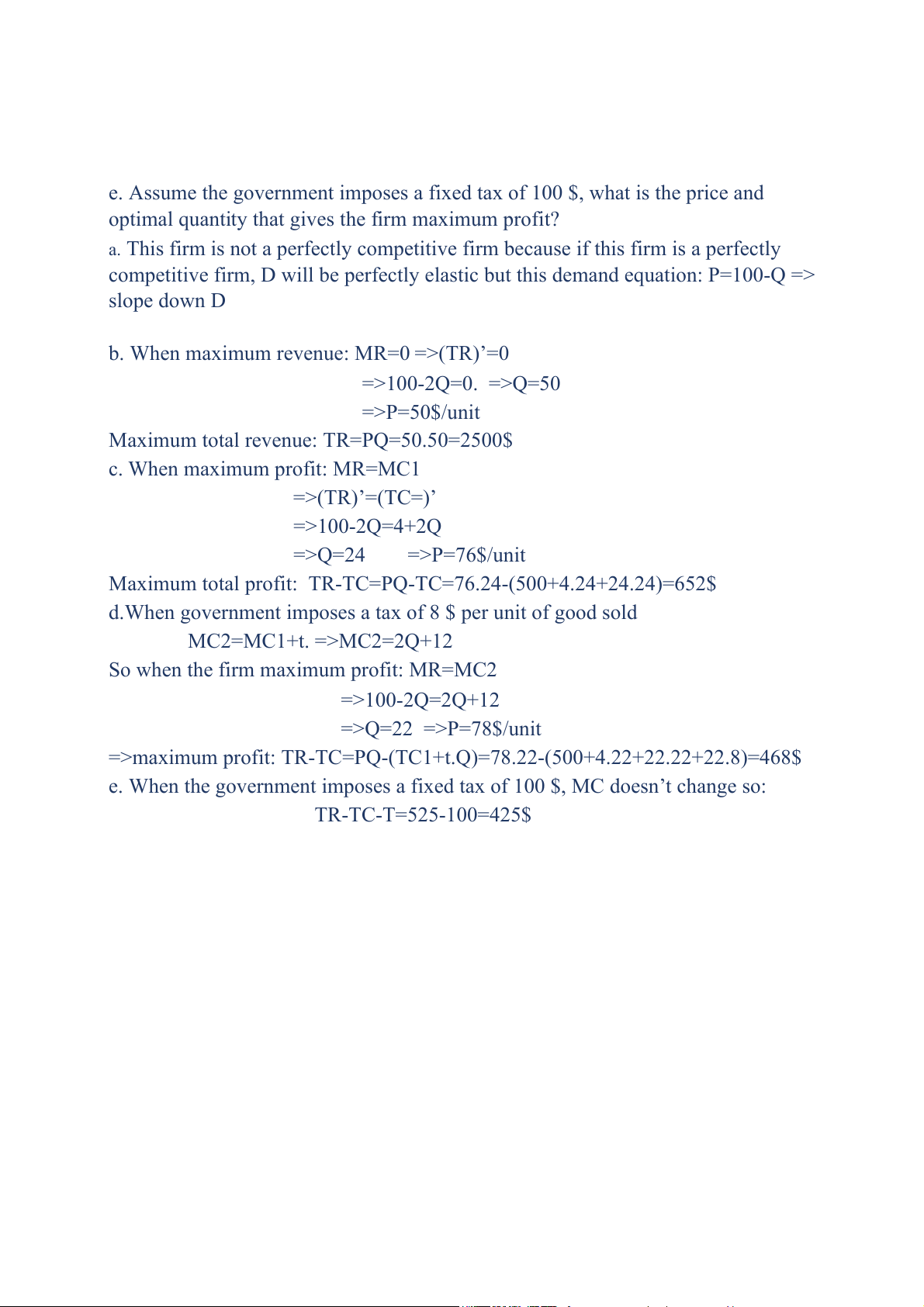
e. Assume the government imposes a fixed tax of 100 $, what is the price and
optimal quantity that gives the firm maximum profit?
a. This firm is not a perfectly competitive firm because if this firm is a perfectly
competitive firm, D will be perfectly elastic but this demand equation: P=100-Q => slope down D
b. When maximum revenue: MR=0 =>(TR)’=0 =>100-2Q=0. =>Q=50 =>P=50$/unit
Maximum total revenue: TR=PQ=50.50=2500$
c. When maximum profit: MR=MC1 =>(TR)’=(TC=)’ =>100-2Q=4+2Q =>Q=24 =>P=76$/unit
Maximum total profit: TR-TC=PQ-TC=76.24-(500+4.24+24.24)=652$
d.When government imposes a tax of 8 $ per unit of good sold MC2=MC1+t. =>MC2=2Q+12
So when the firm maximum profit: MR=MC2 =>100-2Q=2Q+12 =>Q=22 =>P=78$/unit
=>maximum profit: TR-TC=PQ-(TC1+t.Q)=78.22-(500+4.22+22.22+22.8)=468$
e. When the government imposes a fixed tax of 100 $, MC doesn’t change so: TR-TC-T=525-100=425$
Tài liệu liên quan:
-
Chương 3: độ co giãn và các nhân tố ảnh hưởng | Microeconomics | Trường Đại học Quốc tế, Đại học Quốc gia Thành phố Hồ Chí Minh
3 2 -
Microeconomics Syllabus | Microeconomics | Trường Đại học Quốc tế, Đại học Quốc gia Thành phố Hồ Chí Minh
3 2 -
Microeconomics Course Syllabus & Assessment Details | Microeconomics | Trường Đại học Quốc tế, Đại học Quốc gia Thành phố Hồ Chí Minh
3 2 -
Assignment 3 - Elasticity MCQs and Key Concepts | Microeconomics | Trường Đại học Quốc tế, Đại học Quốc gia Thành phố Hồ Chí Minh
3 2 -
Assignment 2 - Economic Equilibrium Analysis of Fridges and Motorcycles | Microeconomics | Trường Đại học Quốc tế, Đại học Quốc gia Thành phố Hồ Chí Minh
3 2