Monopolistic Competition & Its Impacts on Welfare | Microeconomics | Trường Đại học Quốc tế, Đại học Quốc gia Thành phố Hồ Chí Minh
What market structures lie between perfect competition and monopoly, and what are their characteristics? • How do monopolistically competitive firms choose price and quantity? Do they earn economic profit? • How does monopolistic competition affect society’s welfare? • What are the social costs and benefits of advertising? Tài liệu được sưu tầm và soạn thảo dưới dạng file PDF để gửi tới các bạn cùng tham khảo, ôn tập đầy đủ kiến thức, chuẩn bị cho các buổi học thật tốt. Mời bạn đọc đón xem!
Môn: Microeconomics 635 tài liệu
Trường: Trường Đại học Quốc tế, Đại học Quốc gia Thành phố Hồ Chí Minh 1.9 K tài liệu
Tác giả:





Preview text:
N. GREGORY MANKIW PRINCIPLES OF ECONOMICS Eight Edition CHAPTER Monopolistic Competition
© 2018 Cengage Learning®. May not be scanned, copied or duplicated, or posted to a publicly accessible website, in whole or in part, except for use
as permitted in a license distributed with a certain product or service or otherwise on a password-protected website or school-approved learning 1
management system for classroom use.
Look for the answers to these questions:
• What market structures lie between perfect
competition and monopoly, and what are their characteristics?
• How do monopolistically competitive firms
choose price and quantity? Do they earn economic profit?
• How does monopolistic competition affect society’s welfare?
• What are the social costs and benefits of advertising?
© 2018 Cengage Learning®. May not be scanned, copied or duplicated, or posted to a publicly accessible website, in whole or in part, except for use
as permitted in a license distributed with a certain product or service or otherwise on a password-protected website or school-approved learning 2
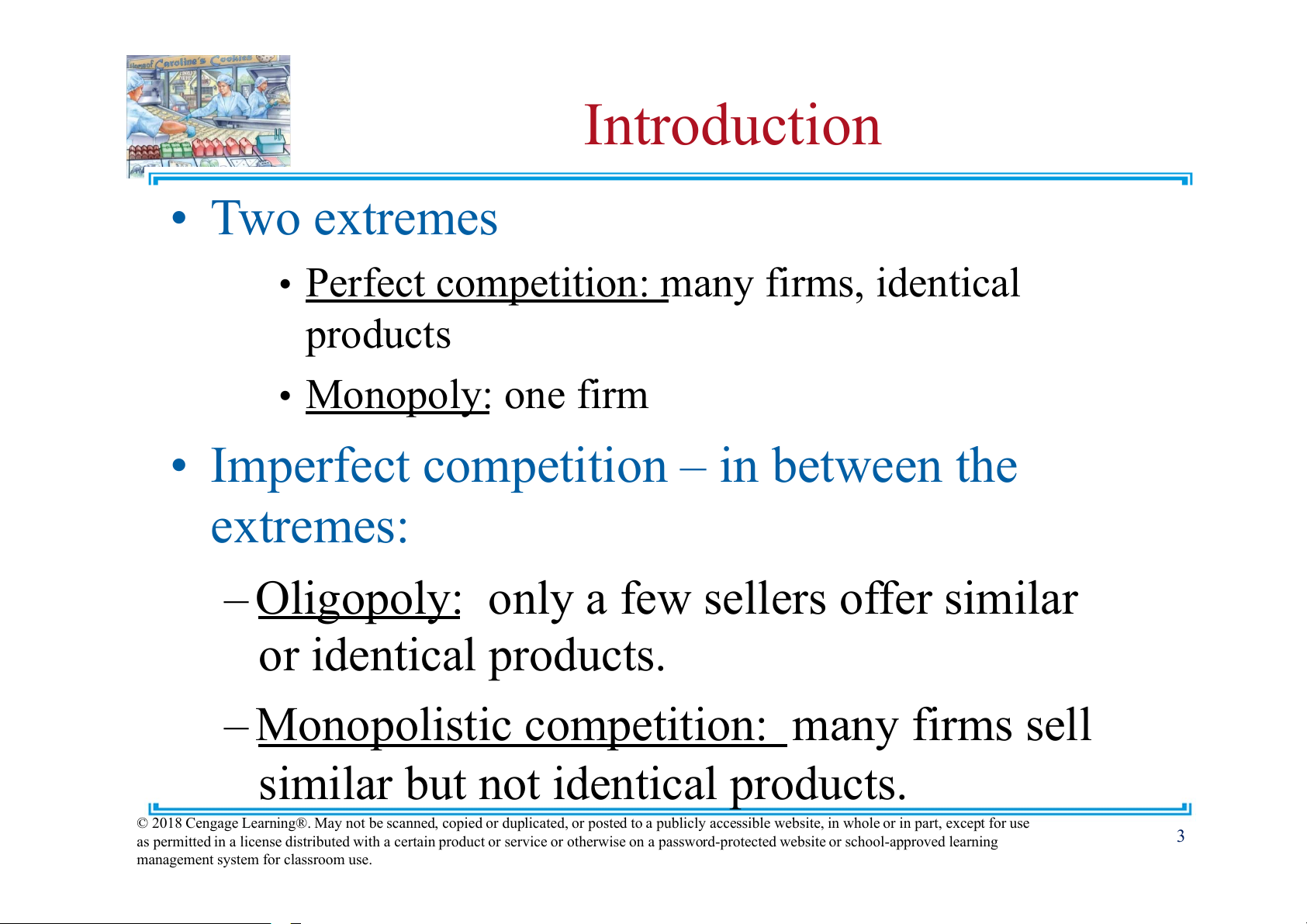
management system for classroom use. Introduction • Two extremes
• Perfect competition: many firms, identical products • Monopoly: one firm
• Imperfect competition – in between the extremes:
– Oligopoly: only a few sellers offer similar or identical products.
– Monopolistic competition: many firms sell
similar but not identical products.
© 2018 Cengage Learning®. May not be scanned, copied or duplicated, or posted to a publicly accessible website, in whole or in part, except for use 3
as permitted in a license distributed with a certain product or service or otherwise on a password-protected website or school-approved learning
management system for classroom use. Monopolistic Competition • Characteristics: – Many sellers – Product differentiation
• Not price takers; downward sloping D curve – Free entry and exit
• Zero economic profit in the long run
• Examples of monopolistic competition:
– Apartments, books, bottled water,
clothing, fast food, night clubs
© 2018 Cengage Learning®. May not be scanned, copied or duplicated, or posted to a publicly accessible website, in whole or in part, except for use 4
as permitted in a license distributed with a certain product or service or otherwise on a password-protected website or school-approved learning
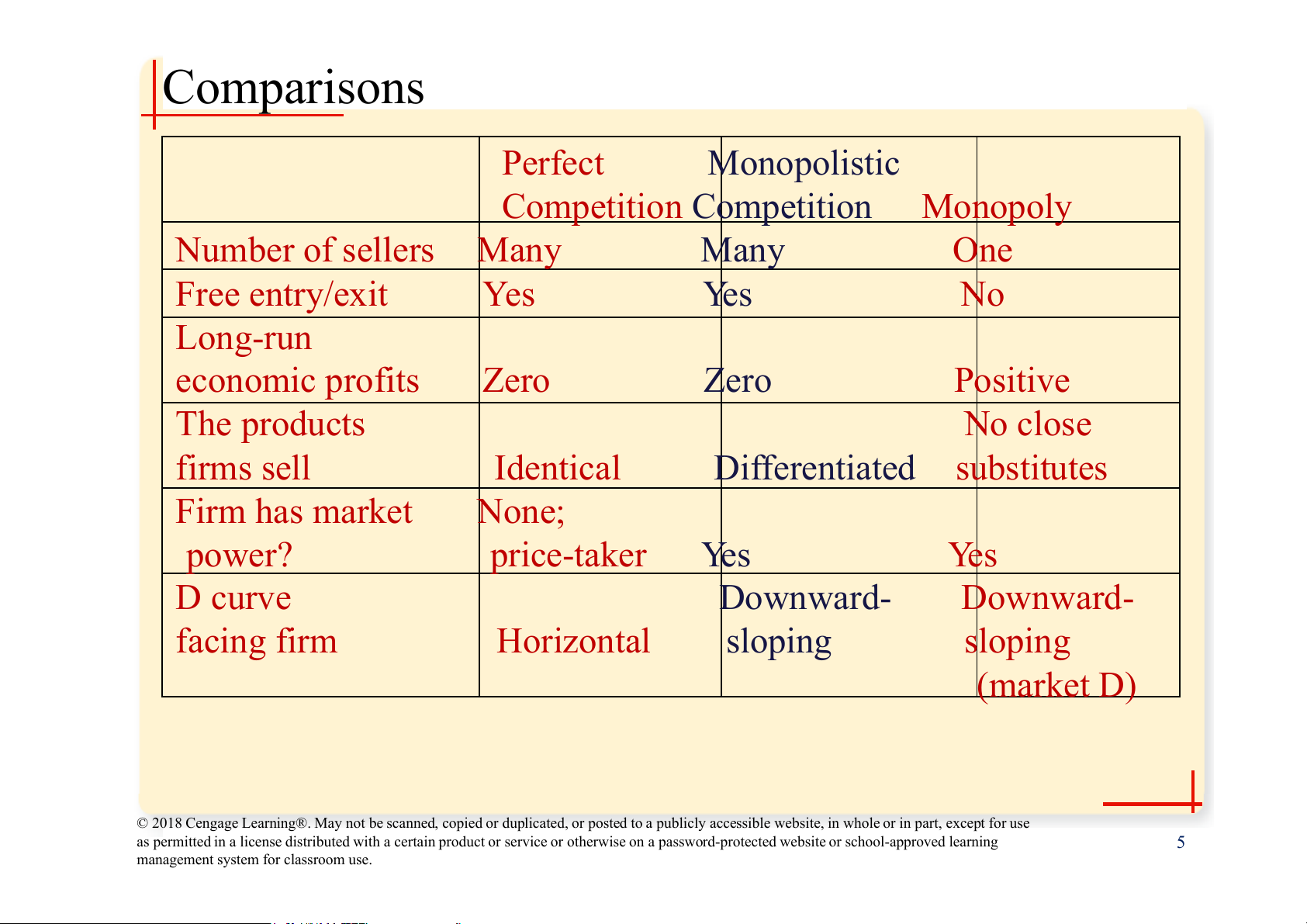
management system for classroom use. Comparisons Perfect Monopolistic Competition Competition Monopoly Number of sellers Many Many One Free entry/exit Yes Yes No Long-run economic profits Zero Zero Positive The products No close firms sell Identical Differentiated substitutes Firm has market None; power? price-taker Yes Yes D curve Downward- Downward- facing firm Horizontal sloping sloping (market D)
© 2018 Cengage Learning®. May not be scanned, copied or duplicated, or posted to a publicly accessible website, in whole or in part, except for use
as permitted in a license distributed with a certain product or service or otherwise on a password-protected website or school-approved learning 5
management system for classroom use. Short Run Equilibrium
• Profit maximization in the short-run for the
monopolistically competitive firm:
– Produce the quantity where MR = MC – Price: on the demand curve – If P > ATC: profit – If P < ATC: loss – Similar to monopoly
© 2018 Cengage Learning®. May not be scanned, copied or duplicated, or posted to a publicly accessible website, in whole or in part, except for use 6
as permitted in a license distributed with a certain product or service or otherwise on a password-protected website or school-approved learning
management system for classroom use.
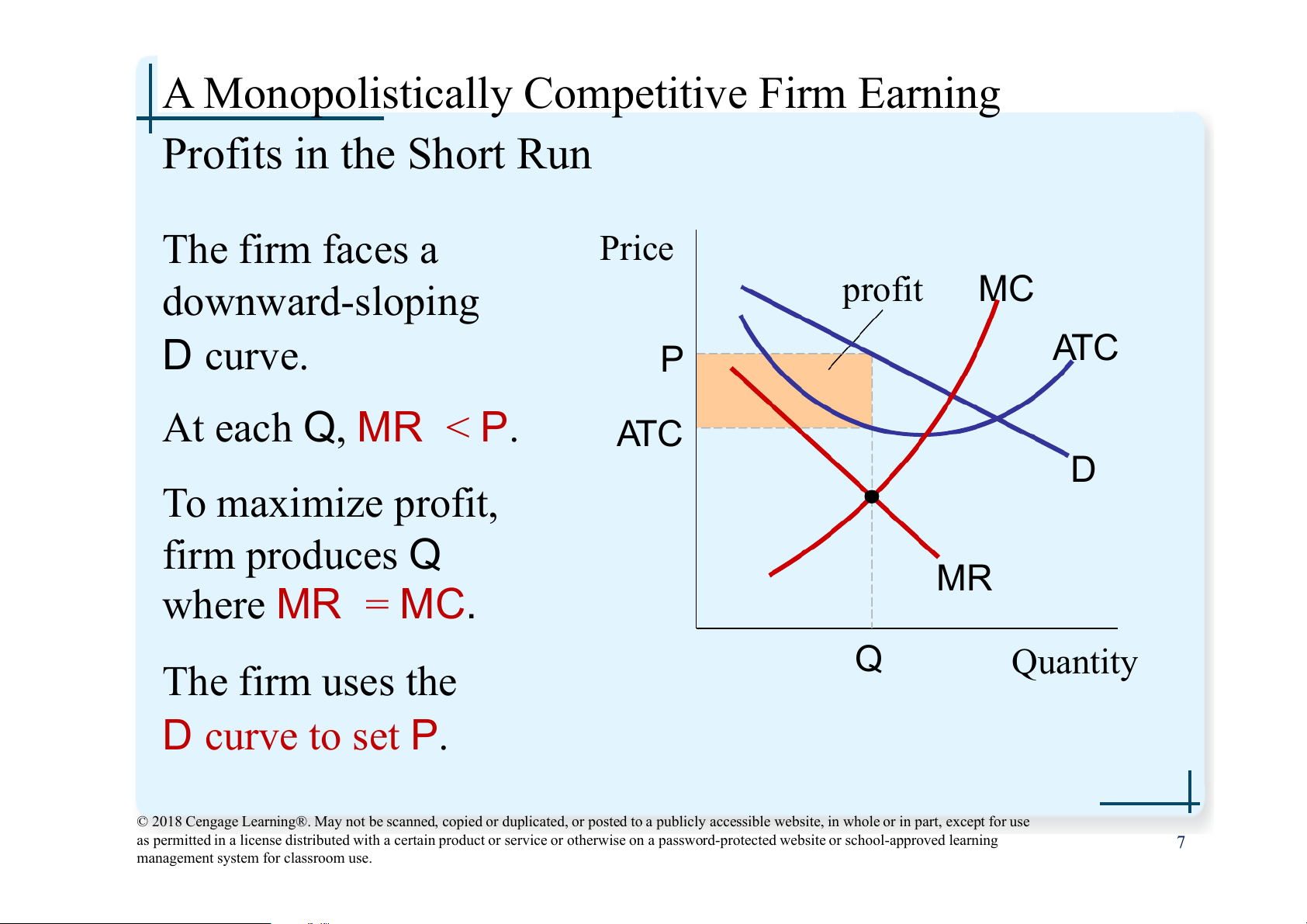
A Monopolistically Competitive Firm Earning Profits in the Short Run The firm faces a Price profit downward-sloping MC D curve. P ATC At each Q, MR < P. ATC D To maximize profit, firm produces Q MR where MR = MC. The firm uses the Q Quantity D curve to set P.
© 2018 Cengage Learning®. May not be scanned, copied or duplicated, or posted to a publicly accessible website, in whole or in part, except for use
as permitted in a license distributed with a certain product or service or otherwise on a password-protected website or school-approved learning 7
management system for classroom use.
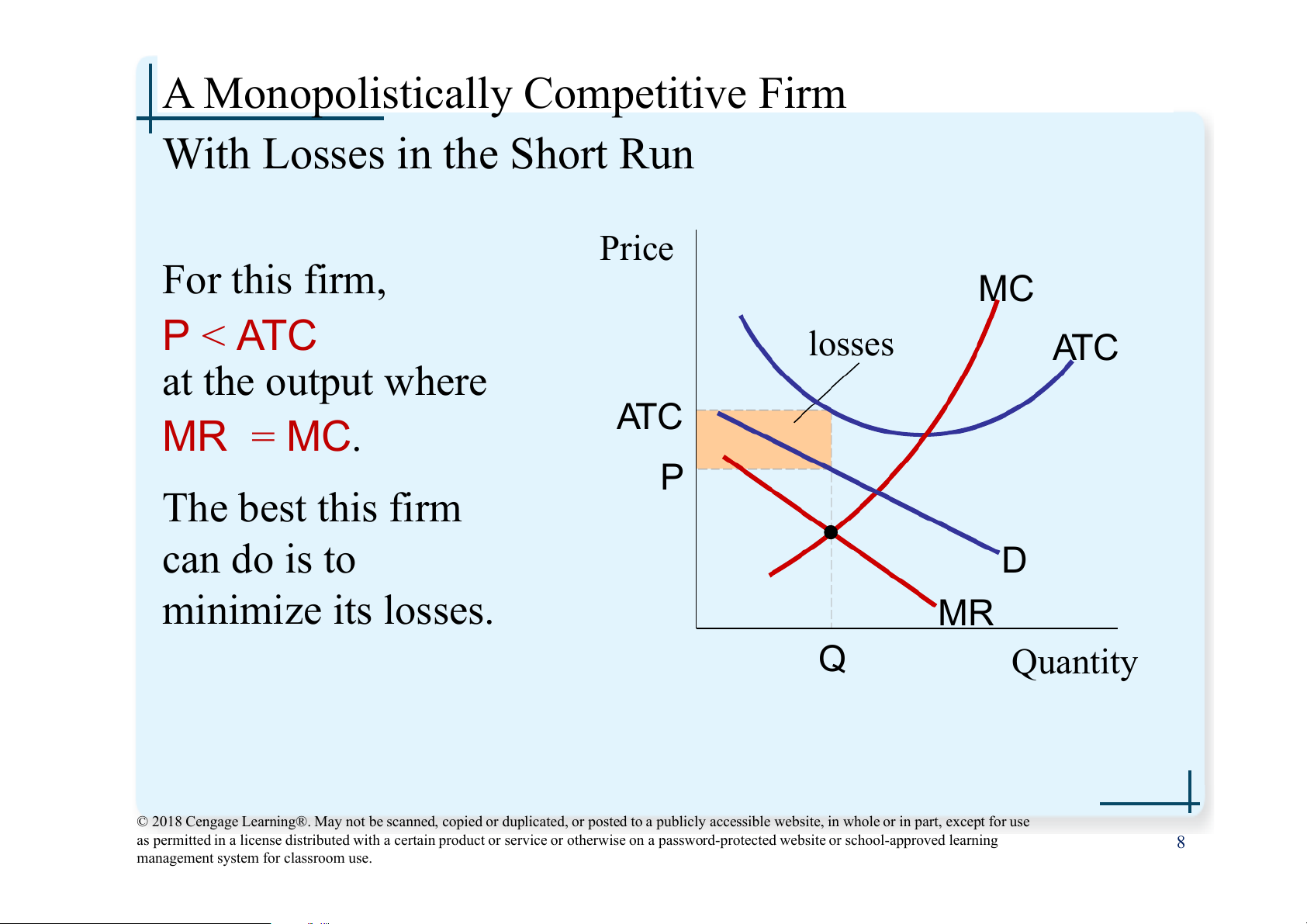
A Monopolistically Competitive Firm With Losses in the Short Run Price For this firm, MC P < ATC losses ATC at the output where MR = MC. ATC P The best this firm can do is to D minimize its losses. MR Q Quantity
© 2018 Cengage Learning®. May not be scanned, copied or duplicated, or posted to a publicly accessible website, in whole or in part, except for use
as permitted in a license distributed with a certain product or service or otherwise on a password-protected website or school-approved learning 8
management system for classroom use. Long Run Equilibrium
• If monopolistically competitive firms are making profit in short run
– New firms: incentive to enter the market
• Increase number of products
– Reduces demand faced by each firm
• Demand curve shifts left; prices fall
– Each firm’s profit declines to zero
• If losses in the short run:
– Some firms exit the market, remaining firms enjoy higher demand and prices
© 2018 Cengage Learning®. May not be scanned, copied or duplicated, or posted to a publicly accessible website, in whole or in part, except for use 9
as permitted in a license distributed with a certain product or service or otherwise on a password-protected website or school-approved learning
management system for classroom use.
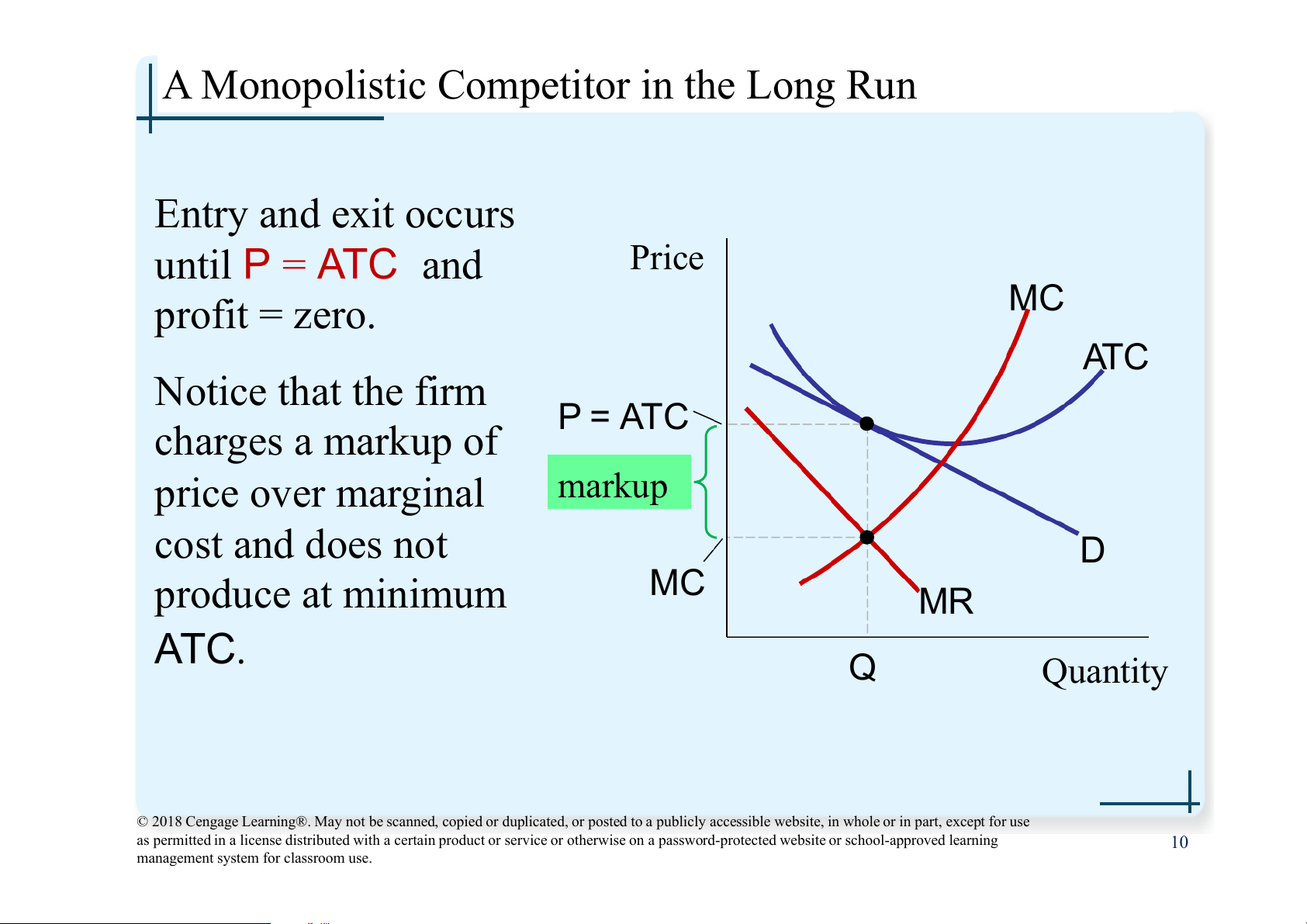
A Monopolistic Competitor in the Long Run Entry and exit occurs until P = ATC and Price profit = zero. MC ATC Notice that the firm P = ATC charges a markup of price over marginal markup cost and does not D produce at minimum MC MR ATC. Q Quantity
© 2018 Cengage Learning®. May not be scanned, copied or duplicated, or posted to a publicly accessible website, in whole or in part, except for use
as permitted in a license distributed with a certain product or service or otherwise on a password-protected website or school-approved learning 10
management system for classroom use.
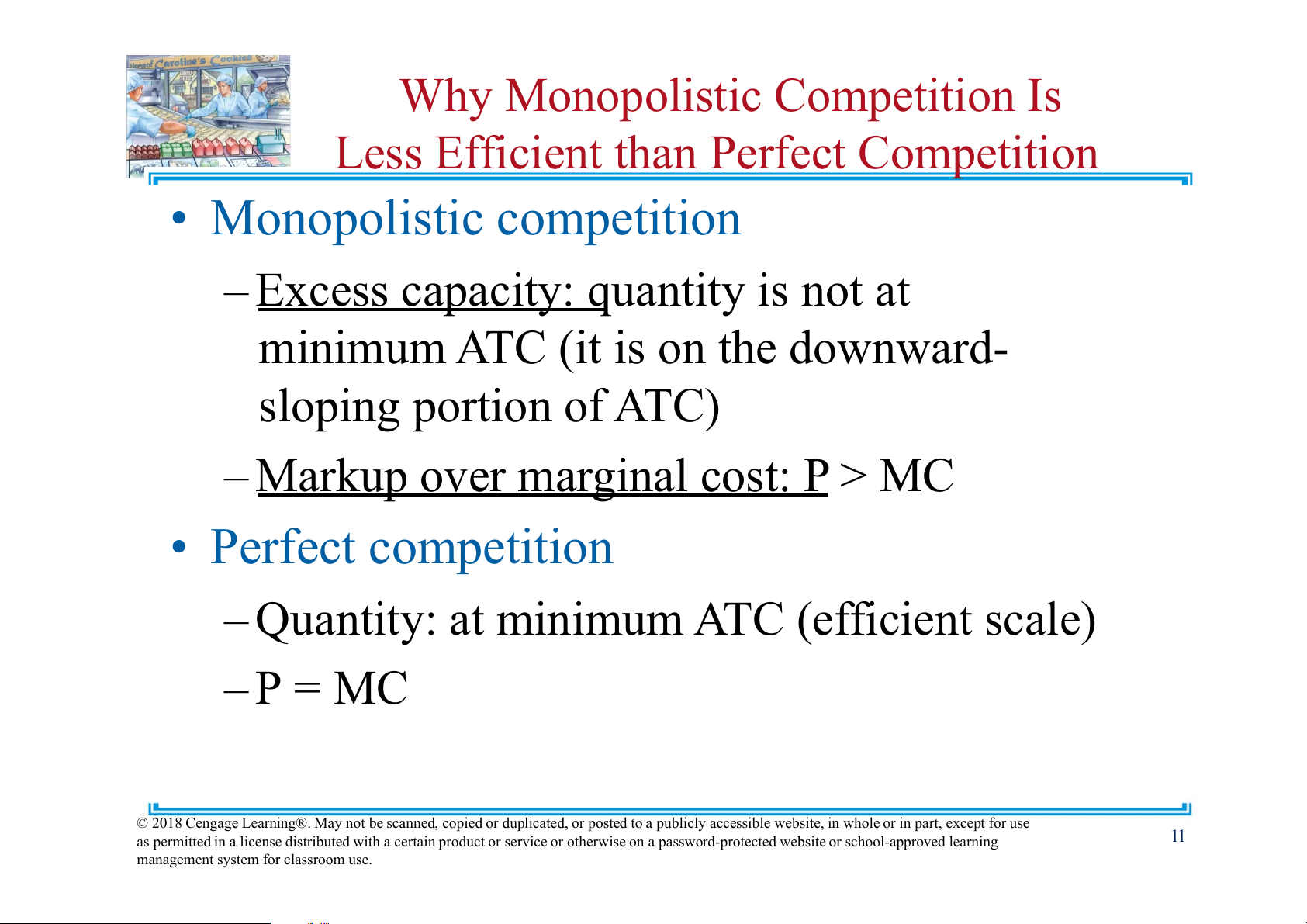
Why Monopolistic Competition Is
Less Efficient than Perfect Competition • Monopolistic competition
– Excess capacity: quantity is not at
minimum ATC (it is on the downward- sloping portion of ATC)
– Markup over marginal cost: P > MC • Perfect competition
– Quantity: at minimum ATC (efficient scale) – P = MC
© 2018 Cengage Learning®. May not be scanned, copied or duplicated, or posted to a publicly accessible website, in whole or in part, except for use 11
as permitted in a license distributed with a certain product or service or otherwise on a password-protected website or school-approved learning
management system for classroom use. Welfare of Society
• Monopolistically competitive markets
– Do not have all the desirable welfare
properties of perfectly competitive markets • Sources of inefficiency
– Markup of price over marginal cost
– Too much or too little entry (number of firms in the market)
• Product-variety externality
• Business-stealing externality
© 2018 Cengage Learning®. May not be scanned, copied or duplicated, or posted to a publicly accessible website, in whole or in part, except for use 12
as permitted in a license distributed with a certain product or service or otherwise on a password-protected website or school-approved learning
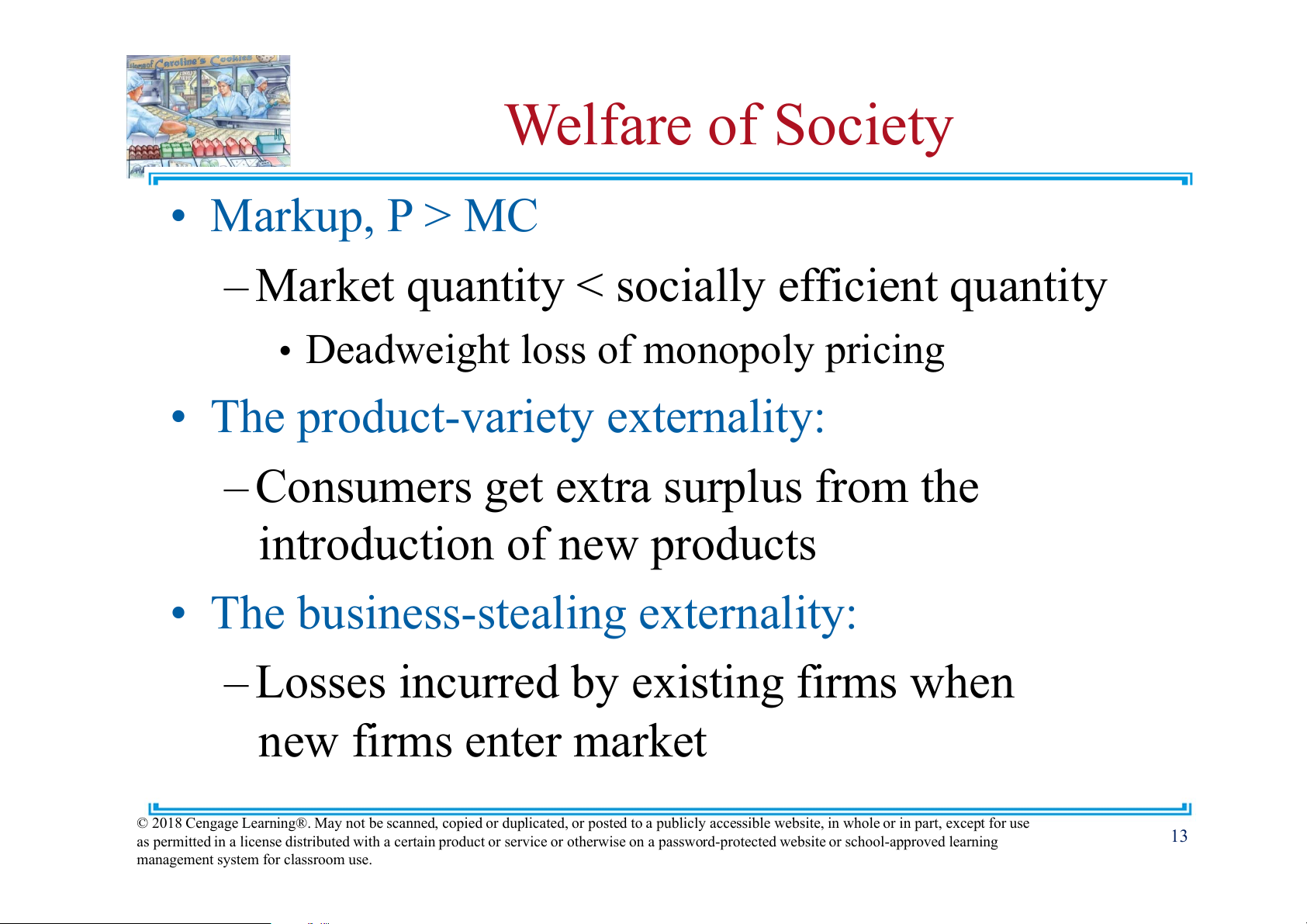
management system for classroom use. Welfare of Society • Markup, P > MC
– Market quantity < socially efficient quantity
• Deadweight loss of monopoly pricing
• The product-variety externality:
– Consumers get extra surplus from the introduction of new products
• The business-stealing externality:
– Losses incurred by existing firms when new firms enter market
© 2018 Cengage Learning®. May not be scanned, copied or duplicated, or posted to a publicly accessible website, in whole or in part, except for use 13
as permitted in a license distributed with a certain product or service or otherwise on a password-protected website or school-approved learning
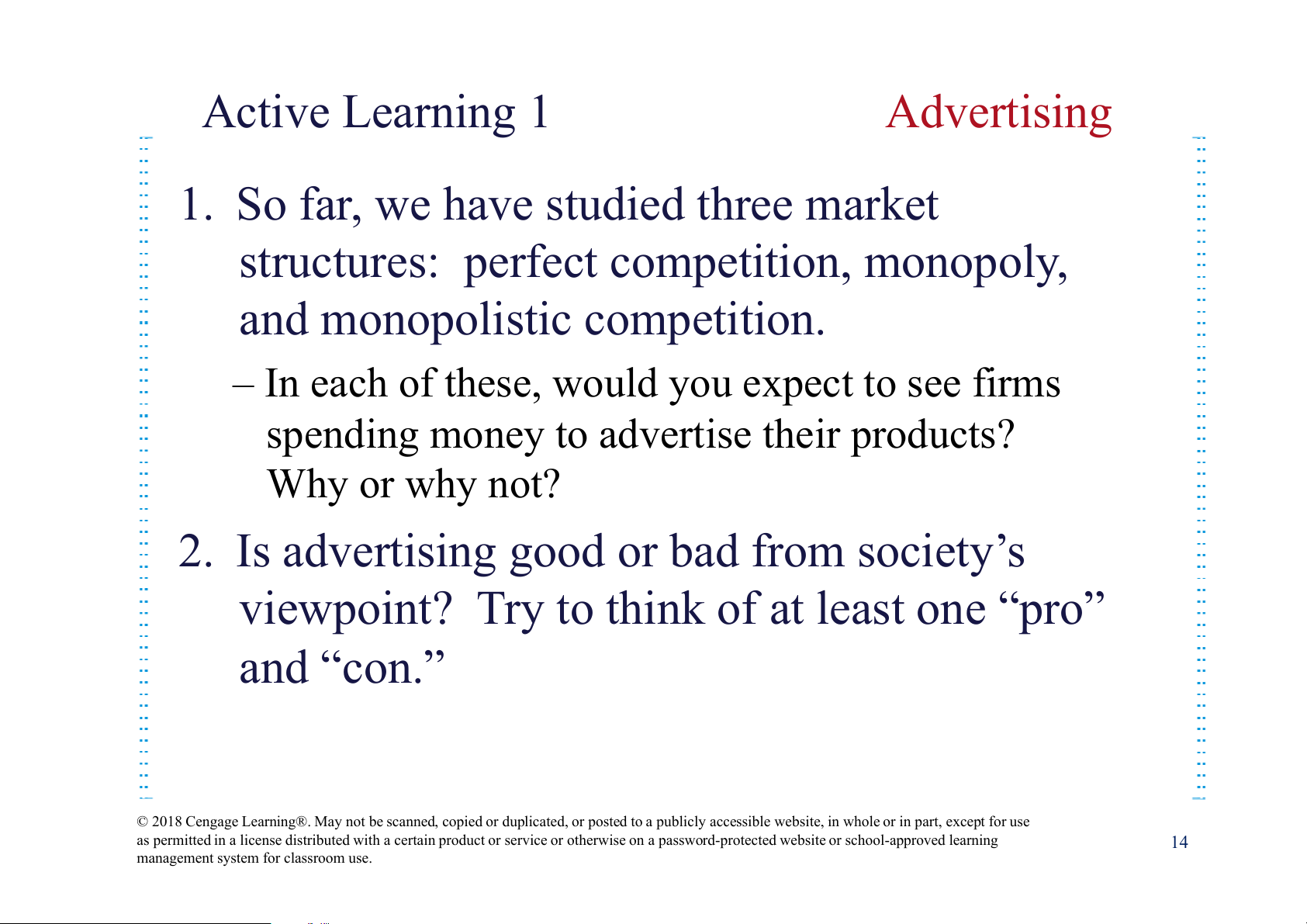
management system for classroom use. Active Learning 1 Advertising
1. So far, we have studied three market
structures: perfect competition, monopoly, and monopolistic competition.
– In each of these, would you expect to see firms
spending money to advertise their products? Why or why not?
2. Is advertising good or bad from society’s
viewpoint? Try to think of at least one “pro” and “con.”
© 2018 Cengage Learning®. May not be scanned, copied or duplicated, or posted to a publicly accessible website, in whole or in part, except for use
as permitted in a license distributed with a certain product or service or otherwise on a password-protected website or school-approved learning 14
management system for classroom use. Advertising • Incentive to advertise
– When firms sell differentiated products
and charge prices above marginal cost
– Advertise to attract more buyers • Advertising spending
– Highly differentiated goods: 10-20% of revenue
– Industrial products: Little advertising
– Homogenous products: No advertising
© 2018 Cengage Learning®. May not be scanned, copied or duplicated, or posted to a publicly accessible website, in whole or in part, except for use 15
as permitted in a license distributed with a certain product or service or otherwise on a password-protected website or school-approved learning
management system for classroom use. Advertising
• In monopolistically competitive industries
– Product differentiation and markup pricing
lead naturally to the use of advertising
• The more differentiated the products
– The more advertising firms buy
• Economists disagree about the social value of advertising: – Wasting resources? – Valuable purpose?
© 2018 Cengage Learning®. May not be scanned, copied or duplicated, or posted to a publicly accessible website, in whole or in part, except for use 16
as permitted in a license distributed with a certain product or service or otherwise on a password-protected website or school-approved learning
management system for classroom use. The Critique of Advertising
• Firms advertise to manipulate people’s tastes
– Psychological rather than informational
• Creates a desire that otherwise might not exist
• Advertising impedes competition
– Increase perception of product differentiation
• Foster brand loyalty; higher markups
• Makes buyers less concerned with price
differences among similar goods
© 2018 Cengage Learning®. May not be scanned, copied or duplicated, or posted to a publicly accessible website, in whole or in part, except for use 17
as permitted in a license distributed with a certain product or service or otherwise on a password-protected website or school-approved learning
management system for classroom use. The Defense of Advertising • The defense of advertising
– It provides useful information to buyers
– Informed buyers can more easily find and exploit price differences
– Advertising promotes competition and reduces market power
• Results of a prominent study:
– Eyeglasses were more expensive in states that
prohibited advertising by eyeglass makers than
in states that did not restrict such advertising
© 2018 Cengage Learning®. May not be scanned, copied or duplicated, or posted to a publicly accessible website, in whole or in part, except for use 18
as permitted in a license distributed with a certain product or service or otherwise on a password-protected website or school-approved learning
management system for classroom use. Advertising
• Advertising as a signal of quality
– Little apparent information
– Real information offered – a signal
• Willingness to spend large amount of money
• = signal about quality of the product
– Content of advertising = irrelevant
© 2018 Cengage Learning®. May not be scanned, copied or duplicated, or posted to a publicly accessible website, in whole or in part, except for use 19
as permitted in a license distributed with a certain product or service or otherwise on a password-protected website or school-approved learning
management system for classroom use. Brand Names
• In many markets, brand name products coexist with generic ones. • Brand names
– Spend more on advertising and charge
higher prices than generic substitutes
• As with advertising, there is disagreement
about the economics of brand names…
© 2018 Cengage Learning®. May not be scanned, copied or duplicated, or posted to a publicly accessible website, in whole or in part, except for use 20
as permitted in a license distributed with a certain product or service or otherwise on a password-protected website or school-approved learning
management system for classroom use.
Tài liệu liên quan:
-

Chương 3: độ co giãn và các nhân tố ảnh hưởng | Microeconomics | Trường Đại học Quốc tế, Đại học Quốc gia Thành phố Hồ Chí Minh
4 2 -
Microeconomics Syllabus | Microeconomics | Trường Đại học Quốc tế, Đại học Quốc gia Thành phố Hồ Chí Minh
4 2 -
Microeconomics Course Syllabus & Assessment Details | Microeconomics | Trường Đại học Quốc tế, Đại học Quốc gia Thành phố Hồ Chí Minh
4 2 -
Assignment 3 - Elasticity MCQs and Key Concepts | Microeconomics | Trường Đại học Quốc tế, Đại học Quốc gia Thành phố Hồ Chí Minh
4 2 -
Assignment 2 - Economic Equilibrium Analysis of Fridges and Motorcycles | Microeconomics | Trường Đại học Quốc tế, Đại học Quốc gia Thành phố Hồ Chí Minh
4 2