Monopoly & Monopolistic Competition Exercises and Theory | Microeconomics | Trường Đại học Quốc tế, Đại học Quốc gia Thành phố Hồ Chí Minh
A monopolist faces a demand curve that is a. The same as the total market demand. b. Horizontal. c. Perfectly inelastic. d. Very stable, not greatly affected by economic changes. e. Relatively elastic. M2 As a rule, the monopoly price will be a. As high as the monopolist wants. b. Greater than marginal cost. c. Greater than average revenue. d. Lower than marginal revenue. e. Equal to long-run average cost. Tài liệu được sưu tầm và soạn thảo dưới dạng file PDF để gửi tới các bạn cùng tham khảo, ôn tập đầy đủ kiến thức, chuẩn bị cho các buổi học thật tốt. Mời bạn đọc đón xem!
Môn: Microeconomics 635 tài liệu
Trường: Trường Đại học Quốc tế, Đại học Quốc gia Thành phố Hồ Chí Minh 1.9 K tài liệu
Tác giả:

Preview text:
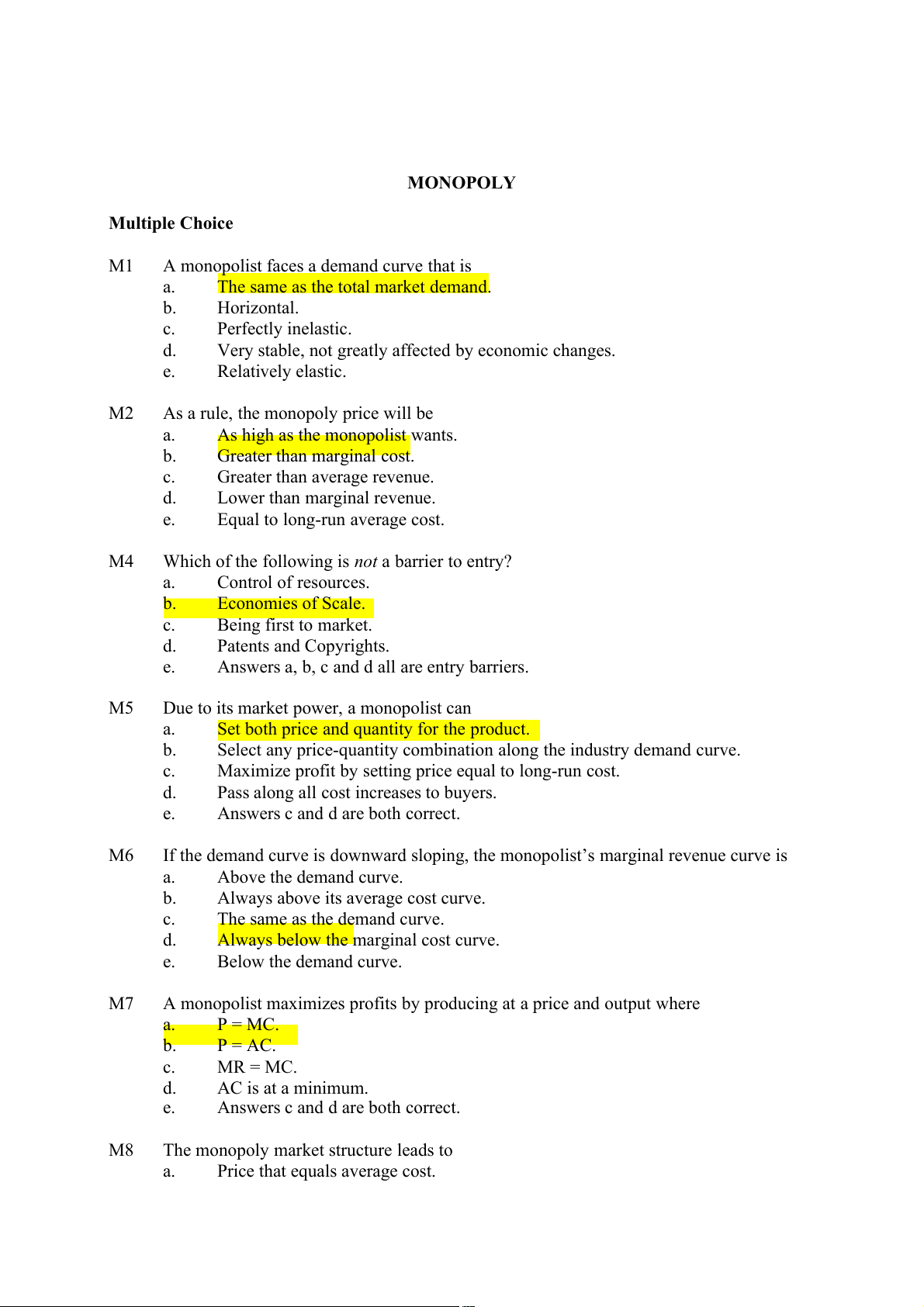
MONOPOLY Multiple Choice M1
A monopolist faces a demand curve that is a.
The same as the total market demand. b. Horizontal. c. Perfectly inelastic. d.
Very stable, not greatly affected by economic changes. e. Relatively elastic. M2
As a rule, the monopoly price will be a.
As high as the monopolist wants. b. Greater than marginal cost. c. Greater than average revenue. d. Lower than marginal revenue. e.
Equal to long-run average cost. M4
Which of the following is not a barrier to entry? a. Control of resources. b. Economies of Scale. c. Being first to market. d. Patents and Copyrights. e.
Answers a, b, c and d all are entry barriers. M5
Due to its market power, a monopolist can a.
Set both price and quantity for the product. b.
Select any price-quantity combination along the industry demand curve. c.
Maximize profit by setting price equal to long-run cost. d.
Pass along all cost increases to buyers. e.
Answers c and d are both correct. M6
If the demand curve is downward sloping, the monopolist’s marginal revenue curve is a. Above the demand curve. b.
Always above its average cost curve. c. The same as the demand curve. d.
Always below the marginal cost curve. e. Below the demand curve. M7
A monopolist maximizes profits by producing at a price and output where a. P = MC. b. P = AC. c. MR = MC. d. AC is at a minimum. e.
Answers c and d are both correct. M8
The monopoly market structure leads to a.
Price that equals average cost. b.
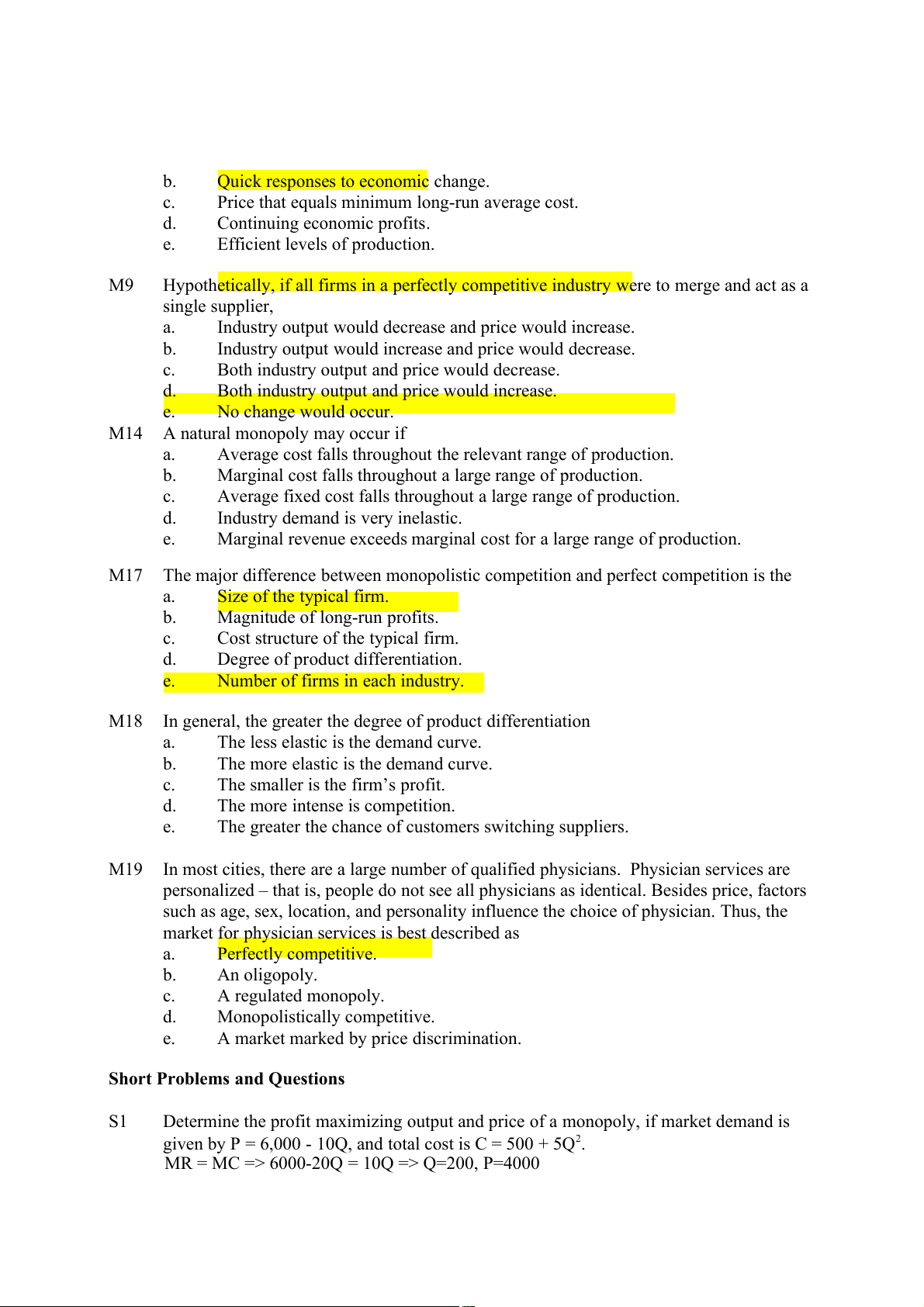
Quick responses to economic change. c.
Price that equals minimum long-run average cost. d. Continuing economic profits. e.
Efficient levels of production. M9
Hypothetically, if all firms in a perfectly competitive industry were to merge and act as a single supplier, a.
Industry output would decrease and price would increase. b.
Industry output would increase and price would decrease. c.
Both industry output and price would decrease. d.
Both industry output and price would increase. e. No change would occur. M14
A natural monopoly may occur if a.
Average cost falls throughout the relevant range of production. b.
Marginal cost falls throughout a large range of production. c.
Average fixed cost falls throughout a large range of production. d.
Industry demand is very inelastic. e.
Marginal revenue exceeds marginal cost for a large range of production. M17
The major difference between monopolistic competition and perfect competition is the a. Size of the typical firm. b. Magnitude of long-run profits. c.
Cost structure of the typical firm. d.
Degree of product differentiation. e.
Number of firms in each industry. M18
In general, the greater the degree of product differentiation a.
The less elastic is the demand curve. b.
The more elastic is the demand curve. c.
The smaller is the firm’s profit. d.
The more intense is competition. e.
The greater the chance of customers switching suppliers. M19
In most cities, there are a large number of qualified physicians. Physician services are
personalized – that is, people do not see all physicians as identical. Besides price, factors
such as age, sex, location, and personality influence the choice of physician. Thus, the
market for physician services is best described as a. Perfectly competitive. b. An oligopoly. c. A regulated monopoly. d. Monopolistically competitive. e.
A market marked by price discrimination.
Short Problems and Questions S1
Determine the profit maximizing output and price of a monopoly, if market demand is
given by P = 6,000 - 10Q, and total cost is C = 500 + 5Q2.
MR = MC => 6000-20Q = 10Q => Q=200, P=4000 S2
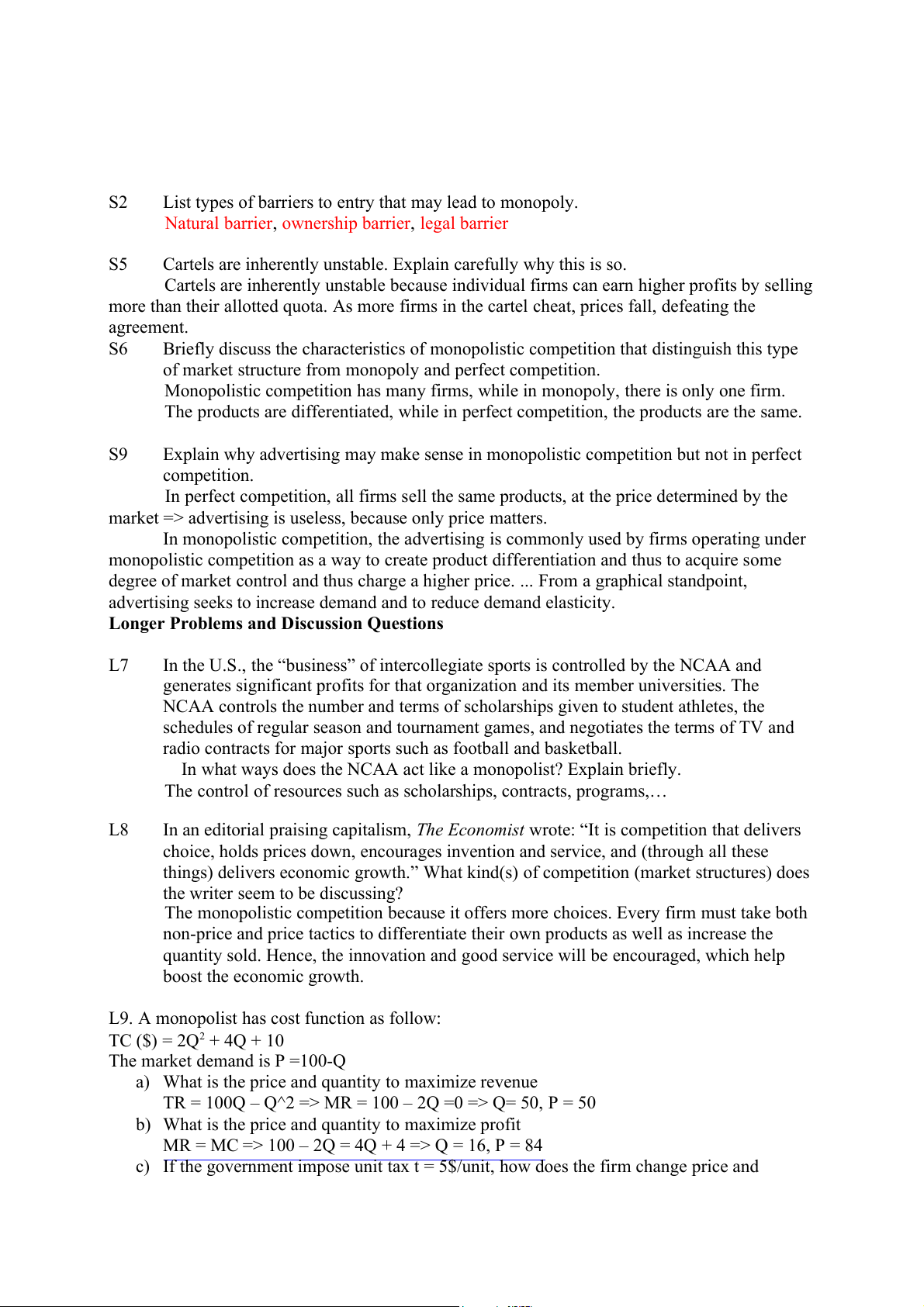
List types of barriers to entry that may lead to monopoly.
Natural barrier, ownership barrier, legal barrier S5
Cartels are inherently unstable. Explain carefully why this is so.
Cartels are inherently unstable because individual firms can earn higher profits by selling
more than their allotted quota. As more firms in the cartel cheat, prices fall, defeating the agreement. S6
Briefly discuss the characteristics of monopolistic competition that distinguish this type
of market structure from monopoly and perfect competition.
Monopolistic competition has many firms, while in monopoly, there is only one firm.
The products are differentiated, while in perfect competition, the products are the same. S9
Explain why advertising may make sense in monopolistic competition but not in perfect competition.
In perfect competition, all firms sell the same products, at the price determined by the
market => advertising is useless, because only price matters.
In monopolistic competition, the advertising is commonly used by firms operating under
monopolistic competition as a way to create product differentiation and thus to acquire some
degree of market control and thus charge a higher price. ... From a graphical standpoint,
advertising seeks to increase demand and to reduce demand elasticity.
Longer Problems and Discussion Questions L7
In the U.S., the “business” of intercollegiate sports is controlled by the NCAA and
generates significant profits for that organization and its member universities. The
NCAA controls the number and terms of scholarships given to student athletes, the
schedules of regular season and tournament games, and negotiates the terms of TV and
radio contracts for major sports such as football and basketball.
In what ways does the NCAA act like a monopolist? Explain briefly.
The control of resources such as scholarships, contracts, programs,… L8
In an editorial praising capitalism, The Economist wrote: “It is competition that delivers
choice, holds prices down, encourages invention and service, and (through all these
things) delivers economic growth.” What kind(s) of competition (market structures) does
the writer seem to be discussing?
The monopolistic competition because it offers more choices. Every firm must take both
non-price and price tactics to differentiate their own products as well as increase the
quantity sold. Hence, the innovation and good service will be encouraged, which help boost the economic growth.
L9. A monopolist has cost function as follow: TC ($) = 2Q2 + 4Q + 10 The market demand is P =100-Q
a) What is the price and quantity to maximize revenue
TR = 100Q – Q^2 => MR = 100 – 2Q =0 => Q= 50, P = 50
b) What is the price and quantity to maximize profit
MR = MC => 100 – 2Q = 4Q + 4 => Q = 16, P = 84
c) If the government impose unit tax t = 5$/unit, how does the firm change price and
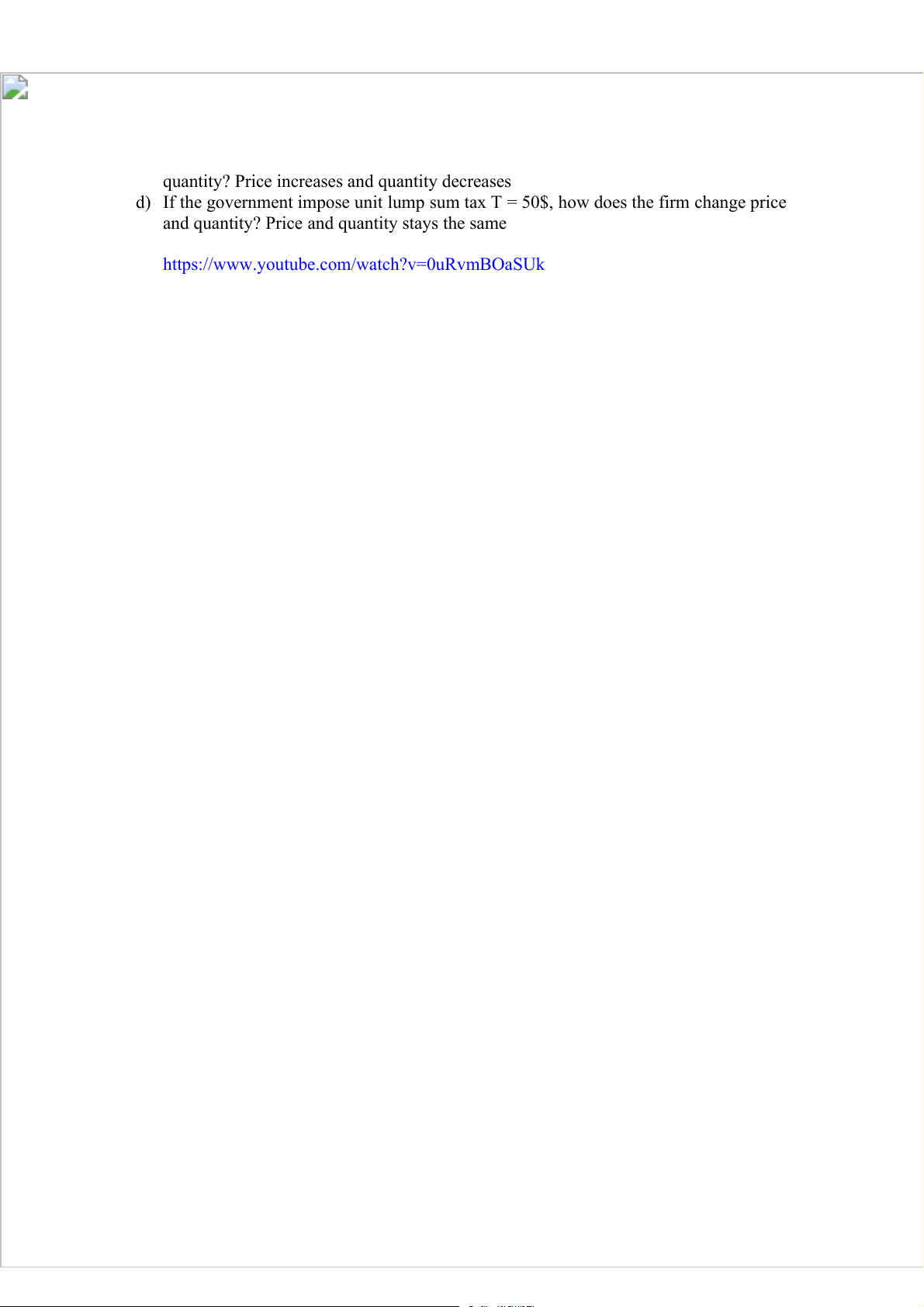
quantity? Price increases and quantity decreases
d) If the government impose unit lump sum tax T = 50$, how does the firm change price
and quantity? Price and quantity stays the same
https://www.youtube.com/watch?v=0uRvmBOaSUk
Tài liệu liên quan:
-
Chương 3: độ co giãn và các nhân tố ảnh hưởng | Microeconomics | Trường Đại học Quốc tế, Đại học Quốc gia Thành phố Hồ Chí Minh
5 3 -
Microeconomics Syllabus | Microeconomics | Trường Đại học Quốc tế, Đại học Quốc gia Thành phố Hồ Chí Minh
5 3 -
Microeconomics Course Syllabus & Assessment Details | Microeconomics | Trường Đại học Quốc tế, Đại học Quốc gia Thành phố Hồ Chí Minh
5 3 -
Assignment 3 - Elasticity MCQs and Key Concepts | Microeconomics | Trường Đại học Quốc tế, Đại học Quốc gia Thành phố Hồ Chí Minh
4 2 -
Assignment 2 - Economic Equilibrium Analysis of Fridges and Motorcycles | Microeconomics | Trường Đại học Quốc tế, Đại học Quốc gia Thành phố Hồ Chí Minh
4 2