Oligopoly Dynamics and Market Strategies | Microeconomics | Trường Đại học Quốc tế, Đại học Quốc gia Thành phố Hồ Chí Minh
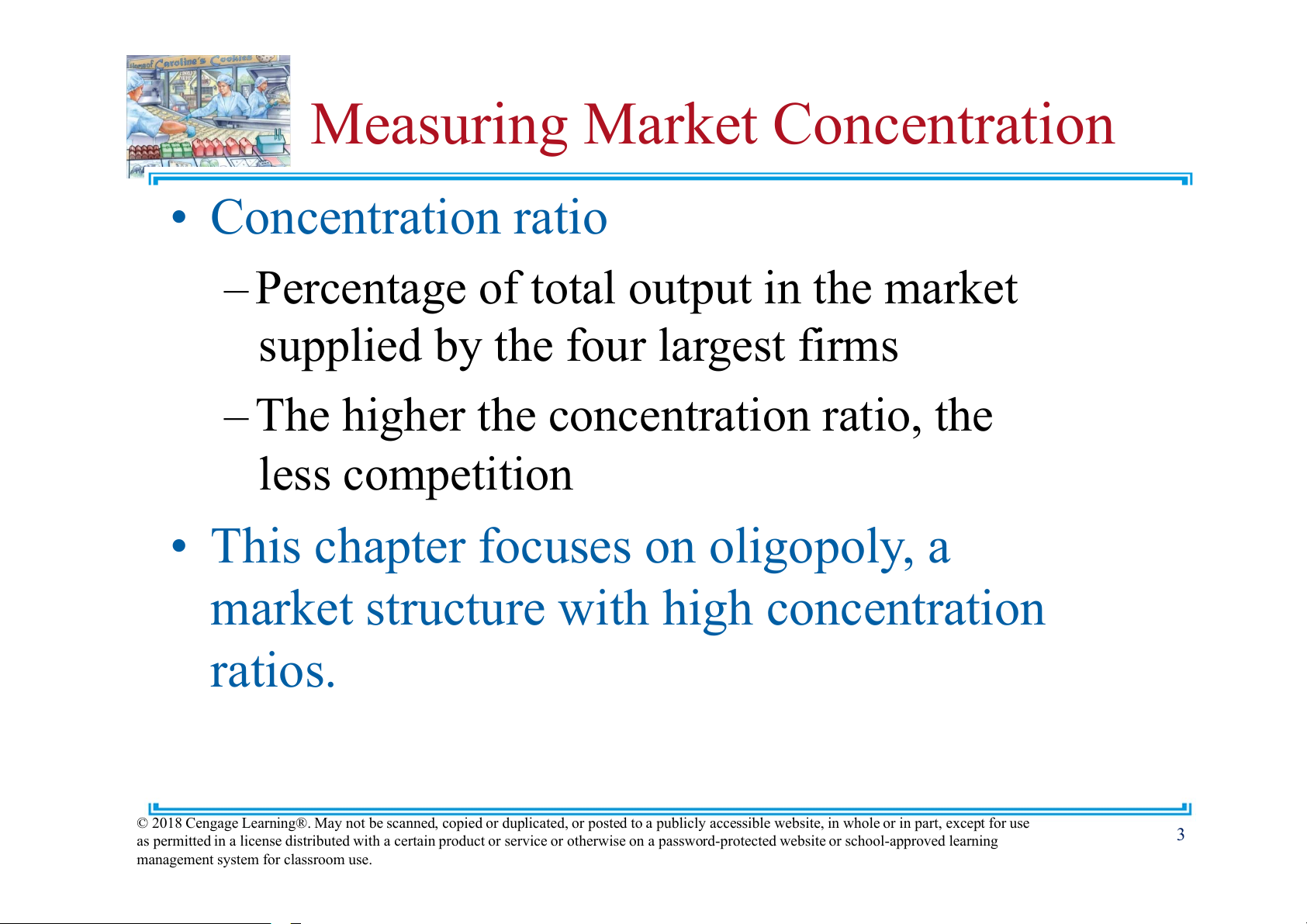
Concentration ratio – Percentage of total output in the market supplied by the four largest firms –The higher the concentration ratio, the less competition • This chapter focuses on oligopoly, a market structure with high concentration ratios. Tài liệu được sưu tầm và soạn thảo dưới dạng file PDF với mục đích hỗ trợ học tập và tham khảo. Nội dung tài liệu được trình bày rõ ràng, dễ tiếp cận, phù hợp cho việc ôn tập và củng cố kiến thức trong quá trình học đại học. Đây sẽ là nguồn tư liệu hữu ích giúp các bạn sinh viên chuẩn bị tốt hơn cho các buổi học, đồng thời mở rộng thêm hiểu biết về môn học. Hy vọng tài liệu này sẽ mang lại nhiều giá trị và hỗ trợ các bạn trong hành trình học tập. Mời bạn đọc cùng tham khảo!
Môn: Microeconomics 635 tài liệu
Trường: Trường Đại học Quốc tế, Đại học Quốc gia Thành phố Hồ Chí Minh 1.9 K tài liệu
Tác giả:


Preview text:
N. GREGORY MANKIW PRINCIPLES OF ECONOMICS Eight Edition CHAPTER Oligopoly
© 2018 Cengage Learning®. May not be scanned, copied or duplicated, or posted to a publicly accessible website, in whole or in part, except for use
as permitted in a license distributed with a certain product or service or otherwise on a password-protected website or school-approved learning 1
management system for classroom use.
Look for the answers to these questions:
• What outcomes are possible under oligopoly?
• Why is it difficult for oligopoly firms to cooperate?
• How are antitrust laws used to foster competition?
© 2018 Cengage Learning®. May not be scanned, copied or duplicated, or posted to a publicly accessible website, in whole or in part, except for use
as permitted in a license distributed with a certain product or service or otherwise on a password-protected website or school-approved learning 2
management system for classroom use. Measuring Market Concentration • Concentration ratio
– Percentage of total output in the market
supplied by the four largest firms
– The higher the concentration ratio, the less competition
• This chapter focuses on oligopoly, a
market structure with high concentration ratios.
© 2018 Cengage Learning®. May not be scanned, copied or duplicated, or posted to a publicly accessible website, in whole or in part, except for use 3
as permitted in a license distributed with a certain product or service or otherwise on a password-protected website or school-approved learning
management system for classroom use.
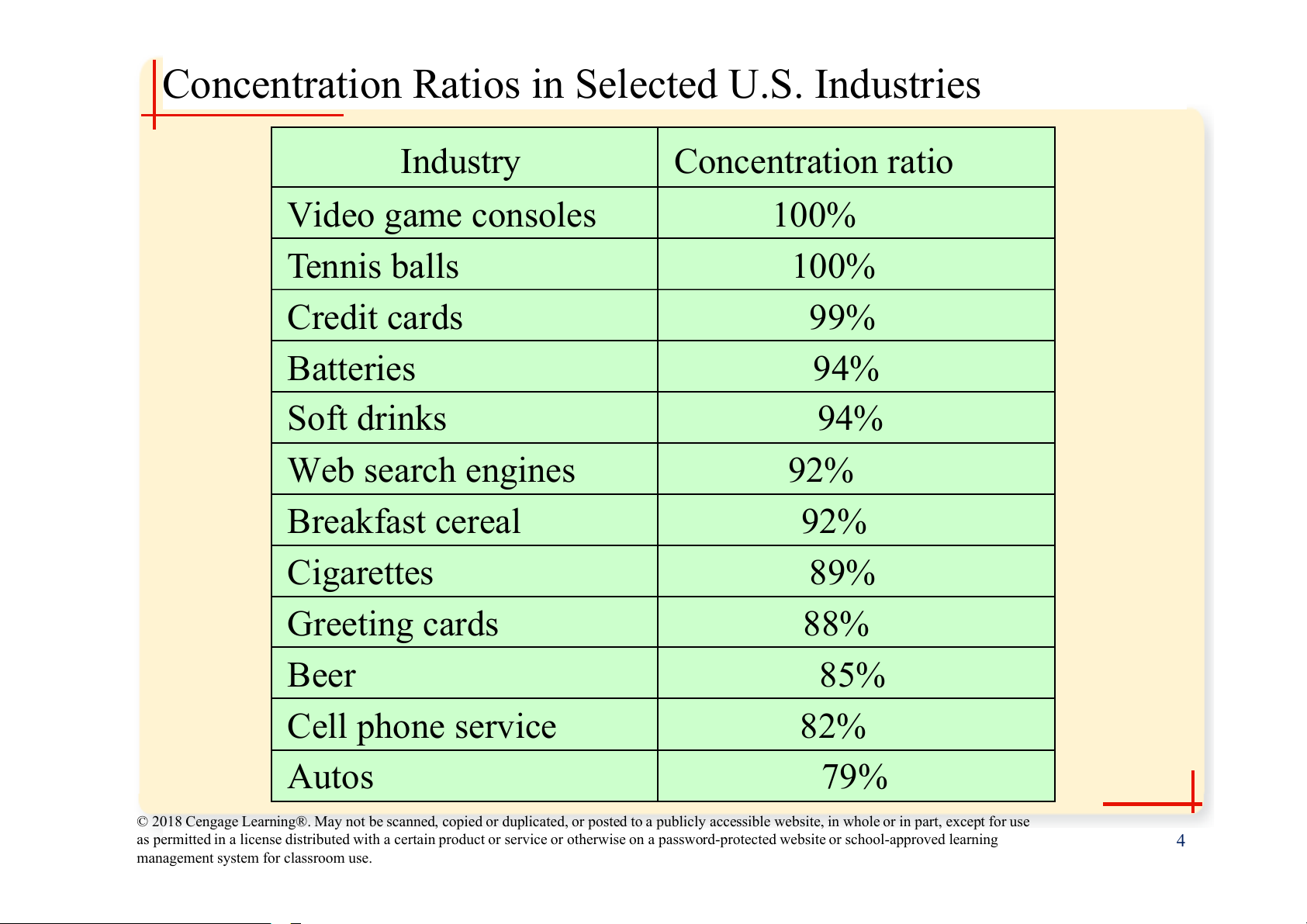
Concentration Ratios in Selected U.S. Industries Industry Concentration ratio Video game consoles 100% Tennis balls 100% Credit cards 99% Batteries 94% Soft drinks 94% Web search engines 92% Breakfast cereal 92% Cigarettes 89% Greeting cards 88% Beer 85% Cell phone service 82% Autos 79%
© 2018 Cengage Learning®. May not be scanned, copied or duplicated, or posted to a publicly accessible website, in whole or in part, except for use
as permitted in a license distributed with a certain product or service or otherwise on a password-protected website or school-approved learning 4
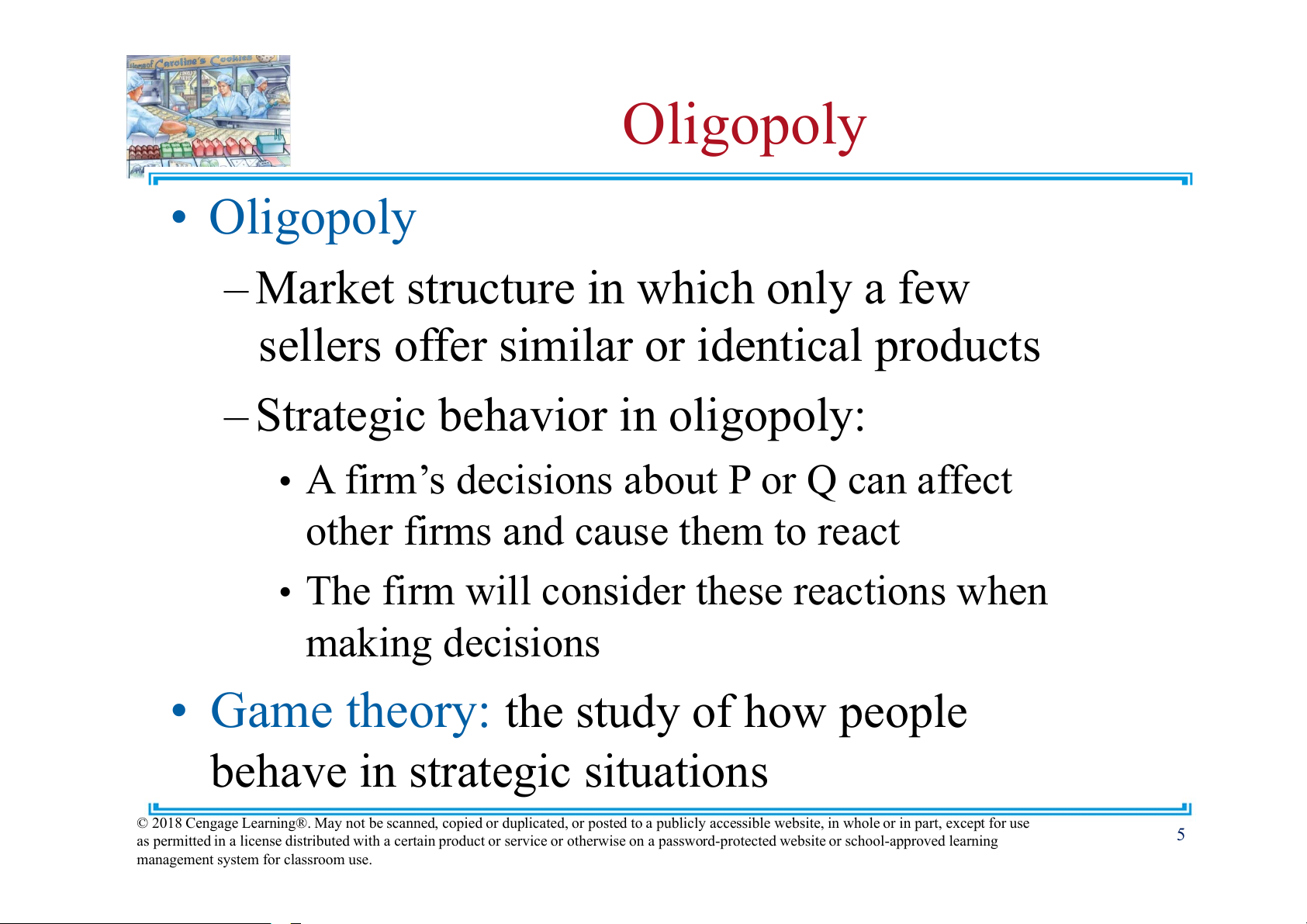
management system for classroom use. Oligopoly • Oligopoly
– Market structure in which only a few
sellers offer similar or identical products
– Strategic behavior in oligopoly:
• A firm’s decisions about P or Q can affect
other firms and cause them to react
• The firm will consider these reactions when making decisions
• Game theory: the study of how people behave in strategic situations
© 2018 Cengage Learning®. May not be scanned, copied or duplicated, or posted to a publicly accessible website, in whole or in part, except for use 5
as permitted in a license distributed with a certain product or service or otherwise on a password-protected website or school-approved learning
management system for classroom use.
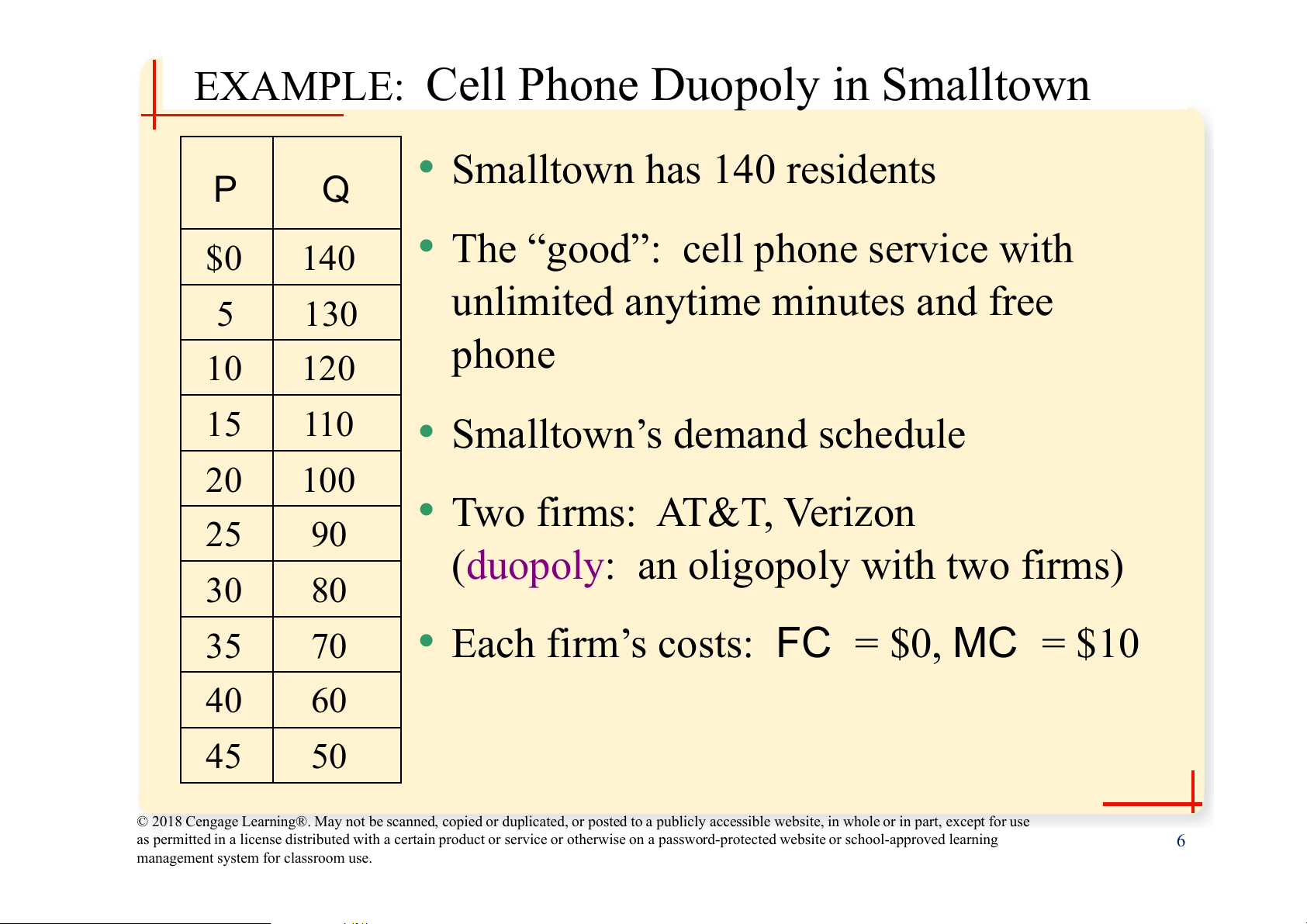
EXAMPLE: Cell Phone Duopoly in Smalltown
• Smalltown has 140 residents P Q $0 140
• The “good”: cell phone service with
unlimited anytime minutes and free 5 130 phone 10 120 15 110
• Smalltown’s demand schedule 20 100
• Two firms: AT&T, Verizon 25 90
(duopoly: an oligopoly with two firms) 30 80 35 70
• Each firm’s costs: FC = $0, MC = $10 40 60 45 50
© 2018 Cengage Learning®. May not be scanned, copied or duplicated, or posted to a publicly accessible website, in whole or in part, except for use
as permitted in a license distributed with a certain product or service or otherwise on a password-protected website or school-approved learning 6
management system for classroom use.
EXAMPLE: Cell Phone Duopoly in Smalltown Competitive P Q Revenue Cost Profit outcome: $0 140 $0 $1,400 –1,400 P = MC = $10 5 130 650 1,300 –650 Q = 120 10 120 1,200 1,200 0 Profit = $0 15 110 1,650 1,100 550 20 100 2,000 1,000 1,000 25 90 2,250 900 1,350 Monopoly outcome: 30 80 2,400 800 1,600 35 70 2,450 700 1,750 P = $40 40 60 2,400 600 1,800 Q = 60 45 50 2,250 500 1,750 Profit = $1,800
© 2018 Cengage Learning®. May not be scanned, copied or duplicated, or posted to a publicly accessible website, in whole or in part, except for use
as permitted in a license distributed with a certain product or service or otherwise on a password-protected website or school-approved learning 7
management system for classroom use.
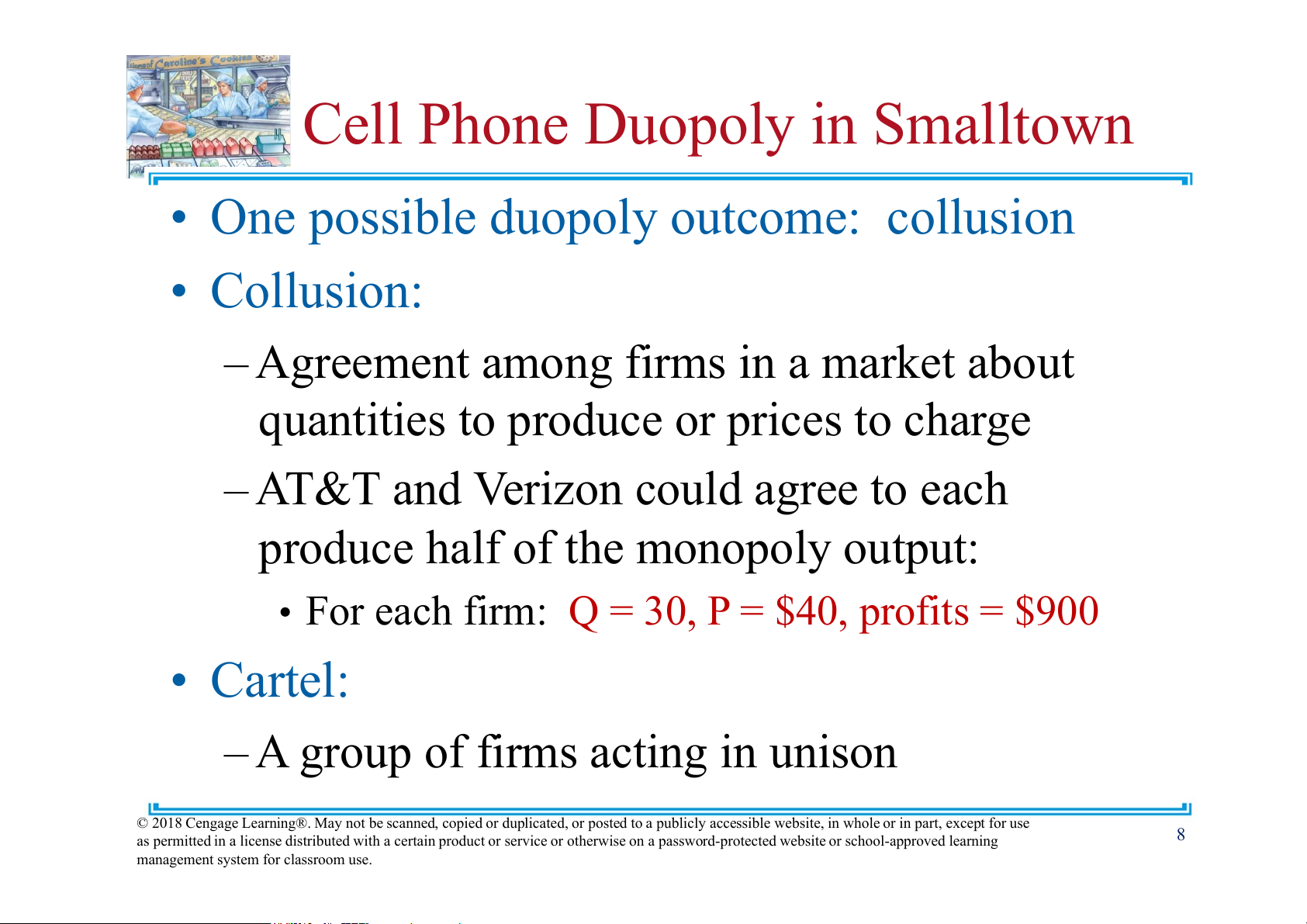
Cell Phone Duopoly in Smalltown
• One possible duopoly outcome: collusion • Collusion:
– Agreement among firms in a market about
quantities to produce or prices to charge
– AT&T and Verizon could agree to each
produce half of the monopoly output:
• For each firm: Q = 30, P = $40, profits = $900 • Cartel:
– A group of firms acting in unison
© 2018 Cengage Learning®. May not be scanned, copied or duplicated, or posted to a publicly accessible website, in whole or in part, except for use 8
as permitted in a license distributed with a certain product or service or otherwise on a password-protected website or school-approved learning
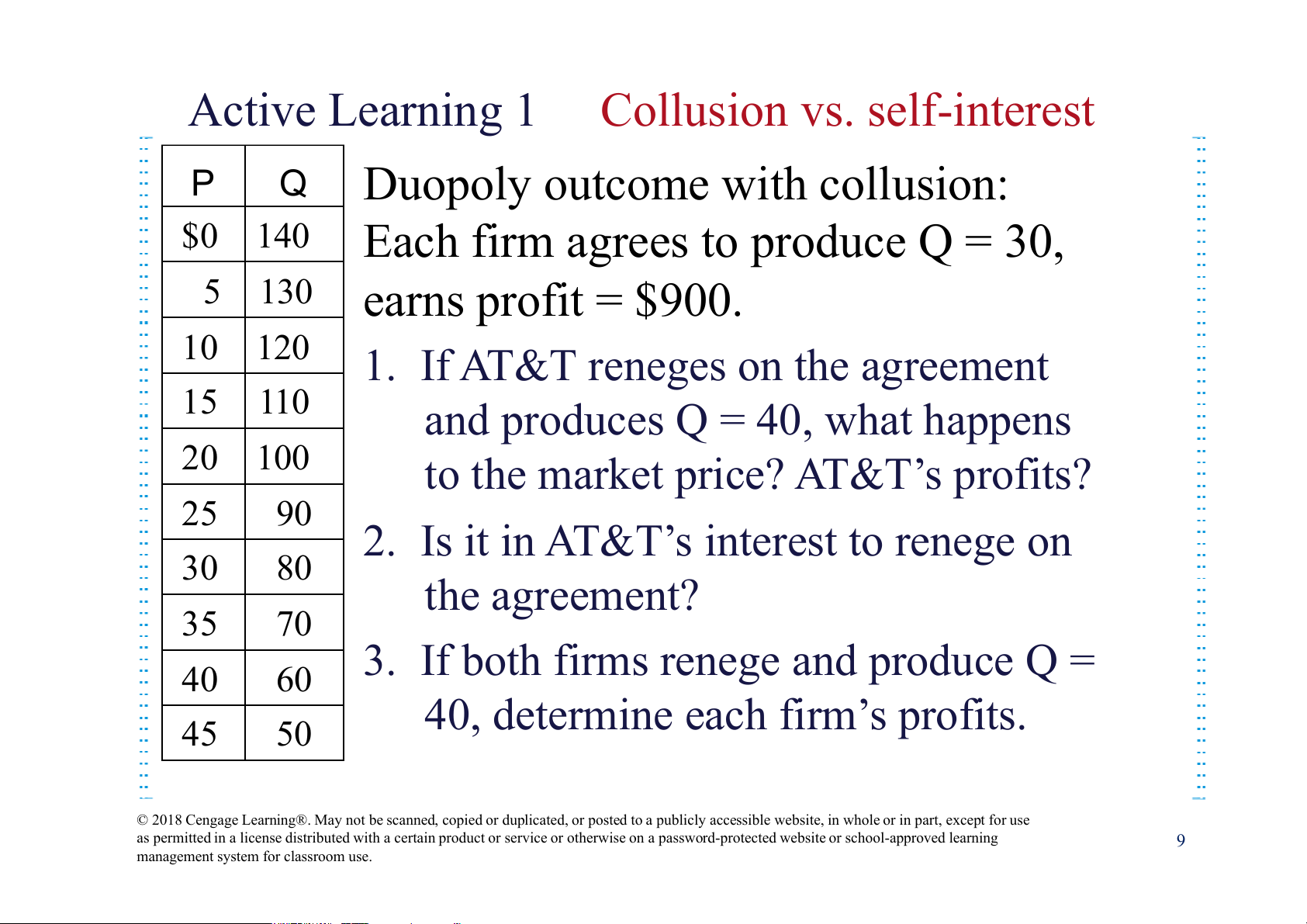
management system for classroom use. Active Learning 1 Collusion vs. self-interest P Q
Duopoly outcome with collusion: $0 140
Each firm agrees to produce Q = 30, 5 130 earns profit = $900. 10 120
1. If AT&T reneges on the agreement 15 110
and produces Q = 40, what happens 20 100
to the market price? AT&T’s profits? 25 90
2. Is it in AT&T’s interest to renege on 30 80 the agreement? 35 70
3. If both firms renege and produce Q = 40 60
40, determine each firm’s profits. 45 50
© 2018 Cengage Learning®. May not be scanned, copied or duplicated, or posted to a publicly accessible website, in whole or in part, except for use
as permitted in a license distributed with a certain product or service or otherwise on a password-protected website or school-approved learning 9
management system for classroom use. Active Learning 1 Answers
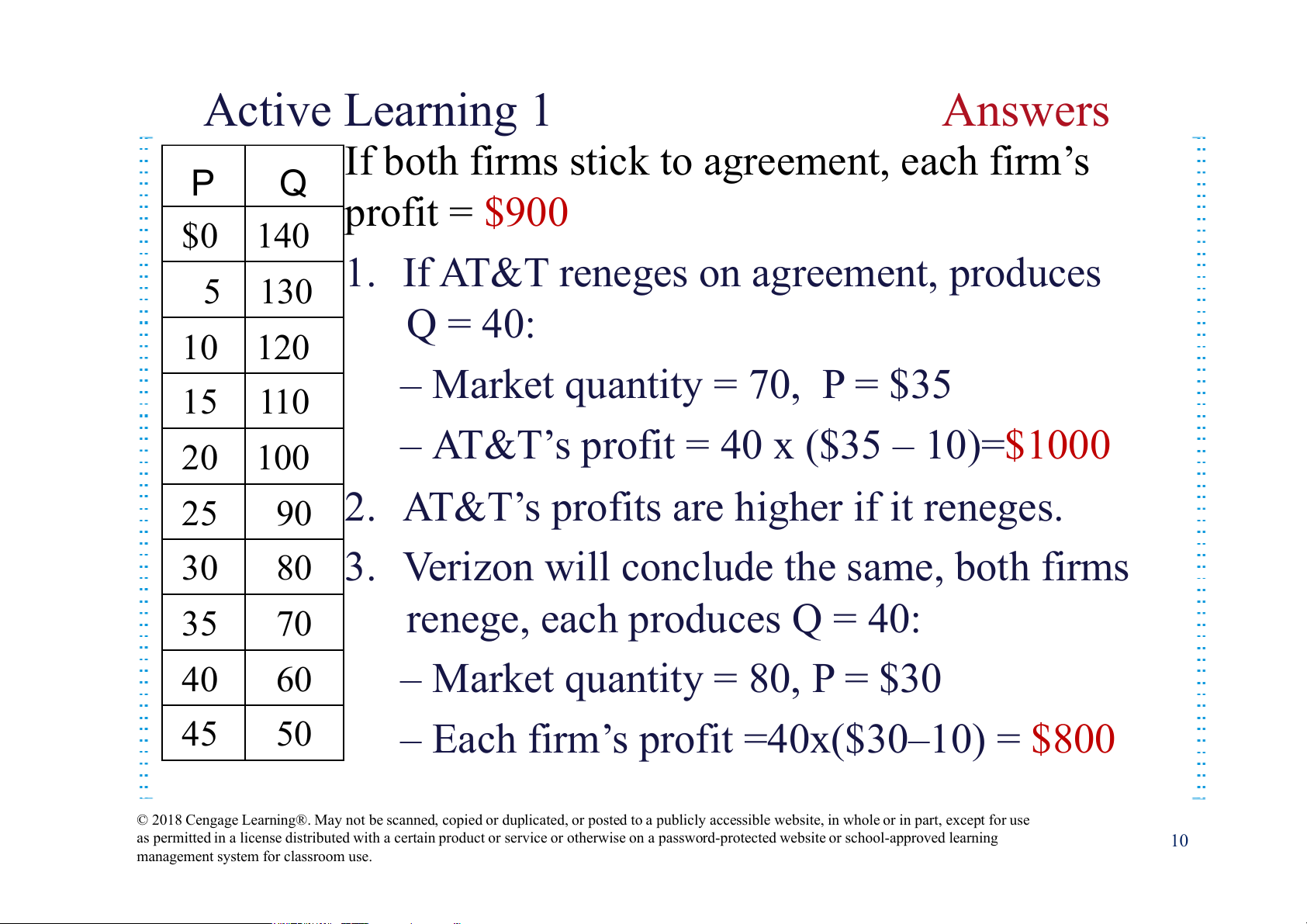
If both firms stick to agreement, each firm’s P Q profit = $900
$0 140 1. If AT&T reneges on agreement, produces 5 130 Q = 40: 10 120
– Market quantity = 70, P = $35 15 110
– AT&T’s profit = 40 x ($35 – 10)=$1000 20 100 25
90 2. AT&T’s profits are higher if it reneges. 30
80 3. Verizon will conclude the same, both firms 35 70 renege, each produces Q = 40: 40 60
– Market quantity = 80, P = $30 45 50
– Each firm’s profit =40x($30–10) = $800
© 2018 Cengage Learning®. May not be scanned, copied or duplicated, or posted to a publicly accessible website, in whole or in part, except for use
as permitted in a license distributed with a certain product or service or otherwise on a password-protected website or school-approved learning 10
management system for classroom use. Collusion vs. Self-Interest
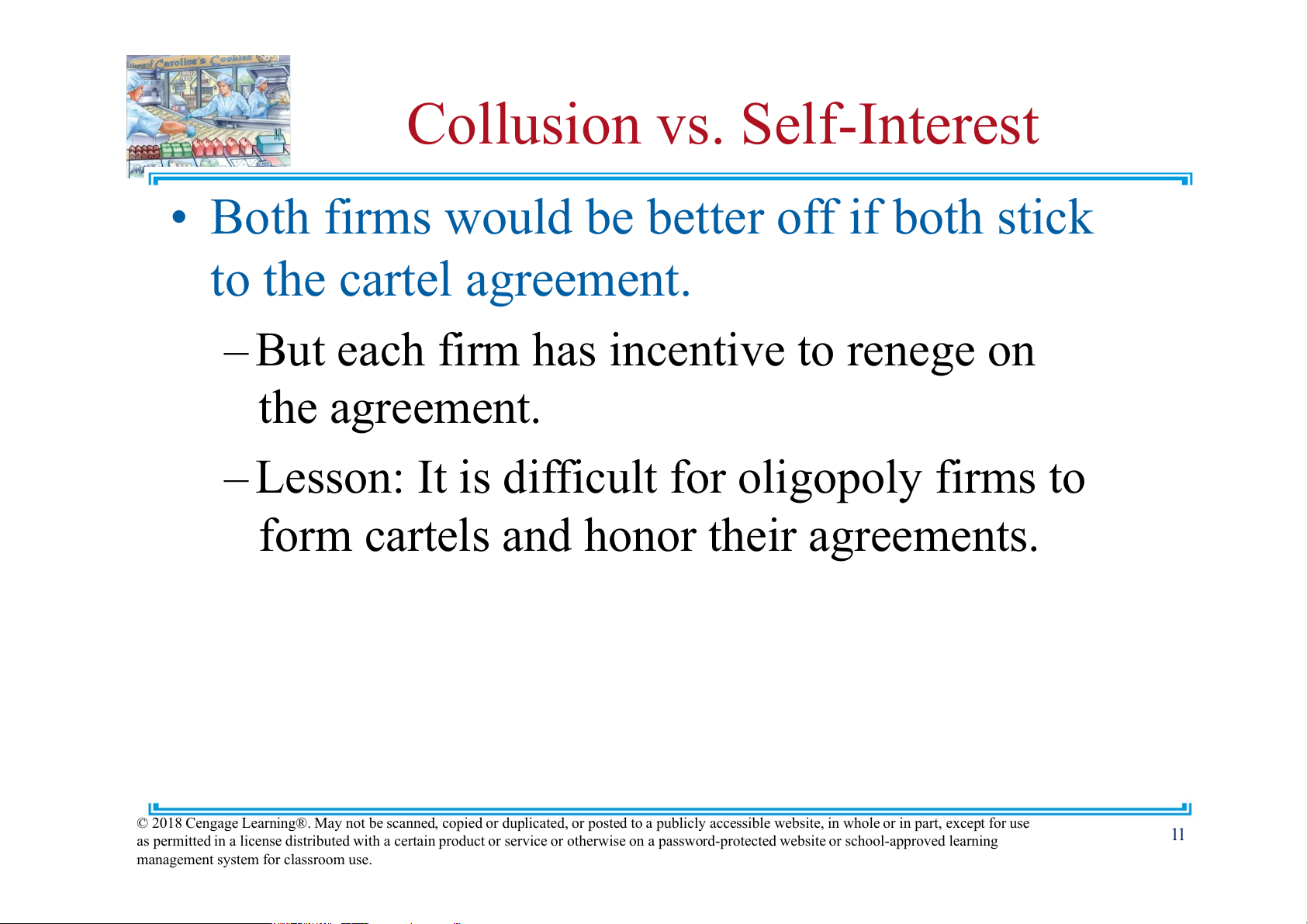
• Both firms would be better off if both stick to the cartel agreement.
– But each firm has incentive to renege on the agreement.
– Lesson: It is difficult for oligopoly firms to
form cartels and honor their agreements.
© 2018 Cengage Learning®. May not be scanned, copied or duplicated, or posted to a publicly accessible website, in whole or in part, except for use 11
as permitted in a license distributed with a certain product or service or otherwise on a password-protected website or school-approved learning
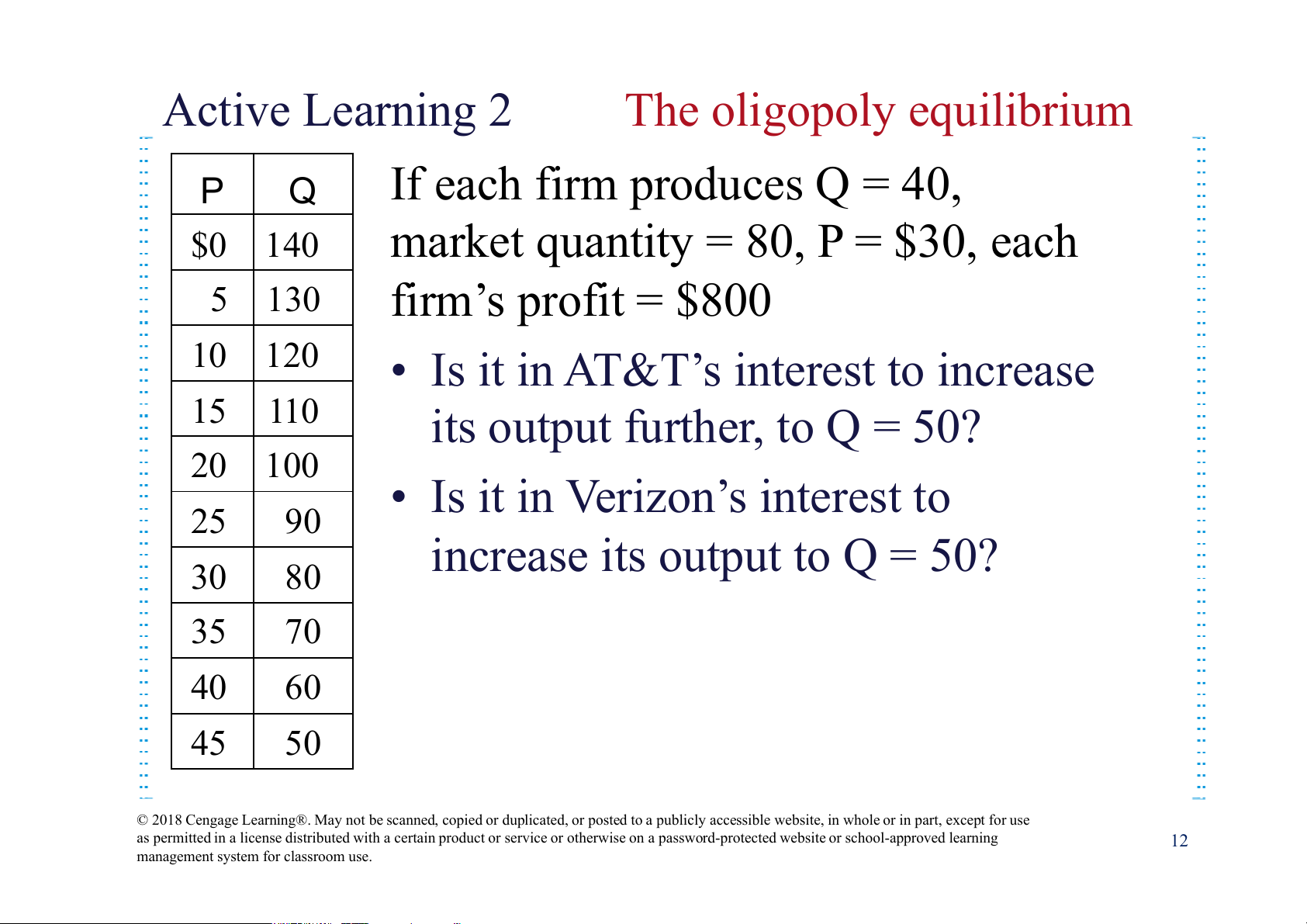
management system for classroom use. Active Learning 2 The oligopoly equilibrium P Q If each firm produces Q = 40, $0 140
market quantity = 80, P = $30, each 5 130 firm’s profit = $800 10 120
• Is it in AT&T’s interest to increase 15 110
its output further, to Q = 50? 20 100
• Is it in Verizon’s interest to 25 90
increase its output to Q = 50? 30 80 35 70 40 60 45 50
© 2018 Cengage Learning®. May not be scanned, copied or duplicated, or posted to a publicly accessible website, in whole or in part, except for use
as permitted in a license distributed with a certain product or service or otherwise on a password-protected website or school-approved learning 12
management system for classroom use. Active Learning 2 Answers P Q
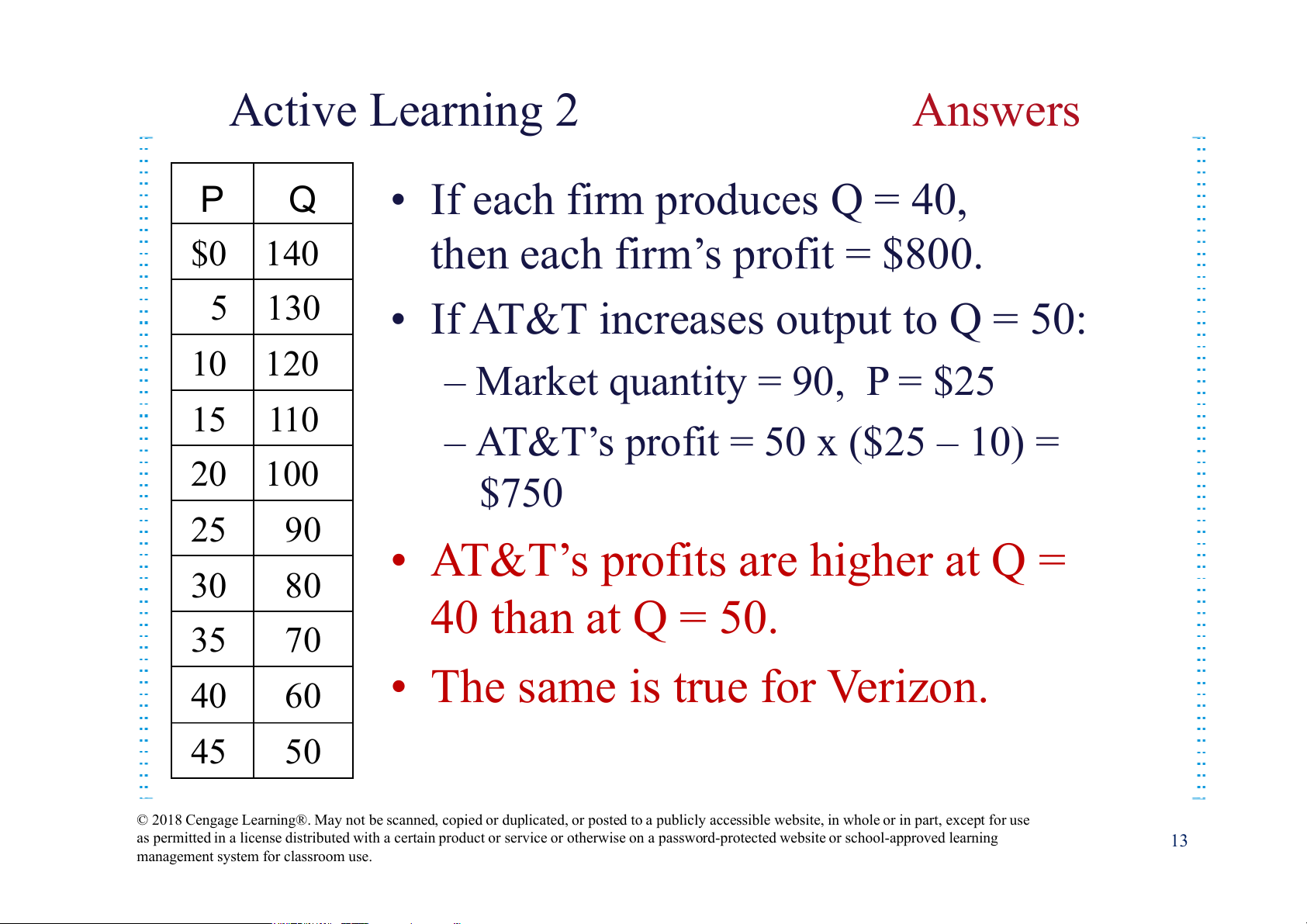
• If each firm produces Q = 40, $0 140
then each firm’s profit = $800. 5 130
• If AT&T increases output to Q = 50: 10 120
– Market quantity = 90, P = $25 15 110
– AT&T’s profit = 50 x ($25 – 10) = 20 100 $750 25 90
• AT&T’s profits are higher at Q = 30 80 40 than at Q = 50. 35 70 40 60
• The same is true for Verizon. 45 50
© 2018 Cengage Learning®. May not be scanned, copied or duplicated, or posted to a publicly accessible website, in whole or in part, except for use
as permitted in a license distributed with a certain product or service or otherwise on a password-protected website or school-approved learning 13
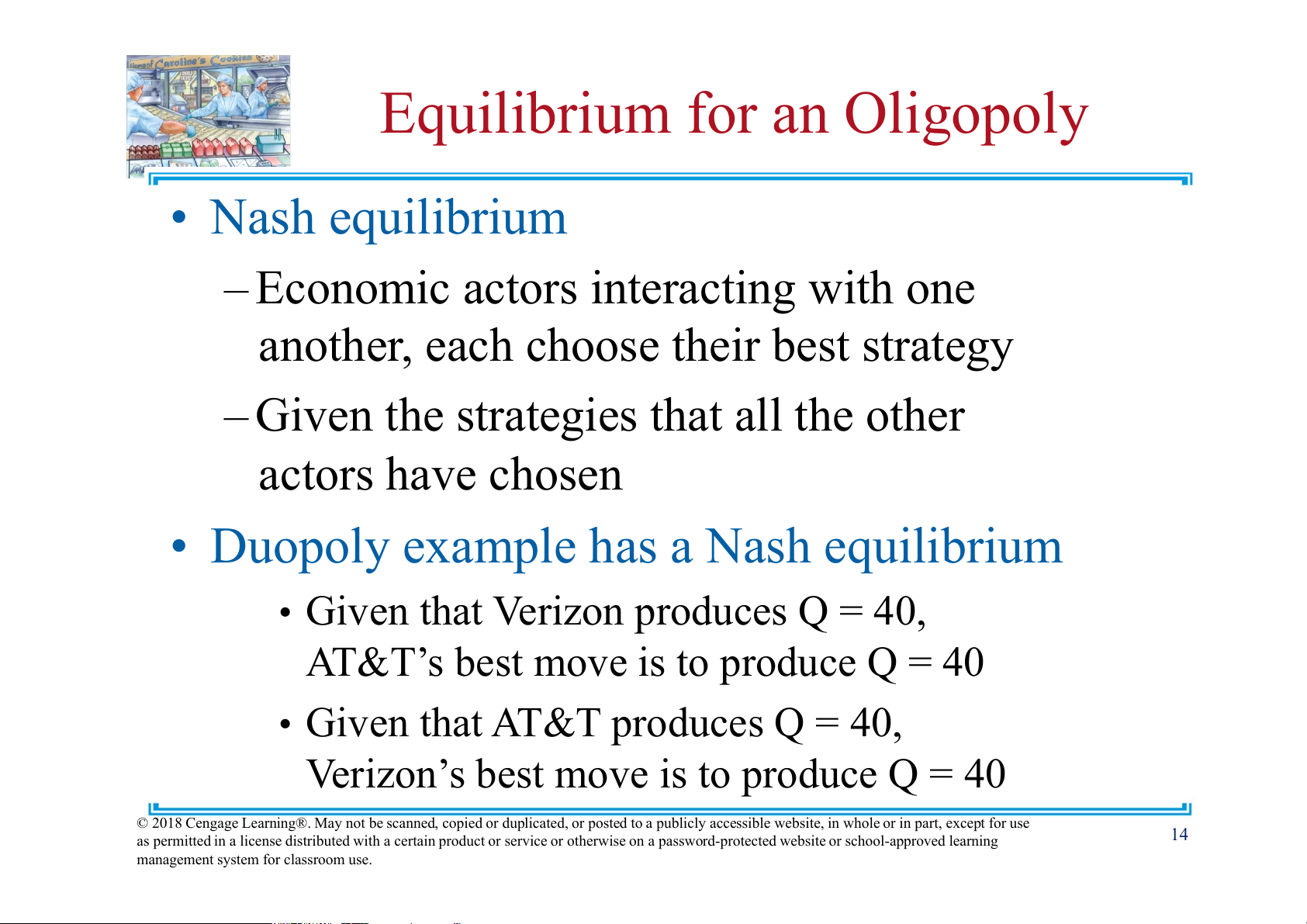
management system for classroom use. Equilibrium for an Oligopoly • Nash equilibrium
– Economic actors interacting with one
another, each choose their best strategy
– Given the strategies that all the other actors have chosen
• Duopoly example has a Nash equilibrium
• Given that Verizon produces Q = 40,
AT&T’s best move is to produce Q = 40
• Given that AT&T produces Q = 40,
Verizon’s best move is to produce Q = 40
© 2018 Cengage Learning®. May not be scanned, copied or duplicated, or posted to a publicly accessible website, in whole or in part, except for use 14
as permitted in a license distributed with a certain product or service or otherwise on a password-protected website or school-approved learning
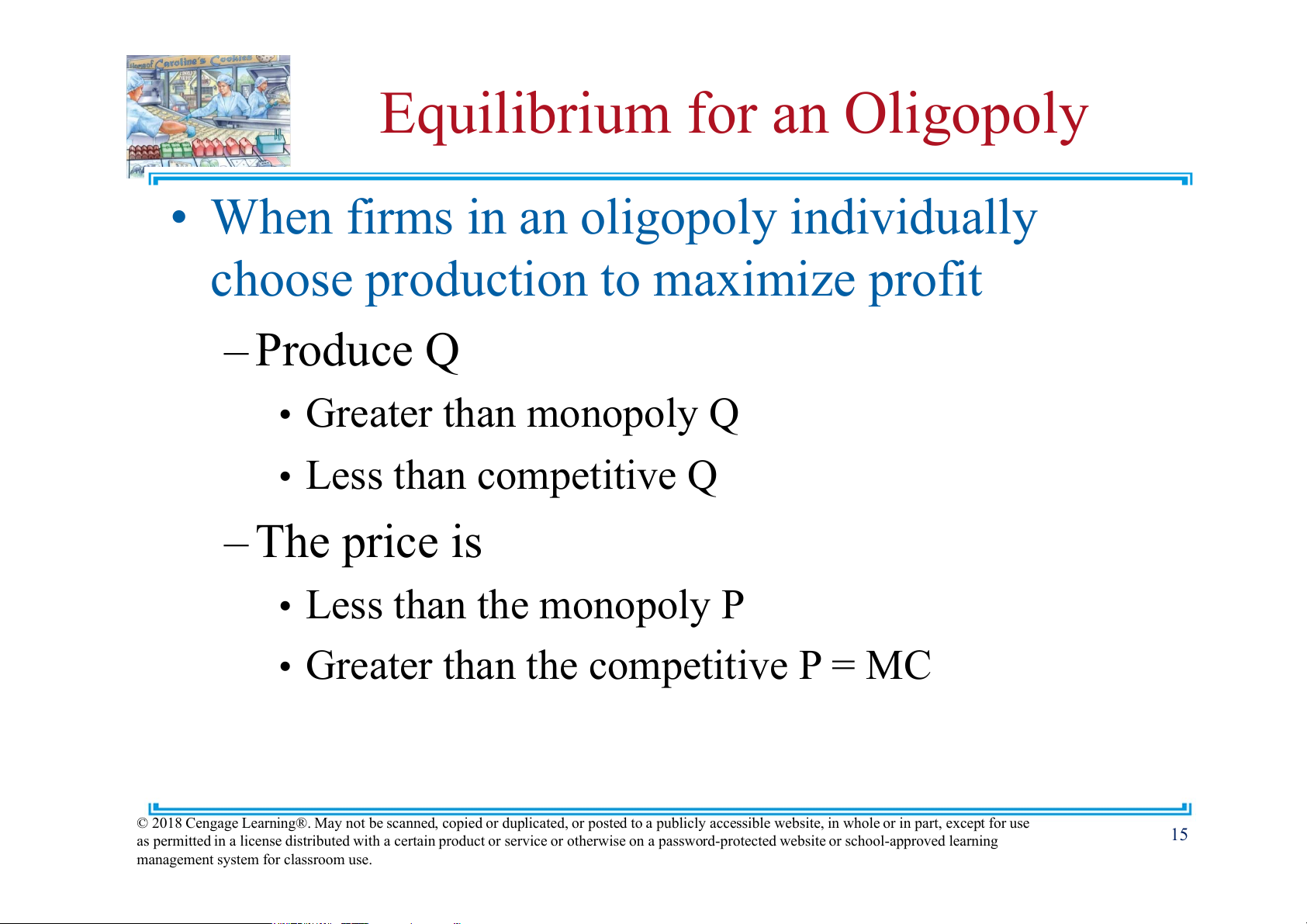
management system for classroom use. Equilibrium for an Oligopoly
• When firms in an oligopoly individually
choose production to maximize profit – Produce Q • Greater than monopoly Q • Less than competitive Q – The price is • Less than the monopoly P
• Greater than the competitive P = MC
© 2018 Cengage Learning®. May not be scanned, copied or duplicated, or posted to a publicly accessible website, in whole or in part, except for use 15
as permitted in a license distributed with a certain product or service or otherwise on a password-protected website or school-approved learning
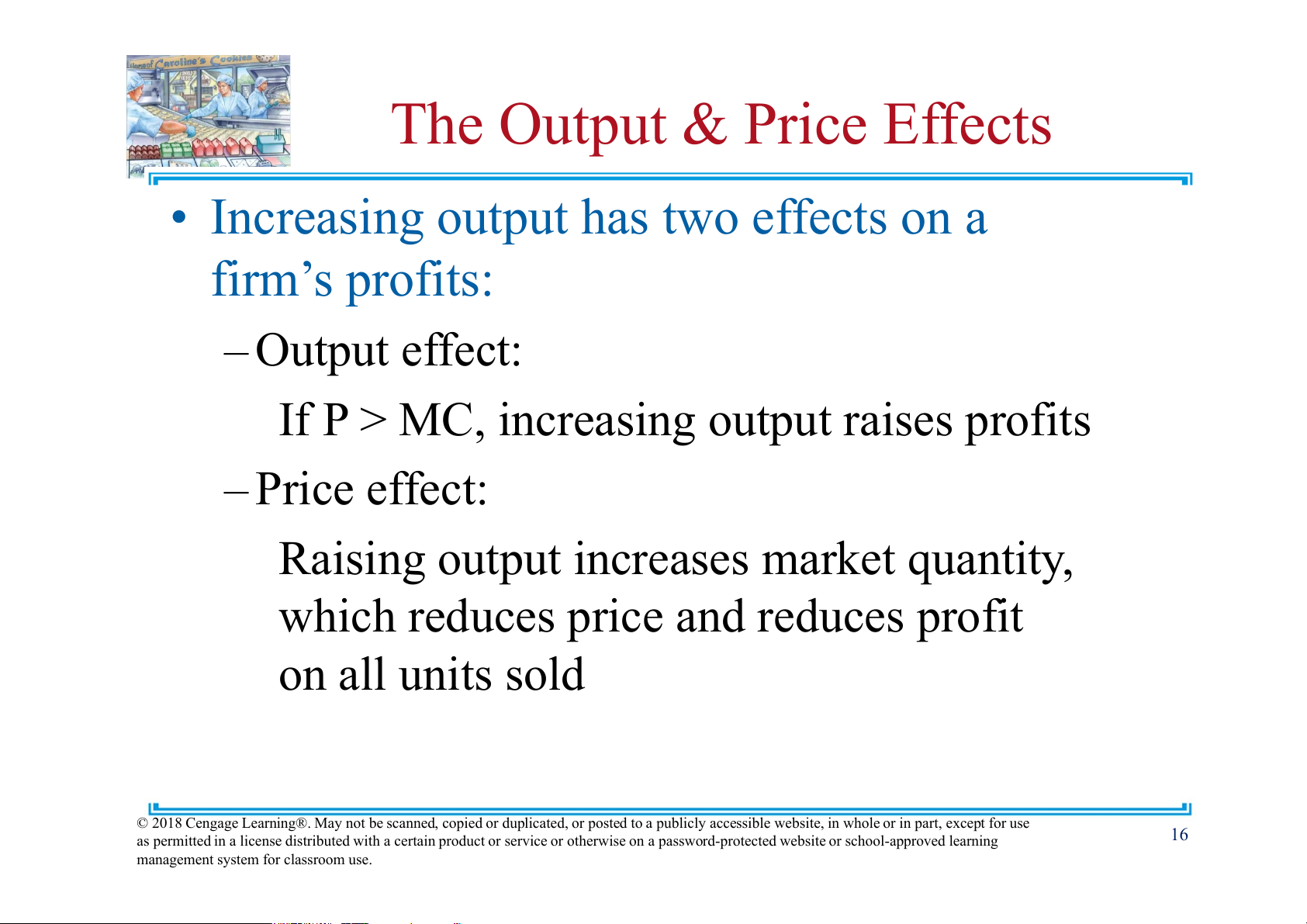
management system for classroom use. The Output & Price Effects
• Increasing output has two effects on a firm’s profits: – Output effect:
If P > MC, increasing output raises profits – Price effect:
Raising output increases market quantity,
which reduces price and reduces profit on all units sold
© 2018 Cengage Learning®. May not be scanned, copied or duplicated, or posted to a publicly accessible website, in whole or in part, except for use 16
as permitted in a license distributed with a certain product or service or otherwise on a password-protected website or school-approved learning
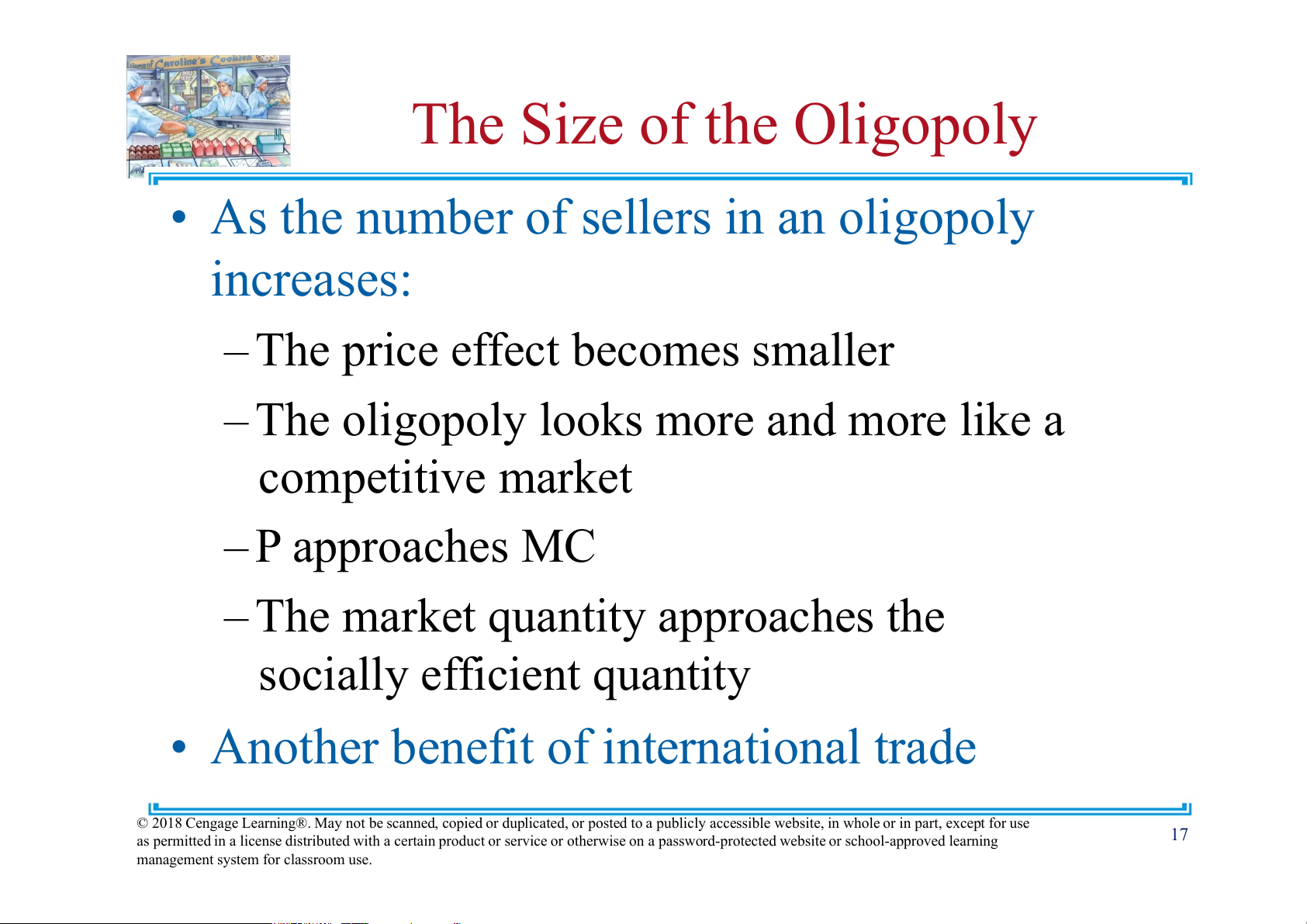
management system for classroom use. The Size of the Oligopoly
• As the number of sellers in an oligopoly increases:
– The price effect becomes smaller
– The oligopoly looks more and more like a competitive market – P approaches MC
– The market quantity approaches the socially efficient quantity
• Another benefit of international trade
© 2018 Cengage Learning®. May not be scanned, copied or duplicated, or posted to a publicly accessible website, in whole or in part, except for use 17
as permitted in a license distributed with a certain product or service or otherwise on a password-protected website or school-approved learning
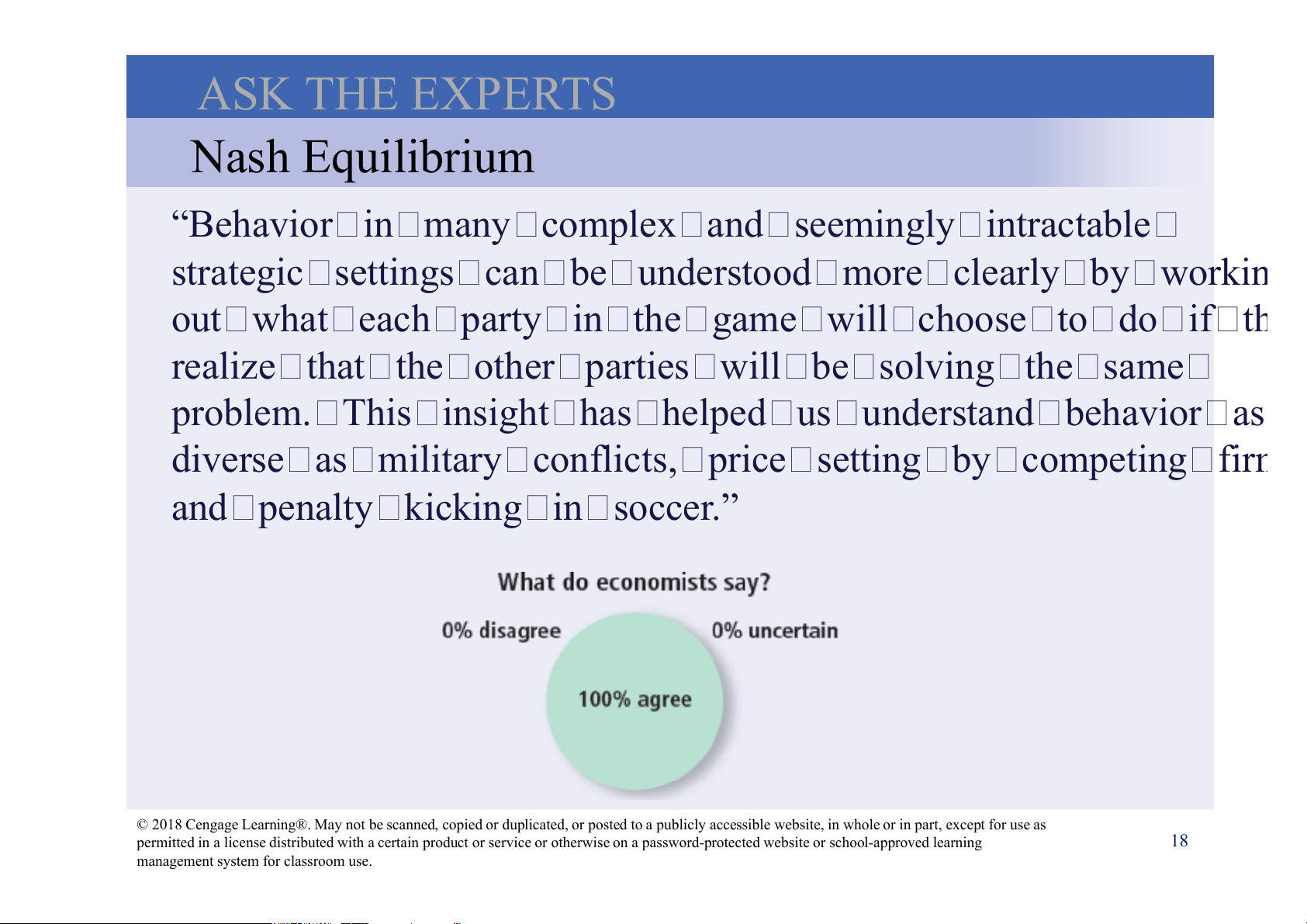
management system for classroom use. ASK THE EXPERTS Nash Equilibrium
“Behavior in many complex and seemingly intractable
strategic settings can be understood more clearly by workin
out what each party in the game will choose to do if th
realize that the other parties will be solving the same
problem. This insight has helped us understand behavior as
diverse as military conflicts, price setting by competing firm
and penalty kicking in soccer.”
© 2018 Cengage Learning®. May not be scanned, copied or duplicated, or posted to a publicly accessible website, in whole or in part, except for use as
permitted in a license distributed with a certain product or service or otherwise on a password-protected website or school-approved learning 18
management system for classroom use. The Economics of Cooperation • The prisoners’ dilemma
– Particular “game” between two captured prisoners
– Illustrates why cooperation is difficult to
maintain even when it is mutually beneficial • Dominant strategy
– Strategy that is best for a player in a game
– Regardless of the strategies chosen by the other players
© 2018 Cengage Learning®. May not be scanned, copied or duplicated, or posted to a publicly accessible website, in whole or in part, except for use 19
as permitted in a license distributed with a certain product or service or otherwise on a password-protected website or school-approved learning
management system for classroom use. Prisoners’ Dilemma Example
The police have caught Bonnie and Clyde, two
suspected bank robbers, but only have enough
evidence to imprison each for 1 year.
• The police question each in separate rooms, offer each the following deal:
– If you confess and implicate your partner, you go free.
– If you do not confess but your partner implicates
you, you get 20 years in prison.
– If you both confess, each gets 8 years in prison.
© 2018 Cengage Learning®. May not be scanned, copied or duplicated, or posted to a publicly accessible website, in whole or in part, except for use 20
as permitted in a license distributed with a certain product or service or otherwise on a password-protected website or school-approved learning
management system for classroom use.
Tài liệu liên quan:
-
Chương 3: độ co giãn và các nhân tố ảnh hưởng | Microeconomics | Trường Đại học Quốc tế, Đại học Quốc gia Thành phố Hồ Chí Minh
4 2 -
Microeconomics Syllabus | Microeconomics | Trường Đại học Quốc tế, Đại học Quốc gia Thành phố Hồ Chí Minh
4 2 -
Microeconomics Course Syllabus & Assessment Details | Microeconomics | Trường Đại học Quốc tế, Đại học Quốc gia Thành phố Hồ Chí Minh
4 2 -
Assignment 3 - Elasticity MCQs and Key Concepts | Microeconomics | Trường Đại học Quốc tế, Đại học Quốc gia Thành phố Hồ Chí Minh
4 2 -
Assignment 2 - Economic Equilibrium Analysis of Fridges and Motorcycles | Microeconomics | Trường Đại học Quốc tế, Đại học Quốc gia Thành phố Hồ Chí Minh
4 2