Overview of the 10 Principles of Economics | Microeconomics | Trường Đại học Quốc tế, Đại học Quốc gia Thành phố Hồ Chí Minh
People face trade-offs - Trade-offs between efficiency and equality Greater equality -> prosperity distributed equally to everyone -> reduces the incentive to work and produce -> less efficiency and Vice versa 2. The cost of something is what you give up to get it Example: the cost of watching a movie is the money to buy the ticket and the value of the time you spend watching it. Tài liệu được sưu tầm và soạn thảo dưới dạng file PDF để gửi tới các bạn cùng tham khảo, ôn tập đầy đủ kiến thức, chuẩn bị cho các buổi học thật tốt. Mời bạn đọc đón xem!
Môn: Microeconomics 635 tài liệu
Trường: Trường Đại học Quốc tế, Đại học Quốc gia Thành phố Hồ Chí Minh 1.9 K tài liệu
Tác giả:

Preview text:
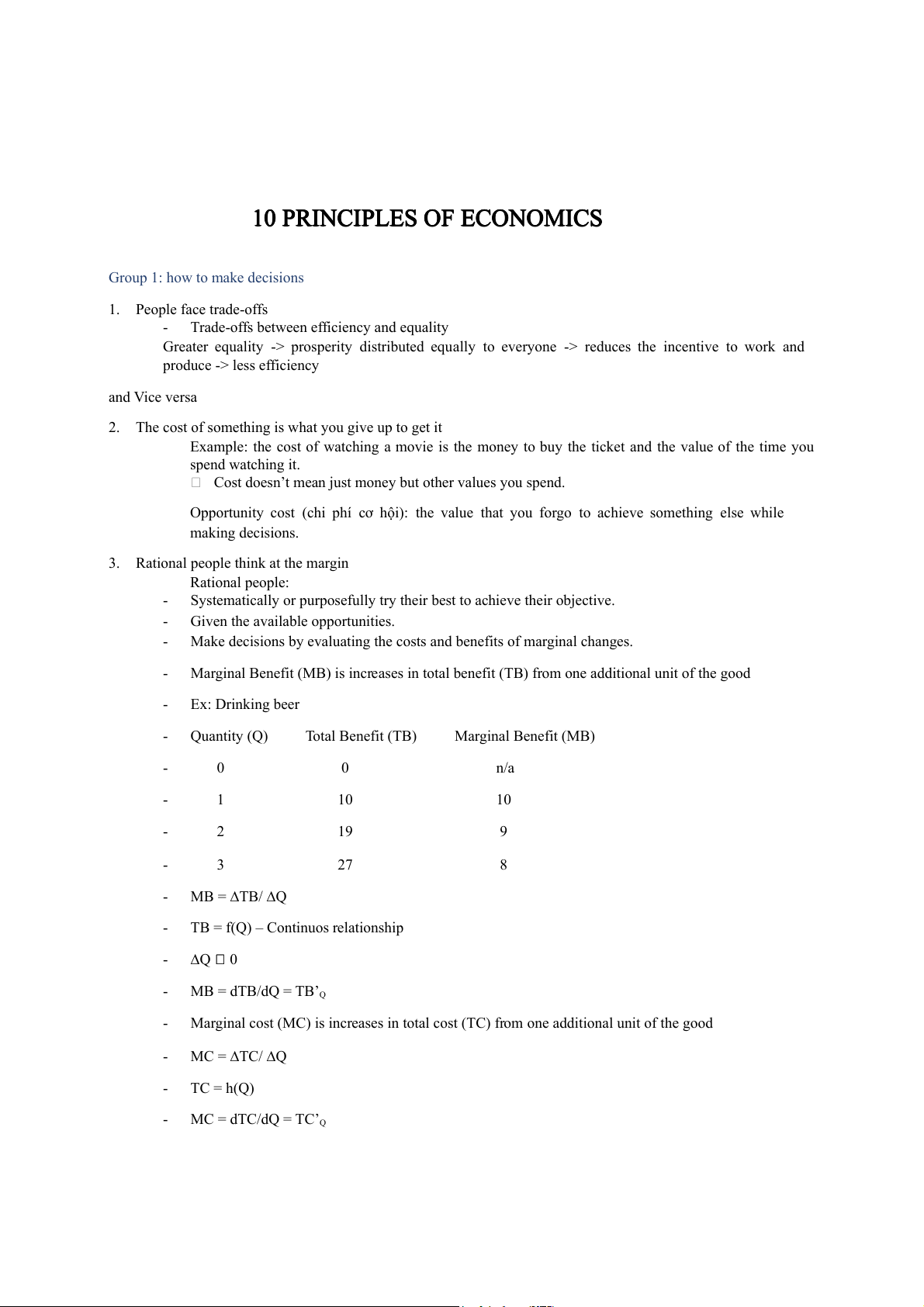
10 PRINCIPLES OF ECONOMICS Group 1: how to make decisions 1. People face trade-offs -
Trade-offs between efficiency and equality
Greater equality -> prosperity distributed equally to everyone -> reduces the incentive to work and produce -> less efficiency and Vice versa
2. The cost of something is what you give up to get it
Example: the cost of watching a movie is the money to buy the ticket and the value of the time you spend watching it.
Cost doesn’t mean just money but other values you spend.
Opportunity cost (chi phí cơ hội): the value that you forgo to achieve something else while making decisions.
3. Rational people think at the margin Rational people: -
Systematically or purposefully try their best to achieve their objective. -
Given the available opportunities. - Make decisions by and evaluating the costs benefits of marginal changes. -
Marginal Benefit (MB) is increases in total benefit (TB) from one additional unit of the good - Ex: Drinking beer -
Quantity (Q) Total Benefit (TB) Marginal Benefit (MB) - 0 0 n/a - 1 10 10 - 2 19 9 - 3 27 8 - MB = ∆TB/ ∆Q -
TB = f(Q) – Continuos relationship - ∆Q 0 - MB = dTB/dQ = TB’Q -
Marginal cost (MC) is increases in total cost (TC) from one additional unit of the good - MC = ∆TC/ ∆Q - TC = h(Q) - MC = dTC/dQ = TC’Q
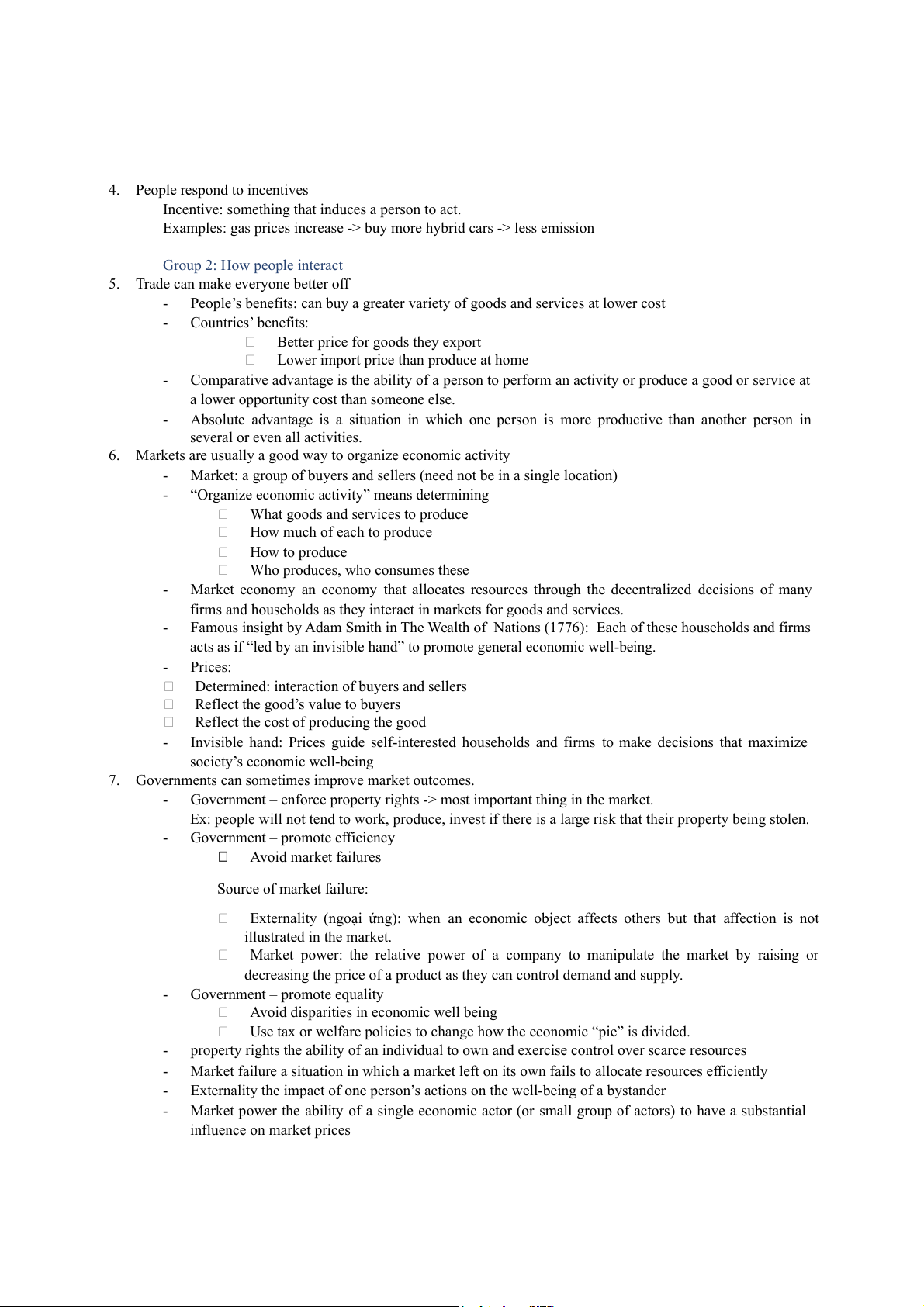
4. People respond to incentives
Incentive: something that induces a person to act.
Examples: gas prices increase -> buy more hybrid cars -> less emission Group 2: How people interact
5. Trade can make everyone better off -
People’s benefits: can buy a greater variety of goods and services at lower cost - Countries’ benefits:
Better price for goods they export
Lower import price than produce at home -
Comparative advantage is the ability of a person to perform an activity or produce a good or service at
a lower opportunity cost than someone else. -
Absolute advantage is a situation in which one person is more productive than another person in
several or even all activities.
6. Markets are usually a good way to organize economic activity -
Market: a group of buyers and sellers (need not be in a single location) -
“Organize economic activity” means determining
What goods and services to produce How much of each to produce How to produce
Who produces, who consumes these -
Market economy an economy that allocates resources through the decentralized decisions of many
firms and households as they interact in markets for goods and services. -
Famous insight by Adam Smith in The Wealth of Nations (1776): Each of these households and firms
acts as if “led by an invisible hand” to promote general economic well-being. - Prices:
Determined: interaction of buyers and sellers
Reflect the good’s value to buyers
Reflect the cost of producing the good -
Invisible hand: Prices guide self-interested households and firms to make decisions that maximize
society’s economic well-being
7. Governments can sometimes improve market outcomes. -
Government – enforce property rights -> most important thing in the market.
Ex: people will not tend to work, produce, invest if there is a large risk that their property being stolen. -
Government – promote efficiency Avoid market failures Source of market failure:
Externality (ngoại ứng): when an economic object affects others but that affection is not illustrated in the market.
Market power: the relative power of a company to manipulate the market by raising or
decreasing the price of a product as they can control demand and supply. -
Government – promote equality
Avoid disparities in economic well being
Use tax or welfare policies to change how the economic “pie” is divided. -
property rights the ability of an individual to own and exercise control over scarce resources -
Market failure a situation in which a market left on its own fails to allocate resources efficiently -
Externality the impact of one person’s actions on the well-being of a bystander -
Market power the ability of a single economic actor (or small group of actors) to have a substantial influence on market prices
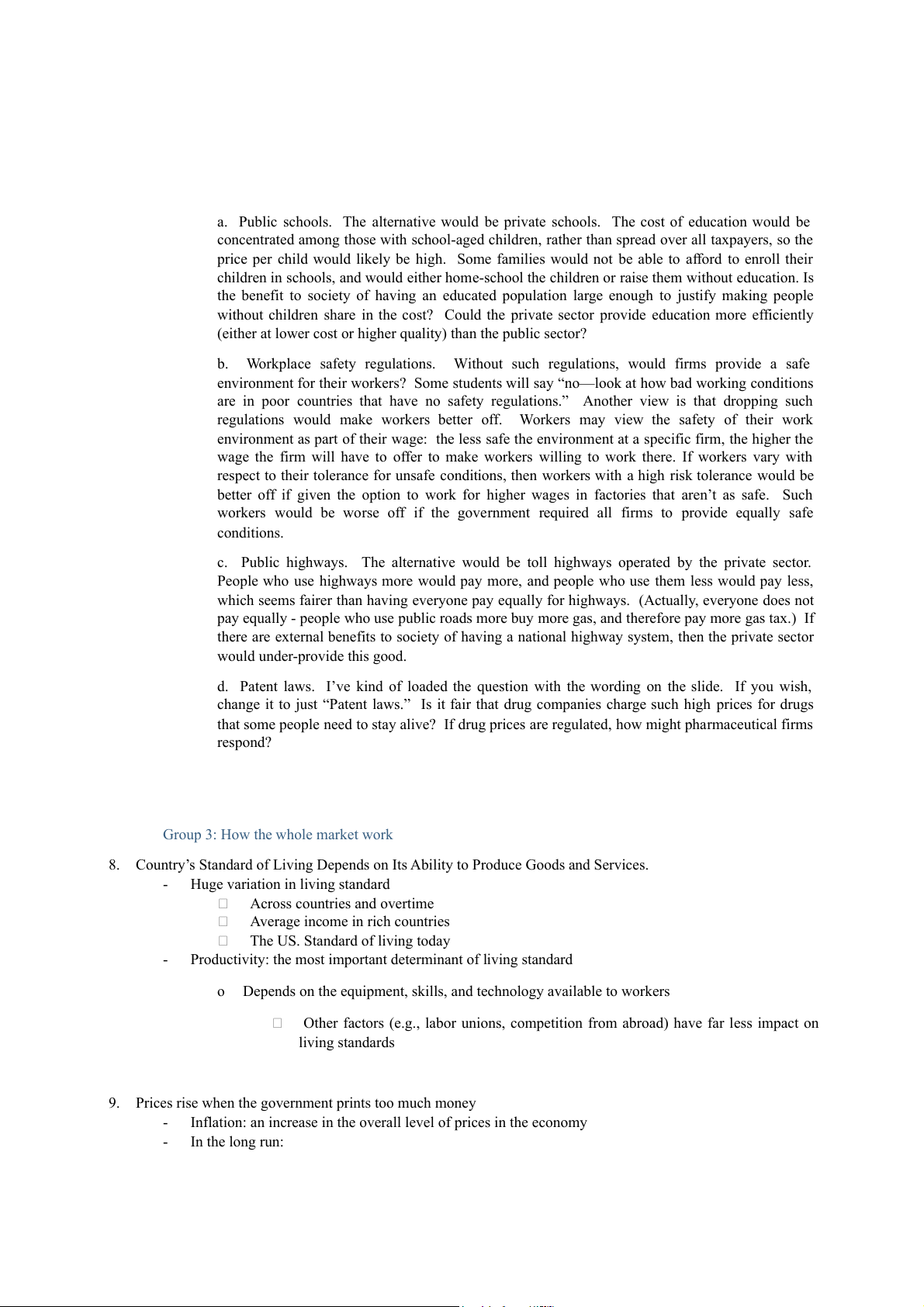
a. Public schools. The alternative would be private schools. The cost of education would be
concentrated among those with school-aged children, rather than spread over all taxpayers, so the
price per child would likely be high. Some families would not be able to afford to enroll their
children in schools, and would either home-school the children or raise them without education. Is
the benefit to society of having an educated population large enough to justify making people
without children share in the cost? Could the private sector provide education more efficiently
(either at lower cost or higher quality) than the public sector?
b. Workplace safety regulations. Without such regulations, would firms provide a safe
environment for their workers? Some students will say “no—look at how bad working conditions
are in poor countries that have no safety regulations.” Another view is that dropping such
regulations would make workers better off. Workers may view the safety of their work
environment as part of their wage: the less safe the environment at a specific firm, the higher the
wage the firm will have to offer to make workers willing to work there. If workers vary with
respect to their tolerance for unsafe conditions, then workers with a high risk tolerance would be
better off if given the option to work for higher wages in factories that aren’t as safe. Such
workers would be worse off if the government required all firms to provide equally safe conditions.
c. Public highways. The alternative would be toll highways operated by the private sector.
People who use highways more would pay more, and people who use them less would pay less,
which seems fairer than having everyone pay equally for highways. (Actually, everyone does not
pay equally - people who use public roads more buy more gas, and therefore pay more gas tax.) If
there are external benefits to society of having a national highway system, then the private sector
would under-provide this good.
d. Patent laws. I’ve kind of loaded the question with the wording on the slide. If you wish,
change it to just “Patent laws.” Is it fair that drug companies charge such high prices for drugs
that some people need to stay alive? If drug prices are regulated, how might pharmaceutical firms respond?
Group 3: How the whole market work
8. Country’s Standard of Living Depends on Its Ability to Produce Goods and Services. -
Huge variation in living standard Across countries and overtime
Average income in rich countries
The US. Standard of living today -
Productivity: the most important determinant of living standard o
Depends on the equipment, skills, and technology available to workers
Other factors (e.g., labor unions, competition from abroad) have far less impact on living standards
9. Prices rise when the government prints too much money -
Inflation: an increase in the overall level of prices in the economy - In the long run:
Print too much money -> inflation -> a fall in value of money
Faster money printing -> greater rate of inflation.
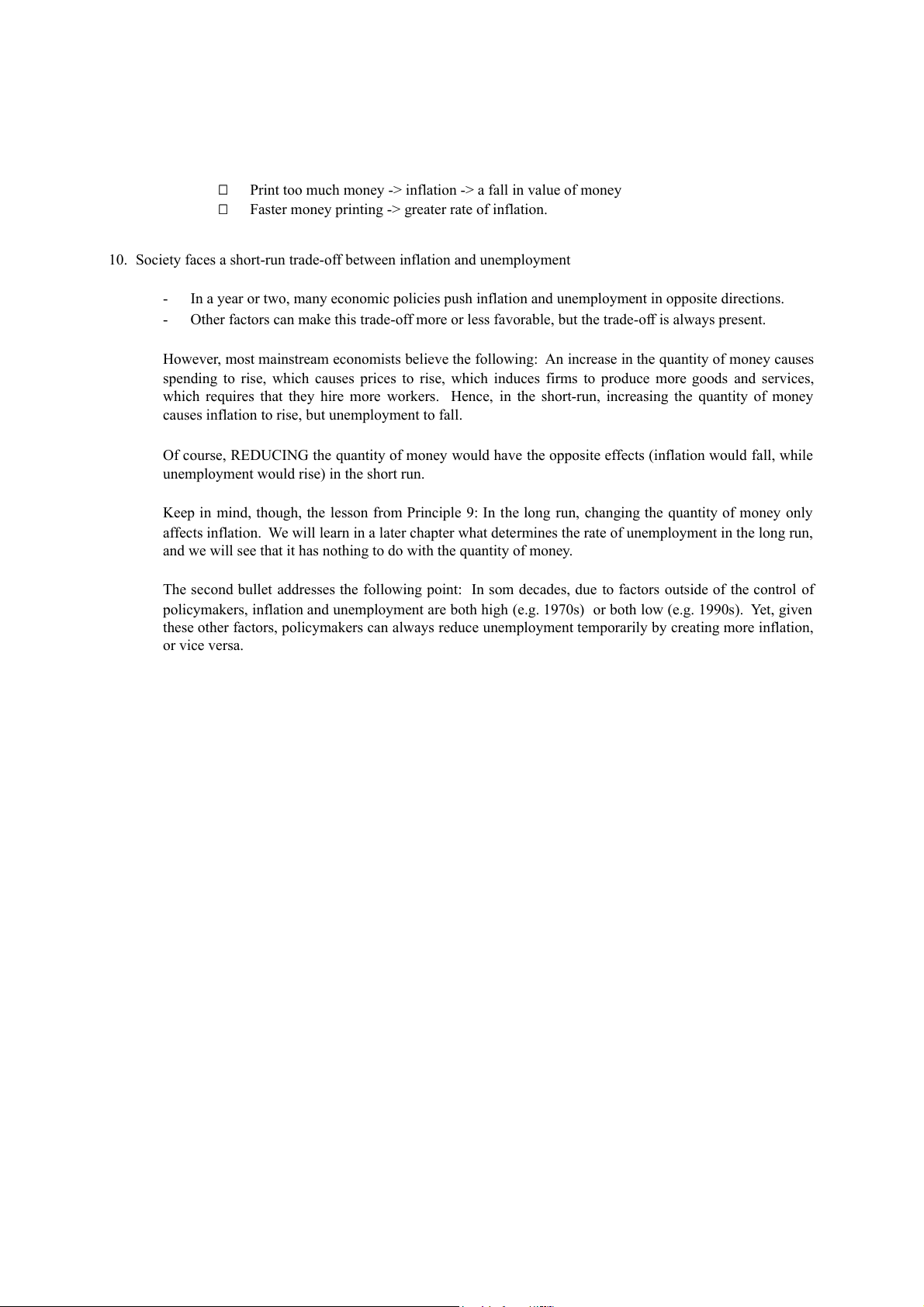
10. Society faces a short-run trade-off between inflation and unemployment -
In a year or two, many economic policies push inflation and unemployment in opposite directions. -
Other factors can make this trade-off more or less favorable, but the trade-off is always present.
However, most mainstream economists believe the following: An increase in the quantity of money causes
spending to rise, which causes prices to rise, which induces firms to produce more goods and services,
which requires that they hire more workers. Hence, in the short-run, increasing the quantity of money
causes inflation to rise, but unemployment to fall.
Of course, REDUCING the quantity of money would have the opposite effects (inflation would fall, while
unemployment would rise) in the short run.
Keep in mind, though, the lesson from Principle 9: In the long run, changing the quantity of money only
affects inflation. We will learn in a later chapter what determines the rate of unemployment in the long run,
and we will see that it has nothing to do with the quantity of money.
The second bullet addresses the following point: In som decades, due to factors outside of the control of
policymakers, inflation and unemployment are both high (e.g. 1970s) or both low (e.g. 1990s). Yet, given
these other factors, policymakers can always reduce unemployment temporarily by creating more inflation, or vice versa.
Tài liệu liên quan:
-

Chương 3: độ co giãn và các nhân tố ảnh hưởng | Microeconomics | Trường Đại học Quốc tế, Đại học Quốc gia Thành phố Hồ Chí Minh
3 2 -
Microeconomics Syllabus | Microeconomics | Trường Đại học Quốc tế, Đại học Quốc gia Thành phố Hồ Chí Minh
3 2 -
Microeconomics Course Syllabus & Assessment Details | Microeconomics | Trường Đại học Quốc tế, Đại học Quốc gia Thành phố Hồ Chí Minh
3 2 -
Assignment 3 - Elasticity MCQs and Key Concepts | Microeconomics | Trường Đại học Quốc tế, Đại học Quốc gia Thành phố Hồ Chí Minh
3 2 -
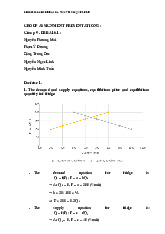
Assignment 2 - Economic Equilibrium Analysis of Fridges and Motorcycles | Microeconomics | Trường Đại học Quốc tế, Đại học Quốc gia Thành phố Hồ Chí Minh
3 2