Practice Chapter Notes on Economics Concepts and Trade-offs | Microeconomics | Trường Đại học Quốc tế, Đại học Quốc gia Thành phố Hồ Chí Minh
Economics is best defined as the study of a.how society manages its scarce resources b. how to run a business most profitably. c. how to predict inflation, unemployment, and stock prices. d. how the government can stop the harm from unchecked self-interest. 2. Your opportunity cost of going to a movie is a. the price of the ticket. b. the price of the ticket plus the cost of any soda and popcorn you buy at the theater. c. the total cash expenditure needed to go to the movie plus the value of your time. d. zero, as long as you enjoy the movie and consider it a worthwhile use of time and money. Tài liệu được sưu tầm và soạn thảo dưới dạng file PDF để gửi tới các bạn cùng tham khảo, ôn tập đầy đủ kiến thức, chuẩn bị cho các buổi học thật tốt. Mời bạn đọc đón xem!
Môn: Microeconomics 635 tài liệu
Trường: Trường Đại học Quốc tế, Đại học Quốc gia Thành phố Hồ Chí Minh 1.9 K tài liệu
Tác giả:


Preview text:
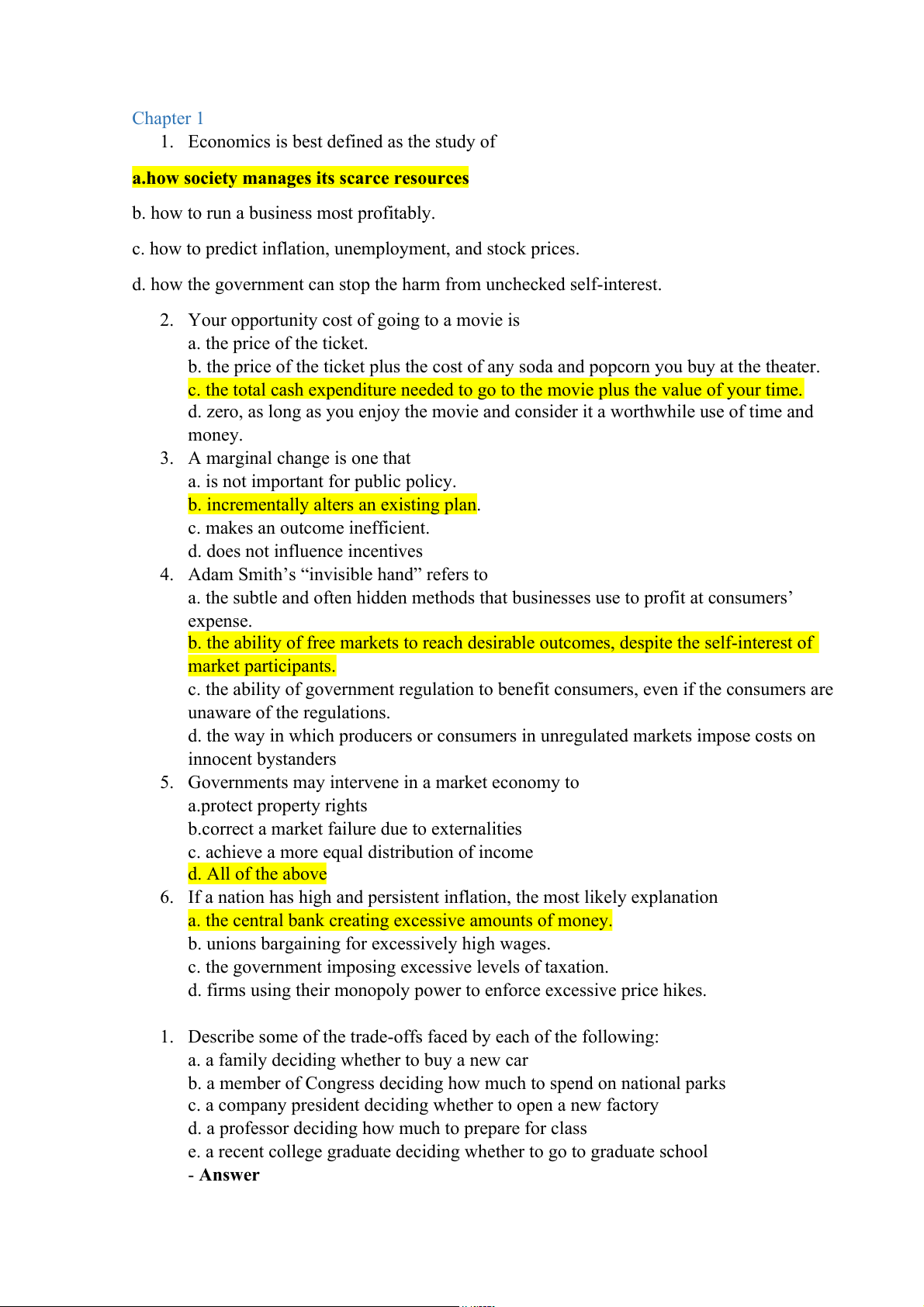
Chapter 1
1. Economics is best defined as the study of
a.how society manages its scarce resources
b. how to run a business most profitably.
c. how to predict inflation, unemployment, and stock prices.
d. how the government can stop the harm from unchecked self-interest.
2. Your opportunity cost of going to a movie is a. the price of the ticket.
b. the price of the ticket plus the cost of any soda and popcorn you buy at the theater.
c. the total cash expenditure needed to go to the movie plus the value of your time.
d. zero, as long as you enjoy the movie and consider it a worthwhile use of time and money.
3. A marginal change is one that
a. is not important for public policy.
b. incrementally alters an existing plan.
c. makes an outcome inefficient.
d. does not influence incentives
4. Adam Smith’s “invisible hand” refers to
a. the subtle and often hidden methods that businesses use to profit at consumers’ expense.
b. the ability of free markets to reach desirable outcomes, despite the self-interest of market participants.
c. the ability of government regulation to benefit consumers, even if the consumers are unaware of the regulations.
d. the way in which producers or consumers in unregulated markets impose costs on innocent bystanders
5. Governments may intervene in a market economy to a.protect property rights
b.correct a market failure due to externalities
c. achieve a more equal distribution of income d. All of the above
6. If a nation has high and persistent inflation, the most likely explanation
a. the central bank creating excessive amounts of money.
b. unions bargaining for excessively high wages.
c. the government imposing excessive levels of taxation.
d. firms using their monopoly power to enforce excessive price hikes.
1. Describe some of the trade-offs faced by each of the following:
a. a family deciding whether to buy a new car
b. a member of Congress deciding how much to spend on national parks
c. a company president deciding whether to open a new factory
d. a professor deciding how much to prepare for class
e. a recent college graduate deciding whether to go to graduate school - Answer
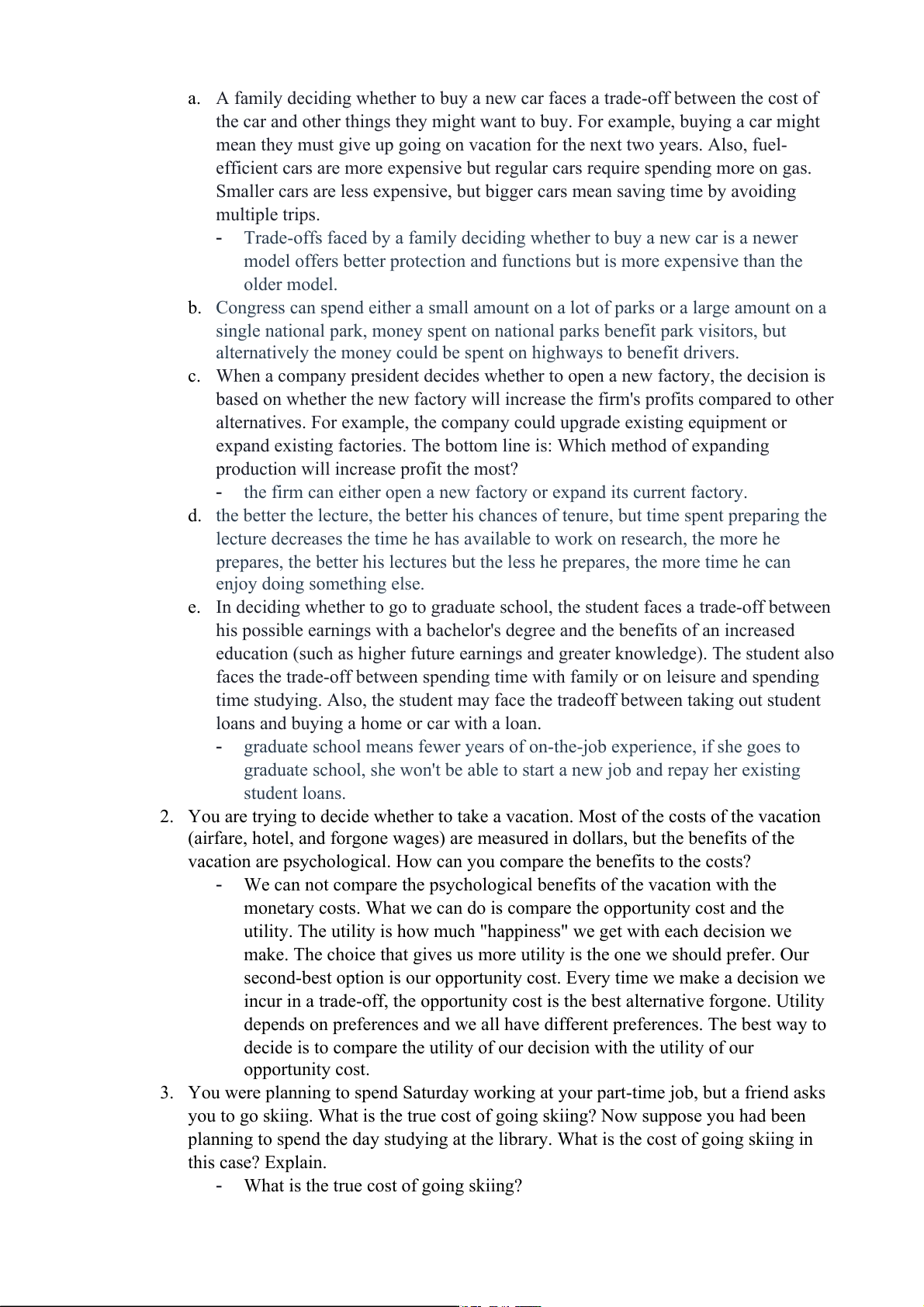
a. A family deciding whether to buy a new car faces a trade-off between the cost of
the car and other things they might want to buy. For example, buying a car might
mean they must give up going on vacation for the next two years. Also, fuel-
efficient cars are more expensive but regular cars require spending more on gas.
Smaller cars are less expensive, but bigger cars mean saving time by avoiding multiple trips. -
Trade-offs faced by a family deciding whether to buy a new car is a newer
model offers better protection and functions but is more expensive than the older model.
b. Congress can spend either a small amount on a lot of parks or a large amount on a
single national park, money spent on national parks benefit park visitors, but
alternatively the money could be spent on highways to benefit drivers.
c. When a company president decides whether to open a new factory, the decision is
based on whether the new factory will increase the firm's profits compared to other
alternatives. For example, the company could upgrade existing equipment or
expand existing factories. The bottom line is: Which method of expanding
production will increase profit the most? -
the firm can either open a new factory or expand its current factory.
d. the better the lecture, the better his chances of tenure, but time spent preparing the
lecture decreases the time he has available to work on research, the more he
prepares, the better his lectures but the less he prepares, the more time he can enjoy doing something else.
e. In deciding whether to go to graduate school, the student faces a trade-off between
his possible earnings with a bachelor's degree and the benefits of an increased
education (such as higher future earnings and greater knowledge). The student also
faces the trade-off between spending time with family or on leisure and spending
time studying. Also, the student may face the tradeoff between taking out student
loans and buying a home or car with a loan. -
graduate school means fewer years of on-the-job experience, if she goes to
graduate school, she won't be able to start a new job and repay her existing student loans.
2. You are trying to decide whether to take a vacation. Most of the costs of the vacation
(airfare, hotel, and forgone wages) are measured in dollars, but the benefits of the
vacation are psychological. How can you compare the benefits to the costs? -
We can not compare the psychological benefits of the vacation with the
monetary costs. What we can do is compare the opportunity cost and the
utility. The utility is how much "happiness" we get with each decision we
make. The choice that gives us more utility is the one we should prefer. Our
second-best option is our opportunity cost. Every time we make a decision we
incur in a trade-off, the opportunity cost is the best alternative forgone. Utility
depends on preferences and we all have different preferences. The best way to
decide is to compare the utility of our decision with the utility of our opportunity cost.
3. You were planning to spend Saturday working at your part-time job, but a friend asks
you to go skiing. What is the true cost of going skiing? Now suppose you had been
planning to spend the day studying at the library. What is the cost of going skiing in this case? Explain. -
What is the true cost of going skiing?
-the rental of any ski equipment you need -the cost of a ticket
-the wages you forgo by going skiing -
What is the cost of going skiing in this case?
-the value of your time spent studying
-the rental of any ski equipment you need -the cost of a lift ticket -
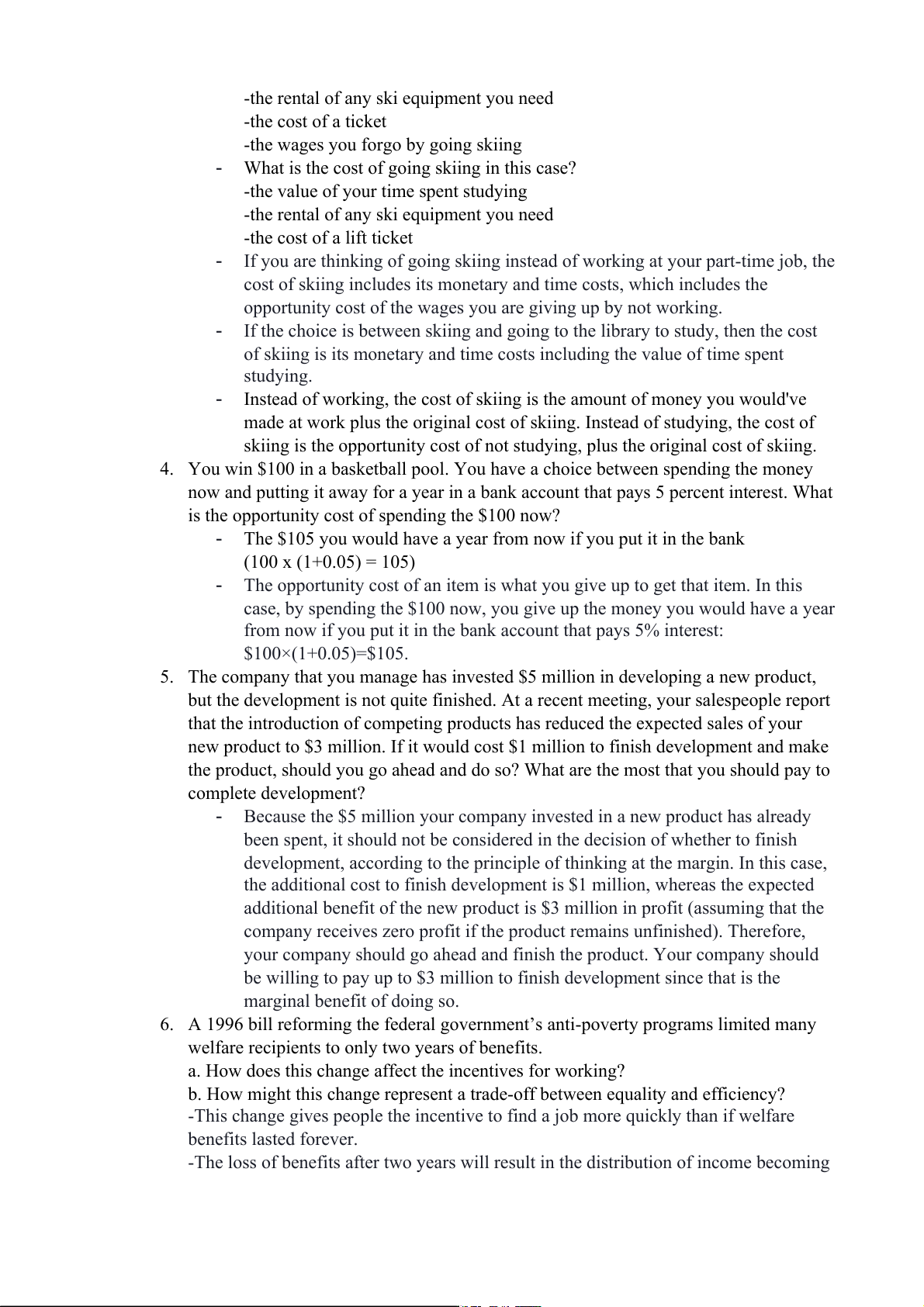
If you are thinking of going skiing instead of working at your part-time job, the
cost of skiing includes its monetary and time costs, which includes the
opportunity cost of the wages you are giving up by not working. -
If the choice is between skiing and going to the library to study, then the cost
of skiing is its monetary and time costs including the value of time spent studying. -
Instead of working, the cost of skiing is the amount of money you would've
made at work plus the original cost of skiing. Instead of studying, the cost of
skiing is the opportunity cost of not studying, plus the original cost of skiing.
4. You win $100 in a basketball pool. You have a choice between spending the money
now and putting it away for a year in a bank account that pays 5 percent interest. What
is the opportunity cost of spending the $100 now? -
The $105 you would have a year from now if you put it in the bank (100 x (1+0.05) = 105) -
The opportunity cost of an item is what you give up to get that item. In this
case, by spending the $100 now, you give up the money you would have a year
from now if you put it in the bank account that pays 5% interest: $100×(1+0.05)=$105.
5. The company that you manage has invested $5 million in developing a new product,
but the development is not quite finished. At a recent meeting, your salespeople report
that the introduction of competing products has reduced the expected sales of your
new product to $3 million. If it would cost $1 million to finish development and make
the product, should you go ahead and do so? What are the most that you should pay to complete development? -
Because the $5 million your company invested in a new product has already
been spent, it should not be considered in the decision of whether to finish
development, according to the principle of thinking at the margin. In this case,
the additional cost to finish development is $1 million, whereas the expected
additional benefit of the new product is $3 million in profit (assuming that the
company receives zero profit if the product remains unfinished). Therefore,
your company should go ahead and finish the product. Your company should
be willing to pay up to $3 million to finish development since that is the marginal benefit of doing so.
6. A 1996 bill reforming the federal government’s anti-poverty programs limited many
welfare recipients to only two years of benefits.
a. How does this change affect the incentives for working?
b. How might this change represent a trade-off between equality and efficiency?
-This change gives people the incentive to find a job more quickly than if welfare benefits lasted forever.
-The loss of benefits after two years will result in the distribution of income becoming
less equal. In addition, the economy will be more efficient because of the change in working incentives.
- This change in the government's antipoverty program reduces equality in the
distribution of income since those who cannot find a job will get no income at all;
however, the economy is more efficient given the increased incentive for the
unemployed to find work and contribute to the nation's output.
7. Explain whether each of the following government activities is motivated by a concern
about equality or concern about efficiency. In the case of efficiency, discuss the type of market failure involved. a. regulating cable TV prices
b. providing some poor people with vouchers that can be used to buy food
c. prohibiting smoking in public places
d. breaking up Standard Oil (which once owned 90 percent of all oil refineries) into several smaller companies
e. imposing higher personal income tax rates on people with higher incomes
f. instituting laws against driving while intoxicated - Answer
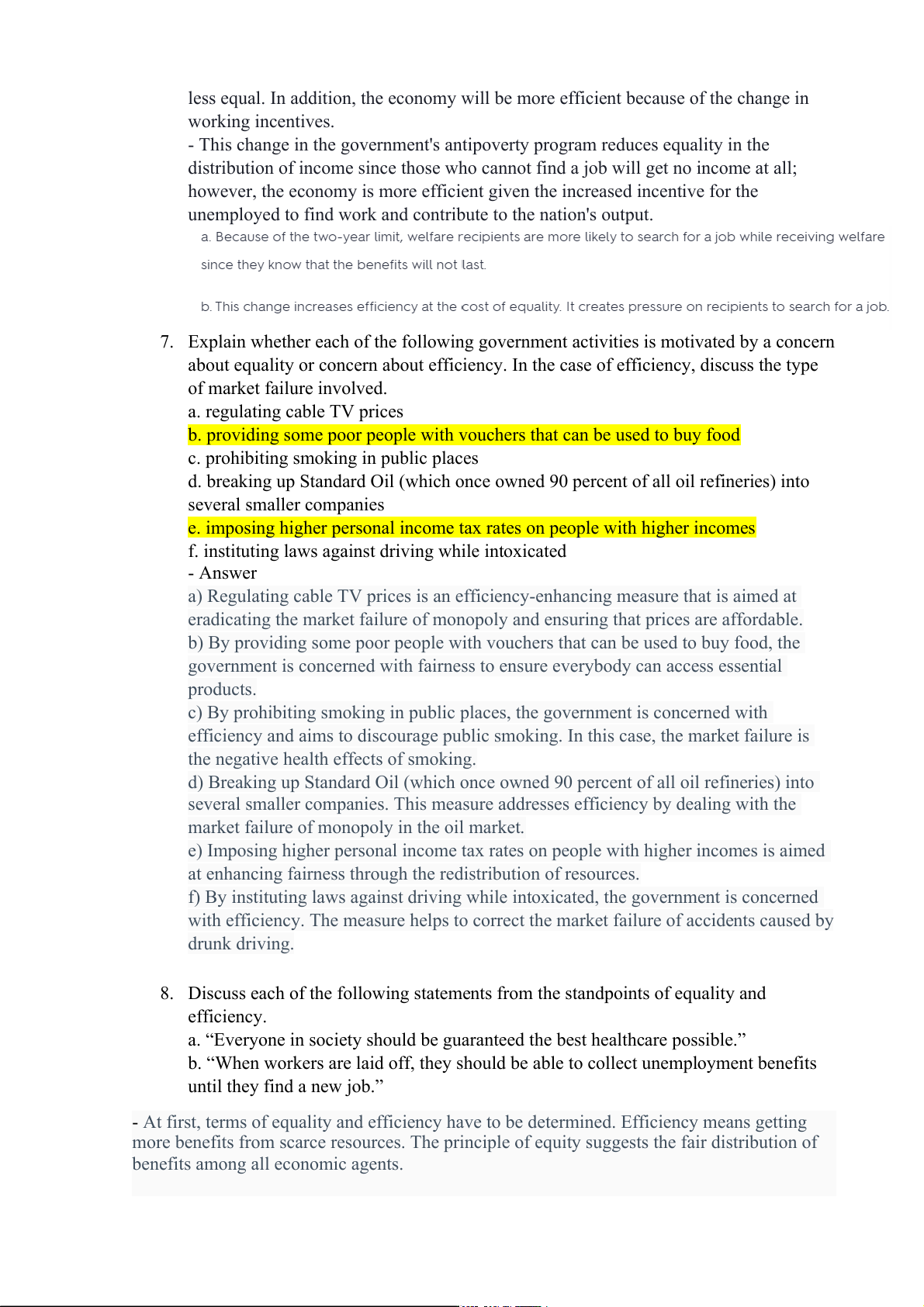
a) Regulating cable TV prices is an efficiency-enhancing measure that is aimed at
eradicating the market failure of monopoly and ensuring that prices are affordable.
b) By providing some poor people with vouchers that can be used to buy food, the
government is concerned with fairness to ensure everybody can access essential products.
c) By prohibiting smoking in public places, the government is concerned with
efficiency and aims to discourage public smoking. In this case, the market failure is
the negative health effects of smoking.
d) Breaking up Standard Oil (which once owned 90 percent of all oil refineries) into
several smaller companies. This measure addresses efficiency by dealing with the
market failure of monopoly in the oil market.
e) Imposing higher personal income tax rates on people with higher incomes is aimed
at enhancing fairness through the redistribution of resources.
f) By instituting laws against driving while intoxicated, the government is concerned
with efficiency. The measure helps to correct the market failure of accidents caused by drunk driving.
8. Discuss each of the following statements from the standpoints of equality and efficiency.
a. “Everyone in society should be guaranteed the best healthcare possible.”
b. “When workers are laid off, they should be able to collect unemployment benefits until they find a new job.”
- At first, terms of equality and efficiency have to be determined. Efficiency means getting
more benefits from scarce resources. The principle of equity suggests the fair distribution of
benefits among all economic agents.
Guaranteed healthcare policy matches the principle of equity, but it doesn't meet the principle
of efficiency. It can be explained by the fact that the marginal benefit of maintaining
additional healthcare resources (good medical staff or modern hospital equipment) is always
less than the marginal cost of their formation.
The policy of guaranteed benefits for unemployed workers suggests the principle of equity for
all members of society in meeting their basic needs. At the same time, it doesn't match the
principle of efficiency since it doesn't motivate people to look for a job and causes a decrease in supply in the labor market.
9. In what ways is your standard of living different from that of your parents or
grandparents when they were your age? Why have these changes occurred? -
These changes in standards of living as a result of technological progress and globalization mainly
10. Suppose Americans decide to save more of their incomes. If banks lend this extra
saving to businesses, which use the funds to build new factories, how might this lead
to faster growth in productivity? Who do you suppose benefits from the higher
productivity? Is society getting a free lunch? -
If Americans save more and it leads to more spending on factories, there will
be an increase in production and productivity, since the same number of
workers will have more equipment to work with. -
The benefits from higher productivity will go to both the workers, who will get
paid more since they're producing more, and the factory owners, who will get a return on their investments. -
There is no such thing as a free lunch, however, because when people save
more, they are giving up spending. They get higher incomes at the cost of buying fewer goods.
11. During the Revolutionary War, the American colonies could not raise enough tax
revenue to fully fund the war effort. To make up the difference, the colonies decided
to print more money. Printing money to cover expenditures is sometimes referred to as
an “inflation tax.” Who do you think is being “taxed” when more money is printed? Why? -
If the state generates more currency, the average man will be taxed. This is
since the price level causes increased rates and currencies to depreciate over
time. As a result, consumers carry fewer funds with them, causing them to visit institutions more frequently. Chapter 2 1. An economic model is
a. a mechanical machine that replicates the functioning of the economy.
b. a fully detailed, realistic description of the economy.
c. a simplified representation of some aspect of the economy.
d. a computer program that predicts the future of the economy.
2. The circular-flow diagram illustrates that, in markets for the factors of production,
a. households are sellers, and firms are buyers.
b. households are buyers, and firms are sellers.
c. households and firms are both buyers.
d. households and firms are both sellers.
3. A point inside the production possibilities frontier is
a. efficient but not feasible.
b. feasible but not efficient.
c. both efficient and feasible.
d. neither efficient nor feasible.
4. An economy produces hot dogs and hamburgers. If a discovery of the remarkable
health benefits of hot dogs were to change consumers’ preferences, it would
a. expand the production possibilities frontier.
b. contract the production possibilities frontier.
c. move the economy along the production possibilities frontier.
d. move the economy inside the production possibilities frontier.
5. All of the following topics fall within the study of microeconomics EXCEPT
a. the impact of cigarette taxes on the smoking behavior of teenagers.
b. the role of Microsoft’s market power in the pricing of software.
c. the effectiveness of antipoverty programs in reducing homelessness.
d. the influence of the government budget deficit on economic growth.
6. Which of the following is a positive, rather than a normative, statement?
a. Law X will reduce national income.
b. Law X is a good piece of legislation.
c. Congress ought to pass law X.
d. The president should veto law X.
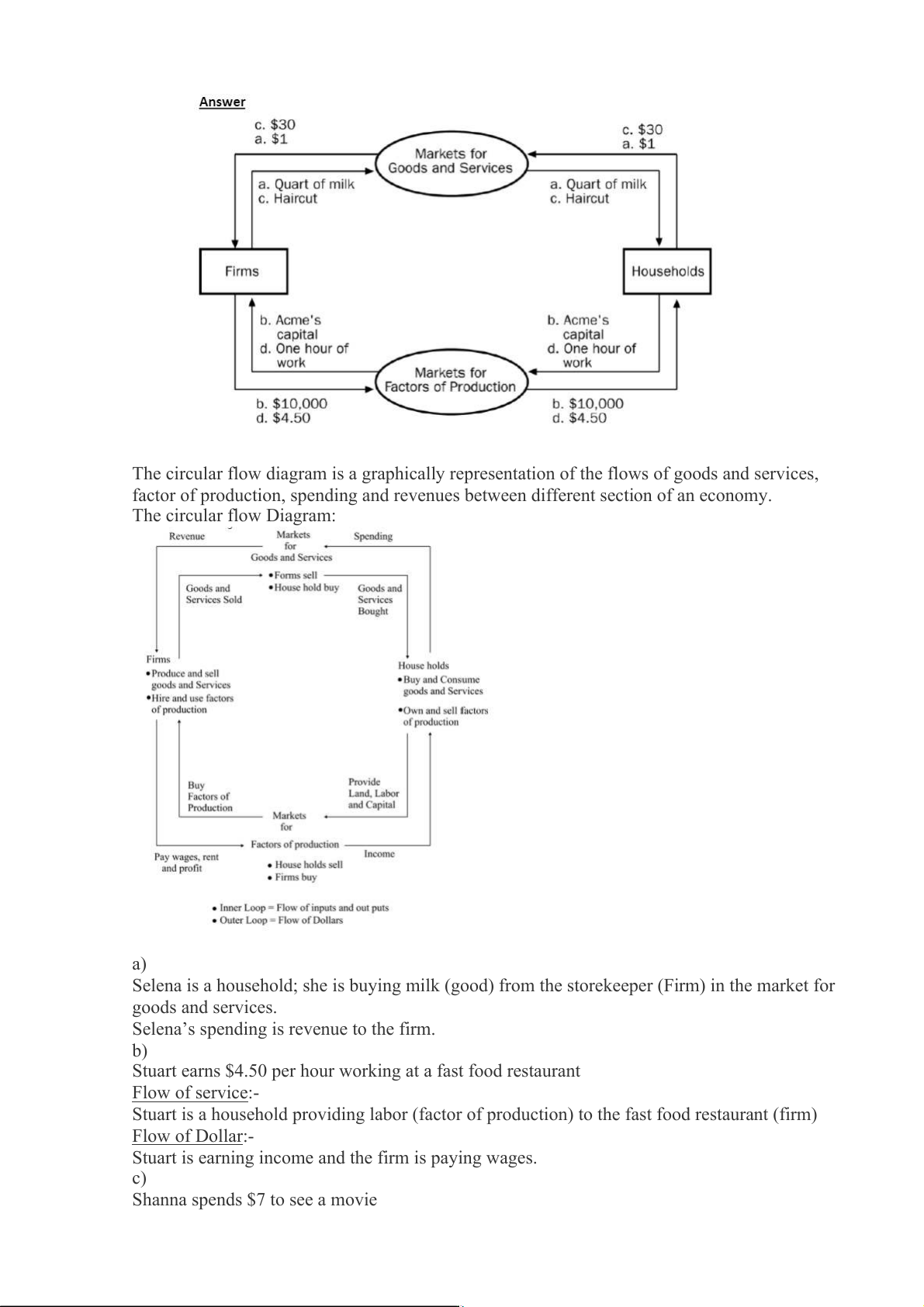
1. Draw a circular-flow diagram. Identify the parts of the model that correspond to the
flow of goods and services and the flow of dollars for each of the following activities.
a. Selena pays a storekeeper $1 for a quart of milk.
b. Stuart earns $8 per hour working at a fast-food restaurant.
c. Shanna spends $40 to get a haircut.
d. Salma earns $20,000 from her 10 percent owner-ship of Acme Industrial.
The circular flow diagram is a graphically representation of the flows of goods and services,
factor of production, spending and revenues between different section of an economy. The circular flow Diagram: a)
Selena is a household; she is buying milk (good) from the storekeeper (Firm) in the market for goods and services.
Selena’s spending is revenue to the firm. b)
Stuart earns $4.50 per hour working at a fast food restaurant Flow of service:-
Stuart is a household providing labor (factor of production) to the fast food restaurant (firm) Flow of Dollar:-
Stuart is earning income and the firm is paying wages. c)
Shanna spends $7 to see a movie Flow of service:-
Firm (theatre) is spending dollars to the service. Shanna (household) Flow of Dollars:-
Shanna (household) is spending dollars to get the service it is income to the firm (Theatre). d)
Sally earns $10,000 from his 10 percent owner slip of Acme industrial. Flow of service:
Household (sally) is providing capital (factor of production) to the firm, acme industrial. Flow of Dollar:-
Sally (household) is earning (income) profits of $ 10,000 from the firm Acme industrial.
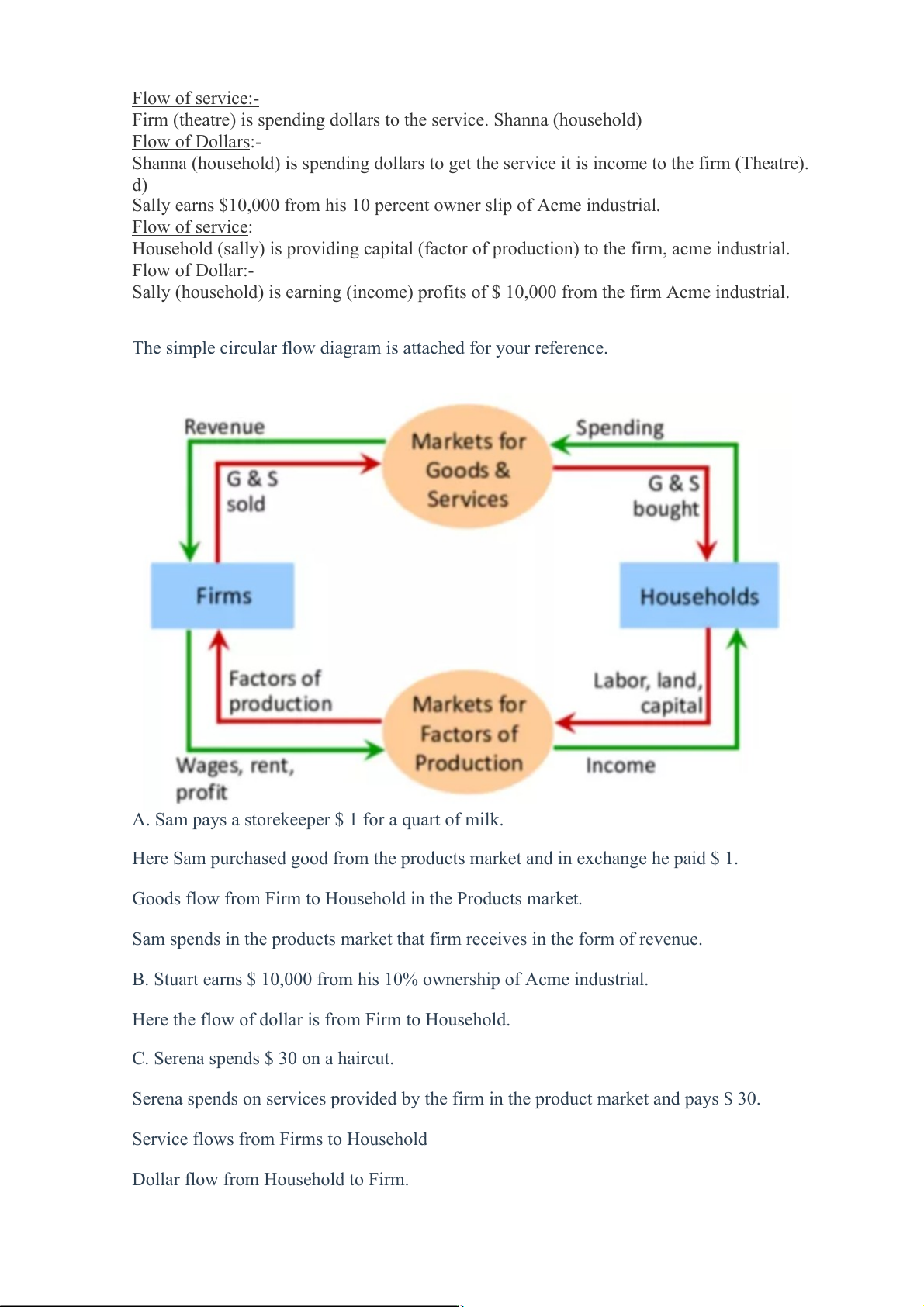
The simple circular flow diagram is attached for your reference.
A. Sam pays a storekeeper $ 1 for a quart of milk.
Here Sam purchased good from the products market and in exchange he paid $ 1.
Goods flow from Firm to Household in the Products market.
Sam spends in the products market that firm receives in the form of revenue.
B. Stuart earns $ 10,000 from his 10% ownership of Acme industrial.
Here the flow of dollar is from Firm to Household.
C. Serena spends $ 30 on a haircut.
Serena spends on services provided by the firm in the product market and pays $ 30.
Service flows from Firms to Household
Dollar flow from Household to Firm.
D. Sally earns $ 4.50 /hr working at a fast food restaurant.
Sally labor flows from the household to firm through market for factors of production.
Sally earns $ 4.50/hr in exchange of her service.
Factor of production flows from household to firm
Dollar flows from Firms to household.
2. Imagine a society that produces military goods and consumer goods, which we’ll call “guns” and “butter.”
a. Draw a production possibilities frontier for guns and butter. Using the concept of
opportunity cost, explain why it most likely has a bowed-out shape.
b. Show a point that is impossible for the economy to achieve. Show a point that is feasible but inefficient.
c. Imagine that the society has two political parties, called the Hawks (who want a strong
military) and the Doves (who want a smaller military). Show a point on your production
possibilities frontier that the Hawks might choose and a point that the Doves might choose.
d. Imagine that an aggressive neighboring country reduces the size of its military. As a result,
both the Hawks and the Doves reduce their desired production of guns by the same amount.
Which party would get the bigger “peace dividend,” measured by the increase in butter production? Explain. .
It is bowed out because the opportunity cost of butter depends on how much
butter and how many guns the economy is producing. When the economy is
producing a lot of butter, workers and machines best suited to making guns are
being used to make butter, so each unit of guns given up yields a small increase in
the production of butter. Thus, the frontier is steep and the opportunity cost of
producing butter is high. When the economy is producing a lot of guns, workers
and machines best suited to making butter are being used to make guns, so each
unit of guns given up yields a large increase in the production of butter. Thus, the
frontier is very flat and the opportunity cost of producing butter is low. b.
Point A is impossible for the economy to achieve; it is outside the production
possibilities frontier. Point B is feasible but inefficient because it is inside the
production possibilities frontier.
c. The Hawks might choose a point like H, with many guns and not much butter.
The Doves might choose a point like D, with a lot of butter and few guns. d.
If both Hawks and Doves reduced their desired quantity of guns by the same
amount, the Hawks would get a bigger peace dividend because the production
possibilities frontier is much flatter at point H than at point D. As a result, the
reduction of a given number of guns, starting at point H, leads to a much larger
increase in the quantity of butter produced than when starting at point D. .
It is bowed out because the opportunity cost of butter depends on how much
butter and how many guns the economy is producing. When the economy is
producing a lot of butter, workers and machines best suited to making guns are
being used to make butter, so each unit of guns given up yields a small increase in
the production of butter. Thus, the frontier is steep and the opportunity cost of
producing butter is high. When the economy is producing a lot of guns, workers
and machines best suited to making butter are being used to make guns, so each
unit of guns given up yields a large increase in the production of butter. Thus, the
frontier is very flat and the opportunity cost of producing butter is low. b.
Point A is impossible for the economy to achieve; it is outside the production
possibilities frontier. Point B is feasible but inefficient because it is inside the
production possibilities frontier.
c. The Hawks might choose a point like H, with many guns and not much butter.
The Doves might choose a point like D, with a lot of butter and few guns. d.
If both Hawks and Doves reduced their desired quantity of guns by the same
amount, the Hawks would get a bigger peace dividend because the production
possibilities frontier is much flatter at point H than at point D. As a result, the
reduction of a given number of guns, starting at point H, leads to a much larger
increase in the quantity of butter produced than when starting at point D. a.
It is bowed out because the opportunity cost of butter depends on how much
butter and how many guns the economy is producing. When the economy is
producing a lot of butter, workers and machines best suited to making guns are
being used to make butter, so each unit of guns given up yields a small increase in
the production of butter. Thus, the frontier is steep and the opportunity cost of
producing butter is high. When the economy is producing a lot of guns, workers
and machines best suited to making butter are being used to make guns, so each
unit of guns given up yields a large increase in the production of butter. Thus, the
frontier is very flat and the opportunity cost of producing butter is low. b.
Point A is impossible for the economy to achieve; it is outside the production
possibilities frontier. Point B is feasible but inefficient because it is inside the
production possibilities frontier.
c. The Hawks might choose a point like H, with many guns and not much butter.
The Doves might choose a point like D, with a lot of butter and few guns. d.
If both Hawks and Doves reduced their desired quantity of guns by the same
amount, the Hawks would get a bigger peace dividend because the production
possibilities frontier is much flatter at point H than at point D. As a result, the
reduction of a given number of guns, starting at point H, leads to a much larger
increase in the quantity of butter produced than when starting at point D.
t is bowed out because the opportunity cost of butter depends on how much
butter and how many guns the economy is producing. When the economy is
producing a lot of butter, workers and machines best suited to making guns are
being used to make butter, so each unit of guns given up yields a small increase in
the production of butter. Thus, the frontier is steep and the opportunity cost of
producing butter is high. When the economy is producing a lot of guns, workers
and machines best suited to making butter are being used to make guns, so each
unit of guns given up yields a large increase in the production of butter. Thus, the
frontier is very flat and the opportunity cost of producing butter is low.
a. It is bowed out because the opportunity cost of butter depends on how much butter and how
many guns the economy is producing. When the economy is producing a lot of butter,
workers and machines best suited to making guns are being used to make butter, so each unit
of guns given up yields a small increase in the production of butter. Thus, the frontier is steep
and the opportunity cost of producing butter is high. When the economy is producing a lot of
guns, workers and machines best suited to making butter are being used to make guns, so each
unit of guns given up yields a large increase in the production of butter. Thus, the frontier is
very flat and the opportunity cost of producing butter is low.
b. Point A is impossible for the economy to achieve; it is outside the production possibilities
frontier. Point B is feasible but inefficient because it is inside the production possibilities frontier.
c. The Hawks might choose a point like H, with many guns and not much butter. The Doves
might choose a point like D, with a lot of butter and few guns.
d. If both Hawks and Doves reduced their desired quantity of guns by the same amount, the
Hawks would get a bigger peace dividend because the production possibilities frontier is
much flatter at point H than at point D. As a result, the reduction of a given number of guns,
starting at point H, leads to a much larger increase in the quantity of butter produced than when starting at point D.
3. The first principle of economics discussed in Chapter 1 is that people face trade-offs. Use a
production possibilities frontier to illustrate society’s trade-off between two “goods”—a clean
environment and the quantity of industrial output. What do you suppose determines the shape
and position of the frontier? Show what happens to the frontier if engineers develop a new
way of producing electricity that emits fewer pollutants. Given;
There are two goods in the economy:- 1) a clean environment
2) Quantity of industrial output.
Production possibility curve illustrating society's trade-off between two-"goods":-
society's trade-off between two "goods”
The form of the production possibility curve is determined by the clean environment's
opportunity cost in terms of industrial output. The shape of the PPF is governed by how
expensive it is to keep a clean environment in terms of industrial output productivity.
If engineers create a new method of producing power that emits less pollutants, it will be less
expensive to clean up the environment. This means that the economy will have a cleaner
environment at all levels of industrial activity than before. As a result, the introduction of new
technology will result in an outward shift in one end of the PPF, while the other end will remain unchanged.
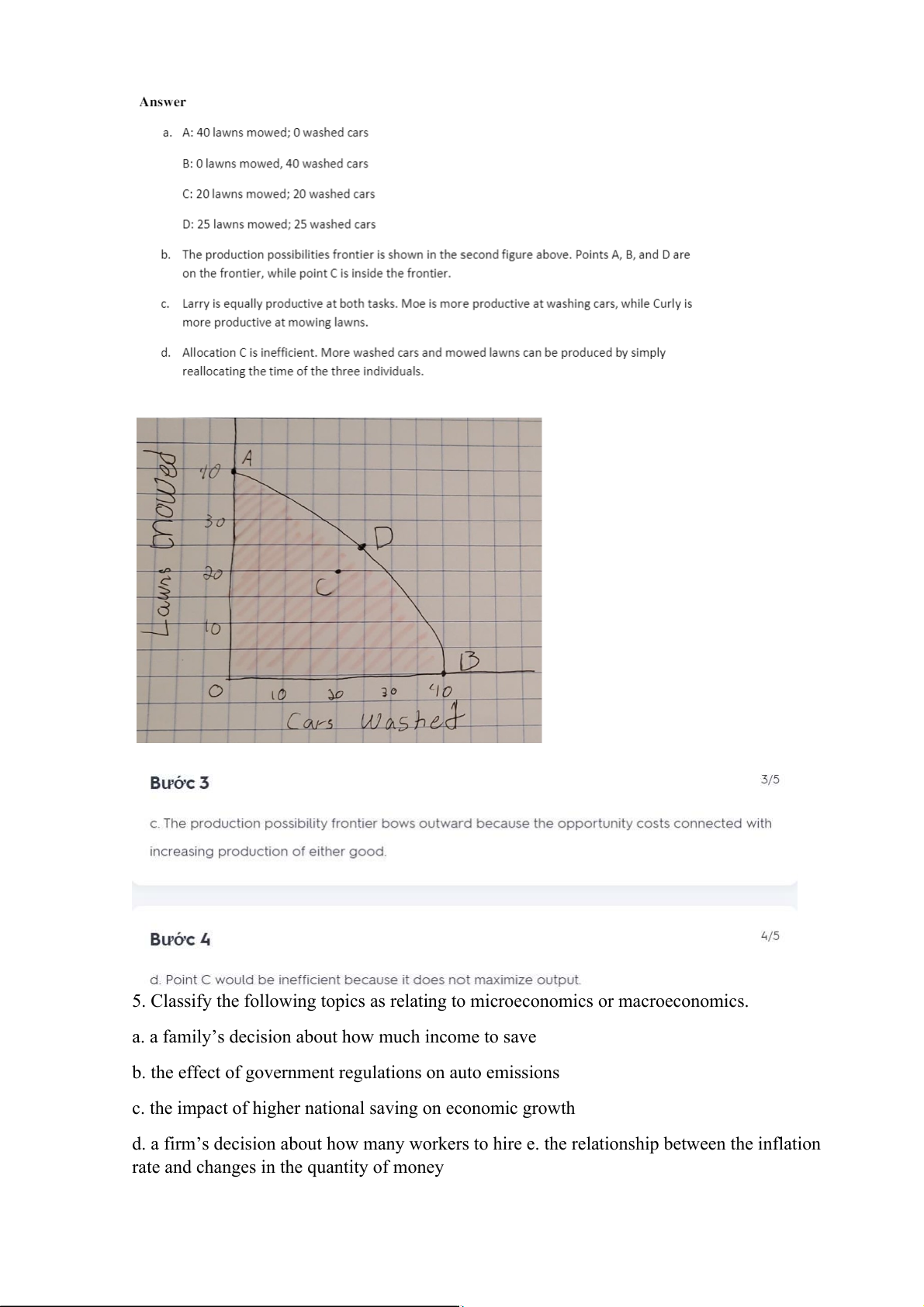
4. An economy consists of three workers: Larry, Moe, and Curly. Each works 10 hours a day
and can produce two services: mowing lawns and washing cars.
In an hour, Larry can either mow one lawn or wash one car;
Moe can either mow one lawn or wash two cars;
Curly can either mow two lawns or wash one car.
a. Calculate how much of each service is produced under the following circumstances, which we label A, B, C, and D:
- All three spend all their time mowing lawns. (A)
- All three spend all their time washing cars. (B)
- All three spend half their time on each activity. (C)
- Larry spends half his time on each activity, while Moe only washes cars and Curly only mows lawns. (D)
b. Graph the production possibilities frontier for this economy. Using your answers to part a,
identify points A, B, C, and D on your graph.
c. Explain why the production possibilities frontier has the shape it does.
d. Are any of the allocations calculated in part a inefficient? Explain.
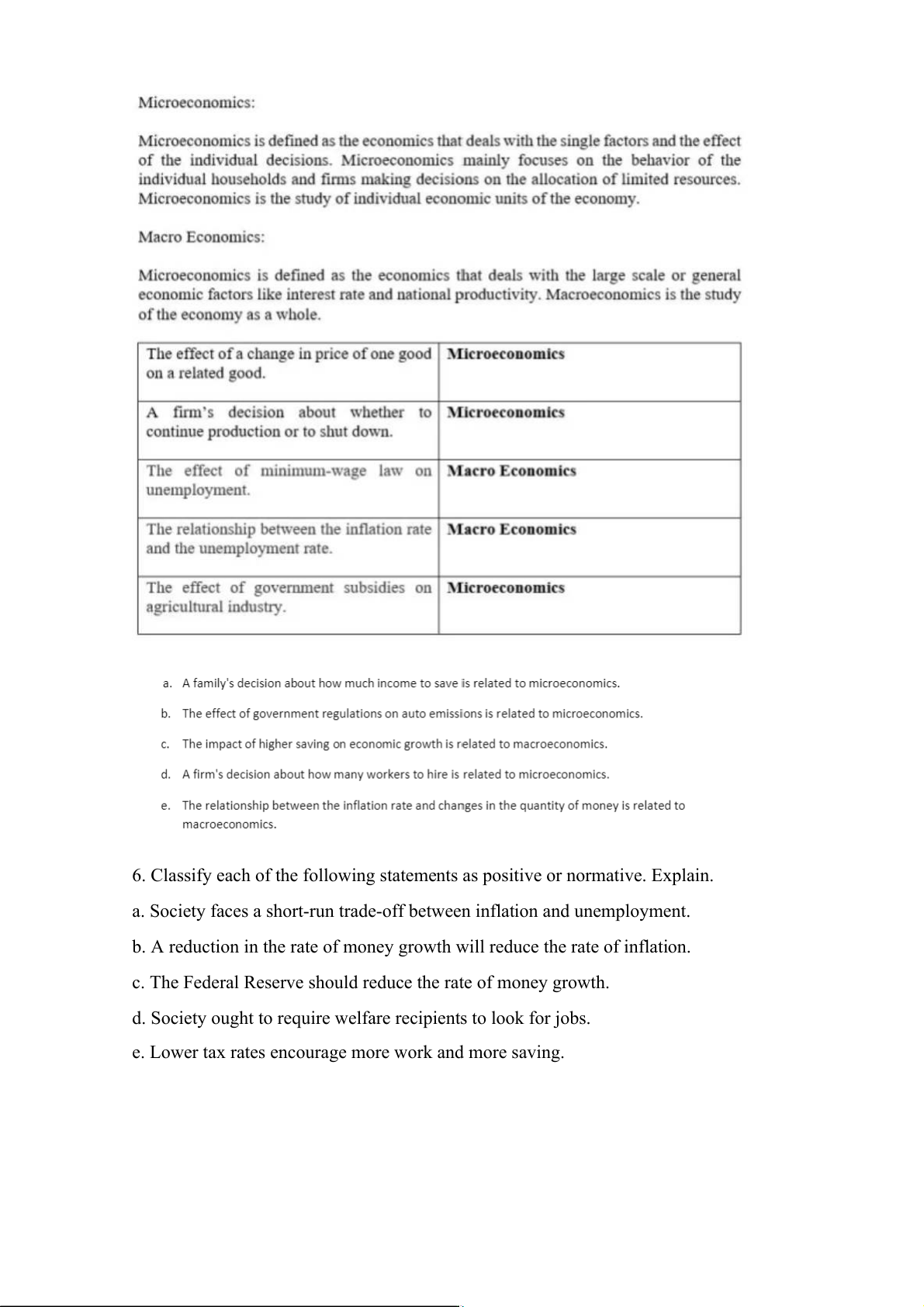
5. Classify the following topics as relating to microeconomics or macroeconomics.
a. a family’s decision about how much income to save
b. the effect of government regulations on auto emissions
c. the impact of higher national saving on economic growth
d. a firm’s decision about how many workers to hire e. the relationship between the inflation
rate and changes in the quantity of money
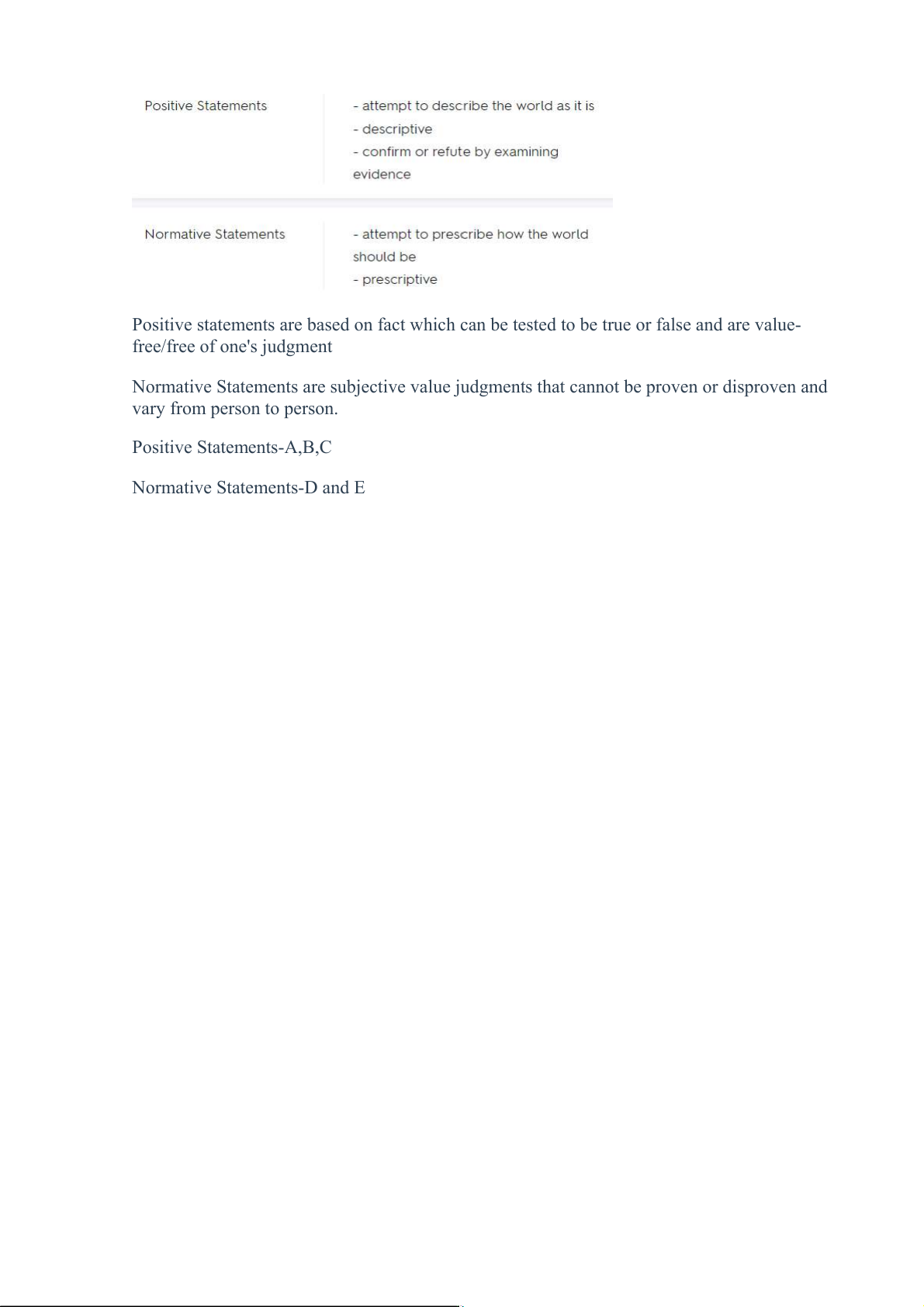
6. Classify each of the following statements as positive or normative. Explain.
a. Society faces a short-run trade-off between inflation and unemployment.
b. A reduction in the rate of money growth will reduce the rate of inflation.
c. The Federal Reserve should reduce the rate of money growth.
d. Society ought to require welfare recipients to look for jobs.
e. Lower tax rates encourage more work and more saving.
Positive statements are based on fact which can be tested to be true or false and are value- free/free of one's judgment
Normative Statements are subjective value judgments that cannot be proven or disproven and vary from person to person. Positive Statements-A,B,C Normative Statements-D and E Chapter 4
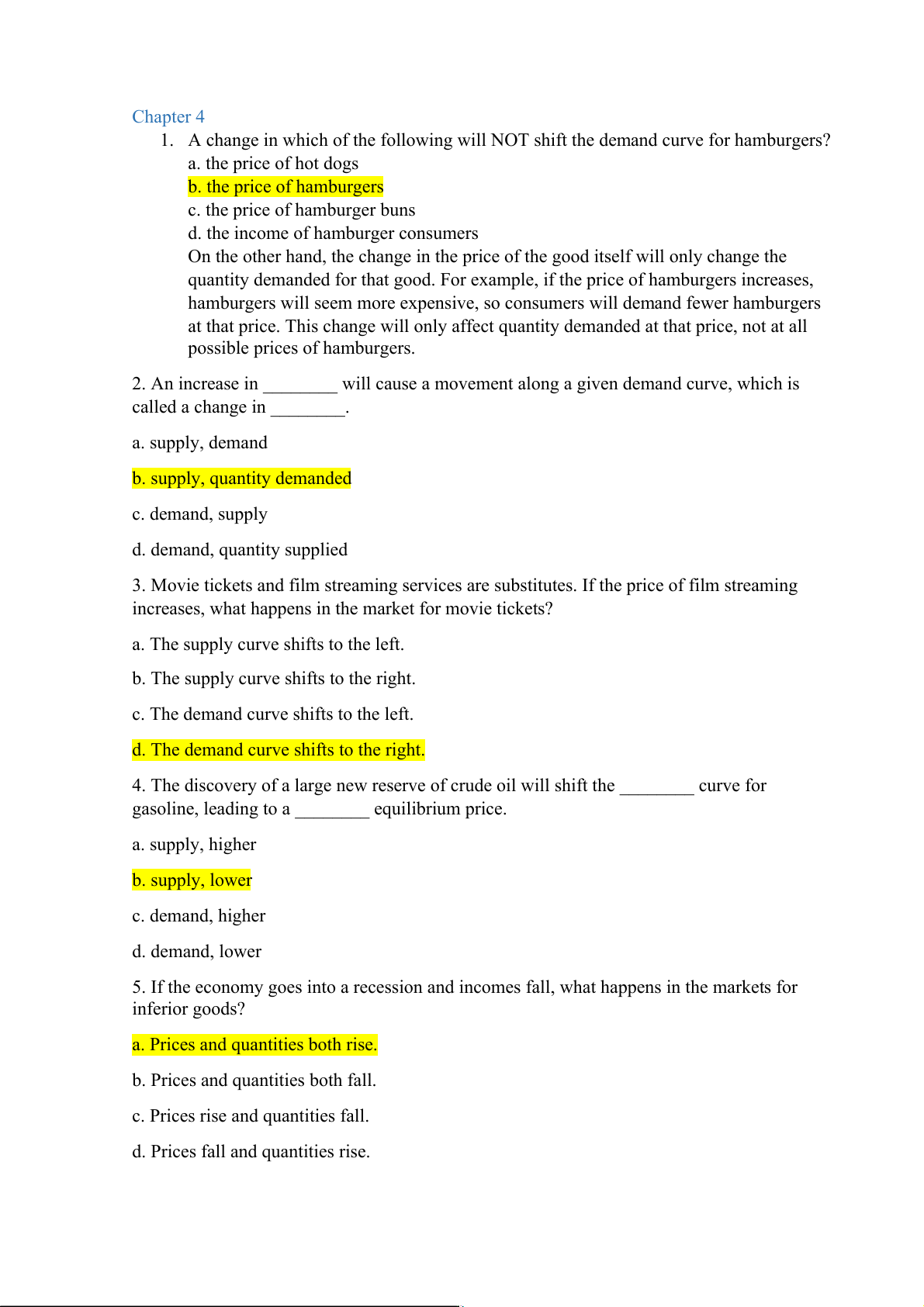
1. A change in which of the following will NOT shift the demand curve for hamburgers? a. the price of hot dogs b. the price of hamburgers
c. the price of hamburger buns
d. the income of hamburger consumers
On the other hand, the change in the price of the good itself will only change the
quantity demanded for that good. For example, if the price of hamburgers increases,
hamburgers will seem more expensive, so consumers will demand fewer hamburgers
at that price. This change will only affect quantity demanded at that price, not at all possible prices of hamburgers.
2. An increase in ________ will cause a movement along a given demand curve, which is called a change in ________. a. supply, demand b. supply, quantity demanded c. demand, supply d. demand, quantity supplied
3. Movie tickets and film streaming services are substitutes. If the price of film streaming
increases, what happens in the market for movie tickets?
a. The supply curve shifts to the left.
b. The supply curve shifts to the right.
c. The demand curve shifts to the left.
d. The demand curve shifts to the right.
4. The discovery of a large new reserve of crude oil will shift the ________ curve for
gasoline, leading to a ________ equilibrium price. a. supply, higher b. supply, lower c. demand, higher d. demand, lower
5. If the economy goes into a recession and incomes fall, what happens in the markets for inferior goods?
a. Prices and quantities both rise.
b. Prices and quantities both fall.
c. Prices rise and quantities fall.
d. Prices fall and quantities rise.
Inferior goods, by definition, are goods whose quantity demanded decrease with increase in
income. Thus, during recession when income decreases, the demand increases. Eg- Peanut
butter or Ramen Noodles. When you have less money, instead of having expensive dinners,
one would rather fill your stomach with cheap goods as one cannot afford anything else.
6. Which of the following might lead to an increase in the equilibrium price of jelly and a
decrease in the equilibrium quantity of jelly sold?
a. an increase in the price of peanut better, a complement to jelly
b. an increase in the price of Marshmallow Fluff, a substitute for jelly
c. an increase in the price of grapes, an input into jelly
d. an increase in consumers’ incomes, as long as jelly is a normal good
The other three choices are examples of changes that will shift the demand curve for jelly. A
change in demand moves equilibrium quantity and price of a good in the same direction. For
example, an increase in consumer income would shift the demand curve to the right and
increase both the equilibrium quantity and price of jelly. On the other hand, the increase in the
price of an input will decrease the supply of jelly, which will shift the supply curve to the left.
In this case, the new equilibrium quantity for jelly will decrease and the equilibrium price will increase
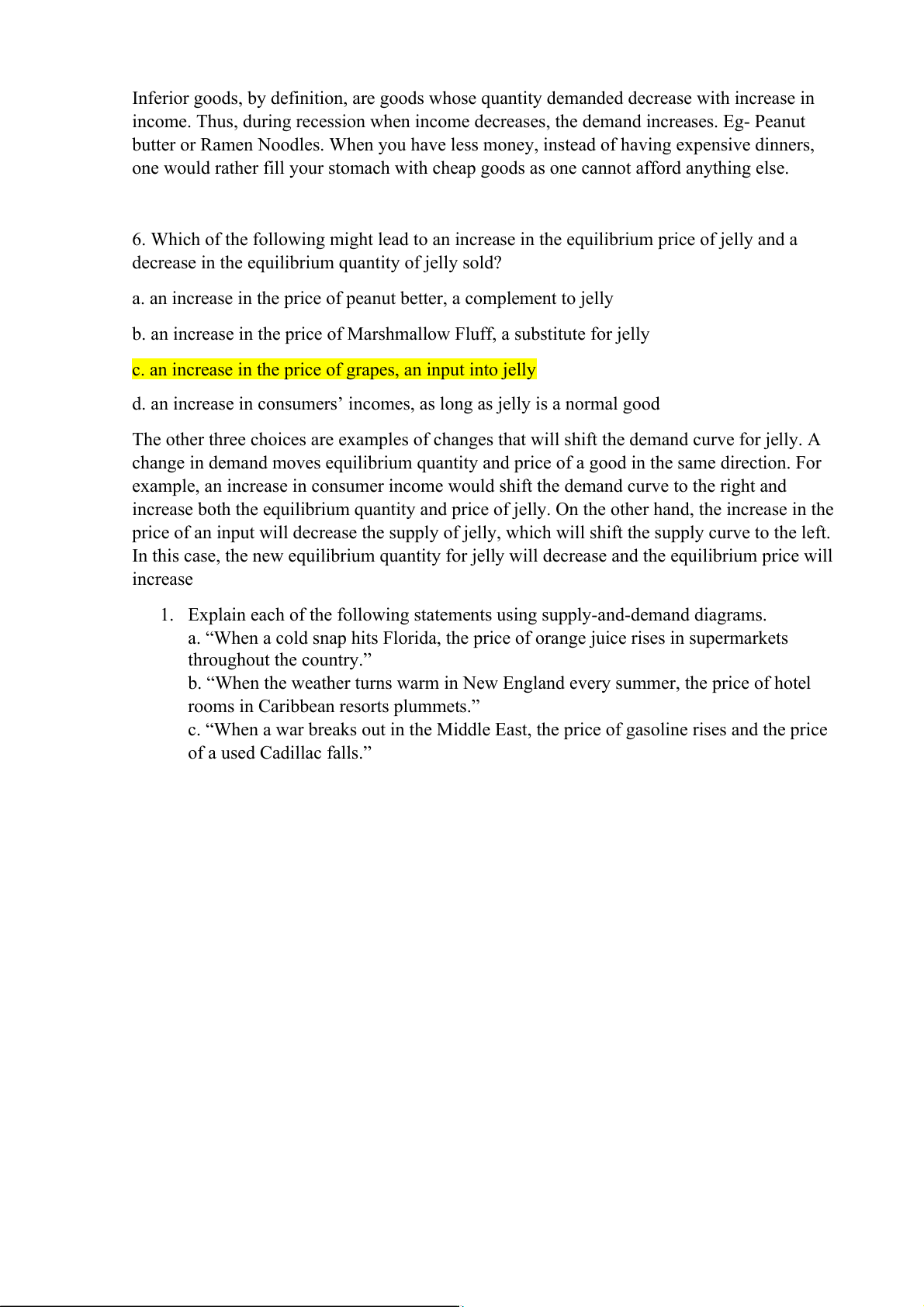
1. Explain each of the following statements using supply-and-demand diagrams.
a. “When a cold snap hits Florida, the price of orange juice rises in supermarkets throughout the country.”
b. “When the weather turns warm in New England every summer, the price of hotel
rooms in Caribbean resorts plummets.”
c. “When a war breaks out in the Middle East, the price of gasoline rises and the price of a used Cadillac falls.”
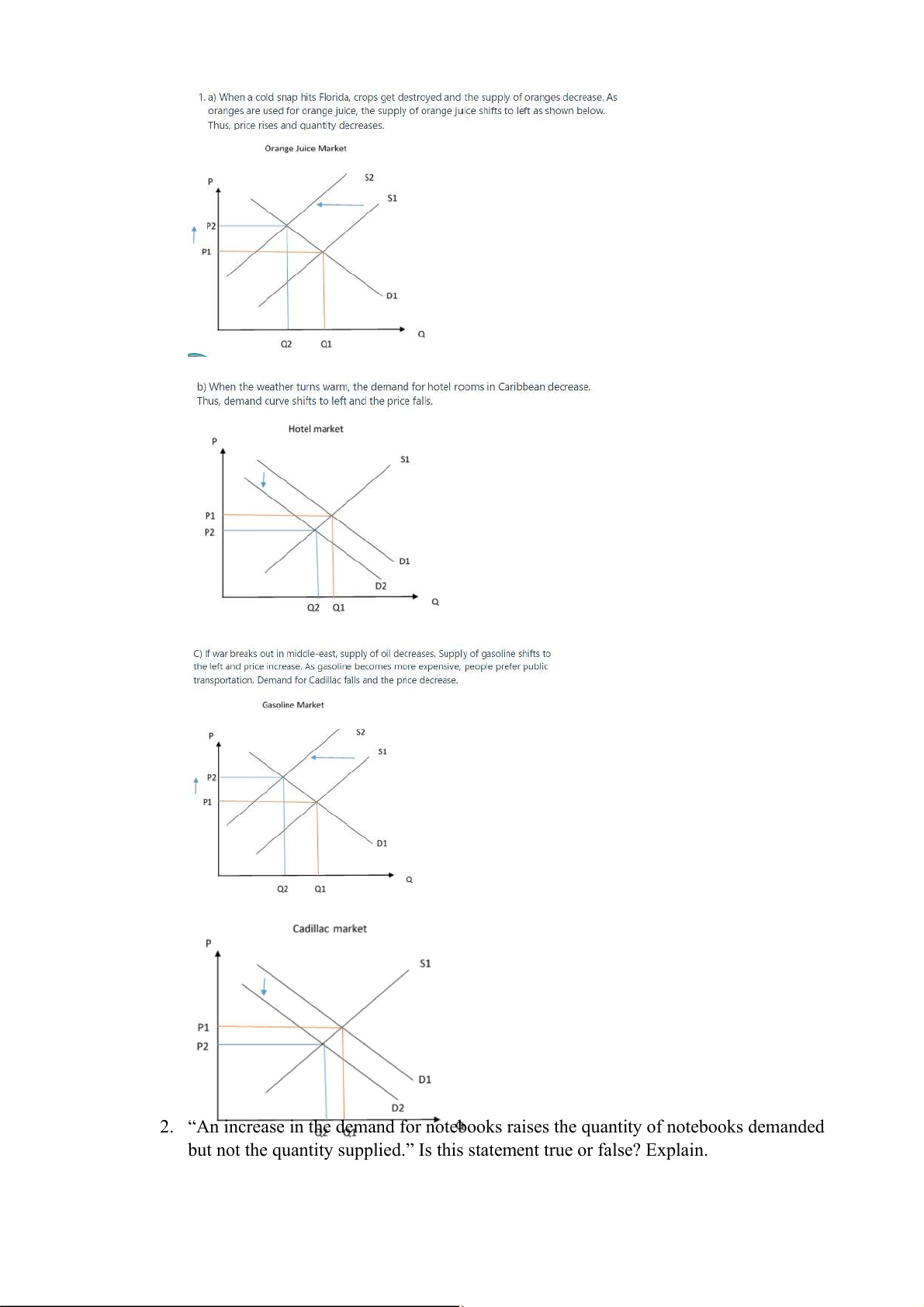
2. “An increase in the demand for notebooks raises the quantity of notebooks demanded
but not the quantity supplied.” Is this statement true or false? Explain.
3. Consider the market for minivans. For each of the events listed here, identify which of
the determinants of demand or supply are affected. Also indicate whether demand or
supply increases or decreases. Then draw a diagram to show the effect on the price and quantity of minivans.
a. People decide to have more children.
b. A strike by steelworkers raises steel prices.
c. Engineers develop new automated machinery for the production of minivans.
d. The price of sports utility vehicles rises.
e. A stock market crash lowers people’s wealth.
Tài liệu liên quan:
-
Chương 3: độ co giãn và các nhân tố ảnh hưởng | Microeconomics | Trường Đại học Quốc tế, Đại học Quốc gia Thành phố Hồ Chí Minh
5 3 -
Microeconomics Syllabus | Microeconomics | Trường Đại học Quốc tế, Đại học Quốc gia Thành phố Hồ Chí Minh
5 3 -
Microeconomics Course Syllabus & Assessment Details | Microeconomics | Trường Đại học Quốc tế, Đại học Quốc gia Thành phố Hồ Chí Minh
5 3 -
Assignment 3 - Elasticity MCQs and Key Concepts | Microeconomics | Trường Đại học Quốc tế, Đại học Quốc gia Thành phố Hồ Chí Minh
4 2 -
Assignment 2 - Economic Equilibrium Analysis of Fridges and Motorcycles | Microeconomics | Trường Đại học Quốc tế, Đại học Quốc gia Thành phố Hồ Chí Minh
4 2