Practice MCQs: Chapter 1 - Ten Principles of Economics | Microeconomics | Trường Đại học Quốc tế, Đại học Quốc gia Thành phố Hồ Chí Minh
With what concept does economics deal primarily with? a. scarcity b. poverty c. change d. power 2. Which of the following is NOT included in the decisions that every society must make? a. what goods will be produced b. who will produce the goods c. what determines consumer preferences d. who will consume the goods. Tài liệu được sưu tầm và soạn thảo dưới dạng file PDF để gửi tới các bạn cùng tham khảo, ôn tập đầy đủ kiến thức, chuẩn bị cho các buổi học thật tốt. Mời bạn đọc đón xem!
Môn: Microeconomics 635 tài liệu
Trường: Trường Đại học Quốc tế, Đại học Quốc gia Thành phố Hồ Chí Minh 1.9 K tài liệu
Tác giả:




Preview text:
Junjie Liu – Econ Practice Multiple
Chapter 1—Ten Principles of Economics
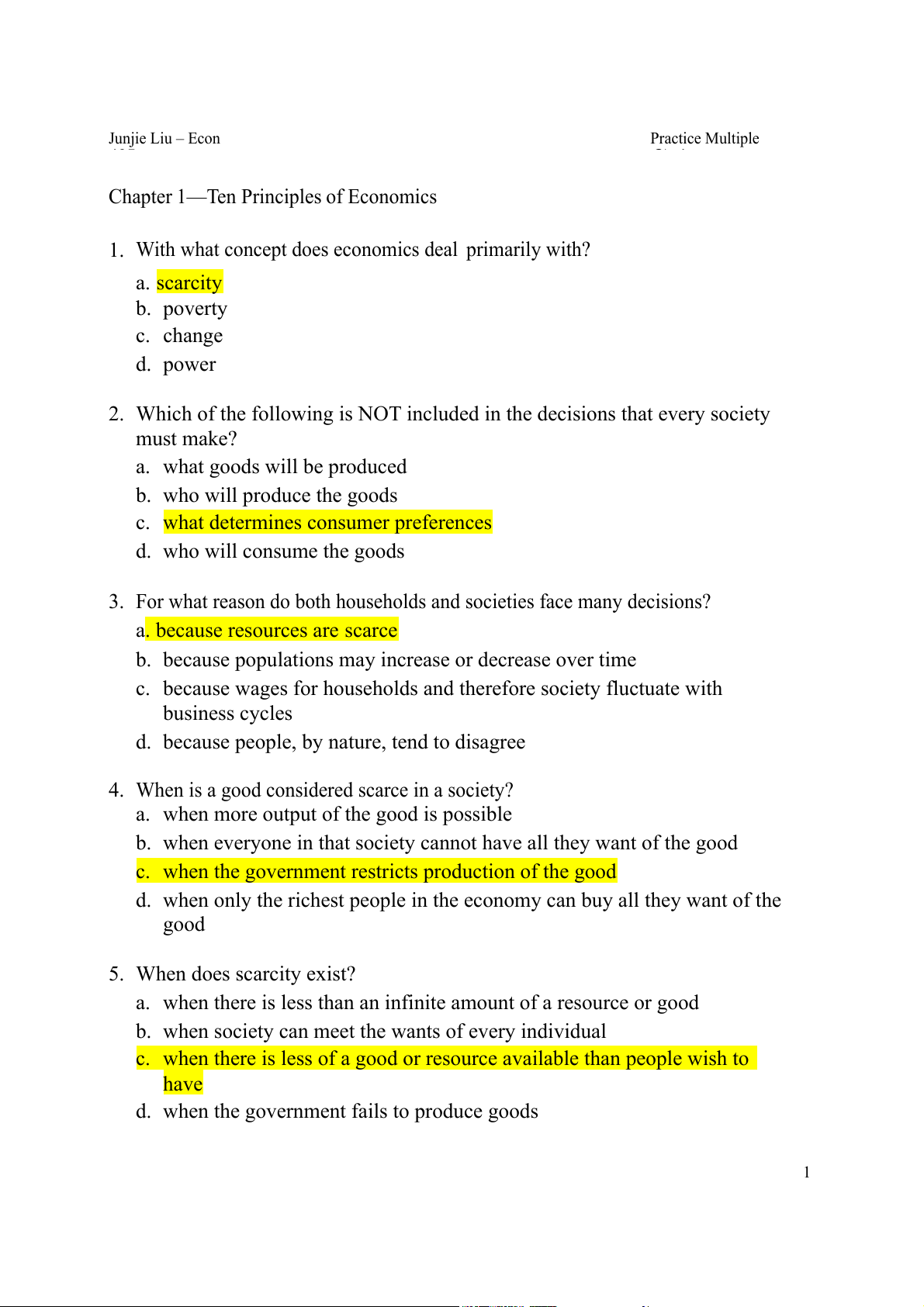
1. With what concept does economics deal primarily with? a. scarcity b. poverty c. change d. power
2. Which of the following is NOT included in the decisions that every society must make? a. what goods will be produced b. who will produce the goods
c. what determines consumer preferences d. who will consume the goods
3. For what reason do both households and societies face many decisions?
a. because resources are scarce
b. because populations may increase or decrease over time
c. because wages for households and therefore society fluctuate with business cycles
d. because people, by nature, tend to disagree
4. When is a good considered scarce in a society?
a. when more output of the good is possible
b. when everyone in that society cannot have all they want of the good
c. when the government restricts production of the good
d. when only the richest people in the economy can buy all they want of the good 5. When does scarcity exist?
a. when there is less than an infinite amount of a resource or good
b. when society can meet the wants of every individual
c. when there is less of a good or resource available than people wish to have
d. when the government fails to produce goods 1 Junjie Liu – Econ Practice Multiple
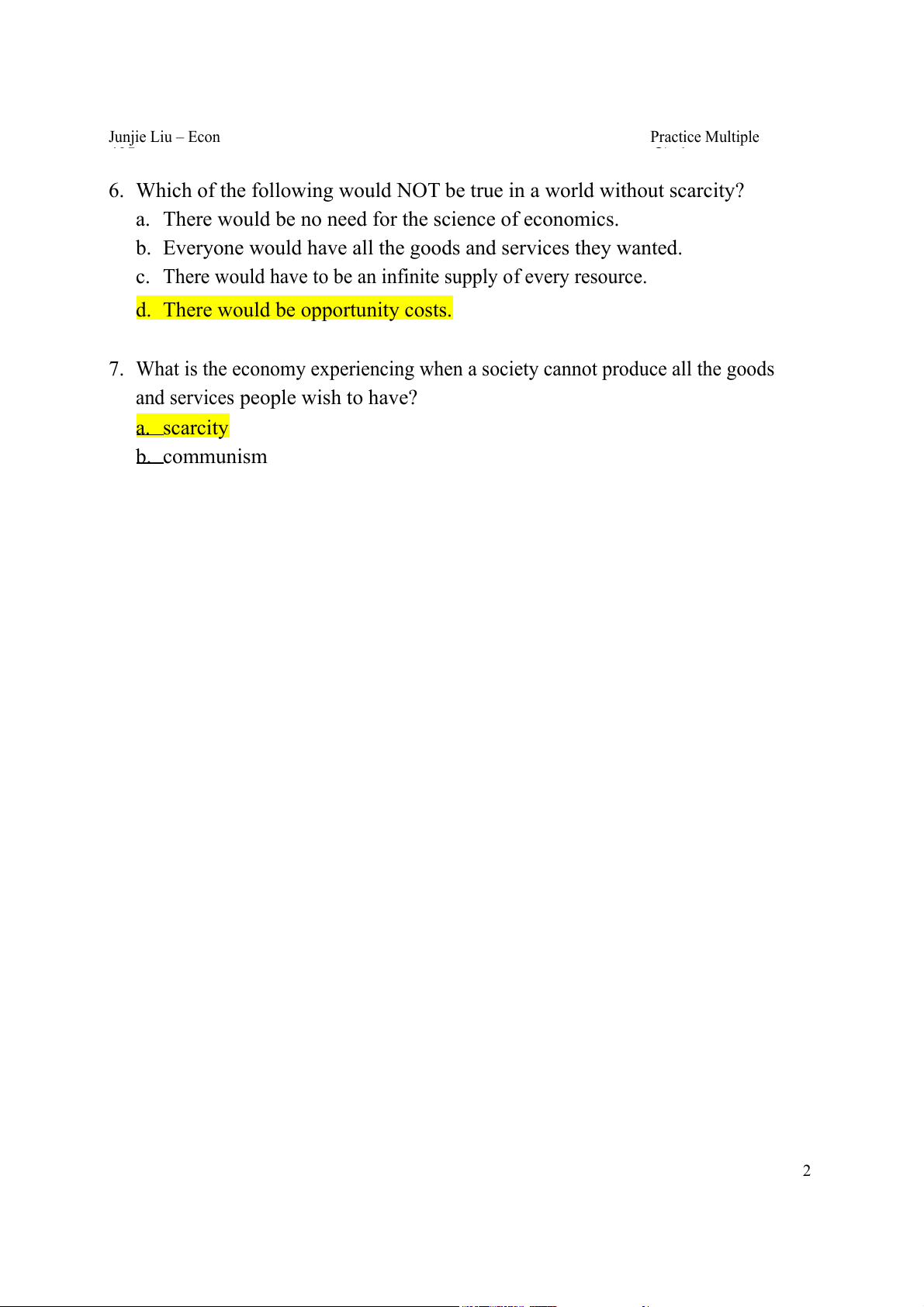
6. Which of the following would NOT be true in a world without scarcity?
a. There would be no need for the science of economics.
b. Everyone would have all the goods and services they wanted.
c. There would have to be an infinite supply of every resource.
d. There would be opportunity costs.
7. What is the economy experiencing when a society cannot produce all the goods
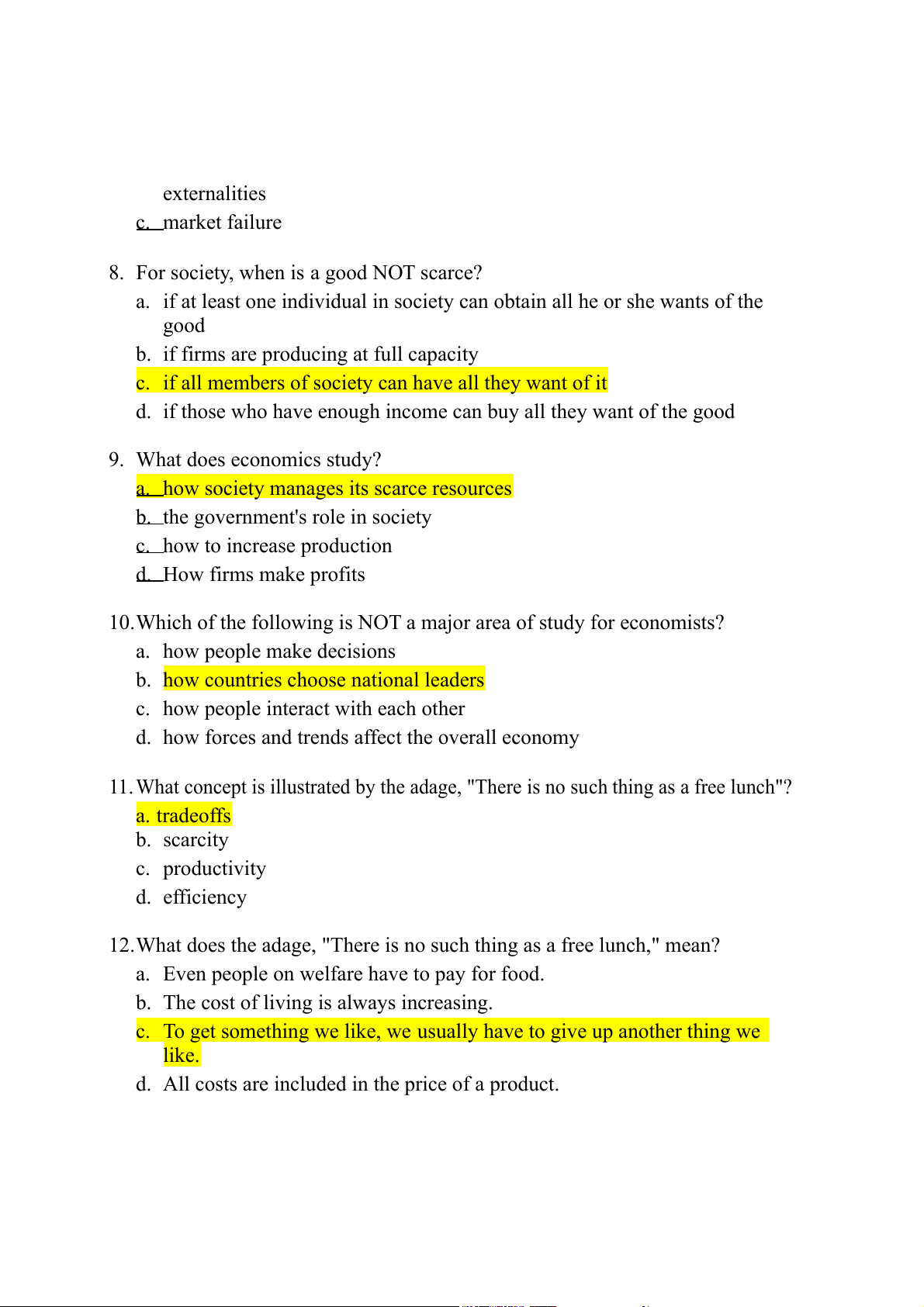
and services people wish to have? a. scarcity b. communism 2 externalities c. market failure
8. For society, when is a good NOT scarce?
a. if at least one individual in society can obtain all he or she wants of the good
b. if firms are producing at full capacity
c. if all members of society can have all they want of it
d. if those who have enough income can buy all they want of the good 9. What does economics study?
a. how society manages its scarce resources
b. the government's role in society c. how to increase production d. How firms make profits
10.Which of the following is NOT a major area of study for economists? a. how people make decisions
b. how countries choose national leaders
c. how people interact with each other
d. how forces and trends affect the overall economy
11.What concept is illustrated by the adage, "There is no such thing as a free lunch"? a. tradeoffs b. scarcity c. productivity d. efficiency
12.What does the adage, "There is no such thing as a free lunch," mean?
a. Even people on welfare have to pay for food.
b. The cost of living is always increasing.
c. To get something we like, we usually have to give up another thing we like.
d. All costs are included in the price of a product.
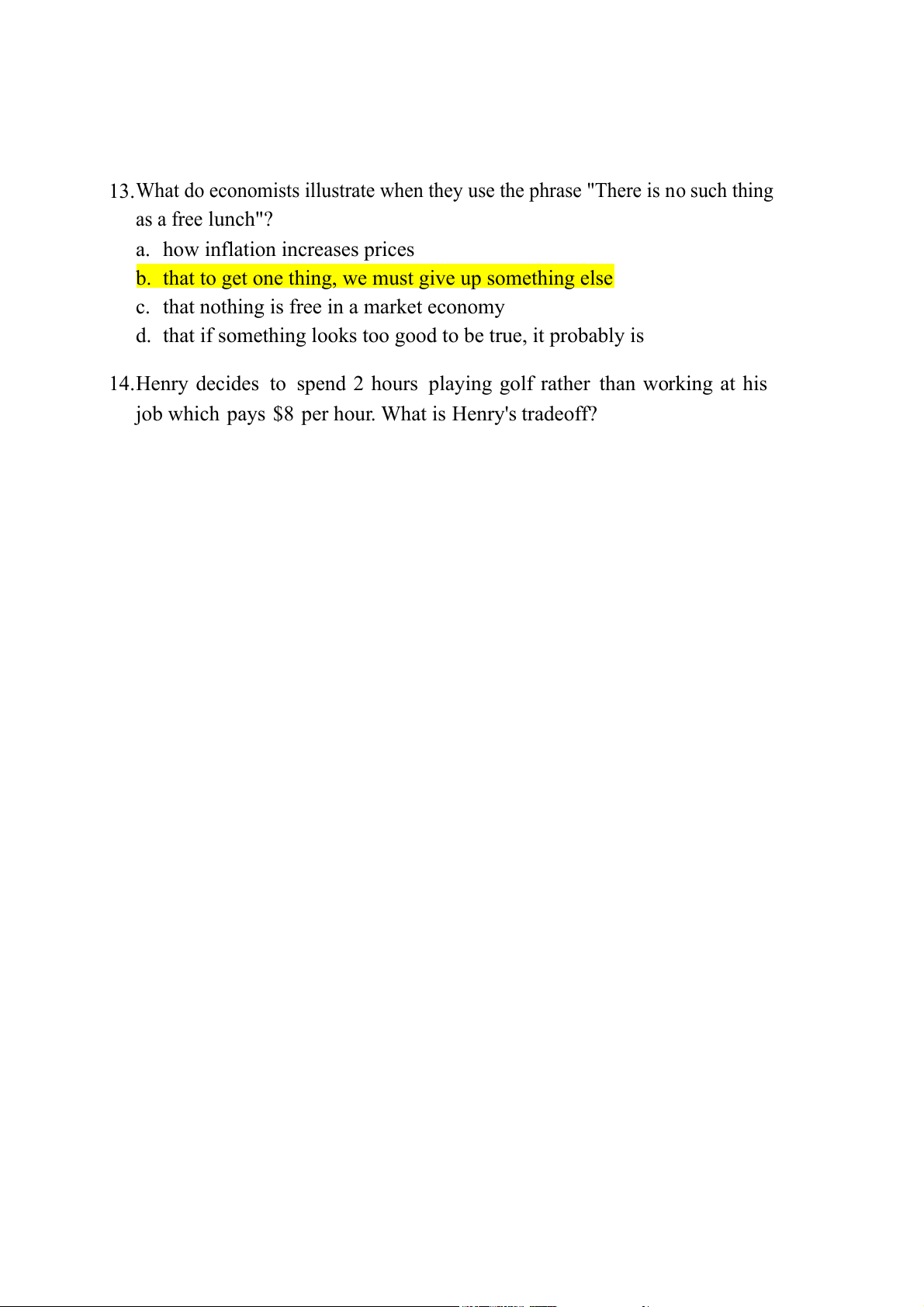
13.What do economists illustrate when they use the phrase "There is no such thing as a free lunch"?
a. how inflation increases prices
b. that to get one thing, we must give up something else
c. that nothing is free in a market economy
d. that if something looks too good to be true, it probably is
14.Henry decides to spend 2 hours playing golf rather than working at his
job which pays $8 per hour. What is Henry's tradeoff?
a. the $16 he could have earned working for 2 hours
b. nothing, because he enjoys playing golf more than working
c. the increase in skill he obtains from playing golf for those 2 hours
d. nothing, because he spent $16 for green fees to play golf
15.When society requires that firms reduce pollution, what happens?
a. There is a tradeoff because of reduced incomes to the firms' owners, workers, and customers.
b. There is no tradeoff, since everyone benefits from reduced pollution.
c. There is no tradeoff for society as a whole, since the cost of reducing
pollution falls only on the firms affected by the requirements.
d. There is a tradeoff only if some firms are forced to close.
16.Daniel decides to spend the last two hours of the night before his economics
exam studying instead of sleeping. For Daniel, what would his tradeoff be?
a. nothing, since no dollar value can be put on sleep
b. nothing, since studying would be more beneficial than sleep
c. the six hours of sleep he could have had if he had gone to bed before
midnight d. the two hours of rest he would have gotten
17.How does a tradeoff exist between and a clean environment a higher level of income?
a. Studies show that individuals with higher levels of income actually pollute
less than low- income individuals.
b. To pay for pollution clean-up, the government must increase taxes which lowers income.
c. Laws that reduce pollution raise costs of production and reduce incomes.
d. By employing individuals to clean up pollution, employment and income both rise. 18.What does efficiency mean?
a. Society is conserving resources in order to save them for the future.
b. Society’s goods and services are distributed fairly among society's members.
c. Society has lessened its dependence on foreign energy sources.
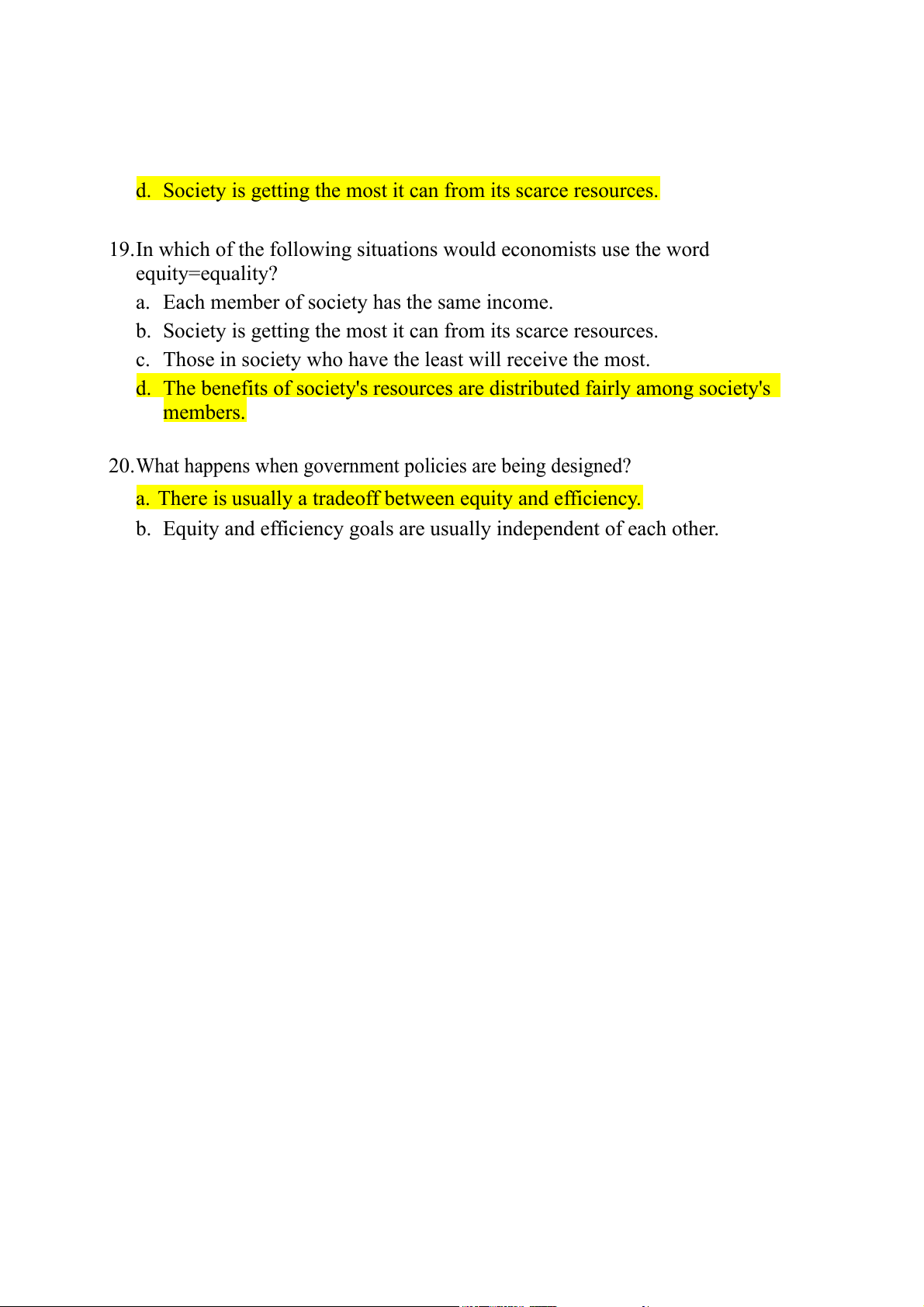
d. Society is getting the most it can from its scarce resources.
19.In which of the following situations would economists use the word equity=equality?
a. Each member of society has the same income.
b. Society is getting the most it can from its scarce resources.
c. Those in society who have the least will receive the most.
d. The benefits of society's resources are distributed fairly among society's members.
20.What happens when government policies are being designed?
a. There is usually a tradeoff between equity and efficiency.
b. Equity and efficiency goals are usually independent of each other.
c. Equity can usually be achieved without an efficiency loss.
d. Increasing efficiency usually results in more equity.
21.When government policies such as the welfare system try to help the neediest
members of society, what happens?
a. It increases equity and reduces efficiency.
b. It reduces charitable contributions in an economy.
c. It increases the productivity of the needy in the society.
d. It causes market failure to occur.
22.When the government attempts to cut the economic pie into more equal slices, what happens?
a. It is easier to cut the pie, and therefore the economy can produce a larger pie.
b. The government can more easily allocate the pie to those most in need.
c. The pie gets smaller, and there will be less pie for everyone.
d. The economy will spend too much time cutting and loses the ability to
produce enough pie for everyone.
23.When the government attempts to improve equity in an economy, what is often the result?
a. an increase in overall output in the economy
b. additional government revenue since overall income will increase
c. an actual reduction in equity
d. reduced efficiency in the economy
24.What is the opportunity cost of going to college?
a. the total spent on food, clothing, books, transportation, tuition, lodging, and other expenses
b. the value of the best opportunity a student gives up to attend college
c. zero for students who are fortunate enough to have all of their college expenses paid by someone else
d. zero, since a college education will allow a student to earn a larger income after graduation
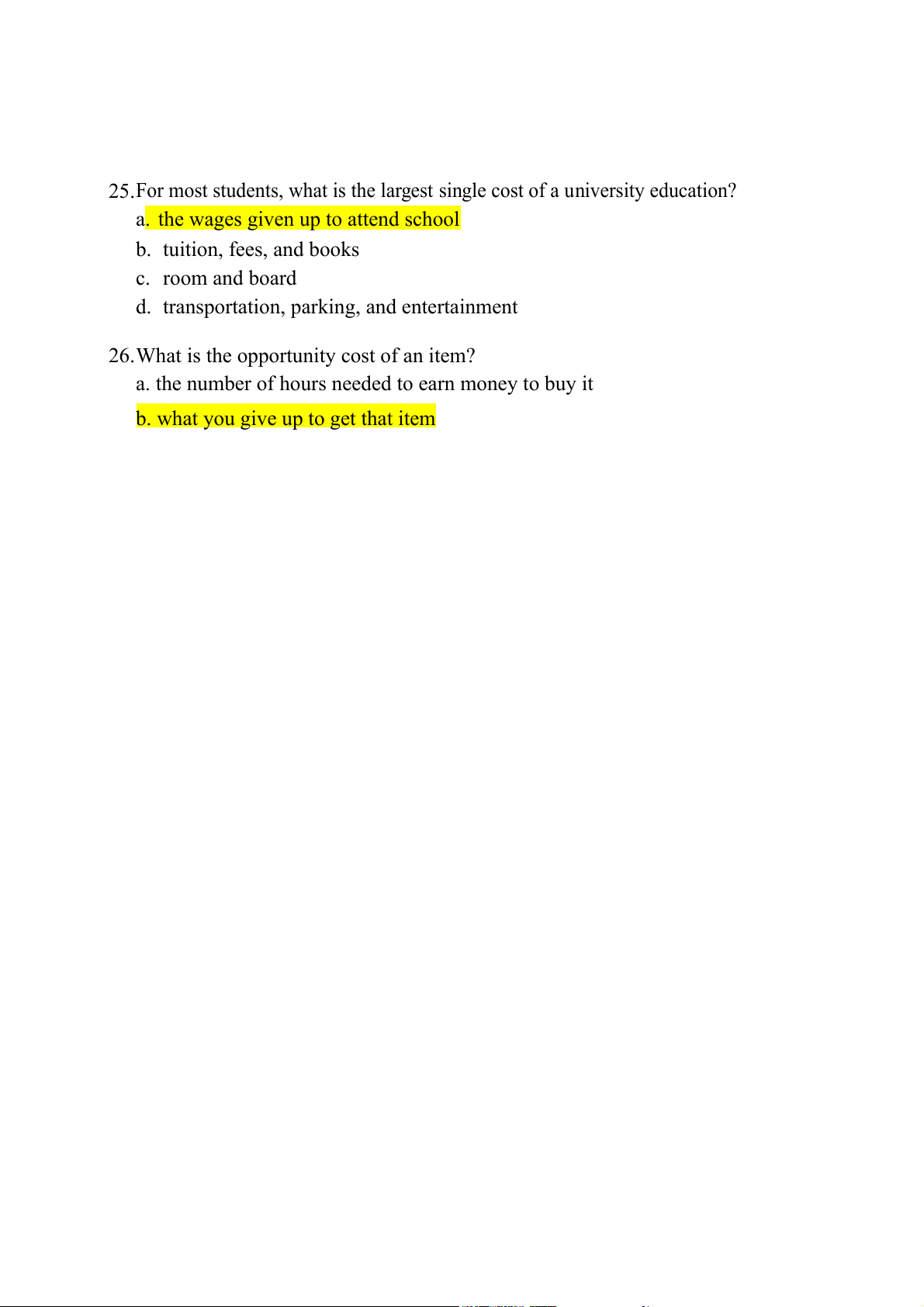
25.For most students, what is the largest single cost of a university education?
a. the wages given up to attend school b. tuition, fees, and books c. room and board
d. transportation, parking, and entertainment
26.What is the opportunity cost of an item?
a. the number of hours needed to earn money to buy it
b. what you give up to get that item
c. usually more than the dollar value of the item
d. usually less than the dollar value of the item
27.Russell spends an hour studying instead of playing tennis. What is the
opportunity cost to him of studying?
a. the improvement in his grades from studying for the hour
b. the difference between the improvement in his grades from studying minus
the enjoyment of playing tennis
c. the enjoyment and exercise he would have received had he played tennis
d. Zero, Since Russell chose to study rather than to play tennis, the value of
studying must have been greater than the value of playing tennis
28.What do we know about college-age athletes who drop out of college to play professional sports?
a. They are not rational decision makers.
b. They are well aware that their opportunity cost of attending college is very high.
c. They are concerned more about present circumstances than their future.
d. They underestimate the value of a college education.
29.How do people make decisions at the margin? a. by following tradition b. by experience c. by calculating dollar costs
d. by comparing costs and benefits
30.What does making decisions "at the margin" mean?
a. that people make those decisions that do not impose a marginal cost
b. that people evaluate how easily a decision can be reversed if problems arise
c. that people compare the marginal costs and marginal benefits of each decision
d. that people always calculate the marginal dollar costs for each decision
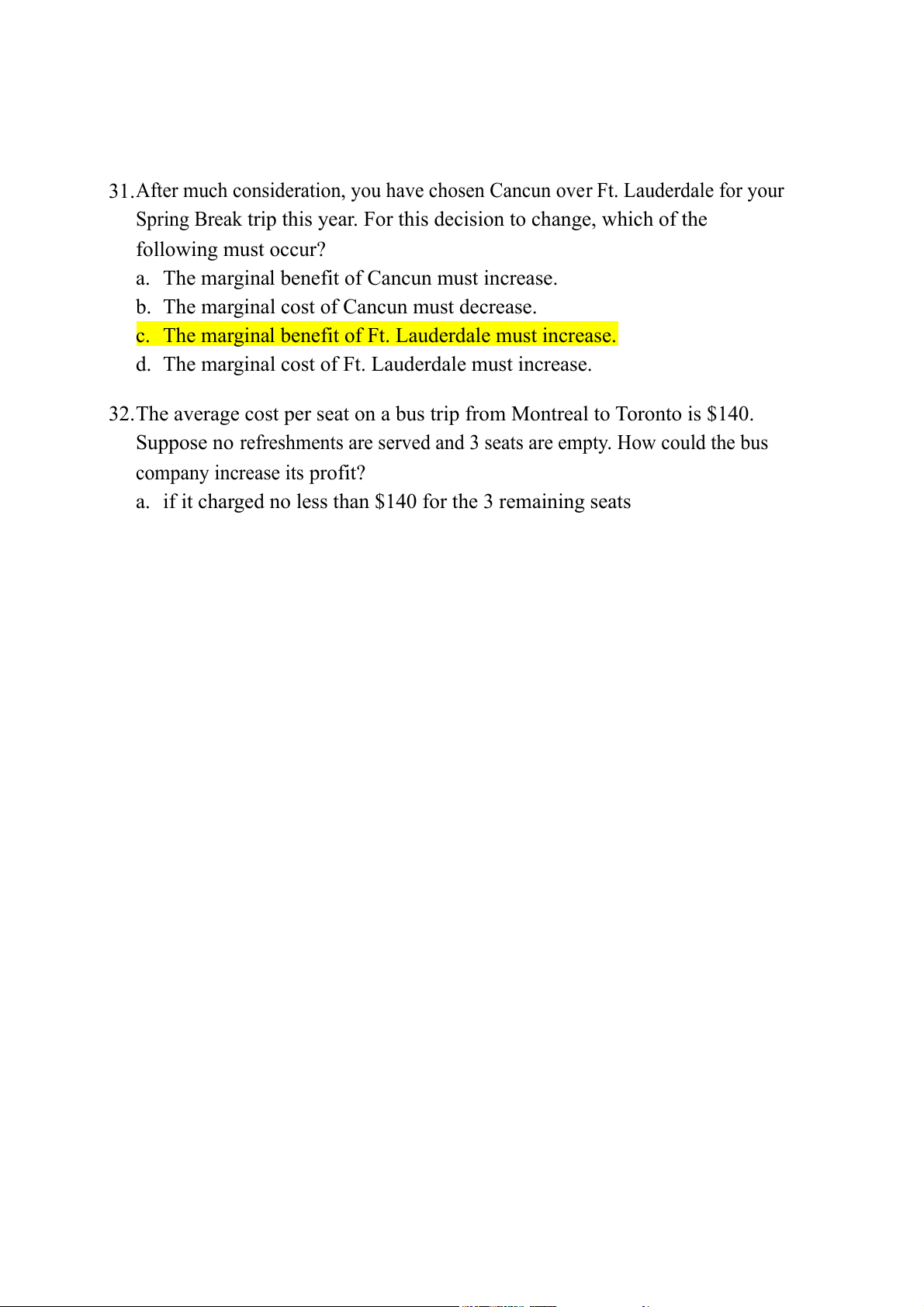
31.After much consideration, you have chosen Cancun over Ft. Lauderdale for your
Spring Break trip this year. For this decision to change, which of the following must occur?
a. The marginal benefit of Cancun must increase.
b. The marginal cost of Cancun must decrease.
c. The marginal benefit of Ft. Lauderdale must increase.
d. The marginal cost of Ft. Lauderdale must increase.
32.The average cost per seat on a bus trip from Montreal to Toronto is $140.
Suppose no refreshments are served and 3 seats are empty. How could the bus company increase its profit?
a. if it charged no less than $140 for the 3 remaining seats
b. if it charged more than $140 for the 3 remaining seats
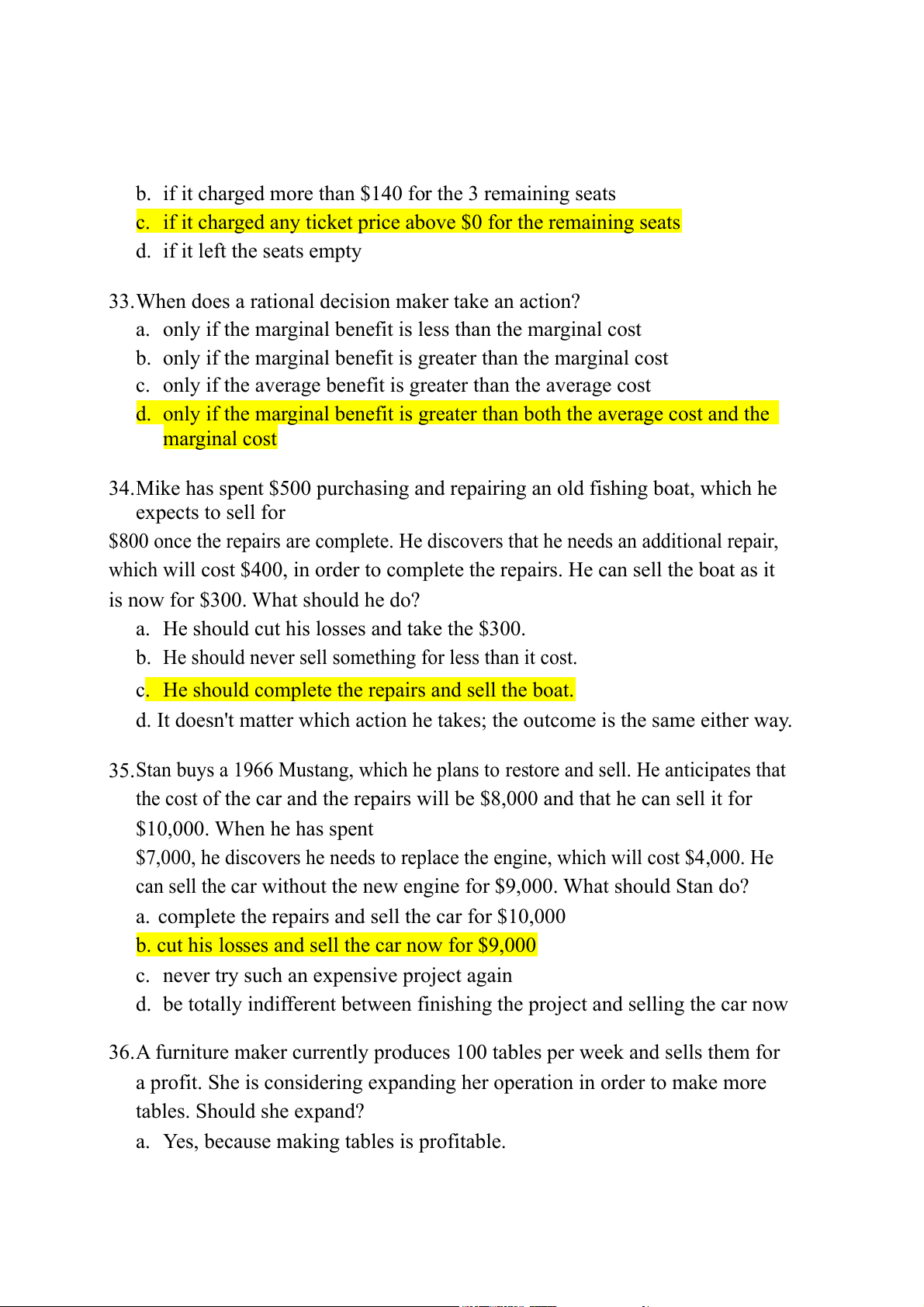
c. if it charged any ticket price above $0 for the remaining seats d. if it left the seats empty
33.When does a rational decision maker take an action?
a. only if the marginal benefit is less than the marginal cost
b. only if the marginal benefit is greater than the marginal cost
c. only if the average benefit is greater than the average cost
d. only if the marginal benefit is greater than both the average cost and the marginal cost
34.Mike has spent $500 purchasing and repairing an old fishing boat, which he expects to sell for
$800 once the repairs are complete. He discovers that he needs an additional repair,
which will cost $400, in order to complete the repairs. He can sell the boat as it
is now for $300. What should he do?
a. He should cut his losses and take the $300.
b. He should never sell something for less than it cost.
c. He should complete the repairs and sell the boat.
d. It doesn't matter which action he takes; the outcome is the same either way.
35.Stan buys a 1966 Mustang, which he plans to restore and sell. He anticipates that
the cost of the car and the repairs will be $8,000 and that he can sell it for $10,000. When he has spent
$7,000, he discovers he needs to replace the engine, which will cost $4,000. He
can sell the car without the new engine for $9,000. What should Stan do?
a. complete the repairs and sell the car for $10,000
b. cut his losses and sell the car now for $9,000
c. never try such an expensive project again
d. be totally indifferent between finishing the project and selling the car now
36.A furniture maker currently produces 100 tables per week and sells them for
a profit. She is considering expanding her operation in order to make more tables. Should she expand?
a. Yes, because making tables is profitable.
b. No, because she may not be able to sell the additional tables.
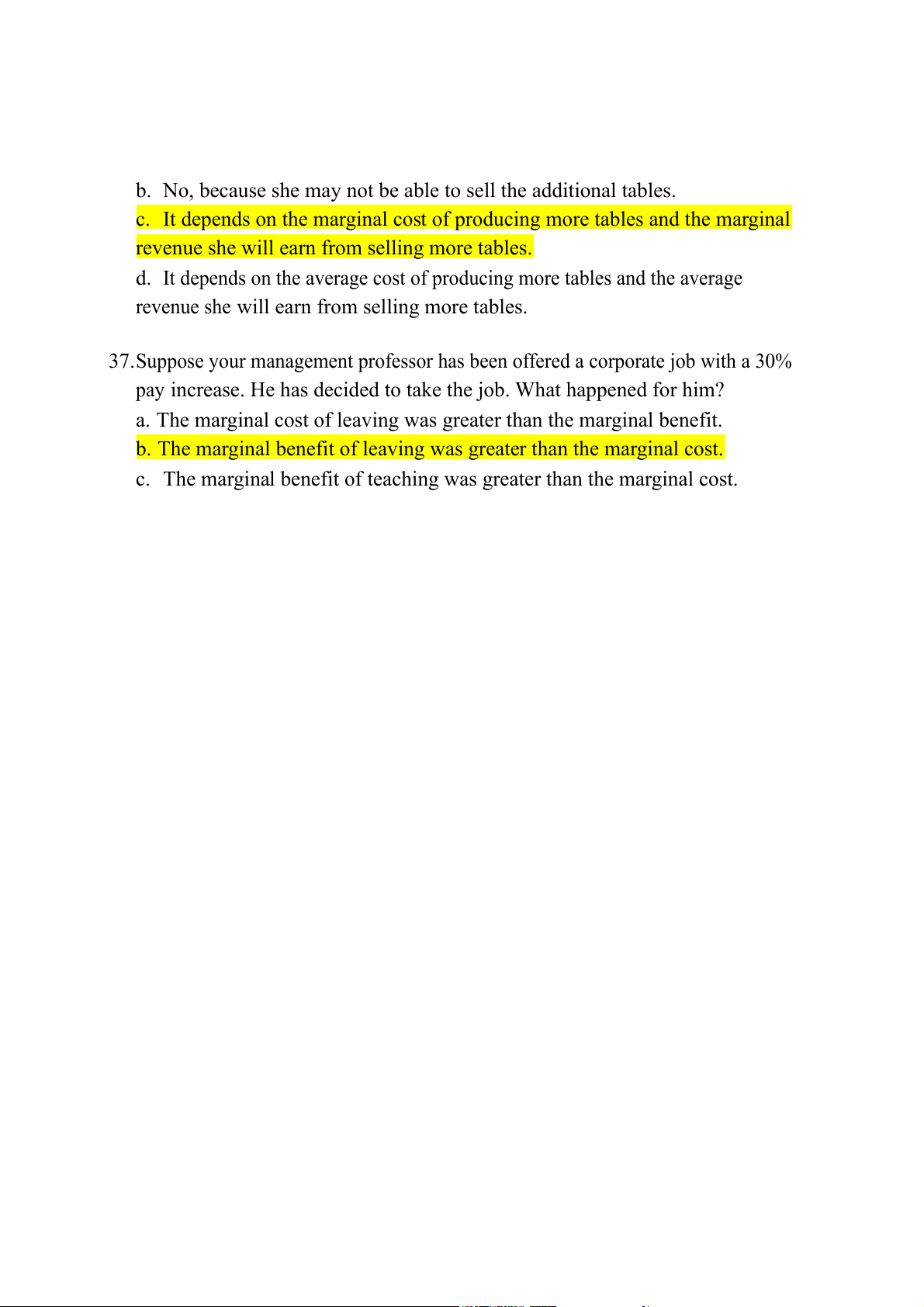
c. It depends on the marginal cost of producing more tables and the marginal
revenue she will earn from selling more tables.
d. It depends on the average cost of producing more tables and the average
revenue she will earn from selling more tables.
37.Suppose your management professor has been offered a corporate job with a 30%
pay increase. He has decided to take the job. What happened for him?
a. The marginal cost of leaving was greater than the marginal benefit.
b. The marginal benefit of leaving was greater than the marginal cost.
c. The marginal benefit of teaching was greater than the marginal cost.
d. The marginal cost of teaching was greater than the marginal benefit.
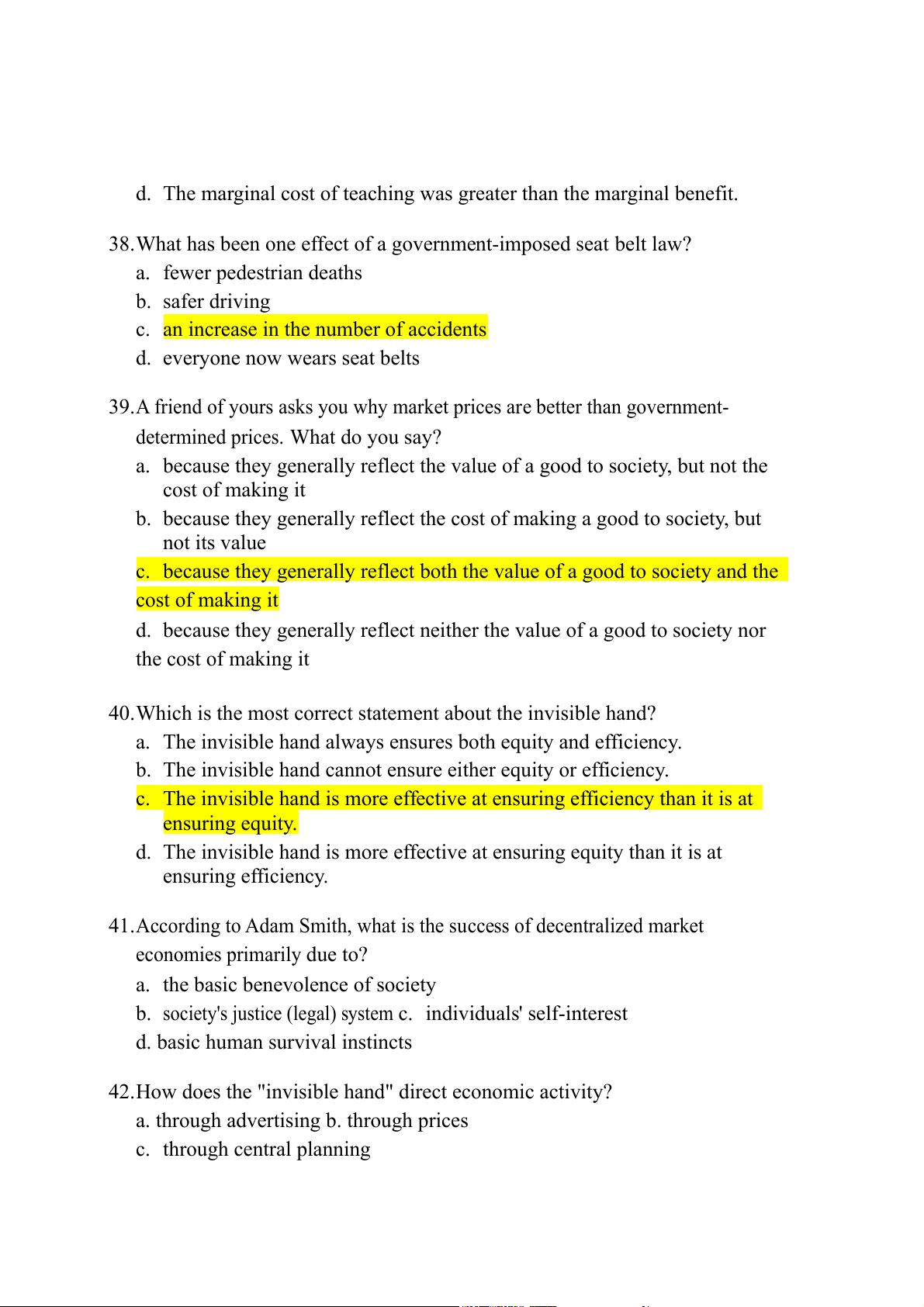
38.What has been one effect of a government-imposed seat belt law? a. fewer pedestrian deaths b. safer driving
c. an increase in the number of accidents
d. everyone now wears seat belts
39.A friend of yours asks you why market prices are better than government-
determined prices. What do you say?
a. because they generally reflect the value of a good to society, but not the cost of making it
b. because they generally reflect the cost of making a good to society, but not its value
c. because they generally reflect both the value of a good to society and the cost of making it
d. because they generally reflect neither the value of a good to society nor the cost of making it
40.Which is the most correct statement about the invisible hand?
a. The invisible hand always ensures both equity and efficiency.
b. The invisible hand cannot ensure either equity or efficiency.
c. The invisible hand is more effective at ensuring efficiency than it is at ensuring equity.
d. The invisible hand is more effective at ensuring equity than it is at ensuring efficiency.
41.According to Adam Smith, what is the success of decentralized market economies primarily due to?
a. the basic benevolence of society
b. society's justice (legal) system c. individuals' self-interest
d. basic human survival instincts
42.How does the "invisible hand" direct economic activity?
a. through advertising b. through prices c. through central planning
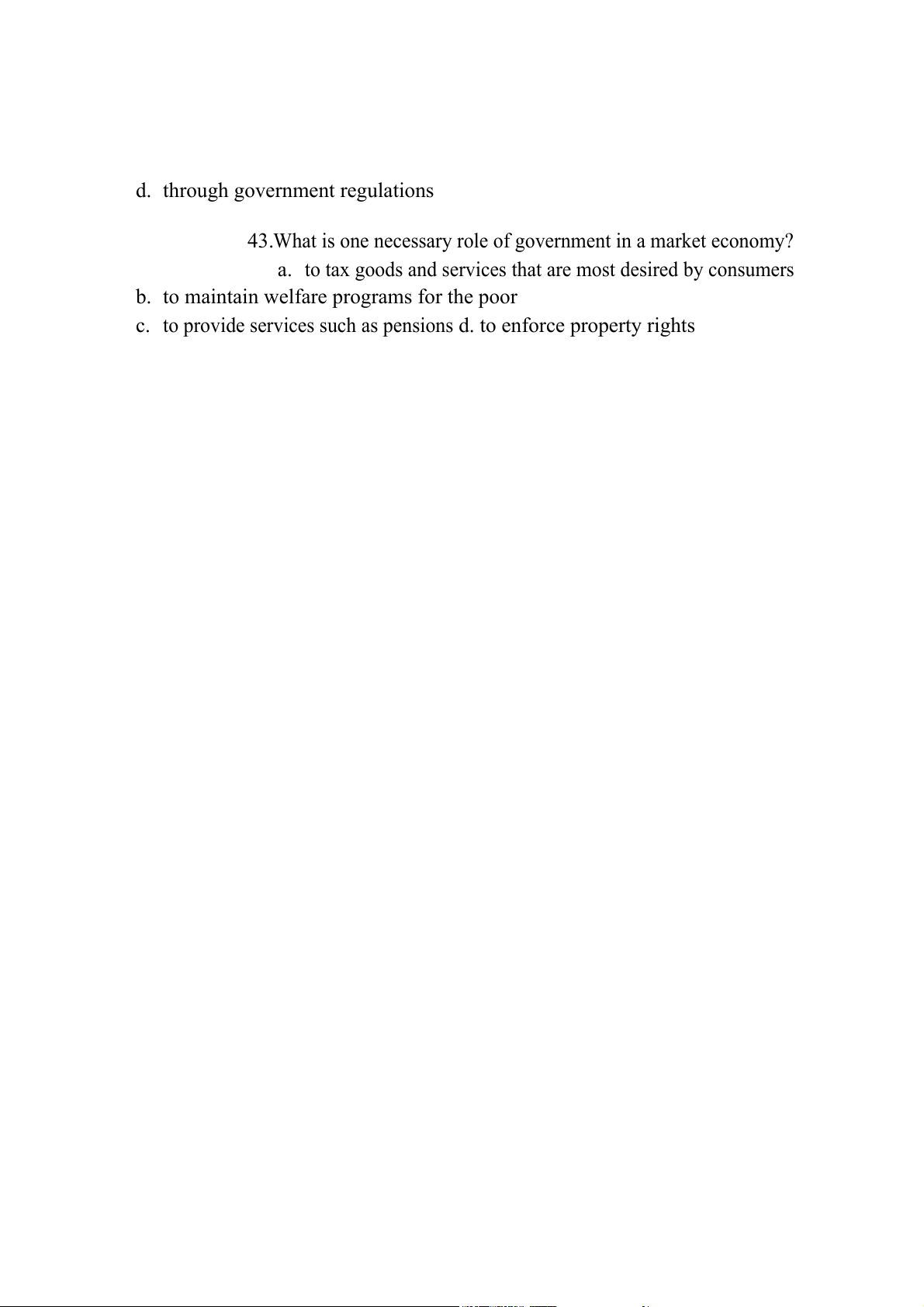
d. through government regulations
43.What is one necessary role of government in a market economy?
a. to tax goods and services that are most desired by consumers
b. to maintain welfare programs for the poor
c. to provide services such as pensions d. to enforce property rights
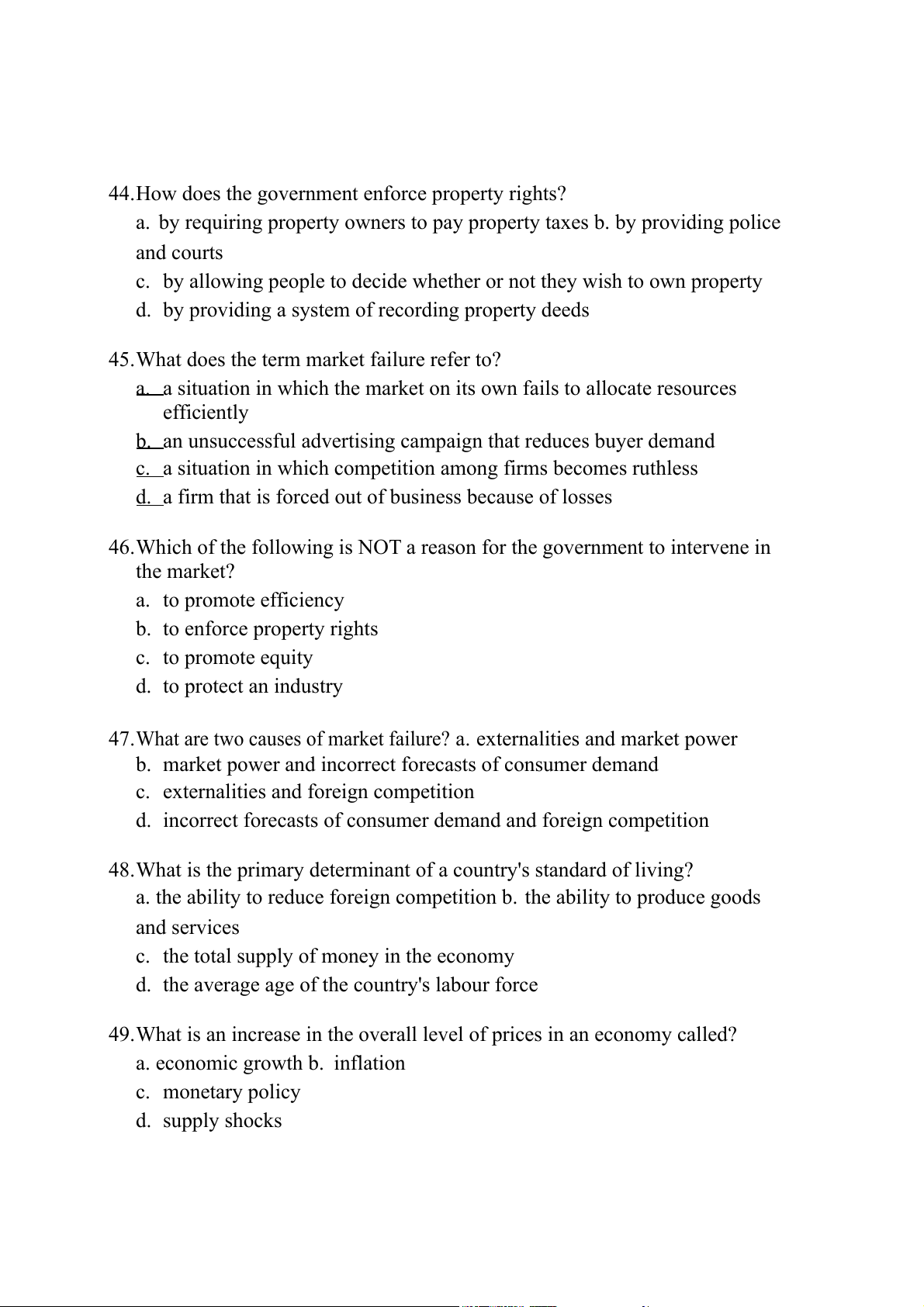
44.How does the government enforce property rights?
a. by requiring property owners to pay property taxes b. by providing police and courts
c. by allowing people to decide whether or not they wish to own property
d. by providing a system of recording property deeds
45.What does the term market failure refer to?
a. a situation in which the market on its own fails to allocate resources efficiently
b. an unsuccessful advertising campaign that reduces buyer demand
c. a situation in which competition among firms becomes ruthless
d. a firm that is forced out of business because of losses
46.Which of the following is NOT a reason for the government to intervene in the market? a. to promote efficiency b. to enforce property rights c. to promote equity d. to protect an industry
47.What are two causes of market failure? a. externalities and market power
b. market power and incorrect forecasts of consumer demand
c. externalities and foreign competition
d. incorrect forecasts of consumer demand and foreign competition
48.What is the primary determinant of a country's standard of living?
a. the ability to reduce foreign competition b. the ability to produce goods and services
c. the total supply of money in the economy
d. the average age of the country's labour force
49.What is an increase in the overall level of prices in an economy called?
a. economic growth b. inflation c. monetary policy d. supply shocks
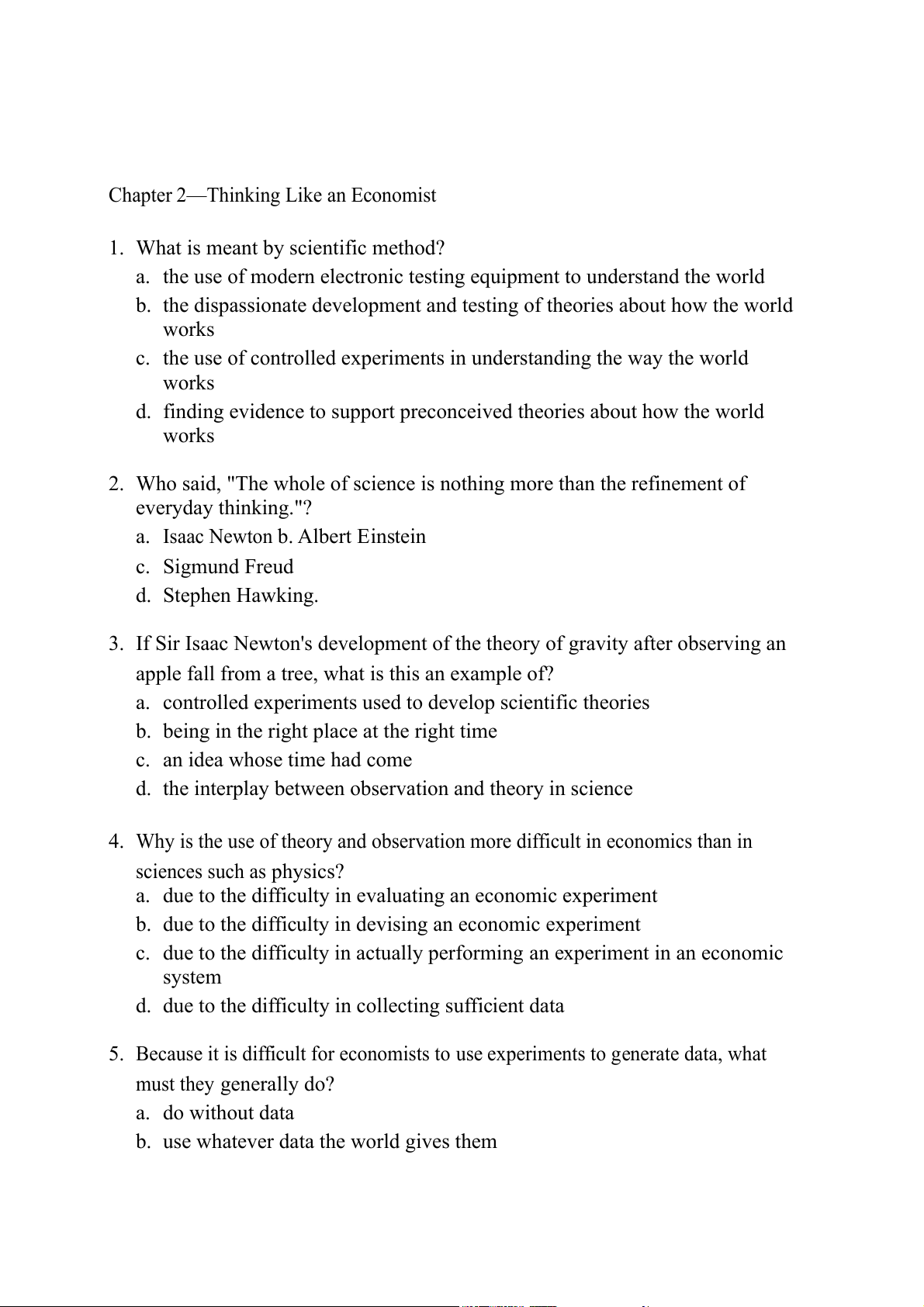
Chapter 2—Thinking Like an Economist
1. What is meant by scientific method?
a. the use of modern electronic testing equipment to understand the world
b. the dispassionate development and testing of theories about how the world works
c. the use of controlled experiments in understanding the way the world works
d. finding evidence to support preconceived theories about how the world works
2. Who said, "The whole of science is nothing more than the refinement of everyday thinking."?
a. Isaac Newton b. Albert Einstein c. Sigmund Freud d. Stephen Hawking.
3. If Sir Isaac Newton's development of the theory of gravity after observing an
apple fall from a tree, what is this an example of?
a. controlled experiments used to develop scientific theories
b. being in the right place at the right time c. an idea whose time had come
d. the interplay between observation and theory in science
4. Why is the use of theory and observation more difficult in economics than in sciences such as physics?
a. due to the difficulty in evaluating an economic experiment
b. due to the difficulty in devising an economic experiment
c. due to the difficulty in actually performing an experiment in an economic system
d. due to the difficulty in collecting sufficient data
5. Because it is difficult for economists to use experiments to generate data, what must they generally do? a. do without data
b. use whatever data the world gives them
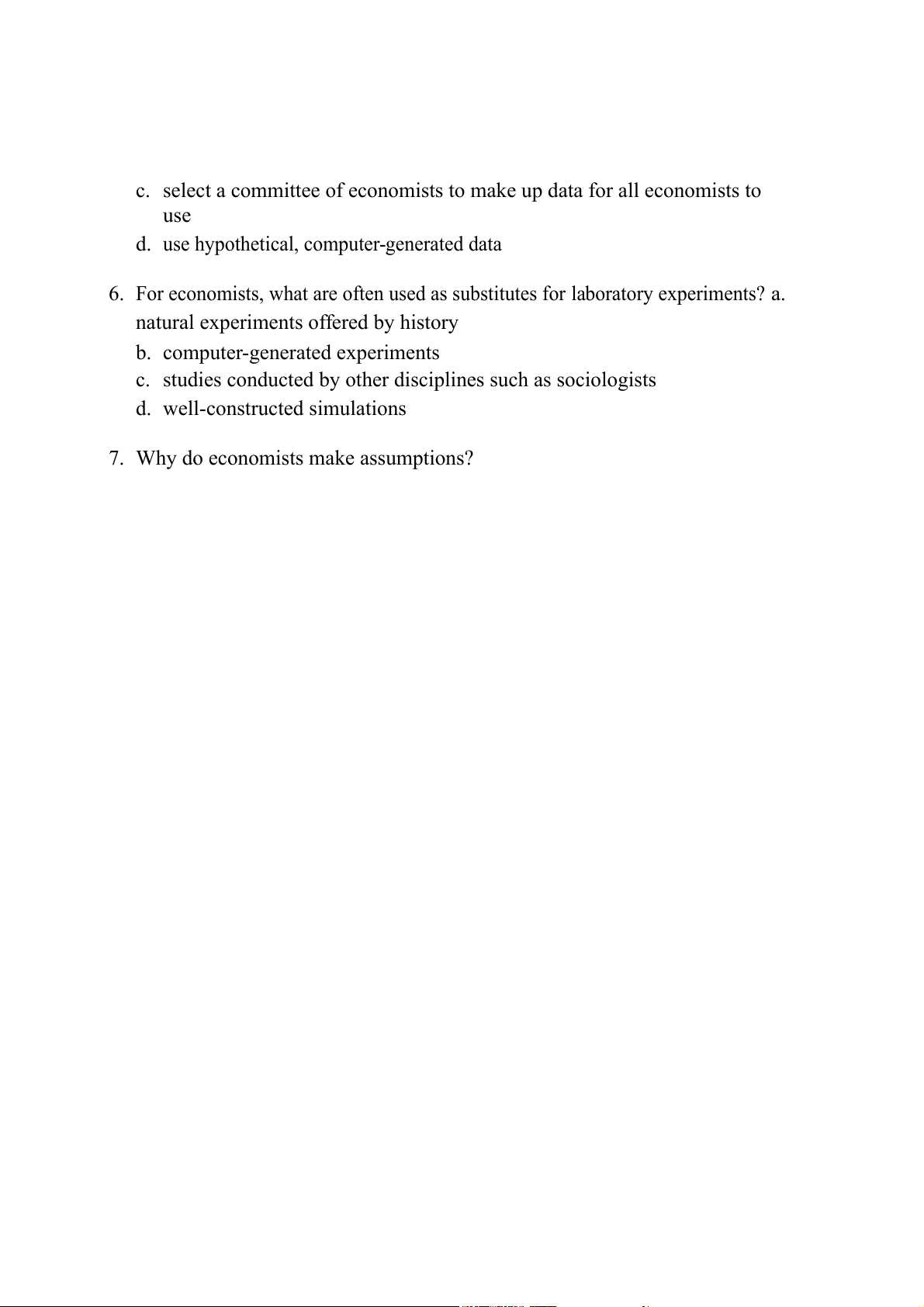
c. select a committee of economists to make up data for all economists to use
d. use hypothetical, computer-generated data
6. For economists, what are often used as substitutes for laboratory experiments? a.
natural experiments offered by history
b. computer-generated experiments
c. studies conducted by other disciplines such as sociologists
d. well-constructed simulations
7. Why do economists make assumptions?
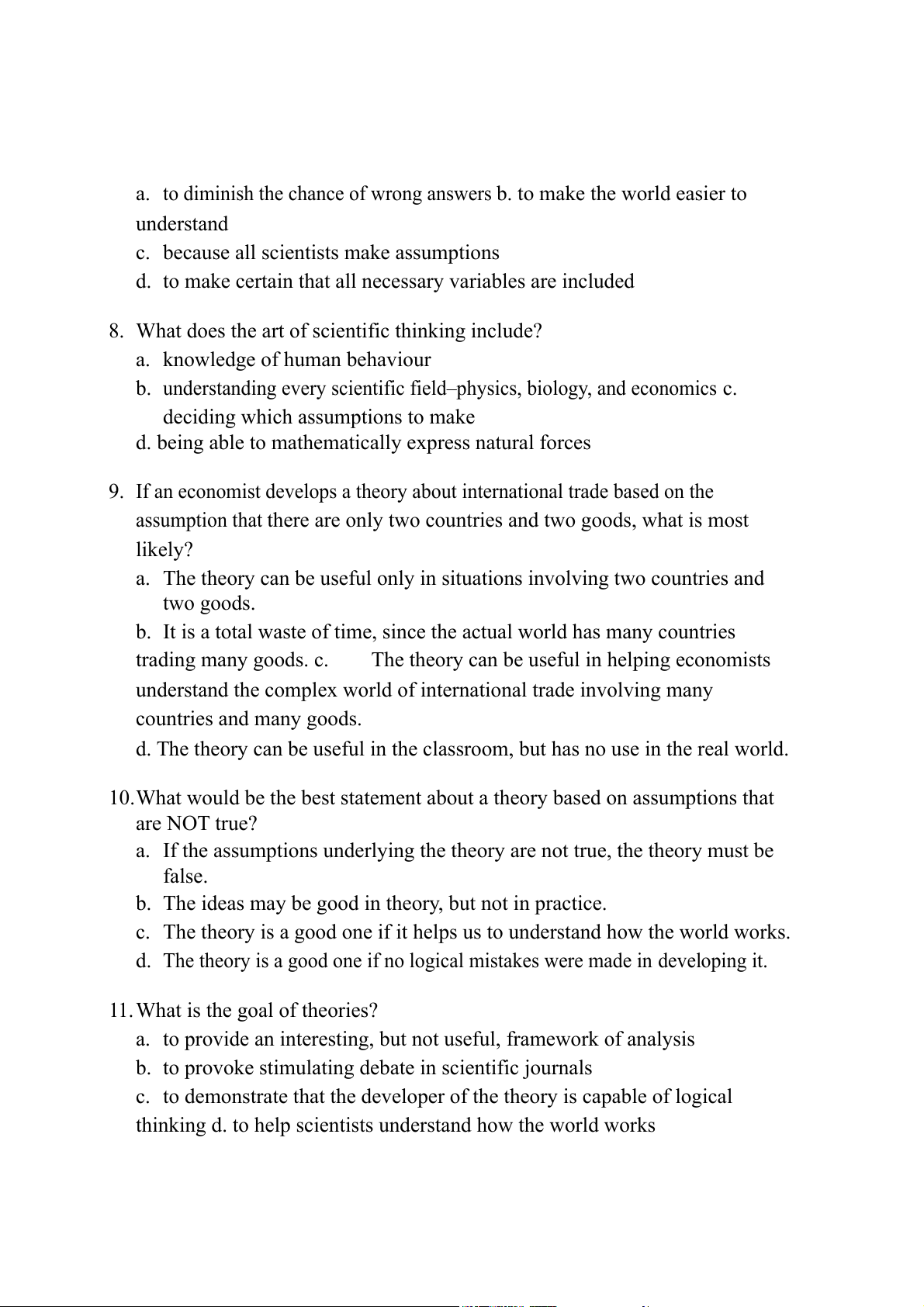
a. to diminish the chance of wrong answers b. to make the world easier to understand
c. because all scientists make assumptions
d. to make certain that all necessary variables are included
8. What does the art of scientific thinking include?
a. knowledge of human behaviour
b. understanding every scientific field–physics, biology, and economics c.
deciding which assumptions to make
d. being able to mathematically express natural forces
9. If an economist develops a theory about international trade based on the
assumption that there are only two countries and two goods, what is most likely?
a. The theory can be useful only in situations involving two countries and two goods.
b. It is a total waste of time, since the actual world has many countries trading many goods. c.
The theory can be useful in helping economists
understand the complex world of international trade involving many countries and many goods.
d. The theory can be useful in the classroom, but has no use in the real world.
10.What would be the best statement about a theory based on assumptions that are NOT true?
a. If the assumptions underlying the theory are not true, the theory must be false.
b. The ideas may be good in theory, but not in practice.
c. The theory is a good one if it helps us to understand how the world works.
d. The theory is a good one if no logical mistakes were made in developing it.
11.What is the goal of theories?
a. to provide an interesting, but not useful, framework of analysis
b. to provoke stimulating debate in scientific journals
c. to demonstrate that the developer of the theory is capable of logical
thinking d. to help scientists understand how the world works
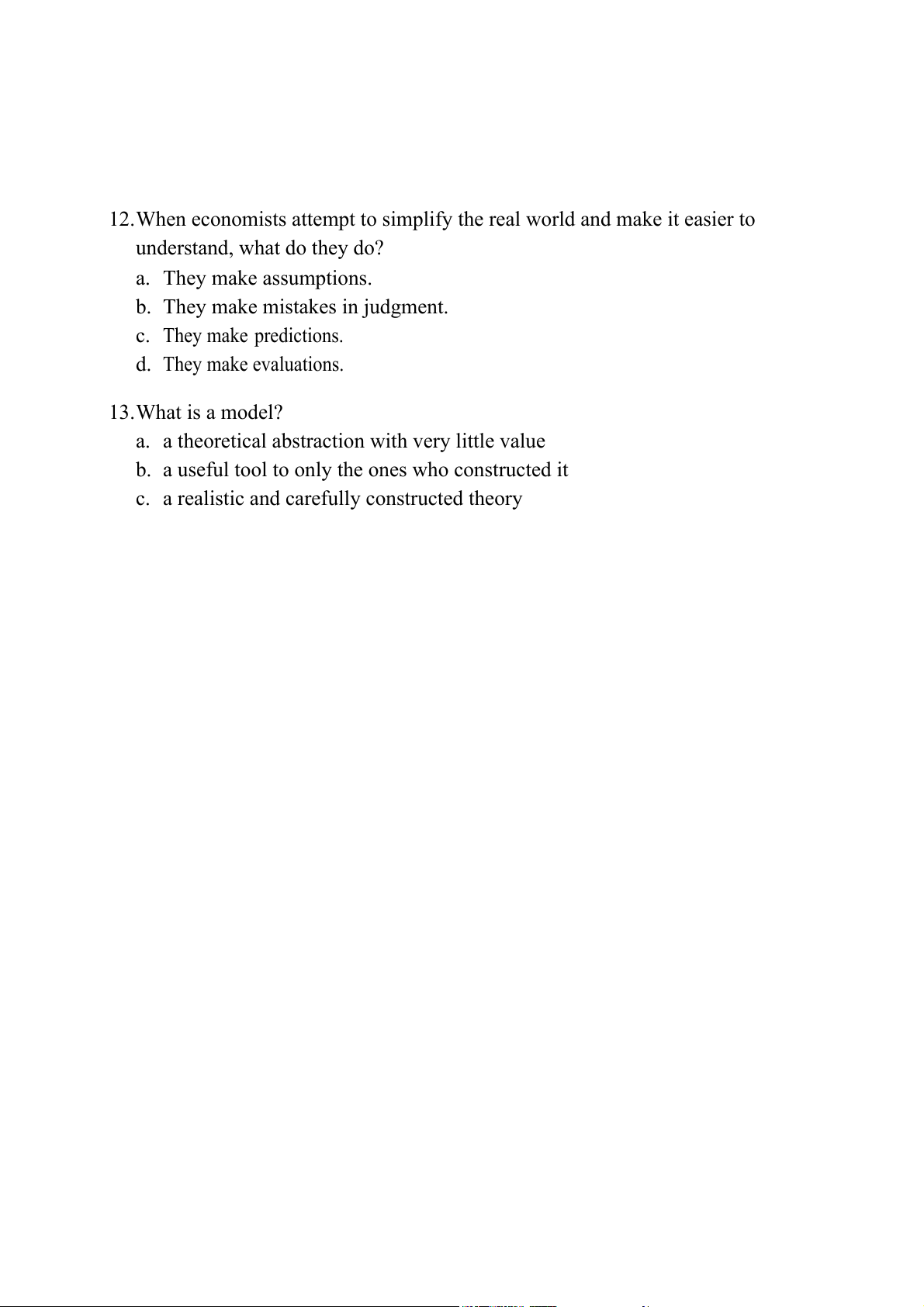
12.When economists attempt to simplify the real world and make it easier to understand, what do they do? a. They make assumptions.
b. They make mistakes in judgment. c. They make predictions. d. They make evaluations. 13.What is a model?
a. a theoretical abstraction with very little value
b. a useful tool to only the ones who constructed it
c. a realistic and carefully constructed theory
d. a simplification of real life
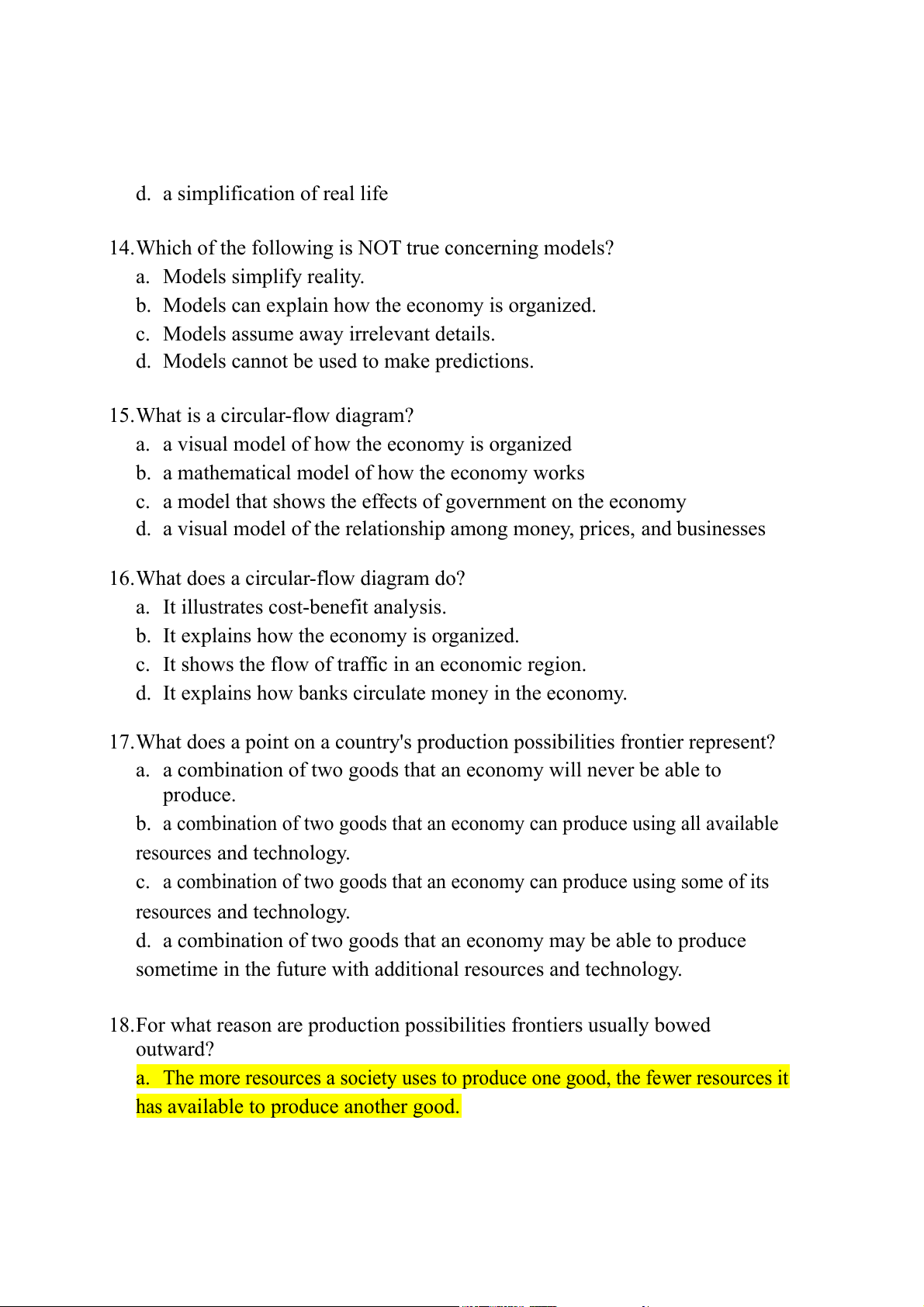
14.Which of the following is NOT true concerning models? a. Models simplify reality.
b. Models can explain how the economy is organized.
c. Models assume away irrelevant details.
d. Models cannot be used to make predictions.
15.What is a circular-flow diagram?
a. a visual model of how the economy is organized
b. a mathematical model of how the economy works
c. a model that shows the effects of government on the economy
d. a visual model of the relationship among money, prices, and businesses
16.What does a circular-flow diagram do?
a. It illustrates cost-benefit analysis.
b. It explains how the economy is organized.
c. It shows the flow of traffic in an economic region.
d. It explains how banks circulate money in the economy.
17.What does a point on a country's production possibilities frontier represent?
a. a combination of two goods that an economy will never be able to produce.
b. a combination of two goods that an economy can produce using all available resources and technology.
c. a combination of two goods that an economy can produce using some of its resources and technology.
d. a combination of two goods that an economy may be able to produce
sometime in the future with additional resources and technology.
18.For what reason are production possibilities frontiers usually bowed outward?
a. The more resources a society uses to produce one good, the fewer resources it
has available to produce another good.
Tài liệu liên quan:
-
Chương 3: độ co giãn và các nhân tố ảnh hưởng | Microeconomics | Trường Đại học Quốc tế, Đại học Quốc gia Thành phố Hồ Chí Minh
4 2 -
Microeconomics Syllabus | Microeconomics | Trường Đại học Quốc tế, Đại học Quốc gia Thành phố Hồ Chí Minh
4 2 -
Microeconomics Course Syllabus & Assessment Details | Microeconomics | Trường Đại học Quốc tế, Đại học Quốc gia Thành phố Hồ Chí Minh
4 2 -
Assignment 3 - Elasticity MCQs and Key Concepts | Microeconomics | Trường Đại học Quốc tế, Đại học Quốc gia Thành phố Hồ Chí Minh
4 2 -
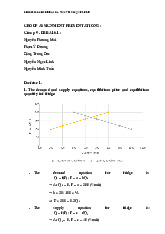
Assignment 2 - Economic Equilibrium Analysis of Fridges and Motorcycles | Microeconomics | Trường Đại học Quốc tế, Đại học Quốc gia Thành phố Hồ Chí Minh
4 2