Premium PowerPoint Slides: Ch 11 Public Goods & Common Resources | Microeconomics | Trường Đại học Quốc tế, Đại học Quốc gia Thành phố Hồ Chí Minh
Look for the answers to these questions: • What are public goods? • What are common resources? Give examples of each. • Why do markets generally fail to provide the efficient amounts of these goods? • How might the government improve market outcomes in the case of public goods or common resource. Tài liệu được sưu tầm và soạn thảo dưới dạng file PDF để gửi tới các bạn cùng tham khảo, ôn tập đầy đủ kiến thức, chuẩn bị cho các buổi học thật tốt. Mời bạn đọc đón xem!
Môn: Microeconomics 635 tài liệu
Trường: Trường Đại học Quốc tế, Đại học Quốc gia Thành phố Hồ Chí Minh 1.9 K tài liệu
Tác giả:

Preview text:
10/25/2021 N. GREGORY MANKIW PRINCIPLES OF ECONOMICS Eight Edition CHAPTER Public Goods and Common Resources Premium PowerPoint Slides by: V. Andreea CHIRITESCU Eastern Illinois University
© 2018 Cengage Learning® . May not be scan ned, copied or d uplicated, or posted to a p ublicl y accessible website, in whole or in p art, except for use
as permitted in a license distribu ted with a certain p roduct or service or otherwise on a password-protected website or school-approved l earning 1
management system for classroom use. 1
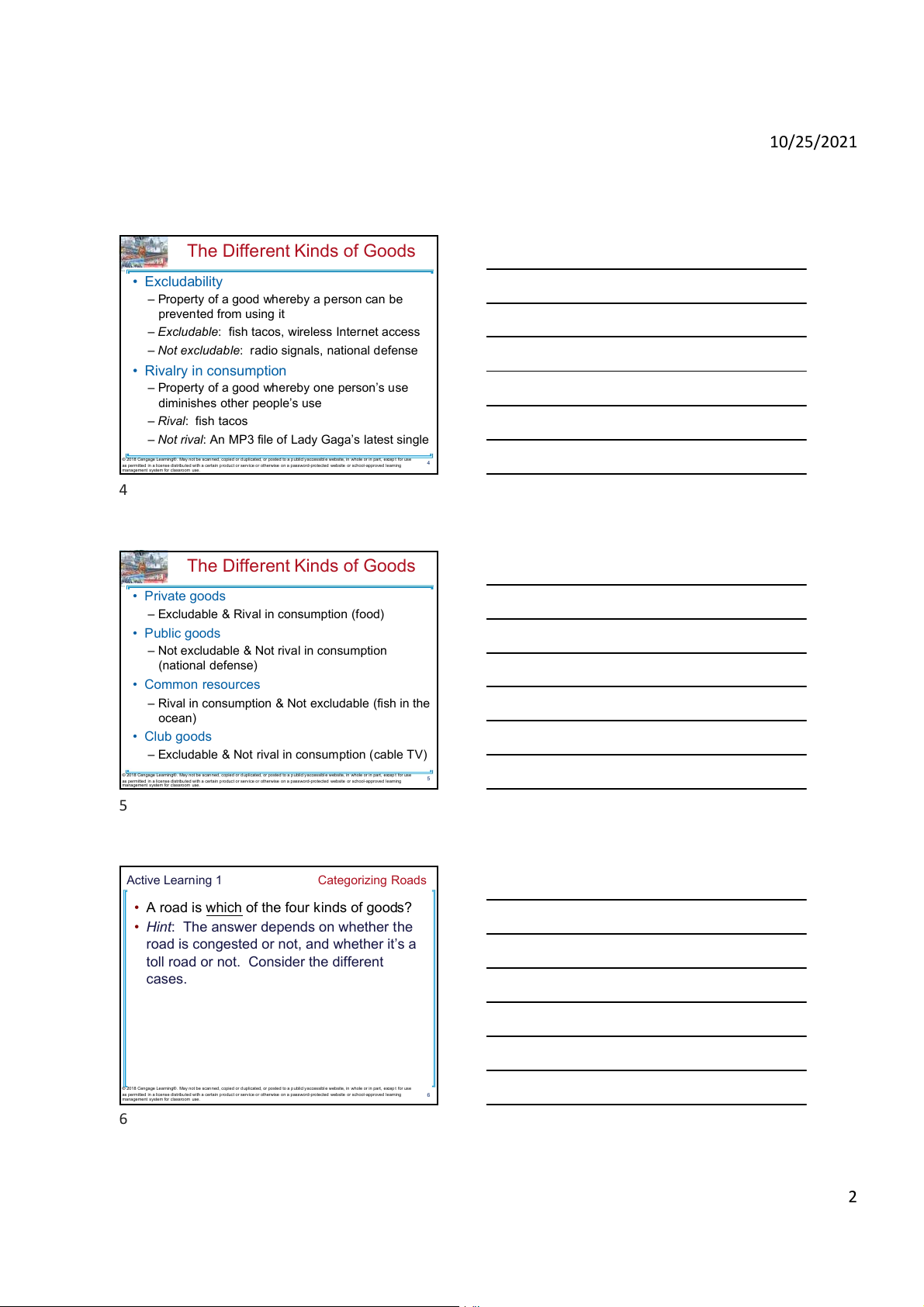
Look for the answers to these questions: • What are public goods?
• What are common resources? Give examples of each.
• Why do markets generally fail to provide the
efficient amounts of these goods?
• How might the government improve market
outcomes in the case of public goods or common resources?
© 2018 Cengage Learning® . May not be scan ned, copied or d uplicated, or posted to a p ublicl y accessible website, in whole or in p art, except for use
as permitted in a license distribu ted with a certain p roduct or service or otherwise on a password-protected website or school-approved l earning 2 2 Introduction
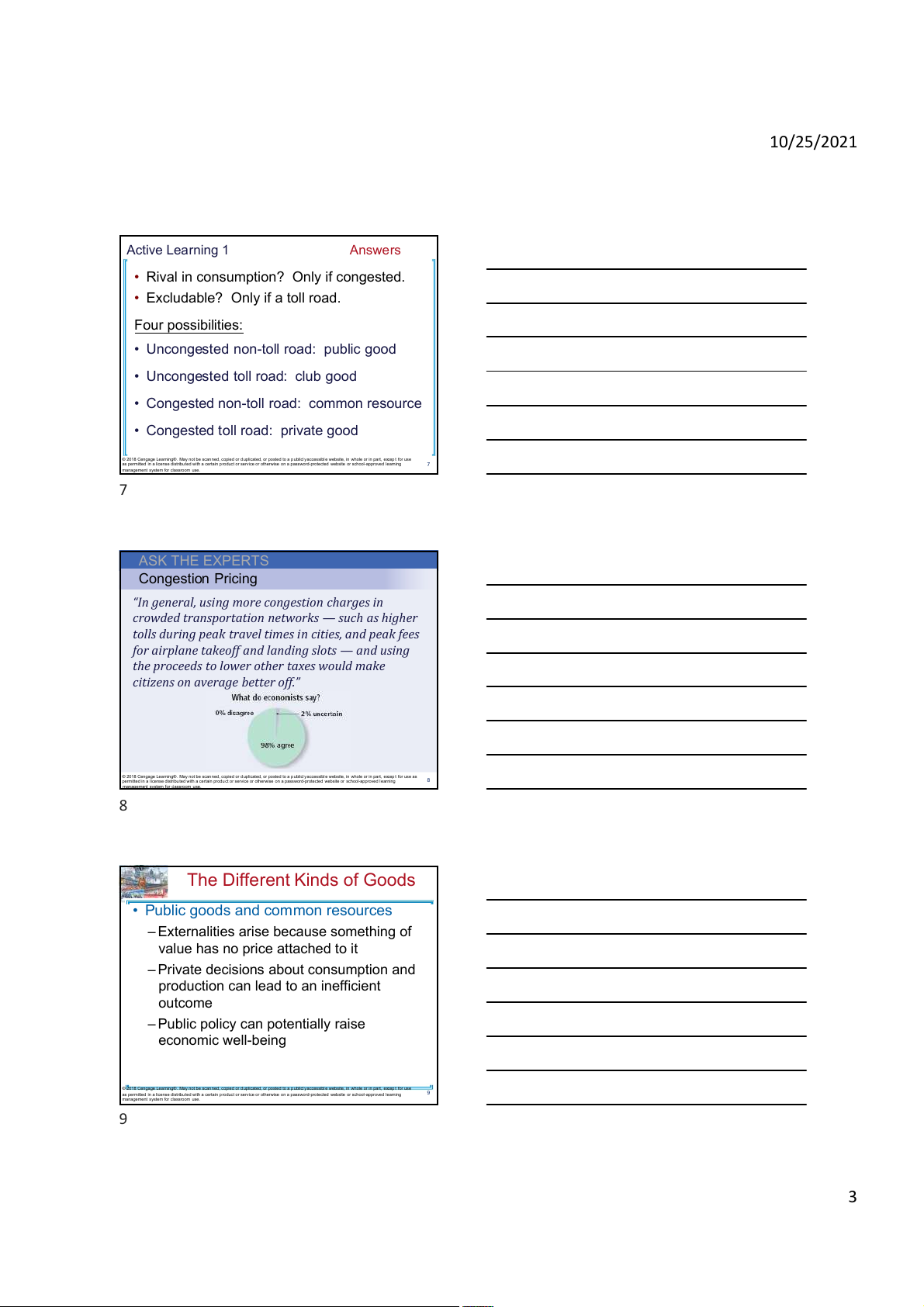
• We consume many goods without paying:
– Parks, national defense, clean air & water
– When goods have no prices, the market
forces that normally allocate resources are absent
– The private market may fail to provide the
socially efficient quantity of such goods
• ‘Governments can sometimes improve market outcomes’
© 2018 Cengage Learning® . May not be scan ned, copied or d uplicated, or posted to a p ublicl y accessible website, in whole or in p art, except for use 3
as permitted in a license distribu ted with a certain p roduct or service or otherwise on a password-protected website or school-approved l earning
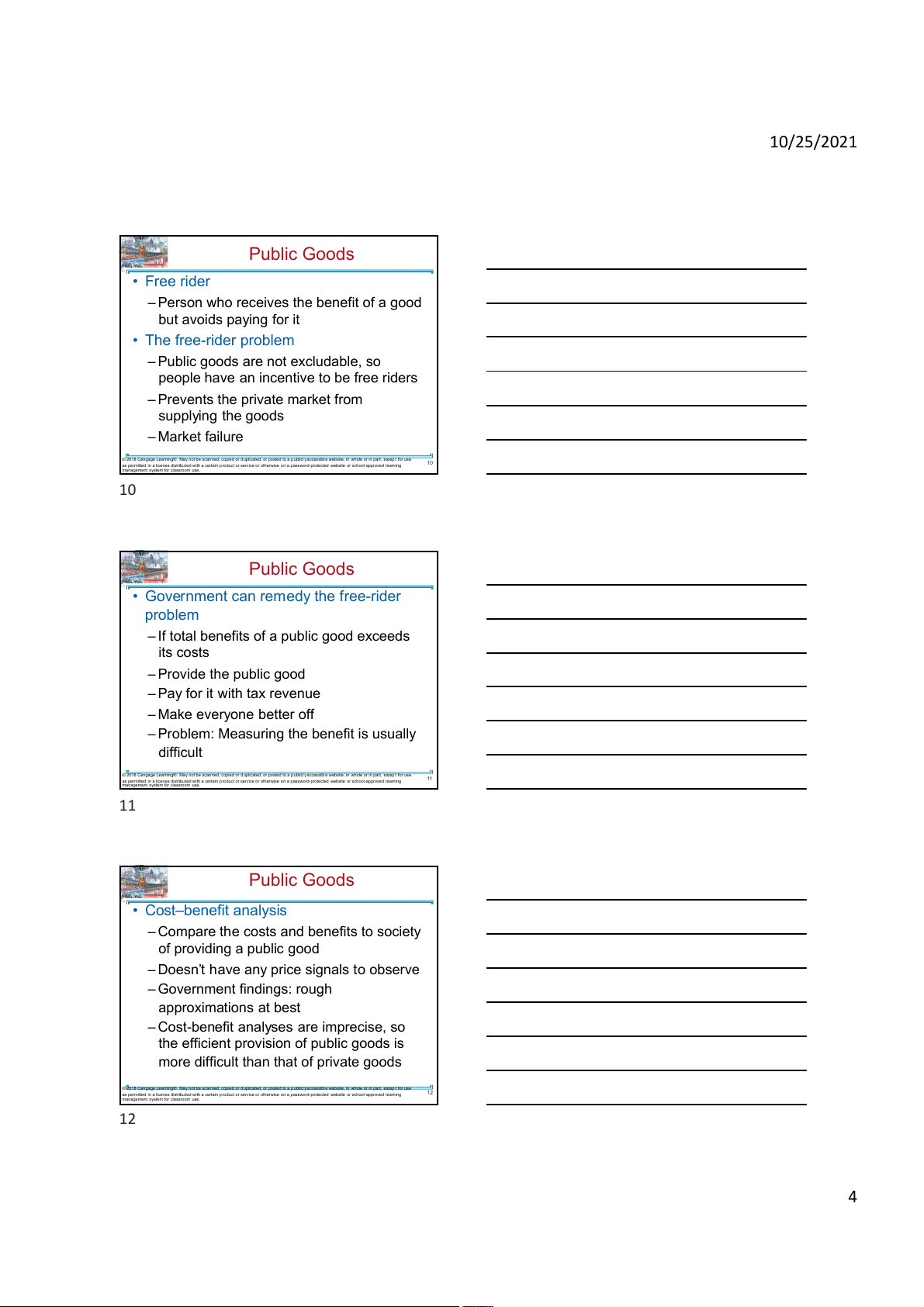
management system for classroom use. 3 1 10/25/2021 The Different Kinds of Goods • Excludability
– Property of a good whereby a person can be prevented from using it
– Excludable: fish tacos, wireless Internet access
– Not excludable: radio signals, national defense • Rivalry in consumption
– Property of a good whereby one person’s use
diminishes other people’s use – Rival: fish tacos
– Not rival: An MP3 file of Lady Gaga’s latest single
© 2018 Cengage Learning® . May not be scan ned, copied or d uplicated, or posted to a p ublicl y accessibl e website, in whole or in part, excep t for use 4
as permitted in a license distribu ted with a certain p roduct or service or otherwise on a password-protected website or school-approved l earning
management system for classroom use. 4 The Different Kinds of Goods • Private goods
– Excludable & Rival in consumption (food) • Public goods
– Not excludable & Not rival in consumption (national defense) • Common resources
– Rival in consumption & Not excludable (fish in the ocean) • Club goods
– Excludable & Not rival in consumption (cable TV)
© 2018 Cengage Learning® . May not be scan ned, copied or d uplicated, or posted to a p ublicl y accessibl e website, in whole or in part, excep t for use 5
as permitted in a license distribu ted with a certain p roduct or service or otherwise on a password-protected website or school-approved l earning
management system for classroom use. 5 Active Learning 1 Categorizing Roads
• A road is which of the four kinds of goods?
• Hint: The answer depends on whether the
road is congested or not, and whether it’s a
toll road or not. Consider the different cases.
© 2018 Cengage Learning® . May not be scan ned, copied or d uplicated, or posted to a p ublicl y accessibl e website, in whole or in part, excep t for use
as permitted in a license distribu ted with a certain p roduct or service or otherwise on a password-protected website or school-approved l earning 6
management system for classroom use. 6 2 10/25/2021 Active Learning 1 Answers
• Rival in consumption? Only if congested.
• Excludable? Only if a toll road. Four possibilities:
• Uncongested non-tol road: public good
• Uncongested toll road: club good
• Congested non-toll road: common resource
• Congested toll road: private good
© 2018 Cengage Learning® . May not be scan ned, copied or d uplicated, or posted to a p ublicl y accessibl e website, in whole or in part, excep t for use
as permitted in a license distribu ted with a certain p roduct or service or otherwise on a password-protected website or school-approved l earning 7
management system for classroom use. 7 ASK THE EXPERTS Congestion Pricing
“In general, using more congestion charges in
crowded transportation networks — such as higher
tolls during peak travel times in cities, and peak fees
for airplane takeoff and landing slots — and using
the proceeds to lower other taxes would make
citizens on average better off.”
© 2018 Cengage Learning® . May not be scan ned, copied or d uplicated, or posted to a p ublicl y accessibl e website, in whole or in part, excep t for use as
permitted in a l icense distribu ted with a certain produ ct or service or otherwise on a password-protected website or school-approved l earning 8 8 The Different Kinds of Goods
• Public goods and common resources
– Externalities arise because something of
value has no price attached to it
– Private decisions about consumption and
production can lead to an inefficient outcome
– Public policy can potentially raise economic well-being
© 2018 Cengage Learning® . May not be scan ned, copied or d uplicated, or posted to a p ublicl y accessibl e website, in whole or in part, excep t for use 9
as permitted in a license distribu ted with a certain p roduct or service or otherwise on a password-protected website or school-approved l earning
management system for classroom use. 9 3 10/25/2021 Public Goods • Free rider
– Person who receives the benefit of a good but avoids paying for it • The free-rider problem
– Public goods are not excludable, so
people have an incentive to be free riders
– Prevents the private market from supplying the goods – Market failure
© 2018 Cengage Learning® . May not be scan ned, copied or d uplicated, or posted to a p ublicl y accessibl e website, in whole or in part, excep t for use 10
as permitted in a license distribu ted with a certain p roduct or service or otherwise on a password-protected website or school-approved l earning
management system for classroom use. 10 Public Goods
• Government can remedy the free-rider problem
– If total benefits of a public good exceeds its costs – Provide the public good
– Pay for it with tax revenue – Make everyone better off
– Problem: Measuring the benefit is usually difficult
© 2018 Cengage Learning® . May not be scan ned, copied or d uplicated, or posted to a p ublicl y accessibl e website, in whole or in part, excep t for use 11
as permitted in a license distribu ted with a certain p roduct or service or otherwise on a password-protected website or school-approved l earning
management system for classroom use. 11 Public Goods • Cost–benefit analysis
– Compare the costs and benefits to society of providing a public good
– Doesn’t have any price signals to observe
– Government findings: rough approximations at best
– Cost-benefit analyses are imprecise, so
the efficient provision of public goods is
more difficult than that of private goods
© 2018 Cengage Learning® . May not be scan ned, copied or d uplicated, or posted to a p ublicl y accessibl e website, in whole or in part, excep t for use 12
as permitted in a license distribu ted with a certain p roduct or service or otherwise on a password-protected website or school-approved l earning
management system for classroom use. 12 4 10/25/2021 Public Goods
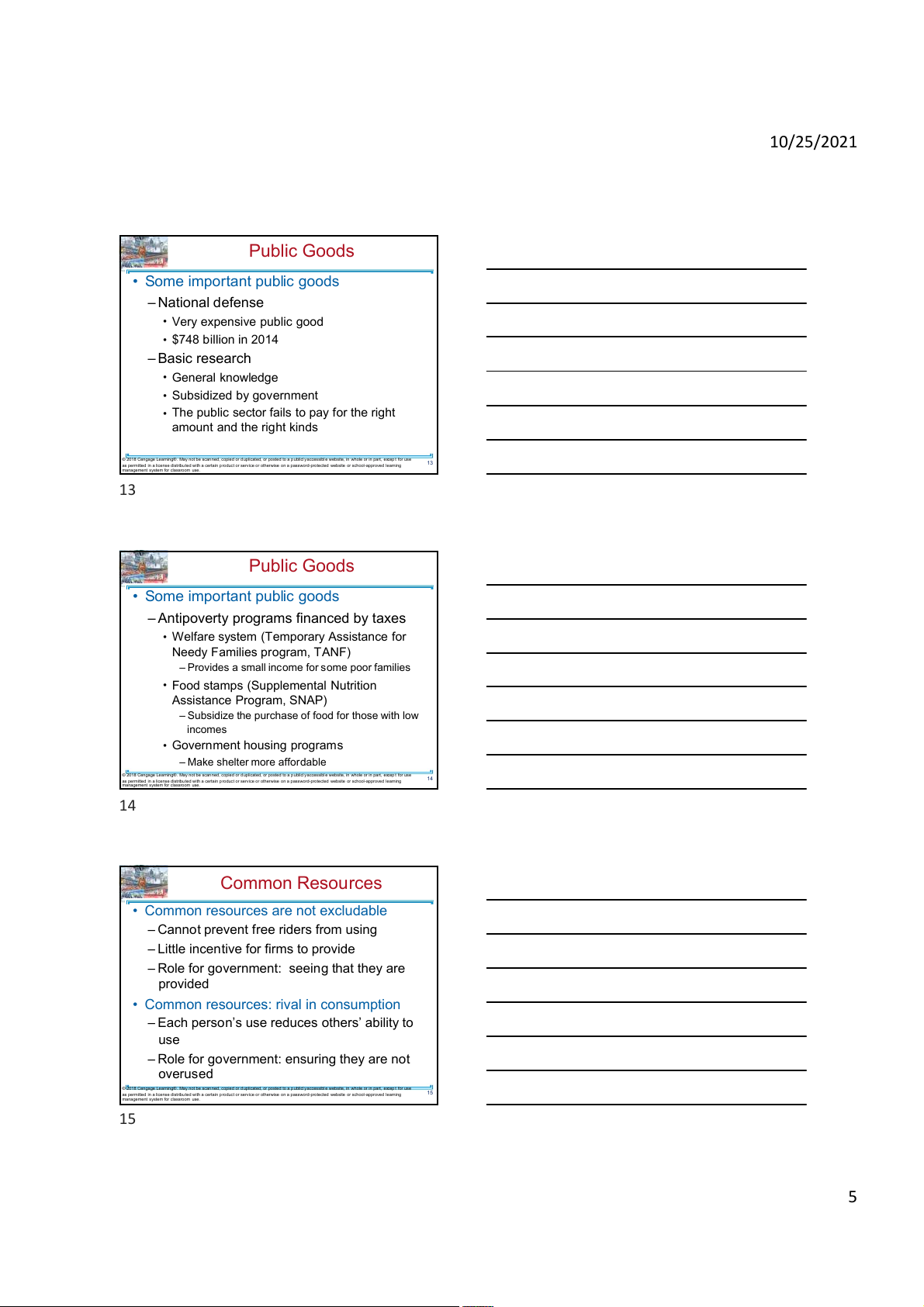
• Some important public goods – National defense • Very expensive public good • $748 billion in 2014 – Basic research • General knowledge • Subsidized by government
• The public sector fails to pay for the right amount and the right kinds
© 2018 Cengage Learning® . May not be scan ned, copied or d uplicated, or posted to a p ublicl y accessibl e website, in whole or in part, excep t for use 13
as permitted in a license distribu ted with a certain p roduct or service or otherwise on a password-protected website or school-approved l earning
management system for classroom use. 13 Public Goods
• Some important public goods
– Antipoverty programs financed by taxes
• Welfare system (Temporary Assistance for Needy Families program, TANF)
– Provides a small income for some poor families
• Food stamps (Supplemental Nutrition Assistance Program, SNAP)
– Subsidize the purchase of food for those with low incomes
• Government housing programs
– Make shelter more affordable
© 2018 Cengage Learning® . May not be scan ned, copied or d uplicated, or posted to a p ublicl y accessibl e website, in whole or in part, excep t for use 14
as permitted in a license distribu ted with a certain p roduct or service or otherwise on a password-protected website or school-approved l earning
management system for classroom use. 14 Common Resources
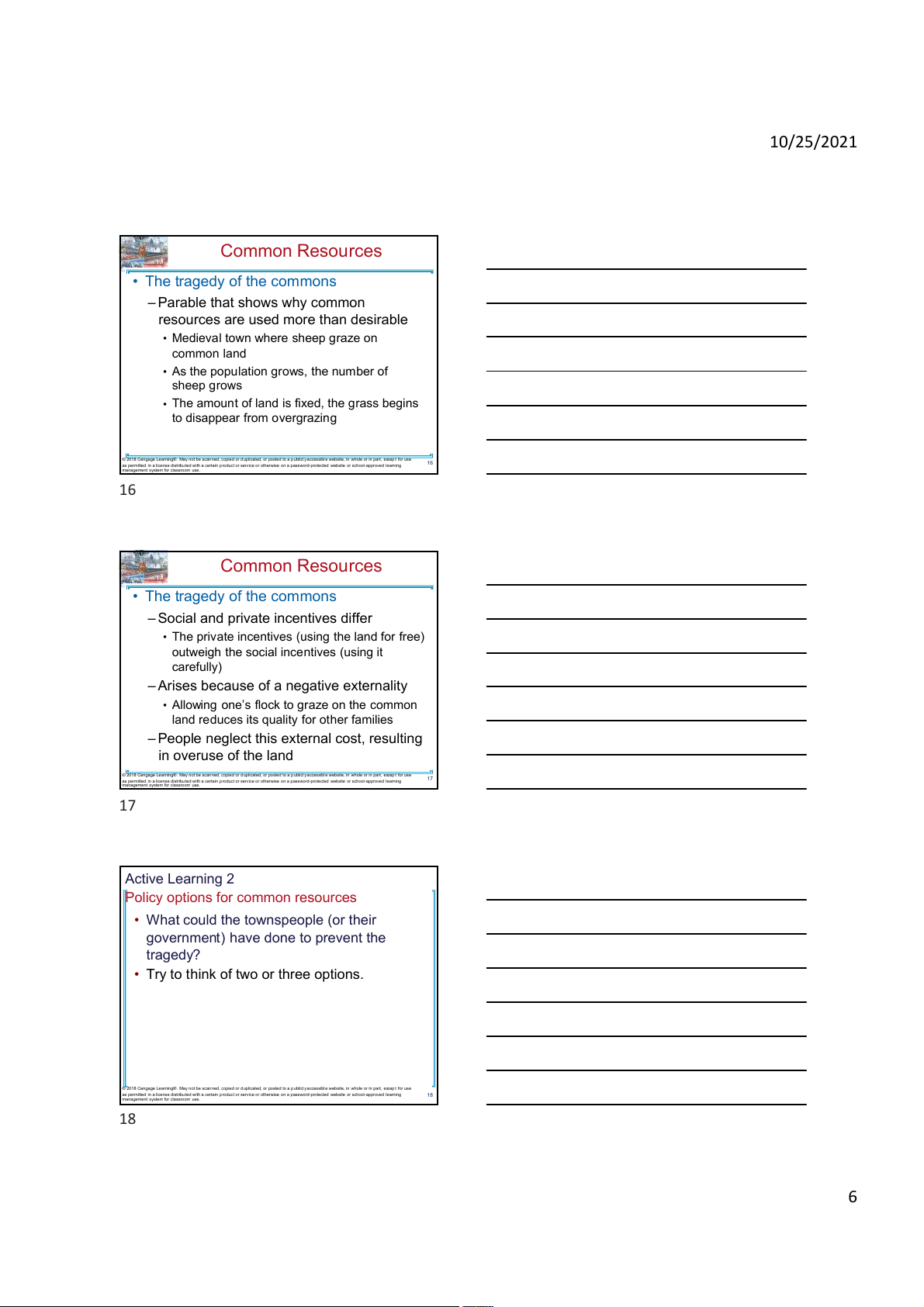
• Common resources are not excludable
– Cannot prevent free riders from using
– Little incentive for firms to provide
– Role for government: seeing that they are provided
• Common resources: rival in consumption
– Each person’s use reduces others’ ability to use
– Role for government: ensuring they are not overused
© 2018 Cengage Learning® . May not be scan ned, copied or d uplicated, or posted to a p ublicl y accessibl e website, in whole or in part, excep t for use 15
as permitted in a license distribu ted with a certain p roduct or service or otherwise on a password-protected website or school-approved l earning
management system for classroom use. 15 5 10/25/2021 Common Resources • The tragedy of the commons
– Parable that shows why common
resources are used more than desirable
• Medieval town where sheep graze on common land
• As the population grows, the number of sheep grows
• The amount of land is fixed, the grass begins to disappear from overgrazing
© 2018 Cengage Learning® . May not be scan ned, copied or d uplicated, or posted to a p ublicl y accessibl e website, in whole or in part, excep t for use 16
as permitted in a license distribu ted with a certain p roduct or service or otherwise on a password-protected website or school-approved l earning
management system for classroom use. 16 Common Resources • The tragedy of the commons
– Social and private incentives differ
• The private incentives (using the land for free)
outweigh the social incentives (using it carefully)
– Arises because of a negative externality
• Allowing one’s flock to graze on the common
land reduces its quality for other families
– People neglect this external cost, resulting in overuse of the land
© 2018 Cengage Learning® . May not be scan ned, copied or d uplicated, or posted to a p ublicl y accessibl e website, in whole or in part, excep t for use 17
as permitted in a license distribu ted with a certain p roduct or service or otherwise on a password-protected website or school-approved l earning
management system for classroom use. 17 Active Learning 2
Policy options for common resources
• What could the townspeople (or their
government) have done to prevent the tragedy?
• Try to think of two or three options.
© 2018 Cengage Learning® . May not be scan ned, copied or d uplicated, or posted to a p ublicl y accessibl e website, in whole or in part, excep t for use
as permitted in a license distribu ted with a certain p roduct or service or otherwise on a password-protected website or school-approved l earning 18
management system for classroom use. 18 6 10/25/2021 Active Learning 2 Answers
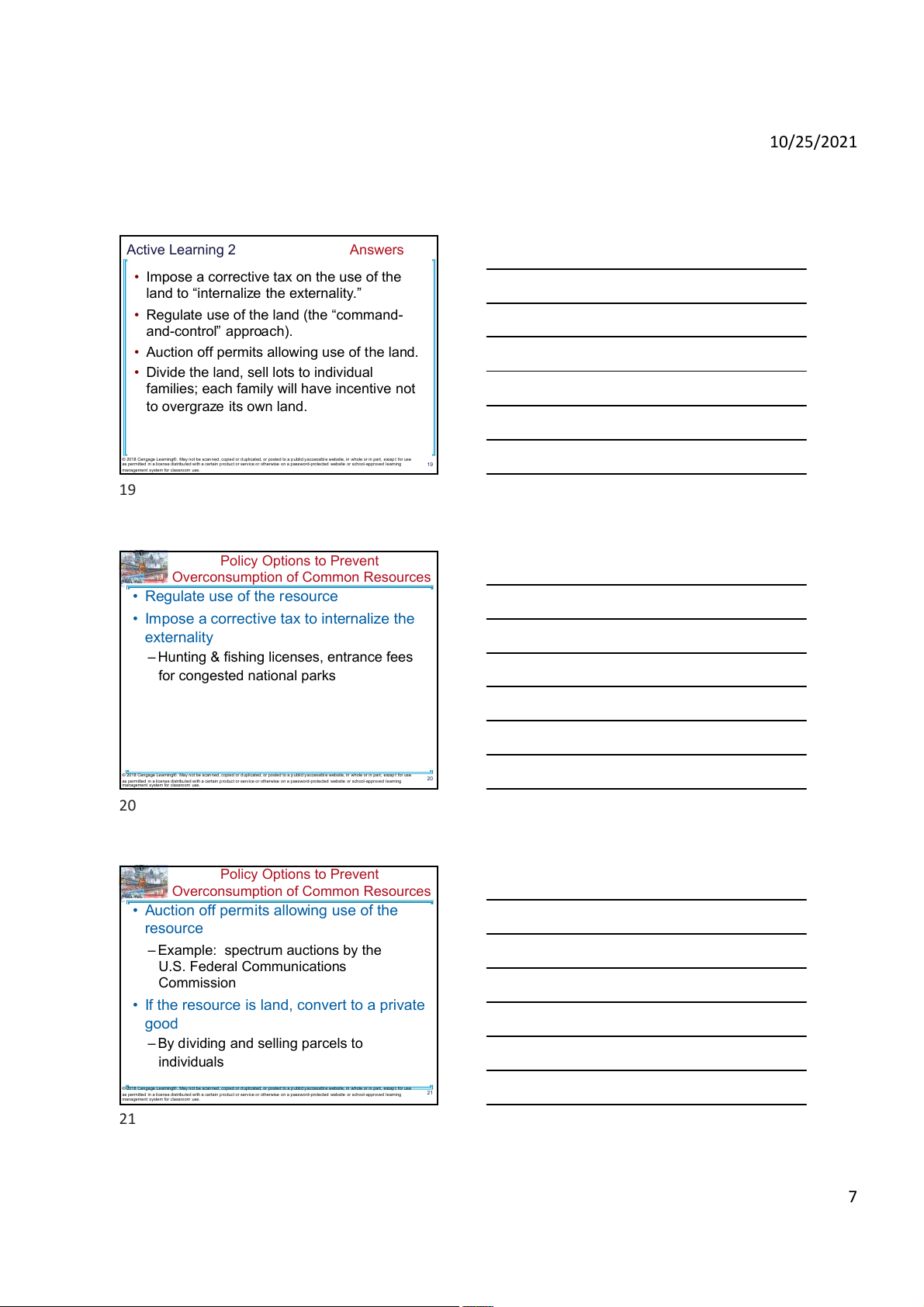
• Impose a corrective tax on the use of the
land to “internalize the externality.”
• Regulate use of the land (the “command- and-control” approach).
• Auction off permits allowing use of the land.
• Divide the land, sell lots to individual
families; each family will have incentive not to overgraze its own land.
© 2018 Cengage Learning® . May not be scan ned, copied or d uplicated, or posted to a p ublicl y accessibl e website, in whole or in part, excep t for use
as permitted in a license distribu ted with a certain p roduct or service or otherwise on a password-protected website or school-approved l earning 19
management system for classroom use. 19 Policy Options to Prevent
Overconsumption of Common Resources
• Regulate use of the resource
• Impose a corrective tax to internalize the externality
– Hunting & fishing licenses, entrance fees for congested national parks
© 2018 Cengage Learning® . May not be scan ned, copied or d uplicated, or posted to a p ublicl y accessibl e website, in whole or in part, excep t for use 20
as permitted in a license distribu ted with a certain p roduct or service or otherwise on a password-protected website or school-approved l earning
management system for classroom use. 20 Policy Options to Prevent
Overconsumption of Common Resources
• Auction off permits allowing use of the resource
– Example: spectrum auctions by the U.S. Federal Communications Commission
• If the resource is land, convert to a private good
– By dividing and selling parcels to individuals
© 2018 Cengage Learning® . May not be scan ned, copied or d uplicated, or posted to a p ublicl y accessibl e website, in whole or in part, excep t for use 21
as permitted in a license distribu ted with a certain p roduct or service or otherwise on a password-protected website or school-approved l earning
management system for classroom use. 21 7 10/25/2021 Common Resources
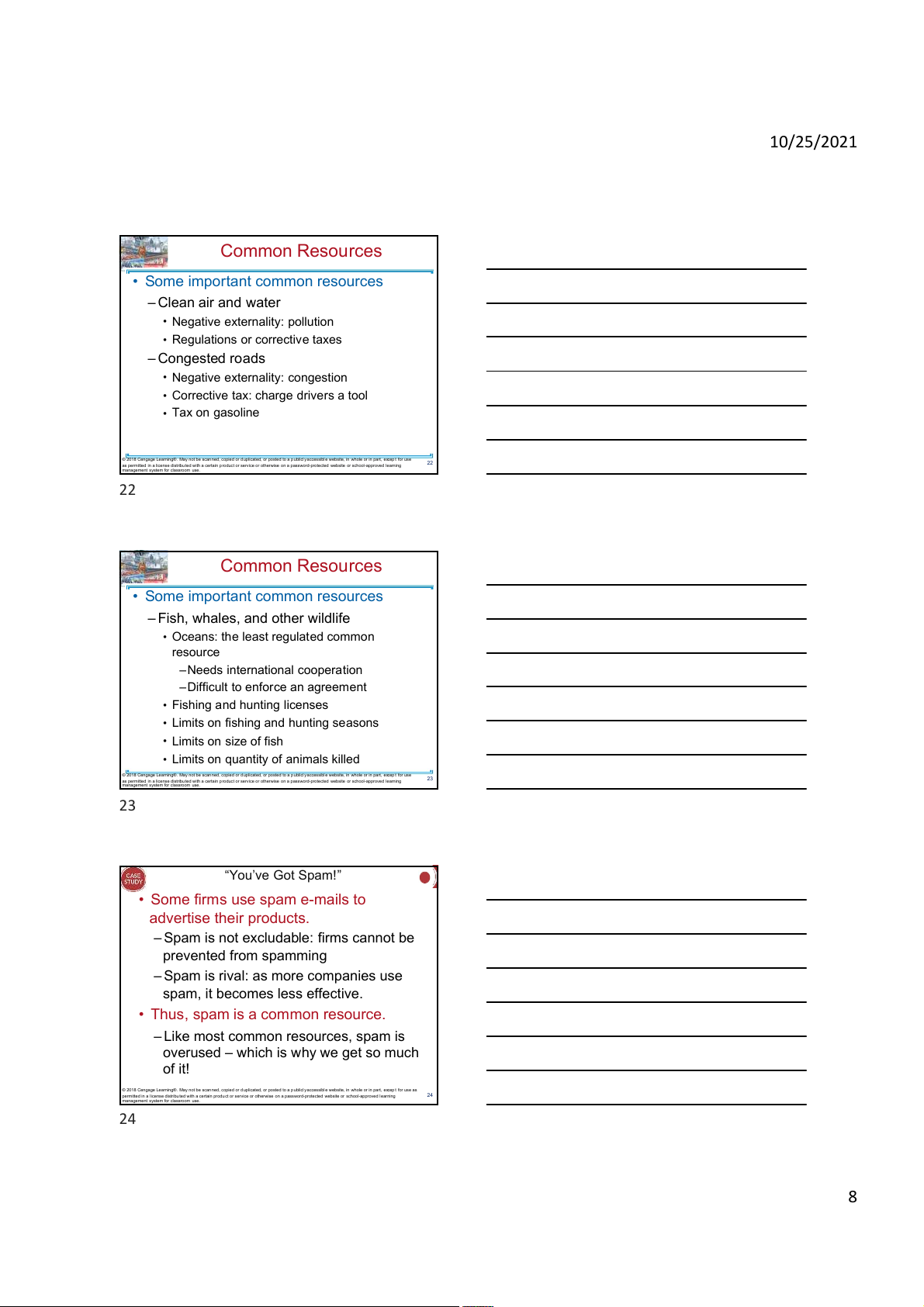
• Some important common resources – Clean air and water
• Negative externality: pollution
• Regulations or corrective taxes – Congested roads
• Negative externality: congestion
• Corrective tax: charge drivers a tool • Tax on gasoline
© 2018 Cengage Learning® . May not be scan ned, copied or d uplicated, or posted to a p ublicl y accessibl e website, in whole or in part, excep t for use 22
as permitted in a license distribu ted with a certain p roduct or service or otherwise on a password-protected website or school-approved l earning
management system for classroom use. 22 Common Resources
• Some important common resources
– Fish, whales, and other wildlife
• Oceans: the least regulated common resource
–Needs international cooperation
–Difficult to enforce an agreement
• Fishing and hunting licenses
• Limits on fishing and hunting seasons • Limits on size of fish
• Limits on quantity of animals killed
© 2018 Cengage Learning® . May not be scan ned, copied or d uplicated, or posted to a p ublicl y accessibl e website, in whole or in part, excep t for use 23
as permitted in a license distribu ted with a certain p roduct or service or otherwise on a password-protected website or school-approved l earning
management system for classroom use. 23 “You’ve Got Spam!”
• Some firms use spam e-mails to advertise their products.
– Spam is not excludable: firms cannot be prevented from spamming
– Spam is rival: as more companies use
spam, it becomes less effective.
• Thus, spam is a common resource.
– Like most common resources, spam is
overused – which is why we get so much of it!
© 2018 Cengage Learning® . May not be scan ned, copied or d uplicated, or posted to a p ublicl y accessibl e website, in whole or in part, excep t for use as
permitted in a l icense distribu ted with a certain produ ct or service or otherwise on a password-protected website or school-approved l earning 24
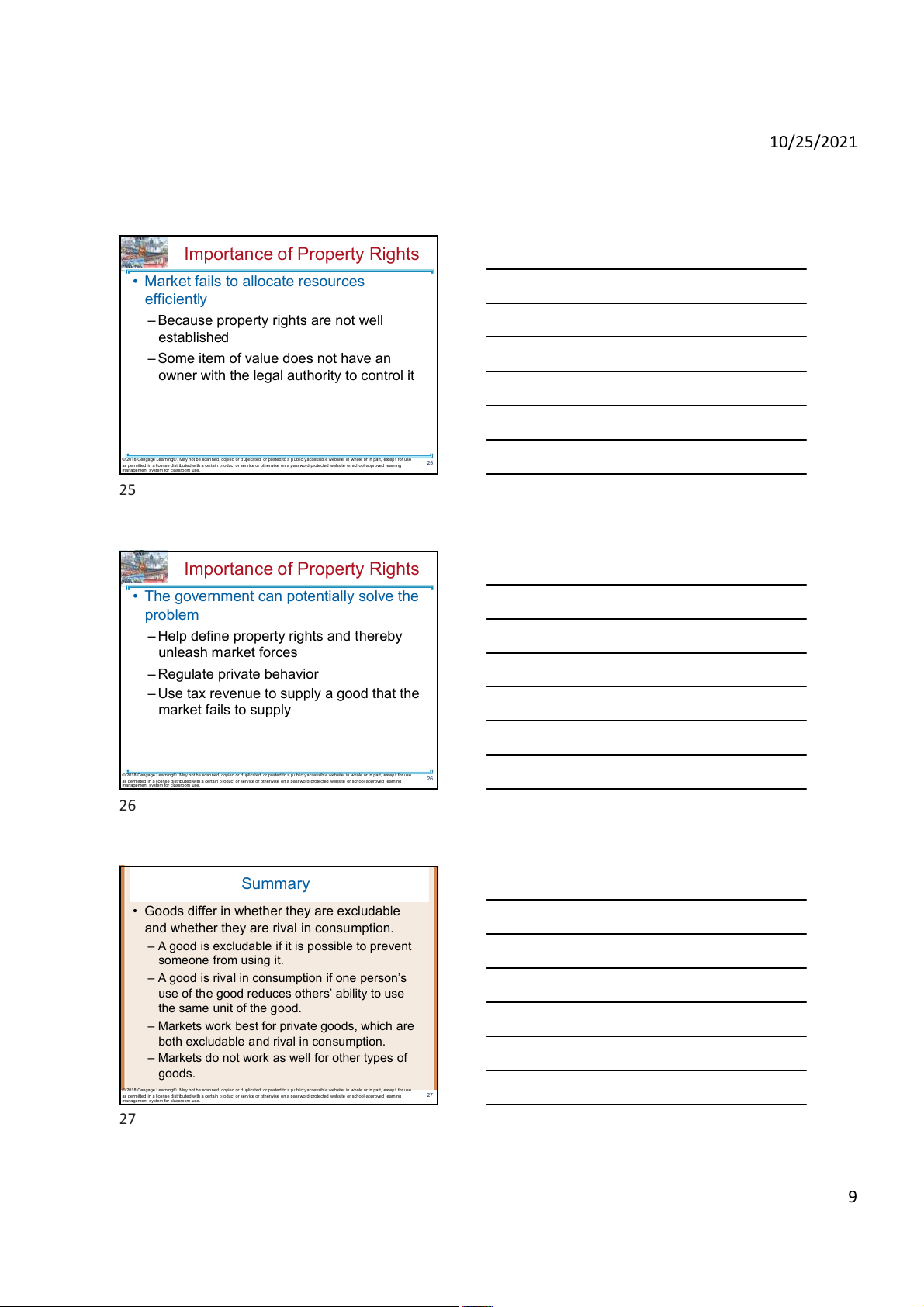
management system for classroom use. 24 8 10/25/2021 Importance of Property Rights
• Market fails to allocate resources efficiently
– Because property rights are not well established
– Some item of value does not have an
owner with the legal authority to control it
© 2018 Cengage Learning® . May not be scan ned, copied or d uplicated, or posted to a p ublicl y accessibl e website, in whole or in part, excep t for use 25
as permitted in a license distribu ted with a certain p roduct or service or otherwise on a password-protected website or school-approved l earning
management system for classroom use. 25 Importance of Property Rights
• The government can potentially solve the problem
– Help define property rights and thereby unleash market forces – Regulate private behavior
– Use tax revenue to supply a good that the market fails to supply
© 2018 Cengage Learning® . May not be scan ned, copied or d uplicated, or posted to a p ublicl y accessibl e website, in whole or in part, excep t for use 26
as permitted in a license distribu ted with a certain p roduct or service or otherwise on a password-protected website or school-approved l earning
management system for classroom use. 26 Summary
• Goods differ in whether they are excludable
and whether they are rival in consumption.
– A good is excludable if it is possible to prevent someone from using it.
– A good is rival in consumption if one person’s
use of the good reduces others’ ability to use the same unit of the good.
– Markets work best for private goods, which are
both excludable and rival in consumption.
– Markets do not work as well for other types of goods.
© 2018 Cengage Learning® . May not be scan ned, copied or d uplicated, or posted to a p ublicl y accessibl e website, in whole or in part, excep t for use
as permitted in a license distribu ted with a certain p roduct or service or otherwise on a password-protected website or school-approved l earning 27
management system for classroom use. 27 9 10/25/2021 Summary
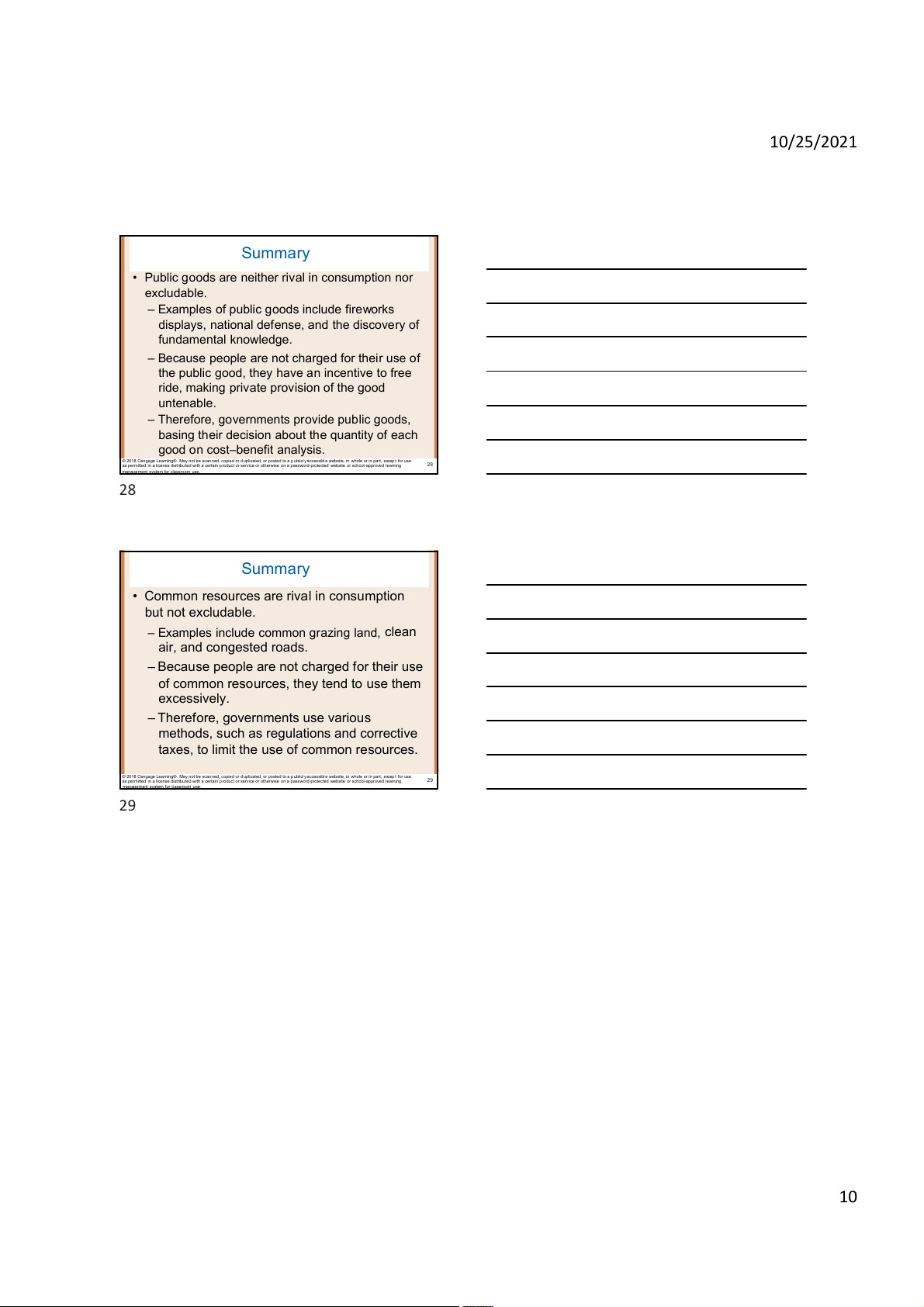
• Public goods are neither rival in consumption nor excludable.
– Examples of public goods include fireworks
displays, national defense, and the discovery of fundamental knowledge.
– Because people are not charged for their use of
the public good, they have an incentive to free
ride, making private provision of the good untenable.
– Therefore, governments provide public goods,
basing their decision about the quantity of each
good on cost–benefit analysis.
© 2018 Cengage Learning® . May not be scan ned, copied or d uplicated, or posted to a p ublicl y accessibl e website, in whole or in part, excep t for use
as permitted in a license distribu ted with a certain p roduct or service or otherwise on a password-protected website or school-approved l earning 28
management system for classroom use. 28 Summary
• Common resources are rival in consumption but not excludable.
– Examples include common grazing land, clean air, and congested roads.
– Because people are not charged for their use
of common resources, they tend to use them excessively.
– Therefore, governments use various
methods, such as regulations and corrective
taxes, to limit the use of common resources.
© 2018 Cengage Learning® . May not be scan ned, copied or d uplicated, or posted to a p ublicl y accessibl e website, in whole or in part, excep t for use
as permitted in a license distribu ted with a certain p roduct or service or otherwise on a password-protected website or school-approved l earning 29 29 10
Tài liệu liên quan:
-
Chương 3: độ co giãn và các nhân tố ảnh hưởng | Microeconomics | Trường Đại học Quốc tế, Đại học Quốc gia Thành phố Hồ Chí Minh
4 2 -
Microeconomics Syllabus | Microeconomics | Trường Đại học Quốc tế, Đại học Quốc gia Thành phố Hồ Chí Minh
4 2 -
Microeconomics Course Syllabus & Assessment Details | Microeconomics | Trường Đại học Quốc tế, Đại học Quốc gia Thành phố Hồ Chí Minh
4 2 -
Assignment 3 - Elasticity MCQs and Key Concepts | Microeconomics | Trường Đại học Quốc tế, Đại học Quốc gia Thành phố Hồ Chí Minh
4 2 -
Assignment 2 - Economic Equilibrium Analysis of Fridges and Motorcycles | Microeconomics | Trường Đại học Quốc tế, Đại học Quốc gia Thành phố Hồ Chí Minh
4 2