Principle of Econ HW1 (Solutions & Analysis of Key Concepts) | Microeconomics | Trường Đại học Quốc tế, Đại học Quốc gia Thành phố Hồ Chí Minh
You can either stand during a college football game or you can sit. You believe that you will see the game very well if you stand and others sit but that you will not be able to see at all if you sit and others stand. You therefore decide to stand. 2. Your friend tells you that he expects many people to stand at football games. Tài liệu được sưu tầm và soạn thảo dưới dạng file PDF để gửi tới các bạn cùng tham khảo, ôn tập đầy đủ kiến thức, chuẩn bị cho các buổi học thật tốt. Mời bạn đọc đón xem!
Môn: Microeconomics 635 tài liệu
Trường: Trường Đại học Quốc tế, Đại học Quốc gia Thành phố Hồ Chí Minh 1.9 K tài liệu
Tác giả:

Preview text:
Principle of Economics Homework 1 October 1, 2021 Problem 1
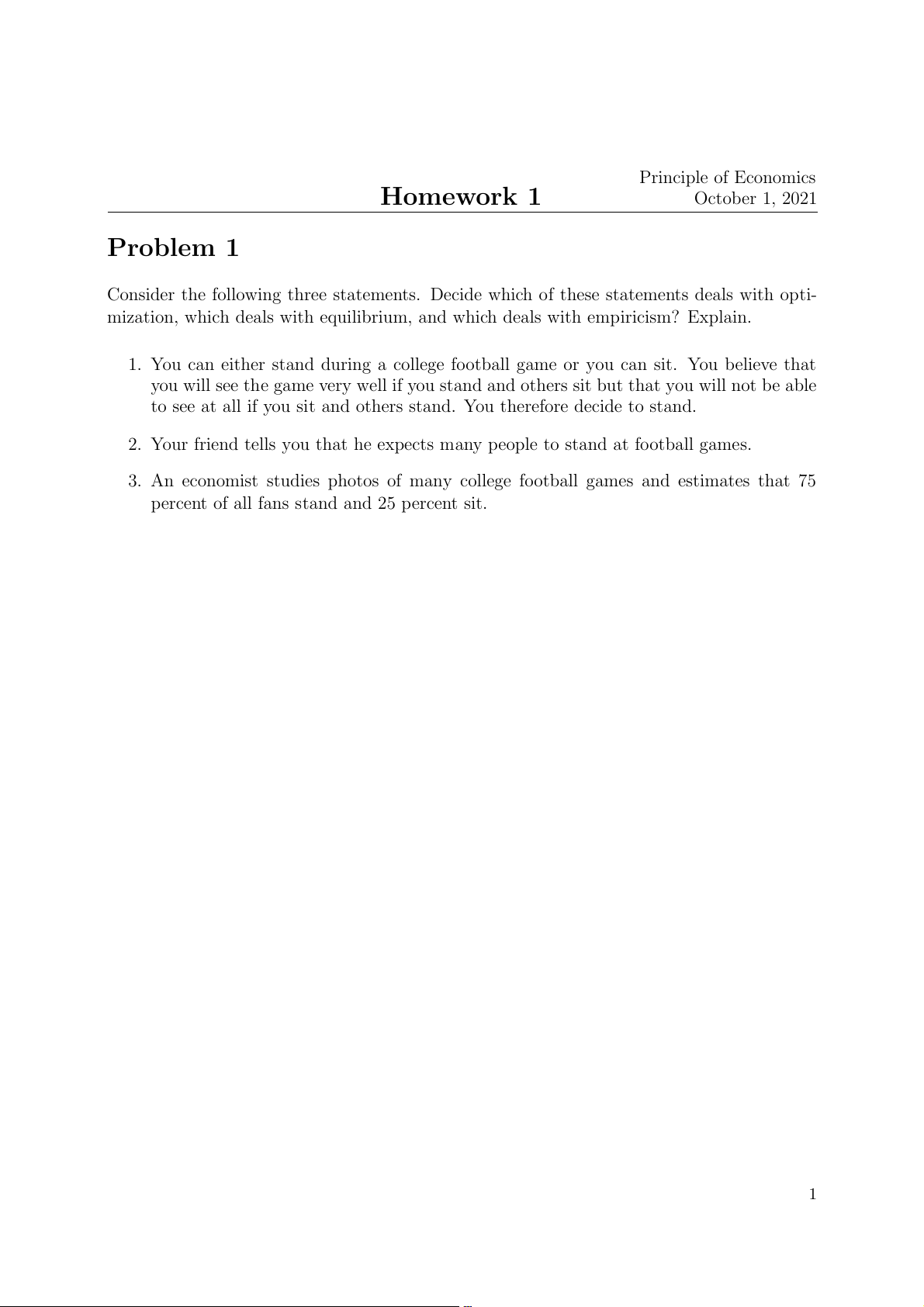
Consider the following three statements. Decide which of these statements deals with opti-
mization, which deals with equilibrium, and which deals with empiricism? Explain.
1. You can either stand during a college football game or you can sit. You believe that
you will see the game very well if you stand and others sit but that you will not be able
to see at all if you sit and others stand. You therefore decide to stand.
2. Your friend tells you that he expects many people to stand at football games.
3. An economist studies photos of many college football games and estimates that 75
percent of all fans stand and 25 percent sit. 1 Principle of Economics Homework 1 October 1, 2021 Problem 2
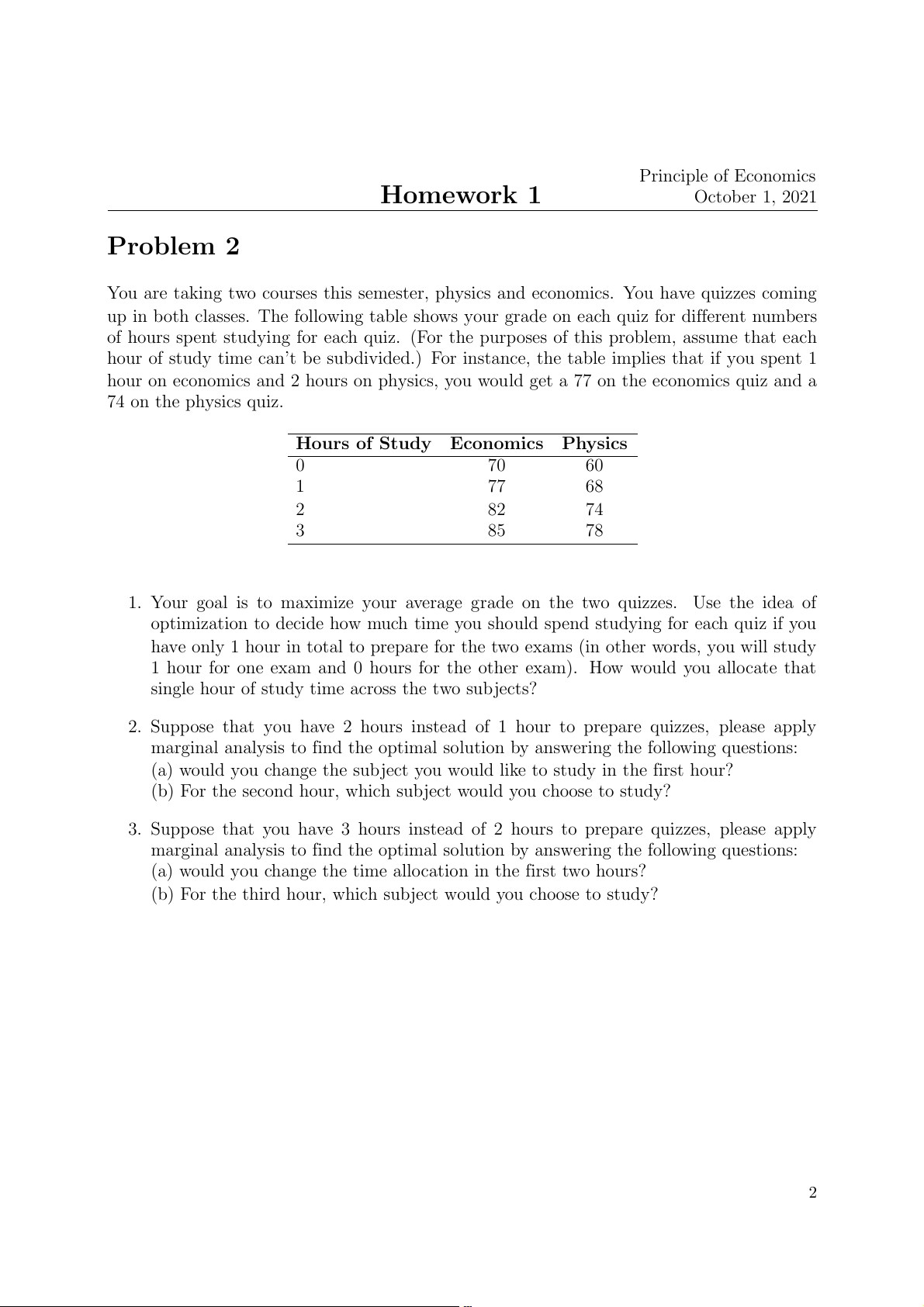
You are taking two courses this semester, physics and economics. You have quizzes coming
up in both classes. The following table shows your grade on each quiz for different numbers
of hours spent studying for each quiz. (For the purposes of this problem, assume that each
hour of study time can’t be subdivided.) For instance, the table implies that if you spent 1
hour on economics and 2 hours on physics, you would get a 77 on the economics quiz and a 74 on the physics quiz. Hours of Study Economics Physics 0 70 60 1 77 68 2 82 74 3 85 78
1. Your goal is to maximize your average grade on the two quizzes. Use the idea of
optimization to decide how much time you should spend studying for each quiz if you
have only 1 hour in total to prepare for the two exams (in other words, you will study
1 hour for one exam and 0 hours for the other exam). How would you allocate that
single hour of study time across the two subjects?
2. Suppose that you have 2 hours instead of 1 hour to prepare quizzes, please apply
marginal analysis to find the optimal solution by answering the following questions:
(a) would you change the subject you would like to study in the first hour?
(b) For the second hour, which subject would you choose to study?
3. Suppose that you have 3 hours instead of 2 hours to prepare quizzes, please apply
marginal analysis to find the optimal solution by answering the following questions:
(a) would you change the time allocation in the first two hours?
(b) For the third hour, which subject would you choose to study? 2 Principle of Economics Homework 1 October 1, 2021 Problem 3
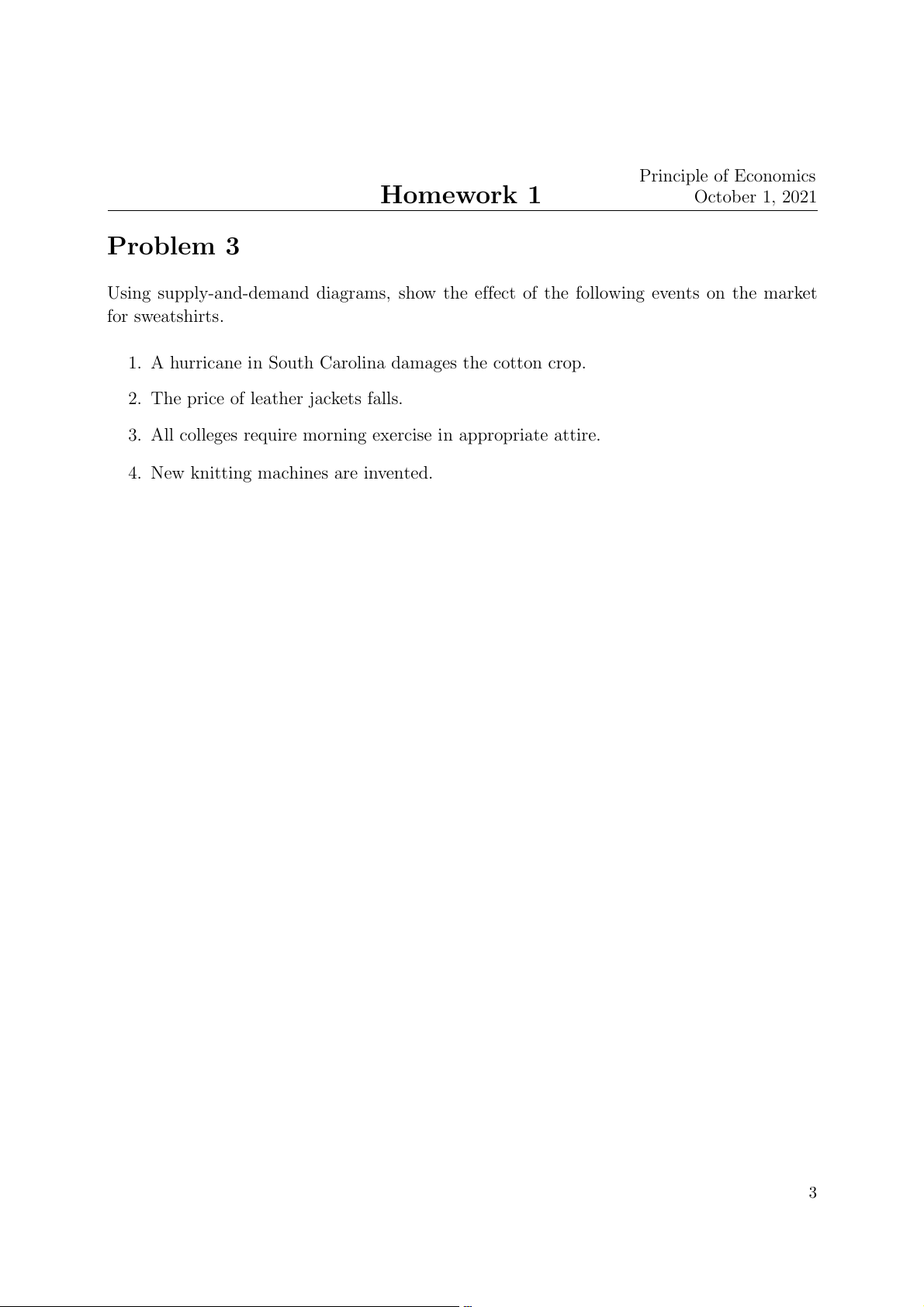
Using supply-and-demand diagrams, show the effect of the following events on the market for sweatshirts.
1. A hurricane in South Carolina damages the cotton crop.
2. The price of leather jackets falls.
3. All colleges require morning exercise in appropriate attire.
4. New knitting machines are invented. 3 Principle of Economics Homework 1 October 1, 2021 Problem 4
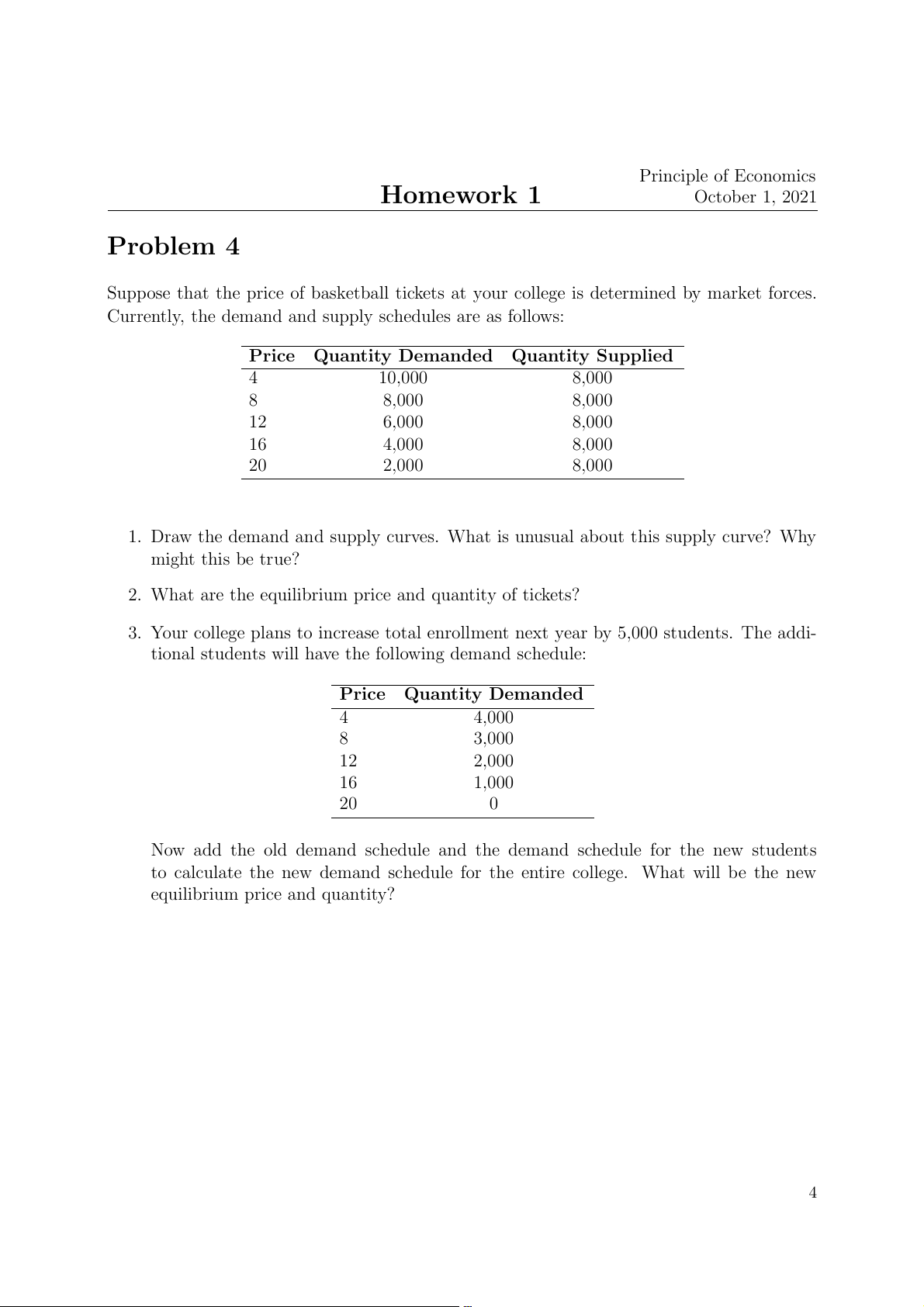
Suppose that the price of basketball tickets at your college is determined by market forces.
Currently, the demand and supply schedules are as follows: Price Quantity Demanded Quantity Supplied 4 10,000 8,000 8 8,000 8,000 12 6,000 8,000 16 4,000 8,000 20 2,000 8,000
1. Draw the demand and supply curves. What is unusual about this supply curve? Why might this be true?
2. What are the equilibrium price and quantity of tickets?
3. Your college plans to increase total enrollment next year by 5,000 students. The addi-
tional students will have the following demand schedule: Price Quantity Demanded 4 4,000 8 3,000 12 2,000 16 1,000 20 0
Now add the old demand schedule and the demand schedule for the new students
to calculate the new demand schedule for the entire college. What will be the new
equilibrium price and quantity? 4 Principle of Economics Homework 1 October 1, 2021 Suggested Solution Problem 1
1. The first statement involves optimization. You believe that you will be best off if you
stand regardless of the decisions other people make.
2. The second statement involves equilibrium. If many other people also reason as you
did then we should expect many people will decide to stand.
3. The third statement involves empiricism. Our theory tells us that we should expect
many people to stand at games. This economist’s empirical study supports the theory. Problem 2
1. If you had just one hour, you should study physics since you would raise your physics
grade by 68 – 60 = 8 points; if instead you studied economics you would raise your
economics grade by just 77 – 70 = 7.
2. Since the marginal benefit for studying physics is greater than economics, you should
study physics in the first hour. If you had a second hour, you should study economics
since you would raise your economics grade by 77 – 70 = 7; if instead you studied
physics for a second hour you would raise your physics grade by just 74 – 68 = 6.
3. Because in the first two hours, you have chosen the time use method with the highest
marginal benefit. So even if there is a third hour, you would not change the previous
time allocation. If you had a third hour, you should study physics since you would
raise your physics grade by 74 – 68 = 6; if instead you studied economics you would
raise your economics grade by just 82 – 77 = 5. 5 Principle of Economics Homework 1 October 1, 2021 Problem 3
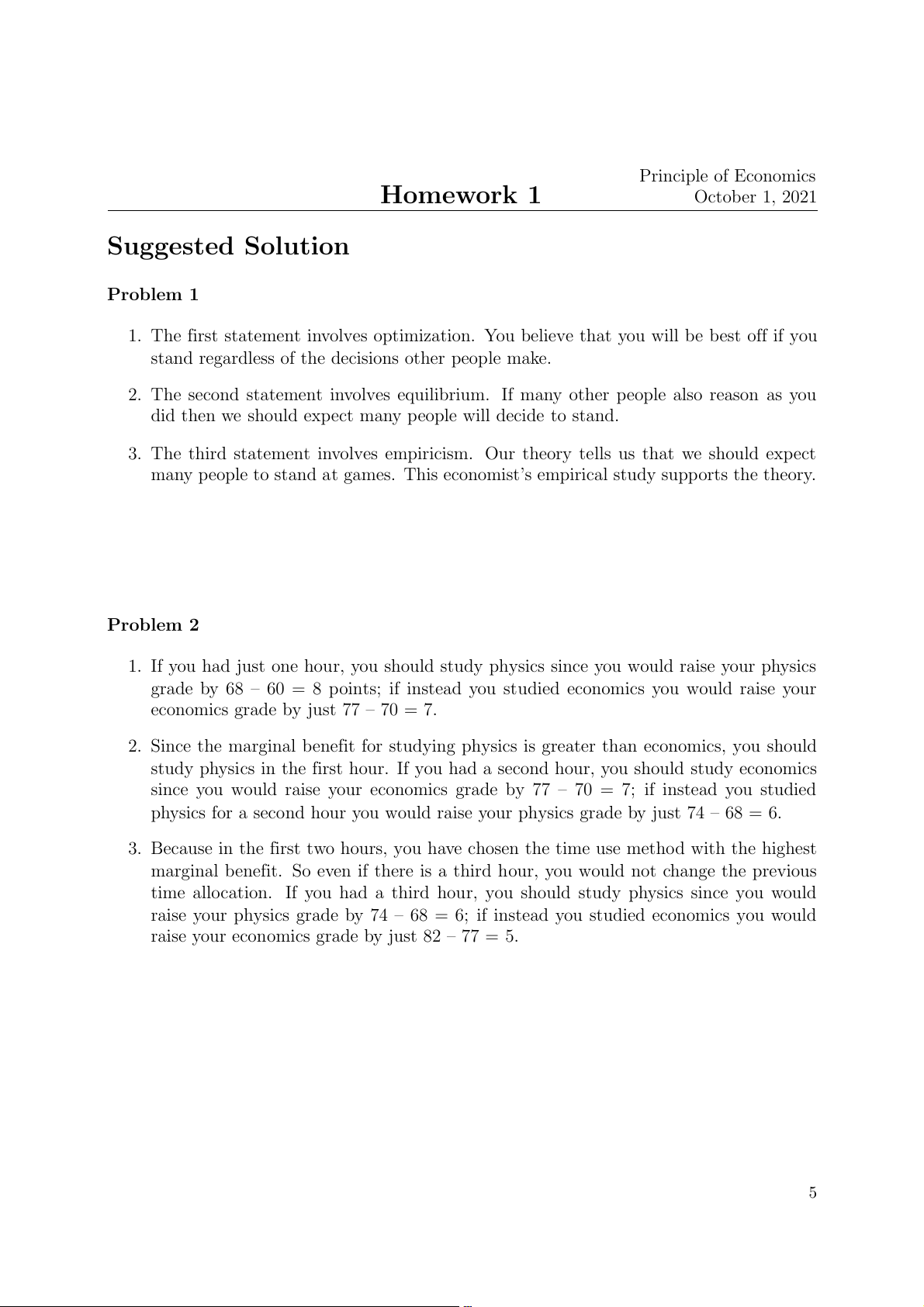
1. Cotton is the raw material for sweatshirts. Consider a hurricane in South Carolina that
damages the cotton crop. The price of cotton will increase and the manufacturing cost
of sweatshirts will also increase. Producers will reduce the supply of sweatshirts at a
high cost of production. With demand being constant, a decrease in supply leads to an
increase in the price of sweatshirts. As a result, the supply of sweatshirts shifts to the left, as shown in the figure.
The supply of sweatshirts decreases and is shown by a leftward shift in the supply curve
from S1 to S2. The quantity decreases from Q1 to Q2, and the price increases from P1 to P2.
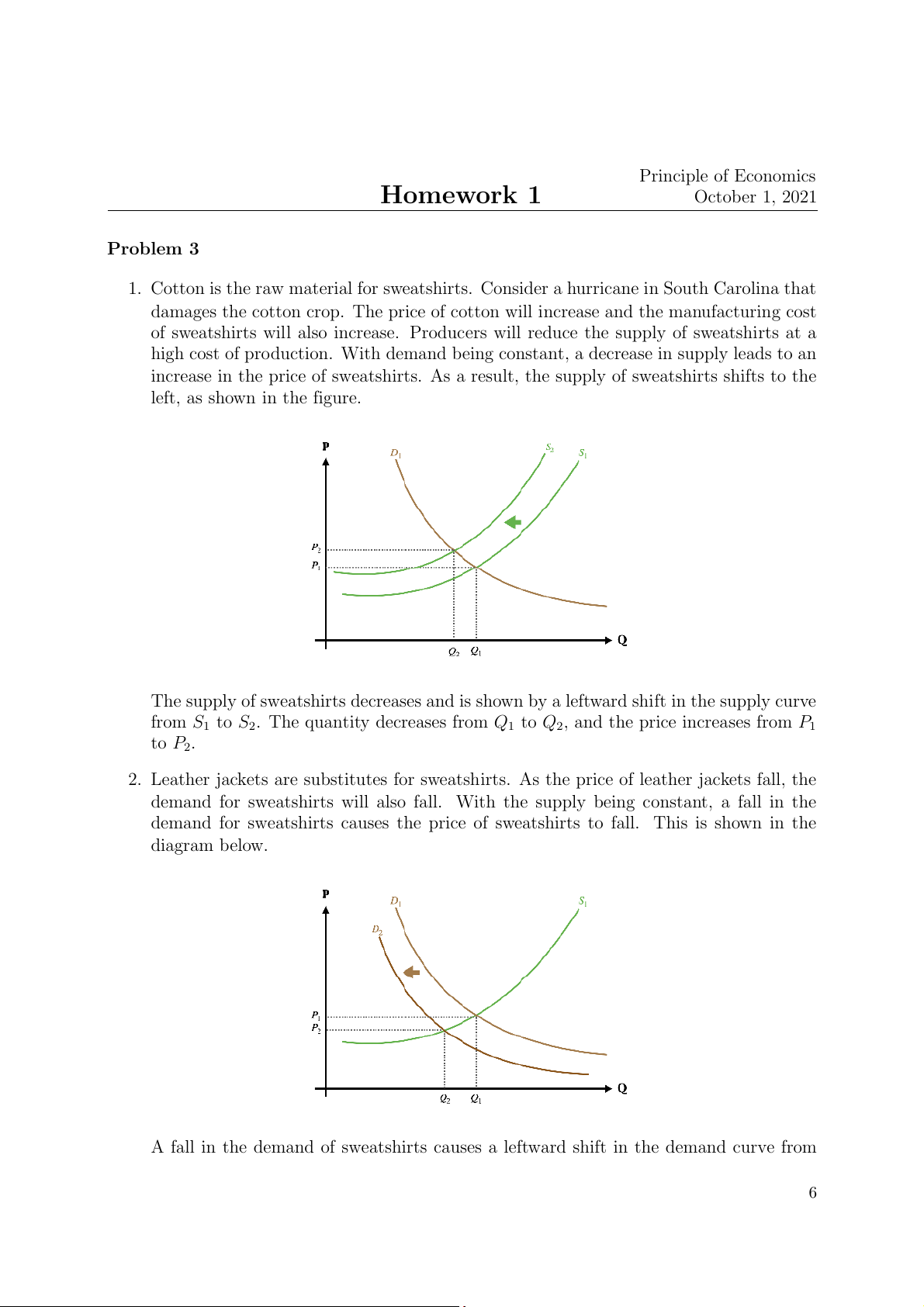
2. Leather jackets are substitutes for sweatshirts. As the price of leather jackets fall, the
demand for sweatshirts will also fall. With the supply being constant, a fall in the
demand for sweatshirts causes the price of sweatshirts to fall. This is shown in the diagram below.
A fall in the demand of sweatshirts causes a leftward shift in the demand curve from 6 Principle of Economics Homework 1 October 1, 2021 D D 1 to
2. With the supply being constant, a fall in the demand decreases the price
from P1 to P2. The quantity decreases from Q1 to Q2.
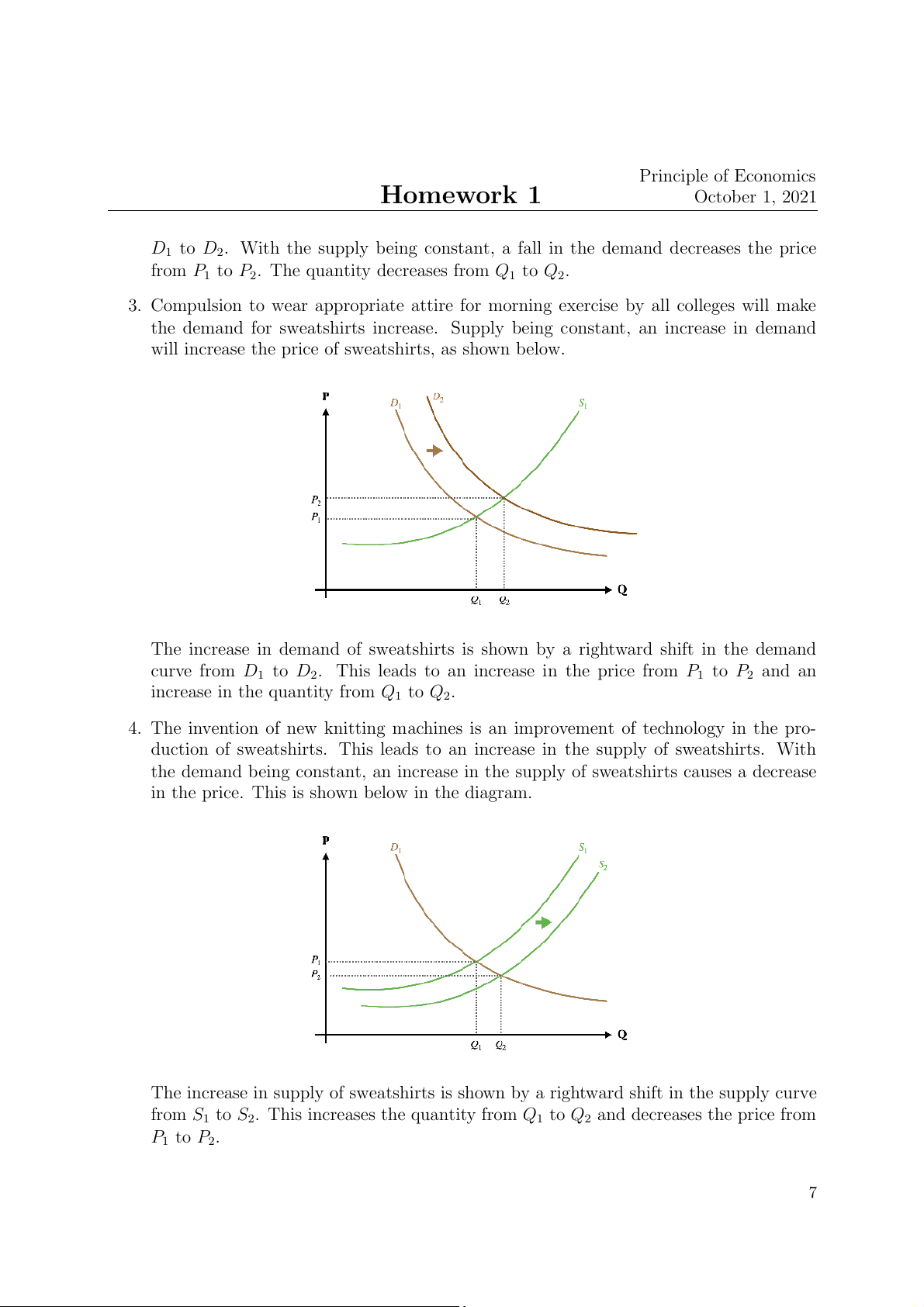
3. Compulsion to wear appropriate attire for morning exercise by all colleges will make
the demand for sweatshirts increase. Supply being constant, an increase in demand
will increase the price of sweatshirts, as shown below.
The increase in demand of sweatshirts is shown by a rightward shift in the demand
curve from D1 to D2. This leads to an increase in the price from P1 to P2 and an
increase in the quantity from Q1 to Q2.
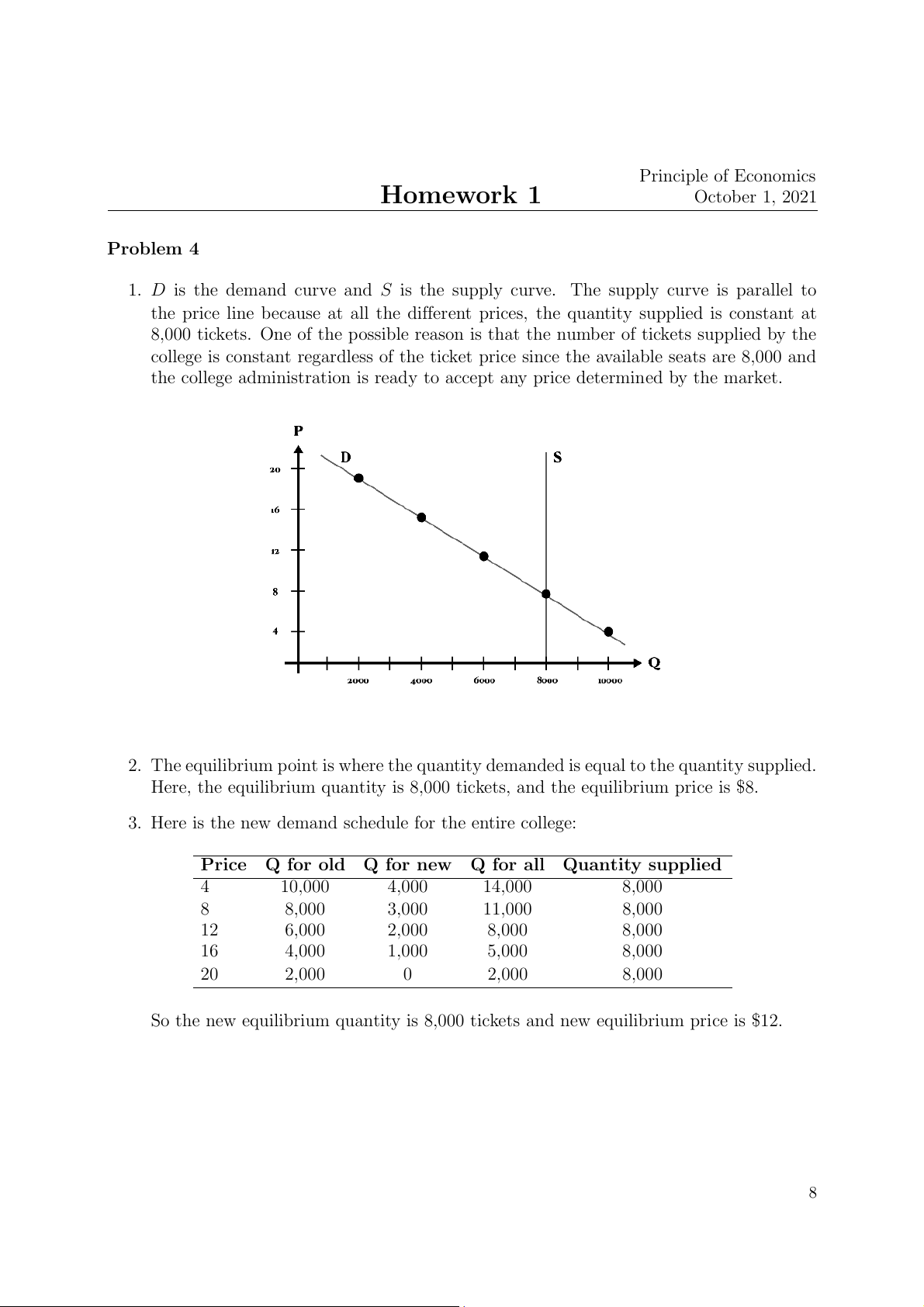
4. The invention of new knitting machines is an improvement of technology in the pro-
duction of sweatshirts. This leads to an increase in the supply of sweatshirts. With
the demand being constant, an increase in the supply of sweatshirts causes a decrease
in the price. This is shown below in the diagram.
The increase in supply of sweatshirts is shown by a rightward shift in the supply curve
from S1 to S2. This increases the quantity from Q1 to Q2 and decreases the price from P1 to P2. 7 Principle of Economics Homework 1 October 1, 2021 Problem 4
1. D is the demand curve and S is the supply curve. The supply curve is parallel to
the price line because at all the different prices, the quantity supplied is constant at
8,000 tickets. One of the possible reason is that the number of tickets supplied by the
college is constant regardless of the ticket price since the available seats are 8,000 and
the college administration is ready to accept any price determined by the market.
2. The equilibrium point is where the quantity demanded is equal to the quantity supplied.
Here, the equilibrium quantity is 8,000 tickets, and the equilibrium price is $8.
3. Here is the new demand schedule for the entire college: Price Q for old Q for new Q for all Quantity supplied 4 10,000 4,000 14,000 8,000 8 8,000 3,000 11,000 8,000 12 6,000 2,000 8,000 8,000 16 4,000 1,000 5,000 8,000 20 2,000 0 2,000 8,000
So the new equilibrium quantity is 8,000 tickets and new equilibrium price is $12. 8
Tài liệu liên quan:
-
Chương 3: độ co giãn và các nhân tố ảnh hưởng | Microeconomics | Trường Đại học Quốc tế, Đại học Quốc gia Thành phố Hồ Chí Minh
4 2 -
Microeconomics Syllabus | Microeconomics | Trường Đại học Quốc tế, Đại học Quốc gia Thành phố Hồ Chí Minh
4 2 -
Microeconomics Course Syllabus & Assessment Details | Microeconomics | Trường Đại học Quốc tế, Đại học Quốc gia Thành phố Hồ Chí Minh
4 2 -
Assignment 3 - Elasticity MCQs and Key Concepts | Microeconomics | Trường Đại học Quốc tế, Đại học Quốc gia Thành phố Hồ Chí Minh
4 2 -
Assignment 2 - Economic Equilibrium Analysis of Fridges and Motorcycles | Microeconomics | Trường Đại học Quốc tế, Đại học Quốc gia Thành phố Hồ Chí Minh
4 2