Principles of Economics and Scarcity | Microeconomics | Trường Đại học Quốc tế, Đại học Quốc gia Thành phố Hồ Chí Minh
Scarcity: - The limited nature of society' resources - Society has limited resources *Cannot produce all the goods and services people wish to have 1. Economics - The study of how society manages its scare resources 1. Economists study - How people decide what to buy, how much to work, save and spend - How firms decide how much to produce, how many workers to hire o so sánh: thị trường lao động ở đâu rẻ hơn thì đầu tư vào đó (compare EU vs VN). Tài liệu được sưu tầm và soạn thảo dưới dạng file PDF để gửi tới các bạn cùng tham khảo, ôn tập đầy đủ kiến thức, chuẩn bị cho các buổi học thật tốt. Mời bạn đọc đón xem!
Môn: Microeconomics 635 tài liệu
Trường: Trường Đại học Quốc tế, Đại học Quốc gia Thành phố Hồ Chí Minh 1.9 K tài liệu
Tác giả:


Preview text:
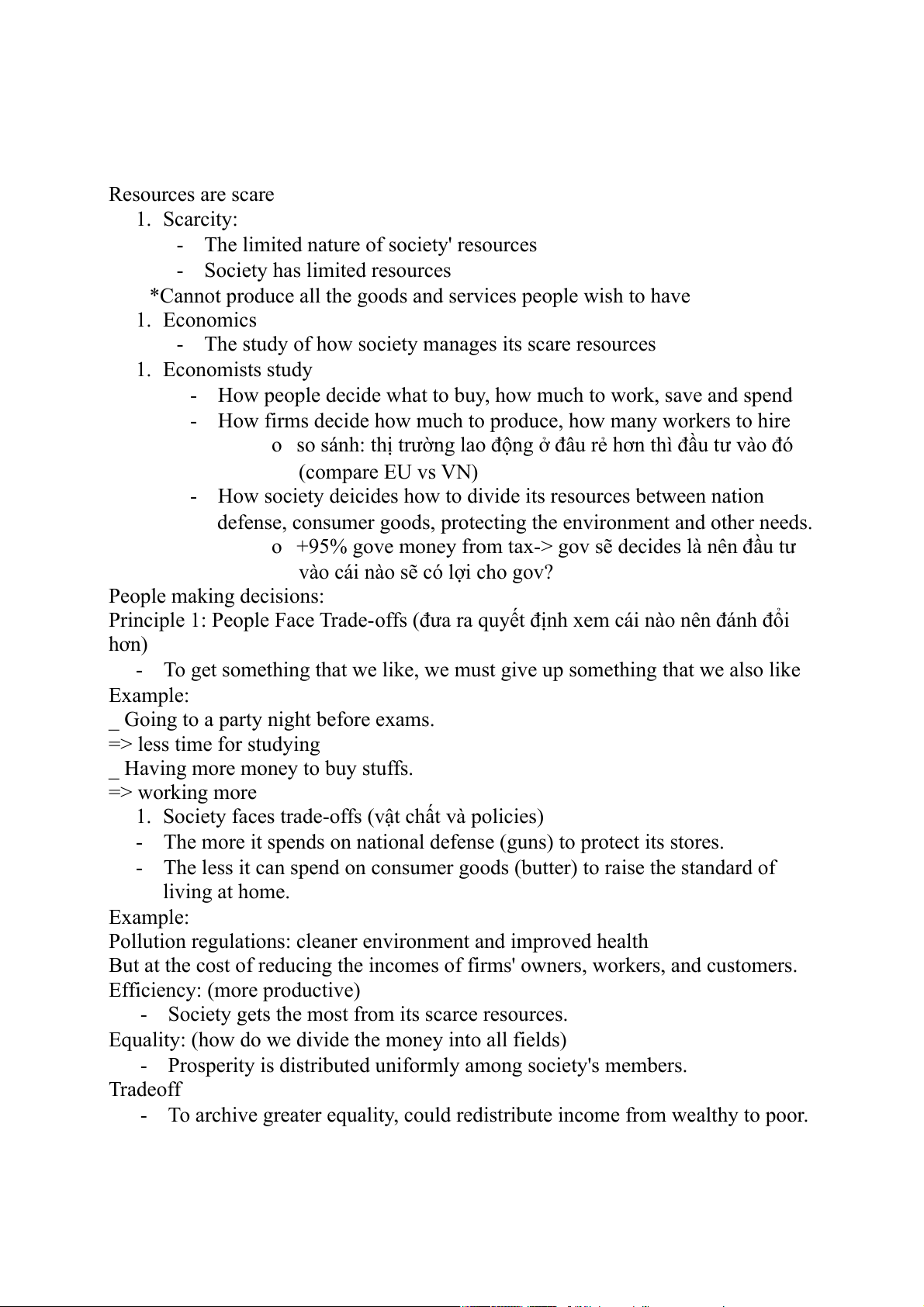
Resources are scare 1. Scarcity:
- The limited nature of society' resources
- Society has limited resources
*Cannot produce all the goods and services people wish to have 1. Economics
- The study of how society manages its scare resources 1. Economists study
- How people decide what to buy, how much to work, save and spend
- How firms decide how much to produce, how many workers to hire
o so sánh: thị trường lao động ở đâu rẻ hơn thì đầu tư vào đó (compare EU vs VN)
- How society deicides how to divide its resources between nation
defense, consumer goods, protecting the environment and other needs.
o +95% gove money from tax-> gov sẽ decides là nên đầu tư
vào cái nào sẽ có lợi cho gov? People making decisions:
Principle 1: People Face Trade-offs (đưa ra quyết định xem cái nào nên đánh đổi hơn)
- To get something that we like, we must give up something that we also like Example:
_ Going to a party night before exams. => less time for studying
_ Having more money to buy stuffs. => working more
1. Society faces trade-offs (vật chất và policies)
- The more it spends on national defense (guns) to protect its stores.
- The less it can spend on consumer goods (butter) to raise the standard of living at home. Example:
Pollution regulations: cleaner environment and improved health
But at the cost of reducing the incomes of firms' owners, workers, and customers. Efficiency: (more productive)
- Society gets the most from its scarce resources.
Equality: (how do we divide the money into all fields)
- Prosperity is distributed uniformly among society's members. Tradeoff
- To archive greater equality, could redistribute income from wealthy to poor.
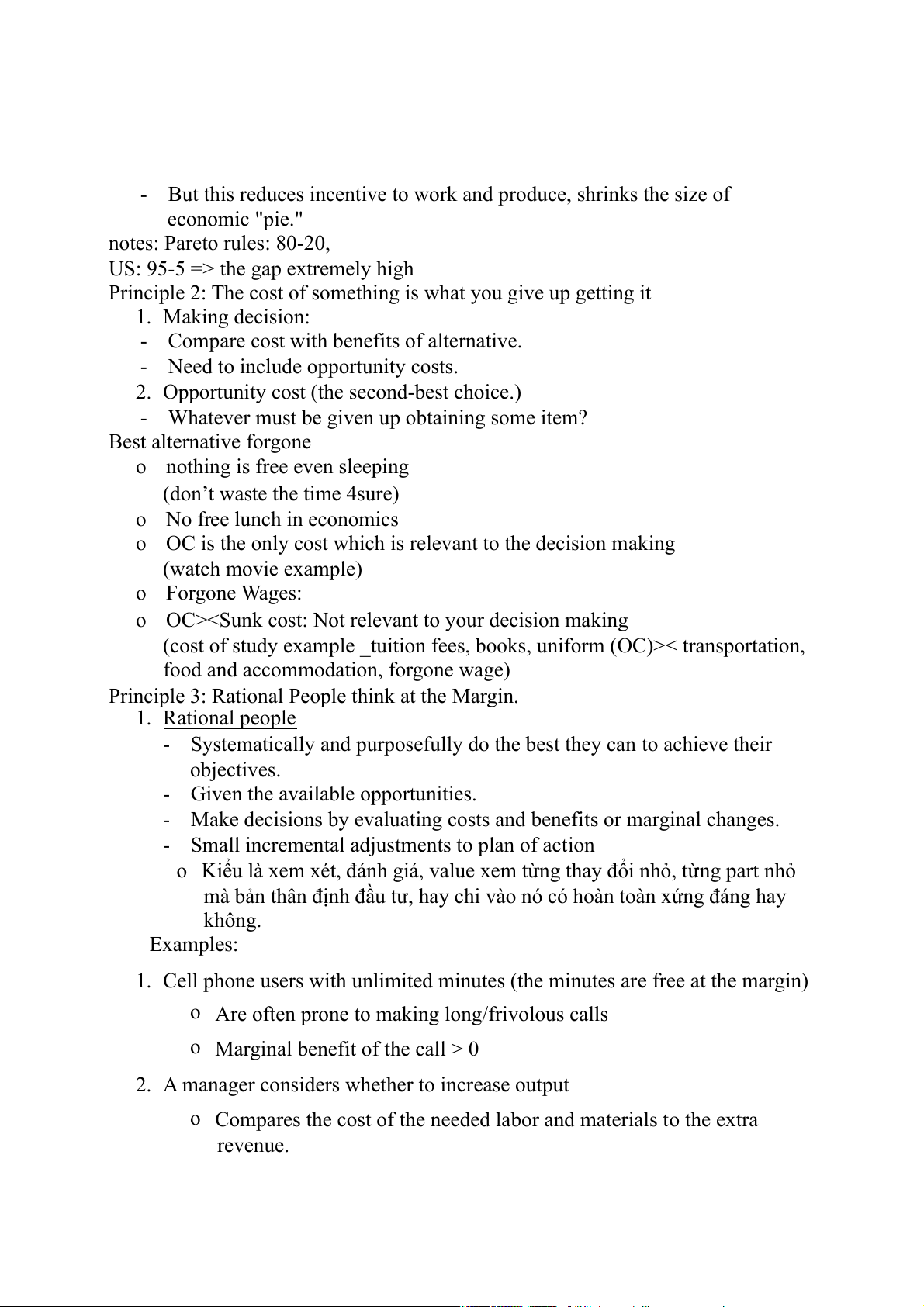
- But this reduces incentive to work and produce, shrinks the size of economic "pie." notes: Pareto rules: 80-20,
US: 95-5 => the gap extremely high
Principle 2: The cost of something is what you give up getting it 1. Making decision:
- Compare cost with benefits of alternative.
- Need to include opportunity costs.
2. Opportunity cost (the second-best choice.)
- Whatever must be given up obtaining some item? Best alternative forgone
o nothing is free even sleeping (don’t waste the time 4sure) o No free lunch in economics
o OC is the only cost which is relevant to the decision making (watch movie example) o Forgone Wages:
o OC>(cost of study example _tuition fees, books, uniform (OC)>< transportation,
food and accommodation, forgone wage)
Principle 3: Rational People think at the Margin. 1. Rational people
- Systematically and purposefully do the best they can to achieve their objectives.
- Given the available opportunities.
- Make decisions by evaluating costs and benefits or marginal changes.
- Small incremental adjustments to plan of action
o Kiểu là xem xét, đánh giá, value xem từng thay đổi nhỏ, từng part nhỏ
mà bản thân định đầu tư, hay chi vào nó có hoàn toàn xứng đáng hay không. Examples:
1. Cell phone users with unlimited minutes (the minutes are free at the margin)
o Are often prone to making long/frivolous calls
o Marginal benefit of the call > 0
2. A manager considers whether to increase output
o Compares the cost of the needed labor and materials to the extra revenue. 1. Think at the margin
1. Don't look to the total benefits
=> Max the benefits=> consider the margin Example:
1 worker and want more 1 worker, so we must consider: compare the benefit from having 1 more worker. If plus 1 more worker
o extra money (marginal) -> more worker, how many to pay?
o If worker working hard: more benefits, higher dollars.
o If not (lazy worker) => the investment is not working Definition: 1. Marginal Benefit (MB)
Increases in total benefit from one extra unit of goods Ex: Drinking beer
Quantity (Q) Total Benefit (TB) Marginal Benefit (MB) 0 0 n/a 1 10 10 2 19 9 3 27 8 MB = ∆TB/ ∆Q
TB = f(Q) – Continuos relationship MB = dTB/dQ = TB’Q 1. Marginal cost Marginal = increases
Marginal cost is increase in total cost (TC) from one extra unit of goods MC = ∆TC/ ∆Q MC = dTC/dQ = TC’Q - MB > MC: increases Q - MB < MC: decreases Q - MB = MC: Optimal point Example:
1. Buy a table: 500$=>> Optimal Choice Make it buy yourself: 700$
1. Marginal benefit of going to US than NEU
Graduated in US: higher income.
=> The chance of income goes with the cost of study (consider about it)
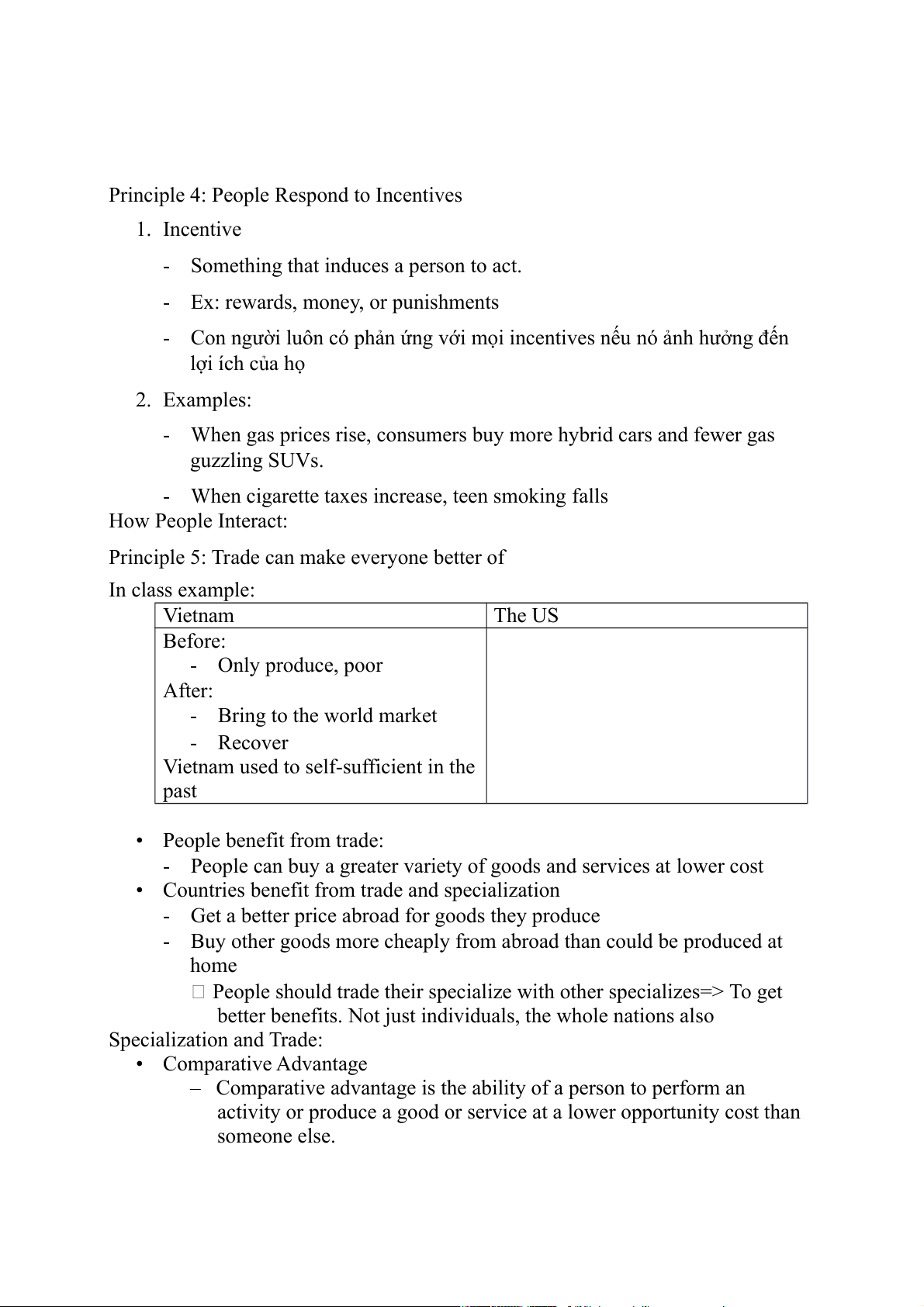
Principle 4: People Respond to Incentives 1. Incentive
- Something that induces a person to act.
- Ex: rewards, money, or punishments
- Con người luôn có phản ứng với mọi incentives nếu nó ảnh hưởng đến lợi ích của họ 2. Examples:
- When gas prices rise, consumers buy more hybrid cars and fewer gas guzzling SUVs.
- When cigarette taxes increase, teen smoking falls How People Interact:
Principle 5: Trade can make everyone better of In class example: Vietnam The US Before: - Only produce, poor After: - Bring to the world market - Recover
Vietnam used to self-sufficient in the past • People benefit from trade:
- People can buy a greater variety of goods and services at lower cost
• Countries benefit from trade and specialization
- Get a better price abroad for goods they produce
- Buy other goods more cheaply from abroad than could be produced at home
People should trade their specialize with other specializes=> To get
better benefits. Not just individuals, the whole nations also Specialization and Trade: • Comparative Advantage
– Comparative advantage is the ability of a person to perform an
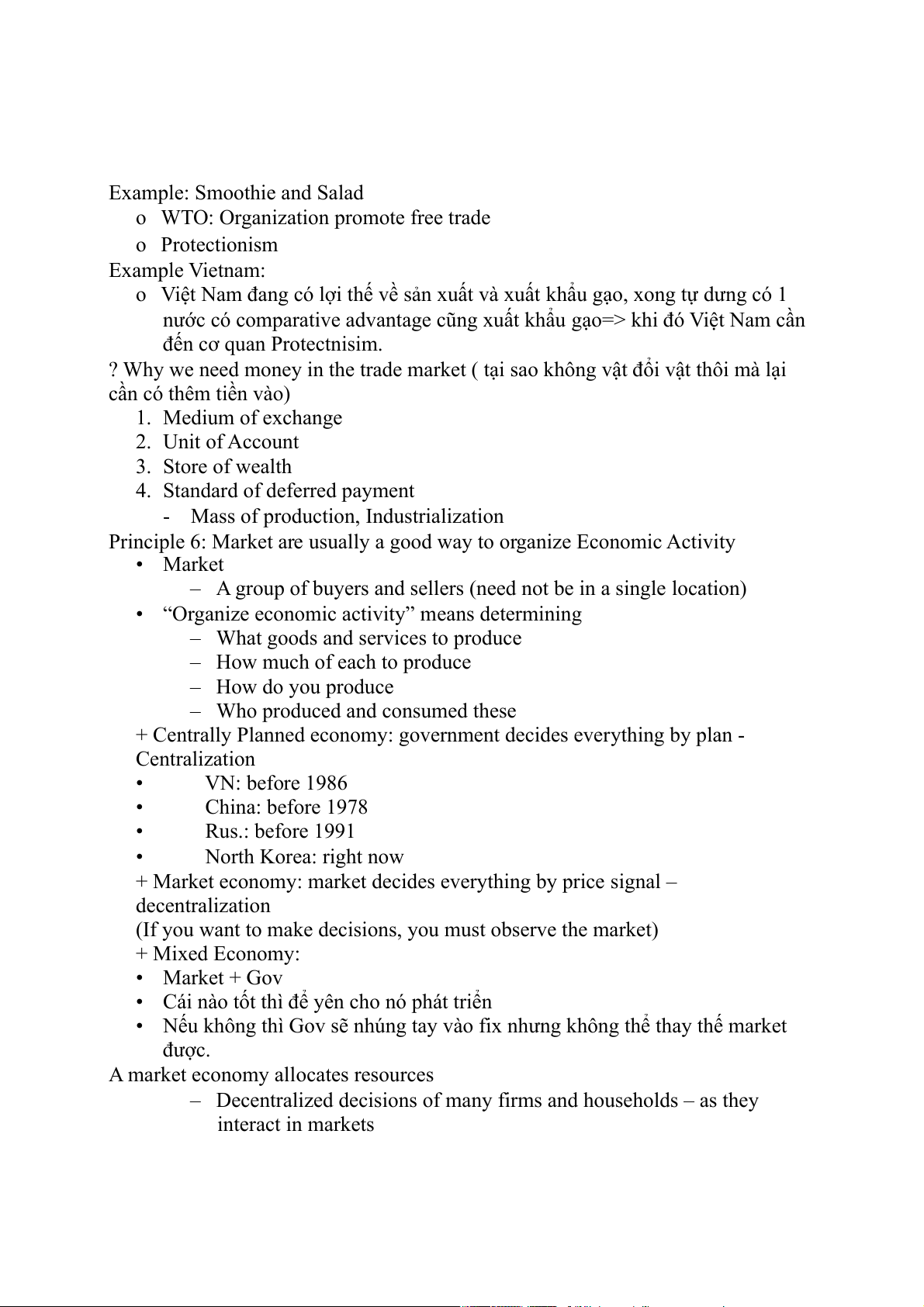
activity or produce a good or service at a lower opportunity cost than someone else. Example: Smoothie and Salad
o WTO: Organization promote free trade o Protectionism Example Vietnam:
o Việt Nam đang có lợi thế về sản xuất và xuất khẩu gạo, xong tự dưng có 1
nước có comparative advantage cũng xuất khẩu gạo=> khi đó Việt Nam cần đến cơ quan Protectnisim.
? Why we need money in the trade market ( tại sao không vật đổi vật thôi mà lại cần có thêm tiền vào) 1. Medium of exchange 2. Unit of Account 3. Store of wealth
4. Standard of deferred payment
- Mass of production, Industrialization
Principle 6: Market are usually a good way to organize Economic Activity • Market
– A group of buyers and sellers (need not be in a single location)
• “Organize economic activity” means determining
– What goods and services to produce
– How much of each to produce – How do you produce
– Who produced and consumed these
+ Centrally Planned economy: government decides everything by plan - Centralization • VN: before 1986 • China: before 1978 • Rus.: before 1991 • North Korea: right now
+ Market economy: market decides everything by price signal – decentralization
(If you want to make decisions, you must observe the market) + Mixed Economy: • Market + Gov
• Cái nào tốt thì để yên cho nó phát triển
• Nếu không thì Gov sẽ nhúng tay vào fix nhưng không thể thay thế market được.
A market economy allocates resources
– Decentralized decisions of many firms and households – as they interact in markets
Famous insight by Adam Smith in The Wealth of Nations (1776):
– Each of these households and firms acts as if “led by an invisible
hand” to promote general economic well-being Prices:
– Determined: interaction of buyers and sellers
– Reflect the good’s value to buyers
– Reflect the cost of producing the good Invisible hand:
– Prices guide self-interested households and firms to make decisions that
maximize society’s economic well-being
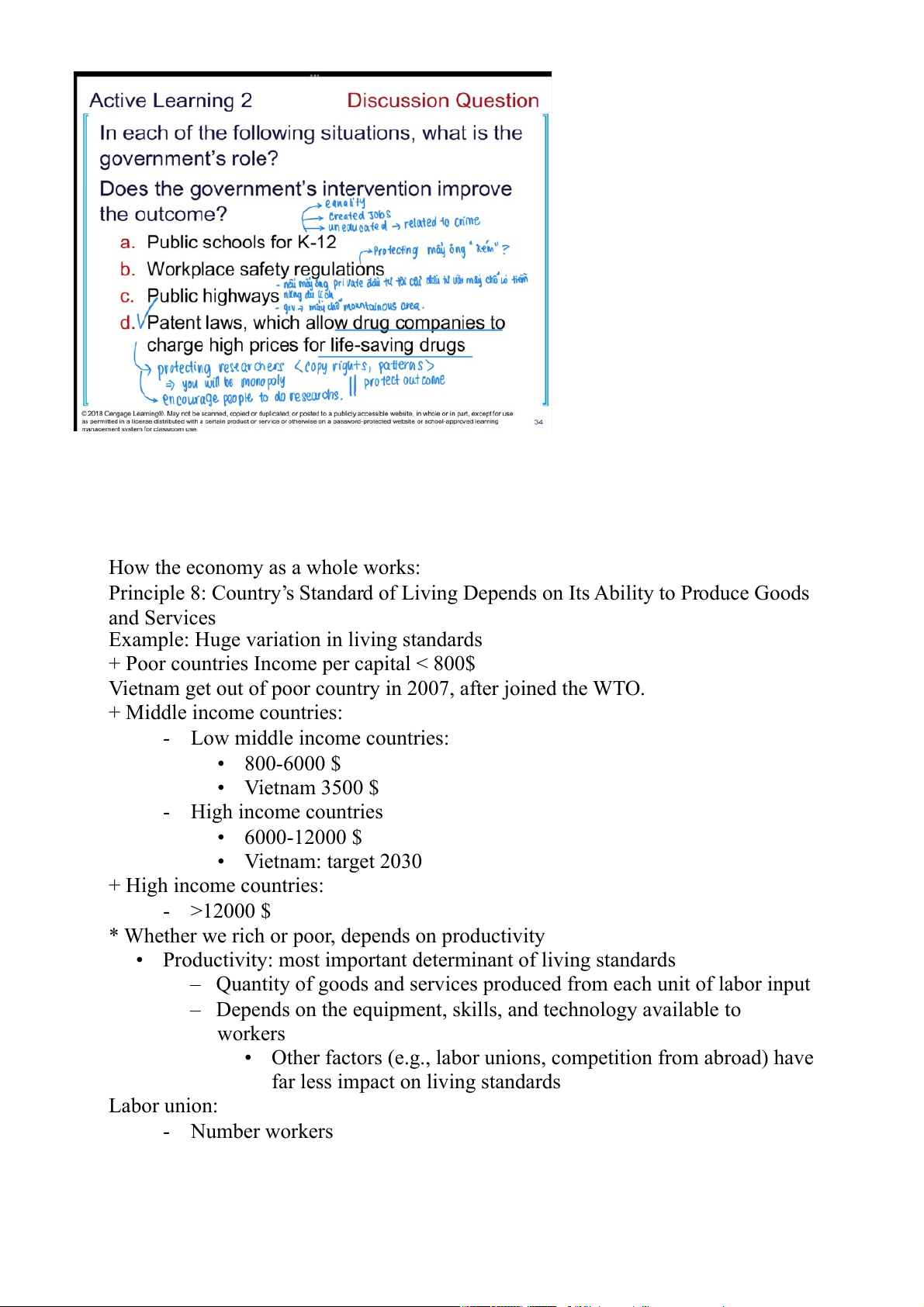
Principle 7: Governmeny can Sometimes Improve Market Outcome:
Government - enforce property rights
– Enforce rules and maintain institutions that are key to a market economy
(People are less inclined to work, produce, invest, or purchase if large risk of their property being stolen)
property rights: the right of owning something
If we don’t have property rights=> you won’t have market, you won’t maximize the return.
Government - promote efficiency
– Avoid market failures: market left on its own fails to allocate resources efficiently
– Externality – source of market failure (Fomusa example)
• Production or consumption of a good affects bystanders (e.g. pollution)
• (Fomusa example) => homework research
– Market power – source of market failure
• A single buyer or seller has substantial influence on market price (e.g., monopoly) Government - promote equality
– Avoid disparities in economic wellbeing
– Use tax or welfare policies to change how the economic “pie” is divided
How the economy as a whole works:
Principle 8: Country’s Standard of Living Depends on Its Ability to Produce Goods and Services
Example: Huge variation in living standards
+ Poor countries Income per capital < 800$
Vietnam get out of poor country in 2007, after joined the WTO. + Middle income countries: - Low middle income countries: • 800-6000 $ • Vietnam 3500 $ - High income countries • 6000-12000 $ • Vietnam: target 2030 + High income countries: - >12000 $
* Whether we rich or poor, depends on productivity
• Productivity: most important determinant of living standards
– Quantity of goods and services produced from each unit of labor input
– Depends on the equipment, skills, and technology available to workers
• Other factors (e.g., labor unions, competition from abroad) have
far less impact on living standards Labor union: - Number workers
- Number of firms create job to workers
- (inside the firm in VN is not really working)
Principle 9: Prices Rise When the Government Prints Too Much Money • Inflation
- An increase in the overall level of prices in the economy Example: tuition fees 2020: 5 million 6th grade
2021: 6 million and still 6th grade • FED
- Raise interest rate to help developing countries get out of troubles
- Reduce inflation (get money back) • In the long run:
- Inflation is almost always caused by excessive growth in the quantity of
money, which causes the value of money to fall
- The faster the government creates money, the greater the inflation rate Example: Artificial Economy Year 1: o GOV has no money o 1000 individuals have 100$ o 100 units of goods => price 1$/unit Year 2:
o GOV decided to print 1000$ more
o (case: no develop) 1000 individuals have 100$ o 100 units of goods => price 2$/unit GOV print more money:
o They take something from individuals o They take purchasing Power Inflation Tax: Home Research
Principle 10: Society Faces a Short-run Trade-off between Inflation and Unemployment In class example: COVID 19: o Unemployment rate: higher
o Price of good services: cheaper AFTER o Job opportunities comeback o Price rises again
o Reduce inflation=> create jobs
Short-run trade-off between unemployment and inflation
- Over a period of a year or two, many economic policies push inflation and
unemployment in opposite directions
- Other factors can make this tradeoff more or less favorable, but the tradeoff is always present SUMMARY
• Fundamental lessons about individual decision making:
– People face trade-offs among alternative goals
– The cost of any action is measured in terms of forgone opportunities
– Rational people make decisions by comparing marginal costs and marginal benefits
– People change their behavior in response to the incentives they face
• Fundamental lessons about interactions among people:
– Trade and interdependence can be mutually beneficial
– Markets are usually a good way of coordinating economic activity among people
– The government can potentially improve market outcomes by
remedying a market failure or by promoting greater economic equality
• Fundamental lessons about the economy as a whole:
– Productivity is the ultimate source of living standards
– Growth in the quantity of money is the ultimate source of inflation
– Society faces a short-run trade-off between inflation and unemployment
Tài liệu liên quan:
-
Chương 3: độ co giãn và các nhân tố ảnh hưởng | Microeconomics | Trường Đại học Quốc tế, Đại học Quốc gia Thành phố Hồ Chí Minh
3 2 -
Microeconomics Syllabus | Microeconomics | Trường Đại học Quốc tế, Đại học Quốc gia Thành phố Hồ Chí Minh
3 2 -
Microeconomics Course Syllabus & Assessment Details | Microeconomics | Trường Đại học Quốc tế, Đại học Quốc gia Thành phố Hồ Chí Minh
3 2 -
Assignment 3 - Elasticity MCQs and Key Concepts | Microeconomics | Trường Đại học Quốc tế, Đại học Quốc gia Thành phố Hồ Chí Minh
3 2 -
Assignment 2 - Economic Equilibrium Analysis of Fridges and Motorcycles | Microeconomics | Trường Đại học Quốc tế, Đại học Quốc gia Thành phố Hồ Chí Minh
3 2