Principles of Microeconomics - Comprehensive Overview | Microeconomics | Trường Đại học Quốc tế, Đại học Quốc gia Thành phố Hồ Chí Minh
Tài liệu được sưu tầm và soạn thảo dưới dạng file PDF với mục đích hỗ trợ học tập và tham khảo. Nội dung tài liệu được trình bày rõ ràng, dễ tiếp cận, phù hợp cho việc ôn tập và củng cố kiến thức trong quá trình học đại học. Đây sẽ là nguồn tư liệu hữu ích giúp các bạn sinh viên chuẩn bị tốt hơn cho các buổi học, đồng thời mở rộng thêm hiểu biết về môn học. Hy vọng tài liệu này sẽ mang lại nhiều giá trị và hỗ trợ các bạn trong hành trình học tập. Mời bạn đọc cùng tham khảo!
Môn: Microeconomics 635 tài liệu
Trường: Trường Đại học Quốc tế, Đại học Quốc gia Thành phố Hồ Chí Minh 1.9 K tài liệu
Tác giả:



Preview text:
PRINCIPLES OF MICROECONOMICS
Chapter 1: Thinking Like an Economist
Economics:the study ofhow people make choices under conditions of
opportunitycost,defined asthe valuesofthe mosthighly valued
scarcityandtheresultsofthosechoicesforsociety.
alternativesthatmustbeforgonetocarryouttheaction.
Economicanalysis ofhumanbehaviour beginswith theassumptionthat
Pitfall3:failuretoignoresunkcosts.E.g.Eventhoughatickettoa peoplearerational.
concertmayhavecostyou€100,ifyouhavealreadyboughtitand
Rational person:someone with well-defined goals and will fulfil those
cannotsellittoanyoneelse,the€100isasunkcostandshouldnot
goalsasbestashecan.
influenceyourdecisionaboutwhethertogototheconcert.
Peoplenormallyfacetrade-offswhentheywanttoachievetheirgoals,this
Pitfall4:failuretounderstandtheaverage-marginaldistinction.The
isaresultofscarcity.
focusshouldalwaysbeonthebenefitsandcostsofanadditionalunit
The Scarcity Principle (No-Free-Lunch Priciple): although we have
activity.Thus,thelevelofanactivityshouldbeincreasedif,andonly
boundlessneedsandwants,resourcesavailabletousarelimited,sohaving
if,itsmarginalbenefitexceedsitsmarginalcost.
moreofongoodthingusuallymeanshavinglessofanother.
Marginal costs:theincreaseintotalcoststhatresultfromcarryingoutone
The Cost-Benefit Priciple: anactionshouldonlybetakenifitsbenefits
additionalunitofactivity. exceeditscosts.
Marginal benefit:anincreaseinthetotalbenefitthatresultfromcarrying
Economic surplus:thebenefitoftakinganaction-thecostoftakingthat
outoneadditionalunitofactivity. action
Average cost:thetotalcostofundertaking‘n’unitsofanactivitydivided
Opportunity cost (of an activity): thevalueofthenextbestalternative by‘n’
thatmustbeforgonetoundertakethatactivity.E.g.Watchingmoviesfor
Average benefit: thetotalbenefitofundertaking‘n’unitsdividedby‘n’
hours,whileyoucouldalsoworkfor5euroanhour.
Microeconomics: the study of individual choice under scarcity and its
Sunk costs:coststhatarebeyondrecoveryatthemomentadecisionmust
implications for the behaviourof the prices and quantities in individual
bemade.E.g.watchaboringmovietilltheendinsteadofleaving,because markets.
youpaidfortheticket.
Macroeconomics:study of performance of national economics and the
The role of economic models:
policiesthatgovernmentsusetotryimprovingthatperformance.
Economistsusethecost-benefitprincipleasanabstractmodelofhowan
Positive economics (kinh tế học thực chứng)consistsintheconclusionof
idealisednationalindividualwouldchooseamongcompetingalternatives.
economics that are independent of the ethical value system of the
Themodelisasimplifiedrepresentationofreality
economist.(IfAhappensthenBhappens):howpeoplewillbehave
4 important decision pitfalls:
Normative economics(kinh tế học chuẩn tắc)consist in statements in
economics that reflect or are based on the ethical value system of the
Pitfall 1: measuring costs and benefits as proportions rather than
absolute moneyamount. E.g.Walk3km to save €10on a €1000
economist,implicitly,explicitly,oromission.(IfAhappensthenBshould computer?
happen):howpeopleshouldbehave.
Pitfall2:ignoringopportunitycosts.Whenperformingacost-benefit
analysisofanaction,itisimportanttoaccountforallrelevant
Chapter 2 : Comparative Advantage
Absolute advantage:1personhasanabsoluteadvantageifanhourspentin
performingataskearnsmorethantheotherpersoninperformingthesame task.
Comparative advantage:1personhasthiswhenhisopportunitycostof
performing a task is lower than the other person’s opportunity cost in
performingthesametask.
The principle of increasing opportunity cost ( Low-hanging-fruit
The principle of comparative advantage:thismeansthateveryonedoes
principle): When resources have different opportunity costs, we should
bestwheneachpersonconcentratesontheactivitiesforwhichhisorher
always exploit the resource with the lowest opportunity cost first, and
opportunitycostislowest.
afterwardsusetheresourceswithhigheropportunitycost(pickingthemost
E.g:Ifapersonproducesnutsandcoffee,theopportunitycostsofnutscan accessiblefruitfirst).
becalculatedthisway:
Factorsthatshifttheeconomy’sPPF:Aneconomicgrowthresultsinan
OCnuts:Lossincoffee/Gaininnuts
outwardshiftintheeconomy’sPPF.
OCcoffee:Lossinnuts/Gainincoffee
Economic growth:the ability of the economy to produce increasing
PPC (production possibility curve): agraphthatshowstherelationship
quantitiesofgoodsandservices.
betweenthequantityofonegoodthatcanbeproducedforeverypossible
Economicgrowthiscausesbydifferentfactors,e.g.increasesinproductive
levelofproductionofanothergood.
resourcesandimprovementsinknowledgeandtechnology(thosearethe2 mainfactors)
PointsthatlieeitheralongorwithinthePPCareattainablepoints:
Attainable point:anycombinationofgoodsthatcanbeproducedusing
Factorsthatmaylimitspecialisation:
currentavailableresources. lowpopulationdensity Isolation
PointsthatlieoutsidethePPCareunattainable:
Unattainable point:any combination of goods thatcannot be produced
Lawsandcustomsthatlimitpeople’sfreedomtotransactfreelywith
usingcurrentlyavailableresources. oneanother Sizeofthemarket
PointsthatliealongthePCCareefficient:
Efficient point:anycombination ofgoodsfor whichcurrentlyavailable
onceyouarebehind,youstaybehind
resourcesdonotallowanincreaseintheproductionofonegoodwithout
Developingcountriesdonotwanttohavecomparativeadvantagein reductionoftheother.
rawmaterialsandagricultureforever.
PointsthatliewithinthePCCareinefficient:
Developingstrategiesaimedatchangingthecomparativeadvantage
Inefficient point:any combination ofgoods forwhich currently
Nationscanalsobenefitfromexchangebasedoncomparativeadvantage.
available resources enable an increase in the production of one good
Outsourcing: a term increasingly used to connote having services
withoutreductionofproductionoftheother.
performedbylow-wageworkersoverseas.
Chapter 3: Supply and Demand
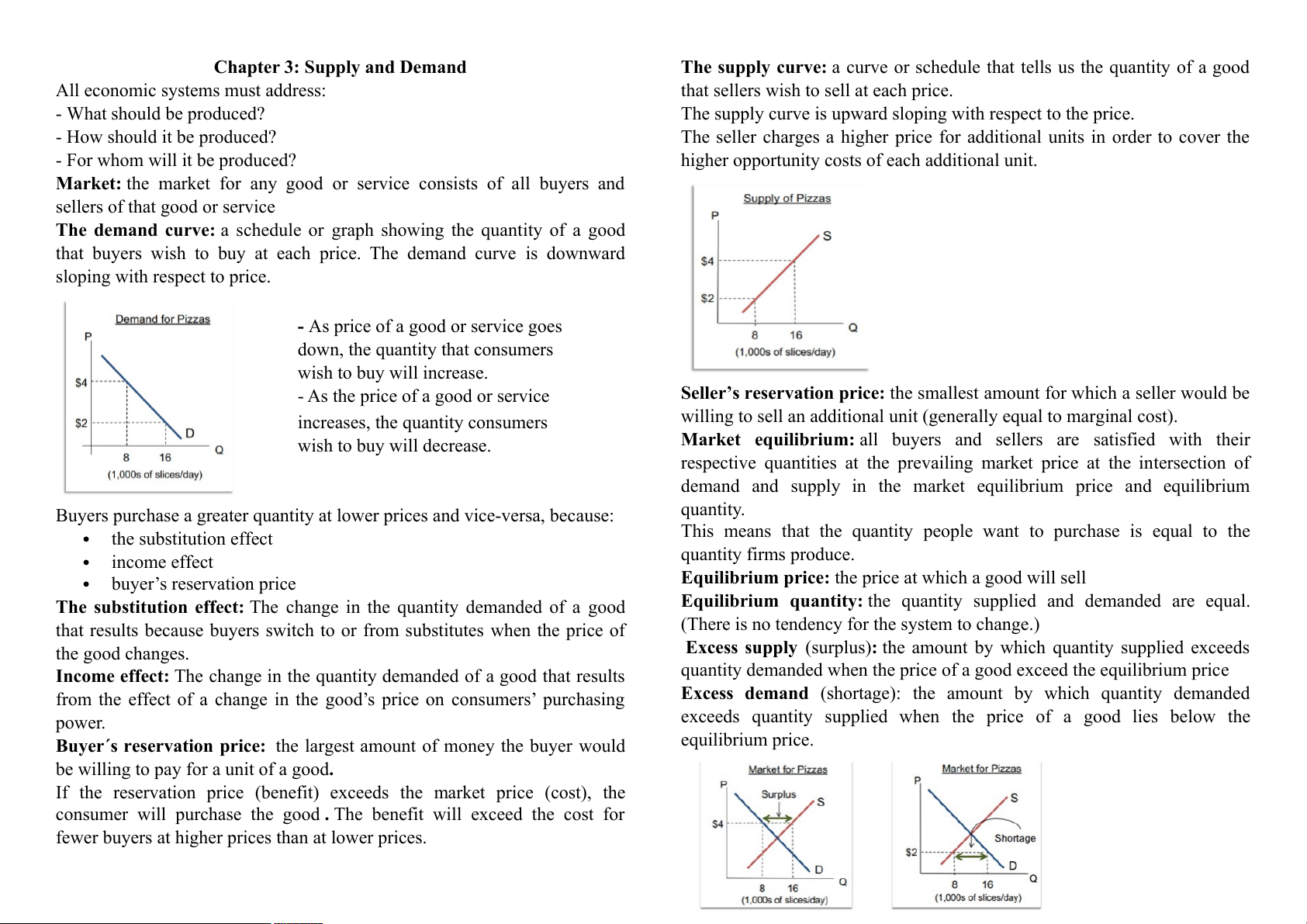
The supply curve:acurveorschedulethattellsusthequantityofagood
Alleconomicsystemsmustaddress:
thatsellerswishtosellateachprice.
-Whatshouldbeproduced?
Thesupplycurveisupwardslopingwithrespecttotheprice.
-Howshoulditbeproduced?
Thesellerchargesahigherpriceforadditionalunitsinordertocoverthe
-Forwhomwillitbeproduced?
higheropportunitycostsofeachadditionalunit.
Market: the market for any good or service consists of all buyers and
sellersofthatgoodorservice
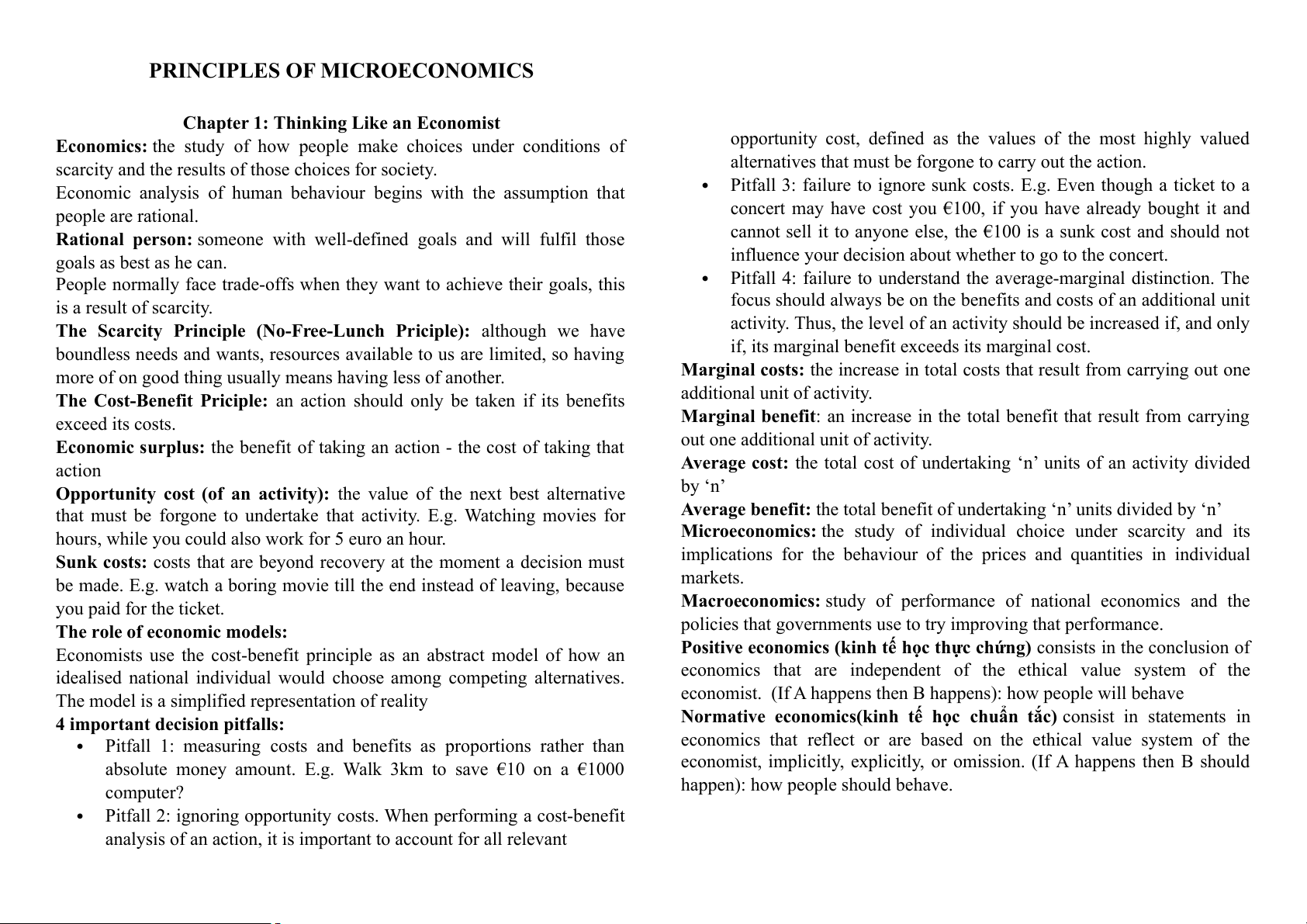
The demand curve: ascheduleorgraphshowingthequantityofagood
that buyers wish to buy at each price.The demand curve is downward
slopingwithrespecttoprice.
- Aspriceofagoodorservicegoes
down,thequantitythatconsumers
wishtobuywillincrease.
-Asthepriceofagoodorservice
Seller’s reservation price:thesmallestamountforwhichasellerwouldbe
willingtosellanadditionalunit(generallyequaltomarginalcost).
increases,thequantityconsumers
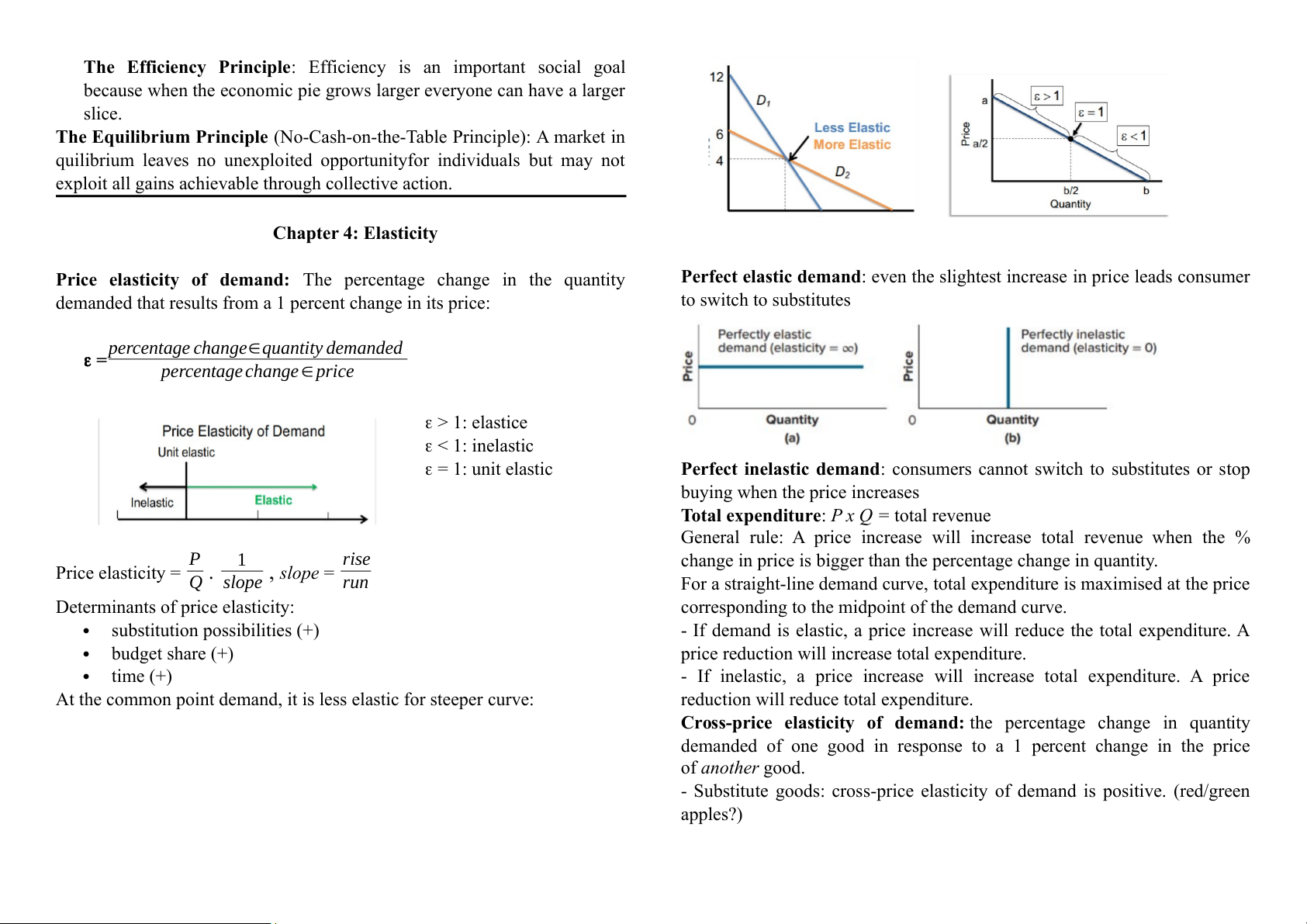
Market equilibrium:all buyers and sellers are satisfied with their
wishtobuywilldecrease.
respectivequantitiesattheprevailingmarketpriceattheintersectionof
demand and supply in the market equilibrium price and equilibrium
Buyerspurchaseagreaterquantityatlowerpricesandvice-versa,because: quantity.
This means that the quantity people want to purchase is equal to the thesubstitutioneffect quantityfirmsproduce. incomeeffect
Equilibrium price:thepriceatwhichagoodwillsell
buyer’sreservationprice
The substitution effect:Thechangeinthequantitydemandedofagood
Equilibrium quantity:the quantity supplied and demanded are equal.
thatresultsbecausebuyersswitchtoorfromsubstituteswhenthepriceof
(Thereisnotendencyforthesystemtochange.) thegoodchanges.
Excess supply (surplus)
:theamountbywhichquantitysuppliedexceeds
Income effect: Thechangeinthequantitydemandedofagoodthatresults
quantitydemandedwhenthepriceofagoodexceedtheequilibriumprice
fromtheeffectofachangeinthegood’spriceonconsumers’purchasing
Excess demand (shortage): the amount by which quantity demanded power.
exceeds quantity supplied when the price of a good lies below the
Buyer´s reservation price: thelargestamountofmoneythebuyerwould equilibriumprice.
bewillingtopayforaunitofagood.
If the reservation price (benefit) exceeds the market price (cost), the
consumer will purchase the good The .
benefit will exceed the cost for
fewerbuyersathigherpricesthanatlowerprices.
expectedfuturelowerprices
Price ceiling:amaximumallowableprice,specifiedbylaw
improvementinweather(farming)
Price floor:aminimumallowableprice,specifiedbylaw
Anincreaseindemandwillleadtoanincreaseinboth,the
Change in quantity demanded:amovementalongthedemandcurvethat
equilibriumpriceandquantity.
occursinresponsetoapricechange.
Adecreaseindemandwillleadtoadecreaseinboth,the
Change in demand:ashiftoftheentiredemandcurve:ademandchangeat
equilibriumpriceandquantity. thesameprice.
Shift in demand due to complements:
-2goodsarecomplementsinconsumptionifanincreaseordecreaseinthe
priceofonecausesaleftwardorrightwardshiftinthedemandcurveforthe other
E.g.tennisracquetsandballs,ginandtonic,printersandpaper.
Shift in demand due to substitutes:
-2goodsaresubstitutesinconsumptionifanincreaseordecreaseinthe
priceofonecausesarightwardorleftwardshiftinthedemandcurveforthe
Anincreaseinsupplywillleadtoadecreaseintheequilibriumprice other
andanincreaseintheequilibriumquantity.
E.g.beerandwine,coffeeandtea.
Adecreaseinsupplywillleadtoanincreaseintheequilibriumprice
Shift in demand due to income change:
andadecreaseintheequilibriumquantity. -normal demand good:
curveshiftsrightwardswhentheincomeofbuyers
increasesandleftwardswhentheincomesofbuyersdecrease. -inferior demand good:
curveshiftleftwardswhentheincomeofbuyers
increasesandrightwardswhentheincomeofbuyersdecreases Otherfactors: increasepreference increaseinpopulation
expectedfuturehigherprices
Change in quantity supplied: a movement along thesupply curve that
Buyer’s surplus:thedifferencebetweenthebuyer’sreservationprice
occursinresponsetoapricechange
andthepriceheactuallypaid.
Change in supply:a shift of the entire supply change at the same
Seller’s surplus:thedifferencebetweenthepricereceivedbytheseller
price.
andhisreservationprice.
Shiftsinsupply(righwardordownward)
Total surplus:thedifferencebetweenthebuyer’sreservationpriceand
decreasepricesofinputsandtheirsubstitutes.
theseller’sreservationprice
improvements of technology, which means that there can be
Economic efficiency:whentheeconomicsurplusismaximised.
producedmorewiththesameinputprices.
increasenumberoffirmsinthemarket
The Efficiency Principle: Efficiency is an important social goal
becausewhentheeconomicpiegrowslargereveryonecanhavealarger slice.
The Equilibrium Principle (No-Cash-on-the-TablePrinciple):Amarketin
quilibriumleavesnounexploitedopportunityforindividuals butmaynot
exploitallgainsachievablethroughcollectiveaction. Chapter 4: Elasticity
Price elasticity of demand: The percentage change in the quantity
Perfect elastic demand:eventheslightestincreaseinpriceleadsconsumer
demandedthatresultsfroma1percentchangeinitsprice: toswitchtosubstitutes
=percentage change∈quantity demanded
percentage change ∈ price >1:elastice <1:inelastic =1:unitelastic
Perfect inelastic demand:consumerscannotswitchtosubstitutesorstop
buyingwhenthepriceincreases
Total expenditure:P x Q =totalrevenue
General rule: A price increase will increase total revenue when the % P rise
changeinpriceisbiggerthanthepercentagechangeinquantity.
Priceelasticity= 1 ,slope= Q slope run
Forastraight-linedemandcurve,totalexpenditureismaximisedattheprice
Determinantsofpriceelasticity:
correspondingtothemidpointofthedemandcurve.
substitutionpossibilities(+)
-Ifdemandiselastic,apriceincreasewillreducethetotalexpenditure.A budgetshare(+)
pricereductionwillincreasetotalexpenditure. time(+)
- If inelastic, a price increase will increase total expenditure. A price
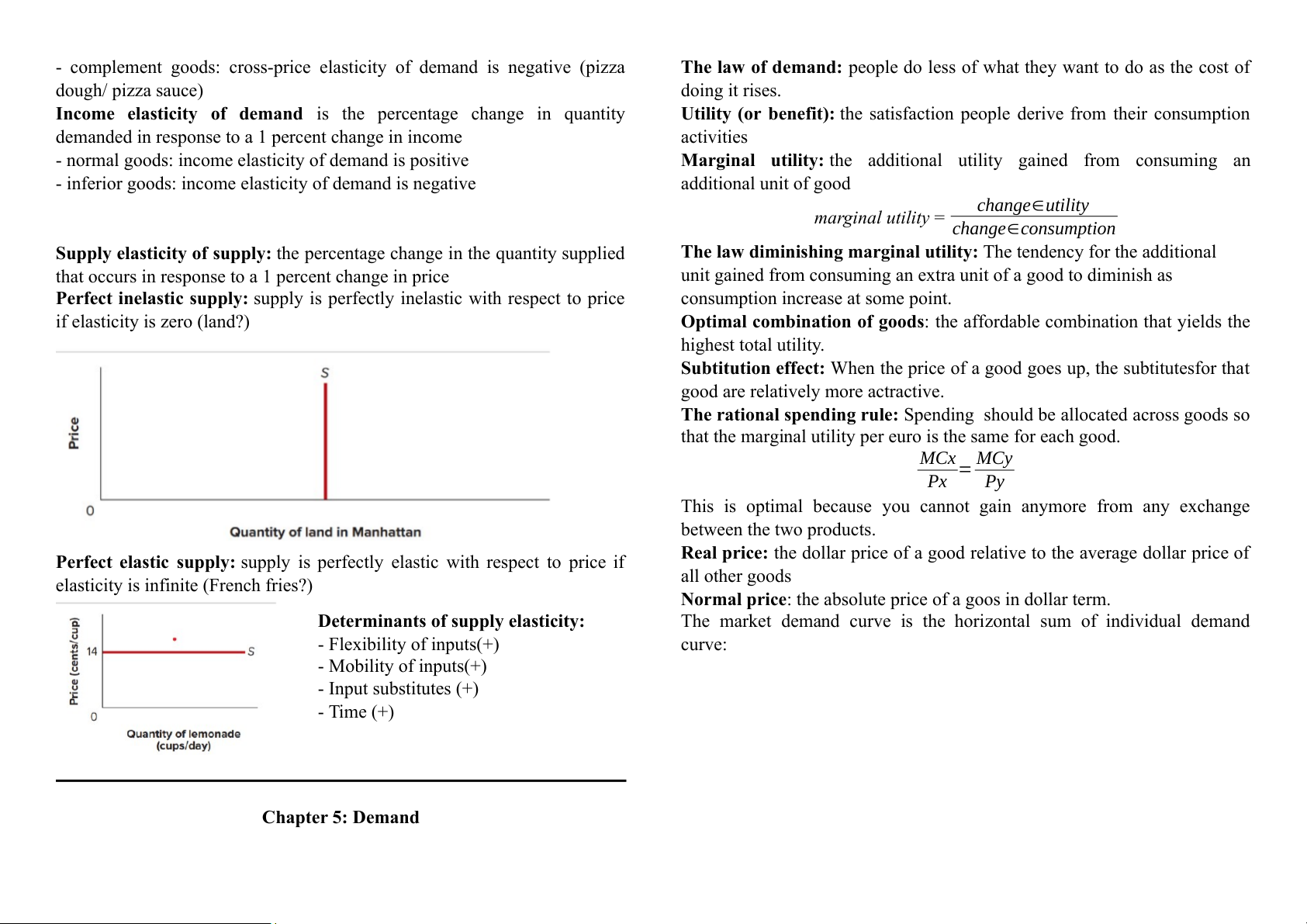
Atthecommonpointdemand,itislesselasticforsteepercurve:
reductionwillreducetotalexpenditure.
Cross-price elasticity of demand:the percentage change in quantity
demanded of one good in response to a 1 percent change in the price ofanothergood.
-Substitutegoods:cross-priceelasticityofdemandispositive.(red/green apples?)
-complement goods: cross-price elasticity ofdemand is negative (pizza
The law of demand: peopledolessofwhattheywanttodoasthecostof dough/pizzasauce) doingitrises.
Income elasticity of demand is the percentage change in quantity
Utility (or benefit): thesatisfactionpeoplederivefromtheirconsumption
demandedinresponsetoa1percentchangeinincome activities
-normalgoods:incomeelasticityofdemandispositive
Marginal utility:the additional utility gained from consuming an
-inferiorgoods:incomeelasticityofdemandisnegative additionalunitofgood ∈ marginal utility= change utility
change∈consumption
Supply elasticity of supply:thepercentagechangeinthequantitysupplied
The law diminishing marginal utility:Thetendencyfortheadditional
thatoccursinresponsetoa1percentchangeinprice
unitgainedfromconsuminganextraunitofagoodtodiminishas
Perfect inelastic supply:supplyisperfectlyinelasticwithrespecttoprice
consumptionincreaseatsomepoint.
ifelasticityiszero(land?)
Optimal combinationof goods:theaffordablecombinationthatyieldsthe highesttotalutility.
Subtitution effect:Whenthepriceofagoodgoesup,thesubtitutesforthat
goodarerelativelymoreactractive.
The rational spending rule:Spendingshouldbeallocatedacrossgoodsso
thatthemarginalutilitypereuroisthesameforeachgood. MCx MCy = Px Py
This is optimal because you cannot gain anymore from any exchange
betweenthetwoproducts.
Perfect elastic supply: supplyisperfectlyelasticwithrespecttopriceif
Real price:thedollarpriceofagoodrelativetotheaveragedollarpriceof
elasticityisinfinite(Frenchfries?) allothergoods
Normal price:theabsolutepriceofagoosindollarterm.
Determinants of supply elasticity:
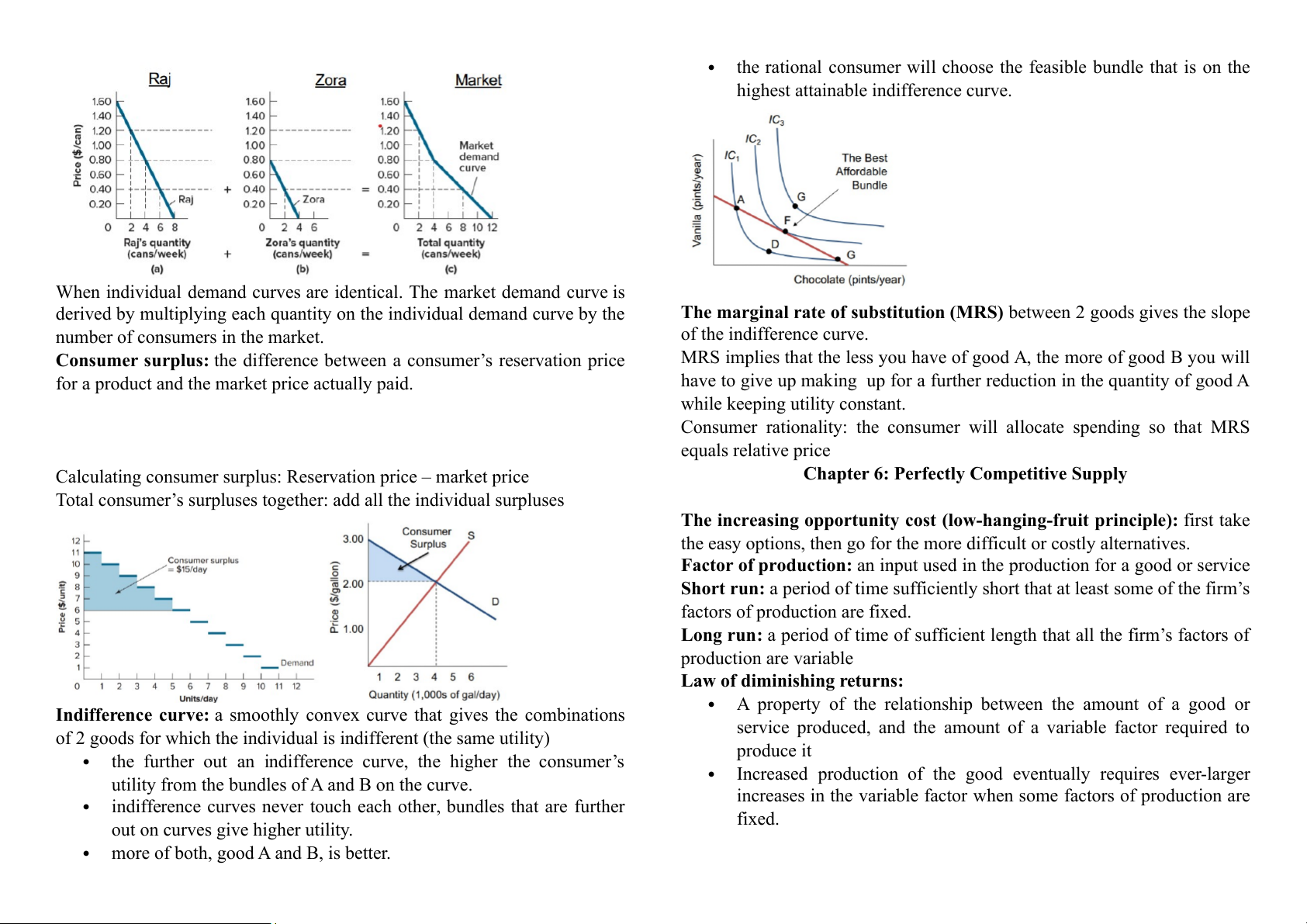
The market demand curve is the horizontal sum of individual demand
-Flexibilityofinputs(+) curve: -Mobilityofinputs(+) -Inputsubstitutes(+) -Time(+) Chapter 5: Demand
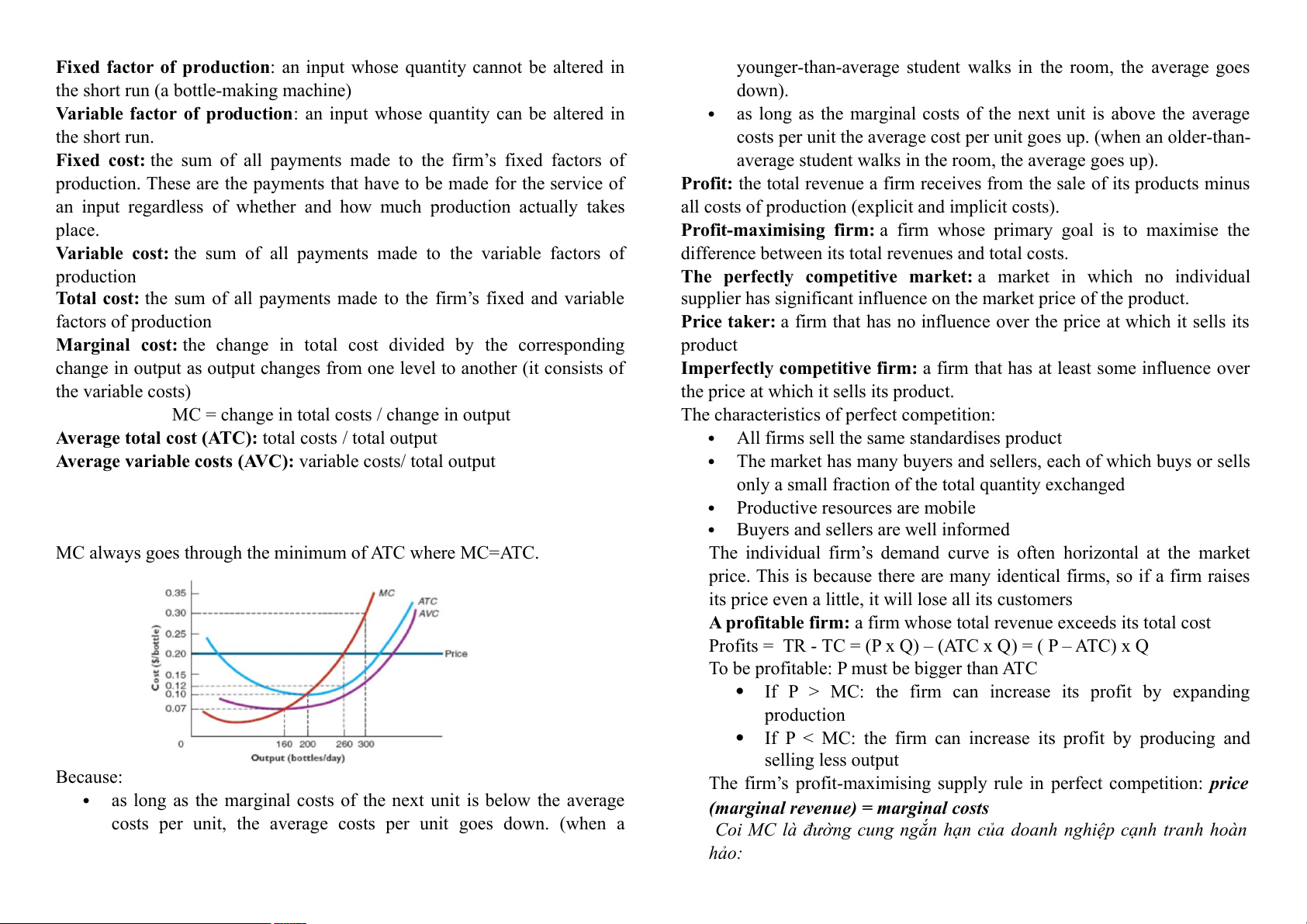
therationalconsumerwillchoosethefeasiblebundlethatisonthe
highestattainableindifferencecurve.
Whenindividualdemandcurvesareidentical.Themarketdemandcurveis
derivedbymultiplyingeachquantityontheindividualdemandcurvebythe
The marginal rate of substitution (MRS) between2goodsgivestheslope
numberofconsumersinthemarket.
oftheindifferencecurve.
Consumer surplus:thedifferencebetweenaconsumer’sreservationprice
MRSimpliesthatthelessyouhaveofgoodA,themoreofgoodByouwill
foraproductandthemarketpriceactuallypaid.
havetogiveupmakingupforafurtherreductioninthequantityofgoodA
whilekeepingutilityconstant.
Consumer rationality: theconsumer willallocate spending sothat MRS equalsrelativeprice
Calculatingconsumersurplus:Reservationprice–marketprice
Chapter 6: Perfectly Competitive Supply
Totalconsumer’ssurplusestogether:addalltheindividualsurpluses
The increasing opportunity cost (low-hanging-fruit principle): firsttake
theeasyoptions,thengoforthemoredifficultorcostlyalternatives.
Factor of production:aninputusedintheproductionforagoodorservice
Short run: aperiodoftimesufficientlyshortthatatleastsomeofthefirm’s
factorsofproductionarefixed.
Long run:aperiodoftimeofsufficientlengththatallthefirm’sfactorsof productionarevariable
Law of diminishing returns:
Indifference curve:asmoothlyconvexcurvethatgivesthecombinations
Aproperty of therelationshipbetween the amount ofa good or
serviceproduced,andtheamountofavariablefactorrequiredto
of2goodsforwhichtheindividualisindifferent(thesameutility) produceit
the further out an indifference curve, the higher the consumer’s
utilityfromthebundlesofAandBonthecurve.
Increased production of the good eventually requires ever-larger
increasesinthevariablefactorwhensomefactorsofproductionare
indifferencecurvesnevertoucheachother,bundlesthatarefurther fixed.
outoncurvesgivehigherutility.
moreofboth,goodAandB,isbetter.
Fixed factor of production:aninputwhosequantitycannotbealteredin
younger-than-averagestudentwalksintheroom,theaveragegoes
theshortrun(abottle-makingmachine) down).
Variable factor of production:aninputwhosequantitycanbealteredin
aslongasthemarginalcostsofthenextunitisabovetheaverage theshortrun.
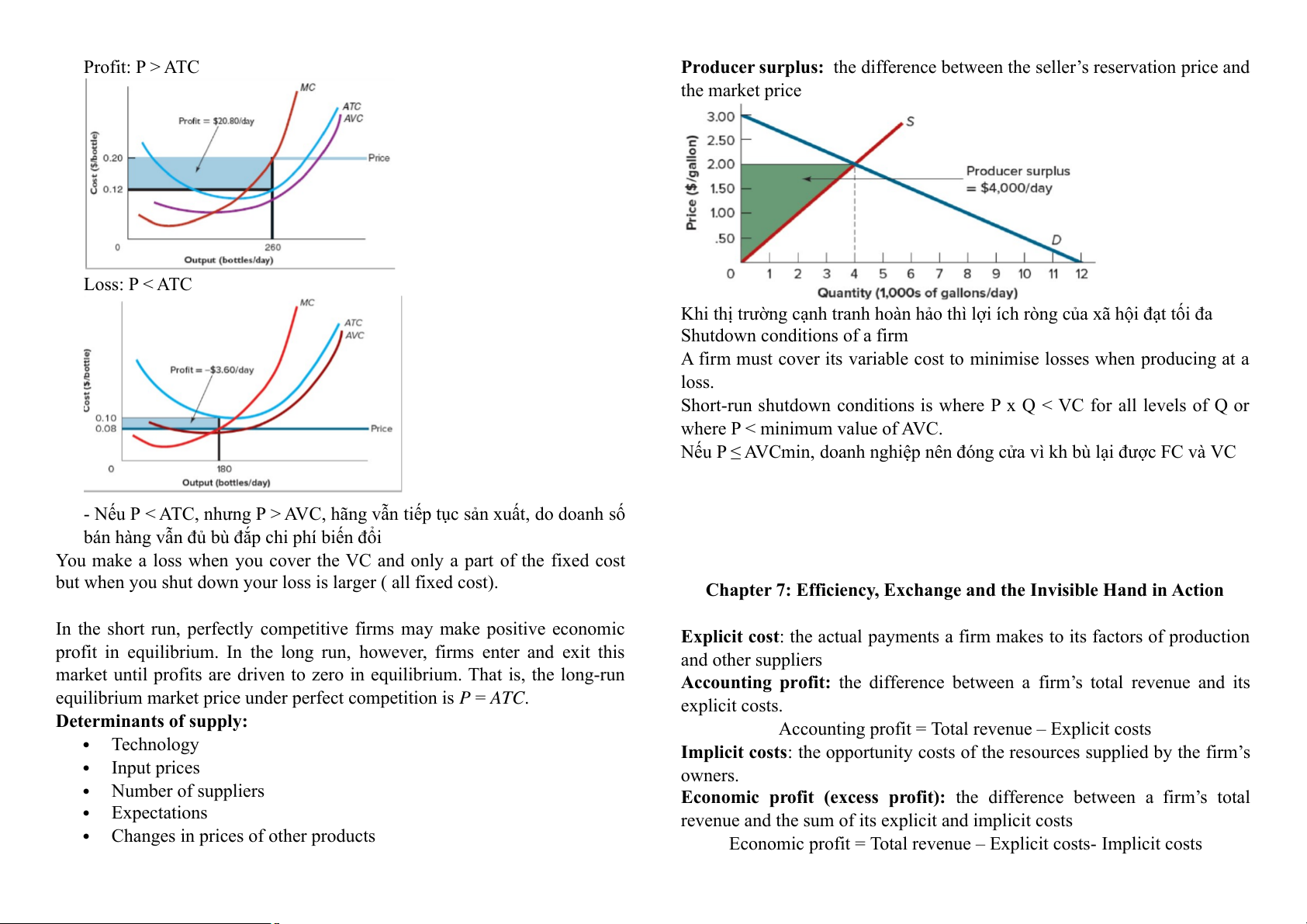
costsperunittheaveragecostperunitgoesup.(whenanolder-than-
Fixed cost:the sumofallpaymentsmadetothefirm’sfixedfactorsof
averagestudentwalksintheroom,theaveragegoesup).
production.Thesearethepaymentsthathavetobemadefortheserviceof
Profit:thetotalrevenueafirmreceivesfromthesaleofitsproductsminus
aninputregardless ofwhether andhowmuch productionactually takes
allcostsofproduction(explicitandimplicitcosts). place.
Profit-maximising firm:a firm whose primary goal isto maximise the
Variable cost:the sum of all payments made to the variable factors of
differencebetweenitstotalrevenuesandtotalcosts. production
The perfectly competitive market:a market in which no individual
Total cost:thesumofallpaymentsmadetothefirm’sfixedandvariable
supplierhassignificantinfluenceonthemarketpriceoftheproduct. factorsofproduction
Price taker:afirmthathasnoinfluenceoverthepriceatwhichitsellsits
Marginal cost:the change in total cost divided by the corresponding product
changeinoutputasoutputchangesfromoneleveltoanother(itconsistsof
Imperfectly competitive firm:afirmthathasatleastsomeinfluenceover thevariablecosts)
thepriceatwhichitsellsitsproduct.
MC=changeintotalcosts/changeinoutput
Thecharacteristicsofperfectcompetition:
Average total cost (ATC):totalcosts/totaloutput
Allfirmssellthesamestandardisesproduct
Average variable costs (AVC):variablecosts/totaloutput
Themarkethasmanybuyersandsellers,eachofwhichbuysorsells
onlyasmallfractionofthetotalquantityexchanged
Productiveresourcesaremobile
Buyersandsellersarewellinformed
MCalwaysgoesthroughtheminimumofATCwhereMC=ATC.
Theindividualfirm’sdemandcurveisoftenhorizontalatthemarket
price.Thisisbecausetherearemanyidenticalfirms,soifafirmraises
itspriceevenalittle,itwillloseallitscustomers
A profitable firm:afirmwhosetotalrevenueexceedsitstotalcost
Profits=TR-TC=(PxQ)–(ATCxQ)=(P–ATC)xQ
Tobeprofitable:PmustbebiggerthanATC
If P > MC: the firm can increase its profit by expanding production
IfP<MC: the firm can increaseitsprofitbyproducingand sellinglessoutput Because:
Thefirm’sprofit-maximisingsupplyruleinperfectcompetition: price
aslongasthemarginalcostsofthenextunitisbelowtheaverage
(marginal revenue) = marginal costs
costs per unit, the average costs per unit goes down. (when a
Coi MC là đường cung ngắn hạn của doanh nghiệp cạnh tranh hoàn hảo: Profit:P>ATC
Producer surplus: thedifferencebetweentheseller’sreservationpriceand themarketprice Loss:P<ATC
Khithịtrườngcạnhtranhhoànhảothìlợiíchròngcủaxãhộiđạttốiđa
Shutdownconditionsofafirm
Afirmmustcoveritsvariablecosttominimiselosseswhenproducingata loss.
Short-runshutdownconditionsiswherePxQ<VCforalllevelsofQor
whereP<minimumvalueofAVC.
NếuP≤AVCmin,doanhnghiệpnênđóngcửavìkhbùlạiđượcFCvàVC
-NếuP<ATC,nhưngP>AVC,hãngvẫntiếptụcsảnxuất,dodoanhsố
bánhàngvẫnđủbùđắpchiphíbiếnđổi
YoumakealosswhenyoucovertheVCandonlyapartofthefixedcost
butwhenyoushutdownyourlossislarger(allfixedcost).
Chapter 7: Efficiency, Exchange and the Invisible Hand in Action
Intheshortrun,perfectlycompetitivefirmsmaymakepositiveeconomic
Explicit cost:theactualpaymentsafirmmakestoitsfactorsofproduction
profitinequilibrium.Inthelongrun,however,firmsenterandexitthis andothersuppliers
marketuntilprofitsaredriventozeroinequilibrium.Thatis,thelong-run
Accounting profit: thedifferencebetweenafirm’stotalrevenueandits
equilibriummarketpriceunderperfectcompetitionis𝑃 =𝐴𝑇𝐶. explicitcosts. Determinants of supply:
Accountingprofit=Totalrevenue–Explicitcosts Technology
Implicit costs:theopportunitycostsoftheresourcessuppliedbythefirm’s Inputprices owners. Numberofsuppliers
Economic profit (excess profit): the difference between a firm’s total Expectations
revenueandthesumofitsexplicitandimplicitcosts
Changesinpricesofotherproducts
Economicprofit=Totalrevenue–Explicitcosts-Implicitcosts
Normal profit:theopportunitycostoftheresourcessuppliedbythefirm’s
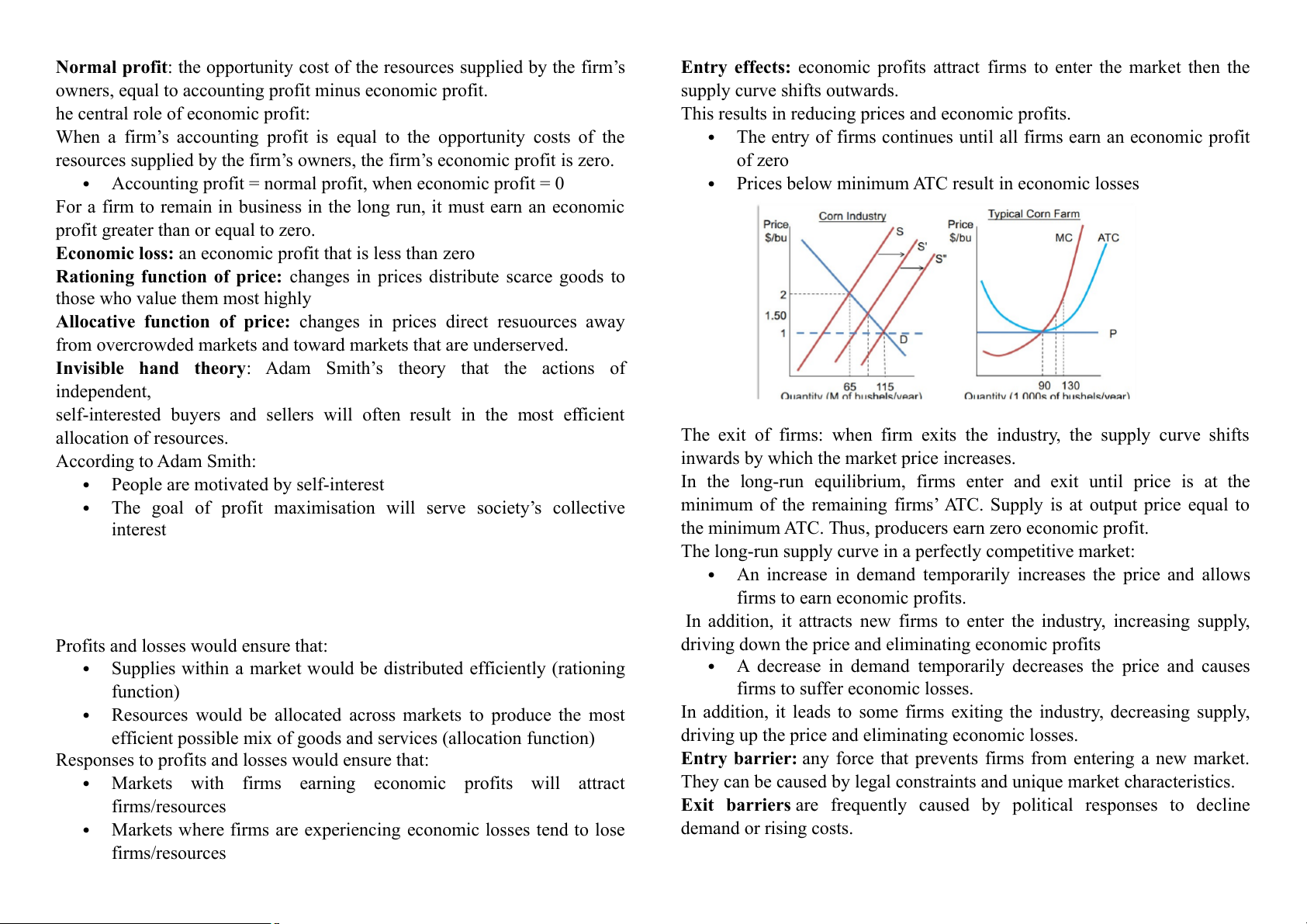
Entry effects: economicprofitsattractfirmstoenterthemarketthenthe
owners,equaltoaccountingprofitminuseconomicprofit.
supplycurveshiftsoutwards.
hecentralroleofeconomicprofit:
Thisresultsinreducingpricesandeconomicprofits.
Whenafirm’saccountingprofitisequaltotheopportunitycostsofthe
Theentryoffirmscontinuesuntilallfirmsearnaneconomicprofit
resourcessuppliedbythefirm’sowners,thefirm’seconomicprofitiszero. ofzero
Accountingprofit=normalprofit,wheneconomicprofit=0
PricesbelowminimumATCresultineconomiclosses
Forafirmtoremaininbusinessinthelongrun,itmustearnaneconomic
profitgreaterthanorequaltozero.
Economic loss:aneconomicprofitthatislessthanzero
Rationing function of price: changesinpricesdistributescarcegoodsto
thosewhovaluethemmosthighly
Allocative function of price: changes in prices direct resuources away
fromovercrowdedmarketsandtowardmarketsthatareunderserved.
Invisible hand theory: Adam Smith’s theory that the actions of independent,
self-interested buyers and sellers will often result in the most efficient allocationofresources.
Theexit of firms: whenfirm exits the industry, the supply curveshifts AccordingtoAdamSmith:
inwardsbywhichthemarketpriceincreases.
Peoplearemotivatedbyself-interest
In the long-run equilibrium, firms enter and exit until price is at the
The goal of profit maximisation will serve society’s collective
minimumoftheremainingfirms’ATC.Supplyisatoutputpriceequalto interest
theminimumATC.Thus,producersearnzeroeconomicprofit.
Thelong-runsupplycurveinaperfectlycompetitivemarket:
Anincreaseindemandtemporarilyincreasesthepriceandallows
firmstoearneconomicprofits.
Inaddition,itattractsnewfirmstoentertheindustry,increasingsupply,
Profitsandlosseswouldensurethat:
drivingdownthepriceandeliminatingeconomicprofits
Supplieswithinamarketwouldbedistributedefficiently(rationing
Adecreaseindemandtemporarilydecreasesthepriceandcauses function)
firmstosuffereconomiclosses.
Resourceswouldbeallocatedacrossmarketstoproducethemost
Inaddition,itleadstosomefirmsexitingtheindustry,decreasingsupply,
efficientpossiblemixofgoodsandservices(allocationfunction)
drivingupthepriceandeliminatingeconomiclosses.
Responsestoprofitsandlosseswouldensurethat:
Entry barrier: anyforcethatpreventsfirmsfromenteringanewmarket.
Markets with firms earning economic profits will attract
Theycanbecausedbylegalconstraintsanduniquemarketcharacteristics. firms/resources
Exit barriersare frequently caused by political responses to decline
Marketswherefirmsareexperiencingeconomiclossestendtolose demandorrisingcosts. firms/resources
Efficiency (Pareto efficeiency):asituationwherenofurthertransactionis
possiblethatwillhelpsomewithoutharmingpeople.
Deadweight loss:thereductionintotaleconomicsurplusthatresultsfrom
theadoptionofapolicy
Observationonefficiency:whenthepriceisaboveorbelowtheequilibrium
price,thequantityexchangedwillbelower thanthemarketequilibrium quantity. Cost-saving innovations: Intheshortrun:
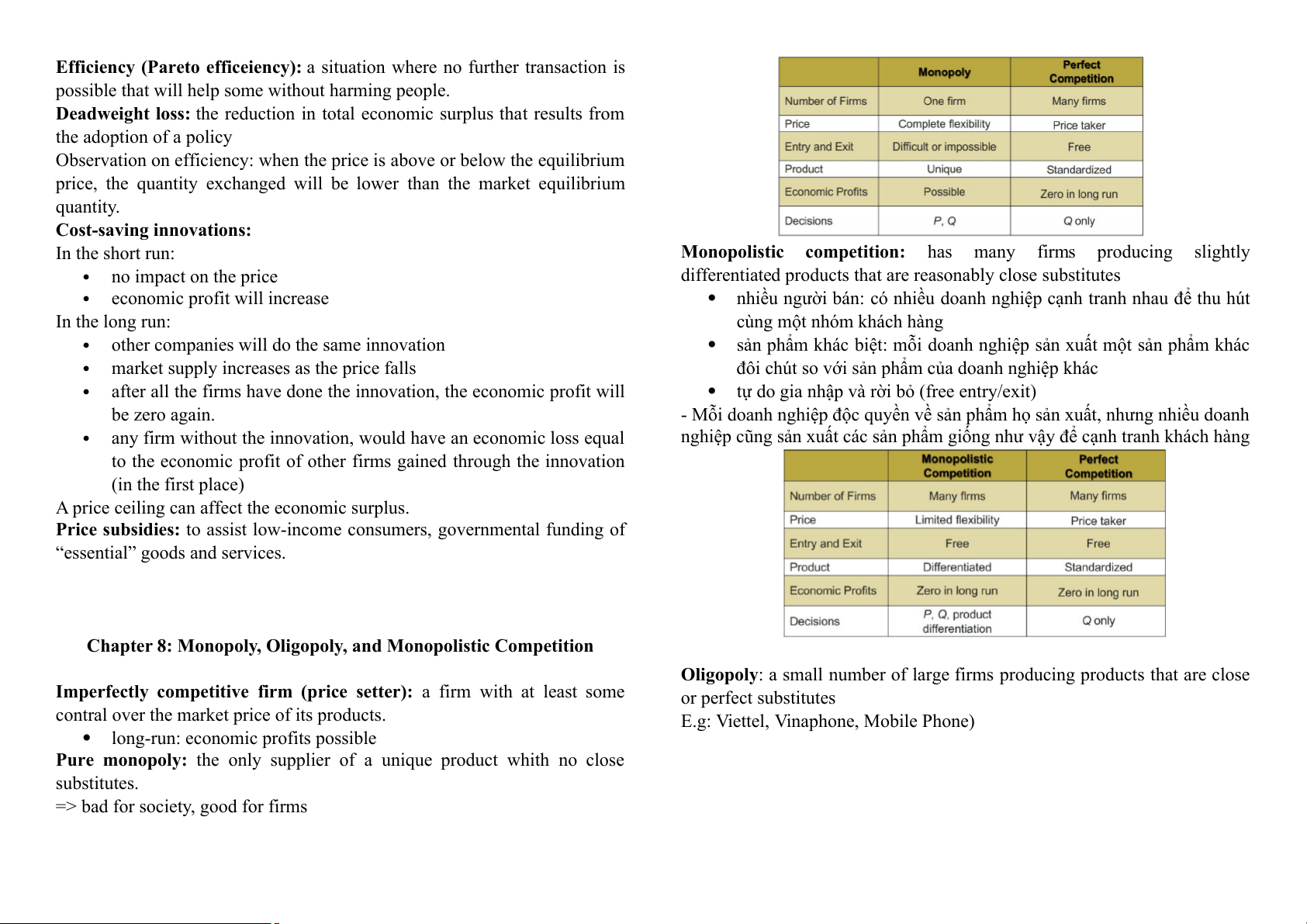
Monopolistic competition: has many firms producing slightly noimpactontheprice
differentiatedproductsthatarereasonablyclosesubstitutes
economicprofitwillincrease
nhiềungườibán:cónhiềudoanhnghiệpcạnhtranhnhauđểthuhút Inthelongrun:
cùngmộtnhómkháchhàng
othercompanieswilldothesameinnovation
sảnphẩmkhácbiệt:mỗidoanhnghiệpsảnxuấtmộtsảnphẩmkhác
marketsupplyincreasesasthepricefalls
đôichútsovớisảnphẩmcủadoanhnghiệpkhác
afterallthefirmshavedonetheinnovation,theeconomicprofitwill
tựdogianhậpvàrờibỏ(freeentry/exit) bezeroagain.
-Mỗidoanhnghiệpđộcquyềnvềsảnphẩmhọsảnxuất,nhưngnhiềudoanh
anyfirmwithouttheinnovation,wouldhaveaneconomiclossequal
nghiệpcũngsảnxuấtcácsảnphẩmgiốngnhưvậyđểcạnhtranhkháchhàng
totheeconomicprofitofotherfirmsgainedthroughtheinnovation (inthefirstplace)
Apriceceilingcanaffecttheeconomicsurplus.
Price subsidies:toassistlow-incomeconsumers,governmentalfundingof
“essential”goodsandservices.
Chapter 8: Monopoly, Oligopoly, and Monopolistic Competition
Oligopoly:asmallnumberoflargefirmsproducingproductsthatareclose
Imperfectly competitive firm (price setter): a firm withat leastsome orperfectsubstitutes
contraloverthemarketpriceofitsproducts.
E.g:Viettel,Vinaphone,MobilePhone)
long-run:economicprofitspossible
Pure monopoly: the only supplier of a unique product whith no close substitutes.
=>badforsociety,goodforfirms
Exclusivecontroloverinputs:Quyềnkiểmsoátđầuvào
Patentsandcopyrights:Bằngsángchếvàquyềntácgiả
=>Bảovệlợinhuậncủadoanhnghiệp,tránhbịsaochép
Governmentlicensesorfranchises:Giấyphéphoặcnhượngquyền từchínhphủ
=>Chínhphủchophépdoanhnghiệpđộcquyềntrong1lĩnhvực
nàođấy(e.g:thugomrác)
Economiesofscaleandnaturalmonopolies:Kinhtếtheoquymô
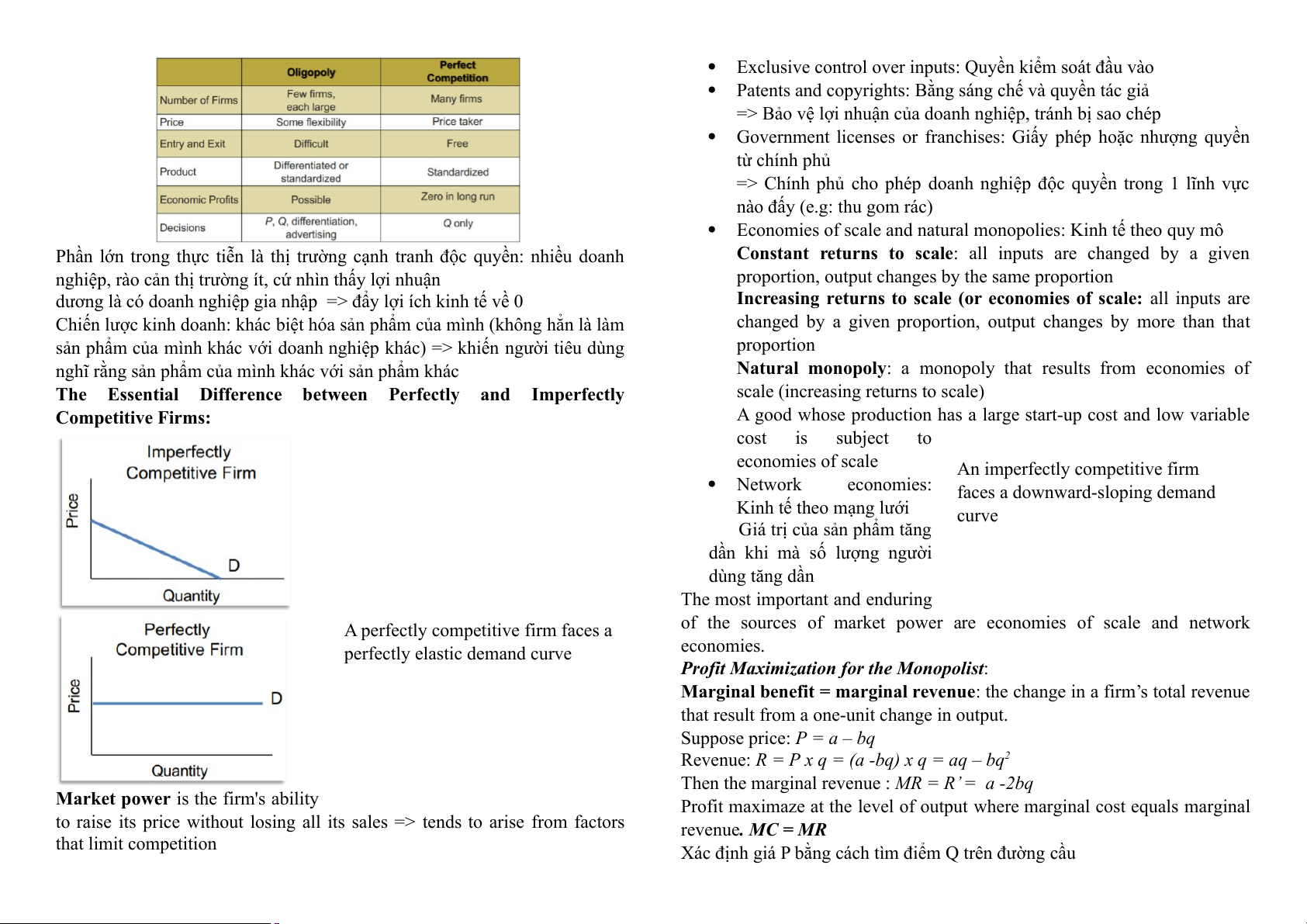
Phầnlớntrongthựctiễnlàthịtrườngcạnhtranhđộcquyền:nhiềudoanh
Constant returns to scale: all inputs are changed by a given
nghiệp,ràocảnthịtrườngít,cứnhìnthấylợinhuận
proportion,outputchangesbythesameproportion
dươnglàcódoanhnghiệpgianhập=>đẩylợiíchkinhtếvề0
Increasing returns to scale (or economies of scale:allinputsare
Chiếnlượckinhdoanh:khácbiệthóasảnphẩmcủamình(khônghẳnlàlàm
changedbyagivenproportion,outputchangesbymorethanthat
sảnphẩmcủamìnhkhácvớidoanhnghiệpkhác)=>khiếnngườitiêudùng proportion
nghĩrằngsảnphẩmcủamìnhkhácvớisảnphẩmkhác
Natural monopoly: a monopoly that results from economies of
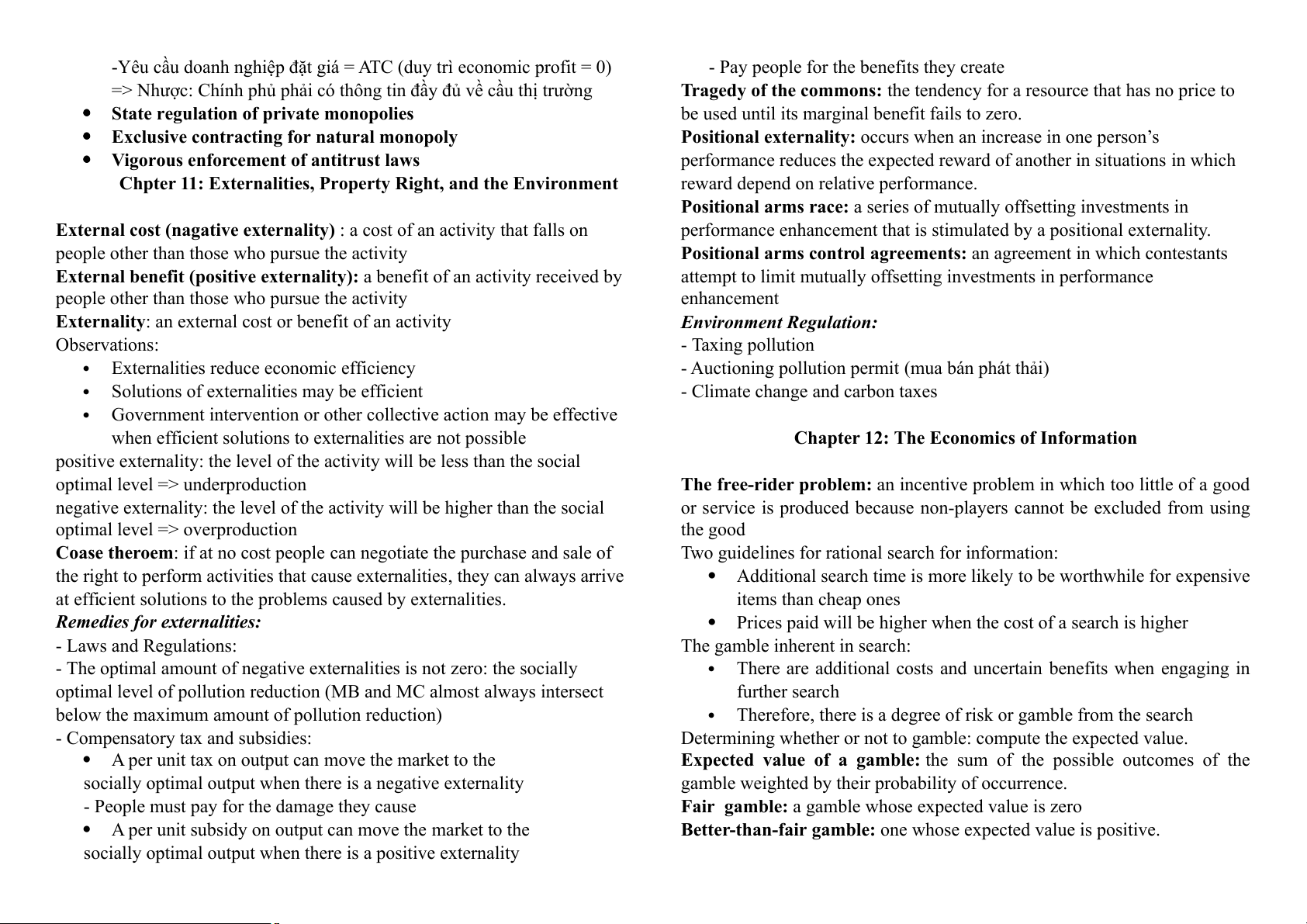
The Essential Difference between Perfectly and Imperfectly
scale(increasingreturnstoscale) Competitive Firms:
Agoodwhoseproductionhasalargestart-upcostandlowvariable cost is subject to economiesofscale
Animperfectlycompetitivefirm Network economies:
facesadownward-slopingdemand
Kinhtếtheomạnglưới curve
Giátrịcủasảnphẩmtăng
dần khi mà số lượng người dùngtăngdần
Themostimportantandenduring
of the sources of market power are economies of scale and network
Aperfectlycompetitivefirmfacesa economies.
perfectlyelasticdemandcurve
Profit Maximization for the Monopolist:
Marginal benefit = marginal revenue:thechangeinafirm’stotalrevenue
thatresultfromaone-unitchangeinoutput.
Supposeprice:P = a – bq
Revenue:R = P x q = (a -bq) x q = aq – bq 2
Thenthemarginalrevenue:MR = R’ = a -2bq
Market poweristhefirm'sability
Profitmaximazeatthelevelofoutputwheremarginalcostequalsmarginal
toraiseitspricewithoutlosingallitssales=>tendstoarisefromfactors revenue. MC = MR thatlimitcompetition
XácđịnhgiáPbằngcáchtìmđiểmQtrênđườngcầu
Perfectly discriminating monopolist: a firm that charges each buyer
exactlyhisorherreservationprice
If the firm can perfectly discriminate the price, then the quantity that
maximizesthemonopolist’sprofit=thequantityisoptimalforsociety
-Nếunhàđộcquyềncóthểphânbiệtgiámộtcáchhoànhảo=>Lợinhuận
tăng,tốtchocảxãhội(mứcsảnlượngbằngmứctốiưucủaxãhội)
-Thựctiễn:perfectpricediscriminationlàkhôngkhảthi(ngườibánphải
biếtchínhxácRPcủatừngkháchhàng–khôngthể,thậmchíngườibánđôi
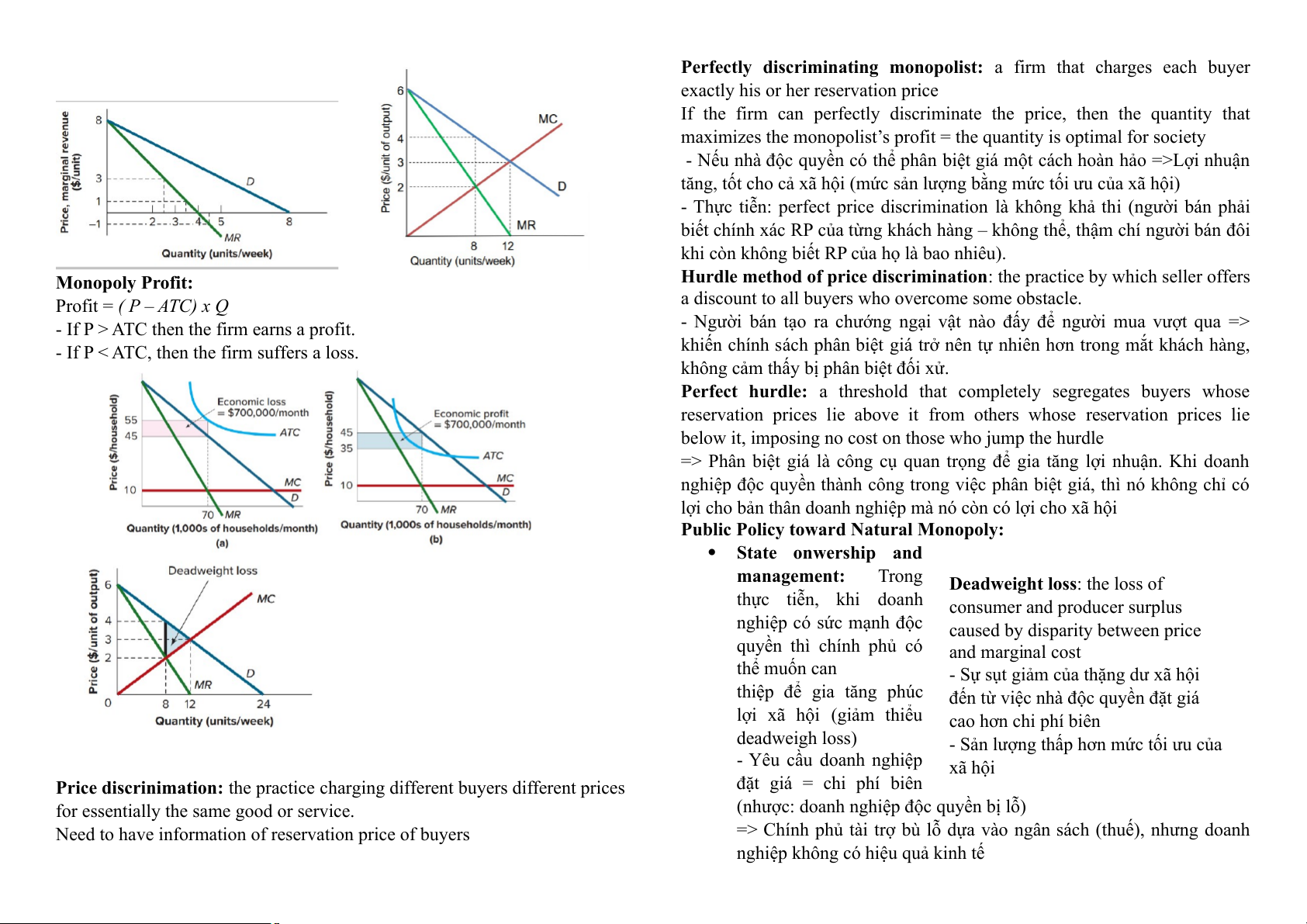
khicònkhôngbiếtRPcủahọlàbaonhiêu). Monopoly Profit:
Hurdle method of price discrimination:thepracticebywhichselleroffers
Profit=( P – ATC) x Q
adiscounttoallbuyerswhoovercomesomeobstacle.
-IfP>ATCthenthefirmearnsaprofit.
-Ngườibántạorachướngngạivậtnàođấyđểngườimuavượtqua=>
-IfP<ATC,thenthefirmsuffersaloss.
khiếnchínhsáchphânbiệtgiátrởnêntựnhiênhơntrongmắtkháchhàng,
khôngcảmthấybịphânbiệtđốixử.
Perfect hurdle: a threshold that completely segregates buyers whose
reservation prices lie above it from others whose reservation prices lie
belowit,imposingnocostonthosewhojumpthehurdle
=>Phânbiệtgiálàcôngcụquantrọngđểgiatănglợinhuận.Khidoanh
nghiệpđộcquyềnthànhcôngtrongviệcphânbiệtgiá,thìnókhôngchỉcó
lợichobảnthândoanhnghiệpmànócòncólợichoxãhội
Public Policy toward Natural Monopoly: State onwership and management: Trong
Deadweight loss:thelossof
thực tiễn, khi doanh
consumerandproducersurplus
nghiệpcósứcmạnhđộc
causedbydisparitybetweenprice
quyềnthì chínhphủ có andmarginalcost thểmuốncan
-Sựsụtgiảmcủathặngdưxãhội
thiệp để gia tăng phúc
đếntừviệcnhàđộcquyềnđặtgiá
lợi xã hội (giảm thiểu
caohơnchiphíbiên deadweighloss)
-Sảnlượngthấphơnmứctốiưucủa
-Yêucầudoanhnghiệp xãhội
Price discrinimation:thepracticechargingdifferentbuyersdifferentprices
đặt giá = chi phí biên
foressentiallythesamegoodorservice.
(nhược:doanhnghiệpđộcquyềnbịlỗ)
Needtohaveinformationofreservationpriceofbuyers
=>Chínhphủtàitrợbùlỗdựavàongânsách(thuế),nhưngdoanh
nghiệpkhôngcóhiệuquảkinhtế
-Yêucầudoanhnghiệpđặtgiá=ATC(duytrìeconomicprofit=0)
-Paypeopleforthebenefitstheycreate
=>Nhược:Chínhphủphảicóthôngtinđầyđủvềcầuthịtrường
Tragedy of the commons:thetendencyforaresourcethathasnopriceto
State regulation of private monopolies
beuseduntilitsmarginalbenefitfailstozero.
Exclusive contracting for natural monopoly
Positional externality:occurswhenanincreaseinoneperson’s
Vigorous enforcement of antitrust laws
performancereducestheexpectedrewardofanotherinsituationsinwhich
Chpter 11: Externalities, Property Right, and the Environment
rewarddependonrelativeperformance.
Positional arms race:aseriesofmutuallyoffsettinginvestmentsin
External cost (nagative externality):acostofanactivitythatfallson
performanceenhancementthatisstimulatedbyapositionalexternality.
peopleotherthanthosewhopursuetheactivity
Positional arms control agreements:anagreementinwhichcontestants
External benefit (positive externality):abenefitofanactivityreceivedby
attempttolimitmutuallyoffsettinginvestmentsinperformance
peopleotherthanthosewhopursuetheactivity enhancement
Externality:anexternalcostorbenefitofanactivity
Environment Regulation: Observations: -Taxingpollution
Externalitiesreduceeconomicefficiency
-Auctioningpollutionpermit(muabánphátthải)
Solutionsofexternalitiesmaybeefficient
-Climatechangeandcarbontaxes
Governmentinterventionorothercollectiveactionmaybeeffective
whenefficientsolutionstoexternalitiesarenotpossible
Chapter 12: The Economics of Information
positiveexternality:theleveloftheactivitywillbelessthanthesocial
optimallevel=>underproduction
The free-rider problem: anincentiveprobleminwhichtoolittleofagood
negativeexternality:theleveloftheactivitywillbehigherthanthesocial
orserviceisproducedbecausenon-playerscannotbeexcludedfromusing
optimallevel=>overproduction thegood
Coase theroem:ifatnocostpeoplecannegotiatethepurchaseandsaleof
Twoguidelinesforrationalsearchforinformation:
therighttoperformactivitiesthatcauseexternalities,theycanalwaysarrive
Additionalsearchtimeismorelikelytobeworthwhileforexpensive
atefficientsolutionstotheproblemscausedbyexternalities. itemsthancheapones
Remedies for externalities:
Pricespaidwillbehigherwhenthecostofasearchishigher -LawsandRegulations:
Thegambleinherentinsearch:
-Theoptimalamountofnegativeexternalitiesisnotzero:thesocially
Thereareadditionalcostsanduncertainbenefitswhenengagingin
optimallevelofpollutionreduction(MBandMCalmostalwaysintersect furthersearch
belowthemaximumamountofpollutionreduction)
Therefore,thereisadegreeofriskorgamblefromthesearch
-Compensatorytaxandsubsidies:
Determiningwhetherornottogamble:computetheexpectedvalue.
Aperunittaxonoutputcanmovethemarkettothe
Expected value of a gamble:the sum of the possible outcomes of the
sociallyoptimaloutputwhenthereisanegativeexternality
gambleweightedbytheirprobabilityofoccurrence.
-Peoplemustpayforthedamagetheycause
Fair gamble:agamblewhoseexpectedvalueiszero
Aperunitsubsidyonoutputcanmovethemarkettothe
Better-than-fair gamble: onewhoseexpectedvalueispositive.
sociallyoptimaloutputwhenthereisapositiveexternality
Risk-neutral person:someonewhowouldbewillingto acceptanyfair
gamble(orbetterthanfairgamble)
Risk-averse person:someonewhowouldrefuseanyfairgamble.
Asymmetric information:where buyers and sellers are not equally
Chapter 14: Public Goods and Tax Policy
informedaboutthecharacteristicsofproductsorservices.
Lemons model:George Akerlof’s explanation of how asymmetric
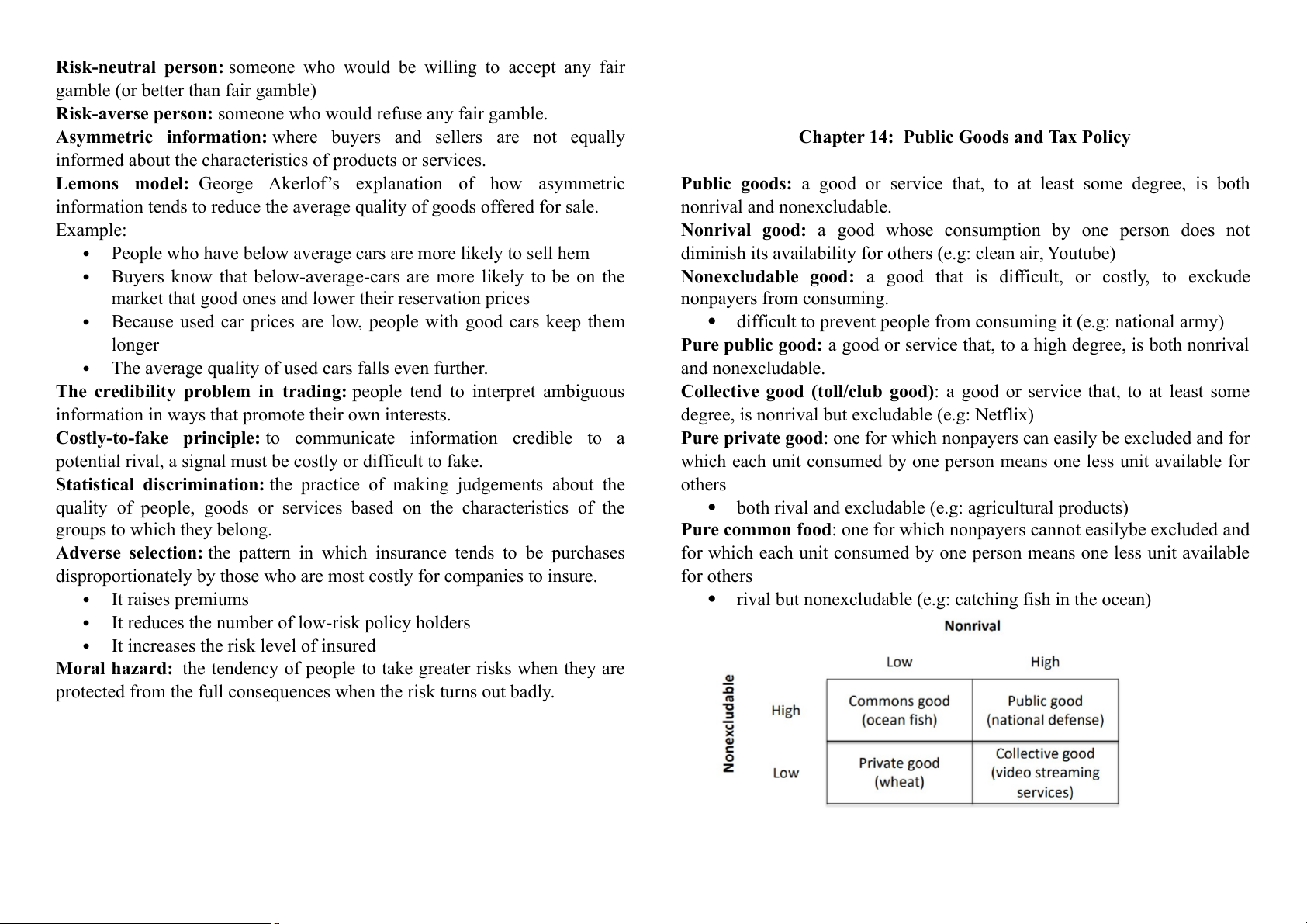
Public goods: a good or service that, to at least some degree, is both
informationtendstoreducetheaveragequalityofgoodsofferedforsale.
nonrivalandnonexcludable. Example:
Nonrival good: a good whose consumption by one person does not
Peoplewhohavebelowaveragecarsaremorelikelytosellhem
diminishitsavailabilityforothers(e.g:cleanair,Youtube)
Buyersknowthatbelow-average-carsaremorelikelytobeonthe
Nonexcludable good: a good that is difficult, or costly, to exckude
marketthatgoodonesandlowertheirreservationprices nonpayersfromconsuming.
Becauseusedcarpricesarelow,peoplewithgoodcarskeepthem
difficulttopreventpeoplefromconsumingit(e.g:nationalarmy) longer
Pure public good:agoodorservicethat,toahighdegree,isbothnonrival
Theaveragequalityofusedcarsfallsevenfurther. andnonexcludable.
The credibility problem in trading:peopletendtointerpretambiguous
Collective good (toll/club good):agoodorservicethat,toatleastsome
informationinwaysthatpromotetheirowninterests.
degree,isnonrivalbutexcludable(e.g:Netflix)
Costly-to-fake principle:to communicate information credible to a
Pure private good:oneforwhichnonpayerscaneasilybeexcludedandfor
potentialrival,asignalmustbecostlyordifficulttofake.
whicheachunitconsumedbyonepersonmeansonelessunitavailablefor
Statistical discrimination:the practice of making judgements about the others
quality ofpeople, goods or services based on the characteristics of the
bothrivalandexcludable(e.g:agriculturalproducts)
groupstowhichtheybelong.
Pure common food:oneforwhichnonpayerscannoteasilybeexcludedand
Adverse selection:thepatterninwhichinsurancetendsto bepurchases
forwhicheachunitconsumedbyonepersonmeansonelessunitavailable
disproportionatelybythosewhoaremostcostlyforcompaniestoinsure. forothers Itraisespremiums
rivalbutnonexcludable(e.g:catchingfishintheocean)
Itreducesthenumberoflow-riskpolicyholders
Itincreasestherisklevelofinsured
Moral hazard: thetendencyofpeopletotakegreaterriskswhentheyare
protectedfromthefullconsequenceswhentheriskturnsoutbadly.
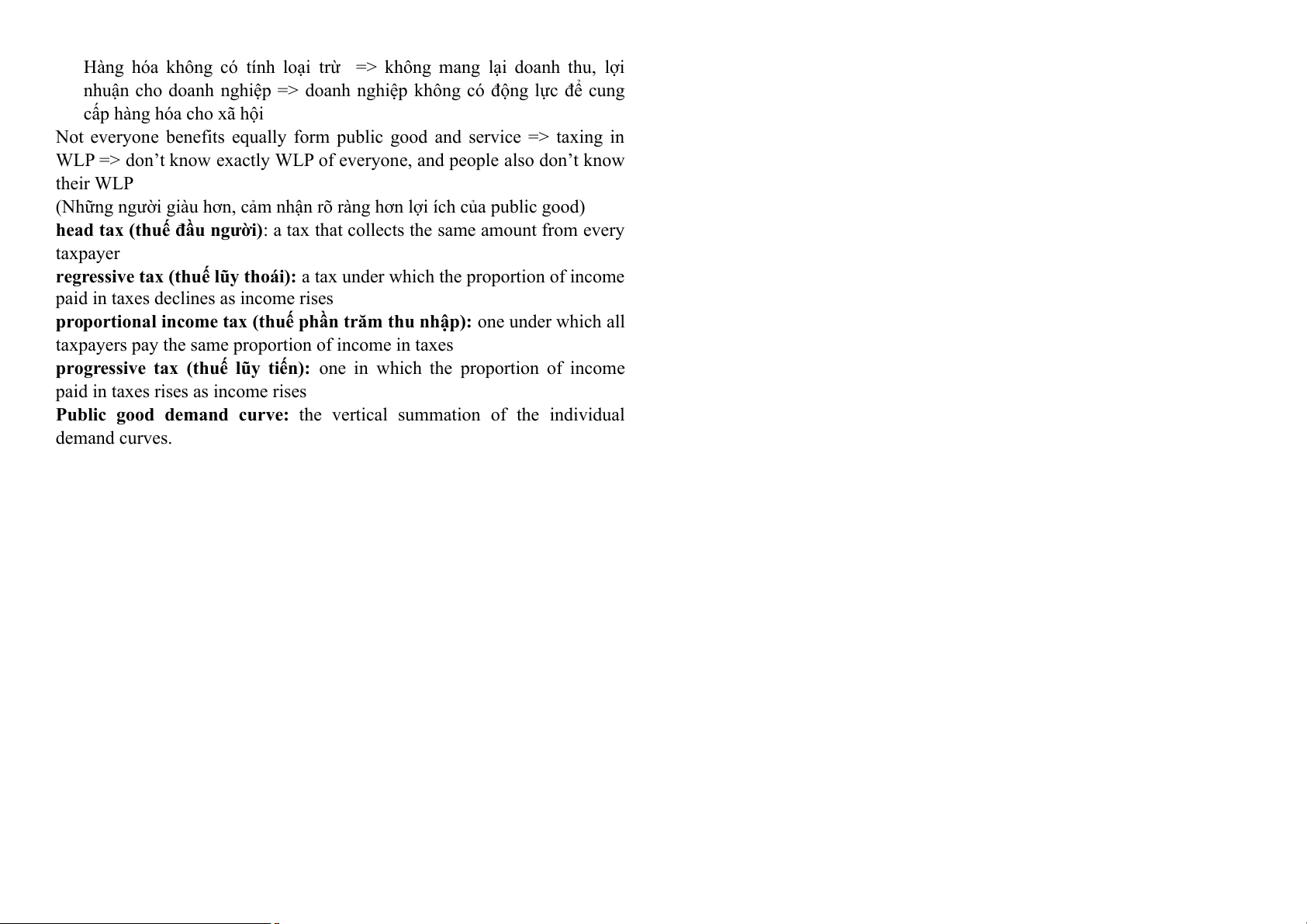
Hànghóakhôngcótínhloạitrừ =>khôngmanglạidoanhthu,lợi
nhuậnchodoanhnghiệp=>doanhnghiệpkhôngcóđộnglựcđểcung
cấphànghóachoxãhội
Noteveryonebenefitsequallyformpublicgoodandservice=>taxingin
WLP=>don’tknowexactlyWLPofeveryone,andpeoplealsodon’tknow theirWLP
(Nhữngngườigiàuhơn,cảmnhậnrõrànghơnlợiíchcủapublicgood)
head tax (thuế đầu người):ataxthatcollectsthesameamountfromevery taxpayer
regressive tax (thuế lũy thoái):ataxunderwhichtheproportionofincome
paidintaxesdeclinesasincomerises
proportional income tax (thuế phần trăm thu nhập):oneunderwhichall
taxpayerspaythesameproportionofincomeintaxes
progressive tax (thuế lũy tiến): oneinwhichtheproportionofincome
paidintaxesrisesasincomerises
Public good demand curve: the vertical summation of the individual demandcurves.
Tài liệu liên quan:
-

Chương 3: độ co giãn và các nhân tố ảnh hưởng | Microeconomics | Trường Đại học Quốc tế, Đại học Quốc gia Thành phố Hồ Chí Minh
4 2 -
Microeconomics Syllabus | Microeconomics | Trường Đại học Quốc tế, Đại học Quốc gia Thành phố Hồ Chí Minh
4 2 -
Microeconomics Course Syllabus & Assessment Details | Microeconomics | Trường Đại học Quốc tế, Đại học Quốc gia Thành phố Hồ Chí Minh
4 2 -
Assignment 3 - Elasticity MCQs and Key Concepts | Microeconomics | Trường Đại học Quốc tế, Đại học Quốc gia Thành phố Hồ Chí Minh
4 2 -
Assignment 2 - Economic Equilibrium Analysis of Fridges and Motorcycles | Microeconomics | Trường Đại học Quốc tế, Đại học Quốc gia Thành phố Hồ Chí Minh
4 2