Problem Solving - Utility Maximization in Section 6 | Microeconomics | Trường Đại học Quốc tế, Đại học Quốc gia Thành phố Hồ Chí Minh
Suppose that Jeremy’s weekly budget on both goods is $10. What quantity of apples and pears will maximize his utility if he spends his entire budget on apples and pears? (Find the optimal combination that maximizes Jeremy’s utility within the budget constraint). Tài liệu được sưu tầm và soạn thảo dưới dạng file PDF để gửi tới các bạn cùng tham khảo, ôn tập đầy đủ kiến thức, chuẩn bị cho các buổi học thật tốt. Mời bạn đọc đón xem!
Môn: Microeconomics 635 tài liệu
Trường: Trường Đại học Quốc tế, Đại học Quốc gia Thành phố Hồ Chí Minh 1.9 K tài liệu
Tác giả:

Preview text:
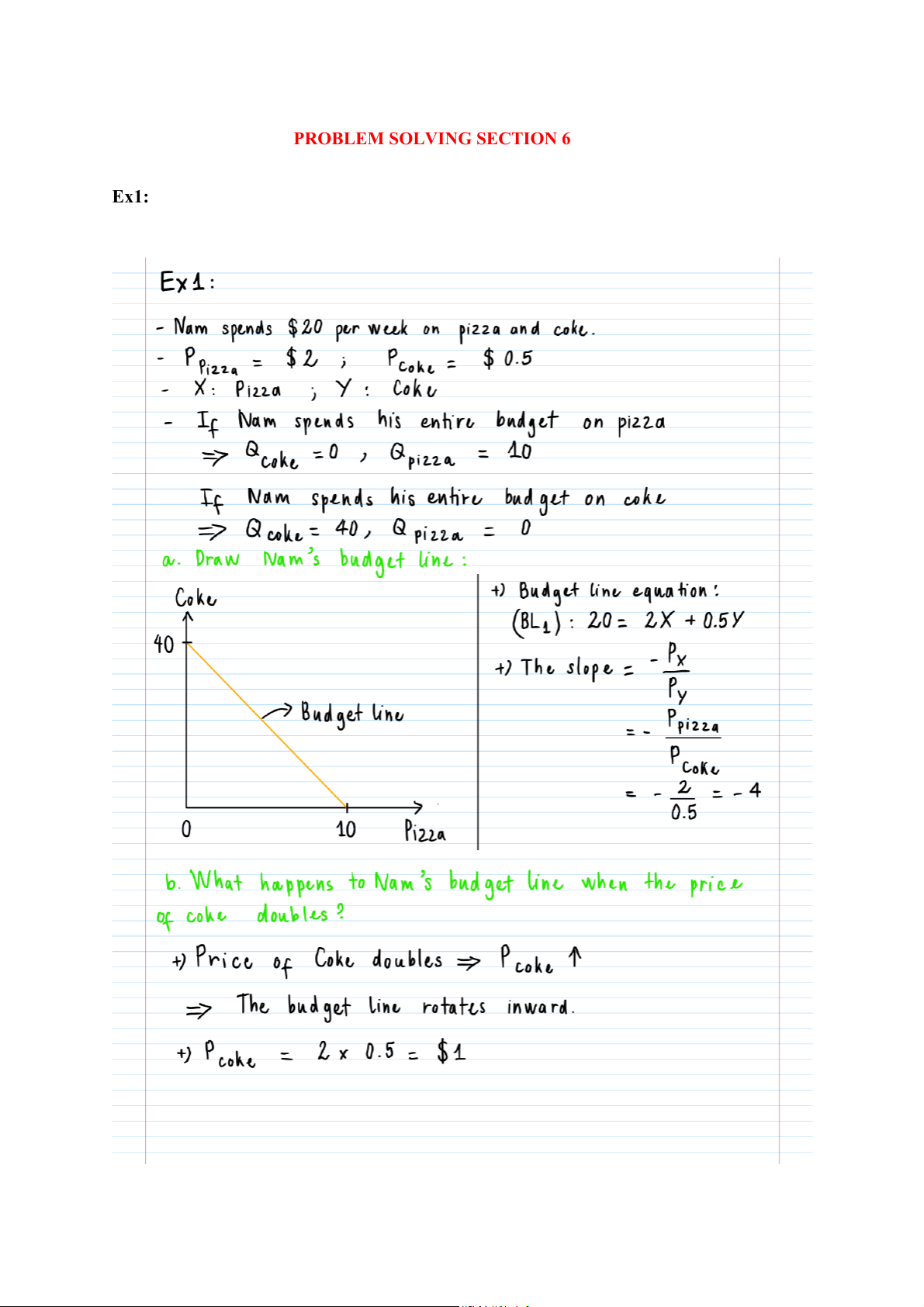
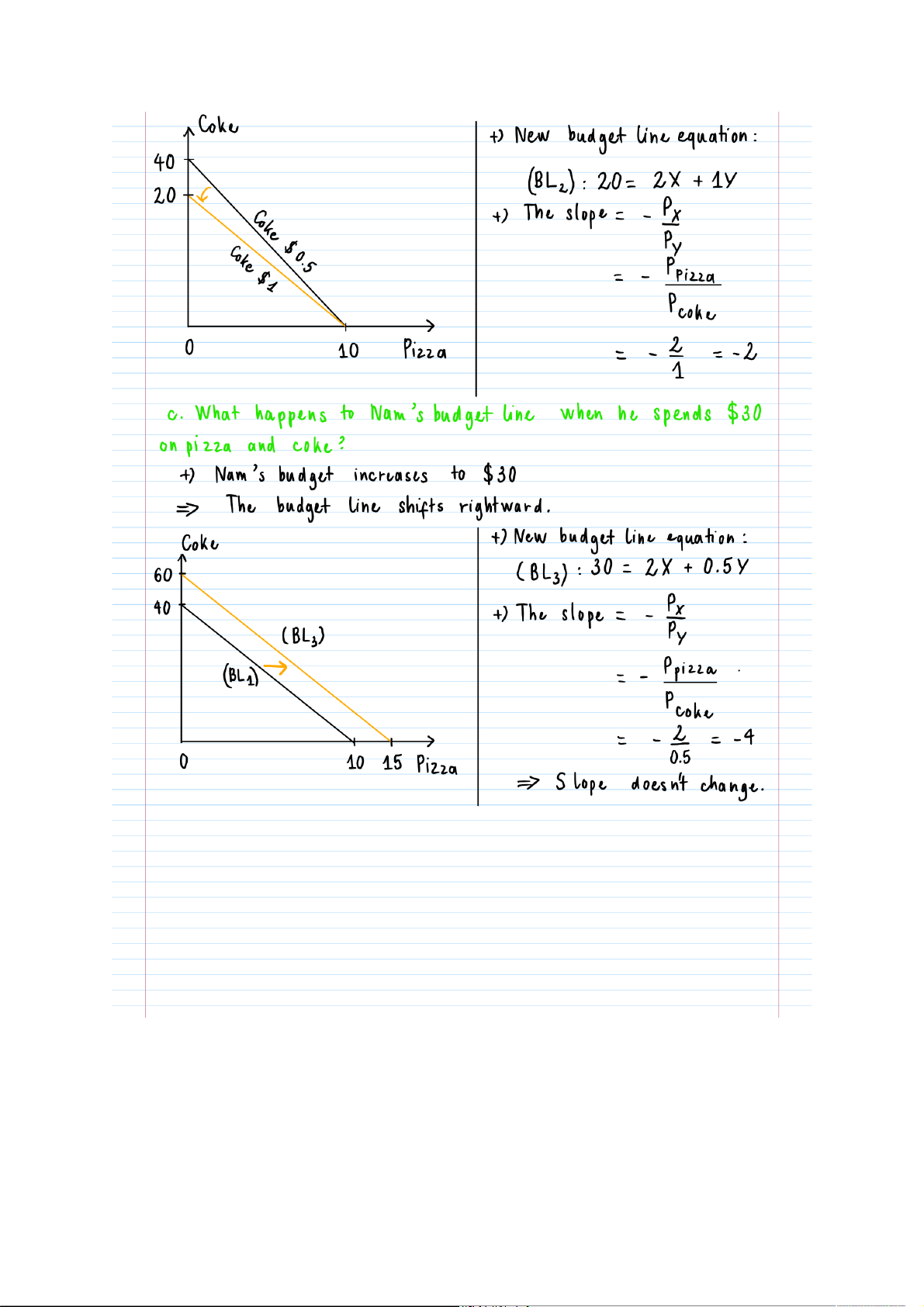
PROBLEM SOLVING SECTION 6 Ex1:
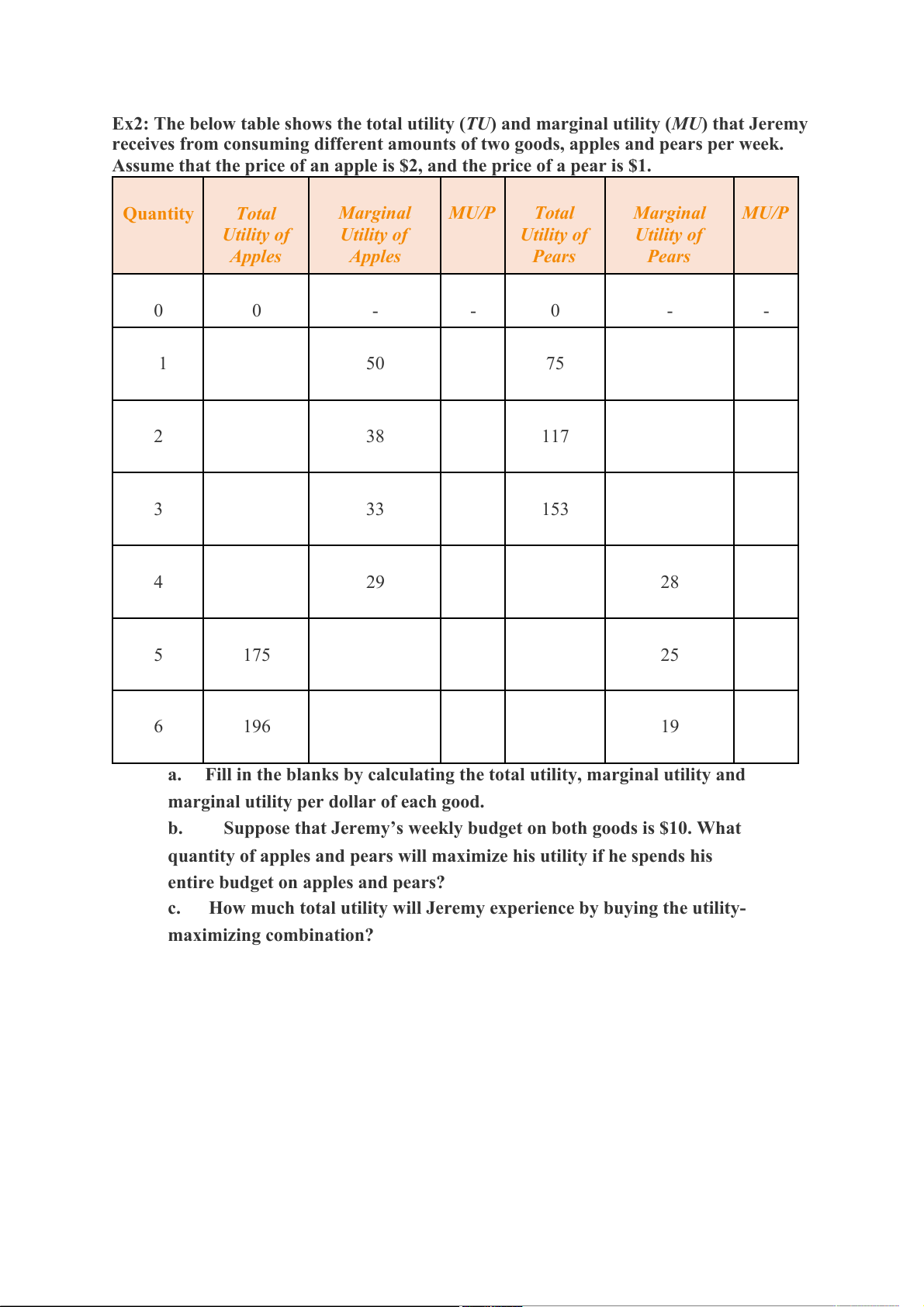
Ex2: The below table shows the total utility (TU) and marginal utility ( ) that Jeremy MU
receives from consuming different amounts of two goods, apples and pears per week.
Assume that the price of an apple is $2, and the price of a pear is $1. Quantity Total Marginal MU/P Total Marginal MU/P Utility of Utility of Utility of Utility of Apples Apples Pears Pears 0 0 - - 0 - - 1 50 75 2 38 117 3 33 153 4 29 28 5 175 25 6 196 19
a. Fill in the blanks by calculating the total utility, marginal utility and
marginal utility per dollar of each good. b.
Suppose that Jeremy’s weekly budget on both goods is $10. What
quantity of apples and pears will maximize his utility if he spends his
entire budget on apples and pears?
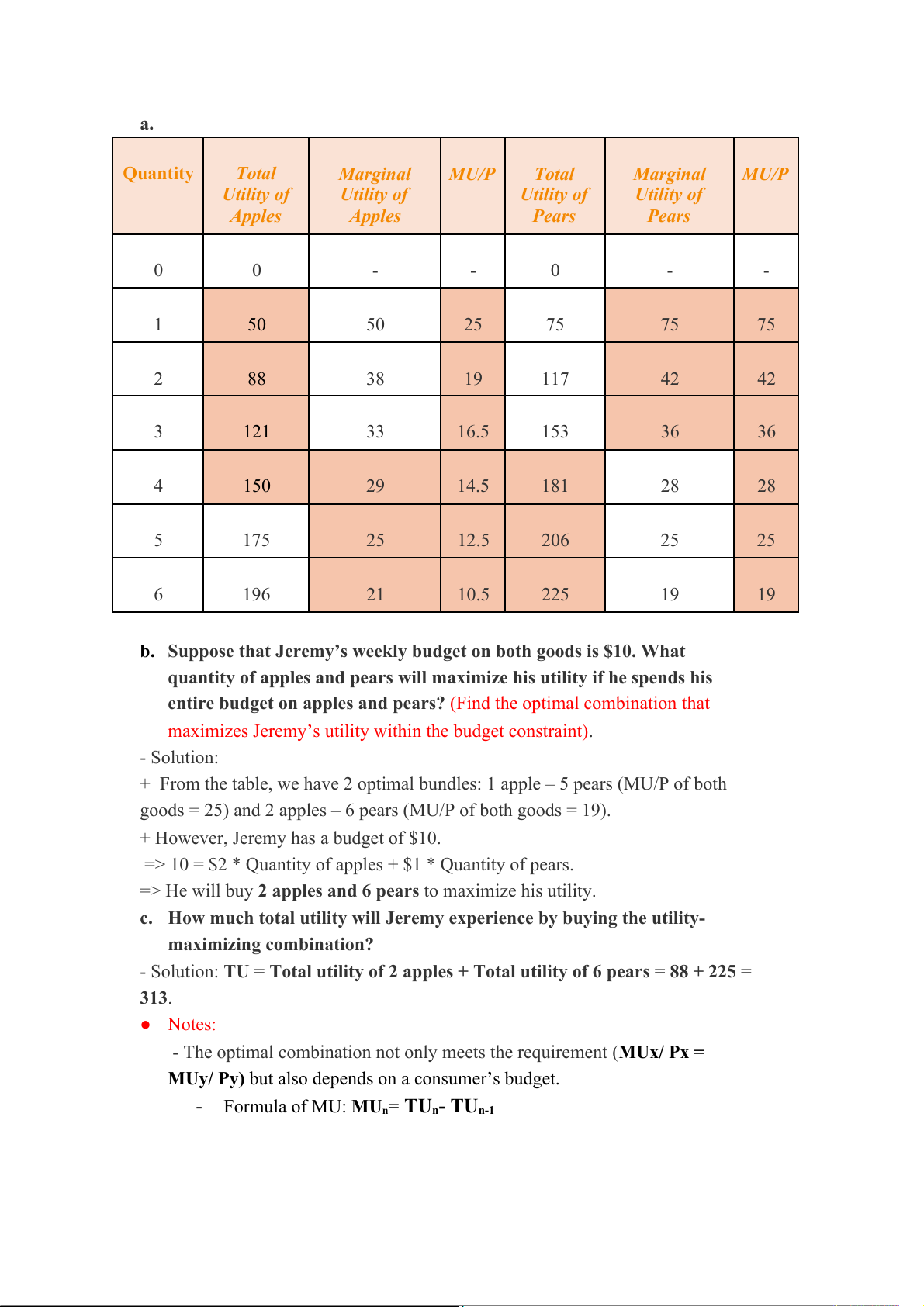
c. How much total utility will Jeremy experience by buying the utility- maximizing combination? a. Quantity Total Marginal MU/P Total Marginal MU/P Utility of Utility of Utility of Utility of Apples Apples Pears Pears 0 0 - - 0 - - 1 50 50 25 75 75 75 2 88 38 19 117 42 42 3 121 33 16.5 153 36 36 4 150 29 14.5 181 28 28 5 175 25 12.5 206 25 25 6 196 21 10.5 225 19 19
b. Suppose that Jeremy’s weekly budget on both goods is $10. What
quantity of apples and pears will maximize his utility if he spends his
entire budget on apples and pears? (Find the optimal combination that
maximizes Jeremy’s utility within the budget constraint). - Solution:
+ From the table, we have 2 optimal bundles: 1 apple – 5 pears (MU/P of both
goods = 25) and 2 apples – 6 pears (MU/P of both goods = 19).
+ However, Jeremy has a budget of $10.
=> 10 = $2 * Quantity of apples + $1 * Quantity of pears.
=> He will buy 2 apples and 6 pears to maximize his utility.
c. How much total utility will Jeremy experience by buying the utility- maximizing combination?
- Solution: TU = Total utility of 2 apples + Total utility of 6 pears = 88 + 225 = 313. ● Notes:
- The optimal combination not only meets the requirement (MUx/ Px =
MUy/ Py) but also depends on a consumer’s budget. -
Formula of MU: MUn= TUn- TUn-1
Tài liệu liên quan:
-
Chương 3: độ co giãn và các nhân tố ảnh hưởng | Microeconomics | Trường Đại học Quốc tế, Đại học Quốc gia Thành phố Hồ Chí Minh
1 1 -
Microeconomics Syllabus | Microeconomics | Trường Đại học Quốc tế, Đại học Quốc gia Thành phố Hồ Chí Minh
1 1 -
Microeconomics Course Syllabus & Assessment Details | Microeconomics | Trường Đại học Quốc tế, Đại học Quốc gia Thành phố Hồ Chí Minh
1 1 -
Assignment 3 - Elasticity MCQs and Key Concepts | Microeconomics | Trường Đại học Quốc tế, Đại học Quốc gia Thành phố Hồ Chí Minh
1 1 -
Assignment 2 - Economic Equilibrium Analysis of Fridges and Motorcycles | Microeconomics | Trường Đại học Quốc tế, Đại học Quốc gia Thành phố Hồ Chí Minh
1 1