Production & Cost Analysis: Key Concepts and Insights | Microeconomics | Trường Đại học Quốc tế, Đại học Quốc gia Thành phố Hồ Chí Minh
The economic field of industrial organization examines how firms’ decisions about prices and quantities depend on the market conditions they face. ANS: T DIF: 2 REF: 13-0 NAT: Analytic LOC: Costs of production TOP: Industrial organization MSC: Interpretive 2. Profit equals marginal revenue minus marginal cost. ANS: F DIF: 1 REF: 13-1 NAT: Analytic LOC: Costs of production TOP. Tài liệu được sưu tầm và soạn thảo dưới dạng file PDF để gửi tới các bạn cùng tham khảo, ôn tập đầy đủ kiến thức, chuẩn bị cho các buổi học thật tốt. Mời bạn đọc đón xem!
Môn: Microeconomics 635 tài liệu
Trường: Trường Đại học Quốc tế, Đại học Quốc gia Thành phố Hồ Chí Minh 1.9 K tài liệu
Tác giả:



Preview text:
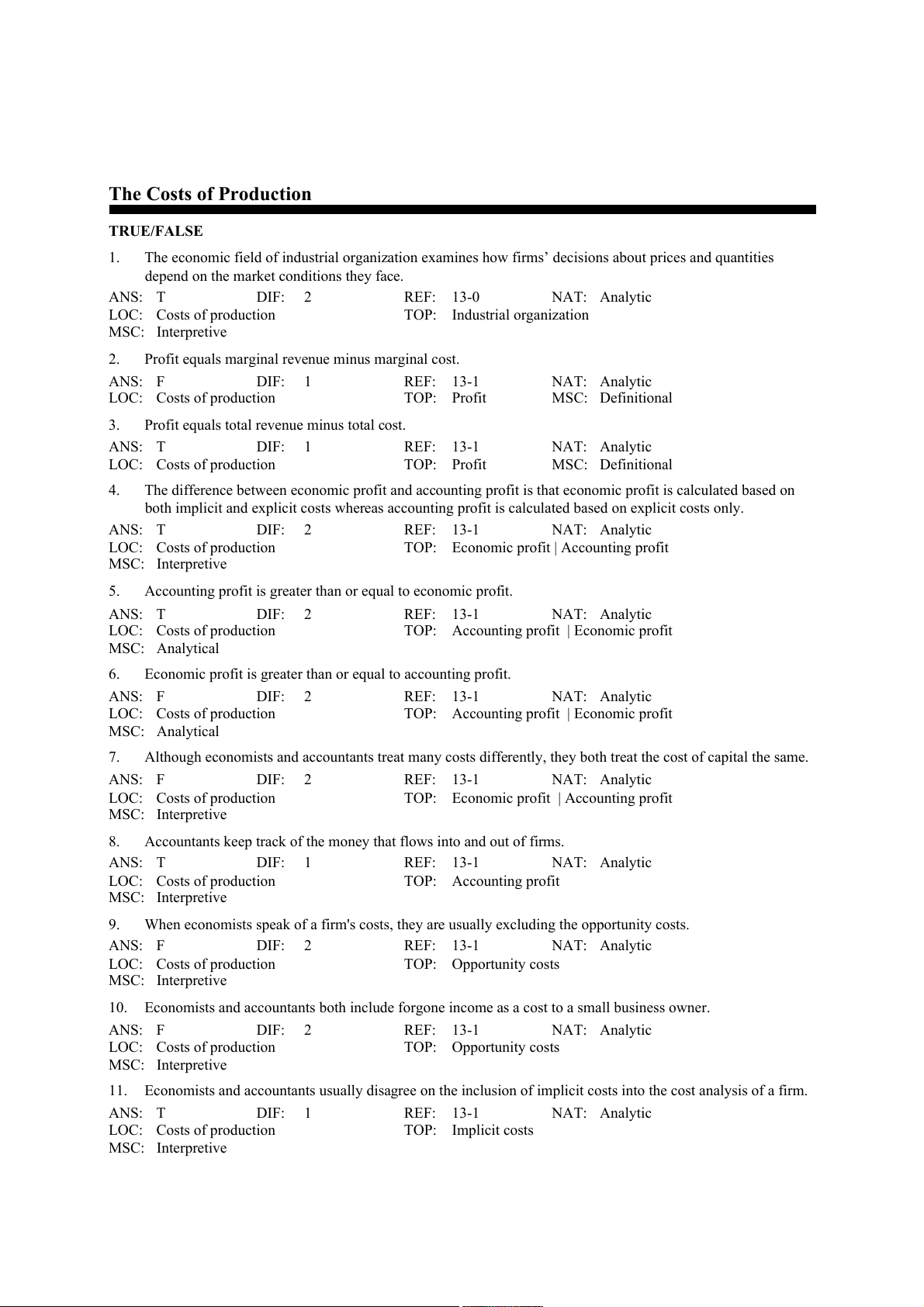
The Costs of Production TRUE/FALSE 1.
The economic field of industrial organization examines how firms’ decisions about prices and quantities
depend on the market conditions they face. ANS: T DIF: 2 REF: 13-0 NAT: Analytic LOC: Costs of production TOP: Industrial organization MSC: Interpretive 2.
Profit equals marginal revenue minus marginal cost. ANS: F DIF: 1 REF: 13-1 NAT: Analytic LOC: Costs of production TOP: Profit MSC: Definitional 3.
Profit equals total revenue minus total cost. ANS: T DIF: 1 REF: 13-1 NAT: Analytic LOC: Costs of production TOP: Profit MSC: Definitional 4.
The difference between economic profit and accounting profit is that economic profit is calculated based on
both implicit and explicit costs whereas accounting profit is calculated based on explicit costs only. ANS: T DIF: 2 REF: 13-1 NAT: Analytic LOC: Costs of production TOP:
Economic profit | Accounting profit MSC: Interpretive 5.
Accounting profit is greater than or equal to economic profit. ANS: T DIF: 2 REF: 13-1 NAT: Analytic LOC: Costs of production TOP:
Accounting profit | Economic profit MSC: Analytical 6.
Economic profit is greater than or equal to accounting profit. ANS: F DIF: 2 REF: 13-1 NAT: Analytic LOC: Costs of production TOP:
Accounting profit | Economic profit MSC: Analytical 7.
Although economists and accountants treat many costs differently, they both treat the cost of capital the same. ANS: F DIF: 2 REF: 13-1 NAT: Analytic LOC: Costs of production TOP:
Economic profit | Accounting profit MSC: Interpretive 8.
Accountants keep track of the money that flows into and out of firms. ANS: T DIF: 1 REF: 13-1 NAT: Analytic LOC: Costs of production TOP: Accounting profit MSC: Interpretive 9.
When economists speak of a firm's costs, they are usually excluding the opportunity costs. ANS: F DIF: 2 REF: 13-1 NAT: Analytic LOC: Costs of production TOP: Opportunity costs MSC: Interpretive 10.
Economists and accountants both include forgone income as a cost to a small business owner. ANS: F DIF: 2 REF: 13-1 NAT: Analytic LOC: Costs of production TOP: Opportunity costs MSC: Interpretive 11.
Economists and accountants usually disagree on the inclusion of implicit costs into the cost analysis of a firm. ANS: T DIF: 1 REF: 13-1 NAT: Analytic LOC: Costs of production TOP: Implicit costs MSC: Interpretive 12.
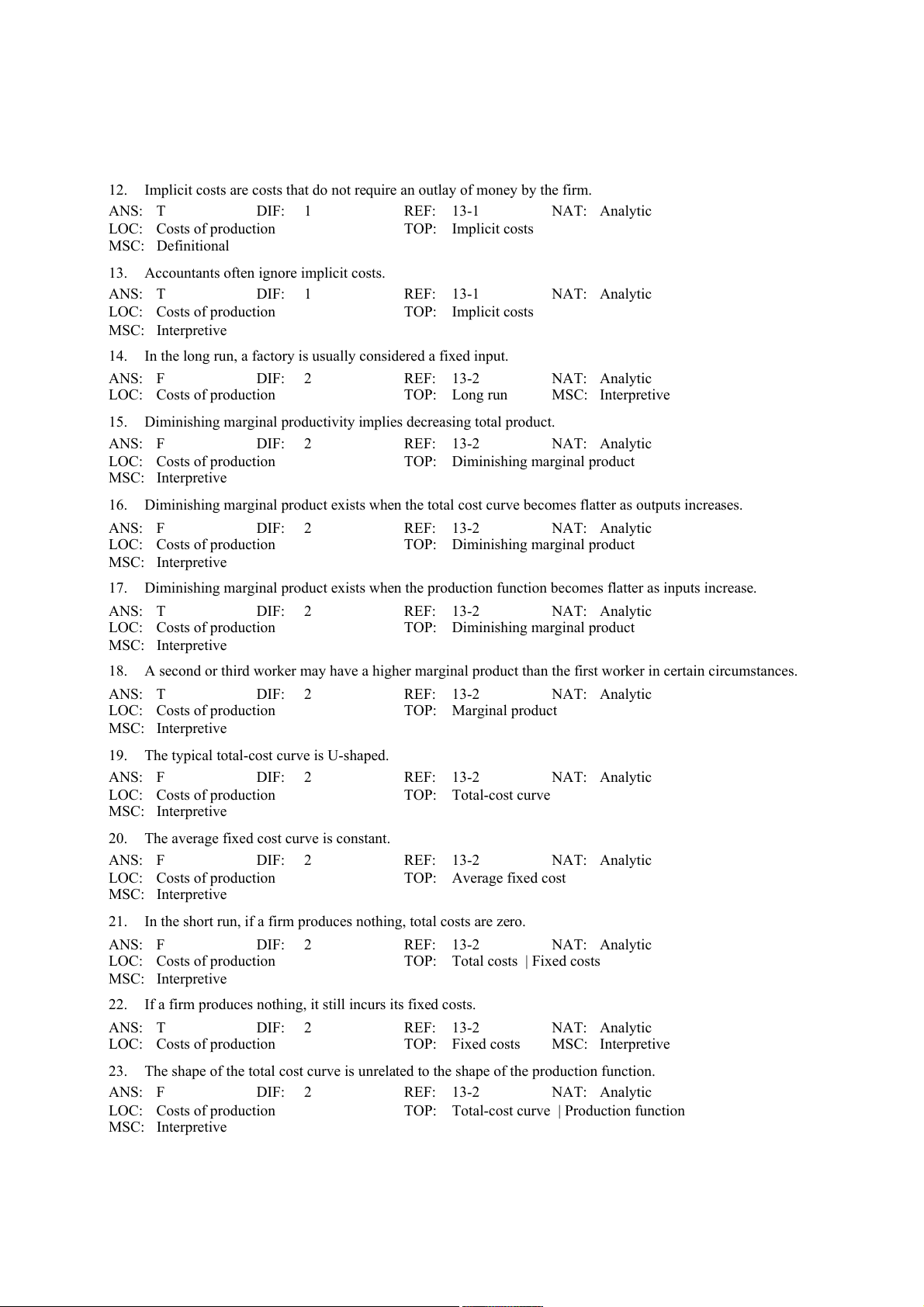
Implicit costs are costs that do not require an outlay of money by the firm. ANS: T DIF: 1 REF: 13-1 NAT: Analytic LOC: Costs of production TOP: Implicit costs MSC: Definitional 13.
Accountants often ignore implicit costs. ANS: T DIF: 1 REF: 13-1 NAT: Analytic LOC: Costs of production TOP: Implicit costs MSC: Interpretive 14.
In the long run, a factory is usually considered a fixed input. ANS: F DIF: 2 REF: 13-2 NAT: Analytic LOC: Costs of production TOP: Long run MSC: Interpretive 15.
Diminishing marginal productivity implies decreasing total product. ANS: F DIF: 2 REF: 13-2 NAT: Analytic LOC: Costs of production TOP: Diminishing marginal product MSC: Interpretive 16.
Diminishing marginal product exists when the total cost curve becomes flatter as outputs increases. ANS: F DIF: 2 REF: 13-2 NAT: Analytic LOC: Costs of production TOP: Diminishing marginal product MSC: Interpretive 17.
Diminishing marginal product exists when the production function becomes flatter as inputs increase. ANS: T DIF: 2 REF: 13-2 NAT: Analytic LOC: Costs of production TOP: Diminishing marginal product MSC: Interpretive 18.
A second or third worker may have a higher marginal product than the first worker in certain circumstances. ANS: T DIF: 2 REF: 13-2 NAT: Analytic LOC: Costs of production TOP: Marginal product MSC: Interpretive 19.
The typical total-cost curve is U-shaped. ANS: F DIF: 2 REF: 13-2 NAT: Analytic LOC: Costs of production TOP: Total-cost curve MSC: Interpretive 20.
The average fixed cost curve is constant. ANS: F DIF: 2 REF: 13-2 NAT: Analytic LOC: Costs of production TOP: Average fixed cost MSC: Interpretive 21.
In the short run, if a firm produces nothing, total costs are zero. ANS: F DIF: 2 REF: 13-2 NAT: Analytic LOC: Costs of production TOP: Total costs | Fixed costs MSC: Interpretive 22.
If a firm produces nothing, it still incurs its fixed costs. ANS: T DIF: 2 REF: 13-2 NAT: Analytic LOC: Costs of production TOP: Fixed costs MSC: Interpretive 23.
The shape of the total cost curve is unrelated to the shape of the production function. ANS: F DIF: 2 REF: 13-2 NAT: Analytic LOC: Costs of production TOP:
Total-cost curve | Production function MSC: Interpretive 24.
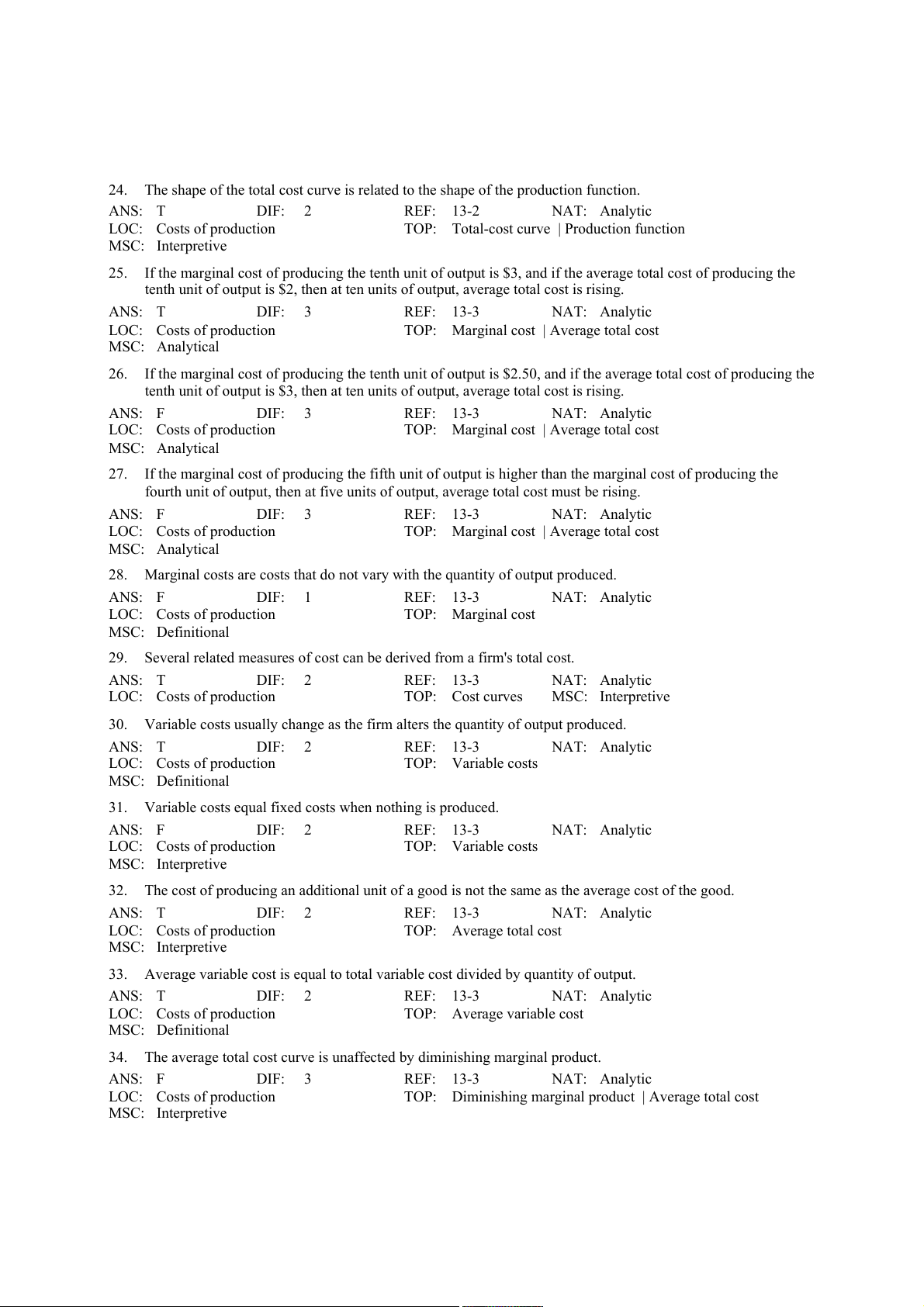
The shape of the total cost curve is related to the shape of the production function. ANS: T DIF: 2 REF: 13-2 NAT: Analytic LOC: Costs of production TOP:
Total-cost curve | Production function MSC: Interpretive 25.
If the marginal cost of producing the tenth unit of output is $3, and if the average total cost of producing the
tenth unit of output is $2, then at ten units of output, average total cost is rising. ANS: T DIF: 3 REF: 13-3 NAT: Analytic LOC: Costs of production TOP:
Marginal cost | Average total cost MSC: Analytical 26.
If the marginal cost of producing the tenth unit of output is $2.50, and if the average total cost of producing the
tenth unit of output is $3, then at ten units of output, average total cost is rising. ANS: F DIF: 3 REF: 13-3 NAT: Analytic LOC: Costs of production TOP:
Marginal cost | Average total cost MSC: Analytical 27.
If the marginal cost of producing the fifth unit of output is higher than the marginal cost of producing the
fourth unit of output, then at five units of output, average total cost must be rising. ANS: F DIF: 3 REF: 13-3 NAT: Analytic LOC: Costs of production TOP:
Marginal cost | Average total cost MSC: Analytical 28.
Marginal costs are costs that do not vary with the quantity of output produced. ANS: F DIF: 1 REF: 13-3 NAT: Analytic LOC: Costs of production TOP: Marginal cost MSC: Definitional 29.
Several related measures of cost can be derived from a firm's total cost. ANS: T DIF: 2 REF: 13-3 NAT: Analytic LOC: Costs of production TOP: Cost curves MSC: Interpretive 30.
Variable costs usually change as the firm alters the quantity of output produced. ANS: T DIF: 2 REF: 13-3 NAT: Analytic LOC: Costs of production TOP: Variable costs MSC: Definitional 31.
Variable costs equal fixed costs when nothing is produced. ANS: F DIF: 2 REF: 13-3 NAT: Analytic LOC: Costs of production TOP: Variable costs MSC: Interpretive 32.
The cost of producing an additional unit of a good is not the same as the average cost of the good. ANS: T DIF: 2 REF: 13-3 NAT: Analytic LOC: Costs of production TOP: Average total cost MSC: Interpretive 33.
Average variable cost is equal to total variable cost divided by quantity of output. ANS: T DIF: 2 REF: 13-3 NAT: Analytic LOC: Costs of production TOP: Average variable cost MSC: Definitional 34.
The average total cost curve is unaffected by diminishing marginal product. ANS: F DIF: 3 REF: 13-3 NAT: Analytic LOC: Costs of production TOP:
Diminishing marginal product | Average total cost MSC: Interpretive 35.
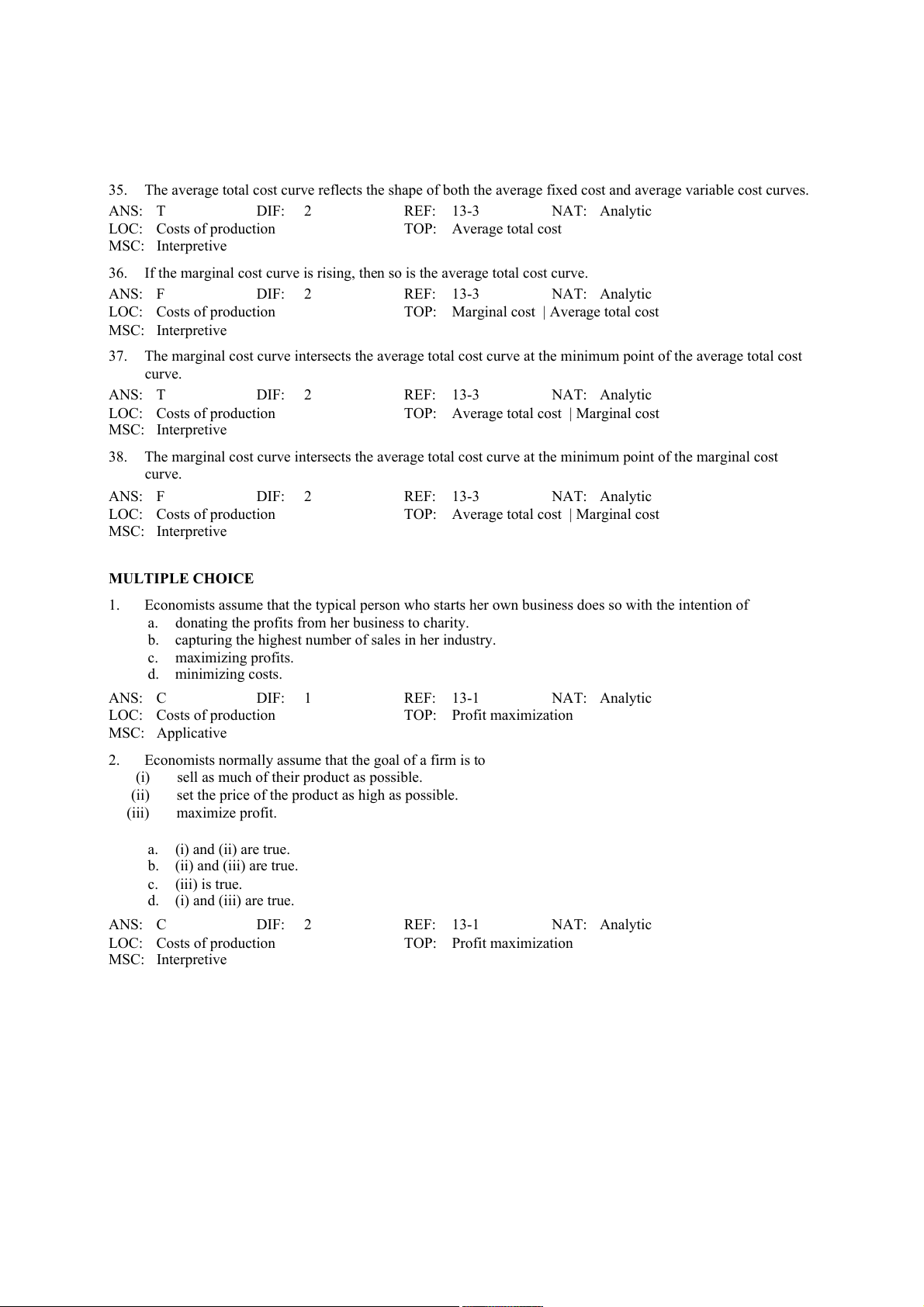
The average total cost curve reflects the shape of both the average fixed cost and average variable cost curves. ANS: T DIF: 2 REF: 13-3 NAT: Analytic LOC: Costs of production TOP: Average total cost MSC: Interpretive 36.
If the marginal cost curve is rising, then so is the average total cost curve. ANS: F DIF: 2 REF: 13-3 NAT: Analytic LOC: Costs of production TOP:
Marginal cost | Average total cost MSC: Interpretive 37.
The marginal cost curve intersects the average total cost curve at the minimum point of the average total cost curve. ANS: T DIF: 2 REF: 13-3 NAT: Analytic LOC: Costs of production TOP:
Average total cost | Marginal cost MSC: Interpretive 38.
The marginal cost curve intersects the average total cost curve at the minimum point of the marginal cost curve. ANS: F DIF: 2 REF: 13-3 NAT: Analytic LOC: Costs of production TOP:
Average total cost | Marginal cost MSC: Interpretive MULTIPLE CHOICE 1.
Economists assume that the typical person who starts her own business does so with the intention of a.
donating the profits from her business to charity. b.
capturing the highest number of sales in her industry. c. maximizing profits. d. minimizing costs. ANS: C DIF: 1 REF: 13-1 NAT: Analytic LOC: Costs of production TOP: Profit maximization MSC: Applicative 2.
Economists normally assume that the goal of a firm is to (i)
sell as much of their product as possible. (ii)
set the price of the product as high as possible. (iii) maximize profit. a. (i) and (ii) are true. b. (ii) and (iii) are true. c. (iii) is true. d. (i) and (iii) are true. ANS: C DIF: 2 REF: 13-1 NAT: Analytic LOC: Costs of production TOP: Profit maximization MSC: Interpretive 3.
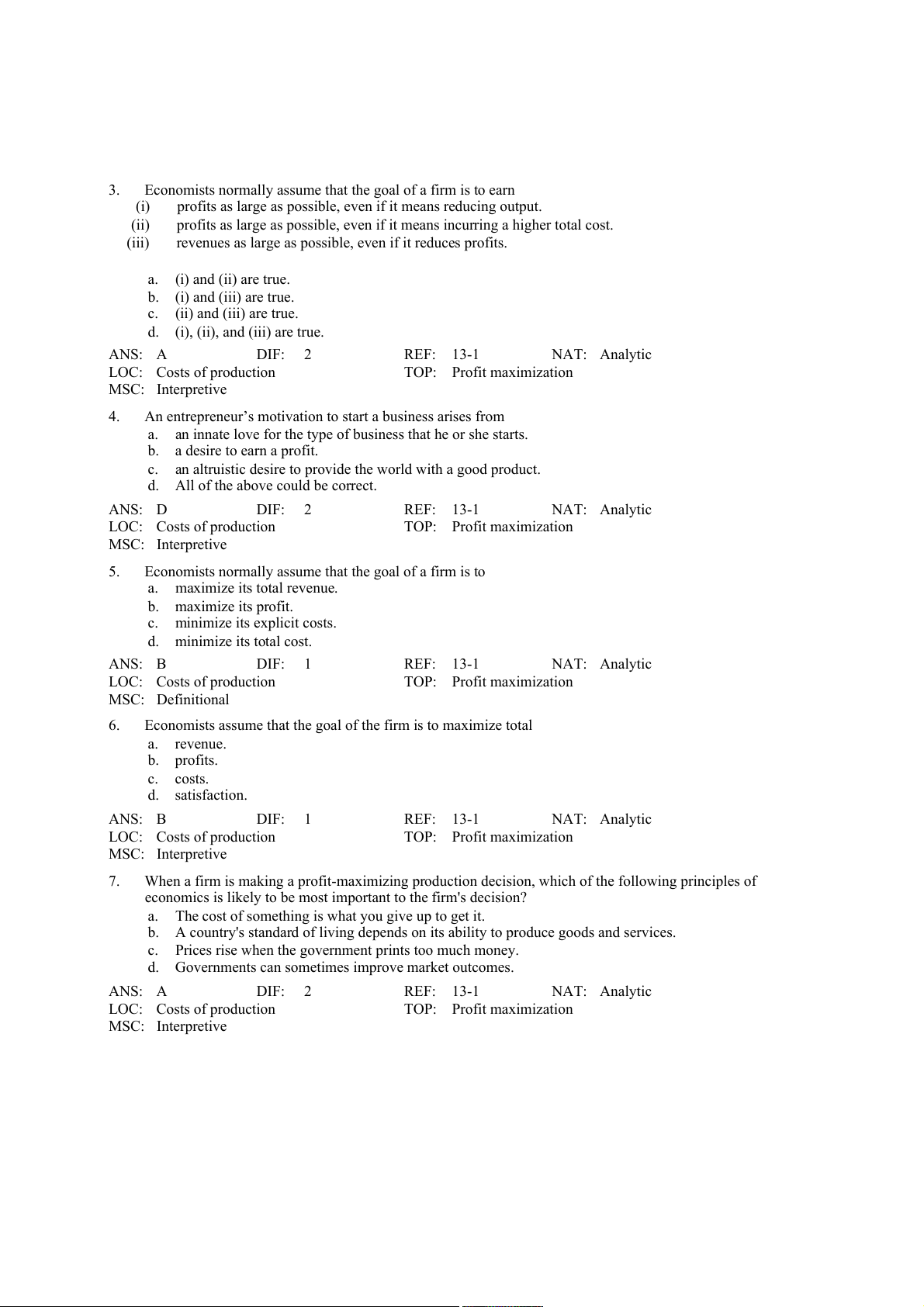
Economists normally assume that the goal of a firm is to earn (i)
profits as large as possible, even if it means reducing output. (ii)
profits as large as possible, even if it means incurring a higher total cost. (iii)
revenues as large as possible, even if it reduces profits. a. (i) and (ii) are true. b. (i) and (iii) are true. c. (ii) and (iii) are true. d. (i), (ii), and (iii) are true. ANS: A DIF: 2 REF: 13-1 NAT: Analytic LOC: Costs of production TOP: Profit maximization MSC: Interpretive 4.
An entrepreneur’s motivation to start a business arises from a.
an innate love for the type of business that he or she starts. b. a desire to earn a profit. c.
an altruistic desire to provide the world with a good product. d.
All of the above could be correct. ANS: D DIF: 2 REF: 13-1 NAT: Analytic LOC: Costs of production TOP: Profit maximization MSC: Interpretive 5.
Economists normally assume that the goal of a firm is to a. maximize its total revenue. b. maximize its profit. c. minimize its explicit costs. d. minimize its total cost. ANS: B DIF: 1 REF: 13-1 NAT: Analytic LOC: Costs of production TOP: Profit maximization MSC: Definitional 6.
Economists assume that the goal of the firm is to maximize total a. revenue. b. profits. c. costs. d. satisfaction. ANS: B DIF: 1 REF: 13-1 NAT: Analytic LOC: Costs of production TOP: Profit maximization MSC: Interpretive 7.
When a firm is making a profit-maximizing production decision, which of the following principles of
economics is likely to be most important to the firm's decision? a.
The cost of something is what you give up to get it. b.
A country's standard of living depends on its ability to produce goods and services. c.
Prices rise when the government prints too much money. d.
Governments can sometimes improve market outcomes. ANS: A DIF: 2 REF: 13-1 NAT: Analytic LOC: Costs of production TOP: Profit maximization MSC: Interpretive 8.
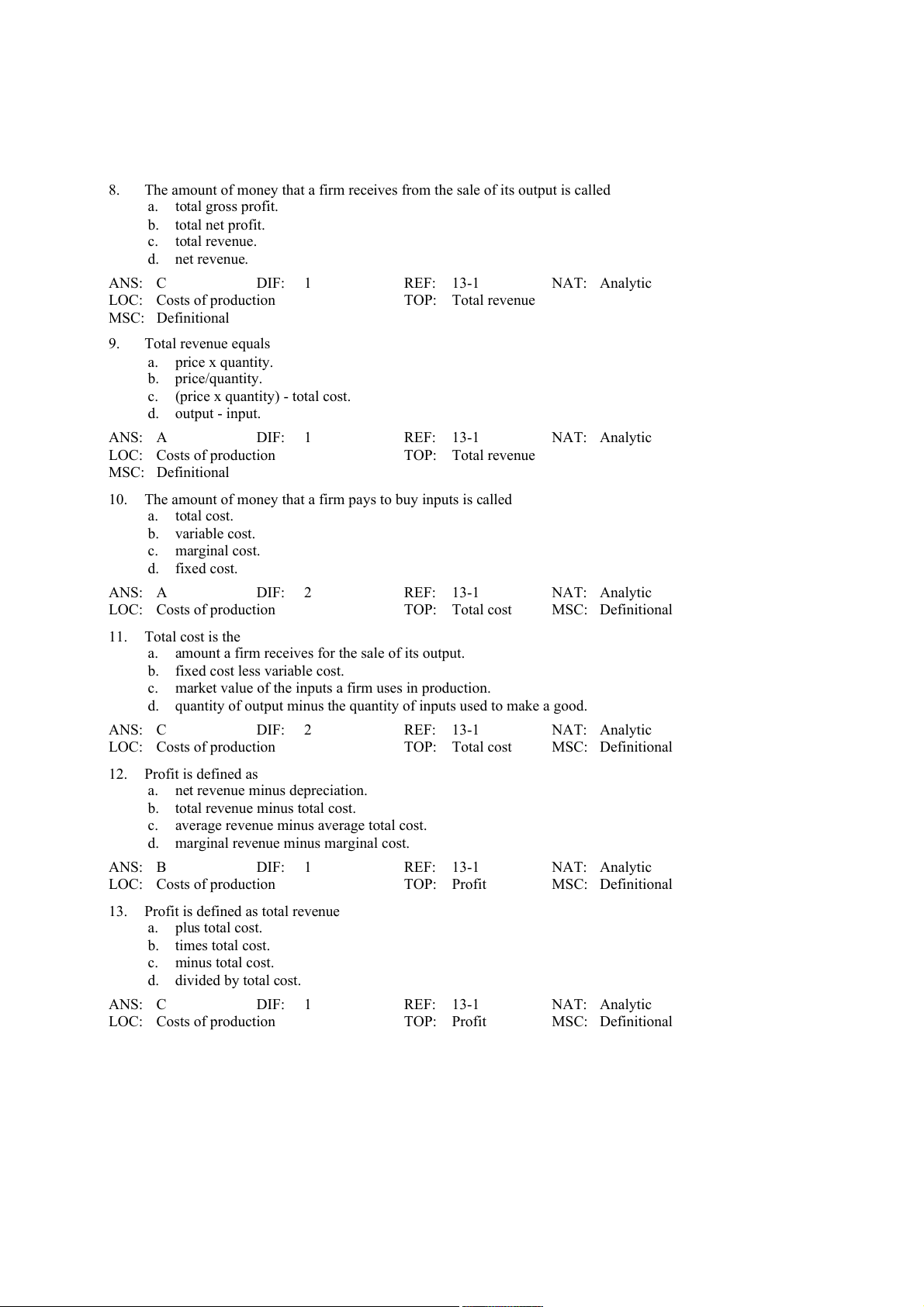
The amount of money that a firm receives from the sale of its output is called a. total gross profit. b. total net profit. c. total revenue. d. net revenue. ANS: C DIF: 1 REF: 13-1 NAT: Analytic LOC: Costs of production TOP: Total revenue MSC: Definitional 9. Total revenue equals a. price x quantity. b. price/quantity. c.
(price x quantity) - total cost. d. output - input. ANS: A DIF: 1 REF: 13-1 NAT: Analytic LOC: Costs of production TOP: Total revenue MSC: Definitional 10.
The amount of money that a firm pays to buy inputs is called a. total cost. b. variable cost. c. marginal cost. d. fixed cost. ANS: A DIF: 2 REF: 13-1 NAT: Analytic LOC: Costs of production TOP: Total cost MSC: Definitional 11. Total cost is the a.
amount a firm receives for the sale of its output. b. fixed cost less variable cost. c.
market value of the inputs a firm uses in production. d.
quantity of output minus the quantity of inputs used to make a good. ANS: C DIF: 2 REF: 13-1 NAT: Analytic LOC: Costs of production TOP: Total cost MSC: Definitional 12. Profit is defined as a.
net revenue minus depreciation. b.
total revenue minus total cost. c.
average revenue minus average total cost. d.
marginal revenue minus marginal cost. ANS: B DIF: 1 REF: 13-1 NAT: Analytic LOC: Costs of production TOP: Profit MSC: Definitional 13.
Profit is defined as total revenue a. plus total cost. b. times total cost. c. minus total cost. d. divided by total cost. ANS: C DIF: 1 REF: 13-1 NAT: Analytic LOC: Costs of production TOP: Profit MSC: Definitional 14.
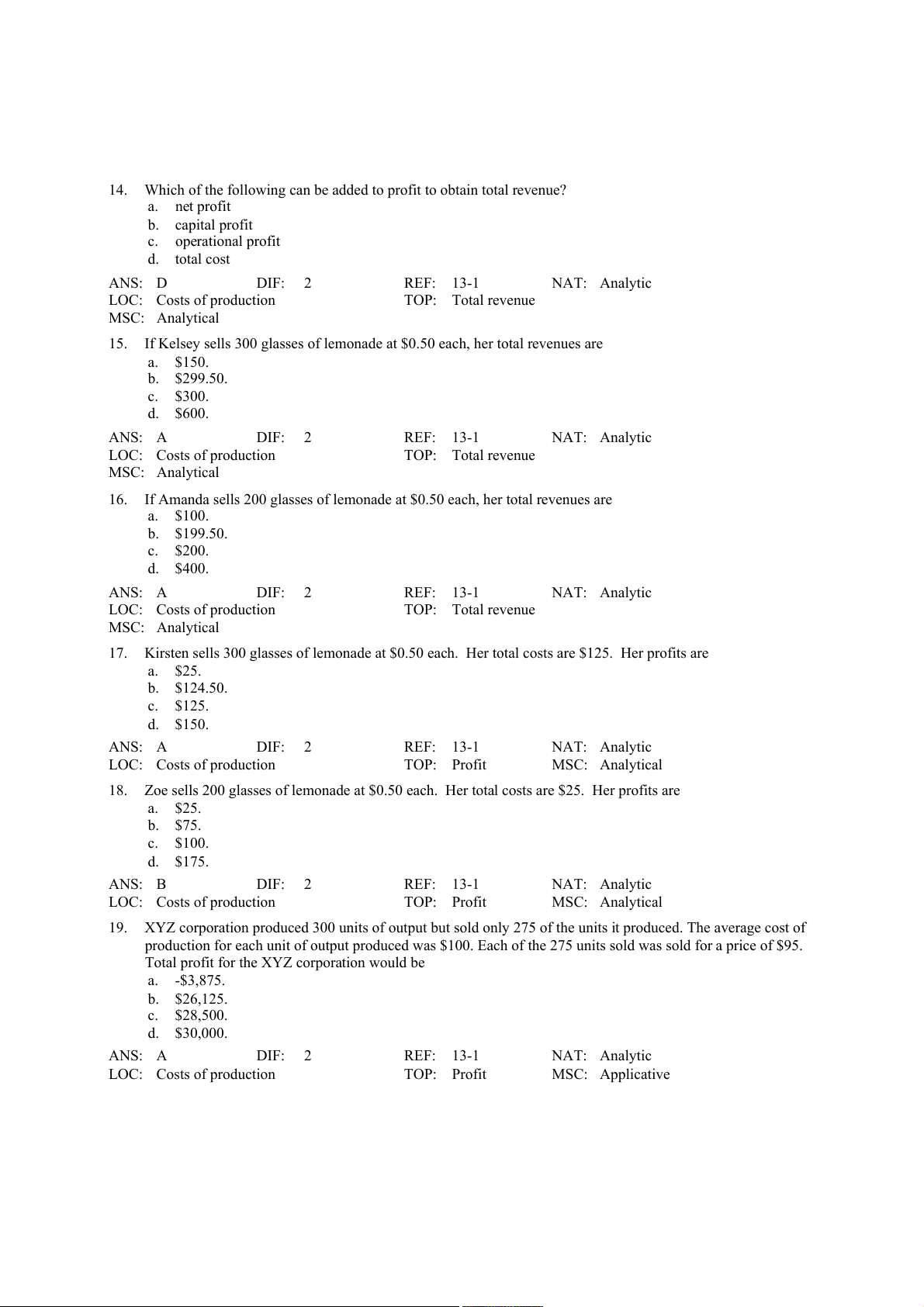
Which of the following can be added to profit to obtain total revenue? a. net profit b. capital profit c. operational profit d. total cost ANS: D DIF: 2 REF: 13-1 NAT: Analytic LOC: Costs of production TOP: Total revenue MSC: Analytical 15.
If Kelsey sells 300 glasses of lemonade at $0.50 each, her total revenues are a. $150. b. $299.50. c. $300. d. $600. ANS: A DIF: 2 REF: 13-1 NAT: Analytic LOC: Costs of production TOP: Total revenue MSC: Analytical 16.
If Amanda sells 200 glasses of lemonade at $0.50 each, her total revenues are a. $100. b. $199.50. c. $200. d. $400. ANS: A DIF: 2 REF: 13-1 NAT: Analytic LOC: Costs of production TOP: Total revenue MSC: Analytical 17.
Kirsten sells 300 glasses of lemonade at $0.50 each. Her total costs are $125. Her profits are a. $25. b. $124.50. c. $125. d. $150. ANS: A DIF: 2 REF: 13-1 NAT: Analytic LOC: Costs of production TOP: Profit MSC: Analytical 18.
Zoe sells 200 glasses of lemonade at $0.50 each. Her total costs are $25. Her profits are a. $25. b. $75. c. $100. d. $175. ANS: B DIF: 2 REF: 13-1 NAT: Analytic LOC: Costs of production TOP: Profit MSC: Analytical 19.
XYZ corporation produced 300 units of output but sold only 275 of the units it produced. The average cost of
production for each unit of output produced was $100. Each of the 275 units sold was sold for a price of $95.
Total profit for the XYZ corporation would be a. -$3,875. b. $26,125. c. $28,500. d. $30,000. ANS: A DIF: 2 REF: 13-1 NAT: Analytic LOC: Costs of production TOP: Profit MSC: Applicative 20.
Those things that must be forgone to acquire a good are called a. implicit costs. b. opportunity costs. c. explicit costs. d. accounting costs. ANS: B DIF: 1 REF: 13-1 NAT: Analytic LOC: Costs of production TOP: Opportunity cost MSC: Definitional 21.
Gordon is a senior majoring in computer network development at Smart State University. While he has been
attending college, Gordon started a computer consulting business to help senior citizens set up their network
connections and teach them how to use e-mail. Gordon charges $25 per hour for his consulting services.
Gordon also works 5 hours a week for the Economics Department to maintain that department's Web page.
The Economics Department pays Gordon $20 per hour. From this information we can conclude: a.
Gordon should increase the number of hours he works for the Economics Department to make it
comparable to his consulting business income. b.
Gordon is obviously not maximizing his well-being if he continues to work for the Economics Department. c.
If Gordon chooses one hour at the beach with his friends rather than spend one more hour with a
consulting client, the forgone income of $25 is considered a cost of the choice to go to the beach. d. Both b and c are correct ANS: C DIF: 2 REF: 13-1 NAT: Analytic LOC: Costs of production TOP: Opportunity cost MSC: Analytical 22.
A firm's opportunity costs of production are equal to its a. explicit costs only. b. implicit costs only. c.
explicit costs + implicit costs. d.
explicit costs + implicit costs + total revenue. ANS: C DIF: 1 REF: 13-1 NAT: Analytic LOC: Costs of production TOP: Opportunity cost MSC: Definitional 23.
Susan used to work as a telemarketer, earning $25,000 per year. She gave up that job to start a catering
business. In calculating the economic profit of her catering business, the $25,000 income that she gave up is
counted as part of the catering firm's a. total revenue. b. opportunity costs. c. explicit costs. d. marginal costs. ANS: B DIF: 1 REF: 13-1 NAT: Analytic LOC: Costs of production TOP: Opportunity cost MSC: Interpretive 24.
John has decided to start his own lawn-mowing business. To purchase the mowers and the trailer to transport
the mowers, John withdrew $1,000 from his savings account, which was earning 3% interest, and borrowed an
additional $2,000 from the bank at an interest rate of 7%. What is John's annual opportunity cost of the
financial capital that has been invested in the business? a. $30 b. $140 c. $170 d. $300 ANS: C DIF: 3 REF: 13-1 NAT: Analytic LOC: Costs of production TOP: Opportunity cost MSC: Analytical 25.
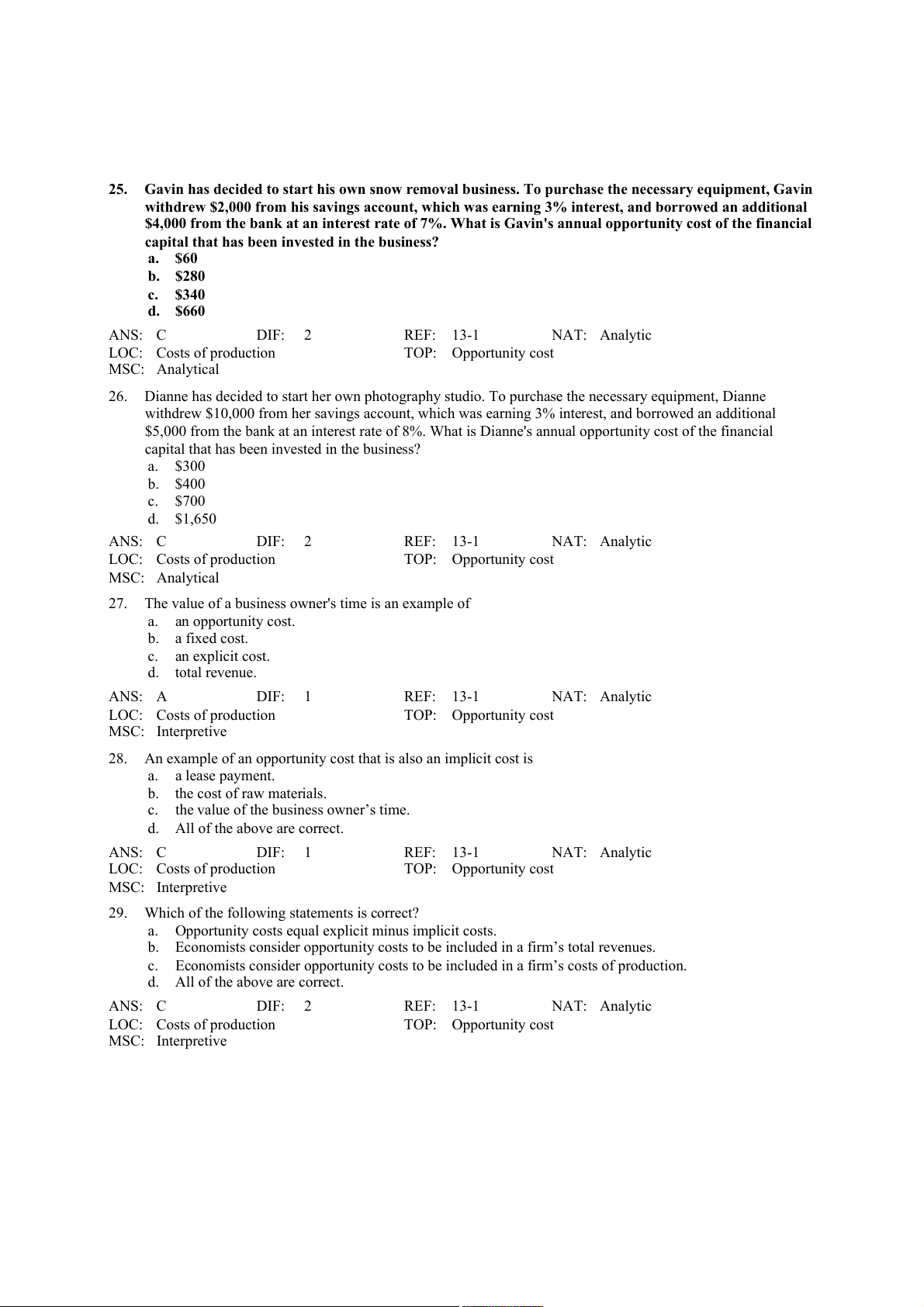
Gavin has decided to start his own snow removal business. To purchase the necessary equipment, Gavin
withdrew $2,000 from his savings account, which was earning 3% interest, and borrowed an additional
$4,000 from the bank at an interest rate of 7%. What is Gavin's annual opportunity cost of the financial
capital that has been invested in the business? a. $60 b. $280 c. $340 d. $660 ANS: C DIF: 2 REF: 13-1 NAT: Analytic LOC: Costs of production TOP: Opportunity cost MSC: Analytical 26.
Dianne has decided to start her own photography studio. To purchase the necessary equipment, Dianne
withdrew $10,000 from her savings account, which was earning 3% interest, and borrowed an additional
$5,000 from the bank at an interest rate of 8%. What is Dianne's annual opportunity cost of the financial
capital that has been invested in the business? a. $300 b. $400 c. $700 d. $1,650 ANS: C DIF: 2 REF: 13-1 NAT: Analytic LOC: Costs of production TOP: Opportunity cost MSC: Analytical 27.
The value of a business owner's time is an example of a. an opportunity cost. b. a fixed cost. c. an explicit cost. d. total revenue. ANS: A DIF: 1 REF: 13-1 NAT: Analytic LOC: Costs of production TOP: Opportunity cost MSC: Interpretive 28.
An example of an opportunity cost that is also an implicit cost is a. a lease payment. b. the cost of raw materials. c.
the value of the business owner’s time. d. All of the above are correct. ANS: C DIF: 1 REF: 13-1 NAT: Analytic LOC: Costs of production TOP: Opportunity cost MSC: Interpretive 29.
Which of the following statements is correct? a.
Opportunity costs equal explicit minus implicit costs. b.
Economists consider opportunity costs to be included in a firm’s total revenues. c.
Economists consider opportunity costs to be included in a firm’s costs of production. d. All of the above are correct. ANS: C DIF: 2 REF: 13-1 NAT: Analytic LOC: Costs of production TOP: Opportunity cost MSC: Interpretive 30. Explicit costs a.
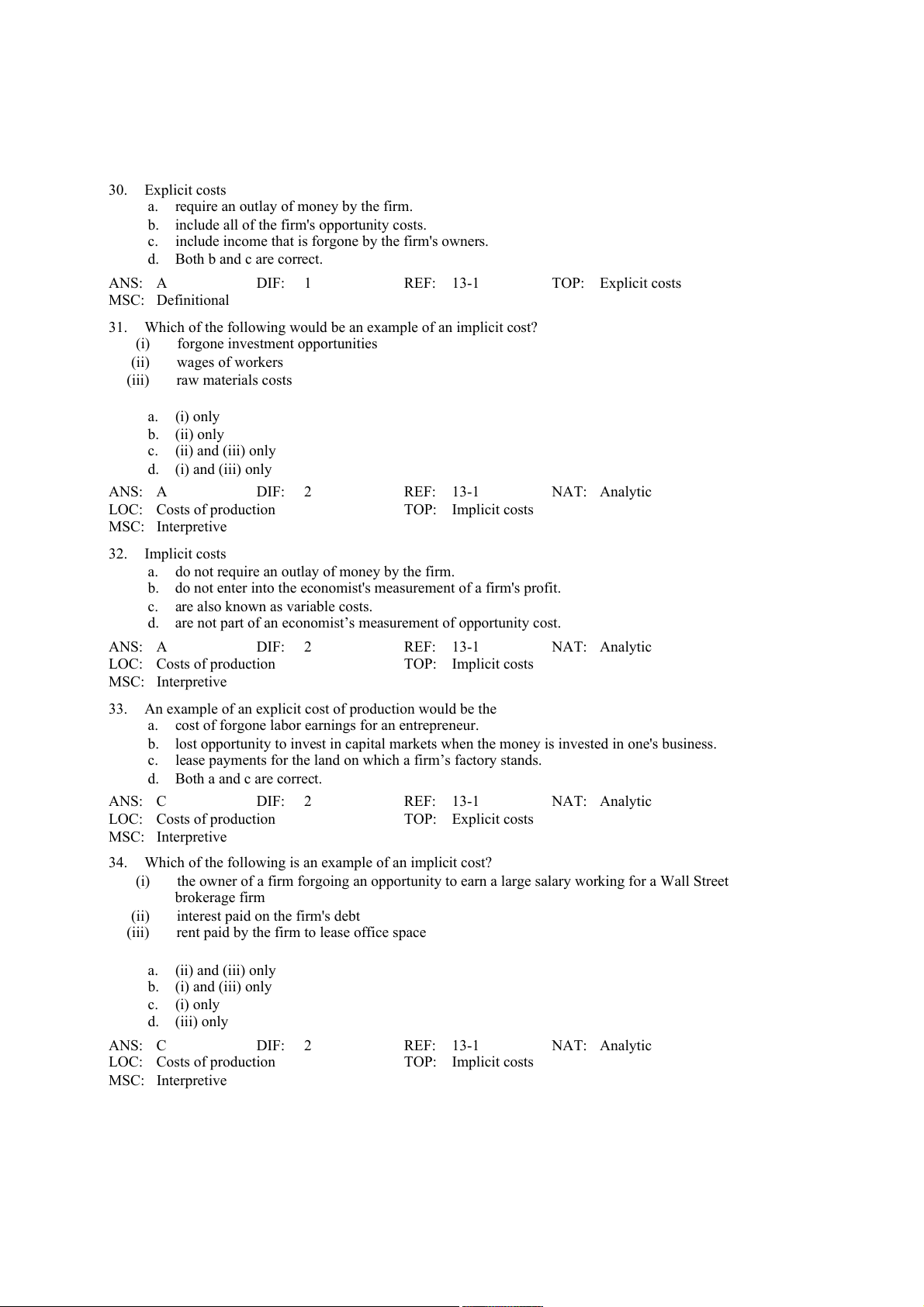
require an outlay of money by the firm. b.
include all of the firm's opportunity costs. c.
include income that is forgone by the firm's owners. d. Both b and c are correct. ANS: A DIF: 1 REF: 13-1 TOP: Explicit costs MSC: Definitional 31.
Which of the following would be an example of an implicit cost? (i)
forgone investment opportunities (ii) wages of workers (iii) raw materials costs a. (i) only b. (ii) only c. (ii) and (iii) only d. (i) and (iii) only ANS: A DIF: 2 REF: 13-1 NAT: Analytic LOC: Costs of production TOP: Implicit costs MSC: Interpretive 32. Implicit costs a.
do not require an outlay of money by the firm. b.
do not enter into the economist's measurement of a firm's profit. c.
are also known as variable costs. d.
are not part of an economist’s measurement of opportunity cost. ANS: A DIF: 2 REF: 13-1 NAT: Analytic LOC: Costs of production TOP: Implicit costs MSC: Interpretive 33.
An example of an explicit cost of production would be the a.
cost of forgone labor earnings for an entrepreneur. b.
lost opportunity to invest in capital markets when the money is invested in one's business. c.
lease payments for the land on which a firm’s factory stands. d. Both a and c are correct. ANS: C DIF: 2 REF: 13-1 NAT: Analytic LOC: Costs of production TOP: Explicit costs MSC: Interpretive 34.
Which of the following is an example of an implicit cost? (i)
the owner of a firm forgoing an opportunity to earn a large salary working for a Wall Street brokerage firm (ii)
interest paid on the firm's debt (iii)
rent paid by the firm to lease office space a. (ii) and (iii) only b. (i) and (iii) only c. (i) only d. (iii) only ANS: C DIF: 2 REF: 13-1 NAT: Analytic LOC: Costs of production TOP: Implicit costs MSC: Interpretive 39.
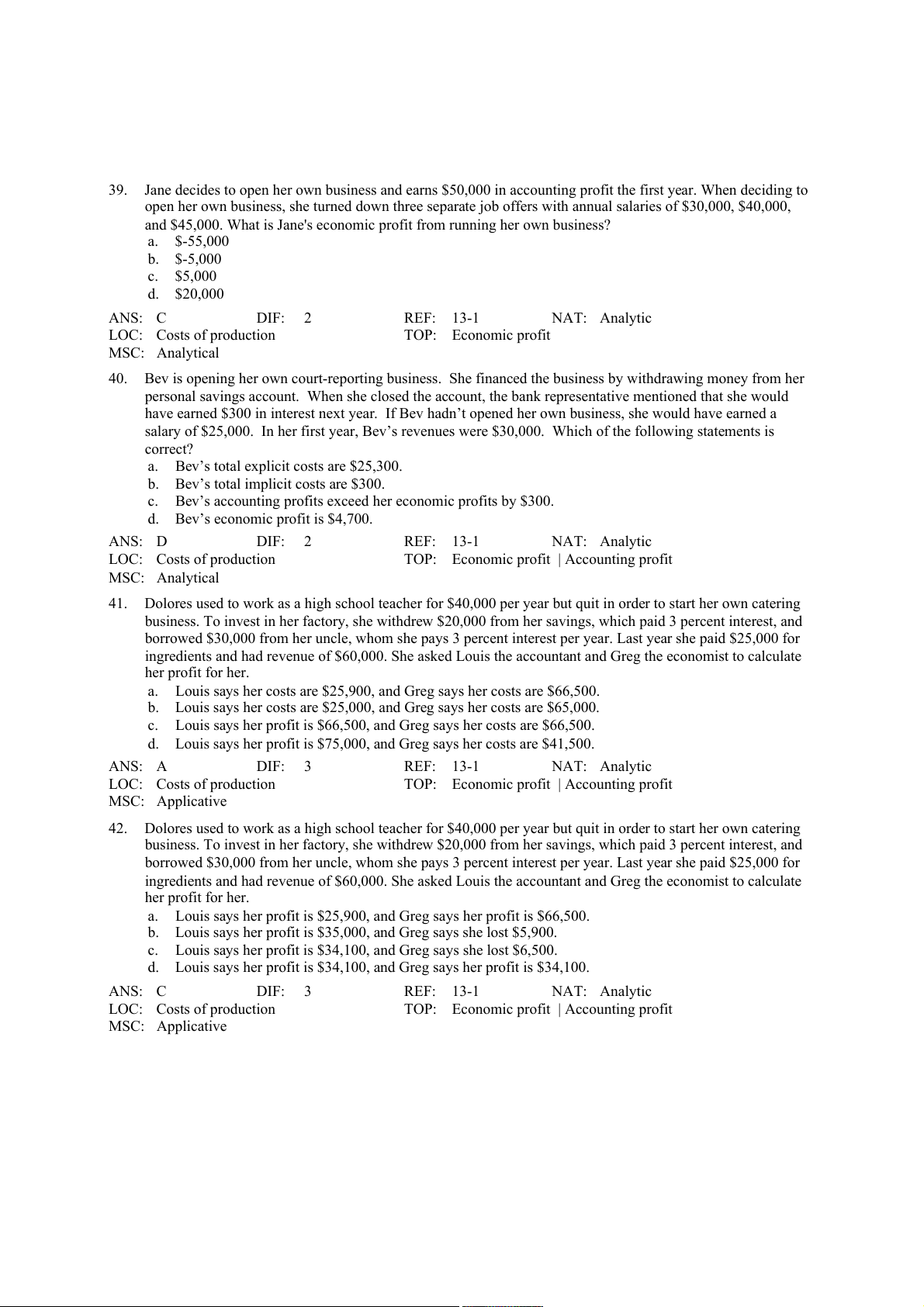
Jane decides to open her own business and earns $50,000 in accounting profit the first year. When deciding to
open her own business, she turned down three separate job offers with annual salaries of $30,000, $40,000,
and $45,000. What is Jane's economic profit from running her own business? a. $-55,000 b. $-5,000 c. $5,000 d. $20,000 ANS: C DIF: 2 REF: 13-1 NAT: Analytic LOC: Costs of production TOP: Economic profit MSC: Analytical 40.
Bev is opening her own court-reporting business. She financed the business by withdrawing money from her
personal savings account. When she closed the account, the bank representative mentioned that she would
have earned $300 in interest next year. If Bev hadn’t opened her own business, she would have earned a
salary of $25,000. In her first year, Bev’s revenues were $30,000. Which of the following statements is correct? a.
Bev’s total explicit costs are $25,300. b.
Bev’s total implicit costs are $300. c.
Bev’s accounting profits exceed her economic profits by $300. d.
Bev’s economic profit is $4,700. ANS: D DIF: 2 REF: 13-1 NAT: Analytic LOC: Costs of production TOP:
Economic profit | Accounting profit MSC: Analytical 41.
Dolores used to work as a high school teacher for $40,000 per year but quit in order to start her own catering
business. To invest in her factory, she withdrew $20,000 from her savings, which paid 3 percent interest, and
borrowed $30,000 from her uncle, whom she pays 3 percent interest per year. Last year she paid $25,000 for
ingredients and had revenue of $60,000. She asked Louis the accountant and Greg the economist to calculate her profit for her. a.
Louis says her costs are $25,900, and Greg says her costs are $66,500. b.
Louis says her costs are $25,000, and Greg says her costs are $65,000. c.
Louis says her profit is $66,500, and Greg says her costs are $66,500. d.
Louis says her profit is $75,000, and Greg says her costs are $41,500. ANS: A DIF: 3 REF: 13-1 NAT: Analytic LOC: Costs of production TOP:
Economic profit | Accounting profit MSC: Applicative 42.
Dolores used to work as a high school teacher for $40,000 per year but quit in order to start her own catering
business. To invest in her factory, she withdrew $20,000 from her savings, which paid 3 percent interest, and
borrowed $30,000 from her uncle, whom she pays 3 percent interest per year. Last year she paid $25,000 for
ingredients and had revenue of $60,000. She asked Louis the accountant and Greg the economist to calculate her profit for her. a.
Louis says her profit is $25,900, and Greg says her profit is $66,500. b.
Louis says her profit is $35,000, and Greg says she lost $5,900. c.
Louis says her profit is $34,100, and Greg says she lost $6,500. d.
Louis says her profit is $34,100, and Greg says her profit is $34,100. ANS: C DIF: 3 REF: 13-1 NAT: Analytic LOC: Costs of production TOP:
Economic profit | Accounting profit MSC: Applicative 43.
Which of the following statements is correct? a.
Assuming that explicit costs are positive, economic profit is greater than accounting profit. b.
Assuming that implicit costs are positive, accounting profit is greater than economic profit. c.
Assuming that explicit costs are positive, accounting profit is equal to economic profit. d.
Assuming that implicit costs are positive, economic profit is positive. ANS: B DIF: 2 REF: 13-1 NAT: Analytic LOC: Costs of production TOP:
Economic profit | Accounting profit MSC: Interpretive 44.
A difference between explicit and implicit costs is that a.
explicit costs are greater than implicit costs. b.
explicit costs do not require a direct monetary outlay by the firm, whereas implicit costs do. c.
implicit costs do not require a direct monetary outlay by the firm, whereas explicit costs do. d.
implicit costs are greater than explicit costs. ANS: C DIF: 2 REF: 13-1 NAT: Analytic LOC: Costs of production TOP:
Explicit costs | Implicit costs MSC: Interpretive 45.
Katherine gives piano lessons for $15 per hour. She also grows flowers, which she arranges and sells at the
local farmer’s market. One day she spends 5 hours planting $50 worth of seeds in her garden. Once the seeds
have grown into flowers, she can sell them for $150 at the farmer’s market. Which of the following
statements is correct regarding Katherine’s profits from selling flowers? a.
Katherine’s accounting profits are $100, and her economic profits are $25. b.
Katherine’s accounting profits are $100, and her economic profits are $75. c.
Katherine’s accounting profits are $25, and her economic profits are $100. d.
Katherine’s accounting profits are $75, and her economic profits are $125. ANS: A DIF: 2 REF: 13-1 NAT: Analytic LOC: Costs of production TOP:
Economic profit | Accounting profit MSC: Analytical 46.
Katherine gives piano lessons for $20 per hour. She also grows flowers, which she arranges and sells at the
local farmer’s market. One day she spends 5 hours planting $50 worth of seeds in her garden. Once the seeds
have grown into flowers, she can sell them for $150 at the farmer’s market. Which of the following
statements is correct regarding Katherine’s profits from selling flowers? a.
Katherine’s accounting profits are $100, and her economic profits are $100. b.
Katherine’s accounting profits are $100, and her economic profits are $0. c.
Katherine’s accounting profits are $0, and her economic profits are $100. d.
Katherine’s accounting profits are $0, and her economic profits are $-100. ANS: B DIF: 2 REF: 13-1 NAT: Analytic LOC: Costs of production TOP:
Economic profit | Accounting profit MSC: Analytical 47.
A certain firm manufactures and sells computer chips. Last year it sold 2 million chips at a price of $10 per
chip. For last year, the firm's a.
accounting profit amounted to $20 million. b.
economic profit amounted to $20 million. c.
total revenue amounted to $20 million. d.
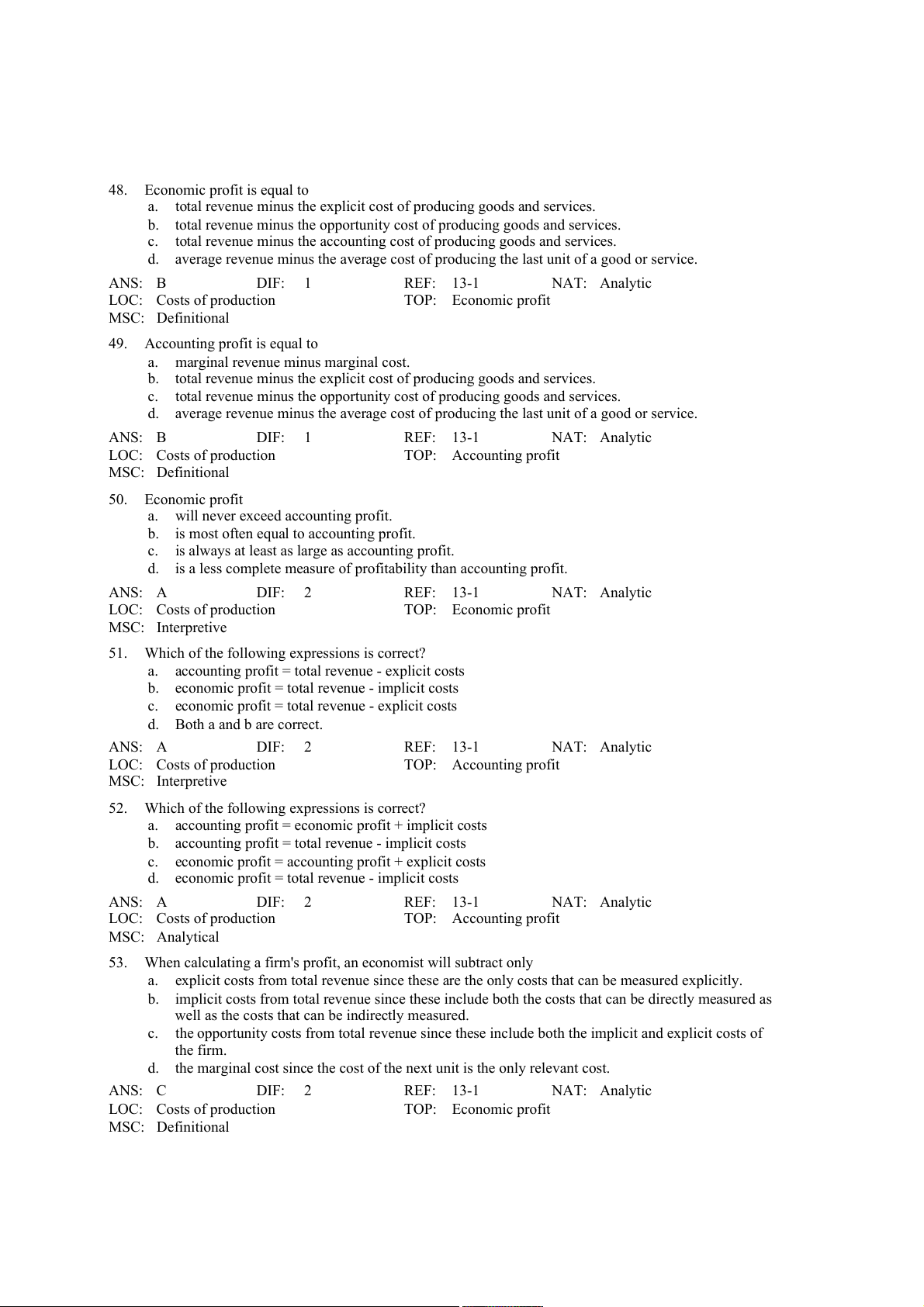
explicit costs amounted to $20 million. ANS: C DIF: 1 REF: 13-1 NAT: Analytic LOC: Costs of production TOP: Total revenue MSC: Applicative 48. Economic profit is equal to a.
total revenue minus the explicit cost of producing goods and services. b.
total revenue minus the opportunity cost of producing goods and services. c.
total revenue minus the accounting cost of producing goods and services. d.
average revenue minus the average cost of producing the last unit of a good or service. ANS: B DIF: 1 REF: 13-1 NAT: Analytic LOC: Costs of production TOP: Economic profit MSC: Definitional 49. Accounting profit is equal to a.
marginal revenue minus marginal cost. b.
total revenue minus the explicit cost of producing goods and services. c.
total revenue minus the opportunity cost of producing goods and services. d.
average revenue minus the average cost of producing the last unit of a good or service. ANS: B DIF: 1 REF: 13-1 NAT: Analytic LOC: Costs of production TOP: Accounting profit MSC: Definitional 50. Economic profit a.
will never exceed accounting profit. b.
is most often equal to accounting profit. c.
is always at least as large as accounting profit. d.
is a less complete measure of profitability than accounting profit. ANS: A DIF: 2 REF: 13-1 NAT: Analytic LOC: Costs of production TOP: Economic profit MSC: Interpretive 51.
Which of the following expressions is correct? a.
accounting profit = total revenue - explicit costs b.
economic profit = total revenue - implicit costs c.
economic profit = total revenue - explicit costs d. Both a and b are correct. ANS: A DIF: 2 REF: 13-1 NAT: Analytic LOC: Costs of production TOP: Accounting profit MSC: Interpretive 52.
Which of the following expressions is correct? a.
accounting profit = economic profit + implicit costs b.
accounting profit = total revenue - implicit costs c.
economic profit = accounting profit + explicit costs d.
economic profit = total revenue - implicit costs ANS: A DIF: 2 REF: 13-1 NAT: Analytic LOC: Costs of production TOP: Accounting profit MSC: Analytical 53.
When calculating a firm's profit, an economist will subtract only a.
explicit costs from total revenue since these are the only costs that can be measured explicitly. b.
implicit costs from total revenue since these include both the costs that can be directly measured as
well as the costs that can be indirectly measured. c.
the opportunity costs from total revenue since these include both the implicit and explicit costs of the firm. d.
the marginal cost since the cost of the next unit is the only relevant cost. ANS: C DIF: 2 REF: 13-1 NAT: Analytic LOC: Costs of production TOP: Economic profit MSC: Definitional 54.
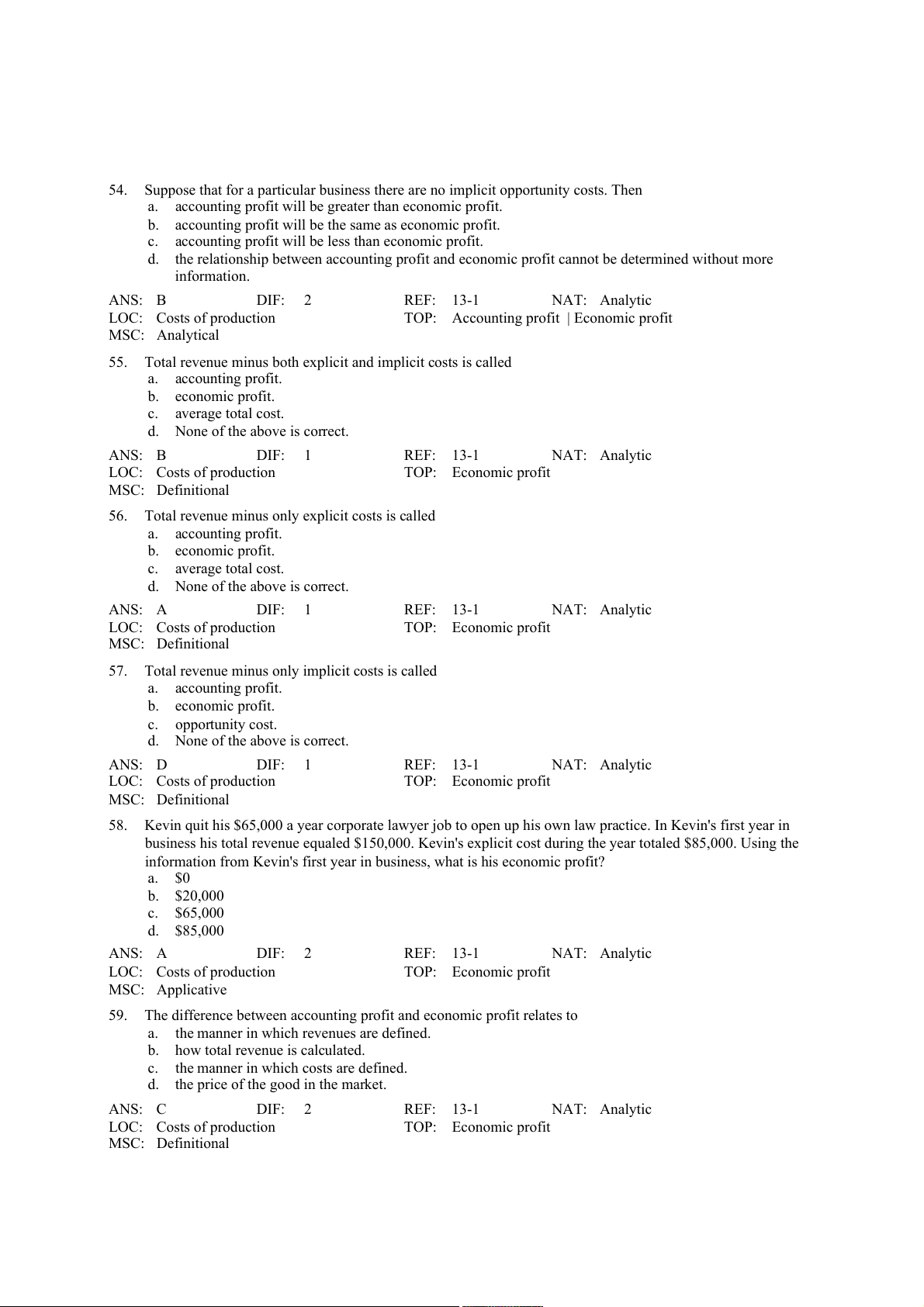
Suppose that for a particular business there are no implicit opportunity costs. Then a.
accounting profit will be greater than economic profit. b.
accounting profit will be the same as economic profit. c.
accounting profit will be less than economic profit. d.
the relationship between accounting profit and economic profit cannot be determined without more information. ANS: B DIF: 2 REF: 13-1 NAT: Analytic LOC: Costs of production TOP:
Accounting profit | Economic profit MSC: Analytical 55.
Total revenue minus both explicit and implicit costs is called a. accounting profit. b. economic profit. c. average total cost. d. None of the above is correct. ANS: B DIF: 1 REF: 13-1 NAT: Analytic LOC: Costs of production TOP: Economic profit MSC: Definitional 56.
Total revenue minus only explicit costs is called a. accounting profit. b. economic profit. c. average total cost. d. None of the above is correct. ANS: A DIF: 1 REF: 13-1 NAT: Analytic LOC: Costs of production TOP: Economic profit MSC: Definitional 57.
Total revenue minus only implicit costs is called a. accounting profit. b. economic profit. c. opportunity cost. d. None of the above is correct. ANS: D DIF: 1 REF: 13-1 NAT: Analytic LOC: Costs of production TOP: Economic profit MSC: Definitional 58.
Kevin quit his $65,000 a year corporate lawyer job to open up his own law practice. In Kevin's first year in
business his total revenue equaled $150,000. Kevin's explicit cost during the year totaled $85,000. Using the
information from Kevin's first year in business, what is his economic profit? a. $0 b. $20,000 c. $65,000 d. $85,000 ANS: A DIF: 2 REF: 13-1 NAT: Analytic LOC: Costs of production TOP: Economic profit MSC: Applicative 59.
The difference between accounting profit and economic profit relates to a.
the manner in which revenues are defined. b.
how total revenue is calculated. c.
the manner in which costs are defined. d.
the price of the good in the market. ANS: C DIF: 2 REF: 13-1 NAT: Analytic LOC: Costs of production TOP: Economic profit MSC: Definitional 1.
A production function describes a. how a firm maximizes profits. b.
how a firm turns inputs into output. c.
the minimal cost of producing a given level of output. d.
the relationship between cost and output. ANS: B DIF: 1 REF: 13-2 NAT: Analytic LOC: Costs of production TOP: Production function MSC: Definitional 2.
A production function is a relationship between inputs and a. quantity of output. b. revenue. c. costs. d. profit. ANS: A DIF: 1 REF: 13-2 NAT: Analytic LOC: Costs of production TOP: Production function MSC: Definitional 3.
Which of the following statements about a production function is correct for a firm that uses labor to produce output? a.
The production function depicts the relationship between the quantity of labor and the quantity of output. b.
The slope of the production function measures marginal cost. c.
The quantity of output determines the maximum amount of labor the firm will hire. d. All of the above are correct. ANS: A DIF: 2 REF: 13-2 NAT: Analytic LOC: Costs of production TOP: Production function MSC: Interpretive 4.
For a firm, the production function represents the relationship between a.
implicit costs and explicit costs. b.
quantity of inputs and total cost. c.
quantity of inputs and quantity of output. d.
quantity of output and total cost. ANS: C DIF: 1 REF: 13-2 NAT: Analytic LOC: Costs of production TOP: Production function MSC: Definitional 5.
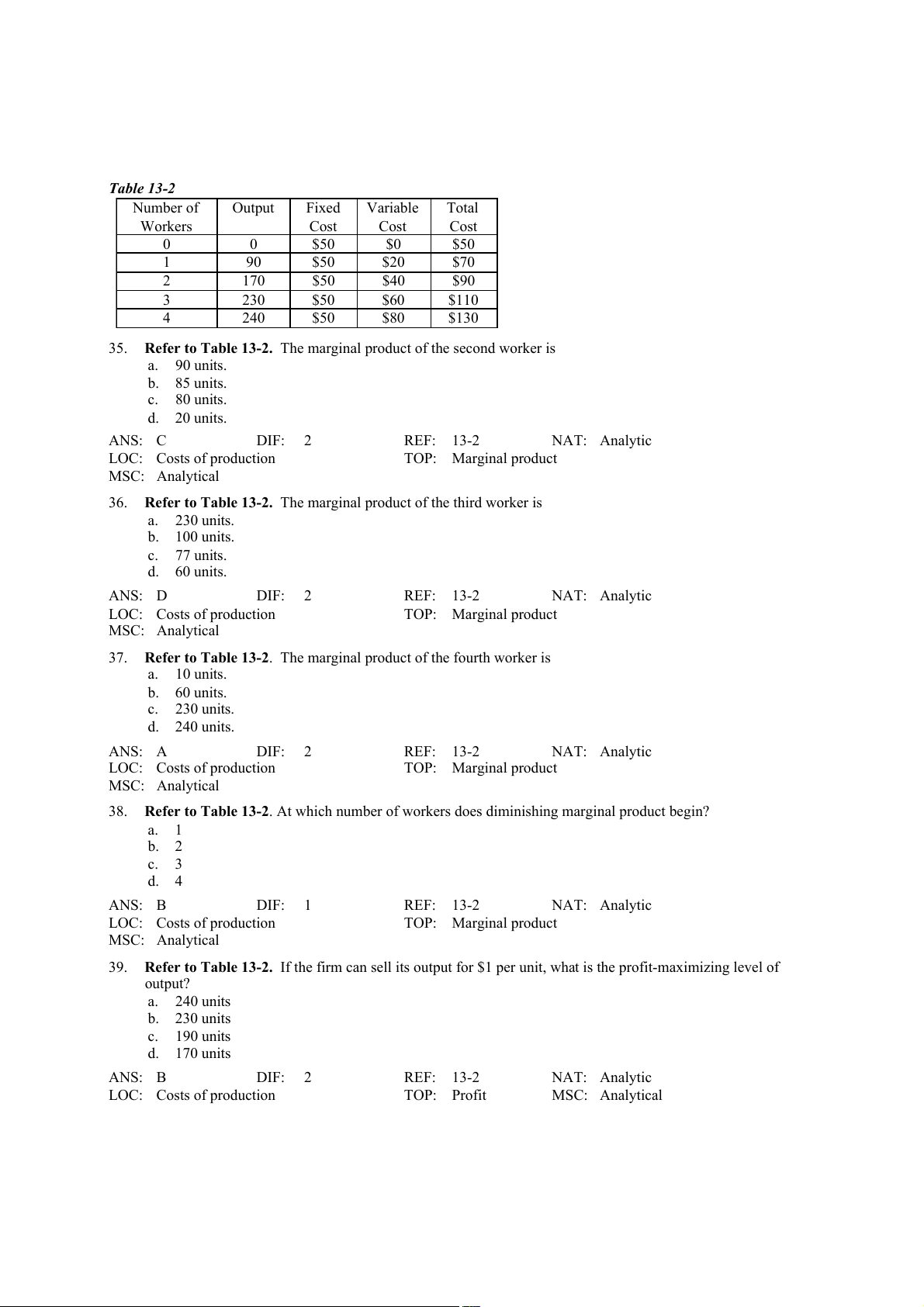
For a firm, the relationship between the quantity of inputs and quantity of output is called the a. profit function. b. production function. c. total-cost function. d. quantity function. ANS: B DIF: 1 REF: 13-2 NAT: Analytic LOC: Costs of production TOP: Production function MSC: Definitional Table 13-2 Number of Output Fixed Variable Total Workers Cost Cost Cost 0 0 $50 $0 $50 1 90 $50 $20 $70 2 170 $50 $40 $90 3 230 $50 $60 $110 4 240 $50 $80 $130 35.
Refer to Table 13-2. The marginal product of the second worker is a. 90 units. b. 85 units. c. 80 units. d. 20 units. ANS: C DIF: 2 REF: 13-2 NAT: Analytic LOC: Costs of production TOP: Marginal product MSC: Analytical 36.
Refer to Table 13-2. The marginal product of the third worker is a. 230 units. b. 100 units. c. 77 units. d. 60 units. ANS: D DIF: 2 REF: 13-2 NAT: Analytic LOC: Costs of production TOP: Marginal product MSC: Analytical 37.
Refer to Table 13-2. The marginal product of the fourth worker is a. 10 units. b. 60 units. c. 230 units. d. 240 units. ANS: A DIF: 2 REF: 13-2 NAT: Analytic LOC: Costs of production TOP: Marginal product MSC: Analytical 38.
Refer to Table 13-2. At which number of workers does diminishing marginal product begin? a. 1 b. 2 c. 3 d. 4 ANS: B DIF: 1 REF: 13-2 NAT: Analytic LOC: Costs of production TOP: Marginal product MSC: Analytical 39.
Refer to Table 13-2. If the firm can sell its output for $1 per unit, what is the profit-maximizing level of output? a. 240 units b. 230 units c. 190 units d. 170 units ANS: B DIF: 2 REF: 13-2 NAT: Analytic LOC: Costs of production TOP: Profit MSC: Analytical 9.
Suppose that for a particular firm the only variable input into the production process is labor and that
output equals zero when no workers are hired. In addition, suppose that when the firm hires 2 workers,
the total cost of production is $100. When the firm hires 3 workers, the total cost of production is $120.
In addition, assume that the variable cost per unit of labor is the same regardless of the number of units
of labor that are hired. What is the firm's fixed cost? a. $40 b. $60 c. $80 d. $100 ANS: B DIF: 3 REF: 13-3 NAT: Analytic
LOC: Costs of production TOP: Fixed costs MSC: Analytical 22.
Which of the following expressions is correct? a.
marginal cost = (change in quantity of output)/(change in total cost) b.
average total cost = (total cost)/(quantity of output) c.
total cost = variable cost + marginal cost d.
average variable cost = (quantity of output)/(total variable cost) ANS: B DIF: 2 REF: 13-3 NAT: Analytic LOC: Costs of production TOP: Average total cost MSC: Interpretive 23.
Average total cost (ATC) is calculated as follows: a.
ATC = (change in total cost)/(change in quantity of output). b.
ATC = (change in total cost)/(change in quantity of input). c.
ATC = (total cost)/(quantity of output). d.
ATC = (total cost)/(quantity of input). ANS: C DIF: 1 REF: 13-3 NAT: Analytic LOC: Costs of production TOP: Average total cost MSC: Definitional 24.
Which of the following measures of cost is best described as "the cost of a typical unit of output if total cost is
divided evenly over all the units produced?" a. average fixed cost b. average variable cost c. average total cost d. marginal cost ANS: C DIF: 1 REF: 13-3 NAT: Analytic LOC: Costs of production TOP: Average total cost MSC: Definitional Scenario 13-7
Farmer Jack is a watermelon farmer. If Jack plants no seeds on his farm, he gets no harvest. If he plants 1 bag of
seeds, he gets 30 watermelons. If he plants 2 bags of seeds, he gets 50 watermelons. If he plants 3 bags of seeds he
gets 60 watermelons. A bag of seeds costs $100, and the costs of seeds are his only costs.
102. Refer to Scenario 13-7. Which of the following statements is (are) true? (i)
Farmer Jack experiences decreasing marginal product. (ii)
Farmer Jack's production function is nonlinear. (iii)
Farmer Jack's total cost curve is linear. a. (i) only b. (i) and (ii) only c. (ii) only d. (i) and (iii) only ANS: B DIF: 2 REF: 13-3 NAT: Analytic LOC: Costs of production TOP: Production function MSC: Analytical
103. Refer to Scenario 13-7. Which of the following statements is(are) true of Farmer Jack's marginal cost? (i)
His marginal cost curve is U-shaped. (ii)
His marginal cost decreases with increased watermelon output. (iii)
His marginal cost reflects diminishing marginal product. a. (ii) only b. (iii) only c. (i) and (iii) only d. (i) and (ii) only ANS: B DIF: 2 REF: 13-3 NAT: Analytic LOC: Costs of production TOP: Marginal cost MSC: Analytical
104. Refer to Scenario 13-7. Farmer Jack's production function will a. decrease at a decreasing rate. b.
decrease at an increasing rate. c. increase at a decreasing rate. d.
increase at an increasing rate. ANS: C DIF: 2 REF: 13-3 NAT: Analytic LOC: Costs of production TOP:
Production function | Marginal cost MSC: Analytical
163. Diminishing marginal product suggests that the marginal a.
cost of an extra worker is unchanged. b.
cost of an extra worker is less than the previous worker's marginal cost. c.
product of an extra worker is less than the previous worker's marginal product. d.
product of an extra worker is greater than the previous worker's marginal product. ANS: C DIF: 2 REF: 13-3 NAT: Analytic LOC: Costs of production TOP:
Marginal cost | Diminishing marginal product MSC: Interpretive
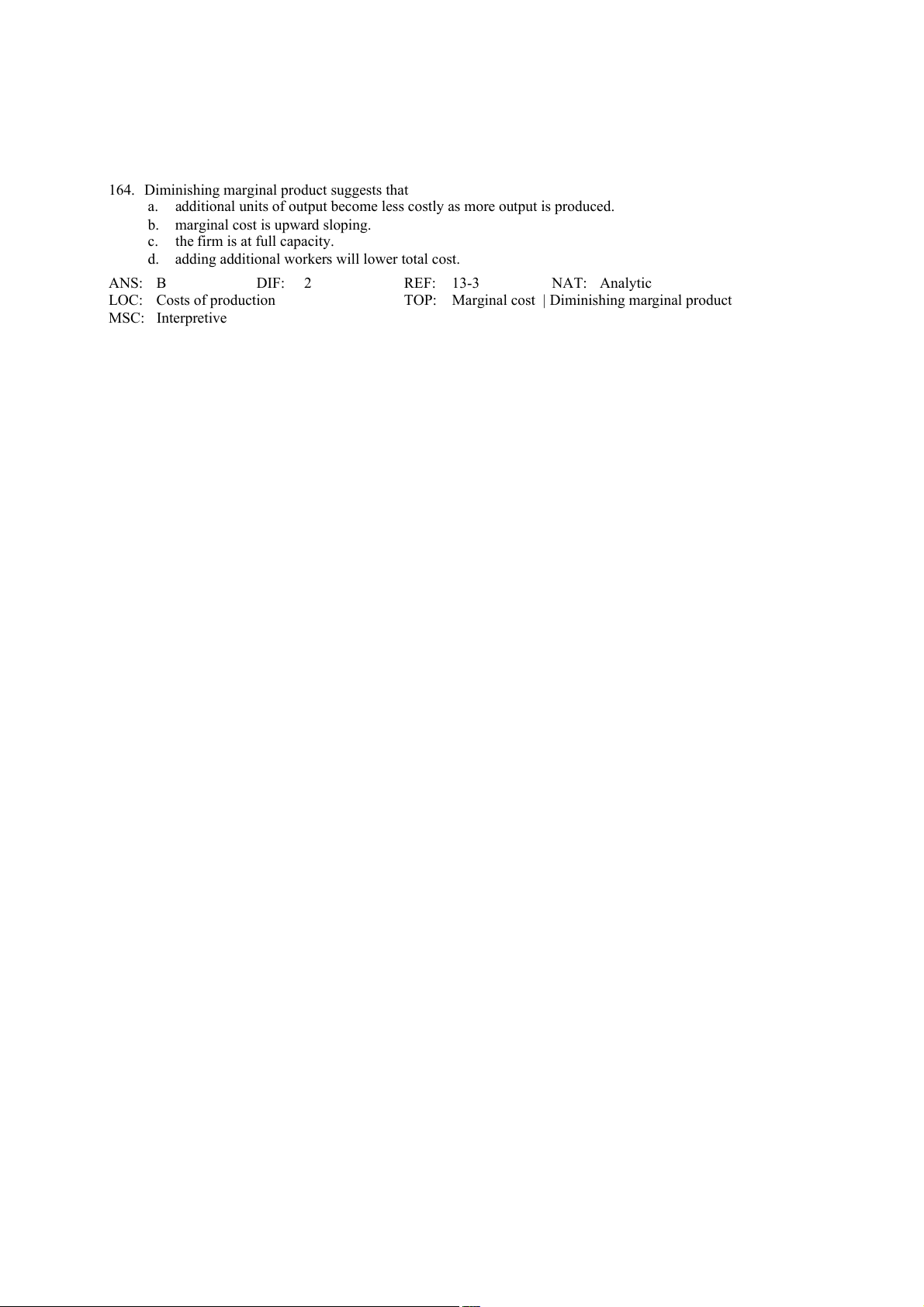
164. Diminishing marginal product suggests that a.
additional units of output become less costly as more output is produced. b.
marginal cost is upward sloping. c. the firm is at full capacity. d.
adding additional workers will lower total cost. ANS: B DIF: 2 REF: 13-3 NAT: Analytic LOC: Costs of production TOP:
Marginal cost | Diminishing marginal product MSC: Interpretive
Tài liệu liên quan:
-
Chương 3: độ co giãn và các nhân tố ảnh hưởng | Microeconomics | Trường Đại học Quốc tế, Đại học Quốc gia Thành phố Hồ Chí Minh
6 3 -
Microeconomics Syllabus | Microeconomics | Trường Đại học Quốc tế, Đại học Quốc gia Thành phố Hồ Chí Minh
5 3 -
Microeconomics Course Syllabus & Assessment Details | Microeconomics | Trường Đại học Quốc tế, Đại học Quốc gia Thành phố Hồ Chí Minh
5 3 -
Assignment 3 - Elasticity MCQs and Key Concepts | Microeconomics | Trường Đại học Quốc tế, Đại học Quốc gia Thành phố Hồ Chí Minh
5 3 -
Assignment 2 - Economic Equilibrium Analysis of Fridges and Motorcycles | Microeconomics | Trường Đại học Quốc tế, Đại học Quốc gia Thành phố Hồ Chí Minh
6 3