Profit Maximization in Perfectly Competitive Markets | Microeconomics | Trường Đại học Quốc tế, Đại học Quốc gia Thành phố Hồ Chí Minh
In the long run, in a perfectly competitive market, economic profits attract new firms to enter, increasing the supply and driving the price down. This process continues until firms earn zero economic profit, where Price = Average Total Cost. Tài liệu được sưu tầm và soạn thảo dưới dạng file PDF với mục đích hỗ trợ học tập và tham khảo. Nội dung tài liệu được trình bày rõ ràng, dễ tiếp cận, phù hợp cho việc ôn tập và củng cố kiến thức trong quá trình học đại học. Đây sẽ là nguồn tư liệu hữu ích giúp các bạn sinh viên chuẩn bị tốt hơn cho các buổi học, đồng thời mở rộng thêm hiểu biết về môn học. Hy vọng tài liệu này sẽ mang lại nhiều giá trị và hỗ trợ các bạn trong hành trình học tập. Mời bạn đọc cùng tham khảo!
Môn: Microeconomics 635 tài liệu
Trường: Trường Đại học Quốc tế, Đại học Quốc gia Thành phố Hồ Chí Minh 1.9 K tài liệu
Tác giả:

Preview text:
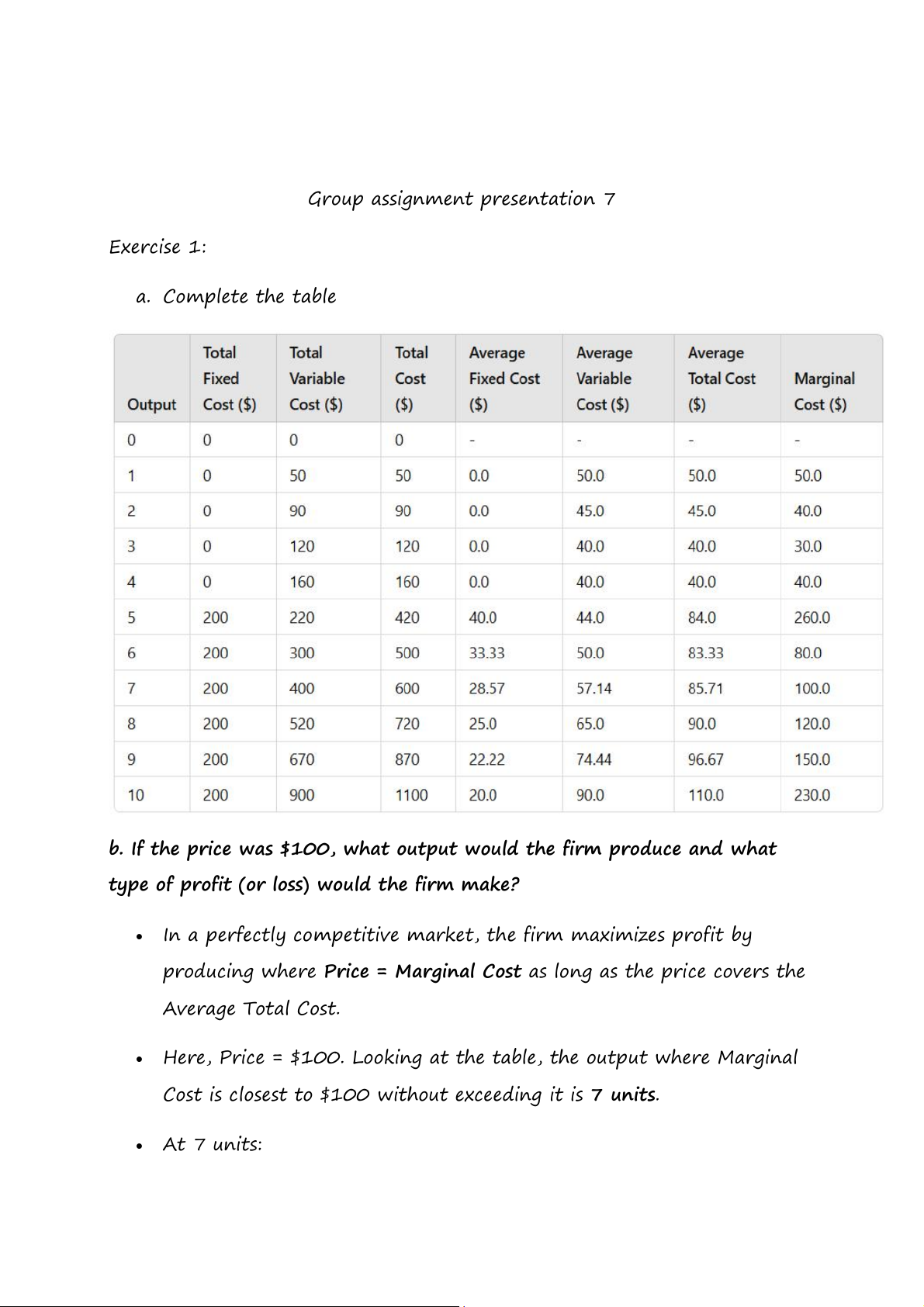
Group assignment presentation 7 Exercise 1: a. Complete the table
b. If the price was $100, what output would the firm produce and what
type of profit (or loss) would the firm make?
In a perfectly competitive market, the firm maximizes profit by
producing where Price = Marginal Cost as long as the price covers the Average Total Cost.
Here, Price = $100. Looking at the table, the output where Marginal
Cost is closest to $100 without exceeding it is 7 unit . s At 7 units: o
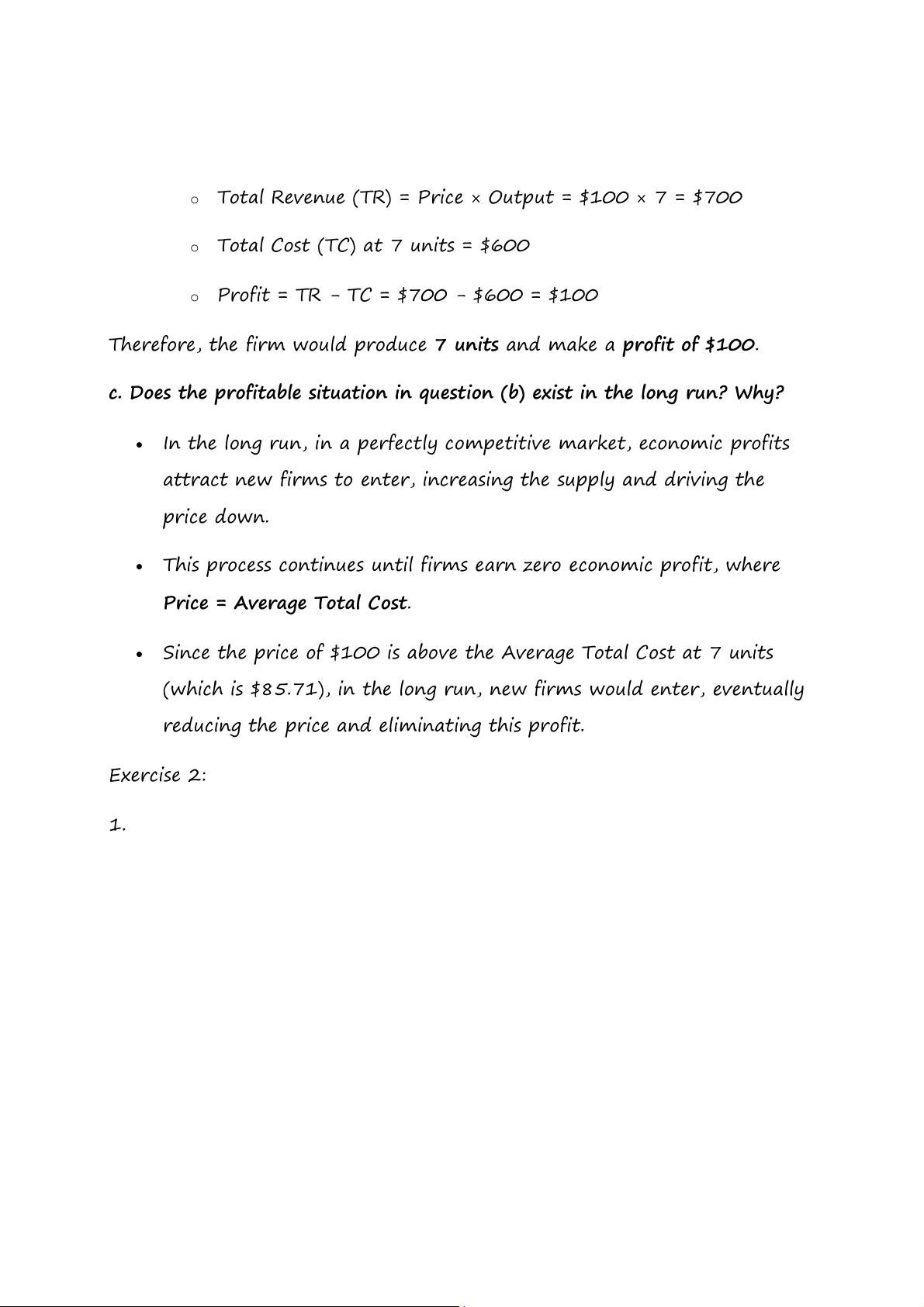
Total Revenue (TR) = Price × Output = $100 × 7 = $700 o
Total Cost (TC) at 7 units = $600 o
Profit = TR - TC = $700 - $600 = $100
Therefore, the firm would produce 7 units and make a profit of $100.
c. Does the profitable situation in question (b) exist in the long run? Why?
In the long run, in a perfectly competitive market, economic profits
attract new firms to enter, increasing the supply and driving the price down.
This process continues until firms earn zero economic profit, where Price = Average Total Cost.
Since the price of $100 is above the Average Total Cost at 7 units
(which is $85.71), in the long run, new firms would enter, eventually
reducing the price and eliminating this profit. Exercise 2: 1. 2.
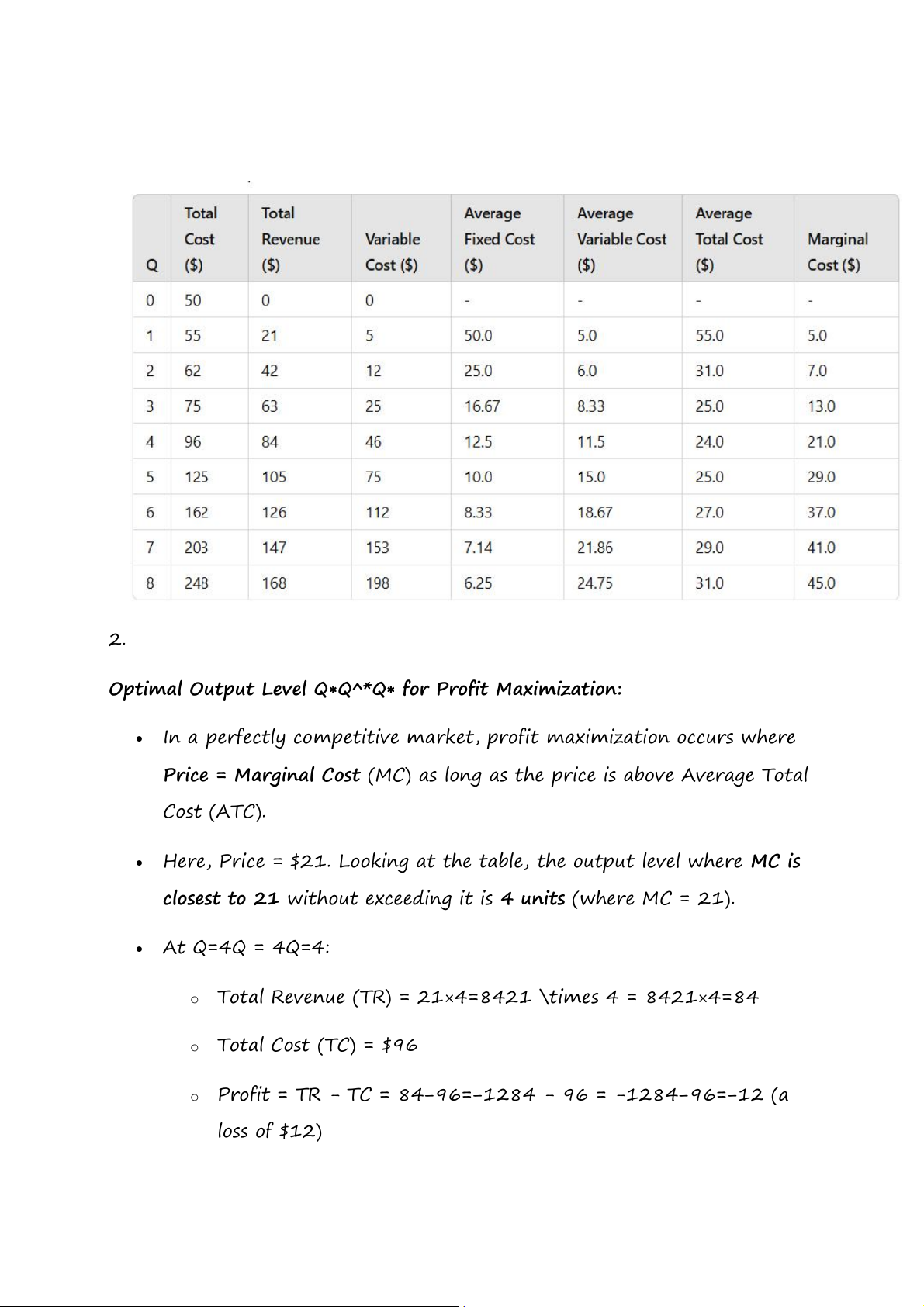
Optimal Output Level Q∗Q^*Q∗ for Profit Maximization:
In a perfectly competitive market, profit maximization occurs where
Price = Marginal Cost (MC) as long as the price is above Average Total Cost (ATC).
Here, Price = $21. Looking at the table, the output level where MC is
closest to 21 without exceeding it is 4 units (where MC = 21). At Q=4Q = 4Q=4: o
Total Revenue (TR) = 21×4=8421 \times 4 = 8421×4=84 o Total Cost (TC) = $96 o
Profit = TR - TC = 84−96=−1284 - 96 = -1284−96=−12 (a loss of $12)
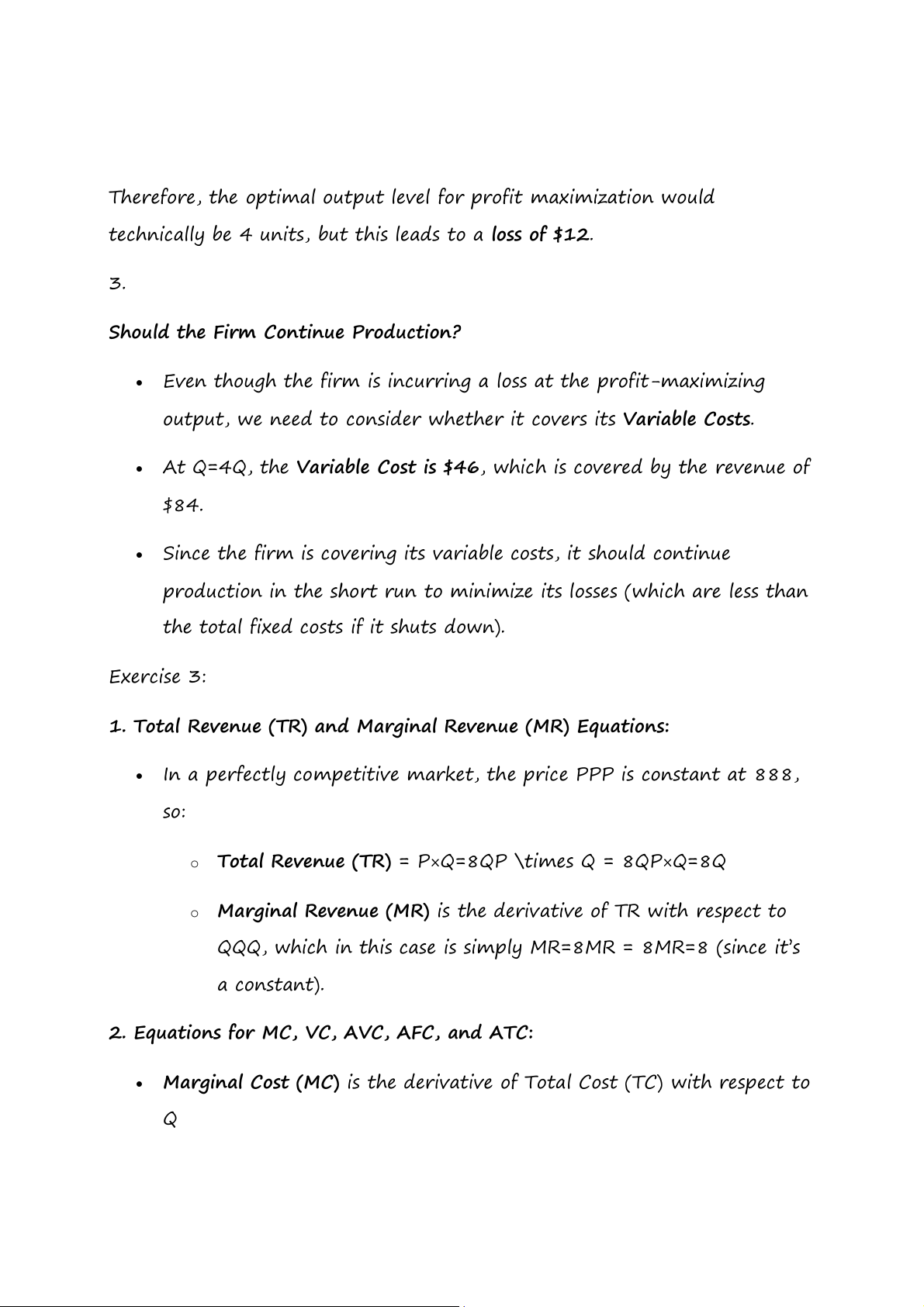
Therefore, the optimal output level for profit maximization would
technically be 4 units, but this leads to a loss of $12. 3.
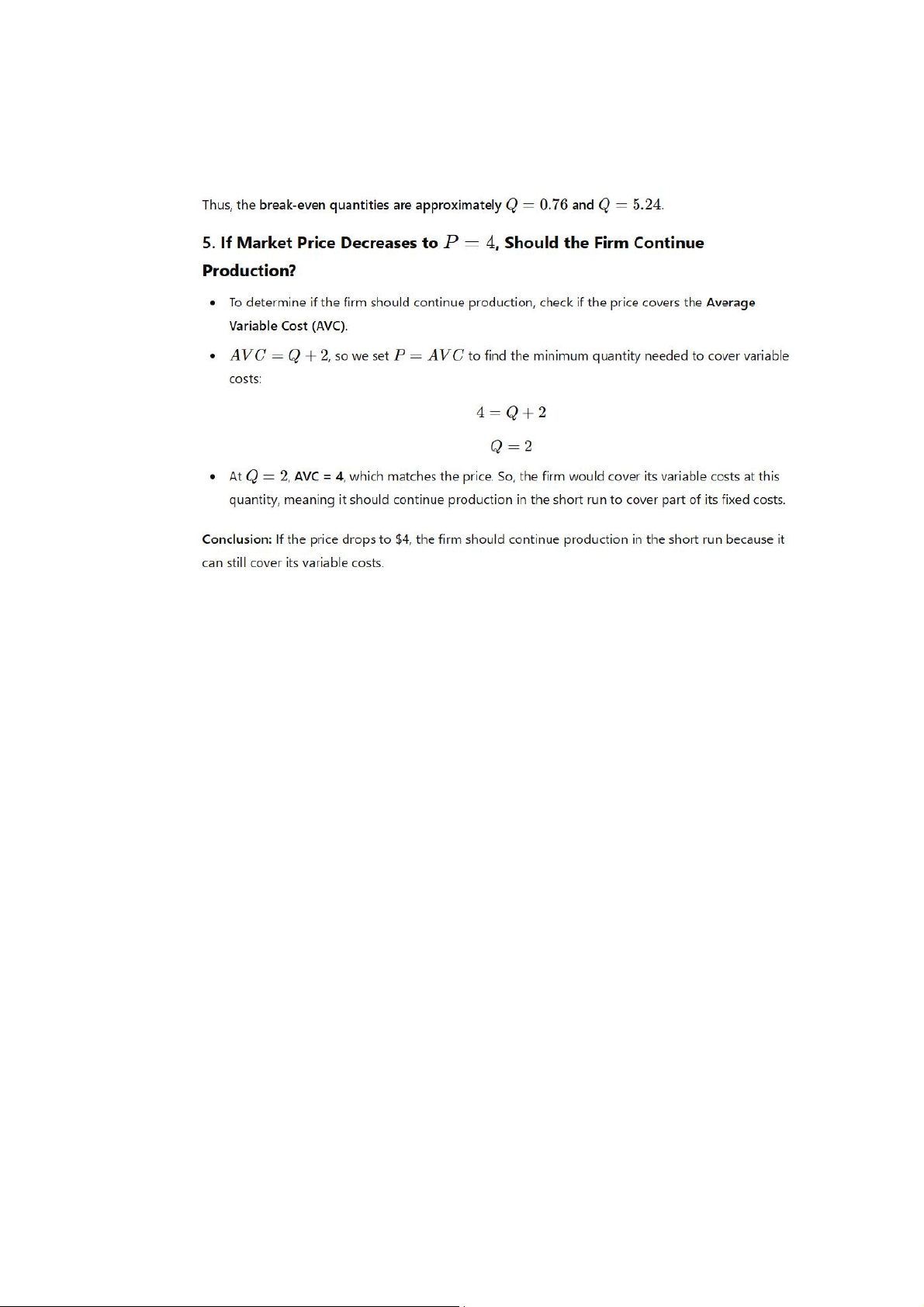
Should the Firm Continue Production?
Even though the firm is incurring a loss at the profit-maximizing
output, we need to consider whether it covers its Variable . Costs
At Q=4Q, the Variable Cost is $46, which is covered by the revenue of $84.
Since the firm is covering its variable costs, it should continue
production in the short run to minimize its losses (which are less than
the total fixed costs if it shuts down). Exercise 3:
1. Total Revenue (TR) and Marginal Revenue (MR) Equations:
In a perfectly competitive market, the price PPP is constant at 888, so: o
Total Revenue (TR) = P×Q=8QP \times Q = 8QP×Q=8Q o
Marginal Revenue (MR) is the derivative of TR with respect to
QQQ, which in this case is simply MR=8MR = 8MR=8 (since it’s a constant).
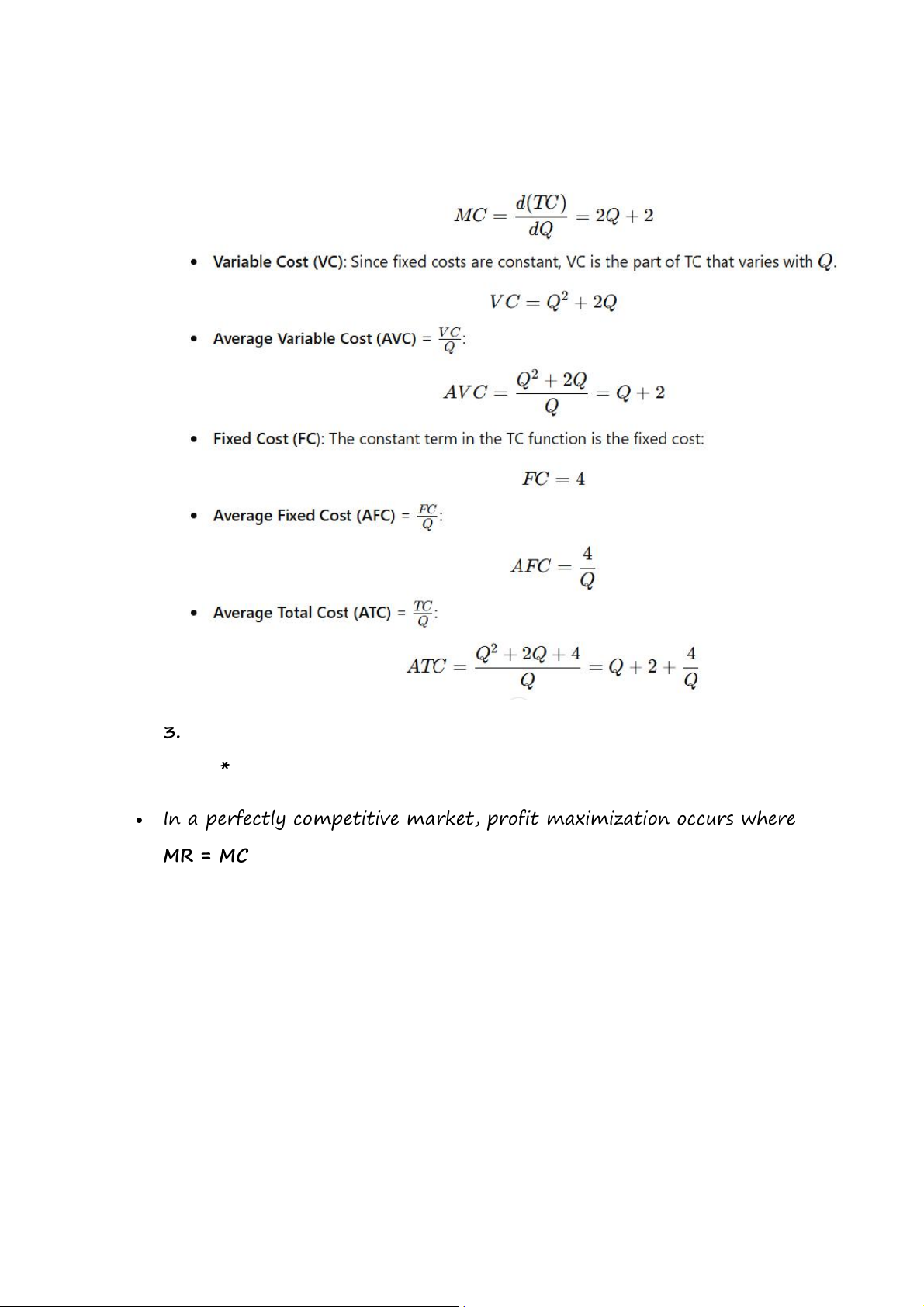
2. Equations for MC, VC, AVC, AFC, and ATC:
Marginal Cost (MC) is the derivative of Total Cost (TC) with respect to Q
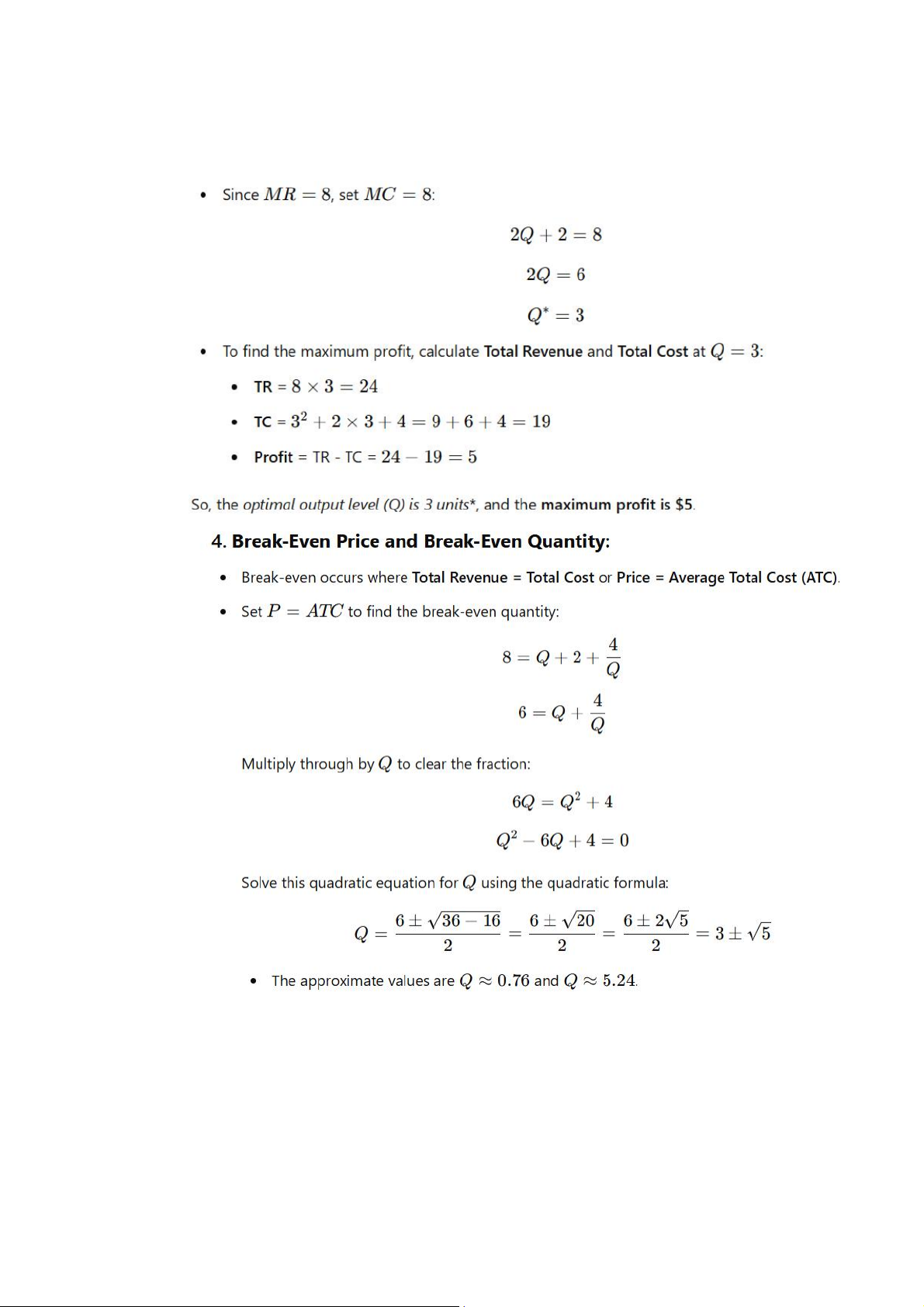
3. Optimal Output Level (Q) for Profit Maximization and Maximum Profit:*
In a perfectly competitive market, profit maximization occurs where MR = MC
Tài liệu liên quan:
-
Chương 3: độ co giãn và các nhân tố ảnh hưởng | Microeconomics | Trường Đại học Quốc tế, Đại học Quốc gia Thành phố Hồ Chí Minh
0 0 -
Microeconomics Syllabus | Microeconomics | Trường Đại học Quốc tế, Đại học Quốc gia Thành phố Hồ Chí Minh
1 1 -
Microeconomics Course Syllabus & Assessment Details | Microeconomics | Trường Đại học Quốc tế, Đại học Quốc gia Thành phố Hồ Chí Minh
1 1 -
Assignment 3 - Elasticity MCQs and Key Concepts | Microeconomics | Trường Đại học Quốc tế, Đại học Quốc gia Thành phố Hồ Chí Minh
1 1 -
Assignment 2 - Economic Equilibrium Analysis of Fridges and Motorcycles | Microeconomics | Trường Đại học Quốc tế, Đại học Quốc gia Thành phố Hồ Chí Minh
1 1