Questions on Perfect Competition & Monopoly | Microeconomics | Trường Đại học Quốc tế, Đại học Quốc gia Thành phố Hồ Chí Minh
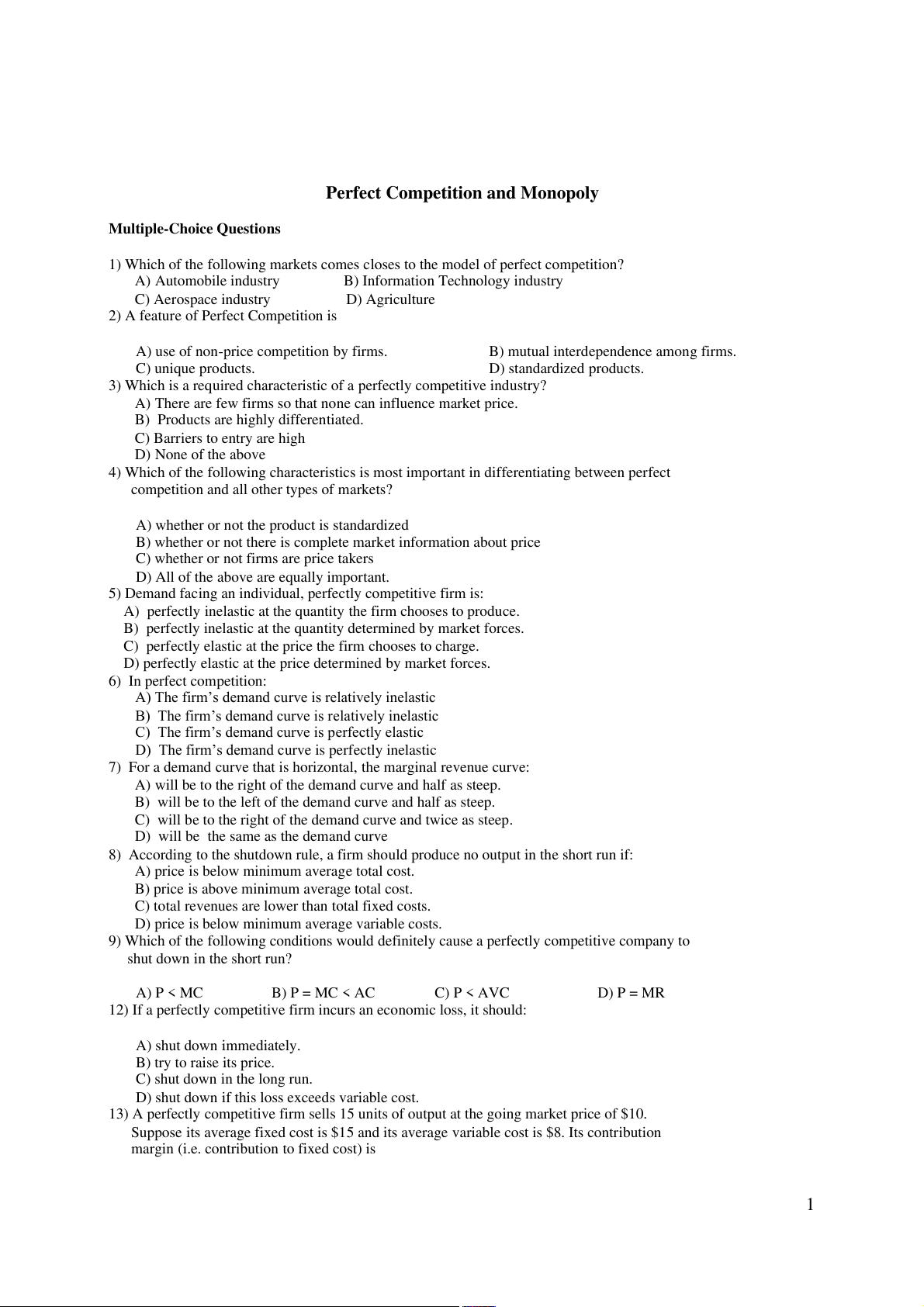
Which of the following markets comes closes to the model of perfect competition? A) Automobile industry B) Information Technology industry C) Aerospace industry D) Agriculture 2) A feature of Perfect Competition is A) use of non-price competition by firms. B) mutual interdependence among firms. C) unique products. D) standardized products. Tài liệu được sưu tầm và soạn thảo dưới dạng file PDF để gửi tới các bạn cùng tham khảo, ôn tập đầy đủ kiến thức, chuẩn bị cho các buổi học thật tốt. Mời bạn đọc đón xem!
Môn: Microeconomics 635 tài liệu
Trường: Trường Đại học Quốc tế, Đại học Quốc gia Thành phố Hồ Chí Minh 1.9 K tài liệu
Tác giả:

Preview text:
Perfect Competition and Monopoly
Multiple-Choice Questions
1) Which of the following markets comes closes to the model of perfect competition?
A) Automobile industry B) Information Technology industry
C) Aerospace industry D) Agriculture
2) A feature of Perfect Competition is
A) use of non-price competition by firms.
B) mutual interdependence among firms. C) unique products. D) standardized products.
3) Which is a required characteristic of a perfectly competitive industry?
A) There are few firms so that none can influence market price.
B) Products are highly differentiated.
C) Barriers to entry are high D) None of the above
4) Which of the following characteristics is most important in differentiating between perfect
competition and all other types of markets?
A) whether or not the product is standardized
B) whether or not there is complete market information about price
C) whether or not firms are price takers
D) All of the above are equally important.
5) Demand facing an individual, perfectly competitive firm is:
A) perfectly inelastic at the quantity the firm chooses to produce.
B) perfectly inelastic at the quantity determined by market forces.
C) perfectly elastic at the price the firm chooses to charge.
D) perfectly elastic at the price determined by market forces. 6) In perfect competition:
A) The firm’s demand curve is relatively inelastic
B) The firm’s demand curve is relatively inelastic
C) The firm’s demand curve is perfectly elastic
D) The firm’s demand curve is perfectly inelastic
7) For a demand curve that is horizontal, the marginal revenue curve:
A) will be to the right of the demand curve and half as steep.
B) will be to the left of the demand curve and half as steep.
C) will be to the right of the demand curve and twice as steep.
D) will be the same as the demand curve
8) According to the shutdown rule, a firm should produce no output in the short run if:
A) price is below minimum average total cost.
B) price is above minimum average total cost.
C) total revenues are lower than total fixed costs.
D) price is below minimum average variable costs.
9) Which of the following conditions would definitely cause a perfectly competitive company to shut down in the short run? A) P < MC B) P = MC < AC C) P < AVC D) P = MR
12) If a perfectly competitive firm incurs an economic loss, it should: A) shut down immediately. B) try to raise its price. C) shut down in the long run.
D) shut down if this loss exceeds variable cost.
13) A perfectly competitive firm sells 15 units of output at the going market price of $10.
Suppose its average fixed cost is $15 and its average variable cost is $8. Its contribution
margin (i.e. contribution to fixed cost) is 1 A) $30. B) $150. C) $105.
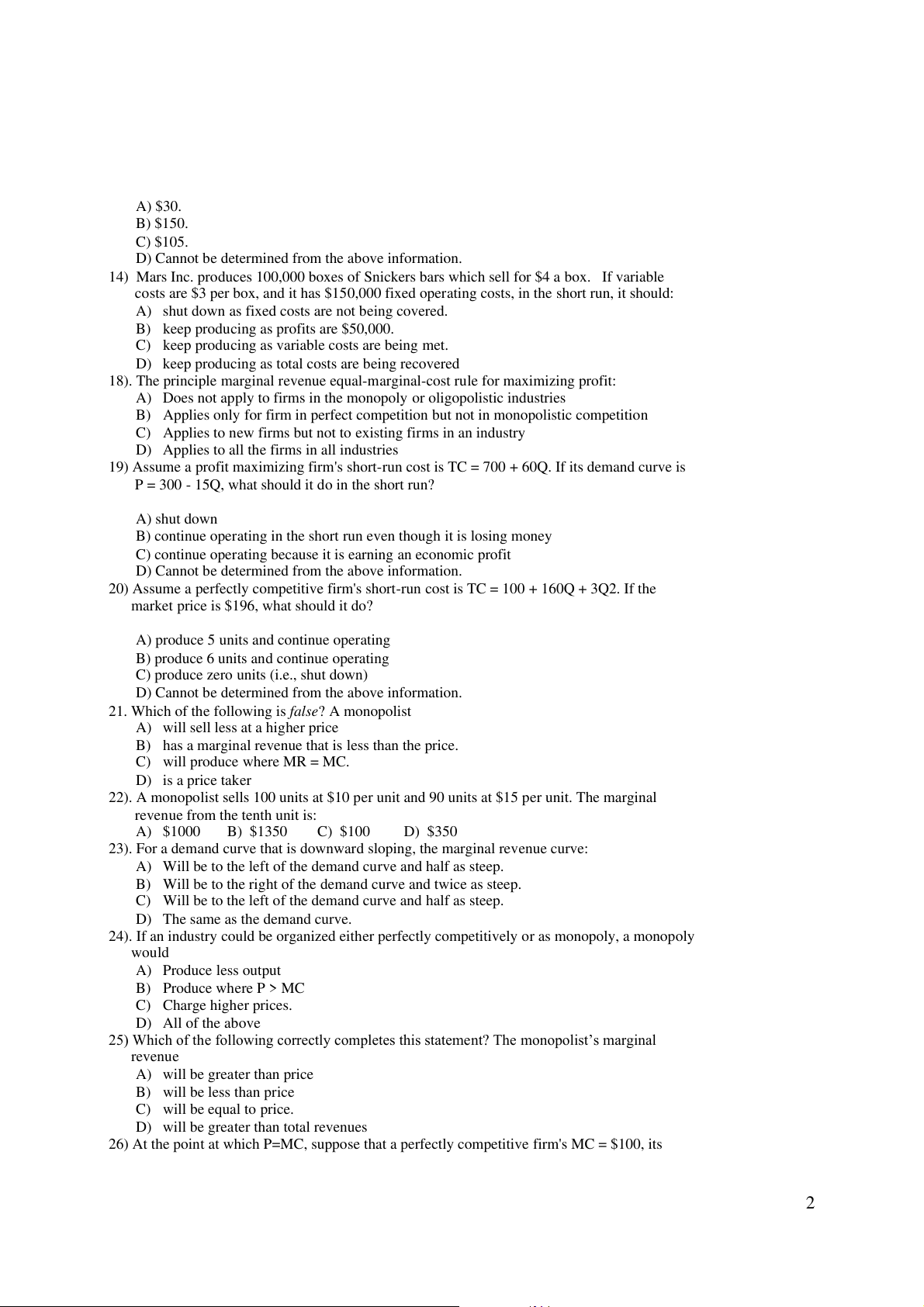
D) Cannot be determined from the above information.
14) Mars Inc. produces 100,000 boxes of Snickers bars which sell for $4 a box. If variable
costs are $3 per box, and it has $150,000 fixed operating costs, in the short run, it should:
A) shut down as fixed costs are not being covered.
B) keep producing as profits are $50,000.
C) keep producing as variable costs are being met.
D) keep producing as total costs are being recovered
18). The principle marginal revenue equal-marginal-cost rule for maximizing profit:
A) Does not apply to firms in the monopoly or oligopolistic industries
B) Applies only for firm in perfect competition but not in monopolistic competition
C) Applies to new firms but not to existing firms in an industry
D) Applies to all the firms in all industries
19) Assume a profit maximizing firm's short-run cost is TC = 700 + 60Q. If its demand curve is
P = 300 - 15Q, what should it do in the short run? A) shut down
B) continue operating in the short run even though it is losing money
C) continue operating because it is earning an economic profit
D) Cannot be determined from the above information.
20) Assume a perfectly competitive firm's short-run cost is TC = 100 + 160Q + 3Q2. If the
market price is $196, what should it do?
A) produce 5 units and continue operating
B) produce 6 units and continue operating
C) produce zero units (i.e., shut down)
D) Cannot be determined from the above information.
21. Which of the following is false? A monopolist
A) will sell less at a higher price
B) has a marginal revenue that is less than the price.
C) will produce where MR = MC. D) is a price taker
22). A monopolist sells 100 units at $10 per unit and 90 units at $15 per unit. The marginal
revenue from the tenth unit is:
A) $1000 B) $1350 C) $100 D) $350
23). For a demand curve that is downward sloping, the marginal revenue curve:
A) Will be to the left of the demand curve and half as steep.
B) Will be to the right of the demand curve and twice as steep.
C) Will be to the left of the demand curve and half as steep.
D) The same as the demand curve.
24). If an industry could be organized either perfectly competitively or as monopoly, a monopoly would A) Produce less output B) Produce where P > MC C) Charge higher prices. D) All of the above
25) Which of the following correctly completes this statement? The monopolist’s marginal revenue A) will be greater than price B) will be less than price C) will be equal to price.
D) will be greater than total revenues
26) At the point at which P=MC, suppose that a perfectly competitive firm's MC = $100, its 2
AVC = $80 and its AC = $110. This firm should A) shut down immediately.
B) continue operating in the short run.
C) try to take advantage of economies of scale.
D) try to increase its advertising and promotion.
27) When a firm produces at the point where MR = MC, the profit that it is earning is considered to be A) maximum. B) normal. C) above normal.
D) Not enough information is provided.
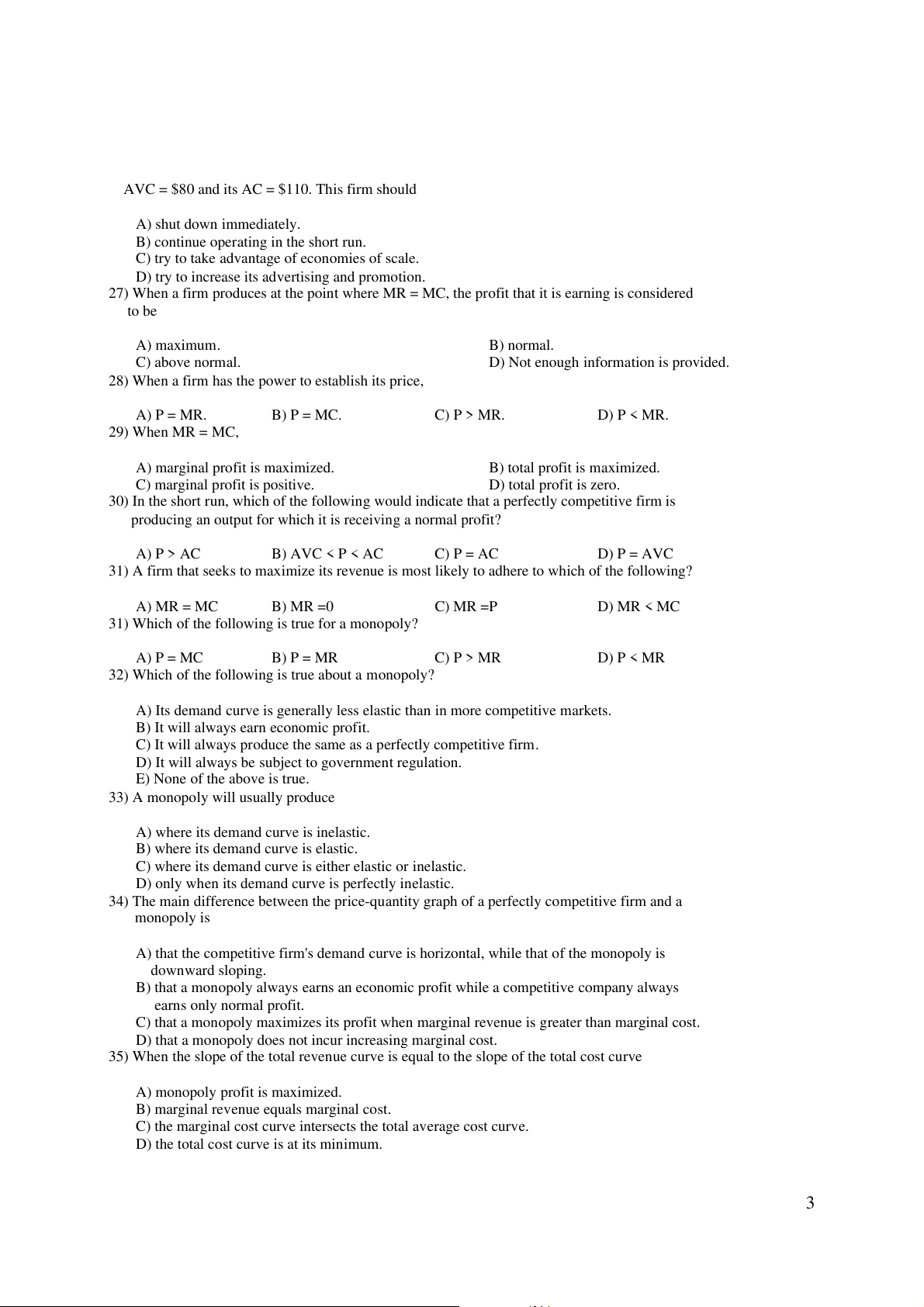
28) When a firm has the power to establish its price, A) P = MR. B) P = MC. C) P > MR. D) P < MR. 29) When MR = MC,
A) marginal profit is maximized. B) total profit is maximized.
C) marginal profit is positive. D) total profit is zero.
30) In the short run, which of the following would indicate that a perfectly competitive firm is
producing an output for which it is receiving a normal profit? A) P > AC B) AVC < P < AC C) P = AC D) P = AVC
31) A firm that seeks to maximize its revenue is most likely to adhere to which of the following? A) MR = MC B) MR =0 C) MR =P D) MR < MC
31) Which of the following is true for a monopoly? A) P = MC B) P = MR C) P > MR D) P < MR
32) Which of the following is true about a monopoly?
A) Its demand curve is generally less elastic than in more competitive markets.
B) It will always earn economic profit.
C) It will always produce the same as a perfectly competitive firm.
D) It will always be subject to government regulation. E) None of the above is true.
33) A monopoly will usually produce
A) where its demand curve is inelastic.
B) where its demand curve is elastic.
C) where its demand curve is either elastic or inelastic.
D) only when its demand curve is perfectly inelastic.
34) The main difference between the price-quantity graph of a perfectly competitive firm and a monopoly is
A) that the competitive firm's demand curve is horizontal, while that of the monopoly is downward sloping.
B) that a monopoly always earns an economic profit while a competitive company always earns only normal profit.
C) that a monopoly maximizes its profit when marginal revenue is greater than marginal cost.
D) that a monopoly does not incur increasing marginal cost.
35) When the slope of the total revenue curve is equal to the slope of the total cost curve
A) monopoly profit is maximized.
B) marginal revenue equals marginal cost.
C) the marginal cost curve intersects the total average cost curve.
D) the total cost curve is at its minimum. 3 E) Both A and B
36) Monopoly is characterized by A) unique products.
B) market entry and exit difficult or impossible.
C) non-price competition not necessary. D) All of the above.
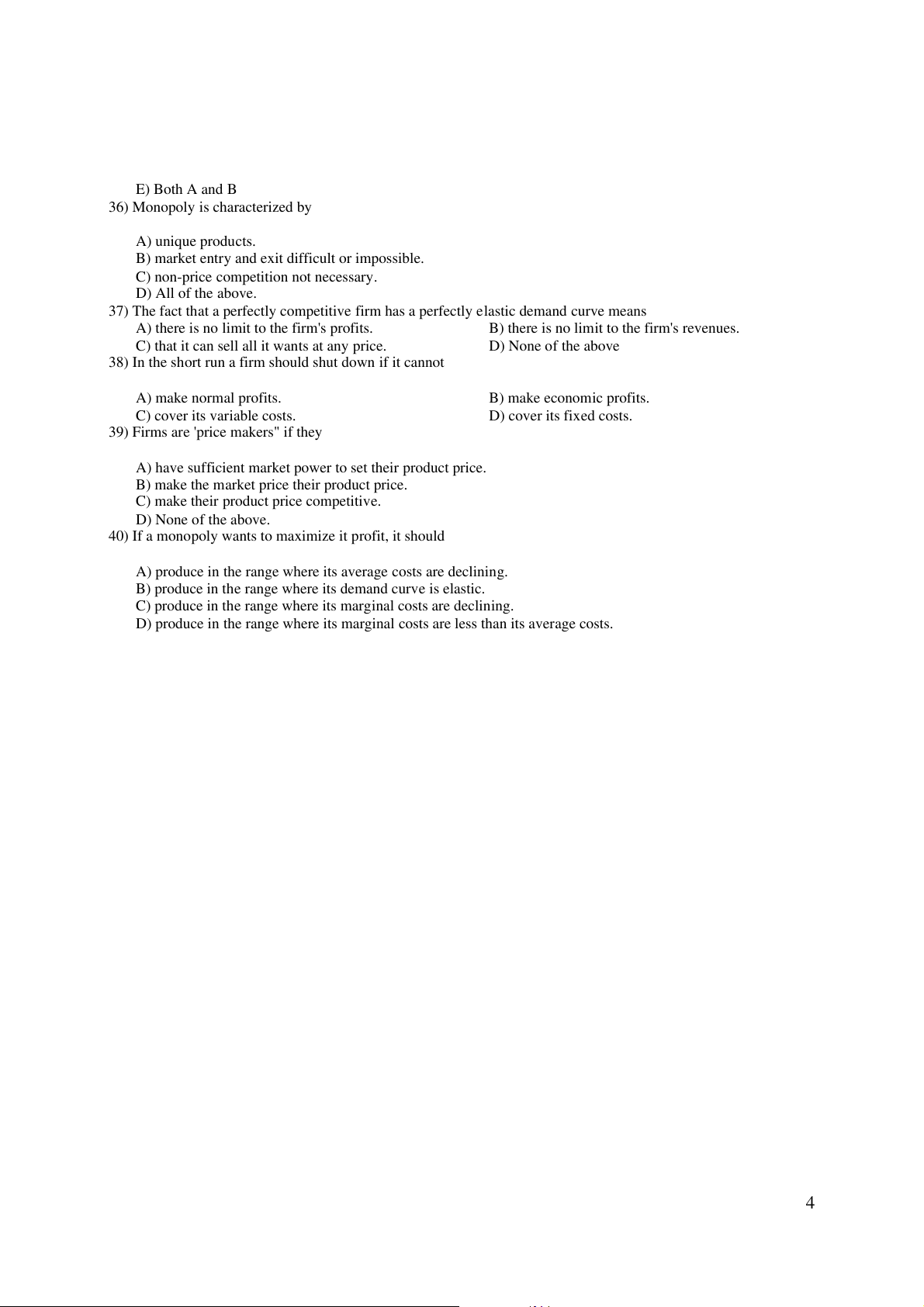
37) The fact that a perfectly competitive firm has a perfectly elastic demand curve means
A) there is no limit to the firm's profits.
B) there is no limit to the firm's revenues.
C) that it can sell all it wants at any price. D) None of the above
38) In the short run a firm should shut down if it cannot A) make normal profits. B) make economic profits. C) cover its variable costs. D) cover its fixed costs.
39) Firms are 'price makers" if they
A) have sufficient market power to set their product price.
B) make the market price their product price.
C) make their product price competitive. D) None of the above.
40) If a monopoly wants to maximize it profit, it should
A) produce in the range where its average costs are declining.
B) produce in the range where its demand curve is elastic.
C) produce in the range where its marginal costs are declining.
D) produce in the range where its marginal costs are less than its average costs. 4
Tài liệu liên quan:
-
Chương 3: độ co giãn và các nhân tố ảnh hưởng | Microeconomics | Trường Đại học Quốc tế, Đại học Quốc gia Thành phố Hồ Chí Minh
4 2 -
Microeconomics Syllabus | Microeconomics | Trường Đại học Quốc tế, Đại học Quốc gia Thành phố Hồ Chí Minh
4 2 -
Microeconomics Course Syllabus & Assessment Details | Microeconomics | Trường Đại học Quốc tế, Đại học Quốc gia Thành phố Hồ Chí Minh
4 2 -
Assignment 3 - Elasticity MCQs and Key Concepts | Microeconomics | Trường Đại học Quốc tế, Đại học Quốc gia Thành phố Hồ Chí Minh
4 2 -
Assignment 2 - Economic Equilibrium Analysis of Fridges and Motorcycles | Microeconomics | Trường Đại học Quốc tế, Đại học Quốc gia Thành phố Hồ Chí Minh
4 2