Reviews Part B - Probability Concepts and Exercises | Microeconomics | Trường Đại học Quốc tế, Đại học Quốc gia Thành phố Hồ Chí Minh
The average number of trips per family to amusement parks managed by Stage-it is Poisson distributed with a mean of 0.7 trips per year. What is the probability of randomly selecting a family and finding that a. The family did not make a trip to an amusement park last year; b. The family took two or more trips last year; c. The family took three or fewer trips over a three year period; d. The family took exactly. Tài liệu được sưu tầm và soạn thảo dưới dạng file PDF để gửi tới các bạn cùng tham khảo, ôn tập đầy đủ kiến thức, chuẩn bị cho các buổi học thật tốt. Mời bạn đọc đón xem!
Môn: Microeconomics 635 tài liệu
Trường: Trường Đại học Quốc tế, Đại học Quốc gia Thành phố Hồ Chí Minh 1.9 K tài liệu
Tác giả:

Preview text:
REVIEW EXERCISES Part B Probability
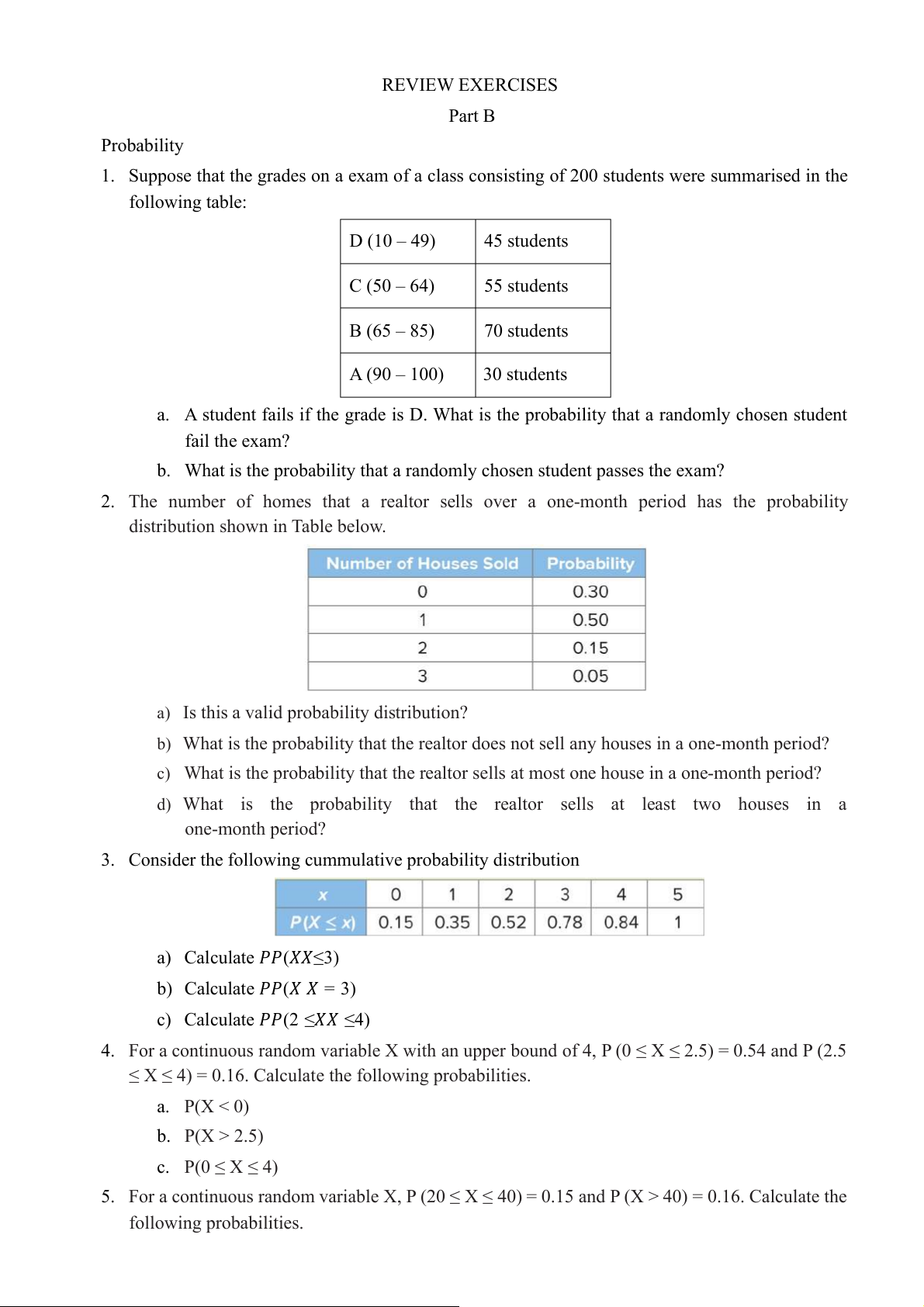
1. Suppose that the grades on a exam of a class consisting of 200 students were summarised in the following table: D (10 – 49) 45 students C (50 – 64) 55 students B (65 – 85) 70 students A (90 – 100) 30 students
a. A student fails if the grade is D. What is the probability that a randomly chosen student fail the exam?
b. What is the probability that a randomly chosen student passes the exam?
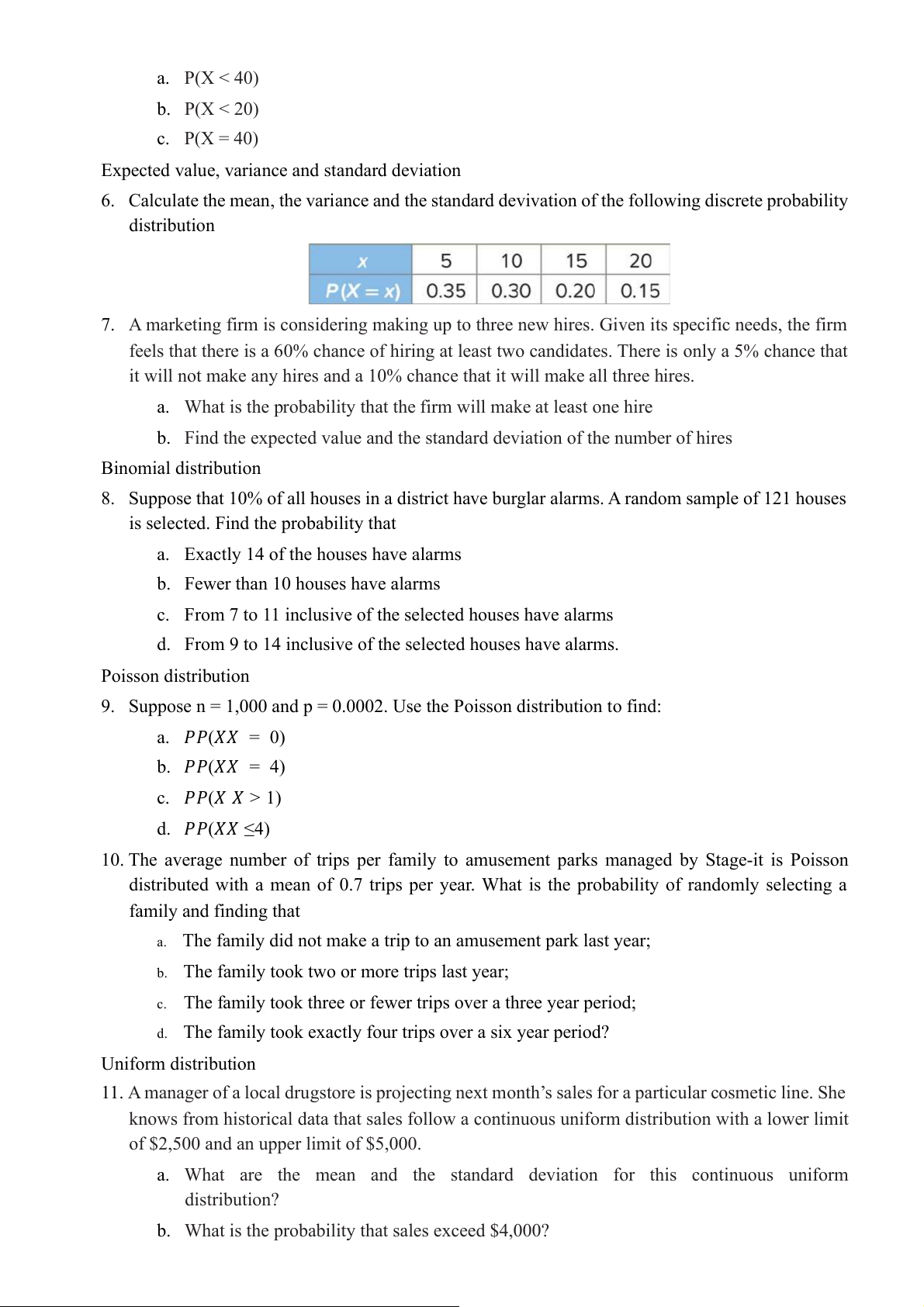
2. The number of homes that a realtor sells over a one-month period has the probability
distribution shown in Table below.
a) Is this a valid probability distribution?
b) What is the probability that the realtor does not sell any houses in a one-month period?
c) What is the probability that the realtor sells at most one house in a one-month period?
d) What is the probability that the realtor sells at least two houses in a one-month period?
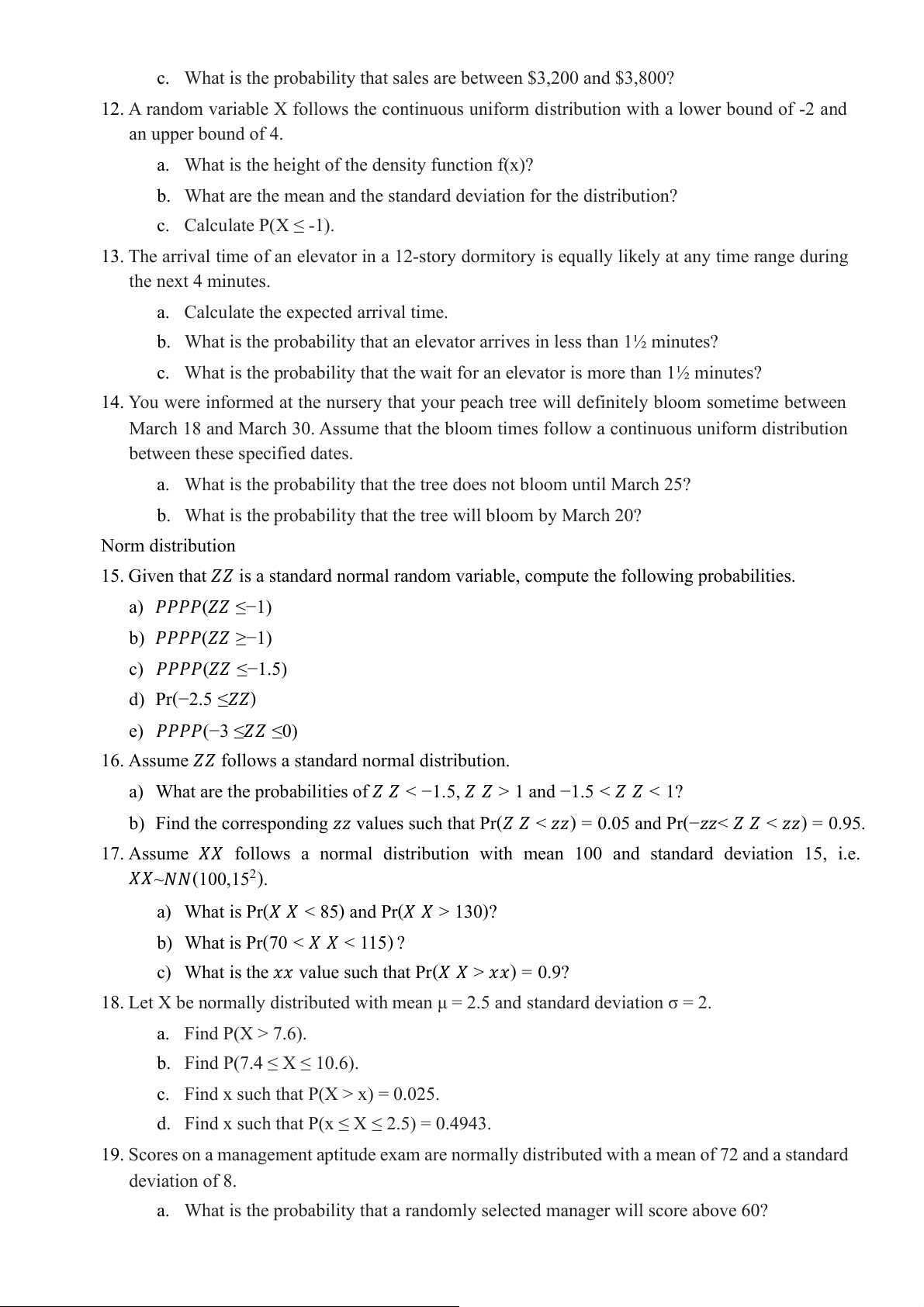
3. Consider the following cummulative probability distribution
a) Calculate 𝑃𝑃(𝑋𝑋≤3)
b) Calculate 𝑃𝑃(𝑋 𝑋 = 3)
c) Calculate 𝑃𝑃(2 ≤𝑋𝑋 ≤4)
4. For a continuous random variable X with an upper bound of 4, P (0 ≤ X ≤ 2.5) = 0.54 and P (2.5
≤ X ≤ 4) = 0.16. Calculate the following probabilities. a. P(X < 0) b. P(X > 2.5) c. P(0 ≤ X ≤ 4)
5. For a continuous random variable X, P (20 ≤ X ≤ 40) = 0.15 and P (X > 40) = 0.16. Calculate the following probabilities. a. P(X < 40) b. P(X < 20) c. P(X = 40)
Expected value, variance and standard deviation
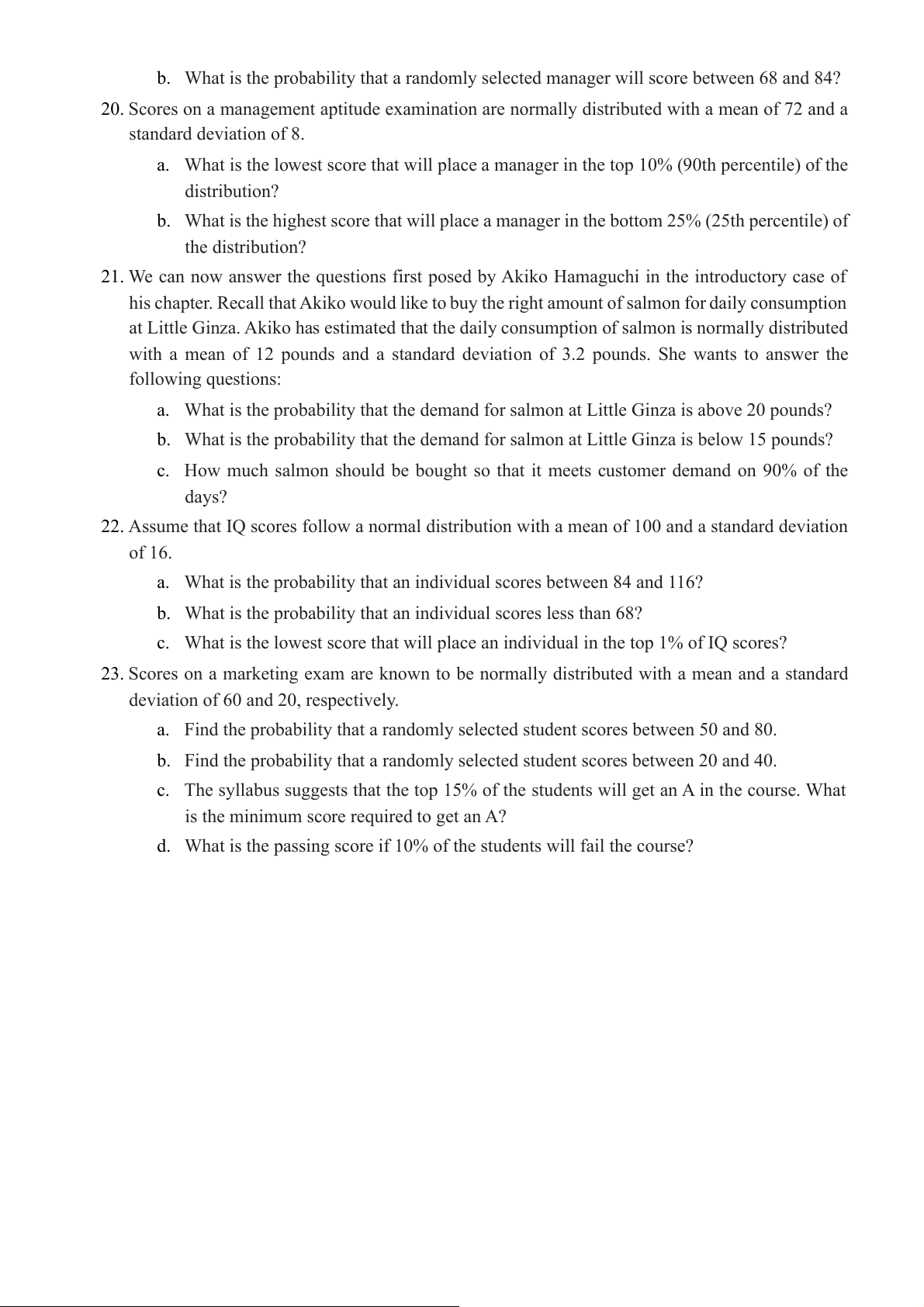
6. Calculate the mean, the variance and the standard devivation of the following discrete roba p bility distri u b tion
7. A marketing firm is considering making up to three new hires. Given its specific needs, the firm
feels that there is a 60% chance of hiring at least two candidates. There is only a 5% chance that
it will not make any hires and a 10% chance that it will make all three hires.
a. What is the probability that the firm will make at least one hire
b. Find the expected value and the standard deviation of the number of hires Binomial distribution
8. Suppose that 10% of all houses in a district have burglar alarms. A random sample of 121 houses
is selected. Find the probability that
a. Exactly 14 of the houses have alarms
b. Fewer than 10 houses have alarms
c. From 7 to 11 inclusive of the selected houses have alarms
d. From 9 to 14 inclusive of the selected houses have alarms. Poisson distribution 9. Suppose n = 1,000 p
and = 0.0002. Use the Poisson distribution to find: a. 𝑃𝑃(𝑋𝑋 = 0) b. 𝑃𝑃(𝑋𝑋 = 4) c. 𝑃𝑃(𝑋 𝑋 > 1) d. 𝑃𝑃(𝑋𝑋 ≤4)
10. The average number of trips per family to amusement parks managed by Stage-it is Poisson
distributed with a mean of 0.7 trips per year. What is the probability of randomly selecting a family and finding that
a. The family did not make a trip to an amusement park last year;
b. The family took two or more trips last year;
c. The family took three or fewer trips over a three year period;
d. The family took exactly four trips over a six year period? Uniform distribution
11. A manager of a local drugstore is projecting next month’s sales for a particular cosmetic line. She
knows from historical data that sales follow a continuous uniform distribution with a lower limit
of $2,500 and an upper limit of $5,000.
a. What are the mean and the standard deviation for this continuous uniform distribution?
b. What is the probability that sales exceed $4,000?
c. What is the probability that sales are between $3,200 and $3,800?
12. A random variable X follows the continuous uniform distribution with a lower bound of -2 and an upper bound of 4.
a. What is the height of the density function f(x)?
b. What are the mean and the standard deviation for the distribution? c. Calculate P(X ≤ -1).
13. The arrival time of an elevator in a 12-story dormitory is equally likely at any time range during the next 4 minutes.
a. Calculate the expected arrival time.
b. What is the probability that an elevator arrives in less than 1½ minutes?
c. What is the probability that the wait for an elevator is more than 1½ minutes?
14. You were informed at the nursery that your peach tree will definitely bloom sometime between
March 18 and March 30. Assume that the bloom times follow a continuous uniform distribution
between these specified dates.
a. What is the probability that the tree does not bloom until March 25?
b. What is the probability that the tree will bloom by March 20? Norm distribution
15. Given that 𝑍𝑍 is a standard normal random variable, compute the following probabilities.
a) 𝑃𝑃𝑃𝑃(𝑍𝑍 ≤−1)
b) 𝑃𝑃𝑃𝑃(𝑍𝑍 ≥−1)
c) 𝑃𝑃𝑃𝑃(𝑍𝑍 ≤−1.5) d) Pr(−2.5 ≤𝑍𝑍)
e) 𝑃𝑃𝑃𝑃(−3 ≤𝑍𝑍 ≤0)
16. Assume 𝑍𝑍 follows a standard normal distribution.
a) What are the probabilities of 𝑍 𝑍 < −1.5, 𝑍 𝑍 > 1 and −1.5 < 𝑍 𝑍 < 1?
b) Find the corresponding 𝑧𝑧 values such that Pr(𝑍 𝑍 < 𝑧𝑧) = 0.0 and 5
Pr(−𝑧𝑧< 𝑍 𝑍 < 𝑧𝑧) = 0.9 . 5
17. Assume 𝑋𝑋 follows a normal distribution with mean 100 and standard deviation 15, i.e. 𝑋𝑋~𝑁𝑁(100,152).
a) What is Pr(𝑋 𝑋 < 85) and Pr(𝑋 𝑋 > 130)?
b) What is Pr(70 < 𝑋 𝑋 < 115) ?
c) What is the 𝑥𝑥 value such that Pr(𝑋 𝑋 > 𝑥𝑥) = 0.9?
18. Let X be normally distributed with mean μ = 2.5 and standard deviation σ = 2. a. Find P(X > 7.6).
b. Find P(7.4 ≤ X ≤ 10.6).
c. Find x such that P(X > x) = 0.025.
d. Find x such that P(x ≤ X ≤ 2.5) = 0.4943.
19. Scores on a management aptitude exam are normally distributed with a mean of 72 and a standard deviation of 8.
a. What is the probability that a randomly selected manager will score above 60?
b. What is the probability that a randomly selected manager will score between 68 and 84?
20. Scores on a management aptitude examination are normally distributed with a mean of 72 and a standard deviation of 8.
a. What is the lowest score that will place a manager in the top 10% (90th percentile) of the distribution?
b. What is the highest score that will place a manager in the bottom 25% (25th percentile) of the distribution?
21. We can now answer the questions first posed by Akiko Hamaguchi in the introductory case of
his chapter. Recall that Akiko would like to buy the right amount of salmon for daily consumption
at Little Ginza. Akiko has estimated that the daily consumption of salmon is normally distributed
with a mean of 12 pounds and a standard deviation of 3.2 pounds. She wants to answer the following questions:
a. What is the probability that the demand for salmon at Little Ginza is above 20 pounds?
b. What is the probability that the demand for salmon at Little Ginza is below 15 pounds?
c. How much salmon should be bought so that it meets customer demand on 90% of the days?
22. Assume that IQ scores follow a normal distribution with a mean of 100 and a standard deviation of 16.
a. What is the probability that an individual scores between 84 and 116?
b. What is the probability that an individual scores less than 68?
c. What is the lowest score that will place an individual in the top 1% of IQ scores?
23. Scores on a marketing exam are known to be normally distributed with a mean and a standard
deviation of 60 and 20, respectively.
a. Find the probability that a randomly selected student scores between 50 and 80.
b. Find the probability that a randomly selected student scores between 20 and 40.
c. The syllabus suggests that the top 15% of the students will get an A in the course. What
is the minimum score required to get an A?
d. What is the passing score if 10% of the students will fail the course?
Tài liệu liên quan:
-
Chương 3: độ co giãn và các nhân tố ảnh hưởng | Microeconomics | Trường Đại học Quốc tế, Đại học Quốc gia Thành phố Hồ Chí Minh
6 3 -
Microeconomics Syllabus | Microeconomics | Trường Đại học Quốc tế, Đại học Quốc gia Thành phố Hồ Chí Minh
5 3 -
Microeconomics Course Syllabus & Assessment Details | Microeconomics | Trường Đại học Quốc tế, Đại học Quốc gia Thành phố Hồ Chí Minh
5 3 -
Assignment 3 - Elasticity MCQs and Key Concepts | Microeconomics | Trường Đại học Quốc tế, Đại học Quốc gia Thành phố Hồ Chí Minh
5 3 -
Assignment 2 - Economic Equilibrium Analysis of Fridges and Motorcycles | Microeconomics | Trường Đại học Quốc tế, Đại học Quốc gia Thành phố Hồ Chí Minh
6 3