Section 6: Consumer Choice - Budget Constraints and Optimal Choices | Microeconomics | Trường Đại học Quốc tế, Đại học Quốc gia Thành phố Hồ Chí Minh
A consumer’s budget constraint for goods X and Y is determined by how much the consumer likes good X relative to good Y. ANS: F DIF: 2 REF: 21-1 NAT: Analytic LOC: Utility and consumer choice TOP: Budget constraint MSC: Definitional 3. The slope of the budget constraint reveals the relative price of good X compared to good Y. ANS: T DIF: 2 REF: 21-1 NAT: Analytic LOC: Utility and consumer choice TOP: Budget constraint MSC: Applicative. Tài liệu được sưu tầm và soạn thảo dưới dạng file PDF để gửi tới các bạn cùng tham khảo, ôn tập đầy đủ kiến thức, chuẩn bị cho các buổi học thật tốt. Mời bạn đọc đón xem!
Môn: Microeconomics 635 tài liệu
Trường: Trường Đại học Quốc tế, Đại học Quốc gia Thành phố Hồ Chí Minh 1.9 K tài liệu
Tác giả:

Preview text:
2.
A consumer’s budget constraint for goods X and Y is determined by how much the consumer likes good X relative to good Y. ANS: F DIF: 2 REF: 21-1 NAT: Analytic
LOC: Utility and consumer choice TOP: Budget constraint MSC: Definitional 3.
The slope of the budget constraint reveals the relative price of good X compared to good Y. ANS: T DIF: 2 REF: 21-1 NAT: Analytic
LOC: Utility and consumer choice TOP: Budget constraint MSC: Applicative 4.
A budget constraint illustrates bundles that a consumer prefers equally, while an indifference curve illustrates
bundles that are equally affordable to a consumer. ANS: F DIF: 2 REF: 21-1 | 21-2 NAT: Analytic
LOC: Utility and consumer choice TOP: Budget constraint MSC: Applicative 18.
At a consumer’s optimal choice, the consumer chooses the combination of goods that equates the marginal
rate of substitution and the price ratio. ANS: T DIF: 2 REF: 21-3 NAT: Analytic
LOC: Utility and consumer choice TOP: Optimization MSC: Interpretive 19.
At a consumer’s optimal choice, the consumer chooses the combination of goods such that the ratio of the
marginal utilities equals the ratio of the prices. ANS: T DIF: 2 REF: 21-3 NAT: Analytic
LOC: Utility and consumer choice TOP: Optimization MSC: Interpretive 1.
Answer the following questions based on the table. A consumer is able to consume the following bundles of
rice and beans when the price of rice is $2 and the price of beans is $3. RICE BEANS 12 0 6 4 0 8 a.
How much is this consumer's income? b.
Draw a budget constraint given this information. Label it B. c.
Construct a new budget constraint showing the change if the price of rice falls $1. Label this C. d.
Given the original prices for rice ($2) and beans ($3), construct a new budget constraint if this
consumer's income increased to $48. Label this D. 1.
Which of the following does not represent a tradeoff facing a consumer? a.
choosing to purchase more of all goods b.
choosing to spend more leisure time and less working time c.
choosing to spend more now and consume less in the future d.
choosing to purchase less of one good in order to purchase more of another good ANS: A DIF: 1 REF: 21-0 NAT: Analytic
LOC: Utility and consumer choice TOP: Consumer choice MSC: Applicative 2.
How are the following three questions related: 1) Do all demand curves slope downward? 2) How do wages
affect labor supply? 3) How do interest rates affect household saving? a.
They all relate to macroeconomics. b.
They all relate to monetary economics. c.
They all relate to the theory of consumer choice. d.
They are not related to each other in any way. ANS: C DIF: 1 REF: 21-0 NAT: Analytic
LOC: Utility and consumer choice TOP: Consumer choice MSC: Applicative 3.
Just as the theory of the competitive firm provides a more complete understanding of supply, the theory of
consumer choice provides a more complete understanding of a. demand. b. profits. c.
production possibility frontiers. d. wages. ANS: A DIF: 1 REF: 21-0 NAT: Analytic
LOC: Utility and consumer choice TOP: Consumer choice MSC: Interpretive 4.
Which of the following statements is correct? a.
The theory of consumer choice provides a more complete understanding of supply, just as the
theory of the competitive firm provides a more complete understanding of demand. b.
The theory of consumer choice provides a more complete understanding of demand, just as the
theory of the competitive firm provides a more complete understanding of supply. c.
Monetary theory provides a more complete understanding of demand, just as the theory of the
competitive firm provides a more complete understanding of supply. d.
The theory of public choice provides a more complete understanding of supply, just as the theory of
the competitive firm provides a more complete understanding of demand. ANS: B DIF: 1 REF: 21-0 NAT: Analytic
LOC: Utility and consumer choice TOP: Consumer choice MSC: Interpretive 5.
When a consumer spends less time enjoying leisure and more time working, she has a.
lower income and therefore cannot afford more consumption. b.
lower income and therefore can afford more consumption. c.
higher income and therefore cannot afford more consumption. d.
higher income and therefore can afford more consumption. ANS: D DIF: 1 REF: 21-0 NAT: Analytic
LOC: Utility and consumer choice TOP: Consumer choice MSC: Interpretive 6.
The theory of consumer choice provides the foundation for understanding the a. structure of a firm. b. profitability of a firm. c. demand for a firm's product. d. supply of a firm's product. ANS: C DIF: 1 REF: 21-0 NAT: Analytic
LOC: Utility and consumer choice TOP: Consumer choice MSC: Definitional 7.
The theory of consumer choice examines a.
the determination of output in competitive markets. b.
the tradeoffs inherent in decisions made by consumers. c.
how consumers select inputs into manufacturing production processes. d.
the determination of prices in competitive markets. ANS: B DIF: 1 REF: 21-0 NAT: Analytic
LOC: Utility and consumer choice TOP: Consumer choice MSC: Definitional 8.
The theory of consumer choice most closely examines which of the following Ten Principles of Economics? a. People face trade-offs. b.
The cost of something is what you give up to get it. c.
Trade can make everyone better off. d.
Markets are usually a good way to organize economic activity. ANS: A DIF: 1 REF: 21-0 NAT: Analytic
LOC: Utility and consumer choice TOP: Consumer choice MSC: Interpretive
Sec 01- The Theory of Consumer Choice - The Budget Constraint: What the Consumer Can Afford MULTIPLE CHOICE 1.
Karen, Tara, and Chelsea each buy ice cream and paperback novels to enjoy on hot summer days. Ice cream
costs $5 per gallon, and paperback novels cost $8 each. Karen has a budget of $80, Tara has a budget of $60,
and Chelsea has a budget of $40 to spend on ice cream and paperback novels. Who can afford to purchase 8
gallons of ice cream and 5 paperback novels? a. Karen, Tara, and Chelsea b. Karen only c. Tara and Chelsea but not Karen d. none of the women ANS: B DIF: 1 REF: 21-1 NAT: Analytic
LOC: Utility and consumer choice TOP: Budget constraint MSC: Applicative 2.
Karen, Tara, and Chelsea each buy ice cream and paperback novels to enjoy on hot summer days. Ice cream
costs $5 per gallon, and paperback novels cost $8 each. Karen has a budget of $80, Tara has a budget of $60,
and Chelsea has a budget of $40 to spend on ice cream and paperback novels. Who can afford to purchase 5
gallons of ice cream and 8 paperback novels? a. Karen, Tara, and Chelsea b. Karen only c. Tara and Chelsea but not Karen d. none of the women ANS: D DIF: 1 REF: 21-1 NAT: Analytic
LOC: Utility and consumer choice TOP: Budget constraint MSC: Applicative 3.
Karen, Tara, and Chelsea each buy ice cream and paperback novels to enjoy on hot summer days. Ice cream
costs $5 per gallon, and paperback novels cost $8 each. Karen has a budget of $80, Tara has a budget of $60,
and Chelsea has a budget of $40 to spend on ice cream and paperback novels. Who can afford to purchase 4
gallons of ice cream and 5 paperback novels? a. Karen, Tara, and Chelsea b. Karen only c. Karen and Tara but not Chelsea d. none of the women ANS: C DIF: 1 REF: 21-1 NAT: Analytic
LOC: Utility and consumer choice TOP: Budget constraint MSC: Applicative 4.
Karen, Tara, and Chelsea each buy ice cream and paperback novels to enjoy on hot summer days. Ice cream
costs $5 per gallon, and paperback novels cost $8 each. Karen has a budget of $80, Tara has a budget of $60,
and Chelsea has a budget of $40 to spend on ice cream and paperback novels. Which of the following statements is correct? a.
Each woman faces the same budget constraint. b.
The slope of the budget constraint is the same for each woman. c.
The area underneath the budget constraint is larger for Chelsea than for Karen. d. All of the above are correct. ANS: B DIF: 2 REF: 21-1 NAT: Analytic
LOC: Utility and consumer choice TOP: Budget constraint MSC: Applicative 5.
Suppose a consumer has an income of $800 per month and that she spends her entire income each month on
beer and bratwurst. The price of a pint of beer is $5, and the price of a bratwurst is $4. Which of the
following combinations of beers and bratwursts represents a point that would lie to the interior of the
consumer’s budget constraint? a. 160 beers and 200 bratwursts b. 40 beers and 50 bratwursts c. 80 beers and 100 bratwursts d. 160 beers and 0 bratwursts ANS: B DIF: 2 REF: 21-1 NAT: Analytic
LOC: Utility and consumer choice TOP: Budget constraint MSC: Analytical 6.
Suppose a consumer has an income of $800 per month and that she spends her entire income each month on
beer and bratwurst. The price of a pint of beer is $5, and the price of a bratwurst is $4. Which of the
following combinations of beers and bratwursts represents a point that would lie to the exterior of the
consumer’s budget constraint? a. 160 beers and 200 bratwursts b. 40 beers and 50 bratwursts c. 80 beers and 100 bratwursts d. 160 beers and 0 bratwursts ANS: A DIF: 2 REF: 21-1 NAT: Analytic
LOC: Utility and consumer choice TOP: Budget constraint MSC: Analytical 7.
Suppose a consumer has an income of $800 per month and that she spends her entire income each month on
beer and bratwurst. The price of a pint of beer is $5, and the price of a bratwurst is $4. Which of the
following combinations of beers and bratwursts represents a point that would lie directly on the consumer’s budget constraint? a. 160 beers and 200 bratwursts b. 40 beers and 50 bratwursts c. 80 beers and 100 bratwursts d. 80 beers and 0 bratwursts ANS: C DIF: 2 REF: 21-1 NAT: Analytic
LOC: Utility and consumer choice TOP: Budget constraint MSC: Analytical 8.
Consider two goods, books and hamburgers. The slope of the consumer's budget constraint is measured by the a.
consumer's income divided by the price of hamburgers. b.
relative price of books and hamburgers. c.
consumer's marginal rate of substitution. d.
number of books purchased divided by the number of hamburgers purchased. ANS: B DIF: 2 REF: 21-1 NAT: Analytic
LOC: Utility and consumer choice TOP: Budget constraint MSC: Interpretive 9.
Suppose a consumer spends his income on CDs and DVDs. If his income decreases, the budget constraint for CDs and DVDs will a.
shift outward, parallel to the original budget constraint. b.
shift inward, parallel to the original budget constraint. c.
rotate outward along the CD axis because he can afford more CDs. d.
rotate outward along the DVD axis because he can afford more DVDs. ANS: B DIF: 2 REF: 21-1 NAT: Analytic
LOC: Utility and consumer choice TOP: Budget constraint MSC: Analytical 10.
When the price of a shirt falls, the a.
quantity of shirts demanded falls. b.
quantity of shirts demanded rises. c.
quantity of shirts supplied rises. d. demand for shirts falls. ANS: B DIF: 1 REF: 21-1 NAT: Analytic
LOC: Utility and consumer choice TOP: Demand MSC: Analytical 11.
A budget constraint illustrates the a.
prices that a consumer chooses to pay for products he consumes. b. purchases made by consumers. c.
consumption bundles that a consumer can afford. d.
consumption bundles that give a consumer equal satisfaction. ANS: C DIF: 1 REF: 21-1 NAT: Analytic
LOC: Utility and consumer choice TOP: Budget constraint MSC: Definitional 12.
Assume that a college student spends her income on books and pizza. The price of a pizza is $8, and the price
of a book is $15. If she has $100 of income, she could choose to consume a. 8 pizzas and 4 books. b. 4 pizzas and 5 books. c. 9 pizzas and 3 books. d. 4 pizzas and 3 books. ANS: D DIF: 2 REF: 21-1 NAT: Analytic
LOC: Utility and consumer choice TOP: Budget constraint MSC: Applicative 13.
Assume that a college student spends her income on mac-n-cheese and CDs. The price of one box of mac-n-
cheese is $1, and the price of one CD is $12. If she has $100 of income, she could choose to consume a.
15 boxes of mac-n-cheese and 6 CDs. b.
20 boxes of mac-n-cheese and 7 CDs. c.
10 boxes of mac-n-cheese and 8 CDs. d.
30 boxes of mac-n-cheese and 6 CDs. ANS: A DIF: 2 REF: 21-1 NAT: Analytic
LOC: Utility and consumer choice TOP: Budget constraint MSC: Applicative 14.
A consumer who doesn't spend all of her income a.
would be at a point outside of her budget constraint. b.
would be at a point inside her budget constraint. c.
must not be consuming positive quantities of all goods. d.
must be consuming at a point where her budget constraint touches one of the axes. ANS: B DIF: 2 REF: 21-1 NAT: Analytic
LOC: Utility and consumer choice TOP: Budget constraint MSC: Interpretive 15.
An increase in income will cause a consumer's budget constraint to a.
shift outward, parallel to its initial position. b.
shift inward, parallel to its initial position. c.
pivot around the horizontal axis. d.
pivot around the vertical axis. ANS: A DIF: 2 REF: 21-1 NAT: Analytic
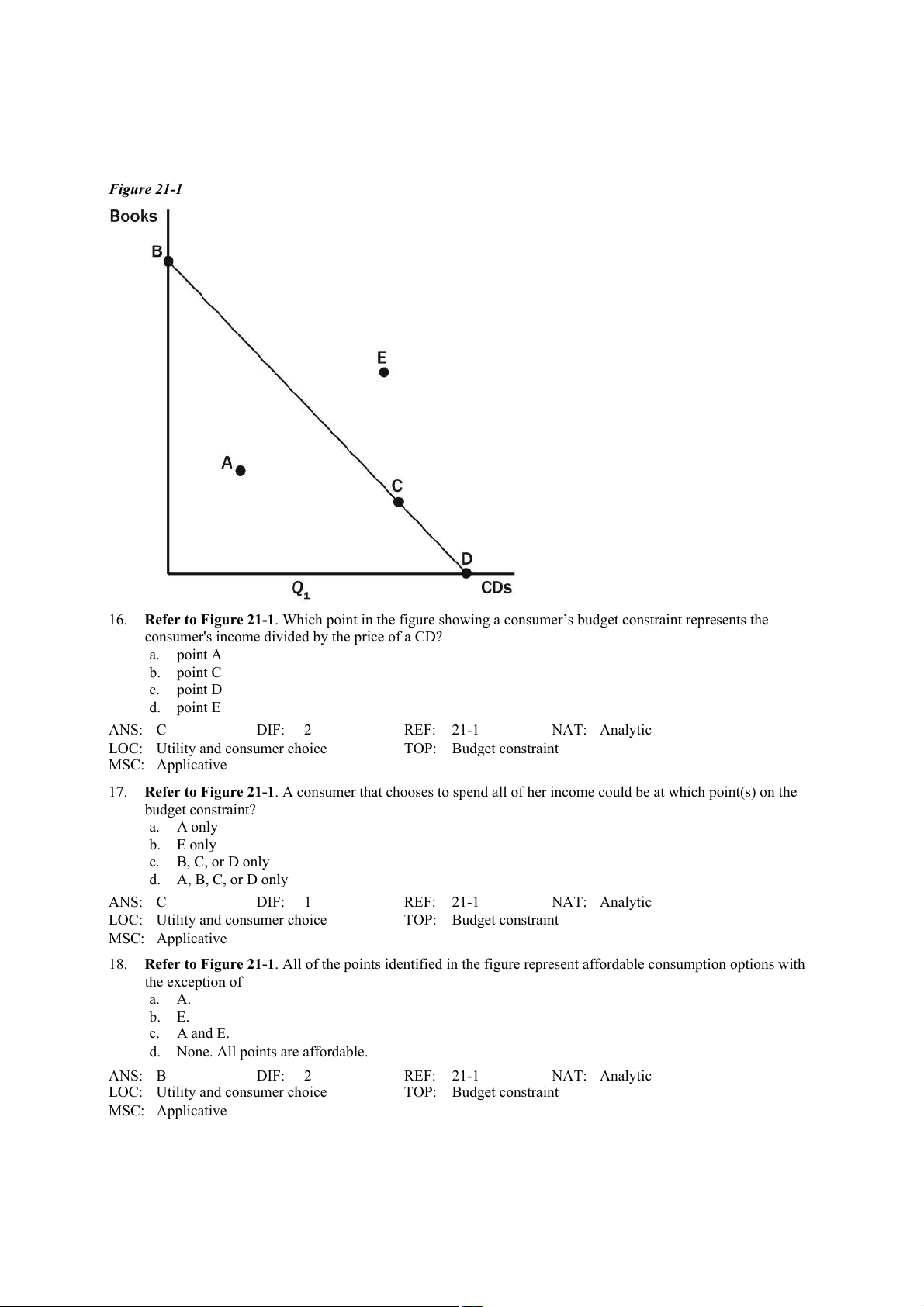
LOC: Utility and consumer choice TOP: Budget constraint MSC: Analytical Figure 21-1 16.
Refer to Figure 21-1. Which point in the figure showing a consumer’s budget constraint represents the
consumer's income divided by the price of a CD? a. point A b. point C c. point D d. point E ANS: C DIF: 2 REF: 21-1 NAT: Analytic
LOC: Utility and consumer choice TOP: Budget constraint MSC: Applicative 17.
Refer to Figure 21-1. A consumer that chooses to spend all of her income could be at which point(s) on the budget constraint? a. A only b. E only c. B, C, or D only d. A, B, C, or D only ANS: C DIF: 1 REF: 21-1 NAT: Analytic
LOC: Utility and consumer choice TOP: Budget constraint MSC: Applicative 18.
Refer to Figure 21-1. All of the points identified in the figure represent affordable consumption options with the exception of a. A. b. E. c. A and E. d.
None. All points are affordable. ANS: B DIF: 2 REF: 21-1 NAT: Analytic
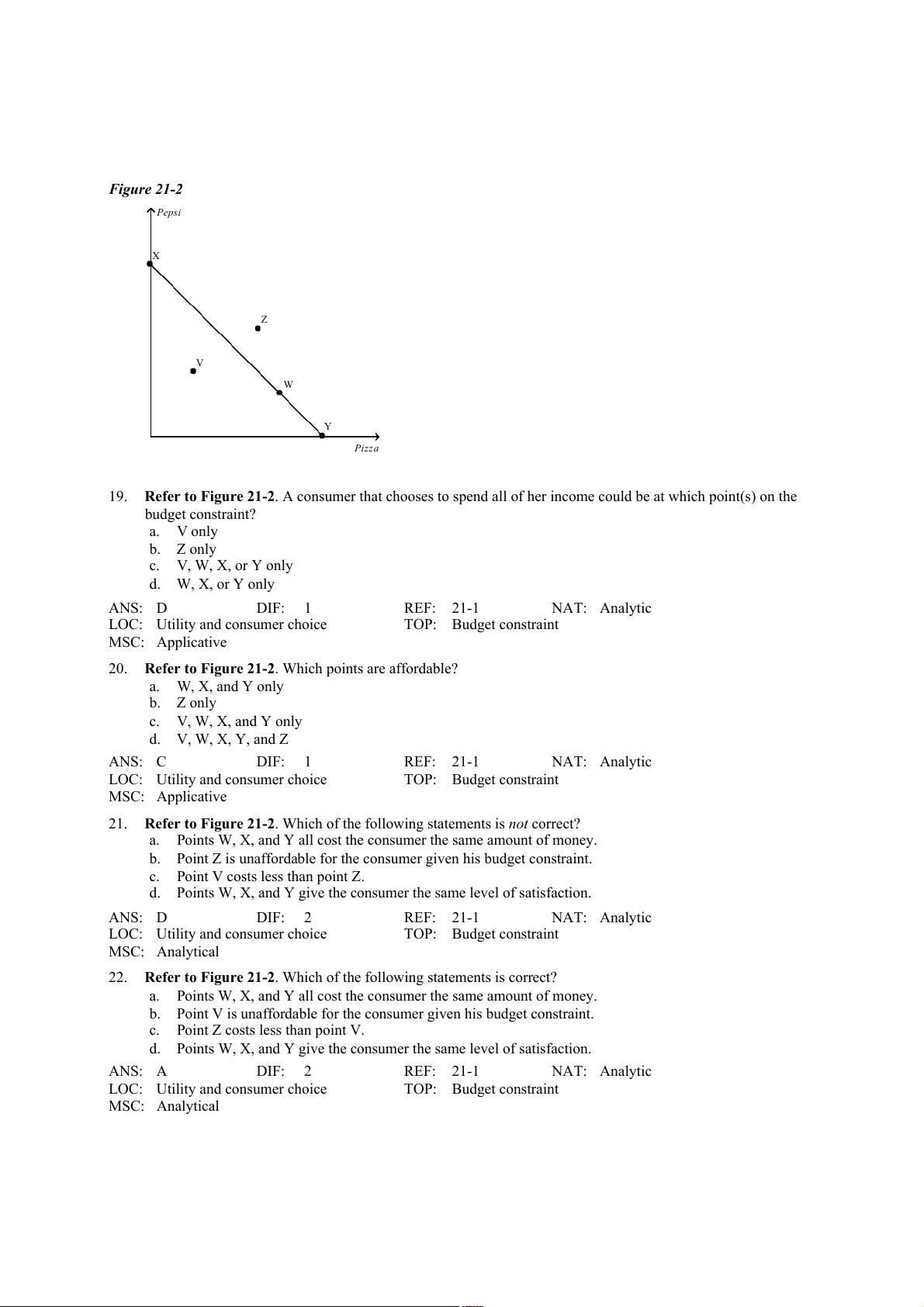
LOC: Utility and consumer choice TOP: Budget constraint MSC: Applicative Figure 21-2 Pepsi X Z V W Y Pizza 19.
Refer to Figure 21-2. A consumer that chooses to spend all of her income could be at which point(s) on the budget constraint? a. V only b. Z only c. V, W, X, or Y only d. W, X, or Y only ANS: D DIF: 1 REF: 21-1 NAT: Analytic
LOC: Utility and consumer choice TOP: Budget constraint MSC: Applicative 20.
Refer to Figure 21-2. Which points are affordable? a. W, X, and Y only b. Z only c. V, W, X, and Y only d. V, W, X, Y, and Z ANS: C DIF: 1 REF: 21-1 NAT: Analytic
LOC: Utility and consumer choice TOP: Budget constraint MSC: Applicative 21.
Refer to Figure 21-2. Which of the following statements is not correct? a.
Points W, X, and Y all cost the consumer the same amount of money. b.
Point Z is unaffordable for the consumer given his budget constraint. c.
Point V costs less than point Z. d.
Points W, X, and Y give the consumer the same level of satisfaction. ANS: D DIF: 2 REF: 21-1 NAT: Analytic
LOC: Utility and consumer choice TOP: Budget constraint MSC: Analytical 22.
Refer to Figure 21-2. Which of the following statements is correct? a.
Points W, X, and Y all cost the consumer the same amount of money. b.
Point V is unaffordable for the consumer given his budget constraint. c.
Point Z costs less than point V. d.
Points W, X, and Y give the consumer the same level of satisfaction. ANS: A DIF: 2 REF: 21-1 NAT: Analytic
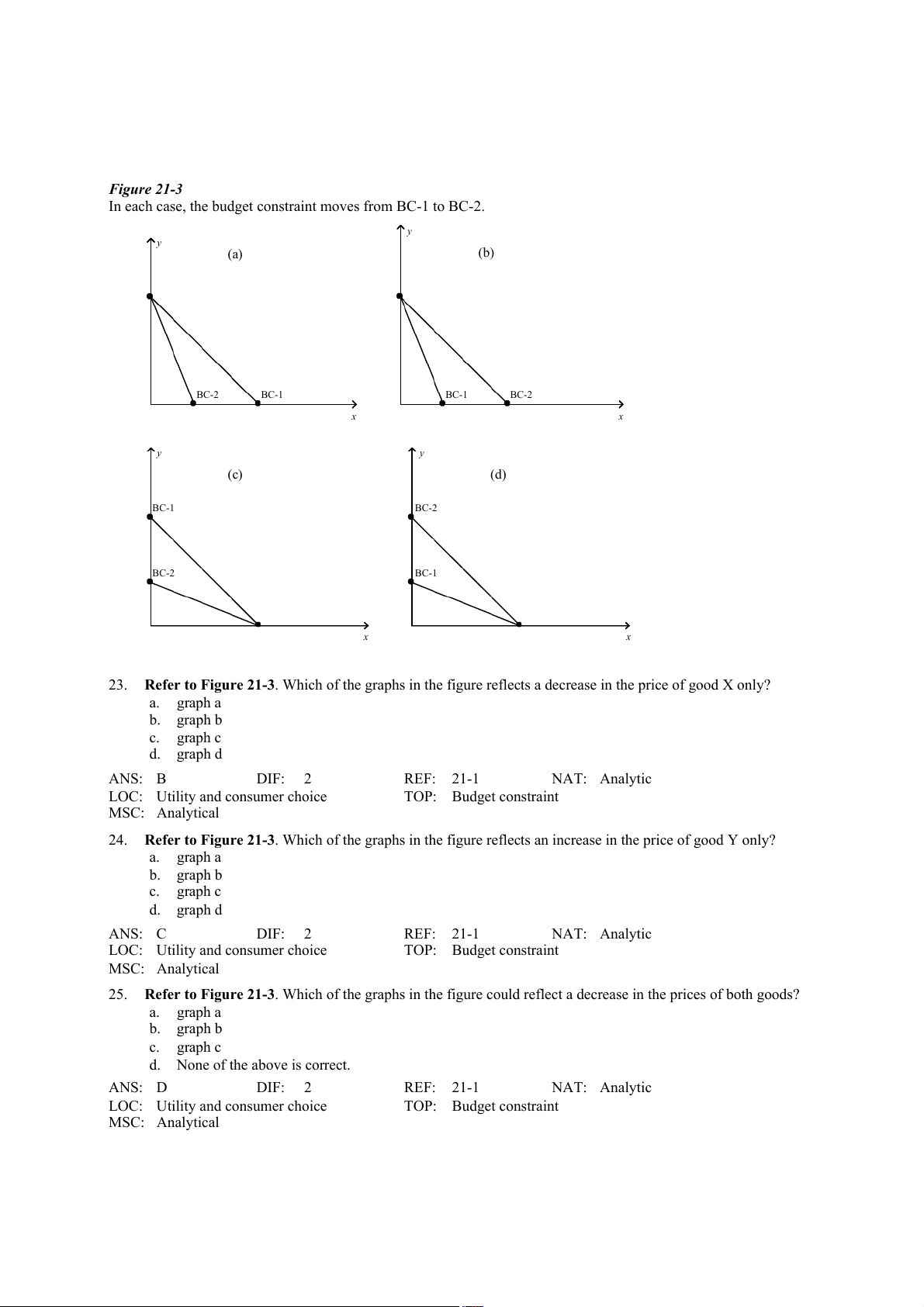
LOC: Utility and consumer choice TOP: Budget constraint MSC: Analytical Figure 21-3
In each case, the budget constraint moves from BC-1 to BC-2. y y (a) (b) BC-2 BC-1 BC-1 BC-2 x x y y (c) (d) BC-1 BC-2 BC-2 BC-1 x x 23.
Refer to Figure 21-3. Which of the graphs in the figure reflects a decrease in the price of good X only? a. graph a b. graph b c. graph c d. graph d ANS: B DIF: 2 REF: 21-1 NAT: Analytic
LOC: Utility and consumer choice TOP: Budget constraint MSC: Analytical 24.
Refer to Figure 21-3. Which of the graphs in the figure reflects an increase in the price of good Y only? a. graph a b. graph b c. graph c d. graph d ANS: C DIF: 2 REF: 21-1 NAT: Analytic
LOC: Utility and consumer choice TOP: Budget constraint MSC: Analytical 25.
Refer to Figure 21-3. Which of the graphs in the figure could reflect a decrease in the prices of both goods? a. graph a b. graph b c. graph c d. None of the above is correct. ANS: D DIF: 2 REF: 21-1 NAT: Analytic
LOC: Utility and consumer choice TOP: Budget constraint MSC: Analytical 26.
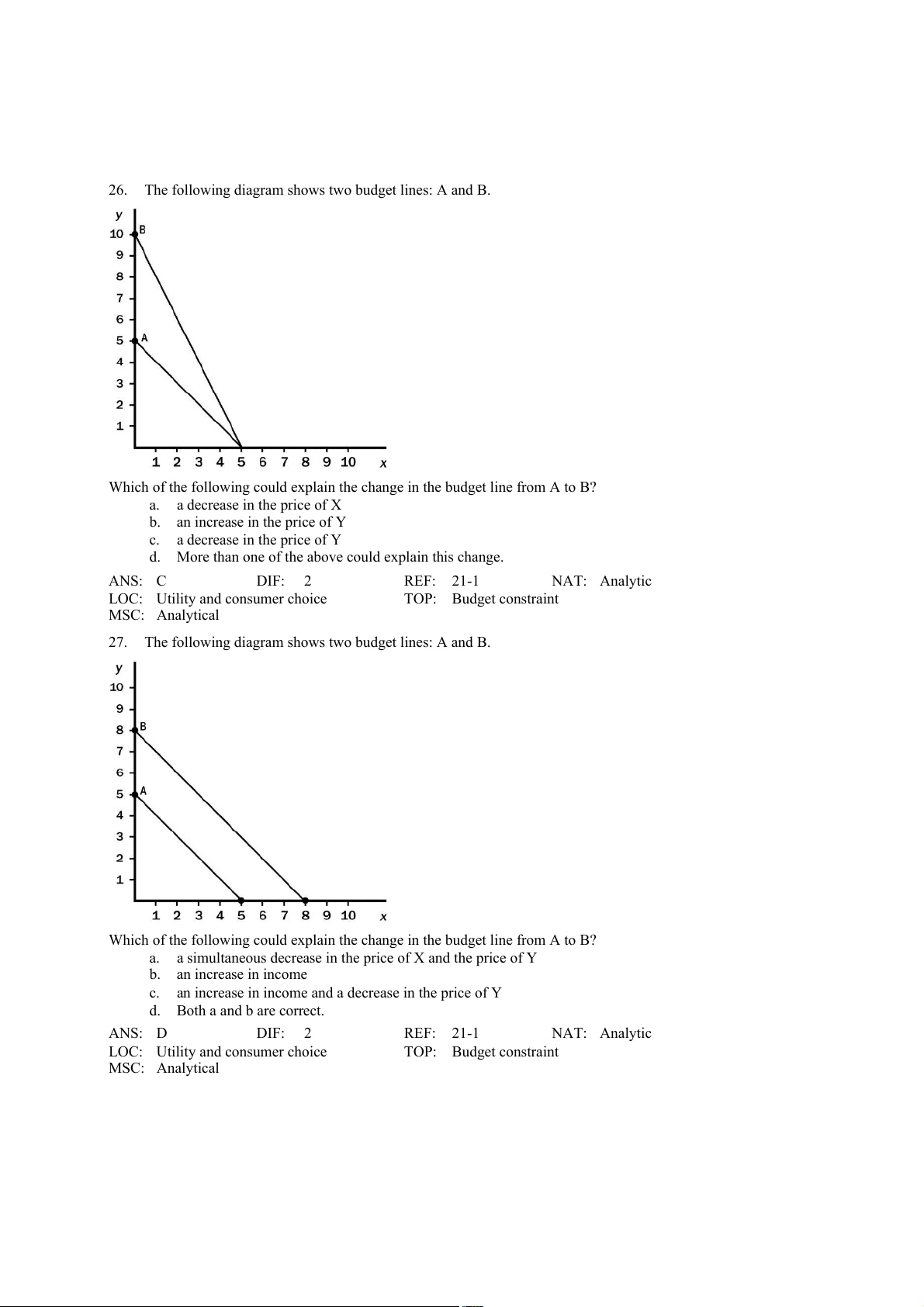
The following diagram shows two budget lines: A and B.
Which of the following could explain the change in the budget line from A to B? a. a decrease in the price of X b. an increase in the price of Y c. a decrease in the price of Y d.
More than one of the above could explain this change. ANS: C DIF: 2 REF: 21-1 NAT: Analytic
LOC: Utility and consumer choice TOP: Budget constraint MSC: Analytical 27.
The following diagram shows two budget lines: A and B.
Which of the following could explain the change in the budget line from A to B? a.
a simultaneous decrease in the price of X and the price of Y b. an increase in income c.
an increase in income and a decrease in the price of Y d. Both a and b are correct. ANS: D DIF: 2 REF: 21-1 NAT: Analytic
LOC: Utility and consumer choice TOP: Budget constraint MSC: Analytical 28.
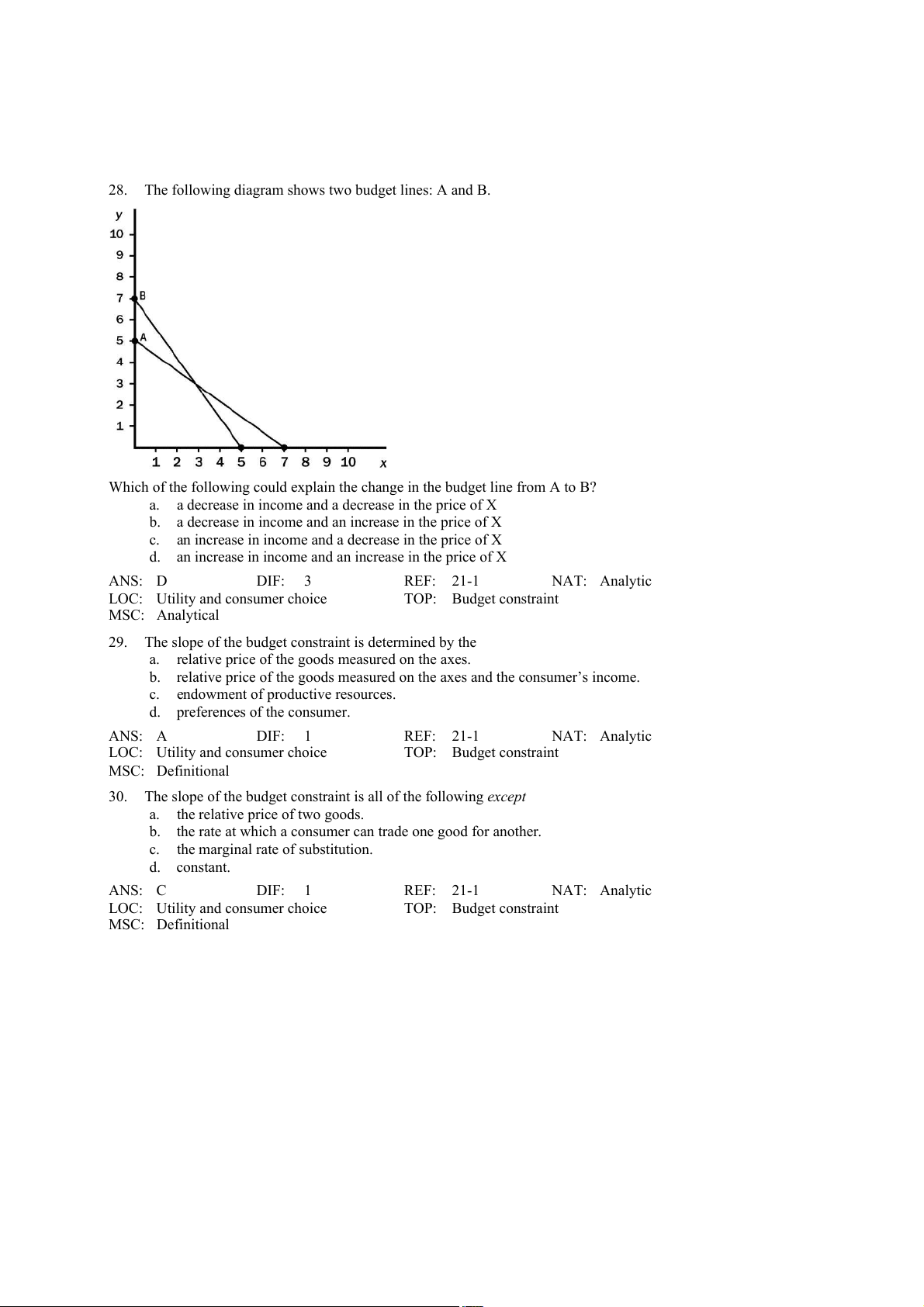
The following diagram shows two budget lines: A and B.
Which of the following could explain the change in the budget line from A to B? a.
a decrease in income and a decrease in the price of X b.
a decrease in income and an increase in the price of X c.
an increase in income and a decrease in the price of X d.
an increase in income and an increase in the price of X ANS: D DIF: 3 REF: 21-1 NAT: Analytic
LOC: Utility and consumer choice TOP: Budget constraint MSC: Analytical 29.
The slope of the budget constraint is determined by the a.
relative price of the goods measured on the axes. b.
relative price of the goods measured on the axes and the consumer’s income. c.
endowment of productive resources. d. preferences of the consumer. ANS: A DIF: 1 REF: 21-1 NAT: Analytic
LOC: Utility and consumer choice TOP: Budget constraint MSC: Definitional 30.
The slope of the budget constraint is all of the following except a.
the relative price of two goods. b.
the rate at which a consumer can trade one good for another. c.
the marginal rate of substitution. d. constant. ANS: C DIF: 1 REF: 21-1 NAT: Analytic
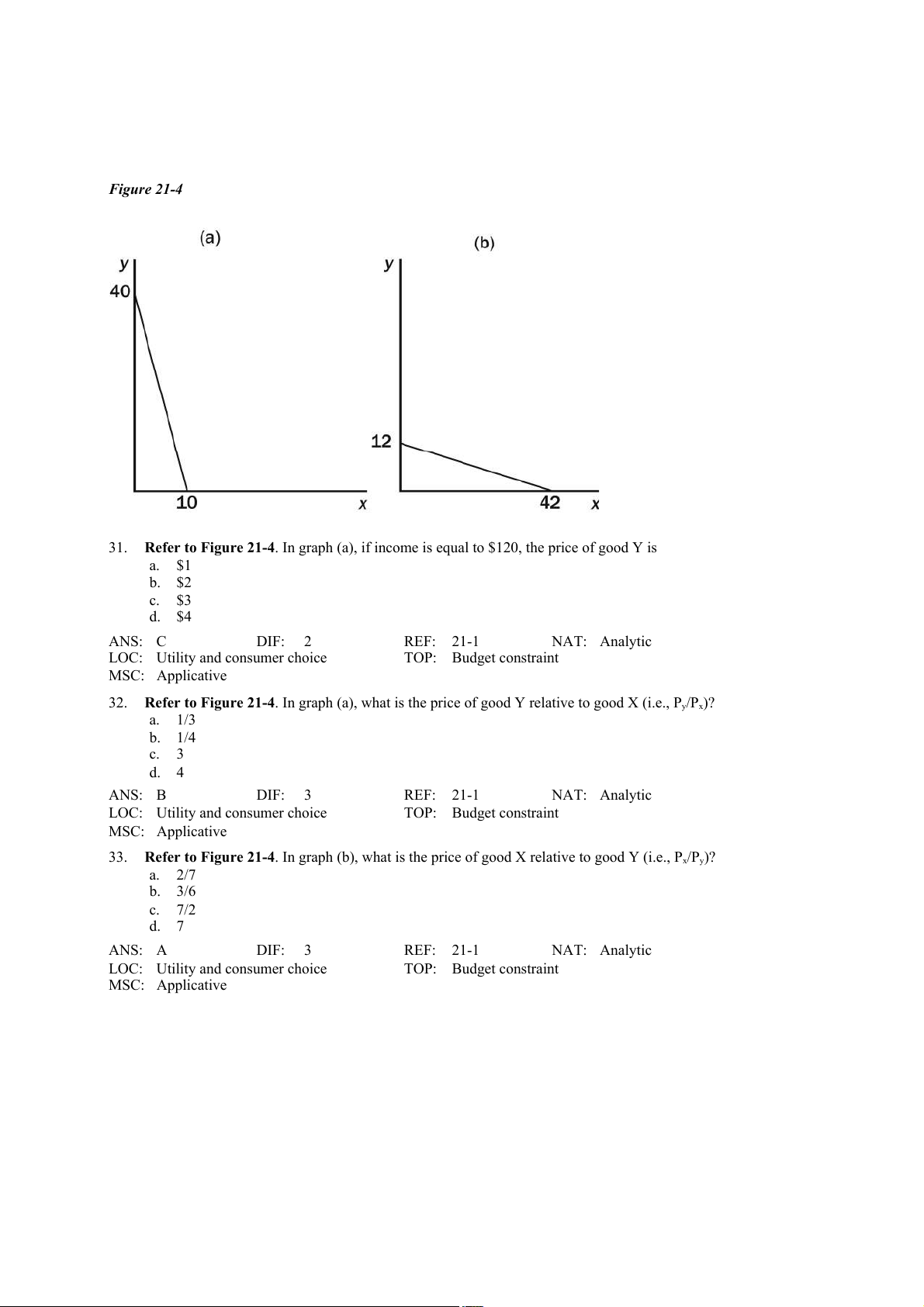
LOC: Utility and consumer choice TOP: Budget constraint MSC: Definitional Figure 21-4 31.
Refer to Figure 21-4. In graph (a), if income is equal to $120, the price of good Y is a. $1 b. $2 c. $3 d. $4 ANS: C DIF: 2 REF: 21-1 NAT: Analytic
LOC: Utility and consumer choice TOP: Budget constraint MSC: Applicative 32.
Refer to Figure 21-4. In graph (a), what is the price of good Y relative to good X (i.e., Py/Px)? a. 1/3 b. 1/4 c. 3 d. 4 ANS: B DIF: 3 REF: 21-1 NAT: Analytic
LOC: Utility and consumer choice TOP: Budget constraint MSC: Applicative 33.
Refer to Figure 21-4. In graph (b), what is the price of good X relative to good Y (i.e., Px/Py)? a. 2/7 b. 3/6 c. 7/2 d. 7 ANS: A DIF: 3 REF: 21-1 NAT: Analytic
LOC: Utility and consumer choice TOP: Budget constraint MSC: Applicative 34.
Refer to Figure 21-4. Assume that a consumer faces both budget constraints in graph (a) and graph (b) on two
different occasions. If her income has remained constant, what has happened to prices? a.
The price of X in graph (a) is higher than the price of X in graph (b). b.
The price of Y in graph (a) is higher than the price of Y in graph (b). c.
The prices of both X and Y are lower in graph (a). d. None of the above is true. ANS: A DIF: 3 REF: 21-1 NAT: Analytic
LOC: Utility and consumer choice TOP: Budget constraint MSC: Analytical 35.
Suppose a consumer spends her income on two goods: music CDs and DVDs. The consumer has $200 to
allocate to these two goods, the price of a CD is $10, and the price of a DVD is $20. What is the maximum
number of CDs the consumer can purchase? a. 10 b. 20 c. 40 d. 50 ANS: B DIF: 1 REF: 21-1 NAT: Analytic
LOC: Utility and consumer choice TOP: Budget constraint MSC: Applicative 36.
Suppose a consumer spends her income on two goods: iTunes music downloads and books. The consumer has
$100 to allocate to these two goods, the price of a downloaded song is $1, and the price of a book is $20.
What is the maximum number of books the consumer can purchase? a. 100 b. 20 c. 10 d. 5 ANS: D DIF: 1 REF: 21-1 NAT: Analytic
LOC: Utility and consumer choice TOP: Budget constraint MSC: Applicative 37.
Suppose a consumer spends her income on two goods: music CDs and DVDs. The price of a CD is $8, and the
price of a DVD is $20. If we graph the budget constraint by placing the quantity of CDs purchased on the
horizontal axis, what is the slope of the budget constraint? a. -5.0 b. -2.5 c. -0.4 d.
The slope of the budget constraint cannot be determined without knowing the income the consumer
has available to spend on the two goods. ANS: C DIF: 2 REF: 21-1 NAT: Analytic
LOC: Utility and consumer choice TOP: Budget constraint MSC: Applicative 38.
Suppose a consumer is currently spending all of her available income on two goods: music CDs and DVDs. If
the price of a CD is $9, the price of a DVD is $18, and she is currently consuming 10 CDs and 5 DVDs, what is the consumer's income? a. $90 b. $180 c. $270 d. $360 ANS: B DIF: 2 REF: 21-1 NAT: Analytic
LOC: Utility and consumer choice TOP: Budget constraint MSC: Applicative 39.
A consumer is currently spending all of her available income on two goods: music CDs and DVDs. At her
current consumption bundle she is spending twice as much on CDs as she is on DVDs. If the consumer has
$120 of income and is consuming 10 CDs and 2 DVDs, what is the price of a CD? a. $4 b. $8 c. $12 d. $20 ANS: B DIF: 3 REF: 21-1 NAT: Analytic
LOC: Utility and consumer choice TOP: Budget constraint MSC: Analytical 40.
The following diagram shows a budget constraint for a particular consumer.
If the price of X is $10, what is the price of Y? a. $15 b. $25 c. $35 d. $70 ANS: C DIF: 3 REF: 21-1 NAT: Analytic
LOC: Utility and consumer choice TOP: Budget constraint MSC: Analytical 41.
The following diagram shows a budget constraint for a particular consumer. y 40 30 20 10 10 20 30 40 50 60 70 80 90 x
If the price of X is $5, what is the price of Y? a. $2 b. $10 c. $30 d. $300 ANS: B DIF: 3 REF: 21-1 NAT: Analytic
LOC: Utility and consumer choice TOP: Budget constraint MSC: Analytical 42.
The following diagram shows a budget constraint for a particular consumer. y 40 30 20 10 10 20 30 40 50 60 70 80 90 x
If the price of X is $5, what is the consumer’s income? a. $2 b. $10 c. $30 d. $300 ANS: D DIF: 3 REF: 21-1 NAT: Analytic
LOC: Utility and consumer choice TOP: Budget constraint MSC: Analytical 43.
Budget constraints exist for consumers because a.
their utility from consuming goods eventually reaches a maximum level. b.
even with unlimited incomes they have to pay for each good they consume. c.
they have to pay for goods, and they have limited incomes. d.
prices and incomes are inversely related. ANS: C DIF: 2 REF: 21-1 NAT: Analytic
LOC: Utility and consumer choice TOP: Budget constraint MSC: Interpretive 44.
A family on a trip budgets $800 for meals and gasoline. If the price of a meal for the family is $50, how many
meals can the family buy if they do not buy any gasoline? a. 8 b. 16 c. 24 d. 32 ANS: B DIF: 2 REF: 21-1 NAT: Analytic
LOC: Utility and consumer choice TOP: Budget constraint MSC: Applicative 45.
A family on a trip budgets $800 for meals and hotel accommodations. Suppose the price of a meal is $40. In
addition, suppose the family could afford a total of 8 nights in a hotel if they don’t buy any meals. How many
meals could the family afford if they gave up two nights in the hotel? a. 1 b. 2 c. 5 d. 8 ANS: C DIF: 3 REF: 21-1 NAT: Analytic
LOC: Utility and consumer choice TOP: Budget constraint MSC: Applicative 46.
If the price of bread is zero, the budget constraint between bread (on the vertical axis) and cheese (on the horizontal axis) would a. be vertical. b.
coincide with the vertical axis. c.
coincide with the horizontal axis. d. be horizontal. ANS: A DIF: 3 REF: 21-1 NAT: Analytic
LOC: Utility and consumer choice TOP: Budget constraint MSC: Analytical Scenario 21-1
Suppose the price of hot wings is $10, the price of beer is $1, and the consumer’s income is $50. In addition,
suppose the consumer’s budget constraint illustrates hot wings on the horizontal axis and beer on the vertical axis. 47.
Refer to Scenario 21-1. If the price of beer doubles to $2, then the a.
budget constraint intersects the vertical axis at 25 beers. b.
slope of the budget constraint rises to -2. c.
budget constraint intersects the vertical axis at 100 beers. d.
budget constraint shifts inward in a parallel fashion. ANS: A DIF: 2 REF: 21-1 NAT: Analytic
LOC: Utility and consumer choice TOP: Budget constraint MSC: Applicative 48.
Refer to Scenario 21-1. If the consumer's income rises to $60, then the budget line for hot wings and beer would a.
now intersect the horizontal axis at 6 orders of hot wings and the vertical axis at 60 beers. b. not change. c.
now intersect the horizontal axis at 4 orders of hot wings and the vertical axis at 16 beers. d.
rotate outward along the beer axis. ANS: A DIF: 1 REF: 21-1 NAT: Analytic
LOC: Utility and consumer choice TOP: Budget constraint MSC: Applicative 49.
An increase in a consumer's income a.
increases the slope of the consumer's budget constraint. b.
has no effect on the slope of the consumer's budget constraint. c.
decreases the slope of the consumer's budget constraint. d.
has no effect on the consumer's budget constraint. ANS: B DIF: 2 REF: 21-1 NAT: Analytic
LOC: Utility and consumer choice TOP: Budget constraint MSC: Analytical 50.
A decrease in a consumer's income a.
increases the slope of the consumer's budget constraint. b.
has no effect on the consumer's budget constraint. c.
decreases the slope of the consumer's budget constraint. d.
has no effect on the slope of the consumer's budget constraint. ANS: D DIF: 2 REF: 21-1 NAT: Analytic
LOC: Utility and consumer choice TOP: Budget constraint MSC: Analytical 51.
Mark spends his weekly income on gin and cocktail olives. The price of gin has risen from $7 to $9 per bottle,
the price of cocktail olives has fallen from $6 to $5 per jar, and Mark's income has stayed fixed at $46 per
week. Since the price changes, Mark has been buying 4 bottles of gin and 2 jars of cocktail olives per week. At
the original prices, 4 bottles of gin and 2 jars of cocktail olives would have a. exactly exhausted his income. b. cost more than his income. c. cost less than his income. d.
could have maximized his satisfaction given his budget constraint. ANS: C DIF: 2 REF: 21-1 NAT: Analytic
LOC: Utility and consumer choice TOP: Budget constraint MSC: Applicative 52.
Mark spends his weekly income on gin and cocktail olives. The price of gin has risen from $7 to $9 per bottle,
the price of cocktail olives has fallen from $6 to $5 per jar, and Mark's income has stayed fixed at $46 per
week. If you illustrate gin on the vertical axis and cocktail olives on the horizontal axis, then the budget constraint a.
is steeper after the price changes. b.
is flatter after the price changes. c.
is the same after the price changes. d.
shifts in a parallel fashion to the old budget constraint after the price changes. ANS: B DIF: 2 REF: 21-1 NAT: Analytic
LOC: Utility and consumer choice TOP: Budget constraint MSC: Applicative 53.
Suppose the only two goods that Brett consumes are wine and cheese. When wine sells for $10 a bottle and
cheese sell for $10 a pound, he buys 6 bottles of wine and 4 pounds of cheese — spending his entire income of
$100. One day the price of wine falls to $5 a bottle and the price of cheese increases to $20 a pound, while his
income does not change. The bundle of wine and cheese that he purchased at the old prices now costs a.
the same amount at the new prices. b.
less than Brett's income at the new prices. c.
more than Brett's income at the new prices. d.
We do not have enough information to answer the question. ANS: C DIF: 1 REF: 21-1 NAT: Analytic
LOC: Utility and consumer choice TOP: Budget constraint MSC: Applicative 54.
Suppose the only two goods that Brett consumes are wine and cheese. When wine sells for $10 a bottle and
cheese sell for $10 a pound, he buys 6 bottles of wine and 4 pounds of cheese — spending his entire income of
$100. One day the price of wine falls to $5 a bottle, and the price of cheese increases to $20 a pound, while his
income does not change. If you illustrate wine on the vertical axis and cheese on the horizontal axis, then a.
the slope of Brett's budget has not changed. b.
the slope of Brett's budget constraint is flatter at the new prices. c.
the slope of Brett's budget constraint is steeper at the new prices. d.
Brett's budget constraint has shifted in a parallel fashion to the budget constraint with the old prices. ANS: C DIF: 2 REF: 21-1 NAT: Analytic
LOC: Utility and consumer choice TOP: Budget constraint MSC: Applicative 55.
If the relative price of a concert ticket is three times the price of a meal at a good restaurant, then the
opportunity cost of a concert ticket can be measured by the a.
slope of the budget constraint. b.
slope of an indifference curve. c. marginal rate of substitution. d. income effect. ANS: A DIF: 2 REF: 21-1 NAT: Analytic
LOC: Utility and consumer choice TOP: Budget constraint MSC: Analytical Figure 21-5 Mt. Dew B Popcorn A 56.
Refer to Figure 21-5. Suppose a consumer has $100 in income, the price of popcorn is $2, and the value of B
is 100. What is the price of Mt. Dew? a. $1 b. $2 c. $5 d. $100 ANS: A DIF: 2 REF: 21-1 NAT: Analytic
LOC: Utility and consumer choice TOP: Budget constraint MSC: Analytical 57.
Refer to Figure 21-5. Suppose a consumer has $200 in income, the price of popcorn is $1, and the price of
Mt. Dew is $2. What is the value of A? a. 200 b. 100 c. 50 d. 25 ANS: A DIF: 2 REF: 21-1 NAT: Analytic
LOC: Utility and consumer choice TOP: Budget constraint MSC: Analytical 58.
Refer to Figure 21-5. Suppose the price of popcorn is $2, the price of Mt. Dew is $4, the value of A is 30,
and the value of B is 15. How much income does the consumer have? a. $120 b. $80 c. $60 d. $30 ANS: C DIF: 2 REF: 21-1 NAT: Analytic
LOC: Utility and consumer choice TOP: Budget constraint MSC: Analytical Figure 21-6 DVDs B Books A 59.
Refer to Figure 21-6. Suppose a consumer has $500 in income, the price of a book is $10, and the value of B
is 50. What is the price of a DVD? a. $5 b. $10 c. $50 d. $100 ANS: B DIF: 2 REF: 21-1 NAT: Analytic
LOC: Utility and consumer choice TOP: Budget constraint MSC: Analytical 60.
Refer to Figure 21-6. Suppose a consumer has $200 in income, the price of a book is $5, and the price of a
DVD is $10. What is the value of A? a. 40 b. 20 c. 10 d. 2 ANS: A DIF: 2 REF: 21-1 NAT: Analytic
LOC: Utility and consumer choice TOP: Budget constraint MSC: Analytical 61.
Refer to Figure 21-6. Suppose the price of a book is $15, the price of a DVD is $10, the value of A is 5, and
the value of B is 7.5. How much income does the consumer have? a. $150 b. $100 c. $75 d. $37.50 ANS: C DIF: 2 REF: 21-1 NAT: Analytic
LOC: Utility and consumer choice TOP: Budget constraint MSC: Analytical 8.
Which of the following equations corresponds to an optimal choice point? (i) MRS = PX/PY (ii) MUX/MUY = PX/PY (iii) MUX/PX = MUY/PY (iv) MUX/PY = MUY/PX a. (i) only b. (i), (ii), and (iii) only c. (ii) and (iv) only d. (i), (ii), (iii), and (iv) ANS: B DIF: 2 REF: 21-3 NAT: Analytic
LOC: Utility and consumer choice TOP: Optimization MSC: Analytical 12.
The relationship between the marginal utility that Wendy gets from eating hamburgers and the number of
hamburgers she eats per month is as follows: Hamburgers 1 2 3 4 5 6 Marginal Utility 20 16 12 8 4 0
Wendy receives 3 units of utility from the last dollar spent on each of the other goods she consumes. If hamburgers
cost $4 each, how many hamburgers will she consume per month if she maximizes utility? a. 2 b. 3 c. 4 d. 5 ANS: B DIF: 3 REF: 21-3 NAT: Analytic
LOC: Utility and consumer choice TOP: Optimization MSC: Applicative
Tài liệu liên quan:
-
Chương 3: độ co giãn và các nhân tố ảnh hưởng | Microeconomics | Trường Đại học Quốc tế, Đại học Quốc gia Thành phố Hồ Chí Minh
6 3 -
Microeconomics Syllabus | Microeconomics | Trường Đại học Quốc tế, Đại học Quốc gia Thành phố Hồ Chí Minh
5 3 -
Microeconomics Course Syllabus & Assessment Details | Microeconomics | Trường Đại học Quốc tế, Đại học Quốc gia Thành phố Hồ Chí Minh
5 3 -
Assignment 3 - Elasticity MCQs and Key Concepts | Microeconomics | Trường Đại học Quốc tế, Đại học Quốc gia Thành phố Hồ Chí Minh
5 3 -
Assignment 2 - Economic Equilibrium Analysis of Fridges and Motorcycles | Microeconomics | Trường Đại học Quốc tế, Đại học Quốc gia Thành phố Hồ Chí Minh
6 3