Solutions to Chapter 1 & 2 Text Problems | Microeconomics | Trường Đại học Quốc tế, Đại học Quốc gia Thành phố Hồ Chí Minh
The four principles of economic decisionmaking are: (1) people face tradeoffs; (2) the cost of something is what you give up to get it; (3) rational people think at the margin; and (4) people respond to incentives. People face tradeoffs because to get one thing that they like, they usually have to give up another thing that they like. The cost of something is what you give up to get it, not just in terms of monetary costs but all opportunity costs. Rational people think at the margin by taking an action if and only if the marginal benefits exceed the marginal costs. Tài liệu được sưu tầm và soạn thảo dưới dạng file PDF để gửi tới các bạn cùng tham khảo, ôn tập đầy đủ kiến thức, chuẩn bị cho các buổi học thật tốt. Mời bạn đọc đón xem!
Môn: Microeconomics 635 tài liệu
Trường: Trường Đại học Quốc tế, Đại học Quốc gia Thành phố Hồ Chí Minh 1.9 K tài liệu
Tác giả:

Preview text:
ECON !)! Chapter 1
SOLUTIONS TO TEXT PROBLEMS: Quick Quizzes 1.
The four principles of economic decisionmaking are: (1) people face tradeoffs; (2) the
cost of something is what you give up to get it; (3) rational people think at the margin;
and (4) people respond to incentives. People face tradeoffs because to get one thing that
they like, they usually have to give up another thing that they like. The cost of something
is what you give up to get it, not just in terms of monetary costs but all opportunity costs.
Rational people think at the margin by taking an action if and only if the marginal
benefits exceed the marginal costs. People respond to incentives because as they
compare benefits to costs, a change in incentives may cause their behavior to change. 2.
The three principles concerning economic interactions are: (1) trade can make everyone
better off; (2) markets are usually a good way to organize economic activity; and (3)
governments can sometimes improve market outcomes. Trade can make everyone better
off because it allows countries to specialize in what they do best and to enjoy a wider
variety of goods and services. Markets are usually a good way to organize economic
activity because the invisible hand leads markets to desirable outcomes. Governments
can sometimes improve market outcomes because sometimes markets fail to allocate
resources efficiently because of an externality or market power. 3.
The three principles that describe how the economy as a whole works are: (1) a country’s
standard of living depends on its ability to produce goods and services; (2) prices rise
when the government prints too much money; and (3) society faces a short-run tradeoff
between inflation and unemployment. A country’s standard of living depends on its
ability to produce goods and services, which in turn depends on its productivity, which is
a function of the education of workers and the access workers have to the necessary tools
and technology. Prices rise when the government prints too much money because more
money in circulation reduces the value of money, causing inflation. Society faces a
short-run tradeoff between inflation and unemployment that is only temporary and
policymakers have some ability to exploit this relationship using various policy instruments. Questions for Review 1.
Examples of tradeoffs include time tradeoffs (such as studying one subject over another,
or studying at all compared to engaging in social activities) and spending tradeoffs (such
as whether to use your last ten dollars on pizza or on a study guide for that tough economics course). 2.
The opportunity cost of seeing a movie includes the monetary cost of admission plus the 1
Chapter 1/Ten Principles of Economics 2
time cost of going to the theater and attending the show. The time cost depends on what
else you might do with that time; if it's staying home and watching TV, the time cost may
be small, but if it's working an extra three hours at your job, the time cost is the money you could have earned. 3.
The marginal benefit of a glass of water depends on your circumstances. If you've just
run a marathon, or you've been walking in the desert sun for three hours, the marginal
benefit is very high. But if you've been drinking a lot of liquids recently, the marginal
benefit is quite low. The point is that even the necessities of life, like water, don't always have large marginal benefits. 4.
Policymakers need to think about incentives so they can understand how people will
respond to the policies they put in place. The text's example of seat belts shows that
policy actions can have quite unintended consequences. If incentives matter a lot, they
may lead to a very different type of policy; for example, some economists have suggested
putting knives in steering columns so that people will drive much more carefully! While
this suggestion is silly, it highlights the importance of incentives. 5.
Trade among countries isn't a game with some losers and some winners because trade can
make everyone better off. By allowing specialization, trade between people and trade
between countries can improve everyone's welfare. 6.
The "invisible hand" of the marketplace represents the idea that even though individuals
and firms are all acting in their own self-interest, prices and the marketplace guide them
to do what is good for society as a whole. 7.
The two main causes of market failure are externalities and market power. An externality
is the impact of one person’s actions on the well-being of a bystander, such as from
pollution or the creation of knowledge. Market power refers to the ability of a single
person (or small group of people) to unduly influence market prices, such as in a town
with only one well or only one cable television company. In addition, a market economy
also leads to an unequal distribution of income. 8.
Productivity is important because a country's standard of living depends on its ability to
produce goods and services. The greater a country's productivity (the amount of goods
and services produced from each hour of a worker's time), the greater will be its standard of living. 9.
Inflation is an increase in the overall level of prices in the economy. Inflation is caused
by increases in the quantity of a nation's money. 10.
Inflation and unemployment are negatively related in the short run. Reducing inflation
entails costs to society in the form of higher unemployment in the short run.
Chapter 1/Ten Principles of Economics 3
Problems and Applications 1. a.
A family deciding whether to buy a new car faces a tradeoff between the cost of
the car and other things they might want to buy. For example, buying the car
might mean they must give up going on vacation for the next two years. So the
real cost of the car is the family's opportunity cost in terms of what they must give up. b.
For a member of Congress deciding whether to increase spending on national
parks, the tradeoff is between parks and other spending items or tax cuts. If more
money goes into the park system, that may mean less spending on national
defense or on the police force. Or, instead of spending more money on the park
system, taxes could be reduced. c.
When a company president decides whether to open a new factory, the decision is
based on whether the new factory will increase the firm's profits compared to
other alternatives. For example, the company could upgrade existing equipment
or expand existing factories. The bottom line is: Which method of expanding
production will increase profit the most? d.
In deciding how much to prepare for class, a professor faces a tradeoff between
the value of improving the quality of the lecture compared to other things she
could do with her time, such as working on additional research. 2.
When the benefits of something are psychological, such as going on a vacation, it isn't
easy to compare benefits to costs to determine if it's worth doing. But there are two ways
to think about the benefits. One is to compare the vacation with what you would do in its
place. If you didn't go on vacation, would you buy something like a new set of golf
clubs? Then you can decide if you'd rather have the new clubs or the vacation. A second
way is to think about how much work you had to do to earn the money to pay for the
vacation; then you can decide if the psychological benefits of the vacation were worth the psychological cost of working. 3.
If you are thinking of going skiing instead of working at your part-time job, the cost of
skiing includes its monetary and time costs, which includes the opportunity cost of the
wages you are giving up by not working. If the choice is between skiing and going to the
library to study, then the cost of skiing is its monetary and time costs including the cost to
you of getting a lower grade in your course. 4.
If you spend $100 now instead of saving it for a year and earning 5 percent interest, you
are giving up the opportunity to spend $105 a year from now. The idea that money has a
time value is the basis for the field of finance, the subfield of economics that has to do
with prices of financial instruments like stocks and bonds. 5.
The fact that you've already sunk $5 million isn't relevant to your decision anymore, since
that money is gone. What matters now is the chance to earn profits at the margin. If you
Chapter 1/Ten Principles of Economics 4
spend another $1 million and can generate sales of $3 million, you'll earn $2 million in
marginal profit, so you should do so. You are right to think that the project has lost a
total of $3 million ($6 million in costs and only $3 million in revenue) and you shouldn't
have started it. That's true, but if you don't spend the additional $1 million, you won't
have any sales and your losses will be $5 million. So what matters is not the total profit,
but the profit you can earn at the margin. In fact, you'd pay up to $3 million to complete
development; any more than that, and you won't be increasing profit at the margin. 6.
Harry suggests looking at whether productivity would rise or fall. Productivity is
certainly important, since the more productive workers are, the lower the cost per gallon
of potion. Ron wants to look at average cost. But both Harry and Ron are missing the
other side of the equation revenue. A firm wants to maximi
ze its profits, so it needs to examine both costs
revenues. Thus, Hermione is right and
it’s best to examine whether
the extra revenue would exceed the extra costs. Hermione is the only one who is thinking at the margin. 7. a.
The provision of Social Security benefits lowers an individual’s incentive to save
for retirement. The benefits provide some level of income to the individual when
he or she retires. This means that the individual is not entirely dependent on
savings to support consumption through the years in retirement. b.
Since a person gets fewer after-tax Social Security benefits the greater is his or
her earnings, there is an incentive not to work (or not work as much) after age 65.
The more you work, the lower your after-tax Social Security benefits will be.
Thus the taxation of Social Security benefits discourages work effort after age 65. 8. a.
When welfare recipients who are able to work have their benefits cut off after two
years, they have greater incentive to find jobs than if their benefits were to last forever. b.
The loss of benefits means that someone who can't find a job will get no income
at all, so the distribution of income will become less equal. But the economy will
be more efficient, since welfare recipients have a greater incentive to find jobs.
Thus the change in the law is one that increases efficiency but reduces equity. 9.
By specializing in each task, you and your roommate can finish the chores more quickly.
If you divided each task equally, it would take you more time to cook than it would take
your roommate, and it would take him more time to clean than it would take you. By
specializing, you reduce the total time spent on chores.
Similarly, countries can specialize and trade, making both better off. For example,
suppose it takes Spanish workers less time to make clothes than French workers, and
French workers can make wine more efficiently than Spanish workers. Then Spain and
France can both benefit if Spanish workers produce all the clothes and French workers
produce all the wine, and they exchange some wine for some clothes.
Chapter 1/Ten Principles of Economics 5 10. a.
Being a central planner is tough! To produce the right number of CDs by the
right artists and deliver them to the right people requires an enormous amount of
information. You need to know about production techniques and costs in the CD
industry. You need to know each person's musical tastes and which artists they
want to hear. If you make the wrong decisions, you'll be producing too many
CDs by artists that people don't want to hear, and not enough by others. b.
Your decisions about how many CDs to produce carry over to other decisions.
You have to make the right number of CD players for people to use. If you make
too many CDs and not enough cassette tapes, people with cassette players will be
stuck with CDs they can't play. The probability of making mistakes is very high.
You will also be faced with tough choices about the music industry compared to
other parts of the economy. If you produce more sports equipment, you'll have
fewer resources for making CDs. So all decisions about the economy influence
your decisions about CD production. 11. a.
Efficiency: The market failure comes from the monopoly by the cable TV firm. b. Equity c.
Efficiency: An externality arises because secondhand smoke harms nonsmokers. d.
Efficiency: The market failure occurs because of Standard Oil's monopoly power. e. Equity f.
Efficiency: There is an externality because of accidents caused by drunk drivers. 12. a.
If everyone were guaranteed the best health care possible, much more of our
nation's output would be devoted to medical care than is now the case. Would
that be efficient? If you think that currently doctors form a monopoly and restrict
health care to keep their incomes high, you might think efficiency would increase
by providing more health care. But more likely, if the government mandated
increased spending on health care, the economy would be less efficient because it
would give people more health care than they would choose to pay for. From the
point of view of equity, if poor people are less likely to have adequate health care,
providing more health care would represent an improvement. Each person would
have a more even slice of the economic pie, though the pie would consist of more
health care and less of other goods. b.
When workers are laid off, equity considerations argue for the unemployment
benefits system to provide them with some income until they can find new jobs.
After all, no one plans to be laid off, so unemployment benefits are a form of
insurance. But there’s an efficiency problem why work if you can get income
for doing nothing? The economy isn’t operating efficiently if people remain
unemployed for a long time, and unemployment benefits encourage
unemployment. Thus, there’s a tradeoff between equity and efficiency. The more
generous are unemployment benefits, the less income is lost by an unemployed
person, but the more that person is encouraged to remain unemployed. So greater equity reduces efficiency.
Chapter 1/Ten Principles of Economics 6 13.
Since average income in the United States has roughly doubled every 35 years, we are
likely to have a better standard of living than our parents, and a much better standard of
living than our grandparents. This is mainly the result of increased productivity, so that
an hour of work produces more goods and services than it used to. Thus incomes have
continuously risen over time, as has the standard of living. 14.
If Americans save more and it leads to more spending on factories, there will be an
increase in production and productivity, since the same number of workers will have
more equipment to work with. The benefits from higher productivity will go to both the
workers, who will get paid more since they're producing more, and the factory owners,
who will get a return on their investments. There is no such thing as a free lunch,
however, because when people save more, they are giving up spending. They get higher
incomes at the cost of buying fewer goods. 15. a.
If people have more money, they are probably going to spend more on goods and services. b.
If prices are sticky, and people spend more on goods and services, then output
may increase, as producers increase output to meet the higher demand rather than raising prices. c.
If prices can adjust, then the higher spending of consumers will be matched with
increased prices and output won't rise. 16.
To make an intelligent decision about whether to reduce inflation, a policymaker would
need to know what causes inflation and unemployment, as well as what determines the
tradeoff between them. Any attempt to reduce inflation will likely lead to higher
unemployment in the short run. A policymaker thus faces a tradeoff between the benefits
of lower inflation compared to the cost of higher unemployment.
Chapter 1/Ten Principles of Economics 7 Chapter 2
SOLUTIONS TO TEXT PROBLEMS: Quick Quizzes 1.
Economics is like a science because economists devise theories, collect data, and analyze
the data in an attempt to verify or refute their theories. In other words, economics is
based on the scientific method.
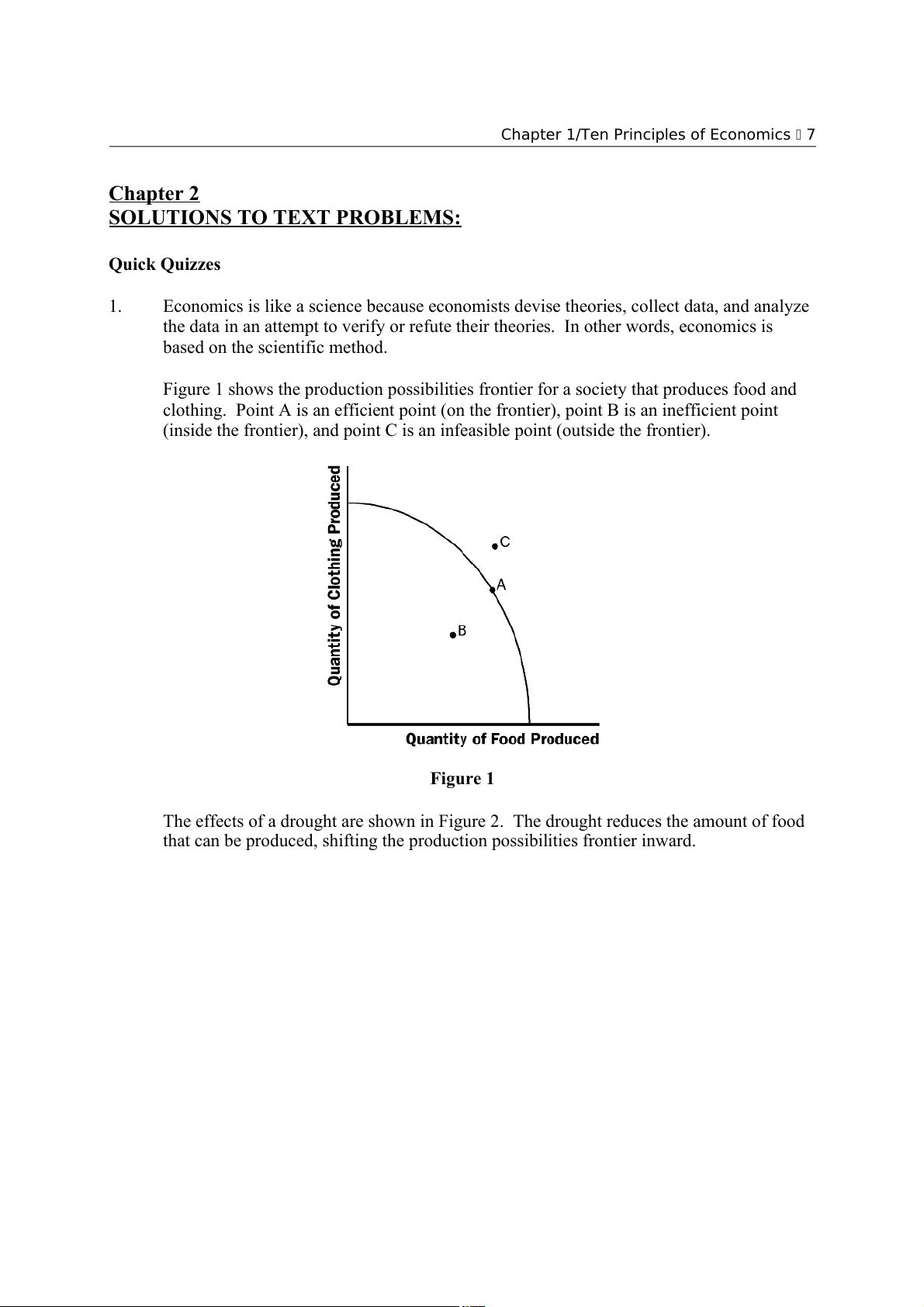
Figure 1 shows the production possibilities frontier for a society that produces food and
clothing. Point A is an efficient point (on the frontier), point B is an inefficient point
(inside the frontier), and point C is an infeasible point (outside the frontier). Figure 1
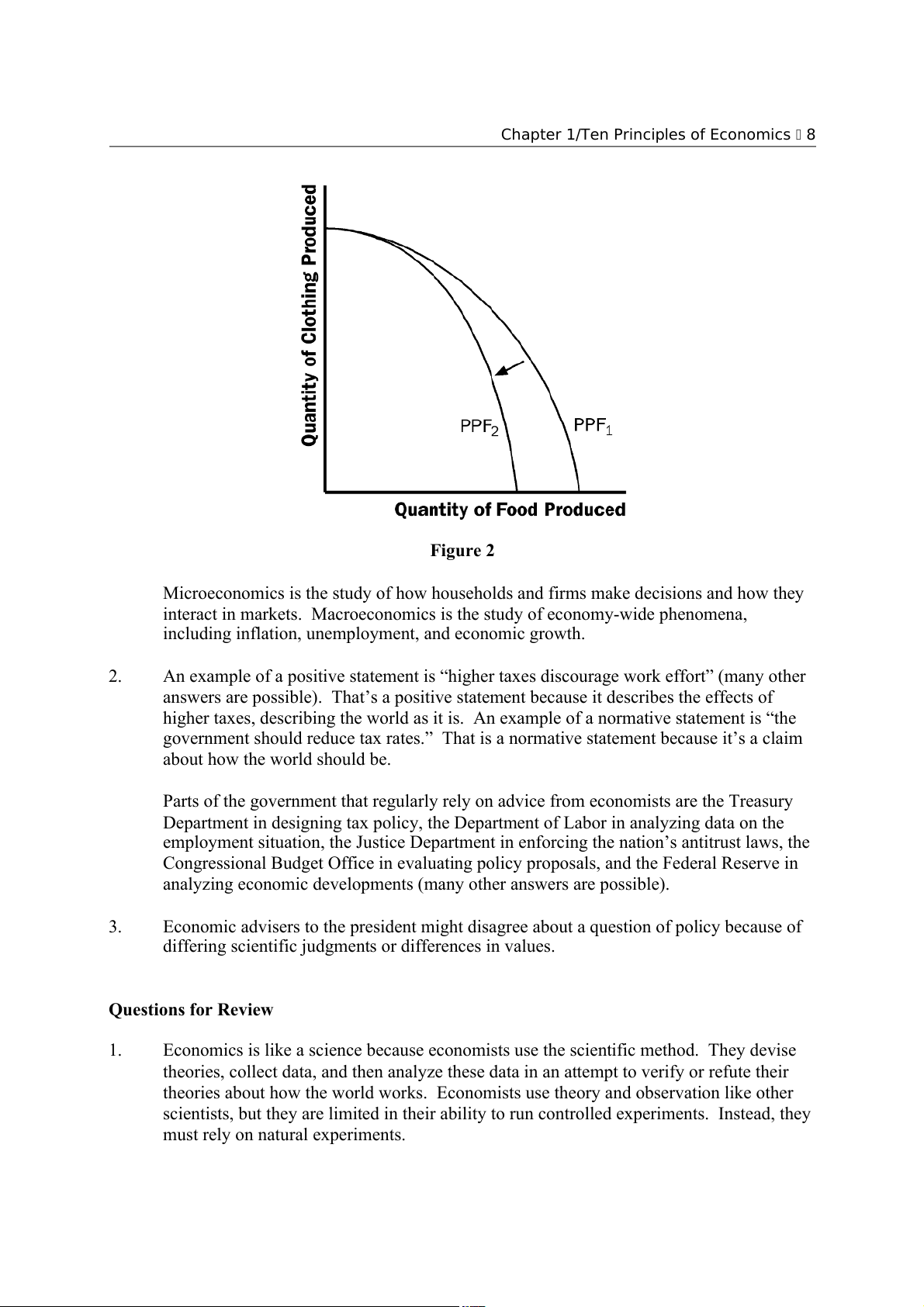
The effects of a drought are shown in Figure 2. The drought reduces the amount of food
that can be produced, shifting the production possibilities frontier inward.
Chapter 1/Ten Principles of Economics 8 Figure 2
Microeconomics is the study of how households and firms make decisions and how they
interact in markets. Macroeconomics is the study of economy-wide phenomena,
including inflation, unemployment, and economic growth. 2.
An example of a positive statement is “higher taxes discourage work effort” (many other
answers are possible). That’s a positive statement because it describes the effects of
higher taxes, describing the world as it is. An example of a normative statement is “the
government should reduce tax rates.” That is a normative statement because it’s a claim about how the world should be.
Parts of the government that regularly rely on advice from economists are the Treasury
Department in designing tax policy, the Department of Labor in analyzing data on the
employment situation, the Justice Department in enforcing the nation’s antitrust laws, the
Congressional Budget Office in evaluating policy proposals, and the Federal Reserve in
analyzing economic developments (many other answers are possible). 3.
Economic advisers to the president might disagree about a question of policy because of
differing scientific judgments or differences in values. Questions for Review 1.
Economics is like a science because economists use the scientific method. They devise
theories, collect data, and then analyze these data in an attempt to verify or refute their
theories about how the world works. Economists use theory and observation like other
scientists, but they are limited in their ability to run controlled experiments. Instead, they
must rely on natural experiments.
Chapter 1/Ten Principles of Economics 9 2.
Economists make assumptions to simplify problems without substantially affecting the
answer. Assumptions can make the world easier to understand. 3.
An economic model cannot describe reality exactly because it would be too complicated
to understand. A model is a simplification that allows the economist to see what is truly important. 4.
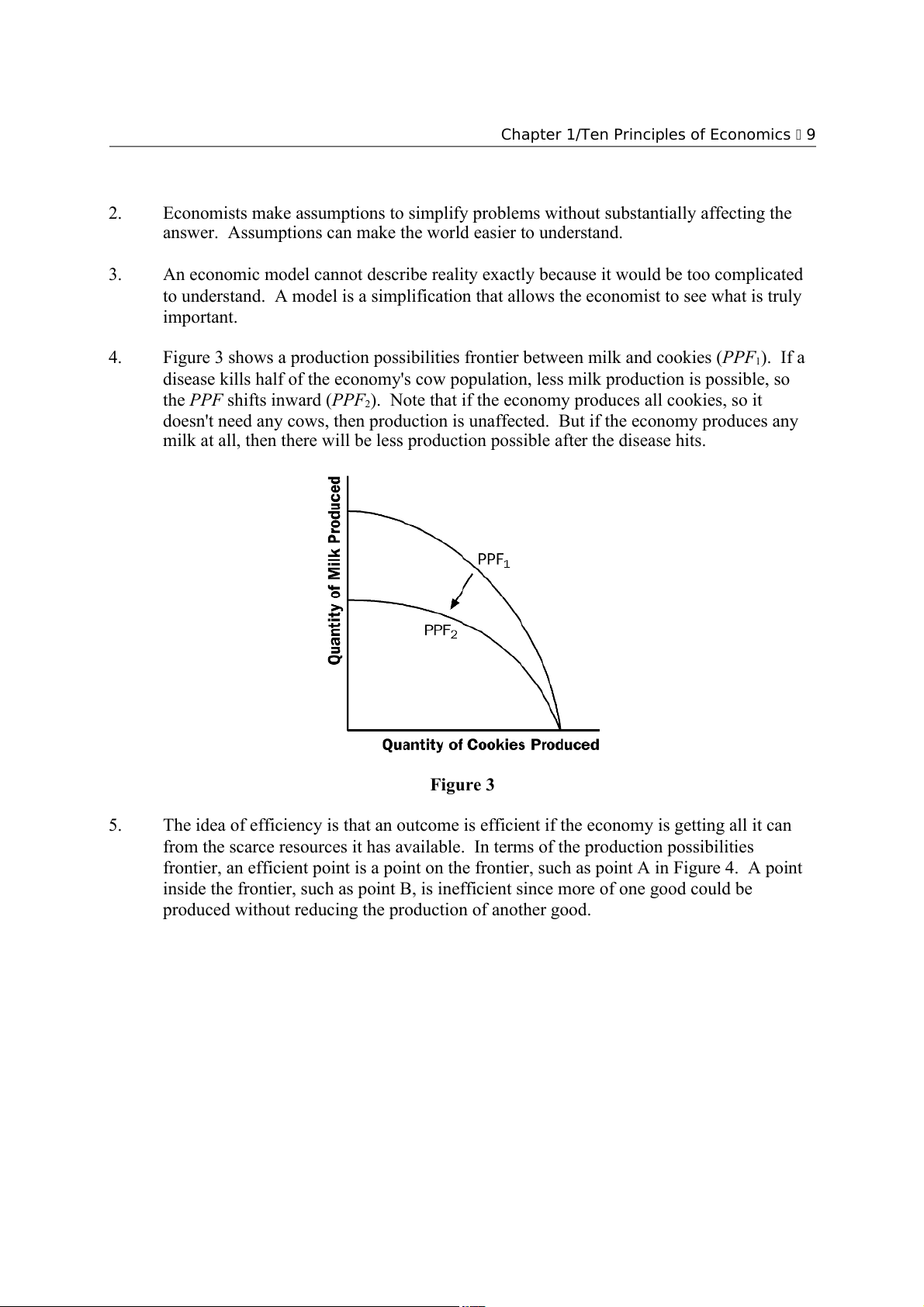
Figure 3 shows a production possibilities frontier between milk and cookies (PPF1). If a
disease kills half of the economy's cow population, less milk production is possible, so
the PPF shifts inward (PPF2). Note that if the economy produces all cookies, so it
doesn't need any cows, then production is unaffected. But if the economy produces any
milk at all, then there will be less production possible after the disease hits. Figure 3 5.
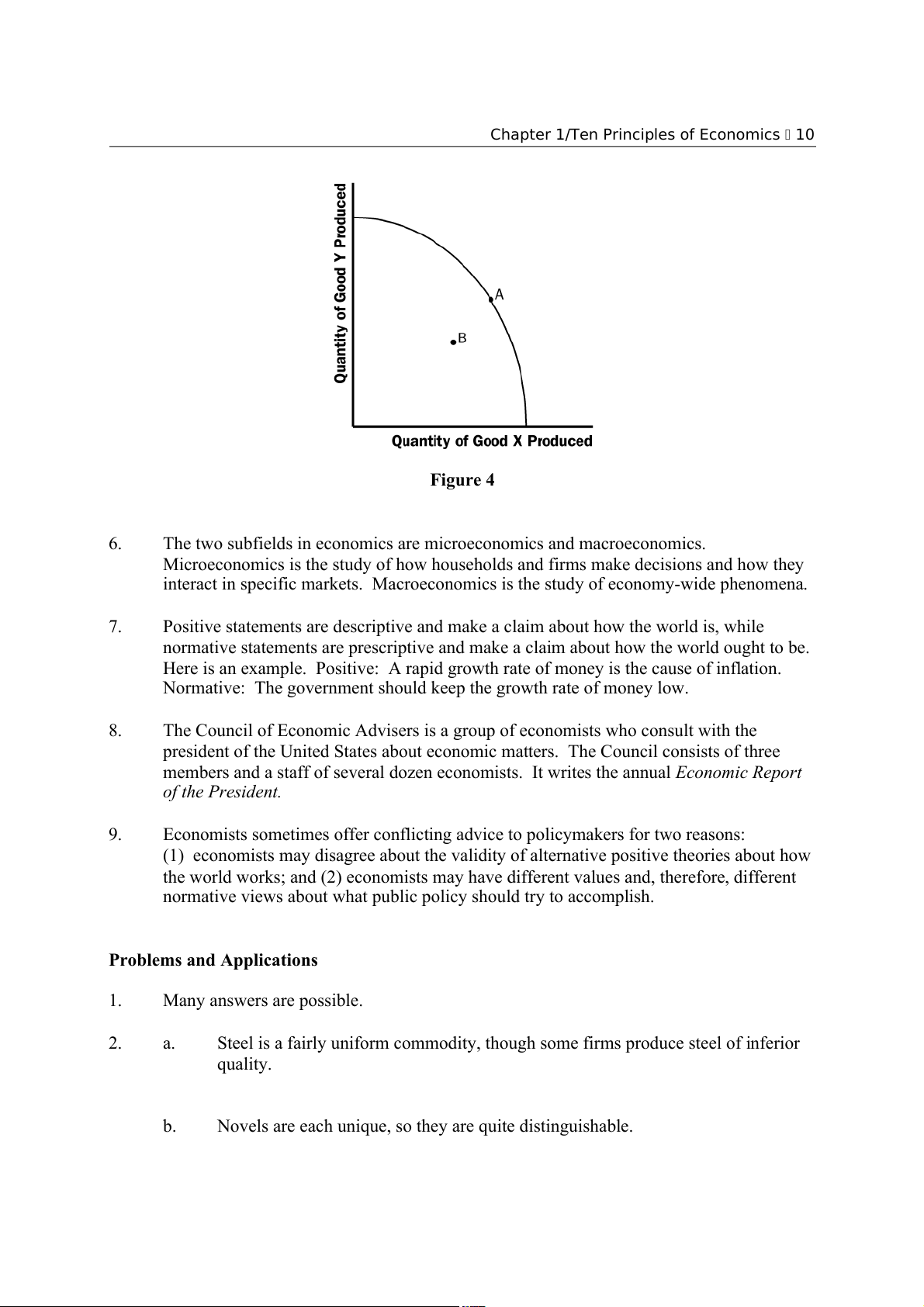
The idea of efficiency is that an outcome is efficient if the economy is getting all it can
from the scarce resources it has available. In terms of the production possibilities
frontier, an efficient point is a point on the frontier, such as point A in Figure 4. A point
inside the frontier, such as point B, is inefficient since more of one good could be
produced without reducing the production of another good.
Chapter 1/Ten Principles of Economics 10 Figure 4 6.
The two subfields in economics are microeconomics and macroeconomics.
Microeconomics is the study of how households and firms make decisions and how they
interact in specific markets. Macroeconomics is the study of economy-wide phenomena. 7.
Positive statements are descriptive and make a claim about how the world is, while
normative statements are prescriptive and make a claim about how the world ought to be.
Here is an example. Positive: A rapid growth rate of money is the cause of inflation.
Normative: The government should keep the growth rate of money low. 8.
The Council of Economic Advisers is a group of economists who consult with the
president of the United States about economic matters. The Council consists of three
members and a staff of several dozen economists. It writes the annual Economic Report of the President. 9.
Economists sometimes offer conflicting advice to policymakers for two reasons:
(1) economists may disagree about the validity of alternative positive theories about how
the world works; and (2) economists may have different values and, therefore, different
normative views about what public policy should try to accomplish.
Problems and Applications 1. Many answers are possible. 2. a.
Steel is a fairly uniform commodity, though some firms produce steel of inferior quality. b.
Novels are each unique, so they are quite distinguishable.
Chapter 1/Ten Principles of Economics 11 c.
Wheat produced by one farmer is completely indistinguishable from wheat produced by another. d.
Fast food is more distinguishable than steel or wheat, but certainly not as much as novels. 3.
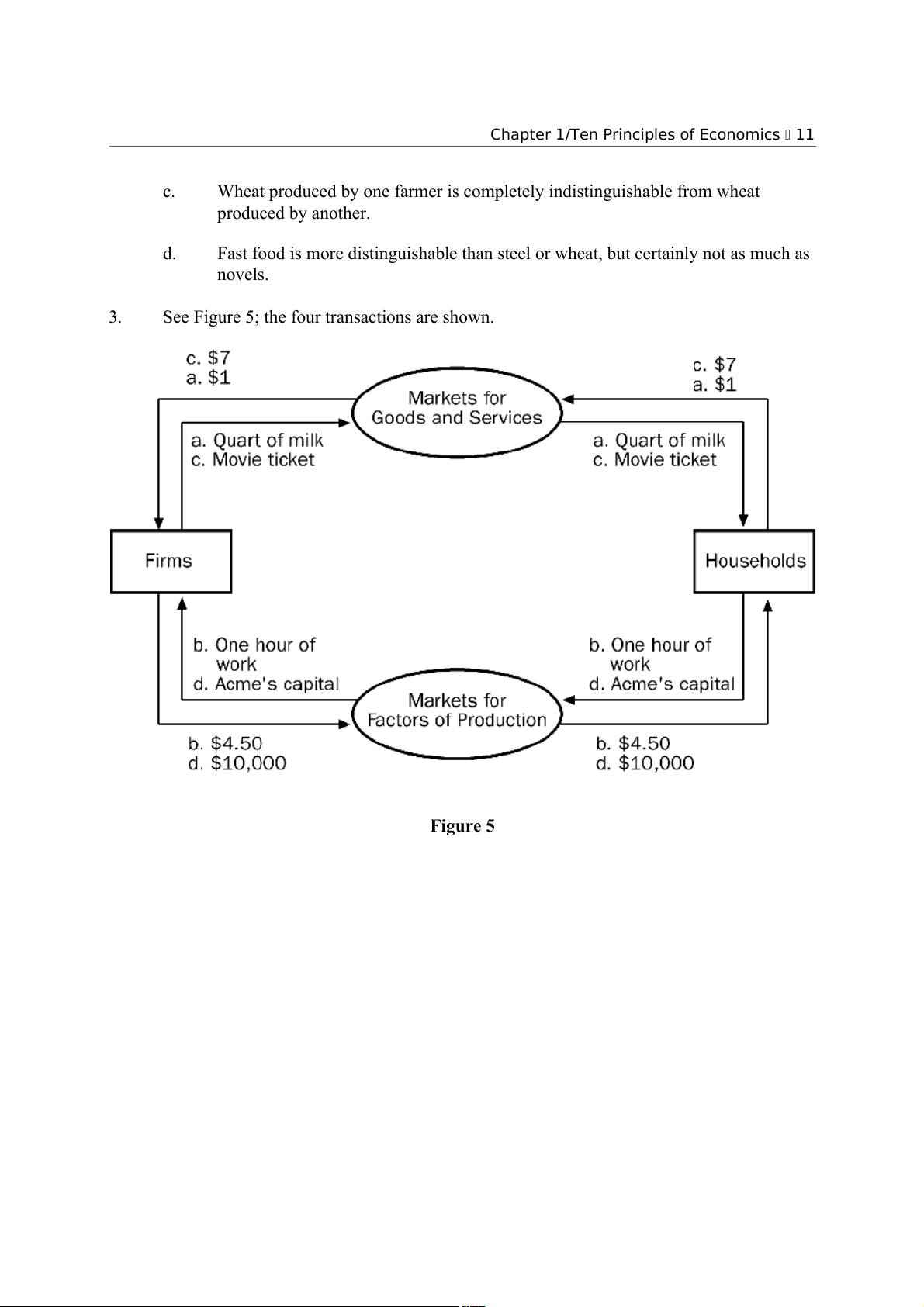
See Figure 5; the four transactions are shown. Figure 5
Chapter 1/Ten Principles of Economics 12 4. a.
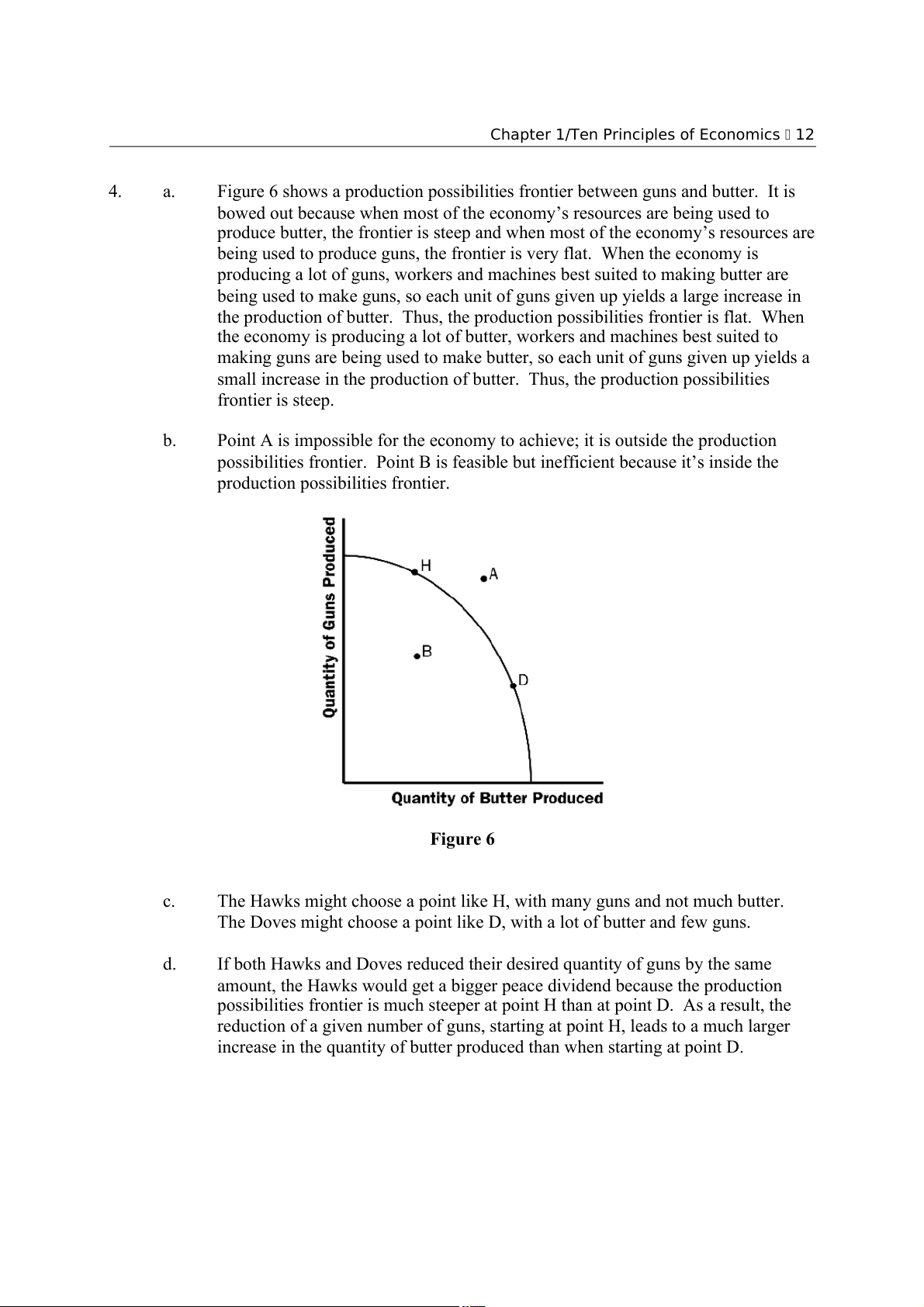
Figure 6 shows a production possibilities frontier between guns and butter. It is
bowed out because when most of the economy’s resources are being used to
produce butter, the frontier is steep and when most of the economy’s resources are
being used to produce guns, the frontier is very flat. When the economy is
producing a lot of guns, workers and machines best suited to making butter are
being used to make guns, so each unit of guns given up yields a large increase in
the production of butter. Thus, the production possibilities frontier is flat. When
the economy is producing a lot of butter, workers and machines best suited to
making guns are being used to make butter, so each unit of guns given up yields a
small increase in the production of butter. Thus, the production possibilities frontier is steep. b.
Point A is impossible for the economy to achieve; it is outside the production
possibilities frontier. Point B is feasible but inefficient because it’s inside the
production possibilities frontier. Figure 6 c.
The Hawks might choose a point like H, with many guns and not much butter.
The Doves might choose a point like D, with a lot of butter and few guns. d.
If both Hawks and Doves reduced their desired quantity of guns by the same
amount, the Hawks would get a bigger peace dividend because the production
possibilities frontier is much steeper at point H than at point D. As a result, the
reduction of a given number of guns, starting at point H, leads to a much larger
increase in the quantity of butter produced than when starting at point D.
Chapter 1/Ten Principles of Economics 13 5.
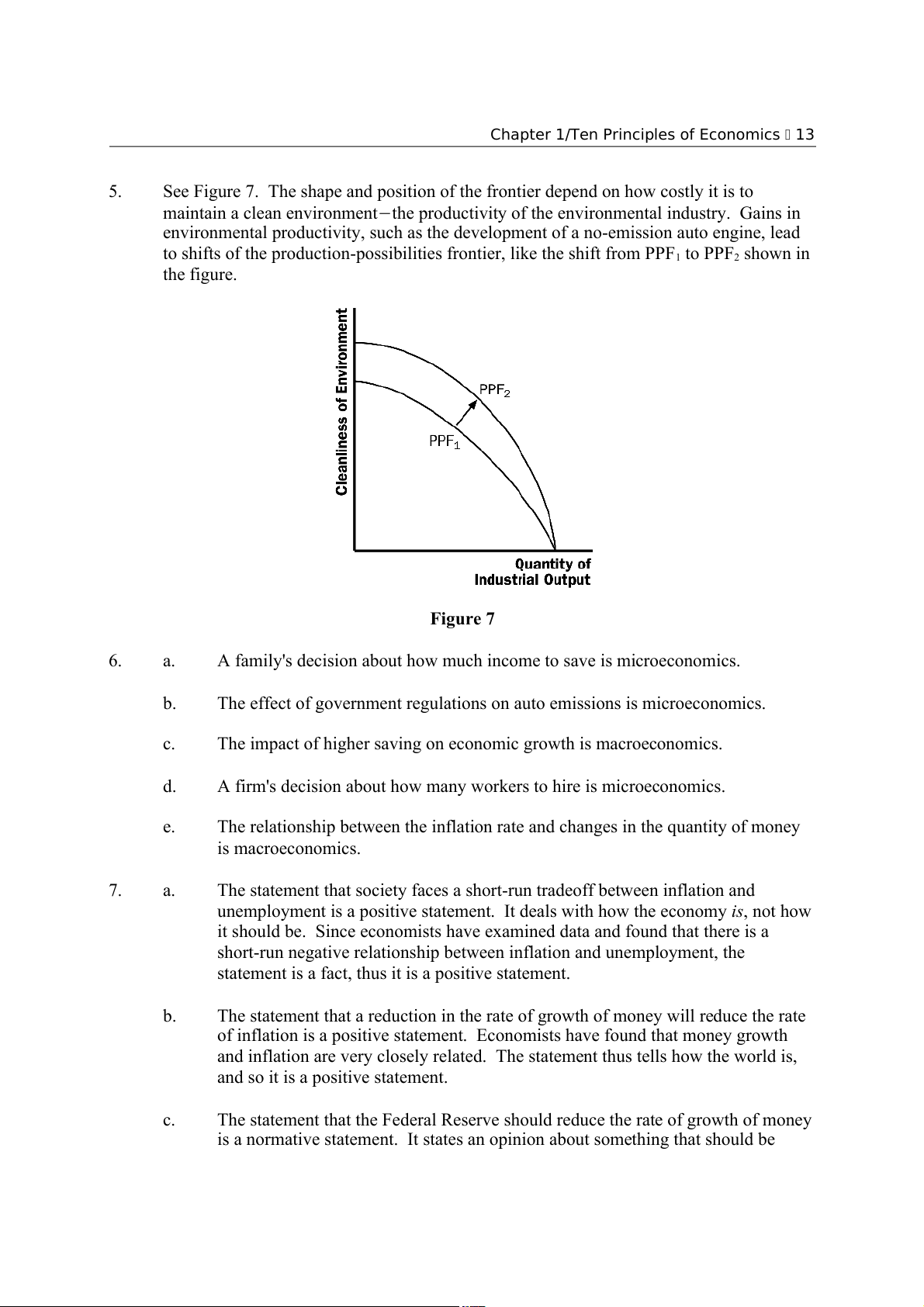
See Figure 7. The shape and position of the frontier depend on how costly it is to
maintain a clean environment the productivit
y of the environmental industry. Gains in
environmental productivity, such as the development of a no-emission auto engine, lead
to shifts of the production-possibilities frontier, like the shift from PPF to PPF 1 2 shown in the figure. Figure 7 6. a.
A family's decision about how much income to save is microeconomics. b.
The effect of government regulations on auto emissions is microeconomics. c.
The impact of higher saving on economic growth is macroeconomics. d.
A firm's decision about how many workers to hire is microeconomics. e.
The relationship between the inflation rate and changes in the quantity of money is macroeconomics. 7. a.
The statement that society faces a short-run tradeoff between inflation and
unemployment is a positive statement. It deals with how the economy is, not how
it should be. Since economists have examined data and found that there is a
short-run negative relationship between inflation and unemployment, the
statement is a fact, thus it is a positive statement. b.
The statement that a reduction in the rate of growth of money will reduce the rate
of inflation is a positive statement. Economists have found that money growth
and inflation are very closely related. The statement thus tells how the world is,
and so it is a positive statement. c.
The statement that the Federal Reserve should reduce the rate of growth of money
is a normative statement. It states an opinion about something that should be
Chapter 1/Ten Principles of Economics 14 done, not how the world is. d.
The statement that society ought to require welfare recipients to look for jobs is a
normative statement. It doesn't state a fact about how the world is. Instead, it is a
statement of how the world should be and is thus a normative statement. e.
The statement that lower tax rates encourage more work and more saving is a
positive statement. Economists have studied the relationship between tax rates
and work, as well as the relationship between tax rates and saving. They have
found a negative relationship in both cases. So the statement reflects how the
world is, and is thus a positive statement. 8.
Two of the statements in Table 2 are clearly normative. They are: "5. If the federal
budget is to be balanced, it should be done over the business cycle rather than yearly" and
"9. The government should restructure the welfare system along the lines of a 'negative
income tax.'" Both are suggestions of changes that should be made, rather than
statements of fact, so they are clearly normative statements.
The other statements in the table are positive. All the statements concern how the world
is, not how the world should be. Note that in all cases, even though they are statements
of fact, fewer than 100 percent of economists agree with them. You could say that
positive statements are statements of fact about how the world is, but not everyone agrees about what the facts are. 9.
As the president, you'd be interested in both the positive and normative views of
economists, but you'd probably be most interested in their positive views. Economists are
on your staff to provide their expertise about how the economy works. They know many
facts about the economy and the interaction of different sectors. So you would be most
likely to call on them about questions of fact positive analysis. Since you are the
president, you are the one who has to make the normative statements as to what should be
done, with an eye to the political consequences. The normative statements made by
economists represent their own views, not necessarily your views or the electorate’s views. 10.
There are many possible answers. 11.
As of this writing, the chairman of the Federal Reserve is Alan Greenspan, the chair of
the Council of Economic Advisers is R. Glen Hubbard, and the secretary of the treasury is Paul H. O’Neill. 12.
As time goes on, you might expect economists to disagree less about public policy
because they will have opportunities to observe different policies that are put into place.
As new policies are tried, their results will become known, and they can be evaluated
better. It's likely that the disagreement about them will be reduced after they've been
tried in practice. For example, many economists thought that wage and price controls
would be a good idea for keeping inflation under control, while others thought it was a
Chapter 1/Ten Principles of Economics 15
bad idea. But when the controls were tried in the early 1970s, the results were disastrous.
The controls interfered with the invisible hand of the marketplace and shortages
developed in many markets. As a result, most economists are now convinced that wage
and price controls are a bad idea for controlling inflation.
But it is unlikely that the differences between economists will ever be completely
eliminated. Economists differ on too many aspects of how the world works. Plus, even
as some policies get tried out and are either accepted or rejected, creative economists keep coming up with new ideas.
Chapter 1/Ten Principles of Economics 16 Chapter 3 Quick Quizzes 1.
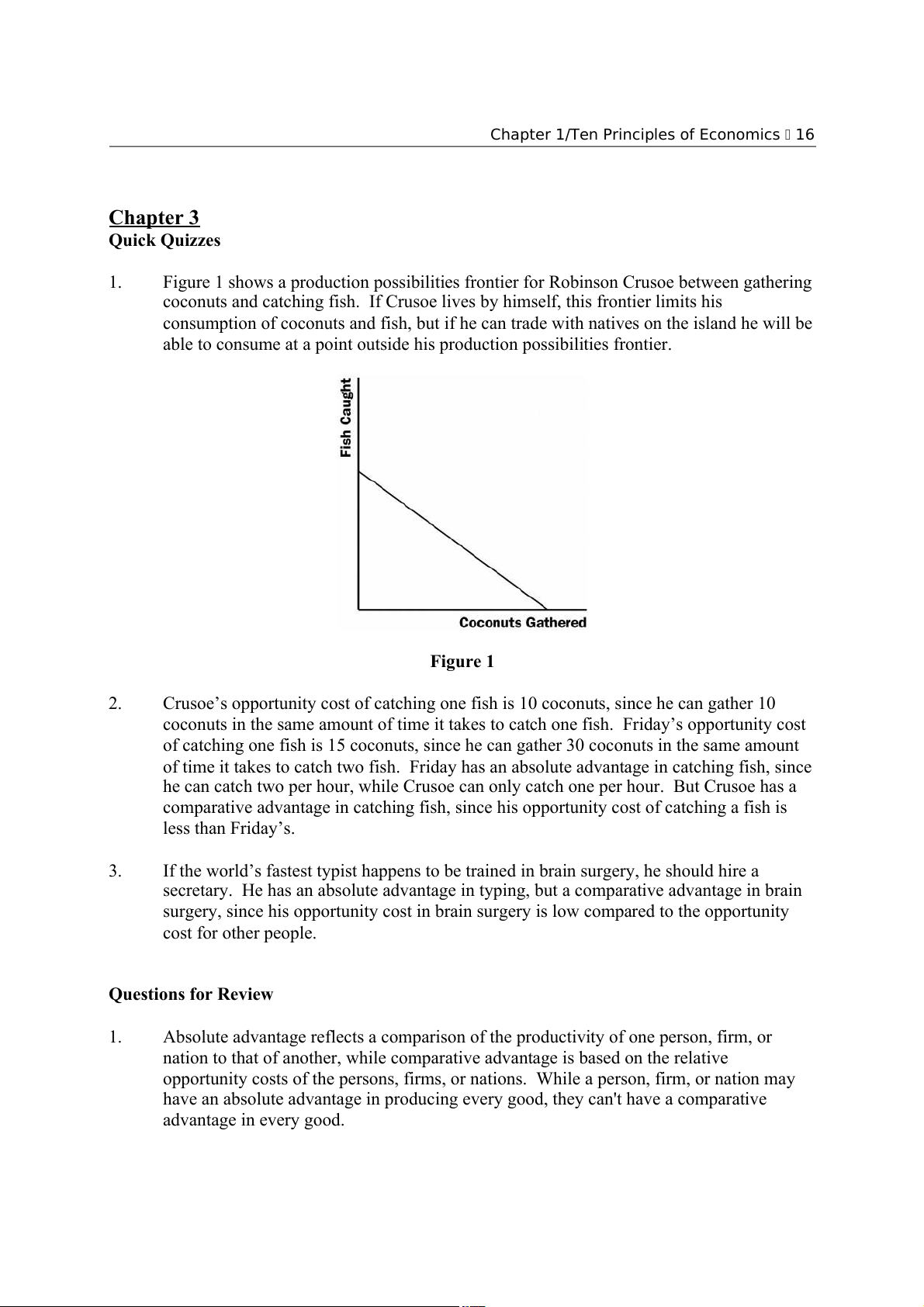
Figure 1 shows a production possibilities frontier for Robinson Crusoe between gathering
coconuts and catching fish. If Crusoe lives by himself, this frontier limits his
consumption of coconuts and fish, but if he can trade with natives on the island he will be
able to consume at a point outside his production possibilities frontier. Figure 1 2.
Crusoe’s opportunity cost of catching one fish is 10 coconuts, since he can gather 10
coconuts in the same amount of time it takes to catch one fish. Friday’s opportunity cost
of catching one fish is 15 coconuts, since he can gather 30 coconuts in the same amount
of time it takes to catch two fish. Friday has an absolute advantage in catching fish, since
he can catch two per hour, while Crusoe can only catch one per hour. But Crusoe has a
comparative advantage in catching fish, since his opportunity cost of catching a fish is less than Friday’s. 3.
If the world’s fastest typist happens to be trained in brain surgery, he should hire a
secretary. He has an absolute advantage in typing, but a comparative advantage in brain
surgery, since his opportunity cost in brain surgery is low compared to the opportunity cost for other people. Questions for Review 1.
Absolute advantage reflects a comparison of the productivity of one person, firm, or
nation to that of another, while comparative advantage is based on the relative
opportunity costs of the persons, firms, or nations. While a person, firm, or nation may
have an absolute advantage in producing every good, they can't have a comparative advantage in every good.
Chapter 1/Ten Principles of Economics 17 2.
Many examples are possible. Suppose, for example, that Roger can prepare a fine meal
of hot dogs and macaroni in just ten minutes, while it takes Anita twenty minutes. And
Roger can do all the wash in three hours, while it takes Anita four hours. Roger has an
absolute advantage in both cooking and doing the wash, but Anita has a comparative
advantage in doing the wash (the wash takes the same amount of time as 12 meals, while
it takes Roger 18 meals' worth of time). 3.
Comparative advantage is more important for trade than absolute advantage. In the
example in problem 2, Anita and Roger will complete their chores more quickly if Anita
does at least some of the wash and Roger cooks the fine meals for both, because Anita
has a comparative advantage in doing the wash, while Roger has a comparative advantage in cooking. 4.
A nation will export goods for which it has a comparative advantage because it has a
smaller opportunity cost of producing those goods. As a result, citizens of all nations are
able to consume quantities of goods that are outside their production possibilities frontiers. 5.
Economists oppose policies that restrict trade among nations because trade allows all
countries to achieve greater prosperity by allowing them to receive the gains from
comparative advantage. Restrictions on trade hurt all countries.
Problems and Applications 1.
In the text example of the farmer and the rancher, the farmer's opportunity cost of
producing one ounce of meat is 4 ounces of potatoes because for every 8 hours of work,
he can produce 8 ounces of meat or 32 ounces of potatoes. With limited time at his
disposal, producing an ounce of meat means he gives up the opportunity to produce 4
ounces of potatoes. Similarly, the rancher's opportunity cost of producing one ounce of
meat is 2 ounces of potatoes because for every 8 hours of work, she can produce 24
ounces of meat or 48 ounces of potatoes. With limited time at her disposal, producing an
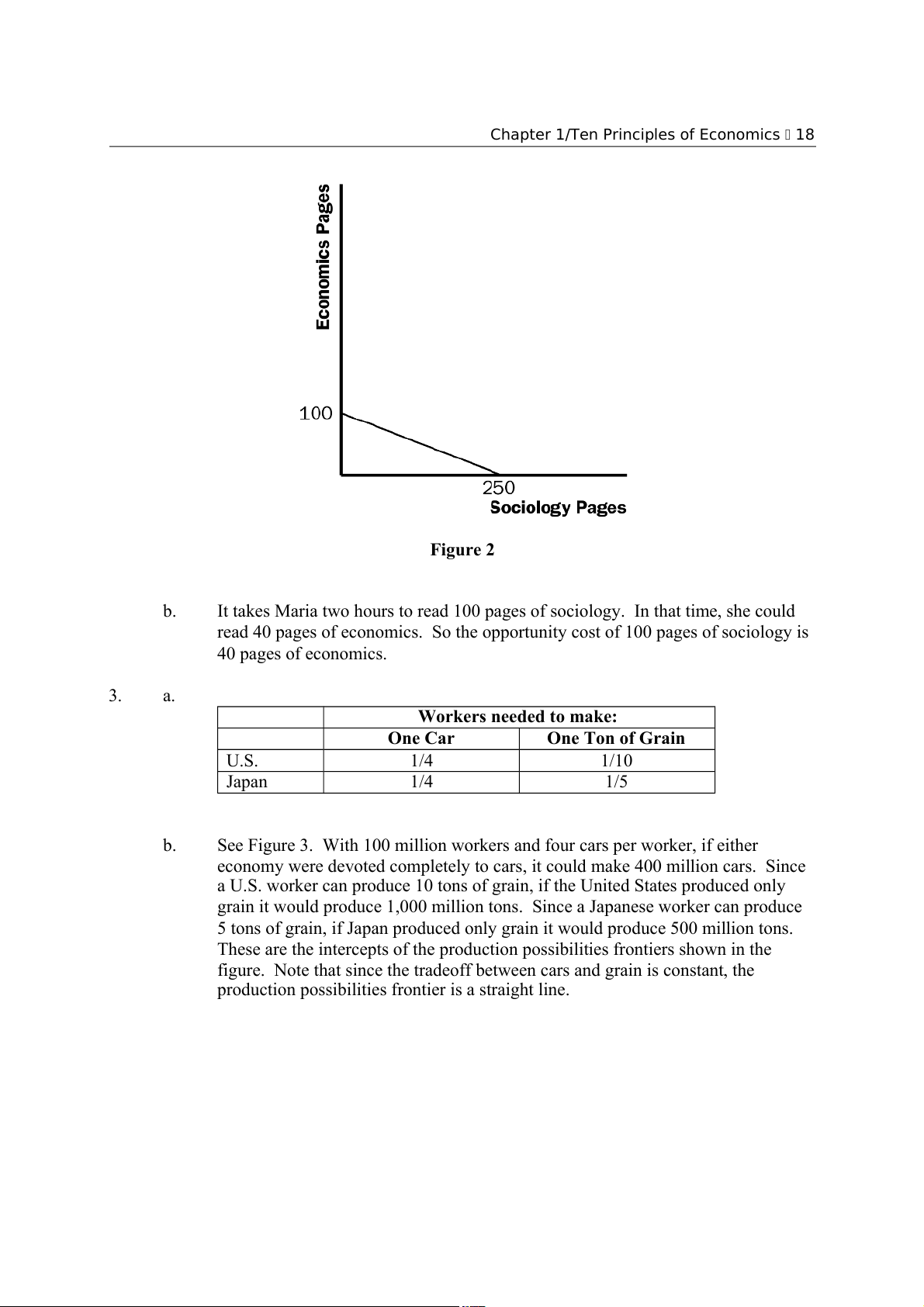
ounce of meat means she gives up the opportunity to produce 2 ounces of potatoes. 2. a.
See Figure 2. If Maria spends all five hours studying economics, she can read
100 pages, so that is the vertical intercept of the production possibilities frontier.
If she spends all five hours studying sociology, she can read 250 pages, so that is
the horizontal intercept. The time costs are constant, so the production
possibilities frontier is a straight line.
Chapter 1/Ten Principles of Economics 18 Figure 2 b.
It takes Maria two hours to read 100 pages of sociology. In that time, she could
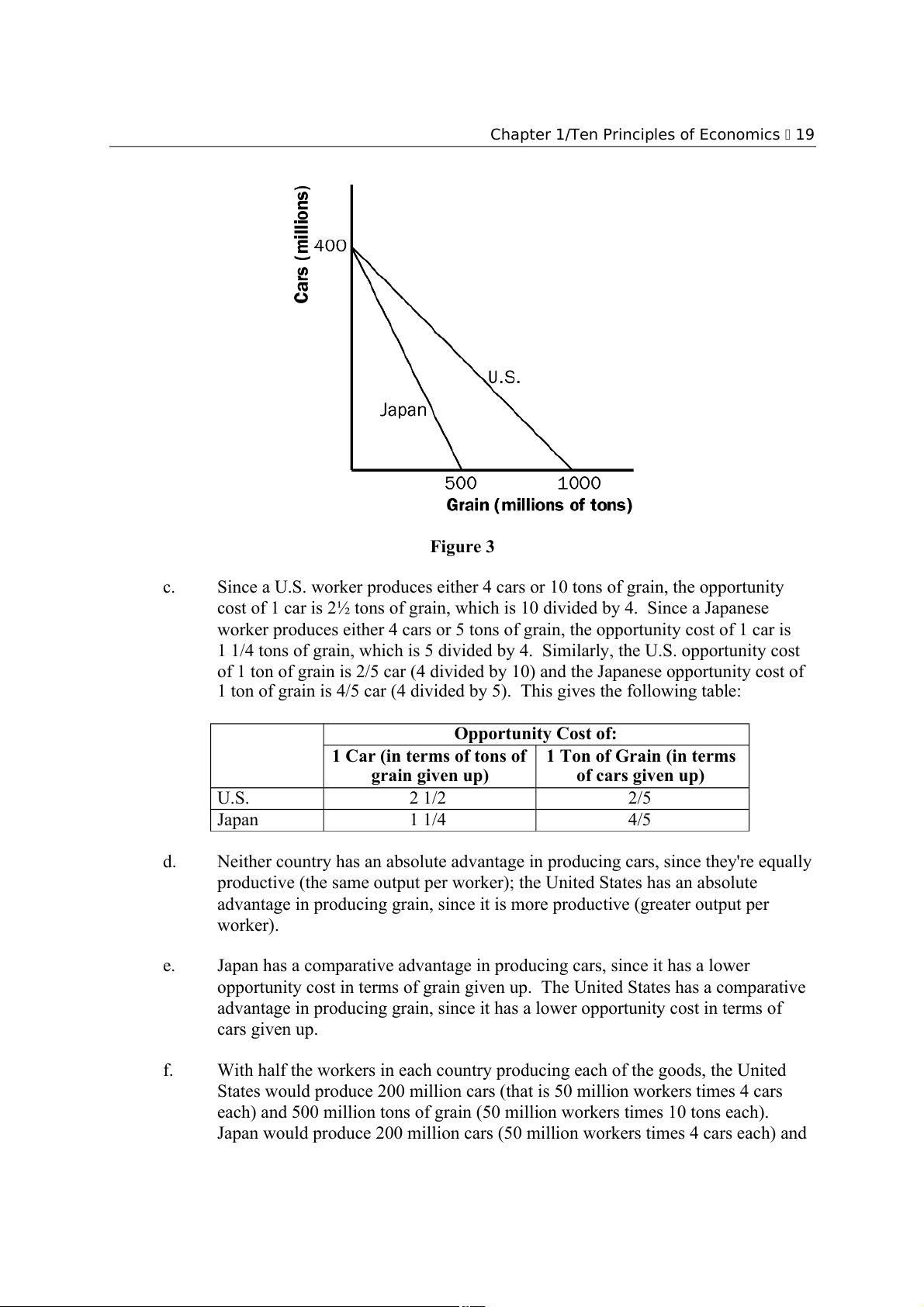
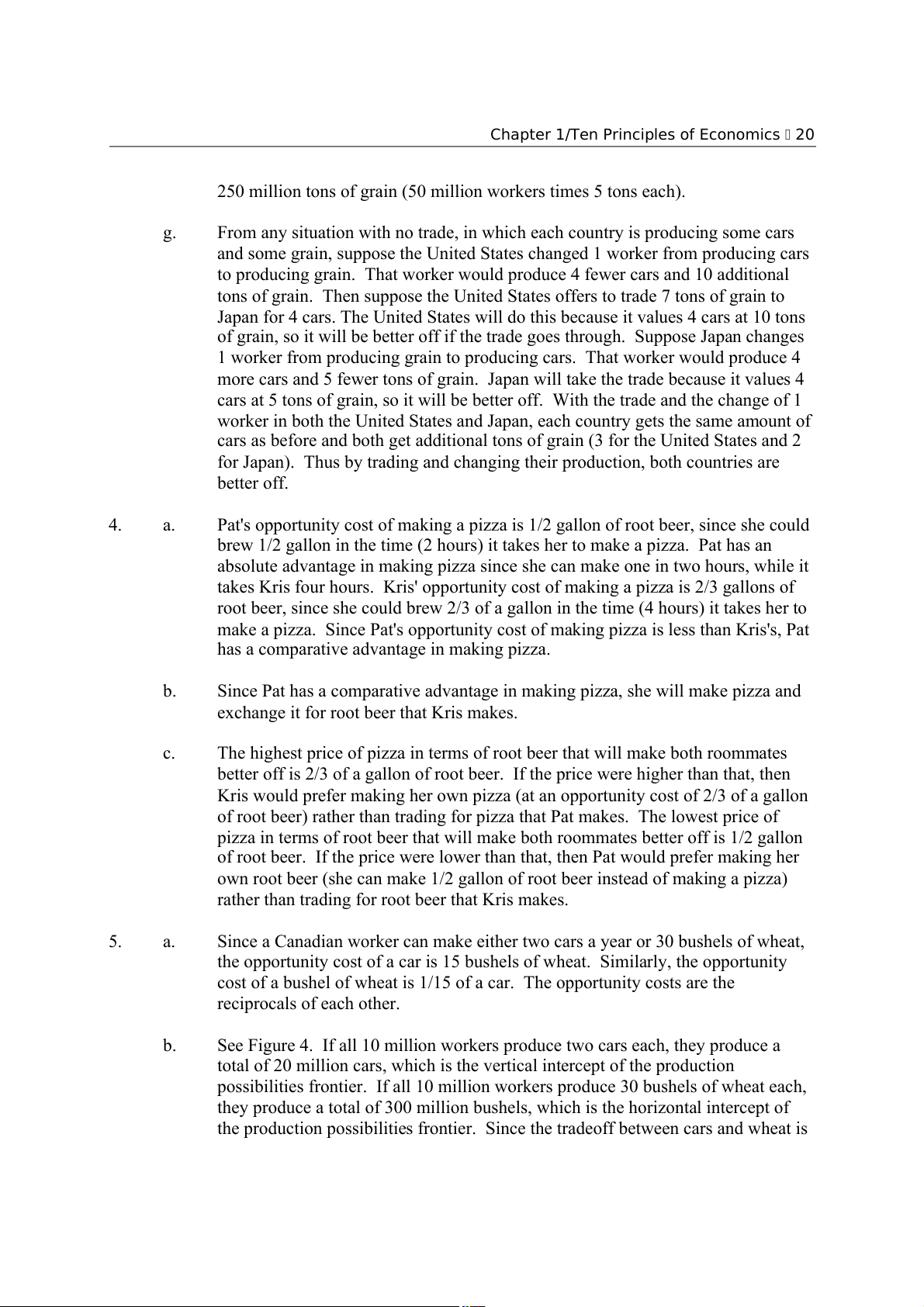
read 40 pages of economics. So the opportunity cost of 100 pages of sociology is 40 pages of economics. 3. a. Workers needed to make: One Car One Ton of Grain U.S. 1/4 1/10 Japan 1/4 1/5 b.
See Figure 3. With 100 million workers and four cars per worker, if either
economy were devoted completely to cars, it could make 400 million cars. Since
a U.S. worker can produce 10 tons of grain, if the United States produced only
grain it would produce 1,000 million tons. Since a Japanese worker can produce
5 tons of grain, if Japan produced only grain it would produce 500 million tons.
These are the intercepts of the production possibilities frontiers shown in the
figure. Note that since the tradeoff between cars and grain is constant, the
production possibilities frontier is a straight line.
Chapter 1/Ten Principles of Economics 19 Figure 3 c.
Since a U.S. worker produces either 4 cars or 10 tons of grain, the opportunity
cost of 1 car is 2½ tons of grain, which is 10 divided by 4. Since a Japanese
worker produces either 4 cars or 5 tons of grain, the opportunity cost of 1 car is
1 1/4 tons of grain, which is 5 divided by 4. Similarly, the U.S. opportunity cost
of 1 ton of grain is 2/5 car (4 divided by 10) and the Japanese opportunity cost of
1 ton of grain is 4/5 car (4 divided by 5). This gives the following table: Opportunity Cost of:
1 Car (in terms of tons of
1 Ton of Grain (in terms grain given up) of cars given up) U.S. 2 1/2 2/5 Japan 1 1/4 4/5 d.
Neither country has an absolute advantage in producing cars, since they're equally
productive (the same output per worker); the United States has an absolute
advantage in producing grain, since it is more productive (greater output per worker). e.
Japan has a comparative advantage in producing cars, since it has a lower
opportunity cost in terms of grain given up. The United States has a comparative
advantage in producing grain, since it has a lower opportunity cost in terms of cars given up. f.
With half the workers in each country producing each of the goods, the United
States would produce 200 million cars (that is 50 million workers times 4 cars
each) and 500 million tons of grain (50 million workers times 10 tons each).
Japan would produce 200 million cars (50 million workers times 4 cars each) and
Chapter 1/Ten Principles of Economics 20
250 million tons of grain (50 million workers times 5 tons each). g.
From any situation with no trade, in which each country is producing some cars
and some grain, suppose the United States changed 1 worker from producing cars
to producing grain. That worker would produce 4 fewer cars and 10 additional
tons of grain. Then suppose the United States offers to trade 7 tons of grain to
Japan for 4 cars. The United States will do this because it values 4 cars at 10 tons
of grain, so it will be better off if the trade goes through. Suppose Japan changes
1 worker from producing grain to producing cars. That worker would produce 4
more cars and 5 fewer tons of grain. Japan will take the trade because it values 4
cars at 5 tons of grain, so it will be better off. With the trade and the change of 1
worker in both the United States and Japan, each country gets the same amount of
cars as before and both get additional tons of grain (3 for the United States and 2
for Japan). Thus by trading and changing their production, both countries are better off. 4. a.
Pat's opportunity cost of making a pizza is 1/2 gallon of root beer, since she could
brew 1/2 gallon in the time (2 hours) it takes her to make a pizza. Pat has an
absolute advantage in making pizza since she can make one in two hours, while it
takes Kris four hours. Kris' opportunity cost of making a pizza is 2/3 gallons of
root beer, since she could brew 2/3 of a gallon in the time (4 hours) it takes her to
make a pizza. Since Pat's opportunity cost of making pizza is less than Kris's, Pat
has a comparative advantage in making pizza. b.
Since Pat has a comparative advantage in making pizza, she will make pizza and
exchange it for root beer that Kris makes. c.
The highest price of pizza in terms of root beer that will make both roommates
better off is 2/3 of a gallon of root beer. If the price were higher than that, then
Kris would prefer making her own pizza (at an opportunity cost of 2/3 of a gallon
of root beer) rather than trading for pizza that Pat makes. The lowest price of
pizza in terms of root beer that will make both roommates better off is 1/2 gallon
of root beer. If the price were lower than that, then Pat would prefer making her
own root beer (she can make 1/2 gallon of root beer instead of making a pizza)
rather than trading for root beer that Kris makes. 5. a.
Since a Canadian worker can make either two cars a year or 30 bushels of wheat,
the opportunity cost of a car is 15 bushels of wheat. Similarly, the opportunity
cost of a bushel of wheat is 1/15 of a car. The opportunity costs are the reciprocals of each other. b.
See Figure 4. If all 10 million workers produce two cars each, they produce a
total of 20 million cars, which is the vertical intercept of the production
possibilities frontier. If all 10 million workers produce 30 bushels of wheat each,
they produce a total of 300 million bushels, which is the horizontal intercept of
the production possibilities frontier. Since the tradeoff between cars and wheat is
Tài liệu liên quan:
-

Chương 3: độ co giãn và các nhân tố ảnh hưởng | Microeconomics | Trường Đại học Quốc tế, Đại học Quốc gia Thành phố Hồ Chí Minh
4 2 -
Microeconomics Syllabus | Microeconomics | Trường Đại học Quốc tế, Đại học Quốc gia Thành phố Hồ Chí Minh
4 2 -
Microeconomics Course Syllabus & Assessment Details | Microeconomics | Trường Đại học Quốc tế, Đại học Quốc gia Thành phố Hồ Chí Minh
4 2 -
Assignment 3 - Elasticity MCQs and Key Concepts | Microeconomics | Trường Đại học Quốc tế, Đại học Quốc gia Thành phố Hồ Chí Minh
4 2 -
Assignment 2 - Economic Equilibrium Analysis of Fridges and Motorcycles | Microeconomics | Trường Đại học Quốc tế, Đại học Quốc gia Thành phố Hồ Chí Minh
4 2