Study Guide on Externalities in Managerial Economics | Microeconomics | Trường Đại học Quốc tế, Đại học Quốc gia Thành phố Hồ Chí Minh
Which of the following does not constitute an externality (positive or negative)? a. Global warming caused by green-house gas emissions. b. Consumer benefits due to advancements in basic science. c. A firm’s in-house production of a key intermediate component. d. A family sending its daughter to an advanced math program after school. e. Answers c and d are both correct. M5 When the market price of a good does not include negative externalities, a. Resources are typically under-allocated for producing the good. Tài liệu được sưu tầm và soạn thảo dưới dạng file PDF để gửi tới các bạn cùng tham khảo, ôn tập đầy đủ kiến thức, chuẩn bị cho các buổi học thật tốt. Mời bạn đọc đón xem!
Môn: Microeconomics 635 tài liệu
Trường: Trường Đại học Quốc tế, Đại học Quốc gia Thành phố Hồ Chí Minh 1.9 K tài liệu
Tác giả:


Preview text:
EXTERNALITY Multiple Choice
M4 Which of the following does not constitute an externality (positive or negative)? a.
Global warming caused by green-house gas emissions. b.
Consumer benefits due to advancements in basic science. c.
A firm’s in-house production of a key intermediate component. d.
A family sending its daughter to an advanced math program after school. e.
Answers c and d are both correct.
M5 When the market price of a good does not include negative externalities, a.
Resources are typically under-allocated for producing the good. b.
Consumers, in effect, are receiving a “subsidized” price. c.
Resources are typically over-allocated for producing the good. d.
Producers of the good are able to earn excess profits. e.
Answers b and c are both correct.
M6 When negative externalities cause market inefficiencies, a.
Taxing producers to increase marginal cost will bring more efficient output levels. b.
Subsidizing the consumer will lead to more efficient production levels. c.
Subsidizing the producer will lead to more efficient production levels. d.
The government should prohibit generation of the externalities. e.
Answers a and d are both correct.
M7 Regulation that requires firms to internalize negative externalities a.
Decreases prices and increases production. b.
Increases prices and decreases production. c.
Places an inefficiently high cost burden on firms. d.
Affects neither price, production, nor economic benefits. e.
Has little effect on the firm’s incentive to clean up the externality.
M8 An efficient tax on an externality should be set at a level a.
Equal to the cost of eliminating the externality, b.
Greater than the cost of eliminating the externality c.
Equal to the economic cost of the harm caused by the externality. d.
Greater than the economic cost of the harm caused by the externality. e.
Answers a and c are both correct.
M9 An efficient level of cleanup occurs where a.
The marginal benefit of cleanup exceeds the marginal cost. b.
The marginal benefit of cleanup is zero. c.
The marginal benefit of cleanup is at a maximum. d.
T he marginal benefit of cleanup equals the marginal cost. e. There is 100 percent cleanup.
M11 A pure public good is best defined as a a.
Government-provided good paid for by user fees.
Managerial Economics Study Guide b.
Government-provided good that entails no external benefits or costs. c.
Government-provided good that is non-rival and non-exclusive. d.
Good paid for by the government, directly or by transfer payments to consumers. e.
Government produced output intended to augment private production.
M12 For a public good such as interstate highways, a.
When more is consumed by truckers, less can be consumed by automobile drivers. b.
More can be consumed by truckers without reducing the amount consumed by automobile drivers. c.
The efficient output level occurs when the marginal benefit of the consumer who
benefits the most equals the marginal cost of production. d.
The efficient output level equates the marginal benefits of all consumers. e.
Answers b and d are both correct.
M13 With respect to a public good, free riders a.
Can lead to inefficiently low output of the good. b.
Voluntarily pay a user fee equal to the marginal benefits they receive. c.
Attempt to receive the benefits of the good without paying. d.
Typically organize to press for more of the government-subsidized public good. e.
Answers a and c are both correct.
Short Problems and Questions S3
The production of a standard type of industrial cleaning acid is estimated to create a
negative externality of $10 per barrel. Many companies are currently producing the acid,
and the market equilibrium output is 500,000 barrels. The price in the competitive market is $50 per barrel. a.
Explain why the competitive market equilibrium is inefficient. b.
Show how a tax could achieve a socially optimal outcome. What tax should be set
and how will it affect the market price and output of the acid? S4
Private firms in a particular industry are generating an externality that generates a MEC
of $1.00 per unit of discharge. The government has issued a regulation requiring these
firms to use a scrubbing technology that completely eliminates the externality at a cost to
the firm of $.65 per unit of discharge. Does this regulation make sense? Explain briefly. S5
Explain the difference between negative and positive externalities and carefully assess the following statement:
“External costs are harmful but external benefits are good. Therefore, government
should intervene in markets when external costs are present but not when external benefits occur.” S7
What is the key characteristic of a pure public good and how does this characteristic
cause private markets to produce an inefficient quantity of such a good? In principle, how
can information on consumer marginal benefits be used to provide the “right” amounts of public goods?
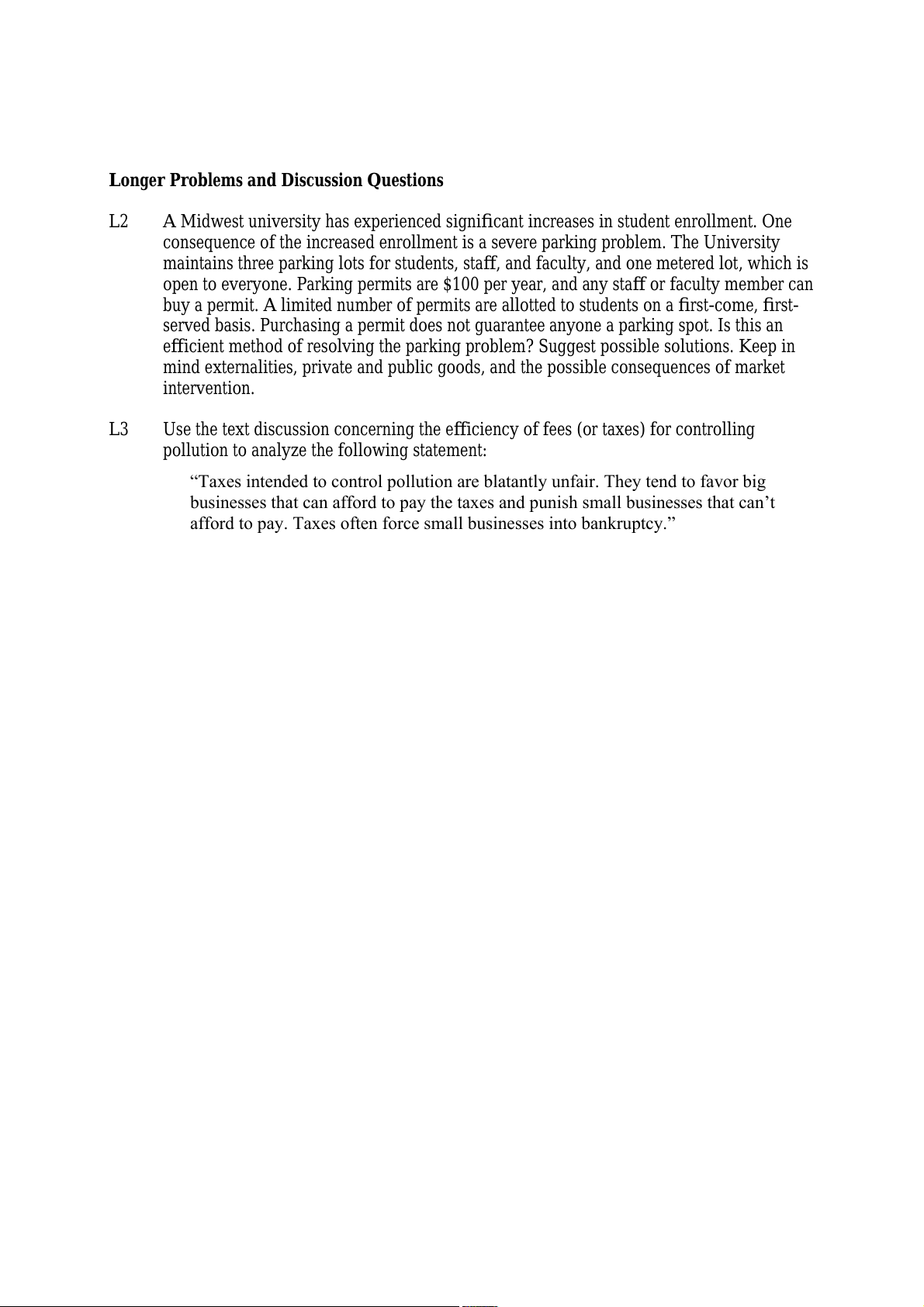
Longer Problems and Discussion Questions L2
A Midwest university has experienced significant increases in student enrollment. One
consequence of the increased enrollment is a severe parking problem. The University
maintains three parking lots for students, staff, and faculty, and one metered lot, which is
open to everyone. Parking permits are $100 per year, and any staff or faculty member can
buy a permit. A limited number of permits are allotted to students on a first-come, first-
served basis. Purchasing a permit does not guarantee anyone a parking spot. Is this an
efficient method of resolving the parking problem? Suggest possible solutions. Keep in
mind externalities, private and public goods, and the possible consequences of market intervention. L3
Use the text discussion concerning the efficiency of fees (or taxes) for controlling
pollution to analyze the following statement:
“Taxes intended to control pollution are blatantly unfair. They tend to favor big
businesses that can afford to pay the taxes and punish small businesses that can’t
afford to pay. Taxes often force small businesses into bankruptcy.”
Tài liệu liên quan:
-

Chương 3: độ co giãn và các nhân tố ảnh hưởng | Microeconomics | Trường Đại học Quốc tế, Đại học Quốc gia Thành phố Hồ Chí Minh
3 2 -
Microeconomics Syllabus | Microeconomics | Trường Đại học Quốc tế, Đại học Quốc gia Thành phố Hồ Chí Minh
3 2 -
Microeconomics Course Syllabus & Assessment Details | Microeconomics | Trường Đại học Quốc tế, Đại học Quốc gia Thành phố Hồ Chí Minh
3 2 -
Assignment 3 - Elasticity MCQs and Key Concepts | Microeconomics | Trường Đại học Quốc tế, Đại học Quốc gia Thành phố Hồ Chí Minh
3 2 -
Assignment 2 - Economic Equilibrium Analysis of Fridges and Motorcycles | Microeconomics | Trường Đại học Quốc tế, Đại học Quốc gia Thành phố Hồ Chí Minh
3 2