Supply and Demand - Key Concepts and Market Dynamics | Microeconomics | Trường Đại học Quốc tế, Đại học Quốc gia Thành phố Hồ Chí Minh
Every society must answer 3 questions of economics: What? How? For whom? In the thousands of different societies for which records are available, issues like these have been decided in essentially one of two ways. One approach is for all economic decisions to be madecentrally, by an individual or small number of individuals on behalf of a larger group. Tài liệu được sưu tầm và soạn thảo dưới dạng file PDF để gửi tới các bạn cùng tham khảo, ôn tập đầy đủ kiến thức, chuẩn bị cho các buổi học thật tốt. Mời bạn đọc đón xem!
Môn: Microeconomics 635 tài liệu
Trường: Trường Đại học Quốc tế, Đại học Quốc gia Thành phố Hồ Chí Minh 1.9 K tài liệu
Tác giả:

Preview text:
Chapter 3: Supply and Demand
WHAT, HOW, AND FOR WHOM? CENTRAL PLANNING VERSUS THE MARKET
Every society must answer 3 questions of economics: What? How? For whom? In the
thousands of different societies for which records are available, issues like these have been
decided in essentially one of two ways.
One approach is for all economic decisions to be made ,
centrally by an individual or small
number of individuals on behalf of a larger group. For example, the economic organization of
the former Soviet Union (and other communist countries) was also largely centralized.
The second major form of economic sytem, capitalist, or free-market, in which people decide
for themselves which careers to pursue and which products to produce or buy, the production
and distribution decisions are left to individuals interacting in private markets.
In fact, there are no pure free-market economies today. Modern industrial countries are more
properly described as “mixed economies.” Their goods and services are allocated by a
combination of free markets, regulation, and other forms of collective control. BUYERS AND SELLERS IN MARKETS
Market: the market for any good consists of all buyers or sellers of that good THE DEMAND CURVE:
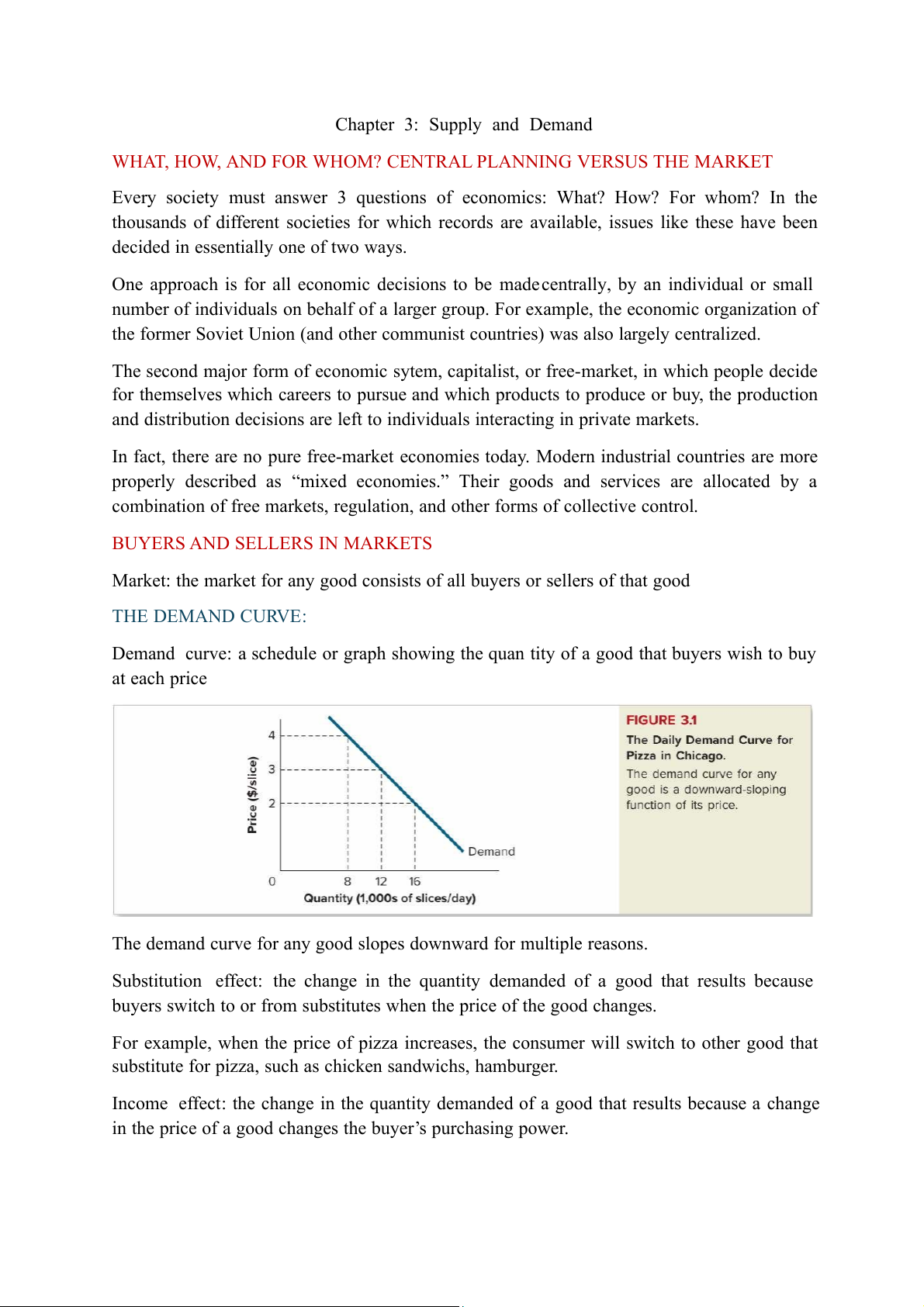
Demand curve: a schedule or graph showing the quan tity of a good that buyers wish to buy at each price
The demand curve for any good slopes downward for multiple reasons.
Substitution effect: the change in the quantity demanded of a good that results because
buyers switch to or from substitutes when the price of the good changes.
For example, when the price of pizza increases, the consumer will switch to other good that
substitute for pizza, such as chicken sandwichs, hamburger.
Income effect: the change in the quantity demanded of a good that results because a change
in the price of a good changes the buyer’s purchasing power.
Buyer’s reservation price: the largest dollar amount the buyer would be willing to pay for a good
Self-test 3.1: In Figure 3.1, what is the marginal buyer’s reservation price when the quantity
of pizza sold is 10,000 slices per day? For the same demand curve, what will be the quantity
of pizza demanded at a price of $2.50 per slice? THE SUPPLY CURVE
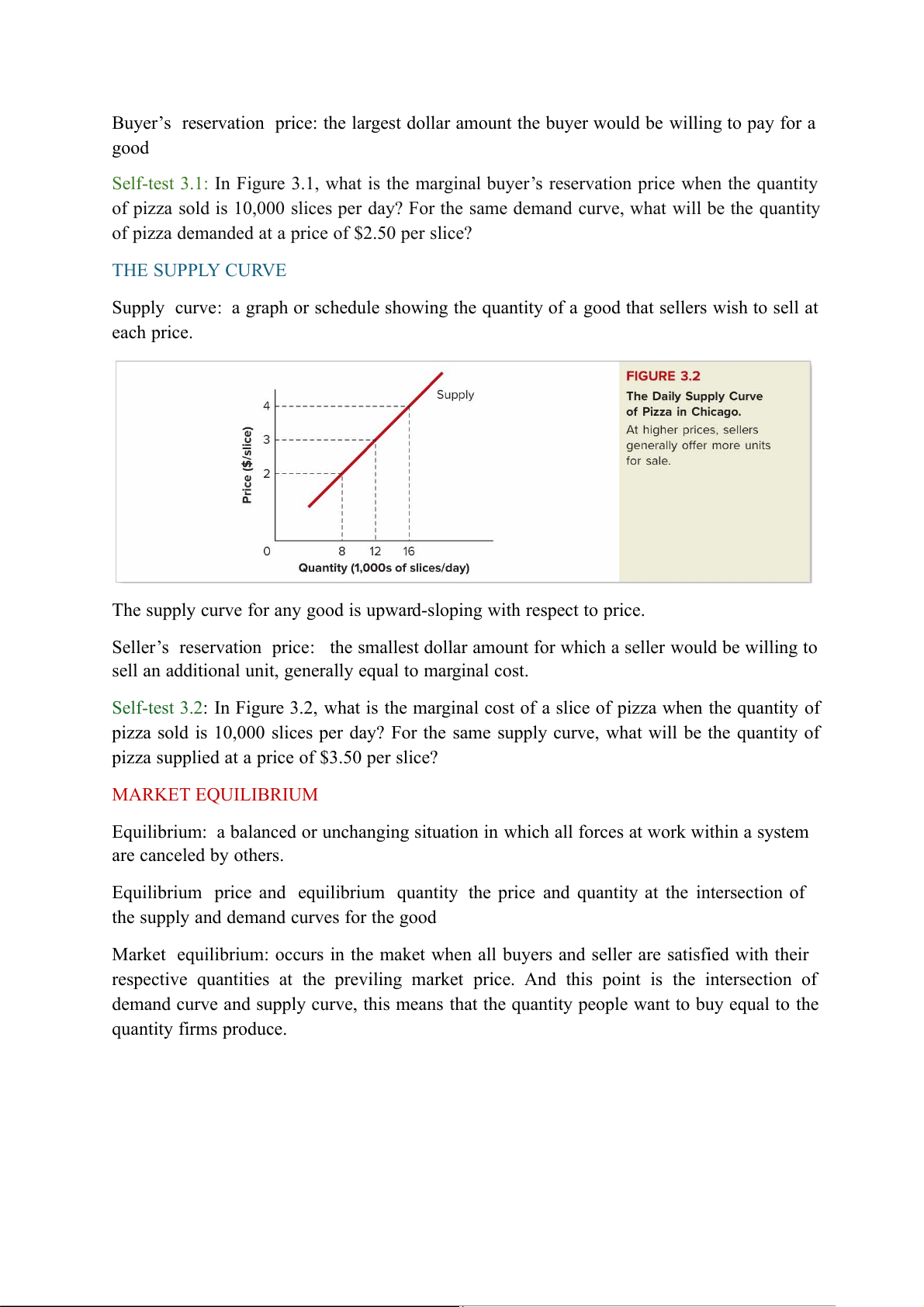
Supply curve: a graph or schedule showing the quantity of a good that sellers wish to sell at each price.
The supply curve for any good is upward-sloping with respect to price.
Seller’s reservation price: the smallest dollar amount for which a seller would be willing to
sell an additional unit, generally equal to marginal cost.
Self-test 3.2: In Figure 3.2, what is the marginal cost of a slice of pizza when the quantity of
pizza sold is 10,000 slices per day? For the same supply curve, what will be the quantity of
pizza supplied at a price of $3.50 per slice? MARKET EQUILIBRIUM
Equilibrium: a balanced or unchanging situation in which all forces at work within a system are canceled by others.
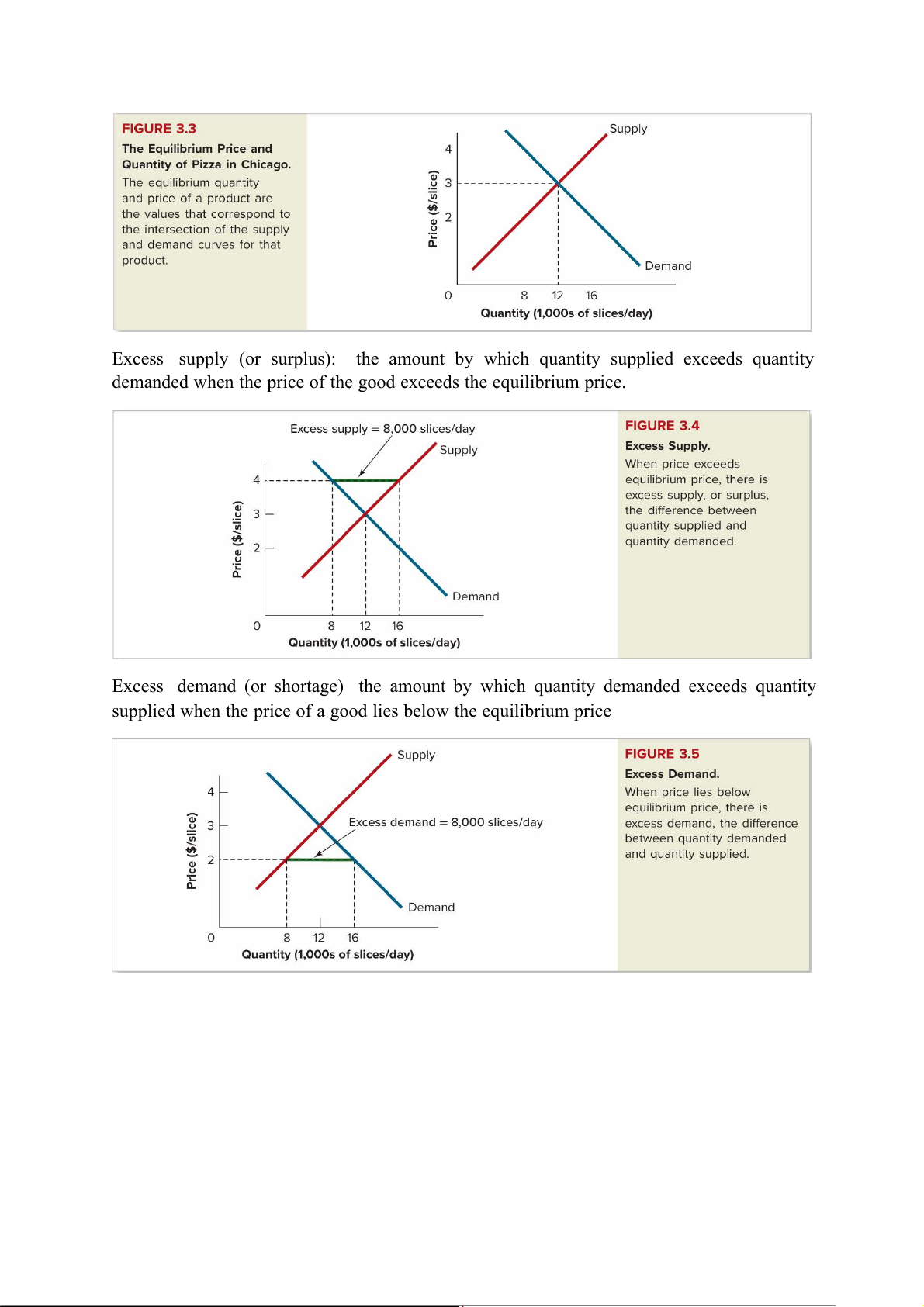
Equilibrium price and equilibrium quantity the price and quantity at the intersection of
the supply and demand curves for the good
Market equilibrium: occurs in the maket when all buyers and seller are satisfied with their
respective quantities at the previling market price. And this point is the intersection of
demand curve and supply curve, this means that the quantity people want to buy equal to the quantity firms produce.
Excess supply (or surplus): the amount by which quantity supplied exceeds quantity
demanded when the price of the good exceeds the equilibrium price.
Excess demand (or shortage) the amount by which quantity demanded exceeds quantity
supplied when the price of a good lies below the equilibrium price
Tài liệu liên quan:
-
Chương 3: độ co giãn và các nhân tố ảnh hưởng | Microeconomics | Trường Đại học Quốc tế, Đại học Quốc gia Thành phố Hồ Chí Minh
0 0 -
Microeconomics Syllabus | Microeconomics | Trường Đại học Quốc tế, Đại học Quốc gia Thành phố Hồ Chí Minh
1 1 -
Microeconomics Course Syllabus & Assessment Details | Microeconomics | Trường Đại học Quốc tế, Đại học Quốc gia Thành phố Hồ Chí Minh
1 1 -
Assignment 3 - Elasticity MCQs and Key Concepts | Microeconomics | Trường Đại học Quốc tế, Đại học Quốc gia Thành phố Hồ Chí Minh
1 1 -
Assignment 2 - Economic Equilibrium Analysis of Fridges and Motorcycles | Microeconomics | Trường Đại học Quốc tế, Đại học Quốc gia Thành phố Hồ Chí Minh
1 1