Supply, Demand & Elasticity: Tax Implications Analysis | Microeconomics | Trường Đại học Quốc tế, Đại học Quốc gia Thành phố Hồ Chí Minh
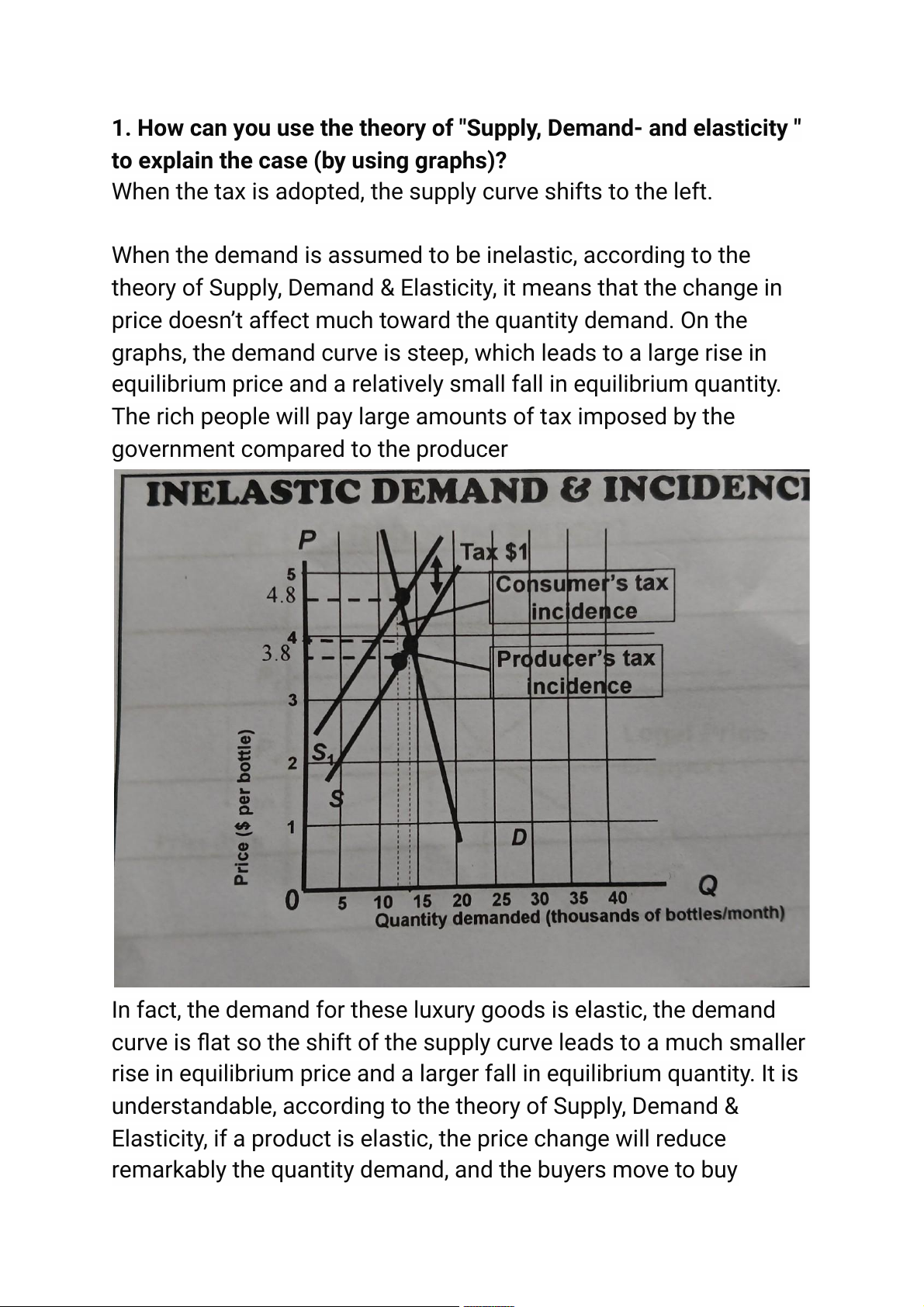
When the demand is assumed to be inelastic, according to the theory of Supply, Demand & Elasticity, it means that the change in price doesn’t affect much toward the quantity demand. On the graphs, the demand curve is steep, which leads to a large rise in equilibrium price and a relatively small fall in equilibrium quantity. The rich people will pay large amounts of tax imposed by the government compared to the producer. Tài liệu được sưu tầm và soạn thảo dưới dạng file PDF để gửi tới các bạn cùng tham khảo, ôn tập đầy đủ kiến thức, chuẩn bị cho các buổi học thật tốt. Mời bạn đọc đón xem!
Môn: Microeconomics 635 tài liệu
Trường: Trường Đại học Quốc tế, Đại học Quốc gia Thành phố Hồ Chí Minh 1.9 K tài liệu
Tác giả:


Preview text:
1. How can you use the theory of "Supply, Demand- and elasticity "
to explain the case (by using graphs)?
When the tax is adopted, the supply curve shifts to the left.
When the demand is assumed to be inelastic, according to the
theory of Supply, Demand & Elasticity, it means that the change in
price doesn’t affect much toward the quantity demand. On the
graphs, the demand curve is steep, which leads to a large rise in
equilibrium price and a relatively small fall in equilibrium quantity.
The rich people will pay large amounts of tax imposed by the
government compared to the producer
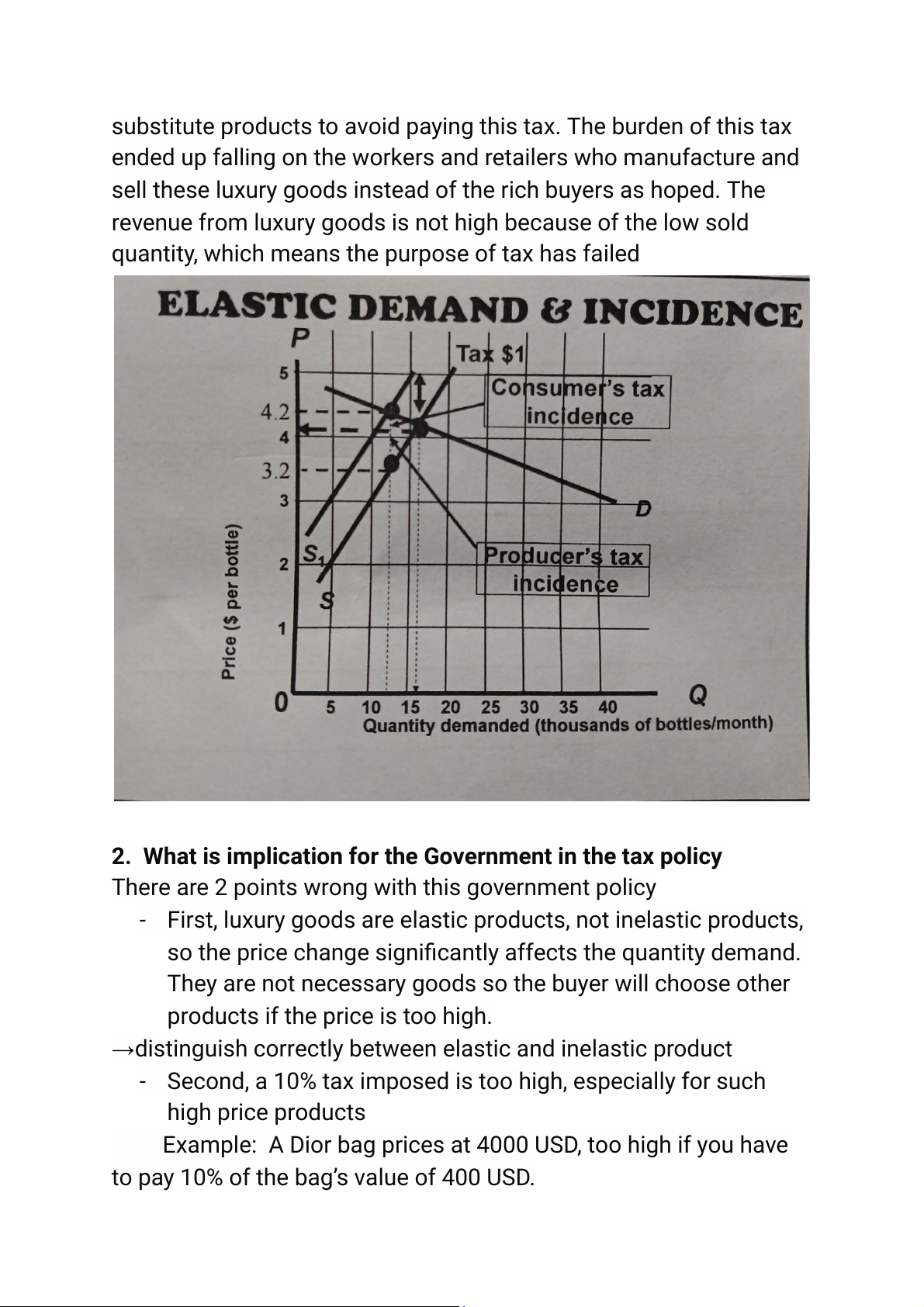
In fact, the demand for these luxury goods is elastic, the demand
curve is flat so the shift of the supply curve leads to a much smaller
rise in equilibrium price and a larger fall in equilibrium quantity. It is
understandable, according to the theory of Supply, Demand &
Elasticity, if a product is elastic, the price change will reduce
remarkably the quantity demand, and the buyers move to buy
substitute products to avoid paying this tax. The burden of this tax
ended up falling on the workers and retailers who manufacture and
sell these luxury goods instead of the rich buyers as hoped. The
revenue from luxury goods is not high because of the low sold
quantity, which means the purpose of tax has failed
2. What is implication for the Government in the tax policy
There are 2 points wrong with this government policy
- First, luxury goods are elastic products, not inelastic products,
so the price change significantly affects the quantity demand.
They are not necessary goods so the buyer will choose other
products if the price is too high.
→distinguish correctly between elastic and inelastic product
- Second, a 10% tax imposed is too high, especially for such high price products
Example: A Dior bag prices at 4000 USD, too high if you have
to pay 10% of the bag’s value of 400 USD.
→3-5% is quite enough, it doesn’t change the price too much so
the quantity demand doesn’t reduce a lot
Tài liệu liên quan:
-

Chương 3: độ co giãn và các nhân tố ảnh hưởng | Microeconomics | Trường Đại học Quốc tế, Đại học Quốc gia Thành phố Hồ Chí Minh
3 2 -
Microeconomics Syllabus | Microeconomics | Trường Đại học Quốc tế, Đại học Quốc gia Thành phố Hồ Chí Minh
3 2 -
Microeconomics Course Syllabus & Assessment Details | Microeconomics | Trường Đại học Quốc tế, Đại học Quốc gia Thành phố Hồ Chí Minh
3 2 -
Assignment 3 - Elasticity MCQs and Key Concepts | Microeconomics | Trường Đại học Quốc tế, Đại học Quốc gia Thành phố Hồ Chí Minh
3 2 -
Assignment 2 - Economic Equilibrium Analysis of Fridges and Motorcycles | Microeconomics | Trường Đại học Quốc tế, Đại học Quốc gia Thành phố Hồ Chí Minh
3 2