Test Bank for Labor Economics | Microeconomics | Trường Đại học Quốc tế, Đại học Quốc gia Thành phố Hồ Chí Minh
Student name:__________ 1) In competitive labor markets, _____ demand labor and ______ supply labor. A) firms; labor unions B) labor unions; firms C) workers; firms D) firms, workers 2) In a competitive labor market, if a firm pays a worker less than that worker's VMP, then in the long run A) the firm will earn positive economic profits. B) competing firms will hire the worker away. C) the worker will have no incentive to work hard. D) the supply of. Tài liệu được sưu tầm và soạn thảo dưới dạng file PDF để gửi tới các bạn cùng tham khảo, ôn tập đầy đủ kiến thức, chuẩn bị cho các buổi học thật tốt. Mời bạn đọc đón xem!
Môn: Microeconomics 635 tài liệu
Trường: Trường Đại học Quốc tế, Đại học Quốc gia Thành phố Hồ Chí Minh 1.9 K tài liệu
Tác giả:

Preview text:
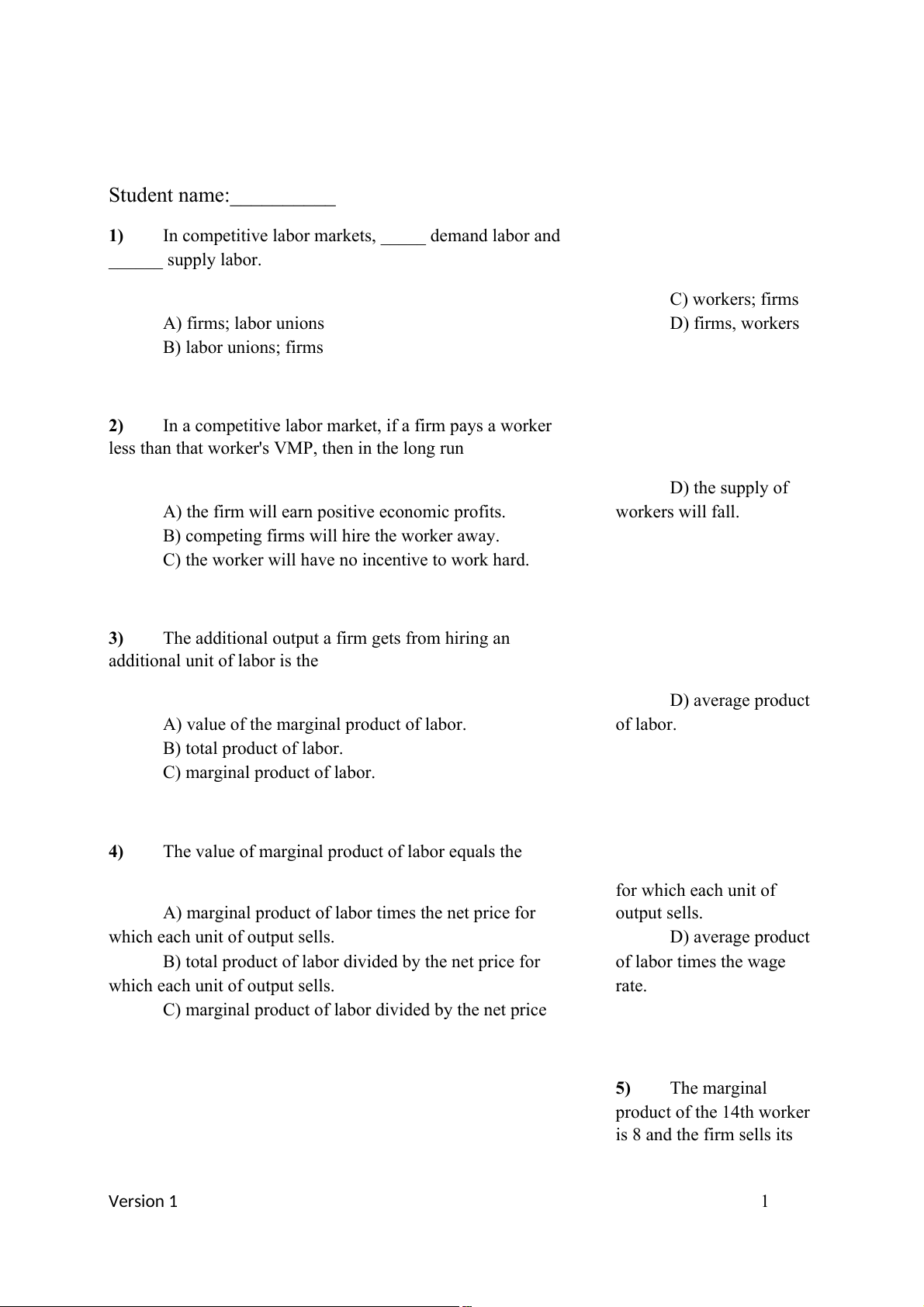
Student name:__________ 1)
In competitive labor markets, _____ demand labor and ______ supply labor. C) workers; firms A) firms; labor unions D) firms, workers B) labor unions; firms 2)
In a competitive labor market, if a firm pays a worker
less than that worker's VMP, then in the long run D) the supply of
A) the firm will earn positive economic profits. workers will fall.
B) competing firms will hire the worker away.
C) the worker will have no incentive to work hard. 3)
The additional output a firm gets from hiring an
additional unit of labor is the D) average product
A) value of the marginal product of labor. of labor. B) total product of labor. C) marginal product of labor. 4)
The value of marginal product of labor equals the for which each unit of
A) marginal product of labor times the net price for output sells.
which each unit of output sells. D) average product
B) total product of labor divided by the net price for of labor times the wage
which each unit of output sells. rate.
C) marginal product of labor divided by the net price 5) The marginal product of the 14th worker is 8 and the firm sells its Version 1 1
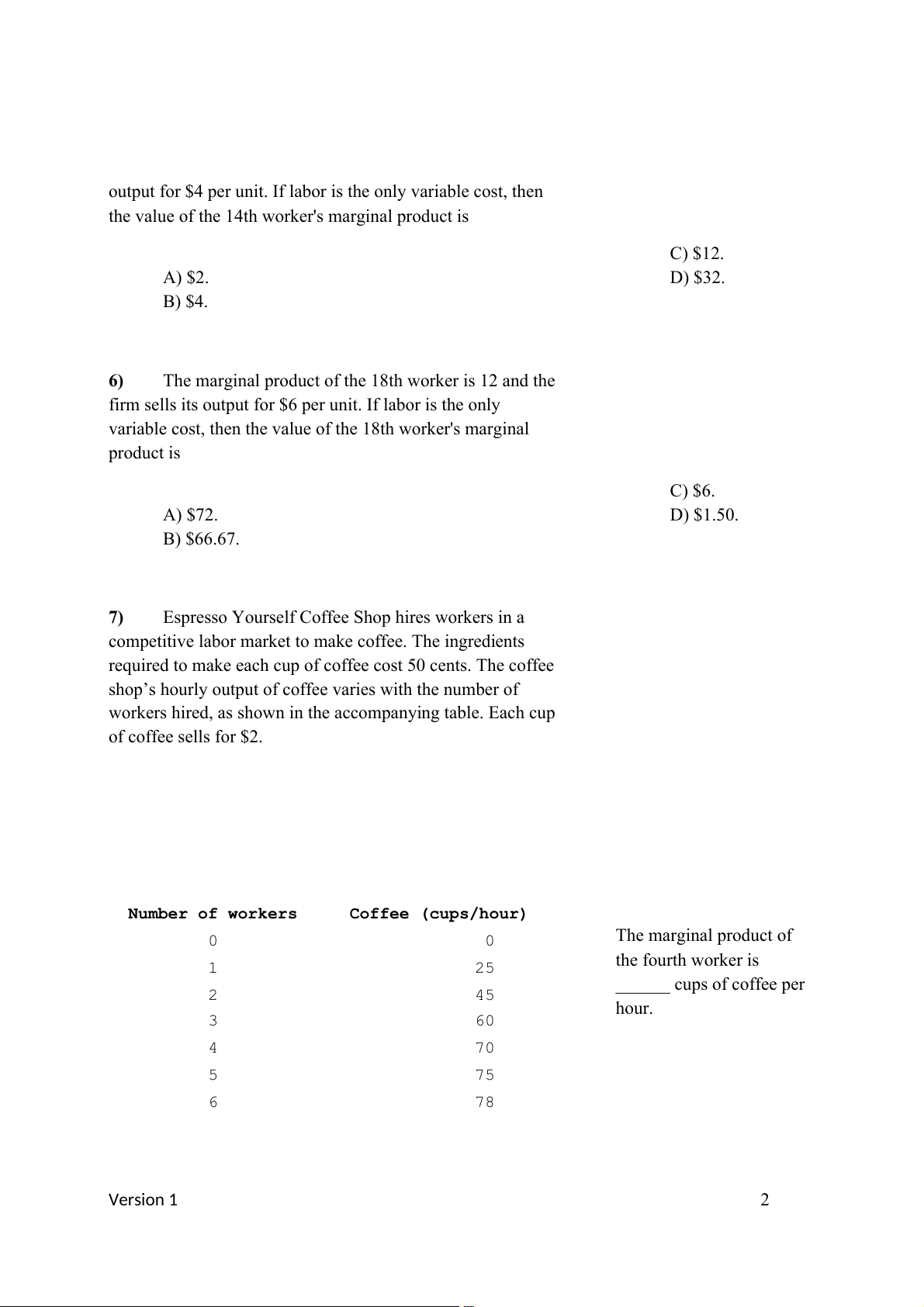
output for $4 per unit. If labor is the only variable cost, then
the value of the 14th worker's marginal product is C) $12. A) $2. D) $32. B) $4. 6)
The marginal product of the 18th worker is 12 and the
firm sells its output for $6 per unit. If labor is the only
variable cost, then the value of the 18th worker's marginal product is C) $6. A) $72. D) $1.50. B) $66.67. 7)
Espresso Yourself Coffee Shop hires workers in a
competitive labor market to make coffee. The ingredients
required to make each cup of coffee cost 50 cents. The coffee
shop’s hourly output of coffee varies with the number of
workers hired, as shown in the accompanying table. Each cup of coffee sells for $2. Number of workers Coffee (cups/hour) 0 0 The marginal product of the fourth worker is 1 25 ______ cups of coffee per 2 45 hour. 3 60 4 70 5 75 6 78 Version 1 2 C) 17.5 A) 70 D) 10 B) 60 8)
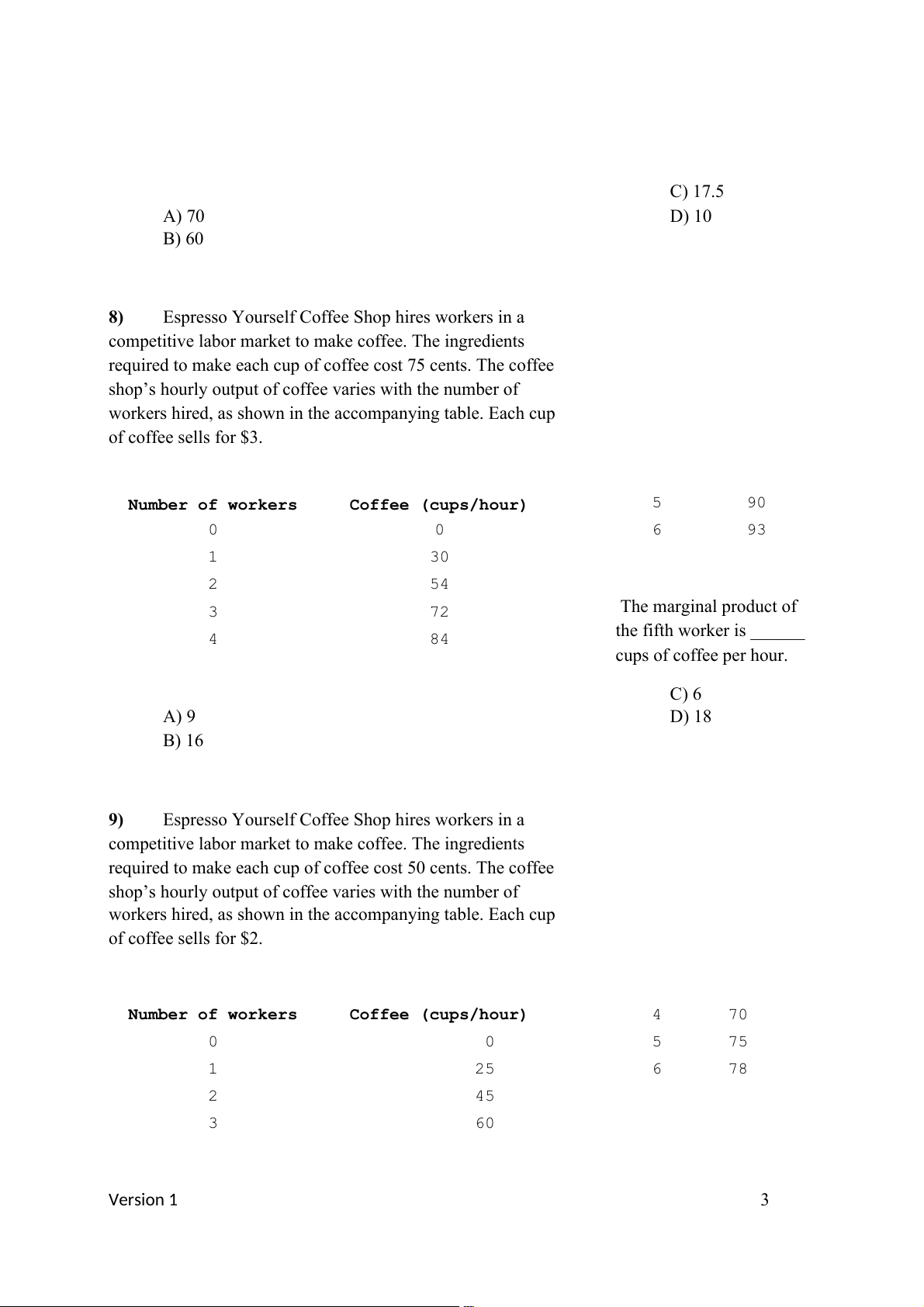
Espresso Yourself Coffee Shop hires workers in a
competitive labor market to make coffee. The ingredients
required to make each cup of coffee cost 75 cents. The coffee
shop’s hourly output of coffee varies with the number of
workers hired, as shown in the accompanying table. Each cup of coffee sells for $3. Number of workers Coffee (cups/hour) 5 90 0 0 6 93 1 30 2 54 3 72 The marginal product of the fifth worker is ______ 4 84 cups of coffee per hour. C) 6 A) 9 D) 18 B) 16 9)
Espresso Yourself Coffee Shop hires workers in a
competitive labor market to make coffee. The ingredients
required to make each cup of coffee cost 50 cents. The coffee
shop’s hourly output of coffee varies with the number of
workers hired, as shown in the accompanying table. Each cup of coffee sells for $2. Number of workers Coffee (cups/hour) 4 70 0 0 5 75 1 25 6 78 2 45 3 60 Version 1 3
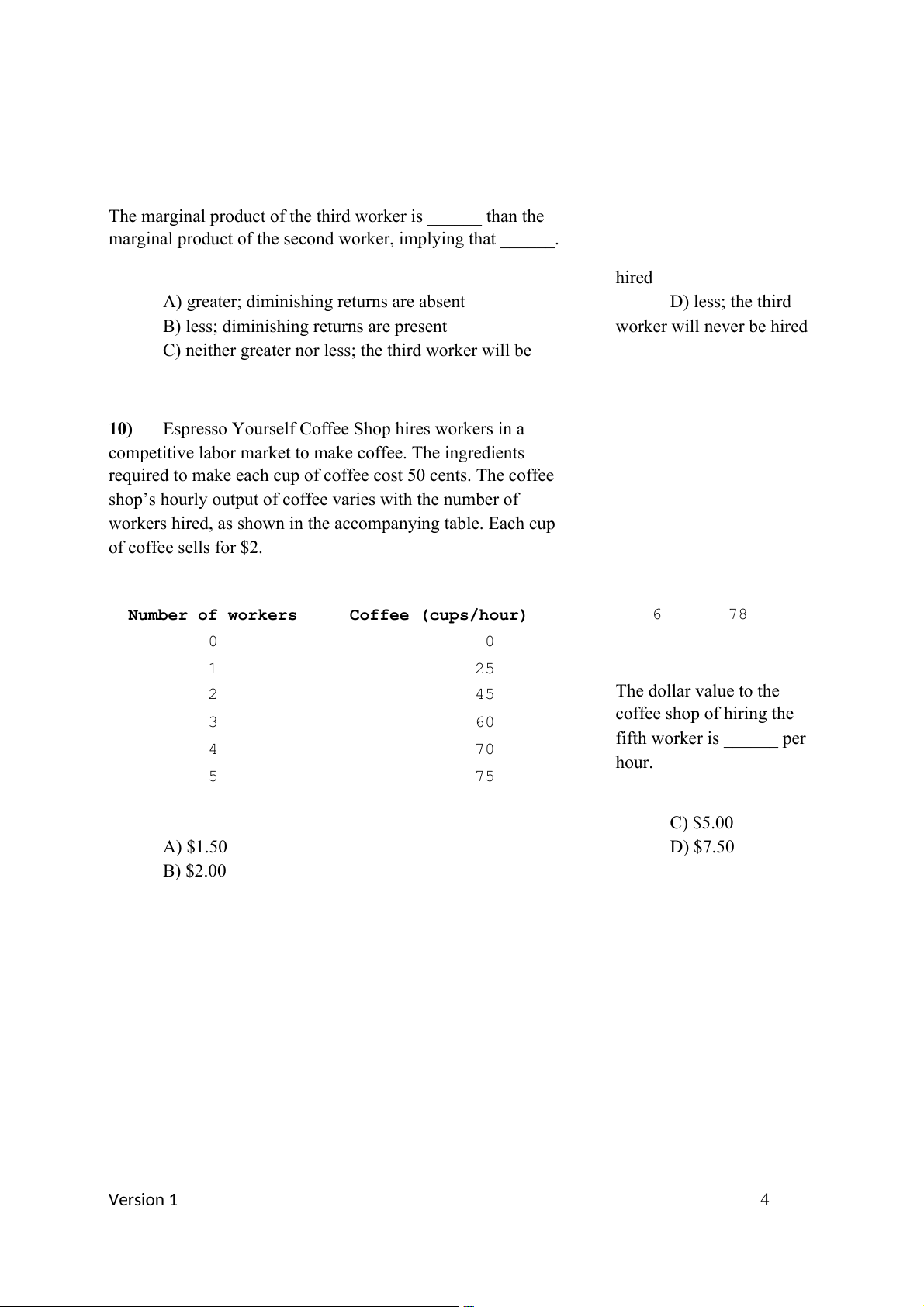
The marginal product of the third worker is ______ than the
marginal product of the second worker, implying that ______. hired
A) greater; diminishing returns are absent D) less; the third
B) less; diminishing returns are present worker will never be hired
C) neither greater nor less; the third worker will be 10)
Espresso Yourself Coffee Shop hires workers in a
competitive labor market to make coffee. The ingredients
required to make each cup of coffee cost 50 cents. The coffee
shop’s hourly output of coffee varies with the number of
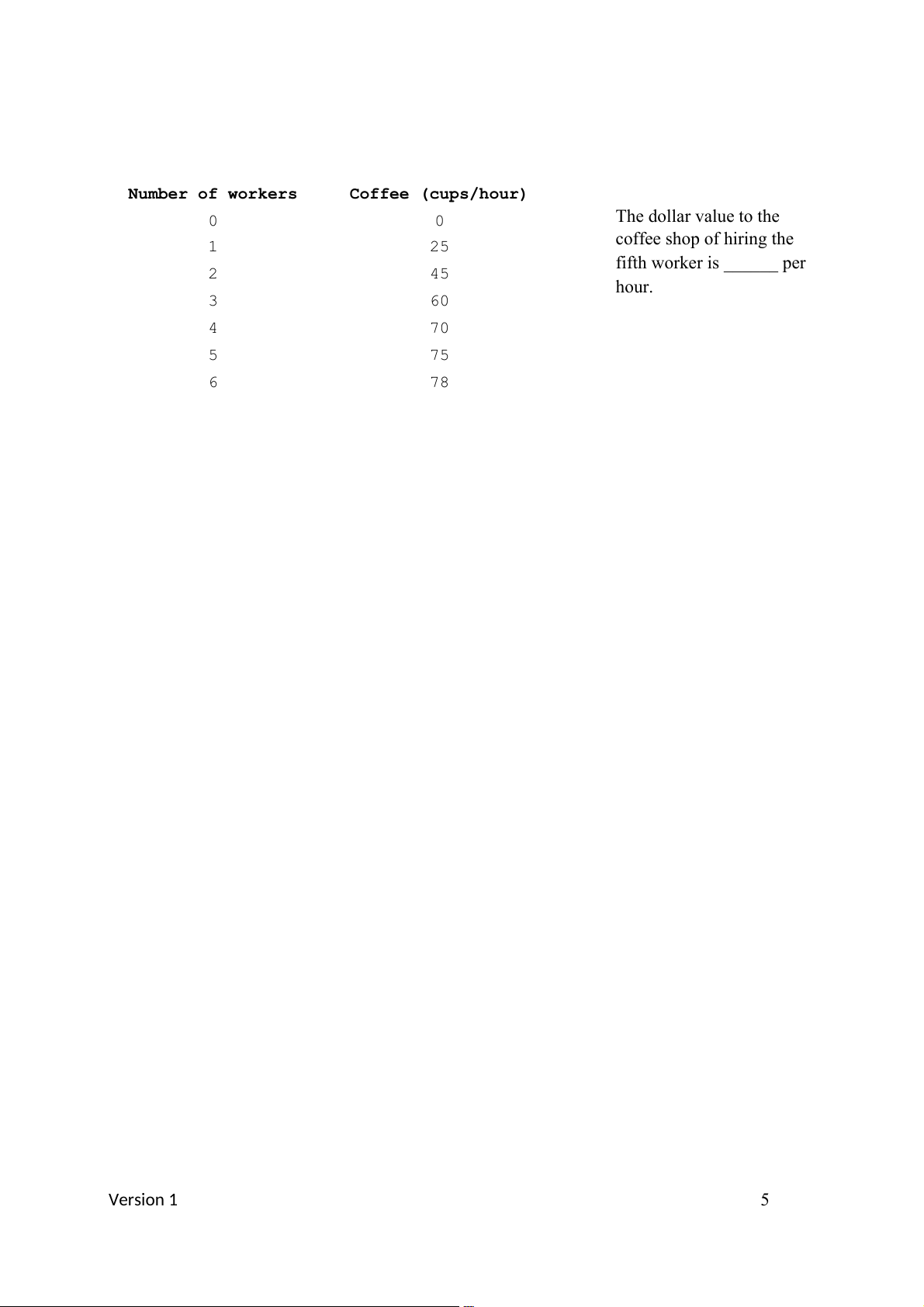
workers hired, as shown in the accompanying table. Each cup of coffee sells for $2. Number of workers Coffee (cups/hour) 6 78 0 0 1 25 2 45 The dollar value to the coffee shop of hiring the 3 60 fifth worker is ______ per 4 70 hour. 5 75 C) $5.00 A) $1.50 D) $7.50 B) $2.00 Version 1 4 Number of workers Coffee (cups/hour) 0 0 The dollar value to the coffee shop of hiring the 1 25 fifth worker is ______ per 2 45 hour. 3 60 4 70 5 75 6 78 Version 1 5 C) $12.50 A) $2.50 D) $7.50 B) $5.00 12)
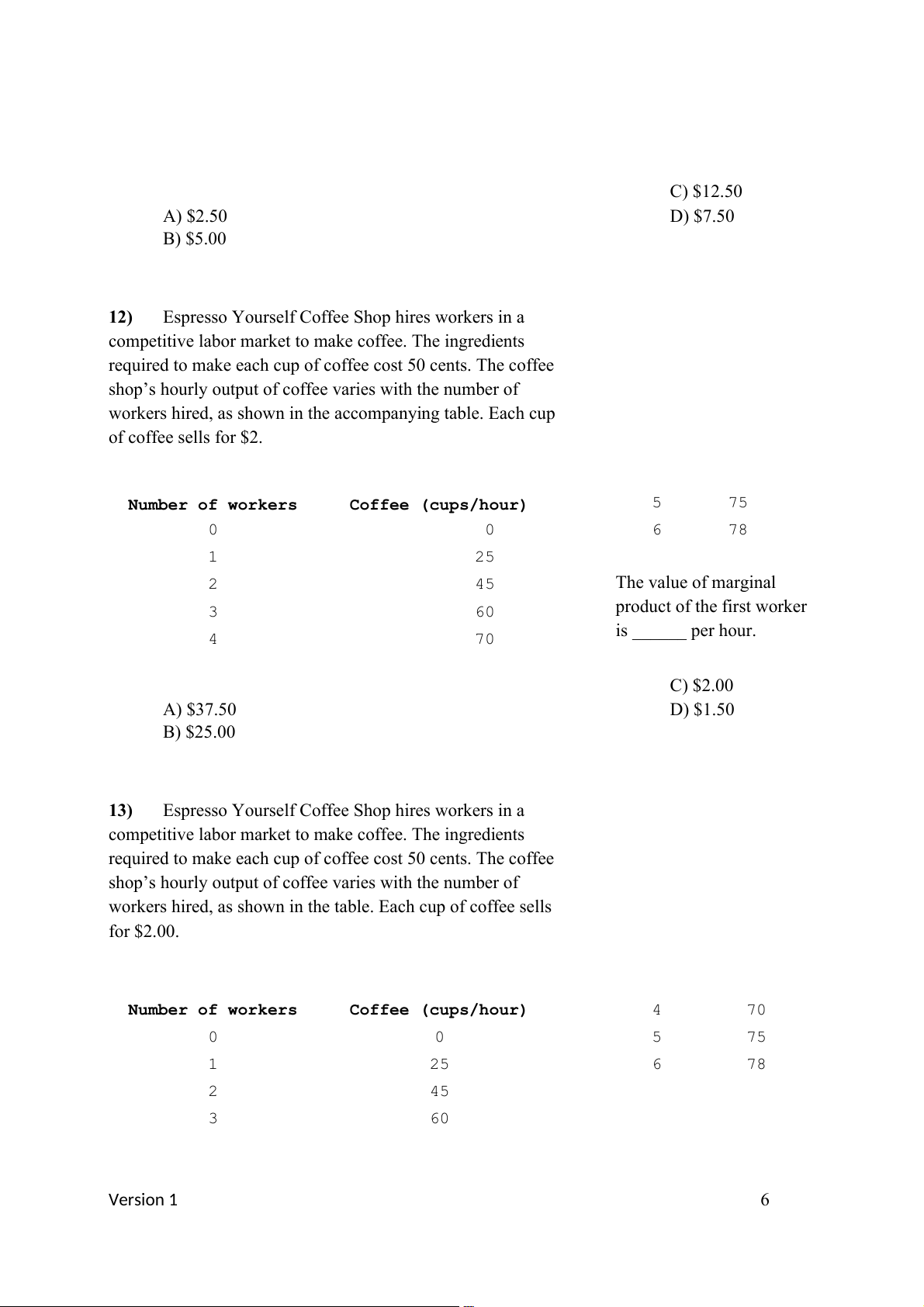
Espresso Yourself Coffee Shop hires workers in a
competitive labor market to make coffee. The ingredients
required to make each cup of coffee cost 50 cents. The coffee
shop’s hourly output of coffee varies with the number of
workers hired, as shown in the accompanying table. Each cup of coffee sells for $2. Number of workers Coffee (cups/hour) 5 75 0 0 6 78 1 25 2 45 The value of marginal 3 60 product of the first worker is ______ per hour. 4 70 C) $2.00 A) $37.50 D) $1.50 B) $25.00 13)
Espresso Yourself Coffee Shop hires workers in a
competitive labor market to make coffee. The ingredients
required to make each cup of coffee cost 50 cents. The coffee
shop’s hourly output of coffee varies with the number of
workers hired, as shown in the table. Each cup of coffee sells for $2.00. Number of workers Coffee (cups/hour) 4 70 0 0 5 75 1 25 6 78 2 45 3 60 Version 1 6
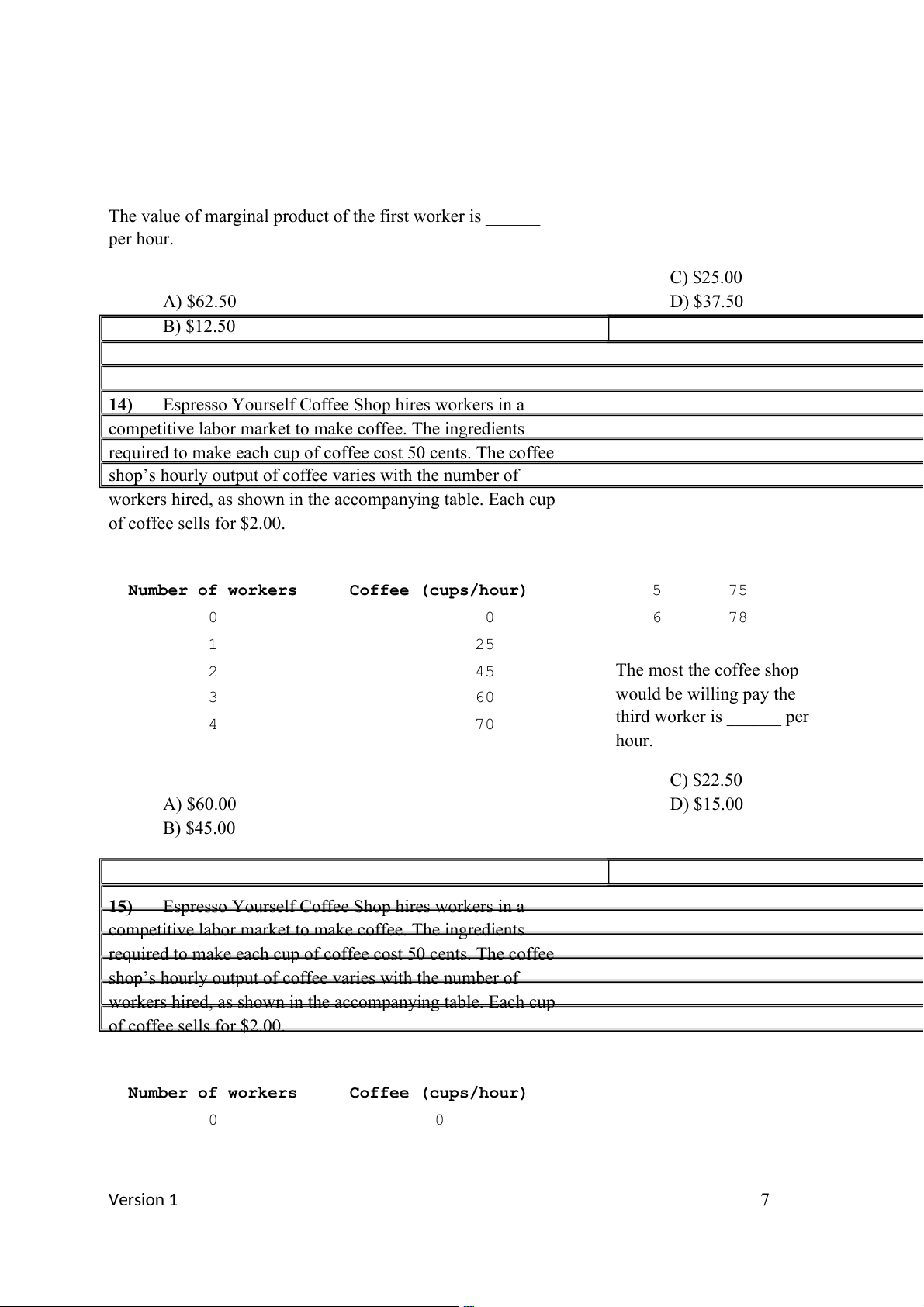
The value of marginal product of the first worker is ______ per hour. C) $25.00 A) $62.50 D) $37.50 B) $12.50 14)
Espresso Yourself Coffee Shop hires workers in a
competitive labor market to make coffee. The ingredients
required to make each cup of coffee cost 50 cents. The coffee
shop’s hourly output of coffee varies with the number of
workers hired, as shown in the accompanying table. Each cup of coffee sells for $2.00. Number of workers Coffee (cups/hour) 5 75 0 0 6 78 1 25 2 45 The most the coffee shop 3 60 would be willing pay the third worker is ______ per 4 70 hour. C) $22.50 A) $60.00 D) $15.00 B) $45.00 15)
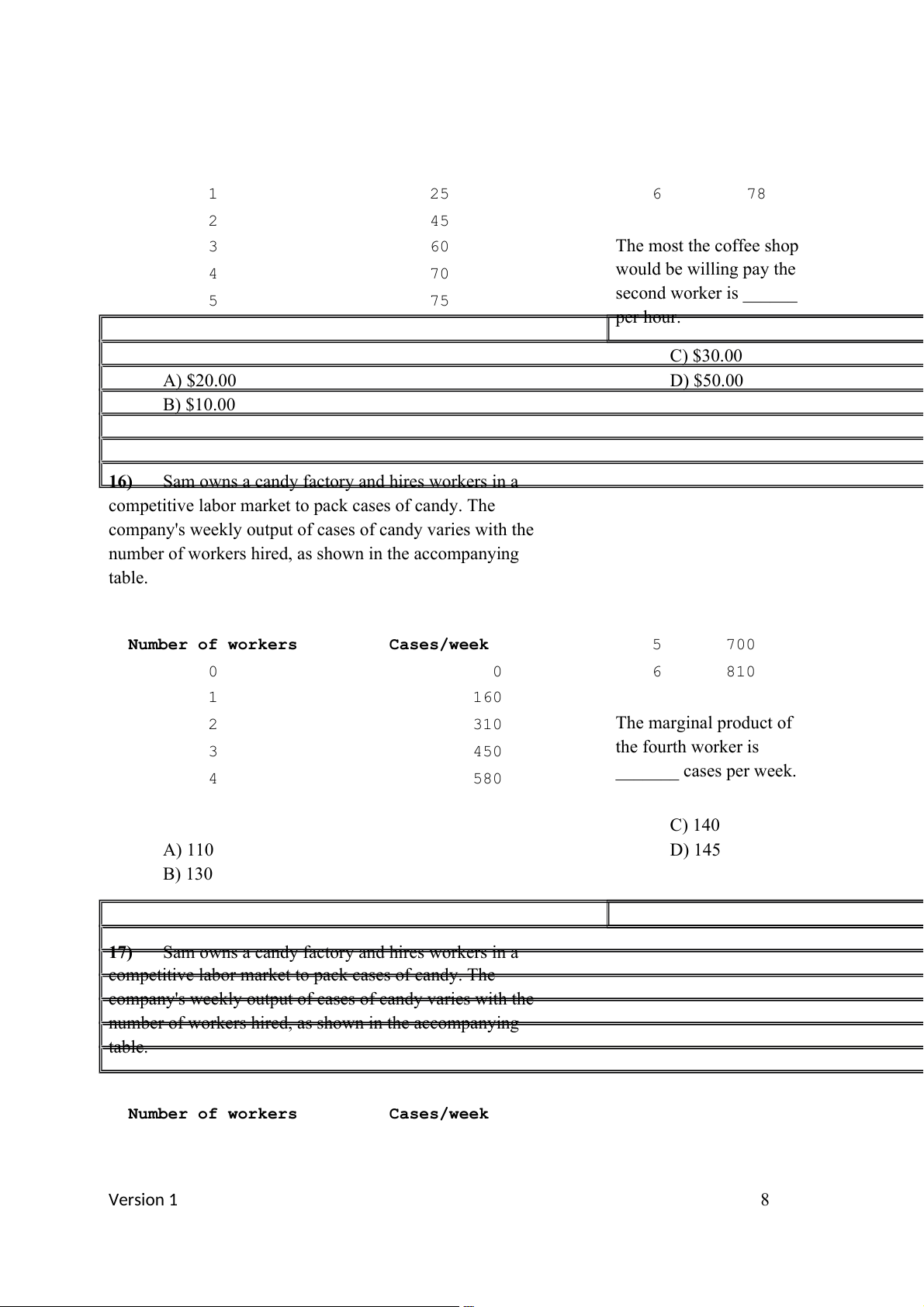
Espresso Yourself Coffee Shop hires workers in a
competitive labor market to make coffee. The ingredients
required to make each cup of coffee cost 50 cents. The coffee
shop’s hourly output of coffee varies with the number of
workers hired, as shown in the accompanying table. Each cup of coffee sells for $2.00. Number of workers Coffee (cups/hour) 0 0 Version 1 7 1 25 6 78 2 45 3 60 The most the coffee shop 4 70 would be willing pay the second worker is ______ 5 75 per hour. C) $30.00 A) $20.00 D) $50.00 B) $10.00 16)
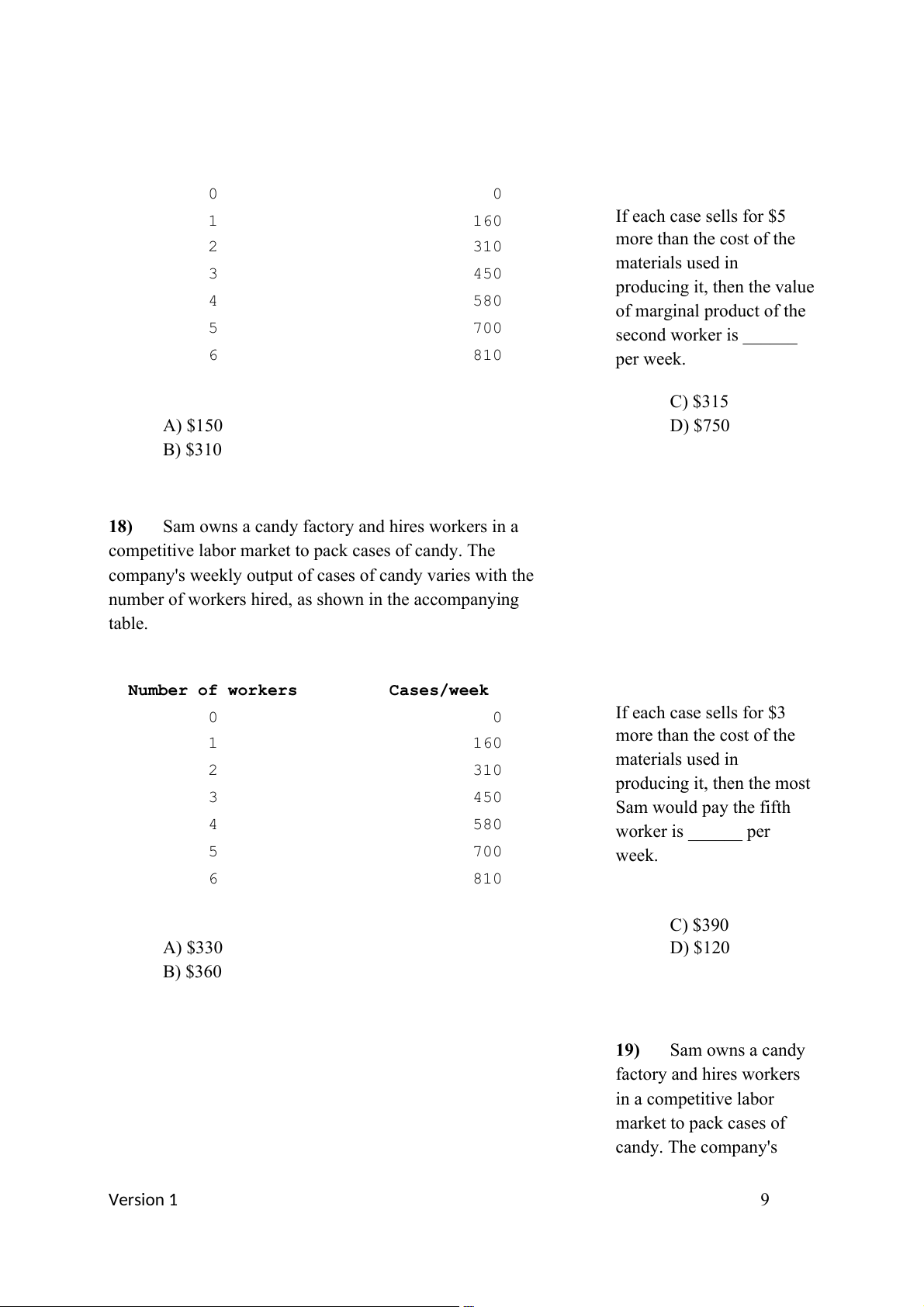
Sam owns a candy factory and hires workers in a
competitive labor market to pack cases of candy. The
company's weekly output of cases of candy varies with the
number of workers hired, as shown in the accompanying table. Number of workers Cases/week 5 700 0 0 6 810 1 160 2 310 The marginal product of 3 450 the fourth worker is _______ cases per week. 4 580 C) 140 A) 110 D) 145 B) 130 17)
Sam owns a candy factory and hires workers in a
competitive labor market to pack cases of candy. The
company's weekly output of cases of candy varies with the
number of workers hired, as shown in the accompanying table. Number of workers Cases/week Version 1 8 0 0 1 160 If each case sells for $5 more than the cost of the 2 310 materials used in 3 450 producing it, then the value 4 580 of marginal product of the 5 700 second worker is ______ 6 810 per week. C) $315 A) $150 D) $750 B) $310 18)
Sam owns a candy factory and hires workers in a
competitive labor market to pack cases of candy. The
company's weekly output of cases of candy varies with the
number of workers hired, as shown in the accompanying table. Number of workers Cases/week 0 0 If each case sells for $3 more than the cost of the 1 160 materials used in 2 310 producing it, then the most 3 450 Sam would pay the fifth 4 580 worker is ______ per 5 700 week. 6 810 C) $390 A) $330 D) $120 B) $360 19) Sam owns a candy factory and hires workers in a competitive labor market to pack cases of candy. The company's Version 1 9
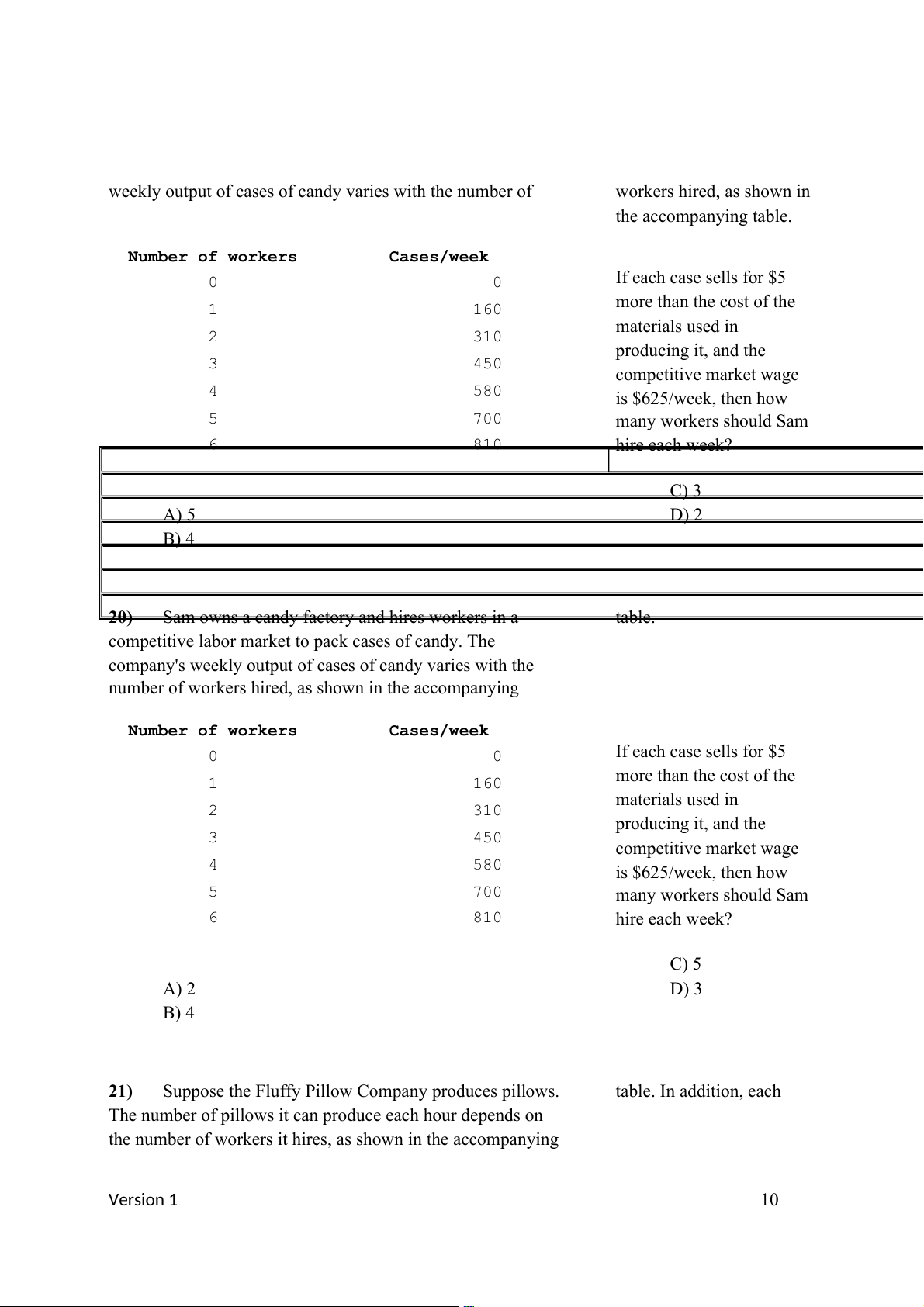
weekly output of cases of candy varies with the number of workers hired, as shown in the accompanying table. Number of workers Cases/week 0 0 If each case sells for $5 more than the cost of the 1 160 materials used in 2 310 producing it, and the 3 450 competitive market wage 4 580 is $625/week, then how 5 700 many workers should Sam 6 810 hire each week? C) 3 A) 5 D) 2 B) 4 20)
Sam owns a candy factory and hires workers in a table.
competitive labor market to pack cases of candy. The
company's weekly output of cases of candy varies with the
number of workers hired, as shown in the accompanying Number of workers Cases/week 0 0 If each case sells for $5 more than the cost of the 1 160 materials used in 2 310 producing it, and the 3 450 competitive market wage 4 580 is $625/week, then how 5 700 many workers should Sam 6 810 hire each week? C) 5 A) 2 D) 3 B) 4 21)
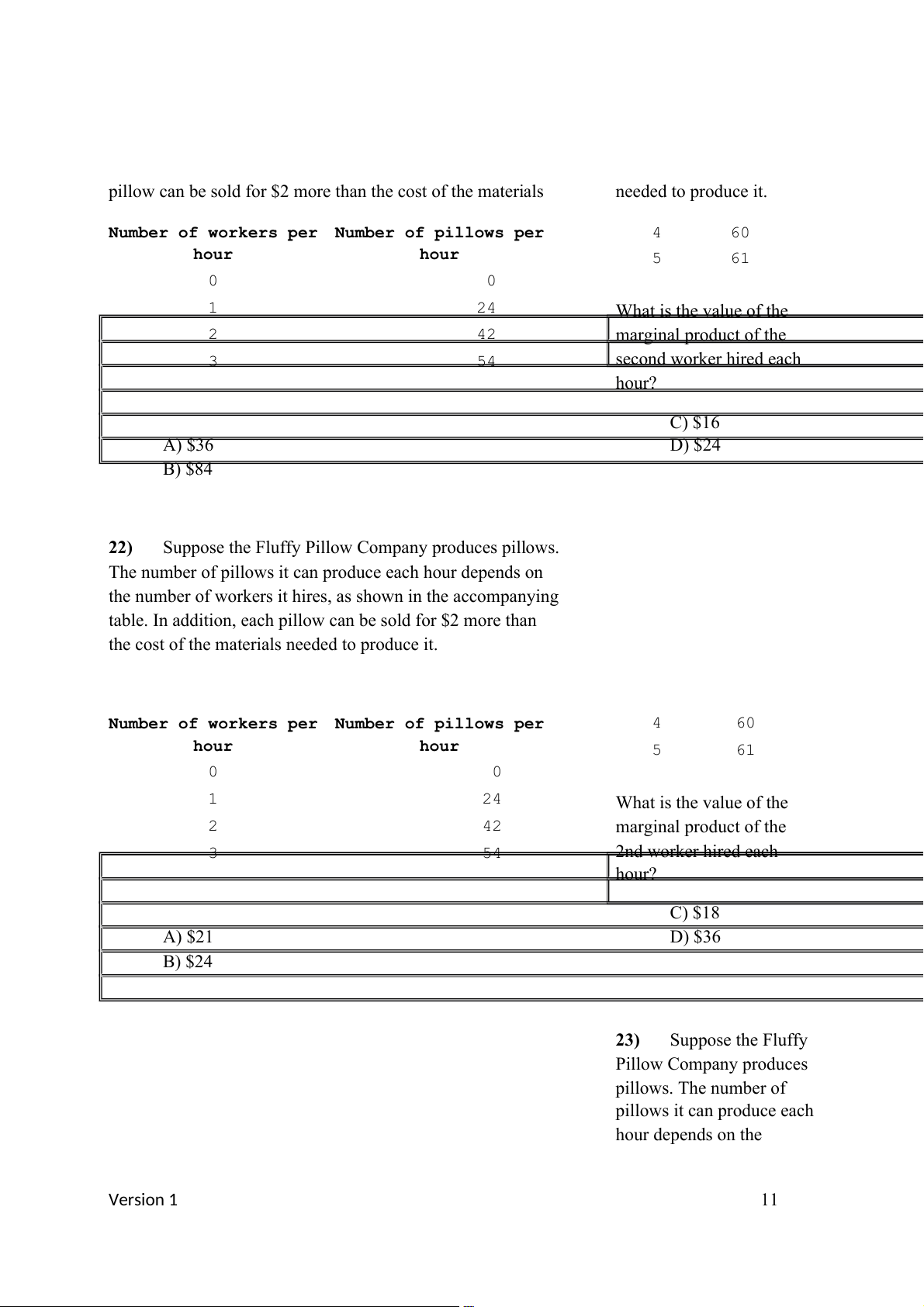
Suppose the Fluffy Pillow Company produces pillows. table. In addition, each
The number of pillows it can produce each hour depends on
the number of workers it hires, as shown in the accompanying Version 1 10
pillow can be sold for $2 more than the cost of the materials needed to produce it. Number of workers per Number of pillows per 4 60 hour hour 5 61 0 0 1 24 What is the value of the 2 42 marginal product of the 3 54 second worker hired each hour? C) $16 A) $36 D) $24 B) $84 22)
Suppose the Fluffy Pillow Company produces pillows.
The number of pillows it can produce each hour depends on
the number of workers it hires, as shown in the accompanying
table. In addition, each pillow can be sold for $2 more than
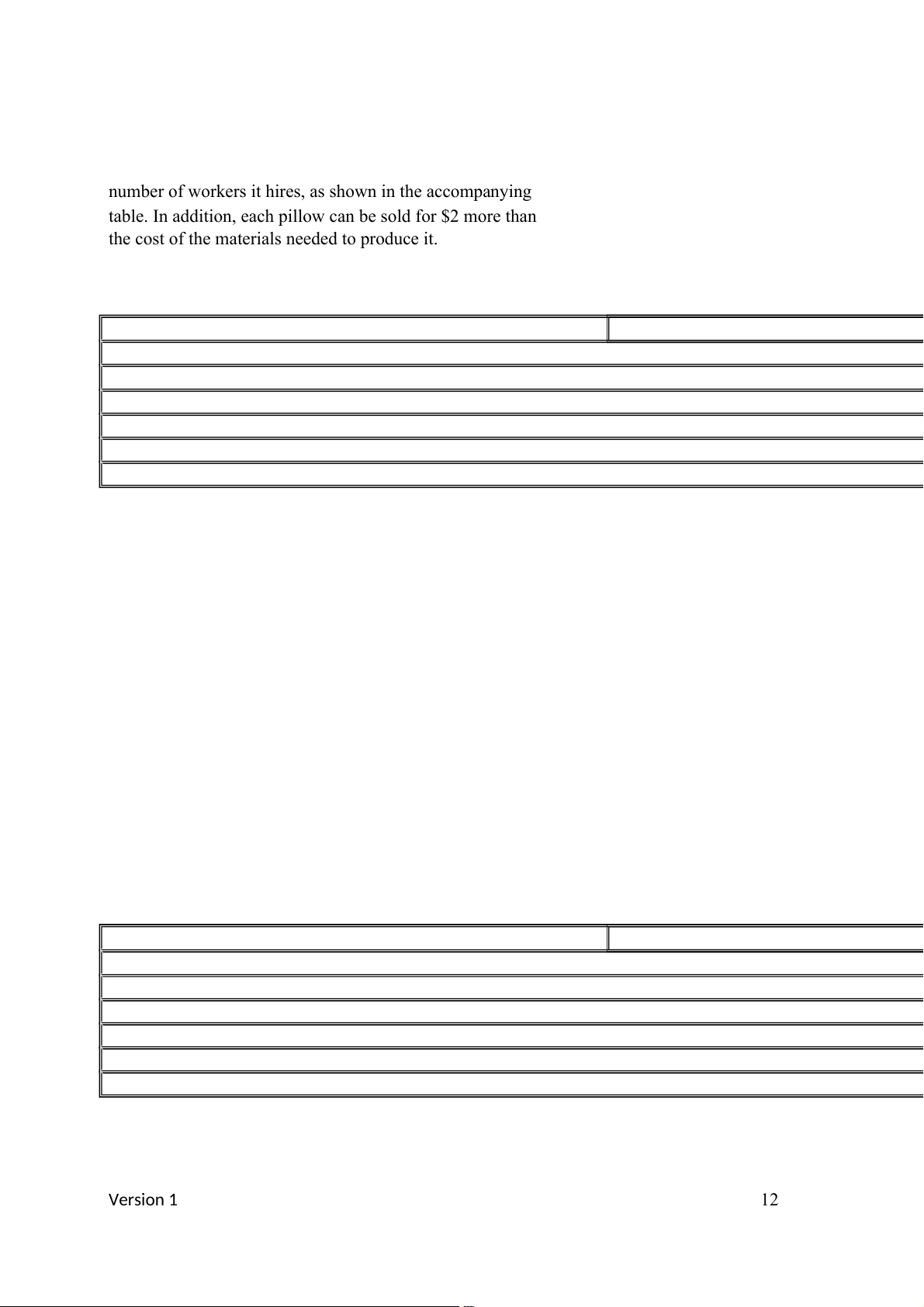
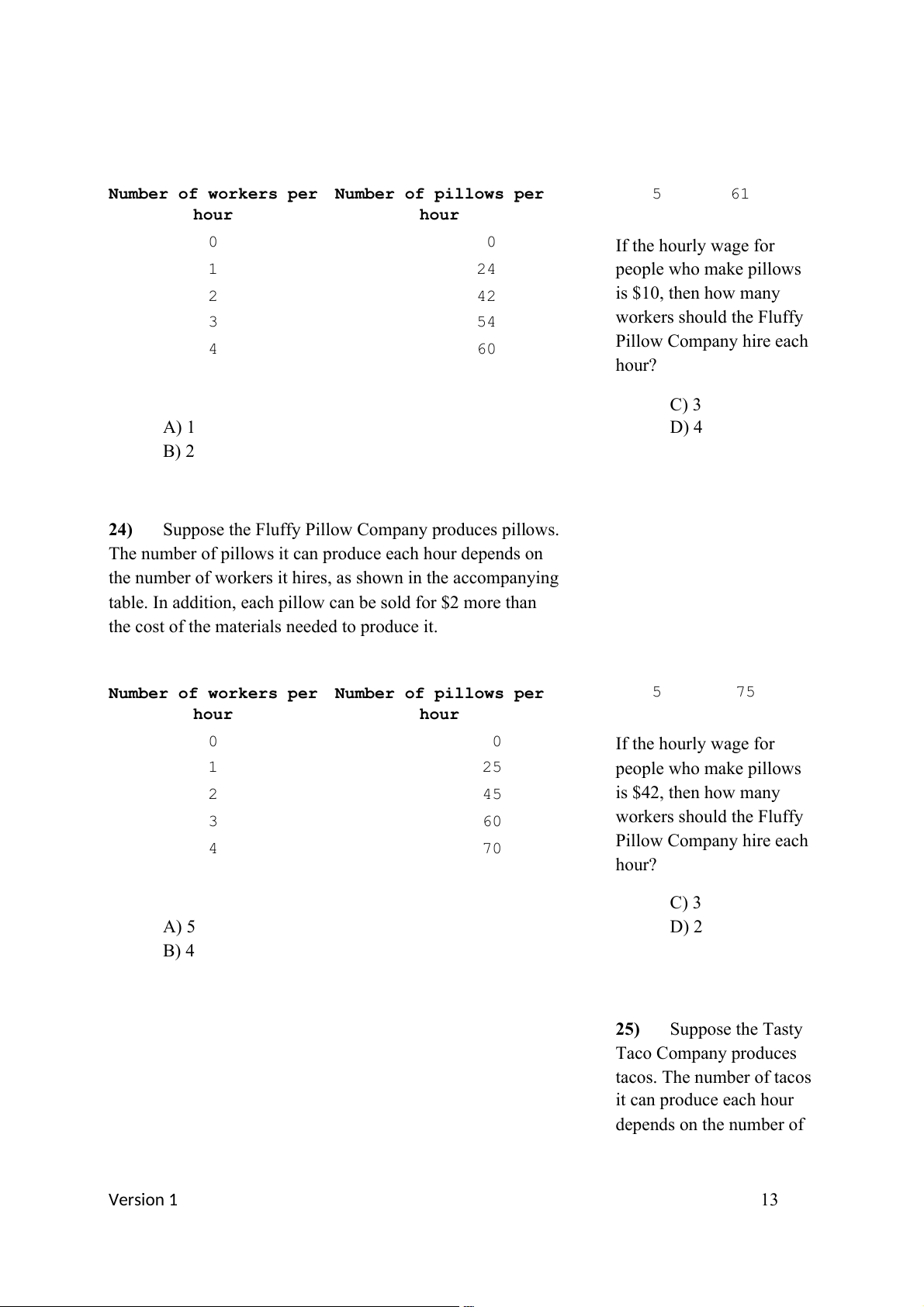
the cost of the materials needed to produce it. Number of workers per Number of pillows per 4 60 hour hour 5 61 0 0 1 24 What is the value of the 2 42 marginal product of the 3 54 2nd worker hired each hour? C) $18 A) $21 D) $36 B) $24 23) Suppose the Fluffy Pillow Company produces pillows. The number of pillows it can produce each hour depends on the Version 1 11
number of workers it hires, as shown in the accompanying
table. In addition, each pillow can be sold for $2 more than
the cost of the materials needed to produce it. Version 1 12 Number of workers per Number of pillows per 5 61 hour hour 0 0 If the hourly wage for 1 24 people who make pillows 2 42 is $10, then how many 3 54 workers should the Fluffy Pillow Company hire each 4 60 hour? C) 3 A) 1 D) 4 B) 2 24)
Suppose the Fluffy Pillow Company produces pillows.
The number of pillows it can produce each hour depends on
the number of workers it hires, as shown in the accompanying
table. In addition, each pillow can be sold for $2 more than
the cost of the materials needed to produce it. Number of workers per Number of pillows per 5 75 hour hour 0 0 If the hourly wage for 1 25 people who make pillows 2 45 is $42, then how many 3 60 workers should the Fluffy Pillow Company hire each 4 70 hour? C) 3 A) 5 D) 2 B) 4 25) Suppose the Tasty Taco Company produces tacos. The number of tacos it can produce each hour depends on the number of Version 1 13
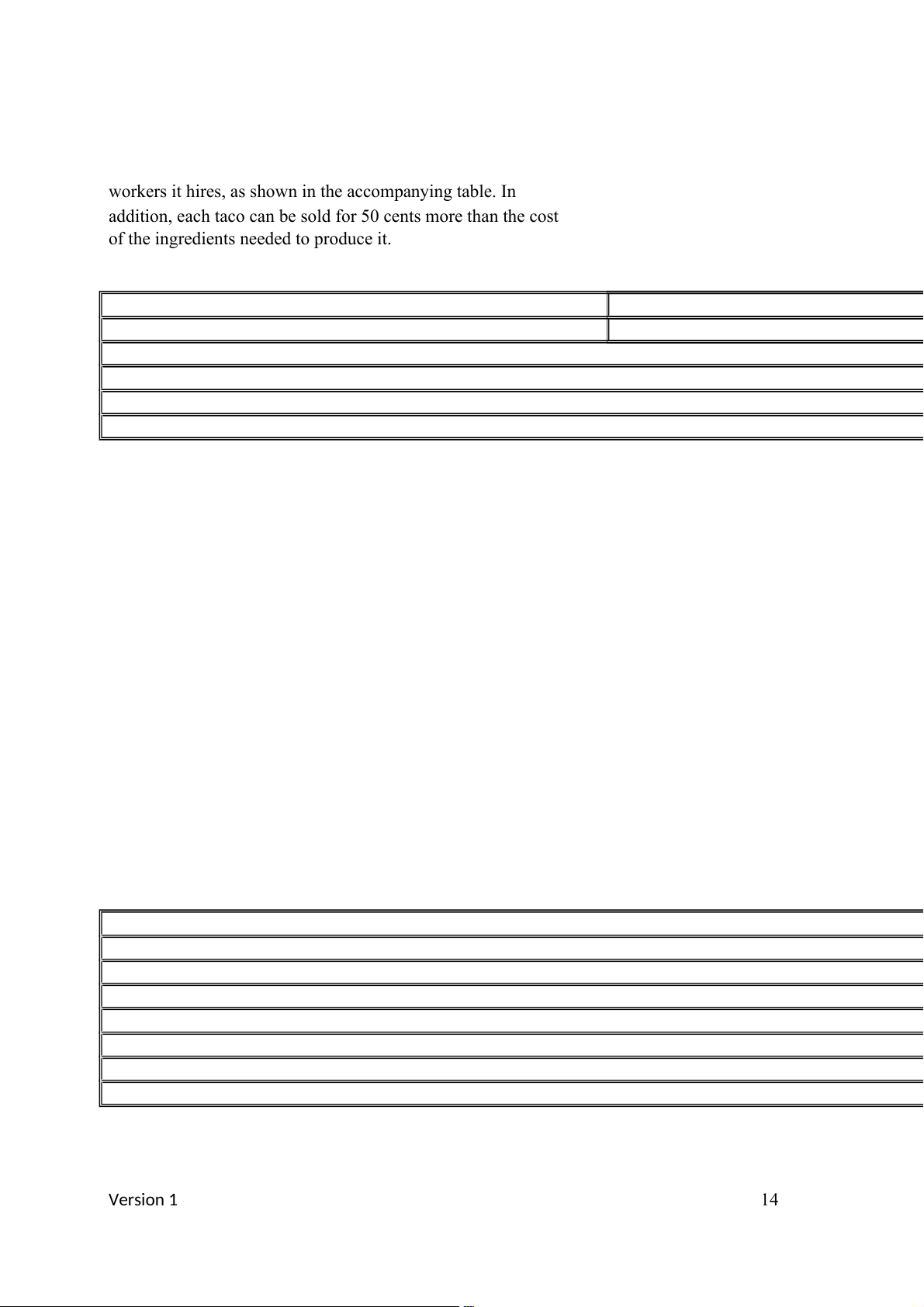
workers it hires, as shown in the accompanying table. In
addition, each taco can be sold for 50 cents more than the cost
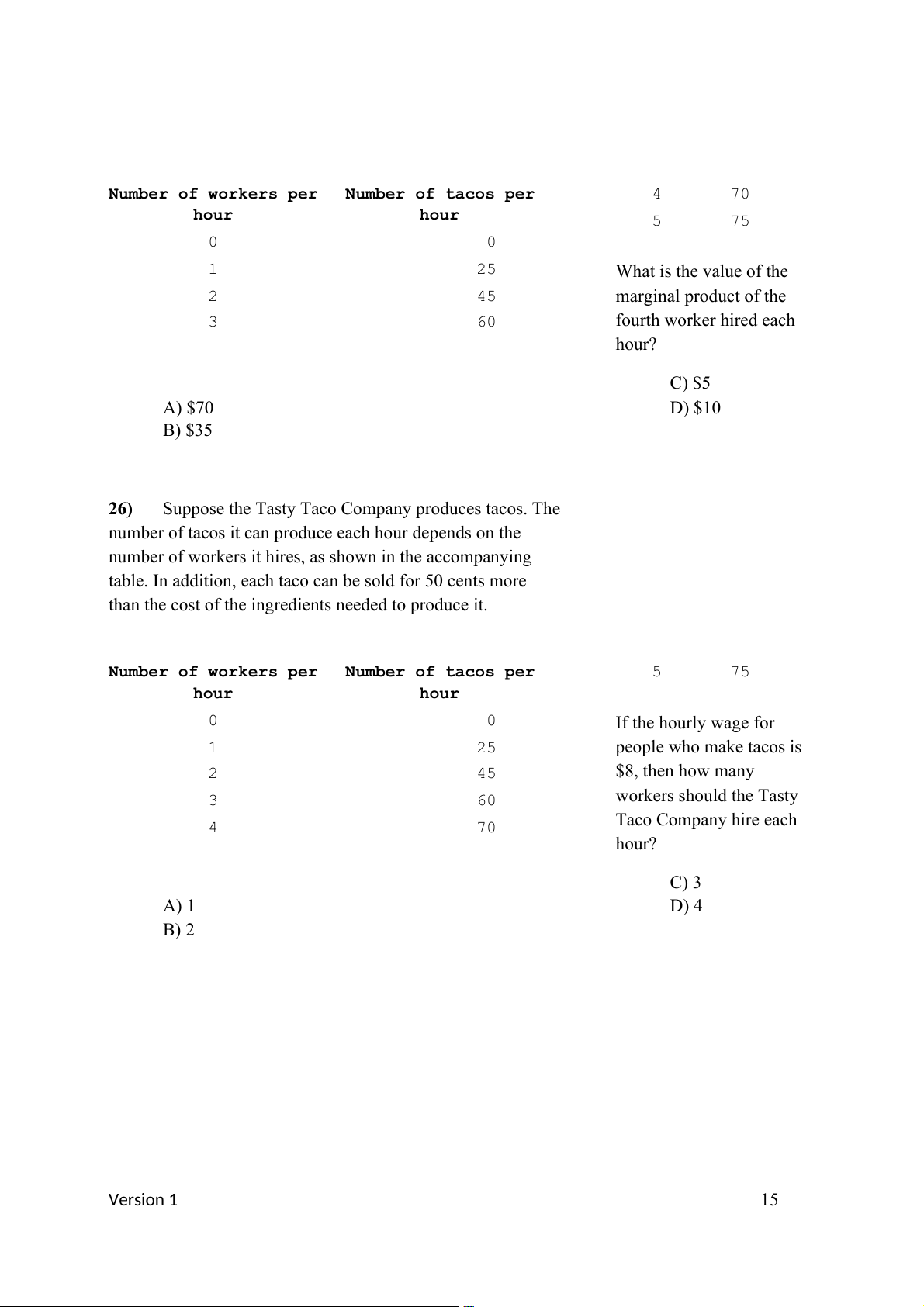
of the ingredients needed to produce it. Version 1 14 Number of workers per Number of tacos per 4 70 hour hour 5 75 0 0 1 25 What is the value of the 2 45 marginal product of the 3 60 fourth worker hired each hour? C) $5 A) $70 D) $10 B) $35 26)
Suppose the Tasty Taco Company produces tacos. The
number of tacos it can produce each hour depends on the
number of workers it hires, as shown in the accompanying
table. In addition, each taco can be sold for 50 cents more
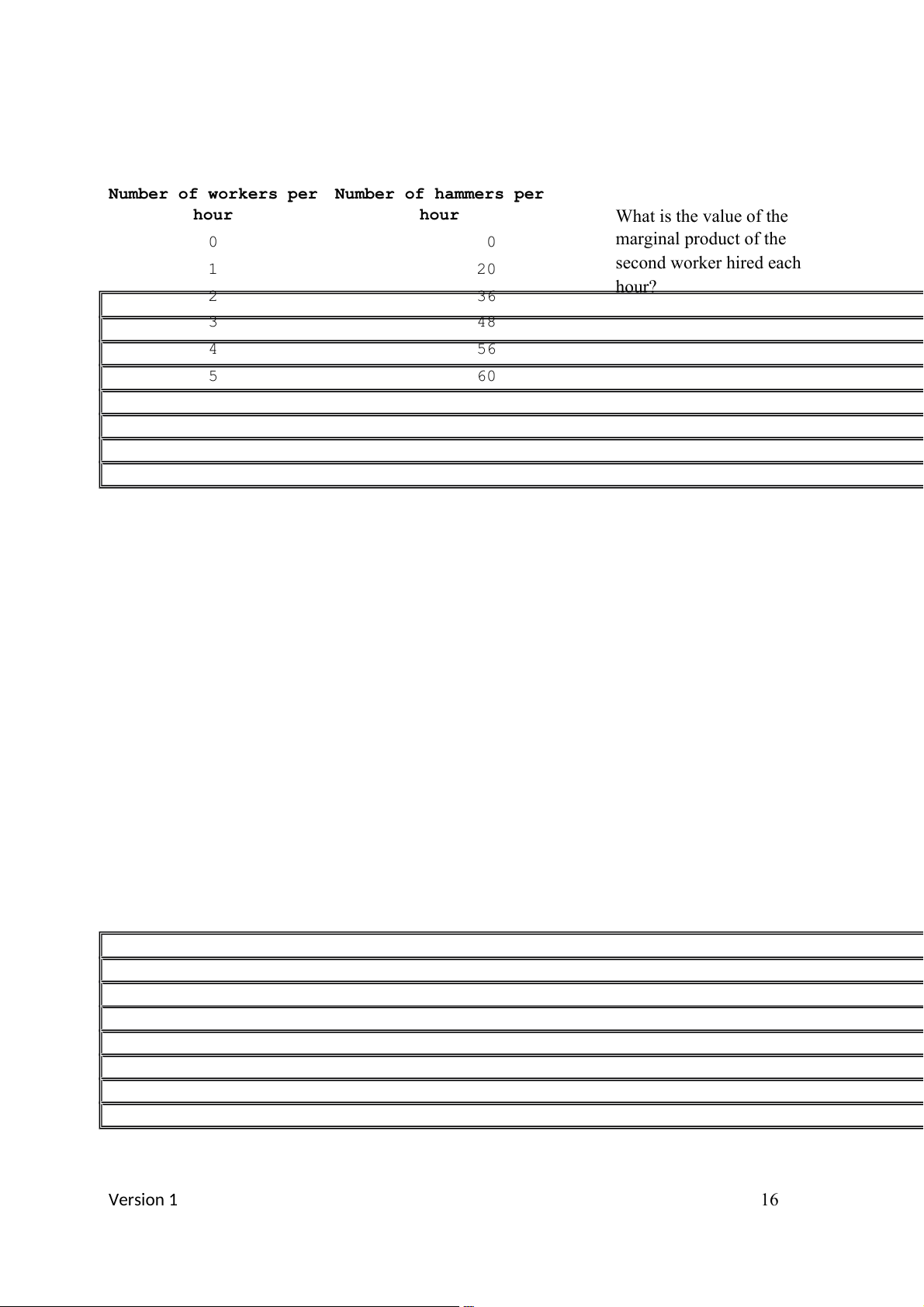
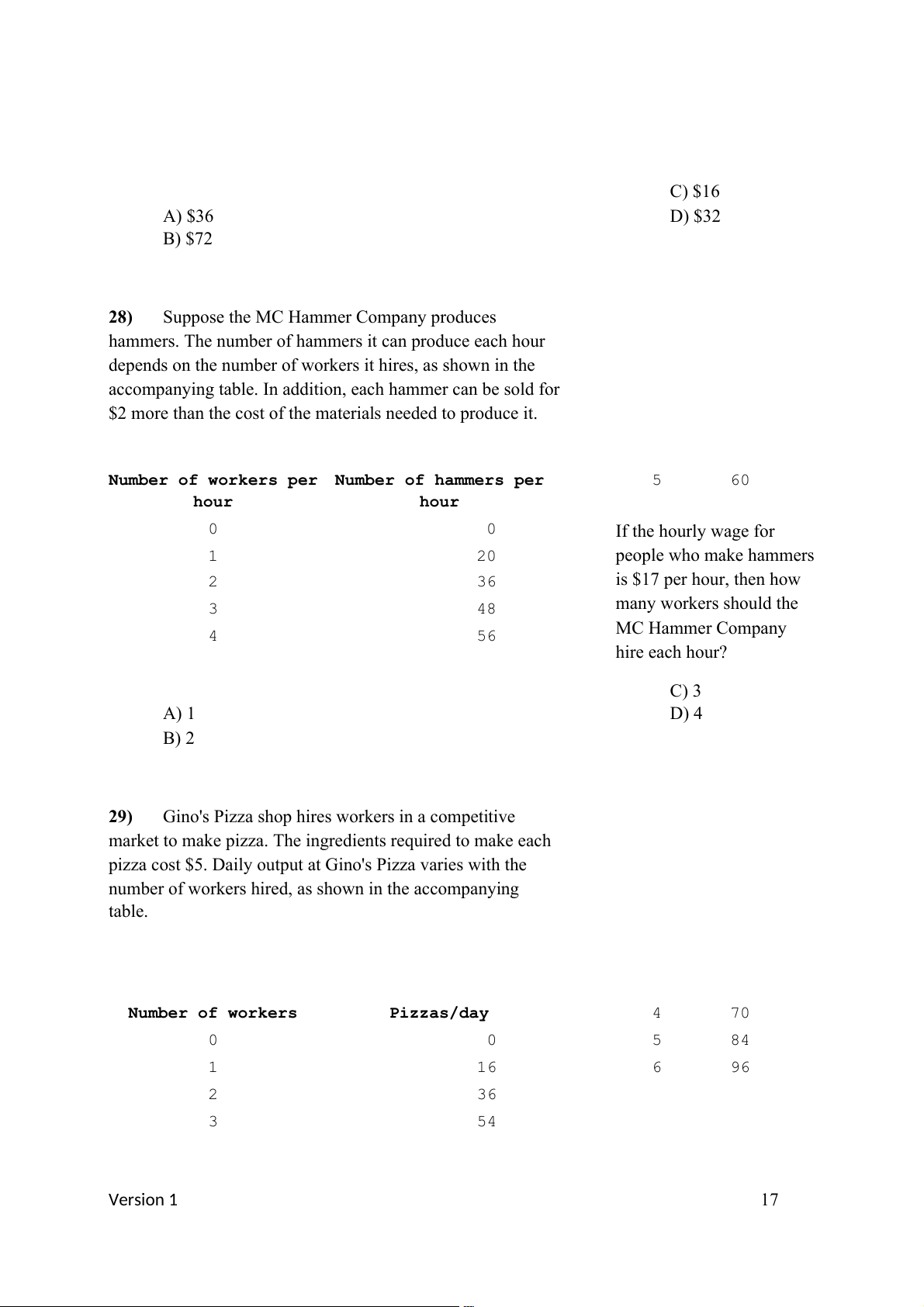
than the cost of the ingredients needed to produce it. Number of workers per Number of tacos per 5 75 hour hour 0 0 If the hourly wage for 1 25 people who make tacos is 2 45 $8, then how many 3 60 workers should the Tasty Taco Company hire each 4 70 hour? C) 3 A) 1 D) 4 B) 2 Version 1 15 Number of workers per Number of hammers per hour hour What is the value of the 0 0 marginal product of the 1 20 second worker hired each hour? 2 36 3 48 4 56 5 60 Version 1 16 C) $16 A) $36 D) $32 B) $72 28)
Suppose the MC Hammer Company produces
hammers. The number of hammers it can produce each hour
depends on the number of workers it hires, as shown in the
accompanying table. In addition, each hammer can be sold for
$2 more than the cost of the materials needed to produce it. Number of workers per Number of hammers per 5 60 hour hour 0 0 If the hourly wage for 1 20 people who make hammers 2 36 is $17 per hour, then how 3 48 many workers should the MC Hammer Company 4 56 hire each hour? C) 3 A) 1 D) 4 B) 2 29)
Gino's Pizza shop hires workers in a competitive
market to make pizza. The ingredients required to make each
pizza cost $5. Daily output at Gino's Pizza varies with the
number of workers hired, as shown in the accompanying table. Number of workers Pizzas/day 4 70 0 0 5 84 1 16 6 96 2 36 3 54 Version 1 17
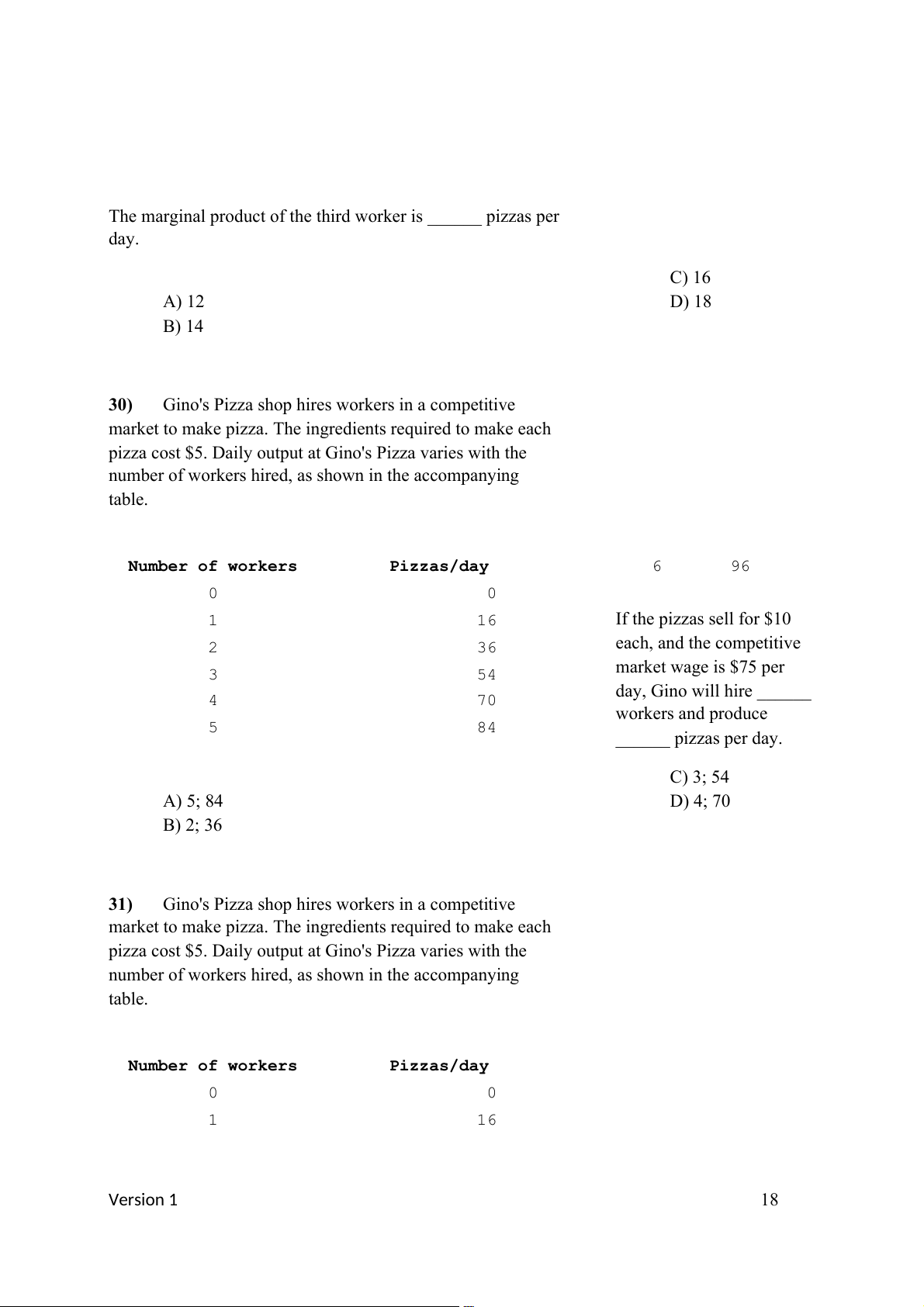
The marginal product of the third worker is ______ pizzas per day. C) 16 A) 12 D) 18 B) 14 30)
Gino's Pizza shop hires workers in a competitive
market to make pizza. The ingredients required to make each
pizza cost $5. Daily output at Gino's Pizza varies with the
number of workers hired, as shown in the accompanying table. Number of workers Pizzas/day 6 96 0 0 1 16 If the pizzas sell for $10 2 36 each, and the competitive market wage is $75 per 3 54 day, Gino will hire ______ 4 70 workers and produce 5 84 ______ pizzas per day. C) 3; 54 A) 5; 84 D) 4; 70 B) 2; 36 31)
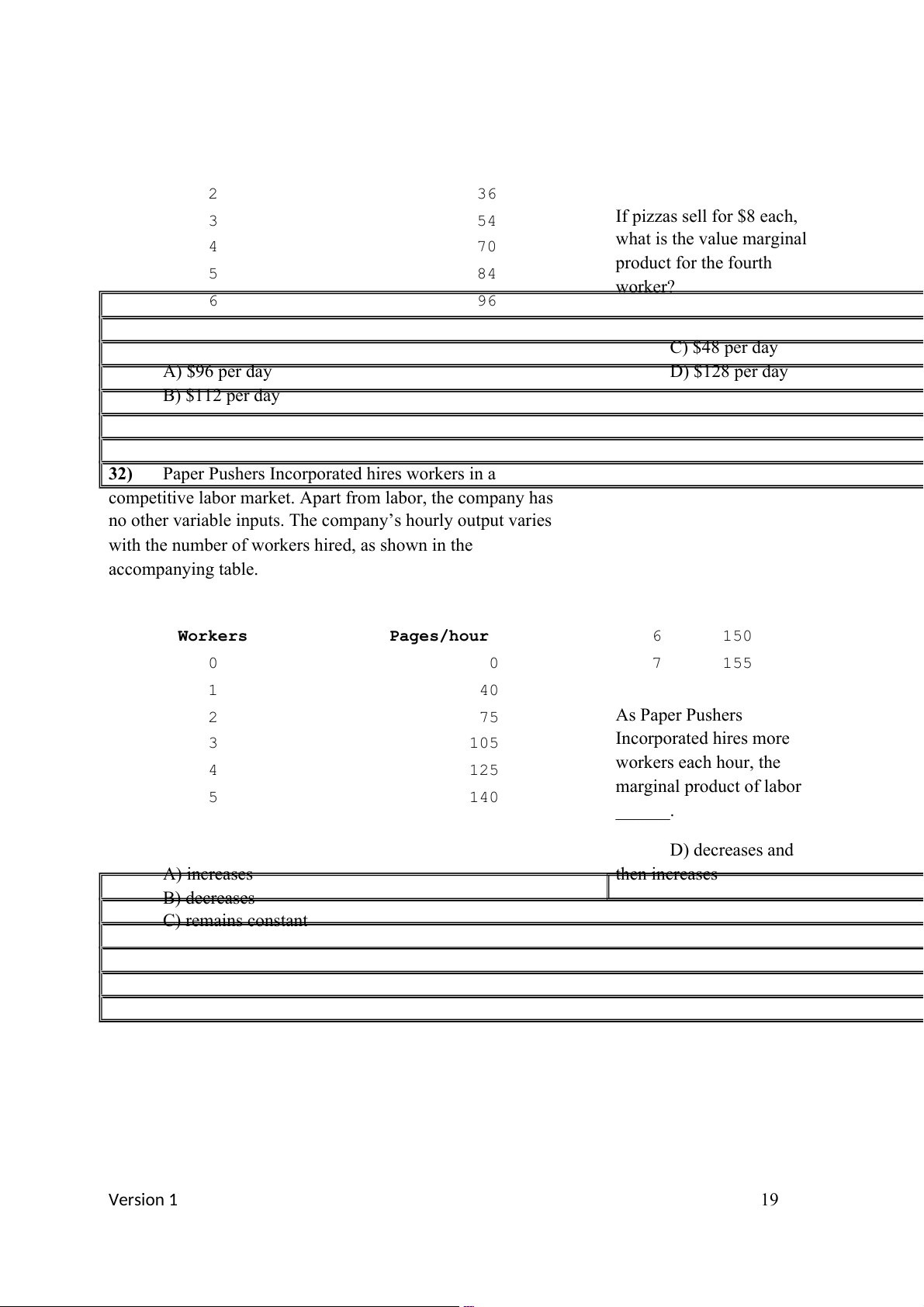
Gino's Pizza shop hires workers in a competitive
market to make pizza. The ingredients required to make each
pizza cost $5. Daily output at Gino's Pizza varies with the
number of workers hired, as shown in the accompanying table. Number of workers Pizzas/day 0 0 1 16 Version 1 18 2 36 3 54 If pizzas sell for $8 each, what is the value marginal 4 70 product for the fourth 5 84 worker? 6 96 C) $48 per day A) $96 per day D) $128 per day B) $112 per day 32)
Paper Pushers Incorporated hires workers in a
competitive labor market. Apart from labor, the company has
no other variable inputs. The company’s hourly output varies
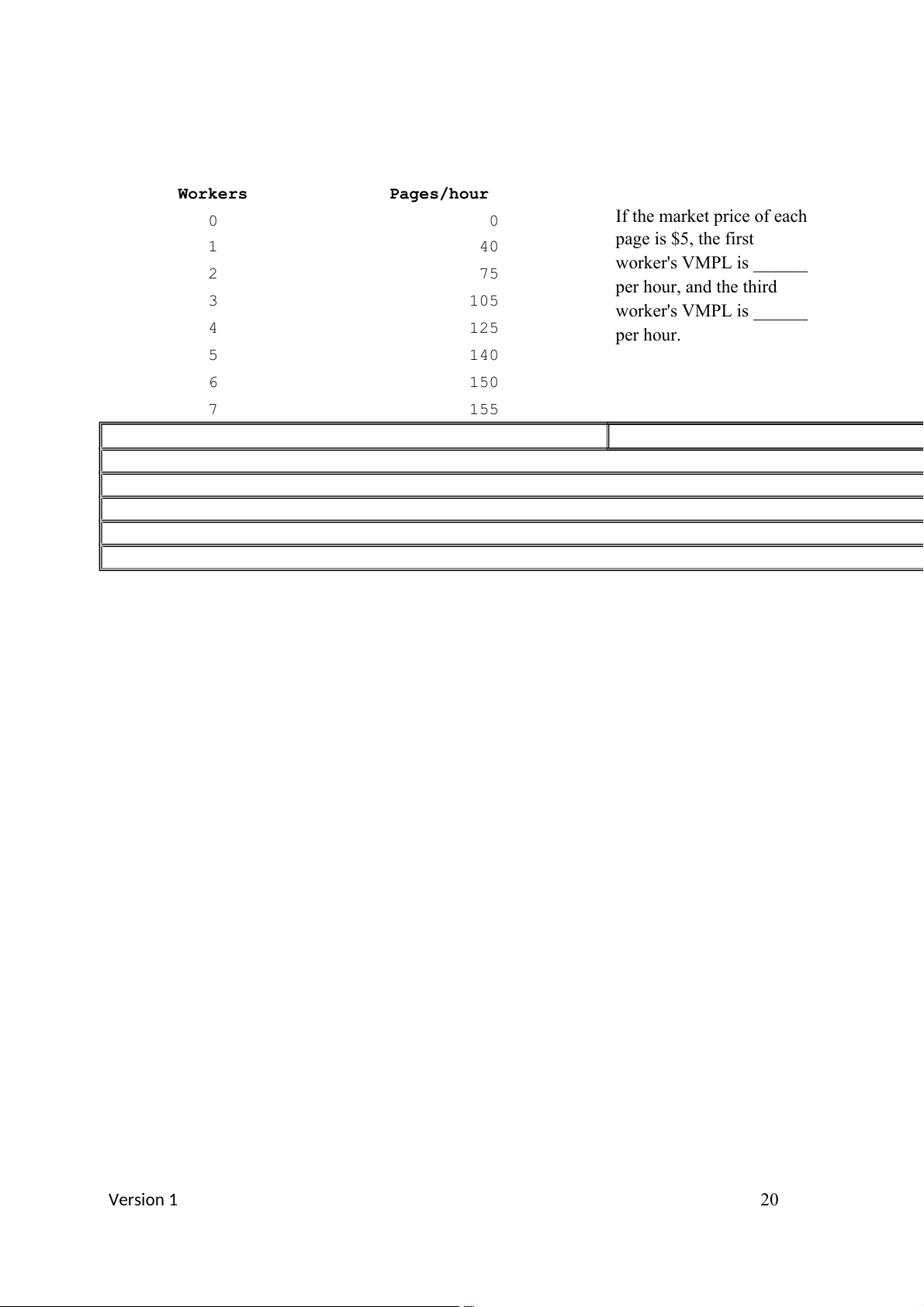
with the number of workers hired, as shown in the accompanying table. Workers Pages/hour 6 150 0 0 7 155 1 40 2 75 As Paper Pushers 3 105 Incorporated hires more workers each hour, the 4 125 marginal product of labor 5 140 ______. D) decreases and A) increases then increases B) decreases C) remains constant Version 1 19 Workers Pages/hour 0 0 If the market price of each page is $5, the first 1 40 worker's VMPL is ______ 2 75 per hour, and the third 3 105 worker's VMPL is ______ 4 125 per hour. 5 140 6 150 7 155 Version 1 20
Tài liệu liên quan:
-
Chương 3: độ co giãn và các nhân tố ảnh hưởng | Microeconomics | Trường Đại học Quốc tế, Đại học Quốc gia Thành phố Hồ Chí Minh
5 3 -
Microeconomics Syllabus | Microeconomics | Trường Đại học Quốc tế, Đại học Quốc gia Thành phố Hồ Chí Minh
5 3 -
Microeconomics Course Syllabus & Assessment Details | Microeconomics | Trường Đại học Quốc tế, Đại học Quốc gia Thành phố Hồ Chí Minh
5 3 -
Assignment 3 - Elasticity MCQs and Key Concepts | Microeconomics | Trường Đại học Quốc tế, Đại học Quốc gia Thành phố Hồ Chí Minh
4 2 -
Assignment 2 - Economic Equilibrium Analysis of Fridges and Motorcycles | Microeconomics | Trường Đại học Quốc tế, Đại học Quốc gia Thành phố Hồ Chí Minh
4 2