The Market Forces of Supply and Demand | Microeconomics | Trường Đại học Quốc tế, Đại học Quốc gia Thành phố Hồ Chí Minh
In a perfectly competitive market, buyers and sellers are price setters. ANS: F DIF: 1 REF: 4-1 NAT: Analytic LOC: Perfect competition TOP: Perfect competition MSC: Definitional 12. All goods and services are sold in perfectly competitive markets. ANS: F DIF: 1 REF: 4-1 NAT: Analytic LOC: Perfect competition TOP: Perfect competition MSC: Definitional 13. If a good or service has only one seller, then the seller is called a monopoly. ANS: T DIF: 1 REF: 4-1 NAT: Analytic LOC: Monopoly TOP: Monopoly MSC: Definitional. Tài liệu được sưu tầm và soạn thảo dưới dạng file PDF để gửi tới các bạn cùng tham khảo, ôn tập đầy đủ kiến thức, chuẩn bị cho các buổi học thật tốt. Mời bạn đọc đón xem!
Môn: Microeconomics 635 tài liệu
Trường: Trường Đại học Quốc tế, Đại học Quốc gia Thành phố Hồ Chí Minh 1.9 K tài liệu
Tác giả:


Preview text:
Chapter 4
The Market Forces of Supply and Demand TRUE/FALSE 1.
Prices allocate a market economy’s scarce resources. ANS: T DIF: 1 REF: 4-0 NAT: Analytic
LOC: Markets, market failure, and externalities TOP: Market economies MSC: Definitional 2.
In a market economy, supply and demand determine both the quantity of each good produced and the price at which it is sold. ANS: T DIF: 1 REF: 4-0 NAT: Analytic
LOC: Markets, market failure, and externalities TOP: Market economies MSC: Definitional 3.
A market is a group of buyers and sellers of a particular good or service. ANS: T DIF: 1 REF: 4-1 NAT: Analytic
LOC: Markets, market failure, and externalities TOP: Markets MSC: Definitional 4.
Sellers as a group determine the demand for a product, and buyers as a group determine the supply of a product. ANS: F DIF: 1 REF: 4-1 NAT: Analytic LOC: Supply and demand TOP: Demand | Supply MSC: Definitional 5.
A yard sale is an example of a market. ANS: T DIF: 2 REF: 4-1 NAT: Analytic
LOC: Markets, market failure, and externalities TOP: Markets MSC: Applicative 6.
A newspaper’s classified ads are an example of a market. ANS: T DIF: 2 REF: 4-1 NAT: Analytic
LOC: Markets, market failure, and externalities TOP: Markets MSC: Applicative 7.
Most markets in the economy are highly competitive. ANS: T DIF: 1 REF: 4-1 NAT: Analytic
LOC: Markets, market failure, and externalities TOP: Markets MSC: Definitional 8.
In a competitive market, the quantity of each good produced and the price at which it is sold are not
determined by any single buyer or seller. ANS: T DIF: 1 REF: 4-1 NAT: Analytic
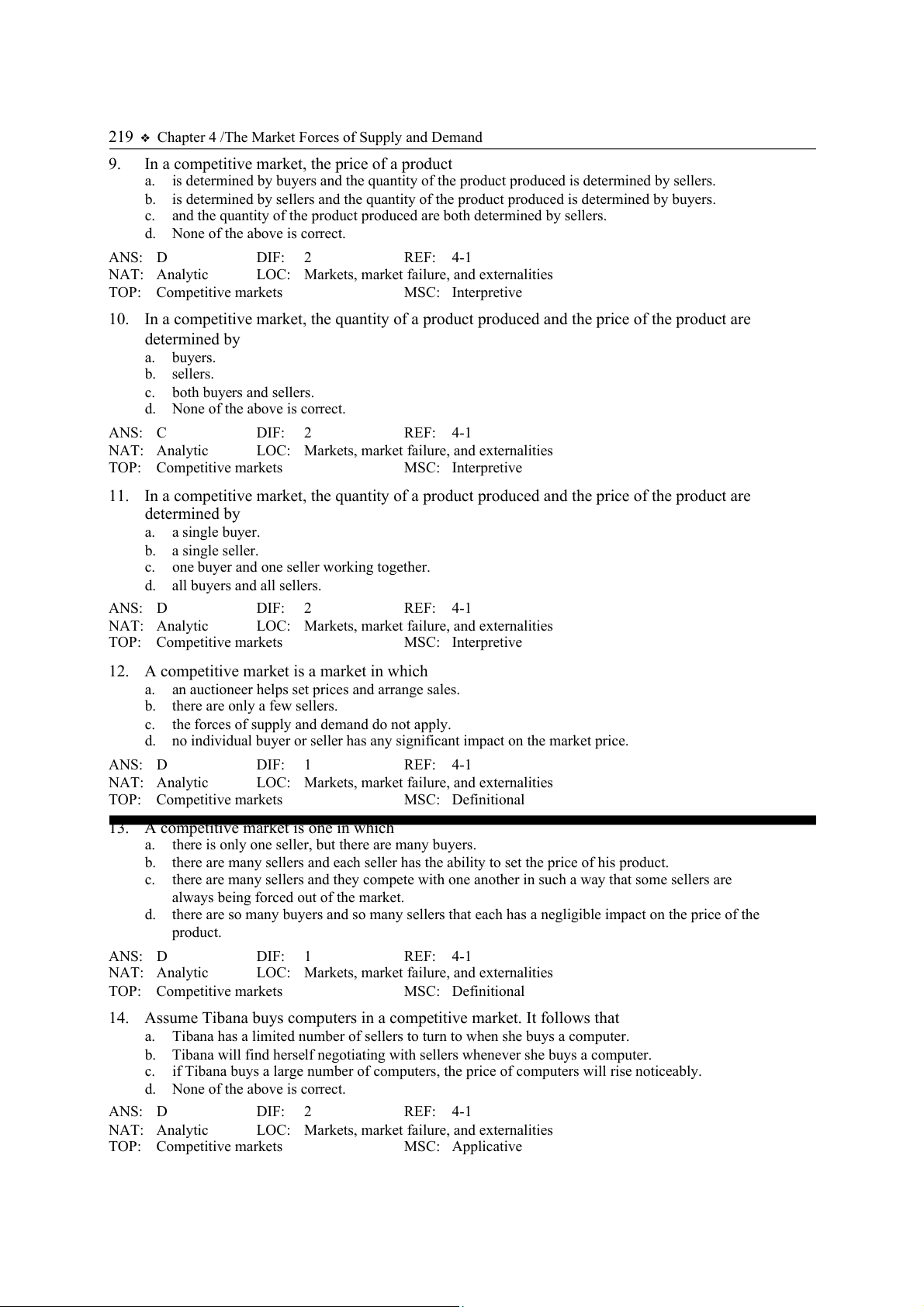
LOC: Markets, market failure, and externalities TOP: Competitive markets MSC: Definitional 9.
In a competitive market, there are so few buyers and so few sellers that each has a significant impact on the market price. ANS: F DIF: 1 REF: 4-1 NAT: Analytic
LOC: Markets, market failure, and externalities TOP: Competitive markets MSC: Definitional 10.
In a perfectly competitive market, the goods offered for sale are all exactly the same. ANS: T DIF: 1 REF: 4-1 NAT: Analytic LOC: Perfect competition TOP: Perfect competition MSC: Definitional 202
203 Chapter 4 /The Market Forces of Supply and Demand 11.
In a perfectly competitive market, buyers and sellers are price setters. ANS: F DIF: 1 REF: 4-1 NAT: Analytic LOC: Perfect competition TOP: Perfect competition MSC: Definitional 12.
All goods and services are sold in perfectly competitive markets. ANS: F DIF: 1 REF: 4-1 NAT: Analytic LOC: Perfect competition TOP: Perfect competition MSC: Definitional 13.
If a good or service has only one seller, then the seller is called a monopoly. ANS: T DIF: 1 REF: 4-1 NAT: Analytic LOC: Monopoly TOP: Monopoly MSC: Definitional 14. Monopolists are price takers. ANS: F DIF: 2 REF: 4-1 NAT: Analytic LOC: Monopoly TOP: Monopoly MSC: Interpretive 15.
Local cable TV companies frequently are monopolists. ANS: T DIF: 1 REF: 4-1 NAT: Analytic LOC: Monopoly TOP: Monopoly MSC: Definitional 16.
The quantity demanded of a product is the amount that buyers are willing and able to purchase at a particular price. ANS: T DIF: 1 REF: 4-2 NAT: Analytic LOC: Supply and demand TOP: Quantity demanded MSC: Definitional 17.
The law of demand is true for most goods in the economy. ANS: T DIF: 1 REF: 4-2 NAT: Analytic LOC: Supply and demand TOP: Law of demand MSC: Definitional 18.
The law of demand states that, other things equal, when the price of a good rises, the quantity demanded of the
good rises, and when the price falls, the quantity demanded falls. ANS: F DIF: 1 REF: 4-2 NAT: Analytic LOC: Supply and demand TOP: Law of demand MSC: Definitional 19.
The demand curve is the upward-sloping line relating price and quantity demanded. ANS: F DIF: 1 REF: 4-2 NAT: Analytic LOC: Supply and demand TOP: Demand curve MSC: Definitional 20.
Individual demand curves are summed horizontally to obtain the market demand curve. ANS: T DIF: 1 REF: 4-2 NAT: Analytic LOC: Supply and demand TOP: Market demand curve MSC: Definitional 21.
The market demand curve shows how the total quantity demanded of a good varies as the income of buyers
varies, while all the other factors that affect how much consumers want to buy are held constant. ANS: F DIF: 1 REF: 4-2 NAT: Analytic LOC: Supply and demand TOP: Market demand curve MSC: Definitional 22.
If something happens to alter the quantity demanded at any given price, then the demand curve shifts. ANS: T DIF: 1 REF: 4-2 NAT: Analytic LOC: Supply and demand TOP: Demand curve MSC: Definitional
Chapter 4 /The Market Forces of Supply and Demand 204 23.
A movement upward and to the left along a given demand curve is called a decrease in demand.. ANS: F DIF: 2 REF: 4-2 NAT: Analytic LOC: Supply and demand TOP: Demand curve MSC: Interpretive 24.
An increase in demand shifts the demand curve to the left. ANS: F DIF: 1 REF: 4-2 NAT: Analytic LOC: Supply and demand TOP: Demand curve MSC: Definitional 25.
If the demand for a good falls when income falls, then the good is called an inferior good. ANS: F DIF: 1 REF: 4-2 NAT: Analytic LOC: Supply and demand TOP: Normal goods MSC: Definitional 26.
When Mario's income decreases, he buys more pasta. For Mario, pasta is a normal good. ANS: F DIF: 2 REF: 4-2 NAT: Analytic LOC: Supply and demand TOP: Inferior goods MSC: Applicative 27.
A decrease in income will shift the demand curve for an inferior good to the right. ANS: T DIF: 2 REF: 4-2 NAT: Analytic LOC: Supply and demand TOP: Inferior goods MSC: Interpretive 28.
An increase in the price of a substitute good will shift the demand curve for a good to the right. ANS: T DIF: 2 REF: 4-2 NAT: Analytic LOC: Supply and demand TOP: Substitutes MSC: Interpretive 29.
Baseballs and baseball bats are substitute goods. ANS: F DIF: 2 REF: 4-2 NAT: Analytic LOC: Supply and demand TOP: Complements MSC: Applicative 30.
A decrease in the price of a complement will shift the demand curve for a good to the left. ANS: F DIF: 2 REF: 4-2 NAT: Analytic LOC: Supply and demand TOP: Complements MSC: Interpretive 31.
When an increase in the price of one good lowers the demand for another good, the two goods are called complements. ANS: T DIF: 1 REF: 4-2 NAT: Analytic LOC: Supply and demand TOP: Complements MSC: Definitional 32.
Cocoa and marshmallows are complements, so a decrease in the price of cocoa will cause an increase in the demand for marshmallows. ANS: T DIF: 2 REF: 4-2 NAT: Analytic LOC: Supply and demand TOP: Complements MSC: Applicative 33.
If a person expects the price of socks to increase next month, then that person’s current demand for socks will increase. ANS: T DIF: 2 REF: 4-2 NAT: Analytic LOC: Supply and demand TOP: Expectations MSC: Applicative
205 Chapter 4 /The Market Forces of Supply and Demand 34.
A decrease in the price of a product and an increase in the number of buyers in the market affect the demand curve in the same general way. ANS: F DIF: 2 REF: 4-2 NAT: Analytic LOC: Supply and demand TOP: Demand curve MSC: Interpretive 35.
Whenever a determinant of demand other than price changes, the demand curve shifts. ANS: T DIF: 2 REF: 4-2 NAT: Analytic LOC: Supply and demand TOP: Demand curve MSC: Interpretive 36.
An increase in the price of pizza will shift the demand curve for pizza to the left. ANS: F DIF: 2 REF: 4-2 NAT: Analytic LOC: Supply and demand TOP: Demand curve MSC: Applicative 37.
Public service announcements, mandatory health warnings on cigarette packages, and the prohibition of
cigarette advertising on television are all policies aimed at shifting the demand curve for cigarettes to the right. ANS: F DIF: 2 REF: 4-2 NAT: Analytic LOC: Supply and demand TOP: Demand curve MSC: Applicative 38.
Most studies have found that tobacco and marijuana are complements rather than substitutes. ANS: T DIF: 2 REF: 4-2 NAT: Analytic LOC: Supply and demand TOP: Complements MSC: Applicative 39.
The quantity supplied of a good or service is the amount that sellers are willing and able to sell at a particular price. ANS: T DIF: 1 REF: 4-3 NAT: Analytic LOC: Supply and demand TOP: Quantity supplied MSC: Definitional 40.
When the price of a good is high, selling the good is profitable, and so the quantity supplied is large. ANS: T DIF: 1 REF: 4-3 NAT: Analytic LOC: Supply and demand TOP: Law of supply MSC: Definitional 41.
When the price of a good is low, selling the good is profitable, and so the quantity supplied is large. ANS: F DIF: 1 REF: 4-3 NAT: Analytic LOC: Supply and demand TOP: Law of supply MSC: Definitional 42.
Price cannot fall so low that some sellers choose to supply a quantity of zero. ANS: F DIF: 2 REF: 4-3 NAT: Analytic LOC: Supply and demand TOP: Quantity supplied MSC: Interpretive 43.
The law of supply states that, other things equal, when the price of a good rises, the quantity supplied of the good falls. ANS: F DIF: 1 REF: 4-3 NAT: Analytic LOC: Supply and demand TOP: Law of supply MSC: Definitional 44.
The law of supply states that, other things equal, when the price of a good falls, the quantity supplied falls as well. ANS: T DIF: 1 REF: 4-3 NAT: Analytic LOC: Supply and demand TOP: Law of supply MSC: Definitional
Chapter 4 /The Market Forces of Supply and Demand 206 45.
If a higher price means a greater quantity supplied, then the supply curve slopes upward. ANS: T DIF: 1 REF: 4-3 NAT: Analytic LOC: Supply and demand TOP: Supply curve MSC: Definitional 46.
Individual supply curves are summed vertically to obtain the market supply curve. ANS: F DIF: 1 REF: 4-3 NAT: Analytic LOC: Supply and demand TOP: Market supply curve MSC: Definitional 47.
The market supply curve shows how the total quantity supplied of a good varies as input prices vary, holding
constant all the other factors that influence producers’ decisions about how much to sell. ANS: F DIF: 1 REF: 4-3 NAT: Analytic LOC: Supply and demand TOP: Market supply curve MSC: Definitional 48.
If something happens to alter the quantity supplied at any given price, then we move along the fixed supply
curve to a new quantity supplied. ANS: F DIF: 2 REF: 4-3 NAT: Analytic LOC: Supply and demand TOP: Supply curve MSC: Interpretive 49.
A movement along a supply curve is called a change in supply while a shift of the supply curve is called a change in quantity supplied. ANS: F DIF: 2 REF: 4-3 NAT: Analytic LOC: Supply and demand TOP: Supply | Quantity supplied MSC: Interpretive 50.
A decrease in supply shifts the supply curve to the left. ANS: T DIF: 1 REF: 4-3 NAT: Analytic LOC: Supply and demand TOP: Supply curve MSC: Definitional 51.
A reduction in an input price will cause a change in quantity supplied, but not a change in supply. ANS: F DIF: 2 REF: 4-3 NAT: Analytic LOC: Supply and demand TOP: Input prices MSC: Interpretive 52.
An increase in the price of ink will shift the supply curve for pens to the left. ANS: T DIF: 2 REF: 4-3 NAT: Analytic LOC: Supply and demand TOP: Input prices MSC: Applicative 53.
If there is an improvement in the technology used to produce a good, then the supply curve for that good will shift to the left. ANS: F DIF: 2 REF: 4-3 NAT: Analytic LOC: Supply and demand TOP: Technology MSC: Interpretive 54.
Advances in production technology typically reduce firms’ costs. ANS: T DIF: 2 REF: 4-3 NAT: Analytic LOC: Supply and demand TOP: Technology MSC: Interpretive 55.
If a company making frozen orange juice expects the price of its product to be higher next month, it will
supply more to the market this month. ANS: F DIF: 2 REF: 4-3 NAT: Analytic LOC: Supply and demand TOP: Expectations MSC: Applicative
207 Chapter 4 /The Market Forces of Supply and Demand 56.
When a seller expects the price of its product to decrease in the future, the seller's supply curve shifts left now. ANS: F DIF: 2 REF: 4-3 NAT: Analytic LOC: Supply and demand TOP: Expectations MSC: Interpretive 57.
An increase in the price of a product and an increase in the number of sellers in the market affect the supply curve in the same general way. ANS: F DIF: 2 REF: 4-3 NAT: Analytic LOC: Supply and demand TOP: Supply curve MSC: Interpretive 58.
Whenever a determinant of supply other than price changes, the supply curve shifts. ANS: T DIF: 2 REF: 4-3 NAT: Analytic LOC: Supply and demand TOP: Supply curve MSC: Interpretive 59.
A decrease in the price of pizza will shift the supply curve for pizza to the left. ANS: F DIF: 2 REF: 4-3 NAT: Analytic LOC: Supply and demand TOP: Supply curve MSC: Applicative 60.
Supply and demand together determine the price and quantity of a good sold in a market. ANS: T DIF: 1 REF: 4-4 NAT: Analytic LOC: Supply and demand TOP: Equilibrium MSC: Definitional 61.
A market’s equilibrium is the point at which the supply and demand curves intersect. ANS: T DIF: 1 REF: 4-4 NAT: Analytic LOC: Supply and demand TOP: Equilibrium MSC: Definitional 62.
At the equilibrium price, quantity demanded is equal to quantity supplied. ANS: T DIF: 1 REF: 4-4 NAT: Analytic LOC: Equilibrium TOP: Equilibrium MSC: Definitional 63.
The equilibrium price is the same as the market-clearing price. ANS: T DIF: 1 REF: 4-4 NAT: Analytic LOC: Equilibrium TOP: Equilibrium MSC: Definitional 64.
At the equilibrium price, buyers have bought all they want to buy, but sellers have not sold all they want to sell. ANS: F DIF: 1 REF: 4-4 NAT: Analytic LOC: Equilibrium TOP: Equilibrium MSC: Definitional 65.
The actions of buyers and sellers naturally move markets toward equilibrium. ANS: T DIF: 1 REF: 4-4 NAT: Analytic LOC: Equilibrium TOP: Equilibrium MSC: Definitional 66.
When the market price is above the equilibrium price, the quantity of the good demanded exceeds the quantity supplied. ANS: F DIF: 1 REF: 4-4 NAT: Analytic LOC: Equilibrium TOP: Equilibrium MSC: Definitional 67.
When the market price is above the equilibrium price, suppliers are unable to sell all they want to sell. ANS: T DIF: 1 REF: 4-4 NAT: Analytic LOC: Equilibrium TOP: Equilibrium MSC: Definitional 68.
A surplus is the same as an excess demand. ANS: F DIF: 1 REF: 4-4 NAT: Analytic LOC: Supply and demand TOP: Surplus MSC: Definitional
Chapter 4 /The Market Forces of Supply and Demand 208 69.
Sellers respond to a surplus by cutting their prices. ANS: T DIF: 1 REF: 4-4 NAT: Analytic LOC: Supply and demand TOP: Surplus MSC: Definitional 70.
Price will rise to eliminate a surplus. ANS: F DIF: 2 REF: 4-4 NAT: Analytic LOC: Equilibrium TOP: Surplus MSC: Interpretive 71.
When quantity supplied exceeds quantity demanded at the current market price, the market has a surplus and
market price will likely rise in the future to eliminate the surplus. ANS: F DIF: 2 REF: 4-4 NAT: Analytic LOC: Equilibrium TOP: Surplus MSC: Interpretive 72.
When the market price is below the equilibrium price, the quantity of the good demanded exceeds the quantity supplied. ANS: T DIF: 1 REF: 4-4 NAT: Analytic LOC: Equilibrium TOP: Equilibrium MSC: Definitional 73.
When the market price is below the equilibrium price, suppliers are unable to sell all they want to sell. ANS: F DIF: 1 REF: 4-4 NAT: Analytic LOC: Equilibrium TOP: Equilibrium MSC: Definitional 74.
A shortage is the same as an excess demand. ANS: T DIF: 1 REF: 4-4 NAT: Analytic LOC: Supply and demand TOP: Shortage MSC: Definitional 75.
Sellers respond to a shortage by cutting their prices. ANS: F DIF: 1 REF: 4-4 NAT: Analytic LOC: Supply and demand TOP: Shortage MSC: Definitional 76.
Price will rise to eliminate a shortage. ANS: T DIF: 2 REF: 4-4 NAT: Analytic LOC: Equilibrium TOP: Shortage MSC: Interpretive 77.
When quantity demanded exceeds quantity supplied at the current market price, the market has a shortage and
market price will likely rise in the future to eliminate the shortage. ANS: T DIF: 2 REF: 4-4 NAT: Analytic LOC: Equilibrium TOP: Shortage MSC: Interpretive 78.
Surpluses drive price up while shortages drive price down. ANS: F DIF: 2 REF: 4-4 NAT: Analytic LOC: Equilibrium TOP: Shortage | Surplus MSC: Interpretive 79.
A shortage will occur at any price below equilibrium price and a surplus will occur at any price above equilibrium price. ANS: T DIF: 2 REF: 4-4 NAT: Analytic LOC: Equilibrium TOP: Shortage | Surplus MSC: Interpretive 80.
In a market, the price of any good adjusts until quantity demanded equals quantity supplied. ANS: T DIF: 2 REF: 4-4 NAT: Analytic LOC: Equilibrium TOP: Equilibrium MSC: Interpretive 81.
When a supply curve or a demand curve shifts, the equilibrium price and equilibrium quantity change. ANS: T DIF: 1 REF: 4-4 NAT: Analytic LOC: Equilibrium TOP: Equilibrium MSC: Definitional
209 Chapter 4 /The Market Forces of Supply and Demand 82.
Demand refers to the amount buyers wish to buy, whereas the quantity demanded refers to the position of the demand curve. ANS: F DIF: 1 REF: 4-4 NAT: Analytic LOC: Supply and demand TOP: Demand | Quantity demanded MSC: Definitional 83.
Supply refers to the position of the supply curve, whereas the quantity supplied refers to the amount suppliers wish to sell. ANS: T DIF: 1 REF: 4-4 NAT: Analytic LOC: Supply and demand TOP: Supply | Quantity supplied MSC: Definitional 84.
It is not possible for demand and supply to shift at the same time. ANS: F DIF: 2 REF: 4-4 NAT: Analytic LOC: Supply and demand TOP: Supply | Demand MSC: Interpretive 85.
A decrease in demand will cause a decrease in price, which will cause a decrease in supply. ANS: F DIF: 2 REF: 4-4 NAT: Analytic LOC: Supply and demand TOP: Equilibrium MSC: Interpretive 86.
An increase in demand will cause an increase in price, which will cause an increase in quantity supplied. ANS: T DIF: 2 REF: 4-4 NAT: Analytic LOC: Supply and demand TOP: Equilibrium MSC: Interpretive 87.
An increase in supply will cause a decrease in price, which will cause an increase in demand. ANS: F DIF: 2 REF: 4-4 NAT: Analytic LOC: Supply and demand TOP: Equilibrium MSC: Interpretive 88.
A decrease in supply will cause an increase in price, which will cause a decrease in quantity demanded. ANS: T DIF: 2 REF: 4-4 NAT: Analytic LOC: Supply and demand TOP: Equilibrium MSC: Interpretive 89.
In a market economy, prices are the signals that guide the allocation of scarce resources. ANS: T DIF: 1 REF: 4-5 NAT: Analytic
LOC: Markets, market failure, and externalities TOP: Market economies MSC: Definitional SHORT ANSWER 1.
a. What is the difference between a "change in demand" and a "change in quantity demanded?" Graph your answer.
b. For each of the following changes, determine whether there will be a change in quantity demanded or a change in demand. i.
a change in the price of a related good ii. a change in tastes
iii. a change in the number of buyers iv. a change in price v.
a change in consumer expectations vi. a change in income
Chapter 4 /The Market Forces of Supply and Demand 210 ANS: a.
A change in demand refers to a shift of the demand curve. A change in quantity demanded refers to
a movement along a fixed demand curve. b.
A change in price causes a change in quantity demanded. All of the other changes listed shift the demand curve.
A change in quantity demanded A change in demand price price D D D' quanti ty quanti ty DIF: 2 REF: 4-2 NAT: Analytic LOC: Supply and demand TOP: Demand | Quantity demanded MSC: Interpretive
211 Chapter 4 /The Market Forces of Supply and Demand 2. a.
What is the difference between a "change in supply" and a "change in quantity supplied?" Graph your answer. b.
For each of the following changes, determine whether there will be a change in quantity supplied or a change in supply. i. a change in input costs ii
a change in producer expectations iii. a change in price iv. a change in technology
v. a change in the number of sellers ANS: a.
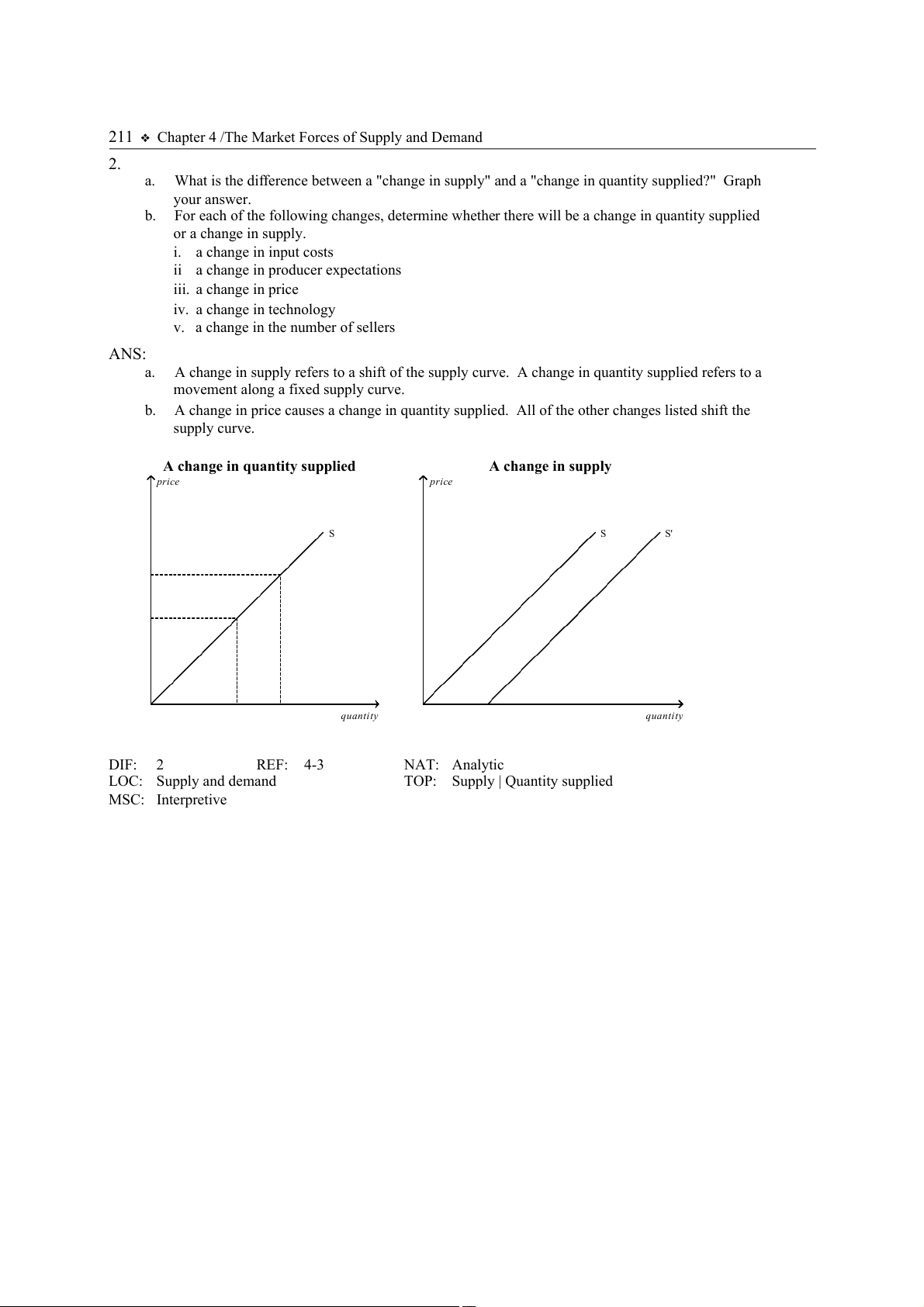
A change in supply refers to a shift of the supply curve. A change in quantity supplied refers to a
movement along a fixed supply curve. b.
A change in price causes a change in quantity supplied. All of the other changes listed shift the supply curve.
A change in quantity supplied A change in supply price price S S S' quanti ty quanti ty DIF: 2 REF: 4-3 NAT: Analytic LOC: Supply and demand TOP: Supply | Quantity supplied MSC: Interpretive
Chapter 4 /The Market Forces of Supply and Demand 212 3. a.
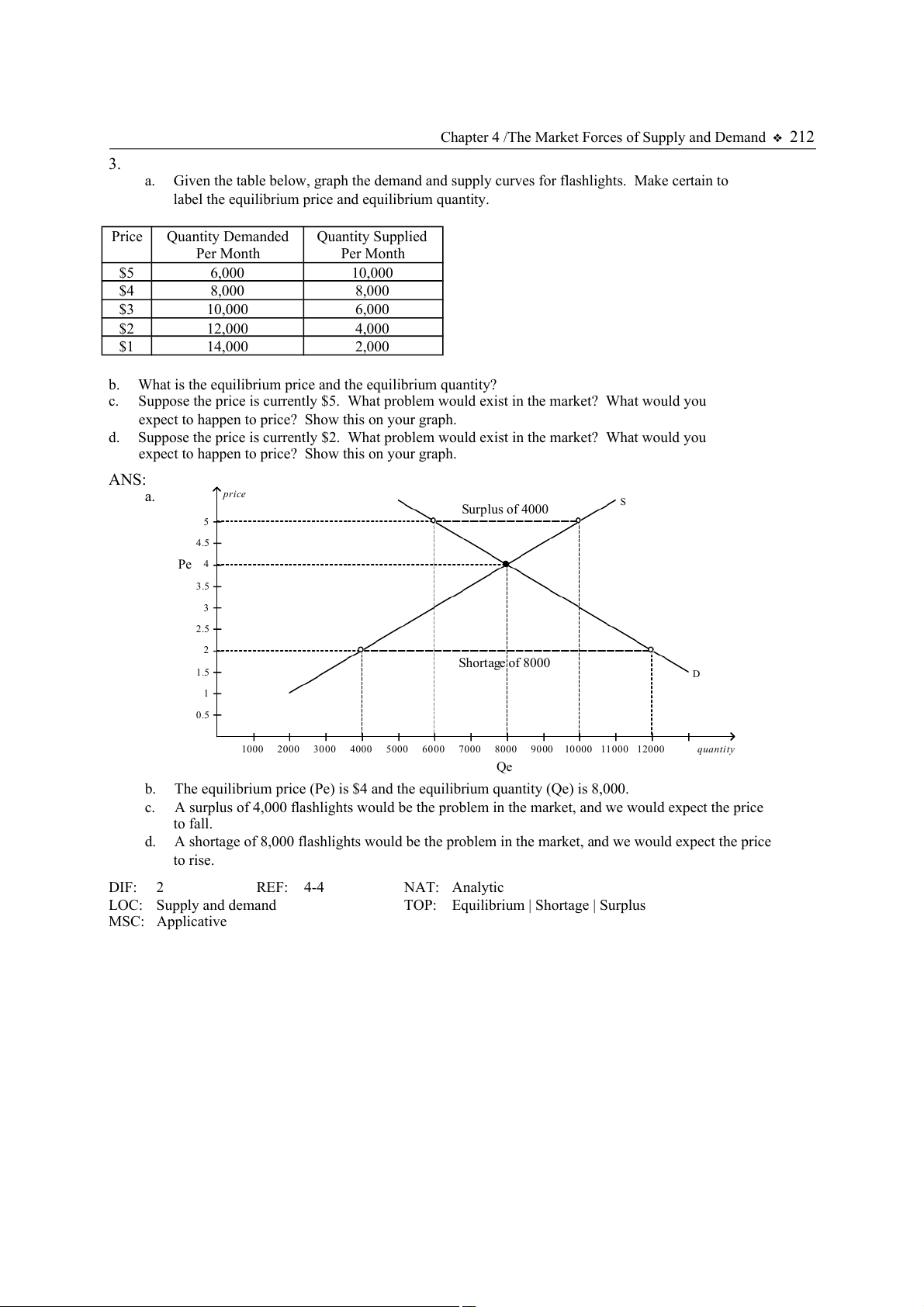
Given the table below, graph the demand and supply curves for flashlights. Make certain to
label the equilibrium price and equilibrium quantity. Price Quantity Demanded Quantity Supplied Per Month Per Month $5 6,000 10,000 $4 8,000 8,000 $3 10,000 6,000 $2 12,000 4,000 $1 14,000 2,000 b.
What is the equilibrium price and the equilibrium quantity? c.
Suppose the price is currently $5. What problem would exist in the market? What would you
expect to happen to price? Show this on your graph. d.
Suppose the price is currently $2. What problem would exist in the market? What would you
expect to happen to price? Show this on your graph. ANS: a. price S Surplus of 4000 5 4.5 Pe 4 3.5 3 2.5 2 Shortage of 8000 1.5 D 1 0.5 1000 2000 3000 4000 5000 6000 7000 8000 9000 10000 11000 12000 quanti ty Qe b.
The equilibrium price (Pe) is $4 and the equilibrium quantity (Qe) is 8,000. c.
A surplus of 4,000 flashlights would be the problem in the market, and we would expect the price to fall. d.
A shortage of 8,000 flashlights would be the problem in the market, and we would expect the price to rise. DIF: 2 REF: 4-4 NAT: Analytic LOC: Supply and demand TOP:
Equilibrium | Shortage | Surplus MSC: Applicative
213 Chapter 4 /The Market Forces of Supply and Demand 4.
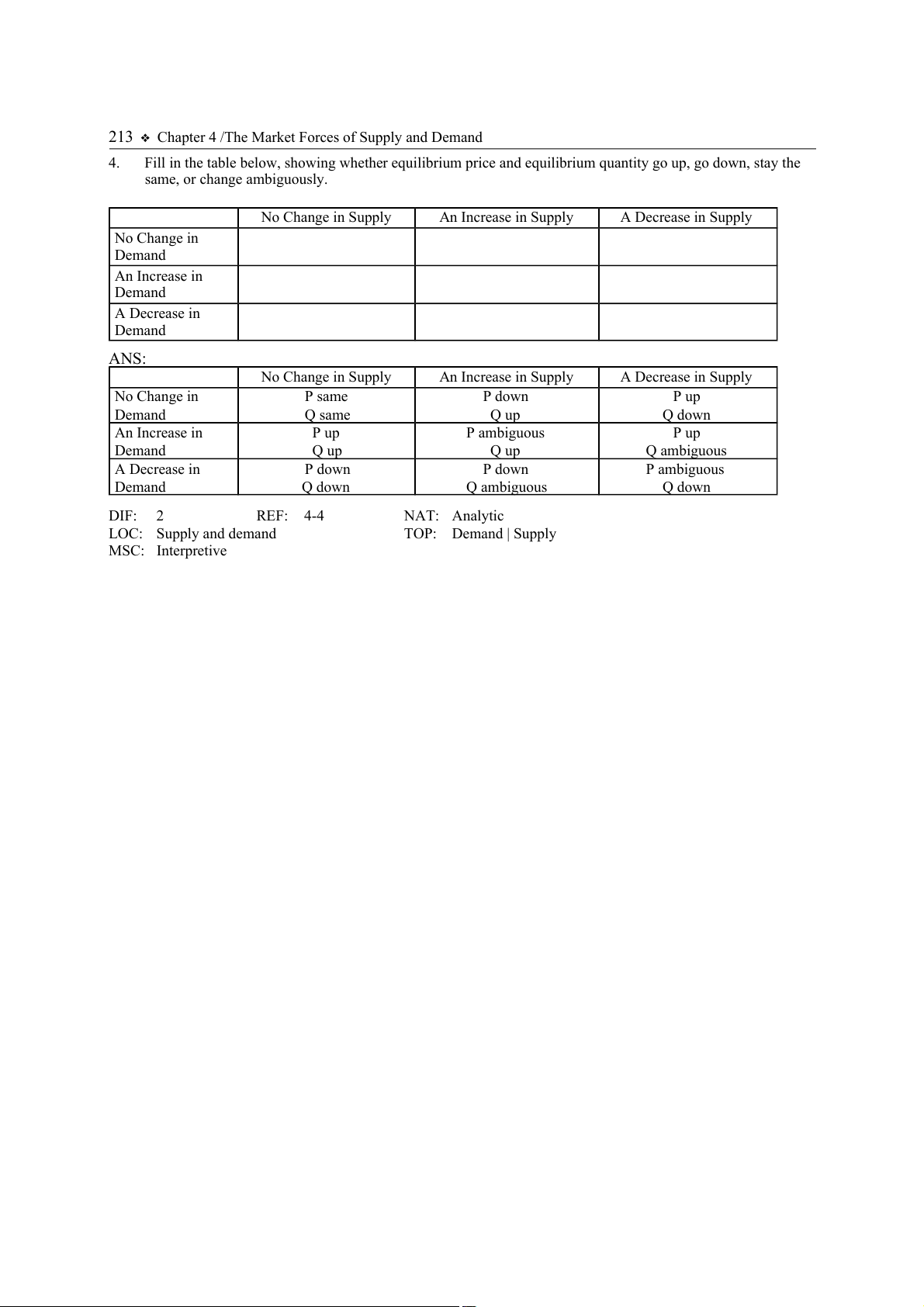
Fill in the table below, showing whether equilibrium price and equilibrium quantity go up, go down, stay the same, or change ambiguously. No Change in Supply An Increase in Supply A Decrease in Supply No Change in Demand An Increase in Demand A Decrease in Demand ANS: No Change in Supply An Increase in Supply A Decrease in Supply No Change in P same P down P up Demand Q same Q up Q down An Increase in P up P ambiguous P up Demand Q up Q up Q ambiguous A Decrease in P down P down P ambiguous Demand Q down Q ambiguous Q down DIF: 2 REF: 4-4 NAT: Analytic LOC: Supply and demand TOP: Demand | Supply MSC: Interpretive
Chapter 4 /The Market Forces of Supply and Demand 214 5.
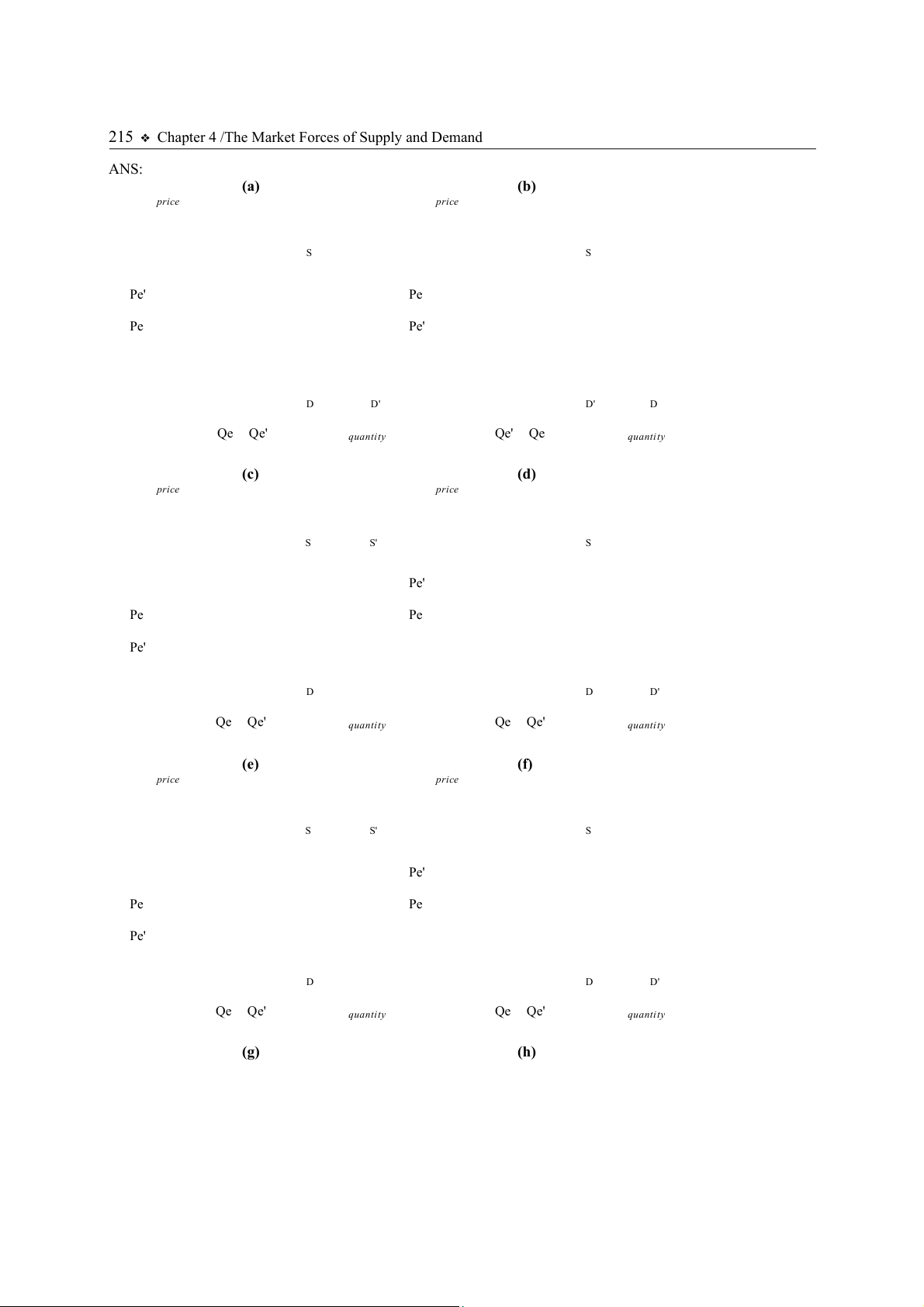
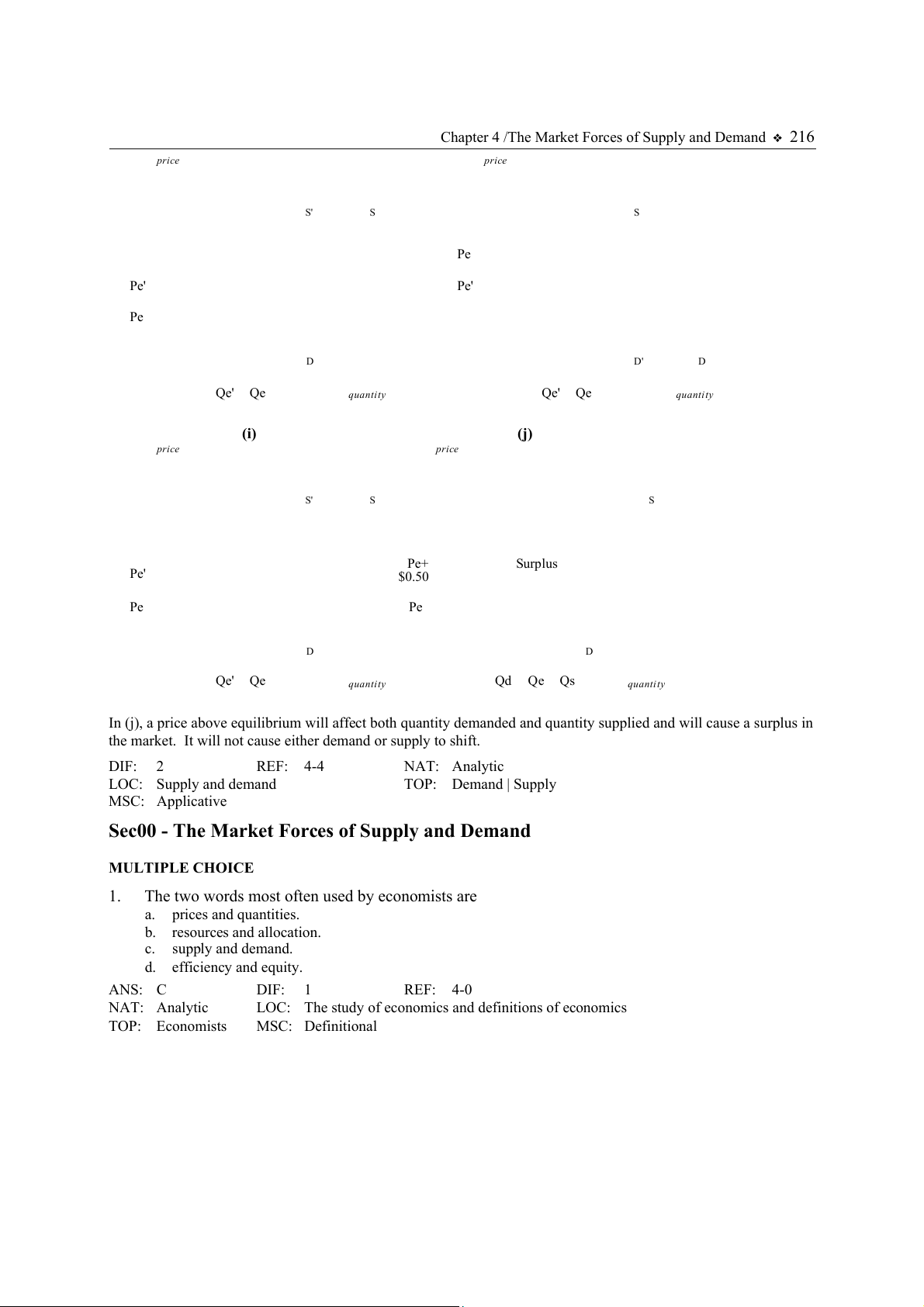
Suppose we are analyzing the market for hot chocolate. Graphically illustrate the impact each of the
following would have on demand or supply. Also show how equilibrium price and equilibrium quantity would change. a.
Winter starts and the weather turns sharply colder. b.
The price of tea, a substitute for hot chocolate, falls. c.
The price of cocoa beans decreases. d.
The price of whipped cream falls. e.
A better method of harvesting cocoa beans is introduced. f.
The Surgeon General of the U.S. announces that hot chocolate cures acne. g.
Protesting farmers dump millions of gallons of milk, causing the price of milk to rise. h.
Consumer income falls because of a recession, and hot chocolate is considered a normal good. i.
Producers expect the price of hot chocolate to increase next month. j.
Currently, the price of hot chocolate is $0.50 per cup above equilibrium.
215 Chapter 4 /The Market Forces of Supply and Demand ANS: (a) (b) price price S S Pe' Pe Pe Pe' D D' D' D Qe Qe' quanti ty Qe' Qe quanti ty (c) (d) price price S S' S Pe' Pe Pe Pe' D D D' Qe Qe' quanti ty Qe Qe' quanti ty (e) (f) price price S S' S Pe' Pe Pe Pe' D D D' Qe Qe' quanti ty Qe Qe' quanti ty (g) (h)
Chapter 4 /The Market Forces of Supply and Demand 216 price price S' S S Pe Pe' Pe' Pe D D' D Qe' Qe quanti ty Qe' Qe quanti ty (i) (j) price price S' S S Pe+ Surplus Pe' $0.50 Pe Pe D D Qe' Qe quanti ty Qd Qe Qs quanti ty
In (j), a price above equilibrium will affect both quantity demanded and quantity supplied and will cause a surplus in
the market. It will not cause either demand or supply to shift. DIF: 2 REF: 4-4 NAT: Analytic LOC: Supply and demand TOP: Demand | Supply MSC: Applicative
Sec00 - The Market Forces of Supply and Demand MULTIPLE CHOICE 1.
The two words most often used by economists are a. prices and quantities. b. resources and allocation. c. supply and demand. d. efficiency and equity. ANS: C DIF: 1 REF: 4-0 NAT: Analytic
LOC: The study of economics and definitions of economics TOP: Economists MSC: Definitional
217 Chapter 4 /The Market Forces of Supply and Demand 2.
The forces that make market economies work are a. work and leisure. b. politics and religion. c. supply and demand. d. taxes and government spending. ANS: C DIF: 1 REF: 4-0 NAT: Analytic
LOC: Markets, market failure, and externalities TOP: Market economies MSC: Definitional 3.
In a market economy, supply and demand determine a.
both the quantity of each good produced and the price at which it is sold. b.
the quantity of each good produced, but not the price at which it is sold. c.
the price at which each good is sold, but not the quantity of each good produced. d.
neither the quantity of each good produced nor the price at which it is sold. ANS: A DIF: 1 REF: 4-0 NAT: Analytic
LOC: Markets, market failure, and externalities TOP: Market economies MSC: Definitional 4.
In a market economy, supply and demand are important because they a.
play a critical role in the allocation of the economy’s scarce resources. b.
determine how much of each good gets produced. c.
can be used to predict the impact on the economy of various events and policies. d. All of the above are correct. ANS: D DIF: 1 REF: 4-0 NAT: Analytic
LOC: Markets, market failure, and externalities TOP: Market economies MSC: Definitional 5. In a market economy, a.
supply determines demand and demand, in turn, determines prices. b.
demand determines supply and supply, in turn, determines prices. c.
the allocation of scarce resources determines prices and prices, in turn, determine supply and demand. d.
supply and demand determine prices and prices, in turn, allocate the economy’s scarce resources. ANS: D DIF: 1 REF: 4-0 NAT: Analytic
LOC: Markets, market failure, and externalities TOP: Market economies MSC: Definitional
Sec01 - The Market Forces of Supply and Demand - Markets and Competition MULTIPLE CHOICE 1.
A group of buyers and sellers of a particular good or service is called a(n) a. coalition. b. economy. c. market. d. competition. ANS: C DIF: 1 REF: 4-1 NAT: Analytic
LOC: Markets, market failure, and externalities TOP: Markets MSC: Definitional 2.
Which of the following statements is correct? a.
Buyers determine supply and sellers determine demand. b.
Buyers determine demand and sellers determine supply. c.
Buyers determine both demand and supply. d.
Sellers determine both demand and supply. ANS: B DIF: 1 REF: 4-1 NAT: Analytic LOC: Supply and demand TOP: Demand | Supply MSC: Definitional
Chapter 4 /The Market Forces of Supply and Demand 218 3.
The demand for a good or service is determined by a.
those who buy the good or service. b. the government. c.
those who sell the good or service. d.
both those who buy and those who sell the good or service. ANS: A DIF: 1 REF: 4-1 NAT: Analytic LOC: Supply and demand TOP: Demand MSC: Definitional 4.
The supply of a good or service is determined by a.
those who buy the good or service. b. the government. c.
those who sell the good or service. d.
both those who buy and those who sell the good or service. ANS: C DIF: 1 REF: 4-1 NAT: Analytic LOC: Supply and demand TOP: Supply MSC: Definitional 5.
For a market for a good or service to exist, a.
there must be a group of buyers and sellers. b.
there must be a specific time and place at which the good or service is traded. c.
there must be a high degree of organization present. d. All of the above are correct. ANS: A DIF: 1 REF: 4-1 NAT: Analytic
LOC: Markets, market failure, and externalities TOP: Markets MSC: Definitional 6.
Which of the following is an example of a market? a. a gas station b. a garage sale c. a barber shop d.
All of the above are examples of markets. ANS: D DIF: 2 REF: 4-1 NAT: Analytic
LOC: Markets, market failure, and externalities TOP: Markets MSC: Applicative 7. The market for ice cream is a. a monopolistic market. b. a highly competitive market. c. a highly organized market. d. both (b) and (c) are correct. ANS: B DIF: 1 REF: 4-1 NAT: Analytic
LOC: Markets, market failure, and externalities TOP: Markets MSC: Definitional 8.
Most markets in the economy are a.
markets in which sellers, rather than buyers, control the price of the product. b.
markets in which buyers, rather than sellers, control the price of the product. c. perfectly competitive. d. highly competitive. ANS: D DIF: 1 REF: 4-1 NAT: Analytic
LOC: Markets, market failure, and externalities TOP: Markets MSC: Definitional
219 Chapter 4 /The Market Forces of Supply and Demand 9.
In a competitive market, the price of a product a.
is determined by buyers and the quantity of the product produced is determined by sellers. b.
is determined by sellers and the quantity of the product produced is determined by buyers. c.
and the quantity of the product produced are both determined by sellers. d. None of the above is correct. ANS: D DIF: 2 REF: 4-1 NAT: Analytic
LOC: Markets, market failure, and externalities TOP: Competitive markets MSC: Interpretive
10. In a competitive market, the quantity of a product produced and the price of the product are determined by a. buyers. b. sellers. c. both buyers and sellers. d. None of the above is correct. ANS: C DIF: 2 REF: 4-1 NAT: Analytic
LOC: Markets, market failure, and externalities TOP: Competitive markets MSC: Interpretive
11. In a competitive market, the quantity of a product produced and the price of the product are determined by a. a single buyer. b. a single seller. c.
one buyer and one seller working together. d. all buyers and all sellers. ANS: D DIF: 2 REF: 4-1 NAT: Analytic
LOC: Markets, market failure, and externalities TOP: Competitive markets MSC: Interpretive
12. A competitive market is a market in which a.
an auctioneer helps set prices and arrange sales. b. there are only a few sellers. c.
the forces of supply and demand do not apply. d.
no individual buyer or seller has any significant impact on the market price. ANS: D DIF: 1 REF: 4-1 NAT: Analytic
LOC: Markets, market failure, and externalities TOP: Competitive markets MSC: Definitional
13. A competitive market is one in which a.
there is only one seller, but there are many buyers. b.
there are many sellers and each seller has the ability to set the price of his product. c.
there are many sellers and they compete with one another in such a way that some sellers are
always being forced out of the market. d.
there are so many buyers and so many sellers that each has a negligible impact on the price of the product. ANS: D DIF: 1 REF: 4-1 NAT: Analytic
LOC: Markets, market failure, and externalities TOP: Competitive markets MSC: Definitional
14. Assume Tibana buys computers in a competitive market. It follows that a.
Tibana has a limited number of sellers to turn to when she buys a computer. b.
Tibana will find herself negotiating with sellers whenever she buys a computer. c.
if Tibana buys a large number of computers, the price of computers will rise noticeably. d. None of the above is correct. ANS: D DIF: 2 REF: 4-1 NAT: Analytic
LOC: Markets, market failure, and externalities TOP: Competitive markets MSC: Applicative
Chapter 4 /The Market Forces of Supply and Demand 220
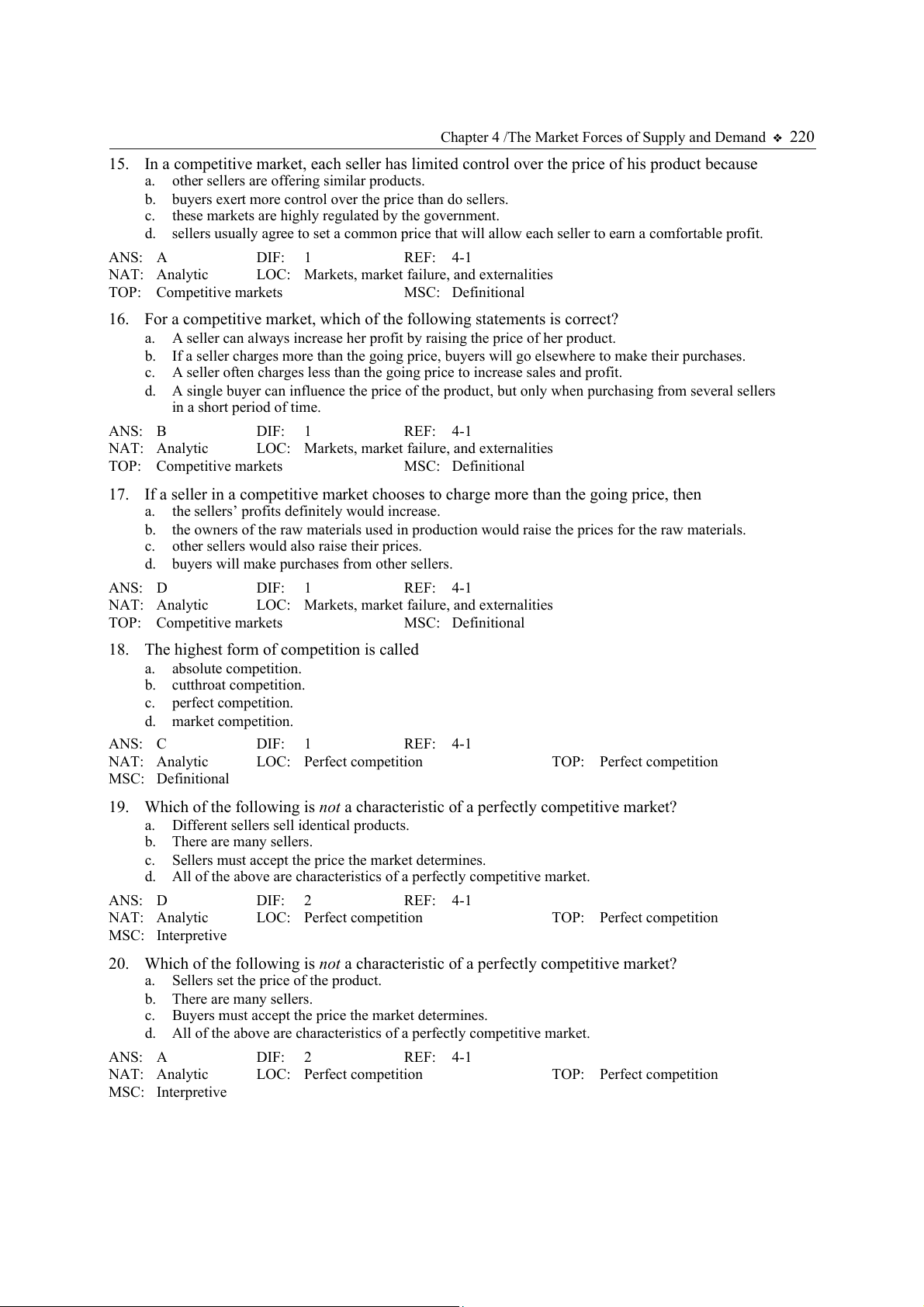
15. In a competitive market, each seller has limited control over the price of his product because a.
other sellers are offering similar products. b.
buyers exert more control over the price than do sellers. c.
these markets are highly regulated by the government. d.
sellers usually agree to set a common price that will allow each seller to earn a comfortable profit. ANS: A DIF: 1 REF: 4-1 NAT: Analytic
LOC: Markets, market failure, and externalities TOP: Competitive markets MSC: Definitional
16. For a competitive market, which of the following statements is correct? a.
A seller can always increase her profit by raising the price of her product. b.
If a seller charges more than the going price, buyers will go elsewhere to make their purchases. c.
A seller often charges less than the going price to increase sales and profit. d.
A single buyer can influence the price of the product, but only when purchasing from several sellers in a short period of time. ANS: B DIF: 1 REF: 4-1 NAT: Analytic
LOC: Markets, market failure, and externalities TOP: Competitive markets MSC: Definitional
17. If a seller in a competitive market chooses to charge more than the going price, then a.
the sellers’ profits definitely would increase. b.
the owners of the raw materials used in production would raise the prices for the raw materials. c.
other sellers would also raise their prices. d.
buyers will make purchases from other sellers. ANS: D DIF: 1 REF: 4-1 NAT: Analytic
LOC: Markets, market failure, and externalities TOP: Competitive markets MSC: Definitional
18. The highest form of competition is called a. absolute competition. b. cutthroat competition. c. perfect competition. d. market competition. ANS: C DIF: 1 REF: 4-1 NAT: Analytic LOC: Perfect competition TOP: Perfect competition MSC: Definitional
19. Which of the following is not a characteristic of a perfectly competitive market? a.
Different sellers sell identical products. b. There are many sellers. c.
Sellers must accept the price the market determines. d.
All of the above are characteristics of a perfectly competitive market. ANS: D DIF: 2 REF: 4-1 NAT: Analytic LOC: Perfect competition TOP: Perfect competition MSC: Interpretive
20. Which of the following is not a characteristic of a perfectly competitive market? a.
Sellers set the price of the product. b. There are many sellers. c.
Buyers must accept the price the market determines. d.
All of the above are characteristics of a perfectly competitive market. ANS: A DIF: 2 REF: 4-1 NAT: Analytic LOC: Perfect competition TOP: Perfect competition MSC: Interpretive
221 Chapter 4 /The Market Forces of Supply and Demand
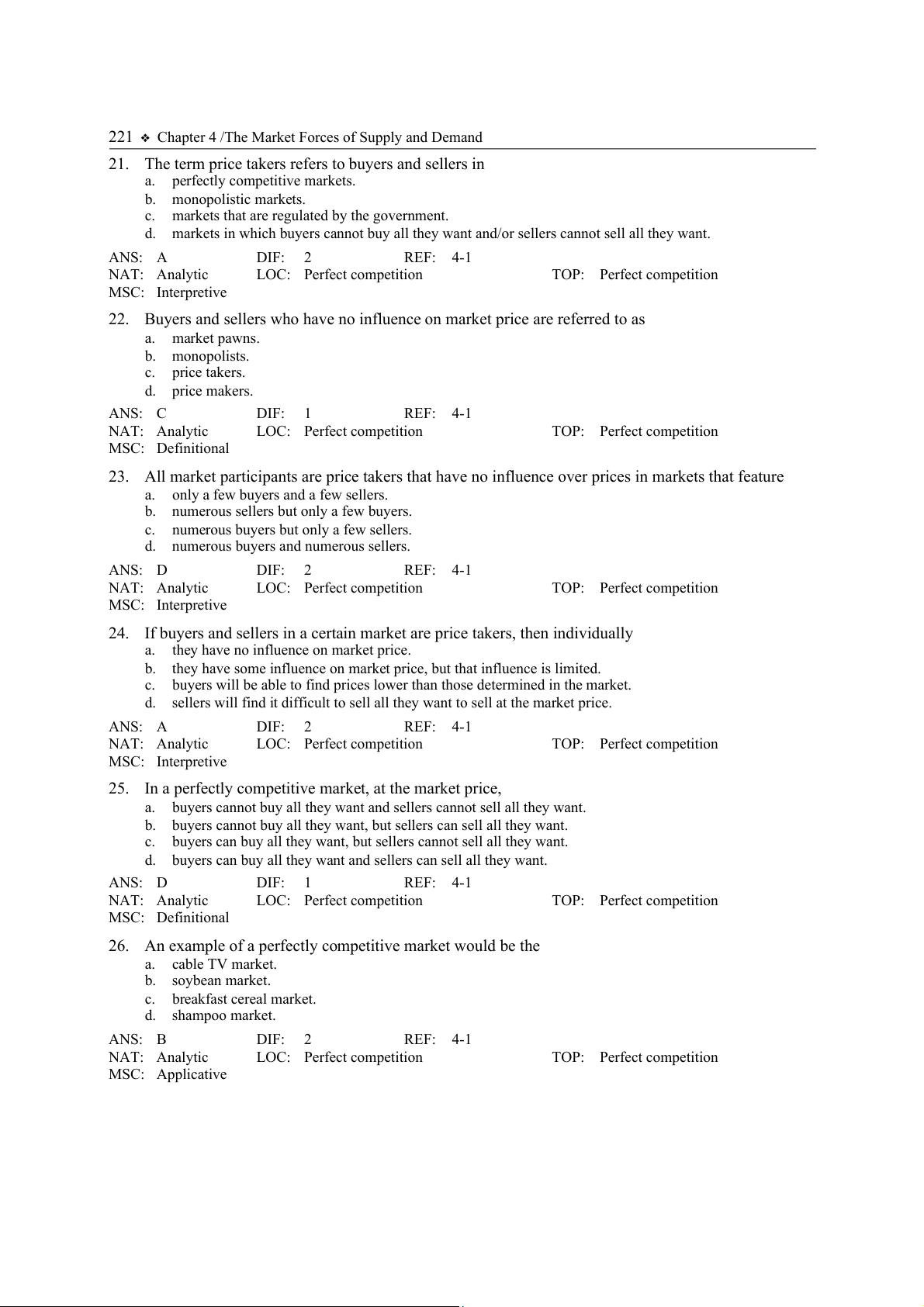
21. The term price takers refers to buyers and sellers in a. perfectly competitive markets. b. monopolistic markets. c.
markets that are regulated by the government. d.
markets in which buyers cannot buy all they want and/or sellers cannot sell all they want. ANS: A DIF: 2 REF: 4-1 NAT: Analytic LOC: Perfect competition TOP: Perfect competition MSC: Interpretive
22. Buyers and sellers who have no influence on market price are referred to as a. market pawns. b. monopolists. c. price takers. d. price makers. ANS: C DIF: 1 REF: 4-1 NAT: Analytic LOC: Perfect competition TOP: Perfect competition MSC: Definitional
23. All market participants are price takers that have no influence over prices in markets that feature a.
only a few buyers and a few sellers. b.
numerous sellers but only a few buyers. c.
numerous buyers but only a few sellers. d.
numerous buyers and numerous sellers. ANS: D DIF: 2 REF: 4-1 NAT: Analytic LOC: Perfect competition TOP: Perfect competition MSC: Interpretive
24. If buyers and sellers in a certain market are price takers, then individually a.
they have no influence on market price. b.
they have some influence on market price, but that influence is limited. c.
buyers will be able to find prices lower than those determined in the market. d.
sellers will find it difficult to sell all they want to sell at the market price. ANS: A DIF: 2 REF: 4-1 NAT: Analytic LOC: Perfect competition TOP: Perfect competition MSC: Interpretive
25. In a perfectly competitive market, at the market price, a.
buyers cannot buy all they want and sellers cannot sell all they want. b.
buyers cannot buy all they want, but sellers can sell all they want. c.
buyers can buy all they want, but sellers cannot sell all they want. d.
buyers can buy all they want and sellers can sell all they want. ANS: D DIF: 1 REF: 4-1 NAT: Analytic LOC: Perfect competition TOP: Perfect competition MSC: Definitional
26. An example of a perfectly competitive market would be the a. cable TV market. b. soybean market. c. breakfast cereal market. d. shampoo market. ANS: B DIF: 2 REF: 4-1 NAT: Analytic LOC: Perfect competition TOP: Perfect competition MSC: Applicative
Tài liệu liên quan:
-
Chương 3: độ co giãn và các nhân tố ảnh hưởng | Microeconomics | Trường Đại học Quốc tế, Đại học Quốc gia Thành phố Hồ Chí Minh
4 2 -
Microeconomics Syllabus | Microeconomics | Trường Đại học Quốc tế, Đại học Quốc gia Thành phố Hồ Chí Minh
4 2 -
Microeconomics Course Syllabus & Assessment Details | Microeconomics | Trường Đại học Quốc tế, Đại học Quốc gia Thành phố Hồ Chí Minh
4 2 -
Assignment 3 - Elasticity MCQs and Key Concepts | Microeconomics | Trường Đại học Quốc tế, Đại học Quốc gia Thành phố Hồ Chí Minh
4 2 -
Assignment 2 - Economic Equilibrium Analysis of Fridges and Motorcycles | Microeconomics | Trường Đại học Quốc tế, Đại học Quốc gia Thành phố Hồ Chí Minh
4 2